p What is the reason for this? What conditioned these fatal errors of thought in a man who was extremely gifted, intelligent and, moreover, possessed of the most genuine and strong desire for truth?
p The reason is to be found in the influence on Ibsen’s world outlook of the social environment in which he was born and grew up.
p Vicomte de Golleville and F. de Zepelin, the authors of the rather interesting book Le Maitre du drame moderne—Ibsen, are most contemptuous of the idea that the great Norwegian dramatist’s world outlook was formed under the influence of the "much-discussed environment so dear to Taine". [431•*** They believe that Norway "was not the environment in which Ibsen’s genius developed". [431•**** But they are conclusively disproved by the material collected in their own book.
p For example, they themselves say that some of Ibsen’s dramas were “conceived” entirely under the influence of memories of his childhood. Is this not the influence of his environment? And see how they themselves describe the social environment in which Ibsen was born, grew up and developed. This environment, they 432 say, was marked by a "hopeless banality". [432•* The small sea town of Grimstad in which Ibsen spent his youth emerges from their description as a classical place of insipidity and boredom. "The only means of livelihood in this small town were its harbour arid its commerce. In such an environment people’s thoughts <lo not rise beyond the level of material life, and if the inhabitants occasionally leave their houses, they do so only in order to inquire when the ships are coming and to take a look at the stock-exchange bulletin.... They all know one another. The wall of private life is transparent as glass in such repulsive holes. Everyone bows respectfully to the rich man, the prosperous man is greeted, although not so hastily, but the greeting of a worker or a peasant is acknowledged with a curt nod of the head." [432•** "Everything there is done very slowly: what hasn’t been done today can be done tomorrow. Anyone who deviates from the ordinary habits of life is strictly censured; anything original seems ridiculous, anything eccentric criminal." [432•*** Already at that time Ibsen showed an inclination for originality and eccentricity.
p It is not hard to imagine how he must have felt among these Philistines. They irritated him; he irritated them. "My friends,” Ibsen writes of himself in the introduction to the second edition of Catiline, "thought me an odd fellow; my enemies were incensed by the fact that a person holding such a low social position [432•**** presumed to express an opinion on things on which they themselves did not dare to hold an opinion. I would add that my unruly behaviour sometimes left society little hope that I would ever acquire the bourgeois virtues.... In short, at a time when the world was excited by the idea of revolution, I was in open conflict with the small society in which I lived by the will of fate and circumstances."
p Ibsen’s life in the capital of Norway, Christiania, where he settled later, was no better. Here too the pulse of social life beat with a dreary sluggishness. "At the beginning of this (i.e., the nineteenth.—G.P.) century,” say de Colleville and Zepelin, "Christiania was a small town with a population of six thousand. With a speed reminiscent of the growth of American towns, it became a town with a population of about 180,000, but retained all of its former pettiness: scandal, gossip, slander and meanness continued to flourish there. Mediocrity was extolled there, while true greatness went unrecognised. One could fill a whole tome with the articles written by Scandinavian writers on the dark side of life in the Norwegian capital." [432•*****
433p Ibsen continued to suffocate here as he had in Grimstad. But when the Danish-German war^^121^^ began, his patience came to an end. Outwardly the Norwegians were full of Scandinavian patriotism and ready to sacrifice all for the common good of the three Scandinavian peoples. But in fact they gave no assistance whatever to Denmark, which was soon defeated by its powerful enemies. In the impassioned poem A Brother In Need, written in December 1863, Ibsen held up to shame the empty phrases of Scandinavian patriotism; "and from that time onwards,” says one of his German biographers, "contempt for people took deep root in his heart". [433•* In any case he was filled with contempt for his fellow citizens. "It was then that Ibsen’s revulsion reached its limit,” say de Colleville and Zepelin, "he realised that leaving this country had become a matter of life or death for him." [433•** Having put his material affairs in some sort of order, he "shook the dust off his feet" and went abroad, where he remained almost to the end of his life.
p These few facts alone show that, in spite of our French authors, the social environment must have left a very obvious mark on Ibsen’s life and world outlook, and, consequently, on his literary works also.
p In saying this I would ask the reader to remember that the influence of any social environment is felt not only by the person who comes to terms with it, but also by the one who declares war on it.
p I may be told: "But Ibsen did not come to terms with the very environment with which the vast majority of his fellow citizens got on so well.” To this I would reply that quite a lot of Norwegian wii’ers fought against this environment, although, naturally, Ibsen waged war against it in his own, special way. But I do not deny the importance of the individual in history in general and in the history of literature in particular. For without individuals there would be no society, and consequently no history either. When an individual protests against the baseness and falsehood around him, his intellectual and moral features are undoubtedly making themselves felt: his perception, sensitivity, responsiveness, etc. Each individual traverses the path of protest in his own way. But where this path leads depends on the social environment that surrounds the protesting individual. The nature of his rejection is determined by the nature of that which is being rejected.
p Ibsen was born, grew up and reached maturity in a pettybourgeois environment, and the nature of his rejection was, so to say, predetermined by the nature of this environment.
434p One of the distinguishing moral features of this environment is, as we have already seen, hatred for all that is original, for all that departs in the slightest from established social customs. Even Mill complained about the tyranny of public opinion. But Mill was an Englishman, and the petty bourgeoisie does not exert a predominant influence in England. In order to find out how far the tyranny of public opinion can go, one must live in one of the petty-bourgeois countries of Western Europe. It was against this tyranny that Ibsen revolted. We have seen that as a young man of twenty living in Grimstad he was already fighting “society”, taunting it with epigrams and ridiculing it with caricatures.
p The young Ibsen left a notebook in which there is a drawing of "public opinion”, a kind of symbol. What do you think this drawing shows, reader? A fat bourgeois, armed with a whip, is driving two pigs who are running along cheerfully with their curly tails forming a spiral in the air. [434•* I would not say that this first attempt by Ibsen in the sphere of artistic symbolism was very successful: the author’s idea is expressed vaguely. But the presence of the pigs in the drawing shows us that it was at least an extremely disrespectful idea.
_p The boundless, all-seeing and petty tyranny of petty-bourgeois public opinion teaches people to be hypocritical, to lie and ignore the voice of conscience; it debases their characters, makes them inconsistent and half-hearted. Arid so Ibsen who raised the banner of revolt against this tyranny dematids truth at all costs and preaches "be yourself".
p Brand says:
_p
Be what you are with all your heart,
And not by pieces and in part.
The Bacchant’s clear, defined, complete,
The sot, his sordid counterfeit;
Silenus charms; but all his graces
The drunkard’s parody debases.
Traverse the land from beach to beach,
Try every man in heart and soul,
You’ll find he has no virtue whole,
But just a little grain o/ each.
A little pious in the pew,
A little grave,—his father’s way,—
Over the cup a little gay,—
It was his father’s fashion too!
A little warm when glasses clash,
And stormy cheer and song go round
For the small Folk, rock-will’d, rock-bound,
435
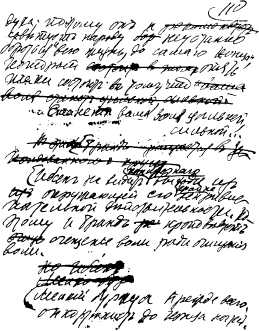
_p A page of the rough copy of the article "Henrik Ibsen"
28*
436 437That never stood the scourge and lash.
A little free in promise-making;
And then, when vows in liquor will’d
Must be in mortal stress fulfill’d,
A little fine in promise-breaking.
Yet, as I say, all fragments still
His faults, his merits, fragments all,
Partial in good, partial in ill,
Partial in great things and in small;—
But here’s the grief—that, worst or best,
Each fragment of him wrecks the rest!
p Some critics [437•* say that Brand was written hy Ibsen under the influence of a certain Pastor La miners and, in particular, undes the influence of the famous Danish writer Soren Kierkegaard. This is quite possible. But it does not, of course, detract in the slightest from the truth of what 1 maintain here. Pastor Lammers and Soren Kierkegaard dealt, each in his own sphere, with the same environment against which Ibsen fought. It is not surprising that their protest against this environment was similar in part to his protest.
p 1 am not familiar with the works of Soren Kierkegaard. But as far as I can judge his views from what Lothar says of them, the caJl to "be yourself" might well have been borrowed from S. Kierkegaaid. "A man’s task is to be an individual, to concentrate himself within himself. A man should become that which he is, his only task is to choose himself by ’God-willed self-choice’, just as the only task of life is its self-development. Truth contists not of knowing the truth, but of being the truth. Subjectivity is above all else" and so on and so forth. [437•** All this is indeed very similar to what Ibsen preached, and all this shows yet again that similar causes produce similar effects.
p In petty-bourgeois society people whose “spirit” inclines to “revolt” cannot fail to be rare exceptions to the general rule. Such people often proudly call themselves aristocrats, and then are indeed similar to aristocrats in two respects: firstly, they are superior to others in the spiritual respect, as true aristocrats are superior to others by virtue of their privileged social position; secondly, they, like real aristocrats, stand apart, because tteir interests cannot be the interests of the majority, and more often than not clash bitterly with the latter. But the difference is that the real, historical aristocracy at the finest period of its development ruled over the whole of society at that time, whereas the spiritual aristocrats of the petty-bourgeois social environment 438 have practically no influence on it whatever. These “aristocrats” are not a social force: they remain separate individuals. And they devote themselves all the more diligently to the cult of the individual.
p The environment turns them into individualists, and, having become such, they make a virtue of necessity, as the well known French expression puts it, and elevate individualism into a principle, regarding as a sign of their personal strength that which is a result of their isolated position in petty-bourgeois society.
p Fighters against petty-bourgeois half-heartedness, they are often wretched and split themselves. But one does find some excellent examples of the breed of consistent people among them. Pastor Lammers, who is mentioned by Lothar, was probably such an example; Soren Kierkegaard was perhaps one, and Ibsen was most likely one as well. He was completely devoted to his literary vocation. What he wrote to Brandes about friends is very moving. "Friends are too expensive a luxury, and the man who has invested all his capital in his vocation, his mission in life, cannot afford to keep friends. Friends are too expensive, not in respect of what you do for them, but in respect of what you do not do because of them.” By following such a path one can arrive, as Goethe did, at terrible egoism. But this path does at least pass through complete and total devotion to one’s vocation.
_p And Ibsen’s spiritual son, Brand, was another splendid specimen of this breed of integrated people. When he fulminates against petty-bourgeois moderation, against the philistine’s separation of the word from the deed, he is magnificent. The petty bourgeois creates even God in his own image and likeness: in glasses, slippers and a skull-cap.
p Brand says to Einar:
p
I do not flout;
Just so he looks in form and face.
The household idol of our race.
As Catholics make of the Redeemer
A baby at the breast, so ye
Make God a dotard and a dreamer,
Verging on second infancy.
And as the Pope on Peter’s throne
Calls little but his keys his own,
So to the Church you would confine
The world-wide realm of the Divine;
’Twixt Life and Doctrine set a sea.
Nowise concern yourselves to be;
Bliss for your souls ye would receive.
Not utterly and wholly live.
Ye need, such feebleness to brook,
A God who’ll through his fingers look.
Who, like yourselves, is hoary grown,
439
p
And keeps a cap for his bald crown.
Mine is another kind of God!
Mine is a storm, where thine’s a lull,
Implacable where thine’s a clod,
All-loving there, where thine is dull;
And He is young like Hercules,
No hoary sipper of life’s lees!
His voice rang through the dazzled night
When He, within the burning wood,
By Moses upon Horeb’s height
As by a pigmy’s pigmy stood.
In Gideon’s vale He stay’d the sun,
And wonders without end has done,
And wonders without end would do,
Were not the age grown sick,—like you!
p Through Brand, Ibsen castigates petty-bourgeois hypocrisy that reconciles itself to evil allegedly for the sake of love:
p
Never did word so sorely prove
The smirch of lies, as this word Love:
With devilish craft, where will is frail,
Men lay Love over, as a veil,
And cunningly conceal thereby
That all their life is coquetry.
Whose path’s the steep and perilous slope,
Let him but love.—and he may shirk it;
If he prefer Sin’s easy circuit,
Let him but love,—he still may hope;
If God he seeks, but fears the fray,
Let him but love,—’tis straight his prey;
If with wide-open eyes he err,
Let him but love,—there’s safety there!
p Here I sympathise with Brand with all my heart: how often do the opponents of socialism refer to love! How often do they reproach socialists for the fact that in the latter love of the exploited generates hatred of the exploiters! The good souls tell us to love everything: flies, spiders, oppressors and oppressed. Hatred of oppressors is “inhumane”. Brand, i.e., Ibsen, knows the worth of this debased word only too well.
p
Humanity!—That sluggard phrase
Is the world’s watchword nowadays.
With this each bungler hides the fact
That he dare not and will not act;
With this each weakling masks the lie,
440
That he II risk all for victory;
With this each dastard dares to cloak
Vows faintly rued and lightly broke;
Your puny spirits will turn Man
Himself Humanitarian!
Was God “humane” when Jesus died?
Had your God then his counsel given.
Christ at the cross for grace had cried—
And the Redemption signified
A diplomatic note from Heaven.
p All this is magnificent. This is how the great figures of the Great French Revolution argued. And here one feels the kinship of Ibsen’s spirit with the spirit of the great revolutionaries. But nevertheless R. Doumic is wrong in calling Brand s morality a revolutionary morality. The morality of revolutionaries has a concrete content, whereas Brand’s morality is, as we already know, form lacking in content. I said above that Brand with his morality lacking in content finds himself in the ridiculous position of the man milking the he-goat. I shall shortly attempt to give a sociological explanation of how he comes to be in this unpleasant position. But now I must dwell on some other characteristic features of the type of social man of interest to us.
p The spiritual aristocrats of petty-bourgeois society frequently regard themselves as chosen people, or supermen, as Nietzsche would have put it. And in seeing themselves as chosen people, they begin to look down on the “mob”, the masses, the ordinary people. A chosen person is permitted to do everything.
p It is actually to them that the injunction "be yourself" applies. A different morality exists for ordinary mortals. Wilhelm Hans rightly remarked that according to Ibsen those who have no vocation are called upon only to sacrifice themselves. [440•* King Skule says in The Pretenders: "There are men created to live and men created to die.” It is the chosen people who are created to live.
As for our aristocrats’ disdainful view of the mob, we do not have to look far for an example: we still recall clearly the remarkable speech of Doctor Stockmann.
Notes
[431•***] Introduction, p. 15.
[431•****] Ibid., p. 16.
[432•*] l,e M(litre du draine inodernc, etc., p. 29.
[432•**] Ibid., pp. 30-37.
[432•***] Ibid., p. 37.
[432•****] Ibsen was a pharmacist’s apprentice in Gmn«l. d.
[432•*****] Ibid., p. 75.
[433•*] Dr. Rudolph Lotliar, Ibsen, Leipzig Wien, 19(2. S. 5s.
[433•**] Lf M nitre, etc., p. 78.
28—076U
[434•*] Dr. Rudolph Lothar, 1. c., S. 9.
[437•*] Uiulolph Lothar, 1. c., S. t)lM!3.
[437•**] Ibid., S. 03.
[440•*] Schicksal mid Wllle, Miinchon, 1900, S. 50.
| < | > | ||
| << | II | IV | >> |
| <<< |
THE PROLETARIAN MOVEMENT
AND BOURGEOIS ART^^116^^ |
ON THE PSYCHOLOGY OF THE WORKERS' MOVEMENT^^129^^ | >>> |