AND BOURGEOIS ART^^116^^
(SIXTH EXHIBITION OF LITERATURE AND THE ARTS IN VENICE)
p When I was about to go to Venice I read in an Italian periodical, II Divenire sociale, I think, that at the Sixth international exhibition now being held in the town there was no "piece de resistance”, no outstanding work of art, but that nevertheless there was a great deal of interest to be seen there. On reaching the former queen of the Adriatic I soon became convinced that this was in fact the case: there is nothing particularly remarkable at the Venice exhibition; but all the same I am very glad that 1 managed to visit it. It does at least deserve serious attention, and I should like to share with readers the impressions which it made on me.
_p First lei me say a few words about the premises, which deserve the highest praise. This beautiful building in Ionic style with the inscription "pro arle" is in the municipal gardens which, as we know, are on a separate island that adjoins the San Pietro quarter. It is very spacious and airy in this elegant, light building; the gentle light that falls from above illumines all the pictures on the walls equally; there are restful divans and armchairs for the visitors; the journalists have a special room next to the postal and telegraph section. Finally, there is a marvellous view of the lagoon from the terrace of the exhibition hall. In a word, elegance and beauty are most fortuitously combined here with complete comfort.
p In the rooms of this line building 1 turned first to the paintings.
p There are not many of them. To say nothing of Russian painting which is represented at the Venice exhibition not only poorly, but positively beggarly: one picture by S. Yuzhanin, one by the late Vereshchagin and two by Nikolai Schattenstein. Russian artists are fairly slow off the mark in general. The Russian art section was very poor even at the World Fair of 1900 in Paris. But even the far more mobile French and Germans were few in number this time in Venice. Nor can other peoples boast about the richness of their sections. The only rich section is the Italian one; but Venice is home to the Italians.
p 1 thought that the international exhibition in Venice had suffered this time from competition with the World Fair in Liege, but then I learnt that previous Venice international exhibitions were even poorer. At the iirsl, which was held in 1895, the foreign exhibitors numbered only 131, and the Italian 124; at the 1897 399 exhibition there were 263 of the former and 139 of the latter; the 1899 exhibition had 261 foreign exhibitors and 152 Italian; in 1901 the number of foreign ones dropped to 215 and Italian to 150; two years later at the 1903 exhibition the number of foreign exhibitors fell even lower, to 151, whereas the Italian ones already numbered 184. In view of these numbers this year’s exhibition, which features 316 foreign exhibitors, can be considered relatively rich. The Italians hope that the 1907 exhibition—as the reader can see, these exhibitions are held every two years—will attract even more exhibitors. I think that this hope of theirs is not without foundation, but "for the time being" it must be noted that the Sixth exhibition is not impressive for its riches.
p But in such cases the question of quality is more important than that of quantity. Some Italian practitioners, for example, Vittorio Pica in his interesting book L’Arte mondiale alia VI Esposizione di Venezia, have showered praise on the paintings of the Spaniard Hermen Anglada and the Dutchman, a native of the island of Java. Jan Toorop. 1 approached these artists’ pictures with a completely open mind and stood in front of them for a long time, but I do not share the enthusiasm of their admirers.
p That Toorop is a great master is indisputable, and I would refer anyone who doubts this to the Thames (II Tamigi di Londra in the catalogue) exhibited by this artist. There can be no difference of opinion about this picture: everyone will say that it is excellent. It would be hard to portray belter the foggy and smoky atmosphere of London, the dirty yellow water of the Thames and the bustling activity on the river. If Toorop had exhibited only his Thames, I should have acknowledged the praise which Vittorio Pica showers upon him as perfectly well-founded. But, apart from the Thames, Toorop has exhibited several other pictures which compel one to regard him with far more reserve. His Portrait of Doctor Timmermann would be very good, were it not for the strange, somehow greenish colour which greatly detracts from the impression made by it. And his Old Men on the Sea Shore (this picture is called Vecchi in riva al mare in the catalogue whereas in Pica’s book it is I veterani del mare) is most “obscure”. The foreground of the picture is taken up almost entirely by two shaven old men deep in thought sitting on the ground. The old men are drawn very well,—I repeat, Toorop is a great master,—but I heir faces and bodies are disfigured by grey-violet and light-yellow stripes that produce, I would not say an unpleasant, a strange, no, simply a comic impression. In the background, on the sea shore, a man is riding a horse, some women seem to be circling in a dance. and to the left of the women a fisherman is carrying a pole on his shoulder. Is there any connection between these people? 1 do not know. I think this question is just as difficult to answer as whether there is any connection between the unnatural old men who 400 are silting in Hodler’s famous picture Les canes en peine. There is no perspective, and the figures in the foreground are out of proportion in relation to those in the background. What is it? Why is it so? And why is it necessary? "C’est une merveille!". [400•* a Frenchman standing near me exclaimed passionately in front of the grey-violet pictures. I looked at him with unconcealed amazement. The next day I went up to the same picture and found a group of Italians in front of it, one of whom was saying angrily to his companions: "Look at this caricature!" (Questa caricatura!...) I laughed in sympathy. Alas! There is indeed too much of the caricature in the old men of the great master Toorop, as in Les ames en peine of the great master Hodler.
p There is even more of the caricature in The Younger Generation (Giovane generazione] also by Toorop. This is not even imagination, but whatever that comes into one’s head. There is a kind of forest consisting of something like trees. A woman’s head is looking out of a fissure, and in the foreground, on the left, is a telegraph pole. Just try and understand that! It is not a picture, but a puzzle, and when I was standing in front of this puzzle, trying in vain to work it out, I thought: it is highly possible, even probable, that many of the critics who praise such works at the same time attack ideology in art. But what is the symbolism to which we are indebted for such works? It is au involuntary protest by artists against lack of ideology. But it is a protest that arises on unideological soil, that lacks all definite content and is therefore lost in the mists of abstraction, which we find in literature in certain works by Ibsen and Hauptmann, and in the chaos of vague, chaotic images, which we find in certain pictures by Toorop and Hodler. Understand this protest, and you will inevitably return to the very ideology which you attacked. True, tales are quickly told, but deeds are not quickly done. It is easy to say: "Understand this protest."
p For the modern protest against lack of ideology in art, leading to abstraction and chaos, to receive a definite content, what is required is the existence of certain social conditions which are totally lacking at the present moment and which will not be created at the drop oE a hat. There was a time when the upper classes, for whom art exists for the most part in “civilised” society, were striving ahead, and then they were not frightened by ideology, but, quite the reverse, attracted by it. Today, however, these classes are at best standing still, therefore ideology is either quite unnecessary to them or necessary only in minute doses, and therefore also their protest against lack of ideology, a protest which is inevitable for the simple reason that art cannot live without an idea, leads to nothing but abstract and chaotic symbolism. It is 401 not consciousness that determines being, but being that determines consciousness!
p Toorop is a Symbolist and an Impressionist at one and the same time. Hermen Anglada is content to disfigure his pictures to the glory of impressionism. Pictures of his, such as White Peacock (Pavone bianco—a woman in white lying on a couch), The Champs Elysees in Paris, Restaurant at Night, The Flowers of Evil (Fiori del male), Flowers of Night (Fiori della notte), and Glow-worm (Lucciola) portray the effects made by artificial night lighting in big towns. The action in these pictures is set in Paris, and the characters are the "flowers of evil”, i.e., ladies of the demimonde, dressed in fashionable costumes that give their figures in the night lighting fantastic and sometimes remarkably ugly shapes. It goes without saying that one cannot object to the choice of the heroines. And as for the idea of portraying them under night lighting, this must be acknowledged as worthy of approval. It is a fact that in modern cities night is often changed into day, and this change is produced by new sources of light provided by modern technology; ordinary gas lighting, acetylene, electricityeach of these new sources illuminates objects in its own way, and modern art was duty bound to pay attention to the light effects produced by them. But, unfortunately, Hermen Anglada has been unsuccessful in solving this artistic task which he took upon himself. The whitish blobs which appear in his pictures under various names do not convey at all that which they were supposed to convey. His pictures are an unsuccessful attempt to carry out a rather original idea—this is all that can be said of them.
p It is not only Hermen Anglada’s whitish blobs that are unsuccessful. In his picture Old Gypsy Woman Selling Pomegranates alongside the whitish colouring there is also a kind of deep red ( pomegranate?) which envelops the old gypsy and makes the viewer raise his hands in amazement.
p Nor are things any better with his drawing. His Dancing Gypsy Woman reminds one of a cavorting centaur. On the back of this capering monster is a hump, and its sinewy arms, which would be the envy of any athlete, end in hooks with a kind of webbing. I have never in all my life seen a picture that produces a more anti-aesthetic impression. In this respect it is way ahead of Toorop’s grey old men.
Vittorio Pica says that all Anglada’s pictures reveal a persistent and ardent search for strong and paradoxical (actually ambiguous: ambigui) light effects. This striving for paradox is the undoing of Anglada, who is certainly not void of artistic talent. When an artist concentrates all his attention on light effects, when these effects become the be-all and end-all of his work, it is difficult to expect first-class artistic works from him—his art necessarily dwells on the surface of phenomena. But when he succumbs to the tempta-
28—0766
402 tion of impressing the viewer with paradoxical effects, it must be recognised that he has embarked on the path of the ugly and ridiculous.p Here we feel the full effect of the psycho-physiological law which says that sensation is the logarithm of irritation: in order to heighten effects, and artists are compelled to do so by the competition between them, the dose of paradoxality has to be increased more and more and the artist succumbs to caricature without realising it.
p And those who say that Anglada is reviving the splendid traditions of old Spanish painting are wrong. Old Spanish painting was indeed not void of effects; but it had a rich inner content; it had a whole world of ideas which gave it "a living soul". These ideas have now had their day even in Spain; they no longer correspond to the position of the social classes for which modern art exists. But these social classes have nothing to put in their place; they themselves are preparing to retire from the historical arena and therefore evince little concern for ideology. This is why modern painters such as Anglada have nothing but a striving for effects; this is why their attention is attracted only by the surface, the outer shell of phenomena. They want to say something new, but they have nothing to say; therefore they resort to artistic paradoxes: paradoxes at least help to epater les bourgeois.
p By this I do not wish to say that I see nothing good in impressionism. Certainly not! I regard many of the results at which impressionism has arrived as unsuccessful, but I believe that the technical questions which it has brought to the fore are of considerable value.
p Attention to light effects increases the store of pleasures which nature gives man. And since nature will probably become far dearer to man in the "future society" than it is today, it must be acknowledged that impressionism too is working for the good of this society, although not always successfully: "it has brought us the affection of life illumined by the sun,” says one of its devoted supporters, Camille Mauclair. For this we must thank impressionism; although it has by no means always been successful in conveying this wondrous affection of nature; but the selfsame Mauclair admits that the French Impressionists, for example, show far less interest in ideas than in technique. Mauclair regards this as a shortcoming of impressionism, but I think he is expressing himself too mildly. Impressionism’s lack of ideology is its original sin, as a consequence of which it verges on caricature and which prevents it entirely from bringing about a profound change in painting.
p
One more reservation which I regard as equally important. There are Impressionists and Impressionists. The Swede Carl Larsson, for example, whom it would be unfair to accuse of lacking
403
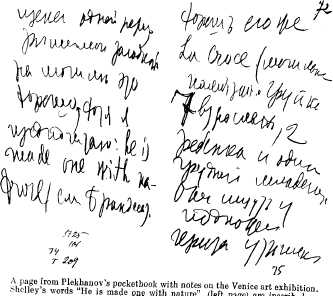
_p A page from Plekhanov’s pocketbook with notes on the Venice art exhibition. Shelley’s words “He is made one with nature” (left page) are inscribed on Plekhanov’s gravestone in Leningrad
26*
404 405 ideology, is often regarded as an Impressionist. Larsson occupied a very important place at the Sixth Venice exhibition. His watercolours are excellent from the point of view of ideas. Particularly good are his Portrait of My Eldest Daughter, Girl with Strawberries, Girl Reading, Open Door and Supper, but in fact everything he does is particularly good, and it is difficult to tear oneself away from any of his works. He has so much light, air and life that the wall hung with his water-colours in the Swedish room produces a truly refreshing and invigorating impression. If anyone can convey the “smile” of light, it is Larsson, and if he does indeed owe a great deal to the Impressionists they can rightly pride themselves on their beneficial influence.p But note that Larsson is very far removed indeed from the paradoxical effects to which our friend Anglada is so strongly attracted. His distinguishing features are simplicity and naturalness. In this respect the man himself would appear to resemble his works. There is a self-portrait of him (in oils) at the exhibition. Looking at this portrait, one cannot help feeling a liking for the talented Swedish artist. Plain-looking, but strong and full of joie de vivre, he reveals such a tremendous reserve of healthy and serious simplicity, that he seems safely insured against all that is empty, boastful and sensationally paradoxical. And he is not interested in light effects as such; for him light is a means, and not the central figure of his artistic works. In his water-colours you are confronted with real, “living”, genuine life, which exists for itself and not in order to give the Impressionist the opportunity to portray this or that light effect. This is why they attract one with the full power of real life. Take his Supper for example. Two children, a boy and a girl, are sitting at a table set for two, on which there is a small vase of flowers, a bowl, and a jug. They are eating seriously, fully aware of the importance of the duty which they are performing; they are sages, [405•* as the French say, and their sagesse [405•** is portrayed with such gentle, loving, moving humour that it immediately makes the viewer well-disposed to the artist.
p His Open Door is also good, very good. Through an open door entwined with plants one can see the inside of a room: a tall, eld grandfather clock, a window with a curtain, etc. All this, as is always the case with Larsson, is extremely simple. And this extreme simplicity radiates purity, freshness and peace. It is an idyll. While admiring Larsson’s Open Door I recalled the pictures of Pieter de Hooch, unsurpassed of their kind. Pieter de Hooch, better than any other Dutch painter, portrayed the happiness of the peaceful and comfortable life, the right to which 406 had just been won by the Dutch bourgeoisie by such persistent effort, such a long, heroic struggle. Pieter de Hooch’s pictures reflect what is by no means an unimportant aspect of Dutch life at that time, an aspect which the Dutch burgher was bound to cherish and which Dutch artists were bound to poeticise. Larsson’s water-colours show that this aspect still exists in the present-day, far more complex life of European societies, but they also remind us of the fact that it is no longer so important and inspires only a very few. Larsson is exceptional in his way. And the fact he appeared in one of the Scandinavian countries, in which the contradictions of modern society have not yet developed to a significant extent, is no accident. But even in these countries the happiness of a peaceful and prosperous life is no longer regarded by everyone as the highest criterion of happiness. This can be seen best of all from the example of Ibsen.
p Larsson’s idylls are very attractive, but the range of ideas connected with them is very narrow, and this is why, in spite of my fondness for them, I was glad to turn to such pictures as Munkacsy’s Night Vagrants in the Hungarian room and the Spaniard Bilbao Gonzalo’s Slave Girl in the so-called central salon, which are immeasurably richer in content, although not so outstanding technically.
p Soldiers with guns are leading off some tramps arrested during their night round. One of those arrested, a young lad with his hands tied, is very embarrassed; lie has hung his head and is turning away: he has been noticed and recognised by a young woman who was walking along with a basket in her hand probably to do the morning shopping but has stopped in sad surprise at the sight of the unexpected spectacle. She is the embodiment of the angry reproach which lias made the young man hang his rebellious head. The other tramps are walking along quite unconcerned—for them it is obviously not the first time. In front is an elderly man, his hands also tied, with an expression of grim determination. Another, even more elderly man with a red nose, strikes one by his cowed appearance. A third is looking curiously to see what, has embarrassed his comrade. In the narrow street along which the arrested men are being taken some seated women street vendors are pointing at the young woman. One of them, a fat old woman, is staring contemptuously, hands on hips; she is full of self-esteem, like Madame Bayard in Anatole France’s Crainquebille who thinks it beneath her dignity even to pay a debt to the greengrocer who has been arrested by the police. Then come barefooted children with books in their hands, future tramps, perhaps, or future fighters for a better social order—they are not studying in vain. A boy is looking at the arrested men with a mixture of fear and surprise, and a little girl is gazing with the blissful air of a child who is still thinking of nothing 407 and simply enjoying an interesting event. Of the street vendors the old woman right in the foreground selling vegetables is good. She is looking and seems to be thinking as she watches. About what? About the grief of the young woman whose fate was in some way connected with the arrested man? Unlikely! I think she is wondering whether she will manage to make the tiny profit that supports her wretched existence. She has no time to think of others, nor is she accustomed to do so.
p This is no idyll; Bilbao Gonzalo’s Slave Girl is even further removed, if this is possible, from the idyll. Imagine several young women whose profession it is to sell their body; they have done their hair, put on their make-up, dressed themselves up, and are sitting, laughing merrily and waiting for their “guest”clients. In the background is a large, elderly woman—evidently the esteemed owner of this esteemed establishment—with a dog on her lap and the look of a completely clear conscience on her face: she has to work for a living too, hers is no easy job either. And right in the foreground you can see a young woman, not fully dressed yet, who is also made up, but has frozen in a pose of the most hopeless and bitter desperation. This is a “commodity” which has not yet grown accustomed to performing its delightful duty; but there is no escape, she’ll get used to it. This is why the owner is not worried by her grief; she’s seen worse than that! In a word, we are confronted with a truly moving drama.
p I shall perhaps be told—one often hears this nowadays—that the portrayal of such dramas is not a matter for painting, the tasks of which are not the same as the tasks of literature; but why is it not a matter for painting? And why should painting not portray in its own way, i.e., in colours and not in words, that which literature portrays? The task of art is to portray all that which is of interest and concern to social man, and painting is no exception to the general rule. It is interesting that the very same people who would like to put a gulf between painting and literature often welcome the “fusion”—imaginary and impossible—of painting with music. They are delighted by various "symphonies of colour". And this is understandable. In trying to put up a barrier between painting and literature, these people are actually fighting against the ideological element, to whose influence literature succumbs, as we know, far more easily than music. Das ist des Pudels Kern! [407•*
p On the subject of painters who do not shun the ideological element, I should like to mention here a picture by the Dutchman Josef Israels, Madonna in a Hovel.
p On a straw chair sits a cleanly, but very poorly dressed, barefooted young woman, who is holding her child in her lap and feeding it something from a spoon; there is nothing remarkable 408 either in the face of the young woman or in the room around her, she is an ordinary mother in an ordinary hovel. Why then is she a Madonna? Because she is also a mother like the most " sublime" Madonnas of Raphael. The “sublimity” of the latter lies precisely in their motherhood, but whereas in Raphael, as in Christian art in general, this purely human, and not only human, feature is made an attribute of the deity, in Israels it has been returned to man. Earlier, to quote Feuerbach, man devastated himself by worshipping his own essence in the deity, hut now he understands the vanity of this self-devastation and cherishes human features precisely because they belong to man. This is a revolution, which was extolled by Heine:
p
Ein neues Lied, ein schoneres Lied,
0 Freunde, will ich euch dichten,
Wir wollen hier, auf Erden schon,
Das Himmelreich
errichten! [408•* ^^117^^
p Nor is Silvio Rotta’s Carita (Charity), exhibited in the room for Venetian artists, void of ideological significance. In a Jong, narrow room poor people of different sexes and ages are eating soup from bowls, which they have evidently just received; some are still waiting for their portions; the mother hurrying to feed her child is good, as is the old man who has turned away to the wall to eat. The whole picture gives an impression of complete authenticity: nothing that strives for effect, nothing artificial. It is a page from contemporary social life.
p An undoubted element of ideology is to be found also in two pictures by the Belgian Eugene Laermans: Human Drama and The Promised Land.
p The first of them shows two peasants carrying the dead body of a young man; in front and slightly to the side walks a weeping girl; behind is an old woman, also weeping; the faces of the girl and the old woman are not visible, but in their figures, in their gait there is so much profound, heavy grief! This picture immediately commands the attention by both its idea and execution. It contains much that is truly dramatic. But it is unfortunate that Laermans’ cold and harsh colours detract considerably from the aesthetic impact.
p His Promised Land, which evidently has a symbolical meaning, also suffers from the same unpleasant colours. Two poorly dressed men (one in wooden clogs and a patched cloak) are standing by a fence on a river bank and gazing intently into the distance where 409 there are the outlines of a town. They are obviously cold: they have scarves wrapped round their necks and their caps are pulled well down. The trees growing on the river bank are bending under the blast of a strong wind and the sky is covered with dark clouds But in the distance one can see the town at which our poor men are gazing; it is bathed in gay, bright sunlight; there it is light. calm and pleasant. I heard an Italian who was standing in fro t of this picture try to explain its meaning to another person by expanding on the subject of the grass on the other side is greener. Perhaps this is what Laermans wanted to express in his Promised Land. But in his picture the town actually exists and there it really is protected from the bad weather. Whence does it follow that in his opinion the Promised Land is nothing but an illusion for tired, cold people, a kind of fata morgana? I do not know.
p To finish with ideological painting, which now suffers from cachexy and is not in the public’s good books, I would mention the painting The Last Supper by the American Gari Melchers. Jesus and his disciples are sitting in a room lit by a hanging lamp with a metal shade, a cheap but, one might say, ultra-modern object. In front of Jesus stands a cup radiating light, similar to the chalice with the sacraments, and in front of the disciples are small glasses like the ones used for drinking wine in cheap cafes in Western Europe. Jesus, whose head is surrounded by radiance as in our icons, looks like a strong and energetic Yankee. He has short, curly hair, a moustache and a small beard. If one were to shave off the hair on his upper lip and cheeks, leaving a small tuft on his chin, he would immediately set about founding a meat or stearin trust. Here we have a kind of "couleur locale”. But for all the absurdity of this “couleur”, it must be said that there is something truly original in the expression on Jesus’ face: he is looking down as if ashamed of Judas’ betrayal.
p His disciples have also paid considerable tribute to "couleur locale": some of them are the spit and image of Yankees. I am not sure whether this strange modernisation is the product of simple naivete. It is possible that it conceals an idea. But what idea? I confess I do not know—and I am not sure that Melchers himself understood clearly why he had to modernise (he very episode from Jesus’ life which, because of its mystical nature, is quite unsuitable for modernisation.
Ideology in art is right, of course, only when the ideas portrayed by it do not bear the stamp of vulgarity. It would be very strange if there was no vulgarity among the ideological artistic works of our age: for the sum total of the ideas circulating among the upper classes shows a striking poverty. Vulgarity is worthy of mention only when it is of a significant nature, but it is precisely this type of vulgarity which confronts us in the painting Carita (Charity) by the Belgian Charles Hermans. A young woman in
r
410 a sumptuous costume is breast-feeding what is obviously a poor child belonging to someone else. It is extremely moving! And the sumptuous costume is most appropriate here! If one remembers thai even in England, where charity is very developed, according to the most exaggerated estimates the sums received by poor people from benefactors do not exceed one per cent of the surplus value which the capitalists extort from the proletariat, it must be said that the bourgeoisie should be ashamed of its charity as one of the weightiest arguments against the existing order.p 1 liked the painting Evening Falls by the Italian Giuseppe de Sanctis very much. A busy street in a large town, which joins a square in the foreground; the street lamps are coming on; there are lights in the shops and they are reflected attractively in the puddles on the pavements. Below on the pavement the town evening with its artificial lighting has come into its own, but above, at the end of the street, there is a shaft of pale blue light from the dying day. De Sanctis has portrayed brilliantly the poetry that surrounds this peaceful struggle between night light and day light and which all of us can observe in the most prosaic quarters of the most prosaic towns of our day. Poetry is no frequent visitor in these towns, but that makes it all the more precious and welcome.
p There is much poetry, although of a different kind, the poetry of country, and not town life, in Francesco Gioli’s Tuscan Autumn. A small group of young peasants are harvesting grapes. They are strong, cheerful and happy—the harvest is obviously a good one this year, and their high spirits and happiness communicate themselves to the viewer too. Here is a portrayal of the power of the land in one of its most attractive manifestations. Looking at this picture I thought of the late G. I. Uspensky. He would have enjoyed it, as he once enjoyed some of Koltsov’s poems.
p The Sixth international exhibition in Venice abounds in portraits. Some of them are very good; thus, for example, anyone who enters Room XXIII, one of the two allotted to Venetian painters, is bound to stop in front of the portrait of Giosue Carducci painted by AlessandroMilesi; in the second Venetian room—Room XXIV—one’s attention is commanded by the Portrait of a Man exhibited by G. Talamini; in the Hungarian room F. E. Laszlo’s portrait of Count Pierre de Vey is good; in the Spanish room Antonio de la Gandara’s portrait of Jean Lorrain; in the Spanish room Salvino Tofanari’s Portrait of a Woman; in one of the Lombardic rooms Emilio Gola’s Portrait of a Milanese Lady (Ritratto di signora milanese); in the Latin room Arturo Noci’s portrait of a woman (pastel); in the French room the portraits by Rodin, Emile Blanche, etc., etc. But the finest of them all, real masterpieces, are the portraits of women by Maurice Greiffenhagen (woman in “grey”) and John Levery (woman in “green”). One cannot look at them long enough.
411p If, after admiring Greiffenhagen’s woman in “grey”, you take a look at the picture next to it, in the English room, the Annunciation by the same artist, you will be greatly disappointed. Simplicity reigns in the former; affected imitation of Rossetti in the latter. The woman in “grey” attracts you to the artist, the Annunciation arouses your doubts as to his sincerity. Whence this difference?
p The fact is that the portrait in general occupies a special place among the types of painting. It too is not independent of the influence of the age, of course, but these influences leave a less noticeable imprint on it. Take the portraits painted by David, for example, and compare them with those of his pictures that reflect most strongly the ideas prevalent among the revolutionary French bourgeoisie at the end of the eighteenth century. David’s portraits arouse universal acclaim to this day, but many people now shrug their shoulders at his Brutus and The Horace Brothers.
p Why is this so? It is very simple! Many of our contemporaries not only fail to share, but are positively hostile to the revolutionary ideas that inspired David, and to an even greater extent none of us share the concepts and tastes with which these great revolutionary ideas were associated in the heads of French people of that day. What spoils The Horace Brothers and Brutus in the eyes of our contemporaries is precisely that which David’s contemporaries specially admired. But in the portraits painted by David this element of the times is far less noticeable; the chief merit of the portrait has always been its likeness to the original. Therefore it conceals David’s vast, manly and, for all its rhetorical nature, truthful talent far less from our contemporaries, and therefore also the Frenchmen of the end of the eighteenth century, conversely, were far less admiring of David’s portraits than of his Brutus and The Horace Brothers. Therefore, finally, you will not be mistaken, if, in wishing to assess the talent of the artist in question, you seek first of all to acquaint yourself with the portraits painted by him.
p Applied to Maurice Greiffenhagen this general remark takes the following form: this undoubtedly very talented artist lives in an age when the concepts characteristic of the bourgeoisie, for whom artistic works of all kinds are created in the main, are distinguished by narrowness and poverty of content. There is no place in them for anything worldly, anything possible, anything great, any of the things that inspire social man to great deeds, that make him sacrifice himself for the sake of the common good. And everything that suggests such selflessness seems artificial, “theatrical” to this declining class; this class demands “simplicity”. But in its present language “simple” means lacking an ideological element. The true simplicity which inspired, for example, the Dutch painters of the generation that was conceived during the 412 heroic struggle against the Spanish oppressors has no attraction for the present children of the bourgeoisie. For them it is alst too “theatrical”. In order for simplicity not to seem theatrical to them, it has to be made up in a more or less old-fashioned way. In their eyes the past is good because it reminds them of the good old days which did not know the "cursed questions" of our times and naively believed in things which neither the bourgeoisie, nor its future gravedigger, the proletariat, can believe in today. [412•* And so they idealise the past. Incidentally, the activity of Rossetti was also the fruit of such idealisation. But the “spiritual” makeup of the people of our day is so unlike that of the people of the early Renaissance, that present-day artists who imitate the artists of that time are bound to lapse into affectation. This affectation is felt, incidentally, in those works of Greiffenhagen’s which offer great scope for the application of his aesthetic theories. And this is why his Annunciation is incomparably weaker than his woman in “grey”.
p Portraits are good not only because they constrict the artist less, but also because they immortalise features of the rapidly changing generations and thereby facilitate the work of the historian and sociologist. Ingres’ portrait of Bertin pere is worthy of a whole treatise. And in this respect Carolus Duran’s Portrait of Madame X at the Venice exhibition is most interesting. It is very good in itself, i.e., in terms of its technique, but the finest thing about it is the expression on "Madame X’s" face. This thin and morbid face expresses such capricious satiety, such boredom, that looking at it you begin to understand the extent to which people of this kind need, as they put it, new art, i.e., what is in fact art completely lacking in ideas. What are ideas to Madame X? What is Hecuba to her and she to Hecuba? And how many people like this there are now in the “upper” classes of Europe and America!
p There are a great deal of lithographs, pastels, pen drawings, etc., at the Venice exhibition. They fill several rooms and include some very fine exhibits, particularly in the "Dutch room". Almost everything there is important, expressive, serious and powerful. But the finest exhibits there are Haverman’s lithographs. They stand out even in this rich collection. There are seven of them in all, including four portraits. I particularly liked the portrait of the former Dutch Social-Democrat, now an anarchist, Domela Nieuwenhuis. But the portrait of Doctor Bests is perhaps just as fine. It is impossible to convey how excellent these small exhibits 413 are. Their distinguishing feature is what I should call honesty. They contain nothing at all that is striving after effect, everything in them is authentic down to the smallest detail. Haverman is a fine, a very fine artist!
p The lithographs by De Josselin di Jong Via crucis and The Calling of SS Peter and Andrew are also good. The former shows Jesus on the Road to Calvary. Thin, exhausted, but firm and unshakeable, he walks along, making a reassuring gesture to the womea who are accompanying him full of despair, and the soldiers escorting him are gazing at this drama indifferently, totally unaware of its majesty. They have their “orders”, they are doing their “job”, and nothing else matters to them. In the second lithograph Jesus has the refined, thin figure of the thinker, while the apostles are healthy and simple-hearted fishermen, who have retained in the lap of nature all their primitive spontaneity. The scene takes place on the shore of a lake, and the scenery is very beautiful.
p In one of the other rooms containing this type of work I liked Edgar Chahine’s etching Carro (The Cart). A carter is reining in his horse on the embankment of a large town. The scene is lively and well portrayed.
p I should also like to mention Adolfo Magrini’s Woman in Front of a Mirror. It is a kind of Nana: a naked woman with a young and strong body of great plastic beauty, this is a masterly work of its kind.
p Space does not permit me to discuss this interesting section at length; I shall be brief. I experienced here far more aesthetic enjoyment than in the rooms set aside for oil paintings. One can detect here an incomparably more serious attitude to the subject, and therefore artistic talent reveals itself incomparably more vividly here too; thus, for example, the small works exhibited here by Toorop, with whom the reader is already familiar, testify to his talent far better than his large pictures. Whence this difference? To my mind, it is explained by the fact that oil paints give the artist far more technical opportunity to strive for paradoxical effects and confine himself to portraying only the appearance, only the outer shell—in a more or less paradoxical light—of phenomena.
p What about sculpture? Here I would mention first and foremost certain works by Leonardo Bistolfi; for the most part they are burial memorials full of the sombre poetry of death; the most interesting of them in terms of conception is the memorial for the Pansa family in Cuneo entitled La Sfinge. On the high gravestone sits a woman with long hair that has been let down. Her whole bearing expresses immobility, and her face is frozen in tense, persistent thought; her fingers are clutching convulsively at her knees, and this convulsive clutching with her beautiful, long fingers expresses vividly the torment of an unsolved mystery. 414 To my mind, this is not a sphinx, but a creature that is struggling with the sphinx’s agonising enigma, the question of death.
p From the viewpoint of modern natural science there is nothing mysterious about death. Death is no sphinx. It can be said of any dead person, as Shelley once said of the dead poet Keats: "He is made one with nature”, but anyone who is accustomed to regard the question of death as a mystery, who sees in it the strange enigma of the sphinx, will undoubtedly be greatly impressed by this well conceived and finely executed statue of Bistolfi’s.
p “Being made one with nature" contains nothing mysterious, but it is sometimes very painful, particularly for those who have lost in the dead person one who was near and dear to them. From this point of view death will always attract the attention of the artist. At the Sixth Venice exhibition this subject is treated in Albert Bartholomews bronze group The Dead Child. A seated woman is cradling the body of a dead child tightly in her arms and pressing her left cheek against it. Her face cannot be seen, but her whole figure expresses a terrible, overwhelming grief. This is one of the finest sculptural works on view at the Venice exhibition.
p In the same, i.e., the French room, where Bartholomews group is exhibited, one can see another group, also interesting in its way, Dalou’s The Kiss. A faun is embracing a nymph and kissing her very, very hard. This is an old theme, like death, but it is treated with great expressive power.
p Finally, in the same room one must on no account miss Rodin’s statue Reclining Woman; it is an unfinished work: the woman has no arms and the contours of her body are barely indicated. She undoubtedly contains much power; but I do not understand why something incomplete should have been exhibited. I heard some visitors compare this statue with the statues of Michelangelo in the Medici Chapel of the Church of San Lorenzo in Florence. Rodin’s style is in fact somewhat reminiscent of Michelangelo’s. But if many of the latter’s statues remained unfinished, this was only by force of circumstance. And it is hardly likely that Michelangelo would have wished to exhibit them before the final touches had been put: his aesthetic sense was far too developed for that.
p Passing over many other interesting statues, I shall stop at two bronze factory-girls by the Belgian painter and sculptor Jules van Biesbroeck.
p Together with Constantin Meunier and Pierre Braecke, Jules van Biesbroeck belongs to a group of Belgian sculptors which not only does not oppose the ideological element in art, but, quite the reverse, attaches great importance to it. Victor Rousseau, also a Belgian, recently replied as follows to the question of what he thought about ideology in art: "I am firmly convinced that, 415 while remaining beautiful, sculpture can draw its inspiration from ideas, base itself on them. People here like beautiful forms. But if the lyricism of a great soul makes itself felt through beautiful forms, an artistic work profits greatly from this in its expressiveness. What is the task of sculpture? To impress your emotion upon matter, to make bronze or marble sing your song, convey it to people.” An excellent reply. [415•* A truly fine artistic work always expresses the "lyricism of the great soul". In order to follow successfully in the footsteps of Michelangelo, one must be able to think and feel as the great Florentine thought and felt; one must be able to suffer the sufferings of the society around one, like he who wrote the well-known quatrain on behalf of his famous statue Night, suffered them:
p
Grata m’e il sonno, e piu Vesser dl sasso:
Mentre che’l danno e la vergogna dura,
Non veder, non sentir m’e gran Ventura;
Però, non mi destar! deh, parla basso!
p It is greatly to the honour of Meunier, Braecke and Biesbroeck that they understand the importance of the ideological element at a time when most artists in all countries are so inclined to be carried away by paradoxical external effects and when lack of ideology in art, which is occasionally wrongly called the emancipation of the personality, is becoming the ideal for so many. These artists’ commitment to ideology is explained by the fact that a very considerable stratum of the Belgian petty bourgeoisie, which is dissatisfied with the unmitigated rule of the big moneybags in Belgium, is very inclined to oppose and condemn the existing social order there. In Belgium the “intelligentsia” has a wider range of interests than in France, Germany or Switzerland. There are many “intellectuals” in the ranks of the Belgian workers’ party. But it is precisely these “intellectuals” who give the party the shades of moderation and inconsistency which have long been characteristic of it. The Belgian “intelligentsia” has many good intentions; but these good intentions by no means protect it against bourgeois influences. This is easy to see, inter alia, from the artistic works of the Meunier, Braecke and Biesbroeck group.
p Take a look at Biesbroeck’s small factory-girls. Poorly nourished, anaemic organisms, poor clothing; thin faces with the imprint of early awareness and ... obediently, submissively bowed young heads. They are, without a doubt, very good, even excellent works. In them the bronze “sings” splendidly a poem of poverty and hard- 416 ship experienced early in life. But there is not a single note of protest to be heard in this poem. It is similar to Nekrasov’s poem that invites the reader to wish a good night to those who suffer i the name of Christ and
p
The toil of whose rough hands releases us
And respectfully gives us the chance
To delve into the arts and the sciences.
To surrender to dream and
romance.^^118^^
True, it is hard to expect protest from young factory-girls, conscious protest at least, but the fact is that there is no protest at all in the lyricism of these artists. Take a look at Braecke’s plaster group The Fishermen’s Wives; it is also in the exhibition. Huddled closely together, four women are staring into the distance. Their faces are very expressive, they show clearly the fear for their husbands who have been caught in a storm out at sea. The woman standing in front of the group is wringing her hands with an expression of horror and humble supplication. This is also a fine work, but humble supplication constitutes, as it were, the leitmotiv of the poem which this splendid work sings. You will again say, perhaps, that it is useless to protest against a storm. I shall not dispute this, but shall ask you to turn with me to Meunier’s bronze relief, also in this room, entitled Coal-miners Returning from Work. A group of eight miners is walking with the heavy gait of men exhausted by excessively hard work. Their heads are also bowed, and there is not a trace of thought on their low foreheads. These adult microcephalies, like Biesbroeck’s young girls, are the embodiment of obedience. This relief reminded me of Emile Zoir’s etching The. White Slave. That too shows a worker going to or from work, I do not know which, but the whole of his figure expresses his submissiveness. And Meunier’s miners are the same white slaves. These white slaves also remind one of the Working Horses portrayed in one of Dingemans’ excellent etchings—in the "Dutch room”. Only Dingemans’ "working horses" are more energetic and better fed than the "white slaves" of Zoir and Meunier. From this point of view, I preferred Meunier’s relief which was exhibited at the International Paris Exhibition of 1900 and shows miners carrying on a stretcher the body of their comrade who has died at work; the face of one of the stretcherbearers in this relief has an expression which is most unlike slavish submissiveness. Of course, there the coal-miners are portrayed in exceptional circumstances. But the liberation movement of the modern proletariat is not something exceptional. The basic idea of this movement is the resolute and final rejection of submissiveness. Why then has this idea not found expression in Meunier or any other artist? If a person wished to get an idea of 417 the great social aspirations of our day, and if he could do so only by acquainting himself with the works of art which are in the Sixth international exhibition in Venice, he would not have the slightest suspicion that our historical period has put forward the "idea of the fourth estate" and that this idea possesses the remarkable ability to regenerate "white slaves”, by igniting the urge to struggle in their hearts and the light of consciousness in their heads. Only Laermans’ The Promised Land would perhaps have hinted to him that the men wearing the rough clogs and patched clothes are striving towards some happy far-off land, but this hint would have been unclear, almost ambiguous.... Hence we see to what an incredible extent the art of our day is one-sided, to what an extent it is deaf to the aspirations of the working class. Being determines consciousness, not consciousness being. The upper classes do not and cannot go beyond sympathy and pity for the insulted and humiliated. The pictures of Munkacsy, Bilbao and Rotta speak of pity, urge pity; the statues of Biesbroeck, Braecke and Meunier speak of pity, urge pity. The best of those representatives of the upper classes who have not been able to go over once and for all to the side of the proletariat are capable only of wishing "good night" to the unfortunate and oppressed. Thank you, kind sirs! But your clocks are slow: the night is at an end, the "real day" is beginning....
Notes
[400•*] [It’s marvellous!]
[405•*] [good]
[405•**] [ goodness ]
[407•*] [That’s the truth of the matter!]
[408•*]
[A different song, a better song,
I’d write: one baked with leaven.
Ob let us here on our good earth
Set up the kingdom of heaven.]
[412•*] The weak children of the upper classes like the faith n ithe good old days because they themselves no longer believe and are incapable of believing. In the same way they are fond of Nietzsche for the simple reason that they have no strength. The strong man idealises that which constitutes his strength; the weak man that which he lacks.
[415•*] This reply is quoted in the above-mentioned hook by Pica: L’Arte mondiale, etc., pp. 190-91.
r
| < | > | ||
| << | >> | ||
| <<< |
FRENCH DRAMA AND FRENCH PAINTING
OF THE EIGHTEENTH CENTURY FROM THE SOCIOLOGICAL VIEWPOINT^^99^^ |
HENRIK IBSEN^^119^^ | >>> |