
INSTITUTE OF PHILOSOPHY
OF THE ACADEMY OF SCIENCES
OF THE USSR
r.B.rijiexaHOB
cf)iuiococ£>CKue npouseezieHUH
B II fl T II T 0 M A X
T o M V
UOJIMTM4ECKOn JIMTEPATVIJI.1 M O C K 13 A
[3] __AUTHOR__ Georgi Plekhanov __TITLE__ Georgi Plekhanov PROGRESS PUBLISHERS
Translated from the Russian by K. M. COOK and A. FIXEBERG
Designed by V. YERYOMIN
n
© Translaiton into English. Progress Publishers 1981 First printing 1981
Printed in the Union of Soviet Socialist Republics 10104--274
016(01)-81
80--26
~0101040000CnVJ'KXTs
[5]CONTENTS
V. Shcherbina. G. V. PLKKHANOV'S VIEWS OF AESTHETICS
(Introduction) ..........................
7
SELECTED PHILOSOPHICAL WORKS
Volume V
Gl. I. USPENSKY [1888]...................
37
S. KARONIN [1890].....................
88
N. I. NAUMOV [1897]....................
128
A. L. VOLYNSKY. Russian Critics. Literary Essays [1897] ....
149
V. G. BELINSKY'S LITERARY VIEWS [1897].........
178
N. G. CHERNYSHEVSKY'S AESTHETIC THEORY [1897] . .
222
UNADDRESSED LETTERS [1899--1900]. Translated by A. Fineberg
263
First Letter .......................
263
Second Letter.......................
295
Third Letter.......................
326
Fourth Letter.......................
328
NOTES FOR A LECTURE ON ART [1904]
360FRENCH DRAMA AND FRENCH PAINTING OF THE EIGHTEENTH CENTURY FROM THE SOCIOLOGICAL VIEWPOINT [1905].......................
374
THE PROLETARIAN MOVEMENT AND BOURGEOIS ART [1905]
398
HENRIK IBSEN [1906]....................
418
ON THE PSYCHOLOGY OF THE WORKERS' MOVEMENT
(Maxim Gorky, The Enemies) [1907].............
466
THE IDEOLOGY OF OUR PRESENT-DAY PHILISTINE [1908]
484
TOLSTOY AND NATURE [10081...............
559
``WITHIN LIMITS" (A Publicist's Notes) [1910].........
563
KARL MARX AND LEV TOLSTOY [1911]..........
572
DOCTOR STOCKMANN'S SON [I910[.............
590
6DOBROLYUBOV AND OSTROVSKY [I'lll]
ART AND SOCIAL LIFE [1912--13]. Triu^hted l.v A. !'.
Note. .........................
Name Index ........................
Subject Index........................
Index of G. V. Plekhanov s Writings Included in the Present l-'ii\ Volume Edition of the "Selected P/iilim/i/i/i/>,;/ IT*,,r/,-.v"
704 725 733 [7] __ALPHA_LVL1__ G. V. PLEKHANOV'S VIEWS OF AESTHETICSG. V. Plekhanov was the lirst representative of Marxism in aesthetics and literary criticism in Russia. He entered the world of letters at a time when, alongside the spread of subjective sociological views of liberal Narodism, the advocates of various forms of decadence and mysticism had raised their voices.
Plekhanov's struggle for Marxist principles in aesthetics and literary criticism, and his attacks on reactionaries and pseudoinnovators of different persuasions, contributed some fine pages to the history of revolutionary social thought.
The present volume of the Selected Philosophical Works of G. V. Plekhanov contains his writings on questions of aesthetics. Plekhanov's range of interests in this field is extremely broad. He sought to elucidate from the Marxist standpoint questions concerning the origin of art and to explain the specific nature of art among the other forms of mankind's spiritual life, its purpose, content and form, its social role and the laws of its historical development. He pursued his studies with the help of a vast amount of artistic and literary material of many periods and countries. To his pen belongs a series of outstanding works on many writers and artists and on the aesthetic views of foreign and Russian classic philosophers. His analysis of the writings of V. G. Belinsky and N. G. Ghernyshevsky, who were prominent figures in Russian revolutionary-democratic aesthetics, was particularly broad and fruitful. Plekhanov's attention was attracted by the problems of the development of modern artistic creation: he firmly opposed decadence and naturalism and defended the principles of realist truth, the ideological foundations of the new revolutionary art and literature.
By his persistent struggle Plekhanov paved the way for Marxism in the field of aesthetics and literary criticism in Russia. His brilliant style and popular method of exposition enhanced even more the influence of his works in progressive circles of Russian society.
Plekhanov's first work of literary criticism written from the Marxist viewpoint is an article on Gl. Uspensky (the collection Sotsial-Demokrat, No. 1, 1888). An article on S. Karonin followed 8 __RUNNING_HEADER_LEFT__ V. SHCHERBINA in 1890 (Sotsial-Demokrat, No. 1, 1890). Then other articles appeared: onChaadayev (the collection Materials for a Characterisation of Our Economic Development, 1895), on A. L. Volynsky's book Russian Critics (Novoye Slovo, No. 4, 1897), on N. Naumov (Novoye Slovo, No. 5, 1897), and others.
For Plekhanov revolutionary-democratic views were the summit of pre-Marxist aesthetics. He constantly emphasised the proximity of his views to those of Belinsky and Chernyshevsky. lie regards as a brilliant discovery Chernyshevsky's conclusion that different social classes have different ideals of beauty, depending on the socio-economic conditions of their existence.
Contrary to idealist aesthetics, which declared that artistic creation was independent of the objective world and looked upon art as an immanent manifestation of the human spirit, Plekhanov showed that art had its roots in real life and that it was derived from social being.
Plekhanov's search for a Marxist basis for the theory of art and literary criticism was aimed in the first instance against the views of the Narodniks and Decadents, against subjectivism in all its forms. His many years of struggle for the principles of realist literature characterise most vividly the trend of his aesthetics. Plekhanov's consistent defence of artistic realism proceeded logically from the materialist basis of his theory of art. In developing and defending the traditions of materialist aesthetics, Plekhanov considered the authentic portrayal of reality to be the main criterion of art and its greatest merit and he consistently maintained that reality was the main source of art.
Plekhanov did not confine himself to the heritage of Russian classical revolutionary-democratic thought in the field of aesthetics. He went further. The basic task of substantiating a scientific, Marxist understanding of art and literature is characteristic of all his studies. A most important aspect of Plekhanov's activity is his desire to make criticism scientific, to find firm theoretical grounds for judgments on literature. Plekhanov found this scientific basis for a theory of art and critical judgment intthe Marxist world outlook. In one of his early works on art he expressed the conviction that the further development of the theory of art and criticism was possible only on a Marxist basis. "I am deeply convinced,'' he said, "that criticism (more exactly, scientific theory of aesthetics) can now advance only if it rests on the materialist conception of = history."^^*^^
Plekhanov firmly believed that Marxism, which produced the scientific method of the conscious application*of objective social laws, confronts aesthetics with new tasks. First and foremost, aesthetics must acquire a scientific understanding _-_-_
^^*^^ See this volume, p. 290.
9 __RUNNING_HEADER_RIGHT__ INTRODUCTION of the laws of development and the specific nature of art, and provide firm 'objective artistic criteria.The main purpose of most of Plekhanov's works on art and literature is to provide a materialist substantiation for art and its social role. These works include: "V. G. Belinsky's Literary Views" (1897), "N. G. Chernyshevsky's Aesthetic Theory" (1897), "Unaddressed Letters" (1899--1900), "French Drama and French Painting of the Eighteenth Century from the Sociological Viewpoint" (1905), and "Art and Social Life" (1912--13).
Plekhanov's great service is that he revealed the relations!)ip between the historical and the individual, the objective and the subjective in art. We know that the concept that art is socially conditioned, that it is dependent on the being of definite classes, has been and still is interpreted in different ways. The view that the writer embodies abstract ideas in the artistic image was very widespread among theoreticians of art, many of whom sincerely considered themselves to be Marxists. In particular, vulgar sociologists of the Shulyatikov type, who were close to the idealists in their contempt for the representation of reality in art, reasoned thus. Later the Prolelkult^^*^^ also sought to propagate this point of view.
According to Plekhanov, the artist reproduces the phenomena of reality in the light of his class views. He links the representation of certain aspects of life in art witli the world outlook of classes or social groups. At the same time Plekhanov did not accept the idea of the identity, the harmony of all aspects of the artist's world outlook and the objective content of his work, the pictures of life presented by him. lie noted, for example, the limited nature of Balzac's political views, but what attracted him primarily in the French novelist's works was their realism, their authentic representation of life. PJekhanov pointed out that Balzac did a great deal to explain the psychology of the different classes in the society of his day. In his review of G. Lanson's book Histoire de la litterature franyaise Pleklianov writes that Balzac "'took' passions in the form which the bourgeois society of his day gave them; lie traced with the naturalist's care how they grow and develop in a given social environment. Thanks to this he became a realist in the most profound meaning of the word, and his works are a unique source for studying the psychology of French society during the periods of the Restoration and Louis Philippe."
Plekhanov regarded objective portrayal as the main positive feature of Gustavo Flaubert's realism.
In spite of his reactionary way of thinking Flaubert was able to study his environment well, portray it faithfully and create _-_-_
^^*^^ Proletariau Culture Organisation.
10 highly artistic works. For Plekhanov there is no doubt that the reactionary nature of Flaubert's views greatly restricted his field of vision. Alien to the liberation movement of his day, he overlooked the most vivid human types with a rich inner life. Nevertheless, Flaubort was a truthful writer in his portrayal of bourgeois society. "Flaubert,'' Plekhanov remarks, "considered it his duty to be as objective in his attitude to the social environment he described as the natural scientist is in his attitude to nature."^^*^^Plekhanov approached the phenomena of Russian literature from the standpoint of materialist aesthetics. In his opinion, the realist works of certain Narodnik writers refuted their Utopian Narodist doctrines. Authentic portrayal of life clashed with narrow and erroneous thought. Examining S. Karonin's sketches of village life, Plekhanov notes that this writer's portrayal of the village is at variance with the general Narodnik moods. He sees Karonin's originality as lying in the fact that, in spite of his subjective views, Karonin depicted precisely those aspects of peasant life the clash with which reduced all the Narodniks' ideals to ashes. The mun merit of Karonin's sketches and stories, according to Plekhanov, is that they reflected the most important of social processes in Russia at that time: the break-up of old village customs, the disappearance of peasant patriarchism, and the emergence in the people of new feelings, new views on tilings and new intellectual requirements.
Plekhanov finds the same in Gl. Uspensky. "The most observant, most intelligent and most talented of all the Narodnik fiction writers, Gl. Uspensky, having undertaken to show us some 'quite definite', 'real forms of the people's cause', has, without realising it, signed the death warrant of Narodisrn and all the 'programmes' and plans of practical activity that are in any way connected with it. But if this is so, we are at a loss to understand how the 'harmony' of peasant life perceived by him could have such a reassuring effect on him. The theoretical clarity of his view of the people was purchased at the price of the sad practical conclusion: `don't interfere!'\thinspace".^^**^^
Piekhanov's articles on the Narodnik fiction writers Gl. Uspensky, S. Karonin and N. Naumov played an important role in the struggle against Narodism. Another, no less important positive feature of these articles is that they seek to establish the realist criterion for assessing literary phenomena.
True, during the period when he adopted the Menshevik standpoint Piekhanov's treatment of the phenomena and questions of realism was one-sided and inconsistent. This made itself felt _-_-_
^^*^^ See this volume, p. 053.
^^**^^ Ibid., p. 05.
11 most strongly in his assessment of literary works connected with an understanding of the motive forces of the maturing socialist revolution, in particular in his assessment of certain works bv Maxim Gorky. Because of his narrow understanding of realism Plekhanov failed to see the Decadent nature of the novel What Never Happened by Ropshin (B. Savinkov), describing it as an artistically truthful work.Plekhanov deduced the origin and development of the artistic tastes of people belonging to different social groups from the conditions of social being, lie reveals most convincingly the invalidity of theories that connect a sense of beauty primarily with man's biological perception. Biology does not reveal the origin of our aesthetic tastes and even less can it explain their historical development. "It is because of human nature" Plekhanov concludes, "that man may have aesthetic tastes and concepts. It is the conditions surrounding him that determine the conversion of this possibility into a reality; they explain why a given social man (that is, a given society, a given people, or class) possesses particular aesthetic tastes and concepts and not others."^^*^^
But there are disputable and clearly erroneous elements in Piekhanov's explanation of the role of the social and biological factors in the origin and development of art. In his later views excessive importance is attached to man's biological organisation: "The ideal of beauty,'' he wrote in 11)12, "prevailing at any time in any society or class of society is rooted partly in the biological conditions of mankind's development ... and partly in the historical conditions in which the given society or class arose and exists."^^**^^ This statement of Piekhanov's is misleading, because it equates the biological and historical factors. The authors of many works have exaggerated its significance, ignoring other statements by Plekhanov concerning the same question, and not taking into account the general meaning, the whole spirit of his views. If one proceeds from Piekhanov's overall aesthetic view, it is perfectly obvious that he did not attach decisive importance to the biological factor, and (irmly advanced the idea of the social nature of man's aesthetic sense. In criticising Plekhanov, we are still not justified in adhering to the standpoint of his vulgar sociological opponents, who denied that the peculiarities of man's sense of colour, space, perspective, sound, rhythm, etc., are of any significance in art.
The great attention which Plekhanov paid to primitive forms of art is perfectly logical. Specimens of primitive art express most clearly the link of art with people's labour, its socially conditioned nature. Plekhanov turns mainly to the artistic _-_-_
^^*^^ See this volume, p. 27'i.
^^**^^ See lli-is volume, p. 651.
12 creation of hunting tribes, whore the productive forces were less developed than in pastoral tribes, and still less than in farming tribes. This makes it possible to examine the very origins of art, where its link with people's labour and everyday life is particularly obvious. "Here life appears to us in its simplest form and yields up its secrets to us all the more easily."Plekhanov believes that originally drawing and dancing had a utilitarian aim or were clo.'ely connected with production: fish drawn on a river bank indicated the type of fish to be found in the river; primitive man's dancing reproduced a definite production process and had the significance of an exercise; a certain rhythm in singing and music corresponded to a work rhythm, etc. As a result of his studies of artistic creation in primitive society Plekhanov concludes that "...work is older than art, and that, generally, man first looked upon objects and phenomena from the utilitarian standpoint, and only later did he begin to regard them from the aesthetic standpoint."^^*^^
Plekhanov subordinated the study of the origin of art to the task of working out the materialist principles of scientific aesthetics. On the basis of considerable historical material he showed the invalidity of theories that art was older than human productive activity. On this question Plekhanov polemicised fruitfully with Spencer and Gros and concluded that art in primitive society was directly conditioned by human labour. Plekhanov agreed with Biicher tint work, music and poetry merged together at the initial stage of development. But work was the main element of this triad, whereas music and poetry were only of secondary importance.
Plekhanov's materialist substantiation of the nature of art served a specific purpose of great importance at that time. Theconsistency and persistence with which he advanced the idea that art is socially conditioned is explained by the vital need to eliminate idealism and vulgar views of all kinds from the path of revolutionary thought. Plekhanov never tired of opposing attempts to vulgarise the materialist treatment of literature. He revealed the anti-scientific nature of the oversimplified views of the so-called economic materialists, who discredited Marxist aesthetics with their crude ideas. As we know, the vulgar sociologists distorted Marxism by linking art directly with the development of the economy, with the state of the productive forces.
A study of the art of primitive peoples helps one to answer the question of the origin of art, but cannot provide material for revealing the laws of its development at the higher stages of human society. Whereas at the beginning of its emergence art is linked directly with the economy, later this connection manifests itself _-_-_
^^*^^ See this volume, p. 326.
13 in immeasurably more complex forms. Vulgar sociological art historians sought to extend the proposition on the direct link of art with production and the economic system to the art of the later period. Plekhanov rejected this primitive point of view. He ends his notes on the materialist interpretation of history with the following conclusion which expresses his viewpoint on this question clearly: "Thus, in primitive, more or less communistic society, art is subject to the direct influence of the economic situation (de la situation economique) and the state of the productive forces. In civilised society the evolution of the fine arts is determined by the class struggle."Objecting to the eclectic viewpoint of the well-known art historian Wilhelm Liibke, Plekhanov explains: "...the art of civilised peoples is no less under the sway of necessity than primitive art. The only difference is that with civilised peoples the direct dependence of art on technology and mode of production disappears. I know, of course, that this is a very big difference. But I also know that it is determined by nothing else thin the development of the social productive forces, which leads to the division of social labour among different classes. Far from refuting the materialist view of the history of art, it provides convincing evidence in its favour".^^*^^
By emphasising the complexity of the connections between the material basis of society and art, Plekhanov sought to reveal its specific nature as a special type of human spiritual activity. Unlike the supporters of the idealist systems of aesthetics of the past and present he considered social relations to be the main motive force of the development of art.
The causes of the emergence and disappearance of this or that trend, conflict and clash in literature are found by Plekhanov in life itself, in the position of the classes, in the social relations that determine the nature of the art of their day.
__*_*_*__~Plekhariov sought to reveal the active role of art, arguing that Marxist aesthetics alone provides a truly scientific solution and substantiation of tliis question. It was precisely his profound understanding of the formative influence of art that explained his great interest in problems of aesthetics and literary criticism. Yet this aspect of Plekhanov's aesthetics has received one-sided treatment by some theoreticians of art. As a rule, reference has been made only to Plekhanov's statement that art is socially conditioned, that it depends on the basis. Far less attention has been paid to the propositions of Plekhanov's aesthetics that speak _-_-_
^^*^^ See this volume, p. 288.
14 of the specific historical features of this conditioning, the mutual interaction of art and social being, the specific nature of its historical development.The Narodniks and other opponents of Marxism alleged thai the Marxist viewpoint ascribes to art a passive, fatalistic role, which is entirely predetermined by the movement of the basis, and denies its active influence on the life of society. Plekhanov persistently revealed the invalidity of such allegations. His statements on the cognitive importance of art, its role in the transformation of reality are most valuable for elucidating the active influence of art on life. In this respect Plekhanov's aesthetics is opposed to many theories of art of the past and present which limit the function of art to the passive reflection of life. As a rule, these uninspired ``theories'' have served, and still do, as the foundation for dull, Naturalist art. Plekhanov does not accept the standpoint of "pure reflection'', of the separation of art from thought and from other ways of cognising reality.
The idea of the automatic replacement of some types of art by others is alien to Plekhanov's aesthetic view. Using extensive material he shows that, in spite of their dependence on the upheavals that take place during the replacement of one social formation by another, literature and art possess continuity, relative independence and specific laws of development. Art accumulates the constant artistic values. Many of its phenomena outlive by far the age which gives birth to them and exert an ever growing influence on the consciousness of new generations of people.
Plekhanov was not always consistent on this question. One cannot agree, for example, with his interpretation of Alexander Pushkin's works, with his opinion that they are too old-fashioned for the modern reader, the worker. But on the whole it is clear from Plekhanov's writings that Marxism highly appreciates the progressive heritage of the past and sees the creation of the new art as a logical continuation of the whole of artistic development.
Plekhanov's aesthetic view refutes the vulgar sociological interpretation of art as directly dependent on the economy. The idea of the complex forms of connection between social being and art was illustrated by Plekhanov with the example of the development of French drama in the eighteenth century. The mail) popular dramatic genre in mediaeval France was the farce. This dramatic genre served to express the views of the people, its discontent with the upper estates. During the age of Louis XIV farce was declared to be unworthy of ``respectable'' society. Its place was taken by tragedy. French tragedy, says Plekhanov, has nothing in common witli the views, aspirations and feelings of the popular masses. It is the creation of the aristocracy and expresses the views, rnoods and tastes of the upper class, "``(lass decorum" becomes the criterion for assessing literary works. 15 The decline of Classical tragedy and the emergence and development of "tearful comedy" are linked by Plekhanov with the development of the French bourgeoisie. The main thing in French "tearful comedy'', as in the older English bourgeois drama, is the idealisation of bourgeois life. Nevertheless, French bourgeois drama soon gave way again to Classical tragedy. The reason for this was the need for the ideals of the civic virtues and for an heroic garb for the revolutionary overthrowing of the power of the feudal lords. Models of civic virtue and heroism were found in the ancient world, the heroes of which had earlier been rejected by the authors of "tearful comedy''. A new content was poured into old literary forms. When the passion for republican heroes lost all social significance, bourgeois drama rose again. Speaking of the revolutionary bourgeoisie attiring itself in antique garb, Plekhanov proceeded from Marx's explanation of the complex forms of expression of the class ideal in art and criticised idealist and vulgar sociological views on this question.
One cannot agree fully with all Plekhanov's concrete historicoliterary judgments concerning eighteenth-century French drama. Nevertheless, the main propositions on art being conditioned by clsses are substantiated convincingly by him.
According to Plekhanov, idealist critics believed that the main task of studying the phenomena of art was to reveal the mysterious, supernatural force that guides the artist's hand and to trace how a timeless, abstract poetic idea, which has arisen in the mysterious depths of the human spirit, makes its way through the diverse material of ideas and views of life. In his article on the book by the idealist A. L. Volynsky, Hussion Critics, Plekhanov writes: "Idealist aesthetics knew, of course, that each great historical epoch had its own art (for example, Hegel distinguishes between Oriental, Classical and Romantic art); but in this case while stating obvious facts, it gave a totally unsatisfactory explanation of them."^^*^^ Plekhanov stressed the historical changeability of art, the decisive importance of the artist's ideas and views of life, which are ignored by idealist aesthetics. Plekhanov argued with the idealist Volynsky that Aeschylus' poetic idea was not similar to Shakespeare's poetic ideas. The art of each historical period has a special character of its own. For Plekhanov his dispute with Volynsky was not an end in itself. He carried on the polemic with him for a broader purpose: first and foremost, to establish the principles of the materialist interpretation of artistic phenomena and to discredit the foundations of idealist aesthetics as a whole.
According to Plekhanov, people's spiritual development, art and literature, is an expression of mankind's social life. He shows _-_-_
^^*^^ Sec this volume, p. I(VI.
16 that the speciiic nature of Shakespeare's works was determined by the social relations in England during the reign of Elizabeth, when the upper classes had not yet severed their ties with the people and still shared with it the same tastes and aesthetic requirements, and when the end of the recent strife and the rise in the level of the people's well-being gave a strong impetus to the nation's moral and intellectual forces. "It was then that the colossal energy built up, which was felt later in the revolutionary movement; but for the time being this energy made itself felt mainly in a peaceful field. Shakespeare expressed it in his dramas."^^*^^The historically conditioned development of art and literature is also illustrated by Plekhanov with the example of the refined aristocratic painting of Boucher and the contrasting Jacobinically austere brush of David.
Plekhanov attacks the Narodniks and other opponents of Marxism who alleged that Marxism oversimplified and schematised the complex, living development of art, overlooking the role and influence of ideas, artistic traditions, etc. In Plekhanov's opinion, the link of art with social being is expressed in the most varied forms and is frequently an indirect one. He sought to clarify the role of aspects of social life that are directly connected with art, such as psychology, politics, philosophy and morals.
Contrary to the crude ideas of economic materialism, Plekhanov shows the importance in art of all aspects of the political and spiritual life of mankind, of the influence of cultural traditions and the interaction of the artistic works of different countries and periods. Due to historical conditions the influence of one or other of these aspects of social life frequently comes to the fore. "At certain moments of social development,'' Plekhanov writes in his notes for lectures on art, "the influence on literature of the political factor is stronger than that of the economic factor, for example, in the nineteenth century (during the Restoration). Basically, economics is there as well, but sometimes it does not exert an influence through politics, but through philosophy, for example. This depends on what kind of social relations have developed on a given economic basis, but it seems as though the matter depends on the fact that, for some inexplicable reason, the factors influence one another more weakly at some times and more strongly at others."
The question of literary influences and interconnections is placed by Plekhanov on a real historical basis. As a Marxist he helped to explain and develop the broadest links between the literatures of the various peoples. He saw the development of social life, class being, as the basis of literary development. Therefore _-_-_
^^*^^ See this volume, p. 164.
17 he regarded as invalid idealist comparative theories that advance the factor of influences as the main one which determines the emergence and development of literary phenomena. According to his point of view, the process of the mutual influences of the literatures of different peoples is based on common laws and the specific historical path of each people and its culture.In dealing with questions of literature and art Plekhanov always supported the broadest international links and opposed national isolation. He regarded the progressive movement of literature and art as resting on the achievements of the whole of preceding human culture. In spite of a certain abstraclness in his understanding and studying of the problem of literary influences, Plekhanov provided a fruitful materialist treatment of it. According to him, "the influence of one country's literature on that of another is directly related to the similarity of the social structures of each of these countries. It does not exist at all when this similarity is insignificant."
According to Plekhanov, the influence of one country's literature on that of another is directly proportional to the similarity of the social relations and the ideological and practical aspirations of these countries. However, Plekhanov realised that this proposition was not universal. For example, the imitation of Greek tragedy by French dramatists of the seventeenth and eighteenth centuries cannot be explained by a similarity in social relations. Plekhanov gives a special explanation of this: when Virgil wrote the Aeneid Roman society was quite unlike Greek society at the time of Homer. This fact did not prevent Virgil from imitating Homer, but this imitation is confined only to form. Thus, in the absence of common social or ideological aspirations imitation will be purely external. Greek literature influenced not only Roman literature, but also the literature of peoples who lived much later. Here a comparison of the Iliad with the Aeneid or of the tragedy of the Greeks with the pseudo-Classical French tragedy of the eighteenth century suggests itself. It is not enough to want to imitate, Plekhanov says, the imitator is separated from his model by the distance which separates the societies to which each of them belongs. Is Racine's Achilles a Greek or a marquis from the Frensh court? And are not the characters in the Aeneid really Romans of Augustus' day?
The importance of the socio-ideological prerequisites that determine literary influences is vividly illustrated by Plekhanov with the influence of French eighteenth-century drama on English bourgeois drama. Plekhanov explains the extensive international influence of progressive French literature in the late eighteenth century and the first half of the nineteenth by the profound social and ideological changes brought about by the French Revolution.
While stating that the development of literature is based on
2---0786
18 social being, Plekhanov sees the interaction of national literatures and arts as a complex process in which both progressive ami reactionary tendencies manifest themselves. His works distinguish clearly between progressive literary influences that promote the development of progressive national literatures, and reactionary ones that impede the development of popular emancipatory ideas and traditions in literature.The principle of the historical approach advanced by Plekhanov in solving the problem of literary influences and interactions deserves special attention. The vital interests of the development of culture and friendship between peoples demand a profound study of the historical interconnections and laws of the process of the mutual enrichment of the progressive literatures of the different peoples.
Plekhanov's idea that the influence of one country's literature on that of another is directly proportional to the .similarity of the social relations in these countries provides a key for explaining many phenomena of modern art. It enables one to understand more deeply the foundations of the very close and constantly developing interconnections of the socialist art of the Soviet Union and other socialist countries. On the other hand, this idea makes it possible to explain why the works of Decadent art are so willingly exported and imported by the bourgeoisie of the various countries.
In support of his propositions in the sphere of aesthetics Plekhanov makes extensive use of the works of foreign art theoreticians and historians---H. Taine, Gh. Saint-Beuve, F. Brunetiere and G. Lanson. What attracted Plekhanov in the works by these scholars were the ideas of the historical development of art, of its dependence on social life, and of the unity of the artistic process and social evolution.
In his Unaddressed Letters Plekhanov, assessing Taine's view of aesthetic development, makes special mention of this author's study of the importance of the principle of antithesis. However, in analysing the development of art, Plekhanov sometimes adopts an uncritical attitude to Taine, who reduced the laws of art to two opposing qualities of human nature---to ``imitation'' and " contradiction''. According to Taine, the desires to ``imitate'' and ``contradict'' are inherent in human nature: these biological features of human nature make possible the sense of rhythm and symmetry. But, according to Plekhanov, the character of the ``imitation'' and ``contradiction'' and their concrete content are determined in each individual case by historical forces. Plekhanov illustrates his understanding of the operation of the laws of imitation and contradiction, and also of their interconnection, in the sphere of drama with the example of the attitude of English society to Shakespeare's works.
19Plekhanov also repeats the scheme of art according to the law of antithesis in his lectures on the materialist conception of history. The new dramatic genre of "tearful comedy" is defined by him as a ``reaction'' against the expression of moral dissoluteness in literature and the theatre.
The law of thesis and antithesis, uncritically accepted by Plekhanov as the main law of development of literature and art, is a particular case of dialectical movement and there are no grounds for regarding it as a general law of artistic development. Plekhanov usually regards art from the Marxist viewpoint, first and foremost as a phenomenon of social history, lie believes, for example, that G. Tarde placed the study of the law of imitation on a false biological basis. Man's natural urge to imitate manifests itself only in certain social conditions and relations. If they are absent the urge to imitate disappears, giving way to the opposite---the urge to contradict. Therefore, both the appearance of influences and imitations in the sphere of art and their character are determined by social conditions. Nevertheless, Plekhanov occasionally raises the principle of thesis and antithesis to the level of the basic law of development of literature and art in relation not only to the primitive art of primitive peoples, but also to the developed artistic creation of the modern period. There can be no doubt that these mistaken opinions contradict Plekhanov's basically correct scientific materialist views.
Plekhanov advances the Marxist idea that contradictions in the literary development of a given period always express the social contradictions, views, positions and struggle of the classes. He proceeds to develop this idea with a concrete historical analysis of literary phenomena.
In general Plekhanov is critical of the main principles of Taine's and Brunetiere's theories. While accepting some of their propositions, he gives them a materialist interpretation. For example, even before he wrote the Unaddressed Letters, in the book The Development of the Monist View of History (1895), he expressed his opinion of Brunetiere's theory as follows: "Where Brunetiere sees only the influence of some literary works on others we see in addition the mutual influences of social groups, strata and classes, influences that lie more deeply. Where he simply says: contradiction appeared, men wanted to do the opposite of what their predecessors had been doing, we add: and the reason why they wanted it was because a new contradiction had appeared in their actual relations, because a new social stratum or class had come forward, which could no longer live as the people had lived in former days."^^*^^
_-_-_^^*^^ Georgi Plekhanov, Selected Philosophical Works, Vol. I, Moscowll974, PP. 634--35.
2*
20PJekhanov's system of ideas on the laws of the historical development of literature is, of course, richer than the theory of imitation and contradiction. It is significant that in his historicocritical works he rarely makes use of this theory. It is therefore unjustified when certain researchers concentrate attention only on this proposition of Plekhanov's, ignoring the other, more fruitful ideas on the laws of the development of art.
Plekhanov thoroughly substantiated the idea that the art and literature of any people are closely interrelated with its history, with the struggle of classes, with their views and psychology. This standpoint had, and still has, a militant political purpose and serves to refute reactionary views widespread in the past and the present, on the lack of dependence of art and literature on history and the development and struggle of classes. Following Marx and Engels, Plekhanov defended the idea of the dependence of art and literature on the onward movement of society. In spite of isolated mistakes, the main content of Plekhanov's theory is first and foremost the idea of the historical nature of the development and class foundations of artistic creation. Plekhanov's heritage has been of great value in overcoming the various forms of opposition to the historical method in dealing with the development of literature and art.
__*_*_*__Plekhanov's works on questions of aesthetics are characterised by attention to the specific nature of art which distinguishes it from other types of human ideological activity. The problem of the specific nature of artistic portrayal is analysed most thoroughly by Plekhanov in the Unaddressed Letters. In his opinion, the specific nature of art is that whereas science cognises social life in abstract concepts, art begins at the point where impressions, thoughts and feelings acquire expression in images. Plekhanov regarded representation as the necessary specific quality of art. In this question he proceeded from the tradition of classical aesthetics. In defining art as the reproduction of life in images he is, for the most part, developing certain propositions in the aesthetics of Belinsky and Chernyshevsky. But it would be wrong to think that in this case Plekhanov merely repeated what had been said before him. The emphasis on the representational nature of art was a matter of dire necessity. On the one hand, Plekhanov's emphasis on the specific representational nature of art was largely necessitated by struggle against vulgar sociologists of the Shulyatikov type, who ignored the difference between literature and publicistics. On the other hand, already in the late nineteenth and early twentieth centuries Plekhanov saw clearly the beginning of the Decadent campaign not only against the general ideological 21 principles of Realist literature, but also against, its artistic principles. He noted, first and foremost, the tendency of the artistic image to be dissolved into various forms of the lifeless abstractness of formalism and mysticism. History has shown how perceptive Plekhanov was. The striving of the Decadent trends to subvert and discredit the representational basis of art has revealed itself fully in our time, reaching its limit in the so-called non-- representational, abstract art, in the aesthetics of modernism.
Plekhanov's treatment of the problem of the speeific nature of art, the reproduction of reality in images, was at that time and still is today of topical significance. The representational nature of artisticembodiment was established by classical aesthetics long before Plekhanov. But the problem of the artistic image during different periods has often revealed new aspects, grown more acute and become the object of bitter disputes. Plekhanov not only reminded us of the classical treatment of the specific nature of art. but also sensed most perceptively the tremendous importance of solving the problem of the artistic image in the interests of the struggle for realism, against various types of Decadent art.
Plekhanov's artistic criteria proceed from his understanding of the essence of art. He denies the absolute nature of the criteria of the ``beautiful'' of normative aesthetics. Disagreeing with A. V. Lunacharsky, he shows in the work Art and Social Life that there is not and cannot be any absolute criterion of beauty because people's ideas of beauty do not stay the same all the time, but change with the course of historical development. But, if there is no absolute criterion of the beautiful, Plekhanov continues to develop his view, this does not mean that there is no objective artistic criterion. The objective artistic criterion lies in the correspondence of form to content. Plekhanov says: "The more closely the execution corresponds to the design, or---to use a more general expression---tiie more closely the form of an artistic production corresponds to its idea, the more successful it is. There you have an objective criterion."^^*^^ He stresses the same proposition in the original versions of the Unaddressed Letters. All the laws of artistic creation, Plekhanov states, "ultimately amount to the following one: form should correspond to content ... this law is important for all schools---for Classics, and for Romantics, etc."
The correspondence of design to execution, of form to content is, according to Plekhanov, the key, the criterion for ascertaining the artistic merit of this or that work of art. And it is precisely because this criterion exists, Plekhanov argues, tfiat we are justified in saying that the drawings of, for example, Leonardo da _-_-_
^^*^^ See this volume, p. 685.
22 Vinci are better than the drawings of some little Themistocle? who daubs paper for his own entertainment.Pleklianov's idea about the existence of objective artistic criteria is correct and extremely fruitful. His assertion of objective criteria of aesthetic appreciation in the period of the spread of Narodnik and Decadent aesthetics, and later of Machisl views in the late nineteenth and early twentieth centuries, was extremely fruitful. It armed Russian social thought and criticism against various types of subjectivism and helped to defend the true values of art and literature. Plekhanov's desire to find objective artistic standards is undoubtedly rooted in the scientific, Marxist basis of his aesthetic views.
It must be noted, however, that in some cases Plekhanov treated the criterion of artistic merit as the correspondence of the execution to the author's design, basing himself on a particular, subordinate factor of the dialectics of form and content, on the high level of the execution of the artistic design. Execution must correspond to design---this is how Plekhanov sometimes formulated the objective criterion of artistic merit.
The proposition on the unity of form and content is not a nonhistorical, empty formula, as critics of Plekhanov's understanding of artistic merit maintained. As we know, this proposition was developed in classical aesthetics long before Plekhanov. For Lessing, Belinsky and Chernyshevsky the question of artistic merit is inseparable from the question of the general relation of art to reality. Thus, a broad materialist understanding of unity of content and form (reproduction in images) presupposes the relation of works of art to reality as the basis for judging artistic perfection. At the same time the classical critics did not separate this basis from the specific nature of its reproduction in art. Judgment about the authenticity, depth and character of the portrayal of life in works of art cannot fail to be at the same time judgment about the perfection of the technological execution of the artist's design (particularly images, language and composition). However, materialist aesthetics regards as the basis of the objective criterion of artistic merit not the correspondence of art to a speculative idea, but its correspondence to living reality.
The strong and weak aspects of the criterion of artistic merit and of Plekhanov's methodology of literary criticism as a whole are seen most clearly in his articles on Lev Tolstoy: "Within Limits" (1910), "A Confusion of Ideas" (1910--11), "Karl Marx and Lev Tolstoy" (1911), and "More about Tolstoy" (1911). These articles were written in connection with Tolstoy's death and the first anniversary of his death (about the same time as V. I. Lenin's articles). The conservative aspects of Tolstoyism in the late nineteenth and early twentieth centuries in Russia were taken 23 up by reactionary circles who sought to make use of them in the struggle against the revolutionary movement. Various revisionists and liquidators from among the Social-Democrats also sought to idealise these weak aspects of Tolstoy's world outlook. Plekhanov sharply criticised the reactionary teaching of non-resistance of evil by violence and its apologists. V. I. Lenin noted the positive significance of Plekhanov's articles in this respect. In a letter to Gorky of January 3, 1911, he commented approvingly on Plekhanov's articles about Tolstoy and expressed his agreement with their general trend: "Plekhanov, too, was infuriated by all the lying and sycophancy around Tolstoy, and in here we see eye to eye."^^*^^ Concerning the comment with which the editors of the Zvezda furnished Plekhanov's article "Within Limits'', Lenin wrote to Gorky: "Zvezda No. 1 ... also contains a good article by Plekhanov with a trivial comment, for which we have already scolded the editors."^^**^^ The editors' comment on Tolstoy was unprincipled and vague. They equated all points of view, making it impossible to ascertain which were correct and acceptable, and which mistaken and unacceptable.
Plekhanov rightly notes Tolstoy's merciless criticism of the social foundations of autocracy and the established church. Working people, he writes, "...value in Tolstoy a writer who, although he did not understand the struggle for the reorganisation of social relations and remained completely indifferent to it, nevertheless felt deeply the inadequacy of the present social order. And, most importantly, they value in him a writer who used his tremendous artistic talent in order to portray this inadequacy vividly, although, it is true, only episodically."^^***^^
Plekhanov's articles that expose the reactionary meaning of ``sycophancy'' in relation to everything wrong in Tolstoy are an important phenomenon of Russian social thought and literary criticism of the early twentieth century. However, a comparison of them with Lenin's works on Tolstoy reveals their weak aspects most clearly. They depend largely on Pleklianov's Menshevik ideas about the motive forces of the Russian revolution and disregard of the role of the peasantry. Lenin finds the origins of the contradictory nature of Tolstoy's world outlook in the specific and contradictory nature of the Russian peasantry, whose ideology the great writer reflected. For Plekhanov, however, Tolstoy was first and foremost an aristocrat and nobleman. While saying a great deal that is right and valuable about Tolstoy, which was approved by Lenin, he emphasises that "Tolstoy was and remained to the end of his life a real barin'',^^****^^ not noticing _-_-_
^^*^^ V. I. Lenin, Collected Works, Vol. 34, p. 437.
s)e jje T 1_ i * OFT on
^^**^^ Ibid., pp. 437--38.
^^***^^ See this volume, p. 571.
^^****^^ Ibid., p. 570.
24 that the writer arrived, through long and painful searching, at the patriarchal, peasant consciousness and left his own class.Whereas Lenin relates Tolstoy's world outlook and work primarily to Russian reality and all its specific features, showing them in connection with all the complex social relations of the period, Plekhanov characterises him as a thinker and writer divorced from the reality of his day. He says so directly and without reservations. "When a person [i.e., Tolstoy.---V.Sh.],'' he writes, "withdraws to such an extent from the 'present day', it is absurd to even speak of his 'close link' with it."^^*^^
Rightly attacking Bazarov and Potresov, who were guilty of ``sycophancy'' in relation to Tolstoy, and making many correct and interesting points in his analysis of Tolstoy's work, Plekhanov overlooks the historical roots of the contradictions in the writer's world outlook and work. Therefore he characterises these contradictions as an abstract struggle in Tolstoy's mind between ``Christian'' and ``pagan'' elements, linking this only with his nobleman's consciousness.
__*_*_*__In the atmosphere of the nineties and the beginning of the nineteen hundreds, when "lack of principles and ideals" was elevated by the Decadents and Naturalists to the rank of the chief artistic merit, Plekhanov championed the ideological nature of art, its duty to bring progressive social ideals to the people. In the article "V. G. Belinsky's Literary Views'', he formulates aptly the significance of ideas in artistic creation: "...the great poet is great only in so far as he expresses a great stage in the historical development of society".^^**^^ How can one fail to support Plekhanov when he says that each artist gains a great deal if he is imbued with the progressive ideas of his day?
The merit of a work of art depends not only on the authenticity with which it portrays the phenomena of reality, but also on the importance of the ideas expressed in it. According to Plekhanov, no work of art is entirely devoid of ideas, but not every idea can form the basis of an artistic work. Quoting Ruskin's words that a maiden may sing of her lost love, but a miser cannot sing of his lost money, Plekhanov accompanies them with his own commentary: "Why,'' he asks, "cannot a miser sing of his lost money? Simply because, if he did sing of his loss, his song would not move anybody, that is, could not serve as a means of communication between himself and other people."^^***^^ This opinion forms the basis of Plekhanov's well-known proposition on "false ideas". _-_-_
^^*^^ See this volume, p. 574.
^^**^^ Ibid., p. 216.
^^***^^ Ibid., p. 649.
25 Its essence is expounded most fully by the author in the articles "Art and Social Life'', "Henrik Ibsen" and "Doctor Stockmann's Son".Plekhanov never supported the oversimplified idea that a talented writer who proceeds from mistaken views cannot create a truly artistic work. In speaking of the pernicious nature of "false ideas'', Plekhanov had in mind the entire process of the development of literature, and not individual phenomena. "It would therefore be strange to think,'' he writes, "that present-day bourgeois ideologists are definitely incapable of producing works of distinction. Such works, of course, are possible even now. But the chances of any such appearing have drastically diminished. Furthermore, even works of distinction now bear the impress of the era of decadence."^^*^^ Plekhanov illustrates his idea with the example of D. Merezhkovsky's novel Alexander the First which, in spite of the author's talent, was irreparably harmed by his religious mystical philosophy.
Plekhanov's assertion that a false, reactionary idea in art limits the artist's horizons is perfectly true. The demand that works of art should have a progressive ideological content is a fundamental one in Russian and world classical criticism. Often a "false idea" at the basis of an artistic work leads to the distortion of reality in its most essential features. This logically reduces the cognitive and artistic merits of the work. This proposition of Plekhanov's is particularly relevant to modern Decadent art.
The following idea of Plekhanov's is extremely valuable and correct: when a false idea is made the basis of a work of art it introduces into the latter inner contradictions which inevitably impair its aesthetic merit.
Plekhanov's analysis of Ibsen's dramas is extremely important for an understanding of the question of "false ideas''. In the abundant international critical literature on the famous Norwegian dramatist Plekhanov's article "Henrik Ibsen" is one of the best. In terms of subtlety of observation and depths of analysis of Ibsen's plays it has much to offer the modern reader also. And it was all the more significant in its day.
Plekhanov describes in detail the pointlessness of Brand's and Stockmann's revolt against the reality around them from the viewpoint of modern socialism. The vagueness of the protest by Ibsen and his characters, Plekhanov maintains, introduces an anti-artistic element into the dramatist's works. But Plekhanov analyses the ideas and content of Ibsen's dramas without reference to the historical environment which gave birth to them. However, the ``eccentricity'' of Stockmann's and Brand's actions cannot be _-_-_
^^*^^ Ibid., p. 686.
26 explained by their petty-bourgeois nature alone, as Plekhanov seeks to explain it. Their initiative, their striving for truth and independence have their roots in the specific features of Norwegian history.As an example of a literary work that suffers from the falsity of its ba-^ic idea Plekhanov takes Knut Hamsun's play At the Gates of the Realm. The hero of the play, the writer Ivar Kareno, calls himself a man with "thoughts that are as free as a bird''. He calls on people to hate the proletariat and resist it, i.e., he preaches a reactionary bourgeois thought.
``Kriut Hamsun,'' Plekhanov says, "is highly talented. But no talent can convert into truth that which is its very opposite. The grave defects of his play are a natural consequence of the utter unsoundness of its basic idea. And its unsoundness springs from the author's inability to understand the struggle of classes in present-day society of which his play is a literary echo."^^*^^ While criticising the Nietzschean ideas of Kareno, the hero of Hamsun's drama, and a number of collisions that arose on this basis, Plekhanov overlooks the second, equally important problem of the degree of authenticity in the artistic portrayal of reality. In spite of the shortcomings of his world outlook, in the drama At the Gates of the Realm Knut Hamsun succeeded in showing some important processes that were taking place among the bourgeois individualist intelligentsia.
In his concrete critical judgments Plekhanov did not always adhere fully to his proposition on "false ideas'', but revealed the real contradictions in the writers' world outlook and work. For example, in examining the special features of Narodnik literature, he threw considerable light on the difference between the Narodnik ideas and realism of Gleb Uspensky's works.
Plekhanov convincingly developed and gave materialist substantiation to the proposition of classical aesthetics on the unity of thought and feeling in art. As we know, he did not accept the definition of the essence of art as a means of emotional human intercourse, given by Lev Tolstoy, and considered it one-sided. In criticising it, Plekhanov formulated his point of view as follows: "Nor is it true that art expresses only men's emotions. No, it expresses both their emotions and their thoughts---expresses them, however, not abstractly, but in live images---I, however, think that art begins when a man re-evokes in himself emotions and thoughts which he has experienced under the influence of surrounding reality and expresses them in definite images."^^**^^ Plekhanov's assertion of the unity of thought and feeling proceeded from a materialist idea of man and the nature of art.
_-_-_^^*^^ See this volume, p. 601.
^^**^^ Ibid., p. 264.
27In his works Plekhanov proceeded from the proposition on the uneven development of art in different periods and different countries. Characterising the art of capitalist society, he develops Marx's idea that the flowering of a new art does not always coincide with the progress of the material basis of capitalist society that constitutes, as it were, the skeleton of its organism. Plekhanov explains the phenomena of crisis and decline in art and literature during the late nineteenth and early twentieth centuries---the spread of various types of decadence and uninspired naturalism--- by the hostility of the capitalist system to art. "The same capitalism,'' Plekhanov writes, "that in the sphere of production is an obstacle to the utilisation of all the productive forees at the disposal of modern mankind is also a brake in the sphere of artistic creation."^^*^^
In preaching artistic realism, Plekhanov sharply criticised all Decadent trends in art and literature. He regarded as the main feature of contemporary bourgeois art its isolation from life, its depersonalisation, its belittling and distortion of human strivings. Plekhanov's analysis of the origin and content of Decadent and Formalist trends in criticism helps to reveal more profoundly the logic of their further development, their negative role in the spiritual life of modern mankind. Against the opinion that Russian decadence was borrowed from the West Plekhanov argues convincingly: "But if the appearance of Russian decadence cannot be adequately explained, so to speak, by domestic causes, this fact in no way alters its nature. Introduced into our country from the West, it does not cease to be what ii was at home, namely, a product of the 'anaemia' that accompanies the decay of the class now predominant in Western Europe."^^**^^ The belittling of aesthetic and social ideas by modern reactionary writers does not mean that the latter lack social interests. Using the works of Ziuaida Hippius, D. Merezhkovsky and D. Filosofov as examples, Plekhanov reveals the conservatism of their social ideas. The mystic does not reject thought, but his thought is reactionary and irreconcilably opposed to reason, to reality. The main manifestation of the reactionary world outlook of Decadent artists is their hostility to progressive movements of the day. A reactionary idea frequently assumes the form of indifference to earthly things and makes itself felt in Hie urge to withdraw into another world, in a special passion for the subconscious.
``Nonsense cubed" is what Plekhanov called the Cubist trend m painting. In his opinion, cubism has as its creative principle the philosophy of subjective idealism and rests on the idea that there is no reality other than our ``self''. But it took all the infinite _-_-_
^^*^^ See this volume, p. 465.
^^**^^ Ibid., p. 071.
28 individualism of the period of the decline of the bourgeoisie lo turn this narrow idea not only into an egoistic rule that determines the mutual relations between people, but also into the theoretical basis of aesthetics. From this viewpoint Plekhanov criticises the propositions in the book by the Cubist painters Albert Glei/es and Jean Metzinger where they expound the doctrines of their school. "There is nothing real outside of us,'' they say. "... ll does not occur to us to doubt the existence of the objects which act upon our senses: but reasonable certainty is possible only in respect to the images which they evoke in our mind."^^*^^Plekhanov provided an interesting description of the Decadent trends, symbolism, in particular. First of all he demolishes the popular argument that futurism and symbolism are the most convenient way of overcoming poetically the ugly prose of bourgeois reality. The Symbolists, dissatisfied with the Naturalist extremes produced by the crisis in modern art, emphasised, as their main principle, the desire to reveal in the symbol the inner meaning of phenomena which allegedly cannot be understood by tho usual forms of cognition. They declared that, apart from the reflection of reality, there is something else. In his polemic with the Symbolists PJekhanov wrote: "But thought can advance beyond the bounds of a given reality---because we are always dealing only with a given reality---along two paths: firstly, the path of symbols which lead to the sphere of abstraction; secondly, the path along which reality itself---the reality of the present day---developing its own content with its own forces, advances beyond its bounds, outliving itself and creating the foundation for the reality of the future"^^**^^
Orientation towards symbolism shows that an artist's mind is not investigating the meaning of the social development taking place around him. "Symbolism is a kind of testimony to poverty,"^^***^^ Plekhanov states. When an artist is equipped with an understanding of reality he has no need to venture into the wilderness of symbolism; then he seeks a way out in reality itself, and then art is capable, to use Hegel's splendid expression, of uttering magical words that conjure up an image of the future.
It is particularly interesting to recall Plekhanov's shrewd and apt remarks on impressionism. He sees considerable value in the representational searchings and achievements of the Impressionists, and iinds a serious meaning in the technical questions which they pose. Having rightly detected in impressionism a kind of protest against the lack of ideas in naturalism, Plekhanov gave a profound analysis of the strong aspects of this trend---its lively, _-_-_
^^*^^ Sue this volume, p. 677.
^^**^^ Ibid., p. 422.
^^***^^ Ibid.
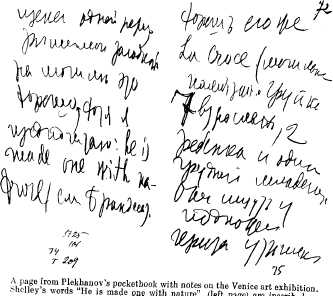
29 spontaneous perception of reality and its masterly rendering of the rich colours of nature and of the real world around. He singles out in particular the importance of the Impressionists' light effects in painting. While acknowledging the merits of the works of certain Impressionist painters, Plekhanov criticised this trend for its indifference to the social content of art. The artist who confines his attention to the sphere of sensations is indifferent to thoughts. He may paint a good landscape, but landscape is not all there is to painting. The main subject of art is man.Plekhanov pinpointed clearly the main weakness of impressionism, its failure to develop the human, social element. In respect of the representational potential of art this is connected with a lack of attention to the culture of plastic form which is expressed primarily in the realistic portrayal of man. It is precisely this Achilles' heel of impressionism that makes one most acutely aware of the dividing line between impressionism and lofty realism. Recording his impressions of the picture At the Cattle Market by the Italian painter Gioli Luigi, Plekhanov pinpoints the main shortcoming of impressionism. "A cattle market in a square surrounded with trees. The light effects here are very good indeed. The patches of light on the bulls' backs are so beautiful. But when it is a question of man, we demand more. Compare Leonardo da Vinci's The Last Supper."
Contrasting Leonardo da Vinci's famous picture The Last Supper with the works of the Impressionists in his article "Art and Social Life'', Plekhanov stresses the profound humanity of the loftiest works of art. Leonardo da Vinci portrayed a spiritual human drama brilliantly, whereas impressionism confines the artist's task to well-painted patches of light.
This comparison is most important for an understanding of Plekhanov's aesthetic standpoint. Essentially two types of art are counterposed here. The first places man and the most profound problems that affect his interests, directly or indirectly, at the centre of what is portrayed. The second type of art confines itself to tasks of an emotional, aesthetic nature. This kind of art is based on exclusive attention to representational devices. At the same time it is indifferent to human life, feelings, thoughts, i.e., everything that concerns man. Plekhanov is firmly on the side of humane art that reflects progressive thought and noble sentiments.
Plekhanov was most consistent in his defence of the human, truly dramatic principle in art. The picture The Slave Girl by the painter Bilbao Gonzalo caused certain critics to comment that its dramatic theme (prostitution) bore no relation to art. Plekhanov attacked the widespread Decadent formalist view that the portrayal of swch dramas is not a matter for painting, the 30 tasks of which are not the same as those of literature. The task of art, he maintains, is to portray everything of interest and concern to social man, and painting is no exception to the general rule.
__*_*_*__Plekhanov fruitfully developed genera) Marxist principles in aesthetics and literary criticism. But in his works, as has already been noted, one can find oversimplified, one-sided, and sometimes mistaken ideas which were conditioned by his Menshevik views. His incorrect idea of the motive forces and paths of revolution led Plekhanov to make a number of grave errors, including a negative assessment of some of Maxim Gorky's ideas and characters and attempts to use his articles on this writer in order to challenge Lenin's political standpoint.
Gorky's work is the subject of Plekhanov's articles "On the Psychology of the Workers' Movement" (1907), the foreword to the third edition of the symposium Twenty Years (1908), and some letters of 1911. Hitherto in considering Plekhanov's works on Gorky the critics have concentrated their attention mainly on the mistakes in the foreword to the symposium Twenty Years. Quite wrongly the other aspect of Plekhanov's writings on Gorky, his defence of the great proletarian writer's works, has remained in the background. Plekhanov sees Gorky not only as an outstanding writer indissolubly linked with the proletarian revolutionary movement, but also as an outstanding artist. He argued convincingly with critics who commented unfavourably on Gorky's creative development and declared that his talent was waning and that his new works were artistically weak and did not meet the requirements of the day. To the incorrect statements of Koruei Chukovsky, who said that "Gorky is a philistine from head to foot'', Plekhanov rightly objected that only someone who did not know the difference between socialism and philistinism could write that. Plekhanov also challenged the unfair comments of those who regarded themselves as sharing Gorky's views, but who denied the power of his literary talent. "As for my own humble opinion,'' Plekhanov wrote in the article "On the Psychology of the Workers' Movement'', "I will say outright that Gorky's new play is excellent. It is extremely rich in content, and one would have to close one's eyes deliberately not to see this."^^*^^
Plekhanov had a high opinion of the talent of the proletarian writer Maxim Gorky, and of the ideological importance of his works in the development of modern revolutionary literature. He emphasises in particular that it is not only a question of the importance of the actual material on the working-class _-_-_
^^*^^ See this volume, p. 466.
31 revolutionary movement which the writer shows in his works. The material merely provides the possibility of producing a good literary work. For this possibility to become reality a highly artistic treatment of the material is necessary. And Plekhanov rates Gorky's new work, the controversial play The Enemies, as satisfying the strictest aesthetic requirements. He singles out in particular the importance of the excellent portrayal in The Enemies of the psychology of the modern working-class movement.As can be seen from Plekhanov's statements, he commented equally approvingly on other works by Gorky also, persistently denying the assertion by reactionary critics that his talent was on the decline. However, Plekhanov wrote about Gorky mainly in the period from 1907 to 1911, i.e., during his sudden turning to Menshevism. This explains his incorrect, distorted treatment of a number of Gorky's well-known ideas and characters. His general correct assessments of the merits of Gorky's play The Enemies are mixed up with criticism of the Bolsheviks' tactics in the revolution of 190J3 and later.
Plekhanov considers that truly revolutionary tactics are embodied in the characters of the class-conscious workers, Levshin, Yagodin and Ryabtsov, heroes from the proletariat. The workers portrayed in Gorky's play are full of noble self-sacrifice and inspired by the noble aim of elevating the masses, "rectifying the people''. Plekhanov contrasts the true heroism of the workers with an intellectual who has no definite world outlook, the former actress Tatyana Lugovaya. The genuine heroism of the revolutionary workers seems to her loo .simple and lacking in passion. According to Plekhanov, people like Tatyana Lugovaya are prone to deceive themselves with exaggerated, unjustified, rosy hopes, excessive optimism. Long painstaking work with the masses, systematic influencing of them, seems boring lo these people; they see no passion, no heroism in it. Therefore, when she encountered the true revolutionary consciousness of the workers Tatyana Lugovaya did not understand it. She did not nolice heroism where it governed all their actions. And in the heat of his polemic with the Bolsheviks Plekhanov quite unjustifiably compares Tatyana Lugovaya's groundless optimism to the tactics of I he Bolsheviks.
Plekhanov was perfectly right in criticising Gorky strongly for his Machist God-building sympathies which are felt most slrongly in the short novel Confession.~ But Plekhanov's attitude to Bolsheviks' tactics as "revolutionary alchemy" produced his unfair assessment of some of Gorky's works. In the foreword to the third edition of the symposium Twenty Years he gave an obviously Mistaken assessment of the novel Mother, equaling it with Confession.
32Lenin criticised Gorky's ``God-building'' sympathies categorically and uncompromisingly, and his Confession, in particular. However, he never fully identified Gorky's philosophical mistakes with his general position as a writer, and he emphasised Gorky's indissoluble link with the working masses and the revolutionary movement.
In spite of his one-sided characterisation of certain aspects of Gorky's work, Plekhanov saw him in general as an outstanding, talented writer who was closely connected with the people and the proletarian revolutionary movement.
Lenin never identified Plekhanov's political opportunism with his pliilosophico-aesthetic writings. In a letter to Gorky of March 24, 1908, Lenin remarked that in the sphere of philosophy, in the struggle against the Machists, "Plekhanov, at bottom, is entirely right in being against them...."^^*^^ Lenin stressed firmly the invalidity of attempts to preach old, reactionary rubbish under the pretext of criticising Plekhanov's tactical opportunism.
Nor should one overlook the complexity of the evolution of Plekhanov's social views. Even when he was already a Meushevik, Plekhanov. to quote Lenin, "occupied a special position, and departed from Menshevism many limes".^^**^^
I'lekhanov's political evolution to Menshevism resulted in a strengthening of the weak aspects of Ids aesthetics and undoubtedly affected his literary-critical views. However, Plekhanov's special position ou these questions enabled him even after 1903 to produce a number of line works and express much of value in the sphere of philosophy and the theory of art and literature (the articles "French Drama and French Painting of the Eighteenth Century from the Sociological Viewpoint'', "The Proletarian Movement and Bourgeois Art'', "Art and Social Life'', "Henrik Ibsen'', "The Ideology of Our Present-Day Philistine'', and "On D. V. Filosofov's Book''). And during this period one is bound to note and duly appreciate his fight for materialism in aesthetics, against naturalism and decadence, for progressive realist traditions, and for authentic and representational art.
Plekhanov's study of the laws of the art of revolutionary periods is extremely relevant today. He criticises the still widespread view that revolutionary periods are unfavourable for artistic creation. Characterising the art of revolutionary times, Plekhanov totally rejects the popular saying; "When the cannons roar, the muses are silent.'' On the contrary, he argues, periods of revolution give art new opportunities and directions. Of particular importance is Plekhanov's remark that the sansculottes set _-_-_
^^*^^ V. I. Lenin, Collected Works, Vol. 34, p. 388.
^^**^^ Ibid., Vol. 20, p. 279.
33 art "on the path which the art of the upper classes had been unable to follow: it became a matter for the whole people".^^*^^ The revolutionary awakening of the consciousness of the masses does indeed create the most favourable conditions for artistic creation and give art a popular character. Plekhanov is right in saying that the savage Thermidor reaction and the historical limitations of the French Revolution of 1789 soon put an end to the influence of the sansculottes and the realisation of their aesthetic ideals. Only a victorious socialist revolution, capable of liberating the people's spiritual powers and creative energy, can carry out fully the task of creating an art of the whole people.Plekhanov's ideas on the art of revolutionary periods bear directly on a number of problems of the present-day literary movement. They show convincingly how invalid are the attempts of some writers to elevate a certain "time distance" into a universal standard of artistic creation.
Already at the dawn of the proletarian movement in Russia Plekhanov raised the question of the development of the new, proletarian literature. He proceeded from the fact that the works of Marx and Engels define theoretically many features of the future socialist art. Marx and Engels spoke of the appearance in the future of art which in the new social conditions, on the basis of the experience of the struggle for the liberation of the people, would develop all that is best in the traditions of the past, would reflect the birth of the new, socialist era, and would achieve a total fusion of great ideological depth and conscious historical purpose with Shakespearian verve and efficacy. Plekhanov was deeply convinced that the time had come to create such a literature. He saw the vital basis of socialist literature in the revolutionary movement and the conscious creative activity of the masses.
The coming to the fore of the working class, as the most powerful progressive force of history, produces the conditions for the creation of proletarian literature. In 1885 in the introduction to the poetry collection Songs of Labour, which the Emancipation of Labour group was proposing to have published, Plekhanov wrote, addressing the workers: "You must have your own poetry, your own songs, your own verse. In them you must seek the expression of your own grief, your own hopes and aspirations.... And it is not just grief alone, not despair alone that will find expression in it [poetry.---V. Sh.}.... Alongside discontent with the present there will grow within you faith in the great future that is now opening up to the working class of all the civilised countries. And this faith will also be reflected in your poetry; it will make _-_-_
^^*^^ See this volume, p. 395.
3---0766
34 your songs loud, mighty and proud, the victory cry of universal liberty, true equality and sincere fraternity."These words, full of faith in the spiritual forces of the popular masses, define the initial, essential features of the new literature created during the struggle for a new world, for the world of socialism.
The works of the eminent Marxist theoretician of art and literature, Georgi Valentinovich Plekhanov, were of major importance for the development of Marxist aesthetics.
V. Shcherbina
[35] SELECTED
PHILOSOPHICAL
WORKS
VOLUME
V
(Dedicated to S.~M. = Kravchinsky)^^1^^
The abolition of serfdom has confronted thinking people in Russia with a whole series of questions that could not be solved without a prior understanding of how our people lives, what it thinks and where it is striving. All our public figures, peaceful and revolutionary, legal and illegal, have realised that the nature of their activity must be determined by the nature and mode of life of the people. Hence there has arisen the natural urge to study the people, to understand its position, its world outlook and its needs. A comprehensive study of popular life has begun. The results of this study which have appeared in the press have been received by the public with tremendous interest and sympathy. They have been read and reread, and made the basis of all manner of ``programmes'' of practical activity. In all this the most active and enthusiastic figure has been our = raznochinets,^^2^^ our "thinking proletarian'', who calls himself with pride and a somewhat amusing exclusiveness "the intelligentsia".
The educated raznochinets existed at the time of serfdom too, but then he represented a very small group of people who managed to get as far as abstract negation, in the manner of = Bazarov,^^8^^ but could not even think of forming a ``party''. At that time in general the existence of any parties other than literary ones was impossible. With the abolition of serfdom matters changed. The collapse of the old economic structure increased the numbers of the thinking proletariat considerably and aroused in it new hopes and new demands. These demands remained unsatisfied for the most part. The disgraceful political system, by its very nature alien to any ``intelligentsia'' without rank, was increasingly arousing a spirit of opposition in our educated proletariat, while the vagueness and ambiguity of the latter's position between the upper classes, on the one hand, and the people, on the other, forced it to reflect upon the question of what was to be done. It is not surprising, therefore, that it was our raznochinets who plunged so avidly into all manner of research into popular life. The most determined section of these peculiar proletarians of unproductive (in the economic sense of the word) labour sought in the people support for its oppositional and revolutionary strivings; the other, 38 peaceful section simply regarded the people as a medium in which it could live and work without relinquishing its human dignity and without cringing to any authority. For both a knowledge of the people was essential. And so our raznochinets not only devours studies on popular life, but is for the most part the author of these studies. He gets to know the urban artisan and petty-- bourgeois, studies the common law of the peasants, observes the land commune and cottage industries, copies down folk tales, songs and proverbs, has theological talks with sectarians, collects all sorts of statistical data and information about the people's sanitary conditions, in a word, investigates and takes an interest in everything. A new Narodnik trend in our literature arose and soon became established, exerting an influence, inter alia, on fiction. Alongside the various special studies there appeared a multitude of sketches, scenes, and stories based on popular life. The raznochinets also contributed to fiction, as he did somewhat later to painting, where, incidentally, his activity was less interesting and fruitful.
Knowing that the writer is not only the spokesman of the social environment from which he comes, but also its product; that he brings with him into literature its likes and dislikes, its world outlook, customs, ideas and even language, we can say with certainty that as a writer our raznochinets too was bound to retain the distinctive features that were in general characteristic of him as a raznochinets.
__ALPHA_LVL2__ IIWhat are these features?---They are best shown by comparison. Is our raznochinets like the old "liberal idealist" extolled by N. A. Nekrasov, for example?
Dialectician always charming,
Pure in thought, in heart as chaste,
Eyes of one forever dreaming,
Liberal idealist,
Fighting shy of grim reality,
Treating lightness as your duty,
Disillusioned---yet you wandered
Everywhere adoring =
beauty....^^4^^
The only thing that our raznochinets has in common with such a liberal is that he too is no less "pure in thought, in heart as chaste" than the latter. In everything else he is the direct opposite. He cannot "treat lightness as his duty" and wander around idly ``disillusioned'', if only for the fact that he is not a landowner, but a proletarian, albeit of noble origin. He must earn his living by the sweat of his brow. Our raznochinets is primarily a specialist: 39 __RUNNING_HEADER_RIGHT__ GL. I. USPENSKY a chemist, mechanic, physician, veterinary surgeon, etc. True, under the present system in Russia he also often, almost always, ``fights shy of grirn reality'', if he does not want to strike shameful bargains with his conscience. This is the tragedy of his position, this is why his head is full of "cursed = questions".^^6^^ But he is no longer daunted by the obstacles around him, he laughs at sterile disillusion, seeks a practical solution and strives to alter the social relations. Therefore in his case social interests dominate all else. Purely literary questions are of relatively little concern to him. Until recently he was even formally at loggerheads with art. He wanted to "destroy aesthetics" once and for all, believed that "a good shoemaker is better than any Raphael" and despised Pushkin because he did not study natural science and write tendentious novels. Now he realises that this was an extreme view on his part. Now he readily pays proper tribute to art, takes pride in Pushkin and Lermontov and admires Tolstoy and Turgenev. But now also he does this in passing, as it were, putting "first things first'', as the saying goes. After reading some Anna Karenina with great enjoyment, he again buries himself in articles on social questions, again starts arguing about the commune, observing and studying popular life. In foreign literatures he also looks not so much for belles-lettres as for works on social questions. For him Saint-Simon or Louis Blanc is far more interesting than George Sand or Balzac, and as for Corneille or Racine he is quite unfamiliar with them, whereas, albeit from Mr. Shcheglov's poor history, he knows what Thomas More and Campanella wrote about.^^6^^ Those who regard him as a "crude materialist'', however, are gravely mistaken. He is very far indeed from moral materialism. His morals are those of a pure-blooded idealist, but his idealism bears a special imprint due to the specific features of his social and historical position. The well-known Marlinsky once said in one of his critical articles that "the age of Peter had no time to engage in literature, its poetry revealed itself in great deeds, not in words''. Such an explanation of the literary paucity of the "age of Peter" is rather one-sided, of course, but we mention it because Marlinsky's words are perfectly applicable to our raznochinets. He is a protester and fighter by virtue of his very position. His attention is totally absorbed by struggle---be it peaceful or revolutionary, legal or ``criminal''---and he simply "has no time to engage in literature" for literature's sake, to "adore beauty'', to enjoy art. He is interested in the poetry that "reveals itself in great deeds, not in words''. And his social activity abounds in examples of what can be called the "poetry of the great deed''.
If our raznochinets is little attracted by the inner beauty of a literary work, he is even less liable to be seduced by its outer appearance, for example, beauty of style, to which the French still attach such importance. He is ready to say to any writer: 40 ``Don't talk prettily, please, ray friend'', as Bazarov advised the young = Kirsanov.^^7^^ Contempt for externals is obvious in the raznochinets' own speech. His somewhat rough and awkward language is far inferior to the refined, fluent and brilliant language of the "liberal idealist" of the good old days. Occasionally it shuns not only ``beauty'' but, alas, even grammatical correctness. In this respect things have gone so far that when the revolutionary raznochinets addressed the public in order to arouse it with his written or spoken word, because of his poor command of language he proved, for all his sincerity, to be not eloquent, but verbose. All organs grow weak from inactivity, as we know.
Since, in addition to all this, our raznochinets has always shown the greatest contempt for philosophy, which he called metaphysics, one can also hardly say that he was a "charming dialectician''. Hegel would probably not have attributed any great merit to him in this sphere. Many of the raznochinets' grave theoretical errors are explained by his lack of philosophical development.
Finally, do not forget that his knowledge of foreign languages is very weak: his parents were too poor for him to be taught them as a child, they were badly taught at school, and at a more mature age he had no time for them. Therefore he has only a sketchy, second-hand, knowledge of foreign literatures, from translations. Here also we find the direct opposite to the "liberal idealist''; the latter spoke almost all the European languages and knew the main foreign literatures like the back of his hand.
__ALPHA_LVL2__ IIISuch is our raznochinets in general, and such is the raznochinets writer also. In our Narodnik literature and even Narodnik fiction it is easy to find all the merits and defects characteristic of the raznochinets.~ In order to convince yourself of this take the works of G. I. Uspensky, for example, and compare them with those of Turgenev. You will see at once that these two writers belong to two different social strata, that they were brought up in completely different conditions and set themselves completely different tasks in their literary activity. Turgenev was no less responsive than Uspensky to everything of vital social interest in his day. But whereas Turgenev wrote about the life of "nests of the gentry'', Uspensky writes about the life of the people. Turgenev approaches phenomena as an artist, and almost exclusively as an artist; even when he is writing about the most topical subjects, he is more interested in aesthetics than ``questions''; Uspensky very often approaches them as a publicist. Turgenev, with a few exceptions, has given us literary characters and only characters; Uspensky, in portraying characters, accompanies them with his own interpretations. Herein lies, of course, the weak point of 41 Uspensky, as of almost all the other Narodnik fiction writers, and we might be told that it is strange to contrast the strong points of one writer or one trend with the weak points of another writer or another school. But whence this weak point of Narodnik fiction? It emerged precisely because of the prevalence of social interests over literary interests in the Narodnik writers. From the purely literary, artistic point of view a given story or sketch might have benefited greatly from a more objective attitude by the author to the subject. The author himself probably knows this perfectly well, too. But what makes him take up his pen is not so much the need for artistic creation as the desire to explain to himself and others this or that aspect of our social relations. Therefore in his case artistic portrayal is accompanied by reasoning, and the author is frequently far less of an artist than a publicist. Moreover, take a look at those works of Narodnik fiction in which the artist gains the upper hand over the publicist or even ousts him completely; you will not encounter such clearly delineated, artistically polished characters in them as you find in A Hero of Our Time, Rudin, On The Eve, Fathers and = Sons,^^8^^ etc. Nor will you find in them the scenes of passions, the subtly detected emotions which attract you in the works of Dostoyevsky or Tolstoy. Narodnik fiction shows us not individual characters and not the emotions of individuals, but the habits, views and, most important, the social life of the masses.~ It looks in the people not for man in general, with his passions and emotions, but for representatives of a certain social class, the bearers of certain social ideals. The mental eye of the Narodnik fiction writers sees not vivid artistic images, but prosaic, albeit topical questions of the national economy. The relation of. the peasant to the land is therefore now the main object of their quasi-artistic descriptions. There are writer-psychologists. With certain reservations the Narodnik fiction writers might perhaps be called writersociologists.
The prevalence of social over purely literary interests also explains the disregard of literary form which makes itself felt strongly in the works of the Narodnik fiction writers. As an example let us take once more the works of Gl. Uspensky. Here we find scenes and even whole chapters which would do honour to the most first-class writer. There are many such scenes in Ruin, for example. But alongside them, also in Ruin, we find scenes of secondary or altogether doubtful merit. At times the most likeable, life-like character in Ruin, Mikhail Ivanovich, becomes simply ridiculous, playing the role of a = Chatsky^^9^^ from the factory workers. There are many such dissonances in his other works also. In general they lack a strictly worked-out plan and well-balanced parts that relate properly to the whole. Like certain philosophers of ancient times, Gl. Uspensky "makes no sacrifices to the graces".
42 He is concerned not to give artistic form to his works, but to grasp and convey correctly the social meaning of the phenomena which he depicts. His latest works have nothing in common with fiction.It goes without saying that an author who pays little attention to the artistic form of his works will show even less concern for language. In this respect our Narodnik fiction writers cannot be compared not only with Lermontov or Turgenev but even with V. Garshin or Mr. M.~Belinsky.
There are critics who consider it their duty to pinpoint all the defects of Narodnik fiction and ridicule it in every possible way. Their attacks are justified to a large extent, but what is bad is, firstly, that they see only the defects in this literature and not its merits, and, secondly, that they do not notice, and thanks to their point of view cannot notice, its chief defect.
Our Narodnik literature, in general, and our Narodnik fiction, in particular, possesses .some very important merits which are closely linked with its defects, as is always the case incidentally. An enemy of all embellishment and artificiality, the raznochinets was bound to create, and did indeed create, a profoundly truthful literary trend. In this case he remained loyal to the best traditions of Russian literature. Our Narodnik fiction is perfectly realistic, and, moreover, not in the modern French manner: its realism is warmed with feeling, imbued with thought. And this difference is perfectly understandable. French naturalism, or at least Zolaism, is the literary expression of the moral and intellectual bankruptcy of the modern French bourgeoisie, which has long since been abandoned by the ``spirit'' of world history.^^*^^ Russian Narodnik literature, on the contrary, expresses the views and aspirations of the social stratum which for three decades was the most advanced stratum in Russia. Herein lies the main historical service of the trend in question. When Russian social relations change (and they are already changing), when new, more advanced strata or classes appear on the Russian historical scene (and this time is already not far off), Narodnik fiction, and Narodnik literature as a whole, will fade into the background, making way for new trends. But its representatives will always have the right to say that they did not write in vain and that in their time they were able to serve the cause of Russian social development.
They served it by depicting the life of their people. No special studies can take the place of the pictures of popular life drawn by them. The works of our Narodnik fiction writers must be studied just as carefully as statistical research on the Russian national economy or works on peasant common law. No public figure, whatever trend he belongs to, can say that he is not bound to _-_-_
^^*^^ In 1888, when this article was written, the works by Zola which heralded a turning-point in his writing did not yet exist.
43 make such a study. It would seem that on these grounds one can iorgive the Narodnik fiction writers many of their intentional and unintentional sins against aesthetics.In general one can say that our aesthetic critics are condemned to total impotence in their struggle against the defects of Narodnik fiction. They set about the matter in the wrong way. To Convince Narodnik fiction writers that they should not take an interest in social questions is impossible, and to try to convince -them of it is ridiculous.~ Russia is going through a period now in -which the advanced strata of its population cannot help being interested in such questions. Therefore, no matter how hard "Messieurs aesthetic critics may strive, interest in social questions will of necessity be reflected in fiction also.
Criticism must at least reconcile itself to this fact. This does not mean, however, that it should close its eyes to the defects in the literary works of our Narodniks. It must simply change its --weapons. It is absurd to approach such works with a schoolmaster's pointer, "with textbooks on poetics and rhetoric in one's hands'', as a critic for the Severny Vestnik^^10^^ rightly notes. Yet it is not ^at all absurd, but, on the contrary, perfectly proper to ask how well-founded the views of Russian life held by our Narodnik :fiction writers are and whether the main artistic defects in their -works do not depend, in part at least, on the mistaken, one-sided nature of these views. It is very likely that, by shifting the argument to this ground, criticism would succeed in revealing a different, more correct point of view which, without removing the vital issues of the day from fiction, would nevertheless lead to the removal of many of the defects now characteristic of it. Where fiction writers become publicists, even the literary critic can do nothing but arm himself with the weapons of the publicist.
In the present article we wish to examine the works of Gl. I. Uspensky, the most talented Narodnik fiction writer, precisely from .this angle.
__ALPHA_LVL2__ IVGl. I. Uspensky began to write a long time ago. The twenty-- fifth anniversary of his literary activity was celebrated at the end of last year.^^*^^ Throughout this time he has, on the whole, .been completely faithful to his chosen trend. But since Narodism itself has changed in certain important respects, it is not surprising that the character of our author's works has not remained unchanged either. One can discern three periods in his activity.
In his early works Gl. Uspensky mainly described the life of the people and, in part, the life of petty officials. He portrayed the iower classes of society, describing what he saw without trying _-_-_
^^*^^ We would remind the reader that this article was written in 1888.
44 to explain it with the help of any theories and almost without taking an interest in any definite social theory. To this period belong The Ways of Rasteryaeva Street, The Capital's Poor, Winter Evening, The Booth, The Cab-Driver, Ruin and other sketches which now constitute the first few volumes of his works. In them we find not only peasants, but also urban craftsmen, petty officials, the lower clergy and similar poor souls condemned to perpetual worry about their daily bread. He describes all these povertystricken people, this world of the "insulted and injured'', with great humour, skill and the most profound, heartfelt sympathy for human grief and suffering. Artistically these are, without a doubt, his finest works.But "times changed'', and with them the nature of our Narodnik movement also changed. The attention of the ``intelligentsia''" became concentrated on the peasantry, which it saw as the estatecalled upon by history to renew and reshape all our social relations. Everywhere one heard talk of "popular character" and "popular ideals'', and both the ``character'' and the ``ideals'' were painted in the most glowing colours. Inspired by the general enthusiasm, G. Uspensky also went "to the people"---with the most peaceful literary aims, of course---and made the peasant the main character in his works. But, as a highly observant and highly intelligent man, he soon saw that our raznochinets' view of the ``people'' did not correspond to reality by a long chalk. Apropos of this he expressed many grave doubts which make him the object of bitterattacks by orthodox Narodniks. He believed, for example, that the old peasant way of life idealised by the Narodniks was disintegrating rapidly due to the intrusion of a new force---money. "The man who is not dull-witted, whose mind has not been ealem away by need, whom chance or something else has forced to reflect on his position, the man who has the slightest understanding of the tragi-comic aspects of peasant life,'' he says, describing peasant life in Novgorod Gubernia, "cannot help seeing his deliverancein a thick wad of money alone, in nothing but money, and will stop at nothing in order to get it.'' Describing a rich village in Samara Gubernia, which possessed much arable land and an abundance of the most ``remarkable'' fertile soil, he exclaims in. bewilderment: "And just imagine: amid such plenty not a day passes without you encountering a phenomenon, scene or conversation that instantly destroys all your fantasies, that contradicts all the ideas and views on village life you have acquired from reading,---in a word, that makes it completely impossible for you to understand how in such conditions that which you are seeing with your very eyes can come to pass.'' From here it was but a short step to the conclusion---a shameful one for an orthodox Narodnik---that not everything in the village communeis good, that one cannot explain all the unattractive aspects of 45 popular life by poverty alone and that "at the heart of village life there are intellectual imperfections worthy of attention''. Our author saw, for example, that the rich communes of Samara Gubernia can "put a hard-working, healthy man in a completely helpless position, bring him to the point where he ... goes hungry with hungry children and says: 'The main reason, brother, is that we have no food---see!'" He saw that "such a new public institution as the rural loan society is not at all untrue to its banking spirit, the spirit of an iustitution that makes no claim to distribute banking bounty in a more or less communal way. By giving more to the man who has plenty and less to the one who has little, and by placing no trust at all in the man who has nothing, the rural bank carries on its operations in the village with the same invariability as in the town, where, as we know, there is no commune and each man fends for himself....'' And, finally, GL Uspensky saw that the kulaks were the product of the internal relations of the commune, not merely of external influences on it, and eventually reached the conclusion that the time could soon come when "the village, i.e., all that is good in it, will pine away, drift off, and what remains in it, having lost the appetite for peasant toil, will be merely helpless labour material in the hands of those who give any miserly wage''. Gl. Uspensky summoned the "new people" to the village, saying that it needed "new views on things and new, well-developed, educated people'', so that in the richest areas and the most prosperous communes "there shall be no over-crowding and amid the possible prosperity so close at hand no terrible poverty that knows not where to lay its head''. At that time he thought he was presenting our intelligentsia with a problem which, although not in easy one, was at least = soluble.^^*^^
Experience, however, was preparing a new disappointment for him. The longer he lived in the village, the more convinced he became that it was quite impossible to cultivate in the peasants "new views on things'', i.e., a realisation of the "full value of communal, collective labour for the common good''. At best the propagation of such views made the hearers "yawn dreadfully''. And occasionally, as we shall see below, the matter took a quite unexpected turn. In a series of practical arguments the peasants sought to convince Gi. Uspensky that his "new views" were inapplicable to village life. In general the negative attitude of the tillage" to the author's propaganda was so great and so constant that he frequently vowed "not to talk to them about their peasant ways, because in most cases such conversations are completely futile and nothing practical or sensible ever comes of them". _-_-_
^^*^^ Gl. Uspensky's sketches belonging to this period bear the general : From a Village Diary.
46 It goes without saying that such a state of affairs grieved our author deeply, until a certain chance and "completely trivial circumstance" made his thoughts take a new turn. Thanks to this fortunate circumstance he developed a new view on peasant lifer his theoretical Wanderjahre^^*^^ ended, and he entered what seemed to him to be a safe harhour. It was then that the third and final period of his activity began.What was the discovery that Gl. I. Uspensky made?
__ALPHA_LVL2__ VFormerly he, like the other Narodniks, had explained all aspects of peasant life by the feelings, concepts and ideals of the peasants. And we already know that for him such an explanation left a great deal that was unexplained and contradictory.
The above-mentioned "chance circumstance" compelled him to do the opposite, i.e., to look for the key to popular concepts and ideals in the forms of popular life, and try to explain the origin of popular forms of life "by the conditions of agricultural labour''. His attempt at such an explanation met with considerable success.
The life and world outlook of the peasant, which had formerly seemed obscure, contradictory, dull and meaningless to him,, unexpectedly acquired a "remarkable harmony" and consistency in his eyes. "The breadth and soundness of this harmony,'' he says, "became apparent to me when I placed agricultural labour at the basis of the whole organisation of peasant life, family and social, and tried to examine it in more detail, to understand its special qualities and its influence on the man who is indissolubly connected with it.'' It even emerged that the specific features of agricultural labour explained not only the organisation of the peasant family and commune, but also the peasant's age-old patience, his religious beliefs, his attitude towards the government and, finally, even towards Messrs. Narodniks themselves.
Agricultural labour makes the peasant entirely dependent on natural phenomena which he does not understand and which appear to be entirely accidental. Nature "teaches him to acknowledge authority, authority that is unchecked, specific, wilfully capricious and heartlessly cruel''. And the peasant "knows how to be patient, to be patient without thinking, without explaining, to be patient unquestioningly. He is familiar with this expression in practice, on his own skin, familiar to such an extent that it is quite impossible to place a more or less definite limit on this patience".
It goes without saying that the peasant personifies nature, whose accidents for him "are concentrated in God''. He believes _-_-_
^^*^^ [years of wandering]
47 in God "strongly, unshakeably" and "senses His proximity almost nalpably''. He prays to Him to win His favour, although he does not know a single prayer properly. Gl. Uspensky once happened to hear a most interesting version of the Creed. "I believe in one God, the Father,'' a peasant whom he knew, Ivan Yermolayevich, was teaching his son, "and in heaven and earth. Visible and invisible, heard and unheard. He pontified and pilatified ... and goodness knows what came after that,'' remarks the author. All this is ridiculous and incoherent, but necessary, inevitable and indeed very ``harmonious''. Religious superstition is a natural product of the peasant's relations with nature, of "the distinctive features of agricultural labour''. The peasant's thought is enslaved by the "power of the land" and nature. At best it can create some ``rationalistic'' sect, but it can never reach the materialist and only true view of nature, the concept of man's power over the land.The power of the bolshak^^*^^ in the peasant family is also explained by the features of agricultural labour.
``A head in the house, a family authority, is necessary,'' says Gl. Uspensky. "This again is required by the complexity of agricultural labour, which forms the basis of the economy, and by the dependence of this labour on the behests and commands of nature."
The decisive influence of the same principle can easily be traced in the peasants' land relations. "The land relations of the commune are also explained by requirements based solely on the conditions of agricultural labour and on agricultural ideals: a weak man who cannot perform his agricultural task through lack of the strength necessary for this task gives up his land (what use is it to him?) to a man who is stronger and more energetic, who is able to carry out this task on a larger scale. Since the amount of strength is constantly changing, since the man who is weak today may be stronger tomorrow, and the other man weaker, peredvizhka---as the peasants sometimes call peredel^^**^^---is bound to be an inevitable and just phenomenon."
Do not think, reader, that this agricultural ``justice'' is done without the slightest inconvenience to anyone: in the works of the selfsame Gl. Uspensky we find some most instructive passages in this respect.
``Next to the house of a peasant who has amassed twenty thousand roubles lives an old woman and her granddaughters, and she will have nothing to heat the stove with, nothing to cook the dinner on, if she does not pick up some firewood 'on the sly', to say nothing of the winter when she freezes with the cold.
_-_-_^^*^^ [head]
^^**^^ [re-allotment]
48``'But you have communal forests, do you not?' you, who know little of village life, exclaim in surprise.
``'They don't give the likes of me anything from there.'
'"Why not?'
``'Well, like, they don't give firewood to everybody.'
``Or:
``'Alms for the love of Christ.'
``'Are you a local woman?'
``'Yes, I am.'
'"How did you get into this state?'
``Til tell you how. We were living well, friend, then my old man went to build the master a barn and fell off the roof, and he's been poorly for more than six months now.... They say he should be taken to town, but how can we get him there? I'm alone with the little ones. The = mir^^11^ has taken our land.'
``'Taken your land? Why?'
``'Who could have paid the taxes on it? Thank the good Lord that they did take it. We haven't got the strength''', etc.
Both the old woman with her granddaughters, who stole firewood, and the wife of the peasant who had an accident while working for his master are deprived of land and firewood by precisely the same ``harmony'' of agricultural life which requires that land be taken from "a weak man who cannot perform his agricultural task" and given to a man "who is stronger and more energetic''. Gl. Uspensky sees the seamy side of ``harmonious'' village life clearly, but he reconciles himself to it, adopting the peasant point of view. He now understands the inevitability of many phenomena which previously grieved and angered him so strongly. His nerves become "stronger as it were" and begin "to discover a certain tenacity in situations in which formerly, i.e., very recently, they could not help complaining, although, of course, to no avail".
Let us too follow our author's example. Let us study and not condemn the modern village system. Let us trace the influence of agricultural labour on the peasant's views of the law and politics.
``The same agricultural ideals are to be found in legal relations,'' Gl. Uspensky continues: "property belongs to the person by whose work it has been created.... It is received by the son, and not the father, because the father drank, and the son worked; it is received by the wife, and not the husband, because the husband is a complete idiot and idler, etc. The supreme state system is also explained without the slightest difficulty in terms of the experience acquired by the peasant in the sphere of agricultural labour and ideals alone. On the basis of this experience the supreme authority can be explained: 'There must be a bolshak, it's just like with us.' From the same experience it is also easy to 49 explain the existence of taxes: 'They must be paid, the tsar needs money too.... It's just like with us; if we hire a herdsman, we have to pay him, and the tsar gives the land.'"
In a word, just as the accidents of nature are concentrated for the peasant in God, so the accidents of politics are concentrated for him in the tsar.
``The tsar has gone to fight, the tsar has set us at liberty, the tsar gives the land, the tsar gives bread,---let it be as the tsar says."
Agricultural labour absorbs all the peasant's attention and forms the whole content of all his mental activity. "In no other sphere, apart from the sphere of agricultural labour, again in countless ramifications and complications, is his thinking so free, so bold, so intense, as here, where the wooden plough, the harrow, sheep, hens, ducks, cows, etc. are. He knows almost nothing about his 'rights', knows nothing at all about the origin and significance of the authorities, does not know why the war started and where the enemy's country is, etc., because he is interested in his own work and has no time to know and be interested in all this, just as you and I, who are interested in all this, have neither the desire nor the opportunity to spend three evenings in a row thinking about a duck or gazing sorrowfully at a poor crop of oats.... But in his own work he pays attention to the slightest detail, each of his sheep has a name which suits its character, he does not sleep at night because of a duck, thinks about stone, etc."
__ALPHA_LVL2__ VIThus Gl. Uspensky explains all the aspects of peasant life and all the distinctive features of peasant thought. His explanations proceed logically from a single basic principle. But what is this principle itself, what are the "conditions of agricultural labour"? Our author expresses himself somewhat vaguely on this point, which has a rather unfortunate effect on his theory of the "power of the land''. Generally speaking, by the "conditions of agricultural labour" one can understand the social conditions in which the farmer of any given country finds himself at any given time, i.e., the relations in law of the farmer to his fellow workers, other farmers, his relations with the supreme authority, with other estates, etc. But Gl. Uspensky is not content with such a superficial concept of the conditions of agricultural labour. In his analysis he goes much further and, as we have already seen, tries to explain all the social relations of an agricultural country by other ``conditions'' from which these relations proceed as a kind of derivative. What are the ``conditions'' about which Uspensky speaks? Leaving aside all the relations into which people enter with one another in the production process, i.e., in this case leaving
4---0766
50 aside all the social conditions of agricultural labour, we are confronted solely with man's relations with nature. And it is precisely man's relation with nature that Gl. Uspensky has in mind. He says outright that he regards nature as the ``root'' of all the " influences" of agricultural labour on the farmer and on the whole system of his social relations. "It is with nature that a man does his work, he depends on it directly.'' Hence the ``power'' of nature and above all, of course, of the land over man. This is correct, without the slightest doubt. But it is not enough. Man's dependence on nature has a measure which itself changes.After reaching a certain degree, this quantitative change in the measure of man's dependence on nature brings about a qualitative change in man's actual relation with nature. Originally under the power of nature, he himself gradually acquires power over nature. In accordance with this human relations also change not only in the actual production process, but in society as a whole. Above all the growth of man's power over nature is expressed, of course, in the increase in the productivity of his labour, in the growth of the amount of productive forces at his disposal. Therefore it can be said that the degree of development of productive forces determines both people's mutual relations in production and all their social relations. Did Gl. Uspensky take this aspect of the matter into account? No, he did not, because if he had, he would not have talked about the "conditions of agricultural labour" as something constant and immutable. He would himself have seen that they are very changeable and that a change in them is bound to lead to a change in the whole pattern of our village life, in the peasants' relations with one another in law, their attitude to the supreme authority and even their religious ideas. At the same time his own views on Russian life would have become far more ``harmonious'' and consistent. He would have needed only to decide in what direction the conditions of our agricultural labour should be changed, in order to indicate clearly to the "new people" the most fitting role for them in the historical process of this change.
Let us quote some examples to clarify what has been said. Gl. Uspensky speaks of the peasants' attitude to the supreme authority in such terms as to suggest that the "conditions of agricultural labour" could produce no other attitude to it. Yet we see that agricultural labour is very widespread in the United States, but American farmers have an altitude to this system which is completely different from that of Russian peasants. In general, American agricultural labour produces a lot of grain and not a single "Ivan Yermolayevich''. The American farmerdoes his job, as we know, far better than the Russian peasant, and at the same time he is able to think about more than just ``ducks'': he takes part in the political life of his country. Whence 51 this difference? It cannot be explained by simply referring to the "conditions of agricultural labour''. One must show how and why conditions of agricultural labour in America differ from conditions of agricultural labour in Russia. The whole matter is easily explained by the theory of productive forces. The American colonists took with them from Europe and developed on new ground productive forces of a far higher order than those at the disposal of the Russian peasant. A different level of development of productive forces means a different relation between people in the production process and a different pattern of social relations as a whole.
Moreover, we see that even with a very low level of development of productive forces an absolute monarchy did not emerge in all farming peoples. Are there not many examples in history of republican federations of agricultural communes? In this case, besides the conditions of agricultural labour one must also take into account what Hegel called "the geographical background to world history".™ Republican federations of agricultural communes arose almost exclusively in mountainous countries or countries well protected by nature. On the other hand, farming peoples inhabiting the broad expanses of plains and big river basins always grew up under despotism.^^*^^ Examples of this are China, Egypt and, unfortunately, our Russia. Therefore everything that Gl. Uspensky says about the Russian peasant's attitude to the supreme authority is perfectly correct. Russian absolutism becomes unstable only in so far as the conditions of agricultural labour described by our author change.
Another example. Gl. I. Uspensky appears to think that the "conditions of agricultural labour" inevitably lead to the existence of a village commune with re-allotment. But in this case also history and ethnography strongly undermine the validity of his conclusions. They provide many examples of other types of agricultural communes, from communist ones to those of homesteads passed on by inheritance. Communes of the latter type can also be found in Russia. Obviously, the origin of all these different sorts of communes can again not be explained by a simple reference to the "conditions of agricultural labour''. One must show in what way differences in these conditions have led to differences in the internal organisation of the communes. We do not propose to go into an explanation here of the process that leads to the disintegration of primitive communist communes. The connection between this process and the development of productive forces is shown in Mr. Ziber's fine book Essays on Primitive Economic Culture. Having referred the reader to it, we shall seek in Gl. _-_-_
^^*^^ Although in their caso also despotism did not arise at the early stages Oi their history. Despotic power itself presupposes the relatively advanced development of productive forces by comparison with the primitive period.
52 Uspensky's works an indication of the path which leads to the disintegration of the village commune with re-allotment.To quote Uspensky, the above-raentioued Ivan Yermolayo^ich "complains about the people, about tiie other members of the village commune: 'the people are not what they used to be, they've got worse, got spoilt'''. In other words, Ivan Yermolayevich is already dissatisfied with the present state of affairs in the commune. In his opinion things were, of course, bad uader serfdom: "What was good about those days?" But all the same there, was more equality between the peasants. "In those days, you know, it was bad for everyone, one and all, but today it's like this: you want to make things better for yourself, but your neighbour's got it in for you.'' He explains this at first glance incomprehensible phenomenon as follows: "Judge for yourself, I'll tell you. The mir woodland is divided into plots to be felled; each man clears his own plot. So I cut down the trees in my plot, pull up the roots, clear the soil and I've got some more ploughland. As soon as my amount of ploughland increases there is a re-allotment. 'You've got more land than the other man with the same number of household taxpayers,' they say. 'Your amount of land from tho mir has increased, so there must be a re-allotment!'"
``But everyone can clear his piece of woodland, can't he?" asks the author.
``Yes, but not everyone wants to. That's the point. One -nan has got weaker, another man poorer, and a third is lazy; it's true, there are lazy people. If I get up before dawn, work till the sweat pours off me, and reap more grain, they'll take it away from me, be sure of that! Then it's shared out and everyone gets such a tiny scrap that it's no good to them either, see! Twice they've taken land away from me like that, and all within the law,---'there's more land; but not just for you, everyone must have a bit more'. So there's no way of getting on. I want to leave the commune; one bloke here told me I can, but I don't know how much it costs."
As you can see, while retaining all the ``harmony'' of his farmer's world outlook, Ivan Yermolayevich is against the selfsame commune with re-allotment that, in Gl. Uspensky's opinion, proceeds inevitably from the conditions of agricultural labour. How is this discrepancy to be explained? By the fact that Ivan Yermolayevich understands better than Uspensky the present state of "conditions of agricultural labour" in Russia. He sees that in order to cultivate the over-worked land more means of production must be expended than before. But not all peasants have the same means of production at their disposal: "one man has got weaker, another man poorer, and a third is lazy''. Therefore the ro-allotment of communal land leads to inconveniences which did not exist before. And therefore Ivan Yermolayovich is going to upset Messrs. Narodniks by leaving the commune. 53 He will become an even deadlier enemy of the commune if he goes over to intensive working of the land. The disintegration of the commune thus results logically from a change in the technical "conditions of agricultural labour".
One more point. Seeing in the peasants' relations in law the existence of the labour principle by virtue of which the product should belong to the producer, Gl. Uspensky does not hesitate to ascribe this principle also to the conditions of agricultural labour. But the same labour principle also exists in the common law of primitive hunting communes. So what is the relevance of the conditions of agricultural labour here? Obviously this principle does not owe its existence to them. On the contrary, in the modern village this notorious labour principle frequently turns into its direct opposite.^^*^^ After selling on the market the products created "by the labour of his own hands'', the peasant can use the money he has obtained to buy the labour power of a farmlabourer and carry on further production with the assistance of another man's hands.
Such a relation between people in production leads, as we know, to the appropriation by one man of the products of the labour of another man or other men. Here again we see how the present state of agricultural labour in Russia leads logically to a rejection of what Gl. Uspensky regards as the necessary consequence of its ``conditions''.
We repeat, Gl. Uspensky would not have been guilty of such contradictions if, in arriving at the idea of the dependence of the whole pattern of peasant life on the conditions of agricultural labour, he had tried to understand the concept of these conditions. This would have been all the easier for him since the theory of the dependence of human progress on the development of productive forces has long been elaborated in West European literature. Marx's historical ideas would have introduced a great deal of ``harmony'' into Gl. Uspensky's world outlook.
However, our author's works contain abundant material illustrating to which state of productive forces his picture of popular life corresponds. "On the very same spot,'' we read there, "where Ivan Yermolayevich worked his fingers to the bone merely in order to have enough to eat, his ancestors had also worked their fingers to the bone for no less than a thousand years and, as you can imagine, had not thought up or done anything at all to make it easier to get enough to eat. His ancestors, who had lived in this spot for a thousand years (and had long since been ploughed with oats and eaten up by the cattle in the form of oats) did not even bequeath to their descendants the idea that the drudgery _-_-_
^^*^^ In general it can be said that il is precisely this "labour principle" tnat leads to the disintegration of primitive communism. In any case, this principle" is the ``principle'' of private ownership.
54 caused by the need to have enough to eat should be made easier; in this respect there is nothing at all to remind him of his ancestors. In Solovyov's History one can find out something about the past in this area, but here, on the spot, nobody knows anything about it. It is impossible to imagine anything worse than the conditions in which the peasant works, and we must assume that a thousand years ago there were the same bast sandals, the same wooden plough and the same draught animals as now. His forefathers did not leave behind them any communication, bridges or the slightest improvements to ease labour. The bridge you can see was built by his ancestors and is almost falling down. All his implements are primitive, heavy and awkward. Ivan Yermolayevich's forefathers left him impassable marshes, which can be crossed only in winter, and I believe that Ivan Yermolayevich will leave his 'lad' the marshes in the same condition. And his lad will flounder and 'struggle along with his horse' just as Ivan Yermolayevich does now.... For a thousand years they have not been able to fill in the marshes over a mere quarter of a verst, which would immediately have increased the income of these parts, yet all the Ivan Yermolayeviches know perfectly well that this work could be done once and for all in two Sundays, if each of the twenty-six homesteads were to send out a man with an axe and a horse."Generation has succeeded generation, but each successive generation has lived and worked in exactly the same conditions in which the preceding one lived and worked. This fact alone has been quite enough to give peasant life great stability and ``harmony''. But it was, as you can see, a totally savage harmony. The Russian farmer cannot remain in the same "conditions of agricultural labour" that are described by Gl. Uspensky. It is to be hoped that history will finally take pity on its outcast, lead him out of his stagnation, put greater productive forces in his hands, and give him greater power over nature. The ever increasing relations with the West may serve as sufficient guarantee of this. The only question is in what sense an increase in the productivity of agricultural labour will change our village system and in what way our "new people" can come to the aid of the peasant in this case.
__ALPHA_LVL2__ VIIBefore looking in Gl. Uspensky's works for an answer to this question, let us acquaint ourselves with certain other aspects of "popular character''. Let us imagine that our Ivan Yermolayevich has been taken away from his beloved sphere of agricultural labour and turned into a soldier, for example. What will be his attitude in this new role to different social phenomena? "The 55 Observations of an Idle Fellow" (Part Three of Ruin) contains a most instructive passage in this respect.
A sexton and a retired soldier who have come on a pilgrimage are chatting quietly to each other as they wait for the church service to begin.
``'What did you get that medal for?'
``'Poland!'
``'Ah, what about it?'
``'About what?'
``'Well, that revolt of theirs.'
``'Oh, that. They just wanted their own tsar, that's what.'
``'Ee, the wicked lot,' said the sexton, shaking his head. 'And what about the people?'
``'The people are alright.'
``'Alright?'
``'Yes, alright.'"
Ivan Yermolayevich, now decorated with a medal and discharged, describes how he ``quelled'' his fellow peasants:
``'We came and stopped outside a village. The womenfolk all ran away---thought the soldiers would have a go at them....'
``'Ee, what blockheads!' remarks the sexton.
``'So they all ran off.... But the men came out to greet us. They thought we'd see eye to eye with them! Tee, hee!'
``'What fools, eh!'
``Til say so, a real load of trouble. I says to one of them: You just cut out all this nonsense, lads, I says! We won't think twice. If we get an order, we'll do as we're told, and you'll get it in the neck.... No bullets will be fired at us, he says.'
``'What idiots, eh!'
``'No bullets will be fired at us, he says---And I says: you'll soon see, if you don't behave yourselves.'
``'And then what?'
``'Disobedience, that's what.... Didn't even take their caps off! We got the order to fire blanks. So we fired and none of them budged an inch. They burst out laughing like geldings. Ha, ha, ha! No bullets.... No bullets, eh? No. 'Let 'em have it, lads,' we were ordered. Boom, we goes. You should have seen them run. Scared the living daylights out of them. That'll teach you---no bullets!'
``'Ah.... Don't like that, do you?'
``'There's no bullets for you!'
``'Tee, hee. The silly fools! No bullets! How could they think that!'
'"They saw their mistake alright.... But---'
``'I'll say they did!'"
Just why did this Ivan Yermolayevich shoot at other Ivan Yermolayeviches who had been left in the fields and not conscripted into any infantry regiment? Why did he fire at Poles who were 56 guilty only of "wanting their own tsar'', as he put it? Does he think that the desire to have one's own tsar is a terrible crime? Does he think so? But what are we saying---does he think? The fact of the matter here is that, away from his plough, harrow, ducks and cows, Ivan Yermolayevich ceases to think entirely. We have already seen that his range of interests is limited to the narrow confines of his peasant farm. Wo already know how vague his ideas are concerning everything outside these confines. In particular, we have remarked that he is a very poor politician, that he "knows nothing at all about the origin and significance of the authorities'', that when these authorities place the heavy burden of war on his broad back he does not know why it is being waged "and where the enemy's country is'', etc. He remembers one thing only: "let it be as the tsar says'', and if the tsar so orders he is ready to ``quell'' anyone at all. In the story Slight Defects of the Mechanism (God is patient of sins) we find a young lad who is hired to guard a merchant's woodshed and in an excess of zeal clubs a beggar who is walking past the barn to death. "It's not my fault,'' the lad says in self-justification. "I was told to use the club and I did.... We do as we're told.'' When a young lad like this is given a gun and told to "let 'em have it'', he will shoot at a Pole, a ``student'' or his own brother, Ivan Yermolayevich, and then, after he has killed and quelled them, he will tell you that they were all ``alright'' as people, and will sincerely regret their unfortunate ``disobedience''. There is an interesting book in French byMenant called Annales des rois d'Assyrie. This book is a translation of the original inscriptions of the Assyrian kings on various Nineveh monuments. In accordance with Oriental custom the Assyrian autocrats are intolerably boastful about their victories and conquests. Describing the suppression of this or that internal or external enemy, they give a most vivid account of the bloodshed and devastation inflicted by them. "I did kill a great multitude of them,'' exclaims the victor, "and their corpses did float down the river like tree trunks.'' It goes without saying that the suppression was carried out not by the kings, but by the armies at their disposal, which were made up of Assyrian Ivan Yermolayeviches. The latter probably thought that the tribes and peoples being destroyed by them were ``alright'' and had nothing whatsoever against them, but wreaked havoc simply because for them politics "was concentrated in the king" and "it was as the king said''. The Assyrian Ivan Yermolayeviches were given a bow and arrows, the Assyrian Muravyovs shouted "let 'em have it'', and they ``quelled'' the foe, without philosophising, and the corpses of those who had been quelled "did float down the river like tree trunks''. Almost all the special features of the ancient history of the East are explained by the ``influences'' of agricultural labour.
57 __ALPHA_LVL2__ VIIILet us consider yet another "special feature" which we shall take this time from the) essay Trivia from Remembered Journeys
Gl. Uspensky was returning from his voyages round the Caspian when, to his amazement, he felt a strange, inexplicable sadness. The ship on which he was sailing kept encountering fishing boats with their recent catch. "What sort of fish is that?" he asked. "It's roach nowadays,'' they answered him.... "Nothingbut roach nowadays.... See that great pile of it there! Masses of roach nowadays.'' This word ``masses'' cast what was for the author an unexpected light on his spiritual state. "Yes,'' he thought, "this is what's makiriglme sad.... Now there'll be 'masses of everything'. There are masses of sheat-fish, thousands of them, whole hordes of them, so that it is impossible to drive them away, and millions of roach too 'each one like the next', and there will be masses of people too 'each one like the next' up to Archangel, and from Archangel to `Adesta',^^*^^ arid from 'Adesta' to Kamchatka, and from Kamchatka to Vladikavkaz and further, to the Persian, to the Turkish border.... Up to Kamchatka, Adesta, St. Petersburg, Lenkoran,---there will be masses of everything, all identical, from one mould: the fields, the ears of corn, the land, the sky, the men and women, each one like the next, with the same colours, thoughts, dress, the same songs.... Masses of everything,--- nature, philislines, morality, truth, poetry, in a word---an homogeneous hundred-million-strong tribe that lives a mass life, thinks collectively and can be understood only in the form of a mass. To separate from, this million-strong mass an individual, our village elder Semyon Nikitich, say, and try to understand him is an impossible task.... Semyon Nikitich can be understood only in the heap of other Semyon Nikitiches. A single roach by itself costs a mere farthing, but a million roach is capital, and a million Semyon Nikitiches is also a most interesting creature, an organism, hut on his own, with his own thoughts, he is incomprehensible and cannot be studied.... He has just uttered the proverb: if a man doesn't trade in a thing, he won't steal it. Did he invent that himself? No, it was invented by the human ocean in which he lives, just as the Caspian invented roach, and the Black Sea plaice. Semyon Nikitich himself will never invent anything to be remembered by. 'Don't go in for that sort of thing---don't have the education,' he says, when you ask him about anything. But again this Semyon Nikitich, who is full of all manner of rubbish when it comes to his personal opinion, becomes extraordinarily intelligent as soon as he begins to _-_-_
^^*^^ [Odessa]
58 present the opinions, proverbs and didactic stories created by goodness-know-whom, the ocean of Semyon Nikitiches, the mass mind of millions. Here there is fact, poetry, humour, and intellect.... Yes, it is terrible, awful, to live in this human ocean.... Millions are living 'like the others', and each one of these others feels and realises that 'in all senses' he is worth a mere farthing, like a roach, and that he means something only in a heap: 'It was terrible to realise this'...."Here again we find inaccuracies. There is no "homogeneous hundred-million-strong tribe" in Russia. And yet all this, taken in the right proportions, is indisputably, perfectly and amazingly correct. The Russian people really is living a ``mass'' life, created by nothing but the "conditions of agricultural labour''. But a "mass life" is not yet human life in the true sense of the word. It characterises the childhood of mankind; all peoples have had to pass through it, with the sole difference that a fortunate combination of circumstances has helped some of them to grow out of it earlier. And only those peoples who succeeded in doing so have become truly civilised. Where there is no inner development of the individual, where mind and morality have not yet lost their ``mass'' character, there is, properly speaking, no mind, no morality, no science, no art, no even remotely conscious social life yet. There human thought lies in a deep sleep, and in its place operates the objective logic of facts and of production relations, relations of agricultural or other labour, imposed upon man by nature itself. This unconscious logic often creates extremely ``harmonious'' social organisations. But do not be misled by their harmony, and in particular do not ascribe it to people, who are not responsible for it at all. Gl. Uspensky himself vouches for this. In the sketch Against His Will he makes a certain Pigasov express some very intelligent ideas on the subject, which are unfortunately occasionally mixed up with some rather strange views on the West. "I think,'' reasons Pigasov (who, incidentally, directs a most telling criticism at Uspensky's theory), "that our peasant, our people lives without its own will, without its own thought, lives only by subjecting itself to the will of its own labour.... It carries out only those obligations which this labour places upon it. And since this labour depends entirely on the harmonious laws of nature, its life is also harmonious and full, but without any effort on its part, without any thought of its own..." "If you catch a jackdaw and examine its organisation, you will be amazed at how remarkably cleverly it is constructed, how much intellect has been put into its organisation, how well-balanced everything is, how beautifully it all fits together, without a single superfluous feather or angle anywhere, or a line that is unnecessary, unharmonious and not strictly thought out....'' "But whose mind has been at work here? Whose will? Surely you will not ascribe all this to the 59 jackdaw? For then all jackdaws would be brilliant creatures with unbounded minds?...'' "To boast about our commune and artel is the same as to ascribe to oneself and to one's own mind the brilliant organisation of one's own body, one's nervous and circulatory system, the same as to ascribe a remarkably successful intellectual development to the jackdaw, because it has organised itself so well and does not only fly where and when it likes, but leven knows that five versts away a peasant has spilt oats and that it must fly there...."
Does Gl. Uspensky know that everything he has said about mass life is a brilliant artistic illustration of the work of a certain German philosopher whom our educated raznochinets has long since proclaimed to be an obsolete metaphysician? We are referring to Hegel. Open his Philosophy of History and read the passages there dealiug with Lhe East. You will see that Hegel says exactly the same thing about the "mass life" of the Eastern peoples as that which Uspensky says about the life of the Russian people. In Hegel's opinion, "mass thought'', "mass morality" and mass life in general is a characteristic feature of the East in general and China in particular. Of course, Hegel uses different terminology. In his words, the principle of individuality is lacking in the East, and therefore both morality and mind are something external for the individual, something that has developed and exists without his participation: "Weil der Geist die Innerlichkeit noch nicht erlangt hat, so zeigt or sich iiberhaupt nur als natiirliche Geistigkeit.'' In China, as in Russia (i.e., as it appears to our Narodniks), there are no classes and no class struggle. China is a country of absolute equality, and all the differences that we liud there owe their existence to the mechanism of state administration. One person can be superior to another only because he occupies a higher place in this mechanism.
``Since equality reigns in China, there is no freedom there,'' Hegel remarks, "and despotism is the necessary form of government there.... The Chinese government does not recognise the legitimacy of private interests, and the government of the country is concentrated in the hands of the emperor, who rules through a whole army of officials or mandarins....'' Because of the total lack of development of individuality the sense of personal self-respect is completely undeveloped in the people. "It thinks that it exists only in order to carry the chariot of His Imperial Majesty. It regards the burden which bends it to the ground as its inevitable = fate...."^^13^^ The selfsame Hegel understands perfectly that the history of China is primarily the history of an agricultural country.
The similarity to China is not, of course, very flattering for our national pride and would not soem to bode well for Russian progress. Fortunately, Gl. Uspensky himself tells us that our 60 ``mass'' life has not much longer "to go''. Below we shall see how history is leading us to completely different, European forms of life.
__*_*_*__ __ALPHA_LVL2__ IXWe now know enough about what is the character of our agricultural population as long as it is truly agricultural. The Narodnik fiction writers regard the portrayal of this character as their main task, and we have already seen how their works are influenced by the qualities of the milieu to which they themselves belong. But the character of the milieu portrayed cannot fail in its turn to influence the character of literary works. Let us see, therefore, how the character of the peasant mass has affected the character of our Narodnik fiction. Did we not fear accusations of being paradoxical, we would formulate this question differently: we would ask ourselves in what sense contemporary Russian " conditions of agricultural labour" have influenced the character of the works by Narodnik fiction writers. To our mind Gl. Uspensky's reflections on the "mass life of our peasantry" provide a quite definite answer to this seemingly strange question. Indeed, can this milieu which is a "human ocean'', where "millions are living like the ethers, and each one of these others feels and realises that in all senses he is worth a mere farthing, like a roach, and that he means something only in a heap'', give much scope lo the artist's brush?
Gl. Uspensky himself says that "to separate from this millionstrong mass an individual and try to understand him is an impossible task" and that "the elder Semyon Nikitich can be understood only in the heap of other Semyon Nikitiches''. Therefore Semyon Nikitich can be portrayed only "in the heap of other Semyon Nikitiches" also. This is by no means a rewarding task for a writer. Shakespeare himself would have found it difficult to portray a peasant mass in which there are "men and women, each one like the next, with the same thoughts, dress, the same songs'', etc. Only a milieu in which human individuality has reached a certain stage of development lends itself well to artistic portrayal. The portrayal of individuals who take part in the great progressive movement of mankind and serve as the bearers of great universal ideas is the height of artistic creation. But it goes without saying that "the elder Semyon Nikitich'', for whom the circumstances around him are an expression not of his own, but of some extraneous, completely alien thought and will, cannot be such an individual. Thus we see that the predominant social interest of the present day has led our Narodnik writers of fiction to portray peasant life, but the character of this life was bound to influence the character of their literary works unfavourably.
61Regrettable as this may be, one would have to reconcile oneself to it tf the above-mentioned writers had really solved the question as to what Russian intellectuals with a genuine love of their country could and should do for the people.
Let us see whether Gl. Uspensky has succeeded in solving this auestion. Concluding one of the sketches quoted above, our author writes: "From all that has been said it is clear that the people's cause can and should assume quite definite and real forms and that a great multitude of workers is required for it."
All the better: that means none of us will be left with nothing to do!
But what exactly are these forms, however?
Perhaps our intelligentsia should try to dissuade Ivan Yermolayevich from leaving the commune? Perhaps it should inculcate "new views on the importance of concerted artel labour for the common good"? But bitter experience has already convinced our author that such conversations do not lead to anything practical and necessary and are capable only of making the hearers "yawn dreadfully''. We do not think that other "intellectual workers" will be more fortunate than Gl. Uspensky in this case. The cause of the failure is deeply rooted "in the conditions of agricultural labour'', about which nothing can be done with words, or, as our author puts it, "with lofty talk''. Consider, for example, the following conversation of a "new person" with Ivan Yermolayevich:
``'Tell me, please, is it not possible to perform together those tasks which cannot be done by a single man? Take the soldier, your farmhand and the others---each of them is wretched, wears himself out, lies and cheats, and, in the end, everyone goes begging.... But if they joined their forces, their horses, farmhands and so on, they would be stronger than the strongest family. Then there would be no need to send children to work, etc.'
``'Work together, you say?'
``'Yes.'
``Ivan Yermolayevich thought for a moment and replied:
``'No! That wouldn't be any good.'
``He thought a bit more and said again:
``'No! What for? How could we? Ten men wouldn't lift a single log, but I could pick it up like a feather all on my own if I had to.... No, how could we? One lad would say: 'That's enough, mates, let's go and have our dinner!' But I want to work! So what do we do then? He goes off, and I do his work for him. No, that's impossible!... How could we? One man's got one sort of character, another's got a different sort!... It would be like writing one letter by the whole village.'"
The author hears similar answers from other peasants to whom he tries to demonstrate the advantages of communal working of the land. The peasant Ivan Bosykh in the sketch The Power of the 62 Land argues forcefully and heatedly, "his eyesj flashing'', that a good farmer \vill never "entrust his horse to anyone else" and cites many other objections, quite unforeseen by the "new person''. It turns out that the land needs to be manured, but the manure in the different peasant homesteads is not all the same. "Say, I'm carrying some horse dung, and somebody else has got cow dung,
how would that work out?... No, it wouldn't be any good__ No!
No! The very thought of it is.... And, pardon me, but what about my horse? How could I, its master, entrust it to someone else? They'd tip any old rubbish on my ploughland.... No, it wouldn't be any good! The manure alone would cause a lot of trouble.... Or say I've brought horse (dung), and my neighbour's got hen droppings ... how could he agree to that? Hen droppings, bird droppings are all worth a gold piece ... why should he? No! No! There's no way al all. How could we? What sort of a farmer would I be, eh?"
``Millions of the most trivial farming details,'' adds Gl. Uspensky, "which I thought were not of the slightest importance toanyone, and not worthy of attracting the slightest attention, suddenly grew into an insuperable obstacle on the way to universal prosperity. The passion, even fervour, which gripped Ivan during this monologue, showed that these trivia had touched him to the very core, i.e., the most sensitive spot of his privateinterests."
Mr. Engelhardt, in his Letters from the Countryside,^^*^^ also points to the same, entirely negative attitude of the peasants to communal cultivation. We understand this attitude perfectly. Under communal ownership of the land in our countryside there exists private ownership or ownership by each homestead of chattels. Hence the inequality in the economic power of the various homesteads and the total impossibility of achieving a concordance of private interests that would make it possible to embark upon "concerted artel labour for the common good''. And all "lofty _-_-_
^^*^^ This is how Mr. Engelhardt describes ``communal'' peasant work. "The obloga (i.e., meadow) must be ploughed by everyone together. They agreed to begin at a certain time. They set out in the morning. Six of them arrived, but two were missing: had got drunk the night before and overslept, the harness was in a mess. The ones who had come stood on the land and waited for the two who were late. They gave thej horses some hay, lit their pipes and began swearing. Then the latecomers arrived. Who was to go first? They argued. Finally the order was agreed on. They started ploughing. One man's plough broke down, and they all stopped. He put it right, and off they went again. One man's horse and harness were better than the rest, another man was no good himself; they started grumbling. 'If I were ploughing alone, I'd have started before sunrise, but in the village you have to wait for them all to get up. Wait here on the ploughland,' [said one]. 'I'd have ploughed it long ago with my horses, but here it's nothing but wait. To hell with the fief!' said another'', etc. («ITnci,Ma iw ^epeBnn», C.-HeTepGypr, 1885, cTp. 205--06). [Letters front the Countryside, St. Petersburg, 1885, pp. 205--06.}
63 talk" is indeed powerless against this. But, on the other hand, what is to be done about the commune? For Gl. Uspensky himself has noted in its organisation ``shortcomings'' which produce a "London type of over-crowding" and "the most astounding poverty" in the richest areas, with the most favourable conditions. And how many of our communes enjoy favourable conditions? If a "London type of over-crowding" is found even in the rich communes, what happens in the communes of the poor, or even not very well-off? Consider the position of Ivan Yermolayevich. He, a good, ``thorough'', thrifty peasant, ``complains'' and even wants to leave the commune precisely because it prevents him from living in accordance with his farming ideals. Alongside him, the thorough peasant, two new strata have emerged in the commune: the rich and the poor, or, as Uspensky puts it, the third and fourth estates. "The harmony of agricultural farming ideals is being mercilessly destroyed by so-called civilisation.'' Its influence "is felt by the simple-hearted peasant in the slightest contact which he has with it. The slightest touch, one light brush, and the ideal structures of a thousand years' standing turn to dust''. Gl. Uspensky thinks that if things continue as they are now, "in ten years' time, at the most, it will be impossible for Ivan Yermolayevich and his like to live in this world''. What is the way out of this hopeless position?In former times some of our Narodnik revolutionaries assumed that it would be very easy to find a way out: it was necessary to make a social revolution which would nip the third and fourth estates in the bud, so that Ivan Yermolayevich could live and prosper happily ever after. Experience has shown that it is easy to talk about a peasant revolution, but impossible to make one. Ivan Yermolayevich lacks all revolutionary striving. He is conservative in both his thinking and his position. He believes that we must have the tsar, that the tsar must be obeyed and that only the most empty and foolish people revolt. Gl. Uspensky has never thought of inciting the peasants to ``revolt'', it has never occurred to him to shake the foundations of the present Russian state and social system. He has tried only to shake the foundations of certain "intellectual shortcomings" in village life. Yet he, too, has inevitably come to the sad conclusion: "don't interfere''. Gl. Uspensky has seen that in reply to all his arguments "Ivan Yermolayevich" can say one thing only: that's the way it must be. But this only has behind it the eternity and stability of nature itself. Yet Ivan Yermolayevich can confine himself to a mild answer to the shaker of the foundations only because of his kind heart; if, however, he is a person who is not particularly warm-hearted, his answer to the shaker of this or that foundation is bound to consist, in handing the shaker over "to the authorities".
64Thus, it is impossible to introduce collective cultivation of the fields; and it is out of the question to incite Ivan Yermolayevich against the authorities; moreover, even to attempt to change anything in his daily routine is to show oneself to be a frivolous "shaker of the foundations" whom Ivan Yermolayevich should "hand over to,the authorities''. These are the conclusions to which the "remarkable harmony" of the popular world outlook leads the Narodnik! What is to be done? Teach the people to read and write? But, .firstly, by putting the schools under the management t" the clergy, the ``authorities'' in their turn are saying quite unambiguously to the Narodnik: "don't interfere!'', and, secondly, Ivan Yermolayevich himself does not understand the value of education as long as he remains in the sphere of his agricultural ideals. Under the influence of these ideals, the author himself could not understand why it should be necessary to send Ivan Yermolayevich's son, Alishutka, to school: "The main thing is that I simply could not see what he should be taught. Therefore in our conversations about sending him to school Ivan Yermolayevich and I merely repeated one thing: he must be taught, he must.... Must, must, but Ivan Yermolayevich does not know or understand the essence and aims, and I am now too lazy to explain them, and I have forgotten how this must is to be justified."
Ivan Yermolayevich nevertheless does send his son to school, but only because he senses vaguely the coming of a new economic order. "He begins to feel that somewhere in the distance something bad and hard is in the making, which a person will need skill to confront....'' And at such moments he says: "Yes, Mishutka must have an education, he really must!" Thus it follows that as long as the life "of the people corresponds in the slightest to Narodnik ``ideals'' no need is felt for education, but when the value of education is recognised, the old popular ``foundations'' are close to destruction, a fourth estate appears in the village and the thrifty peasant, Ivan] Yermolayevich, has "ten years at the most" to live in this world. What a cruel trick of history! And how right our author. 3 Twhen, summing up all the contradictions in the position of the intellectual in' the village, he exclaims: "And so everyone who thinks about the people (i.e., thinks about it from the^Narodnik point of view) is faced with a truly insoluble task: civilisation (i.e., capitalism) is advancing, and you, the observer oflRussian life, are not only incapable of halting this advance but, as they assure you and as Ivan Yermolayevich himself shows, you should not, you do not have any right or reason to interfere, in view of the fact that agricultural ideals are splendid and perfect. Thus---you cannot halt the advance and must not interfere!" Narodism as a literary trend which seeks to examine and give a correct interpretation of popular life is quite different from Narodism as a social teaching which points the way to 65 ``universal prosperity''. The former is not only entirely different from the latter, but can, as we see, be the direct opposite of it.
The most observant, most intelligent and most talented of all the Narodnik fiction writers, Gl. Uspensky, having undertaken to show us some "quite definite'', "real forms of the people's cause'', has, without realising it, signed the death warrant of Narodism and all the ``programmes'' and plans of practical activity that are in any way connected with it. But if this is so, we are at a loss to understand how the ``harmony'' of peasant life perceived by him could have such a reassuring effect on him. The theoretical clarity of his view of the people was purchased at the price of the sad practical conclusion: "don't interfere!"
But the whole raison d'etre of Narodnik teaching lay in the desire to solve the question "what is to be done?''. The inability to answer this question demonstrates its complete bankruptcy, and we can say that the literary merits of the works of our Narodnik fiction writers have been sacrificed to a false social doctrine. In the spring of 1886 Istorichesky = Vestnik^^14^^ published a letter from Aksakov, the late editor of Rus,^^15^^ written a few years before his death to one of his young friends. In this letter the last of the Mohicans of Slavophil = doctrine^^16^^ gives a crushing assessment of Narodism. He ridicules Gl. Uspensky's projects for the artel cultivation of fields and for farming associations, regarding them as an impracticable Utopia. In his opinion, Narodism is nothing more than distorted, inconsistent Slavophilism. He maintains that the Narodniks adopted all the principles of Slavophilism, while rejecting all the conclusions that proceeded from them concerning the tsar and religion. The general sense of this letter is as follows: he who admires the old foundations of our peasant life is bound to become reconciled to the tsar and God. The Narodniks, according to him, do not feel sufficient respect for either the tsar or God, but he believes that sooner or later life will teach them common sense.
We now see that Gl. Uspensky's works too could have taught them exactly the same Aksakovian common sense: autocracy, orthodoxy, and nationality---this should be the motto of all those who admire the ``harmony'' of Ivan Yermolayevich's world outlook.
We say ``could'' and ``should'' because in fact our raznochinets will never be able to earn the approval of the follower of Rus.~ He is too educated to believe in God, and at the same time too honest to pretend to worship Him out of a belief that religion keeps the mob in check. When deeply moved our raznochinets can exclaim: "The people is the man, who, when his disobedient brother was expelled from Paradise (?!), chose to stay there, saying to himself: 'it's good enough even like this''', as Gl. Uspensky's Pigasov exclaims; but nevertheless he understands perfectly well that in fact the life of the people is more comparable with Hell.~
5---0766
66 He senses that his own position is quite intolerable also, and therefore he can never be at peace with absolutism. He cannot escape struggle or at least peaceful opposition. He can resign himself in exhaustion, as the legal Narodniks do, he can submit to force, but he will never honestly become reconciled to the existing order. He will always strive for the peaceful or revolutionary reconstruction of our social relations. But as long as he seeks for support among the Ivan Yermolayeviches alone he will have no support at all.The ``people'' (i.e., the ``thrifty'' peasant), whom he idealises, will remain deaf to his appeals. This is why, by continuing to adhere to the Narodnik viewpoint, he will always find himself in the most false and contradictory position. He will invent absurd social theories, discover already discovered Americas, without having any real link with life, without feeling any firm ground beneath his feet. The task of fruitful social activity will remain for him an insoluble task.
The despondent mood, which has long been noticeable among our Narodniks and in our legal Narodnik literature, is perfect confirmation of what has been said. Our legal "new people" have even developed a special language which characterises the full hopelessness of their position splendidly. A few years ago they carried on bitter disputes with the Slavophils about how one should weep: "with the people" or "over the people''. And there is indeed nothing left for them but to weep---to weep over the fact that the government is oppressing and ruining the people, that we are being invaded by ``civilisation'' and that Ivan Yermolayevich has "ten years at the most" to live; finally, they must weep most bitterly and copiously of all over their own hopeless position.
We have already seen that peasant Asia is rejecting " intellectual" Europe stubbornly, energetically, ardently, "with eyes flashing".
Enduring is that place
Where generations without end
Must live and die without a trace,
And by the children nothing's =
learned!^^17^^
But why do we speak of our Narodnik as having no way out? There is a way out, and the Narodnik writers themselves point to it. From certain works by Mr. Zlatovratsky one might think that he sees this way out in Count L. Tolstoy's famous theory. Well, of course, why should not our Narodniks take up this teaching? But strangely and unexpectedly it leads to the conclusion that "a peasant needs exactly three arshins of land so that there is 67 somewhere to bury him'', and such a conclusion is an outright negation of Narodism. Gl. Uspensky sees the way out in a saintly and placid life "of labouring with one's own hands''. In A Nest of the = Gentry^^18^^ Lavretsky tells Panshin that he is going to "plough the land and try to do it as well as possible''. This is also what Gl. Uspensky advises our "new people" to do. But is it a way out, and if so, for whom? Not for the ``people'', who ploughs the land now and tries to plough it as well as possible, in so far as its primitive fanning implements permit, of course. The Russian peasant will never pass through this narrow way to his liberation. The only people who may be able to squeeze through it are a few members of the "bored public'', and they would probably reach no freedom through it, even if they were not immediately caught by the village constable and sent back to their former place of residence. And in the present state of affairs the matter could easily take this latter turn. The above-quoted Letters from the Countryside by Mr. Engelhardt are capable of disappointing the most extreme optimist on this count.
In this case Mr. Engelhardt's testimony is worthy of great attention. He is convinced that if our intelligentsia decided, at last, "to go to the land'', we "would soon achieve results that would amaze the world''; therefore he summons the intelligentsia urgently to the village. "Enough of this rushing about!" he exclaims. "Go to the land, to the peasant! The peasant needs the intellectual.... Russia needs villages of intellectuals. Those intellectuals who go to the land will find happiness and peace for themselves there! The work of the farmer is heavy, but bread obtained with your own hands is light. This bread will riot stick in your throat. Each man will eat it with a light heart. And is this not happiness!
``When Nekrasov's peasants, searching for a happy man in Russia, come upon the intellectual settled on the land, the intellectual village, they will hear: 'we are happy men, we live well in Russia'" (p. 482, Letters from the Countryside). Such is the ideal. Let us now examine the reality.
We have already mentioned that in present-day Russian reality there exist not only ``intellectuals'' striving to "settle on the land'', but also various police officials whose attitude towards this striving is most disapproving. And the poor ``intellectual'' is given a bad time by these officials. Mr. Engelhardt, "who is settled on the land" and, evidently, ``happy'', "just could not get used to the sleigh bells, particularly in the evening when you cannot see who is coming. As soon as I heard a sleigh bell,'' he confesses, "I got nervous tremors and palpitations and felt apprehensive. Vodka was the only thing that could help. I knocked back a glass. They rode past. And a feeling of relief spread over me, thank God.
``But if they turned into the yard, however, I grabbed a bottle and drank straight from it.... So the district police officer only 68 ever saw me drunk.... One morning a police chief arrived.... As soon as I heard the bell, I took a swig, of course.
``I looked out of the window, saw the chief's horses, and took another swig.
``I cheered up. Decided he'd come about the taxes. But it was just about a few papers. He sat and talked, giving me funny looks and asking who visited me. He also enquired about the strangers who came to learn about farming. I learnt later that someone went to the village too and conducted enquiries, questioning people, mostly women, about who came to my place, what they did, how I lived, how I behaved, i.e., was I a one for the women, the peasants explained to me. A few days later another police chief arrived, a new man and not very high up. The priest dropped in. I could see he was behaving rather strangely, beating about the bush and dropping hints as if he was trying to justify himself in some way. I began to get fits of depression, and that's the end. The peasants say that even infectious diseases are caught more easily in depression. I began to drink more and more. I heard the peasants talking among themselves. Someone had been getting at them, saying they would be held responsible together with the gentleman. `Tell us what's going on there, who comes to see him. Who has ever heard of gentlemen working'....^^*^^
``Perhaps it was the depression getting on top of me, but I noticed that when I gave money to a peasant he would turn the banknote round and round, examining it closely. Ah, I thought, they suspect me of forging banknotes. In the spring the police chiefs began to arrive more often: they asked everyone for their documents, stamped them, examined them, inspected newcomers, noted down their particulars; they said there was an order that everyone had to be identified.... 1 started to drink heavily all the time---I fell ill and could not walk---I would set off for the fields, and not have the strength to go any further.... Then I would come home, pick up a newspaper and get even more irritated. The letters swam in a kind of mist. And suddenly through the mist I would see the face of a police chief in a peaked cap" (pp. 415, 416, 417, 418, 419). So this is the sort of happiness that Mr. Engelhardt promises the Russian intelligentsia!
It is not hard to "amaze the world" with such happiness, but few are content with it.
In order to feel free to act without the fear of administrative coercion, our intellectual raznochinets must first win himself "the ' rights of a person and citizen'', and for this he must fight against absolutism, and for the fight against absolutism he must enlist strong support from somewhere.
_-_-_^^*^^ It is known that some ``intellectuals'' did visit Engelhardt to learn how to work.
69True, in seeking to suppress the raznochinets' farming aspirations, our government is showing yet again that it has no understanding whatsoever of its own interests. In fact it would be impossible to think of a better way out for it than this. For whole decades it has been attempting unsuccessfully to suppress the ``intellectual'' by putting the muzzle of censorship on him, exiling him to places "not particularly'', but sometimes extremely remote, prosecuting and even hanging him, and suddenly--- what luck!---the intellectual is forgetting all his "lofty talk'', retiring to "nature's bosom'', planting cabbages and "thinking about ducks''. Farewell, cursed questions! An end to all the " disturbances"! Sedition is dying of anaemia, and in the Department of the State Police there is peace and good-will to men. Could one think of anything more fatal for the social development of Russia?
And how would the "people's cause" benefit from the fact that our educated raznochintsi cultivated several hundred or even several thousand dessiatines of land? Would this halt the collapse of the old, peasant, agricultural ``ideals''? Could it put an end to the formation in the village of a third and fourth estate? Uspensky himself says that the village will soon disperse, that everything forceful and energetic will soon leave it. Does he think that the appearance of the intellectual "in his native fields" will make up for this loss?
Obviously such plans for living "by the labour of one's own hands" do not envisage the well-being of the people, but are intended only to serve the intelligentsia as a kind of opium, to enable it to escape from harsh reality, "to find oblivion and sleep''. But it is destined not to find oblivion as long as the present political system in Russia exists. The government of Alexander III will succeed in rousing it and confronting it once more with the pressing questions of the present day.
__ALPHA_LVL2__ XIIt was mentioned above that, because of his poor command of foreign languages, our educated raznochinets has little knowledge of foreign literatures. Therefore, in spite of his interest in West European social theories, his knowledge of them is extremely superficial and incomplete, gained from the odd magazine articles and some translations. The underdeveloped state of Russian social relations, moreover, has hindered the formulation in our country of any serious independent social teachings. All this was inevitably bound to produce great confusion in the mind of the raznochinets. Tylor says in his Anthropology that the Chinese purchase English vessels which they do not know how to sail and then deliberately deform them by trying to turn them into their own 70 ugly junks. And our raznochinets does exactly the same with the social teachings of the West.
Having chanced upon this or that social idea, he immediately tries to re-model it according to Russian customs, and what emerges as a result is often a truly reactionary Utopia.
There are many examples of such treatment of West European social theories in the works of Gl. Uspensky also. He readily compares Russian social relations with those of Western Europe. Moreover, in defence of his plans for attaching the Russian intelligentsia to the land he writes almost a whole treatise on the harmful effects of the division of labour. But what a treatise it is! The most talented fiction writer turns into the most mediocre publicist and reveals a total ignorance of the subject under discussion. He confuses socialism with anarchism, and, moreover, expresses the opinion that both socialism and anarchism reek of "the barrackroom and boredom''. He turns away from them in contempt and hastens to repose with the Russian peasant who, for all his ``mass'' character, sometimes appears to him as a perfect example of " allround development''. But this idealisation of peasant "all-- roundedness" merely shows that he does not know the primitive history of mankind.
There are stages of social development at which man possesses even more all-roundedness than the Russian peasant. The savage hunter is even less acquainted with the division of labour than Ivan Yermolayevich. He has no tsar in whom politics would be concentrated for him. He himself engages in politics, himself declares war, himself concludes peace and, unlike Ivan Yermolayevich, knows perfectly well "where the enemy's country is''. In the same way he has no priest, to whom Ivan Yermolayevich entrusts the management of religious matters, just as he entrusts the post master with the management of postal matters. The sorcerers that one finds in primitive communities are quite different from Russian priests.
Primitive man knows his religion just as well as the sorcerer, he does not talk "what he regards as the most amazing rubbish" about it, and will not say, like the elder Semyon Nikitich: "We're not educated, you know better than us from your books.'' He is ``educated'' in everything and knows everything that can be known in the hunter period. In general, if Russian peasant barbarity with its absence of division of labour is superior to Western civilisation, then primitive savage life is even better than Russian barbarity. And if Gl. Uspensky can look at Russian women and exclaim with delight: "How fine our Russian women are, free spirits, indeed!'', he should regard a red-skinned or black-skinned matron as even ``finer''. Such a matron is a whole head above the Russian peasant woman: she knows nothing of subjection to a man, and herself frequently holds men in a considerable degree of subjection. She 71 leaves her mark on all the legal relations, recognises no law other than maternal law, takes part in wars and performs heroic feats in battle. Just try telling her "You'll be thrashed by your hard-- to-please husband, and you'll slave for your = mother-in-law'',^^19^^ she will simply not understand you. What fine people the primitive savages are, truly free spirits! And would it not be better for us, instead of ploughing the land, to create ``intellectual'' communes of savages? It would be hard to turn savage to such an extent, but given the effort it is possible, there have been precedents. In his book Les debuts de Vhumanite Hovelacque recounts that there was a red-skinned doctor in a certain town in South America who practised quite successfully for a while. But one day this ``intellectual'' went for a walk and, arriving at the edge of the forest, remembered the free spirits of his confreres, cast off the tailcoat covering his red body and his other raiment and ran off, as naked as the day he was born, into the heart of the forest. After that he was occasionally encountered by his former male and female patients, but he no longer wrote out prescriptions and did not show the slightest inclination to abandon his ``all-round'' life. In this connection Hovelacque remarks that 1'habit ne fait pas le moine,^^*^^ and the correctness of this remark permits us to hope that our intellectual opponents of the division of labour might, perhaps, be able to turn savage without any great effort. We shall be told that one must not joke about serious subjects. But is it humanly possible to take such theories seriously? However, if you desire seriousness, we shall say quite seriously that Gl. Uspensky is gravely mistaken in all his ideas on the division of labour and its role in human society. Nothing that he says concerning its harmful effects can possibly lead to the conclusion that it must be abolished. By simplifying the role of the producer in the production process, the development of machines creates the material possibility of moving from one occupation to another occupation, and, consequently, of all-round development also.^^**^^ The examples quoted by Gl. Uspensky, such as bast matting _-_-_
^^*^^ [the habit does not make the monk]
^^**^^ "When Adam Smith wrote his immortal elements of economics,'' says Andrew Ure, "the automatic, industrial system was hardly known. The division of labour was, naturally, regarded by him as the grand principle of manufacturing improvement; he showed its advantages in the example of pin-making.... But what was in Dr. Smith's time a topic of useful illustration, cannot now be used without risk of misleading the public mind as to the right principles of manufacturing industry.... The principle of the automatic system (i.e., of machine industry) is to substitute 'the partition of a process into its essential constituents for the division of labour among artisans'.... Thanks to this industrial labour no longer requires considerable special training, and the workers can in the last resort, at the discretion of the master, move from ono machine to the other (what Ure regards as the last resort will become the rule in a socialist society. The point here is that machine __NOTE__ Footnote cont. on page 72. 72 production, belong to manufacturing and not to machine production. What is more, machine production has the unique advantage that it frees man for the first time from "the power of the land" and nature and from all the religious and political superstitions connected with this power, by subjecting the land and nature to his will and reason. Only with the development and proper organisation of machine production can a history truly worthy of man begin. But Gl. Uspensky wants to take us back, to the primitive, ``heavy'' and ``awkward'' implements of Ivan Yermolayevich, who "has not been able to drain the marshes" for a thousand years. No, gentlemen, our present is bad, we shall not dispute that; in order to settle accounts with it, however, we must not idealise our past, but work for a better future with energy and skill. Yet another example of the remarkable absence of ``harmony'' in our author's practical suggestions. He is rightly angered by many unpleasant aspects of factory life. But, whereas the West European proletariat in pointing out these unpleasant aspects concludes the need for the socialist organisation of society, Gl. Uspensky suggests ... what would you think? Nothing more nor less than the spread in Russia of cottage industry (which is called Hausindustrie by the Germans) well-known in the annals of economic history.
``The German colonists ... did not respond to the summons of the newly appeared coupon ... and did not give their wives and daughters to be devoured by this ruler of our day,'' he says in the article "Live Figures" (Collected Works, Vol. II, p. 1216). "Not, however, disdaining in the least the money which factory labour promised, they began to do factory work at home, and instead of factory machines cottage machines appeared---Saratov printed calico proved to be better, stronger and cheaper than foreign or Moscow printed calico. And, I assure you, when I was conversing about this with the dealer in manufactured goods who told me about this new experiment in production, he, a simple _-_-_ __NOTE__ Footnote cont. from page 71. labour makes such transfers possible). Such transfers are utterly at variance with the old practice of the division of labour, which fixed one man to shaping the head of a pin, and another to sharpening its point, with most irksome and spirit-wasting uniformity, for a whole life'', etc. (Andrew Ure, Philosophie des manujaktures, Bruxelles, 1836, Vol. I, pp. 27--32). [ Plekhanov is quoting from the French translation of Andrew Ure's The Philosophy of Manufactures.] "Since the motion of the whole system does not proceed from the workman, but from the machinery, a change of persons can take place at any time without an interruption of the work" (Karl Marx, Capital, p. 373 of the Russian = translation).^^20^^ According to Ure, modern automatic machinery revokes the famous edict: "In the sweat of thy face shalt thou eat bread.'' Of course, in bourgeois society this edict remains in full force. But it is true that in the hands of the revolutionary proletariat the machine really can serve to revoke it, i.e., to free man from the power of the land and nature. And only with the revocation of this edict will the true, uninvented development of all man's physical and spiritual powers become possible.
73 man who had probably never thought about how this chintz and printed calico were made and knew only how to trade in them, was obviously amazed by this brilliant experiment and began talking about what an abyss of vileness and falsehood, which is inseparable from factory production, had been avoided by this cottage mode of production. He spoke not only about cheapness and strength, but also about the fact---much more than about the cheapness---that it had all worked out very well and fairly; a cheap product had emerged without a shadow of factory profligacy and sin!" (Small wonder that a merchant talks approvingly about cottage industry: for it is cottage industry that puts the producer in the power of buyers-up!)``It is not man who has gone out of his home to the machine, but the machine that has come to him in his home.'' (And we all know how machines ``come'' to petty producers "in their home"!)
``And in our peasant family is there the slightest sign of reluctance to complicate household work by adding new types of work to it? No tool and no machine that enters the peasant house voluntarily (!) will bring this house anything but the joy of having earnings. A peasant family likes work and lightens even the hardest, most difficult work with singing."
The point is not the singing, but the fact that the German colonist and the Russian peasant are in entirely different positions. The former is on average at least five times richer than the latter. Where the colonist is still able to uphold his economic independence, the Russian peasant will probably lapse into servitude. How could Uspensky forget this simple truth?
The triumph of capitalism is so inevitable in Russia that in the vast majority of cases even the plans of the ``new'' people concerning "universal prosperity" bear its imprint. These plans are distinguished by the fact that in closing the door to large capital, they leave it open to the petty bourgeoisie. Such is the "charming dialectics" of the Russian raznochinets.
But if you regard the Narodniks' plans as fantastic, reactionary and therefore impracticable, a reader may say, show us something better; after all we are not to hire ourselves into the service of Russian capitalists, are we? Or comfort ourselves with the appearance of coupons?
Let us look for this something better in the works of the Narodnik fiction writers themselves.
__ALPHA_LVL2__ XIIBefore us lie two works by Mr. Karonin: the sketch The Young People in Yama^^*^^ (the name of a village) and the short novel From the llottom Upwards. In both the main character is a young _-_-_
^^*^^ [``Yama'' also means ``pit''.]
74 peasant called Mikhail Lunin, who does not share many of Ivan Yermolayevich's views concerning what can and ``cannot'' be done. This is due largely to the fact that the homestead to which Mikhailo belongs can by no means be called a ``good'', prosperous peasant homestead. It is on the verge of complete ruin, like almost all the homesteads in the village of Yama. The impossibility of continuing "agricultural labour" peacefully inevitably forces the younger generation in the village to reflect on its position. Added to this is the fact that it has never known serfdom. It regards itself as ``free'', whereas a multitude of the most oppressive restrictions constantly remind it that its ``freedom'' is not real at all. Mikhailo Lunin "involuntarily finds himself making the most unexpected comparisons. Freedom ... and 'bashing' (i.e., flogging at the volost headquarters) ... free tilling of the land ... and 'a piece' (his name for bread which was baked with all sorts of things mixed with the flour and which, in Mikhailo's opinion, did not deserve to be called bread). Under the influence of these reflections he became despondent".Bad food had a most disastrous effect on Mikhailo's organism. He was so anaemic, weak and small that he was rejected for military service. "The only things in his body that were in good condition were his face, cold but expressive, and his eyes, flashing, but dark as an enigma.'' Mikhailo's reflections led him to the most bitter conclusions. He became embittered and began to scorn and ``reject'', first and foremost, his fellow peasants, the older generation in the village. Scenes would often take place between him and his father in which the father would argue that he had the right to teach, i.e., beat, him, and the son would refuse totally to acknowledge the salutary nature of the stick.
``'Well, you just tell me: is your lot a happy one? Do you live well? You've had the stick enough in your time, haven't you?'
``'Well, I'm a proper peasant. Thank the Lord! An honest peasant!' his father would say.
``'What sort of a peasant are you! Spend your whole life wandering around in distant parts, leaving your house and your land. You've neither horse nor home. You're only a peasant because you get treated like muck. Go off to earn a bit somewhere and get your leg broke, then come home and get a flogging!'
'"Don't talk like that, Mishka,' his father would snap, with terrible anguish.
``'Well, it's true, isn't it? The corvee's finished, but you're still being flogged.'
``'Stop that, Mishka!'
``But Mikhailo's anger was not yet spent.
``'Is any part of you still unbruised? Surely you don't think you can teach me to lead a miserable life like yours? I won't have it!'
75``'Live as you like, and good luck to you!' the father would groan.
``Then Mikhailo would feel sorry for his father, too sorry for words."
Mikhailo did not want to live as his ``forefathers'' had lived, but he did not know how to live properly, and this lack of knowledge tormented him terribly. "'I don't know! How should we live, eh?'" he asked his fiancee Pasha one day.
'"Like other people, Misha,' the girl remarked timidly.
``'Like what other people? Our old 'uns? What sort of life is that? Get beaten about, the shame of it, and eat ... straw! I want to live a decent life.... But how? Do you know how, Pasha, eh? Tell us how to live,' Mikhailo asked urgently.
``'I don't know, Misha. I haven't got no head for that. All I can do is go wherever you say, to the end of the world with you....'
``'What must we do to live honestly, without a lot of muck, not like cattle, but properly....'
``Mikhailo's talk was confused ... but his eyes were shining with tears."
When a peasant finds himself in the position that Mikhailo was in, he is faced with a single alternative: of leaving the village and seeking his fortune elsewhere by trying to find a new job and with its help organising his new life ``properly'', or joining the village "third estate'', becoming a kulak, who can eat something better than "a piece" and is not afraid of the birch rods lying ready at the volost headquarters. Our Narodniks have often noted and pointed out that it is mostly very talented, outstanding people who become kulaks in the village.^^*^^
Both Gl. Uspensky and Mr. Zlatovratsky have examples of ordinary people who turn into kulaks and make money in order, inter alia, to protect their human dignity. But to do this one must possess: firstly, the wherewithal and a suitable opportunity, and, secondly, a special type of character. Among Mikhailo's village friends we meet a certain Ivan Sharov, who appears to have all the necessary features to become a worthy member of the village bourgeoisie. He is lively, inventive and has a remarkable ``flair'' for making money. He is always rushing around trying to pick up a penny, so that "his life is like a whirlwind''. But _-_-_
^^*^^ "Every peasant has a bit of the kulak in him,'' says Mr. Engelhardt, "with the exception of blockheads, and particularly good-natured people, the perch. Each peasant is to some extent a kulak, a pike who is in the sea to keep the perch on the alert.... I have frequently pointed out that egoism, individualism, and the urge to exploit are extremely developed in the peasant. Envy, mistrust of others, doing the other man down, humiliation of the weak before the strong, the arrogance of the strong, the worship of riches, all this is strongly developed in the peasantry. The kulak's ideals reign among them. Each man is proud to be the pike and tries to gobble up the perch.'' (Letters from the Countryside, p. 491).
76 Mikhailo, although amazed at Ivan's talents, was himself "quite incapable of spinning round like a top.... He hadn't the character to spend all his life nipping in and out on the make".``I don't see how you can rush about like that all the time,'' he often asked Sharov.
``If you don't you've had it,'' the latter would retort. "Got to keep on your toes. Sit around doing nothing, and you're done for---
``But you don't do any work, do you? I think you just run around for nothing__
``Perhaps I do, but one day I might be lucky, and that's it.... You don't get anything by lying around all day. You have to chase your luck."
Mikhailo was a born worker, not a merchant. If ho occasionally spoke about his homestead in terms that might easily have caused a good Narodnik to despair, this was because of one reason only: the homestead did not make it possible for him to live properly. Given this possibility, Mikhailo would have reconciled himself to his peasant lot without any difficulty. "At a different time, a more just time,'' says. Mr. Karonin, "Mikhailo would have made a peasant who was perfectly satisfied with himself and his homestead, a peasant for whom bread and manure, a good gelding and a sturdy log cabin, a couple of pigs and a dozen sheep would have been enough to think himself a lucky man.'' In a word, he would have become a real Ivan Yermolayevich and would have delighted Messrs. Narodniks by the ``harmony'' of his world outlook. But he has no bread, no manure, no sturdy log cabin, no pigs and no sheep, and therefore his world outlook has no ``harmony''. He is a bitter man, despises his ``forefathers'', torments himself with the question of how to live ``properly'' and, finally, after various mishaps, after clashes with the village elder and kulak Treshnikov, he demands a passport from his father and leaves the village. This marks the end of the sketch The Young People in Yanta.
The short novel From the Bottom Upwards portrays his subsequent adventures. As soon as Mikhailo arrived in the town he landed up in prison for some swindling which he was driven to because of dire need for money. Fortunately for him his short term of imprisonment was not enough to disaccustom him from work and suppress his awakening mind. When he regained his freedom, he found employment at some brickworks where his life was a constant round of hard work and moral humiliation. He could not endure this life. Prompted by his desire "to live honestly, properly'', he left the brickworks and decided to look for other employment. He did not need a large wage, he just needed not to be pushed around like a pawn and to have his human dignity respected. He did not want to be a ``slave'', he wanted to 77 stand up for his freedom whatever the cost. It is no easy task for a working man to solve such a problem, but Mikhailo was helped by a piece of luck.
At the brickworks he had heard a great deal about a certain Fomich, an ordinary metal-worker, of whom all the workers spoke with the greatest respect. Once Fomich had even come to the brickworks, and he had impressed Mikhailo by his fine appearance and his European dress. It was to him that the young man, "blessed with an unusual urge to fight against something, driven by a force which never gave him peace'', now went.
But on entering Fomich's home Mikhailo thought he must have come to some gentlefolk by mistake. "The light from the bright lamp dazzled him, and the four people who sat drinking tea so amazed him by their appearance alone that he stood stock-still on the threshold.... The samovar, the table, the furniture and the room---it was all so clean and tidy that it crowned his amazement.'' But the owner of the flat turned out to be none other than Fomich.
``Well, I never, and he's a metal-worker,'' the thought flashed through Mikhailo's mind.
Greatly embarrassed he explained to Fomich the aim of his visit and declared that he would not return to the brickworks for anything, because he found the atmosphere there stifling.
``Not a thought in your brain-box all day long,'' as he explained in his coarse language.
Fomich worked at home and had a lot of work. He took Mikhailo on as his apprentice. A new life began for the latter. He saw that Fomich had succeeded in solving the question of how to live properly. Therefore he felt a kind of reverence for his master, his master's wife and all their friends. They overwhelmed him by their intellectual superiority. "Comparing himself to them, he grew accustomed to think of himself as a real idiot. But one night, alone in the workshop, he suddenly realised that he too could study, that Fomich must have got it all from somewhere. Startled by this thought, he jumped off the bed with joy, not knowing himself why he had done so.'' Seizing a manual of metal-working and other trades that was lying in the workshop, he began to try and remember the half-forgotten alphabet which he had been taught once in the village school. At first it was very hard going.... Progress in his studies was slowed down by the fact that shyness prevented him from turning to his new friends for help. But he had made a start anyway. "From then onwards he used to practise every evening."
But who is this Fomich, this metal-worker who seems such a superior being to the simple village lad? He too is a "son of the people'', but a son who has been brought up in special conditions. He came from a poor urban bourgeois family and as a boy did 78 the inevitable period of hard labour as a craftsman's apprentice. Actually he had a relatively kind master, who beat him "not with the pincers'', but ``only'' with his fist. A thirst for knowledge awakened in him fairly early, and when he came of age he "used every free moment to study. The constant cutting down of leisure time weakened him, his health began to fail, and the smile disappeared from his good-natured face''. But soon fate itself came to his aid. Something unexpected happened which he himself regarded as most ``fortunate'' for him. He was thrown into prison for a strike. Prison was bad in all respects but one: he had a lot of free time. "So there I was,'' he recounted later, "I had a roof over my head; I got down to some reading, and I enjoyed it. Because I've never had and never will have such freedom as in prison, and I did a lot of good things there!" In prison he "learnt arithmetic and geometry, read a mass of books, and taught himself to appreciate literature, sensing with the instinct of the savage what was good. He learnt grammar and even wanted to try German'', etc., but then the authorities saw to his higher education as well: he was sent into exile. In the wretched little town where he found himself there lived another exile, a sick woman from an educated family called Nadezhda Nikolayevna. It was she who took upon herself the role of professor of all subjects in this unusual university. With her Fomich studied "geography and embarked upon algebra and physics''. When Fomich eventually returned to his native town he was a well-educated person. As a sober, industrious metalworker who knew his trade well, he received a comparatively good wage at an engineering works. Thus he was able to create the European conditions which had so impressed Mikhailo. He worked hard all day and in the evenings he read books and newspapers and in general led the life of an educated person. This was greatly assisted by his wife, the selfsame Nadezhda Nikolayevna who had once taught him in exile "at the end of the world".
This, briefly, is the story of the metal-worker. It enables one to detect a feature, not without interest, that is typical of urban, and not of agricultural labour. Urban labour cannot devour the whole of a man's mind, the whole of his moral being. On the contrary, as Marx rightly pointed out, a worker's life begins only when his work = ends.^^21^^ Consequently he can have other interests lying outside the sphere of his work. Given favourable circumstances, which, as we have seen, can be found in Russian towns also, his mind, unoccupied by work, awakes and demands sustenance. The worker avidly sets about studying, learns "grammar, arithmetic, physics and geometry'', and reads "good books''. Below we shall see that other spiritual requirements must inevitably awake in him as well.
But let us return to Mikhailo. Although he tried hard to conceal his studies from Fomich, the secret finally came out. It 79 goes without saying that Fomich fully approved of his initiative and even found him a good teacher. In Mikhailo's case the role of the educated lady in exile was to be played by a certain educated raznochinets called Kolosov, who was very ``strict'' with his pupils from the workers. Thus, for example, he had completely terrified a worker called Voronov, an unfortunate creature, who had been browbeaten ever since childhood and then totally confused by the clumsy educational activity of some young liberal or radical gentlemen. Fomich even warned Mikhailo about Kolosov's strictness. But the latter was not disconcerted. "I'll do whatever he says, even if he beats me,'' he announced energetically.
The real ``strict'' teaching began. In the daytime Mikhailo worked in the workshop, and in the evenings he hurried to Kolosov and had a lesson. "He studied not so much with enthusiasm, as with a kind of frenzy, and it was now not a question of the teacher urging him on, but the reverse. Sometimes he used to wonder: what if Kolosov were to die! Or Fomich went away somewhere! What would happen to him then?" But Kolosov did not die, Fomich did not go away, and the young peasant succeeded finally in making his cherished dream come true and leading an honest and sensible life. The job of assistant engineer at an engineering works which he found after completing his professional training under Fomich guaranteed him a reasonable existence and a certain amount of leisure for intellectual pursuits. Although Mikhailo stopped having lessons with Kolosov, he continued to study and read a great deal. One might think that now he could consider himself a happy man, but he was unexpectedly plagued by a new moral torment.
One day he went to the library to change his books and met his fiancee Pasha, whom he had all but forgotten. Not having received any news from Mikhailo, Pasha had bravely set off for the town and found work as a cook there. She could not help but marvel at the changes that she found in her Misha. "Well, I never, what a fine gentleman you've become!" the village girl exclaimed in amazement. His room and his dress made her think that Mikhailo was now an important person. "These all your outfits?" she asked.
``The clothes? Yes, they're mine.
``I'll bet they cost a pretty penny!"
The lamp with the shade also made her marvel, but what impressed Pasha most of all were all the books and newspapers in Mikhailo's room. "Goodness, what a lot of gazettes you've got.... Do you read them?" "Yes, I do.'' Pasha stared apprehensively at the pile of printed paper. "And what about these books?" "They're nearly all mine.'' The poor girl saw all these ``outfits'', lamps, books and newspapers as an unheard-of luxury in the room of a peasant.
80Fomich and his friends thought that Pasha would not be a good wife for Mikhailo and therefore advised him against marrying her, but Mikhailo did not heed them. For all the difference in their development they had something in common, the author remarks, namely, their village reminiscences. Pasha chatted to Mikhailo about everything that had been happening in the village: about his father, relatives and friends. Mikhailo listened to her with interest, "he was not bored to hear these apparently insignificant trifles''. He was often amused by the tragi-comic escapades of the villagers, but at the same time "he was sad. Evidently these conversations both pleased and upset him''. Mikhailo began to brood and became prey to attacks of a strange and inexplicable anguish. "It was not the anguish that comes to a man when he has nothing to eat, when he is beaten and insulted, when, in short, he is cold, hurt and afraid for his life. No, he contracted a different kind of anguish---groundless, but all-- pervading and ever-lasting!"
Under the influence of this anguish Mikhailo almost took to drink. One Sunday, when he and Fomich set off for a walk in the country, he began to drag his quiet and respectable friend into a tavern.
``'Let's go in!' he said, terribly pale.
``Fomich did not understand. 'Where?' he asked.
``'Into the tavern!' Mikhailo said abruptly.
``'What for?'
``'To have a drink!'
``Fomich thought it was a joke. 'Whatever will you think of next?'
``'You don't want to? Alright, I'll go on my own. I want a drink.'"
Having said this, Mikhailo Grigoryevich put his foot on the first step of the dirty porch.
But he did not enter the tavern. "He flushed a deep red, stepped slowly down from the porch, then rushed after Fomich and walked off beside him."
These burning attacks of anguish recurred frequently. "He felt the urge to drink, but when he walked up to the tavern he would hesitate, dawdle, and fight with himself until he overcame the fatal desire by a tremendous effort of will. It sometimes happened that he actually entered the tavern and ordered himself a glass of vodka, but then he would suddenly tell the nearest regular customer to drink it instead and would rush out. Sometimes this hard battle was repeated several times in a day and he would return home almost dead with exhaustion.... The disease would flare up again after a month or two."
What strange thing is this? Up till now we have never read in Narodnik literature that "a man from the people" could suffer 81 from such anguish. It is a kind of Byronism. quite out of place in a working man. Ivan Yermolayevich probably never knew such anguish! What did Mikhailo want? Let us try to examine his new spiritual state---it is beautifully described by Mr. Karonin. "He began to regard all that he possessed as worthless, unimportant or even totally unnecessary. Even his intellectual development, which lie had acquired with such effort, began to seem dubious to him. He kepi asking himself---what use is it to anyone and where do 1 go from here? He wore good clothes and did not live from harrd to mouth; he thought... read books, journals and newspapers. Me knew that the earth did not rest on three whales and the whales on an elephant, and theelephanl on a turtle, and knew a great deal more besides. But what was it all for? lie read every day that things were bad in Urzlmrn and even worse in Belebey. and (hat in Kazan Gubernia the Tartars were really done for; he read all this, and a million times more than this, because each day he travelled round Russia, and encompassed the whole globe__ But what was the use of it all? Me read, thought and knew ... but what next? He was wretched, wretched!"
The mallei' becomes a little clearer. Mikhailo is wretched because his intellectual development does not ease the position of his fellow peasants and all those for whom things are "bad, very bad''. Although his thoughts encompass the whole globe, nevertheless or. rather, by virtue of this and all the more attentively they dwell on the ugly phenomena of Russian reality. Ivan Yermolayevich does not read newspapers, and (11. Uspensky himself believes that as a good peasant he has no need to know when "the Queen of Spain was delivered of her child or how General Cissey was caught stealing with Mrs.~Kaula".^^*^^ But obviously even in Russian newspapers Mikhailo could hnd news of another kind that made him wonder what use his intellectual development was to anyone. Perhaps, when his thoughts were encompassing the globe, he saw. far off in the West, his toiling brothers lighting for a better future; perhaps he had already managed to perceive certain features of this belter future, and he was wretched at not being able to take part in the great work of liberation. At home, in Russia, he saw great need, bul a tola! absence of light. This is how he expresses himself, for example, to Fomich, lying on the grass during the walk when he first started to seek the path to the tavern.
'"But they are down in the very depths, Fomich,' he said gloomilv.
_-_-_^^*^^ It is interesting that all those who support plans for binding our intelligentsia to the land arc unfavourably disposed to the reading of newspapers arid to politics. "Politics?" exclaims Mr. Engelhardt, "but allow me to ask you what difference it makes to us hero who is emperor in France: Thiers, Napoleon or Bismarck" (Letters from the Countryside, p. 25).
82'"'Who?' Fomich was surprised and had no idea whom his friend was talking about.
'"All of them. I'm lying here, free, but they're clown, in the depths where it's dark and cold.'
``Fomich did not know what to say to this.
``'My father, mother and sisters are still living in the village.....
But I'm here!' Mikhailo spoke softly, as if afraid that ? cry might escape from his breast.
'"Send them a bit more.'
'"What use is money!' shouted Mikhailo. 'You can'i nelp with money! It's dark where they are, and money won't give light!'
``Fomich felt, he should say something, but could cot. They were both silent for a while.
'"They still flog them even now, Fomich, you know?'
'"What is to be done, Misha?'"
In giving this reply, Fomich knew perfectly well Ilia I, he was talking utter nonsense, but at the time he could not think oi anything else.
Mikhailo was faced with the same fatal question thai has so> tormented our intelligentsia: what is to be done? What is to hedone to bring light into the dark world of the people, to free working people from material poverty and moral humiliation? In. the person of Mikhailo the people itself had arrived "from the bottom upwards" at this fatal question.
And indeed, remember that even as a youth Mikhailo had felt, "an unusual urge to fight against something'', reflect upon his; spiritual state, and you will understand perfectly whal he needs. "He sometiir.es feels a great surge of strength, he is ready to jump up and senses that he must go somewhere, run and do something.'' He really does need to do something, he needs to work for the' liberation of the very people to whom he belongs flesh and blood. I do not remember which critic it was in Russkaya Mysl who said that Mikhailo is unhappy because he wants to go back to the village.^^22^^ Most likely, in fact almost certainly, Mr. Karonin himself, as a Narodnik, would also not be averse to returning his brain-child to his former place of residence, the half-iuined village of Yama with which we are familiar. Mikhailo would probably agree to take this advice, but we can assure Messrs. Narodniks that he would not go there in order to admire the "harmony of the peasant world outlook''. He could not reconcile himself to. the disorder in the countryside even when he was an ignorant, almost illiterate lad. Now an educated man, he wants to bring light and knowledge to the people. But what light? We believe that Mikhailo would hardly have acknowledged as "'light" the teaching which in the person of its most talented representative arrived at the cheerless conclusion: "you cannot halt tho advance of civilisation and must not interfere''. We believe that his 83 atlitude towards ``civilisation'' would have been the same as I hat oi his West European confreres. He would have made use of it to fight against it. He would have organised the forces created by it to fight against its dark aspects, in short, he would have become a fighter in the vanguard of the proletariat.
Immodest though it may be on our part to quote our own programme in this connection, we would nevertheless take the liberty of reminding Ihe reader of it. "The proletarian ejected from the countryside as an impoverished member of the village commune,'' it says, "will return there as a Social-Democratic = agilalor."^^23^^
Herein lies the moral of Mr. Karonin's short novel, and iiow much richer his literary activity would have been, if he had been aware of this moral!
Unfortunately we have no hope of that at all. As an orthodox Narodnik, ever ready to sing Ihe praises of the commune. Mr. Karonin will probably declare our conclusions to be utter nonsense and totally inapplicable to Russian life. Bui this, of course, will not detract from their validity and will merely injure the further literary activity of Mr. Karonin.
__ALPHA_LVL2__ XIIIWe remarked above that in the works of our Narodnik fiction writers there are no clearly delineated characters and no subtly detected emolions. We explained this by the fact that tor the Narodnik fiction writers social interests prevail over purely literary ones. We then added to this explanation. We said lhal the ``harmonious'' and balanced world outlook of the Ivan Yermolayeviches excludes such emotions and that they appear only at a higher stage of the hitter's intellectual and moral development, and reach full bloom only when they begin to live an historical life, to take part in the great movements of mankind.
In other words, we pointed out that the ``mass'' nature of the agricultural population does not give great scope for the artist's brush. But we added that one might be able to reconcile oneself to this fact, if the Narodnik fiction writers had really succeeded in showing our intelligentsia what it can do for the people.
Then it emerged that the Narodnik viewpoint leads the Narodniks to insoluble contradictions. And we felt justified in saying that the literary merit of these fiction writers has been sacrificed to an erroneous social doctrine. Now all that remains for us is to ask ourselves: what viewpoint could reconcile the demands of art with the interest in social questions which the advanced section of our fiction writers cannot and should not under any circumstances renounce. We shall do so briefly.
The milieu to which Mikhailo Lunin belongs permits, as we have seen, a rnosl considerable intellectual and moral __PRINTERS_P_83_COMMENT__ 6* 84 developmeut of the individual. At (lie same lime it causes the person who belongs to it to adopt a negative altitude to Lhe reality around him. It arouses in him the spirit of protest and the urge to light for a belter future, for a ``proper'' life. "From the bottom upwards" it leads the worker to I lie very questions which our intelligentsia lias approached from the top downwards. And once these great questions have appeared in working men's heads, one can say that an historical movement capable of inspiring (lie greatest artist has already begun in the country.
``1 have long regarded the portrayal of the great cultural-- historical processes of different ages and peoples, and in particular of one's own age and one's own people, as the highest (ask of historical, and consequently of all tragedy in general,'' says Uassalle. "It must take as its content, ils soul, the great cultural ideas and the struggle of such momentous epochs. Drama of this kind would deal nol wild individuals, who are merely the bearers and embodiment of these profound and mutually hostile opposites of the social spirit, but with the most important destinies of (he nation, destinies which have become a question of life or death for the characters in the drama, who are lighting for them with all the destructive passion generated by great historical aims.... Before the greatness of such historical aims and the passions generated by them all possible content of the tragedy of the individual destiny = pales."'^^24^^
What, Lassalle says about tragedy can also be said about lid ion writing in general and about our fiction writing in particular.
Our Narodnik fiction writers needed only to understand the meaning of our momentous epoch in order to give their works great social and literary significance.
But to do this, of course, one must be able to reject all the prejudices of Narodism. And it is indeed high time thiswas done. Narodism as a literary trend, of course, arose from the desire of our educated raznochinets to understand the whole pattern of the people's life. Narodism as a social teaching was an answer to (he question: what can the raznochinets do for the people? But given Russia's underdeveloped social relations and the raznochinets' scanty knowledge of the working-class movement in the West, this answer could nol be correct. Further study of the life of our people has revealed its total invalidity with remarkable clarity. It, has also shown in which direction the correct reply must be sought. We know that we cannot "halt the advance of civilisation''. This means that this very ``advance'' must be turned into the means of freeing the people.
``Civilisation'' is leading to the formation among the peasantry of two new estates, the third and the fourth, i.e., the bourgeoisie and the proletariat. At the same time there is arising within the peasantry an irreconcilable conflict of interests under which any 85 stagnation is inconceivable. Our educated rtiziiochines must join in the nascent historical movement and adopt the viewpoint of the interests of the proletariat. By so doing he will immediately solve all the contradictions of his ambiguous intermediate position between the people and the upper classes. Then he will no longer be a raznochinets, but a member of the universal family of proletarians, while Narodism will give way to socialism.
Here is the solution, and what a solution it is! Ivan Yermolayevich merely yawned when (11. Uspensky attempted lo enlighten him as best he could. Moreover, Uspensky himself admits thai if was only thanks lo his goodnature that Ivan Yermolayevich did not hand him over to the authorities. But alongside Ivan Yermolayevich new people are appearing in Bussia who are striving avidly for light and education. They say lo the intelligent raznucliintsi: "We will still listen lo you. even if you beat us.'' Teach them, organise and support them in the light and know that herein lies both your and their salvation.
Gl. Uspensky has frequently expressed the idea that as soon as the peasant is released from "the power of the land" he at once becomes corrupted. The short novel From the ttottom Upirards shows that (11. Uspensky made mistakes, and what has been said above concerning the vagueness of his ideas on "the conditions of agricultural labour" will easily explain tons the origin of his mistake.
Ignoring the ability of the conditions of agricultural and «H other labour lo change, he naturally began lo regard the moral habitus which is created by the present Russian conditions of agricultural labour as the only morality capable of bringing about salvation. He forgot (hat. apart from agricultural labour, there is also industrial labour in Russia, and that apart from people who are in "the power of the land'', there are people who work with the help of macliinery. Industrial labour leaves the same clear imprint on the worker as agricultural labour on the peasant. If determines the whole pattern of life of the working man, all his concepts and habits; but since large-scale industry corresponds to a far higher stage of economic development, it is not surprising that the morality of the industrial worker-proletarian is broader than peasant morality.
In lamenting the advent of ``civilisation'', in Russia (11. Uspensky was very like those Utopian socialists who, as .Marx remarked, saw nothing but evil in evil and did not notice its destructive side, which will overthrow the old society. In accordance with the inevitable logic of things the new people created by " civilisation" will be 'the most reliable servants of Russian = progress.^^*^^
_-_-_^^*^^ This article had already been written when I received the March issue of Russkaya Mysl for 1888 and read in it Uspcnsky's letter to the Society of Lovers of Russian Literature. In this letter he states that in connectien with the twenty-fifth anniversary of his literary activity he received u written __NOTE__ Footnote cont. on page 86. 86
These new people are quite unlike both the .Assyrian and the Russian Ivan Yermolayeviches. Neither Mikhailo Lunin. nor Fomich, and not even the wretched, broken Voronov would hand over the shakers of the foundations to the authorities or quell them if they look up arms. They would not say "what do 1 care. 1 light because the authorities have ordered me to fight'', but would rather go against the ``authorities'' themselves. Only with I lie development of the proletariat does the people cease to be a blind tool in the hands of the government. If French soldiers sometimes refuse to shoot at ``rebels'' and even fraternise vvitli them, this is because they consist partly of proletarians and because a section of them has lived in large towns for a long time and been influenced by the revolutionary, working-class environment. The Russian critics should have explained all this to the fiction writers. But unfortunately our leading critics have themselves adopted a Narodnik viewpoint. They regard the social doctrines of the West, either as totally inapplicable in Russia, or applicable only in limited, distorted, colourless, so to say, orthodox form. We fully appreciate the purity of our ``leading'' critics' intentions. But when we read their articles, we frequently recall Griboyedov's words:
And how compare or contemplate
The age we have with what has perished?
'Tis hard to credit now, though fresh is its =
renown.^^25^^
For there was a time (and how recent it was!) when our criticism did not lag behind West European thought in the slightest We had Belinsky, we had the = Sovremennik.^^26^^. Then our critics were not afraid of being accused of = Westernism,^^27^^ but today they are all for originality. Just try now to present Marx's teaching to them as a teaching that will help us to sort out the muddle of Russian life. They will mock you as a wild dreamer. They will say thai Marx's teaching could not take root in Russian soil. But what is Marxism if not a new phase of the intellectual movement for which we are indebted to Belinsky? Can that which was applicable to us in (lie thirties and forties be inapplicable now? But, mv dear sir. we shall be told, now it is obvious that you are living abroad: you have forgotten about the censorship. Belinsky tour-he>1 upon literary questions only, but modern Marxism is, to IISP official language, "the pernicious doctrine of communism". _-_-_ __NOTE__ Footnote cont. from page 85. exprossion of sympathy from 15~workers. Thanking the society in queauon for electing him a member, Uspensky says: "For my part I can welcome it only by pointing joyfully to these masses of the new emerging reader, the new, fresh 'lover of literature'.'' But where is this "fresh reader" ``emerging'' from? l.s he coming from the village or the factory? And if from the factory, does this not prove how mistaken are the views of Uspensky, who would like to turn not only all factory workers, but even the whole of the intelligentsia into Ivan Yermolayeviches? Did Gl. Uspensky really think that Ivan Yermolay«vich sympathised strongly with his literary activity?
87 This is so, but, on the other hand, we are not proposing that our legal men of letters should preach the ultimate conclusions of Marxism and take upon themselves the role of a Bebel or Liebknecht. We are merely advising them to master the basic premises of this teaching. And that is not the same. The ultimate conclusions of Marxism constitute an extremely revolutionary socio-political teaching, whereas its basic premises must be acknowledged as objective scientific propositions by even the strictest and most absurd censorship. Master these propositions well, and you will write quite differently from the way in which you write now about the most innocent, purely literary questions. Come, now. gentlemen, you must not blame the censorship for everything, after all it is not the old girl's fault that you cannot bid farewell to Narodism! People become Narodniks not because of the censorship, but actually in spite of it. Finally, if the censorship hinders you, set up free printing-presses abroad. Recall the example of Herzen, recall the numerous examples of West European writers who have succeeded in overcoming the censorship barrier and arousing public opinion in their country from abroad.But we know in advance all the objections of our Narodniks. Have we many workers?---they enquire of us constantly. Yes, many, gentlemen, far more than you think! In this case one can say without the slightest exaggeration in the words of the New Testament: "The harvest truly is plenteous, but the labourers are few.'' The demand is far greater than the supply, there are far more workers seeking light than educated raznochintsi capable of bringing them light!
You still cannot help thinking that we are greatly exaggerating the development of capitalism in Russia. You think that we, the Social-Democrats, approach this question with preconceived notions. Then listen to a man who is totally alien to all Social-- Democratic ``pseudo-doctrines'', listen to Professor Mendeleyev. "You hear it said,'' the famous chemist reasons, "that of the 100 million in Russia only 10 live in the towns, and that these ten consume relatively little. The remaining 90 million are content with their domestic produce, and their requirements are limited to bread, a peasant house, fuel and paying taxes---they need nothing that is factory-made. This is no longer true. It was so at one time, quite recently; but now it is no longer the case, and soon everyone will realise that it cannot remain so.... Russia has already reached a condition from which there is only one proper way out to civilisation, namely, the development of factory production."^^*^^
But if this is the case, we have only one "proper way out to civilisation" in the political sense also: that is to unite and organise the working class into a political party.
_-_-_^^*^^ «riHCb;,ia o 3aBoaax»,---«HoBb», 1885, JY° 10, CTp. 246; -N° 21, cxp. 34--35. ``(Loiters ;<bout Factories'', Nov, 1885, No. 10, p. 246; No. 21, pp. 34--35.]
88 __ALPHA_LVL1__ S. KARONIN __ALPHA_LVL2__ IIf not ton, then almost ton years have passed^^*^^ since the works of Karoniii began to appear in our best jouniaJs. His murie is well known to the reading public. But little is said of him both among the public, and in literature. He is read, but seldom reread. This is a bad sign.
It shows thai Mr.~Karonin has for some reason or other been unable to touch his readers to the quick.
But it must be noted that among the relatively small public that does not forget his stories immediately after reading (hem there exist the most varying views of his talent. Some regard him as gifted, even exceptionally gifted. Others maintain I hat lie has only a feeble semblance of talent, the further development of which, in their opinion, is hindered by what they calJ the author's false, artificial manner. This is a good sign. It suggests that Mr. Karonin possesses at least a certain originality. People who lack originality tend to please everyone without distinction or to be condemned by everyone indiscriminately. Lei us now see whether this sign is not deceiving us and whelher Mr. Karoniii can in fact be called an original writer.
Mr. Karonin belongs to the Naroduik camp in our literature. His sketches and stories are devoted primarily to peasant life. He regards this life from the Naroduik viewpoint and when an opportunity offers is ready to admire the ``harmony'' of the peasant world outlook. He does in fact admire it in certain of his works. But these works stand apart.
In the vast majority of cases Mr. Karonin describes something that is the complete opposite of the ``harmony'' of I he aforementioned world outlook, namely, the muddle, the chaos, which are being brought into it by the new conditions of village life. "The air, the sky and the earth in the village had remained the same as they were hundreds of years ago.'' he says in his story Village Nerves. "In just the same way grass grew in I he street, wormwood in the kitchen gardens, and in the fields the crops which the village produced by the sweat of its brow. Time had. changed _-_-_
^^*^^ Written at the end of 1889.
89 nothing in the landscape that had surrounded the village since time immemorial. Everything was just as it used lo be. Only the people appeared to be different: their attitudes to one another and to their surroundings---the air. the sun, the earth---had changed. Not a month went by, but the inhabitants were upset by some change or some event which completely contradicted e\erylliing that the old men in the village remembered."``That's never happened before'', "the old "uus don't remember the likes of thai!'', they said almost every month about some, such happening. And how could they remember "something thai really had never happened before"? This appearance in the village of "something lhat had never happened before" is reflected perfectly in Mr. Karonin's sketches and stories. They are a true chronicle of the historical process of the transformation of the Russian peasantry. The tremendous significance of this process is self-evident. On it depends the future course of our social development, because under its influence all the foundations of our social edifice, the whole structure of our social organism are changing.
Mr. Karonin's originality lies in the fact that, in spile of all his Narodnik sympathies and prejudices, he has taken upon himself the portrayal of precisely those aspects of our people's life from the collision with which all the Narodniks' ``ideals'' will be and already are being shattered. He must have possessed a strongly developed artistic instinct, must have heeded very carefully the requirements of artistic truth, in order lo refute as a fiction writer, without being worried by his own inconsistency, everything that he would probably have defended passionately as a publicist. Had Mr. Karonin cared less about artistic truth, he would have long since been able to win very cheap, of course, but also very numerous laurels, by devoting himself to a bitter-sweet portrayal of the age-old virtues of commune peasants. The merit of his works would have lost a great deal from this, but for a while his literary reputation would have benefited considerably.
Narodnik readers would have turned a well-disposed eye upon him. People would have started to lalk about him. to analyse him in the press, to quote him__ As we know, the Narodnik reader does not like "art for art's sake''. He looks upon literature, as he does upon life, from the viewpoint of the famous ``foundations''. which he regards as indestructible and invincible. In taking up a book, he demands above all that il should show him the ceremonial march of the ``foundations''. If he does not find what he is seeking in it, he puts it aside. Newspaper reports, statistical data, economists' arguments and historians" explanations are accepted by him only in so far as they confirm his beloved doctrine. Nowhere, with the exception of Germany, is Marx read more than in Russia. Yet it is in Russia thai he is understood least of all.
Why is this so?
90Because we appreciate Marx too only from the viewpoint of the ''foundations'', and since appreciating him from this viewpoint means seeing nothing in him at all, the result is obvious. The Narodnik reader's attitude to fiction, at least fiction that portrays the people's life, is exactly the same. He is firmly convinced that such fiction should provide him with yet another opportunity of thanking history for the blessed uniqueness of the Russian people.
Works which do not justify such confidence are ignored by him, however. This explains to a considerable extent our Narodniks' indifference to Mr. Karonin's works. True, the writings of other Narodnik fiction writers do not always come up to the aforementioned standard either.
They too contain a fairly vivid picture of the collapse of the ``foundations''. But it is entirely a question of degree. There can be no doubt that no one has gone further in this respect, no one has returned to this subject so persistently and so often as Mr. Karonin. And this counts for a great deal in the eyes of the democratic ``intelligentsia'' which constitutes the main contingent of readers of Narodnik fiction.
We remember how angry the Narodniks were with Gl. Uspensky in the second half of the seventies, when his sketches of village life seemed to be going too much against the general Narodnik mood. By that time Gl. I. Uspensky's literary reputation was fully established, and it was quite impossible to ignore his great talent. But we are nevertheless certain that if the famous "power of the = land"-^^9^^ had not put matters right, Gl. I. Uspensky's works would not be read now witli anything like the interest with which they are read. Moreover, Uspensky, like most of his fellow writers and thinkers, is as much a publicist as a writer of fiction. He not 'only portrays, he also discourses on what he portrays, and by his publicistic discourses he softens the impression produced by his fictional portrayals.
Karonin does not possess this habit. He leaves the discoursing to the readers themselves. In his works the publicist does not hasten to the aid of the fiction writer and add an instructive caption to arouse the spectators' interest in a picture the content of which leaves them indifferent.
Karon in could be saved only by great talent.
Great talent compels people to heed it even in cases when it goes against all the public's established habits and most cherished views. But Mr. Karonin does not possess such talent. The extent of his talent is small. Ft would probably not be sufficient for a large, complete work. Mr. Karonin will not go further than the short novel, and he cannot always manage even that, particularly when ho gives vent in it to his Narodnik sympathies, as in the short novel Mif World. His field is short sketches and stories, moreover 91 those that deal with the life of the people. Works that do not deal with this life, such as. for example, Bebe, Gryazev and Babochkin, are not bad. and some of them are even positively good, but that is all. They contain nothing original. Whereas most of his stories that deal with the life of the people are marked, as we have already said, by originality. In general Mr. Karonin possesses everything in this field that is necessary to occupy a most distinguished place in modern Russian belles lettres. The serious critic will always render Mr. Karonin his due: he is intelligent and observant, with a healthy, weighty sense of humour, a sincere warmth for the world he portrays, and a remarkable ability for portraying its most salient aspects. True, we have sometimes heard Mr. Karonin accused of making portrayals that are quite untrue to reality. He was attacked a great deal in particular for his short novel From the Bottom Upwards.
Many readers are to this day most seriously convinced that such workers as Fomich and Mikhailo Lunin (characters in the short novel mentioned above) are nothing but the product of the author's unbridled and tendentious imagination. The existence of such workers in our present-day real life seems completely impossible to such readers. Listening to their attacks, anyone unfamiliar with the life of our factory workers in large urban centres might perhaps think that in the person of Mr. Karonin Narodnik fiction is entering a new, so to say Romantic, period of its development and that the author in question turns Russian workers into Parisian ouvriers with the same lack of ceremony with which Marlinsky once turned our officers into characters from melodrama. But if you were to ask on what these accusations are based, you would not receive anything like a satisfactory reply. It would probably transpire then that the accusers know nothing whatever about the milieu which is discussed in the short novel From the Bottom Upwards, and for this reason alone cannot be competent critics of it. "That's never happened before!'', "the old 'uns don't remember the likes of that"---this is basically what all the arguments of the accusers amount to. These good people do not even suspect that the "old 'uns" whom they regard as so authoritative "don't remember" a great deal more besides, because the bandage of preconceived notions covering their eyes prevented them from seeing the reality around them.
Kindly note that we have no intention whatsoever of presenting Mr. Karonin's sketches and stories as model literary works. They are far from that. as. incidentally, are the works of all our Narodnik fiction writers. In all the works of this trend aesthetic criticism can point to numerous shortcomings.
They are all somewhat awkward, somewhat untidy, somewhat dishevelled and unkempt. These general shortcomings are by no means absent in Mr. Karonin's stories too.
92Take the language, for example.
In the words of our author, one of the 'characters (Komich) sometimes used such "foul language" in conversation that lie was even ashamed of himself afterwards. We occasionally find the same "foul language" in Mr. Karonin, arid whereas he himself is hut little put out by such occasions, they are nevertheless capable of embarrassing the nice lady reader. It must be admitted that Mr. Karonin's language is very much that of a raznochinets And yet just see how expressive it is in places, this somewhat coarse raznochinetsian language, in which imagery is combined with a perfectly unconstrained laconic brevity. At times a single expression, a single verb, for example, "life crawled on" or ''he beat himself against it very successfully'', takes the place of a whole description. Is this not a merit? And in view of this merit should one not forget about the "foul language"?
Finally, let us repeat that the main merit of Mr. Karonin's sketches and stories lies in the fact that they re flee I the most important of our modern social processes: the collapse of the old village system, the disappearance of peasant ingenuousness, the emergence of the people from the childhood of its development, the appearance in it of new feelings, new views on things and new intellectual requirements. A common purveyor of articles of liction would never have chanced upon such a profound and noble theme.
__ALPHA_LVL2__ IIIf the reader wishes to acquaint himself better with the aforementioned process, we would invite him Lo recall together with us the content of some of Mr. Karonin's works. Since the time of their appearance in print is of no importance to us. we need not be concerned about their chronology.
Let us begin with the story Dyoma's Last Visit.
A village meeting is in progress and all the inhabitants of Parashkino in attendance are extremely excited. They are arguing, shouting and abusing one another.
Listening to their inconsistent, incoherent talk one would never imagine that the views of these people could have impressed Messrs. Narodniks by their ``harmony''.
In fact, the matter is very easily explained. The Parashkino villagers are confused. Strange things are beginning to happen more and more often in their village. Quite unexpectedly first one, then another member of the village commune appears al a village meeting, declares lirmly that he does not want to work the land any longer and asks to he relieved of his ``souls''.
He is berated, abused and admonished, hut he stubbornly stands his ground and the villagers are finally forced to agree. There have been many such cases now in Parashkino. "Pyotr Bespalov---one? 93 Potapov---two? Klim Dalny---three?" the villagers count up. "Who else? And Iviryushka Savin---four? Then there was Semyon Belv---live? Semyon Chorny---six. There's too many to count--- Oh. you. rascals.... You vagabonds!" How can the villagers help being worried? For them (he question of the vagabonds is assuming the form of a completely insoluble financial problem. "So I leave my plot, then another leaves his. then a third.'' the village orators thunder, "and we all go off and yon can whistle for us. Who will be left?... Who will pay, if we all run away? Eh? Who?!" On the day described in the story they tried to make the peasant Dyoma. who had decided to go over to the ``vagabond'' state, see reason by putting this fatal question to him. Dyoma was a meek man, but he stood firm like his predecessors. The villagers were forced to give way again, whether they liked it or not, and reconcile themselves to the fact that in his person the commune was losing yet another member.
They went home with heavy hearts.
``Had such things ever happened before? Had anyone ever heard of Parashkino folk thinking of nothing but how to do one another down and go off to goodness knows where?" the author asks. "No, such things had never happened, and the villagers had never heard the like of it.'' he replies.
``They used to be driven away from their nest, but kept coming back; each time they were knocked off it they would climb back to the place they had been ejected from!
``That time is past. Today the Parashkino man goes off without a thought of returning; he is glad to have got out while the going was good. He often leaves simply for the sake of leaving, of getting out. He is sick of staying at home, in the village; he needs a way out, even if it is like the hole they make in the ice to catch suffocating fish in winter.'' Dyoma's story briefly recounted by the author shows perfectly how this desire arises, matures and finally becomes irresistible, the desire of the peasant farmer to escape from the "power of the land" on which his ancestors lived for hundreds of years without oven thinking that a different kind of life was possible for people of their station. At one time Dyoma had lived in the village without ever leaving it and done his utmost to be a ``real'' peasant. But his efforts were in vain.
The economic position of the Parashkino villagers was very unstable in general.
With the abolition of serfdom, or, rather, when the peasants' dependence on the landowners was replaced by a similar dependence on the state, they were allotted plots of ``marshland''. Thus, in relation to the Parashkino peasants one could not speak of the "power of the land'', about which Gl. I. Uspensky writes, but only of the power of the ``marshes'', with which the power of the police authorities was indissolubly linked.
94The power of the ``marshes'' cannot be lasting. In addition, rewarded with the marshes the Parashkino peasants were burdened with incredibly heavy taxes.
Given such a state of affairs it needed only a few yews of bad harvests, cattle plague or something of the sort to upset them once and for all.
Naturally, disasters of this kind, apparently accidental, hut in fact produced by the economic insolvency of the peasants, were not long in descending upon Parashkino. The men began to leave the village. "They ran away in groups and singly.'' Dyoma ran away with the others. He occasionally returned home, hut poverty immediately drove him away again, to find seasonal work. In general, his connection with the village had become, as the author puts it. ambiguous. "His first period after leaving flu- village Dyoma spent eating to his heart's content. He was greedy, because he had grown very thin at home. The money which was left after his expenditure on food he spent on drink....
``At first Dyoma was very satisfied with the life he was loading. He breathed more freely. Freedom that consists in being able to move from place to place on an annual passport is amazing, of course, hut at least he had no need to complain from dawn to dusk as he had done in the village. His food also improved, i.e., he was sure that he would have something to eat the next day. whereas at home he could not have predicted this.'' Nevertheless there were times when he felt intensely homesick for the village. He experienced a passionate desire to go there. "But as soon as Dyoma arrived in the village, he came over cold. After a while... he saw there was nothing for him to do there and that lie must not stay. So, after hanging about at home for a month or so. lie would set off on his wanderings again. With time his visits to Ike village grew less and less frequent. He was not drawn towards it as strongly as before, at the beginning of his vagabond life---"
Then the time came when Dyoma grew to hate the village.
``Arriving there he could not wait to leave again: at home he fretted and worried all the time. He was suddenly confronted by everything that he had run away from; in an instant he was submerged in the world which had formerly stifled him. However wretched the conditions of his factory life were, comparing them with those under which he had been forced to live in the village, he reached the conclusion that it was impossible to live in the mir.... Outside the village at least no one dared to lay hands on Dyoma, and he could leave a place that got him down and that he did not like; but you could not leave the village at any time.... However, the most important point was that outside the Village no one insulted him, whereas the village offered him a series of the most humiliating insults. His human dignity thai had been awakened by the contrast of the two lives suffered, and in Dyoma's 95 mind the village became a place of torment. He unconsciously began to feel dislike for it. And this feeling grew and became stronger.'' Dyoma had only to cut himself off somehow from his plot, of land for his link with the village to be severed forever Although he continued to be counted as a member of the commune, hecould only be called a peasant in the sense of his estate.~ It would have been ridiculous to talk about the ``harmony'' of his agricultural ``ideals''. For he no longer had any such ideals at all.
``The old concepts and desires, with which he had lived in the. village, had been totally destroyed in him."
Yet so great is the force of habit that when Dyoma came home for the last time he felt a pang of regret for his old. peasant way of life. "Once you've gone away and left your land, you'll never come back again.'' he said sadly, sitting in the company of the same ``vagabonds'' as himself, who were planning to set oft the next day for seasonal work.
All those with him felt the same. But they understood that their fate was sealed and therefore felt only anger at Dyoma for his pointless regrets. "And a good thing too,'' retorted Potapov in reply to Dyoma's idea that "there was no coming back for a man".
'"Why is it a good thing? It's home after all!' Dyoma said in surprise.
``'It just is a good thing. And that's that! You wouldn't drag me back here with a lasso, it don't suit me.'
'"Still, you can't help feeling sorry for your house, if it's falling to bits,' remarked Pyotr Bespalov.
'"Let it fall to bits. It's nothing like sumptuous, because it's: all rotten!' joked Klim Dalny, but no one agreed with him.
'"That's what I'm saying: you go away and your farm goes to, rack and ruin,' insisted Dyoma, who was obviously obsessed by the idea of his eventual ruin.
'"Everyone knows that,' came the displeased retort from Kiryushka Savin, annoyed by the depressing monotony of the conversation. 'Why keep repeating: you went away! As if we don't know without you telling us. It makes a man sick!'"
The unexpected death of Dyoma's wife, who had incidentally been "on her back" for a long time, delayed his departure only by the short time required for the funeral. The very next day after the funeral the ``vagabonds'' set off early in the morning.
'"Come back and see me, lad.' said Dyoma's old mother quietly, trying not to show her emotion.
'"We may never meet again,' he replied pensively."
Dyoma was followed by others. The disintegration of the Parashkino commune progressed rapidly. The inexorable force of economic necessity drove Ihe peasant from the land, reducing all his attachments as a tiller of the soil to nothing. Here we have the jolly peasant Minai Osipov (Minai's Fantastic Plans). He is the 96 world's greatest dreamer, a kind of Don Quixote of farming. To ".stun" him. as the author puts it. i.e.. to show him plainly the hopelessness of his economic position, was very difficult. "It is as if lie has acquired the habit of looking at things superficially in his blood from his forefathers.'' His supplies of grain never last until the next harvest because the plot of ``marshland'' allotted to him refuses to reward his labours. He has little cattle and his house is really falling to pieces. But the Parashkino Don Quixote is not disheartened. He comforts himself with "fantastic plans" for the future. "He would come back from his winter carrier's job, take off his coat and boots, lie down on the stove sleeping bench ami begin to dream. There he would invent all mauner of things, imagining countless strokes of luck and admiring his own creations__ His imagination knew no bounds---In the end it always turned out that there was enough graiu and the taxes were paid.'' The miracles on which Minai counted to put his farm in order were of a double nature. Some belonged to the sphere of phenomena of nature in the narrow sense of the word and amounted mainly to the good harvest with which, to his mind, he should be rewarded for his labours on the ``marshes''. The others were closely connected with his views on the tsar as the defender of the peasants' interests, who was bound to realise eventually that no paying power could be based on the meagre income from the ``marshes''. Minai sometimes dreamed of a "Black Bank" that would enable eacli peasant to purchase as much land as he liked, sometimes of an even more joyous event---the famous chorny peredel™, which he called ``pridel''.~ You see, a peasant he knew called Zakliar had told him at the market that "we'll soon have the pride I, and that's for sure, no doubt about it''. And Minai bore the cross of the Russian peasant farmer that had fallen to his lot not only patiently, but even joyfully, with jokes and quips. He loved his house and his commune and was ready to light to the last for any of the mir's "commoonal causes''. But sad reality nevertheless often gained the upper hand over his fantasies. This happened more often than not when he had a drop to drink. "Listen. Dunka,'' he would shout, returning home from the tavern. "Listen, Dunka, we won't have any bread ... never again, not a scrap ... no more bread! Won't have any more bread!" Minai would then start crying and his wife, Fedosya, would try and put him to bed as quickly as possible.
This sombre mood would disappear, it is true, with the wine fumes, but not without trace. From time to time thoughts occurred to Minai that did not Tit in at all well with his role of commune member. He was troubled by the kulak Yepifan Ivanov, or simply Yepishka. This parasite had once been a wretched good-for-- nothing who sold rotten fish at the town market. Then he managed to get to Parashkino where he opened a drinking house and began to 97 make money. By the time in question in Mr. Karonin's sketch he had the villagers completely in his hands. It was his example that made Minai start thinking.
``Minai often forgot about Yepishka for a long time, but when things were very hard, he would remember him. Yepishka used to creep in and suddenly appear before him, smashing all his old ideas and making his dreams take a different turn. The main thing was that Yepishka did well at everything; was this perhaps because he had no 'commoon'?"
He found himself dwelling more and more on this explanation, fatal for the ``ideals'' of the commune. "Yepishka is not tied to anything, Yepishka is not bound to anything; Yepishka can go anywhere he likes.... As long as he's got the money, nothing else matters.... Minai was inevitably coming to the conclusion that to be successful the following conditions were necessary: to have no relatives, acquaintances or 'commoon'---to live on one's own. To be cut off from everything and go wherever you liked.... For Minai Yepishka was a fact that shook him to the very core. Having reached his own, primitive conclusion from this he proceeded to meditate further.'' "Sometimes he arrived at the idea of breaking all the 'commoonal' ties that bound him by running away. The 'commoon' appeared to him as an enemy from whom he must escape as quickly as possible. But escaping was not easy for this poor dreamer, either. For a number of reasons. Firstly, Yepishka was not only a man free of social burdens, but also a man with money, and money was precisely what our hero did not possess. Moreover, Minai knew perfectly well that the 'commoon' did not let its members go off to the end of earth that easily. And wherever Minai roamed in his imagination, the following scene always flashed through his mind:
``'Is Minai Osipov here?'
``'I am Minai Osipov.'
'"Flog him, lads....'
``This idea haunted him. No matter where he went on his imaginary wanderings, he eventually agreed that he would be found, brought back and flogged."
This circumstance alone, which said so much in favour of the indestructibility of the ``foundations'', was enough to slow down Minai's flights of fantasy. Finally, the deeply rooted habit of society also made itself felt. "Minai would only forget it for a moment. But when he dwelt for a long time on a picture of the solitary life, he would suddenly be overcome with anguish."
'"How could I live like that?' he would ask himself in amazement. 'It would mean I was a wolf, wouldn't it? And apart from my lair I wouldn't have anywhere else to go, would I?' There would be no more sitting outside the peasant huts, where he used to crack jokes and chat with the other villagers on holidays, no village
7---0766
98 meetings at which he shouted and raged,---nothing! 'A wolf,' Minai concluded his reflections. Anguish, which could be understood by him alone, would seize him so violently that he cursed Yepishka and stopped thinking about trying to imitate him."When people cling to the given social relations merely through force of habit, whereas in fact reality is going against this habit, one can say confidently that these relations are nearing their end. In one way or other they will be replaced by a new social order, on the basis of which new habits will arise. Although our Don Quixote was horrified by the thought of breaking away from the commune, his link with it had already been undermined once and for all. It had no real basis. "It is only a temporary check,'' says Karonin. "The time will come when the Parashkino commune will melt away, because Yepishka's arrival was no accident---He heralds the coming of another Yepishka, of many Yepishkas, who will befoul the Parashkino commune.'' Minai, however, was forced to leave the village without waiting for the coming of the "many Yepishkas''. He "slipped off" to the town when his last, borrowed sack of flour finished and there was no one else to borrow from, because he was already in debt to all and sundry. In order to protect himself against unpleasant action on the part of the Parashkino ``commoon'', which could, with the help of the authorities, catch him, bring him back and flog him at the uolost headquarters. Minai had to enter into secret negotiations with the clerk Semyonych, who gave him an annual passport. The commune, now incapable of maintaining the welfare of its members, could still do much to thwart their attempts to settle in a new place.
In his letters to his wife Minai indulged in fantasies as before. He assured her that he would soon earn lots of money and that they would buy a new house and begin "to live like a proper family with the children''. But the author does not say whether his hero's new "fantastic plans" came true.
__ALPHA_LVL2__ IIIMost probably they did not come true, because the Parashkino commune disappeared completely. The account of its disappearance is set out in the story How and Where They Migrated. It is impossible to convey the painful impression which this story of Mr. Karonin's makes. The colours are so black that the reader involuntarily wonders whether there is not some exaggeration here.
Unfortunately there is no exaggeration, and we shall see that the author has not deviated in the slightest from sad Russian reality.
When we reread this story we recalled Schiller's words: "Ernst 1st das Leben, heiter ist die Kunst."^^*^^ These words are _-_-_
^^*^^ ["Life is earnest, but art is gay."]
99 inapplicable to us, alas! Our social life is sad, and the art which serves as its faithful reflection is not at all gay either.But let us return to the subject. The Parashkino ``commoon'' was breathing its last. The curse of desolation was settling on the unfortunate village.
``Formerly the village had stretched in two rows along the river,'' we read in the story, "but now only a few traces of the street were left. In place of most of the houses there were empty spaces covered with piles of manure, firewood and rubbish and overgrown with grass. Occasionally there were simply pits in place of the houses. All that remained of the former village was a few dozen houses.... The fields around the village were no longer cultivated right up to it as before; there were large yellow patches of abandoned land in many places; here and there the earth was covered with heather'', the cattle had grown emaciated and "could hardly drag itself along, it was mangy and thin with protruding ribs and scraggy backs".
The poor inhabitants of Parashkino developed a kind of strange indifference to everything around them. They, who had once asked themselves the anxious and perplexed question "who will pay, if we all run away?'', had now forgotten to even think about this fatal question, although it had not only remained unsolved, but was becoming increasingly insoluble as the number of tax-payers shrank. The burden of unpaid arrears grew, the kulak Yepishka enmeshed them in his snares, they had no bread or other stores.... Yet all this could not pierce the indifference that had descended upon them. "They had ceased to understand themselves and their needs, and had lost all sense in general. Their existence throughout this time was simply fantastic. They themselves would not have been able to explain at all clearly what they had lived on.'' Sometimes they happened to get hold of some seasonal employment, sometimes they managed to find some new nutriments such as the bran they got from the miller Yakov, or the clover they received from the landowner Pyotr Petrovich Abdulov.
On several occasions they were helped out by a loan from the Zemstvo,^^31^^ but all this was, of course, insufficient. The Parashkino villagers went hungry. Alarmed by rumours of their hopeless position the gubernia Zemstvo sent a councillor to find out on the spot what their requirements were. The councillor gathered the villagers together by the volost headquarters and tried to hold a conversation with them. "But the villagers were silent, and each word had to be dragged out of them.
``\thinspace`Are you all here?' the councillor began by asking.
``The villagers exchanged glances, shuffled about, but said nothing.
``'Are you all who are left?'
__PRINTERS_P_99_COMMENT__ 7* 100 Emacs-File-stamp: "/home/ysverdlov/leninist.biz/en/1981/GPSPW5PP/20060821/199.tx" __EMAIL__ webmaster@leninist.biz __OCR__ ABBYY 6 Professional (2006.03.0) __WHERE_PAGE_NUMBERS__ top __FOOTNOTE_MARKER_STYLE__ [*]+ __ENDNOTE_MARKER_STYLE__ [0-9]+ __TO_DO__ Check all "." due to *BUG* in abbyycln- (2006.09.22). Use ".~" to mark exceptions. Done! 2006.09.24``'Lucky to have this many!' replied Ivan Ivanov rudely.
'"The rest are off on seasonal labour, are they?' asked the councillor, getting annoyed.
``'The rest? They'll never come back, oh, no! We're all here.'
'"How are things with you? No food?'
``'Aye, that's about it.... That's the way things are.... It couldn't be much worse__' a few voices replied, dully and apathetically.
``'Has it been like that for long?'
``Yegor Pankratov answered this question for all of them.
``'I should say so,' he said. 'It's been like that no end of a time, but we kept hanging on, kept thinking it would pass and God would provide.... That's how blind we are!'
``'Why didn't you have the sense to say something?'
``'That's how blind we are, you see!'" and so on.
It emerged from the ensuing conversation of the villagers with the councillor that their position would not have changed in the slightest even if they had not kept quiet about it---
``'If you don't mind us asking, your worship, what about a loan.... Will we get a loan, or not?' 'You won't get anything,' he replied sombrely and went away."
His refusal did not upset the villagers unduly. They no longer expected help from anywhere. Evidently all that remained for them was to "die off'', when suddenly the peasant Yershov quite unexpectedly began talking about moving to new parts. According to him, he knew of places so full of abundance that when the villagers reached them there would be no need to "die off" after all. "The forest's so thick that not a shaft of sunlight comes through,'' he said, after one village meeting, "and there's all the land you could want, with a rich top soil about two metres deep, like this!" The villagers' despairing hearts began to beat joyfully at these words. The tempting picture of places where there was "all the land you could want" gave them new energy, "there was now not a trace of the former apathy and quiet on a single face''. Yershov was surrounded on all sides and bombarded with questions.
The main question which immediately occurred to these allegedly ``free'' peasant farmers was whether the authorities would let them go.
``'Just go off! That's a good one! How can we go off, how can we get away from here?' they shouted at Yershov.
'"How can we get away from here? We'll get passports and give a reason for going away, like getting seasonal work, I tell you,' Yershov retorted, beginning to get worried himself.
'"What if they catch us?'
``'What the devil do they need you for? Catch us.... Who's going to try and catch us if they're not after us for arrears. We'll do everything properly, just as it should be, with passports....'"
101In order to agree on how to "get away" they resolved to hold a secret meeting at night in the forest, away from the watchful eye of the volost authorities. At this meeting it was decided to get passports the very next day and then set off without delay.
The following detail is extremely characteristic. Since together with the influx of new energy the Parashkino villagers' awareness of the dire need to pay also returned, they immediately realised that although "they're not after us for arrears'', as Yershov had put it, the powers that be would not take kindly to their disappearance.
Therefore the conspirators prevailed upon the village scholar Frol, who always played the role of solicitor for them, "to go straight to the authorities and intercede for them; they might be forgiven, even though it was after the event!" No sooner said than done. The villagers got their passports and went on their way. Only four families stayed behind: old woman Ivanikha (the mother of the afore-mentioned Dyoma) and grandpa Tit, who strongly disapproved of the villagers' venture. "Your evil heads won't get there,'' he shouted, banging his crutch menacingly on the ground, "they'll wring your necks! Mark my words, they'll wring your necks!" The old man's ties with the land were far stronger than those of the other villagers, who belonged to a different generation. "A man should die in the place where he was born; he should put his bones to rest in the earth he has chosen,'' was his reply to all the arguments of his fellow villagers, whom he regarded as thoughtless youngsters. This feature is most significant. N. Zlatovratsky also shows in many of his sketches that the old men are far more strongly attached to their ``foundations'' than the peasants of the younger generation.
So the Parashkino villagers set off for new parts. They walked with light hearts, cheerful and happy. Their happiness was, however, short-lived. Following hot on their heels came the district police officer, like Pharaoh pursuing the Jews on their flight from Egypt.
``'Where do you think you're going, my pretty ones?' he shouted, having caught up with them on the fifteenth verst.
``The villagers froze to the spot and said nothing.
``'So you thought you'd go a-travelling, eh?'
``They took off their caps and moved their lips.
'"Thought you'd go a-travelling, eh? And where to, may J ask?' the police officer enquired. Then with a sudden change of tone he said angrily: 'What are you up to ... eh? Migrating? I'll give you migrating.... I'm sick to death of you! I've not slept for two nights because of you. Home, quick march! Ugh! They never give a man any peace!'
``The villagers had been standing rooted to the spot, but at the sound of the word 'home'they started up and said almost in unison:
102``'As you please, your honour, but it's all the same to us. We will run away!'"
The police pharaoh was undeterred by this threat and began to escort the fugitives back to Parashkino. The two witnesses got into the first cart of migrants and he himself rode along behind. In this form the strange convoy resembling, as Mr. Karonin says, "a funeral procession carrying several dozen corpses to a common grave---the village" set off. When they were half-way there the police officer rode up to the middle of the convoy and asked loudly:
``'Now then, lads, have you changed your minds? Or do you still want to run away? Forget about it! It won't do you any good!'
``'We will run away!' the villagers replied firmly."
As they were about to enter the village the police officer resumed the measures of inducement and exhortation.
``We will run away!" the villagers answered with the same sombre firmness. The vigilant and efficient officer, who had not expected anything of the kind, became frightened and perplexed.
His position was indeed a difficult one. But he had not yet completely lost hope of breaking the fugitives' stubborn will, and, in order to awaken in their hardened hearts an affection for the beneficial ``power'' of the marshes, he decided to employ some slightly more energetic methods. He locked the captive villagers in a log enclosure where the herdsmen of the landowner Abdulov used to round up the cattle. And he decided to keep them there "until they realised the unlawfulness of their actions and renounced the desire to run away".
For more than three days the captives sat in the cattle pen, without food for themselves or fodder for their horses, but their resolve remained unshaken.
``We will run away!" they replied to all threats. Eventually the pharaoh could stand it no longer. He was overcome by such ``melancholy'' that all he wanted was to get out of the wretched village. "Do as you like, damn you!" he exclaimed and rode away. "And on the second day after his departure the villagers left. Not together and not for new parts, but one by one, in whatever direction they happened to be looking at the time. Some fled to the town.... Others disappeared without trace and could not be found, although they continued to be registered as living in the village. Yet others wandered about in the vicinity, without family, a fixed occupation or refuge, because nothing would induce them to return to their village. And that was the end of the village of Parashkino."
All this seems to you a strange and extremely tendentious exaggeration, does it not, reader? But we can assure you that the picture drawn by Mr. Karonin is quite true to reality. The story How ' and Where They Migrated is a true ``record'', although not 103 in the spirit of the Zolaists. Here is a fairly convincing piece of evidence. In 1868 it was reported in the Slavophil newspaper Moskva (issue for October 4) that many peasants in Smolensk Gubernia were selling their property and fleeing wherever the fancy took them. The Porechye police officer described this phenomenon as follows in his report on it to the gubernia authorities: "As a result of the difficult food situation in the past year of the peasants of state properties in the uyezd entrusted to me, of Verkhovskaya, Kasplinskaya,' Loinskaya and Inkovskaya volosts, individual peasants burdened with families sold their cattle and other possessions for food; this being insufficient to satisfy their needs for food, they proceeded to sell their sown crops, outbuildings and the rest of their property and, under the pretext of obtaining seasonal employment, to take away their families with the aim of migrating to other gubernias...."
``The peasants' hopeless starving condition,'' the same district police officer wrote further on, "has engendered in them a spirit of despair verging on unrest".... The Deputy-Governor of Smolensk, the police officer,and a police colonel set off to try and catch the vagrant peasants and return them to their place of residence, butitheir^arguments were in vain. "The peasants of Inkovskaya volost declared to the Deputy-Governor that they would go away in any case and that, if they were turned back and subjected to imprisonment, this would nevertheless be better than starving to death at home."
We have conveyed this fact just as it was related by Moskva.~ Is not the declaration of the Smolensk peasants the same as Karonin's "we will run away"? And the pursuit of them by the DeputyGovernor, the district police officer and the police colonel is even more grandiose than Karonin's police officer chasing after the Parashkino villagers. Kindly accuse our author of exaggerating after that!
__ALPHA_LVL2__ IVIn discussing the so-called ``foundations'' of popular life, our Narodnik ``intelligentsia'' forgets about the real, historical conditions in which these ``foundations'' developed.
Even if one does not doubt that the rural land commune is a very good thing, it should be remembered that history often plays very nasty tricks on the very best of things and that under its influence what is rational often becomes absurd, what is useful becomes harmful. Goethe was well aware of this. It is not enough to approve of the commune in principle, one must ask oneself how the modern members of the modern Russian commune live and whether it would not be better if this modern commune with all its modern, real, and not imaginary conditions ceased to exist. We have seen that the Parashkino villagers replied to this question in the 104 affirmative by the very fact of their flight. And they were right, because for them the village had become a ``grave''.~ We all fear the invasion of the village by ``civilisation'', i.e., capitalism, which, it is said, will destroy the well-being of the people. But, firstly, in the person of "many Yepishkas'', i.e., in the person of the representatives of usurers' capital, ``civilisation'' has already invaded the village, in spite of all our complaints, and, secondly, it is high time people realised that one cannot destroy well-being that does not exist. What did Dyoma lose by escaping from the power of the ``marshes'' to the power of machinery? Remember the words "However wretched the conditions of his factory life were, comparing them with those under which he had been forced to live in the village, he reached the conclusion that it was impossible to live in the mir.... His food also improved, i.e., he was sure that he would have something to eat the next day, whereas at home he could not have predicted this.... However, the most important point was that outside the village no one insulted him, whereas the village offered him a series of the most humiliating insults.''
Remember also that at the thought of the village "his human dignity that had been awakened by the contrast of the two lives suffered'', the two lives being village life on the basis of the old ``foundations'' and factory life, under the power of capitalism. "You wouldn't drag me back here with a lasso,'' says Dyoma's fellow villager, Potapov, perhaps influenced by a similar feeling. "They'll never come back, oh, no!" Ivan Ivanov assures the councillor about the ``vagabonds'' who have left the village. Perhaps all this is not convincing? Or perhaps you will again start talking about exaggeration? In that case you must accuse the whole of Narodnik fiction, because in both Gl. Uspensky and Zlatovratsky, and even in Reshetnikov, you can find exactly the same features of modern popular psychology, although in a less striking form. Take a look at statistical studies also, and you will see there that many peasant ``proprietors'' pay their tenants simply so that the latter free them, albeit for a while, from the land. And not only statistics! Remove the Narodnik bandage from your eyes, take a good look at the workers' life, get to know them, and in the case of a vast number of them you will find the same ``dislike'' for the village that, according to Mr. Karonin, Dyoma felt for it.
For a vast number of them the village and the village commune really is nothing but "a place of torment''. In view of all this it is strange to mourn the advent of ``civilisation'' in Russia and the destruction by the factory of the non-existent well-being of the people. As we know, our Russian Marxist is very often and very readily accused of Westernism.~ In fact we are proud to be thus accused, because all the finest Russians who have left the most beneficial marks on the history of our country's intellectual development have been convinced and unreserved Westerners. But 105 on this occasion we should like to turn our opponents' own weapon against them and show them how much unconscious (and therefore also unconsidered) Westernism there is in their arguments.
The talk in Russia about capitalism destroying the well-being of the people is borrowed from Western Europe. But in the West this talk was really meaningful because it corresponded fully to reality.
The development of capitalism in most West European countries really has lowered the level of the people's well-being. Before the beginning of the capitalist epoch, at the end of the Middle Ages, in both England and Germany, and even in France, the working classes enjoyed a level of prosperity from which they are far removed at the present time.^^*^^
Therefore West European socialists are right in saying that capitalism has brought them impoverishment of the people (although it must be noted that they by no means infer from this that capitalism was not necessary). But how can one equate the present condition of Russian peasants even with the condition of the English working classes at the end of the Middle Ages? For they are poles apart! The English worker may occasionally remember wistfully the material condition of his mediaeval ancestors. But does it follow from this that our present-day Russian factory worker should regret leaving the present-day Russian village in which he experienced nothing but physical and moral suffering?
With respect to the people's well-being Russian history has followed a quite different course from that of Western Europe. That which, for example, in England was devoured by capitalism, was devoured by the state in Russia. It would be worth reminding our opponents of Westernism of that. Herzen was once amazed "by the quite absurd fact that the majority of the population has been deprived of Us rights (in Russia) increasingly from Boris Godunov to the present day''. There is nothing at all absurd about this fact. It could not have been otherwise given our lack of economic development and the requirements which were imposed upon the Russian state by ils proximity to the more developed countries of Western Europe and, in part, by the wilfulness of our autocrats, who often embarked upon the solution of questions of international politics which were quite alien to the interests of Russia. For all this, the proximity to Western Europe and the political caprices of our autocrats, it is the Russian peasant, our only source of income, who lias paid. The Russian state has taken _-_-_
^^*^^ See Janssen, Die allgemeinen Zustdnde des deutschen Volkes beim Ausgang des Mittelalters, Freiburg, 1881, Drittes Buck, ``Volkswirtschaft''. On the condition of the English workers on the eve of the final victory of capitalism see: Engels, Die Lage der arbeitenden Klasse in England, Marx, Das Kapital, and also Rogers' book Six Centuries of Work and Wages.
106 and continues to take from its working population comparatively more (i.e., in relation to its economic wealth) than any other state in the world has ever taken. Hence the unparalleled poverty of the Russian peasantry, hence also "the depriving of the majority of the population of its rights'', a majority which has been directly or indirectly enslaved by the state. The actual emancipation of the peasant "with land'', which still delights sensitive but not very intelligent people, was in Russia nothing but a new attempt to ensure that the financial needs of the state were met by the peasants. Land was given to them in order to ensure that they performed their "obligations in relation to the state" properly, or rather in order to provide the state with a specious excuse for extorting all it could from them. The state profited by the redemption operation, by selling land to peasants at a higher price than it had paid landowners for it. Thus there arose the new, present form of peasant bondage, thanks to which peasants are often deprived (let us recall our statistics) not only of the income from their allotments but also of a considerable part of their seasonal earnings elsewhere. The flight of the peasants from the villages, their desire to get rid of the land, simply reflects their desire to cast off these new enslaving fetters and at least save their seasonal earnings.^^*^^ The authorities' attempts to catch the _-_-_^^*^^ The following most instructive scene is taken from one of Gl. Uspensky's sketches. He meets a representative of the ``vagabonds'', who appears to him to ba a kind of "ethereal being'', and strikes up a conversation with him.
``When I asked him where he was going and why, the ethereal being replied 'Don't know myself. The main thing is I ain't gotjno capital and I ain't got no passport. They're asking me to pay taxes! His words about taxes were most unexpected given the overall impression that the ethereal being produced; he had no capital, no passport, and did not know where he was going; he had no tobacco, no clothes, no cap, and suddenly this talk of taxes! 'What do you pay taxes for?' I asked, puzzled. 'I pay for two souls.' 'Alone?' 'Yes.' 'So you have some land, do you?' The ethereal being thought for a moment and then chirped gaily: 'No! I pay for nothingl'
``Thanks to the last phrase 'for nothing', the conversation about the taxes, which was about to destroy my impression of the man's ethereal nature, again severed any connection between him and reality; he again appeared as an etheraal being, which he hastened to confirm with the following cheerful words:
``'I like paying for nothing!... It would be much worse paying for something.... But thank goodness it is for nothing.' 'It's better paying for nothing, than for something, is it?' I asked in surprise, feeling that after the last few words I had somehow left the ground and was floating in the sky with the man I was talking to, and was also surprised to hoar an even more cheerful reply: 'Yes, it's far better to pay for nothing.'
'"Wait a moment!' I said, feeling as it were dizzy from the height of my ascent above the earth's surface, 'you say that paying for nothing is better? You mean paying without receiving land?' 'Yes, that's right!' 'But why? You could rent out the land.' The ethereal bjing smiled joyfully: 'liut our land is all marshland!...'
``This answer seemed to bring us down^to earth^again.
__NOTE__``'Marshland! moved here from next page to prevent script error.
``'Marshland! __NOTE__ Footnote cont. on page 107. 107 peasants show that the state understands this aspect of the matter very well and, by returning peasants to their place of residence, is seeking again and again to ensure that they perform their " obligations" to it properly. Are we, democrats of whatever shade, to approve of this pursuit? No, no and no again, we welcome the flight of peasants from the land, because we see it as the beginning of the end, the economic prologue to a great political drama: the collapse of the autocratic Russian monarchy. The autocratic monarchy has gone too far, it is "extorting without respect for rank" and by forcing peasants to flee from the land and destroying all the old foundations of their economic life, it is at the same time destroying its own economic foundation.
At one time, in the days of Mamai's = Russia,^^32^^ all those who could not endure the state burden fled to the outlying regions, to the "quiet Don" and "Mother Volga'', where they gathered in huge bands of ``robbermen'' and frequently threatened the state. Today circumstances have changed. In the once deserted outlying regions a new economic life flourishes, the pulse of which beats even faster than in the centre. The ``vagabonds'' who have left the village are grouping together not in ``robber'' bands, but in workers' battalions which the Russian government will find it more difficult to quell than the bold lads of the good old days. A »ew historical force is maturing within these battalions. It is not a wild, robberman's protest that will impel this force to fight against the government, but the conscious desire to rebuild the social edifice on new principles and on the basis of the powerful productive forces which are being created today by their labour in the factories. Let the autocracy pursue its cause, and let the businessmen and entrepreneurs assist it with this. The Russian people has nothing whatsoever to lose from their success. On the contrary, it most likely has a great deal to gain.
__ALPHA_LVL2__ VDo not think, however, that the collapse ol the old " foundations" of popular life is taking place exclusively under the influence of the excessively high payments which the state demands from the commune. Firstly, the point is not so much the actual _-_-_ __NOTE__ Footnote cont. from page 106. But why is it profitable lor you to pay without any marsnland? What's the matter with marshland?' 'God forbid that I should have anything to do with it, with that marshland!' 'Well, don't have anything to do with it then!' 'I wouldn't, but I can't help it. As soon as I got a piece of marshland I became a member of the commune! They started taking money from me for the elder, and for the volost, and the road taxes, and the bridge tax, and the watchman, and goodness knows what else!... But when I gave up thej land all I had left was my own soul, and nothing else.... I pay for two portions, and that's that!'" (Severny Vestnik, 1889, Book 3, pp. 210-ll).i
108 payments as the nature of the monetary payments which these payments inevitably assume in present-day Russia and under the influence of which the peasant economy has changed from a natural into a commodity economy. Moreover, "when a society has got upon the right track for the discovery of the natural laws of its move- = ment'',^^33^^ all its inner forces, working in the most diverse directions, are in fact doing one and the same thing. Ever since the period of Peter's reform the state has done a great deal to push Russia on the path of commodity, and later capitalist production. But now it is not only the state that is acting in this direction. Quite the reverse, while trying to push Russia on this path with one hand, the state is seeking to keep it on the old one with the other. And our autocracy will be destroyed by this contradiction, because it has set in motion an economic driving force with which it is bound to collide.But at the present time in addition to the state there is another, even more terrible force which is leading Russia onto the path of capitalism. It is called the inner logic of popular economic relations. And there is no power capable of halting its action! It penetrates everywhere, its influence is felt in everything, it leaves its mark on all the peasants' attempts to improve their economic condition. See how well this aspect of the matter has been portrayed by the author with whom we are concerned. The peasants of the village of Beryozovka (in the story The Brothers) have moved from inner Russia to one of the vast steppe gubernias. In their old home they were very poor, but in the new parts they have succeeded in attaining "a certain material prosperity''. It would seem that here the famous ``foundations'' should have started to develop beautifully. But quite the reverse took place. In their old home in poverty and misfortune they were "one soul'', as the old men put it, but in the new parts the inner collapse of their commune began, and an invisible battle broke out between the individual and the ``mir''.~ Gradually "each villager began to realise that he was a human being like everyone else, and was made for himself, not for anyone else, just for himself! And that anyone could live on their own, getting along without the help of the volost elder, the cockade and the 'commoon'. As proof of this discovery some examples settled in the surrounding areas. The first example came from the neighbouring town, bought a plot of steppeland from the state, began to live on it under the guise of a meshchanin^^*^^ called Yermolayev and lived 'very nicely', as all the Beryozovka villagers put it. Another example wore a cockade; no one had ever actually seen him, but in his place a merchant of the second guild called Proletayev, 'a splendid rogue', settled in the steppe. The third example that appeared in these _-_-_
^^*^^ [Representative of the lower urban social estate in tsarist Russia.]
109 parts was of unknown ancestry, for none of the Beryozovka villagers knew his origin or profession: 'He's like a peasant to look at, but there's summat so serious about him.'..."And the other people who lived in the village and were not registered in any commune or connected with anything, were they not strong arguments in favour of the new life? Each of the villagers thought about these phenomena very often; and there was not a single person who in his free moments did not think of buying himself a plot of land and setting up "a little shop or a tavern".
``None of the peasants morally condemned people who lived by such enterprises; on the contrary, 'it's a nice little business!' People of this kind were respected for their wits and roguery was regarded as one of the abilities of the human mind. Yet at the same time each of the villagers respected the mir, obeying it and continuing to live in it. The peasant's conscience split in two; the 'examples' belonged to one half and the mir to the other. Two consciences, two moralities appeared.'' One wonders how this duality in the attitude of the whole mir was reflected, how it could be reflected on the attitude of individuals. It goes without saying that this was determined by the personal characteristics of the individuals. In the case of some the old customs still gained the upper hand; others inclined towards the innovations, i.e., the little shop, tavern, etc.
And it is interesting that it was the most energetic and most gifted who inclined towards such innovations. This is always the case, incidentally, when a certain social order is nearing its end. Its decrepitude is expressed in the fact that only passive, inactive natures continue to submit to it without protest or argument. All that is greater, more original and bolder flees from it or at least doggedly seeks for a way out. One need hardly add that when the impending new order is a bourgeois order, this searching sometimes assumes a most unpleasant form. In the story The Brothers the representatives of these two principles, the passive and the active, are two brothers---Ivan and Pyotr Sizov. Ivan is as artless as a child. He lives as his forefathers lived, never imagining that one could live differently. And in terms of character he has no need of a different life. A different life means a life apart, outside the ``mir'', at one's own risk and exclusively for one's own benefit. But Ivan is a sociable man, he loves his mir and is never so happy as when he is engaged in some communal piece of mir activity. He exerts himself to the utmost during the land re-allotment, which, as we know, is a real ritual in the village; he never misses a single meeting and when it comes to a communal drinking-bout, he immediately takes on the role of host, because "no one could share out and serve up glasses of communal vodka like him, when the mir managed to extort a 110 shtrakh (i.e., shtraf)^^*^^ from someone''. The mir understood the character of its member well, and when they decided to purchase a plot of land for the commune from the state, Ivan was chosen as their messenger and entrusted with the mir's money.
Pyotr was a different sort of person. Clever, persistent, active, inventive, selfish and proud, he despised the commune, its members, and all communal affairs and interests. He regarded almost all the actions of his kind-hearted and simple brother as "sheer stupidity''. He dreamed of getting rich quickly, but it was impossible to do so living in the old way. The old mode of peasant life promised not riches, but all manner of burdens. So Pyotr Sizov kept to himself, rarely appearing at village meetings, and thought not of serving the mir, like his brother, but of getting rich at its expense. He became a kulak. And the mir respected him, everyone took off their caps to him, and he was called ``boss''. Pyotr was sent together with Ivan Sizov to purchase the said plot of land.
On the way to the town the following significant conversation took place between the brothers.
'"He's a clever one!' said Pyotr, pointing at the starshina^^**^^ who was driving past them.
``'Why?' asked Ivan.
``'Made a lot of money. Now he doesn't take his cap off to anyone now. Got brains, the clever rogue.'
``'That's usual for a starshina..
'"No, it ain't. A starshina is one thing, but brains are something else.'
``'Dishonest then, I'll bet,' said Ivan naively, surprised that his brother was scowling....
'"Didn't have a penny to start off with,' remarked Pyotr. 'So he must have brains in his head, not a load of shit. Hear how he got on? The Semyonovo folk wanted to buy a meadow, like we're doing. Fine. They chose one. Then they sent the starshina to get the deed of purchase. But he was a clever lad and put the money and the meadow in his own pocket. They made a fuss, but he'd got the deed in his pocket. What a laugh he had! Serve them right, the fools. Nothing they could do about it.'
``'So he is dishonest!' exclaimed Ivan indignantly.
``'That's about it. But who's to say, after all. Look at it simply. All he did was pull a fast one, use his brains. That's the way to get on!'
``'By thieving?'
'"What thieving? All above board. Everything's rules and papers today, lad.'
``'What about sin?'
_-_-_^^*^^ [fine]
^^**^^ [elder]
111``'We're all sinners.'
``Ivan was silent.
``'What about God?' he asked after a while.
``'God's merciful. He'll sort it all out. But a man has to live.'
``'By thieving! But he's a thief, isn't he?'
``'Well!' Pyotr drawled flatly. 'Conscience is a funny thing,' he said after a pause.
``'What about the mir?' asked Ivan.
'"What's the mir!' Pyotr retorted contemptuously.
'"The Semyonovo folk, what about them?'
``'Each man is for himself, even though he's in the mir.~ The mir didn't give birth to you, did it?'
``'But....'
'"The mir doesn't give you food and drink, does it?'
``'That's not the point....'
'"Yes, it is the point. Each man goes his own way. Like there's him and nothing else. No mir.... But that's enough empty talk, hear me?'
``'Yes,'Ivan replied thoughtfully.
'"Pick up the reins!' Pyotr said sharply."
The topic was exhausted and the conversation was not resumed. But Pyotr had not started it in vain. The example of the ``clever'' starshina stuck in his mind. And when, after many long bureaucratic ordeals, the plot of land required by the Beryozovka villagers was acquired, it transpired that the deed of purchase had been made out to Pyotr Sizov.
Poor Ivan, of course, had no inkling of the deception.
What did the mir do? The commune members gave the innocent Ivan the beating of his life, but did not lay a finger on Pyotr.
Pyotr told them that the paper (i.e., the deed of purchase) "had not been made out to them" and promised to return the money eventually. He did not return it, and the Beryozovka men talked it over, then went to work as hired labourers for Pyotr Timofeyevich Sizov on the plot of land that, had been stolen from them. Here too Ivan did not abandon the mir.~ He was among the labourers and willingly cooked gruel for the ``commoon''.
It would be difficult to give a more striking portrayal of the helplessness of the present commune in the struggle with the influences which are breaking it up. On the one hand communal gruel and on the other brains, cunning, ``laws'' and ``papers''.
__ALPHA_LVL2__ VIHowever the triumph of the kulaks in the struggle with the commune is a subject with which readers have long been well acquainted. Mr. Karonin would have told us nothing new had he confined himself to portraying this element of the inner collapse 112 of the ``foundations''. But his works also highlight other elements which our Narodnik fiction writers have rarely touched upon if at all. And these elements merit the student's careful attention.
Not all the gifted people in the village today become kulaks. In order to become a kulak, one needs a certain combination of circumstances on which only a small minority can count. The majority has to adapt itself differently to the historical process which is taking place in the village: it either leaves the village, or continues to live there, but on a new basis, forgetting the close, organic link which once united the members of a commune.
The individualism which is creeping into the village on all sides colours all the peasant's thoughts and feelings. But it would be most mistaken to think that its triumph can be characterised by sombre features alone. Historical reality is never so one-sided.
The invasion of the Russian village by individualism is bringing to life aspects of the peasant mind and character the development of which was impossible under the old system and yet was essential for the further onward movement of the people. The kulaks themselves often herald the awakening of these progressive aspects of popular character today. This may sound paradoxical, but in fact there is not a trace of paradox here. The Narodnik fiction writers have often stressed the fact that the modern peasant frequently sets his sights on becoming a rich kulak precisely because he sees money as the only way of protecting his human dignity.
Zlatovratsky's peasant Pyotr---in The Foundations, if we are not mistaken---becomes a kulak with the aim of protecting his ``person'' from constant humiliation. Gl. Uspensky has frequently noted such features as well. And this is very important for and very typical of our age. Kulaks have existed in the Russian village for a long time, but it is probably only recently that in the dark kulak realm there have appeared people who think about their ``person''.
Even more important, however, is the fact that concern for one's ``person'' is now not restricted to kulaks alone. It is beginning to affect the wretched village poor also; and it is perhaps even better known to the ``vagabonds''. In losing his ingenuousness and taking a good look at himself, the peasant is making new demands on Russian social life. Confronted with these demands our present-day social and political orders are shown to be invalid---and herein lies their historical condemnation. Of course, in wakening from its thousand-year sleep, peasant thought does not immediately reveal the power and strength that we can expect from it in the future. Its first attempts to rise to its feet are often unsuccessful and take a wrong, morbid direction. But at least it is good that such attempts exist; it is also good that our Narodnik fiction writers have noticed them and put them down 113 on paper. Some of Karonin's stories are specially devoted to their portrayal. Let us consider for a moment the story Village Nerves.
The peasant Gavrilo enjoyed a considerable prosperity and, measuring by the old peasant standards, could have thought himself a happy man, it would seem.
``What is happiness?" our author asks. "Or, rather, what is happiness for Gavrilo? Land, a horse, a heifer and steer, three sheep, bread and cabbage and a lot of other things, because if any of the things listed was lacking he would be unhappy. In the year when his heifer died he raved for several nights as if he were delirious.... But such catastrophes were few and far between; he avoided them, by averting or preparing for them. Bread? He never ran out of that. In the years of very poor harvests he always had a sack or two of flour put by, although he concealed the fact from his greedy neighbours so that none of them came begging for a favour. His horse? His horse had served him faithfully for fifteen years and never flagged; only recently it had begun to pant heavily and its hind legs had become less nimble, but Gavrilo had a two-year-old in reserve for when it should die.'' In a word, in Gavrilo's place Ivan Yermolayevich, so inimitably portrayed by Gl. LIspensky and so beloved by him, would probably have been quite happy both with himself and with the world around him. But Uspensky himself admits that Ivan Yermolayevich has already had his day. He is a type which history has sentenced to extinction. The hero of the story Village Nerves does not possess Ivan Yermolayevich's wooden composure in the slightest. He suffers from ``nerves'', which greatly perplexes the village doctor and provides readers with yet another excuse for accusing Karonin of being tendentious. The painful state of Gavrilo's "village nerves" makes itself felt in the fact that he is subject to sudden attacks of excruciating, desperate melancholy, under the influence of which he cannot apply himself to any work. "To hell with it!" he replies to his wife's remark that it is time to start the ploughing. His wife is beside herself with amazement, and Gavrilo himself is frightened by Ids own words; but his ``nerves'' give him no peace, and our hero goes off to have a talk with the priest. "I will tell you all, as 1 would the good Lord,'' he says to the priest. "1 have nothing to hide, and nowhere to go. I feel like doing away with myself. My health's got me down.'' The worthy servant of the Lord, accustomed to the Olympian calm of Ivan Yermolayeviches, simply could not make out what this strange fellow wanted.
``'But I don't know what's the matter with you!' he exclaimed. 'I think it's just nonsense.... That's what's the matter with you!
``'I don't enjoy life---that's what is the matter with me! / don't know what it's all for, why ... what rules....'' Gavrilo insisted stubbornly.
8---0766
114``'You're a ploughman, are you riot?' the priest asked sternly.
"'Yes, a ploughman.'
'"Well, what more do you need! Grow bread in the sweat of thy brow and thou shalt be blessed, as the Scriptures say....' '"But why do I need bread?' Gavrilo asked curiously. "'What do you mean 'why'? You've gone too far, brother. Man needs bread.'
'Yes, bread's alright.... Bread's good thing. But what's it for? That's the question. I eat it today and I'll eat it again tomorrow.... You stuff yourself with bread as if you were a pit, an empty sack, but what for? It's wretched---This is what always happens: you get down to it and start work, then suddenly you ask yourself: why, what for? And it's wretched.....
'"You've got to live, you fool! That's why you work,' said the priest angrily.
'"But why have I got to live?' asked Gavrilo. "The priest spat. 'Igh! What a fool you are!' "'Please don't be angry, father. I'm telling you my dying thoughts.... I am unhappy myself; it's gone so far that it makes a man sick, makes his heart ache__ What causes it?'
``'That's enough of this nonsense!' the priest said sternly, determined to put an end to the strange conversation.
``'The main thing is I don't know what to do with myself,' Gavrilo retorted sadly.
``'Pray to God, work hard__ It's all from laziness and drinking.... I've got no other advice for you. Now go with God.'
``With this the priest rose firmly to his feet__"
Have you by any chance read the so-called Confession of Count. L. Tolstoy? Is it not true that Gavrilo asked himself the same questions of "why, what for, and what comes afterwards?" that tormented the famous novelist? But whereas the rich and educated count had every possibility of replying to these questions less distortedly than he did, Gavrilo by his very position was deprived of all the means and all the aids to solve them correctly. There was no ray of light in the darkness around him.
He wept, behaved eccentrically, was rude to the priest, cursed the doctor, and had a light with the starsltina for which he landed up in prison. He was saved by the doctor who drew the judge's attention to the accused's unbalanced state of mind. And he calmed down considerably later, when he found a job as yardkeeper in the next town. There was nothing to think about there. "One cannot think anything about a broom or iu connection with a broom, can one? All he had left in life was a broom,'' Mr. Karonin explains. "As a result of this he no longer had any thoughts. He did what he was told. If he had been told to heal the backs of the inhabitants with the selfsame broom, he would have done so. The inhabitants did not like him, as if they 115 understood that this man did not think at all. Because of his stance at the gates they called him the 'idol'. Yet his only crime was that his nerves, which had been torn to shreds by the village, had made him insensitive."
The "clever = reader"^^34^^ will hasten to point out to us that the questions which besieged Gavrilo were not solved to the slightest extent by the broom and that therefore it is hard to see how the job of yardkeeper gave this strange peasant the peace he desired. But the point is that, generally speaking, Gavrilo had asked himself questions that were quite unanswerable, in town or country, by the plough or the broom, in the monk's cell or the scholar's study.
``Why? What for? And what comes afterwards?" Remember Heine's young man who asks:
Was bedeutet der Mensch?
Woher ist er kommen? Wo geht er hin?
Did he find an answer?
Es murmeln die Wogen ihr ew'ges Gemurmel,
Es wehet der Wind, es fliehen die Wolken,
Es blinken die Sterne gleichgiiltig und kalt,
Und ein Narr wartet auf Antwort.^^*^^\thinspace^^35^^
Yes, they are unanswerable questions! We can find out how something happens, but we do not know why it happens. And it is interesting that the unanswerability of such questions worries people only in a certain type of social relations, only when the society, or a certain class, or certain stratum of society, is in a state of severe crisis.
A living person thinks about living things. It is a characteristic of physically and morally healthy people that they live, work, study, struggle, grieve and rejoice, love and hate, but not that they weep over unanswerable questions. This is how people usually behave as long as they are healthy both physically and morally. And they remain morally healthy as long as they are living in a healthy social environment, i.e., until the given social order begins to decline. When this time comes there appear, at first in the most educated strata of society, anxious people who ask: "Life, vain gift of chance, pray, tell me---why have you been _-_-_
^^*^^ [What is man?
Where did he come from? Where is ho going?
. . . . . . . . . . . . . . .
The waves rumble as they always rumbled,
The wind whistles, the clouds float by.
Indifferently the cold stars sparkle,
While the fool waits for someone to tell him why.]
From metaphysicians they again turn into living people who think about living things, but think in a new way, not in the old way. There is another means of curing oneself of the same disease: to leave the environment that has inspired the ``dying'' thoughts in you, forget about it and find an occupation which has nothing in common with your old surroundings. It is quite possible that the new environment in which you take refuge will have its own "cursed questions'', but they will be alien to you and before they gain access to your mind and heart you will have time to rest and enjoy a certain degree of ``insensitivity''. This type of cure by running away is not very attractive, but there is no doubt that it can be perfectly effective on occasion. It was to this means that Gavrilo resorted, and cured himself in his way. He was cured not by the ``broom'' but simply by a change of surroundings. The village which he abandoned ceased to torment him with its disorder, and simultaneously his ``dying'' thoughts disappeared.
__ALPHA_LVL2__ VIIThe peasant's unhealthy moral slate of mind which is induced by present-day conditions in the village is also the main theme of another of Mr. Karonin's stories. The Sick Villager.
Like Gavrilo, the hero of this story, a peasant by the name of Yegor Fyodorovich Gorelov, who gave up his farm and felt revulsion for village life, pondered the same questions: "why, what for and by what rules?" However, he arrived at a fairly definite and fairly concrete answer to this. He shook off the "power of the land" as totally as Gavrilo. But he did not grow numb, did not turn into an ``idol''. He had a definite aim for which he strove to the best of his strength and ability. "There are different sorts of order,'' Yegor Fyodorov replies to the question of why he prefers to live as a farm-labourer instead of in his own house. "The main thing is that 117 a man's mind should be in order. If a man is half-witted and has no order in his heart, it's all one to him.'' Such words sound strange in the mouth of a Russian peasant, and it is not surprising that, as the author remarks, after talking to Yegor Fyodorovich many of his fellow villagers "were seized by an attack of melancholy''. The one who heard the above-quoted reply about order could not believe his ears. "His amazement was as great as if he had been told that his cloth-wrapped feet were growing out of his head.'' He could only utter "Well, I never!" and after that he never asked Gorelov anything again, feeling an unconquerable fear of him. This man had obviously not yet lost the old peasant ingenuousness and lived without philosophising. He was a sort of Ivan Yermolayevich, who never missed the chance of making a koppk or two on small deals, however. He could not understand Gorelov. who in his turn had also ceased to understand him and the likes of him. Having established a certain ``order'' in his own mind, Yegor Fyodorovich began to ponder deeply on the fate of his fellow villagers. He had heard "in the gubernias they're trying to do something for our villages''. He was intrigued to find out "what it is and what it means''. So he made up his mind to go and have a talk with the schoolteacher Sinitsyn. Unfortunately, their conversation produced no more than Gavrilo's conversation with the priest.
``'What are they trying to do in the gubernia?' Gorelov asked the teacher persistently. 'What's going to happen to the villager? I've heard he's going to be registered as a meshchanin.... Or will he keep his old position?'
``'They're trying to see that things are better for him,' said the teacher. 'You can't read, but I read the newspapers. It's written there in black and white: give the villager a rest!'
``'Make it easier for him!'
``'Yes. At least make sure he gets enough to eat.'
'"But what about the other things?' Gorelov asked sadly.
``'Well, as far as they're concerned I can't tell you anything yet. Haven't read anything about that. But when I do, you come and see me, and I'll tell you all about it!'
``'I think he's bound to be punished!' said Gorelov.
'"Who's to be punished?' the teacher asked in surprise.
ulrpi
-ill
Ine villager.
'"What are you talking abonl?'
``'Yes ... he's bound to be punished. Mark my words---lie will be punished! How can they do anything good for him, if he's gone out of his mind? You say they're trying, but why to goodness should they? The end's come for him, if he's as good as mad. There's no chance for him now, and no one can help him. I just don't know ... don' t know how to help our lads ... they need help, but the villager doesn't need anything any more! There's only 118 one road for him now, the old villager, and that's to the sin barrel....'
``'The tavern?'
'"Straight to the tavern! Because no one can give him any joy except that!'
``'Do you drink then? I hadn't heard of it.'
``Gorelov shook his head."
Shortly after this conversation he left his native parts forever.
But can it really be so difficult for a peasant with certain degree of ``order'' in his thoughts to live in the village of today? the reader may ask. Instead of a reply we would refer him to two more stories by Mr. Karonin: The Free Man and The Scholar.
In the village of Parashkino, with which we are now familiar, there lived, evidently some time before the mass exodus of its inhabitants, two peasants---Ilya Maly and Yegor Pankratov.
They were totally unlike each other. "Ilya Maly was simplehearted; Yegor Pankratov was concentrated. Ilya Maly kept silent only when he had nothing to say; Yegor Pankratov spoke only when it was impossible to keep silent---The one was in a constant state of despair, the other pretended that all was well with him'', etc. But the main difference in their characters was that "Ilya Maly lived haphazardly and as he was permitted; whereas Yegor Pankratov tried to live by the rules, without waiting for permission."
``The one lived and did not think, the other thought and lived so far by this thinking."
In spite of all the dissimilarity in their characters, there was a close friendship between Ilya Maly and Yegor Pankratov. It began when Yegor got the village elder to give Ilya back his cow, which was to be sold because the owner was in arrears. This act of Yegor's, which was incidentally motivated by the fact that "the law says nothing about a cow'', aroused the greatest surprise in the timid and defenceless Ilya. He thought Yegor was a hero, and he submitted to him without question all the time, except in cases when his friend clashed with the landowner or the village authorities.
In these cases Ilya immediately took to shameful flight, but Yegor stood iirm and sometimes emerged the victor, because he always tried to keep on lawful ground.
The urge to live by the law and "by the rules" became an obsession with Yegor. "He performed all his obligations meticulously, paid his taxes on time and looked with contempt upon the poor who were driving themselves to distraction. He even regarded flogging as something strange and used to say: after all, Fm not a little child."
For all that he sensed vaguely that he did not have any firm lawful ground beneath his feet.
119His rights as a 'Tree man" and an independent peasant were very unclear to him. And although he unreservedly preferred the new village order to the old days when they were serfs, the new order could by no means satisfy his desire for an independent life by the rules. "The soul is free today, brother, but not the body; oh, no!" he said one day to a friend who insisted that "things aren't too bad nowadays".
Yegor Pankratov could never rid himself of the painful, albeit vague awareness of his lack of freedom. The thought was constantly with him of the humiliation that threatened the peasant who did not carry out properly his "obligations in relation to the state''. He became miserly and avaricious, although he saved money solely in order to pay his taxes on time. But the time arrived when all his efforts proved to be in vain.
Together with Ilya Yegor often went to work for the neighbouring landowner who, like many members of the valorous Russian nobility, was not given to settling his debts speedily, particularly debts to those who worked for him. Yegor had already clashed quite strongly with the carefree gentleman on this count, but on the occasion in question the matter took a particularly unpleasant turn. He and his friend were being asked to pay taxes, but the landowner refused to settle his debts to them, saying that he was too busy.
It was in fact true because he had guests and had been drinking heavily witli them for several days without a break. Among the guests was the district police officer.
Yegor was driven to extremity. "A presentiment of it had been hanging over him for some time now, but only vaguely; he had not been very disturbed. But now this extremity was confronting him. The thought of a flogging made him lose all restraint, so it is understandable that he looked very grim when he came to see the landowner."
``'What's all this about?' he asked angrily, standing in the hall in front of the landowner, who was also enraged.
``As usual Yegor Pankratov was in front, and Ilya Maly was hiding behind him.
'"How many limes have you been sent away and told that I am busy?' the landowner said furiously, feeling as if his head was going to split.
``'But we can't wait, your honour. We're being distrained. We've come for what is ours ... by right!' Yegor Pankratov replied with growing agitation.
'"Away with you! You'd pull out a person's soul for a couple of roubles.'
``'We can't wait, your honour__'
``'Away with you, I say! Do you think I'm going to start rummaging away in my accounts now!' shouted the landowner, completely beside himself.
120``Yegor Pankratov stood in front of him, pale and gazing grimly at the ground.
``'Ee, your honour, it's shameful of you to wrong us this time__'
he said.
``'Aren't you going? Hey, Yakov! Throw him out!'
``The noise brought out all the guests---including the district police officer. On learning what was the matter, the latter ordered Yegor Pankratov to withdraw. But Yegor Pankratov did not withdraw; he gazed in desperation, first at one guest, then at another, and finally said in a weak voice:
'"Don't get mixed up in this, officer.'"
The episode ended badly for our champion of the law. They would have flogged him, and it was only on the advice of the starshina, who was afraid of "Yegorka's" ``cantankerous'' disposition, that this ignominious punishment was changed to locking up in the ``clink'' with bread and water!
The village elder was afraid he would kick up a fuss and humbly begged him to "do as he was told''. Pankratov did as he was told. Silently and grimly he went to the ``lock-up'', silently and grimly he came out, returned home, climbed on to the sleeping-bench, had a long drink of kvass and ... went down with a fever. All the neighbours and even all the village authorities felt the greatest of sympathy for him, but they could not understand one thing---what had upset the strange fellow so much. "He was unwell almost all winter; he would potter about in the yard, do a little work, then take to his bed again. Ilya Maly did all he could to help him, but nevertheless his homestead had already run down, and he himself was no longer the same. One day at the beginning of spring he went outside to sit on the bench and warm himself in the sun. No one who walked past recognised him as Yegor Pankratov. The pale face, the dull eyes, the limp movements and the strange, sick smile---this was what had become of Yegor Pankratov. Ilya Maly sat down beside him and, after talking about his plans for the coming summer, imprudently referred to the episode, reproaching Yegor Pankratov for having got so upset over a trifle. Yegor Pankratov grew embarrassed and did not reply for a long time, smiling strangely.... Then he admitted that he had been 'led astray by the devil'. lie was ashamed of his past. And so Yegor Pankratov remained to the end of his days, fie had become indifferent to everything. He evidently did not care how he lived, and if he went on living it was because others were living too, for example, Ilya Maly...."
Of course, Yegor Pankratov and Jlya Maly remained good friends, as before; they worked ``together'', endured misfortunes ``together'' and were flogged at the same time.
Thus the modern village punished the "free man" for trying to live "by Hie rules".
121 __ALPHA_LVL2__ VIIIIn the story The Scholar we find a similar phenomenon: a peasant's awakened sense of his human dignity does not survive the clash with the harsh reality around him; the spark of thought is extinguished under the influence of painful moral insult.
This time we are dealing with a ``villager'' who has chosen the most reliable way to put his mind in ``order''. Uncle Ivan, also a Parashkino ``villager'', has an unusual thirst for knowledge and a passionate love of books. In spite of his advanced years, he went to school where he stoically endured the ridicule of the mischievous children who mocked the slips and errors of their grown-up schoolmate mercilessly. But the schoolteacher was a bad one, and in any case thanks to the Zemstvo the school was soon closed down completely. So Ivan remained semi-literate, a man who could only just read the printed text and regarded the art of writing as the highest wisdom well beyond his grasp. Nevertheless his passion for reading remained just as strong as before. For him there was no greater delight than to buy a book in the town and settle down with it in the time that remained to him after his work on the land. The only trouble was that he by no means always understood everything in the books he purchased. Sometimes he came across a word that, for all his efforts, he could not understand without outside help. In such cases Ivan would visit the clerk Semyonych and in return for an appropriate fee. in the form of a small glass of vodka, would obtain an explanation of the strange word. True, the clerk's delinitions did not always correspond to the true meaning of the word by a long chalk, but Ivan could not manage without his help. Semyonych was the most educated man in the village. With time Ivan began to turn to him not only in the case of words, but every time his head was troubled by questions that had not been solved by the ``strange'' philosophy of his forefathers. And such questions began to arise with increasing frequency in the mind of the ignorant reader.
``Where does water come from? And land too?... Why? Where do rain-clouds go?" There even appeared the question "Where does the peasant come from?" Ivan's talk with Semyonych on this question is brilliantly portrayed by the author.
j
``'Take the peasant, for example....' Uncle Ivan stopped and stared hard at Semyonych.
``'There's no end of peasants in our land,' said the latter.
``'Wait a minute, Semyonych.... Don't be angry.... Well, for example, I'm a peasant, thick, that is, ignorant.... But why?'
``A tormented look appeared in Uncle Ivan's eyes.
``Semyonych oven forgot about the half-bottle of vodka; he even spat.
122``'Well, a peasant's a peasant and that's that! Ee, you stupid tiling!'
``'What I ask myself is why?'
``'Because a peasant's ignorant---Ugh, you stupid thing!' Semyonych spat in surprise and began to laugh.
``'Does that mean there are peasants in other kingdoms too?'
'"In other kingdoms?'
``'Yes.'
'"They don't have peasants there---There's none of that filth there! Peasants are not allowed there! Everything's clean and educated there, brother.'
``'So there aren't any peasants....'
'"Oh, no.'
'"What about education?'
``There? Let's make no bones about it. If you were to stick your ugly mug in there, they'd set the dogs on you! Because you're nothing but an animal!'"
Stupid though Semyonych's lies were, in this case they were probably enough to add fuel to the fire and set Ivan's restless mind a new task.
On learning that peasants were not ``allowed'' in other states and that this was because there was "education there'', Ivan was naturally bound to go further and wonder whether the Russian working populace could not achieve a similar degree of education. And from there it was but a short step to some very radical conclusions.
In the seventies in Berlin the writer of these lines happened to meet an artel of Russian peasants from Nizhni Novgorod Gubernia. who were working at one of the fulling mills in the Prussian capital. We remember what an impression their acquaintance with foreign ways and with the material position of the German workers made on them. "There is no country worse than Russia!" they exclaimed with a kind of sad bitterness and agreed readily with us when we said that it was time the Russian peasants rose up against their oppressors.
Ivan too might have come to the same conclusion, but he was prevented from doing so by an unexpected happening. For some time his head had been working, as the author puts it, more than his hands. His simple homestead began to show signs of neglect, and he found himself in arrears. The elder had already reminded him about this several times, but Ivan continued to occupy himself willi questions. A sad ending was becoming inevitable. During one of the visits of the police superintendent Ivan was called to the volost and reminded of his civic obligations with a flogging. This fatherly punishment came as a thunderbolt to him. On the way home "he kept looking round, afraid of meeting someone,---he would have died of shame, if he had met anyone; yes, of 123 shame! Because all that the wonderful thoughts had given him was shame, bitter, mortal shame".
Under the influence of the first impression Ivan wanted to drown himself. He even ran up to the river bank and was about to jump into the water, but ... he was caught by the elder who desperately needed men to repair the bridge that had most inopportunely collapsed just before the superintendent's visit. "Where's your conscience, you devil, what in heaven's name do you think you're doing here!" shouted the custodian of village law and order. And this bellowing really seemed to wake up Ivan's ``conscience'', the old conscience bequeathed by his forebears of the two-legged beast of burden condemned to eternal hard labour. He set to work without a murmur.
But ever since then his line new conscience, acquired from books, disappeared.
``Uncle Ivan no longer remembered about books and wonderful thoughts. He thought only about arrears.... He no longer carried five-kopek books around with him in the top of his boot. He buried them in a hole that he had dug specially in the kitchen garden__ If he had an attack of melancholy, he would drop in on Semyonych and go off to the tavern with him. Thirty minutes or an hour later the two bosom friends would come out plastered---"
Subsequently Uncle Ivan took part in the exodus of the entire Parashkino ``commoon'', with which we are already acquainted.
__ALPHA_LVL2__ IXIn the article on Gl. Uspensky we contrasted the peasant Ivan Yermolayevich portrayed by him with the worker Mikhailo Lunin. the hero of Mr. Karonin's short novel From the ftottom Upwards. In this connection both Mr. Karonin and ourselves have been widely accused of exaggerating. We agree that the contrast which we made was loo sharp. Mikhailo Lunin is indeed the exact opposite of Ivan Yermolayevich. The one cannot conceive of life without working on the land, and his mind functions only where there is a wooden plough, a harrow, sheep, hens, ducks, cows and such like. The other does not possess a plough, a harrow, sheep, hens, ducks, cows or tlie like, and not only does he not regret it, but it is even hard for him to understand how people can endure the harsh lot of the Russian peasant farmer.
Ivan Yermolayevich does not really see why he needs to teach his son Mishutka to read and write. Mikhailo Lunin studies "not so much with enthusiasm, as with a kind of frenzy''. Ivan Yermolayevich's views are remarkably ``harmonious''.
Mikhailo Lunin, like any one who goes through a period of being at odds with the reality around him, was bound to experience all manner of doubts and misunderstanding, and, consequently, the
124 confusion of concepts that is connected with this. Ivan Yermolayevich merely yawns ``devastatingly'' when a "new person" tries to inculcate in him "new views on things''. In reply to all the arguments of such a person he "can say one thing only: that's the way it must be".But this ``only'' has behind it the eternity and stability of nature itself---Ivan Yermolayevich's head has no room for any questions.~ Mikhailo Lunin is literally besieged with ``questions'' and capable of tormenting the most indefatigable ``intellectual'' with them. Ivan Yermolayevich would like to seize the "shaker of the foundations'', tie him up like a thief and hand him over to the relevant authorities. Mikhailo Lunin will set about shaking the " foundations" any day now himself. Ivan Yermolayevich's gaze is fixed on the past.~ He lives or would like to live as his ``forefathers'' lived before him, with the exception of serfdom, of course. Mikhailo Lunin listens with fear and trembling to stories about the life of his ``forefathers'' and tries to create for himself the possibility of leading a different, new life, to ensure himself of a different, better future.~ In short, the one represents the old, peasant, pre-Petrino Russia, the other the new, emergent, working-class Russia, the Russia in which Peter's reforms are finally receiving their extreme logical expression. Ever since this new, workingclass Russia began to emerge, reformer tsars have lost all importance in our social life and figures of quite a different kind, trend and position have acquired great historical significance and firm, real ground, namely, revolutionary propagandists, agitators and organisers. Formerly our progress came to us (in the very rare cases when it came at all) from above and could only come from above. Now it will come from below and can come only from below. And now it will no longer move at a snail's pace.
We repeat, the contrasting of Lunin with Ivan Yermolayevich was too sharp. But we could not avoid it, since we did not want to leave our idea half-expressed. The sketches and sto:ies by Mr. Karoriin, which we have now examined, give us new material to explain this idea, and if the reader will reflect upon the abovementioned characters arid scenes he will perhaps see for himself that Mikhailo Lunin is an entirely natural phenomenon, even one that is inevitable in our present social life.
Everything depends on the surroundings. Ivan Yermolayevich is in the power of the land. It is to the land and only to the land, to agricultural labour and only to agricultural labour that he is indebted for his ``harmonious'' world outlook.
But ``civilisation'' is advancing upon him and destroying all his centuries-old customs like houses of cards. "The harmony of agricultural farming ideals is being mercilessly destroyed by socalled civilisation,'' says Gl. Uspensky. "Its influence is felt by the simple-hearted peasant in the slightest contact which he has with it. 125 The slightest touch, one light brush, and the ideal structures of a thousand years' standing turn to dust.'' We have seen that it is not only ``civilisation'', but the state itself, under the influence of that civilisation, it is true, that is strongly assisting the breaking up of the ``mass'' life of the Ivan Yermolayeviches. In accordance with thousands of different incidental features, the breaking up takes on different forms and produces entirely different types and characters. Some of them are in many, almost all, respects similar to Ivan Yermolayevich, but they also have new features not typical of Ivan Yermolayevich. In others the similar features are balanced by dissimilar ones. In yet a third group there is very little similarity at all to Ivan Yermolayevich.
Finally, there are also appearing characters who have developed under the influence of a completely new environment and are quite unlike him, even the opposite of him. In the person of Dyoma we have met a peasant who was once a real Ivan Yermolayevich. Only poverty could tear him away from the land; but once having left it and found himself in a new environment he gradually begins to feel ``dislike'' for the village. New moral requirements are aroused in him, which he did not know in the village and which cannot be satisfied there. The same can be said of the dreamer Minai. He is merely a different version of Ivan Yermolayevich. He clings to the land with both hands, and the full flight of his ardent fancy is at first confined only to the sphere of agricultural labour. But the kulak Yepishka by his example upsets Minai's world outlook: Minai dreams of finishing with the commune and beginning a new life, like Yepishka, on his own and not bound by anything. The reader will recall that the idea of leaving the commune occurred even to Ivan Yermolayevich. Only in his case it was not tinged with envy of kulak prosperity, as it was in the case of Minai. After leaving the village, the impressionable Minai probably succumbed even more to the influence of ``civilisation'', and although he did not have the chance to get rich, his world outlook, of course, lost even more of its ``harmony''.
The cunning and energetic Pyotr Sizov is probably just as fond of his land as Ivan Yermolayevich, but in a different way: in the way that kulaks and money-makers in general love it. For him land is precious not simply in itself, but because it possesses a certain exchange value. "The power of the land" takes second place here to the power of capital.
But for all their similarity or dissimilarity to one another, Ivan Yermolayevich, Dyoma, Pyotr Sizov and even the dreamer Minai share the common feature tliat in their attitudes to the world around them, however attractive or unattractive it may be to us, there is nothing morbid.
In Gavrilo's deranged "village nerves" and in the "sick villager" Gorelov we see a different feature. The collapse of the old, 126 ``mass'' life lias had a morbid effect upon them. Their awakened mind, dissatisfied with the old ``mass'' world outlook, has asked itself the question "why, what for?" and has not found a satisfactory answer, becoming enmeshed in darkness and contradiction. But it could not reconcile itself to its own impotence either and has avenged this by adopting a negative attitude to the world around. Both Gavrilo and Yegor Fyodorych Gorelov run away from the village which has tormented and unsettled them in the extreme. The village environment cannot bring the sought-after ``order'' into their heads.
The "free man" Yegor Pankralov is searching not so much for ``order'' in his thoughts, as for the possibility of living by "the law" and not submitting to the arbitrary behaviour of his superiors. More than anything else in the world he values his moral independence. This is his obsession, the dominant urge in his life. Under the influence of this urge, which is so often contradicted by the practice of village life, he becomes morose, unsociable and even avaricious. In this original individual, who concentrates all his powers on protecting his human dignity, one cannot help seeing a sign of the limes.
A representative of ``mass'' life and the ``mass'' world outlook, Ivan Yermolayevich had no exceptional urges; in his mass, wellbalanced heart there was no place for them. Only when this spontaneously developed, mass balance is destroyed does the development of the individual with his own tastes, inclinations and aspirations become possible.
The ``scholar'' Uncle Ivan has departed even further from Ivan Yermolayevich. Like Gavrilo and Gorelov, he is besieged by various questions which Ivan Yermolayevich did not know existed. But his questions take a far more definite and perfectly real direction. He goes the right way about solving them, he knocks at the door of the school, arms himself with a book. "Where does the peasant come from? What is the peasant for?" Once such questions have started appearing in a peasant's head, one can say with complete certainty that the old, mass peasant life is at an end. True, Uncle Ivan does not stand firm, he loses heart, like Yegor Pankratov did. But this merely shows yet again that the modern village is an extremely unfavourable environment for the development of the peasant's mind. Mikhailo Lunin left the village early on and survived. The difference between him and Uncle Ivan is one of fate and not of character. In Lunin's place Uncle Ivan would probably have arrived at the same thing at which Lunin arrived. The relationship of Uncle Ivan to Mikhailo is that of the man who has set himself a definite aim to the man who has achieved that aim. That is all. Uncle Ivan is the opposite of Ivan Yermolayevich in his aspirations. Mikhailo Lunin is the opposite of Ivan Yermolayevich in his actions. We will probably 127 be told that very few workers find themselves in conditions so favourable for intellectual development as those in which Lunin found himself. This is true. But it is not the point. The important thing is that, thanks to the decline of mass life, modern Russian life is creating and will increasingly create individuals like Yegor Pankratov, Uncle Ivan and Mikhailo Lunin. The important thing is that however bad the condition of the Russian worker may be, urban life is far more favourable for the further intellectual and moral development of such individuals than rural life.
Do you want it to be even more favourable? This depends to a very large extent on you yourselves__ Go to the workers and help them to understand the questions that life itself is presenting them. It is in their midst that the new historical force, which in lime will liberate all the working people of Ihe country, is growing.
They are bad people who sit idly and place their hopes on the natural course of events. They are the drones of hislory. They will not stir any hearts. But those who persist in looking back, while talking constantly about the onward movement of the people, are little belter. Such people are condemned to failure and disillusion, because they deliberately turn their backs on history. Only the man who does not shrink from the struggle and is able to direct his efforts in keeping wilh the course of social development can be useful. It is some time since the Russian people began lo experience the process of the collapse of old village life. Ilhas already changed considerably. Yel our democratic intelligentsia slill continues to seek support in the old popular ``ideals''. If it ever realises its mistake, it will perhaps say, as the Parashkino villagers said to the councillor: "It's been like lhal no end of a lime, but we kept hanging on, kept thinking it would pass and God would provide__ Thai's how blind we are!"
And it is blindness indeed! To strive forward arid at the same time defend a way of life which has had its day! To wish the people well and at the same time to defend the institutions which are capable only of perpetuating its slavery! To regard what is alive as dead, and what is dead as alive! Who but the blind cannot see the vast abyss of such contradictions? He who has eyes and uses them will fear neither historical development in general nor the triumph of capitalism in particular. lie will see not only evil in capitalism; he will also see its "destructive revolutionary aspect, which is to overthrow the old society''. This is why, observing Ihe present collapse of all Ihe anlediluvian ``foundations'' of Russian social and political life, the man who has eyes will exclaim wiili a light heart: farewell, old = Oblomovka,^^37^^ you have done your job!
128 __ALPHA_LVL1__ N. I. NAUMOV^^38^^ __ALPHA_LVL2__ IIn the seventies N. I. Naumov was extremely popular with the most progressive strata of our Narodnik (then the most progressive) ``intelligentsia''. His works were read most avidly. The collection Strength Can Break Straw was particularly successful. Now, of course, times have changed, and no one will show the enthusiasm for Naumov's works that people showed some twenty years ago. But his works can still be read today with interest and not without profit by all those who are not indifferent to certain "cursed questions" of the present day; and the historical interest connected with them will be considerable as long as people continue to take an interest in the period of the seventies, an important and instructive one in many respects.
N. I. Naumov is usually regarded as a Narodnik writer of fiction. And rightly so, of course, because he is, firstly, a writer of fiction and, secondly, a Narodnik. But his fiction has a character of its own. Whereas generally speaking in all our Narodnik fiction writers the publicislic element is allotted a very important place, in the case of Naumov it dominates the artistic element completely. We would go even further: in the vast majority of cases it would be strange to speak of an artistic element in Naumov's works at all: it is almost always totally absent in them; Naumov probably rarely set himself the aim of artistic creation. His aim was a different one. In his sketch Mountain Idyll the petty bourgeois Nikita Vasilyevich Yeryomin, a man eager for knowledge and not without a certain erudition, whom fate lias cast among the ignorant, non-Russian population in the foothills of the Altai, remarks that it would be good "to attack in a newspaper" the terrible exploitation to which the non-Russians are subjected by the kulaks and even by their own authorities. But he is restrained by the fear that he might perhaps be made a laughing-stock by other writers who are above him on the social ladder. Moreover he does not know "where to begin''. Naumov also conceived a desire to ``attack'' the terrible condition of the Russian peasants and the non-Russians, with which lie was most familiar. As an educated person able to wield a skilful pen he knew "where to begin" and was not afraid of ridicule from other writers. So he wrote a series of stories, ``studies'', ``scenes'', 129 __RUNNING_HEADER__ N. I. NAUMOV sketches and so on. All his works are works of fiction in form, but even a cursory reading shows that this form is something external to them, something which has been artificially imposed on them. For example, he wanted to ``attack'' the truly appalling and scandalous exploitation to which workers coming from the gold mines at the end of their summer employment there are subjected in the Siberian villages which lie on their path. He could, of course, have done this in a simple article or a series of articles. But he thought that a fictional work would make a stronger impact on the reader, and he wrote some ``scenes'' bearing the general title of The Web. Some of these scenes are written quite brilliantly and reveal an undoubted artistic talent in the writer. As an example we would quote the scene in the shop of the "peasant trader" Ivan Matveich where the half-drunken worker Yevsei is forced to purchase goods (Works, Vol. I, pp. 88--97). But this is one of the happy exceptions. Most of the other ``scenes'', while constantly showing the author's excellent knowledge of the environment described by him, are terribly long-drawn-out and excruciatingly artificial. These scenes have been patently constructed in order to portray this or that form of exploitation. The characters in them are not real people, but anthropomorphical abstractions who have received from the author the gift of speech, or rather, the gift of garrulity, which they abuse most dreadfully with a view to enlightening the reader. Particularly garrulous are the exploiters, who occasionally say openly about themselves: do not look for either shame or conscience in us.^^*^^ But they have to be garrulous: garrulity is their prime and almost only duty; if they were not garrulous, they would be no use to Naumov. He usually portrays the character of kulaks by means of dialogues. He is travelling somewhere on official business, drops in on a kulak and begins to ask him questions to which the kulak gives the appropriate replies. The questions are usually very naive, and sometimes even out of place. For example, the rich kulak Kuzma Terentich in The Web assures us that his life is nothing but " downright hard labour''. Apropos of this the author asks: "If you are aware, Kuzma Terentich, that the trade in which you are engaged _-_-_
^^*^^ In the very long ``scene'' of workers being made to pay an exorbitant sum for their lodgings the peasant Mark Antonych says to them: ``People here don't care much about conscience. They say you buy bread with money, not with conscience.... And that's true enough, I'll say. We're all sinners before God in these parts, you won't find a righteous man. That's why our cabbage soup is made with meat, not with prayers like yours" (Vol. I, p._ 154). This is forceful and perfectly intelligible even to the most slowwitted reader: when vice presents itself as vice, no one will take it for virtue. But even in Naumov vice does not always denounce itself. In reply to the exclamation "rob me!" from one of his victims, the same shameless Mark Antonych remarks reproachfully: "Why such words, my friend.'' This is far more natural.
9---0766
130 is both difficult and dangerous, why do you not leave it, in order to endure such toil and danger no longer, eh?" (Vol. I, p. 65). The kulak argues that this is impossible; the conversation becomes animated and continues for several pages, which is exactly what the author wants,---his naive question was put precisely to this end. In the sketch Mountain Idyll the afore-mentioned petty bourgeois Yeryomin gets talking and mentions that Siberian officials break the law and not only do not prevent the sale of vodka to non-Russians, but actually sell it themselves in non-Russian settlements. "Surely you don't mean that they travel into the mountains just to sell wine?" asks the author. Yeryomin naturally exclaims: "No, of course not!" and then gives a detailed description of the officials' exploits. Thus there emerges an interesting sketch which you will probably read with great pleasure. But if you remember the naive question that prompted this sketch, if you bear in mind that the author, i.e., rather, the person who narrates the story, is himself an official, and that therefore the question put by him is incomparably more naive, you are bound to be amazed at the primitive simplicity of Naumov's literary devices; you will agree that he can be called a writer of fiction only with certain reservations.The author does not always take the little trouble required to think up even naive questions. More often than not he repeats stereotype phrases such as "Is this all really true?" or "You're not making all this up, are you?" And these phrases always stimulate the loquacity of those with whom he is conversing to a perfectly sufficient and sometimes, as we have already said, even excessive extent.
These loquacious collocutors usually have a good command of popular = language.^^*^^ Unfortunately they "stutter with embarrassment" more than is necessary, speaking, for example, as follows:
``W... w... what have you got against me? Have I ever d... d... done you any harm? I've always b... b... been good to you'', etc. (Vol. II, p. 146).
You must agree that there is too much ``stuttering'' here and that the character is expressing his embarrassment in the same way that bad actors sometimes express it in a provincial theatre.
And here is another distinctive feature of the language of Naumov's loquacious collocutors. All of them "speak ironically'', "retort ironically'', "ask ironically'', etc., etc. They hardly utter _-_-_
^^*^^ We say usually because we cannot say always.~ Sometimes a peasant narrator speaks in our ordinary literary language, only occasionally inserting into his speech such words as ``eh'', "ain't it'', etc., as if to'remind.the reader that he, the narrator, is not an ``intellectual'', but a peasant. Naumov knows peasant language so well that it would have been no!trouble at'all for him to remedy this shortcoming. But he evidently does not even notice it, being indifferent to the form of his works.
131 a single word without ``irony'' or ``sarcasm''. Here is an example:``'So you want to warm yourself with salvation in this birdhouse, do you?' he asked ironically.
'"Yes, salvation,' the other replied.
``'And when did you first think up this nonsense?'
'"When God punished me for my sins.'
``'Aha,' he drawled, 'so there were a lot of sins, were there, tee, hee? And are they keeping you nice and warm?' he inquired ironically..." (Vol. I, p. 209).
Or:
``'Be so kind as to wait, sir ... sit down, and perhaps the weather will soon change in your favour.... Though I can't say as it's all that comfortable here in my place!' he continued ironically" (Vol. I, p. 30), etc.
This ``irony'', always painstakingly recorded by the author, which is replaced only by ``sarcasm'' or ``mockery'', eventually bores and irritates one as the unnecessary repetition of the same old thing. The author could easily have spared the reader this irritation, by leaving it to him to note irony when it appears in the characters' words. He did not do so. He wanted to portray the character of the Russian people. To his mind irony is one of the salient features of this character: so he sticks in ``ironies'' and ``sarcasms'' everywhere, without it ever occurring to him that they might bore the reader.
Naumov has never possessed great artistic talent. But such a sketch as By the Ferry or The Village Auction alone is enough to acknowledge him as a talented writer of fiction. Many individual scenes and pages in the two volumes of his works also testify to his artistic talent. However, he did not cultivate it, only rarely allowing it to develop fully, and more often sacrificing it deliberately for the sake of certain publicistic aims. This was most harmful to his talent, but in no way detracted from the practical effect of his works.
__ALPHA_LVL2__ IIWhat were the practical aims which Naumov pursued in his literary activity? They should be explained precisely because his activity met with such warm sympathy among the most progressive young people in the seventies.
In the sketch Yashnik the author begins the story with the following important reservation:
``I shall not go into a detailed description of the hardships, joys and sorrows encountered in Yashnik's life for fear not only of exhausting the reader's attention, but also of appearing ridiculous in'his eyes. In describing the life of a hero from the intelligentsia an author can probably be sure of arousing the reader's sympathy for and interest in the joys and sorrows of the person of his choice because these joys and sorrows will be comprehensible 9* 132 to each of us. But would the joys and sorrows of such people as Yashnik be comprehensible to us? What would the reader say if the author gave him a detailed description of the joy that seized Yashnik when his cow gave birth to a calf, a cow which had been purchased by him after much toil and privation and which for a long time did not produce any milk, thereby depriving his children of their only nourishment? Would he not ridicule the writer's claim to describe the joys of such insignificant people as Yashnik? Are we capable to understand Yashnik's profound sorrow when he miscalculated and lost one ruble and seventy kopeks at the market selling the wooden troughs, tubs and ladles that he had made when he was not working in the fields? Of course, we would gladly laugh at a skilful portrayal of the comical situation of the poor fellow who walked around for several days afterwards like a lost soul, spreading out his hands in a helpless gesture and saying: 'Ee, there's a terrible thing for you, p'raps it's a punishment from the good Lord, to be cheated out of a whole ruble and seventy kopeks, eh?' But we cannot understand the grief of a man who mourns the loss of such a trivial sum. In our life one ruble and seventy kopeks does not play such an important role as it does in the life of such people as Yashnik. We give more than that to the lackey who serves us a rich dinner in a restaurant. Whereas Yashnik, in order to get one ruble and seventy kopeks and hand it over in payment of the taxes he owes, scraped the last remains of corn out of the bin and sold them at the market, feeding himself and his family on bran mixed with pine bark and other substitutes, specimens of which we see displayed in museums and looking at them only shrug our shoulders in amazement at how people can eat such loathsome things. So, avoiding all these details which are of no interest to us, I shall proceed directly to recount an episode in Yashnik's life which had fateful effect on his destiny...'' (Vol. I, p. 213).
This long reservation is a direct reproach to our ``society'' which is incapable of sympathising "with the people's grief. The sketch in question is devoted to portraying this grief in one of its countless manifestations. In itself it is a very bad one: it exudes a kind of almost artificial lachrymosity. But its aim is perfectly clear: Naumov wanted to show that even such a person as Yashnik, who is small in all senses, a kind of Akaky = Akakiyevich^^39^^ "settled on the land'', is capable of noble impulses and that for this reason alone he deserves our sympathy. This idea is, of course, perfectly correct, but it is very elementary, so elementary that one cannot help wondering whether such ideas could have been so novel for the progressive intelligentsia of the seventies that it felt obliged to applaud the writer who had expressed them.
In fact the progressive intelligentsia of the seventies was interested not in Naumov's elementary ideas, but in the radical conclusions that it drew from his works itself. We do not know when Yashnik was published, and this is not important. The important thing is that if this sketch came out in the seventies it won the approval of progressive readers, firstly, by its abovequoted reproach to society which lives on the people but is incapable of understanding and alleviating its condition, and, secondly, by its portrayal of the noble character of the unfortunate Yashnik. This nobility was extremely gratifying and sought-after evidence in favour of "popular character'', the idealisation of 133 which was a perfectly natural and essential requirement of the best people of that day. We now know full well that so-called popular character cannot guarantee the future destiny of our people, because it is itself the product of certain social relations, with the more or less radical changing of which it is bound to change more or less radically. But this is a view which was totally alien to the Narodnik intelligentsia of the seventies. It adhered to the opposite view, according to which the basic cause of any given type of social relations are popular views, feelings, customs and popular character in general. How interesting it must have found views on popular character: after all, in its opinion, the whole future social development of our people depended on the qualities of this character. The Narodnik intelligentsia liked Naumov precisely because he portrayed popular character, at least partially, in the way in which it wanted to see it. Even the now obvious shortcomings in his writings must have seemed great merits then. Thus, Naumov actually has only two characters: the exploiter and the exploited. These characters are separated from each other by an immense gulf, without a trace of any bridges, any connecting links between them. This is a great shortcoming, of course, which is most evident when one compares the writings of Naumov with those of, say, Zlatovratsky, where the characters are for the most part real people, and not anthropomorphical abstractions. But to the progressive intelligentsia of the seventies this shortcoming must have seemed to be a merit. It was itself convinced that there was nothing whatsoever in common between the peasant kulak and the peasant victim of kulak exploitation; it regarded the kulak as the accidental product of external unfavourable influences on the life of the people, and not as the inevitable result of the phase of economic development through which the peasantry was passing. Constantly excited and ready to do anything for the good of the people, it was convinced that the alien layer of parasites that had been imposed on the people's body from without could be removed immediately and without great difficulty, by a single energetic effort. And once this conviction had appeared and grown firm, the progressive intelligentsia of the seventies found it unpleasant to read sketches on popular life which showed that it was not entirely right, i.e., that the exploitation of the peasant by the peasant did not result from the so-called ``external'' influences on popular = life^^*^^ alone, and, conve-r sely, it began to find works which confirmed its cherished idea, albeit slightly, particularly to its liking.
Let the reader recall how strongly and bitterly G.I. Uspensky was reproached at that time for his alleged excessive and _-_-_
^^*^^ What was meant by external influences at that time was the influence of the state and the higher estates.
134 unfounded pessimism. In what did this ``pessimism'' consist? Precisely in pointing to those aspects of peasant life which cause inequality, and with it the exploitation of the peasant by the peasant, to arise in the village commune even in cases when the external influences that favour their growth are totally absent. The Narodnik intelligentsia had every reason to be displeased with G. I. Uspensky: this fine man's probing mind was destroying one by one all the principal propositions of Narodism and preparing the ground for totally different views of our popular life. There was nothing of the kind in Naumov, he did not try to make the reader eat of the tree of knowledge of good and evil, the fruit of which, as we know, can sometimes be very bitter; without philosophising he sought to arouse hatred of the exploiters, i.e., the very feelings the appeal to which was the main, if not the only, force of the Narodniks' arguments. The Narodniks could not help liking in Naumov even the explanation scenes between the kulaks and their victims, which with a few exceptions now seem terribly long-drawn-out and therefore boring to us: for in them the kulaks are pilloried, called robbers, cursed as vipers, etc. People who were proposing to put an end to the existence of the vipers any day now and did not possess a developed aesthetic taste were bound to read such scenes with great pleasure.N. I. Naumov never went further than propagating the most elementary humanism. The peasant has a soul like the rest of us,^^*^^ the convict is also a human being, among the so-called criminals there are many who are mentally sick and should be given treatment, not = punished,^^**^^---these are the truisms to which his preaching amounts. To this it must be added that he does not offer any real solutions to the social questions whicli he raises, but, on the contrary, shows an obvious willingness to be satisfied with palliatives.^^***^^ If the progressive Narodnik intelligentsia of the seventies that was so enthusiastic about Naumov's works had ever had a clear idea of the practical aims that he pursued in these works, it would have regarded him as an extremely backward person. But it did not try to find out these aims and showed no interest in them at all. It had its own, firmly set aim. It thought that Naumov's works were a new and strong argument in support _-_-_
^^*^^ See p. 74, Vol. I, where this thought is expressed by the virtuous starshina Flegont Dmitrich.
^^**^^ See the story The Herdsman and the scene The Web.
^^***^^ He occasionally gives a precise indication of these palliatives. "For the first two years after their arrival in Siberia settlers are almost always poor and in need'of assistance, but to give them grants in the form of grain alono is, to my mind, a groat mistake which results from ignorance of the conditions of peasant life in Siberia. What the settler needs first of all is help in acquiring a horse, cart, sledge, agricultural and domestic implements and a house'', etc. (Vol. II, p. 376).
135 of this aim, and therefore read them avidly, without inquiring either about their artistic merit or about the practical " programme" of their author.The fulfilment of the aim which it set itself assumed, among other things, a great deal of initiative on the part of the Russian peasantry. But there is not the slightest trace of such initiative in Naumov's writings. The poor as he portrays them can do nothing but slap their thighs and exclaim "a-ah!" or "have a heart!''. It they ever produce people who are incapable of obediently putting their neck under the yoke of the village exploiters and who urge them to resist, they cannot support such people. The story Peasant Elections depicts this attitude of the village poor to their own defenders very well. The intelligent and persistent peasant Yegor Semyonovich Bychkov earns the hatred of the "eaters of the = mir'',^^*^^ the volost authorities and even the posrednik^^**^^ by his independent behaviour and his energetic and skilful defence of the interests of the peasant mir.~ But he is loved by the peasants, who are even proposing to elect him as the volost starshina. Naturally, this intention does not please the "eaters of the mir" at all, and a bitter struggle between the parties rages throughout the U... volost.~ The closer the elections come, the more strongly the kulak party attacks the mir's cherished candidate, using money and slander. Among the various untrue stories that are spread about Bychkov there is a rumour that he is soon to be put in prison for inciting the peasants to complain to the highest authorities about the irregular actions of the posrednik and officials of the Zemstvo police. The peasants partly guess that this rumour has been spread by the kulaks; but, on the other hand, they cannot help admitting that it contains a considerable amount of probability. They are themselves partly ready to acknowledge that their favoured candidate is a rebel. They say "who can see into another man's soul! It's no secret that Bychkov has got it in for the authorities!" Thus the clever lie has a great effect on the village poor; Bychkov's ``sin'', which they admit, greatly weakens their energy. And when the posrednik informs the peasants at the volost meeting to elect the starshina that he will not permit them to elect Bychkov and will not even let them go home until they have voted for the candidate put forward by the "eaters of the mir'', they acquiesce. "Of course, there was a lot of talking, bitter, angry talking; and a lot of sighing and slapping of thighs, the peasant's favourite gesture, that expresses so much, but the result of all this was that many left silently and others voted for Trofim Kirillovich (the candidate of the kulak party) and towards the evening of the same day the noisy village became deserted, and all the highways and _-_-_
^^*^^ [miroyeds in Russian]
^^**^^ [arbitrator]
136 byways were filled with people travelling home and talking loudly about the recent happenings" (Vol. I, pp. 500--01).And what about Bychkov? The posrednik illegally ordered Bychkov to be put in the volost prison where he spent about five months, enduring terrible privation and persecution. Freed at last, thanks to the fortuitous intercession of the assessor, he found his farm completely ruined, and his former supporters terribly frightened.
``He did not lose the respect and sympathy of those around him,'' says Naumov, "because it is not in the nature of the Russian common man to turn his back on another's misfortune; but the timidity and secrecy in which they expressed them for fear of victimisation were more painful to him than if they had not been there at all. People were obviously shunning him as if he were infectious, not daring to cross the threshold of his ever hospitable home" (Vol. I, pp. 506--07). Bychkov became unsociable, avoiding all dealings with his fellow villagers, and finally decided to move to another district. His fellow villagers saw him off with sincere regret and when his covered wagon disappeared from view, they talked for a long time on the way home about how this man, in whom there was so much truth, had come to no good "for nothing".
Concluding the story of Yegor Semyonovich, Naumov remarks that he did not perish after all and "was properly appreciated" in his new place of residence, where he was elected volost starshina. So virtue eventually triumphed after all. But whatever others may think, this triumph holds little joy for us; to us it seems contrived, or at least totally accidental.~ Since the peasants of U... volost were no different from the peasants of other volosts, it is obvious that in his new place of residence too Bychkov could have been made to knuckle under and his new fellow villagers not only might have, but were bound to be as timid in this case as his former ones.
But why did the progressive intelligentsia of the seventies not notice that the suffering peasant masses as portrayed by Naumov were completely lacking in initiative? It is difficult to answer this question today, because it is hard today to reconstruct in all its detail the psychology of the progressive Narodnik of that time. Most probably the explanation is as follows: the progressive intelligentsia assumed that people of the mir like Bychkov perished because of the lack of any mutual link between them and of any help, any guidance from outside. It was the intelligentsia's duty to create this link, bring this help, provide this guidance. When this duty had been done, the people of the mir would no longer be single helpless individuals, and the peasant masses themselves would cease to take fright at the first cockade they encountered and to abandon their defenders in trouble. It was precisely in 137 order to perform this duty that the progressive intelligentsia of that time went to the people.
And people of the mir such as Bychkov remained its favourite types. Naumov says of such people: "They devote themselves entirely to their cause, allowing nothing to stop them and not sparing themselves; they have a great deal of ineradicable faith in the truth, and they search for it in every way possible; they do not know disillusion, although life confronts them with it at every step, and when all the paths leading to their goal are closed before them, they open up new ones and struggle on towards it until they fall under the weight of the uneven struggle" (Vol. I, p. 435). Just imagine the delight of the progressive intelligentsia of that day when it encountered the portrayal of such people. How many bright hopes it was bound to pin on their existence! And it was not wrong, of course, to value such people so highly. Its mistake lay elsewhere, namely in the thoughtless idealisation of our old economic system which was by then rapidly disintegrating. The perpetuation of this system would inevitably have led to the perpetuation of the very qualities of popular character which so often defeated the energy of the Bychkovs and which subsequently defeated the selflessness of the Narodniks.
__ALPHA_LVL2__ IIILet us now see what this old economic system was and how it affected the views, feelings and customs of the popular masses who were subjected to its irresistible influence.
Naumov did not set himself the task of portraying it in all its aspects. He dwelt in detail only on a few of its social consequences. However, in the process he collected quite a lot of material for a description of this old system and its influence on popular life.
Naumov's observations concern for the most part the life of Siberian peasants, but this does not change the matter at all, of course.
Kindly listen to the following conversation between the author and the coachman taking him to the village of T... (The Web).
``'What rich land you have here....'
'"I should say so, couldn't ask for better!' replied the coachman. 'You'd think life would be good in a place like this, my friend, but everyone has a hard time all the same. There's good harvests, mustn't grumble, plenty of bees, and enough honey to last through the winter with some over, but we have a hard time, that's the wonder of it!' he concluded.
``'Why do you have a hard time?'
``'Why?' he repeated. 'The land's good round here, but it's miles from anywhere. See for yourself. If the harvest's good you can 138 give your corn away for nothing and no one will take it from you, that's the trouble! But the taxes won't wait, and you can't keep a farm going without a penny, but where are you going to get your pennies from, eh, tell me that? Them that has plenty of horses and time load up and take their crops to the town T...; they make a profit and get rich, but we ordinary folk can't do that, because you wear out your horses and time's too short anyway.... So you have corn, but still suffer all the same...'" (Vol. I, p. 54).
This idea that the peasant can suffer even when he has enough corn is also confirmed by the remarks of the afore-mentioned kulak Kuzma Terentich. In reply to the naive question as to why he does not work the land, the money-maker says curtly: "Lost the habit, sir'', and when the author asks whether anyone still farms in their = village,^^*^^ he says:
``One or two do, but it's not worth it, sir! There are many villages round here where people still work the land. They're up to their ears in corn, but they still haven't got a penny, just hang around us all the time. Where are you going to sell it? They've got corn in their stacks that's been lying there for five or six years, and not a penny to buy boots to keep out the cold. So why bother to grow it. No, it's not worth it, sir!" (Vol. I, p. 65).
In another passage (Yurovaya) a peasant who is trying to sell a kulak some fish argues like this:
``We've got plenty of corn, too, thank the Lord, but what good is it to us? Do you think we wouldn't like to eat fish, too? I'll say we would.... But if you eat it what are you going to pay the taxes with, eh? And what are you going to use to plug up the holes in the farm? There's plenty of them too, those holes! You're lucky if you manage to caulk them! Another man would find something in the house and sell it in the town, but where can we take it? Three hundred versts to cover on one animal. It would warm your feet, but you can warm them without that journey; anything you took would go to feed you and your horse, and you'd come back with nothing, just a waste of time, and who's going to do the work when you're away. The farm can't wait either, time's precious. That's a peasant's life for you...'' (Vol. I, p. 353).
We imagine that these excerpts are quite sufficient to give one an idea of the national economy in the areas described by Naumov. This economy is what is known in the science as a natural economy. But this natural economy is already in the process of turning into a commodity economy. The peasant needs not only the natural produce of his own field, kitchen garden and cattle yard; he also needs a "universal commodity'', i.e., money, and even a relatively _-_-_
^^*^^ This is one of the villages where the inhabitants are almost all engage d in filling the gold-mine workers with drink and fleecing them.
139 large amount of money. Moreover he needs money not only to satisfy the demands of the state, i.e., to pay taxes, but also for his own ``farm'', where, it appears, there are a lot of holes which can be stopped only with money. But it is not easy for the peasant to obtain money. Given an abundance of natural agricultural produce and the absence of an extensive and proper market for it, this produce is given away almost for nothing. Therefore people with money, by using it to gain control of trading, reap vast profits that put them far above the mass of the peasants in the material respect.But this is not all. As master of the marketing of the natural produce of the peasant economy, the possessor of the "universal commodity" becomes at the same time master of the producer himself. The producer becomes the slave of the buyer-up, and the less developed the emerging money economy, the more merciless and flagrant this bondage becomes. The buyer-up wishes to control, and does in fact control, not only the produce of peasant labour, but also the peasant's whole heart and mind. "In this poor, oppressed life,'' says Naumov, "capital plays an even greater role than anywhere else, suppressing all honest thought if it is born in the mind of a poor man dressed in a worn sheepskin coat and equally worn boots" (Vol. I, p. 344).
The Narodniks believed that the kulaks appeared in the peasantry as a result of unfavourable external influences on it. They regarded the kulaks as an element of national economic life which could easily be removed not only without changing the foundations of this life, but by doing everything possible to strengthen them. We have seen that the kulak buyer-up is the inevitable product of a certain phase of socio-economic development. If a social cataclysm were to remove all the buyers-up, they would appear again in a very short time for the simple reason that such a cataclysm would not remove the economic reason for their appearance.
The Narodniks were always inclined to idealise the natural peasant economy. They were delighted by all the phenomena and all the government measures that might, as they thought, strengthen this economy. But since there are in fact no areas of Russia where the transition of the natural economy to a commodity economy has not begun and been completed to a greater or lesser extent, the hoped-for strengthening of the natural economy meant in fact nothing but the strengthening of the most primitive, most crude and most merciless forms of exploitation of the producer.
The Narodniks were genuinely concerned for the welfare of our working masses, but having failed to understand the Russian economy of their day, they set off for one room and landed up in another, to quote Griboyedov's famous expression.
So, the population of the areas described by Naumov was suffering both from the development of commodity production and
140 from its insufficient development. What social relations arise on this economic soil?In a natural economy any given economic unit satisfies almost all of its needs with the produce of its own farm. There is no division of labour between these units: each of them produces the same as all the others. Our Narodniks saw this economic system as a kind of Golden Age, in which there was no sorrow, no lamentation, only the all-round, harmonic development of the working people. All the formulae of progress popular with the Narodniks in some way or other urged civilised mankind to regress all the way back to a natural economy. And even today many people in our country are still convinced that the peasant who is capable of satisfying the greater part of his needs with his own produce is bound to be "more developed" than any industrial worker who is constantly engaged in one and the same type of work. In order to verify this opinion we strongly recommend the reader to turn to the story Zamora in Volume I of Naumov's works.
Zamora is the name of the ruts which form on the road when the snow is thawing. Once a traveller has got caught in them it is very difficult to get out. So people are very afraid of them. In Naumov's story Zamora is the name given to the peasant Maksim Korolkov who possesses the quality, unheard of in the " intelligentsia'', of "having a bee in his bonnet". It transpires from the explanations of his fellow villagers that this strange quality is simply a tendency to reflect, to think: "That Zamora, he's forever thinking 'why and what's the cause of it, and where's the law?'" This tendency is regarded by the peasants as quite out of place in their life; they are convinced that thinking "is not a peasant's job''. Of course, even a peasant cannot live without thinking at all: "he might sometimes like to live without thinking, but the trouble is that thoughts don't ask you whether you need them or not, they just come into your head like that''. But there are thoughts and thoughts. Some thoughts the peasant can "allow freely" into his head, but others he should drive away and ``suppress'' as " funny'', i.e., harmful. Funny thoughts are those which are not about the thinker's own farm, but about the existing social relations or even just customs. Zamora asks: "If there isn't a law from God about drinking wine, why do people still drink it and do harm to themselves?" In the opinion of the peasant who informs the author about this, it was a harmful thought, because you mustn't think "like that".
``Why mustn't you, tell me that?" the author asks him.
``'It's wrong, it's not a peasant's job to go thinking such thoughts,' he replied heatedly. 'A peasant's job, sir, is to know one thing only: plough, sow, look after your farm, do what the authorities tell you, and don't bother your head about things, whatever happens....'
141'"Don't bother your head about things, no matter what is going on around you, eh?'
``'Yes, that's right!'
``'So Zamora kept bothering his head about things, did he?'
``'That's what I'm saying. He has a bee in his bonnet! Thinking is like a fresh loaf for a hungry mouth, it tempts a man. But take a bite, and you'll eat too much before you know where you are.'
``'Too much thinking?'
``'Well, too much thinking about things that are no concern of yours'" (Vol. I, p. 285).
A person who is accustomed to ``think'' will find it hard to understand how one can "eat too much" of it. Meanwhile poor Zamora really did get sick from it; he ended up with hallucinations and ``prophecies''. Naumov portrays something similar in the study The Madman. A peasant who begins to "bother his head" about the system around him goes mad. When we read this study, we remembered what a great part all manner of ``visions'', ``voices'', "'prophecies'', etc., played in the history of our schism. The schism was, undoubtedly, a form of protest by the people against the burdens placed upon it by the state. In the schism the people protested through its ``thinking'', but this was the broken and feverish thinking of people who were quite unaccustomed to reflect on their own social relations. As long as such people are satisfied with these relations, they believe that the slightest change in them might anger the heavens; but when these relations become very inconvenient, people condemn them in the name of the Divine will and wait for a miracle, such as the appearance of an angel with a fiery broom, who will sweep away the impious order and clear the way for a new one more pleasing to the Lord.
__ALPHA_LVL2__ IV``Plough, sow, look after your farm, do what the authorities tell you, and don't bother your head about things, whatever happens!" says the reliable, thrifty peasant. The sphere in which the peasant's thought can safely move is restricted to the peasant's farming. By engaging in farming the peasant is placed in certain relations with the land, manure, implements of labour and draught animals. We assume that these relations are extremely varied and extremely instructive. But they have nothing in common with the mutual relations of people in society, and it is the latter that cultivate the citizen's thinking and it is on them that the greater or lesser breadth of his views, concepts of justice, and social interests depend. As long as a man's thinking does not extend beyond the limits of his farm, his mind will sleep the sleep of the dead, and if it awakes under the influence of some exceptional circumstances, it awakes only to hallucinations. A natural 142 economy is most unfavourable for the development of keen social thought and broad social interests. Since any given economic unit is satisfied by its own produce, its relations with the rest of the world are extremely uncomplicated, and it is totally indifferent to the fate of the latter. We are accustomed here to extol a sense of solidarity as being characteristic to a high degree of commune peasants. But this custom is quite unfounded. In fact commune peasants are just as individualist as peasant proprietors. "Fictitiously united in the commune by collective responsibility in the performance of numerous social obligations, the greater part of which, moreover, are imposed from without,'' Gl. I. Uspensky rightly says, "they are left to themselves, not as commune members and state workers, but simply as people, each one has to answer for himself, each one suffers for himself, struggles through, if he can, and if he can't, goes under" (From a Village Diary}. True this remark of Gl. I. Uspensky's refers to the peasants of Novgorod Gubernia who have long since been living in the conditions of a very developed commodity economy. But from Naumov's writings it is clear that there is little solidarity between the Siberian peasants too and that the poor man meets with little sympathy from his fellow villagers there too. The peasant Yashnik with whom we are already acquainted had only one horse, Peganka, that was worn out by constant work and lack of fodder. Peganka would often stop in the road, totally exhausted, and no amount of urging or blows could get it to move from the spot. All that Yashnik could do was to harness himself to the cart, to the great amusement of the whole village.
``'There's a fine pair of trotters for you, lads, just take a look. Tee, hee, hee! Looks as if they'll smash the cart to pieces, eh?'
``'A pair like that would cost about a hundred rubles, friends, eh?'
``'You couldn't get them even for that! Just look, they're both going at a trot now, see how their colouring matches.... As if they came from the same mare.'
``'But if you take the difference between them, lads, which is the best-looking, the central one or the outrunner, eh?'
``'The central one, of course, because at least its coat is all in one piece, though it's moulting, but there's so many patches on the outrunner it makes your eyes sore!' hooted the village wits, referring to the large number of motley patches that adorned Yashnik's one and only sheepskin coat which never left his shoulders either in winter or in summer" (Vol. I, p. 212).
Such callous mocking of the poor is possible only where the harsh law of "each man for himself, and God for all" reigns supreme and where a man who is not able to combat want unaided arouses nothing but contempt in those around him. Naumov gives a good portrayal of the peasants' indifference to another man's 143 grief in The Village Auction also. One of the villagers is having his property sold by auction. From the open windows of his house comes a muffled sobbing. He himself is sitting on the porch, his head bowed in misery, while a dense crowd of peasants who have driven to the auction from the neighbouring villages presses round him, examining the objects prepared for auctioning and not paying the slightest attention to his genuine grief. A young fellow has bought his mare at an advantageous price and an old man has been ``swindled'' buying two harnesses. The latter is whining to the assessor, asking him to knock something off the excessively high price of the harnesses: "please, your honour, I'm a poor man''. But the very same "poor man" has just been intending to benefit at the expense of his fellow villager who has been ruined by an unfortunate combination of circumstances. He shouts: "A curse on them, all these okshuns".... But the only reason why he shouts this is because his calculations have not worked out, not because the ``okshun'' has ruined another peasant like him.
It could be said, of course, that in such cases the lack of solidarity between the peasants is the result of the new, emergent commodity economy, and not of the old, natural one. But this would be wrong. The commodity economy does not create the divergency of interests between the peasants; it merely aggravates it, using it as a foundation tor its own development. We have already seen how revolting the forms of exploitation are that arise in the process of the transition of a natural economy into a commodity one: the usurer enslaves the producers completely. But what creates this terrible, overwhelming power of usurer's capital? The relations which it finds, on its emergence, between producers who have been brought up in the conditions of a natural economy. Isolated from one another and totally incapable of toiling together for the common good as soon as this toil extends beyond the limits of their age-old routine, the producers are the usurer's natural prey and he deals with them as easily as a kite with chickens. And they themselves are aware not only of their economic impotence in relation to the usurer, but also of his intellectual superiority to them.
``He's a bright one, he is!" says Naumov's coachman about the kulak Kuzma Terentich.
``Clever, is he?
``Bucketfuls of brains, he's got. Just take a look at him yourself and see what he's like, this Kuzma Terentich...'', etc. (Vol. I, p. 56, The Web).
This admiration of the ordinary peasant for the brains of the kulak has always struck the best researchers into Russian popular life. It would in itself be sufficient proof of the fact that the kulaks are produced not by the external, but by the internal conditions of peasant life. External conditions would be powerless if the 144 internal conditions precluded the emergence from the peasant mir of people bearing the expressive name of eaters of the mir.
Powerless before the kulak as a result of their isolation, the producers of the period of economic development in question are also totally powerless in relation to the centre which is in charge of the general affairs of any given territory. The larger this territory, the more powerless individuals and whole communes are in relation to it. The proud independence of the savage gives way to the pathetic submissiveness of the enslaved barbarian. The total insignificance of each of these barbarians in relation to the centre assumes an extremely unattractive external, so to say, ceremonial expression. In his relations with the centre the barbarian producer acts not as a human being, but merely as a pathetic semblance of a human being. He calls himself not by his full name, but by a degrading nickname, extending his disparagement to everything that has the slightest relationship to him: he adds the derogatory suffix -ka when speaking of his wife, his children and his cattle. Finally, he has ceased to belong to himself, becoming the property of the state. His slavery, his attachment to the land is, in the afore-mentioned conditions, essential for the satisfaction of the economic needs of the state. If he were not attached to the land, he would never cease to "roam around" depriving the state of all possibility of a stable existence. The state gives him land as long as this is the only way of maintaining his "paying power''. Once having grown attached to the land, he becomes one with it, like a snail with its shell, like a plant with the soil that nourishes it. As long as such a person is in a state of mental equilibrium, i.e., to put it more simply, in his right mind, it never occurs to him to ask himself questions that are not directly related to the production process which absorbs all his spiritual and physical strength. He ploughs, sows, looks after his farm, does what the authorities tell him, and never "bothers his head about things". That is not his job. It is the job of the people who live in the centre, and it is his duty to provide them with the economic possibility of bothering their heads about things, i.e., to plough, sow, look after his farm, etc. Only producers who for some reason or other are mentally unbalanced can permit themselves the luxury of ``thinking''. At the stage of economic development which we are discussing now the absence of division of labour in the production process inevitably leads to social division of labour in which ``thinking'' becomes a quite superfluous and even harmful activity for producers.
Kindly do not point to people like Bychkov as evidence that people of sound mind could "bother their heads about things" under the economic order in question. The Bychkovs do not in fact "bother their heads" about the social relations around them, but struggle against a few individual abuses. The questions that 145 occur to people such as Zamora would in most cases seem senseless even to the Bychkovs. The Bychkovs do not aim at leading their fellows forward, they only try to alleviate their stationary existence. The Bychkovs are honest conservatives; and these conservatives also come to a bad end, as we have seen, and also have to flee to other ``okrugs''.~ The Bychkovs have settled all our eastern borderlands. These borderlands have frequently ``revolted'' but they have never introduced anything new into our popular life for the simple and understandable reason that they themselves have not managed to reach a higher level of economic development.
Oppressed on all sides by harsh and merciless reality, the barbarian farmer himself becomes harsh and merciless. He knows no pity where he has to struggle for his wretched existence. We know how peasants deal with horse-thieves. Naumov describes how some Siberian drivers dealt with three thieves who made their living by stealing tea: "They caught them, see, and dragged them into the forest, about a verst from the road. Then they stripped them bare, lit three fires, and tied them to trees by their hands and feet so that their backs were hanging over the fires, then started to warm their backs.... So much, folk say, that they prayed to be put to death. After that, a long time after, they were found hanging from the trees, and the roasted flesh had dropped off their bones...'' (Sketches Without Shadows, Vol. II, p. 338).
Naumov goes on to argue in detail that the peasant drivers incur great losses because of the thieves. No one will dispute this. But barbaric cruelty is barbaric cruelty, and there is always a great deal of it among ``patriarchal'' farming peoples. Take the refined cruelty of the Chinese, for example.
The absence of division of labour among producers in no way precludes the division of labour between man and woman. The man produces and the woman adapts his produce for consumption. Thus the woman becomes materially dependent on the man, and in the stage of economic development in question material dependence quickly leads to slavery. And women are indeed becoming men's slaves, their things, their property. The husband can not only ``teach'' his wife "a lesson"', but is often compelled to do so by the influence of public opinion. When he is ``teaching'' her, no one considers that they have the right to interfere and stay his heavy hand, and neighbours frequently watch with philosophical calm as a husband beats his wife almost to death. In Naumov's Sketches Without Shadows we find a story about a working man who lets another man have his wife. "There was this soldier who lived at the gold mine ... a lecherous bastard, who boasted of nothing but his St. George's cross. But his wife was a good, hardworking woman__ Then she got mixed up with another fellow and latched on to him. At first the other fellow had a lot of trouble __PRINTERS_P_145_COMMENT__ 10---0766 146 with the soldier. One day the soldier went at him with a knife, but the fellow took hold of him like a pup by the scruff of his neck, see, and put him in a trough of water by the machine that washes the gold, and said: give me your wife, or I'll decide the matter by drowning you, St. George's cross and all.... Well, after the soldier had cooled off a bit in the icy water his spirits sank: 'Take my wife, only let me go in peace!' he said. So the fellow got the woman, and to make it more official he and the soldier got a paper about it; in the gold-mine office they wrote out this paper, that the soldier had given his wife to the other fellow, like rented her out, for a hundred rubles down, and whatever he could manage later, and that the soldier would have nothing to do with the woman, and that if the fellow should die, the woman should be entrusted to the will of God" (Vol. II, pp. 333--34). A wife can only be rented out if she is regarded as her husband's property. But even this formal handing over of a woman by one man to another is in fact a presage of the collapse of the old peasant life, the result of the instability which the gold mines have brought to the life of the working masses. A true peasant would never give up his wife, just as he would never sell a horse needed "by the homestead" except in extreme need: such an action would introduce too much disorder into his farm. The system which we are examining shows a remarkable vitality. Usurer's capital robs and humiliates producers, but it does not^change the modes of production. These modes can exist for thousands of years almost without any change. Correspondingly the social relations which grow up on their basis show a remarkable inertia. The countries in which they prevail are rightly regarded as stagnating countries. Mankind has made the transition to higher stages of cultural development only in places where a favourable combination of circumstances has upset the balance of these barbaric systems, where economic progress has dispelled the century-old slumber of the barbarians. To the good fortune of all Russians without exception, Russia is not fated to sleep as soundly as the other historical Oblomovkas, such as Egypt and China. It has been saved by the influence of its Western neighbours, thanks to which it has already embarked irrevocably on the path of general European economic development. Ever since the abolition of serfdom the decline of our old economic life has proceeded very rapidly, bringing broad rays of light into the formerly dark realm. In spite of the most persistent attempts to idealise this life, all that remained to the Narodnik fiction writers was to portray both the actual process of its decline arid its social and psychological consequences. Busy with his humane preaching, Naumov barely touches upon this aspect of the = matter.^^*^^ _-_-_
^^*^^ He touches upon it when he portrays peasant family relationships and the changes that are taking place in them. "The young are complaining __NOTE__ Footnote cont. on page 147. 147 But it comes out very clearly in Gl. I. Uspensky, Karonin and Zlatovratsky.
By a strange irony of fate the finest Narodnik fiction writerswere to portray the triumph of the new economic order which, in their opinion, promised to bring Russia nothing but material and moral disaster. This view of the new order was bound to be reflected in their writings also. With a very few exceptions (for example, Karonin's short novel From the Bottom Upwards), they portray only the negative aspects of the process which we are undergoing, and the positive ones are touched upon only by chance, accidentally and in passing. It must be hoped that the disappearance of Narodnik prejudices will be accompanied by the emergence in Russia of writers who are consciously striving to study and reproduce artistically the positive aspects of this process. This would be a great step forward in the development of our fiction. And in order to take such a step writers do not need to stifle within themselves the sympathy for the people which was the strongest and most appealing aspect of Narodism. Certainly not. The nature of this sympathy would be different, of course. But it would merely be stronger for the change. However much the Narodniks idealised the peasants, they nevertheless looked down upon them as good material for their charitable historical experiments. There was a strong element of haughtiness among the Narodniks. The new type of intelligentsia which has been called upon to replace the Narodniks is incapable of adopting a haughty attitude towards people who do manual labour because of its belief that these people's historical task can only be carried out by them. It sees them not as children who have to b& educated, not as unfortunates who deserve charity, but as comrades with whom one must march side by side, sharing both joy and sorrow, defeat and victory, with whom one is to go through the great educating school of historical progress to a single common goal. And who does not know that comradely sympathy is more serious and more valuable than sympathy, or rather compassion, the pity of the benefactor for the person upon whom he is proposing to bestow charity? In this way the gulf that has long existed between thinking people and people of manual labour disappears, because the latter themselves begin to think, themselves become intellectuals, thereby putting an end to the once inevitable, but extremely unattractive monopoly _-_-_ __NOTE__ Footnote cont. from page 146. that the old 'uns don't live properly nowadays ... that the son goes off to work and the father to the tavern,'' a peasant says in Sketches Without Shadows: "The son does his best to bring a bit of money home, and the father takes money out of the house. But the old 'uns say that the young have got out of hand ... that's why they won't obey any more...'' (Vol. Ii, p. 346). This is an obvious symptom of the decline of the old pattern of family life, but its significance does not appear to be clear to Naumov.
10*
148 on intelligence. And it ends precisely because the collapse of the old ``foundations'' cherished by the Narodniks has dispelled the age-old slumber of our Oblomovkas. The peasant of the good old days was not supposed to "bother his head about things" for fear of going mad. The working man of our day is obliged to "bother his head" simply by virtue of his economic position, albeit only in order to fight for his existence in the struggle against unfavourable, but at the same time constantly mobile, constantly changing economic conditions; like Figaro he needs more wit than was required "to rule all the Spains''. This is a tremendous difference which radically changes the whole character of the working masses and with it all the chances of our future historical development. The Narodniks do not see and do not recognise this difference. But ... ignorantia non est argumentum.^^*^^ _-_-_^^*^^ [ignorance is no argument]
[149] __ALPHA_LVL1__ A. L. VOLYNSKY __ALPHA_LVL2__ I __NOTE__ The following appears inbetween ALPHA_LVL1 and ALPHA_LVL2.Russian Critics. Literary Essays^^40^^
Mr. Volynsky lias written a book entitled Russian Critics, What sort of book is it?
It's the dress that attracts but the mind that holds, as the saying goes. In real life it is very bad to be attracted to people by their dress, but in the "republic of the written word" it is not only permissible, but quite inevitable. The literary appearance of any given work is the first thing that catches the eye, and on the basis of this ``dress'' one can form a fairly accurate idea of the author. Le style c'est l'homme.~^^*^^
The literary appearance of Mr. Volynsky's book not only shouts loudly but, to put it bluntly, positively howls against him.
Famusov~^^41^^ was pleased that Moscow damsels never uttered a single word simply, but always with a grimace. Mr. Volynsky has for some unknown reason decided to imitate these Moscow damsels. He never says anything at all without a grimace, and a noisy, hysterical grimace at that. If he is talking about Pushkin, Mr. Volynsky rolls his eyes and cries: "His pathos does not lie where Belinsky sees it. His bright genius is broad and sad, like the Russian countryside. Vast spaces, expanses that the eye cannot encompass, endless forests rippling with a mysterious murmur, and in all this the languor of an inexpressible anguish and melancholy. An upsurge, a wild outburst of passion, and then, a few moments later, the thought of death, the wail of dissatisfied feeling, a mood of incoherent and, because of their incoherence, painful questions that arise in the mist. Such is the genius of Russian life. Such is the Russian soul'', etc., etc. If he is speaking of Gogol's satire, Mr. Volynsky again lifts up his sorry eyes and pontificates: "Everywhere (in Gogol) one senses the suppressed laughter through tears, the fanatical hatred of vice, the desire to escape from this earthly life which leaves nothing but despair in the soul, the passionate straining towards heaven with eyes, wide open in horror, that seek refuge and salvation for the tormented = heart."^^**^^ Dobrolyubov, Mr. Volynsky assures us, knew "no sweeping passions with a tumult of all emotions''; yet the articles of Belinsky are "bathed in the light of an inner fire".^^***^^ _-_-_
^^*^^ [The style is the man.]
^^**^^ P. 122.
^^***^^ Pp. 134--35.
150 In short, whatever page you may open in the book Russian Critics, you will be sure to encounter "the breath of eternal ideals'', or "inspiration from above'', or "the man who conceived eternity" (this is Hegel), or "the impetuous habit of struggle in the popular spirit" (kindly note that Belinsky's nature was marked by such a ``habit''), or, finally, some other high-flown rubbish.Reading Mr. Volynsky's book we frequently felt like exclaiming as Bazarov did: "Oh, my friend, Arkady Nikolayovich! One thing I ask of you---don't speak = pretty."^^42^^ However, we immediately realised that we were being unjust to Kirsanov. He was, it must be owned, a most verbose speaker, yet his verbosity was the fruit of an almost childlike naivete; whereas Mr. Volynsky's verbosity has nothing to do with naivete. It reminds one for some reason of the ``pathos'' of Uteshitelny about whom Shvokhnev remarks: "he is unusually fervent: one can understand the first two words of what he says, and then nothing = more".^^43^^ Mr. Volynsky has attired his thoughts very, very badly!
But what exactly are these thoughts? What is the ``mind'' of his book?
In publishing his book Mr. Volynsky "wished to offer the reader a more or less complete work on the history of Russian criticism in its main aspects".^^*^^ From this ``work'' it emerges that until now we have not had any "true criticism" and that if Mr. Volynsky does not come to our aid we cannot expect anything worthwhile in the future either.
``True criticism" is ``philosophical'', namely, idealist criticism. As such it should, of course, rest on some idealist system. Mr. Volynsky's account does not make it quite clear to exactly which philosophical system he adheres. But it would seem that "the man who conceived eternity'', i.e., Hegel, is most to his liking. We assume so because, in speaking of this splendid man, Mr. Volynsky makes incomparably more grimaces than when he happens to touch upon other great idealists. If our assumption is correct, our author is an extremely interesting if not unique phenomenon: Hegelians are so rare nowadays.
But, as we know, much time has passed since Hegel's system appeared. Philosophical thought has not stood still. Within the Hegelian school a most important division has taken place. Some of the philosophers who belonged to it have gone over to materialism. And, on the other hand, the natural and social sciences have been enriched by such important discoveries that no seriousminded person can declare himself to be a follower of Hegel without some very, very substantial reservations. There are no such reservations in Mr. Volynsky's book. Mr. Volynsky does not _-_-_
^^*^^ Preface, p. I.
151 criticise Hegel. In place of criticism we find a scholastic and extremely uninteresting account of certain paragraphs of Hegelian logic and some loud-mouthed yet at the same time empty tirades such as the following:``The point is not whether this system is right in its individual particulars, whether it is consistent in all its details. To conceive (!) the whole world in its ideal foundations, to try to understand the laws of its unceasing motion, to understand the living God in his general and concrete expressions, to give a vital impulse to the abstract and to inspire the concrete with a thirst for the infinite, this is the eternal task of philosophy which does not wish to confine itself merely to scholastic, formal constructions. Certain mistakes, which will disappear in the stream of future philosophical progress, are inevitable here. Individual errors of logic are inevitable here. But the essence of the task, understood in this way, placed on this real, historical (sic!) ground, and bound by inner ties to the interests of human existence, will remain unchanged for all times and epochs" (Russian Critics, pp. 59--60).
That Mr. Volynsky is "unusually fervent" is beyond the slightest doubt. But the same must be said of him as he says of Belinsky: "He does not reveal any original philosophical talent." And not only original philosophical talent! Mr. Volynsky is even incapable of understanding other people's philosophical ideas. For example, he attacks materialism with the arguments of Yurkevich who had criticised the author of the famous article "The Anthropological Principle in = Philosophy"^^44^^ in the Proceedings of the Kiev Theological Academy. Inter alia, he also cites the following harsh verdict of the Kiev thinker: "Materialism, with its categorical assertion that physical forces produce psychic life, does not have the right to regard itself as either a science or a philosophy suitable for modern man. It is also metaphysics, but crude, dogmaticallyprimitive metaphysics which does not understand that only in connection with consciousness is matter that which it appears in practice" (p. 284).
Let us assume that the materialists' view of the relationship of physical forces to psychic life is correctly propounded here. And let us assume also that it follows from this that materialism is crude, dogmatically-primitive metaphysics. But would not idealism, so dear to Mr. Volynsky's heart, also suffer from this assumption of ours?
Mr. Volynsky says rightly that "Hegel put the concept of the spirit at the basis of his whole system" (p. 57). On what grounds did Hegel do this? Would this not appear to be crude, dogmatically-primitive metaphysics to the very same people who regard the above-quoted argument against materialism as incontrovertible? Does Mr. Volynsky know what Hegel himself thought of the philosophical doctrine, from the arsenal of which this 152 argument was borrowed? It was all the same to Yurkevich, of course: he was only interested in belittling the materialists. But why on earth did our Hegelian take it into his head to praise Yurkevich's arguments? Surely he does not think it possible to lump absolute idealism together with ``critical'' philosophy?
But let us now return to the materialists' view of the relationship between physical forces and psychic life.
Matter "as it appears to us in practice" is not a thing-in-itself (Ding an sich), a noumenon; it is a phenomenon.~ This is indisputable; it is a simple tautology. But it is also indisputable that consciousness, as it appears to us in our inner experience, is also a phenomenon, and not a thing-in-itself. We have no grounds whatever for equating one of these phenomena with the other or for reducing one to the other in any way, for example, by declaring matter to be the "other being of the spirit'', as Hegel did, or the spirit the other being of matter, as the materialists do, according to Yurkevich, Volynsky and other clever people (their name is legion) who do not know the history of materialism. But we have all essential and sufficient grounds for recognising the existence of a certain connection between the phenomena in question.
Experience shows that psychic phenomena are produced by certain physico-chemical (physiological) phenomena in the nervous tissue. "Surely no one who is cognisant of the facts of the case, nowadays, doubts that the roots of psychology lie in the physiology of the nervous system,'' says Huxley. "What we call the operations of the mind are functions of the brain, and the materials of consciousness are products of cerebral = activity."^^*^^ Thus, if we were to say with Spinoza that thought and matter are two different attributes of one and the same substance, we would have to admit at the same time that the first of these attributes is revealed only thanks to the second. This would surely in no way contradict the deductions of present-day science, but would actually amount to the view of "psychic life" to which Yurkevich took such exception.
__ALPHA_LVL2__ IILet us proceed further. Yurkevich argued that materialism could not provide a firm foundation for a truly progressive world outlook. The same is repeated by Mr. Volynsky in his attempts to demonstrate the advantages of idealism from the viewpoint of practical reason. But, not possessing either an "original philosophical talent" or even the simple ability to understand other _-_-_
^^*^^ Hume, sa vie, sa philosophie, Paris, 1880, p. 108. [Plekhanov is quoting from the French translation of Huxley's Hume. (English Men of Letters).] It should be noted, incidentally, that even organisms which do not yet have a snpante nervous system apparently possess sensibility.
153 people's ideas properly, our author fails in his intention in this case also. Thus, for example, Belinsky reproached Hegel for the fact that "for him the subject is not an aim in itself, but a means for the instantaneous expression of the general, while this general is a Moloch for him, because, after parading it, it casts it off like a pair of old trousers".Mr. Volynsky objects:
``The dependence of the subject on the world all-uniting spirit is the true strength of this system which determined (!?) the supreme law, meaning and order in the process of life. It is precisely in this point that Hegel's teaching rises above ordinary knowledge (ah! precisely in this, we will make a note of that), by fusing science with religion and giving a firm answer to the noblest needs of the human soul" (p. 101).
Tell us, reader, if this is a ``firm'' answer and, in general,
...is it an answer at all!
Belinsky says that all Hegel's discussions of morality are nonsense, "because in the objective realm of thought there is no morality''. It is not hard to prove that this ``because'' is unfounded. Yet Mr. Volynsky does not try to prove anything, but merely rolls his eyes, as is his wont, and gives full rein to his ``pathos''.
``If, in order to save mankind from immorality, the childish inventions of dilettante subjectivism are required, there can be no doubt that mankind could be saved only by the efforts of purely Russian philosophy (about which Belinsky never dreamed). A philosophy that conceives the world principle, that makes man the organ of the embodiment of objective forces, a philosophy that contemplates beauty and truth in the movement of universal reason, such a philosophy is bound to destroy mankind. Salvation is only within!" (p. 102).
Yes, Mr. Volynsky is fervent, unusually fervent!
And here is another tirade, not only with a "tumult of emotions" but even with a certain philosophical cunning, as it were.
``The progressive force of idealism lies in its clear understanding of the struggle which is constantly taking place between man's higher and lower principles. To see the whole of nature in the light of consciousness, to subject the mechanical movement of natural forces to a supreme, spiritual principle, to advance free human will as a key factor in the reconstruction of the crude forms of historical existence, this is the task of idealism if it is addressed not only to the theoretical, but also to the practical interests of mankind. The eternal contrasts between the idea and the fact, between sensual experience and the demands of reason, this is the means for real humane and moral agitation. Only in inexperienced hands can idealism, which is progressive by its = very nature,~^^4^^>irn into an instrument of retrograde influence" (p. 8(>).
154Mr. Volynsky would have done well to acquire the habit of rereading in the "light of consciousness" albeit those lines in which a tumult of emotions takes place apropos of important philosophical matters. This habit would have saved him from a lot of nonsense.
The progressive power of dialectical idealism did not lie at all in its clear understanding, invented by Mr. Volynsky, of the struggle taking place between man's higher and lower principles.
Catholic priests, the Jesuits in particular, always engaged in this struggle far more and, of course, understood it more clearly than the great idealists, in whom there was so much of the bright pagan spirit of Ancient Greece, at least in the finest periods of their life The progressive power of dialectical idealism lay in the fact that it examined phenomena in the process of their development, their emergence and their destruction. It is enough to assimilate the viewpoint of development fully in order to lose all possibility of being a true conservative.~ And as long as the human race is in the ascending section of the curve of its historical movement, anyone who has assimilated this viewpoint of development is sure to be progressive, if he does not wish to strike a bargain with his conscience and does not lose essentially the quite elementary ability to draw correct conclusions from premises which he himself has accepted. But in order to be able to adhere firmly to the viewpoint in question, one does not have to be an idealist. The new dialectical materialism adheres to it at least as firmly .as the idealism of the first half of the nineteenth century.
To see the whole of nature in the light of consciousness, to subject mechanical movement to a supreme spiritual principle.... This would be splendid, of course, but unfortunately Mr. Volynsky does not explain exactly how idealism has solved this ``task'' and in what way the solution provided by idealism differs from that offered by modern natural science and modern technology, which, as we know, are quite successfully subjecting the powers of nature (Mr. Volynsky's "natural forces'') to human reason, i.e., if you wish to express yourself in high-flown language, to the higher spiritual principle. Or perhaps Mr. Volynsky manages to see nature in the light of consciousness in some other way? Perhaps seeing nature in this light means simply declaring matter to be "the other being of the spirit" and constructing a Naturphilosophie in keeping with this basic proposition. But such a ``task'' belongs to the sphere of theoretical reason, while Mr. Volynsky and I are at the present moment concerning ourselves with idealism that is addressed "not only to the theoretical, but also to the practical interests of mankind''. So how are we to interpret our thinker?
Ah, Mr. Volynsky is fervent, unusually fervent! One can understand the first two words of what he says, and then nothing more!
The ``task'' of idealism is also to advance human will as a key 155 factor in the reconstruction of the crude forms of historical existence.
Splendid. But let us take a look at the matter in "the light of consciousness".
According to the teaching of the great idealists of the first half of the present century, the historical development of mankind is by no means the product of people's free will. Quite the reverse. History is leading mankind to freedom, but the task of philosophy is to understand this movement as necessary.~ Naturally, neither people in general, nor the great historical figures in particular, lack will; but their will in each of its apparently quite free selfdeterminations is totally subject to necessity.~ Moreover, people never see their actions in the whole fullness of their future consequences. Therefore historical movement takes place to a very large extent quite independently of human consciousness and human will. This is how the matter appeared to Schelling and Hegel when they examined it from the theoretical point of view. In turning to practical questions, they were bound, of course, to look at it from a different aspect.
In its self-determination the will is subjected to necessity. But no matter how necessary each of its determinations may be {i.e., no matter how illusory our inner freedom is), the human will, once determined, becomes a source of action and, consequently, also a cause of social phenomena. Man is not conscious of the process by which his will is determined; but he is more or less clearly aware of the results of this process, i.e.. he knows that at a given moment he wants to act in one way and not in another. When we are seeking to achieve any practical aim, when we are striving, for example, to abolish this or that outdated social institution, we seek to act in such a way that the will of the people around us is in keeping with our wishes. We seek to persuade them, argue with them and appeal to their emotions. This influence of ours upon them is bound to be one of the conditions that determine their will. The process of its determination will be a necessary process in this case, as always; but in the heat of our campaign we will forget about this completely. Our attention will be concentrated not on the fact that people's will is an effect, but on the fact that it can be a cause, i.e., in the case in question it can produce the changes in social life that we desire. Thus, in practice we shall regard human will as if it were free. To act otherwise is quite impossible because of the very nature of the phenomenon known as the self-determination of the human will.
The dialectical idealists knew this perfectly well. Therefore, in examining will as an effect in theory, they saw it as a cause in practice, i.e., recognised its freedom, as it were. But this still does not prove their progressive aspirations at all, just as it does not constitute a distinctive feature of either dialectical 156 idealism in particular, or idealism in general. In their practical philosophy the materialists (with the possible exception of Jacques le = fataliste^^45^^) have never expressed a different view of human will. Let Mr. Volynsky recall Diderot at least. Our present-day dialectical materialists remember very well that in practice the human will is a key factor in the reconstruction of the crude forms of historical existence. Why then does Mr. Volynsky imagine that this "key factor" is known only to idealists? Probably because the distinctive features of idealism are a closed book to Mr. Volynsky.
To our mind there was yet another cause here, however. Over the last few decades there has been a great deal of discussion in our country on the subject that the human will is a key factor of social progress. This indisputable truth, which can be understood by everyone, even if they have not received a seminary education, was declared to be a great discovery, it was carefully dissolved in the water of allegedly scientific ... verbosity, it was chewed and rechewed, it was propped up with various ``laws'', surrounded with ``formulae'', and embellished with ``amendments'' and "amendments to amendments". Thanks to all the fuss about it there suddenly appeared in our country a multitude of "our revered sociologists'', whose profundity is recognised by all rightthinking Russians, and whose fame, I fear, will travel beyond the borders of their native land. The fame of "our revered sociologists" gave Mr. Volynsky no sleep, just as the fame of Miltiades gave Themistocles no rest. But he did not want to follow the beaten track. He saw clearly that in spite of all his efforts and grimaces he would not be able to excel his predecessors in the fruitful activity of inventing ``laws'', ``formulae'' and " amendments''. So he decided to embark upon a new path. Having noticed that "our revered sociologists" were extremely weak in the matter of philosophy, he declared himself to be an idealist and proceeded as a warning to refer constantly (and invariably to no effect) now to Schopenhauer, now to Hegel, Schelling or Fichte. And since idealism has had conservative tendencies attributed to it in our country, Mr. Volynsky began at every convenient and inconvenient opportunity, sometimes in the language of a schoolgirl whohas read too much Marlinsky, sometimes in the language of a = bursak^^46^^ confused by some poorly digested "wisdom of books" and, finally, partly in the language of Uteshitelny to assure his readers that he, Mr. Volynsky, the idealist, was no less progressive than "our revered sociologists'', but, being more profound and cleverer, he could at any given moment mobilise for the defence of progress a whole army of the most terrifying philosophers, whereas they, "our revered sociologists'', knew only ``formulae'' and ``amendments''. And so that the reader should not have the slightest doubt as to his progressive intentions, Mr. Volynsky 157 advanced free will as a key factor, and so on. Thus it emerged that, by parting company with "our revered sociologists" and putting himself under the intellectual guidance of Mr. Volynsky, the reader would have retained fully the "key factor" long dear to his heart, and at the same time acquired a whole mass of philosophical wisdom. Anything more profitable than such an exchange one cannot imagine.
Mr. Volynsky wishes to convince his readers that his views constitute a total rejection of all the many philosophical sins of which, it must be admitted, Russian thought has been guilty in the period from the twenties up to the present day. In fact, however, his views are the raising of these sins to the second, if not the fourth power. His theoretical philosophy amounts to totally meaningless phrases; his practical philosophy is nothing but a very poor parody of our "subjective sociology".
__ALPHA_LVL2__ IIIMr. Volynsky's discourses on "true criticism" are distinguished by the same lack of meaning as all his other philosophical exercises.
``In studying the activity of Russian critics,'' he proclaims right in the preface, "I have adhered, as will be seen from the book itself, to the opinion that the criticism of artistic works should be philosophical, not publicistic, and should rest on a sound system of philosophical concepts of a certain idealist type. It should trace how the poetic idea, after emerging in the mysterious depths of the human spirit, passes through the variegated material of the author's ideas and views of life. This poetic idea either refashions the facts of external experience and presents them in a light which enables one to measure their true significance, or, if the writer's natural talent is limited, disintegrates under the influence of his psychological characteristics and the false tendencies of his world outlook. And real literary criticism should be competent at both assessing poetic ideas, which are always of an abstract nature, and revealing the creative process, which is the interaction of the artist's conscious and unconscious powers. Art can yield up.its secrets only to the inquiring mind of the philosopher, who, in contemplative ecstasy, unites the finite and the infinite, connects the psychological moods which take the form of poetic images with the eternal laws of world development."
Phew! Let's have a breather.... We have quoted this long passage because we wanted to acquaint you, the reader, with "true criticism" at one go.
Now, even if you read Mr. Volynsky's book five times over, you would still not be able to add any new features to the revered, 158 if somewhat pedantic picture of this old woman, Criticism. Everything that our author says about her further on is but eloquent variations (you are already familiar with his lofty eloquence) on the theme of the need to reveal the creative process and assess abstract poetic ideas, and also on the use of contemplative ecstasy. All these variations exude a quite deadly boredom, and when Mr. Volynsky, speaking about some individual poetic work, expresses a correct view of it, this view turns out on closer inspection to have been borrowed from the selfsame Belinsky, who "was incapable of searching quietly for the truth" and did not show "any original philosophical talent''. We do not propose to torment the reader by quoting any new passages, but will simply point out how Mr. Volynsky administers judgment and metes out punishment to his predecessors in the sphere of literary criticism.
Summoning them one by one to his philosophical tribunal^ he asks:
1) Has the accused always recognised certain philosophical concepts of a "certain idealist type"?
2) Was he always sufficiently firmly convinced that criticism should be philosophical and not publicistic?
If it transpires that the accused is guilty of certain misdemeanours in this respect, our author immediately has a fit of hysterics. He raves on about God, heaven, eternity, truth, beauty, the poetic idea and other elevated subjects.
Having raved to his heart's content, he calms down and hastens to reassure the alarmed readers, by giving them to understand that although poor Russian thought has indeed been guilty of a great deal in the person of the accused, there is no need to despair as long as we have such a fine literary fellow as him, Mr. Volynsky, who, after rendering to each man his just deserts, will, with God's help, rectify, settle and sort everything out, give a proper assessment of all abstract poetic ideas, and even unite the finite with the infinite in contemplative ecstasy. Filled with this heartening conviction, the reader looks all the more contemptuously on all the Belinskys and Dobrolyubovs, who seem such wretched pygmies by comparison to the great author of the book Russian Critics,
Belinsky, Dobrolyubov and the author of The Aesthetic Relation of Art to Reality" incur Mr. Volynsky's greatest wrath. This is understandable. They are guilty of allowing themselves to become famous before him. In addition, each of them has committed certain misdemeanours. Belinsky did not understand Hegel's expression that all that is real is rational and later betrayed idealism, berated Gogol's Selected Passages from a Correspondence with = Friends^^48^^ and so on. The author of The Aesthetic Relation of Art to Reality was the author of The Aesthetic Relation of Art 159 to Reality and moreover strongly disagreed with Yurkevich in philosophy. Dobrolyubov was not inclined to "a tumult of all emotions''; had a "narrow view of the needs of social life, the aims of progress''; engaged in publicistic, and certainly not philosophical criticism; was the main contributor to the Svistok,^^49^^ etc., etc. In short, it is impossible to even name all the misdemeanours and crimes of these unpleasant people in whom thinking Russia decided for some reason to take pride, without previously consulting Mr. Volynsky on the matter!
In the following articles we shall have occasion to speak of these people's views. We shall deal there with at least some of the accusations made against them by our self-styled Hegelian. For the time being, however, we shall merely make a few individual comments in connection with them.
Can there be anybody in our country today who does not know that Belinsky misunderstood Hegel's famous proposition about the rational nature of all that is real? So much has been said and written about this mistake of our great writer that every schoolchild knows about it. But it by no means follows from this that every schoolchild possesses more "original, philosophical talent" than Belinsky had. One can be mistaken in various ways, just as one can express correct ideas in various ways. One man reveals a great mind even in his errors, while another repeats correct ideas parrot-fashion. We shall show that this is precisely the case with Belinsky, on the one hand, and Mr. Volynsky, on the other. The conservative conclusions which Belinsky drew from Hegel's philosophy, although totally incorrect, at the same time do him great honour by showing that he was perhaps the finest of all the minds that have ever entered the field of literature in our country; the idealist liberalism of Mr. Volynsky, however, is nothing but phrasemongery of the lowest kind.
One more word. When the "man who conceived eternity" set about portraying any process of development he really did succeed in pinpointing and recording its main elements. In this respect Mr. Volynsky differs from the "man who conceived eternity''. He undertook to show us the main periods in the history of the development of Russian criticism, but it transpired that there were no such ``periods'' at all, only chaos, and masses of misconceptions, the black cloud of which grew bigger and bigger, making the already overcast Russian sky darker and darker, until our critical Messiah appeared at last and the bright sun of reason shone out over our land in the person of Mr. Volynsky. The appearance of Mr. Volynsky thus constitutes the first ``period'' in the history of Russian thought.
The "man who conceived eternity" would hardly have accepted this result of our author's ``labours''.
160 __ALPHA_LVL2__ IVCriticism "should trace how the poetic idea, after emerging in the mysterious depths of the human spirit, passes through the variegated material of the author's ideas and views of life''. Very well; let us assume that this is the most important task of criticism. But the material, through which the poetic idea is said to ``pass'' is provided by the social environment surrounding the artist, and the poetic idea itself, no matter in what "depths of the spirit" it is born, cannot help being influenced by this environment. The poetic ideas of Aeschylus are not the same as the poetic ideas of Shakespeare. And if Mr. Volynsky is right in saying that criticism should be competent at both assessing poetic ideas and revealing the creative process, there cannot be the slightest doubt that it should ``rest'' first and foremost on history. The " philosophical concepts of a certain idealist type" explain little where it is a question of facts and of the causality between them. And there can be no doubt whatever that in order to understand the process of artistic creation one must be familiar with the facts, i.e., the history of art. And it must be noted that this process is not a uniform process, in which one and the same abilities always take part. In different historical epochs it sets in motion very different "psychic forces" (we shall put it like that to gratify Mr. Volynsky), in consequence of which the art characteristic of each epoch always has its own specific character.
To explain our idea let us take an example from the history of painting in France. In Boucher's paintings a refined gracious sensuality predominates; in David's paintings there is a certain conventional simplicity; and finally, in the paintings of the Romantic artists such as Delacroix or Gericault, who are indifferent to grace and hate conventional simplicity, there predominates what the French call le pathetique (suffice it to recall Dante et Virgile and Le Radeau de la Meduse). These are three separate schools. And each of these schools has a different attitude to line, colour and composition. It is obvious that Boucher needed one set of abilities for his creation, David another, and the Romantic artists a third. But where did this difference derive from? Is it not explained by the special features of each individual? No, and precisely because we are speaking not of special features which were characteristic of individual artists, but of features which belonged to whole schools, or, rather, to be more exact, whole epochs.~^^*^^
_-_-_^^*^^ David said of himself: "Je n'aime ni je ne sens le merveilleux; je ne puis marcher a 1'aise qu'avec lo secours d'un fait reel.'' ["I neither like nor feel the wondrous; I can proceed comfortably only with the help of a real fact."] (Delecluzo, L. David, son ecole et son temps, Paris, 1855, p. 338). This is extremely characteristic of the eighteenth century in general and of __NOTE__ Footnote cont. on page 161. 161
Idealist aesthetics knew, of course, that each great historical epoch had its own art (for example, Hegel distinguishes between Oriental, Classical and Romantic art); but in this case while stating obvious facts, it gave a totally unsatisfactory explanation of them. The history of art was explained in the final analysis by the qualities of the spirit, the laws of development of the absolute idea. When a Mr. Volynsky sets about such explanations he produces nothing but empty, allegedly philosophical phrases. But when the matter is taken up by a giant, such as Hegel, he undoubtedly occasionally produces some very witty and even downright brilliant logical constructions. Only one thing is wrong: these brilliant constructions usually explain nothing at all, i.e., they do not lead to the goal, for the sake of which they were advanced. Indeed, Hegel tells us that Classical art is marked by a perfect balance between form and content, whereas in Romantic art content (the idea) outbalances form. This is a very interesting remark which anyone who studies the history of art would do well to remember. But why does content outbalance i'orm in Romantic art? Hegel's idealist aesthetics is incapable of answering this, for one cannot regard as an answer his reference to the fact that the infinite (content, idea) in its logical development is bound to outbalance the finite (form). Here Hegel is repeating what we saw in his Philosophic der Geschichte, where the historical movement of mankind is explained by the logical laws of development of the same absolute idea, and where these logical laws also explain nothing. And in his Aesthetics, just as in the Philosophic der Geschichte Hegel himself sometimes leaves his idealist realm of shadows in order to breathe the fresh air of everyday reality. And it is interesting that in these cases the old man's chest breathes as freely as if it had never inhaled a different sort of air. Let us recall his remarks about Dutch painting.
As we know the pictures of Dutch painters hardly ever have an ``elevated'' content. It is as if these painters had sworn to forget ``noble'' subjects and portray nothing but the prose of everyday life. Hegel asks whether in so doing they have not sinned against the rules of aesthetics. And replies that they have not, and that their subjects are not as prosaic as might appear at first glance.
``The Dutch,'' he says, "took the content of their pictures out of themselves, out of the social life of their day; one cannot reproach them for the fact that with the help of art they reproduced this reality of their day.'' If they had not reproduced it, their _-_-_ __NOTE__ Footnote cont. from page 160. its second half in particular. At that time rationality was characteristic of everyone (progressive people in particular); this is why people found it pleasing in the manner of David and his school. But in the nineteenth century the very same rationality was held against him and he was bitterly reproached for not having eniugh imagination.
162 pictures would have ceased to be of interest to their contemporaries. In order to understand Dutch painting one must remember the history of the Dutch. They won from the sea the land on which they live; thanks to their persistence, patience and courage they succeeded in overthrowing the rule of Philip II and gaining religious and political freedom, and their industry and enterprise ensured them considerable prosperity. The Dutch valued these qualities of their character and this respectable bourgeois prosperity of theirs. And it was these qualities and this prosperity that the Dutch painters reproduced. We see them in Rembrandt's pictures, Van Dyck's portraits and Wouwerman's = scenes.^^*^^ For us the important point here is not that Hegel is trying to justify the Dutch painters: to our mind they were never in need of defence. But we would direct the reader's attention to the fact = that t^^1^^- great idealist has succeeded very well in explaining, at least, certain phenomena in the history of art by the course of development of social life. In order to understand the painting of the Dutch, one must remember their history. This is a perfectly correct idea. But this correct idea leads one on to reflections that are very dangerous for idealist aesthetics.What if a thought which is correct in relation to Dutch painting turned out to be equally correct in relation to painting in Italy, sculpture in Greece, poetry in France, etc., etc.? The history of art would begin to be explained by the history of social life, and there would not be the slightest need for the cunning logical constructions of the idealists who appeal to the qualities of the absolute idea. Idealist aesthetics would have died of its own accord.
And this is what did happen. While idealist aesthetics was busy with the absolute idea, the view that mankind's spiritual development was merely a reflection of its social development became more and more widespread and established in the literature of the leading European countries. The very beginning of the nineteenth century saw the appearance of Madame de StaeT's book De la litterature, consideree dans ses rapports avec les institutions sociales (Paris, 1800). The task which Madame de Stae'l set herself was solved most unsatisfactorily: it was far beyond the powers of this famous, but basically superficial writer, who barely even understood its vast significance. But the task had been set, and this was extremely important. The very social life of Western Europe vouched for its correct solution.
France did more for this solution than the other countries, and among the French the people who understood the matter best were by no means always from the literary profession. Thus, for example, the famous historian Guizot understood it incomparably more _-_-_
^^*^^ Vorlesungen fiber die Aesthetik, 1-er Band, Berlin, 1835, S. 216--17. Cf. also B. II, S. 222--23.
163 correctly and profoundly than Villemain or Victor Hugo. In his fine essay fitude sur Shakespeare (1821) Guizot adheres to the conviction firmly and quite consistently that the history of literature of any given country is the fruit of its social history. Shakespeare is a perfectly legitimate offspring of English social relations and customs of the Elizabethan age. In the same way, whereas Guizot thinks that classicism has had its day this is because the society of which it was the brilliant expression no longer exists. Finally, whereas Guizot assumes that only "Shakespeare's system" is capable today of giving "the plans according to which genius should work" (les plans d'apres lesquels le genie doit maintenant travailler), this again is for a reason which lies in the social system: "only this system is capable of embracing all the social conditions and feelings ... the clash and activity of which constitute for us the spectacle of human life".If we compare this study by Guizot with the famous preface to Cromwell, which is regarded as the literary manifesto of the Romantics,^^50^^ we see that as far as the explanation of the historical development of the drama is concerned the poet is a mere child in relation to the historian. And this is not surprising. A rich store of historical knowledge is in itself a good thing when it is a question of historical development. But our historian was not just an historian. In his case the scholar capable of assiduous theoretical study was complemented by the man of practice.~ Guizot was one of the most outstanding political representatives of the French bourgeoisie of the nineteenth century. Political struggle showed him early on where the secret springs of social movements, springs imperceptible to the naked eye and concealed by the veil of poetry, lie. He was one of the first people to understand clearly the truth that the political relations of peoples are rooted in their social relations. And from this truth it was but a step to the conviction that the selfsame social relations also explain peoples' literary history.
And this is still not all. By taking an active part in the political struggle of the bourgeoisie with the aristocracy and clergy, Guizot came to understand the importance of clashes between social classes in the historical movement of mankind. In the boldest and most unambiguous terms he proclaimed that the whole of French history was the result of such clashes. And once having assimilated this view he was, of course, bound to try and apply it to the history of literature also. This attempt was made by him in his fitude sur Shakespeare.
Dramatic poetry was born in the people and for the people. But little by little it became everywhere a favourite pastime of the upper classes, the influence of which was bound to change its whole character. This change was not for the better. Taking advantage of their privileged position, the upper classes draw away from the 164 people, developing their own specific views, customs, emotions and habits. Simplicity and naturalness gives way to refinement and artificiality, manners become effete. All this affects drama also; its sphere grows narrower, it is pervaded by monotony. Tkis is why in modern times dramatic poetry flourishes only where, thanks to a fortunate combination of circumstances, the artiiciality which always prevails among the upper classes has not yet succeeded in having a harmful effect on it and where the upper classes have not yet severed their link with the people entirely and still share certain tastes and aesthetic requirements with it. Precisely this combination of circumstances is found in Elizabeth's reign in England where, moreover, the end of the recent political disorder and the rise in the people's level of prosperity gave a most powerful stimulus to the nation's moral and intellectual powers. It was then that the colossal energy built up, which was felt later in the revolutionary movement; but for the time being this energy made itself felt mainly in a peaceful field. Shakespeare expressed it in his dramas. His country did not always appreciate his brilliant works, however. After the Restoration the aristocracy forgot Shakespeare in its attempt to import the tastes and customs of the splendid French nobility. Dryden found his language anachronistic, and at the beginning of the eighteenth century Lord Shaftesbury complained bitterly of his barbaric style and oldfashioned spirit. Finally, Pope expressed regret that Shakespeare had written for the people and not tried to please "a better sort" of audience. It was only from the time of Garrick that Shakespeare was again acted on the English stage in full (without omissions and alterations).
It would be absurd to say that Guizot listed all the historical conditions that produced Shakespeare's dramas. Anyone who could do that would be able to give history a recipe for producing writers of genius. But there is no doubt that in his studies Guizot proceeded along the right path and that history does indeed explain the matter much better than the "absolute idea" could. If Guizot had continued to work in this sphere or if his viewpoint had been better assimilated by the writers who followed in his footsteps, we would, of course, now possess a great deal of wellprocessed material for a history of world literature. But the consistent application of Guizot's view soon became a moral impossibility for ideologists from the bourgeoisie.
By 1830 the big bourgeoisie already held a dominant position in France. Its struggle with the nobility was over; the once terrifying enemy had been defeated and broken; from now onwards there was no need to fear new devastating 'blows from it. But, alas! Earthly happiness is transient. Hardly had the big bourgeoisie settled accounts with one enemy, when it was threatened by another from the opposite direction. The workers and petty 165 beurgeoisie, who had played such an energetic part in the struggle against the old regime, but remained as beforejin a difficult economic position and without any political rights, began to make demands on its recent ally which the latter partly did not want to satisfy and partly could not satisfy at all without laying hands on itself. A new struggle began, in which the big bourgeoisie was now forced to adopt a defensive position. And, as we know, defensive positions do not encourage the development of a love of truth in the social strata and classes that adopt them. "To live among one's fellow citizens as among enemies, to regard one's own people as an enemy, to fight against it, while dissembling aad concealing one's hostility and veiling it in various more or less artificial guises'', is to bid farewell forever' to all noble impulses, to love not that which is true, but that which is useful, and to define goodness by the formula which, it is said, a savage once gave to a missionary: good is when I steal something from someone else, and evil is when someone steals something from me. In their studies on social questions the learned representatives of the French bourgeoisie began to talk a great deal and most eagerly to the effect that everything has its place and that the poor would show themselves to be goodjpeople full of high morals if only they would forget about their unpleasant position and let those to whom fate has given the opportunity^ get rich in peace. Any reference to the struggle of social forces was now regarded as improper among the bourgeoisie, just as twenty or so years earlier it had been regarded as improper among the aristocracy. And the selfsame Guizot who had once proclaimed that the whole of French history amounted to such a struggle and that only hypocrites could conceal this well-known fact, the selfsame Guizot now began to preach the opposite. He was particularlyfactive in this direction after 1848, the year which frightened his beloved "middle classes" so badly.
Since the earlier viewpoint had become practically undesirable and intolerable for the big bourgeoisie, it is not surprising that its ideologists were now reluctant to assimilate and apply it in theory also. They gradually forgot completely that their predecessors had adhered to this viewpoint most successfully only a very short time ago. They forgot and began to hold the conviction that it had been invented by wicked shakers of the bourgeois foundations with the evil aim of exciting the credulous masses and thereby injuring decent folk. In their studies on the history of art they continued to repeat that art is the reflection of social requirements and tastes; but now they rarely referred to the fact that society consists of different classes, the requirements and tastes of which are bound to change in connection with[changes in social relations. And these rare occasions were only when they were discussing phenomena relating to the period of the struggle of the 166 selfsame third estate against the old regime; in the same way old men remember their childhood and youth well, but forget what happened yesterday and are unable to grasp the obvious meaning of that which jis taking place before their eyes at the present moment; they^have eyes and almost do not see, ears but hardly hear....
The events of 1830 put the petty bourgeoisie and the working class in a quite different relationship to impartial theoretical truth. Hatred of ``privileges'' engendered in them a desire for justice, and anger at the hypocrisy of the big bourgeoisie made them love truth independently of any practical considerations. In the period 1830 to 1848 the French petty bourgeoisie produced a vast number of all sorts of talented people, and questions of literature and art acquired tremendous significance in the eyes of its educated section. And for all this its ideologists did a great deal for scientific aesthetics. The indeterminate position of their class (or, rather, social stratum) between the big bourgeoisie and the proletariat did not permit them to regard inter-class relations as clearly as Guizot and those of like mind had once regarded them. They wanted to rise above classes and transfer questions of social life and science to the hazy realm of abstractions. These people, many of whom were passionately interested in the doctrines of Utopian socialism and communism, did not want to even hear of the clash of social elements. Obviously they could not understand the tremendous scientific importance of the viewpoint which Guizot had adopted so firmly in his fitude sur Shakespeare.
The proletariat__ But it had no time for aesthetics.
__ALPHA_LVL2__ VThus, for reasons quite beyond its control, one might say, the theory of art did not fulfil by a long chalk all that it had promised in the twenties of the present century. What it did do, however, was enough to prove that the aesthetics of the absolute idealists was useless.
In forgetting about the clashes and friction of social elements and strata, art theoreticians closed their eyes to an extremely important factor which explains a great deal in the history of all ideologies in general. They deprived themselves of the possibility of understanding many details in the history of art, without an understanding of which it is impossible to avoid schematism and abstractions in theory. But nevertheless they did not cease to adhere to a correct theory. None of them doubted that the history of art is explained by the history of society, and some, Taino, for example, developed this idea with extremo talent. This idea is not sufficient for a full understanding of the history of art, but it is quite enough to .study this history without the slightest 167 reference to the absolute idea. Let us take albeit the above-- mentioned example from the history of French painting. Why did Boucher's school give way to that of David, and David's school to that of the Romantics?
``It had to be so by the laws of development of the absolute idea,'' Mr. Volynsky will tell us. But not expecting anything sensible from Nazareth, we shall not listen to Mr. Volynsky, but will attempt to solve the question with the help of the theory which we are defending.
You may have chanced to read the study on Boucher in the first volume of the Goncourt brothers' interesting work = L^^1^^ Art du dix-huitieme siecle. If so, you will of course remember how it explains the appearance of this painter.
``Neither the great age (i.e., the age of Louis XIV), nor the great king (i.e., Louis XIV himself) liked truth in art. The patronage that came from Versailles and the applause of public opinion made literature, painting, sculpture, architecture, in brief, all great minds and talents, seek false grandeur and conventional nobleness.... French society assumed that this false grandeur was the absolute ideal of art, the supreme law of aesthetics....
``When the age of Louis XIV was succeeded by the age of Louis XV, and French magnificence gave way to French gallantry and when the people and things around the more human monarchy became more shallow, the ideal of art remained false and conventional, but it turned from the majestic to the elegant. Refined elegance and a passion for sensual delights spread everywhere.'' It was then that Boucher appeared. "Sensual delight--- that is the ideal, the entire soul of his painting---The Venus of whom Boucher dreams and whom he paints is a purely physical Venus."^^*^^
To this one thing must be added: Boucher's Venus is not only "a sensual Venus''. Many "sensual Venuses" are painted today as well to satisfy the ``aesthetic'' feeling of profligates from the rich bourgeoisie satiated with life. But Boucher's Venus is far more elegant. She is a coquettish woman of the eighteenth century, who knows very well how to live for pleasure, but who also knows how to behave according to all the refined rules of that refined age. She was not brought up on Olympus, of course, but nor was she brought up in a grocer's shop. Thus Boucher is not only expressing sensual aspirations: he is expressing the sensual aspirations of the elegant French nobility, which had grown much more shallow in the eighteenth century and was quite incapable of being moved by the cold majesty that reigned during the days of Louis XIV, the golden age of the old regime. So Boucher's painting is an _-_-_
^^*^^ L'Ar du dix-huitieme siecle, t. I, 3 ed., Paris, 1880, pp. 135--36 and 145.
168 expression of a certain period in the history of French society, to put it more precisely, in the history of the upper estates in France.As the powers and self-awareness of the third estate grow, so its dissatisfaction with the existing order, its hostility towards the nobility and clergy also increase. And although, of course, the rich financiers to a large extent assimilated the depravity of the upper classes and their passion for the "sensual Venus'', the hotter, healthy section of the bourgeoisie looked with contempt upon the dissolute manners of the nobility and preached ``virtue'' (la vertu) ardently. Let us assume that often even in the works of the most progressive ``philosophers'' this virtue sometimes showed a bourgeois tastelessness and, to a large extent, lacked content. But different, truly courageous notes can also be heard in it, which grow progressively stronger. Descriptions of the joys of family life and sermons on respecting other people's property give way to eulogies on the sentiments of the citizen who is always ready to sacrifice his personal well-being for the interests of his suffering homeland. At this time also worship of the great sages of antiquity became particularly widespread and firmly established. Young people read Plutarch avidly, diligently studying ``virtue'' from his heroes.
Anyone who has read Diderot's famous Salons will know how this brilliant representative of the third estate hated Boucher. This is understandable. If Boucher expressed the tastes of the corrupt upper classes he could not appeal to those who hated the nobility, its tastes, and particularly its corruption. Tims the course of social development in France was bound inevitably to produce a strong reaction against Boucher.
Boucher painted Venuses and the graces, shepherds and shepherdesses who were the same graces, only dressed (half-dressed) in something resembling clothes. These Venuses, graces, shepherds and shepherdesses became so loathsome to the section of French society that dreamed of Plutarch's heroes, that the hatred and contempt for "Boucher's absurd and monstrous system" continued even in the nineteenth century, when people could have regarded it more = tolerantly.^^*^^ In complete accordance with the general change in taste, there now appeared in painting imitation of the Ancients, both in the drawing and composition of pictures, the content of which was, of course, borrowed from the lives of great people of antiquity. In place of Venus and Diana there appeared the Horace brothers, Belisarius and so on.
Thus David's school arose.
"In David,'' Clement says, "there is no absence of imagination, _-_-_
^^*^^ See Gericault, ftttde btfgraphique ft critique par Ch. Clement, Paris, 1868, p. 243.
169 the principal faculty of the artist. He was gifted with it to a high degree, but in his case it was deliberately suppressed by will, its nights were restrained by the spirit of the system. Intelligence. rationality or, rather, prejudice, assumed a role which did not belong to it at all, prevailing over inspiration and feeling."^^*^^A strong imagination suppressed by an even stronger will, the impulse of the innovator governed by reason which adheres firmly to its ``system''---what is this if not the psychology of the Jacobin? In all probability many of David's friends in the Convention shared the same qualities. Napoleon was well aware of the meaning of the antiquarian interests of the new school in painting, when he advised David to renounce them and turn to the portrayal of ``modern'' subjects.
But then the revolutionary storm subsided; society, ``saved'' by the coup of = 18~Brumaire,^^51^^ returned to the peaceful prose of everyday life, and although its ``saviour'' showed an excessively militant spirit, the thunder now roared not in Paris, but somewhere far away, on the fields of Austerlitz and Eylau. In Paris life was comparatively very peaceful, and since all the essential economic demands of the former third estate had been met. it no longer dreamed of revolutions, but feared them. If its artists still continued even now to portray the great sages of antiquity, these sages no longer aroused in = people^^**^^ the feelings which they had aroused before 1789. Now the portrayal of these sages became a matter of routine, they exuded no less conventionality than Boucher's pastoral scenes. If reason continued to dominate imagination as before in David's school, this reason no longer served any ``system'' of preconceived progressive ideas, but coexisted peacefully with what was around it, and was sometimes not even averse to dropping a few curtseys to the old regime. From being an innovator it had become a conservative. And this made its position insecure. Society,needed only to take a new important step in its development and produce a new phalanx of innovators, for the imagination of the latter to revolt against the reason of the protectors and for artists infected by the spirit of the new times to discover something that nobody had noticed before, i.e., that the artistic devices of Dav?d and his school did not satisfy a whole number of the ``eternal'' requirements of art.^^***^^
Thus the Romantic school of painting arose. We shall not dwell upon it, but shall ask the reader: have we not done well in forgetting entirely for a while about the existence of the "absolute idea"? We trust that our forgetfulness has not caused him any inconvenience.
_-_-_^^*^^ L.~c., Introduction, p.~4.
^^**^^ Exceptions are extremely rare and may be discounted.
^^***^^ In other words David's painting---his line, colour and^composition, pleased those generations for whom it was associated with one set of ideas, __NOTE__ Footnote cont. on page 170. 170
We believe that if the reader can reproach us for anything it is tiie following: "In fact you have gone no further than the surface of phenomena.'' he will perhaps say to us. "It is true that the course of development of art is determined by the course of development of social life; but you have not taken the trouble to say what determines the development of social life in its turn. And until you say this, you run the risk at any moment of once more returning to idealism in aesthetics, not to the idealism which Schellmg and Hegel preached, true, but to the idealism of Buckle and suchlike imitators, who regarded the development of human idens AS the mainspring of historical movement. And once you have adopted the viewpoint of this idealism, you will no longer be able to break out of the vicious circle: the history of art and of all human spiritual activity in general is determined by the history of social development, but the springs of social development are rooted in human spiritual activity. If you wish to leave nothing unsaid, you should cast aside all `allegories and empty hypotheses'^^52^^ and give me a straight reply to my question."
We should be delighted if the reader were to address us mentally in such terms. And should be equally delighted to reply to his imaginary question, as long as
we do not tease the geese.
But why should we bother about the geese? We shall reply as we think; and let the silly birds cackle as they please.
Tiie development of society is determined in the 'final analysis by its economic development, from which, however, it by no means follow? that we should be interested only in the "economic string'', as the revered sociologist N. K. Mikhailovsky once put it.
__ALPHA_LVL2__ VIWe already know that real literary criticism should be competent at assessing poetic ideas, which are always of an abstract nature. So says Mr. Volynsky. On p. 214 of his book this real literary critic reproaches Dobrolynbov for the fact that the latter's "analysis never delves into the subject of a literary work with tho aim of revealing some general psychological elements, of illuminating with a certain philosophical concept the complex processes of human creativity''. Unfortunately Mr. Volynsky himself has never shown us by his own example what exactly assessing a poetic idea and illuminating with a philosophical concept the
_-_-_ __NOTE__ Footnote cont. from page 169. and seemed unsatisfactory and even downright unpleasant to other generations for whom thanks to the continuous course of social development it, this paintiiijr, was associated with other ideas and views. The same may be said of all schools in art that have ever played an important role and have later been forced to retire by the reaction which arose against them. 171 process which takes place in a writer's head means: the fits of hysterics to which our critic is prone from time to time do not, of course, illuminate anything except certain ``processes'' which take place in his own nervous system. Consequently we are compelled willy-nilly to turn again to the "man who conceived eternity''.What is the main idea of Sophocles' Antigone? The clash of family and state law, Hegel replies: the former is represented by Antigone and the latter by Greon. Antigone perishes as a victim of this significant clash. This idea of Hegel's is far more comprehensible than Mr. Volynsky's lamentations: we shall note it and proceed further. We shall now ask whether Hegel's reference to this idea can be considered tantamount to "revealing some general psychological elements"? "No,'' Hegel would reply to us, "do not believe Mr. Volynsky if he starts saying that in my opinion illuminating the artist's creative process with a philosophical concept means delving into psychology. You know that I have no groat fondness for psychology. Illuminating an artistic work with the light of philosophy means interpreting it as an expression of one of the elements, the clash, the contradiction of which determines the course of world history. The psychological processes that take place in the individual soul are of interest to me only as an expression of the general, only as a reflection of the process of development of the absolute idea."
The reader is already aware that our viewpoint is diametrically oppose'i to the idealist one. Nevertheless it is with great pleasure that \v.;- quote Hegel here. In his views on art there is a great deal of truth, but this truth is upside down, to use the well-known expres-ion, and one must be able to put it the right way up.
Whereas we examined Antigone together with Hegel as the artistic expression of the struggle between two legal principles, we shall now be able to examine without Hegel Beaumarchais' Marians de Figaro, for example, as an expression of the third estate s struggle against the old regime. And once we have learnt to illuminate literary works with the light of this philosophy, we shall again have no need of the absolute idea, but we shall find it absolutely necessary to admit that the person who is not clearly aware of this struggle, the age-old and diverse process of which constitutes history, cannot be an intelligent literary critic.
In regarding the Mariage de Figaro as an expression of the third estate's struggle with the old regime we shall not, of course, overlook /">'t> this struggle is expressed, i.e., whether the writer succeeded in his task. The content of a literary work consists of a certain general or (as Mr. Volynsky, forgetting the terminology of the ''man who conceived eternity'', puts it) abstract idea. But where this idea appears in its ``abstract'' form there is no artistic creativity whatsoever. The artist has to individualise the general 172 that forms the content of his work. And since we are dealing with the individual, we find ourselves confronted with certain psychological processes, so that here psychological analysis is not only perfectly relevant, but quite essential and even most instructive. But the psychology of the characters assumes such importance for us precisely because it is the psychology of whole social classes or at least strata and consequently the processes taking place in the individual characters are a reflection of historical movement.
Mr. Volynsky will perhaps accuse us angrily of utilitarianism, saying that we are rapidly approaching the viewpoint of the publicistic criticism so repellent to him. But we shall take refuge from his blows behind the broad back of the "man who conceived eternity''. Let Mr. Volynsky deal with Hegel himself.
Hegel would probably have been highly contemptuous of our men of talent, major and minor, who promise to show us "new beauty" but do not yet always cope with the old. He would have said that their works lack any significant content. And content was an extremely important thing in Hegel's = eyes.^^*^^ We know, for example, that he was somewhat ill-disposed towards the glorification of amorous sentiments and prone to grumble about poets who thought it terribly important that he (dieser) loved her (diese), but she loved another and would not look al anyone else, etc. In general, according to him, poetry has not yet acquired any significant content when it tells us that "em Schaf sicb verloren, ein Madchen verliebt" (a sheep is lost, a maid is in love). Such grumbling would probably not be to the liking of our preachers of art for art's sake, who would see it as a tendency towards publicistic criticism, and Mr. Volynsky might well Lave had a fit of hysterics if he had forgotten for a moment that in the given case it was Hegel grumbling, and not a = ``whistler''.^^53^^ In general it would seem to us that in declaring himself to be an idealist Mr. Volynsky was not fully aware of how many heretical ideas can be found in the eighteen volumes of Hegel's works.
In order not to irritate the ``real'' literary critic, we should declare outright exactly which sort of criticism we support: philosophical or publicistic. But the trouble is that we cannot do so, because we believe that truly philosophical criticism is at the same time truly publicistic criticism.
We shall proceed to explain ourselves; but first let us make a minor comment with regard to terminology. We have called _-_-_
^^*^^ "Denn der Gehalt 1st es, der, \vie in allem Menschenwerk, so aucn in der Kunst, entscheidet. Die Kunst, ihrem Begriffe nach, hat nichts anderes zu ihrem Beruf, als das in sich selbst Gehaltvolle zu adaquater sinnlicher Gegenwart herauszustellen.'' ["For in art, as in all the works of man, it is content that is decisive. Art by its very concept has no other vocation than to display in adequate sensual form that which is in itself full of centent."] Aesthetik, II Band, S. 240.
173 criticism of a certain type philosophical only because Mr. Valyasky is prone to use this expression, and we did not want to confuse our idea by using different terminology to express it. But in fact we are convinced that given the present state of our knowledge we can now permit ourselves the luxury of replacing old philosophical criticism and aesthetics in general with scientific aesthetics and criticism.Scientific aesthetics does not lay down any instructions for art; it does not say to art: you must stick to such and such rules and devices. It confines itself to observing how the different rules and devices that predominate in different historical epochs arise.~ It does not proclaim eternal laws of art; it strives to study those eternal laws the operation of which determines the historical development of art. It does not say: "French Classical tragedy is good, but Romantic drama is worthless.'' For it everything is good during its time; it has no predilection for this and not that school in art; and if (as we shall see below) such predilections do arise, at least it does not try to justify them by reference to the eternal laws of art. In a word, it is objective, like physics, and therefore alien to all metaphysics. And this objective criticism, we maintain, is publicistic precisely in so far as it is truly scientific.
In order to explain this idea let us return to Guizot who declared the "Classical system" to be the creation of the upper classes of French society. Imagine for a moment that in his study he did not confine himself to a few isolated remarks and instructions, but, on the contrary, gave a thorough description of the artificiality which dominated the manners of the aristocracy and showed in detail the social foundation on which it arose and the degree of humiliation of the third estate which it signified. Imagine also that he wrote all this quite objectively, like the scribe grown greyhaired in the chancery
Who looks unmoved on innocence and guilt,
And good or ill indifferent regards,
Nor sign of pity or of anger =
shows.^^54^^
Imagine, finally, that this objective ``tale'' of criticism is read by a person belonging to the bourgeoisie. If this person is not totally indifferent to the historical fate of his class, he will probably feel hostile to an order in which the nobility and the clergy could cultivate "a refined manner" sitting on the back of the tiersetat. And since Guizot's study appeared at a time when the final battle between the old regime and the new bourgeois society was at its height, we can say with certainty that it was of considerable publicistic importance and that this importance would have been even greater had the author dwelt longer on the historical causality between the old order and the "Classical system''. Then
r
174 research into the history of literature might easily, without for a moment ceasing to satisfy the strictest scientific requirements, have turned out, even against the will of the author, to be a passionatepublicistic appeal. "The poet, even when he preaches patience, rubs salt on the heart's wounds, because he always moves it strongly" (said Foscolo). It can be said of scientific criticism that it highlights social evil all the more vividly, the more objective its analysis, i.e., the more clearly and distinctly it portrays this evil.To tell criticism that it must not indulge in publicistics is as pointless as going on about the ``eternal'' laws of art. If anyone listens to you it is only for a while, i.e., only until prevailing tastes change under the influence of social development and nrw ``eternal'' laws of art are discovered. The enemy of publicistics. Mr. Volynsky, evidently has no idea that there arc epochs when not only criticism, but even artistic creativity itself is full of publicistic spirit. Are not the cold pomp and the cold regal grandeur exuded by the art "of the age of Louis XIV" publicistic in part? Are they not deliberately introduced into creativity in order to extol a certain political idea? Is there not a publicistic element in David's paintings or the so-called bourgeois drama? There is; even too much of it, if you like. But what would you have done about it? If eternal laws of art really do exist, they are those by virtue of which at certain historical epochs publicislics forces its way irrepressibly into the sphere of arlistic creation and takes charge there as in its own home.
The same applies to criticism. In all transitional social epochs it is infused with the spirit of publicistics, and actually becomes publicistics in part. Is this good or bad? C'est selon!^^*^^ But the main thing is that it is inevitable, and no one has yet invenled any cure for this disease.
But wait! We are wrong: there is one! It consists, believe^ it or not, in taking a sensible view of scientific criticism. Anyone who has once realised the great social power of this criticism, will never want to arm himself with criticism that is ``publicistic'' in quotes, just as the man who has realised the power of a magazine rifle, will never return to a primitive bow.
Do you remember Pisarev's article "Stagnant Water"? This is publicistic criticism in the fullest sense of the word. Although under the title of the article we find in brackets The Works of A. F. Pisemsky and so on, Pisemsky's writings are mentioned in it only in passing, a fact which the author himself brings to the reader's notice in the first few lines. In general the article is about our backwardness, lack of character, dumbness and inertia, about our prejudices, about the barbarity of our family relations, about _-_-_
^^*^^ [It depends!]
175 the oppression of women, etc. All these negative qualities of ours are examined as the simple result of our intellectual lack of development, against which the author's impassioned preaching is directed. In a word, Pisarev adopts here, as everywhere, the viewpoint which the Germans call the enlightened one and from which one can see only an abstract difference between truth and error, between knowledge and ignorance, between intellectual backwardness and intellectual development. There is no denying that Pisarev castigates our backward society brilliantly, but his ardent preaching, while censuring ignorance and branding petty tyranny, does not point to any real means of lighting against them. To say "study, develop yourselves" is the same as exclaiming "repent, brothers!" Time is passing, but we still do not seem very repentful. There would appear to exist certain general reasons for both our backwardness and our unrepentfulness. Until these general causes have been discovered and pointed out, advocating knowledge will not yield a fraction of the results which it is capable of producing. And the advocate himself will necessarily be full of doubts. It would, perhaps, be difficult to believe in the all-saving power of knowledge more ardently than Pisarev; it would, perhaps, be difficult to imagine a type better fitted for the fight against petty tyranny arid prejudice than Bazarov, who, to quote Pisarev, possesses both knowledge and will. Yet how does Pisarev understand the activity which awaits Bazarov? Reread the end of the article ``Bazarov'' and you will be struck by its sad. hopeless tone: "But the Bazarovs have a hard life, although they sing and whistle. There is no activity, no love, and therefore no enjoyment. They are incapable of suffering and refuse to complain, but from time to time they feel only that life is empty, tedious, colourless and pointless.'' Why is 1here no activity? All because the power of our backwardness, lack of character, dumbness and inertia, and our other negative qualities which so often arouse Pisarev's eloquent indignation is so great. Until these qualities are understood as "historical categories'', until they are explained as transient phenomena, until their emergence as well as their future disappearance are connected with the historical development of our social relations, they are necessarily bound to appear as a kind of invincible force, a kind of insurmountable essence, an indestructible ``thing-in-itself'', which is quite inaccessible to Bazarov in spite of all his knowledge and strength of will. And this is why he is compelled to turn his back on the social life around him and seek salvation in the ``laboratory''.The French ``philosophers'' of the eighteenth century also believed passionately in the power of reason, but they too frequently came to the bitter conclusion that life was empty, tedious, colourless and pointless and that there was no activity for a thinking person. In general it should be remembered that in all " 176 enlighteners" (Aufkl\"arer, as the Germans put it) firm belief in the power of reason was accompanied by an equally firm belief in the power of ignorance, so that their mood was constantly changing, depending on which belief happened to gain the upper hand.
Thus, the power and impact of Pisarev's publicistic criticism were bound to be weakened due to the viewpoint which he held. It allowed him to write an ardent denunciation of ignorance and petty tyranny, but prevented him from pointing to the fatal social forces, incomparably more powerful than all ignorance or petty tyranny, which, while operating like all elemental forces, are at the same time clearing the ground for the noble and intelligent labour of people of good-will and true knowledge. If, instead of the impassioned article "Stagnant Water'', Pisarev had written a perfectly calm and even cold review of Pisemsky's story The Flabby Fellow, examining this story as a portrayal of the negative aspects of a life which has already been overthrown by history ``(Stagnant Water" was published in October 1861), his calm language would have had a more reassuring effect on readers than his simple although talented attacks on weakness of character and obtuseness.
But in that case Pisarev would have had to change the whole character of his literary activity arid take up sociological research, the reader will point out to us.
True, we reply. In Pisarev's day it was impossible for a Russian writer to adopt the viewpoint to which we refer, without first, solving with his own mind a whole series of basic sociological questions. And anyone who took it into his head to seek their solution, would have been quite lost as a literary critic. But we do not wish to blame Pisarev: we are merely saying that it would be strange today to engage in the sort of criticism in which the circumstances of his age compelled him to engage.
Today scientific literary criticism is possible, because today some of the essential prolegomena of social science have already been established. And since scientific criticism is possible, publicistic criticism, as something separate from and independent of it, becomes a ridiculous archaism. This is all that we wish to say.
Until now we have assumed that people who engage in scientific criticism should and can remain in their writings as cold as marble, as unruffled as the scribes grown grey-haired in the chancery. But this assumption is essentially superfluous. If scientific criticism regards the history of art as the result of social development, it too is the fruit of this development. If history and the present position of a given social class necessarily engender within it specific aesthetic tastes and artistic preferences, scientific critics too may show definite tastes and preferences, because these critics do not appear out of thin air either, because they too are the products of history. Let us again take Guizot. He was a 177 scientific critic in so far as he succeeded in linking the history of literature with the history of classes in modern society. In pointing to this link, he was proclaiming a perfectly scientific objective truth. But this link became apparent to him only because history placed his class in a certain negative relationship to the old order. Without this negative relationship, the historical consequences of which are q_uite innumerable, the objective truth, most important for the history of literature, would not have been discovered. But precisely because the discovery of this truth was the fruit of history and the clashes of real social forces which had taken place in history, it was bound to be accompanied by a definite subjective mood which, in its turn, was bound to find a certain literary expression. And indeed Guizot does not dwell only on the link between literary tastes and social customs. He condemns certain of these customs; he argues that the artist should not pander to the caprices of the upper classes; he advises the poet to serve no one but the ``people'' with his lyre.
The scientific criticism of the present time has every right to resemble Guizot's criticism in this respect. The only difference is that the subsequent historical development of modern society has defined more accurately for us the contradictory elements that went to make up the ``people'' in whose name Guizot condemned the old order, and has shown us more clearly which of these elements is of truly progressive historical significance.
12---0766
[178] __ALPHA_LVL1__ V. G. BELINSKY'S LITERARY VIEWS^^55^^ __ALPHA_LVL2__ IHow did Belinsky's reconciliation with "rational reality" affect his literary views?
``Carried away by B...n's interpretations of Hegel's philosophy, that 'all that is real is rational', Belinsky preached reconciliation in life and art,'' says Panayev. "He reached the point (extremes were in his nature) at which any social protest seemed a crime to him__ He spoke contemptuously of the French Encyclopaedists of the eighteenth = century,^^66^^ of critics who did not recognise the theory of 'art for art's sake', of writers who were seeking a new life, social revival. He was particularly angry and bitter in his remarks about George Sand. For him art was a kind of superior, separate world, enclosed within itself, that concerned itself only with eternal truths and had no connection at all with our everyday worries and trifles, with the base world in which we move. He regarded as true artists only those who created unconsciously.~ To them belonged Homer, Shakespeare and Goethe.... Schiller did not fit in with this view, and Belinsky, who had once admired him passionately, cooled towards him as his new theory took hold of him. In Schiller he did not find the calm which was an, essential condition of free creativity.... Belinsky's clear vision became more and more clouded, his innate aesthetic sense was stifled by implacable theory. Belinsky imperceptibly became enmeshed in it."
In quoting this passage from Panayev's reminiscences, Mr. Pypin confined himself to the laconic remark: "It was already in St. Petersburg that Belinsky found a way out of this situation.'' Thus, our esteemed scholar accepted without any reservations Panayev's view of the significance of reconciliatory aspirations in the development of Belinsky's literary ideas. This view is very widespread now. One might say that it has even reached the school textbook. This is what we read, for example, in Mr. N. Polevoi's History of Russian Literature.
``This period of Belinsky's activity, from 1838 to 1841, consists of the saddest and least fruitful years of his literary career. True. he performed services to Russian literature in this period also by introducing the public to Hegel's philosophy, but at the same 179 __RUNNING_HEADER_RIGHT__ V. G. BELINSKY'S LITERARY VIEWS time, having assimilated this philosophy in an extremely onesided, bookish, abstract way. he introduced one-sidedness and exchisiveness into aesthetic concepts also. Thus, basing himself on the proposition that the truly rational person should adopt an attitude of calm impartiality to all life's adversities and, bearing in mind that all that is real is rational, should reconcile all contradictions in his reason. Belinsky began to regard as truly artistic only those works in which he saw an objective, Olympian, calm contemplation of life.... Demanding that poetry, while contemplating life impassively, should exist for its own sake and not concern itself with anything but the artistry of its forms, and declaring that true poetry was poetry of form, while poetry of content, no matter how noble the ideas it contained, was a travesty of poetry and eloquence, Belinsky also excluded from the sphere of poetry all works in which he saw an interest on the part of the poets in the vital questions of social life. From this point of view Belinsky showed particular virulence and bitterness in his attacks on modern French literature, and at the same time on French national character itself."
This is almost the same as Panayev said.
In Mr. Polevoi's opinion, Belinsky's revolt against Hegel and "rational reality" marked a whole turning-point in Belinsky's aesthetic concepts. This opinion follows quite logically from Panayev's view, which we have quoted, of the "sad period" in Belinsky's literary activity. And this opinion in its turn leadslogically to the conclusion that his enthusiasm for Hegel's philosophy brought nothing but harm to our brilliant critic.
But is this really so? Is it true that Belinsky's enthusiasm for Hegel had a harmful effect on the development of his aesthetic and his literary views in general?
In order to reply to this question we shall find it useful to recall what Belinsky's aesthetic concepts were in the period of his total reconciliation with reality, i.e., in the period when he wrote the article on Essays on the Battle of Borodino.
At the end of this article is the following extremely interesting and instructive passage:
``We think and firmly believe that the time of 'oohs and alls' and exclamation marks and rows of dots to express profound thought where none exists has passed in our literature; that the time has passed when great truths were stated with dictatorial pomposity, but without any foundation or support apart from the personal opinion and arbitrary conceptions of a pseudothinker. The public is beginning to demand thought, not opinions. An opinion is an arbitrary concept based on the by-word 'that's how it seems to me'; what does it matter to the public what and how it seems to this or that gentleman?... One and the same thing will seem like this to one person, like that to another, and for
12*
180the most part usually topsy-turvy. The question is not one of what seems to be but one of what is in actual fact, and that question cannot be solved by opinion but by thought. Opinion reposes on the chance conviction of a chance individual who is, in himself, an insignificant thing and of no interest to anyone; thought reposes on itself, on its own internal development in accordance with the laws of logic."
In the article "Menzel, Goethe's Critic" we read: "Art is the reproduction of reality; consequently, its task is not to correct and not to embellish (life), but to show it as it really is. Only on this condition are poetry and morality identical. The works of tempestuous French literature are immoral not because they present revolting pictures of adultery, incest, patricide and filicide, but because they dwell on these pictures with gusto and, by abstracting from the fullness and wholeness of life only these aspects of it, which really do belong to it, select them exclusively. But since in this choice, which is false already by virtue of its one-sidedness, the literary sansculottes are governed not by the requirements of art, which exists for its own sake, but by the desire to confirm their personal convictions, their portrayals do not possess the merit of probability and truth, the more so because they slander the human heart intentionally. In Shakespeare too we find the same aspects of life which tempestuous literature grasps so exclusively, but in him they do not offend either our aesthetic or our moral sense because together with them he shows us ones that are the opposite of them, and most importantly because he does not seek to develop or prove anything, but simply shows life as it is."
One more passage, this time from the article on Wit Works Woe: "Poetry is truth in the form of contemplation; its creations are embodied ideas, visible, tangible ideas. Consequently, poetry is the same philosophy, the same thought, because it has the same content---absolute truth, only not in the form of the dialectical development of the idea out of itself, but in the form of the direct appearance of the idea in an image. The poet thinks in images; he does not try to prove the truth, but shows it. But poetry does not possess an end outside itself---it is its own end; consequently, the poetic image is not something external for the poet or secondary, it is not a means, but an end: otherwise it would be not an image, but a symbol. The poet sees images and not the idea, which is concealed from him by the images and which, when the work is ready, is more accessible to the thinker than to the creator himself. Therefore the poet never proposes to develop this or that idea, never sets himself a task; without his knowledge and will images arise in his imagination, and, fascinated by their charm, he strives to transfer them from the sphere of ideals (and) possibility to reality, i.e., to make that which is visible to him 181 alone visible for everyone. The highest reality is truth; and since the content of poetry is truth, poetical works too are the highest reality. The poet does not embellish reality, he does not show people as they should be, but as they are."
That is enough quotations; let us now see what they show.
If we are not mistaken, they show, firstly, that during the period of his enthusiasm for Hegel's philosophy Belinsky did in fact support the so-called theory of art for art's sake.
Secondly, they show that Mr. Polevoi had no grounds whatsoever for ascribing to the Belinsky who was reconciled with reality an exclusive passion for "the poetry of form" and a " negative attitude towards the poetry of content".
Thirdly, they show that the Belinsky who was reconciled with reality was extremely contemptuous of the subjective method (as we would say today) in literary criticism and believed firmly in the possibility of finding an objective basis for this criticism.
Fourthly, they show something else as well, but not very clearly, and therefore we shall not pay attention to this something else until it reveals itself on its own in one of the following chapters. For the present let us see where our critic sought an objective basis for the assessment of literary works.
__ALPHA_LVL2__ IIIn this respect Belinsky's unfinished article on Fonvi/in and Zagoskin, published in the Moskovsky = Nablyudatel^^57^^ as early as 1838, is most instructive.
In it Belinsky attacks French criticism. "For the French,'' he says, "a writer's work is not the expression of his spirit, the fruit of his inner life; no, it is a product of the external circumstances of his life.'' He contrasts French criticism with German philosophical criticism. What is philosophical criticism? Belinsky replies to this question by expounding the views of Rotscher, whose article on criticism had been published not long before in the iMoskovsky Nablyudatel.
It must not be forgotten that we are dealing with an idealist, for whom everything that exists, "the whole of God's wonderful boundless world'', is merely the embodiment of the absolute idea which manifests itself in countless forms, "as a great spectacle of absolute unity in endless variety''. From this idealist's point of view to understand truth is to understand the absolute idea which forms the essence of all phenomena, and to understand the absolute idea is to discover the laws of its self-development. The discovery of these laws is a matter for reason, which recognises in them its own laws. Philosophy deals with truth an it exists for reason. Yet not only philosophy deals with truth, but also religion 182 and art.~ We already know that, according to Belinsky's definition, poetry is truth in the form of contomplalioii and that its subject is the same as the subject of philosophy, i.e., the absolute idea, which in art appears in the image. But if this is so, it is easy to see what is the task of pl/ilosopJiical crllicism. This criticism translates truth from, the language of art into the language of philosophy, from the language of images into the language of logic.
The philosopher critic should first of all understand the idea which is embodied in a given literary work and evaluate it. The idea expressed in a literary work should be concrete.~ A concrete idea embraces the subject from all sides and in its entirety. In this it differs from a non-concrete idea, whicii expresses only a part of truth, only a single aspect of the subject. A non-concrete idea cannot be embodied in a truly literary work: an image which expresses a one-sided idea will of necessity itself lack artistic fullness and integrity, i.e., life. Belinsky like Rolscher (and contrary to Mr. Polevoi) says that form should be justified by content, "because just as it is impossible for a non-concrete idea to be embodied in literary form, so it is impossible for a concrete idea to form the basis of a non-literary work".
Now let us proceed further. When the philosopher critic has found the idea whicii inspired the artist he must ascertain that it has infused all the parts of the work under review. There is nothing superfluous in a literary work; all its parts form a single indissoluble whole, and even those of them which appear to be alien to its basic idea exist only in order to express this idea more fully. Belinsky quotes the example of Othello, in which only the main character expresses the idea of jealousy, and all the others are moved by different passions and interests. Notwithstanding this, all the secondary characters in this drama serve to express the main idea. Thus, "the second act of the process of philosophical criticism consists in showing the idea of an artistic creation in its concrete manifestation, in tracing it in the images and finding the whole and the unity in the details".
A full and perfect understanding of a literary work is possible only through philosophical criticism, the aim of which is to find a manifestation of the general and infinite in the particular and finite. Of course, such criticism is no easy matter. "In Germany itself such criticism has only just begun, as the result of the latest philosophy of the day.'' We still have long to wait for it, but it is useful for us to keep it in view as an ideal.
Philosophical criticism should be merciless to works which have no artistic merits at all and very attentive to Ihose which lack them in part only. To this second type of works belong, for example, the finest works of Schiller, "that strange semi-artist and semi-philosopher''. Belinsky also includes in them Yuri Miloslavsky which, to quote him, is not lacking in great poetic, if 183 not artistic, merit and is, moreover, of great historical significance.
The question of the historical significance of a given work of art is most important for philosophical criticism. Sculptures of the ancient Hellenic or hieratic style have no value as artistic works, but they are important in the historical sense as the transition from the symbolic art of the East to Greek art. In Belinsky's opinion, which, he remarks, in no way contradicts Rotscher's ' idea, "there are also works which may be important as features in the development not of art in general, but of the art of a certain people and, in addition, as features of a people's (historical development and) the development of its public. From this point of view Fonvizin's The Minor and The Brigadier-General and Kapnist's Chicaner acquire considerable significance, just as phenomena such as Kantemir, Sumarokov, Kheraskov, Bogdanovich, etc."
It is from this point of view that French historical criticism also acquires its relative merit. Its main defect, which constitutes at the same time its main difference from German criticism, is that it does not recognise the laws of the beautiful and does not pay attention to the artistic merit of a work. "It takes a work, having already agreed, as it were, to consider it a true work of art, and begins to look for the stamp of the age on it not as an historical feature in the absolute development of mankind or even of any one people, but as a civic and political feature.'' "It inspects the individual character of the writer, the external circumstances of his life, his social position, the influence upon him of various aspects of the social life around him and on the basis of all this tries to explain why he writes as he does and not differently.'' Belinsky says that this is not criticism of a literary work, but commentary on it, which is of greater or lesser value merely depending on its quality as a commentary. He thinks that the details of a poet's life do not explain his work at all. We know almost nothing about Shakespeare's life, but this does not prevent us from understanding his work clearly. We do not need to know what the attitude of Aeschylus and Sophocles was to their government and their fellow citizens and what was happening in Greece during their lifetime. "In order to understand their tragedies, we need to know the significance of the Greek people in the absolute life of mankind; we need to know that the Greeks expressed one of the finest periods of the living, concrete awareness of truth in art. Political events and trifles are of no concern to us.'' French historical criticism explains nothing whatever in literary works, but it is of value in the case of works which, like Voltaire's writings, for example, are only of historical, not of artistic, significance. Here, too, of course, it is incapable of exhausting the question thoroughly, but it can be included as a very useful element 184 ``in real criticism, which, whatever its character, reveals a constant striving to explain the particular from the general and to confirm the reality of its principles by facts, but not to deduce its principles and proofs from facts".
__ALPHA_LVL2__ IIIBelinsky's attitude to French historical criticism is unjust. At the time to which the article we are considering belongs, the most eminent representative of this criticism was Sainte-Beuve. Can it be said that Sainte-Beuve did not, recognise the laws of the beautiful and did not pay attention to the artistic merits of a work? Of course not. Sainte-Beuve's literary views were in many respects close to those of Belirisky. For him, as for our critic, literature was the expression of the people's = self-awareness.^^*^^ But Sainte-Beuve was not an adherent of absolute idealism; he looked for the ultimate causes of literary movements not in the immanent laws of the development of the absolute idea, but in social relations. "With any great social and political revolution,'' he said, "there is also a revolution in art, which is one of the most important aspects of social life; this revolution affects not its inner principle---which is eternal---but the conditions of its existence, its means of expression, its attitudes to the objects and phenomena around it, the feelings and ideas that leave their mark on it, as well as the sources of artistic inspiration."^^**^^ Having adopted this point of view, Sainte-Beuve was, of course, compelled to take into account the historical conditions of artists' lives. He had to know what was happening in Greece during the lifetime of Aeschylus and Sophocles and what the attitude of these tragic dramatists was to their government and their fellow citizens. He could not regard political events as ``trifles''.~ But his criticism only profited from this. True, he attached excessive importance to the individual character of writers and the external circumstances of their private lives. This was an indisputable and most _-_-_
^^*^^ Let us note here en passant a rather characteristic detail. In his Literary Reveries Belinsky says that in France literature was always a true reflection of high society and ignored the mass of the people. This is not the case in other countries; there literature has always reflected the spirit of the people, "for there is not a single people whose life manifests itself primarily in high society, and one can say with certainty that in this case France is the (only) exception''. There is no need to point out that such a view of French literature is extremely one-sided and therefore totally incorrect. Unfortunately, we have no information to show how Belinsky regarded this literature during the period of his enthusiasm for Fichte's philosophy. But his attitude to it would appear to have been unjust from the very beginning of his literary activity, i.e., long before his passion for Hegel.
^^**^^ See the article "Espoir et voeu du mouvement litteraire et poetiqueapres la revolution de 1830 which was published in the = Globe^^58^. in thy same year and reprinted in Volume~I of Premiers Lundis.
185 important defect of his criticism. But this defect arose not from the fact that Sainte-Beuve "deduced his principles and proofs from facts'', but that what he deduced from the facts was not always correct. In April 1829, giving a description of Boileau, he wrote: "Today people have begun to apply a highly philosophical method in all branches of history. In order to assess the life, activity and works of a famous person, they try to study and describe the age which preceded his appearance, the society in which lie was born, the intellectual movement that was taking place in this society, in a word, the great stage on which he was to play his part.... This method is particularly fruitful where it is a question of statesmen and conquerors, theologians and philosophers. But when we are dealing with poets and artists, who often lead a solitary and secluded life, it must be applied with great caution, because here exceptions are very frequent.'' In the sphere of artistic and literary activity "human initiative comes to the fore and is less subject to general causes".The only argument which Sainte-Beuve used in support of thisidea was that the artist could, by finding some forgotten corner (un coin oublie) and withdrawing to it, escape from the social movement taking place around = him.^^*^^ This argument is very weak. Philosophers and theologians can also withdraw to "forgotten corners'', but their ``initiative'' does not escape subjection to general causes. Why is this so?
Sainte-Beuve evidently did not know this himself and rarely gave it any thought. The contradiction between personal initiative and general laws remained unsolved for him.^^**^^ In his literary portrayals (Portraits) he paid attention mainly to one side of this antinomy: to initiative, which in his view was linked primarily with the writer's individual character and private life. This is why his Portraits are good only from this psychological aspect, while the writers' historical significance is explained rather poorly in them. But, we repeat, Sainte-Beuve's mistake arose not because he based himself on facts, but because the philosophical significance of these facts was not entirely clear to him. As a pupil of Hegel Belinsky was not confused by the antinomy that confused Sainte-Beuve; he believed that the general does not contradict the individual and that the concept of freedom is fully reconcilable with the concept of necessity. Here he was expressing the strong aspect of his views. But when he said that the significance of the _-_-_
^^*^^ Portraits litteraires (published by Gamier brothers). Vol. I. pp. 0-7.
^^**^^ He did give thought to these laws at the very beginning of his literary activity, as can be seen from his articles written in 1825 and 182(> (see Premiers Lundis, Vol. I, the articles on works by Thiers and Mignet on the history of the French Bevolution). At that time Sainte-Beuve was inclined to ascribe excessive importance to "personal initiative" not only in poets and artists but also in political figures.
186 political history of Greece and the attitudes of Greek tragic dramatists to their fellow citizens (i.e., knowledge of Greek social life) was not important for an understanding of Greek tragedy, and that one need only understand the importance of the Greek people in the absolute life of mankind, he disclosed the weak aspect of his views. Absolute idealism explained the historical movement of mankind by the logical laws of development of the idea. For it history was something in the nature of applied logic. Hegel paid great attention to the events and phenomena of social history and frequently showed remarkable insight even in specific questions of history and political economy. But his idealist viewpoint prevented him from utilising the full power of his own method. And as for his followers, the view of history as applied logic occasionally made them rather inattentive to historical ``trifles''. One example of this inattention is provided by Belinsky when he maintained that the "significance of the Greek people in the absolute life of mankind" can be explained without a careful study of the socio-political history of Greece. Hegel himself would have said that Belinsky was wrong here and referred him to his Philosophic der Geschichte.In general during the period of his reconciliatory mood Belinsky frequently abused a priori logical constructions and ignored the facts. This is understandable. We already know from a preceding = article^^59^^ that at that time he admired Hegel not as a dialectician, but as a proclaimer of absolute truth. This extremely important fact left its mark on the whole of his literary activity during that period. In a review of Michelet's Short History of France he passionately attacked Lerminier who "declared that the French, like all other peoples, should have their own philosophy''. This idea seems a gross error to him: "According to his (Lerminier's) theory, there are as many minds as men,'' he says, "and all these minds are different coloured spectacles through whicli the world and truth appear in different colours; there is no absolute truth, and all truths are relative, although they do not refer to anything.'' There is one truth, truth is absolute---this is the viewpoint from which Belinsky now regards literature. "The task of the true critic,'' he says in his review of N. Polevoi's Essays on Russian Literature, "is to seek in a poet's creations for the general, not the particular, for the human, not the mundane, the eternal, not the temporal, the necessary, not the accidental, and to determine on the basis of the general, i.e., the idea, the poet's value, merit, place and importance.'' So true criticism does not concern itself with the ``temporal''. But in ignoring the ``temporal'' criticism is turning its back on everything historical.
From the viewpoint of "absolute truth'', history itself contrary to the true meaning of absolute idealism sometimes appeared as a combination of meaningless accidents. Belinsky sees the French 187 Romantic school as a "perfectly random'', arbitrary and therefore insignificant phenomenon. And the whole history of French literature in general was of little importance in his eyes. "There were four main periods in the history of French art and literature in general,'' he says: "The age of Ronsard's poetry and the sentimental allegorical novels of Madeleine de Scudery, then the brilliant age oi Lonis XIV, after that the eighteenth century, and finally the age of the ideal and the tempestuous (as he calls the Romantic age). And so what? In spite of the external difference between these four periods of literature, they are closely connected by an inner unity, they share a common basic idea which can be defined as follows: inflated, cloying ideality and sincerity in unbelief, as an expression of the finite intellect which constitutes the essence of the French and in which they solemnly take pride, naming it common sense.'' Belinsky sees no other idea in the history of French literature, apart from that of cloying ideality and sincerity in unbelief. Hegel was very far from sucli a view of French literature. He sympathised greatly with the social movement in France in the last century. "That was a magnificent sunrise,'' he said. "All thinking beings greeted joyously the coming of the new epoch. A festive mood reigned throughout that time, and an entire world was permeated by enthusiasm of the spirit, as if its reconciliation with the deity had taken place for the first = time."^^60^^ Compare this with the following comment by Belinsky on Voltaire's literary activity: "Voltaire in his satanic might, under the colours of the finite intellect, rebelled against eternal reason, raging against his inability to comprehend by his intellect that which is only comprehensible by reason, which is at the same time love, and beatitude, and revelation.'' What a colossal difference! In view of this one is perfectly justified in assuming that Belinsky did not understand Hegel at all. But the reader already knows that Hegel the dialectician was quite unlike Hegel the proclaimer of absolute truth. The sympathetic comment on the French social movement belongs to Hegel the dialectician, whereas the sympathy for an order in Germany the perpetuation of which would have halted all social development there belongs to Hegel the proclaimer of absolute truth.
This was the Hegel that Belinsky knew in the period of his reconciliatory mood and he rightly remarked later that he "was true to him in Feeling, when he reconciled himself to Russian reality".^^*^^
_-_-_^^*^^ As a person with a strong logical mind, Belinsky could not help noticing tile individual contradictions which Hegel was led into as a result of this main contradiction. He resolved these contradictions by developing his teacher's ``absolute'' tendency to its extreme conclusion. It is quite wrong to think that after Tailing under Hegel's influence Belinsky renounced all independence of judgment. In one of his letters of 1838 he says: "When __NOTE__ Footnote cont. on page 188. 188
Mr. Pypin maintains that by the end of 1842 or the beginning of 1843 Belinsky "had finally rejected idealist romanticism, and his views began to be dominated by a critical attitude to reality, by the historical and social viewpoint''. This is both vague and incorrect. We have already said in a previous article that Belinsky's revolt against Hegel's "philosophical cap" did not mean that he broke with philosophical idealism. After this revolt the historical and social element did begin to prevail in his views. But this happened only because he abandoned the ``absolute'' viewpoint for the dialectical one. Since we are concerned here with Belinsky's literary concepts, we shall now trace the effect of this change upon them.
In the absolute period of his philosophical development Belinsky believed that in a poet's works the critic should find the ``general'' and the necessary, and not concern himself with that which is temporal and accidental. In the article "A Look at Russian Literature in 1847'', i.e., shortly before his death, he says: "The poet must express not the particular and the accidental, but the general and the necessary.'' This would appear to be the same view. But this view lias been radically changed by the introduction of the dialectical element into it. Belinsky no longer makes a contrast between the ``general'' and the ``temporal'' and does not identify the temporal with the ``accidental''. The general develops in time, giving temporal phenomena their meaning and their content. The temporal is necessary precisely because the dialectical development of the general is necessary. Only that is accidental which is of no significance for the course of this development, which plays no role in it. A slightly more careful reading of Belinsky's works shows clearly that it is precisely this important change in his philosophical views, i.e., this introduction of the dialectical element into them, that determines almost all the changes which took place in his literary views after his break with Hegel.
On abandoning the absolute viewpoint, he began lo regard the historical development of art differently.
``Nothing emerges suddenly, nothing is born ready-made,'' he says in his article on Derzhavin, "everything that has an idea for a starting-point develops moment by moment, moving dialectically from a lower stage to a higher one. We observe this immutable law in nature, in man. in mankind---The same law is true _-_-_ __NOTE__ Footnote cont. from page 187. it is a question of art and particularly the direct interpretation of art ... I am bold and audacious, and my boldness and audacity in this respect extend even beyond the authority of Hegel himself.... I understand the mystic respect of the pupil for his teacher, but do not considermyself obliged,, not being a pupil in the full sense of the word, to play the role of Seyit. I respect Hegel and his philosophy deeply, but this does not prevent me from thinking ... that not all the verdicts in its name are inviolably sacred and indisputable."
189 of art as well. Art too goes through different phases of development. Thus, in India it is at the first stage of its development; there it has a symbolical character; its images express ideas conventionally, not directly. In Egypt it takes a step forward, coming .somewhat closer to nature. In Greece it renounces symbolism entirely, and ils images are clothed in simplicity and truth, which is the highest ideal of beauty."Since the content of art is the selfsame eternal idea, which by its dialectical movement determines the whole historical movement of mankind and, consequently, the development of the human spirit, it is obvious that art always develops with the development of social life and the different aspects of human consciousness. At the early stages of its development to a greater or lesser extent it expresses religious ideas; then it becomes the expression of philosophical concepts. Where art expresses religious ideas, its development is naturally determined by the development of the latter. "Indian art could not rise to the portrayal of human beauty because in. the pantheistic religion of the Hindus God is nature, and man is merely its servant, priest and sacrifice.'' Egyptian mythology lies in between Indian and Greek: among its gods one already finds human images, but it is only in Greece that the gods are ideal human images, only here is the human image radiant and sublime, expressing the highest ideal of beauty. In Greece for the first time art becomes art in the true sense of the word, because it is now free from symbolism and allegory. ""The explanation of this must be sought in Greek religion and in the profound, quite developed and established meaning of its world-embracing myths,'' Belinsky remarks.
The development and character of art is also influenced by nature: "The hugeness of the architectural edifices, the colossal size of Indian statues are an obvious reflection of the immenseness of nature in the country of the Himalayas, of elephants and boa constrictors. The nakedness of Greek statues is connected to a greater or lesser extent with the blessed climate of Hellas.... The poor arid majestically wild countryside of Scandinavia was for the Normans the revelation of their grim religion and harshly majestic poetry."
Belinsky still attacks critics who try to explain the nature and history of a poet's work by his private life. He now calls them empiricists. In his opinion, empirical critics do not see the general for the particular, the wood for the trees. Having learnt from the biography of some poet that he was unhappy, they imagine that they have found the key to understanding his sad works. With the help of such a device it is extremely easy to explain, for example, the gloomy nature of Byron's poetry. Empirical critics will point to the fact that Byron was irritable and prone to hypochondria; others will add perhaps that he 190 suffered from indigestion, "good-naturedly unaware, in the base simplicity of their gastric views, that such trivial causes could not result in such phenomena as Byron's poetry''. In fact, however, a great poet is great only because he is the organ and mouthpiece of his time, his society, and. consequently, mankind. "To solve the riddle of the gloomy poetry of such a colossal poet as Byron, one must first solve the mystery of the epoch expressed by him, and to do that one must throw the light of the torch of philosophy onto the historical labyrinth of events which mankind traversed on the way to its great destination---to be the embodiment of eternal reason, and one must determine philosophically the latitude and longitude of the point at which the poet found mankind on the path of its historical movement. Without this, all references to events, all analysis of morals and manners, of the relations of society to the poet and (of the poet to society) and to his own self will explain nothing at all."
The reader is already aware that Belinsky had formerly been very unjust to French literature. For him Corneille and Racine were poetic = monsters.^^*^^ After adopting the new---dialectical--- viewpoint, he has a different attitude to these writers. "Corneille's tragedies are, it is true, very ugly in terms of their Classical form,'' he says, "and theorists have every right to attack this Chinese form, to which the majestic and powerful genius of Corneille yielded as a result of the coercive influence of Richelieu, who wanted to be chancellor of literature also. But theorists would be gravely mistaken if they overlooked behind the ugly pseudoClassical form of Corneille's tragedies the terrible inner force of their pathos.'' He continues to regard Racine as stiff and forced, but remarks that in Ancient Greece this stiff and forced Racine would have been a passionate and profound Euripides. In general Belinsky becomes increasingly convinced that the development of talent is determined wholly by the influence of the surrounding" social environment. Therefore his own criticism becomes more and more historical.~ As, for example, in his articles on Pushkin, where Belinsky's penetrating historical vision is clouded by another, also very important element of his criticism, which we shall discuss below.
__ALPHA_LVL2__ IVAll these views of Belinsky's are pure Hegelianism, taken from its dialectical aspect, and, frankly, one would need to be extremely ignorant of the history of modern philosophy not to see this. Of course, the transition from the absolute viewpoint to the dialectical one was bound to influence certain of Belinsky's _-_-_
^^*^^ This is reminiscent of the extremes of the ``tempestuous'' (i.e., Romantic) school, the most ardent representatives of which regarded Racine as nothing more than a polisson [rogue].
191 aesthetic judgments. But in general these judgments remained almost unchanged. Take Wit Works Woe, for example. In a letter to. Botkin of December 10--11,'1840, Belinsky ardently regrets having expressed such a poor opinion of this comedy, which he " condemned from the artistic point of view" and about which he spoke disparagingly, not realising that it was a most noble, humane work, an energetic (the first, moreover) protest against base Russian reality, against bribe-taking officials, and profligate lords, against ... high society, against ignorance, voluntary servility and so on, and so = forth.^^*^^ This sharp and honest self-- criticism does Belinsky great credit. But it does not guarantee that he has given a proper assessment of his own judgment of Griboyedov's comedy. So let us recall what he said about it in the long article written during the period of his truce with reality.He said that Wit Works Woe is an unusual phenomenon, the work of a striking, lively, fresh, strong and powerful talent; that it is excellent in its details; that Natalia Dmitriyevna and her husband and their mutual relations with each other, Prince Tugoukhovsky and the Princess with six daughters, the Khryumina countesses, grandmother and granddaughter, Zagoretsky---are all types created by the hand of a true artist, and their speeches, words, exchanges and manners, and the mode of thought that shows through them, are brilliantly drawn and amaze one by their accuracy and true, creative objectivity; that Griboyedov's comedy is an ediiice built of precious Parian marble, with gold decoration, wondrous carving and elegant columns; but that for all this it lacks artistic integrity, because there is no objectivity, as a result of which the magnificent edifice turns out to be insignificant in terms of its purpose, like some sort of barn, and the critic should recognise that Wit Works Woe is actually not a comedy, but merely a satire. Belinsky supports his idea about the lack of artistic integrity in Griboyedov's famous work with a fairly detailed analysis of the play on the basis "of the laws of the beautiful". From this analysis it emerges that the characters of the main personages are not consistent and that these inconsistent characters do not form a comedy by their mutual relations. The personages talk a great deal and do very little. Character is revealed in conversation, of course. But conversations should not be an aim in themselves. In a truly artistic work the personages talk not because the reader or spectator must get an idea of their characters, but because they cannot help talking by virtue of their actual position and the course of the action. This is how they talk in The = Inspector-General,^^61^^ for example, but not in Wit Works Woe where the personages utter speeches which are _-_-_
^^*^^ IltmHH, «EejiiiHCKiiH» H T. fl., T. II, CTp. 77--78. [Pypin, Belinsky,, etc., Vol. II, pp. 77--78.]
192 very strange in their mouths and which wo can understand only if we remember thai it is actually not they who are speaking, but Griboyedov himself. Belinsky believes that the defects of Griboyedov's comedy are caused by the lack of objectivity in it. In another passage in his article he expresses himself even more definitely: "The comedy lacks wholeness, because it lacks an idea.'' Chatsky's clash with the society around him could not provide the foundation for a truly artistic work. It is one of two things: either there were no circles in Russian society that were superior to the circle of the Famusovs, Tugoukhovskys, Zagoretskys and so on, or such circles did exist. In the former case society was right to banish a man alien to it: "Society is always more right and higher than the individual person, and individuality is reality and not illusion only in so far as it expresses society.'' In the latter case one can only wonder why Chatsky tried to get in to the Famusovs' circle and not to enter other circles that were closer and more akin to him. This is why Chatsky's clash with society seems accidental to Belinsky, and not real. "It is obvious that Griboyedov's idea was inconsistent and unclear to him himself, and this is why it took on such an immature form.'' The question now arises as to how Belinsky regarded Griboyedov when his enthusiasm for Hegel had passed and the German thinker's " philosophical cap" had even begun to arouse his distaste. In the article "Russian Literature in 1841" he says the following:``The content of this comedy is taken from Russian life; its spirit is anger at reality which bears the seal of the past. The authenticity of the characters in it often gives way to the satirical element. The fullness of its artistry has been impaired by the vagueness of the idea which had not yet fully matured in the author's mind; rightly taking up arms against senseless aping to imitate everything foreign, he urges society to take the other extreme---a Chinese ignorance of foreigners. Having failed to realise that the emptiness and triviality of the society portrayed by him proceeds from the absence in it of any convictions, any rational content, he puts the blame entirely on ridiculous, shaven chins, on coats with a tail at the back and cut away in the front and enthuses about the majestic long robes of the old days. But this shows only the immaturity and youth of Griboyedov's talent: Wit Works Woe in spite of all its shortcomings is brimming with the brilliant forces of inspiration and creativity. Griboyedov was not yet in a condition to command such gigantic forces. If he had had time to write another comedy, it would have left Wit Works Woe far behind. This is clear from Wit Works Woe itself: it contains so much promise of vast poetic development."
What Belinsky says here about Griboyedov's idea is quite unlike what he said earlier. In this respect there is a vast difference. But it does not concern his assessment of the artistic merits of 193 Wit Works Woe.~ The assessment of these merits is just the same as the one he made in his reconciliatory period. Yet the review of Russian literature in 1841 was probably written about a year after Belinsky regretted his unfair attitude to Griboyedov in the letter to Botkin. But in 1841 Belinsky's new literary views were not yet fully established, and therefore the opinions expressed by him at that time about this or that literary work cannot be regarded as final opinions. Therefore we would point to the article "Thoughts and Remarks on Russian Literature" which Belinsky wrote for the Peterburgsky Sbornik published in 1846. In this article he calls Griboyedov's comedy a splendid example of intellect, talent, wit, genius, and angry, bilious inspiration, but at the same time only half recognises = it.^^*^^
No radical change can be seen in Belinsky's views on Schiller's poetry either, although undoubtedly at first glance things should appear quite differently here too. Let us recall the history of his attitudes to Schiller's dramatic works. At first he admired them greatly and was totally under their influence.
Then he writes: "Perhaps I am mistaken, but really the locksmith's wife = Poshlyopkina^^62^^ (as a literary creation) is for me far superior to Thecla, that tenth, last, improved, revised and amended edition of Schiller's one and the same woman. And as for the Orleans girl---what can I say!---the Orleans girl, with the exception of a few purely lyrical passages, which have a special significance of their own, is for me nothing but sheer rubbish!" At this period he felt almost hatred, at least great irritation, for the "strange semi-artist, semi-philosopher''. After his break with the ``cap'' he proclaimed Schiller the Tiberius Gracchus of our time and exclaimed rapturously: "Long live the great Schiller, mankind's noble advocate, the bright star of salvation, the emancipator of society from the bloody prejudices of tradition!" It would seem impossible to change more drastically in one's attitude to a writer.
But the same letter from which we have borrowed these lines contains an explanation of the new attitude to Schiller: "For me now the human individual is superior to history, superior to society, superior to mankind.'' This is the exact opposite of what Belinsky says about the relation of the individual to society in respect of Wit Works Woe. It goes without saying that this radical change in his view of the individual was bound to bring with it the same radical change in his views on writers who gave poetic expression to the aspirations and suffering of the individual fighting against social prejudice, and, first and foremost, on Schiller. Beliusky is no longer angered by his dramatic works, he justifies them fully and even admires them, but he admires them from a very special point of view. He says that the dominant _-_-_
^^*^^ He expresses a similar view in one of his articles on Pushkin.
__PRINTERS_P_193_COMMENT__ 13--0766 194 characteristic of Schiller's dramas is pure lyricism and that "they have nothing in common with the prototype of drama that portrays reality, with Shakespeare's drama''. He calls Schiller's dramas great, everlasting creations "in their own sphere'', but immediately adds that they must not be confused with the real drama of the modern world, and remarks: "One must be too great a lyrical poet to be able to walk freely wearing the buskins of Schiller's drama: a mere talent putting on its buskin is bound to fall off it right into the mud. That is why all imitators of Schiller are so cloying, philistine and unbearable.'' This means that Schiller's dramas are bad as dramas and good only as lyrical = works.^^*^^ In essence this judgment differs but little from the one that was pronounced and so passionately repeated by Belinsky in the ``sad'' period of his activity. Mr. P. Polevoi says that at the time thanks to his aesthetic concepts of that period Belinsky "was compelled to exclude the whole of subjective lyricism from the sphere of poetry''. But all lyricism is subjective; at least this is what Belinsky thought: "In epic poetry,'' he said, "the subject is devoured by the object; in lyrical poetry he not only transfers the object into himself, dissolves it and infuses it with himself, but also extracts from his own inner depths all the sensations which confrontation with the object has aroused in him.'' In short, the content of a lyrical work is the subject himself and everything that takes place in him. Therefore to exclude subjective lyricism from the sphere of poetry is to exclude all lyricism from it in general. But in his reconciliatory period Belinsky was extremely fond of Goethe's lyrical poetry, and the Moskovsky Nablyudatel published several excellent translations of lyrical poems by Goethe. Koltsov's poetry is also lyrical, and Belinsky always had a high opinion of it. Thus it transpires that he did not exclude lyricism from poetry. During the period of his reconciliation he opposed only lyricism that expressed the poet's discontent with "rational reality''. Consequently, it was only this lyricism that he had to rehabilitate later. But our critics and historians of literature usually forget or do not know that, by admitting the legitimacy of the element of reflection in poetry, Belinsky was merely assimilating more fully the aesthetic theory of Hegel; he himself knew this full well. In condemning reflective poetry, he realised that he was at variance with the German thinker. When defending it later, he quoted from Hegel's Aesthetics.^^**^^ And this is not all. Belinsky remained on the ground of Hegel's Aesthetics to a certain extent even when he was attacking the so-called theory of art for art's _-_-_^^*^^ Only in Wallenstein did Belinsky see the urge for direct creation.
^^**^^ In his Aesthetics Hegel regards it as greatly to Schiller's credit that the reflective element predominates in his works, and calls this predominance "an expression of the spirit of the new age''. An explanation on an explanation concerning Gogol's poem Dead Souls.
195 sake. In his review of Russian literature for 1847 he says: "In general the character of modern art is that the importance of content outweighs the importance of form, whereas the character of ancient art is a balance of content and form.'' This is taken completely from Hegel.Belinsky's attitude to George Sand is reminiscent of his attitude to Schiller. At first he does not want to even hear about her novels, but then he praises them, one might say, up to the = skies.^^*^^
But for what does he praise them? First and foremost, for their author's noble anger at falsehood "legitimised by the violence of ignorance''. Ardently sympathising with the French writer's noble anger, Belinsky analyses her novels also from the viewpoint of the same "laws of the beautiful'" which formed his own immutable aesthetic code. And he is by no means blind to the artistic shortcomings of these novels. Suffice it to recall his negative attitude to Isidora, Le Meunier d'Angibault, and Le Peche de Monsieur Antoine.
We do not know whether we need quote further evidence of the remarkable firmness of Belinsky's aesthetic judgments, which showed itself most clearly in his attitude to Gogol. In any case we shall refer to the articles on Lermontov. True, these articles were written at the time of Belinsky's transition from the " absolute" viewpoint to the dialectical one. But in the first article the influence of this transitional period is barely noticeable. Belinsky states categorically there that the art of our time is the reproduction of rational reality. According to him = Pechorin^^63^^ suffers only because he has not yet become reconciled with this reality. Mr. Pypin would say that this is pure romantic idealism. But romantic idealism did not prevent Belinsky from understanding very well what sort of poet he was dealing with. Later, after he had gone over completely to the dialectical viewpoint, he understood better the social significance of Lermontov's works, but he continued to regard the artistic aspect of them as before.^^**^^
_-_-_^^*^^ In a letter to Panayev of Decembers, 1842, written immediately after he had read Melchior, he exclaims: "We ... are happy---our eyes have seen our salvation, and the Lord has let us depart in peace, we have waited for our prophets and have recognised them, we have waited for signs and have understood (and comprehended } them'', etc. This really is boundless enthusiasm.
^^**^^ His opinion of Lermontov shows better than anything else that his enthusiasm for a writer did not prevent him from being very strict concerning the artistic shortcomings of his works. Thus, in one of his letters to Botkin written in 1842, fie describes how thrilled he was by "The Boyar Orsha": "There are some devastatingly good passages, and the tone of the whole is terrible, wild enjoyment. It's too much for me, I am drunk and frenzied. Such verse intoxicates better than any wine.'' But in the same year to the very same Botkin Belinsky wrote that in the artistic respect ``Orsha'' was a child's work and that artistically Lermontov was inferior not only to Pushkin, but even to Maikov in the letter's anthological poems.
13*
196``Belinsky's criticism developed quite consistently and gradually,'' says the author of Essays on the Gogol Period of = Russian .Literature,^^64^^ ``the article on Essays on the Battle of Borodino contrasts with the article on Selected Passages (i.e., Gogol's Selected Passages from a Correspondence with Friends), because they are two extremes of the path traversed by Belinsky's criticism, but if we reread his articles in chronological order we do not notice anywhere an abrupt change or break; each succeeding article is very closely connected with the previous one, and for all its immensity the progress takes place gradually and perfectly logically."
This is true; it should merely be added that the article on Essays on the Battle of Borodino contrasts with the article on the "Selected Passages" mainly in the publicistic respect.
__ALPHA_LVL2__ VWhat laws went to make up Belinsky's immutable aesthetic 'Code?
There are only a few, five in all, and they are indicated by him in articles written during the reconciliatory period of his activity. Subsequently he merely explained and illustrated them with new examples.
The first of them, the basic law, so to say, is the one according to which the poet should show, but not seek to prove; "to think in images and pictures, but not in syllogisms and dilemmas''. This law proceeds from the very definition of poetry, which, as we know, is the direct contemplation of truth or thinking in images. Where this law is not observed there is no poetry, only symbolism and allegory. Belinsky never forgot to regard the work which he was analysing from the viewpoint of this law. He remembers it «even in his last annual review of Russian literature: "The philosopher talks in syllogisms, the poet in images and pictures."
Since the subject of poetry is truth, the greatest beauty lies precisely in truth and simplicity, and authenticity and naturalness are an essential condition of truly artistic creation. The poet must portray life as it is, without embellishing or distorting it. This is the second law of Belinsky's artistic code. He insists upon it equally firmly during all the periods of his literary activity. The works of Gogol and the Naturalist school pleased him, inter alia, by their total authenticity and simplicity, which he regarded as a gratifying sign of maturity. "The last period of Russian literature, the prose period, differs sharply from the Romantic one by its virile maturity,'' he says in the Review of Russian Literature for 1842. "If you like, it is not rich in the number of works, but, to make up for that, everything mediocre or commonplace that appeared in it either had no success at all or only a momentary one; and the little that went beyond the commonplace 197 bears the imprint of mature and virile power, it remains forever, and in its triumphant victorious course, gradually gaining influence, it has left a deep impression on society and literature. The drawing closer to life, to reality is the direct cause of the virile maturity of the last period of our literature.'' A few years later he repeats: "If we were to be asked what is the distinguishing feature of modern Russian literature, we would reply: a more (and more) close drawing together with life, with reality, more and more maturity and manhood."
The third law of the beautiful says that the idea which forms the basis of a literary work should be a concrete idea embracing the whole of the subject and not merely one of its aspects. This concrete idea should be marked by unity. If, however, it "runs into another, albeit related idea, the unity of the literary work is destroyed, and, consequently, the unity and force of the impression produced on the reader. Reading such a work, one feels disturbed, but not satisfied".
According to the fourth law the form of a literary work should correspond to its idea, and the idea to the form.
Finally, unity of form should correspond to unity of thought. In other words, all the parts of a literary work should constitute a single, harmonic whole. This is the fifth and last law of Belinsky's code. This code is the objective basis on which Belinsky made his critical judgments. Since the poet thinks in images, and not in syllogisms, it is natural that, while seeing the image clearly, he does not always see clearly the idea expressed in it. In this sense his creating may be called unconscious. In the first two periods of his activity (i.e.. before his enthusiasm for Hegel's absolute philosophy and during it) Belinsky thought that unconsciousness was the main distinguishing feature and essential condition of all poetic creation: later he expressed himself less definitely in this respect, but he never ceased to ascribe great importance to unconsciousness in the activity of true artists.
``Today (many people) are attracted by the magic word 'trend','' he wrote in the Review of Literature for 1847, "they think that it is all a matter of this, and do not understand that in the sphere of art, firstly, no trend is worth a brass farthing without talent, and, secondly, the trend itself should be not only in the head, but first and foremost in the heart, in the life-blood of the person writing; first and foremost it should be a feeling, an instinct, and only then, perhaps (sic!), a conscious thought; they do not understand that it, this trend, needs to be born as much as art itself.'' In the same review, defending the Naturalist school against the accusation that it had inundated literature with peasants, Belinsky remarks that the writer (i.e., the writer of fiction) is not an artisan and that in choosing subjects for his writing he cannot be guided by anyone else's will, or even by his own arbitrariness, 198 but should remain true to his talent and his imagination. We considered it necessary to note this view of Belinsky's here because in the sixties our enlighteners, particularly Pisarev, denied that there was any element of unconsciousness in artistic creation. His revolt against Russian reality changed Belinsky's basic aesthetic concepts in one respect only, namely, he began to interpret differently the law in his aesthetic code according to which the idea of an artistic work should be concrete, i.e., should embrace the subject in all its aspects. What does embracing the subject in all its aspects mean? In the reconciliatory period it meant for Belinsky that a poetic work should portray the rational nature of the reality surrounding the poet. If it does not achieve this aim, if it only half convinces us that reality is not entirely rational, this means that only one aspect of the subject is portrayed in it, i.e., that it is not artistic.~ Such an interpretation is narrow and therefore quite incorrect. The idea of jealousy by no means embraces all the relations that exist between husband and wife in civilised society, but this did not prevent Shakespeare from giving a perfectly artistic portrayal of it. There can be no concrete idea that would embrace absolutely all the aspects of social life: life is too complicated for that. For an idea to be concrete it is enough for it to embrace any one phenomenon fully. If Hugo had decided to write Othello he would probably have given us a far-fetched, inartistic drama. Why? Because he would have understood the idea of jealousy as he understood everything--- in an abstract and one-sided way. Critics would have been quite justiiied in reproaching him for this; but they would have been quite wrong if they had blamed him for portraying an unhappy, pathological case of love instead of portraying the love between man and woman in all its aspects. After abandoning the absolute viewpoint, Belinsky realised how wrongly he had interpreted the law in question, but he continued to ascribe the same great importance as before to this law and to the whole of his aesthetic code. But if the revolt against reality brought little change to Belinsky's aesthetic concepts, it brought about a whole revolution in his social concepts. It is not surprising, therefore, that his view of the role which art should play in social life changed, and also his view of the critic's task. Formerly he had said that poetry was an aim in itself. Now he disputes the so-called theory of pure art. He tries to prove that the idea of art divorced from life and having nothing in common with its other aspects "is an abstract, dreamer's idea'', which could only arise in Germany, i.e., among a people that thinks and dreams, but is not given to widespread and lively social activity. Pure art has never existed anywhere. The poet is a citizen of his country, a son of his time. The spirit of this time affects him no less than it does his fellow countrymen. This is why exclusively aesthetic criticism, which seeks to analyse 199 a poet's work without paying attention to the historical character of his age and the circumstances influencing his work, has become discredited and impossible. "People usually quote Shakespeare and particularly Goethe as representatives of free pure art; but this is a most unconvincing argument,'' Belinsky says, " Shakespeare conveys everything through poetry, but what he conveys by no means belongs to poetry alone.'' The quoting of Goethe seems even less convincing to Belinsky. People point to Faust as a work of pure art that is subject to its own laws alone. But Faust is a complete reflection of the entire life of German society in his day; it expresses the whole philosophical movement in Germany at the end of the last century. "Where is pure art here?" asks Belinsky. He thinks that Greek art comes closest of all to the ideal of pure art. But it too drew its content from religion and civic life. "Thus, even Greek art (itself) is merely closer than the others to the ideal of absolute art, but it cannot be called absolute, i.e., independent of the other aspects of national life.'' Modern art has always been far from this ideal and is moving further and further away from it, for it serves other interests, more important for mankind. And it would be wrong to blame it: to take away from it the right to serve social interests is not to elevate it, but to degrade it, to deprive it of its life force, i.e., thought, and to make it "the object of a kind of sybaritic enjoyment, the plaything of idle sluggards".
Earlier Belinsky had liked the idea of Pushkin's famous poem "The Rabble'', but now it rouses his indignation; now he is convinced that since all true poetry has popular roots, the poet has no grounds, no right to despise the crowd in the sense of the popular masses. Moreover we are justified in demanding that the poet's work should reflect the great social questions of the day. "He who is a poet for himself and about himself, and looks down upon the mob, runs the risk of being the only reader of his works,'' writes Belinsky in his fifth article on Pushkin. In conversation with friends, as we see from Turgenev's reminiscences, he expressed himself even more forcefully. Two lines in particular:
Prize you far more than any marble
The pots and pans that grace your stove!
``And, of course,'' says Belinsky, pacing to and fro, his eyes flashing, "of course, I prize them more. I cook food in them not tor myself alone, but for my family, for some other poor man, and before admiring the beauty of an idol, even if it be the Apollo Belvedere, I have the right, the duty, to feed my family and mysell in spite of all the indignant fops and versifiers.'' Belinsky now also regards the idea of Pushkin's "The Poet" as quite false. The poet should be pure and noble not only when Apollo summons him to 200 Emacs-File-stamp: "/home/ysverdlov/leninist.biz/en/1981/GPSPW5PP/20060821/299.tx" __EMAIL__ webmaster@leninist.biz __OCR__ ABBYY 6 Professional (2006.03.0) __WHERE_PAGE_NUMBERS__ top __FOOTNOTE_MARKER_STYLE__ [*]+ __ENDNOTE_MARKER_STYLE__ [0-9]+ __TO_DO__ Check all "." due to *BUG* in abbyycln- (2006.09.22). Use ".~" to mark exceptions. Done! 2006.09.25 the holy sacrifice, but always, throughout his whole life. "Our age genuflects only to the artist whose life is the best commentary on his works, and whose works are the best justification of his life. Goethe did not belong to the base peddlers of ideas, feelings and poetry; but his practical and historical indifferentism would not have allowed him to become a ruler of minds in our day, in spite of all the breadth of his world-embracing genius."
__ALPHA_LVL2__ VIA sharply negative attitude to the theory of art for art's sake is the largest and strongest of the links that bound Belinsky's criticism with the criticism of the second half of the fifties and the first half of the sixties. This is why it deserves special attention.
Our enlighteners could not forgive Pushkin for his contempt of the "vers de terre'', the ``rabble''; this alone would have been enough to set them against the great poet. But did they understand Pushkin correctly? Which rabble is he speaking of in his poetry? Belinsky thought that this word meant the popular masses. For Pisarev this opinion became an unshakeable conviction. That is why he answered the poet with such violent passion: "Well, and what about you, the exalted critic, you, the celestial son, what do you cook your food in: pots and pans or a Belvedere idol?... A ver pe terre lives in semi-starvation all the time, but a celestial son acquires a good layer of fat that makes it quite possible for him to create marble gods for himself and spit brazenly in the kitchen pots of his indigent fellow countrymen.'' But what is there to suggest that in Pushkin the poet is fulminating against his "indigent fellow countrymen'', precisely the poor people who are half-starving? There is nothing whatsoever to suggest this.
In the articles and letters of Belinsky himself one frequently comes across attacks on the ``rabble'' and on the ``mob'' which does not understand anything sublime. But it would be strange to accuse him on these grounds of having contempt for the poor.~ In his Answer to the Anonymous Author Pushkin exclaims:
How foolish he who thinks the world will offer
Him sympathy!... Coldly the mob regards a bard; too often
Is he a clown to it....
Is the word ``mob'' to be understood here too as meaning the popular masses?
In a letter to Prince P. A. Vyazemsky (1825) he speaks of the mob as follows: "The mob avidly reads confessions, diaries, etc., because in its baseness it delights in the humiliation of the lofty, the weaknesses of the strong. At the discovery of anything vile it 201 exults: he is small, like us, he is vile, like us! You lie, scoundrels: he is small and vile, but not like you, differently!"
Is this mob that avidly reads the confessions and diaries of the great the people? One cannot deny that in Pushkin the indifferent mob is the same as the cold and arrogant people, the obtuse rabble, etc.
In Eugene Onegin he says that life in high society means living
Amid the soulless and the vain
The sly, the craven, the inane,
Mid fools that yet aspire to brilliance,
Mid pampered madcaps by the score
And dull and faintly comic villains,
Mid the importunate who bore
Us with their stock of trite opinions,
Mid pious flirts and zealous minions,
Mid fashion's posturings amid
Polite betrayals safely hid
Behind prim masks' amid the vicious,
Chill sneers of heartless vanity,
The coldness and vacuity
Of prudent thought and talk judicious....
What do you think, reader? Do these pious flirts, these soulless and the vain and these fools that yet aspire to brilliance attach great value to the Belvedere idol? We think that they are most indifferent to art and to all idols, except the golden calf. Whence this indifference? After all, the fools that yet aspire to brilliance can hardly plead in their defence oppressive poverty and hard toil which does not leave time for spiritual delights. It is not a matter of poverty here, of course. With Pushkin preference of pots and pans to the Apollo Belvedere simply means the irrelevance of spiritual interests compared to material ones. Pushkin has in mind not only the use value, but also the exchange value of pots and pans. Its exchange value is practically nothing, but the fools that yet aspire to brilliance, the arrogant and cold aristocratic rabble, brought up amid plenty and material delights of all kinds, still cherishes it more than great works of art. This rabble can find a use for pots and pans, yet does not know why these works exist. Is it really right, and the poet who reproaches it for being interested in nothing but profit wrong?
The idea in the poem "The Rabble" is obviously the same as that in Alfred de Vigny's drama Chatterton.~ In this play an impoverished poet kills himself, certain that he will never have any sympathy from the cold and arrogant rabble around him. And this rabble by no means consists of poor people: young lords who live a life of debauchery, a factory-owner who squeezes the life-blood out 202 of his workers, and the Mayor of London. This revered bourgeois, as we can see, also values pots and pans more than the Belvedere idol; he prudently advises Chatterton to abandon the unprofitable activity of writing poetry and take up some useful work: become a footman. Can accusing a well-fed and complacent Lord Mayor of obtuseness actually mean offending toiling mankind?^^*^^
What it is like to live among fools that yet aspire to brilliance can bo seen from the example of Pushkin himself:
...they took his former garland
And made him wear a crown of thorns in laurels wrapped;
The hidden thorns which malice hardened
Strung cruelly the forehead they had trapped...^^65^^
Everything that we know about Pushkin's life in the period which began after his Wanderjahre^^**^^ and during which his final views on art were formed shows that there is not the slightest exaggeration in the lines which we have quoted from Lermontov__ Life was terribly hard for Pushkin in the social environment that surrounded him. "The baseness and stupidity of both our capitals is the same, although different in character,'' he complains in a letter to P. A. Osipova in the spring of 1827. In January 1828 he again writes to her: "I confess that the noise and bustle of St. Petersburg have become quite alien to me, I endure them with difficulty.'' About the same time he wrote the poem "Life, vain gift of chance...'' full of despair and the following cheerless lines which Belinsky so often repeated at painful moments of dissatisfaction with himself and the life around him:
In the world's wasteland, dolorous and boundless,
Mysteriously have broken forth three springs:
The spring of youth, spring rapid and tumultuous,
Bubbles, runs on, aglitter and agurgle.
The spring of Castaly with swell of inspiration
In the world's wasteland stills the exiles' thirst.
The final spring---the cool spring of oblivion,
Slakes the heart's fever-heat more sweetly still.
Belinsky says that the poet cannot and should not sing for himself arid about himself. But who can he sing for when no one will listen to him and when people prefer popular ditties to his songs? In such a society he is faced with the choice of either rejecting the vain and chance gift of life and slaking his heart's fever-heat _-_-_
^^*^^ According to Pisarev Pushkin rejected and cursed the whole of toiling mankind.
^^**^^ [years of wandering]
203 in the spring of oblivion, i.e., acting as Chatterton did, or singing for himself and for the select few who value art as art and not as a means of winning the favour of a high-ranking patron or as yet another topic for the empty gossip of the salon.Pisarev is angered by the fact that Pushkin's poet scornfully rejects the mob's invitation to sing for its moral reformation, to preach morality to it. But there is morality and morality. How did Pisarev know what was the morality of the mob talking to the poet? The above-mentioned Lord Mayor and factory-owner from Chatterton would also have approved greatly of a poet who undertook to preach their morality, but before doing so he would have had to stifle the finest aspirations of his heart. Therefore, we confess, it would not have upset us in the slightest if he had replied proudly to them:
Begone, ye pharisees! What cares
The peaceful poet for your fate?
Go, boldly steep yourselves in sin:
With you the lyre will bear no =
weight.^^68^^
Pushkin was often invited to write edifying works designed to extol his country. He preferred ``pure'' art and thereby showed himself to be above the trite morality of his day.
People ask why Pushkin should seek out an environment with which he had nothing in common. This is the same question that Belinsky put in connection with Chatsky. We would reply to it by asking another question: what social stratum at that time was superior in its moral and intellectual development to high society? Pushkin could have formed a small friendly circle of educated noblemen and raznochintsi round himself, of course, and taken refuge in it. Upbringing and habit prevented him from doing so. He was drawn to high society in the same way, for example, as his friend Chaadayev, who, according to the author of My Past and = Thoughts^^61^^ who knew him well, was a living protest against the whirlwind of faces revolving senselessly around him, was fretful and became strange and alienated from society, yet could not abandon it. Like Chaadayev Pushkin, while seeking distraction in the upper stratum of society, kept his finest thoughts for himself. Belinsky considered that Chatsky should never have joined the circle of the Famusovs, the Tugoukhovsky princes, the Khryumina countesses, etc. It is interesting that Pushkin's comments on Wit Works Woe express a different view. Pushkin is not surprised that Chatsky moves in high society. But he thinks it was unforgivable to utter the sort of speeches that Chatsky made in this society. "The first sign of an intelligent person is to know at first glance whom you are dealing with and not to cast pearls before a Repetilov, etc.'' This will be right if we add after 204 the epithet "intelligent'' "and not lacking in experience of theworld". But this is not the point.... The important thing is that in certain historical periods an unwillingness to cast pearls before the cold and backward mob is bound to lead intelligent and talented people to the theory of art for art's sake.
The idea in the poem "The Poet" was also misunderstood by Belinsky. In it Pushkin does not give poets permission to be base until Apollo summons them to the holy sacrifice. He does not talk about what a poet should be, but shows what a poet is and what inspiration means for him. In the Egyptian Nights the Italian composer is a most unattractive person: he is uneducated, empty, not averse to servility, and greedy. But this same composer is regenerated under the influence of inspiration. One wonders whether this really happens or whether Pushkin is doing an injustice to the psychology of talent by attributing to it a feature which is incompatible with it. We believe that there is no injustice here; the feature pointed out by Pushkin can be found at any time; but there are periods in which almost all talented people in a certain social class resemble Pushkin's Italian composer. These are periods of social indifferentism and a decline of civic morality. They correspond to the stage of social development when the given ruling class is preparing to leave the historical stage, but has not yet done so because the class which is to put an end to its rule has not yet fully matured. In such periods people in the ruling class follow the principle "Apres nous le deluge" and each thinks only of himself,'abandoning the public good to the mercy of blind chance. It is obvious that in such periods poets too do not escape the common fate: their souls fall into a "cold slumber'', their moral level sinks very low. They do not then ask themselves whether the cause is right or whether the order that they are serving with their talent is a good one. They seek only rich patrons, concern themselves only with the profitable sale of their works. But the magical effect of talent influences them too, and they become nobler and more moral in moments of inspiration. In such moments the gifted poet thinks only of his work, experiences the disinterested delight of creation and becomes purer because he forgets the base passions that move him at other times! And it was this ennobling influence of poetic creation that Pushkin wished to point out. He did not go into philosophico-historical considerations but was obviously very interested in the psychology of the artist.^^*^^ It was comforting for him to think that however much fate might oppress him, whatever humiliations it held in store for him, it could not take away from him the sublime delights of creation.
_-_-_^^*^^ Let us recall that his Mozart says: "Villainy and genius are incompatibles."^^68^^
205 __ALPHA_LVL2__ VIIIn general Belinsky's arguments against the supporters of pure .art are not very convincing. He tells them that although Shakespeare conveyed everything through poetry, what he conveyed does not belong to poetry alone. How are we to understand this? Is there a sphere that belongs exclusively to the domain of poetry? Its content is the same as the content of philosophy, and the only difference between the poet and the philosopher is that the one thinks in images and the other in syllogisms. Or is this not so? From what Belinsky says it emerges that it is in fact not so. But he repeats with great conviction the idea that the content of poetry is the same as that of philosophy in the very article which contains the comment on Shakespeare of interest to us. Obviously his argument here is simply inconsistent.
He is also confused when he says that Faust reflected the whole social life and the whole philosophical movement in Germany during the author's day. His opponents might have asked: what follows from this? Art is the expression of social life and philosophical thought for the simple reason that it cannot express anything else: its content is the same as that of philosophy. But this by no means disproves the theory that art should be an end in itself, and does not even bear a direct relation to this theory. The same may be said of Belinsky's views on Greek art: of course it borrowed its ideas from religion and social life. But the question is how it regarded the matter of expressing these ideas in images which proceeded from the very nature of art. If it was an end in itself for Greek artists, their art was pure art, but if the expressing of ideas in images was for them merely a means of achieving some extraneous ends,---no matter what they may have been,---then it contradicted the ideal of art. Further. Referring to the fact that in modern art content generally outweighs form, Belinsky gives this idea of Hegel's a different meaning from that which the German thinker gave it. For Hegel it simply meant that in Greek art beauty was the main element, whereas in modern art it frequently yields pride of place to other elements. This is a correct idea, and we shall return to it later. But it by no means follows from this that in modern society art played or should play a secondary role, that now it cannot be an end in itself.
We repeat, Belinsky is confused in his reasoning. But in people of outstanding intellect even their mistakes are sometimes extremely instructive. Why was our critic mistaken here?
The question as to whether art can be an end in itself has been answered in different ways at different historical periods. Let us take France, for example. Voltaire, Diderot and the so-called Encyclopaedists in general did not have the slightest doubt that art should serve ``virtue''.~ At the end of the eighteenth century the 206 view became widespread among progressive Frenchmen that art should serve "virtue and freedom". M. J. Chenier, who put on a production of the tragedy Charles IX ou I'Ecole des Rois in 1789, wanted the French theatre to instil in citizens aversion to superstition, hatred of oppressors, love of freedom, respect of the law, etc., etc.^^*^^
In the years that followed the theatre, like all French art in general, became a simple instrument for political propaganda. At the beginning of the nineteenth century emergent romanticism also pursued "socio-political aims" quite consciously. "L'histoire des hommes,'' said Victor Hugo, "ne presente de poesie que jugee du haut des idees monarchiques et des croyances" (history is poetic only when we regard it from the height of monarchic ideas and beliefs). The journal La Muse Francaise rejoiced at the fact that literature, like politics and religion, had its creed (comme la politique et la religion, les lettres ont leur profession de foi). Around 1824, after the war with Spain, a marked change is seen in the attitude of the Romantics to the socio-political element in poetry. This element recedes into the background and art becomes ``disinterested'' (d\'esint\'eress\'e). In the thirties a section of the Romantics headed by Theophile Gautier preached fervently thetheory of art for art's sake. Theophile Gautier said that poetry should not try to ``prove'' anything or even ``narrate'' anything (elle ne prouve rien, ne raconte rien). For him all poetry was simply music and rhythm. After 1848 certain French writers, such as G. Flaubert, continued to adhere to the theory of art for art's sake, while others, like A. Dumas fils, announced that these three words (1'art pour 1'art) did not have any meaning whatsoever and declared that literature should definitely have a social purpose. Who was right: M. J. Chenier or T. Gautier; G. Flaubert or Dumas fils? We believe that they were all right, because each of them was relatively right in his own way. Voltaire, Diderot, M. J. Chenier and the other literary representatives of the third estate, which was fighting against the aristocracy and the clergy, could not support pure art because for them to renounce socio-political propaganda through their more or less artistic works would have meant deliberately reducing the chances of success of their own cause. They were right as representatives of the third estate at a definite stage of its historical development. Hugo, who regarded as poetic only those historical events that marked the triumph of the monarchy and Catholicism, was at this period of his life a representative of the upper estates which were trying to restore the old regime. He was right in the sense that socio-political propaganda through poetry and art was very useful for the estates in question. But the ranks of the followers of French romanticism _-_-_
^^*^^ See his Discours preliminaire dated August 22, 1788.
207 were being increasingly swelled by the educated children of the bourgeoisie which, naturally, had quite different aspirations. Some of those who had previously extolled the old regime went over to the side of the bourgeoisie. As did Hugo, for example. In keeping with this the Romantic ``creed'' also changed. After 1830 some Romantics, rather than discussing the social role of art, began to express the somewhat vague ideals of the petty bourgeoisie, and others preached the theory of art for art's sake, sometimes forgetting entirely about content for the sake of form. And they are all right in their way. The petty bourgeoisie remained dissatisfied: it was quite natural for it to express this dissatisfaction in literature. On the other hand, the supporters of pure art were also right. Their theories meant, firstly, a reaction against the sociopolitical tendencies of earlier romanticism, and, secondly, the lack of correspondence between the prose of a mercantile existence and the tempestuous striving of the young bourgeoisie excited by the noise of the struggle, that had not yet fully died down at that time, of the bourgeoisie for its emancipation. In many bourgeois families of that time a kind of struggle took place between ``fathers'' and ``children''. The fathers said: sit in the shop and make money--- that's the way to get on. But the children replied: we want to study, to paint pictures like Delacroix, or write poetry like Victor Hugo. The fathers argued that art rarely enriched its votaries; the children objected that they wanted nothing, that art was higher than honours and riches, that it could and should be an end in itself. Now the French bourgeois in his very early years laughs at the Romantics' childish contempt for money. Now he becomes adjusted to the prosaic conditions of his existence from the cradle, one might say. But previously this adjustment proceeded much more slowly. And it was then that the theory of art for art's sake was created. In the period of its emergence it expressed merely the urge to serve art disinterestedly, i.e., the prevalence of spiritual interests over material ones in a certain stratum of the French bourgeoisie.But after the bourgeoisie there came the working class. The defence of its interests was taken up by Saint-Simon, Fourier, and after them other writers who belonged to various schools but to the same trend. The people of this trend invited art to serve progress, to help improve the lot of the toiling masses. The theory of art for art's sake then acquired a new meaning: it began to express a reaction against the new, progressive aspirations in France. This new meaning had already been fairly clearly revealed in the preface to Mademoiselle de Maupin, although the French protectors of that time, frightened by the pseudo-revolutionary appearance of Theophile Gautier's literary devices, did not appreciate this service of his to the French bourgeoisie. When Alexandre Dumas fils rebelled against the formula 1'art pour 1'art, he did so 208 in Hie interests of the "old society" which, he said, was collapsing on all sides. Of course, literary vulgarities such as his Fils natural, Pere prodigue, etc., did not do much to strengthen the bourgeois order. But nevertheless Dumas fils was right. After 1848 bourgeois society really did need patching and propping up, and the theory of art for art's sake did not suit this condition; what this society needed was an apologia in poetry and prose on the theatre stage and on the artist's canvas. If Flaubert did not share this view, it was only because he showed too little concern for the interests of the bourgeoisie.
In Russia also the theory of pure art did not always mean the same thing. In Pushkin's lifetime, after the hopes of our intelligentsia of the twenties had been dashed, it expressed the striving of our finest minds to escape from oppressive reality into the only sphere accessible to them at the time, the sphere of higher interests. But when Belinsky revolted against it orally and in his writings, it began to mean something quite different. The toiling masses, the peasant serfs, did not exist for Pushkin as a writer. During Pushkin's day they were not and could not be discussed in literature. But in the forties the Naturalist school "inundated literature with peasants''. When the opponents of this school advanced against it the theory of pure art, they turned this theory into an instrument of struggle against the liberatory aspirations of the time. Pushkin's authority and his wonderful poetry were a real godsend for them in this struggle. When, in the name of the Belvedere idol, they directed contemptuous grimaces at pots and pans, this merely expressed their fear that the growing social interest in the position of the peasant would have an adverse effect on the contents of their own pots and pans. This new meaning of our theory of art for art's sake was very well understood by Belinsky and the enlighteners of the sixties. That was why they attacked it so violently. And they were perfectly right to attack it. But they did not notice that it had a quite different meaning in Pushkin, and they blamed him for the sins of others. This was a mistake. And it was an inevitable mistake. It was caused by their inability to adopt the historical viewpoint in the dispute with their opponents. But in those days there was no time to discuss history; what was needed then was to defend the progressive aspirations and ensure the satisfaction of the social requirements at all costs. Our enlighteners, like the French Enlighteners of the eighteenth century, fought with the weapon of ``reason'' and "common sense'', i.e., in other words, they based themselves on entirely abstract notions. The abstract viewpoint is the distinguishing feature of all periods of enlightenment with which we are familiar.
209 __ALPHA_LVL2__ VIIIFrom the abstract viewpoint there is only an abstract difference between truth and error, between good and evil, between what is and what should be. In the struggle against a regime which has outlived its day such an abstract and consequently one-sided view of things is occasionally even very useful. But it prevents comprehensive study of the subject. Thanks to it literary criticism turns into publicistics. The critic concerns himself not with what is said in a work, but with what could have been said in it if the author had adopted the critic's social views.
The publicistic element is very evident in many of Belinsky's remarks on Pushkin. But Pushkin is primarily the sort of poet who cannot be understood without abandoning the abstract viewpoint of the enlighteners. An enlightener finds it difficult to understand = Pushkin.^^1^^ This is why Belinsky, in spite of all his remarkable artistic feeling, is often unfair to him.
Aleko, the hero of the poem The Gypsies, kills the gypsy girl Zemfira, whom he loves, in a fit of jealousy. Belinsky attacks him bitterly for this, and also has a dig at the insincere liberals of whom D. Davydov says:
Take a look---our Lafayette,
Brutus or Fabritius
Puts his peasants 'neath the press
Like beetroot, cool and vicious.
The ardent propagation of true morality, which takes the form of deeds and not only words, and ardent protest against jealousy, as a feeling which is unworthy of a morally developed person, fill most of the pages of Belinsky's analysis of The Gypsies. It is all quite sensible in itself; it is all very well expressed, as is always the case with Belinsky, and it is all extremely important for establishing and studying the links that connect him with the following generation of enlighteners. But it does not explain the true meaning of the poem. According to Belinsky, Pushkin wanted to portray in The Gypsies a person who valued human dignity very highly and therefore broke away from a society that degraded this dignity at every turn, but in fact wrote a harsh satire both on Aleko himself and on all those like him. But Pushkin's poem is by no means simply a satire on egoism and inconsistency. It goes far more deeply into things, explaining the psychology of a whole historical period. Aleko attacks the social conventions of his day but, finding himself in the almost primitive environment of the gypsies, he continues to be guided in his relations with the woman he loves by views which prevail in the society which he has left. He seeks to restore that which he wanted to
14---076
210 destroy. His psychology is the psychology of the French Romantics. The French Romantics were also unable lo break away from the very social relations against which they revolted. "I am attacking husbands, not marriage,'' wrote George Sand. This is extremely characteristic. The Romantics would attack capitalists at times, but they never had anything against capitalism, they sympathised with the poor, but were ready to take up arms in defence of a social order that was based on the exploitation of the poor. Our romanticism, in many respects an imitation of the French, was guilty of the same sin, but to an even greater extent. The Narodism of our day, which complains loudly and mournfully about capitalism, but in fact cultivates petty capitalism, shows clearly that we have still not parted company with romanticism. Pushkin was well aware of the Romantics' fundamental contradiction, although he was not, of course, able to comprehend it historically. Moreover, at the lime when he wrote the poem, lie himself had not yet parted company witli romanticism entirely. The Gypsies is a Romantic poem which reveals the Achilles' heel of romanticism.There is nothing inconsistent in Aleko's character: Aleko is what lie should be according to his origin. It is rather the characters of the secondary personages in the poem thai are inconsistent. Thus, for example, the character of Zemfira is not consistent in her relationship with her husband. She admits that he has certain rights over her. But where have these rights come from? For it is obvious that Zemlira's environment does not recognise them. An old gypsy says:
Freer titan a bird is love: endeavour
To cage it, and from you 'twill fly.
Pushkin himself was unclear as to the relations that should have been established between Aleko and Zemfira. Hence the inconsistency in their portrayal. But Beliusky did not notice this inconsistency, because his attention was concentrated on how truly developed people should regard the emotion of jealousy.
Many passages in Belinsky's analysis of Onegin are also explained by the same abstract viewpoint. We shall not speak of the passages in which he discusses human nature in general or what man is born for, for good or for evil. There lie is an enlightener of the first water. We shall point to his attitude to Tatyana. He sympathises with her greatly, but cannot forgive her for her iinai talk with Onegin. He does not understand eternal fidelity without love. "Eternal fidelity to whom and in what?" lie asks, "fidelity to relations that are a profanation of a woman's feeling and purity, because certain relations, unsanctified by love, arc highly 211 immoral__ But in our country all this is somehow mixed up together: poetry and (life), love and marriage of convenience, the life of the heart and the strict performance of external obligations which are violated hourly inside the person.'' Talyana's character seems to him to be a mixture of rural dreaminess and urban prudence, and he finds more to his liking the character of Maria in Poltava, which is, in his opinion, the finest ever drawn by Pushkin's pen.
As we know, Pisarev's attitude to Talyana was completely negative and he did not understand how Belinsky could have felt any sympathy for the undeveloped "dreamy girl".
This difference in the attitude of the two erilighteners to one and the same female type is extremely interesting. The fact is that Belinsky's view of women was very different from that of the enlighteners of the sixties. Tatyana won his heart by the strength of her love, and he continued to think that a woman's main purpose was love. People no longer thought so in the sixties, and therefore the extenuating circumstance, which to a large extent reconciled Belinsky to Tatyana, ceased to exist for the enlighteners of that period.
In connection with "My Hero's Genealogy" Belinsky rebukes Pushkin sharply for his aristocratic predilections. He says: "The poet accuses high-born people of our day of despising their forefathers, their fame, rights and honour, an accusation which is as limited as it is unfounded. If a person does not boast of being directly descended from some great man, does this necessarily mean that he despises his great ancestor, his fame and his great deeds? Such a conclusion would appear to be totally arbitrary. To despise one's ancestors, even if they have done nothing good, is absurd and foolish: one need not respect them if there is nothing to respect them for, but at the same time one should not despise them if there is nothing to despise them for. Where there is no place for respect, there is not always place for contempt; one respects what is good and despises what is bad; but the absence of something good does not always presuppose the presence of something badr and vice versa. It is even more absurd to take pride in another's greatness or be ashamed of another's baseness. The former idea is well explained in Krylov's excellent fable The Geese; the latter is clear in itself.'' In another passage in the article he remarks: "As the descendant of an old family Pushkin would have been known only to his circle of friends, and not to Russia, which would have found nothing of interest in this fact; but as a poet Pushkin became known to the whole of Russia, which takes pride in him now as a son who does honour to his mother.... Who needs to know that a poor nobleman who exists by his literary works is rich in a long line of ancestors of little fame in history? It would be far more interesting to know what new work this brilliant poet will write."
14*
212 This is true, but nevertheless the question of Pushkin's aristocratic predilections is far more complex than Belinsky thought. In these predilections there lay more than just imitation of Byron and the West European aristocratic writers in general. They contained a great deal that was original, Russian, a great deal that could no longer be found in France or England in the nineteenth century. In order to explain ourselves, we shall ask the reader to imagine that Molchalin, who grovels before the Famusovs and all other people of rank, has himself reached a "fairly high rank'', as Chatsky predicted. One can be sure that in this case he would proudly stick his head in the air and not show a trace of his former humility. And his children would have become unbearably arrogant at an early age and most likely regarded themselves as great aristocrats. We have no sympathy for aristocratic pretensions, but the false aristocratism of high-ranking parvenus is far more insupportable than the aristocratism of a nobleman of high birth, if he decides to flay the conceited parvenu with a malicious epip-ram, if he says to him, as Pushkin does: My grandsire never hawked bliny,
The tsar's boots never polished he,
Nor chanted psalms with readers, nor
To prince climbed though a moujik born
Nor was he a deserter from
The powdered German cohorts even....
A blue blood?---No, not I! ... Thank Heaven,
It's of the tiers \'etat I come!
In expectation of the blessed time that will make him a really big gentleman, Molchalin might show his new-born arrogance in a special type of democratism which expresses itself in impotent sorties against people of high breeding, provided only that these people are far from authority. Such democratism is similar to the false democratism of the bourgeois grown rich, who attacks the aristocracy enviously, dreaming at the same time of marrying his bourgeois daughter off to a prince or at least a baron. Pushkin frequently came up against the pathetic and vile democratism of the Molchalin kind, and he ridiculed its donkey's hoof. What of it? In his own way he was right. By comparison with the democratism of China even the Indian castes are a great step forward: by comparison with the latest type of Molchalin democratism, i.e., the democratism of the Vorontsovs, the Hofstetters and company, even the most undiluted = Manchesterism^^69^^ is a progressive phenomenon.
Everything is relative. Enlighteners always forget this, but in different periods of social development they forget it in different ways. Pisarev, like Belinsky, regarded Onegin's character with 213 the eyes of an enlightencr, yet he condemned him unreservedly and extremely bitterly, whereas Belinsky was very indulgent towards him. Onegin won over Belinsky by the soberness of his views and the lack of bombast in his speeches. Quoting the passage in which Pushkin describes his acquaintanceship with Onegin Belinsky remarks: "From these lines we at least see clearly that Onegin was not cold, dull or callous, that poetry dwelt in his soul and that in general he was not an ordinary, run-of-the-mill sort of person. His natural propensity for dreaming, his sensitivity and delight in the contemplation of the beauties of nature and the recollection of love affairs of former years---all this speaks more of feeling and poetry, than of coldness and dullness. The point is merely that Onegin did not allow himself to be carried away by dreams, he felt more than he said, and did not confide in everyone. An embittered mind is also the sign of a noble nature, because a person with an embittered mind is dissatisfied not only with people but also with himself.'' Pisarev did not like bombastic speeches either, but he could riot be satisfied with Onegin's soberness and intellect; he did not even consider him an intelligent person, because Onegin's whole life was a contradiction of what the enlighteners of the sixties demanded of an intelligent person. Belinsky says that Pushkin was right to choose a hero from the upper class of society. In Pisarev's eyes Onegin was guilty simply by virtue of the fact that he belonged to the upper class and shared its customs and prejudices. Belinsky was right here, of course, and Pisarev wrong. But between Belinsky's articles on Pushkin and Pisarev's articles on him lay the year = 1801,^^70^^ which set the interests of the nobility against the interests of the other estates, i.e., almost the whole of Russia. In Pisarev's articles we shall understand nothing if we do not take this fact into consideration, and vice versa: everything down to the last word in them becomes clear, if we regard them from the historical viewpoint. However, we shall speak of Pisarev later; we have mentioned him now only to highlight certain of Belinsky's views.
__ALPHA_LVL2__ IXIn his disputes with the defenders of pure art Belinsky abandons the dialectical viewpoint in favour of the enlightened viewpoint. But we have already seen that in many other cases he remained quite true to dialectical idealism regarding the history of literature and art as a manifestation of the universal law of dialectical development. Let us now examine some of the views expressed by Belinsky in such cases.
He said that the development of literature and art is closely connected with the development of other aspects of popular consciousness; he pointed to the fact that at different stages of = __ERROR__ Error in original: hyphen after "its" as last char. on page. its-- 214 development art borrows its ideas from different sources: first from religion, and then from philosophy. This is perfectly correct. The idea that the development of all aspects of popular consciousness takes place solely under the influence of the "economic factor" is usually ascribed to the supporters of dialectical materialism which has replaced the dialectical idealism of Hegel and his followers. It would be hard to find a more mistaken interpretation of their views: they say something quite different. They maintain that literature, art, philosophy, etc., express social psychology, and the nature of social psychology is determined by the properties of the mutual relations that exist between the people who form the given society. These relations depend in the final analysis on the degree of development of the social productive forces. Each important step in the development of these forces leads to a change in people's social relations, and consequently in social psychology as well. Changes that take place in social psychology are also invariably reflected, more or less strongly, in literature, art, philosophy, etc. But changes in social relations set in motion the most diverse ``factors'', and which of these factors influences literature, art, etc., more strongly than the others at any given moment depends on a multitude of secondary and lesser causes which are not directly related to the social economy. As a rule the direct influence of the economy on art and other ideologies is seen extremely rarely. More often than not it is the influence of other ``factors'': politics, philosophy and so on. Sometimes the action of one of them becomes more noticeable than the action of the others. Thus, in Germany in the last century criticism, i.e., philosophy, influenced the development of art very strongly. In France during the Restoration literature was strongly influenced by politics. But in France in the late eighteenth century the influence of literature on the development of political oratory is very evident. At that time political orators spoke like Corneille's characters. So here is tragedy as a factor acting upon politics. And one cannot even begin to list the different combinations in which the various ``factors'' intertwine in different countries and different periods of social development. The dialectical materialists are perfectly aware of this. But they do not stop at the surface of phenomena and are not content to refer to the interaction of various ``factors''. When you say that the influence of the political factor is felt in a certain case, they explain that this means that people's mutual relations in the social process of production are expressing themselves most clearly through politics; when you point to the philosophical or religious ``factor'', they again try to establish the combination of social forces which has caused this factor to predominate in the final analysis. That is all. Belinsky was close to the dialectical materialists in the sense that as an Hegelian he was not content to point to the interaction 215 of the different aspects of social life and social consciousness.
Among the secondary causes influencing art he included the influence of the geographical environment. Without going into a detailed discussion of this question, we would remark that the geographical environment influences the development of art indirectly, i.e., through social relations which develop on the basis of the productive forces, the development of which always depends to a greater or lesser extent on the geographical environment. The direct influence of this environment on art would not appear to exist to any significant extent. It would seem most natural to assume that the development of landscape painting is closely connected with the geographical environment, whereas in fact this connection is not noticeable, and the history of such painting is determined by a change in social moods which in their turn depend on changes in social relations.
We shall not examine Belinsky's aesthetic code here, since we shall be obliged to return to it in our analysis of The Aesthetic Relation of Art to Reality. We shall only say that the question of whether there exist any immutable laws of the beautiful can be solved only on the basis of a careful study of the history of art, and not on the basis of abstract considerations. Already in his article on Derzhavin Belinsky said: "The task of true aesthetics is not to decide what art should be, but what art is. In other words, aesthetics should not discuss art as something presupposed, as a kind of ideal which can be realised only in accordance with its theory; no, it should examine art as a subject which existed for long before it and to the existence of which it owes its own existence.'' This is precisely what we mean. But in considering his own aesthetic code Belinsky did not always remember this golden rule. He forgot about it, just as Hegel himself forgot it. If a scholar regards history in general and the history of art in particular as applied logic, it is only natural that he will often have the desire to construct a priori that which should appear only as a conclusion from the facts. Belinsky, like Hegel, succumbed to this temptation at times. This explains why his aesthetic code is narrow.~ According to this code one is bound to condemn, for example, French tragedy, and Belinsky really did regard it as ugly.~ He thought that ``theoreticians'' were perfectly right to attack its form and that in following the rule of the three unities^^71^^ Corneille's powerful genius had yielded to the coercive influence of Richelieu. But can a literary form arise and become established at the caprice of a single person, even if this person was an all-powerful minister? In a different case Belinsky himself would have declared such an opinion to be naive. In fact French tragedy owed its form to a whole number of causes which were rooted in the course of France's social and literary development. In its time this form represented the triumph of realism over the 216 theatrical emotions of naive mediaeval fantasy. What Belinsky regarded as conventional and unauthentic had in fact emerged as a result of the desire to reduce scenic conventionality and scenic unauthenticity to a minimum. Of course, a great deal that was conventional and unauthentic remained in French tragedy. But since this conventionality was well-defined and known to the public, it did not prevent the public from seeing the truth. It must also be remembered that much that appears conventional and artificial now seemed simple and natural in the seventeenth century. In view of this it would be strange to measure the literary works of that period with the yardstick of our present aesthetic concepts. As a matter of fact Belinsky himself felt that one could quote very many extenuating circumstances in favour of French tragedy. In his article on Boris Godunov. after remarking that Pushkin idealised Pimen very much in his first monologue, lie says: "Consequently, these fine words are a lie, but a lie that is worth the truth: so full of poetry is it, so charmingly does it act upon the intellect and feeling! How much falsehood of this kind was uttered by Corneille and Racine, yet the most enlightened and educated nation in Europe still applauds this (poetic) falsehood! And no wonder: in it, in this falsehood concerning time, place and manners, there lies the truth concerning the human heart, human nature.'' For our part we would say that the ``falsehood'' of Corneille and Racine was the truth not so much concerning the human heart in general, as concerning the heart of the educated French public of the day. But whatever the case may be, there is no doubt that for such ``falsehood'' sui generis a place must be found in an aesthetic code constructed on a broad historical basis.
Belinsky's view of the role of great people in the history of literature is true today also. Today also one is bound to admit that the great poet is great only in so far as he expresses a great stage in the historical development of society. In judging a great writer, like any other great historical figure, one must iirst and foremost, as Belinsky so splendidly puts it, define at what point of the path he found mankind. To this day many people think that such a view of the role of the individual in history leaves too little place for human individuality. But this opinion is absolutely unfounded. The individual does not cease to be an individual when he is the mouthpiece of the general aspirations of his time. But the following is true: Belinsky's Hegelian view of the role of great people in the history of art and in the whole history of mankind in general can be properly substantiated only with the help of the theory of historical materialism. Remember what Belinsky says in his article on Wit Works Woe: "Society is always more right and higher than the individual person, and individuality is reality and not illusion only in so far as (it} expresses society.'' In what sense should the individual serve to express 217 society? When Socrates began to preach his philosophy in Athenshe was undoubtedly not expressing the views which were held by the majority of his fellow citizens. So it is not a matter of views. But if not, then of what? And does the majority constitute the ``general'' which the individual should serve and to which he should subject himself? Belinsky did not answer these questions either in his articles or in his letters. After abandoning the " absolute" viewpoint, he simply declared that for him the individual was above history, above society, above mankind. This is not a philosophical solution of the problem. Hegel regards Socrates as a hero because his philosophy expresses a new step forward in the historical development of Athens. But what is the criterion for judging this step? Since in Hegel history is ultimately only applied logic, the criterion must be sought in the laws of the dialectical development of the absolute idea. This is obscure to say the least. The modern materialists take a quite different view of the matter: as a society's productive forces develop, the relations between people that exist within it also change. The new social relations do not appear immediately or by themselves on the basis of the new productive forces, however. This adjustment has to be a matter for people, a result of a struggle between the protectors and the innovators. This opens up broad scope for individual initiative. The brilliant social figure foresees the changes that must take place in social relations earlier and more clearly than other people. This outstanding farsightedness makes him contradict the views of his fellow citizens and he may remain in the minority to the end of his days; but this does not prevent him from expressing the general, from representing and pointing to the forthcoming changes in the social structure. This is the general that constitutes his strength and that neither ridicule, insult, ostracism or hemlock can take away from him. In order to evaluate this general the modern materialists turn to the condition of the social productive forces. And these forces are easier to measure than Hegel's world spirit.
A great poet is great because he expresses a great step forward in social development. But in expressing this step he does not cease to be an individual.~ In his character and in his life there are probably very many features and circumstances that do not bear the slightest relation to his historical activity and do not influence it in the slightest. But his life probably also has features which, without changing the general historical character of this activity, give it an individual touch. These features can and should be revealed by a detailed study of the individual character and personal circumstances of the poet's life. And it is these features that were studied by the ``empirical'' criticism against which Belinsky revolted. It is to be condemned only when it believes that the personal features which it is studying explain the general 218 character of a great man's activity. But when it quotes them merely in order to explain the individual character of this activity, it is useful and interesting. Unfortunately, in the person of its finest representative, Sainte-Beuve, it made claims that were not justified by this humble role. Belinsky realised this and therefore spoke of the ``empiricists'' with great irritation.
It is now time for us to pass on to the passages in our critic's articles on Pushkin that show both his remarkable critical insight and his outstanding ability to draw extreme and quite consistent conclusions from formerly adopted premises.
__ALPHA_LVL2__ XAccording to Belinsky Pushkin belonged to the school in art which has now had its day in Europe and which can no longer create a single great work even in Russia. History has outstripped Pushkin, taking away from most of his works that lively interest which is aroused by the painful and disturbing questions of our time. This comment aroused and continues to arouse strong dissatisfaction of all supporters of pure art up to and including Mr. Volynsky: they maintained and still maintain that the content of Pushkin's poetry will always be of the same interest to Russian readers. But they have not noticed an even greater heresy of Belinsky's, a terrible heresy compared with which the view that we have just mentioned seems quite innocent. The fact is that Belinsky regarded Pushkin as a poet of noble estate. "In the person of Onegin, Lerisky and Tatyana Pushkin portrayed Russian society in one of the phases of its formation, of its development,'' he says, "and (with what truth), with what fidelity, how fully and how artistically he portrayed it! We shall not speak of the multitude of minor portraits and sketches that form part of his poem and complete the picture of Russian society, high and middle; we shall not speak of the scenes of country balls and receptions in the capital, all this is so well known to our public and has long been fully appreciated (by it).... We shall make one remark only: the personality of the poet, so fully and vividly reflected in this poem, is everywhere so splendid, so humane, but at the same time predominantly aristocratic. Everywhere you see him as a person who belongs body and soul to the basic principle that constitutes the essence of the class he is portraying; in brief, everywhere you see a Russian landowner.... He attacks in this class everything that contradicts humanity; but the principle of the class is for him an eternal truth.... Arid this is why there is so much love in his satire, why his very negation so often resembles approval and admiration.... Remember the description of the Larin family in Chapter Two (and), particularly, the portrait of Larin himself.... This was the reason why much in Onegin
219 is now out of date. But without it Onegin would perhaps not have become such a full and detailed poem of Russian life, such a definite fact to reject the idea that is developing so quickly in this very society.'' When we reread this passage, we asked ourselves: "How many times would Mr. Volynsky have fainted, if he had understood the whole of its terrible meaning?" But since it is obvious that Mr. Volynsky did not understand this passage, we shall make a few explanations which, we trust, will impart even more ardour to his terrible philippics against materialism.Already in his unfinished article on Fonvizin and Zagoskin Belinsky said that since poetry is truth in the form of contemplation the critic must first and foremost determine the idea that has been embodied in an artistic work. At that time determining the idea of an artistic work meant for Belinsky translating truth from the language of images into the language of logic. But in translating truth into the language of logic, the critic, according to Belinsky's opinion at that time, had to determine the place which the idea in the artistic work under review occupied in the course of development of the absolute idea. Mr. Volynsky has in fact nothing against this view of criticism, since it was borrowed by Belinsky from Rotscher whom our present-day "true critic" seriously regards as a profound thinker. But Belinsky's view of the historical significance of Eugene Onegin shows that in the latter years of his life he explained the idea of this novel not in terms of the development of the absolute idea, but in terms of the development of Russian social relations, the historical role and change in our estates. This is a whole revolution, it is precisely what the ``economic'' materialists recommend our critics of today. And Mr. Volynsky would have been perfectly justified in shouting at the top of his voice in view of such unpraiseworthy behaviour by Belinsky.
By appealing to development in his criticism, Belinsky came closer to French criticism, which he had regarded with such contempt at the beginning of his literary activity. In order to explain how close he came to it, we shall refer to Alfred Michiels, a writer who is little known in France and quite unknown in Russia, but who deserves great attention because Taine borrowed all his general views on the historical development of art from him.
In his llistoire de la peinture flamande, the first edition of which came out in 1844, Michiels says that he wants to explain the history of Flemish painting in terms of the social, political and industrial position of the country which produced it (expliquer les variations de la peinture a 1'aide de 1'etat social, politique et industriel). With regard to the well-known definition "literature is the expression of society' he argues: "This is indisputable, but unfortunately it is too vague a principle. In what way does literature express society? How does this society itself develop? What 220 forms of art correspond to each given phase of social development? What elements of art correspond to each given social element? Inevitable tasks, vast and fruitful questions! The principle in question will obtain its true meaning only when it descends from the pale heights on which it now hovers, and thereby acquires precision, instructive fullness and the lucid profundity of a broad system expounded in detail."^^*^^
Belinsky explained Pushkin's poetry by the social position of Russia and the historical role and the condition of the estate to which our great poet belonged. Michiels applied the same device to the history of Flemish painting. It is highly likely that Belinsky did not think out fully all the tasks that Michiels set the criticism and history of art. In this respect, perhaps, Michiels was ahead of Belinsky, but he lagged behind him in another, most important respect. In discussing the dependence which exists between forms of art, on the one hand, and phases of social development, on the other, Michiels overlooked the fact that every civilised society consists of estates or classes, the development and historical collisions of which throw an extremely revealing light on the history of all ideologies. Belinsky evidently already realised the importance of this fact, although he had not yet fully comprehended it. And in so far as he understood it, his views approached those of the modern materialists.
No offence meant to Mr. Volynsky, but the view of Pushkin as a humane and educated poet from the Russian nobility is not only true in itself, but also provides a correct standpoint for understanding our modern enlighteners' attitude to Pushkin. In the second half of the forties Belinsky was convinced that the collapse of serfdom in Russia and, consequently, of the nobility as an estate opposed to the other estates, was close at hand. In his eyes the ``principle'' of the nobility was an out-of-date principle. But he was capable of recognising the historical significance of this principle. He refers to the age during which the nobility was the most educated and "in all respects the best estate". Therefore he was able to grasp the poetry of its life well and feel for it. In the late fifties and early sixties our enlighteners were no longer capable of such an impartial attitude towards the nobility. The principle of the noble estate was unreservedly condemned by them. It is not surprising that they also condemned the poet in whose eyes this principle was an eternal truth. Pushkin's poetry lacked all dreaminess, it was sober, it portrayed nothing but reality. This was enough for it to win Belinsky's ardent approval. But Pisarev was bound to be irritated by this portrayal of the old days in the _-_-_
^^*^^ L. c., seconde edition, p. 21. Michiels is Finnish. In writing his name have followed the Flemish pronunciation. [1'Jekhanov Iranscrihrs his
---, ,.-----A I-------------------
1
221 enchanting light of poetry. And the more powerful Pushkin's talent, the more negative the attitude of our enlighteners of the sixties towards him was bound to be. However, we shall discuss this later.Now to resume: in the period of his reconciliation with reality Belinsky set himself the aim of finding objective principles for the criticism of artistic works and linking these principles with the logical development of the absolute idea. He found these sought-after objective principles in certain laws of the beautiful, which to a large extent were constructed by him (and his teacher) a priori without sufficient attention to the course of the historical development of art. But it is most important that in the latter years of his life he regarded not the absolute idea, but the historical development of social classes and class relations as the final instance for criticism. His criticism deviated from this trend, which was completely identical with the trend in which the philosophical thought of progressive Germany was developing in his day, only in cases when he abandoned the dialectical viewpoint for the viewpoint of the enlightener.~ These deviations, which were inevitable in the historical conditions of that time and were in their way very useful for our social development, made him the father of the Russian enlighteners.
[222] __ALPHA_LVL1__ N. G. CHERNYSHEVSKY'S AESTHETIC THEORY^^72^^ __ALPHA_LVL2__ IIf Belinsky was the father of our enlighteners, Chernyshevsky is their greatest representative. His literary and aesthetic views in general had an enormous influence on the subsequent development of Russian criticism. We must therefore pay great attention to them.
They are set out most fully and strikingly in his famous dissertation The Aesthetic Relation of Art to Reality presented in March 1855 in St. Petersburg University for the conferment of a Master of Arts degree. We shall devote this article to an analysis of it, referring to Chernyshevsky's other works only in so far as they explain and supplement the basic propositions of his dissertation. In this respect an article written by him in connection with the appearance of B. Ordynsky's Russian translation of and commentary on Aristotle's treatise on poetics (Moscow, 1854), published in the criticism section of the ninth issue of Otechestvenniye Zapiski^^13^^ for 1854, is of great importance to us. And even more important is his own analysis of The Aesthetic Relation which appeared in the sixth issue of the Sovremennik for 1855.
But before speaking of Chernyshevsky's dissertation, it will be useful to explain why it was devoted to aesthetics, and not to any other science.
In his article "The Destruction of Aesthetics'', which still arouses the ire of all Russian idealist and eclectic philistines, Pisarev says that Chernyshevsky embarked upon his dissertation with the ``secret'' aim of annihilating aesthetics, smashing it to pieces, then pulverising all these pieces and scattering the powder to the winds. This is witty, but untrue. Pisarev misunderstood the basic idea of The Aesthetic Relation of Art to Reality. In embarking upon his dissertation Chernyshevsky by no means set himself the aim of "annihilating aesthetics''. In order to see this it is enough to read the afore-mentioned article on Ordynsky's book. Chernyshevsky wrote it during the period when he was working on his dissertation. In it, far from attacking aesthetics, he defends it ardently against people who are ``ill-disposed'' towards it, who say that as a science which is excessively abstract and therefore lacking in foundation it is not a proper subject for study. "We could 223 __RUNNING_HEADER_RIGHT__ N. G. CHERNYSHEVSKY'S AESTHETIC THEORY understand this hostility to aesthetics if it were hostile to the history of literature,'' he says, "but the contrary is the case. We have always proclaimed the need for the history of literature, and people, particularly those who have engaged in aesthetic criticism, have also done a great deal---more than any of our present-day writers--- for the history of literature! (This is an obvious reference to Belinsky.) In our literature aesthetics has always recognised that it must be based on an exact study of the facts, and the reproach that its content is abstract and lacking in foundation can apply to it as little as it applies to, say, Russian grammar. If it did not in the past deserve the hostility of the advocates of historical research in literature, it deserves this even less today, when every theoretical science is based on the most exact and fullest possible investigation of facts."
He goes on to say that even out-of-date courses of idealist aesthetics are based on a much larger number of facts than their opponents think. In support of this he rightly quotes Hegel's work on aesthetics which consists of three volumes, of which the last two are completely taken up with the historical part, and mora than half of the first is also taken up by historical details. "In short,'' he concludes, "we think that the whole dispute against aesthetics is based on a misunderstanding, on mistaken concepts of the nature of aesthetics and of a theoretical science in general. The history of art serves as the basis of the theory of art, and then the theory of art facilitates a more thorough and fuller study of its history; a better study of the history will facilitate the further improvement of the theory, and so forth. This interaction of history and theory to their mutual benefit will continue ad infinitum as long as people study facts and draw conclusions from, them, and not become walking chronological tables and bibliographical lists which need not arid cannot think. Without a history of a subject there can be no theory of the subject; but without a theory of a subject its history cannot even be conceived of, because there are no concepts of the subject, of its purpose and its limits. This is as plain as twice two is four, arid one is one."
In another passage of the same article he exclaims: "Aesthetics, is a lifeless science! We do riot say that there are no sciences more alive than it; hut it would be a good thing if we devoted our minds to these sciences. No. we praise other sciences that are of far less lively interest. Aesthetics is a barren science! In answer to this we ask: do we still remember Lessing, Goethe and Schiller, or have they lost the right to be remembered by us since we have become acquainted with Thackeray? Do we recognise the merits of German poetry of the latter half of the last century?..."
We believe that a man who regarded aesthetics as rubbish could not have wrilU'ii like that. And if we were to be told that this 224 ardent defence of aesthetics was not sincere, that it was dictated to Chernyshevsky by his ``secret'' intention to lull the reader's suspicions and thereby destroy the principles of the science of aesthetics all the more fully in his mind, we would reply that by setting himself such an aim our author would be contradicting his own philosophical views in general and his own view of the beautiful in particular. According to the latter view the sensation which the beautiful produces in a person is a serene joy similar to that with which we are filled in the presence of someone dear to us.
Chernyshevsky regarded this selfless joy as a perfectly legitimate feeling which deserved condemnation only when it was aroused in us by subjects that only seem beautiful to us because of the depravity of our taste. In his opinion, one of the most important tasks of aesthetics is to abolish false concepts of the beautiful. And since he was convinced, moreover, that false concepts of this kind are very widespread now, particularly in the upper classes of society, which by their very position are sometimes condemned to almost total idleness, he would have said that aesthetieians who understand the task of their science properly still have a great deal to do and that to ``destroy'' this science would be premature, to say the least.
Pisarev thought it was pointless to talk about aesthetics if only for the fact that one does not argue about tastes. "Aesthetics, or the science of the beautiful, has a rational right to exist only if the beautiful has an independent meaning that does not depend on the infinite variety of personal tastes. If the beautiful is only that which pleases us, however, and if as a result of this all the various concepts of beauty are equally legitimate, aesthetics amounts to nothing. Each individual person forms his own aesthetics, and, consequently, general aesthetics, which reduces personal tastes to a compulsory unity, becomes impossible."
Chernyshevsky would have objected that it is human whims, rather than normal tastes, that are infinitely varied, and that the beautiful undoubtedly possesses a meaning quite independently of the infinite variety of personal tastes. According to his definition the beautiful is life. Thus, for example, in the animal kingdom man regards as beautiful that which expresses, in accordance with human concepts, fresh life, full of health and vigour. In mammals, whose organisation compares more closely in our eyes to man's appearance, we find roundness of form, fullness, freshness and grace beautiful "because a creature's movements are graceful when it is well built, i.e., resembles a well-built person, and not a monster''. The forms of a crocodile or lizard resemble mammals, but in a distorted way. Therefore they appear repulsive to us. A frog is not only ugly in form, but is also covered with cold slime like that which covers a corpse. Therefore it is even more repulsive to us. In short, at the basis of all our aesthetic judgments 225 lies our concept of life. If we were to meet a person who experienced a pleasant sensation on touching a slime-covered corpse, we would not, of course, try to persuade him that he was mistaken: syllogisms do not eliminate sensations. But we would be perfectly right in regarding his organisation as exceptional, abnormal, i.e., not corresponding to human nature. We might not know exactly which pathological cause produced such a deviation from human nature, but we would not doubt that such a cause existed. The meaning of the beautiful is as independent as the meaning of human nature.
__ALPHA_LVL2__ IIThus reasoned Chernyshevsky. True, in his definition of the beautiful he had in mind not only organic life. In saying "the beautiful is life'', he added: "For man the beautiful creature is the one in whom he sees life as he understands it." It was on these grounds that Pisarev thought Chernyshevsky's aim was to destroy all aesthetics. "The doctrine of The Aesthetic Relation is remarkable precisely for the fact that, in breaking the fetters of the old aesthetic theories, it in no way replaces them by new ones. This doctrine says openly and firmly that the right to pronounce final judgment on artistic works belongs not to the aesthetician who can judge only form, but to the thinking person, who judges content, i.e., the phenomena of life.'' But this again is an incorrect conclusion. True, Belinsky thought, as we know, that the content of poetry was the same as the content of philosophy, and that the critic, in analysing an artistic work, was bound first and foremost to explain its idea and only then, in the "second act" of his analysis, to trace the idea in images, i.e., assess the form.~ Does this mean that, in Belinsky's opinion, the right to pronounce final judgment on artistic works belongs not to the aesthetician, but to the thinker? Certainly not! Belinsky would have said that this distinction between the thinker and the aesthetician was a quite arbitrary one and lacking in foundation. To analyse an artistic work is to understand its idea and assess its form. The critic should judge both content and form; he should be both an aesthetician and a thinker; in short, the ideal criticism is philosophical criticism which alone has the right of pronouncing final judgment on artistic works. One might say almost the same, basing oneself on Chernyshevsky's aesthetic theory. People by no means share the same understanding of life, and therefore they differ greatly in their judgments about beauty. But can it be said that they are all right? No, one has correct ideas about life, and another is mistaken; therefore the one judges correctly about beauty, and the other wrongly. The critic must surely be a thinking person. But not every thinking person can be a critic. Chernyshevsky says: "From the definition that the beautiful is life it __PRINTERS_P_225_COMMENT__ 15---0766 226 becomes clear why in the sphere of the beautiful there are no abstract thoughts, but only individual beings; we see life only in real, living beings, but abstract, general ideas do not make up the sphere of life.'' Therefore it is not enough to determine the merit of an artistic work from the viewpoint of ''abstract thought'', one must also be able to assess its form, i.e., trace how successfully the artist has embodied his thought in images. When we see the beautiful, we are gripped by a feeling of serene joy. But this feeling is not always equally strong even in people who have completely identical views on life. In some it is stronger, in others weaker. People in whom it is stronger are more capable of assessing the form of a given artistic work than those in whom it is comparatively weak. Therefore only the person in whom a strongly developed capacity for thinking is combined with an equally strongly developed aesthetic sense can be a good critic of artistic works.
Moreover Pisarev did not notice that for him the word aesthetics had a different meaning than it did for Chernyshevsky. For him aesthetics was the science of the beautiful'', whereas for Chernyshevsky it was "the theory of art. a system of the general principles of art in general and poetry in particular". Chernyshevsky argues in his dissertation that "the sphere of art is not and cannot be confined to the sphere of the beautiful. Even if one agrees that the sublime and the comic are elements of the beautiful,'' he says, "many works of art do not belong in content to these three headings: the beautiful, the sublime and the comic.... The beautiful, the tragic, the comic are only the three most definite elements out of a thousand elements on which the interest of life depends and to list which would mean listing all the feelings, all the aspirations that can move the human heart".^^*^^
He also says that if the beautiful is usually regarded as the only content of art, the reason for this lies in confusing the beautiful as the object of art with beauty of form which is indeed an essential quality of any work of art. But from the fact that the form of any given work of art should be beautiful it does not follow that art should and can confine itself to the reproduction of the beautiful. "Art reproduces everything that is of interest to man in life.'' If this is so, it goes without saying that art will not cease to exist as long as life does not cease to be of interest to man. and that to ``annihilate'' aesthetics, i.e., the theory of art, to ``destroy'' it, is simply impossible.
_-_-_^^*^^ In his book on art Count L. Tolstoy argues that the sphere ol art is incomparably inferior to the sphere of the beautiful. But he does not say a single word about Chernyshevsky. This is all the more a pity since our famous novelist's rationalistic modes of discussing art are most reminiscent of the modes of discussion that we find in the dissertation The Aesthetic Relation of Art to Reality.
[227]
Pages of Plekhanov's notebook with a synopsis of Chernyshevsky's article ``On Poetry''
[228] ~ 229Pisarev misunderstood Chernyshevsky. We do not blame him for this, but simply note the important fact here.
Thus, Chernyshevsky had no intention whatsoever of destroying aesthetics. In embarking on his dissertation, he was pursuing other aims. We are now familiar with one of them: he wanted to prove that the sphere of art is incomparably broader than the sphere of the beautiful. In order to understand how this aim arose, one must recall Belinsky's disputes with the supporters of the theory of art for art's sake. In his last annual review of Russian literature the dying Belinsky challenged this theory, trying to prove that art had never been confined to the element of the beautiful only. The young and vigorous Chernyshevsky made this idea the basis of his first major theoretical study. This best characterises his attitude to the "criticism of the Gogol period". Chernyshesky's dissertation was the further development of the views on art at which Belinsky arrived in the final years of his literary activity.
In our article on Belinsky's literary views we said that in his disputes with the supporters of pure art he sometimes abandoned the dialectical viewpoint for the viewpoint of the = enlightener.^^74^^ But Belinsky was nevertheless more willing to examine the question historically; Chernyshevsky fully transferred it to the sphere of abstract reasoning on the ``essence'' of art, i.e., rather, on what art should be. "Science does not claim to stand higher than reality; and it need not be ashamed of that,'' he says at the end of his dissertation. "Art, too, must not claim to stand higher than reality.... Let art be content with its lofty, splendid mission of being a partial substitvite for reality where it is absent and of being a textbook of life for man.'' This is the view of an enlightener of the first water.
It did not prevent Chernyshevsky from studying the history of literature in Russia and in the West. Shortly after the appearance of The Aesthetic Relation of Art to Reality the Sovremennik began to publish the Essays on the Gogol Period of Russian Literature and a fairly long work on Lessing. But the "exact study of facts" was of interest to Chernyshevsky, as to all enlighteners, mainly because it provided him with new data in support of his view of what art should be and what it would become when artists understood its true ``essence''.
``Being a textbook of life" means promoting the intellectual development of society. The enlightener sees this as the main purpose of art. This has been the case wherever a society has had a so-called period of enlightenment: in Greece, in France and in Germany. It was also the case in Russia when, after the defeat of = Sevastopol,^^75^^ the progressive strata in our society set about reviewing our obsolete social relations and our traditional concepts.
``Art for art's sake is as strange an idea in our day as wealth for 230 wealth's sake, science for science's sake, etc.,'' says Chernyshevsky in his article on Ordynsky's book. "All the affairs of man should he of benefit to man, if they do not want to be an empty and idle activity: wealth exists in order to be used by man, science in order to be man's guide; art, too, should serve some useful purpose and not fruitless pleasure.'' But since the acquisition of useful information and intellectual development in general is the prime requirement of people who seek to organise their life properly, art should serve this development. Art, far more than science, attracts the attention of the public.
``It must be admitted that it attracts an enormous number of people very successfully, and thereby, quite unintentionally, helps to spread education, clear ideas of things, everything which is of intellectual and of subsequent material benefit to people.'' Chernyshevsky says in the same article. "Art or, rather, poetry (poetry alone, for the other arts do very little in this respect), spreads among the mass of the reading public an enormous amount of knowledge and, what is still more important, acquaints it with the concepts worked out by science---such is poetry's great purpose in life."
__ALPHA_LVL2__ IIIThese words alone show clearly what savage and absurd lies were spread by the philistines of pure art and allegedly philosophical criticism who assured the reading public that our enlighteners were prepared to sacrifice the head and the heart to the stomach, mankind's spiritual interests to its material advantage. The enlighteners said that by helping to spread rational ideas in society, art would bring people intellectual benefit, and then bring them material advantage also. In their eyes material advantage was the simple but inevitable result of people's intellectual development; their talk about it meant only that it is more difficult to ``diddle'' a clever man than a fool, and that when the majority acquires rational ideas it will easily cast off the yoke of the pike whose hold is secure only until the perch awake. In order to hasten the longed-for awakening of the perch, the enlighteners were prepared to renounce the use of pots and pans altogether and live on nothing but locusts (even without the wild honey); yet they were accused of valuing nothing but the pots and pans which were said to be more precious to them than the greatest works of human genius. This was the work either of completely naive people or of the pike themselves for whom the awakening of the perch was most disadvantageous. The pike is a cunning fish, it defends disinterestedness most resolutely of all just when it is about to gobble up the gaping = perch.^^76^^
When we hear or read about attacks on temlentiousness in art. we invariably recall the knight Bertram! de Born who, as 231 we know, knew how to wield not only his sword, but also his ``lyre''. This splendid knight, who said that a man was only worth the number of blows he had received and dealt, composed a remarkably poetic poem in which he extolled spring and the delights of warfare. ``Oh, I do love the warm springtime,'' he said there, "when leaves and flowers open; I love to hear the chirping of the birds, and their merry singing in the bushes.'' No less does the splendid knight love it when "people and cattle flee before galloping warriors'', and not food, drink, or sleep---nothing attracts him like "the sight of corpses pierced through with weapons''. He finds that "a slain man is always better than a living one'".
All this is most poetic, is it not?
But we sometimes wonder what impression this poetry must have made on the ``villeins'' who fled in terror with their flocks before the galloping warriors. It is highly likely that because they were so ``coarse'' they saw nothing good about it. It is highly likely that it seemed somewhat tendentious to them. Finally, it is highly likely that some of them in their turn composed poetic ditties in which they expressed their sorrow at the devastation wrought by the martial feats of the knights and said that a living man is always better than a slain one. If such ditties were in fact composed, the knights probably considered them very tendentious and fumed with rage at the coarse people who had no desire to appear in the form of corpses pierced through with weapons and, as a result of their total aesthetic backwardness, found that their cattle made a far more pleasant impression when it was grazing peacefully in the fields than when it was fleeing in horror from galloping knights. Everything is relative, everything depends on one's point of view, even though this is not to the liking of Mr. N.-on.
Our enlighteners did not scorn poetry at all, but they preferred poetry of action to all other. Their hearts had ceased almost entirely to respond to the voice of the poets of peaceful contemplation who only a short while ago had held sway over the minds of their contemporaries; they needed the muse of struggle, "the muse -of vengeance and sorrow" who sings
Unbridled, savage and uncouth
Hostility to all that's foul,
And an immeasurable faith
In unremitting, selfless =
toil.^^77^^
They were ready to listen enrapt to this muse's melodies, and yet they were accused of being hard-hearted, callous, selfish and earthbound. Thus history is written!
But let us return to Chernyshevsky.
If art cannot be an end in itself, if its main purpose is to 232 promote the intellectual development of society, it is obvious that it must fade into the background when it is possible to spread rational ideas in society by a quicker method. The enlightener is not hostile to art, but nor does he have an absolute passion for it. He does not have an absolute passion for anything but his great and sole aim: the spreading of rational ideas in society. This is very clear from the following comment by Chernyshevsky on Lessing, for whom he always felt the most admiring affection and whom he himself resembled in many respects.
``No matter to what branches of intellectual activity his own inclinations drew him, he spoke and wrote only about that to which the intellectual life of his people aspired or was ready to aspire. All that which could not be of immediate importance to the nation, no matter how interesting it was to him personally, was neither the subject of his writing nor of his conversations--- If there was anyone gifted by nature for philosophy in Germany before Kant, that person was, without a doubt, Lessing---Yet he hardly wrote a single word about philosophy as such.... The fact is that it was not yet time for pure philosophy to become the living focus of German intellectual life, and Lessing kept silent about philosophy; the minds of his contemporaries were ready to respond to poetry, but were not yet ready for philosophy, so Lessing wrote dramas and discussed poetry---For natures such as Lessing there is a service dearer than the service of their favourite science---it is that of serving the development of their people. And if a Laocoon or a Hamburgische Dramaturgic is of more use to the nation than a system of metaphysics or an ontological theory, such a man keeps silent about metaphysics, fondly analysing literary questions, although from the absolute scientific viewpoint Virgil's Aeneid and Voltaire's Semiramis are trivial and almost empty subjects for a mind that is capable of contemplating the basic laws of human life."
At the beginning of his literary activity Chernyshevsky found that the progressive strata in society were interested most of all in literature, therefore he embarked upon a study of the aesthetic relation of art to reality. Later our social life gave pride of place to economic questions; so then he too turned from aesthetics to political economy. As in the former, so in the latter case, the course of his studies was determined entirely by the course of his readers' intellectual development, which resulted from the course of development of our social life.
In the preface to his dissertation Chernyshevsky says: "Respect for real life, mistrust of a priori hypotheses, even though they tickle one's fancy, such is the character of the trend that now predominates in science. The author is of the opinion that our aesthetic convictions, if it is still worthwhile discussing aesthetics, should be brought into line with this."
233Many people, including Pisarev, saw these words as an allusion to the conviction that the science of aesthetics should be totally destroyed. We have shown how mistaken this opinion was. In fact the words "if it is still worthwhile discussing aesthetics" simply indicated Chernyshevsky's doubt as to the questions with which he should address the reading public at that particular moment. This doubt will be perfectly understandable if we remember that his dissertation came out in April 1855, i.e., at the very beginning of the reign of Emperor Alexander, which gave rise to great expectations in our society.
In his relations with his readers Chernyshevsky shows only that ``secretiveness'' which is always found in a teacher who loves his subject. The teacher tries to give the pupil a taste for the subject. But he does not, of course, confine the content of his talk to these subjects alone. He seeks to include in it everything that can help to broaden his pupil's intellectual horizons and that does not go beyond the level of his development. Chernyshevsky always acted thus, following the example of the selfsame Lessing. In his review of his own dissertation he says: "Aesthetics may be of some interest for the mind because the solution of its problems depends upon the solution of other, more interesting problems. We hope that everyone who is familiar with good works on the science will agree with this.'' And he expresses regret that "Mr. Chernyshevsky deals too i'leetingly with the points at which aesthetics comes into contact with the general system of concepts of nature and life''. In his words, "this is a grave defect and it is the reason why the inner meaning of the theory accepted by the author may seem obscure to many, and why the ideas he develops may seem to be the author's own, to which he cannot have the slightest claim''. It is easy to see from whence this defect arises, however: "the system of concepts" with which Chernyshevsky's aesthetic views were closely connected could have seemed a dangerous philosophical innovation to an academic university board at that time. He was therefore obliged to confine himself to hints at it (in) his dissertation. In the Sovremennik Chernyshevsky was able to express himself somewhat more freely. He took advantage of this opportunity in order to be somewhat more explicit about the connection of his aesthetics with the general system of his philosophical views under ' the guise of reviewing "Mr. Chernyshevsky's" work.
__ALPHA_LVL2__ IVWhat exactly is this system? Chernyshevsky does not state openly in any of his works whom he regards as his teacher in philosophy. He never goes any further than hints; but his hints are very transparent. For example, in his Polemical Gems he says that 234 his teacher's system is the latest link in a series of philosophical systems and that it emerged from Hegel's system just as Hegel's system emerged from Schelling's. "And probably you would like to know who this teacher is that I am talking about?" he asks, addressing his opponent Dudyshkin. "To help you in your inquiries I will tell you that he is not a Russian, not a Frenchman or an Englishman, not Biichner. not Max Stirner. not Bruno Bauer, not Moleschott. not Vogt. Who is it then?" One would have to be very slow-witted not to reply: Ludwig Feuerbach. And in philosophy Chernyshevsky was indeed a follower of Feuerbach.
There can be no doubt that Feuerbach's philosophy developed from Hegel's philosophy, just as the latter developed from Schelling's. But Hegel was a resolute idealist, whereas Feuerbach was an equally resolute opponent of idealism. However, since he was at the same time fully aware of what constituted the weakness of Kant's ``critical'' dualism,^^*^^ one must count him as a materialist.^^**^^ Some of the most important Neo-Kantians believe that he was never a materialist. But this is a mistaken view. If the reader should wish to convince himself of that, we can suggest a simple, but very effective way of doing so: let him read in the April and May issues of the Sovremennik for 1860 Chernyshevsky's article "The Anthropological Principle in Philosophy" which caused such a stir, and let him decide whether there can be the slightest doubt that it advances a materialist view of nature and man. Any unprejudiced reader will say: no, there can be no doubt whatever about that. And if this is so, one is also bound to call Feuerbach. from whose works Chernyshevsky's view is borrowed in its entirety, a materialist.^^***^^ But in this case we shall perhaps be asked why the Neo-Kantians refuse to recognise Feuerbach as a materialist. We shall reply without the slightest hesitation: simply and solely because Messieurs Neo-Kantians have a mistaken idea of materialism.
This idea is to a considerable extent supported by Lange's well-known book. This is not the place to analyse it; we shall confine ourselves to criticising what it says specifically about Feuerbach's philosophy.
Feuerbach says in his Grundsatze: "The new (i.e., his) philosophy makes man, including nature as the basis of man, the sole, _-_-_
^^*^^ "Die Kantische Philosophic,'' ho says, "1st der Widorspruch von Subject und Object, Wesen und Existenz, Denken und Sein.~ Das Wesen fiillt hier in den Verstand, die Existenz in die Sinno.'' ["Kantian philosophy is the contradiction of subject and object, essence and existence, thought and being.~ Essence falls here into reason, existence into the senses."] Grundsatze, 22.
^^**^^ One might ask, of course, whether he was not a hylozoist. But there is not a hint of hylozoism in his writings.
^^***^^ His article was based mainly on the Grundsiitze der Philosophie der Zukunft and the commentary on it entitled Wider den Dualismus von Leib und Seele, Fleisch und Geist.
235 universal and supreme content of philosophy, that is, it makes anthropology, including physiology, a universal science."In this connection Lange remarks: "This one-sided elevation of man is a feature which comes from Hegel's philosophy and sets Feuerbach apart from the materialists proper. It is again the philosophy of the spirit which appears to us here in the form of a philosophy of sensualism. The real materialist will always be inclined to direct his gaze to the great oneness of external nature and to see man as a wave in the ocean of the movement of matter. Man's nature for the materialist is merely an individual event in the chain of the physical processes of life. He is most ready to place physiology among the general phenomena of physics and chemistry, and he is most pleased to relegate man as far as possible into the ranks of other creatures. There can be no doubt that in practical philosophy he will refer to man's nature also, but here too he will be little inclined to ascribe divine attributes to this nature, as Feuerbach did."^^*^^
Let us note, first and foremost, that in Feuerbach's case the divinity of the attributes of human nature has a quite special meaning. The French materialists of the last century would not, of course, have approved of Feuerbach's terminology in their discussion of these attributes. But this terminological disagreement would not have been of any essential significance and would have been produced by purely practical considerations. Such considerations no longer existed for those French writers of the nineteenth century who, like Dezamy, for example, were ardent followers of the materialism of the last century. And we do not think that Dezamy would have objected to ascribing divine attributes to human nature in the sense that they have in Feuerbach. His view of this nature in general is very reminiscent of what Feuerbach says about it. And although Dezamy very firmly places physiological phenomena among the general phenomena of physics and chemistry, he is convinced at the same time "that the principle and criterion of all certitude lies in complete and synthetic knowledge of man and all that influences man".^^**^^ This is almost literally the same as man and nature as the basis of man. Dezamy's system also has a place for religion, again in the same sense which it has in Feuerbach. And it would be wrong to assume that in this system French materialism underwent a great change. For this is precisely what it did not do! _-_-_
^^*^^ «MCTOPIIH MaTepnajiM3Ma», nepenofl H. H. CTpaxona, TOM BTOpoii, cxp. 82. [Plekhanov is quoting from the Russian translation of F. A. Lange's Geschichte des Materiallsmus und Kritik seiner Bedeutung in der Gegenwart, translated by N. N. Strakhov, Vol. 2, p. 82.]
^^**^^ "Le principe et criterium de toute certitude git dans la connaissance synthetique et parfaite de 1'hommo et des tous ses modificateurs.'' Code de la communaute, Paris, 1842, p. 261.
236 Only details changed.^^*^^ The materialists of the eighteenth century, of course, would not have referred to as religion that which Dezamy calls religion; but they too would not have refused to admit that the sign of all certitude lies in knowledge of man and of all that influences him. In general it must be said that Feuerbach's "philosophy of sensualism" and the materialist philosophy of the author of the Systeme de la Nature are extremely alike. The only difference is that Feuerbach is more categorical than Holbach. "Truth, reality and sensualism are identical,'' says Feuerbach. "Only a sensual essence is a true and real essence, only sensualism is truth and reality.'' The cautious Holbach expresses himself differently: "We do not know the essence of a single .thing, if the word essence is used to denote the inner nature of things. We cognise matter only through the perceptions, sensations and ideas that it gives us---We do not know either the essence or the true nature of matter, although we can judge certain of its qualities by its effect on us.... For us (i.e., for people) matter is that which in some way or other influences our senses.'' This is the same "philosophy of sensualism''. If Lange had taken these thoughts of Holbach's into consideration, he would, firstly, not have said that "materialism stubbornly takes the world of sensual appearance for the world of real objects'',^^**^^ _-_-_^^*^^ It is interesting that in his essay Philosophical Materialism after Kant (Der philosophische Materialismus seit Kant] Lange completely ignores Dezamy, whereas an analysis of this writer's materialist views was important if only for the fact that it would have shown how one of the forms of nineteenth-century French communism proceeded entirely from the materialist teaching of Holbach and particularly Helvetius. To the reader's surprise, we are compelled to remark that Lange's book is very superficial in general.
^^**^^ L. c., Vol. I, p. 349; this refers precisely to Holbach.
The following must be noted, however. If the French materialists did not take "the world of sensual appearance for the world of real objects'', this does not mean that they preached the incognisability of these objects. We have seen that, in Holbach's opinion, we know certain qualities of matter thanks to its effect on our senses. The new materialists think that philosophical fabrications concerning the incognisability of things in themselves are best shattered by experience and industry. "If wo are able to prove the correctness of our conception of a natural process by making it ourselves, bringing it into being out of its conditions and making it serve our own purposes into the bargain, then there is an end to the Kantian ungraspable 'thing-in-itself. The chemical substances produced in the bodies of plants and animals remained just such 'things-in-themselves' until organic chemistry began to produce them one after another, whereupon the 'thing-- in-itself became a thing for us---For three hundred years the Copernican solar system was a hypothesis with a hundred, a thousand or ten thousand chances to one in its favour, but still always a hypothesis. But when Leverrier, by means of the data provided by this system, not only deduced the necessity of the existence of an unknown planet, but also calculated the position in the heavens which this planet must necessarily occupy, and when Galle really found this planet, the Copernican system was proved. If, nevertheless, the Neo-Kantians are attempting to resurrect the Kantian conception in Germany and the agnostics that of Hume in England (where in fact it never __NOTE__ Footnote cont. on page 237. 237 and secondly, he would not have hesitated to regard Feuerbach as a materialist. He would then have understood that this thinker's system is only one of the forms of materialism.
``Whereas earlier philosophy had as its point of departure the proposition: I am an abstract, only thinking being, my body does not belong to my essence,'' says Feuerbach, "the new philosophy, on the contrary, begins with the proposition: I am a real, sensual essence; my body belongs to my essence, even in its entirety my body is my ego, my very essence.'' From these words it is clear what he actually understood by sensualism and how he arrived at it. It appeared as the negation of Hegel's intellectualism.
What is Hegel's absolute idea? It is no more than the process of our thinking taken independently of its subjective character and proclaimed as the essence of the whole world process. To show that the absolute idea is a mere psychological abstraction was to reveal the Achilles' heel of German idealism of that time. This is what Feuerbach did. By showing that the absolute idea is merely "the essence of man" presented to us in the form of the world essence, which is independent of the latter, he showed at the same time that Hegel took a one-sided view of human essence: for him the essence of man was thought, whereas in fact sensation also belongs to it: "only through the senses is the object conveyed in its true form, and not through thought in itself".
``Sensualism'' came to the fore and was bound to do so in philosophy that was not only the further development of Hegel's philosophy, but also its negation.^^*^^ Feuerbach's philosophy could not appear otherwise than in the costume of its day. But if we go further than its costume and examine its ``essence'', we are struck by its similarity to French materialism of the last century. Feuerbach's main efforts were directed towards the struggle against the dualism of spirit and matter. This dualism was also the main target of Holbach's attacks. It is amazing that Lange did not notice this.
True, Feuerbach himself, as far as we can remember, does not actually call himself a materialist anywhere. On the contrary, _-_-_ __NOTE__ Footnote cont. from page 236. became extinct), this is, in view of their theoretical and practical refutation accomplished long ago, scientifically a regression and practically merely a shamefaced way of surreptitiously accepting materialism, while denying it before the world" = (Engels).^^78^^
^^*^^ "Die Vollondung dor neuern Philosophic ist die Hegel'sche Philosophic. Die historische Nothwendigkeit und Rechtfertigung dor neuen Philosophic kniipft sich daher hauptsachlich an die Kritik Hegel's.'' ["The completion of modern philosophy is Hegel's philosophy. Therefore the historical necessity and justification of the new philosophy are connected primarily with criticism of Hegel."] This is what Feuerbach says in his Grundsatze and it explains the external appearance of his philosophy, which Lange mistakes for its ``essence''.
238 even in his work which is aimed specially against the dualism of body and spirit, he says: "Truth is not in materialism and not in idealism, not in physiology and not in psychology, truth is in anthropology.'' In his Nachgelassene Aphorismen there are some even more definite passages:``Materialism,'' he says there, "is a most unsuitable name, which gives a wrong idea and can be justified only by the desire to draw a distinction between the non-material nature of thought and its material nature; for us, however, there exists only organic life, only organic action, only organic thought. Therefore it would be more correct to say organism.~ The consistent spiritualist denies that an organ is necessary for thinking, whereas the natural view of the matter shows that there is no activity without an organ.'' Also in the Aphorisms Feuerbach says that materialism is only the basis of human essence and human knowledge, but not as yet knowledge itself, as physiologists and naturalists in the narrow meaning of the word, such as Moleschott, think. There too he declares that he only goes along with the materialists to a certain point (Riickwarts stimme ich den Materialisten vollkommen bei, aber nicht vorw\"arts).^^*^^
Why is he not perfectly satisfied with ``physiology''? The answer to this is to be found in his work, already quoted by us on several occasions, against dualism of body and spirit. In it Feuerbach says that "physiology reduces everything to the brain, but the brain is no more than a physiological abstraction; it is only the organ of thinking as long as it is connected with the head and the body".^^**^^ This, as you can see, is by no means an essential difference of opinion with ``physiology'' and materialism. It would be more correct to say that there is no difference of opinion here at all, since of course no physiologist or materialist would maintain that intellectual activity can continue in a head that has been severed from a body. Feuerbach was too ready to ascribe to materialists a weakness for what he called physiological abstractions.
This happened because he had a poor knowledge of the history of materialism. As evidence we quote, for example, his work Ueber Spiritualismus und Materialismus besonders in Beziehung auf die Willensfreiheit, where he contrasts German materialism, with which he sympathises greatly, with the materialism of Holbach and the "pate aux truffes" of La Mettrie, obviously without even suspecting how close he is to both of them."^^***^^ In pointing to the distinguishing features of German _-_-_
^^*^^ The N achgelassene Aphorismen are printed in Griin's Ludwig Feuerbach in seinern Briejwechsel und Nachlass, Zweiter Band, S. 307--08.
^^**^^ Ww. [Works], Vol. II, p. 362.
^^***^^ In Holbach, incidentally, we find the rudiments of Feuerbachs* philosophy of religion.
239 materialism, he is, again without realising it, pointing to the distinguishing features of the materialism expressed in the Systeme de la Nature and the Homme machine. One would hardly expect such a mistake from a person whose whole life was devoted to the study of philosophy. But one must remember the intellectual climate in which Feuerbach grew up. At the time when he was a student idealism reigned supreme in Germany, only rarely mentioning its antagonist, materialism, as a doctrine that was already dead and buried. In histories of philosophy materialism, particularly the French materialism of the eighteenth century, was mentioned only in passing. Hegel was much fairer in his attitude to French materialism than the other idealists, but he too allotted it very little space in his Lectures on the History of Philosophy. Given such a state of affairs a mistaken view of French materialism was able to exist quite peacefully even in the most restless and thinking heads. Later, after revolting against idealism, Feuerbach could have and, of course, should have paid more attention to French materialism. But at first he was distracted by the need to destroy idealism with its own dialectical weapon, and a knowledge of French materialism was not necessary in this struggle. And in the fifties in Germany there appeared a form of materialism which could only confirm all the prejudices against this doctrine that remained in his head. We are referring to the materialism of Karl Vogt, Moleschott and the like. It is not at all surprising that Feuerbach did not sympathise fully with this materialism. It is rather surprising that he felt any sympathy for it at all, that he went along with materialists of this type to a certain point. These materialists really were caught up in abstractions, and with regard to their theories Feuerbach had every right to say "that they were not yet the whole truth. That was even putting it too mildly.For example, these materialists said that thought is the movement of matter. But to agree with this means to contradict the law of conservation of energy, i.e., in other words, it means renouncing any possibility of the scientific explanation of nature. When Feuerbach says that truth is not in materialism and not in idealism, but in ``organism'', he merely wishes to say that thought (sensation) is not movement, but the inner state of matter placed in certain conditions (of the brain connected with the body, etc.). But this is precisely what all the great materialists of the seventeenth and eighteenth centuries thought. When Hobbes asked: "What is the nature of the movement that produces sensation and imagination in living beings?" he was obviously not equating matter with movement. The same can also be said of Toland and the French materialists. Toland "regarded thought as a phenomenon in the nervous system which accompanies its material movements,'' says Lange. This is right. But 240 Feuerbach regarded it in exactly the same way too. Toland is a materialist. Why cannot Feuerbach also be called a materialist then? We do not understand!
__ALPHA_LVL2__ VEnough about Feuerbach's materialism, however. What is important for us here is chiefly that Chernyshevsky regarded his teacher as a materialist and that The Aesthetic Relation of Art to Reality is an interesting attempt, unique in its kind, to base aesthetics on the materialist philosophy of Feuerbach. In order to understand this attempt properly, we must examine yet another aspect of Feuerbach's philosophy.
According to Feuerbach, the object in its true sense is conveyed, as we know, only by sensation: "sensation or reality is the same as truth". Speculative philosophy scorned the ``sensual'', i.e., the evidence of our sense organs, assuming that ideas of objects based on sensual experience alone did not correspond to the true nature of the objects and needed to be tested by means of ``pure'' thought. Feuerbach was bound to revolt against such an attitude to the ``sensual''. He argued that if our ideas of objects were based on our sensual experience, they would correspond fully to their true nature. But our imagination often distorts our ideas, which is why they contradict sensual experience. The task of philosophy and science in general is to rid our ideas and the concepts based on them of the imaginary element and make them accord with sensual experience. "At first people see things not as they are in fact, but as they seem to be,'' he said; "people see not the things, but what they think about the things, they ascribe their own essence to them, they do not distinguish between the object and their own idea of it.'' The same takes place in the sphere of thought. People are more willing to study abstract concepts than real objects, and since abstract concepts are the same objects translated into the language of thought, people are more interested in the translation than in the original. It is only very recently that mankind has begun to return to the undistorted, objective contemplation of the sensual, i.e., of real objects.^^*^^ In returning to this contemplation which predominated in Ancient Greece, mankind is, so to say, "returning to itself, because people who deal only with fabrications and abstractions, can themselves be only fantastic and _-_-_
^^*^^ "Feelings say everything,'' Feuerbach remarks, "but in order to be able to read their testimony, one must know how to connect these testimonies with one another. Thinking is being able to read the gospel of feelings coherently."
241 abstract, not real beings. The extent to which a person is real depends'on the extent to which the subject he studies is real".^^*^^But if man's essence is ``sensation'', reality, and not fabrication or abstraction, all extolling of fabrication and abstraction over reality is not only wrong, but downright harmful. And if the task of science in general is to rehabilitate reality, this rehabilitation is also the task of aesthetics as a branch of science. This conclusion, which fellows inevitably from Feuerbach's philosophical teaching, lay at the basis of all Chernyshevsky's discussions of art.
The idealist aestheticians said that the source of art is man's striving to free the beautiful that exists in reality from the defects that prevent it from satisfying man fully. Chernyshevsky, however, maintains, on the contrary, that the beautiful in reality is always superior to the beautiful in art. In support of this idea he analyses in detail all the "reproaches levelled at the beautiful in reality" by Vischer, who was at that time perhaps the most eminent representative of idealist aesthetics in Germany. These reproaches seem to him to be groundless. In his opinion, the beautiful as it exists in living reality either has none of the defects that the idealists wish to see in it, or has them only to a slight extent. And works of art are not free of them either. All the defects of the beautiful that exists in reality assume far greater proportions in works of art. Chernyshevsky examines each art separately and tries to show that none of them can compete with living reality in the beauty of its works. Because such competition is impossible he concludes that the source of art could never be the striving to free the beautiful from the defects which are allegedly inherent in it in reality and prevent people from enjoying it. The relation of art to reality is that of the engraving to the painting. The engraving cannot be better than the painting, but there is only one painting, whereas the engraving is sold all over the world in a multitude of copies and is enjoyed by people who will probably never have the chance to see the painting. Works of art are a substitute for the beautiful in reality; they introduce a beautiful phenomenon to those who have never seen it; they arouse and revive the memory of it in people who have seen it.
The purpose of art is to reproduce the beautiful that exists in reality. But we already know that, in Ghernyshevsky's opinion, the sphere of art is far broader than the sphere of the beautiful in the strict sense of the word. It follows, therefore, that the task of art is to reproduce all the phenomena of life that for some reason or another are of interest to people. "By real life,'' Chernyshevsky adds, "we do not mean only man's relation to _-_-_
^^*^^ Grundsdtze, § 43.
__PRINTERS_P_241_COMMENT__ 16--0766 242 the objects and beings of the objective world, of course, but also the inner life (of man); man sometimes lives by dreams---dreams then have for him (to a certain extent and for a certain time) the importance of something objective; even more often man lives in the world of his feeling; these states, if they are of interest, are also reproduced by art.'' This is a most important addition, about which we shall have much to say later; we therefore request the reader to pay great attention to it.Many works of art not only reproduce life, but also explain it to us, which is why they serve us as textbooks of life. According to Ghernyshevsky, "this applies especially to poetry, which is not able to embrace all details and, therefore, obliged to leave very many trifles out of its pictures, it concentrates our attention on a few retained features; if the important features are retained, as they should be, it is easier for the inexperienced eye to survey the essence of the object".
Finally, Ghernyshevsky ascribes to art, and to poetry in particular, a third purpose, that of "pronouncing judgment on the phenomena that are reproduced''. If an artist is a thinking person, he cannot fail to judge that which he has reproduced, and his judgment is bound to affect his works. We believe, however, that this third purpose of art merges with the second: an artist cannot pass judgment on the phenomena of life without at the same time telling us how he understands them, i.e., without explaining them to us in his own way. It goes without saying that if an artist set himself the task of rehabilitating reality, he would have to explain the true meaning of life every time he believed that people were forgetting it for the sake of "the dreams of the imagination''. There is no need to add also that such an artist would enjoy Ghernyshevsky's wholehearted approval.
Thus we see that his negative attitude to the theory of art for art's sake was indissolubly linked with the whole system of his philosophical views.
__ALPHA_LVL2__ VIIn order to acquaint the reader more closely with our author's arguments, we shall set out here in detail his objections to some of the ``reproaches'' which the idealists levelled against the beautiful in reality.
The idealist aestheticians said that inanimate nature did not care about the beauty of its works and that therefore they could not be as fine as the creation of an artist who was consciously striving to realise his ideal of beauty. Chernyshevsky objects to this that the merit of a premeditated work will be higher than that of an unpremeditated one only when the powers of their producers are equal. But the powers of man are far weaker than 243 those of nature; therefore his creations are rough, crude and clumsy by comparison with the works of nature. Moreover, beauty is unpremeditated only in inanimate nature: animals care about their appearance; some of them constantly preen themselves; as for man, beauty is very rarely unpremeditated in him; there are few people who do not care about their appearance. It cannot be said that nature does not strive to produce the beautiful. It never strives consciously, of course, but "if we understand the beautiful as fullness of life, we must admit that the striving for life that permeates all of nature is at the same time a striving to produce the beautiful''. The fact that this striving is not conscious does not prevent it from being real, just as the fact that striving for symmetry is not conscious does not prevent the two halves of a leaf being symmetrical.
The beautiful in art is premeditated. But here too there are exceptions to the general rule. An artist frequently acts unconsciously. Even when he is guided by a conscious intention, he does not always care about beauty alone, because apart from the striving for beauty he also has other strivings. There is no doubt, however, that there is more premeditation in works of art than in the creations of nature. "But, while it benefits from premeditation, on the one hand, art suffers from it, on the other. The point is that an artist who is striving to conceive the idea of the beautiful, very often conceives something that is not beautiful at all: it is not enough to want the beautiful, one must be able to comprehend it in its true form, and how often artists are mistaken in their conception of beauty! How often they are decieved even by their artistic instinct, not only by their reflective concepts which are for the most part one-sided! In art all the shortcomings of individuality are inseparable from premeditation."
It is also said that the beautiful is rarely found in reality. Chernyshevsky disagrees with this too. According to him, there is far more beauty in reality than the German aestheticians maintain. For example, there are very many beautiful and majestic landscapes in nature, and in some countries one finds them at every turn: places such as Switzerland, Italy, even Finland, the Crimea, the banks of the Dnieper and the Volga. The majestic is comparatively rarely found in the life of man. Yet there have always been many people whose whole lives have been a continuous series of sublime feelings and deeds. And we must not complain that there are few beautiful moments in our life, because it is up to us ourselves to fill it with great and beautiful things.
``Life is empty and colourless only in the case of colourless people who talk about feelings and needs, without in fact being capable of having any special feelings and needs apart from the need to pose.'' Finally, beauty, that is, so-called feminine beauty,
16*
244 is by no means a rare phenomenon, "there are just as many people with beautiful faces as there are people who are kind, clever, etc.'' And in any case the beautiful is found more often in reality than in art. A great many truly dramatic events take place in life, but there are very few truly beautiful tragedies or dramas: only a few dozen in the whole of West European literature, and only two in Russia---Boris Godunov and Scenes from Chivalrous Times.^^79^^ Beautiful landscapes are encountered more frequently in nature than in painting.Works of sculpture, statues, are far inferior to living people. "It has become an axiom,'' our author says, "that the beauty of form of Venus de Medici or Venus de Milo, Apollo Belvedere, and so on, is of a much higher order than the beauty of living people. In St. Petersburg there is no Venus de Medici and no Apollo Belvedere, but there are works by Canova; therefore, we, inhabitants of St. Petersburg, may take the liberty of judging to a certain extent the beauty of works of sculpture. We must say that in St. Petersburg there is not a single statue which in beauty of facial features is not far inferior to a countless number of living people, and that one need only walk along a busy street to encounter several such faces.'' Cliernyshevsky thinks that most people of independent mind will agree with him on this. He does not regard his personal impression as proof, however. He quotes other, ``stronger'' proof. In art execution is always far below the ideal that exists in the artist's imagination. But the artist's ideal cannot be above the people lie encounters in life: the creative Imagination only combines the impressions that reality makes on us; "the imagination only diversifies an object and magnifies it extensively, but we cannot imagine anything more intense than that which we have observed or experienced''. It may perhaps be said that in combining the impressions received from experience, the artist's creative imagination could unite in one face features belonging to different faces. Ghernyshevsky doubts this too. He says: "It is doubtful, firstly, whether there is any need to do so and, secondly, whether the imagination is capable of combining in a single face these features that belong to different faces.'' Eclecticism never leads to anything good and once an artist is infected by it he reveals his lack of taste or his inability to find a truly beautiful face for his model.
This would appear to be contradicted by certain well-known facts from the history of art. Who has not heard of Raphael's complaint about 'the "poo? harvest" of beautiful women in Italy? Chernyshevsky has not forgotten it. Only he thinks that it was not. provoked by the lack of beautiful women there. The point is that Raphael "was looking for the most beautiful woman, and there is of course only one most beautiful woman in the whole 245 world,'' he says, "and where is she to be found? There is always very little of that which is excellent in its kind for the very simple reason that if there were a lot of it we would again divide it into classes and call that which is found only in two OF three individuals excellent; the rest would be called second-rate. And it must be said, in general, that the idea that the beautiful is rarely found in reality is based on a confusion of the concepts of 'very' and 'the most': there are many very majestic rivers, but only one that is the most majestic, of course; there are many great generals, but only one of them was the most great".
The dreams of the imagination are always far inferior in terms of beauty to that which is reality. Recognition of this, in Ghernyshevsky's opinion, is "one of the most essential differences between the old-fashioned world outlook, under the influence of which the transcendental systems of science arose, and the present view of nature and life".
__ALPHA_LVL2__ VIIThe idealist aestheticians regarded the so-called sublime as an ``element'' of the beautiful. Chernyshevsky argues that the sublime is not a form of the beautiful and that the ideas of the sublime and the beautiful are quite different, "there is no inner connection, no inner contradiction" between them. He gives his own definition of the sublime, which, he believes, embraces and explains all the phenomena belonging to this sphere: "a man regards as sublime that which is far bigger than the objects or far stronger than the phenomena with which it is compared by man''.
Chernyshevsky arrives at his definition of the sublime by the following line of argument: "The prevailing system of aesthetics says that the sublime is the manifestation of the absolute or the preponderance of the idea over form.'' But these two definitions are entirely different in meaning, because the preponderance of the idea over form does not produce the concept of the sublime, but the concept of the nebulous and the vague, and the concept of the ugly. Thus the only definition of the sublime in the proper sense of the word which remains is that according to which the sublime is the manifestation of the absolute. But this too does not stand up to criticism. If we examine what takes place within us during contemplation of the sublime, we see that it is the object itself and not the mood which it arouses that we perceive as the sublime: the sea is majestic, a mountain is majestic, a person is majestic. Of course, contemplation of the sublime may lead to different thoughts that strengthen the impression felt by us, but the object that we are contemplating is sublime quite independently of whether such thoughts appear or not. "And therefore even if we agree that contemplation of the 246 sublime always leads to the idea of the infinite, the cause of the impression made upon us by the sublime, which engenders such a thought but is not engendered by it, must lie not in the thought, but in something else.'' In fact, however, contemplation of the sublime does not always lead us to the idea of the infinite. Mont Blanc or Kazbek are majestic mountains, but no one will say that they are infinitely great; a thunderstorm is a very majestic phenomenon, but there is nothing in common between a thunderstorm and infinity; love or passion may be extremely majestic, but it too cannot arouse the idea of the infinite. Some objects and phenomena seem sublime to us simply because they are bigger than others. "Mont Blanc and Kazbek are majestic mountains because they are much bigger than the ordinary hills and mounds that we are accustomed to see.... The smooth surface of the sea is much wider than that of the ponds and small lakes that wayfarers constantly meet; sea waves are much higher than the waves of these lakes, therefore a storm at sea is a sublime phenomenon even if it does not threaten anyone.... Love is much stronger than our petty calculations and motives; anger, jealousy, all passion in general is much stronger than them, therefore passion is a sublime phenomenon.... Much bigger, much stronger--- that is the distinguishing feature of the sublime."
In embarking on his criticism of the prevailing definitions of the sublime, Chernyshevsky regrets that he cannot show the true significance of the absolute in the sphere of metaphysical concepts in his dissertation. He has good reason to regret this. To show the significance of the absolute would have meant for him to refute the basis of absolute idealism, and having refuted the basis of absolute idealism and won the reader over to his own materialist point of view, he would have found it easy to make him acknowledge the invalidity of idealist definitions of the sublime and also of other aesthetic concepts. We shall complete that which our author left unsaid.
Absolute idealism regards the absolute idea as the essence of the world process. The aestheticians of Hegel's school appealed to the absolute idea as the last instance on which all concepts (i.e., including aesthetic concepts) depend and in which all the contradictions that confuse us are resolved.^^*^^ Feuerbach showed, as we already know, that the absolute idea is the process of thought seen as the essence of the world process. He dethroned the absolute idea. But together with the mighty queen all her numerous vassals fell too. All the separate ideas and concepts that had acquired their highest meaning from the absolute idea would be seen to lack content, as it were, and therefore require _-_-_
^^*^^ See Vischer's Aesthetics (in particular, Vol. I, p. 47 ot scq.) or Heget himself.
247 radical revision. Take the concept of the sublime, for example. As long as the absolute idea was regarded as the basis of all that exists, the idealist aestheticians surprised no one by saying that the sublime was the manifestation of the absolute. But when the absolute turned out to be the essence of our own thought process, this definition lost all meaning. A thunderstorm is a sublime natural phenomenon; but how can our own thought be manifested in it? It is clear, then, that the concept of the sublime needs to be revised. It was the awareness of this need that made itself felt in Chernyshevsky's attempt to find a new definition for this concept.The same with the concept of the tragic.
The tragic is the most important form of the sublime. In disagreeing with the idealists on the meaning of the latter, Chernyshevsky was, of course, bound to disagree with them also on the interpretation of the tragic. In order to find out the precise cause of his disagreement with the idealists here, one must recall certain of Hegel's historical views. According to Hegel, Socrates was the representative of a new principle in the social and intellectual life of Athens; herein lies his fame and his historical merit. But in acting as the representative of this new principle Socrates clashed with the laws that existed at that time in Athens. He violated them and perished as a victim of this violation. And such is the fate of historical heroes in general: bold innovators, they violate the established legal order; in this sense they are criminals. The established legal order of things punishes them with death. But their death atones for that which was criminal in their activity, and the principles which they represented triumph after their death. This view of the historical activity of heroes contains two fundamentally different elements. The first element is to be found in the reference to the clash between innovators and the established legal order, which is very frequently repeated in history. The second lies in the attempt to justify the also frequently recurring fact of the death of innovators. These two elements correspond to the dual nature of absolute idealism. As a dialectical philosophical system absolute idealism examined phenomena in their development, in their emergence and destruction. The process of the development of historical phenomena takes place by means of human activity. The struggle of the old with the new is the struggle of people of opposite trends. This struggle sometimes claims many innocent victims. This is an indisputable historical fact. Hegel points it out and explains its inevitability. But Hegel's idealism is not only a dialectical system; it also claims to be a system of absolute truth. It promises to take us into the world of the absolute. And in the world of the absolute there is no injustice. Therefore Hegel's absolute idealism assures us that in actual fact people never perish 248 innocently; that since their actions---the actions of individuals--- inevitably bear the stamp of limitation, they are just, on the one hand, and unjust, on the other. And this injustice is the cause of their death. Thus, the "absolute idea'', the "world spirit'', is relieved of all responsibility for the suffering which accompanies the advance of mankind. Regarded in such a way history becomes a kind of theodicy.
The doctrine of the tragic based on Hegel's philosophy will become quite clear to the reader if we say that according to it Socrates' fate is one of the finest examples of the tragic. By his death the wise Athenian atoned for the inevitable oue-sidedness of his own cause. His death was a necessary atoning sacrifice. Without such a sacrifice our moral feeling would have remained unsatisfied. But, you must agree, this moral feeling is very strange for it demands the death of all those who struggle more energetically and successfully than the rest against social stagnation. An unprejudiced person could not have such a feeling. It was invented, ``constructed'', by philosophers. This did not escape the notice of Chernyshevsky, of course, who said quite rightly that the idea of seeing guilt in every man who perished was a far-fetched and cruel idea. It grew out of the Ancient Greek idea of fate, according to him. But "every educated man understands how ridiculous it is to regard the world through the eyes of Greeks of the period of Herodotus; everybody understands perfectly nowadays that the suffering and death of great men are not inevitable; that not every man who dies does so for his crimes, that not every criminal perishes, that not every crime is punished by the court of public opinion, and so on. Therefore it must be said that the tragic does not always arouse the idea of necessity in our minds, and that the impact which tragedy makes on a person and its essence are by no means based on the idea of necessity".
How does Chernyshevsky himself understand the tragic?
After all that has been said it is easy for us to foresee what view of the tragic we shall find in The Aesthetic Relation of Art to Reality. Chernyshevsky says: "The tragic is a man's suffering or death. That is quite enough to fill us with horror and compassion, even though this suffering or death is not the manifestation of 'an infinitely mighty and irresistible force'. Whether a man's suffering and death are due to chance or necessity makes no difference. Suffering and death are horrible in themselves. We are told: 'purely accidental death is absurd in a tragedy'; this may be so in tragedies written by authors, but not in real life. In poetry the author considers it his bounden duty to 'make the denouement develop out of the plot'; in life the denouement is often quite accidental and a tragic fate may be quite accidental without ceasing to be tragic. We agree that the fate of Macbeth and Lady Macbeth, which proceeds inevitably from their 249 position and their actions, is tragic. But is not the fate of Gustavus Adolphus, who perished quite accidentally in the battle of Liitzen, on the path of triumph and victory, also tragic?"
Eventually Chernyshevsky defines the tragic as that which is terrible in human life. He thinks that this is the fullest definition of the tragic. "It is true,'' he adds, "that most works of art give us the right to add: 'the terrible that afflicts man is more or less inevitable'; but. firstly, there is some doubt as to how right art is in presenting the terrible as nearly always inevitable, when in fact it is not inevitable at all in most cases, but purely accidental; secondly, I think that it is very often only due to the habit of searching in every work of art fur a ' necessary chain of events', for a 'necessary development of the action from the essence of the action itself that we find, and even then with great difficulty, 'necessity in the course of events' even where it does not exist at all, as, for example, in most of Shakespeare's tragedies.'' Thus, the tragic is that which is terrible in human life and it would be wrong to regard this as the result of "the necessary course of events''. Such is Chernyshevsky's idea. Is it right? Before answering this question it is worth asking oneself why our author thinks there is no necessity in most of Shakespeare's ``tragedies''? And what sort of necessity can one speak of here? Obviously only psychological necessity. What do we understand by these words? That the thoughts, feelings and actions of any given character, in our case the hero of the drama in question, proceed necessarily from his character and his position. But can one say that Shakespeare's dramas lack this necessity? Certainly not! Quite the reverse! It is the main distinguishing feature of Shakespeare's dramatic works. Then how are we to understand Chernyshevsky's words? Evidently they can be understood only as meaning that he refuses to acknowledge as inevitable and necessary all the evil and all the human sufferingthat are reflected in Shakespeare. Chernyshevsky's social point of view was that of conventional optimism, so to say. He believed that people would be very happy if they organised their social relations properly. This is a very understandable, very estimable and, given certain psychological conditions, quite inevitable optimism. But actually it bears no direct relation to the question of the tragic. Shakespeare portrayed not that which could have been, but that which was; he took man's psychological nature not in the form which it would assume in the future, but in the one with which he was familiar from observing his contemporaries. And the psychological nature of his contemporaries was not a chance, but a necessary phenomenon. And what is chance if not necessity that evades our understanding? Of course, we cannot see necessity in the form of Greek fate.~ But then it can be seen quite differently. Nowadays it is hardly likely that 250 anyone would try to attribute, for example, the downfall of the Gracchi to the will of ``fate'', the forces of ``chance'', etc. Everyone or nearly everyone would agree that it was prepared by the course of development of Roman social life. But if this course of development was necessary, it is obvious that the famous popular tribunes .also perished by virtue of "a necessary chain of events''. This does not mean that we should be indifferent to the downfall of such people. We can wish them success with all our heart. But this does not prevent us from understanding that their victory is possible only if this and that social condition is present and impossible in the absence of such conditions. In general counterpoising the desirable with the necessary does not stand up to -criticism and is merely an individual case of the dualism which was condemned, inter alia, also by Feuerbach, Chernyshevsky's teacher, the dualism that severs the connection between the subject and the object. Any monist philosophy, and Chernyshevsky's philosophy had good reason to declare itself as such, is obliged to strive to explain the desirable by the necessary, to understand the emergence of any given desires in any given social person as a lav-governed and therefore necessary process. Chernyshevsky--- and for that matter Fouerbach himself---acknowledged that his philosophy was under this obligation, in so far as the task to which we refer was seen by him in its general abstract formulation. But neither Feuerbach nor Chernyshevsky understood that this task inevitably confronts anyone who wishes to understand the history of mankind in general and the history of ideology in particular. This explains why the view of the tragic set out in 'Chernyshevsky's dissertation is unsatisfactory. Hegel, who regarded Socrates' fate as a dramatic episode in the history of the internal development of Athenian society, had a deeper understanding of the tragic than Chernyshevsky, who evidently regarded this fate simply as a terrible accident and nothing more. Chernyshevsky could only have equalled Hegel in his understanding of the tragic, if he, like the great German idealist, had adopted the viewpoint of development, which is, unfortunately, almost entirely absent in his dissertation. The weak point of Hegel's view of the fate of Socrates is his desire to convince us that the deatli of the wise Athenian was necessary in order to reconcile .someone to something and to satisfy the requirements of a higher justice, which Socrates had allegedly violated to some extent. But this desire of Hegel's has nothing in common with his dialectics. It was inspired by the metaphysical element which was characteristic of his philosophy and which gave it such a strong imprint of conservatism. The task of Feuerbach and his followers who criticised Hegel's philosophy was to fight mercilessly against this metaphysical element, the abolition of which would make it the algebra of progress. By consistently adhering to the 251 viewpoint of development, Chernyshevsky would have succeeded, on the one hand, in understanding Socrates' tragic position as a result of the crisis in the domestic life of Athens, and on the other, in not only discovering the weak point of Hegel's theory of the tragic, the idea of the death of the hero as an essential condition of the ``reconciliation'' with which we are already familiar, but also in showing where it actually came from. i.e.. in other words, in applying the instrument of dialectics to the examination of Hegel's philosophy itself. But neither Chernyshevsky himself, nor his teacher Feuerbach, were able to do this. A dialectical critique of Hegelian philosophy was provided only by Marx and Engels.
In his view of the comic our author differed litlle from the "prevailing aesthetic system''. This is explained by the simple fact that he was able to remove all trace of idealism from the definition accepted by the idealists, "the comic is the preponderance of the image over the idea'', without any great dialectical effort. He says that the comic is "inner emptiness and insignificance which lays claim to content and real importance''. And he adds that idealist aestheticians have excessively restricted the concept of the comic by contrasting it only with the concept of the sublime: "comic pettiness and comic stupidity or obtuseness are, of course. the opposite of the sublime; but comic monstrosity, comic ugliness are the opposite of the beautiful, not of the sublime".
__ALPHA_LVL2__ VIIIIn terms of beauty a work of art is far inferior to the creations of nature, ll was not from people's striving to remove the flaws of the beautiful as it exists in reality that art arose. Chernyshevsky is firmly convinced of this. But if we grant that he is right, we are inevitably confronted by the question of where people got the idea of the superiority of works of art to creations of nature from. Chernyshevsky foresees this inevitable question and attempts to answer it.
In general man is inclined to appreciate difficult tasks and rare things. Thus, for example, we, Russians, are not at all surprised when Frenchmen speak French well: it is not difficult for them to do so. But we are readily surprised by a foreigner who speaks the language well. Actually the foreigner is probably never compared with the French in this respect; but we are very willing to forgive him the mistakes in his French and do not even notice them at all. We are not impartial judges in this case either. We are won over by our realisation of the difficulty which the foreigner has overcome. We find the same in the relationship of aesthetics to the creations of nature and art; the slightest real or apparent flaw in a work of nature, and aestheticians pounce 252 on it, are shocked by it, and ready to forget all merits of the work, all its beauty: and indeed should they be valued, when they have appeared without the slightest effort! A work of art may have the same flaw magnified a hundred times, cruder and surrounded by hundreds of other flaws, and we do not see all of tliis, or if we see it, we forgive it and exclaim: there are spots even on the snn!... Chernyshevsky believes that we do well to appreciate the difficulty of a task. But he demands justice. "We must also not forget the essential, intrinsic merit, which is independent of the difficulty; we become positively unjust when we prefer difficulty of execution to merit of execution.'' In order to show how highly difficulty of execution is valued and how little that which comes of itself is appreciated. Chernyshevsky refers to daguerreotype portraits. "Among them we find many that are not only true, but also convey facial expression perfectly. Do we value them? It would be strange to hear anyone praise daguevreotype portraits."
Another source of our preference for works of art is the fact that they are made by man. They bear witness to human abilities, and therefore we treasure them. "All peoples except the French are well aware that there is a vast distance between Corneille or Racine and Shakespeare; but the French still compare them today; it is hard to reach the point of realising that 'ours is not quite as good'. There are very many Russians who readily maintain that Pushkin is one of the world's greatest poets; there are even people who think that he is better than Byron: so highly does a man rate his own. Just as a people exaggerates the merit of its own poets, so man in general exaggerates the merit of poetry in general."
The third cause of our preference for art lies in the fact that it flatters our artificial tastes. We understand today how artificial were the customs, habits and whole mode of thought in the seventeenth century; today we are closer to nature, we understand and value it more, but we are still very remote from it and still infected with artificiality. Everything about us is artificial, from our dress to our food, which is seasoned with all manner of spices that change its natural taste entirely. Works of art flatter our love of artificiality, and this is why we prefer them to the creations of nature.
The first two causes of our preference for works of art deserve respect, according to Chernyshevsky, because they are natural: "how can man fail to respect human* labour, how can he not love man, not value works that testify to human intelligence and strength?" But with regard to the third cause, he considers this reprehensible, objecting to the fact that works of art flatter our petty requirements that proceed from love of artificiality. Chernyshevsky does not wish to examine the question as to how 253 fond we still are of "cleaning up" nature; he says that this would involve him in excessively long discussions of what is ``dirt'' and to what extent it is permissible in works of art. "But to this day there prevails in works of art a petty (finish) of detail, the aim of which is not to being the details into harmony with the spirit of the whole, but merely to make each of them more interesting or beautiful nearly always to the detriment of the general impression of the work, its authenticity and naturalness. There prevails a petty striving for effect in individual words, individual phrases and whole episodes, the depicting of people and events in colours that are striking, but not entirely natural. A work of art is pettier than that which we see in life and in nature, and at the same time more spectacular---how then can one help accepting the opinion that it is more beautiful than real nature and life, in which there is so little artificiality and which do not seek to arouse our interest?" An artificially developed person has many artificial, petty and often fantastically distorted requirements, which it would be more correct to call whims. To pander to a person's whims certainly does not mean to satisfy his needs, among which pride of place belongs to his need for truth.
Chernyshevsky points to several other causes of the preference for art to reality. We shall not list them here, but shall confine ourselves to the remark that all of them, in his opinion, only explain but do not justify this preference. In disagreeing with the view that art should be given precedence over reality. Chernyshevsky naturally could not agree with the idealist view, prevalent in his day, of the needs that gave rise to art and of its purpose. The idealists said that man had an irresistible striving for the beautiful, but was unable to find that which was truly beautiful in objective reality: the idea of the beautiful, which wa*not realised in objective reality, was realised in works of art. Chernyshevsky objects to this that if by the beautiful we mean perfect harmony between the idea and form, we must deduce from the striving for the beautiful not art in particular, but all man's activity in general, the basic principle of which is the complete realisation of a certain idea. "The striving for the unity of the idea and the image is the formal basis of all technique, the desire to understand and improve all works or articles.'' Chernyshevsky maintains that by the beautiful one should understand that in which man sees life. Hence he draws what is for him the obvious conclusion that the striving for the beautiful leads to joyous love for all that is alive and that this striving is fully satisfied by living reality. "If works of art had arisen as a consequence of our striving for perfection and our disdain for all that is imperfect, man would long ago have had to abandon all striving for art as fruitless, because there is no perfection in 254 works of art; he who is dissatisfied with real heauty can be oven less satisfied with the heauty created by art.'' While disagreeing with the idealist explanation of the purpose of art. Chcrnyshevsky believes nevertheless that it contains allusions to the correct interpretation of the matter.
The idealists are right in saying that man is not satisfied by the beauty in reality, but they are wrong in their indication of the causes which give rise to his dissatisfaction. Chernyshevsky understands this question in a totally different way.
When we admire the sea, it does not occur to us to want to add to or change the picture which it presents. "But not all people live near the sea. Many never have the chance to see it even once in their life, but they would like very much to feast their eyes on it---and it is for them that pictures showing the sea appear.'' The aim of most works of art is to give an opportunity of becoming acquainted with reality to people who for some reason or other have not been able to become acquainted with it in fact. Art reproduces nature and life in the same way that an engraving reproduces a picture. "The engraving does not claim to be better than the picture, it is far inferior to it artistically. Similarly a work of art never attains the beauty or majesty of reality; but there is only one picture, it can be admired only by those who go to the gallery which it adorns; the engraving is sold in hundreds of copies all over the world, any person can admire it whenever he likes, without going out of his room, without getting up from his couch, without taking off his dressing gown; similarly an object that is beautiful in reality is not always accessible and not to everyone at that; reproduced (feebly, crudely, palely, it is true, but nevertheless reproduced) by art, it is accessible to everyone at all times."
Chernyshevsky hastens to remark, however, that the words "art is the reproduction of reality" define only the formal principle of art. In order to define the essential content of art he reminds us that it is by no means confined to the sphere of the beautiful. Art embraces everything "in reality (in nature and life) that is of interest to man not as a scholar, but as an ordinary person''. The beautiful, the tragic and the comic are merely the three most definite elements of the multitude of elements on which the interest of human life depends. But why then is the beautiful regarded as the sole content of art? Only because the beautiful as the object of art is confused with beauty of form which is an essential quality of every work of art. Beauty of form is the product of the mutual harmony, the unity of the idea and the image. But this formal beauty does not, in Chernyshevsky's opinion, constitute a feature that distinguishes works of art from the other branches of human activity. "A man's actions always have an aim which constitutes the essence of his work; the merit of the 255 work itself is valued according to the degree to which our work corresponds to the aim which we wished to attain by it; all man's works are judged according to the degree of perfection attained in their execution. This is a general law for handicraft, for industry, for scientific activity, etc. It applies to works of art as well.'' The meaning of the words "harmony of the idea and the image" amounts to the simple idea that all work should be done well.
We said above that apart from reproducing life, art has, according to Chernyshevsky. another purpose: the explaining of this life. Man, who is interested in the phenomena of life, cannot help judging them in some way or other. Therefore the artist too cannot refrain from pronouncing his judgment on the phenomena he portrays. Herein lies art's oilier purpose, thanks to which "art becomes one of man's moral motive forces''. The more conscious the artist's attitude to the phenomena heportrays, the more be becomes a thinker and the more his works, while remaining in the sphere of art, acquire scientii'ic importance.
Summing up all that he has said in this connection. Chernyshevsky finally formulates his view of art as follows: "The essential purpose of art is to reproduce everything that is of interest to man in real life; very often, especially in poetic works, the explaining of life, judging of its phenomena, also comes to the fore."
__ALPHA_LVL2__ IXHow right is our distinguished author? In order to answer this question we shall first examine his definition of the beautiful. The beautiful is life, he says, and, basing himself on this definition, he seeks to explain why we like blossoming plants, for example. "What pleases us in plants is their freshness of colour and their luxuriant richness of form, indicative of fresh, vigorouslife. A wilting plant is not beautiful; a plant in which there is little vital sap is not beautiful.'' This is very wittily said and to a certain extent quite true. But the difficulty is this. We know that primitive tribes, for example, Bushmen, Australians and other ``savages'', who are at the same level of development, never adorn themselves with flowers, although they live in places that are very rich in them. Modern ethnology has firmly established the fact that the tribes in question take their ornamental motifs exclusively from the animal world. Thus it follows that these savages are not at all interested in plants and that Chernyshevsky's witty remarks just quoted by us are quite inapplicable to their psychology. Why are they inapplicable? To this one can reply that they (the savages) do not as yet possess the tastes that are characteristic of a normally developed person. But 256 this is a subterfuge, not the real answer. Wherein lies the criterion with the help of which we determine what tastes are normal and what abnormal? Ghernyshevsky would probably have said that this criterion must be sought in human nature. But human nature itself changes together with the course of cultural development: the nature of a primitive hunter is quite different from that of a seventeenth-century Parisian, and the nature of a seventeenth-century Parisian possessed certain essential features which we would seek for in vain in the nature of the Germans of our day, etc. And this is not all. In each given period the nature of the people in a certain class in society is in many respects different from the nature of people in another class. What is one to do? Where is the answer to be found? Let us look for it first in the dissertation which we are examining.
Chernyshevsky says: "Among the common people, the 'good life', 'life as it should be' means having enough to eat, living in a good house, and having enough sleep. But at the same time the peasant's conception of life always contains the concept--- work: it is impossible to live without work; indeed, life would be dull without it. As a consequence of a life of sufficiency, accompanied by hard but not exhausting work, the peasant lad or peasant maiden will have a very fresh complexion and rosy cheeks---the first attribute of beauty according to the conceptions of (lie common people. Working hard, and therefore being sturdily built, the peasant girl, if she gets enough to eat, will be buxom--- this too is an essential attribute of the village beauty: rural people regard the 'ethereal' society beauty as decidedly 'plain', and are even disgusted by her, because they are accustomed to regard 'skinniness' as the result of illness or of a 'sad lot'. Work, however, does not allow one to get fat: if a peasant girl is fat, it is regarded as a kind of malady, they say she is 'flabby', and the people regard obesity as a defect; [...) in the descriptions of feminine beauty in our folk songs you will not find a single attribute of beauty that does not express robust health and a balanced constitution, which are always the result of a life of sufficiency and constant real hard, but not exhausting, work. The society beauty is entirely different. For a number of generations her ancestors have lived without performing physical work. In a life of idleness, little blood flows to the limbs. With every new generation the muscles of the arms and legs grow feebler, the bones become thinner. An inevitable consequence of all this is small hands and feet---they are the symptoms of the only kind of life the upper classes of society think possible---life without physical work. If a society lady has big hands and feet, it is regarded either as a defect, or as a sign that she does not come from a good, ancient family.... True, good health can never lose its value for a man, for even in a life of sufficiency and luxury, 257 bad health is a drawback. Hence, rosy cheeks and the freshness of good health are still attractive for society people also; but sickliness, frailty, lassitude and languor also have the virtue of beauty in their eyes as long as they seem to be the consequence of a life of idleness and luxury. Pallid cheeks, languor and sickliness have yet another significance for society people: peasants seek rest and tranquility, but people who belong to educated society, who do not suffer from material want and physical fatigue, but often suffer from ennui resulting from idleness and the absence of material cares, seek the 'thrills, excitement and passions' which lend colour, diversity and attraction to an otherwise dull and colourless society life. But thrills and ardent passions soon wear a person out. How can one fail to be charmed by a beauty's languor and paleness when they are a sign that she has lived a 'fast life'?"
What does this mean? It means that art reproduces life, but life, "the good life, life as it should be'', is different in different classes.
Why is it different? The long passage just quoted by us leaves no doubt as to the reason: it is .different because the economic position of these classes is different. Ghernyshevsky has explained this very well. Thus we are justified in saying that people's ideas about life, and therefore their concept of beauty, change in connection with the course of the economic development of society. But if this is so the question arises as to whether Chernyshevsky was right in challenging so firmly the idealist aestheticians who maintained that the beautiful in reality leaves man dissatisfied and that in this dissatisfaction lie the reasons which lead him to engage in creative activity. Chernyshevsky argued that the beautiful in reality is superior to the beautiful in art. In a certain sense this is an indisputable truth, but only in a certain sense. Art reproduces life; this is so. But we have seen that according to Chernyshevsky the idea of life, "of the good life, life as it should be" is not the same for people belonging to different social classes. How will a person from a lower social class regard the life that is led by the upper class and the art that reproduces the life of this upper class? One is bound to assume that, if he has begun to think in accordance with his own class position, he will regard both this life and this art in a negative light. If he has any relation to artistic creation, he will want to reform the prevailing ideas about art---and the ideas that prevail for the time being are usually those of the upper class---he will begin to ``create'' in his own, new way. Then it will be seen that his artistic creation owes its origin to the fact that he is not satisfied with the beautiful which he finds in reality. It can, of course, be said that his own creation will merely reproduce the life, the reality, which is good according
17---0766
258 to the ideas of his own class. However it is not this life, not this reality, that prevail, but the life and the reality that have been created by the upper class and that are reflected in the prevailing school of art. Thus, if Chernyshevsky is right, the idealist school which he is challenging is not completely wrong. Let us take an example. In French society of the time of Louis XV there prevailed certain ideas about life and what it should be, which found expression in the different branches of artistic activity. These ideas were the ideas of the declining aristocracy. They were not shared by the spiritual representatives of the middle estate, which was striving for its emancipation; quite the reverse, these representatives subjected them to sharp, merciless criticism. And when these representatives themselves embarked upon artistic activity, when they created their own artistic schools, they did so because they were not satisfied with the beautiful which was found in the reality that was created, represented and defended by the upper class. Here, then, without a doubt, the matter proceeded as it was portrayed by the idealist aestheticians in their theories. Moreover, even artists belonging t the upper class itself might not have been satisfied with the beautiful which they found in reality, because life dees not stand still, because it develops and because its development produces a lack of correspondence between what is and what, in people's opinions, should be. Thus, in this respect the idealist aestheticians were by no means mistaken. Their mistake lies elsewhere. For them the beautiful was the expression of the absolute idea, the development of which, according to them, was the foundation of all world, and consequently, all social process. Feuerbach was perfectly right in revolting against idealism. Just as his pupil Chernyshevsky was by no means mistaken in revolting against the idealist teaching on art: He was perfectly right iii saying that the beautiful is life "as it should be" and that art in general reproduces "the good life''. His mistake was simply that he did not understand fully how human ideas of ``life'' develop in history. "The view of art,'' he said, "accepted by us proceeds from the views accepted by the modern Geiman aestheticians and emerges from them through the dialectical process, the direction of which is determined by the general ideas of modern science.'' This is true. But Chernyshevsky's aesthetic views were only the embryo of the correct view of art which, in assimilating and perfecting the dialectical method of old philosophy, at the same time rejects its metaphysical basis and appeals to concrete social life, not to the abstract absolute idea. Chernyshevsky was unable to adhere firmly to the dialectical viewpoint, hence there was a very considerable element of metaphysics in his own ideas about life and art. He divided human needs into natural and artificial ones; in accordance with this, "life'' 259 too seemed to him partly normal, in so far as it corresponded to natural needs, but partly, and for the most part at that, abnormal, in so far as its mode was determined by man's artificial needs. Using this criterion, it was easy to reach the conclusion that the life of all the upper classes of society was abnormal. And from here it was but a step to the conclusion that art which expressed this abnormal life in various periods was false art. But society was already divided into classes in the remote days when it began to emerge from the savage state. Thus, Chernyshevsky had to recognise the whole historical life of mankind as mistaken and abnormal and declare as more or less false all the ideas of life that had emerged on this abnormal ground throughout this long period of time. Such a view of history and the development of human ideas could have been, and was, at times, a powerful instrument of struggle in periods of social change, in periods of ``negation''.~ And it is not surprising that our enlighteners of the sixties adhered to it strongly. But it could not serve as an instrument for the scientific explanation of the historical process. Therefore it could not provide the basis of the scientific aesthetics of which Belinsky once dreamed and which does not pronounce judgment---this is not a matter for "theoretical reason"--- but explains. Chernyshevsky rightly called art the reproduction of ``life''. But precisely because art reproduces ``life'', scientific aesthetics, or rather, a correct teaching on art, could have a firm foundation only when a correct teaching on ``life'' emerged. Feuerbach's philosophy contained only a few hints at such a teaching. Therefore the teaching on art which was based on it lacked a firm scientific basis.Such are the general remarks that we wished to make concerning Chernyshevsky's aesthetic theory. As for the details, we shall mention only the following here.
In Russian literature there has been much irate criticism of the above-quoted comparison according to which art is to life as an engraving is to a painting, which Chernyshevsky made in order to explain his idea that people value artistic creations not because the beautiful in reality does not satisfy them, but because they do not have access to it for some reason or other. But this idea is by no means as unfounded as Chernyshevsky's critics think. In painting one can point to many such artistic creations the aim of which is to give people the opportunity to enjoy albeit a copy of the reality which attracts them. Chernyshevsky referred to pictures portraying seascapes. And he was right to a large extent. Many such pictures owed their existence to the fact that people, Dutchmen, for example, loved the sea and wished to enjoy views of it even when it was far away from them. We find something of the kind in Switzerland also. The Swiss love their mountains, but they cannot enjoy real Alpine 17* 260 views all the time: tho vast majority of the population of this country lives in valleys and foothills; that is why many painters there---Lugardon and others---reproduce these views. It does not occur to either the public or the painters themselves that these works of art are more beautiful than reality. But they remind them of it, and this is enough to make people like them, enough to make them value them. Thus we see some indisputable facts that speak clearly in Ghernyshevsky's favour. But there are other facts that speak against him, and they deserve our attention.
The fam3us French Romantic painter Delacroix remarks in his diary that the pictures of the equally famous David are a singular mixture of realism and idealism.^^*^^ This is quite true, and---which is most impartant for us here---it is true not only with respect to David alone. It is true in general of all art that expresses the aspirations of new social strata that are striving for their emancipation. The life of the ruling class appears abnormal, deserving of condemnation, to the new, emjrgent and dissatisfied class. And therefore the devices of the artists who reproduce this life do not satisfy it either, and appear artificial to it. The new class puts forward its own artists who, in their struggle with the old school, appeal to life, act as realists. But the life to which they appeal is "the good life, life as it should be" ... according to the ideas of the new class. This life is not yet fully established, however, for the new class is still only striving for its emancipation; to a considerable extent it is still an ideal.~ Therefore the art, too, created by the representatives of the new class will be "a singular mixture of realism and idealism''. And one cannot say of art which is such a mixture that it strives to reproduce the beautiful that exists in reality. No, such artists are not and cannot be satisfied with reality; they, like the whole class they represent, want partly to alter and partly to add to it in accordance with their ideal.~ In respect of these artists and this art Ghernyshevsky's idea was wrong. But it is interesting that Russian art, too, during Ghernyshevsky's day was a singular and very attractive mixture of realism and idealism. This fact explains why applied to this art Chernyshevsky's theory, which demanded strict realism, was too narrow.
But Chernyshevsky himself was the son---a great son!---of his timss. He himself not only did not stand aloof from the progressive ideals of his day, but was their most devoted and staunch champion. Therefore his theory, while defending strict realism, nevertheless allotted a place to idealist also. Chernyshevsky says that art not only reproduces life, but also interprets it, serves as a textbook of life. He himself was interested in art _-_-_
^^*^^ See Journal d'Eugene Delacroix, Paris, 1893, t. Ill, p. 382.
261 mainly as a textbook of life, and in his critical articles he set himself the aim of helping artists interpret the phenomena of life. His literary follower Dobrolyubov acted likewise; suffice it to recall his famous and truly excellent article "When Will the True Day Come?" written in connection with Turgenev's novel On the Eve. In this article Dobrolyubov says: "The artistwriter.while not concerning himself with any general conclusions on the state of social thought and morality, is always able, however, to grasp their most important features, to illumine them brightly and place them right before thinking people; This is why \ve assume that as soon as talent, i.e., the ability to feel and portray the living truth of phenomena, is recognised in an artist-writer, by virtue of this very recognition his works' provide a legitimate reason for discussing the environment, the age, which inspired this or that work in the writer. And here the measure of the writer's talent will be hew broadly he = has^^1^^ encompassed life, how strong and diverse are the images which he has created.'' In accordance with this Dcbrolyubov made the main task of literary criticism "to explain those phenomena of reality which have produced a given literary work''. 1 bus, the aesthetic theory of Chernyshevsky and Dobrolyubov was itself a singular mixture of realism and idealism. In explaining the phenomena of life, it was not content to note that which is, but also, and even primarily, pointed to that which should be. It rejected existing reality and in this sense served to express the ``negative'' trend of that time. But it was unable "to develop the idea of negation'', as Belinsky once said with reference to himself; it was unable to connect this idea with the objective course of development of Russian social life, in short, it was unable to give it a sociological basis. And herein lay its main shortcoming. But as long as they adhered to Feuerbach's viewpoint, they could rot remedy or even notice this shortcoming. It becomes noticeable only from the viewpoint of Marx's teaching.Space does not permit us to criticise Chernyshevsky's individual propositions. We shall therefore confine ourselves to one more remark only. Chernyshevsky firmly rejected the idealist definition of the sublime as the expression of the idea of the infinite. He was right, because by the idea of the infinite the idealists understood the absolute idea, for which there was no place in the doctrine of Feuerbach-Chernyshevsky. But he was wrong in saying that although the content of the sublime can lead us to various thoughts that strengthen the impression which we receive from it, in itself the object that produces this impression is sublime independently of these thoughts. It follows logically from^this that the sublime exists in itself, independently of our thoughts about it. In Chernyshevsky's opinion, it is the actual object which we regard as sublime, and not the mood which 262 it arouses. Bat he is disproved by his own examples. He says that Mont Blanc and Kazbek are majestic mountains, but no one will say that they are infinitely great. This is true; but nor will anyone say that they are majestic in themselves, independently of the impression that they make on us. The same must be said about the beautiful also. According to Ghernyshevsky, it transpires, on the one hand, that the beautiful in reality is beautiful in itself; but, on the other hand, he himself explains that only that which corresponds to our idea of the good life, of "life as it should be" seems beautiful to us. Thus, objects are not beautiful in themselves.
These mistakes by our author are explained, to put it briefly, by his lack of a dialectical view of things, which we have already indicated. He was unable to find the true connection between the object and the subject, to explain the course of ideas by the course of things. Therefore he inevitably contradicted himself and in spite of the whole spirit of his philosophy attributed objective importance to certain ideas. But this mistake too could be noticed only when Feuerbach's philosophy, which formed the basis of Ghernyshevsky's aesthetic theory, had already become a "surpassed stage''. For its time, however, our author's dissertation was nevertheless a most serious and interesting work.
[263] __ALPHA_LVL1__ UNADDRESSED LETTERS^^80^^ __ALPHA_LVL2__ FIRST LETTERDear Sir,
The subject we shall be discussing is art. But in any exact inquiry, whatever its theme, it is essential to adhere to a strictly defined terminology. We must therefore say first of all what precise meaning we attach to the word art.~ On the other hand it is unquestionable that any at all satisfactory definition of a subject can only be obtained as a result of investigation. It follows, then, that we have to define something which we are not yet in a position to define. How can this contradiction be resolved? I think it can be resolved in this way: I shall take for the time being some provisional definition, and shall then amplify and correct it as the question becomes clearer in the course of the investigation.
What definition shall I take to begin with?
Lev Tolstoy in his What fs Art? cites many definitions of art which seem to him mutually contradictory, and he finds them all unsatisfactory. Actually, ^the definitions^he cites are by ho means as different from one another and by no means as erroneous as he thinks. But let us assume that all of them ireally are very bad, and let us see if we cannot accept his own definition of art.
``Art,'' he says, "is a means of human intercourse.... The thing that distinguishes this means of intercourse from intercourse through words is that with the help of words one man communicates to another his thoughts (my italics); with the help of art, people communicate their emotions (my italics again).
For the present I shall only make one observation.
In Count Tolstoy's opinion, art expresses men's emotions, and words their thoughts.~ This is not true. Words serve men not only for the expression of their thoughts, but also of their emotions. Proof: poetry, whose medium is words.
Count Tolstoy himself says:
"To re-evoke in oneself an emotion once experienced and, having re-evoked it, to convey it through movement, line, colour, images expressed in words, in such a way that others may 264 experience the same emotion---therein lies the function of art."^^*^^ From this it is already apparent that words, as a means of human intercourse, cannot be regarded as something special and distinct from art.
Nor is it true that art expresses only men's emotions. No, it expresses both their emotions and their thoughts---expresses them, however, not abstractly, but in live images. And this i3 its chief distinguishing feature. In Count Tolstoy's opinion, "art begins when a man, with a view to conveying to others an emotion he has experienced, re-evokes it in himself and expresses it in certain outward signs".^^**^^ I, however, think that art begins when a man re-evokes in himself emotions and thoughts which he has experienced under the influence of surrounding reality and expresses them in definite images. It goes without saying that in the vast majority of cases he does so with the object of conveying what he has rethought and refelt to other men. Art is a social phenomenon.
These, for the present, are all the corrections I should like to make in the definition of art given by Count Tolstoy.
But I would ask you, sir, to note also the following thought expressed by the author of War and Peace:
``Always, in every period and in every human society, there is a religious consciousness, common to all the members of that society, of what is good and bad, and it is this religious consciousness that determines the value of the emotions conveyed by art."^^***^^
Our inquiry should show, inter alia, how far this thought is correct. At any rate it deserves the greatest attention, because it brings us very close to the question of the role of art in the history of human development.
Now that we have some preliminary definition of art, I must explain the standpoint from which I regard it.
I shall say at once and without any circumlocution that I look upon art, as upon all social phenomena, from the standpoint of the materialist conception of history.
What is the materialist conception of history?
In mathematics, as we know, there is a method known as the reductio ad absurdum, that is, a method of indirect proof. I shall here resort to a method which might be called indirect explanation. That is, I shall first explain what is the idealist conception of history, and shall then show wherein it differs from its opposite, the materialist conception of history.
_-_-_^^*^^ «COHHH6HHH rp. lOJICTOrO. npOHBBefleHHH C8MHX HOCJieflHHX
MocKBa, 1898, cip. 78. [Works of Count Tolstoy. Latest Writings, Moscow, 1898, p. 78.]
^^**^^ Ibid., p. 77.
^^***^^ Ibid., p. 85.
[265]^JU* Su~fi&£* ??>***U*y **&**' "*"-
&«S**J MtytiUHUHl****.; /k><^$£& ^^<
^^ frn^iz*^ y#&$ X*4+£rzz*S7':'
f.*
First page of [Plekhanov's [manuscript of the Unaddressed Letters
First Letter
The idealist conception of history, in its pure form, consists in the belief that the development of thought and knowledge is the final and ultimate cause of the movement of human history. This view fully predominated in the 18th century, whence it passed into the 19th century. It was still strongly adhered to by Saint-Simon and Auguste Gomte, although their views were in some respects the very opposite of the views held by the philosophers of the preceding century. Saint-Simon, for instance, asks how the social organisation of the Greeks arose.^^*^^ And he answers the question as follows: "With them, the religious system (le syst\`eme religieux) served as the foundation of the political system.... The latter was patterned on the former.'' In proof, he cites the fact that the Olympus of the Greeks was a "republican assembly'', and that the constitutions of all the Greek peoples, however much they may have differed from one another, had the common feature that they were all republican.^^**^^ Nor is this all. In Saint-Simon's opinion, the religious system that underlay the political system of the Greeks itself stemmed from the totality of their scientific concepts, from their scientific world system. Thus the scientific concepts of the Greeks were the underlying foundation of their social life, and the development of these concepts was the mainspring of its historical development, the chief reason which determined the replacement in the course of history of one form of social life by another.
Similarly, Auguste Gomte thought that "the entire social mechanism rests, in the final analysis, on opinions".^^***^^ This is a mere reiteration of the views of the Encyclopaedists, according to whom c'est 1'opinion qui gouverne le monde (it is opinion that governs the world).
There is another variety of idealism, one which found its extreme expression in the absolute idealism of Hegel. How is the history of man's development explained from his point of view? I shall illustrate this by an example. Hegel asks: what caused the fall of Greece? He gives many reasons; but the chief, in his view, is that Greece reflected only one stage in the development of the absolute idea, and had to fall when that stage was passed.
Clearly, in the opinion of Hegel---who however knew that "Lacedaemon fell owing to property inequality"---social relations and the whole history of man's development are determined in the end by the laws of logic, by the development of thought.
_-_-_^^*^^ The Greeks had a special importance in Saint-Simon's eyes since, in his opinion, "c'est chez les Grecs que 1'esprit humain a commence a s' occuper seiieusement de 1'organisation sociale" ["it was with the Greeks that the human mind first began to occupy itself seriously with the organisation of society"].
^^**^^ See his Memoire sur la science de Vhomme.
^^***^^ Cours de philosophie positive, Paris, 1869, t. I, pp. 40--41.
268The materialist view of history is the diametrical opposite of this view. Whereas Saint-Simon, looking at history from the idealist standpoint, thought that the social relations of the Greeks were due to their religious opinions, I, a believer in the materialist view, would say that the republican Olympus of the Greeks was a reflection of their social system. And whereas SaintSimon, in answer to the question^of where the religious views of the Greeks came from replied that they stemmed from their scientific outlook on the world, I think that the scientific outlook of the Greeks was itself determined, in its historical development, by the development of the productive forces at the disposal of the Hellenic peoples.^^*^^
Such is my view of history in general. Is it correct? This is not the place to demonstrate its correctness. Here I would ask you to assume that it is correct and, with me, take it as the starting-point of our inquiry on art. Needless to say, this inquiry on the particular question of art will at the same time be a test of my general view of history. For indeed, if this general view is erroneous, we shall not, by taking it as our starting-point, get very far in explaining the evolution of art. But if we find that this evolution is better explained with its help than with the help of other views, we shall have a new and powerful argument in its favour.
But here I foresee an objection. In his Descent of Man and Selection in Relation to Sex Darwin, as we know, cites numerous facts showing that a fairly important role in the life of animals is played by the sense of beauty. These facts will be pointed to and the conclusion drawn that the origin of the sense of beauty must be explained biologically.~ I shall be told that it is impermissible (``narrow'') to attribute the evolution of this sense in men solely to the economic form of their society. And inasmuch as Darwin's view of the evolution of species is unquestionably a materialist view, I shall also be told that biological materialism provides excellent data for a criticism of one-sided historical (``economic'') materialism.
I realise the weightiness of this objection and shall therefore discuss it. This will be the more useful since, in answering it, I shall at the same time be answering a whole number of similar objections that might be borrowed from the psychical life of animals.
_-_-_^^*^^ Several years ago there appeared in Paris a book by A. Espinas called Histoire de la Technologic, which is an attempt to explain the development of the world outlook of the ancient Greeks by the development of their productive forces. It is an extremely important and interesting attempt for which we should be very grateful to Espinas, despite the fact that his inquiry is erroneous in many particulars.
269First of all, let us try to define as accurately as possible the conclusion that should be drawn from the facts adduced by Darwin. And for this purpose, let us see what inference he draws from them himself.
In Chapter II, Part I (Russian translation) of his book on the descent of man, wa read:
``Sense of Beauty.---This sense has been declared to be peculiar to man. But when we behold a male bird elaborately displaying his graceful plumes or splendid colours before the female, whilst other birds, not thus decorated, make no such display, it is impossible to doubt that she admires the beauty of her male partner. As women everywhere deck themselves with these plumes, the beauty of such ornaments cannot be disputed. The nests of humming-birds, and the playing passages of bower-birds are tastefully ornamsnted with gaily coloured objects: and this shows that they have an idea of beauty. The same can be said about birds' singing. The sweet strains poured forth by many male birds, during the season of love, are certainly admired by the females. If female birds had bsen incapable of appreciating the beautiful colours, the ornaments, and voices of their male partners, all the labour and anxiety exhibited by the latter in displaying their charms before the females would have been thrown away; and this it is impossible to admit.
``Why certain colours and certain sounds grouped in a certain way should excite pleasure cannot, I presume, be explained any more than why certain flavours and scents are agreeable. It can, however, be said confidently that man and many of the lower animals are alike pleased by the same colours and the same sounds."^^*^^
Thus the facts given by Darwin indicate that the lower animals, like man, are capable of experiencing aesthetic pleasure, and that our aesthetic tastes sometimes coincide with those of the lower animals.^^**^^ But these facts do not explain the origin of these tastes. And if biology does not explain the origin of our aesthetic tastes, still less can it explain their historical development. But let Darwin speak again.
``The taste for the beautiful,'' he continues, "at least as far as female beauty is concerned, is not of a special nature in the human mind; for it differs widely in the different races of man, and is not quite the same even in the different nations of the _-_-_
^^*^^ «IIpOHCxo}KneHHe qoJioDeKa», FJI. II, cxp. 45. [Here and below Plekhanov is quoting from the Russian translation of Darwin's The Descent of Man, St. Petersburg, 1899; translation edited by Prof. I. M.Sechenov; Ch. II, p. 45.]
^^**^^ In the opinion of Wallace, Darwin greatly exaggerated the importance of the aesthetic sense in sexual selection of animals. Leaving it to the biologists to decide how far Wallace is right, I shall assume that Darwin's idea is absolutely correct, and you will agree, sir, that this assumption is the least favourable for my purpose.
270 same race. Judging from the hideous ornaments, and the equallyhideous music admired by most savages, it might be urged that their aesthetic faculty was not so highly developed as in certain animals, for instance, as in birds."^^*^^If the notion of the beautiful varies in the different nations of the same race, then obviously the reason for the variety is not tobe sought in biology. Darwin himself says that our search should be directed elsewhere. In the second English edition of his book, we find in the paragraph I have just quoted the following words which are not in the Russian translation of the first English edition, edited by I. M. Sechenov: "With cultivated men such, (i.e., aesthetic) sensations are however intimately associated with complex ideas and trains of thought."^^**^^
This is an extremely important statement. It refers us from biology to sociology, for it is evident that, in Darwin's opinion, it is social causes that determine the fact that with cultivated men aesthetic sensations are associated with many complex ideas. But is Darwin right when he thinks that such association takes place only with cultivated men? No, he is not, and this can easily be seen. Let us take an example. It is known that the skins, claws and teeth of animals hold a very important place in the ornaments of primitive peoples. What is the reason? Is it the combinations of colour and line in these objects? No, the fact is that the savage decks himself, say, with the skin, claws and teeth of the tiger, or the skin and horns of the buffalo as a hint at his own agility and strength: he who has vanquished the agile one, is himself agile; he who has vanquished the strong, is himself strong. It is possible that superstition is also involved here. Schoolcraft tells us that the Red Indian tribes of western North America are extremely fond of ornaments made of the claws of the grizzly bear, the most ferocious beast of prey in those parts. The Indian warrior believes that the ferocity and courage of the grizzly bear are imparted to whoever decks himself with its claws. For him, as Schoolcraft observes, the claws are partly an ornament, partly an amulet.^^***^^
In this case of course it is impossible to conceive that the skins, claws and teeth of animals pleased the Indians originally solely because of the combinations of colour and line characteristic of these objects.^^****^^ No, the contrary assumption is far more likely, _-_-_
^^*^^ JiapBHH, <<flponcxojKp,CHne iejioriCKa», Ch. II, p. 45.
^^**^^ The Descent of Man, London, 1883, p. 92. These words are probably in the newf Russian translation of Darwin, but the^book is not just now at my disposal.
^^***^^ Schoolcraft, Historical and Statistical Information Respecting the History, Condition and Prospects of the Indian Tribes of the United States, Vol. Ill, p. 216.
^^****^^ Therejare cases when such objects please solely because of their colour, but of this later.
271 namely, that these objects were first worn solely as a badge of courage, agility and strength, and only later, and precisely because they were a badge of courage, agility and strength, did they begin to excite aesthetic sensations and acquire the character of oinaments. It follows, then, that "with the savage aesthetic sensations may not only be associated" with complex ideas, but may semetimes arise precisely under the influence of such ideas.Another example. It is known that the women of many African tribes wear iron rings on their arms and legs. Wives of rich men may sometimes be laden with thirty or forty pounds of such ornaments.^^*^^
This of course is most inconvenient, nevertheless these chains of slavery, as Schweinfurth calls them, are worn with pleasure. Why does the Negro woman take pleasure in wearing these heavy chains? Because, thanks to them, she seems beautiful to herself and to others. But why does she seem beautiful? This is the result of a fairly complex association of ideas. The passion for such ornaments is conceived by tribes which, in the words of Schweinfurth, are passing through the iron age, in other words, tribes with which iron is a precious metal. Precious things seem beautiful because they are associated with the idea of wealth. When a woman of the Dinka tribe puts on, say, twenty pounds of iron rings, she seems moie beautiful to herself and to others than she did when she wore only two pounds, that is, when 'she was poorer: Clearly, what counts.here is not the beauty of the rings, but the idea of wealth that is associated with them.
A third example. The Eatokas in the upper reaches of thfr Zambezi consider a man ugly if his upper incisors have not been pulled out. Whence this strange conception of beauty? It arose from a fairly complex association of ideas. The Batokes pull out their upper incisors because they wish to resemble ruminant animals. To cur minds, a rather incomprehensible wish. But the Batokas are a pastoral tribe and almost worship their cows and oxen.^^**^^ Here again, that which is precious is beautiful, and. aesthetic concepts spring from ideas of quite a different order.
Lastly, let us take an example given by Darwin himself, quoting Livingstone. The women of the Makololo tribe perforate the upper lip a.nd wear in the hole a large metal or bamboo ring; called a pelele.~ When a chief of the tribe was asked why the women wear these rings, he, "evidently surprised at such a stupid question'', replied: "For beauty! They are the only beautiful things 'Women have. Men have beards, women have none. What kind of a person would she be without the pelele?" It is hard to say now _-_-_
^^*^^ Schweinfurth, Au cceurdel'Afrique, Paris, 1875, t. I, p. 148. See also Du Chaillu, Voyages et aventures dans I'Afrique equatoriale, Paris, 1863, p. 11.
^^**^^ Schweinfurth, 1. c., I, p. 147.
272 with certainty where the custom of wearing the pelele came from; but, obviously, its origin must be sought in some very complex association of ideas, and not in the laws of biology, with which, apparently, it has not the slightest (direct) connection.^^*^^In view of these examples, I consider myself entitled to affirm that the sensations excited by certain combinations of colours or forms of objects are associated even in the mind of primitive man with very complex ideas, and many, at least, of these forms and combinations seem beautiful only thanks to such association.
How is it evoked? And whence come the complex ideas which are associated with the sensations excited in us at the sight of certain objects? Evidently, these questions cannot be answered by the biologist; they can be answered only by the sociologist.~ And if the materialist view of history is better adapted to facilitate a solution than any other; if we find that the aforesaid association and complex ideas are, in the final analysis, determined and shaped by the state of the productive forces of the given society and its economy, it will have to be admitted that Darwinism in no way contradicts the materialist view of history which I have tried to describe.
I cannot dwell at length here on the relation between Darwinism and this view. I shall however say a few more words on the subject.
Consider the following lines:
``It may be well first to premise that I do not wish to maintain that any strictly social animal, if its intellectual faculties were to become as active and as highly developed as in man, would acquire exactly the same moral sense as ours.
``In the same manner as various animals have some sense of beauty, though they admire widely different objects, so they might have a sense of right and wrong, though led by it to follow widely different lines of conduct.
``If, for instance, to take an extreme case, men were reared under precisely the same conditions as hive-bees, there can hardly be a doubt that our unmarried females would, like the worker-bees, think it a sacred duty to kill their brothers, and mothers would strive to kill their fertile daughters; and no one would think of interfering. Nevertheless, the bee, or any other social animal, would gain in our supposed case, as it appears to me, some feeling of right or wrong, or a conscience."^^**^^
What follows from these words? That man's moral concepts are not absolute; that they change with changes in the conditions in which he lives.
_-_-_^^*^^ I shall later endeavour to explain it in relation to the development of the productive forces in primitive society.
^^**^^ «IIpOHCX05KfleHHe 'IOJ10BCKa», Vol. I, p. 52.
273But what creates these conditions? What causes them to change? Darwin says nothing whatever on this point, and if we affirm and demonstrate that they are created by the state of the productive forces and change in consequence of the development of these forces, far from coming into conflict with Darwin, we shall be supplementing what he says, clarifying what he has failed to clarify, and shall be doing so by applying to the study of social phenomena the same principle that rendered him such immense service in biology.
Generally, it would be very strange to draw a contrast between Darwinism and the view of history I defend. Darwin's field was entirely different. He examined the descent of man as a zoological species. The supporters of the materialist view seek to explain the historical life of this species. Their field of investigation begins precisely where that of the Darwinists ends. Their work cannot replace what the Darwinists provide and, similarly, the most brilliant discoveries of the Darwinists cannot replace their investigations; they can only prepare the ground for them, just as the physicist prepares the ground for the chemist without his work in any way obviating the necessity for chemical investigations as such.^^*^^ It all boils down to this. The Darwinian theory was, in its time, a big and necessary advance in the development of biological science, and fully satisfied the strictest demands that could then have been made by this science of its devotees. Can this be said of the materialist view of history? Can it be affirmed that it was in its time a big and inevitable advance in the _-_-_
^^*^^ I must here make a reservation. When I maintain that Darwinian biologists prepare the ground for sociological inquiries, this must be understood only in the sense that the achievements of biology---in so far as it is concerned with the development of organic forms---cannot but contribute to the perfection of the scientific method in sociology, in so far as the latter is concerned with the development of the social organisation and its products'. human thoughts and emotions. But I do not share the social views of Darwinists like Haeckel. It has already been pointed out in our literature that the Darwinian biologists do not employ Darwin's method in their discussions of human society, and only elevate to an ideal the instincts of the animals (principally beasts of prey) which were the object of the great biologist's investigations. Darwin was far from being ``sattelfest'' [``well-grounded''] in social questions; but the social views which ho conceived as deductions from his theory little resemble those which the majority of Darwinists deduce from it. Darwin believed that the development of the social instincts was "highly beneficial to the species". This view cannot be shared by Darwinists who preach a social struggle of each against all. True, Darwin says that "there should be open competition for all men; and the most able should not be prevented by laws or customs from succeeding best and rearing the largest number of offspring''. But these words are quoted in vain by the believers in a social war of each against all. Let them remember the Saint-Simonists. They said the same of competition as Darwin, but in the name of competition they demanded social reforms which would hardly have been favoured by Haeckel and his = followers.^^81^^ There is competition and competition, just as, in the words of Sganarelle, there are fagots and = fagots.^^82^^
__PRINTERS_P_273_COMMENT__ 18---0766 274 development of social science? And is it now capable of satisfying all the demands of this science? To this I reply: Yes, and yes again! And in these letters I hope to demonstrate, in part, that this confidence is not unfounded.But let us return to aesthetics. It is apparent from the words of Darwin I have quoted that he regarded the development of aesthetic taste from the same standpoint as the development of the moral sense. Men, and many animals, have a sense of the beautiful, that is, they have the faculty of experiencing a particular kind of pleasure (``aesthetic'') under the influence of certain objects or phenomena. But exactly which objects and phenomena afford them this pleasure depends on the conditions in which they grow up, live and function. It is because of human nature that man may have aesthetic tastes and concepts. It is the conditions surrounding him that determine the conversion of this possibility into a reality; they explain why a given social man (that is, a given society, a given people, or class) possesses particulal aesthetic tastes and concepts and not others.
This is the ultimate conclusion that follows automatically from what Darwin says on the subject. And this conclusion, of course, none of the believers in the materialist view of history would contest. Quite the contrary, they would all see in it a new confirmation of this view. It has surely never occurred to any of them to deny any of the generally known properties of human nature, or to interpret it in any arbitrary manner. All they said was that, if human nature is unchangeable, it cannot explain the historical process, which represents an aggregation of constantly changing phenomena, but that if, with the course of historical development, it changes itself, then obviously there must be an external reason for its changes. It therefore follows that in either case the task of the historian and the sociologist consists in something far more than discussing the properties of human nature.
Let us take such a property of human nature as the tendency to imitate. Tarde, who has written a very interesting essay on the laws of = imitation,^^83^^ regards it as the soul of society as it were. As he defines it, every social group is an aggregation of beings who partly imitate one another at the present time, and partly imitated one and the same model in the past. That imitation has played a very big part in the history of all our ideas, tastes, fashions and customs is beyond the slightest doubt. Its immense importance was already emphasised by the materialists of the last century: man consists entirely of imitation, Helvetius said. But it is just as little to be doubted that Tarde based his investigation of the laws of imitation on a false premise.
When the restoration of the Stuarts in Britain temporarily re-established the rule of the old nobility, the latter, far from betraying the slightest tendency to imitate the extreme 275 representatives of the revolutionary petty bourgeoisie, the Puritans, evinced a very strong inclination for habits and tastes that were the very opposite of the Puritan rules of life. The strict morals of the Puritans gave way to the most incredible licentiousness. It became good form to like, and to do, the very things the Puritans forbade. The Puritans were very religious; high society at the time of the Restoration flaunted its impiety. The Puritans persecuted the theatre and literature; their downfall was the signal for a new and powerful infatuation for the theatre and literature. The Puritans wore short hair and condemned refinement in dress; after the Restoration, long wigs and luxurious costumes came into fashion. The Puritans forbade card games; after the Restoration, gambling became a passion, and so on and so forth.^^*^^ In a word, what operated here was not imitation, but contradiction, which evidently is likewise rooted in the properties of human nature. But why did this tendency to contradiction which is rooted in the properties of human nature manifest itself so powerfully in the relations between the bourgeoisie and the nobility in 17th-century Britain? Because it was a century of very acute struggle between the nobility and the bourgeoisie, or, more correctly, between the nobility and the "third estate" generally. We may consequently say that, though man undoubtedly has a strong tendency to imitation, it manifests itself only in definite social relations, for example, those which existed in France in the 17th century, when the bourgeoisie readily, though not very successfully, imitated the nobility: recall Moliere's Le Bourgeois gentilhomme. In other social relations the tendency to imitation vanishes and gives place to its opposite, which for the present I shall call the tendency to contradiction.
But no, I am putting it incorrectly. The tendency to imitation did not vanish among the Englishmen of the 17th century: it probably manifested itself with all its former power in the relations between members of one and the same class. Beljame says of English high society of that period: "these people were not even unbelievers; they denied religion a priori, so as not to be taken for = Roundheads,^^84^^ and so as to spare themselves the trouble of thinking."^^**^^ Of these people it may be said without fear of error that they denied religion from imitation.~ But in imitating more serious atheists, they were contradicting the Puritans. Imitation was thus a source of contradiction. But we know that if the weaker minds among the English nobles imitated the atheism of the stronger, this was because atheism was good form, and it became so only by virtue of contradiction, solely as a reaction to Puritanism---a reaction which in its turn was a result of the aforesaid class struggle. Hence, beneath _-_-_
^^*^^ Cf. Alexandra Beljame, Le Publicet lesHommesde lettres en Angleterre du dix-huitieme si'ecle, Paris, 1881, pp. 1-10. Cf. also Taine, Histoire de la litterature anglaise, t. II, p. 443 ct soq.
^^**^^ L. c., pp. 7-8.
18*
276 all this complex dialectic of mental phenomena lay facts of a social character. And this makes it clear to what extent, and in what sense, the conclusion I have drawn from some of Darwin's statements is correct, the conclusion, namely, that it is because of human nature that man may have certain concepts (or tastes, or inclinations), but that the conversion of this possibility into a reality depends on the conditions surrounding him; it is because of these conditions that he has particular concepts (or inclinations, or tastes) and not others. If I am not mistaken, this is exactly what was said before me by a certain Russian partisan of the materialist view of history.^^85^^``Once the stomach has been supplied with a certain quantity of food, it sets about its work in accordance with the general laws of stomachic digestion. But can one, with the help of these laws, reply to the question of why savoury and nourishing food descends every day into your stomach, while in mine it is a rare visitor? Do these laws explain why some eat too much, while others starve? It would seem that the explanation must be sought in some other sphere, in the working of some other kind of laws. The same is the case with the mind of man. Once it has been placed in a definite situation, once the environment supplies it with certain impressions, it co-ordinates them according to certain general laws ( moreover here, too, the results are varied in the extreme by the variety of impressions received). But what places it in that situation? What determines the influx and the character of new impressions? That is the question which cannot be answered by any laws of thought.
``Furthermore, imagine that a resilient ball falls from a high tower. Its movement takes place according to a universally known and very simple law of mechanics. But suddenly the ball strikes an inclined plane. Its movement is changed in accordance with another, also very simple and universally known mechanical law. As a result, we have a broken line of movement, of which one can and must say that it owes its origin to the joint action of the two laws which have been mentioned. But where did the inclined plane which the ball struck come from? This is not explained either by the first or the second law, or yet by their joint action. Exactly the same is the case with human thought. Whence came the circumstances thanks to which its movements were subjected to the combined action of such and such laws? This is not explained either by its individual laws or by their combined action."
I am firmly convinced that the history of ideologies can be understood only by people who have thoroughly grasped this plain and simple truth.
Let us proceed. When speaking of imitation, I referred to the very opposite tendency, which I called the tendency to contradiction.
277It must be examined more closely.
We know how great a role is played in the expression of the emotions in man and animals by what Darwin calls the "principle of antithesis". "Certain states of the mind lead ... to certain habitual movements which were primarily, or may still be, of service; and we shall find that when a directly opposite state of mind is induced, there is a strong and involuntary tendency to the performance of movements of a directly opposite nature, though these have never been of any service."^^*^^ Darwin cites many examples which show very convincingly that the "principle oj antithesis" does indeed account for a great deal in the expression of the emotions. I ask, is not its action to be observed in the origin and development of customs.
When a dog throws itself belly upwards at the feet of its master, its posture is as completely opposite as possible to any show of resistance and is an expression of complete submissiveness. Here the operation of the principle of antithesis is strikingly apparent. I think, however, that it is equally apparent in the following case reported by the traveller Burton. When Negroes of the Wanyamwezi tribe pass by a village inhabited by a hostile tribe, they do not carry arms so as to avoid provocation. But at home every one of them is always armed with at least a knobstick.^^**^^ If, as Darwin observes, the dog which throws itself on its back seems to be saying to a man, or a strange dog, "Behold, I am your slave!"---the Wanyamwezi Negro, in laying aside his weapons at a time when arming would appear essential, thereby intimates to his enemy: "Nothing is farther from my thought than self-defence; I fully trust in your magnanimity."
The thought is the same in both cases---and so is its expression, that is, through an action that is the direct opposite of that which would have been inevitable if, instead of submissiveness, there had been hostile intent.
We also find the principle of antithesis manifested with striking clarity in customs which serve for the expression of grief. David and Charles Livingstone relate that no Negro woman ever appears in public without wearing ornaments, except in times of mourning for the dead.^^***^^
The coiffure of a Niam-Niam Negro is the object of great care and attention on the part of both himself and his wives, yet he will at once cuthis hair off in token of grief when anear relative dies.^^****^^ _-_-_
^^*^^ «0 BbipajKemiH omymeiiHii (3MOu,iiii) y HeJioseKa H JKHBOTHUX». PycCK. nep., Cn6., 1872, cip. 43. [Plekhanov is quoting from the Russian translation of Darwin's The Expression of the Emotions in Man and Animals, St. Petersburg, 1872, p. 43.]
^^**^^ Voyage aux grands lacs de VA/rique orientate, Paris, 1862, p. 610.
^^***^^ Exploration du Zambeze et de ses affluents, Paris, 1866, p. 109.
^^****^^ Schwoinfurth, Au cceur de I'Afrique, t. II, p. 33.
278 In Africa, according to Du Chaillu, many Negro peoples put on dirty clothing on the death of a man who held an important position in the tribe.^^*^^ Some of the natives of Borneo express their grief by laying aside the cotton sarong they ordinarily wear and putting on clothes of bark, which used to be worn formerly.^^**^^ With the same object, some of the Mongolian tribes turn their clothing inside out.^^***^^ In all these cases, emotion is expressed by actions which are the opposite of those that are considered natural, necessary, useful or pleasant in the normal course of life.In the normal course of life it is considered useful to replace dirty clothing by clean; but in time of mourning, by virtue of the principle of antithesis, clean clothing is changed for dirty clothing. The aforesaid inhabitants of Borneo found it gratifying to wear cotton clothes instead of clothes of bark; but the principle of antithesis induces them to wear bark clothing when they want to express grief. The Mongolians, like all other people, naturally wear their clothes the right way out, but for the very reason that this seems natural to them in the ordinary course of life, they turn them inside out when the ordinary course of life is disturbed by some mournful event. And here is an even more striking example. Schweinfurth says that many African Negroes express grief by putting a rope round their neck.^^****^^ Here grief is expressed by an emotion that is the very opposite of that suggested by the instinct of self-preservation. Very many examples of this kind could be cited.
I am therefore convinced that a very substantial proportion of our customs owe their origin to the principle of antithesis.
If my conviction is justified---and I believe it is fully justified--- we may presume that the development of our aesthetic tastes is likewise, in part, prompted by its influence. Is this presumption corroborated by the facts? I think it is.
In Senegambia, wealthy Negro women wear shoes so small that they cannot accommodate the whole foot, by reason of which these ladies are distinguished by a very awkward gait. But this gait is considered extremely attractive.^^*****^^
How could it have come to be so regarded?
In order to understand this, it must first be observed that such shoes are not worn by poor Negro women who have to work, and they have an ordinary gait. They cannot walk in the way the rich coquettes do because this would result in great loss of time; the _-_-_
^^*^^ Voyages et aventures dans I'Afrique equatoriale, p. 268.
^^**^^ Ratzel, Volkerkunde, B. I, Einleitung, S. 65.
^^***^^ Ratzel, 1. c., B. II, S. 347.
^^****^^ Au cceur de VAjrique, t. I, p. 151.
^^*****^^ L. J. B. B\'erenger-Feraud, Les peuplades de la Senegambie, * ftns) io/yj p. 11,
279 awkward gait of the wealthy women seems attractive precisely because they do not value time, being exempted from the necessity of working. In itself, this gait has no sense whatever; it acquires significance only by virtue of its contrast to the gait of the women burdened with work (and,hence, poor).Here the operation of the "principle of antithesis" is plain. But mark that it is induced by social causes, namely, the existence of property inequality among the Senegambian Negroes.
Recalling what was said above about the morals of the British court nobility at the time of the Restoration, I hope you will readily agree that the tendency to contradiction they reveal represents a particular instance of the action of Darwin's principle of antithesis in social psychology. But here another point should be observed.
Such virtues as industriousness, patience, sobriety, thrift, strict domestic morals, etc., were very useful to the British bourgeoisie when it was seeking to win a more exalted position in society. But vices that were the opposite of the bourgeois virtues were useless, to say the least, to the British nobility in its struggle for survival against the bourgeoisie. They did not provide it with any new weapons in this struggle, and arose only as a psychological result. What was useful to the British nobility was not its inclination for vices that were the opposite of the bourgeois virtues, but rather the emotion that prompted this inclination, namely, hatred of a class whose complete triumph would signify the equally complete abolition of the privileges of the aristocracy. The inclination for vice was only a correlative variation (if I may here use a term borrowed from Darwin). Such correlative variations are quite common in social psychology. They must be taken into account. But it is just as necessary to bear in mind that they too, in the final analysis, are induced by social causes.
We know from the history of English literature how strongly the aesthetic concepts of the upper class were affected by the psychological operation of the principle of antithesis to which I have referred, and which was evoked by the class struggle. British aristocrats who lived in France during their exile became acquainted with French literature and the French theatre, which were an exemplary and unique product of a refined aristocratic society, and therefore were far more in harmony with their own aristocratic inclinations than the English theatre and English literature of Elizabethan times. After the Restoration, the English stage and English literature fell under the domination of French taste. Shakespeare was scorned in the same way as he was subsequently scorned, when they came to know him, by the French, who adhered to the Classical tradition---that is, as a "drunken savage". His Romeo and Juliet was considered ``bad'', and his Midsummer Night's Dream, ridiculous and insipid''; his Henry VIII was "a simple thing'', his 280 Othello, "a mean thing".^^*^^ This attitude did not fully disappear even in the following century. Hume thought that Shakespeare's dramatic genius was commonly overrated for the same reason that, deformed and disproportionate bodies give the impression of being very large. He accused the great dramatist of "total ignorance of all theatrical art and conduct''. Pope regretted that Shakespeare wrote "for the people" and managed to get along without "the protection of his prince and the encouragement of the court''. Even the celebrated Garrick, an ardent admirer of Shakespeare, strove to ennoble his ``idol''. In his performances of Hamlet he omitted the gravediggers' scene as being too coarse. Pie supplied King Lear with a happy ending. But the democratic section of the English theatre-going public continued to cherish the warmest regard for Shakespeare. Garrick was aware that in adapting his plays, he was incurring the risk of evoking the stormy protest of this section of the public. His French friends, in their letters, complimented him for the ``courage'' with which he faced this danger: "car je connais la populace anglaise,'' one of them added.^^**^^
The laxity of aristocratic morals in the second half of the 17th century was, as we know, reflected on the English stage, where it assumed truly incredible proportions. Nearly all the comedies written in England between 1660 and 1690 were almost without exception what Eduard Engel calls pornographic.^^***^^ In view of this, it might be said a priori that sooner or later, in accordance with the principle of antithesis, a type of dramatic works was bound to appear in England whose chief purpose would be to depict and extol the domestic virtues and middle-class purity of morals. And in due course this type really was produced by the intellectual representatives of the English bourgeoisie. But I shall have to speak of this type of dramatic works later, when I discuss the French "tearful comedy".
As far as I know, the importance of the principle of antithesis in the history of aesthetic concepts was noted most keenly and denned most cleverly by Hippolite Taine.^^****^^
In his witty and interesting Voyage aux Pyrenees, he describes a conversation he had with a "table companion'', Monsieur Paul _-_-_
^^*^^ Beljame, ibid., pp. 40--41. Cf. Taine, 1. c., pp. 508--12.
^^**^^ ["for I know the English mob"] On this point, see the interesting inquiry of J. J. Jusserand, Shakespeare en France sous Vanclen regime, Paris, 1898, pp. 247--48.
^^***^^ Geschichte der englischen Literatur, 3 Auflage, Leipzig, 1897, s. 264.
^^****^^ Tarde had an excellent opportunity to investigate the psychological operation of this principle in his L'opposition universelle, essai d'une theorie des contraires, which appeared in 1897. But for.some reason he did not utilise the opportunity, and confined himself to very few remarks on the subject. True, he says (p. 245) that this book is not a sociological essay. But he probably would not have coped with the subject even in an essay specifically devoted to sociology, if he did not abandon his idealist outlook.
281 who, to all appearances, expresses the views of the author himself: "You are going to Versailles,'' Monsieur Paul says, "and you cry out against 17th-century taste__ But cease for a moment to judge from your needs and habits of today.... We are right when we admire wild scenery, just as they were right when they were bored by such landscapes. Nothing was more ugly in the 17th century than real mountains.^^*^^ They evoked in them many unpleasant ideas. People who had just emerged from an era of civil war and semibarbarism were reminded by them of hunger, of long journeys on horseback in rain and snow, of inferior black bread mixed with chaff, of filthy, vermin-ridden hostelries. They were tired of barbarism, as we are tired of civilisation__These ... mountains give us a respite from our sidewalks, our offices and our shops. Wild scenery pleases us only for this reason. And if it were not for this reason, it would be just as repulsive to us as it was to Madame de Maintenon."^^**^^A wild landscape pleases us because of its contrast to the urban scenes of which we are tired.Urban scenes and formal gardens pleased 17th-century people because of their contrast to wild places. Here the operation of the "principle of antithesis" is unquestionable. But just because it is unquestionable it is a clear illustration of the way psychological laws may serve as a key to the history of ideology in general, and to the history of art in particular.
The principle of antithesis played the same role in the psychology of the people of the 17th century as it plays in the psychology of our contemporaries. Why, then, are our aesthetic tastes the opposite of those of 17th-century people?
Because we live in an entirely different situation. We are thus brought back to our familiar conclusion, namely, that it is because of man's psychological nature that he may have aesthetic concepts, and that Darwin's principle of antithesis (Hegel's ``contradiction'') plays an extremely important and hitherto insufficiently appreciated role in the mechanism of these concepts. But why a particular social man has particular tastes and not others, why certain objects and not others afford him pleasure, depends on the surrounding conditions. The example given by Taine also provides a good indication of the character of these conditions; it shows that they are social conditions which, in their aggregate, are determined---I put it vaguely for the time being---by the development of human culture.^^***^^
_-_-_^^*^^ Do not forget that this conversation takes place in the Pyrenees.
^^**^^ Voyage aux Pyrenees, cinquieme edition, Paris, pp. 190--93.
^^***^^ Already on the lowest rungs of civilisation, the psychological principle of contradiction is brought into operation by division of labour between man and woman. V. I. Jochelson says that "typical of the primitive system of the Yukagirs is the opposition between men and women as two separate groups. This is likewise to be seen in their games, in which the men __NOTE__ Footnote cont. on page 282. 282
Here I foresee an objection on your part. You will say: "Let us grant that the example given by Taine does point to social conditions as the cause which brings the basic laws of our psychology into operation; let us grant that the examples you yourself gave point to the same thing. But is it not possible to cite examples that prove something quite different? Are we not familiar with examples which show that the laws of our psychology begin to operate under the influence of surrounding nature"?"
Of course we are, I answer; and even the example given by Taine relates to our attitude towards impressions produced on us by nature.~ But the whole point is that the influence exerted upon us by these impressions changes as our attitude towards nature changes, and the latter is determined by the development of our (that is, social) culture.
The example given by Taine refers to landscape.~ Mark, sir, that landscape has not by any means occupied a constant place in the history of painting. Michelangelo and his contemporaries ignored it. It began to flourish in Italy only at the very end of the Renaissance, at the moment of its decline.
Nor did it have an independent significance for the French artists of the 17th, and even the 18th centuries. The situation changed abruptly in the 19th century, when landscape began to be valued for its own sake, and young artists---Flers, Cabat, Theodore Rousseau---sought in the lap of nature, in the environs of Paris, in Fontainebleau and Melun, inspiration the possibility of which was not even suspected by artists of the time of Le Brun or Boucher. Why? Because social relations in France had changed, and this _-_-_ __NOTE__ Footnote cont. from page 281. and the women constitute two hostile parties; in their language, certain sounds being pronounced by the women differently than the men; in the fact that descent by the maternal line is more important to the women, and by the paternal line to the men, and in that specialisation of occupations which has created a special, independent sphere of activity for each sex" («Ho penaM Hcainoii H KopKOflony, HpeBHHii ioKarnpCKnii 6uT n niiCbMenncCTb>>, Cno., 1898, cip. 5). [On the Rivers Yasachnaya and Korkodon, Ancient Yukagir Life and Literature, St. Petersburg, 1898, p. 5.]
Mr.\thinspaceJochelson does not appear to observe that specialisation in the occupations of the sexes was the cause of the contrast he notes, not the other way round.
That this contrast is reflected in the ornaments of the different sexes, is attested by many travellers. For example: "Here as everywhere, the stronger sex assiduously tries to distinguish itself from the other, and the male toilet is markedly different from the female (Schweinfurth, Au cceur de VAfrique, I, p. 281), and whereas the men (of the Niam-Niam tribe) devote considerable labour to their hairdress, the coiffure of the women is quite simple and modest" (ibid., II, p. 5). For the influence on dances of division of labour between men and women, see von den Steinen, Unter den Naturvolkern Zentral-Brasiliens, Berlin, 1894, S. 298. It may be said with confidence that man's desire to distinguish himself from woman appears earlier than the desire to contrast himself to the lower animals. Surely, in this instance, the fundamental properties of human psychology find rather paradoxical expres- sion.
283 was followed by a change in the psychology of the French. Thus in different periods of social development man receives different impressions from nature because he looks at it from different viewpoints.The operation of the general laws of man's psychical nature does not cease, of course, in any of these periods. But as in the various periods, owing to the different social relations, the material that enters man's head is not alike, it is not surprising that the end results are not alike either.
One more example. Some writers have expressed the thought that everything in a man's external appearance that resembles the features of lower animals seems to us ugly. This is true of civilised peoples, though even with them there are quite a number of exceptions: a "leonine head" does not seem unsightly to any of us. But notwithstanding such exceptions, it may be affirmed that when man comes to realise that he is an incomparably higher being than any of his kindred in the animal world, he fears to resemble them and even endeavours to underline, to exaggerate the dissimilarity.^^*^^
But this assertion is not true of primitive peoples. We know that some of them pull out their upper incisors in order to resemble ruminant animals, others file them in order to resemble beasts of prey, still others plait their hair into the shape of horns, and so on almost ad infinitum.^^**^^
_-_-_^^*^^ "In dieser Idealisirung der Natur liess sich die Sculptur von Fingerzeigen der Natur selbst leiten; sie uberhohte hauptsachlich Merkmale, die den Menschen vom Thiere unterscheiden. Die aufrechte Stellung fiihrte zu grosserer Schlankheit und La'nge der Beine, die zunehmende Steile des Schadelwinkels in der Thierreiche zur Bildung des griechischen Profils, der allgemeine schon von Winckelmann ausgesprochene Grundsatz, dass die Natur, wo sie Flachen unterbreche, dies nicht stumpf, sondern mit fintschiedenheit thue, liess die scharfen Rander der Augenhohle und der Nasenbeine so wie den eben so scharfgerandeten Schnitt der Lippen vorziehen.'' ["In its idealisation of Nature, sculpture was guided by the finger of Nature itself: it chiefly overvalued features which distinguish man from the animal. The erect stature led to greater slenderness and length of leg, the increasing steepness of the cranial angle in the animal kingdom, to the evolution of the Greek profile, while the general law, already formulated by Winckelmann, that when Nature breaks surfaces she does so not bluntly but decisively, led to a preference for sharply rimmed eye-sockets and nose bones, as well as for a sharply curved cut of the lips."] Lotze, Geschichte der Aesthetik in Deutschland, Miinchen, 1868, S. 568.
^^**^^ The missionary Heckewelder relates that he once went to see an Indian of his acquaintance and found him preparing for the dance, which, as we know, is of great social significance with primitive peoples. The Indian had painted his face in the following intricate manner: "When we viewed him in profile on one side, his nose represented the beak of an eagle--- When we turned round to the other side, the same nose now resembled the snout of a pig__ He seemed much pleased with his execution, and having his looking-glass with him, he contemplated his work with satisfaction and a kind of pride.'' Histoire, mceurset continues des nations indiennes, qui habitaient autrefois la Pensylvanie et les etats voisins, par le reverend John Heckewelder, missionaire morave, trad, de I'anglais par le chevalier Du Ponceau, __NOTE__ Footnote cont. on page 284. 284
Often this tendency to imitate animals is connected with the religious beliefs of primitive peoples.^^*^^
But that does not alter things in the least.
For if primitive man had looked on lower animals with our eyes, they would probably have found no place in his religious ideas. He looks at them differently. Why differently? Because he stands on a different level of culture. Hence, if in one case man strives to resemble lower animals and in another to differentiate himself from them, this depends on the state of his culture, that is, again on those social conditions to which I have referred. Here, however, I can express myself more precisely: I would say that it depends on the degree of development of his product ive forces, on his mode of production. And in order not to be accused of exaggeration and ``one-sidedness'', I shall let von den Steinen, the learned German traveller I have already quoted, speak for me. "We shall only then understand these people,'' he says of the Brazilian Indians, "when we regard them as the product of the hunter's way of life. The most important part of their experience is associated with the animal world, and it was on the basis of this experience that their outlook was formed. Correspondingly, their art motifs, too, are borrowed with tedious uniformity from the animal world. It may be said that all their wonderfully rich art is rooted in their life as hunters."^^**^^
Chernyshevsky once wrote, in his dissertation on The Aesthetic Relation of Art to Reality: "What pleases us in plants is their freshness of colour and luxuriant abundance of form, for they reveal a life full of strength and freshness. A withering plant is unpleasant; so is a plant which has little vital sap.'' Chernyshevsky's dissertation is an extremely interesting and unique example of the application of the general principles of Feuerbachian materialism to aesthetic problems.
But history was always a weak point with this materialism, and this is clearly to be seen in the lines I have just quoted: "What pleases us in plants__"
Who is meant by ``MS''? The tastes of men vary extremely, as Chernyshevsky himself pointed out many a time in this same work. We know that primitive tribes---the Bushmen and Australians, for example---never adorn themselves with flowers although they live in countries where flowers abound. It is said that the Tasmanians were an exception in this respect, but it is no longer possible to verify the truth of this statement: the Tasmanians are _-_-_ __NOTE__ Footnote cont. from page 283. Paris, 1822, p. 324. I have written out the title of this book in lull because it contains much interesting information and I want to recommend it to the reader. I shall have other occasions to refer to it.
^^*^^ Cf. J. G. Frazer, Le Totemisme, Paris, 1898, p. 39 et seq.; Schweinfurth, Au coeur de I'Afrique, I, p. 381.
^^**^^ L. c., S. 201.
285 extinct. At any rate, it is very well known that the ornamental art of primitive---more exactly, hunting--- peoples borrows its motifs from the animal world, and that plants have no place in it. And modern science attributes this, too, to nothing but I he state of the productive forces.``The ornamental motifs borrowed by hunting tribes from nature,'' says Ernst Grosse, "consist exclusively of animal and human forms. Thus they select those things which are to them of greatest practical interest. The primitive hunter leaves the gathering of plants, which is also of course necessary for him, to his womenfolk, as an inferior occupation, and shows no interest in it whatever. This explains why we do not find in his ornaments even a trace of the plant motifs which are so richly developed in the decorative art of civilised peoples. Actually, the transition from animal to plant ornaments is symbolical of a great advance in the history of civilisation---the transition from hunting to agriculture."^^*^^
If all this is true, we can now modify as follows the conclusion we drew from Darwin's words: it is the psychological nature of the primitive hunter which determines that he may have aesthetic tastes and concepts generally, but it is the state of his productive forces, his hunter's mode of life, which leads to his acquiring particular aesthetic tastes and concepts, and not others. This conclusion, while throwing vivid light on the art of the hunting tribes, is at the same time another argument in favour of the materialist view of history.
(With civilised peoples the technique of production exercises a direct influence on art far more rarely. This fact, which would seem to testify against the materialist view of history, actually provides brilliant confirmation of it. But we shall leave this point for another occasion.)^^**^^
I shall now pass to another psychological law which has also played a big role in the history of art and which has likewise not received the attention it deserves.
Burton says of certain African Negroes he knew that they had a poorly developed sense of music, but were nevertheless astonishingly sensitive to rhythm: "the fisherman will accompany his paddle, the porter his trudge, and the housewife her task of rubbing down grain, with song".^^***^^ Casalis says the same thing of the Kaffirs of the Basuto tribe, whom he studied very thoroughly. ''The women of this tribe wear metal rings on their arms which jangle at every movement. They not infrequently gather together to grind their corn on the handmills, and accompany the measured movement of the arms with a chant which strictly corresponds to _-_-_
^^*^^ Die Anfange der Kunst, S. 149.
^^**^^ &leftangle; __NOTE__ leftangle goes to *left* of ** ... but that would mask ** as footnote marker. See Raoul Allier's interesting Introduction to Frederic Christol's Au Sud de I'Afrique, Paris, 1897.&rightangle;
^^***^^ L. c., p. 602. A handmill is meant here.
286 the rhythmical sound emitted by the bracelets."^^*^^ The men of this tribe, Casalis says, when they are at work softening hides, "at every movement utter a strange sound, whose significance I was unable to elucidate".^^**^^ What this tribe likes particularly in music is rhythm, and they enjoy most those songs in which it is most strongly marked.^^***^^ In their dances the Basutos beat time with their hands and feet, intensifying the sound thus produced with the help of rattles hung around their bodies.^^****^^ The Brazilian Indians likewise reveal a strong sense of rhythm in their music, but are very weak in melody and apparently have not the slightest idea of harmony.^^*****^^ The same must be said of the Australian aborigines.^^******^^ In a word, rhythm has a colossal significance with all primitive peoples. Sensitivity to rhythm, and musical ability generally, seem to constitute one of the principal properties of the psycho-physiological nature of man. And not only of man. Darwin says that the ability at least to perceive if not to enjoy musical time and rhythm is apparently common to all animals and is undoubtedly connected with the physiological nature of their nervous system.^^*******^^ In view of this, it might be presumed that the manifestation of this ability, which man shares with other animals, is not connected with the conditions of his social life in general, or with the state of his productive forces in particular. But although this presumption may appear very natural at a first glance, it will not stand the criticism of facts. Science has shown that such a connection does exist. And mark, sir, that science has done so in the person of a most distinguished economist---Karl Biicher.As is apparent from the facts I have quoted, it is because of man's ability to perceive and enjoy rhythm that the primitive producer readily conforms in the course of his work to a definite time, and accompanies his bodily movements with measured sounds of the voice or the rhythmical clang of objects suspended from his person. But what determines the time observed by the primitive producer? Why do his bodily movements in the process of production conform to a particular measure, and not another? This depends on the technological character of the given production process, on the technique of the given form of production. With _-_-_
^^*^^ Les Bassoutos par E. Casalis, ancien missionaire, Paris, 1863, p. 150.
^^**^^ Ibid., p. 141.
^^***^^ Ibid., p. 157.
^^****^^ Ibid., p. 158.
^^*****^^ Von don Steinen, 1. c., S. 326.
^^******^^ See E. J. Eyre, "Manners and Customs of the Aborigines of Australia'', in Journal of Expeditions of Discovery into Central Australia and Overland, London, 1847, Vol. II, p. 229. Cf. also Grosse, Anfange der Kunst, S. 271.
^^*******^^ «npoMcxo>K,neHHe HeJioB6Ka», Vol. II, p. 252.
287 primitive tribes each kind of work has its own chant, whose tune is precisely adapted to the rhythm of the body movements characteristic of that kind of work.^^*^^ With the development of the productive forces the importance of rhythmic activity in the production process diminishes, but even with civilised peoples---the German peasants, for example---each season of the year, according to Biicher, has its own work sounds, and each kind of work its own music.^^**^^It should also be observed that, depending on how the work is done---whether by one producer or by a body---songs arise either for one singer or for a whole choir, and the latter kind are likewise divided into several categories. And in all cases, the rhythm of the song is strictly determined by the rhythm of the production process. Nor is this all. The technological character of the process has a decisive influence also on the content of the song accompanying the work. A study of the interconnection between work, music and poetry leads Biicher to the conclusion that "in the early stage of their development work, music and poetry were intimately connected with one another, but the basic element in this trinity was work, the other elements having only a subordinate significance".^^***^^
Since the sounds which accompany many production processes have a musical effect in themselves, and since, moreover, the chief thing in music for primitive peoples is rhythm, it is not difficult to understand how their simple musical productions were elaborated from the sounds resulting from the impact of the instruments of labour on their object.~ This was done by accentuating these sounds, by introducing a certain variety into their rhythm, and generally by adapting them to express human emotions.^^****^^ But for this, it was first necessary to modify the instruments of labour, which in this way became transformed into musical instruments.
The first to undergo such transformation must have been instruments with which the producer simply struck the object of his labour. We know that the drum is extremely widespread among primitive peoples, and is still the only musical instrument of some of them. String instruments originally belonged to the same category, for the primitive musicians play upon them by striking the strings. Wind instruments hold a minor place with them: the most frequent to be met with is the flute, which is often played as an accompaniment of work performed in common, in order to lend _-_-_
^^*^^ K. Biicher, Arbeit und Bhythmus, Leipzig, 1896, S. 21, 22, 23, 35, 50, 53, 54; Burton, 1. c., p. 641.
^^**^^ Biicher, ibid., S. 29.
^^***^^ Ibid., S. 78.
^^****^^ Ibid., S. 91.
288 it a rhythmic regularity.^^*^^ I cannot discuss here in detail Biicher's views concerning the origin of poetry; it will be more convenient to do so in a subsequent = letter.^^86^^ I shall only say briefly that Biicher is convinced that it originated from energetic rhythmical movements of the body, especially tho movements which we call work, and that this is true not only of poetical form, but also of content.^^**^^If Biicher's remarkable conclusions are correct, then we are entitled to say that man's nature (the physiological nature of his nervous system) gave him the ability to perceive musical rhythm and to enjoy it, while his technique of production determined the subsequent development of this ability.
The close connection between the state of the productive forces of the so-called primitive peoples and their art had been recognised by investigators long ago. But as the vast majority of them adhered to an idealist standpoint, they, as it were, recognised this connection despite themselves and explained it incorrectly. For example, the well-known historian of art, Wilhelm Liibke, says that the art productions of primitive peoples bear the stamp of natural necessity, whereas those of the civilised nations are infused with intellectual consciousness. This differentiation rests on nothing but idealist prejudice. In reality, the art of civilised peoples is no less under the sway of necessity than primitive art. The only difference is that with civilised peoples the direct dependence of art on technology and mode of production disappears. I know, of course, that this is a very big difference. But I also know that it is determined by nothing else than the development of the social productive forces, which leads to the division of social labour among different classes. Far from refuting the materialist view of the history of art, it provides convincing evidence in its favour.
I shall also point to the "law of symmetry''. Its importance is great and unquestionable. In what is it rooted? Probably in the structure of man's own body, likewise the bodies of animals: only the bodies of cripples and deformed persons are unsymmetrical, and they must always have produced an unpleasant impression on physically normal people. Hence, the ability to enjoy symmetry was likewise imparted to us by nature. But we cannot say how far this ability would have developed if it had not been strengthened and fostered by the very mode of life of the primitive peoples. We know that primitive man was principally a hunter. One effect of this mode of life, as we have already learned, is that motifs borrowed from the animal world predominate in his ornamental art. And this induces the primitive artist---already from a _-_-_
^^*^^ Biicher. Ibid., S. 91--92.
^^**^^ Ibid., S. 80.
289 very early age---to pay attentive heed to the law of symmetry.^^*^^That man's sense of symmetry is trained precisely on these models, is to be seen from the fact that savages (and not only savages) have a preference in their ornamental art for horizontal, rather than vertical symmetry^^**^^: glance at the figure of the first man or animal you meet (not deformed, of course), and you will see that its symmetry is of the former, not the latter type. It should also be borne in mind that weapons and utensils often required a symmetrical shape because of their very character and purpose. Lastly, as Grosse quite rightly observes, if the Australian savage, when ornamenting his shield, is just as cognizant of the importance of symmetry as were the highly civilised builders of the Parthenon, then it is obvious that the sense of symmetry cannot in itself explain the history of art, and that we must say in this case as in all others: it is nature that imparts an ability to man. but the exercise and practical application of this ability is determined by the development of his culture.
Here again I deliberately employ a vague expression: culture.~ You will, on reading it, exclaim with heat: "Nobody has ever denied this! All we say is that the development of culture is not determined solely by the development of the productive forces, by economics!"
Alas, I am only too well acquainted with this kind of objection. And I confess that I have never been able to understand why even intelligent people fail to observe the frightful logical blunder that lies at the bottom of it.
For indeed you, sir, would like the development of culture to be determined by other ``factors'' as well. 1 ask: is art one of them? You will, of course, say that it is, whereupon we get the following situation: the development of human culture is determined, among other things, by the development of art. and the development of art is determined by the development of human culture. And you will be constrained to say the same thing of all the other ``factors'': economics, civil law, political institutions, morals, etc. What follows? Why, this: the development of human culture is determined by the operation of all the foregoing factors, and the development of all the foregoing factors is determined by the development of _-_-_
^^*^^ I say from a very early age, because with primitive peoples children's games likewise serve as a school 1'or the training of artistic talent. According to the missionary Christol (An Sud de I'Afrique, p. 95 et seq.), children of the Basuto tribe themselves fashion from clay toy oxen, horses, etc. Needless to say, these childish sculptures leave much to be desired, but civilised children cannot compare in this respect with the little African ``savages''. In primitive society the amusements of the children arc intimately associated with the productive pursuits of the adults. This throws vivid light on the relation of ``play'' to social life, as I shall show in a subsequent = letter.^^87^^
^^**^^ See the designs of the Australian shields in Grosse, Anjdnge der Kunst, S. 145.
19---0766
290 culture. This is the old logical fallacy for which our forebears had so strong a propensity:---What does the earth rest on? On whales. And the whales? On water. The water? On the earth. And the earth? On whales---and so on in the same astonishing rotation.You will agree that one must try, after all, to reason a little more seriously when investigating serious problems of social development.
I am deeply convinced that criticism (more exactly, scientific theory of aesthetics) can now advance only if it rests on the materialist conception of history. I also think that in its past development, too, criticism acquired a firmer basis, the nearer its exponents approached to the view of history I advocate. In illustration, I shall point to the evolution of criticism in France.
There its evolution was closely linked with the development of historical thought generally. As I have already said, the 18 thcentury Enlighteners looked upon history from an idealist standpoint. They saw in the accumulation and dissemination of knowledge the chief and most profound cause of man's historical progress. But if the advance of science and the development of human thought generally really are the chief and paramount cause of historical progress, it is natural to ask: what determines the progress of thought itself? From the 18th-century point of view, only one answer was possible: the nature of man, the immanent laws governing the development of his thought. But if man's nature determines the whole development of his thought, then it is obvious that it also determines the development of literature and art. Hence, man's nature---and it alone---can, and should furnish the key to the development of literature and art in the civilised world.
Because of the properties of human nature, men pass through various ages: childhood, youth, adulthood, etc. Literature and art. in their development, pass through the same ages.
``Was there ever a people that was not first a poet and then a thinker?" Grimm asks in his Correspondance = litt\'eraire,^^88^^ wishing to say thereby that the heyday of poetry coincides with the childhood and youth of peoples, and the progress of philosophy with their adulthood. This 18th-century view was inherited by the 19th century. We even meet with it in the celebrated book of Madame de Stael, De la litterature consideree dans ses rapports avec les institutions societies, where at the same time there are quite substantial rudiments of an entirely different view. "Examining the three different periods in Greek literature.'' Madame de Stael says, "we observe a natural movement of the human mind. Homer is characteristic of the first period; in the age of Pericles, we remark the rapid progress of drama, eloquence and morals and the beginnings of philosophy; in the time of Alexander, a more profound study of the philosophical sciences became the principal occupation of men distinguished in literature. Of course, a definite degree of 291 development of the human mind is required to attain the highest peaks of poetry; nevertheless this branch of literature is bound to lose some of its brilliance when the progress of civilisation and philosophy corrects some of the errors of the imagination."^^*^^
This means that if a nation has emerged from its youth, its poetry is bound in one degree or another to pass into decline.
Madame de Stael knew that the modern nations, despite all their intellectual achievements, had not produced a single poetical work that could be ranked above the Iliad or the Odyssey.~ This fact threatened to shake her confidence in the constant and progressive perfection of mankind, and she was therefore unwilling todiscard the theory of the various ages she had inherited from the 18th century, with the help of which the difficulty in question could be easily resolved.
For as we see, from the standpoint of this theory the decline of poetry was a symptom of the intellectual adulthood of the civilised nations of the modern world. But when Madame de Stael abandons these similes as she passes to the history of the literature of modern nations, she is able to look at it from an entirely different standpoint. Particularly interesting in this respect are the chapters in her book which discuss French literature. "French gaiety and French taste have become proverbial in all the European countries,'' she observes in one of these chapters. "This taste and this gaiety were commonly attributed to the national character; but what is the character of a nation if not a result of the institutions and conditions which have influenced its prosperity, its interests and its customs? In these past ten years, even at the calmest moments of the revolution, the most piquant contrasts failed to prompt a single epigram or a single witticism.Many of the men who acquired great influence on the destiny of France possessed neither elegance of expression nor brilliance of mind; it may even be that their influence was in part due to their moroseness, taciturnity and cold ferocity."^^**^^ Whom these lines are hinting at, and how far the hint accords with the facts, is not of importance to us here. The only thing we have to note is that, in Madame de StaeTs opinion, national character is a product of historical conditions. But what is national character, if not human nature as manifested in the spiritual characteristics of the given nation?
And if the nature of any nation is a product of its historical development, then obviously it could not have been the prime mover of this development. From which it follows that literature, being a reflection of a nation's spiritual character, is a product of the same historical conditions that begot the national character. Hence, it is not human nature, nor the character of the given _-_-_
^^*^^ De la litterature, etc., Paris, an VIII, p. 8.
^^**^^ Ibid., II, pp. 1-2.
19*
292 nation, but its history and its social system that explain its literature. It is from this standpoint that Madame de Stael considers the literature of France. The chapter she devotes to 17 thcentury French literature is an extremely interesting attempt to explain its predominating character by the social and political relations prevailing in France at the time, and by the psychology of the French nobility, regarded from the standpoint of its attitude to the monarchical power.Here we find some very subtle observations on the psychology of the ruling class of that period, and some very penetrating ideas concerning the future of French literature."With a new political order in France, no matter what form it may take,'' Madame de Stael says, "we shall see nothing like it (the literature of the 17th century), and this will be a good proof that the so-called French wit and French elegance were only a direct and necessary product of the monarchical institutions and customs which had existed in France for many = centuries.''^^*^^ This new opinion, which holds that literature is a product of the social system, gradually became the predominant opinion in European criticism in the 19th century.
In France, it was reiterated by Guizot in his literary essays.^^**^^ It was also expressed by Sainte-Beuve who, it is true, accepted it only _-_-_
^^*^^ De la litterature, etc., II, p. 15.
^^**^^ Guizot's literary views throw such vivid light on the development of historical thought in France that they deserve to bo mentioned if only in passing. In his Vies des poetes francais du siecle de Louis XIV, Paris, 1813, Guizot says that the history of Greek literature reflects the natural development of the human mind, but that thejproblem is far more complicated in the case of modern peoples: here "a host of secondary causes" must be taken into account. When, however, he passes to the history of French literature and begins to investigate these ``secondary'' causes, we find that they are all rooted in the social relations of France, under whose influence the tastes and habits of her various social classes and strata were moulded. In his Essai sur Shakespeare, Guizot regards French tragedy as a reflection of class psychology. Generally, in his opinion, the history of drama is closely associated with the development of social relations. But the view that Greek literature was a product of the ``natural'' development of the human mind had not been discarded by Guizot even at the time the Essay on Shakespeare appeared. On the contrary, this view found its pendant [ counterpart] in his views on natural history. In his Essais sur Vhistoire de France, published in 1821, Guizot advances the idea that the political system of every country is determined by its "civic life'', and civic life---at least in the case of the peoples of the m.odern'jvorld---'i'i, related to landownership in the same way as effect is related to cause. This "at least" is highly noteworthy. It shows that, in contrast to the civic life of the peoples of the modern world, the civic life of the antique peoples was conceived by Guizot as a product of "the natural development of the human mind'', and not as a result of the history of landownership, or of economic relations generally. This is a complete analogy with the view that the development of Greek literature was exceptional. If it be added that'at the time his Essais sur Vhistoire de France appeared Guizot was ardently and resolutely advocating in his journalistic writings the thought that France had been "created by class struggle'', there cannot __NOTE__ Footnote cont. on page 293. 293 with reservations. Lastly, it was fully and brilliantly reflected in the works of Taine.
Taine was firmly convinced that "every change in the situation of people leads to a change in their mentality".
But it is the mentality of any given society that explains its literature and its art. for "the productions of the human spirit, like the productions of living nature, are only explicable in relation to their environment''. Hence, in order to understand the history of the art and literature of any country, one must study the changes that have taken place in the situation of its inhabitants. This is an undoubted truth. And one has only to read his Philosophic de I'art, Histoire de la litterature anglaise or Voyage en Italie to find many a vivid and talented illustration of this truth. Nevertheless, like Madame de Stael and other of his predecessors, Taine adhered to the idealist view of history, and this prevented him from drawing from the unquestionable truth that he so vividly and so talentedly illustrated, all the benefit that might be drawn from it by an historian of literature and art.
Since the idealist regards the advance of the human mind as the ultimate cause of historical progress, it follows from what Taine says that the mentality of people is determined by their situation, and that their situation is determined by their mentality. This led to a number of contradictions and difficulties, which Taine, like the 18th-century philosophers, resolved by appealing to human nature, which with him took the form of race.~ What doors he sought to open with this key may be clearly seen from the following example. We know that the Renaissance began earlier in Italy than anywhere else, and that Italy, generally, was the first country to end the mediaeval way of life. What caused this change in the situation of the Italians?---The properties of the Italian race, Taine replies.^^*^^ I leave it to you to judge how satisfactory this explanation is and shall pass to another example. In the Sciara Palace in Rome, Taine sees a landscape by Poussin, and he observes in this connection that the Italians, because of the specific qualities of their race, have a peculiar notion of landscape; to them, it is nothing but a villa, only a villa of enlarged _-_-_ __NOTE__ Footnote cont. from page 292. be the slightest doubt that the class struggle in modern society became apparent to modern historians before the class struggle in the states of antique times. It is interesting that the ancient historians, such as Thucydides and Polybius, regarded the struggle of classes in the society of their time as something natural and self-understood, just as our communal peasants regard the struggle between the large and small landholders in their village communes.
^^*^^ "Comme en Italie la race esl precoce et que la crofitc gennanique ne 1'a recouverte qu'a demi, I'Sge modenic s'y developpo plus tot qu'aillcurs'', etc. ["As the Italians are a precocious race, and as the Germanic crust only half covered it, the modern age developed there earlier than in other countries."] Voyage en Italie, Paris, 1872, t. I, p. 273.
294 dimensions, whereas the German race loves nature for its own sake.^^*^^ Yet in another place Taine himself says in reference to Poussin's landscapes: "To really appreciate them, one must be a lover of (Classical) tragedy, Classical poetry, of ornate etiquette and signoral or monarchical grandeur. Such sentiments are infinitely remote from those of our contemporaries."^^**^^ But_ why are the sentiments of our contemporaries so unlike those of the people who loved ornate etiquette, Classical tragedy and Alexandrine verse? Is it because the Frenchmen of the time of Le Roi Soleil, say, were people of a different race than the Frenchmen of the 19th century? A strange question! Did not Taine himself emphatically and insistently reiterate that the mentality of people changes when their situation changes? We have not forgotten this, and repeat after him: the situation of the people of our time is extremely unlike that of the people of the 17th century, and therefore their sentiments are very different from those of the contemporaries of Boileau and Racine.It remains to learn why the situation has changed, that is, why the ancien regime has given place to the present bourgeois order, and why the Bourse now rules in the country where Louis XIV could say almost without exaggeration "L'etat c'est moi''. And this question is answered quite satisfactorily by the economic history of the country.You are aware, sir, that Taine's opinions were contested by writers of very different views. I do not know what you think of their contentions, but I would say that none of Taine's critics succeeded in shaking the thesis which is the sum and substance of nearly everything that is true in his theory of aesthetics, namely, that art is the product of man's mentality, and that man's mentality changes with his situation. And similarly, none of them detected the fundamental contradiction whichrendered any further fruitful development of Taine's views impossible; none of them observed that, according to his view of history, man's mentality is determined by his situation, yet is itself the ultimate cause of that situation. Why did none of them observe this? Because their own views of history were permeated by this same contradiction. But what is this contradiction? Of what elements is it composed? It is composed of two elements, one of which is called the idealist and the other the materialist view of history. When Taine said that people's mentality changes with a change in their situation, he was a materialist; but when this selfsame Taine said that the situation of people is determined by their mentality, he was repeating the idealist view of the 18th century. It need scarcely be added that it was not this latter view that suggested the best of his opinions on the history of literature and art.
_-_-_^^*^^ Voyage en Italie, 1, p. 330.
^^**^^ Ibid., I, p. 331.
295What conclusion is to be drawn from this? It is that the contradiction which ruled out any fruitful development of the intelligent and profound views of the French art critics could have been avoided only by a man who said: The art of any people is determined by its mentality; its mentality is a product of its situation, and its situation is determined in the final analysis by the state of its productive forces and its relations of production. But a man who had said this would have been enunciating the materialist view of history....
But I see that it is high time to close. Well, until the next letter! Forgive me if I have chanced to annoy you by the ``narrowness'' of my views. Next time I shall deal with the art of primitive peoples, and I hope to show that my views are not at all as narrow as you thought, and probably still think.
__NUMERIC_LVL2__ SECOND LETTER __ALPHA_LVL2__ THE ART OF PRIMITIVE PEOPLESDear Sir,
There is always, in my opinion, a close causal connection between the art of a people and its economy. I must, therefore, when proceeding to examine the art of primitive peoples, first indicate the principal distinguishing features of a primitive economy.
Generally speaking, it is very natural for the ``economic'' materialist, as one writer figuratively put it, to "start his tune on the economic = string".^^89^^ And in this instance, moreover, there is a specific and very important reason why this ``string'' should be taken as the starting-point of my research.
Until very recently the firm conviction prevailed among sociologists and economists acquainted with ethnology that the economy of primitive societies was a communistic economy par excellence. "Nowadays,'' M. M. Kovalevsky wrote in 1879, "the historianethnographer studying primitive culture knows that the objects of his research are not sedarate individuals who supposedly enter into agreement with one another to live in common under authorities established by themselves, and not separate families that existed from time immemorial and gradually grow into gentile associations, but herd-like groups of individuals of both sexes, groups within which proceeds a slow and spontaneous process of differentiation, the result of which is the rise of private families and individual---at first only moveable---property."^^*^^
Originally even food, that "most important and essential form of moveable property'', was the common possession of the members _-_-_
^^*^^ «06mHHiioe seMjieBJiaflemie, npunnnu, XO,T; H [nocjieflCTBHH ero pasJio?KeHHH», CTp. 26--27. {Communal Landownership, the Causes, Course and Consequences of Its Decline, pp. 20--27.]
296 of the herd-like group, division of the spoils among the various families arising only in tribes that have reached a relatively higher level of development.^^*^^This view of the primitive economic system was also shared by the late N. I. Ziber, whose well-known book, Essays on Primitive Economic Culture, was devoted to a critical examination "of the hypothesis... that the communal system, in its various phases, was the universal form of economic activity in the early stages of development''. On the basis of extensive factual data, whose analysis, it is true, cannot be said to have been strictly systematic, Ziber arrived at the conclusion that "simple labour co-operation in fishing, hunting, attack and defence, tending of cattle, clearing of forest for cultivation, irrigation, tillage, house-building and the making of big implements like nets, boats, etc., has as its natural corollary the joint consumption of everything produced and, hence, common ownership of immoveable and even moveable property, in so far as it can be protected from the encroachment of neighbouring groups".^^**^^
I could cite many other and no less authoritative investigators. But you are of course familiar with them yourself. I shall not therefore multiply quotations, but will simply say that there is a tendency nowadays to contest the theory of "primitive communism". Karl Biicher, for instance, whom I quoted in my first letter, considers that it does not accord with the facts. In his opinion, the peoples who really can be called primitive are very far removed from communism. It would be truer to call their economy individualistic; but even this term is incorrect, since their mode of life lacks the most essential features of an ``economy''.
``By an economy,'' he says in his essay The Primitive Economic System, "we always mean the joint activity of people aimed at the acquisition of useful things. An economy implies concern not only for the given moment, but also for the future, thrifty use of time and its purposeful distribution; it implies labour, the evaluation of things and the regulation of their consumption, the handing down of cultural acquisitions from generation to generation."^^***^^ Butonly the feeblest rudimentsof these features are to be found in the life of the lower tribes. "Eliminate the use of fire and the bow and arrow from the life of the Bushmen or the Veddahs, and it reduces itself entirely to an individual search for food. Each Bushman must feed himself quite independently. He and his _-_-_
^^*^^ Communal Landownerxhip, etc.,
^^**^^ Essays, pp. 5-6, first ed.
^^***^^ See (( OHepua 113 o6jiacTii Hapo^Horo xo;)niicTBa». Articles from the book (JIpoiicxo/KAcmie napofliioro xo3HiicTBa», C.-IIeTep6ypr, 1898 r., cTp. 91. [Here and below Plekhanov is quoting from the Russian translation of the four articles from Karl Biicher's Die Entstehung der Volkswirtschajt, St. Petersburg, 1898, p. 91.]
297 fellows wander naked and unarmed, like wild game, in the close confines of a definite area.... All, both men and women, consume in the raw state what each manages to catch with his hands or tear out of the ground with his finger-nails---lower animals, roots, fruits. Sometimes they gather in small groups or large herds, then again disperse, depending on how rich the given locality is in plant food or game, but such groups never become permanent societies. They do not ease the existence of the individual. This picture may not be very pleasing to the modern cultivated person, but the empirical data simply compels us to paint it in this way. Not a stroke in it is imaginary; we have merely eliminated from the life of the lower hunting peoples that which, by general consent, is already an earmark of culture: the use of weapons and fire."^^*^^It must be admitted that this picture totally differs from the idea of the primitive communistic economy which formed in our minds under the influence of the writings of M. M. Kovalevsky and N. I. Ziber.
I do not know which of the two pictures ``pleases'' you, sir. But that is of little interest. The important thing is not what pleases you or me or anyone else, but whether the picture drawn by B\"ucher is true, whether it corresponds to the facts, accords with the empirical data gathered by science. These questions are not only important for the history of economic development; they are of immense moment to all who investigate one or another aspect of primitive culture. It is not without reason, indeed, that art is called a reflection of life. If the ``savage'' really is such an individualist as Biicher says he is, then the features of his inherent individualism must inevitably be reproduced in his art. Moreover, art is principally a reflection of social life; and if you look at the savage with the eyes of Bucher, you would be quite consistent if you should tell me that there can be no art where an "individual. search for food" prevails, and where people practically engage in no common activity.
And to all this must be added the following: Biicher undoubtedly belongs to the category of thinking scientists, whose number unfortunately is not as large as might be wished, and therefore his views are deserving serious attention even if they happen to be mistaken.
Let us examine his picture of savage life more closely.
Bucher painted this picture on the basis of data relating to the mode of life of the so-called lower hunting tribes, and eliminated from this data only the earmarks of culture: the use of weapons and fire. Thus he himself indicates the path we must follow in analysing his picture. Namely, we must first verify the empirical data he calls into service, in other words, we must examine how the _-_-_
^^*^^ Ibid., pp. 91--92.
298 lower hunting tribes actually live today, and then select the most probable assumption as to how they lived in those remote times when they were still unfamiliar with the use of fire and weapons. First the facts, then the hypothesis.Biicher cites the Bushmen and the Veddahs of Ceylon. Can it be said that the mode of life of these tribes, which undoubtedly do belong to the lower hunting tribes, bears none of the earmarks of an economy, and that the individual is left entirely to his own resources? I affirm that it cannot.
Take, first, the Bushmen. It is known that they often gather in parties of 200--300 for joint hunting. Being undoubtedly an association of people for productive purposes, such hunting ``presumes'' both labour and purposeful distribution of time, since on such occasions the Bushmen have to build fences, sometimes stretching several miles, dig deep pits and plant sharp stakes at the bottom of them, and the like.^^*^^ Needless to say, all this is done not only to satisfy the requirements of the moment, hut also for the sake of the future.
``It has been denied that they have any economic sense,'' Theophilus Halm says, "and when they are referred to in books, one author copies the mistakes of another. Certainly the Bushmen have no notion of political or state economy, but this does not prevent them from taking thought for a rainy day."^^**^^
And truly, part of the meat of the animals they slay is set aside as a store, which they hide in caves or in well-concealed gorges under the charge of old men who are no longer capable of taking a direct part in the chase.^^***^^ They also lay up stocks of certain bulbous plants. These bulbs, which are gathered in huge quantities, are stored by the Bushmen in birds' nests.^^****^^ It is also known that they keep stores of locusts, for the catching of which they likewise dig deep, long pits.^^*****^^
This shows how very much mistaken Biicher is when he asserts, after Lippert, that the lower hunting tribes never think of laying up stocks.^^******^^
After the collective hunt, it is true, the big Bushmen hunting parties break up into small groups. But, first, it is one thing to be a member of a small group, and quite another to be left to one's own resources. Secondly, even when they disperse in different directions, the Bushmen continue to communicate with one another. Bechuans told Lichtenstein that the Bushmen constantly _-_-_
^^*^^ Cf. "Die Busehinanner. Ein Beitrag zur siid-ai'rikanischen V\"o lkerkunde, von Thcophil Hahn'', Globus, 1870, No. 7, S. 105.
^^**^^ Ibid., No. 8, p. 120.
^^***^^ Ibid., No. 8, pp. 120 and 130.
^^****^^ Ibid., No. 8, p. 130.
^^*****^^ H. Lichtenstoin, Reisen im siidlichen Ajrika in den Jahren 1803, 1804, 1805 and 1806, Zweitcr Toil, S. 74.
^^******^^ «LIoTi,ipe o'iepKa», p. 75 footnote.
299 signalled to each other with the help of bonfires, thanks to which they were better informed of what was going on over a very large area than any of the neighbouring tribes, which were of a much higher cultural level.^^*^^ I think that such customs could not have arisen among the Bushmen if the individual had been left to his own resources, and if an "individual search for food" prevailed among them.Now as to the Veddahs. These hunters (I am referring to the total savages, those the English call Rock Veddahs) live, like the Bushmen, in small clans, within each of which the "search for food" is conducted by the joint effort of all. True, the German researchers Paul and Fritz Sarasin, authors of the latest and in some respects the fullest work on the Veddahs,^^**^^ represent them as pretty confirmed individualists. They say that formerly, when the primitive social relations of the Veddahs had not yet been disrupted by the influence of neighbouring peoples standing at a higher level of cultural development, their hunting territory was divided up among the various families.
This is an entirely mistaken notion. The evidence on which the Sarasins base their hypothesis concerning the primitive social system of the Veddahs actually points to something quite different. The Sarasins, for instance, cite the testimony of a certain Van-Huns, who was a governor of Ceylon in the 17th century. But from what Van-Huns says it is only evident that the territory inhabited by the Veddahs was divided into separate sectors, but not that these sectors belonged to separate families. Another 17 thcentury writer, Knox, says that in the forests the Veddahs had "boundaries dividing them from one another'', and that "the parties must not overstep these boundaries when hunting or gathering fruits".
Here the reference is to ``parties'', and not to separate families, and it is to be presumed therefore that what Knox had in mind was the boundaries of sectors belonging to fairly large clans, not separate families. Further on, the Sarasins quote the Englishman Tennent. But what does Tennent say? He says that the territory of the Veddahs was divided among "clans of families associated by relationship".^^***^^
A clan and a separate family are different things. Of course, the Veddah clans were numerically small. Tennent calls them explicitly: "small clans''. And this is understandable. Clans cannot be large at that low level of development of productive forces which _-_-_
^^*^^ Op. c., Vol. II, p. 472. It is known tViat the Tierra Fuogians also communicate with one another with the help of bonfires. See Darwin, Journal of Researches, etc., London, 1839, p. 238.
^^**^^ Sarasin, Die Weddas von Ceylon und die sie umgebenden Volkerschaften, Wiesbaden, 1892--93.
^^***^^ Ceylon, An Account of the Island, etc., London, 1880, Vol. II, p. 440.
300 Emacs-File-stamp: "/home/ysverdlov/leninist.biz/en/1981/GPSPW5PP/20060821/399.tx" __EMAIL__ webmaster@leninist.biz __OCR__ ABBYY 6 Professional (2006.03.0) __WHERE_PAGE_NUMBERS__ top __FOOTNOTE_MARKER_STYLE__ [*]+ __ENDNOTE_MARKER_STYLE__ [0-9]+ __TO_DO__ Check all "." due to *BUG* in abbyycln- (2006.09.22). Use ".~" to mark exceptions. Done! 2006.09.25 distinguishes the Veddahs. But that is not the point. What is important for ns to know in this case is not the size of the Veddah clan, but the role it plays in the life of the separate individuals of the tribe. Can it be said that this role is nil, that the clan does not ease the existence of the separate individuals? By no means! It is known that the Veddah clans wander about under the direction of their headmen. It is also known that at night the children and adolescents lie down to sleep around the chief, and that the adult members of the clan dispose themselves around them in a living chain, ready to protect them from enemy = attack.^^*^^ This custom, undoubtedly, very much eases the existence of the individual, as of the tribe as a whole. It is no less eased by other manifestations of solidarity. For example, widows continue to receive their share of everything that falls into the possession of the clan.^^**^^If they had no such thing as social cohesion, and if the " individual search for food" really did prevail among them, the lot of women who had lost the support of their husbands would, of course, have been quite different.
I would add in conclusion that the Veddahs, like the Bushmen, lay up stocks of meat and other products of the chase both for their own needs and for purposes of barter with neighbouring tribes.^^***^^ Captain Ribeiro even claimed that the Veddahs did not eat fresh meat at all, but cut it into strips and preserved it in hollow trees, drawing upon their store only at the end of the year.^^****^^ This is probably an exaggeration, but at any rate I would ask you to note once again, sir, that the example of the Veddahs, as of the Bushmen, definitely refutes Biicher's opinion that savages do not store provisions. And, according to Biicher, storing provisions is one of the most unquestionable earmarks of an economy.
The inhabitants of the Andaman Islands, the Mincopi,^^*****^^ are not miichhigher in the cultural scale than the Veddahs, but they too live in clans and often engage in collective hunting. Everything killed by the young unmarried men is common property and is divided as the head of the clan directs. Men who took no part in the hunt receive their share nevertheless, since it is assumed that they would have gone hunting if they had not been busy on other work in the interests of the community. On returning to the camp the hunters seat themselves around the _-_-_
^^*^^ Tennent, op. c., II, 441.
^^**^^ Tennent, ibid., II, 445. It is known that the Veddahs are'monogamous.
^^***^^ Tennont, ibid., II, p. 440.
^^****^^ Histoire de I'isle de Ceylon, ecrite par le capitaine J. Ribeiro et presentee au roi de Portugal en 1685, trad, par 1'abbe Legrand, Amsterdam, MDCCXIX, p. 179.
^^*****^^ A note once appeared in the London magazine Nature saying that the name Mincopi, which is sometimes applied to the inhabitants of the Andaman Islands, has no justification and is not employed either by the natives themsslves or by their neighbours.
301 fire and give themselves over to feasting, dancing and singing. The feast is shared by the unlucky ones who rarely kill anything, and even by the sluggards who prefer to spend their time in = idleness.^^*^^ Does this resemble an "individual search for food'', and can it be said in view of this that the Mincopi clans do not ease the life of the individual? No. On the contrary, it must be said that the empirical data relating to the life of the Mincopi in no way resemble the ``picture'' painted by Biicher.For his characterisation of the mode of existence of primitive hunting tribes, Biicher borrows Schadenberg's description of the life of the Negritos of the Philippine Islands. But anyone who reads Schadenberg's article^^**^^ attentively will see that the Negritos, too, conduct their struggle for existence not as isolated individuals, but by the joint efforts of the clan. Schadenberg quotes a Spanish priest who says that with the Negritos "father, mother and children all have their own arrows and go hunting together''. One might think from this that they live, if not as isolated individuals, at least in small families. But this is not so. The Negrito ``family'' is a clan, embracing from 20 to 80 persons.^^***^^ The members of the clan wander about in a body, under the direction of a headman who selects the camp sites, appoints the time of the expeditions, and so on. In the daytime the old folk, the infirm and the children sit around a large fire while the healthy adult members of the clan are hunting in the woods. At night they all sleep pele-mele around the fire.^^****^^
Not infrequently, however, children and---this should be particularly noted---the women, too, take part in hunting. In such cases they all go together, "like a troop of orang-outangs on a plundering expedition".^^*****^^ Here, too, I see no evidence of an "individual search for food".
On the same level of development stand the pigmies of Central Africa, who have become the subject of more or less authentic observation only very recently. All the "empirical data" gathered by the latest investigators concerning these tribes definitively refute the theory of the "individual search for food''. They hunt wild animals collectively, and collectively plunder the fields of neighbouring tillers. "While the men form a vanguard and, if necessary, give battle to the owners of the ravaged fields, the women seize _-_-_
^^*^^ E. H.Man, "On the Aboriginal Inhabitants of the Andaman Islands'', Journal of the Anthropological Institute of Great Britain and Ireland, Vol. XII, p. 363.
^^**^^ "Uober die Negritos der Philippinon'', in Zeitschrift fur Ethnologie, B. XII.
^^***^^ From 20 to 30, according to Schadenberg; de la Gironiere says from 60 to 80 (see George Windsor Earl, The Native Races of the Indian Archipelago, London, 1853, p. 133).
^^****^^ Earl, op. cit., p. 131.
^^*****^^ Earl, ibid., p. 134.
T
302 the booty, tie it into bundles or sheaves and carry it = off."^^*^^ What we have here is not individualism but co-operation, and even division of labour.I shall not discuss the Brazilian Botocudos, nor the Australian aborigines, because if I did, I should have to repeat what I have already said about many other lower hunting tribes.^^**^^ It would be more useful to cast a glance at the primitive peoples whose productive forces have already attained a higher level of development. There are many such peoples in America.
The Red Indians of North America live in gentes, and expulsion from the gens is a terrible punishment, imposed only for the gravest crimes.^^***^^ This alone shows how far removed they are from individualism, which Bucher claims to be the distinguishingfeature of primitive tribes. With them the gens is the landowner, the lawgiver, the avenger of violations of the rights of the individual, and in many cases his heir and successor. The strength and the viability of the gens depends entirely on the number of its members and, consequently, the death of any member is a severe loss to all the rest. The gens endeavours to make good such losses by adopting new members. Adoption is very widespread among the Red Indians of North America.^^****^^ It shows how greatly important is the combined effort of the group in their struggle for existence, yet Bucher, led astray by his biased view, sees in it only a proof that the sense of kinship is poorly developed among primitive peoples.^^*****^^
_-_-_^^*^^ Gaetano Casati, Dix annees en Equatoria, Paris, 1892, p. 116.
^^**^^ Concerning the Australians, I shall make only, one observation: whereas Bucher considers that their social relations hardly deserve to be called a social-alliance, unbiased investigators are of an entirely different opinion, e.g.: "An Australian tribe is an organized society, governed by strict customary laws, which are administered by the headmen or rulers of the various sections of the community, who exercise their authority after consultation among themselves'', etc. "The Kamilaroi Class System of the Australian Aborigines'', by R. H. Mathews, in Proceedings and Transactions of the Queensland Branch oj the Royal Geographical Society of Australasia, Vol. X, Brisbane, 1895.
^^***^^ On expulsion from the gens, see Powell, "Wyandot Government'', in First Annual Report of the Bureau of Ethnology to the Smithsonian Institution, pp. 67--68.
^^****^^ Cf, Lafitau, Les Mceursdes saui'ages americains, t. II, p. 163. Also Powell, 1. c., p. 68. On adoption among theJEskimos, see Franz Boas, "The Central Eskimo'', in Sixth Annual Report of the Bureau of Ethnology, p. 580.
^^*****^^ M.M.Kovalevsky, pointing to the fact that the institution of adoption is poorly developed among the Svanetians, says that this is due to the tenacity of their gentile system («3aKon H o6biqaii Ha KaBK33e», TOM II, cip. 4-5). [Laws and Customs in the Caucasus, Vol. II, pp. 4-5.] But the unquestionable tenacity of the gentile association does not prevent the strong development of adoption among the North American Indians and the Eskimos. (On the Eskimos, see John Murdoch, " Ethnological Results of the Point Barrow Expedition'', in Ninth Annual Report of the Bureau of Ethnology, p. 417.) Consequently, if the Svanetians rarely practise adoption, the explanation must be sought not in the tenacity of the gens, but in some other quarter.
303How very important combined effort is in their struggle for existence, is also shown by their widespread custom of hunting and fishing = collectively.^^*^^ But, apparently, collective fishing and hunting is even more widespread among the South American Indians. I shall cite, in illustration, the Brazilian Bororo, whose existence, according to von den Steinen, could only be maintained by the constant foregathering of the male members of the tribe, who often engaged in collective hunting of quite considerable duration.^^**^^ And one would be very much mistaken who asserted that collective hunting assumed extreme importance in the life of the American Indians only when they had already quit the lower rung of the hunting mode of life. It must be admittedr of course, that one of the greatest cultural acquisitions of the indigenous tribes of the New World was agriculture, which many of them pursued with more or less assiduity and constancy. But agriculture could only diminish the importance in their life of hunting generally, and, consequently, of hunting by the, combined effort of many members of the tribe in particular. Collective hunting by the American Indians must therefore be regarded as a natural and very characteristic product precisely of the hunting stage of development.
But even agriculture did not diminish the significance of cooperation in the life of the primitive American tribes. Far from it. If, with the rise of agriculture, collective hunting did in some degree lose its importance, cultivation of the soil created a new and very broad sphere for the application of co-operation. With the American Indians the fields are (or, at least, were) cultivated by the combined effort of the women, to whose share agricultural work falls. This was already mentioned by Lafitau.~^^***^^ Contemporary American ethnologists leave not the slightest doubt on this point: I may cite the work of Powell quoted above, The Wyandot Government. He says: "Cultivation is communal; that is, all of the ablebodied women of the gens take part in the cultivation of each household tract."^^****^^ I could give many examples indicative of the _-_-_
^^*^^ Cf. the description of collective buffalo hunting given by G. Catlin in Letters and Notes on the Manners, Customs and Condition of the North American Indians, London, 1842, Vol. I, p. 199.
^^**^^ Unter den NaturvolkernZentral-Brasiliens, Berlin, 1894, S. 481: ''Der Lebensunterhalt konnte nur erhalten werden durch die geschlossene Grmeinsamkeit der Mehrheit der Manner, die vielfach lange Zeit miteinander auf Jagd abwesend sein mussten, wasfiirdenEinzelnen undurchfiihrbar gewesen ware.'' ["Existence could only be maintained through the close community of the majority of the men, who often had to be away on common hunting for long periods, which would have been impossible for the separate individual."]
^^***^^ Ala-iirs des sauvages, II, 77. Cf. Heckewelder, Histoire des Indiens, etc., p. 238.
^^****^^ It is almost superfluous to add that the tracts are not the property of the separate households, but are only assigned to them for use by the __NOTE__ Footnote cont. on page 304. 304 importance of communal labour in the life of primitive peoples in other parts of the world, but lack of space compels me to confine myself to a reference to collective fishing among the New Zealanders.
The nets, several thousand feet in length, were made by the combined effort of the whole New Zealand clan and were used in the interests of all its members. "This system of universal help,'' Polack says, "appears to have been the original plan of the earliest society, from the Creation to the present period, = inclusive."^^*^^ What has been said should be enough, I think, for a critical assessment of the picture of savage life given by Biicher.The facts show|fairly convincingly that what prevails among the savages is not an individual search for food, as Biicher claims, but a struggle for existence waged by the combined effort of the whole---more or less numerous---clan, as affirmed by writers who adhered to the view of Ziber and Kovalevsky. This conclusion will be of the greatest value to us in our inquiry on art. It should be firmly borne in mind.
Let us proceed. The manner in which people live naturally and inevitably determines their whole cast of character. If an " individual search for food" prevailed among the savages, they would necessarily have become complete individualists and egotists, an embodiment, as it were, of Max Stirner's ideal. That is how Biicher regards them. He says: "The preservation of life, the instinct which governs the animals, is also the predominant instinctive urge of the savage. The action of this instinct is coniined, spacially, to the separate individuals, temporally, to the moment when the need is felt. In other words, the savage thinks only of himself, and only of the present."^^**^^
Here, too, I shall not ask whether this picture pleases you. I only ask: is it not contradicted by the facts? In my opinion, it is, and completely.
In the first place, we already know that even the lowest hunting tribes lay up stocks of provisions. This shows that concern for the future is not entirely unknown to them. And even if they did not lay up stocks, it would not necessarily imply that they think only of the present. Why does the savage preserve his weapons even after a successful hunt? Because he thinks of future hunts and of future clashes with enemies. And those bags which the women of savage tribes carry on their backs in the constant journeying from place to place? The most superficial acquaintance with the contents of these bags is enough to inspire a fairly high opinion of the economic forethought of the savage. All manner of things are to be found in them---flat stones for macerating edible roots, pieces of quartz for _-_-_ __NOTE__ Footnote cont. from page 303. gentile council which, I should mention in passing, consists of women. Powell, ibid., p. 65.
^^*^^ Manners and Customs of the New Zealanders, Vol. II, p. 107.
^^**^^ «t!eTupe oiepKa», p. 79.
305 cutting purposes, flint spearheads, spare stone adzes, thongs made of kangaroo sinew, opossum wool, clay of different colours, pieces of bark, lumps of fat, and the fruits and roots gathered on the = way.^^*^^ A regular treasure-store! If the savage has no thought for the morrow, why does he make his wife carry all these things with her? To the European mind, of course, the household gear of an Australian woman is pretty wretched. But everything is relative in history generally, and in economic history in particular.However, it is the psychological side of the matter that interests me here.
Since an individual search for food is very far from being prevalent in primitive society, it is not surprising that the savage is by no means the individualist and egotist Biicher makes him out to be. This is distinctly to be seen from the unequivocal evidence of the most trustworthy observers. Here are several vivid examples.
``As far as food is concerned, the strictest communism prevails among them,'' Ehrenreich says of the Botocudos. "The spoils of the chase are divided among all the members of the horde, as are also any presents they are given, even if it means that each member receives a most insignificant portion."^^**^^ The same is true of the Eskimos, with whom, according to Klutschak, food and other moveable property is, so to speak, common property. "So long as a single piece of meat remains in the camp, it belongs to all, and all are taken into account when it is divided, especially the sick and childless widows."^^***^^ Klutschak's testimony fully accords with the earlier evidence of another authority on the Eskimos, Cranz, who also says that the mode of life of the Eskimos is closely akin to communism. A hunter who returns home with a good bag invariably shares it with others, aboveall with poor widows.^^****^^ Every Eskimo as a rule is well acquainted with his genealogy, and this is a very good thing for the needy, "because nobody is ashamed of his poor relations, and it is enough to prove one's kinship, however remote, with a rich man, to suffer no want of food."^^*****^^
This trait of the Eskimo character is also noted by modern American ethnologists, Boas, for instance.^^******^^
The Australians, who were depicted by earlier investigators as consummate individualists, appear in closer acquaintance in an entirely different light. Letourneau says of them that---within _-_-_
^^*^^ Cf. Ratzel, Volkerkunde, B. I, S. 320--21.
^^**^^ "Ueber die Botocudos der brasilianischen Provinzen Espiritu Santo und Minas Geraes'', Zeitschrift fur Ethnologie, B. XIX, S. 31.
^^***^^ Als Eskimo unter den Eskimos von H. Klutschak, Wien, Pest, Leipzig, 1881, S. 233.
^^****^^ D. Cranz, Histotre von Gronland, 1770, B. I, S. 222.
^^*****^^ Ibid., B. I, S. 292.
^^******^^ Franz Boas, "The Central Eskimo'', Sixth Annual Report of the Bureau of Ethnology, pp. 564 and 582.
20---0766
306 the limits of the clan---everything belongs to = all.^^*^^ This statement, of course, must be taken cum grano sails, because it is unquestionable that certain rudiments of private property already exist among the Australians. But rudiments of private property are still a long way from the individualism of which Biicher speaks.And Letourneau himself, on the authority of Fison and Howitt, gives a detailed account of the rules observed by certain Australian tribes in dividing the spoils of the chase.^^**^^
These rules are intimately associated with the system of kinship, and their very existence is convincing proof that the game secured by the individual members of an Australian clan is not their private property. And it certainly would be their private property if the Australians were individualists, exclusively engaged in an "individual search for food".
The social instincts of the lower hunting tribes sometimes lead to consequences that would surprise the European. If, for example, a Bushman manages to steal one or more head of cattle from a farmer or herdsman, all the other Bushmen consider themselves entitled to share in the feast which usually follows an exploit of this nature.^^***^^
The primitive communistic instincts continue to persist even at higher levels of cultural development. Contemporary American ethnologists depict the Red Indians as veritable communists. Powell, the director of the North American Bureau of Ethnology whom I have already quoted, declares categorically that with the Red Indians " all property" was possessed in common by the "gens or clan'', and that food, the most important of all, was "by no means" left to be exclusively enjoyed by the individual or family obtaining it. Different tribes had different rules of distributing the meat of animals killed in the chase, but they all amounted in practice to the principle of equal division.
``The hungry Indian had but to ask to receive and this no matter how small the supply (of the giver), or how dark the future prospect."^^****^^ And note, sir, that this right to receive was not confined to the limits of the gens or tribe. "What was originally a right conferred by kinship connections, ultimately assumed wider proportions, and finally passed into the exercise of an indiscriminate hospitality."^^*****^^ We learn from Dorsey that when the Omaha Indians had plenty of corn and the Parkas and Pawnees had very _-_-_
^^*^^ L'Evolution de la propriete, Paris, 1889, pp. 36 and 49.
^^**^^ Ibid., pp. 41--46.
^^***^^ Lichtenstein, Reisen, II, 338.
^^****^^ "Indian Linguistic Families'', Seventh Annual Report of the Bureau of Ethnology, p. 34. I shall add that among the American Indians, according to Matilda Stevenson, the strong enjoyed no privileges in the division of the spoils compared with the weak ``(The Sia'', by Matilda Coxe Stevenson, Eleventh Annual Report, p. 12).
^^*****^^ Powell, op. cit., p. 34.
307 little, the former shared their stores with the latter, and vice versa.^^*^^ This meritorious custom had already been noted by old Lafitau, who rightly observed that "Europeans do not act this way".^^**^^As to the Indians of South America, it will be sufficient to cite Martius and von den Steinen. The former says of the Brazilian Indians that objects obtained by the joint effort of many members of the community were the common property of these members, while according to the latter the Brazilian Bakairi---of whom he made a close study---lived as one family and shared whatever was obtained by hunting or fishing.^^***^^ The Bororo hunter who kills a jaguar invites other hunters to join him in consuming the flesh of the beast, but donates its skin and teeth to the man or woman who is the nearest relative of the last person to have died in the community.^^****^^
A hunter of the Kaffir tribes of South Africa cannot dispose of his spoils at his own discretion, but must share them with others.^^*****^^ When a manslaughters an ox, all his neighbours come as his guests and remain until the last of the meat has been consumed. Even the ``king'' bows to this custom and tolerantly entertains his subjects.^^******^^ To borrow the words of Lafitau, Europeans do not act this way!
We already know from Ehrenreich that when a Botocudo receives a present he shares it among all the members of his clan. Darwin says the same of the Tierra Fuegians,^^*******^^ and Lichtenstein of the primitive peoples of South Africa. According to the latter a man that does not share a gift with others is subjected to the most offensive ridicule.^^********^^ When theSarasins gave a Veddah a silver coin, he would take his hatchet and make as if to hack it to pieces and then, with an expressive gesture, ask for some more coins so that he might give them to the others.^^*********^^ Mulihawang, king of the Bechuans, requested one of Lichtenstein's companions to give him presents secretly, for otherwise his dark-skinned majesty would be obliged to share them with his subjects.^^**********^^ Nordenskiold relates that when he was visiting the Chukchis one of the juvenile members of the tribe was presented with a piece of sugar, _-_-_
^^*^^ "Omaha Sociology'', by Owen Dorsey, Third Annual Report of the Bureau of Ethnology, p. 274.
^^**^^ Lafitau, Mceurs des sauvages, t. II, p. 91.
^^***^^ Von den Steinen, Unter den Naturvolkern Zentral-Brasiliens, S. 67--68. Martius, Von dem Rechtszustande unter den Ureinwohnern Brasiliens, S. 35.
^^****^^ Von den Steinen, ibid., S. 491.
^^*****^^ H. Lichtenstein, Reisen, I, 444.
^^******^^ Ibid., I, S. 450.
^^*******^^ Journal of Researches, etc., p. 242.
^^********^^ Reisen, I, S. 450.
^^*********^^ Die Weddas von Ceylnn, S. 560.
^^**********^^ Lichtenstein, ibid., II, 479--80.
20*
308 and the dainty immediately began to pass from mouth to mouth.^^*^^Enough. Biicher makes a great mistake when he says that the savage thinks only of himself. The empirical data at the disposal of the modern ethnologist do not leave the slightest doubt on this score. We may therefore now pass from facts to hypothesis and ask how we must picture the mutual relations of our savage progenitors at that extremely remote period when they were still unacquainted with the use of fire and weapons. Have we any grounds for believing that this period saw the reign of individualism, and that the life of the separate individual was not in the least eased by social solidarity?
It seems to me that we have not the slightest grounds for such a belief. Everything I know concerning the habits of the monkeys of the Old World leads me to think that our forebears were social animals even at the time when they were still only ``sub-men''.~ Espinas says: "What distinguishes a herd of monkeys from a herd of other animals is, first, the assistance its individuals render one another, or the solidarity of its members; second, the subordination, or obedience of all, even the males, to the leader, who looks after the general welfare."^^**^^ As you see, this is already a social alliance in the full meaning of the term.
True, the big anthropoid apes apparently have no particular disposition for social life. But even they cannot be called complete individualists. Some of them often foregather and sing in chorus while drumming with their hands on hollow trees. Du Chaillu came across troupes of gorillas comprising from eight to ten individuals; gibbons have been seen in herds of one hundred and even one hundred and fifty. If the orang-outangs live in separate small families, we must take into consideration the exceptional' conditions of life of these animals. It appears that the anthropoid apes are no longer able to carry on the struggle for existence. They are dying out, their numbers are drastically declining and, as Topinard rightly observes, their present mode of life cannot give us the slightest notion of how they formerly lived.^^***^^
Darwin, at any rate, was convinced that our anthropomorphic progenitors lived in societies,^^****^^ and I am not aware of a single reason to consider this conviction erroneous. And if our anthropomorphic progenitors lived in societies, then it is proper to ask when, at which moment in their subsequent zoological development---and why---should their social instincts have given way to the individualism that is supposedly characteristic of primitive _-_-_
^^*^^ Die Umsegelung Asiens und Europas auf der Vega, Leipzig, 1882, B. II, S. 139.
^^**^^ Les societes animales, deuxieme edition, Paris, 1878, p. 502.
^^***^^ L'Anthropologie et la science sociale, Paris, 1900, pp. 122--23.
^^****^^ The Descent of Man, London, 1883, p. 502.
309 man? I do not know. Nor does Biicher. At least, he tells us nothing whatever on this point.His contention, as we see, is as little supported by hypothetical considerations as by the factual data.
How did an economy evolve out of the individual search for food? This, in Biicher's opinion, it is now almost impossible to conceive. I think that we can form a conception on this point if we take into consideration that originally the search for food was not individual, but social. Men originally ``searched'' for food as the social animals ``search'' for it: the combined efforts of more or less large groups were directed towards the acquisition of the readymade gifts of nature. Earl, whom I quoted above, says on the authority of de la Gironiere that when the Negritos go hunting in whole clans they resemble a troop of orang-outangs on a foray. So do the pigmies of the Akka tribe when, as described above, they join together to ravage the fields of neighbours. If the term ``economy'' is to be understood as meaning the joint action of people aimed at the acquisition of useful things, then forays like the aforesaid must be recognised as one of the earliest forms of economic activity.
The original method of acquiring useful things was the gathering of the ready-made gifts of = nature.^^*^^ This method, of course, may be subdivided into several categories, fishing and hunting being among their number. Gathering was succeeded by production, the one sometimes passing into the other by a series of almost imperceptible transitions---as is to be seen, for instance, in the early history of agriculture. Agriculture, of course, even the most primitive, already bears all the earmarks of economic activity.^^**^^
And since, originally, fields were very often cultivated by the joint efforts of the clan, here you have a clear illustration of the way the social instincts inherited by primeval man from his anthropoid progenitors might have found wide application in his economic activity. The subsequent history of these instincts was determined by the---constantly changing---relations in which men stood towards one another in their economic activity, or, as Marx put it, in the process of production of their = life.^^90^^ Nothing could _-_-_
^^*^^ As Pancow rightly says in Zeitschrift der Gesellschajt fiir Erdkunde zu Berlin, B. XXXI, No. 3, S. 162: "Das Sammelvolk und nicht das Jagervolk miisste danach an dem unteren Ende einer wirtschaftlichen Stufenleiter der Menschheit stehen.'' ["Gathering peoples, not hunting peoples, must accordingly have stood on the lowest rung of the ladder of human development."] This too is the view of the Sarasins, who maintain that hunting is an important means of obtaining food only at a comparatively higher stage of development. Die Weddas, S. 401.
^^**^^ Elements of economic activity may likewise be seen in certain customs of the Australians which once more show that they also take thought for the future. It is forbidden with them to tear up by the roots plants^whose fruits they use as food, or to destroy nests of the birds whose eggs they[eat, etc. Ratzel, Anthropo-Geographie, I. 348.
310 be more natural, and I cannot conceive what can be incomprehensible in this natural course of development.But wait.
The difficulty, according to Biicher, is as follows. "It would be fairly natural to presume,'' he says, "that this crucial change (the transition from the individual search for food to an economy) begins at the point when simple appropriation of the gifts of nature for immediate consumption is superseded by production directed towards a more distant end, and the instinctive activity of the organs is superseded by work, the employment of physical energy with a conscious purpose. But we should as yet gain little from such a purely theoretical premise. Work, as it is practised by primitive peoples, is a rather vague thing. The nearer we approach the point at which its development begins, the closer does it approximate, both in form and content, to = play."^^*^^
Hence, the obstacle to an understanding of the transition from the simple search for food to economic activity is that it is not easy to draw a boundary line between work and play.
The relation of work to play---or, if you like, of play to workis a question of the highest importance in elucidating the genesis of art. I would therefore invite you, sir, to listen attentively and carefully weigh everything Biicher has to say on this point. Let him speak for himself.
``It is probable that man is prompted to go beyond the mere search for food by instincts similar to those which are to be observed among the higher animals, especially the imitative instinct and the instinctive inclination for experiments of every kind. Domestication of animals, for example, begins not with useful animals, but with such as man keeps solely for his pleasure. Everywhere, apparently, the development of manufacturing industry begins with ornamentation of the body, tattooing, piercing or other means of deforming various parts of the body, after which the making of ornaments, masks, drawings on bark, hieroglyphs and similar occupations develop little by little.... Hence, technical skills are acquired in the course of play, and are put to practical use only gradually. The hitherto accepted succession in the stages of development must therefore be replaced by its very opposite: play is older than work, and art is older than the production of useful things."^^**^^
You hear this? Play is older than work, and art is older than the production of useful things.
Now you will understand why I asked you to pay careful attention to Biicher's words: they have a very close bearing on the theory of history I am defending. If play really were older than work, _-_-_
^^*^^ «*IeTupe oqepKa», pp. 92--93.
^^**^^ Ibid., pp. 93--94.
311 and art really older than the production of useful things, then the materialist explanation of history---at least in the form the author of Capital imparts to it---would not stand up to the criticism of facts, and my whole argument would have to be turned upside down: I would have to argue from the dependence of economic activity on art, not from the dependence of art on economic activity. But is Biicher right?Let us first verify what he says about play. We shall speak of art = later.^^91^^
According to Spencer, the principal distinguishing feature of play is that it does not directly aid the processes essential for the maintenance of life. The activity of the player pursues no utilitarian purpose. True, the exercise of the organs which are brought into motion in play is useful both for the playing individual and, in the long run, for the whole race. But exercise is not precluded in activities which pursue utilitarian purposes. The important thing is not the exercise, but the fact that utilitarian activity, apart from the exercise and the pleasure it affords, leads to the attainment of some practical object---the securing of food, for example---whereas play has no such object. When a cat chases a mouse, in addition to the pleasure it derives from exercising its organs, it secures a dainty morsel of food; but when the same cat chases a ball of thread on the floor, it gets nothing from the game but pleasure. But if this is so, how could such a purposeless activity have arisen?
We know how Spencer answers this question. With the lower animals, all the energy of the organism is expended in fulfilling functions essential to the maintenance of life. The activity of the lower animals is solely utilitarian. But this is not so at the higher rungs of the zoological ladder. Here the energy is not entirely absorbed by utilitarian activity. Thanks to better nourishment, a certain amount of surplus energy accumulates in the organism and demands an outlet, and when an animal plays it is obeying this demand. Play is an artificial exercise of = energy.^^*^^
Such is the origin of play. And what is its content? In other words: if, when playing, an animal exercises its energy, why does one animal exercise it in one way, and another in a different way; why does the manner of play vary with the different species of animals?
Spencer says that in the case of beasts of prey it is quite evident that their play consists in sham hunting and sham fighting. It is all "a dramatising of the prey---an ideal satisfaction for the destructive instincts in the absence of real satisfaction for them".^^**^^ _-_-_
^^*^^ Cf. «OcHOBaHHH ncnxojiorHii», C.-neTep6ypr, 1876, T. IV, cip. 330 H cjiefl. [Plekhanov is rei'erring to the Russian translation of Spencer's The Principles of Psychology, St. Petersburg, 1876, Vol. IV, p. 330 et seq.l
^^**^^ Ibid., p. 335.
312 What does this mean? It means that the content of the play of animals is determined by the activity by which they maintain their existence. Which, then, is anterior to the other: play to utilitarian activity, or utilitarian activity to play? It is obvious that utilitarian activity is anterior to play, that the former is ``older'' than the latter. And what do we find in the case of human beings? "The games of children---nursing dolls, giving tea-parties and so on--- are dramatisings of adult = activities."^^*^^ But what purposes do] the activities of the adults pursue? In the vast majority of cases they pursue utilitarian purposes. Hence, in the case of human beings too, activity pursuing utilitarian purposes, in other words, activity essential to the maintenance of the life of the individual and of society, is anterior to play and determines its content. Such is the conclusion that logically follows from what Spencer says on the subject of play.This logical conclusion fully coincides with the views of Wilhelm Wundt on the subject.
``Play is the child of work,'' the famous psycho-physiologist says. "There is no form of play that does not have its prototype in some serious occupation which, it needs no saying, is antecedent to it in time. For it is vital necessity that compels man to work, but little by little he comes to regard the exertion of his energy as a pleasure."^^**^^
Play springs from the desire to re-experience the pleasure caused by the exertion of energy. And the greater the reserve of energy, the more impelling is the urge to play, other conditions of course being equal. Nothing is easier than to show this quite convincingly.
Here, as everywhere, I shall demonstrate and explain my thought with the help of examples.
We know that savage dances often reproduce the movements of animals.^^***^^ What is the explanation? Nothing but the desire to re-experience the pleasure excited by the exertion of energy in the chase. Observe the way an Eskimo pursues a seal: he creeps up to it on his belly; he tries to hold his head the way the seal does; he imitates all its movements, and only when he has stolen very closely upon it does he finally decide to shoot.^^****^^ Imitation of the bodily movements of the animal therefore constitutes a very important part of the chase. Little wonder, then, that when the hunter conceives the desire to re-experience the pleasure caused by the expenditure of energy in hunting, he again begins to _-_-_
^^*^^ «OcHOBaHHH ncHxojioriin», p. 335.
^^**^^ Ethik, Stuttgart, 1886, S. 145.
^^***^^ "So sprachen sie von einem Affentanz, einem Faultiertanz, einem Vogeltanz u.s.w.'' ["They (the savages) spoke, for example, of a monkey dance, a sloth dance, a bird dance, etc."] Schomburgk, Reisen in BritischGuiana, Leipzig, 1847, erster Teil, S. 154.
^^****^^ Cf. Cranz, Historie von Gronland, I, 207.
313 imitate the bodily movements of the animals and creates his unique hunting dance. But what determines the character of the dance, that is, of the play? It is determined by the character of the serious occupation, namely, hunting.~ Play is the child of work, which is necessarily anterior to it in time.Another example. When visiting one of the Brazilian tribes, von den Steinen saw a dance which depicted with amazing dramatic effect the death of a wounded = warrior.^^*^^ Which, do you think, was anterior to the other: war to the dance, or the dance to war? I think that war came first, and that the dances depicting warlike scenes arose later; first there was the impression produced on the savage by the death of a comrade wounded in war, then appeared the urge to reproduce this impression through the medium of the dance. If I am right---and I am sure I am---then here, too, I am fully entitled to say that activity pursuing a utilitarian purpose is older than play, and that play is its offspring.
Biicher would perhaps have said that to primitive man both war and hunting are not so much work as amusement, that is, play. But that would be mere playing with words. At the stage of development to which the primitive hunting tribes belong, hunting and war are essential activities for the subsistence and self-defence of the hunter. Both have a very definite utilitarian purpose, and it is only by a grave and almost deliberate misuse of terms that one can identify them with play, whose distinguishing feature is precisely the lack of such a purpose. What is more, experts in savage life say that savages never hunt for pleasure alone.^^**^^
But let us take a third example, one that leaves no doubt whatever as to the correctness of the view I am defending.
I have already referred to the great importance of social labour in the life of those primitive peoples which, in addition to hunting, engage in agriculture. Now I want to draw your attention to the way fields are socially cultivated by the Bagobosos, one of the indigenous tribes of Southern Mindanao. With them agricultural work is done by both sexes. On the day the rice is to be sown the men and the women gather together early in the morning and set to work. The men go on ahead and dance as they insert their iron hoes into the soil. The women follow, casting the rice seed into _-_-_
^^*^^ Unter den Naturvolkern Brasiliens, S. 324.
^^**^^ "The Indian never hunted game i'or sport.'' Dorsey, "Omaha'Sociology'', Third Annual Report, p. 267. Cf. Hellwald: "Die Jagd ist aber'zugleich an und fur sich Arbeit, eine Anspannung physischer Krafte und dass sie als Arbeit nicht etwa als Vergniigen von den wirklichen Jagdstammen aufgefasst wird, dariiber sind wir erst kiirzlich belehrt word en.'' ["Hunting is at the same time work in itself, an exertion of physical energy, and that it is regarded by the real hunting tribes as work, and not as pleasure, we havelearned only recently."] Kulturgeschichte, Augsburg, 1876, I, S. 109.
314 the holes made by the men and covering it with earth. All this is done in a solemn and serious = manner.^^*^^Here we find play (dancing) combined with work. But the combination does not obscure the true connection between the two. If you do not believe that originally the Bagobosos inserted their hoes in the soil and planted rice for amusement, and only at a subsequent period began cultivating the soil for their subsistence, you are bound to admit that in this case the work is older than the play, and that the play is a product of the specific conditions in which planting is done by the Bagobosos. Play is the child of work which was anterior to it in time.
Please note that in such cases the dances themselves are a mere reproduction of the bodily movements of the worker. In corroboration, I shall cite Biicher himself. In his Arbeit und Rhythmus, he likewise says that "many of the dances of the primitive peoples are nothing but a conscious imitation of definite production actions.... In the case of such mimic depictions, therefore, work must have necessarily preceded the dance".^^**^^ After this, I simply cannot understand how Biicher can assert that play is older than work.
Generally, it may be said without the slightest exaggeration that the whole content of Arbeit und Rhythmus is a complete and brilliant refutation of Biicher's views on the question I am now examining---the relation of play and art to work. It is truly astonishing that Biicher fails to observe this stark and glaring contradiction.
He was evidently misled by the theory of play recently submitted to the scientific world by Professor Karl Groos of Giessen.^^***^^ An acquaintance with Groos' theory would therefore not be amiss.
In the opinion of Groos, the view that play is a manifestation of surplus energy is not entirely borne out by the facts. Puppies' play with one another until they are exhausted, and resume their play after the briefest rest, which does not impart an excess of energy, but only an amount barely sufficient for the resumption of the game. In the same way our children, although they may be very tired, as for instance after a long walk, immediately forget their fatigue the moment they begin to play. They do not need prolonged rest and the accumulation of excess energy: "instinct impels them to activity not only when, to put it figuratively, the cup is filled to overflowing, but even when it contains but a single drop".^^****^^ Surplus of energy is not a conditio sine qua non of play, but only a favouring circumstance.
But even if this were not so, Spencer's theory (Groos calls it _-_-_
^^*^^ "Die Bewohner von Sud-Mindanao und der£ Insel-Samal'', von Al. Schadenberg, Zeitschrift fur Ethnologie, B. XVII, S. 19.
^^**^^ Arbeit und Rhythmus, S. 79.
^^***^^ In Die Spiele der Tiere, Jena, 1896.
^^****^^ Die Spiele der Tiere, S. 18.
315 the Schiller-Spencer theory) would still be inadequate. It seeks to elucidate the physiological significance of play, but does not explain its biological significance---which is substantial. Play, especially the play of young animals, has a definite biological purpose. Both with men and animals, the play of the young represents the exercise of qualities which are useful for the separate individuals or for the race as a = whole.^^*^^ Play trains the young animal for its future life activity. But precisely because it trains the young animal for its future life activity, it is anterior to it, and Groos, consequently, cannot agree that play is the child of work: on the contrary, he maintains that work is the child of play.^^**^^This, as you see, is the same view that we met with in Biicher. Consequently, everything I have said about the real relation of work to play also applies to it. But Groos approaches the question from a different angle: what he has in mind is primarily the play of children, not adults. How will the matter present itself if we, like Groos, examine it from this standpoint?
Let us again take an example. Eyre says^^***^^ that the children of the Australian aborigines often play at war, and are strongly encouraged to do so by the adults because it develops agility in the future warriors. We find the same thing with the Red Indians of North America, where sometimes many hundreds of children take part in such games under the direction of experienced warriors. Gatlin maintains that this form of play is a material branch of the Indians' education.^^****^^ Here we have a vivid instance of that training of the young individuals for their future life activity of which Groos speaks. But does this instance corroborate his theory? Yes and no. Because of the "system of education" prevailing among the primitive peoples I have named, in the life of the individual play ing at war precedes actual participation in war.^^*****^^ It follows, then, that Groos is right: regarded from the standpoint of the separate individual, play is really older than utilitarian activity. But why, among the foresaid peoples, has a system of education arisen in which playing at war holds such a big place? Quite understandably, because it is very important for them to have welltrained warriors who are accustomed to military exercises from their childhood. Hence, regarded from the standpoint of society (the race), the matter presents itself in quite a different light: first came real war and the demand it created for good warriors, then followed playing at war in order to satisfy this demand. In _-_-_
^^*^^ Ibid., S. 19--20.
^^**^^ Ibid., S. 125.
^^***^^ Manners and Customs of the Aborigines of Australia, p. 228.
^^****^^ George Catlin, Letters and Notes on the Manners, Customs and Condition of the North American Indians, I, 131.
^^*****^^ Letournoau, V'Evolution litteraire dans les diverses races humaines, Paris, 1894, p. 34.
316 other words, regarded from the standpoint of society, utilitarian activity is older than play.Another example. One of the things an Australian woman depicts in her dance is the way she pulls nutritious roots out of the = ground.^^*^^ This dance is seen by her daughter and, with the child's customary tendency to imitation, she reproduces the bodily movements of her mother.^^**^^ And she does so at an age when she does not have to occupy herself seriously with the gathering of food. Consequently, in her life the game (dance) of pulling up roots precedes the actual pulling of roots: with her, play is older than work. But in the life of the society, of course, actual pulling of roots preceded the reproduction of the process in the dances of the adults and the games of the children. In the life of society, therefore, work is older than play.^^***^^ This, I think, is perfectly clear. And if it is clear, it only remains to ask from what standpoint should the economist, or any student of social science generally, consider the question of the relation of work to play. I think that the answer to this is also clear: the student of social science must consider this question---just as any other question arising in this science---exclusively from the standpoint of society. He must, because from this standpoint it is much easier to find the reason for the fact that in the life of the individual play is anterior to work; if we did not go beyond the standpoint of the individual, we should not be able to understand why play is anterior to work in his life, nor why he amuses himself with certain games and not others.
This equally applies to biology, except that here the word ``society'' must be replaced by the word ``race'' (more correctly, species). If the purpose of play is to train the young individual for his future task in life, then, obviously, the development of the species first confronts it with a certain task which calls for a definite kind of activity, and only then, and by virtue of this task, come the selection of individuals in accordance with the qualities it requires, and the training of these qualities in childhood. Here, too, play is nothing but the child of work, a [function of utilitarian activity.
_-_-_^^*^^ "Another favourite amusement among the children is to practise the dances and songs of the adults.'' Eyre, op. cit., p. 227.
^^**^^ "Les jeux des petits sont 1'imitation du travail des grands.'' ["The play of children is an imitation of the work of grown-ups."] Dernier journal du docteur David Livingstone, t. II, p. 267. "The play of the little girls consists in imitation of the work of their mothers.... The hoys play with ... small shields, or bows and arrows" (Expedition to the Zambezi, David and Charles Livingstone). "The amusements of the natives are various but they generally have a reference to their future occupations" (Eyre, p. 226).
^^***^^ "These games are an exact imitation of the latest kind of work.'' Klutschak, op. cit., S. 233.
317In this instance the only difference between man and the lower animals is that the development of inherited instincts plays a far smaller part in his upbringing than in that of the animal. The tiger cub is born a beast of prey, but man is not born a hunter or tiller, a soldier or merchant; he becomes these only under the influence of the conditions surrounding him. And this is true of both sexes. An Australian girl is not born with an instinctive urge to pull up roots or to perform other work similarly needed for subsistence. This urge is engendered by her tendency to imitation: she endeavours in her games to reproduce the work of her mother. But why does she imitate her mother, and not her father? Because in the society to which she belongs a division of labour has already been established between man and woman. And this reason too, as you see, does not lie in the instincts of the individuals, but in their social environment. But the more important the social environment, the less is it permissible to abandon the standpoint of society and adopt the standpoint of the individual, as Biicher does in his reflections on the relation of play to work.
Groos says that Spencer's theory ignores the biological significance of play. It might be said with far greater warrant that Groos himself has failed to observe its sociological significance. It is possible, however, that this omission will be corrected in the second part of his work, which is to be devoted to the games of human beings. Division of labour between the sexes furnishes ground for examining Biicher's reflections from another angle. He maintains that with the adult savage work is a pastime. This, of course, is erroneous in itself: with the savage, hunting is not a sport, but a serious occupation essential for the maintenance of life.
Biicher himself quite rightly observes that "savages often experience dire want, and the girdle which comprises all their clothing does indeed perform the service of what the common folk of Germany call 'Schmachtriemen', with which they compress their stomachs so as to ease the torments of = hunger".^^*^^ Do the savages remain sportsmen on these occasions too---which Biicher himself admits are ``frequent''---and hunt for amusement, instead of from dire necessity? Lichtenstein tells us that the Bushmen are sometimes forced to go without food for several days in succession. In these periods of hunger the search for food is, of course, intense. Does it still remain a pastime? The North American Indians dance the "buffalo dance" precisely when they have not come across buffalo for a long time and are threatened with starvation.^^**^^ The dance is continued until buffalo are sighted, and the Indians see a causal connection between the dance and their appearance. _-_-_
^^*^^ «TIeTijipe oiepKa», p. 77.
^^**^^ Catlin, op. cit., I, 127.
318 Leaving aside the question, which does not concern us here, as to how the idea of such a connection could have arisen in their minds, we can certainly say that neither the "buffalo dance'', nor the hunt which begins with the appearance of the animals, can be regarded as a pastime. Here the dance itself is an activity pursuing a utilitarian purpose, and is closely associated with the principal life activity of the Red = Indian.^^*^^Furthermore, consider the wife of our supposed sportsman. During the march she carries heavy burdens, she digs for roots, she builds the hut, makes the fire, curries skins, weaves baskets, and, at a later period, tills the soil.^^**^^ Is all this play, not work? According to F. Prescott, among the Dakota Indians the male in summer works not more than one hour a day. This, if you like, may be called a pastime. But the female of the same tribe works in the same season about six hours a day---and it is harder to believe that this is ``play''. And in the winter both husband and wife have to work far more than in the summer----the husband about six hours a day, and the wife about ten.^^***^^
This, definitely and positively, cannot be regarded as ``play''e This is already work sans phrases, and although it is less intensiv. and less exhausting labour than that of the working men in civilised society, it is none the less economic activity of a quite definite kind.
Consequently, the theory of play offered by Groos does not save the view of Biicher I am examining. Work is just as truly older than play as parents are older than their children and society is older than its individual members.
_-_-_^^*^^ Bticher thinks that primitive man could live without work. Undoubtedly,'' he says, "there were immeasurable periods in which man lived without working, and one might if one wanted find plenty of places on the earth, where the sago-palms, the pisang, the breadfruit tree and the coconut and date-palms even now permit him to live with a minimal exertion of effort" («HeTwpe onepKa», pp. 72--73). If by immeasurable periods Biicher means the era when ``man'' was only taking shape as a separate zoological species (or race), I would say that at that time our progenitors probably ``worked'' neither more nor less than the anthropoid apes, of whom we have no right whatever to assert that play holds a bigger place in their life than activity essential for the support of life. And as to the special geographical conditions that supposedly permit man to live with the minimal exertion of effort, here too exaggeration should be eschewed. The luxuriant natural conditions of the tropical countries demand no less effort of man than those of the temperate zone. Ehrenreich even believes that, all in all, such effort is much greater in the tropical than in the temperate countries ``(Ueber die Botocudos'', Zeitschrift fur Ethnologic, B. XIX, S. 27).
Naturally, when the cultivation of food plants begins, the rich soil of the tropical countries is capable of considerably lightening man's work, but such cultivation begins only at a relatively high level of civilisation.
^^**^^ "The principal occupations of the women in this village consist in procuring wood and water, in cooking, dressing robes and other skins, in drying meat and wild fruit and raising corn.'' Catlin, op. cit., I, 121.
^^***^^ See Schoolcraft, Historical, etc. Information, Part III, p. 235.
319But having touched upon the subject of play, I want to draw your attention to another idea of Biicher's, one with which you are already partly familiar.
In his opinion, at the earliest stages of human development cultural acquisitions are not handed down from generation to generation,^^*^^ and this deprives the savage mode of life of a feature that constitutes one of the most essential earmarks of an economy.^^**^^ But if play, even according to Groos, serves in primitive society as a means of training the young individuals for their future tasks in life, then it is obviously one of the links connecting the various generations and, in fact, serves as a medium for the transmission of cultural acquisitions from one generation to the other.
Biicher says: "It may be conceded, of course, that the latter (i.e., primitive man) cherishes a particular affection for the stone axe, on the making of which he has perhaps toiled for a whole year at the cost of enormous effort, and that the axe seems to him a part of his own being; but it would be a mistake to think that this precious possession will pass down to his children and grandchildren and serve as a basis for future progress.'' Certain as it is that such objects conduce to the development of the first concepts of ``mine'' and ``thine'', yet numerous observations show that these concepts are associated with the particular person and disappear with him. "Possessions are buried in the grave together with the owner (Bucher's italics) whose personal property they were as long as he lived. This custom prevails in all parts of the world, and relics of it are to be met with among many peoples even in the cultural period of their development."^^***^^
This, of course, is true. But with the disappearance of the thing, does the ability to make a similar thing also disappear? No, it does not. Even among the lower hunting tribes we see that the parents strive to transmit to their children all the technical knowledge they themselves acquired. "As soon as the son of an aboriginal Australian learns to walk, his father takes him on hunting and fishing expeditions, teaches him and instructs him in the traditional lore."^^****^^ And the Australians are not an exception in this respect. With the North American Indians it was the practice for _-_-_
^^*^^ «HeTwpe oiepKa», p. 87 ct seq.
^^**^^ Ibid., p. 91.
^^***^^ Ibid., p. 88.
^^****^^ Ratzel, Vdlkerkunde, zweite Ausgabe, B. I, S. 339. Schadenberg says the same of the Philippine Negritos---Zcitschrift fiir Ethnologic, B. XII, S. 136. On the education of children among the inhabitants of the Andaman Islands, see Man, Journal of the Anthropological Institute, Vol. XII, p. 94. If Emilo Deschamps is to be believed, the Veddahs are an exception to the general rule: they supposedly do not instruct their children in the use of weapons (Garnet d'un voyageur. Au pays des Veddas, Paris, 1892, pp. 369--70). This testimony is highly improbable. Generally, Deschamps does not give the impression of being a competent investigator.
320 the clan to appoint special instructors, whose duty it was to impart to the younger generation all the practical knowledge they might need in the = future.^^*^^ With the Koussa Kaffirs all children over the age of ten are trained together under the unflagging supervision of the head of the tribe, the boys being instructed in war and hunting, and the girls in the various kinds of domestic work.^^**^^ Is this not a living link between the generations, the transmission of cultural acquisitions from one generation to the other?Although after the death of a man his belongings are very often destroyed at his graveside, the ability to produce these things is transmitted from generation to generation, and this is far more important than the transmission of the things themselves. Of course, the destruction of the deceased s possessions at his graveside retards the accumulation of wealth in primitive society; but, in the first place, it does not, as we have seen, prevent a living connection between generation and generation, and, in the second place, very many things being socially owned, the property of the separate individual is usually not very large. It consists primarily of weapons, and the weapons of the primitive hunter-warrior are intimately fused with his person, constitute, as it were, an extension of it, and are therefore little suited for use by others.^^***^^ For this reason, the fact that they are interred with their deceased owner does not involve so great a loss to society as might appear at a first glance. When, with the subsequent development of technology and social wealth, the interment of the possessions of a dead man becomes a serious loss to his relatives, it is gradually restricted, or discontinued altogether, and is supplanted by merely symbolical destruction.^^****^^
Since Biicher denies the existence among savages of a livingconnection between the generations, it is not surprising that he is very sceptical as to whether they possess parental feeling.
``Modern ethnographers,'' he says, "have laboured hard to show that maternal love is a feature common to all stages of cultural development. It is indeed hard to concede that a feeling which is so charmingly manifested by many species of animals everywhere, could have been wanting in man. But numerous observations have been recorded which would indicate that the spiritual link between _-_-_
^^*^^ Powell, "Indian Linguistic Families'', Seventh A nnual Report, p. 35.
^^**^^ Lichtenstein, Reisen, I, 425.
^^***^^ Hero is one of many examples: "Der Jager darf sich keiner fremden Waffen bedienen; besonders behaupten diejenigen Wilden, die mit dem Blasrohr schiessen, dass dieses Geschoss durch den Gebrauch eines Fremden verdorben werde und geben es nicht aus ihren Ha'nden.'' ["The hunter must not use another's weapon: in particular, the savages who shoot with the blowpipe claim that this weapon is spoiled when used by another person, and do not let it out of their hands."] Martius, op. cit., S. 50.
^^****^^ See Letourneau, L'Evolution de la propriete, p. 418 et seq.
321 parents and children is the fruit of culture, and that with the lower peoples the concern of the individual for the preservation of his own ego is stronger than any other spiritual prompting, and, perhaps, is even his only concern.... This boundless egotism is manifested in the ruthlessness with which many primitive peoples, during their marches, leave to their fate, or abandon in solitary places, the sick and the aged, who might be a hindrance to the sound and = strong."^^*^^Unfortunately, Biicher gives very few facts in support of his contention, and we are left in almost complete ignorance as to precisely which observations he is referring to. All that remains, therefore, is to check his statements with such observations as I am familiar with myself.
The Australians are with every justification classed among the lowest of the hunting tribes. Their cultural development is negligible. We might therefore expect that the "cultural acquisition" known as parental love is still unknown to them. But this expectation is not borne out by the facts: the Australians are passionately attached to their children; they often play with them and fondle them.^^**^^
The Veddahs of Ceylon likewise stand at the lowest rung of development. Biicher cites them side by side with the Bushmen as an example of extreme savagery. Yet they, too, on the testimony of Tennent, are "remarkably attached to their children and relatives".^^***^^
The Eskimos, whose culture dates back to the glacial period, are also "extremely fond of their children".^^****^^
That the South American Indians have a great love of their children was already observed by Father Gumilla.^^*****^^ Waitz considered it one of the most outstanding features of the indigenous American character.^^******^^
One might likewise name quite a number of the dark-skinned tribes of Africa whose tender care for their children has attracted the attention of travellers.^^*******^^
In a word, the empirical data at the disposal of modern ethnology do not corroborate Biicher's view in this case either.
_-_-_^^*^^ "HeTbipe oiepKa'', pp. 81--82.
^^**^^ Eyre, op. cit., p. 241.
^^***^^ Tennent, Ceylon, II, 445 (cf. P. and F. Sarasin, Die Weddas von Ceylon, S. 469).
^^****^^ D. Cranz, Historie von Gronland, B. I, S. 213. Cf. Klutschak, Als Eskimo unter den Eskimos, S. 234, and Boas, op. cit., p. 566.
^^*****^^ Histoirc naturelle, civile et geographique de I'Orenoque, t. I, p. 211.
^^******^^ Dielndianer Nordamerika's, Leipzig, 1865, S. 101. Cf. Matilda Stevenson, "The Sia'', in Eleventh Annual Report of the Bureau of Ethnology to the Smithsonian Institution. She says that when food is short the elders go hungry but feed their children.
^^*******^^ See, for instance, what Schweinfurth says of the Diurs, in Au cceur de VAfrique, t. I, p. 210.
21---0766
322What was the source of his error? It was that he put a wrong interpretation on the fairly widespread custom among savages of killing children and old folk. To infer from the practice of killing children and old folk that there is no mutual attachment between children and parents seems, at first glance, quite logical. But it only seems so, and only at first glance.
Infanticide, for instance, is very widespread among the Australian aborigines. In 1860, the Narrinyeri tribe killed one-third of their new-born infants: every child born in a family where there were already little children was slain; so were all malformed infants, twins, etc. But this does not signify that the Australians of this tribe were bereft of parental feeling. On the contrary, having decided that such and such an infant was to remain alive, they tended it "with boundless = patience".^^*^^ As you see, the matter is by no means as simple as it first appeared: infanticide did not prevent the Australians from loving their children and tending them patiently. And this is not only true of the Australians. Infanticide was practised in ancient Sparta, but does it follow that the Spartans had not yet = attained^^5^^ the level of cultural development at which parents conceive a love for their children?
As to the slaying of the sick and aged, it is essential to bear in mind the conditions in which it occurs. It is only practised when the old people have become decrepit and are no longer able to accompany their fellow clansmen on the march.^^**^^ Since the means of transport at the disposal of savages is inadequate for the conveyance of such decrepit members of the clan, they are compelled of necessity to abandon them to their fate, in which case death at a friendly hand is the least conceivable evil. It should also be remembered that the abandoning or slaying of old folk is put off to the last possible moment, and therefore occurs very rarely even among the tribes which are most notorious for this practice. Ratzel says that, despite Darwin's statement, so often repeated, that the Tierra Fuegians eat their old women, aged people are held in high respect by this tribe.^^***^^ Earl says the same of the Negritos of the Philippine Islands,^^****^^ and Ehrenreich (quotingMartius) of _-_-_
^^*^^ Ratzel, Volkerkunde, I, 338--30.
^^**^^ See J. F. Lafitau, Mceursdes sauvages, I, p. 490; also Catlin, Letters and Notes, I, 217. Catlin says that in such cases the old people themselves insist on being killed, on the plea of their senility (ibid). 1 must confess that for a long time I had my doubts about this latter statement. But tell me, sir, do you think that the following passage in Tolstoy's Master and Man sins against psychological truth: "Nikita passed away sincerely rejoicing that his death would relieve his son and daughter-in-law of the burden of feeding an extra mouth'', etc. In my opinion, there is nothing psychologically untrue in this. And if there is not, then there is nothing psychologically impossible in Catlin's statement either.
^^***^^ Volkerkunde, I, 524.
^^****^^ Native Races of the Indian Archipelago, p. 133.
323 the Brazilian Botocudos.^^*^^ The North American Indians were reported by Heckewelder to have a greater reverence for their old folk than any other people.^^**^^ Schweinfurth says of the African Diurs that they not only take tender care of their children, but respect their old people, and that this is to be seen in every village.^^***^^ And according to Stanley, respect for old folk is the general rule throughout inner = Africa.^^****^^Biicher takes an abstract view of a phenomenon that can only be explained if treated quite concretely. Primitive man is led to kill old folk---as well as children---not by his character, or his supposed individualism, or the absence of living ties between the generations, but by the conditions in which the savage has to wage his struggle for existence. In my first letter I recalled Darwin's assumption that if human beings lived in the same conditions as hive-bees, they would kill the unproductive members of their society without a twinge of conscience, and even with the gratifying sense of performing a duty. In more or less degree, savages live in conditions in which the extermination of unproductive members becomes a moral obligation to society. And in so far as they find themselves in such conditions, in so far they are compelled to kill redundant children and decrepit folk. That, despite this, they are not the egotists and individualists Biicher makes them out to be, is shown by the examples I have given in such abundance. The same conditions of savage life that lead to the slaying of children and old people, likewise lead tothe maintenance of close ties between the surviving members of the clan. This explains the paradox that killing of children and old folk is sometimes practised by tribes in which parental feeling and respect for old people is strongly developed. The explanation lies not in the psychology of the savage, but in his economic conditions.
Before concluding my examination of Bucher's views on the character of primitive man, I must make two more remarks concerning them.
The first is that, in his eyes, one of the most striking manifestations of the individualism he attributes to savages is the very widespread custom among them of each consuming his food in solitude.
My second remark is this. With many primitive peoples each member of the family has his own moveable property, to which the other members of the family have not the least right, and which as a rule they show no disposition to claim. Not infrequently some members of a big family live separately from the others in small _-_-_
^^*^^ "Ueber die Botokudos, etc.'', Zeitschrlft fur Ethnologic, XIX, S. 32.
^^**^^ Op. cit., p. 251.
^^***^^ Au caeur de I'Afrique, t. I, p. 210.
^^****^^ Dans les tenebres de I'Afrique, II, 361.
324 huts. Biicher regards this as a manifestation of extreme individualism. He would be of a different opinion if he were acquainted with the customs of the big peasant families which were once so numerous in Great Russia. The household economy of such families was purely communistic; yet despite this, the individual members of the family---the babi and devki for instance---might have their own moveable property, which custom firmly protected against the encroachment of even the most despotic bolshak.~ It was often the case that separate huts were built for married members of such big families in the common courtyard. (In Tambov Gubernia they were called khatki.)^^*^^It is quite possible that you are already thoroughly bored with these reflections on the economy of primitive peoples. But you will admit that I simply could not dispense with them. As I have already sud, art is a social phenomenon, and if the savage really were a complete individualist, it would be vain for us to inquire into the character of his art, for we should not find him displaying the slightest trace of artistic activity. But that he does, is beyond all doubt: primitive art is not a myth. This fact alone might serve as a convincing, though indirect, refutation of Biicher's view on the "primitive economic system".
Biicher often repeats the thought that "because his life was one of constant wandering, man was entirely engrossed with the concern for his subsistence to the exclusion even of sentiments which we consider most = natural".^^**^^ Yet this selfsame Biicher, as you already know, is firmly convinced that over the course of immeasurable centuries man lived without working, and that even today there are many places where the geographical conditions are such as to permit man to exist with a minimal exertion of effort. To this our author adds the conviction that art is older than the production of useful things, just as play is older than work. It follows: first, that primitive man was able to subsist with the most insignificant exertion of effort;
second, that this insignificant effort nevertheless absorbed primitive man's energies so completely as to leave no room for any other activity, or even for any of those sentiments which seem to us natural;
third, that man, though he had no thought save for his subsistence, did not begin with the production of things that might at least be useful for his subsistence, but with the satisfaction of his aesthetic requirements.
This is strange indeed. The contradiction is obvious; but how is it to be resolved?
_-_-_^^*^^ [Babi---married women; devki---marriageable girls; bolshak--- patriarchal head of the family; khatki---hutlets.]
^^**^^ ((Hexupe oiepKa», p. 82; cf. also p. 85.
325It cannot be resolved unless we realise the erroneousness of Biicher's views on the relation of art to activity aimed at the production of useful things.
Biicher is very much mistaken when he says that manufacturing industry everywhere began with ornamentation of the body. He did not---and, of course, could not---cite a single fact that might lead us to think that ornamentation of the body, or tattooing, antecedes the making of primitive weapons or primitive instruments of labour. Of the not very numerous bodily ornaments of some of the Botocudo tribes, the chief is the celebrated botoque, a piece of wood inserted into the = lip.^^*^^ It would be strange in the extreme to assume that the Botocudos used this piece of wood as an ornament before they learned to hunt, or at least to dig nutritious roots out of the ground with the help of a pointed stick. R. Semon says that many of the Australian tribes have no ornaments at all.^^**^^ This, probably, is not quite so: it is probable that all Australian tribes use ornaments of some kind, even if very few and of the most simple kind. But here again it is impossible to assume that these ornaments, however simple and few in number, appeared earlier among the Australians, and occupied a bigger place in their activity than concern for their subsistence and the making of the corresponding instruments of labour, that is, weapons and pointed sticks used for obtaining vegetable food. The Sarasins think that among the primitive Veddahs, before they had known the influence of a foreign culture, ornaments were not used by man, woman or child, and that even today one may meet Veddahs in the mountainous areas who are distinguished by a complete absence of ornament.^^***^^ These Veddahs do not even pierce the ears, yet they are already familiar with the use of weapons, and they already make them themselves. It is obvious that with these Veddahs manufacturing industry concerned with the making of weapons was anterior to manufacturing industry concerned with the making of ornaments.
It is true that graphic art is practised even by very low hunting tribes---the Bushmen and Australians, for instance: they have regular picture galleries, of which I shall have occasion to speak in other letters.^^****^^ The Chukchi and Eskimos are known for their _-_-_
^^*^^ Waitz, Anthropologie der Naturvolker, dritter Theil, S. 446.
^^**^^ Im australischen Busch und an den Ktisten des Korallenmeeres, Leipzig, 1896, S. 223.
^^***^^ Die Weddas von Ceylon, S. 395.
^^****^^ On the pictures of the Australians, see Waitz, Anthropologie der Naturvolker, sechster Theil, S. 759 ct seq.; cf. also the interesting article by R. G. Mathews, "The Rock Pictures of the Australian Aborigines'', in Proceedings and Transactions of the Queensland Branch of the Royal Geographical Society of Australasia, Vols. X and XI. On Bushmen paintings, see the already quoted work of Fritsch on the natives of South Africa, Vol. I, pp. 425--27.
326 sculpture and = carving.^^*^^ No less distinctive were the artistic proclivities of the tribes which inhabited Europe at the time of the mammoth.^^**^^ All these facts are very important and cannot be ignored by any historian of art. But what grounds are there for saying that the Australians, the Bushmen, the Eskimos or the contemporaries of the mammoth engaged in artistic activity before the production of useful things; that with them art was ``older'' than work? No grounds whatever. On the contrary, the character of the artistic activity of the primitive hunter testifies quite unequivocally that with him the production of useful things and economic activity generally preceded the beginnings of artistic activity and laid a very strong impress upon it. What do the drawings of the Chukchi depict? They depict scenes from the hunting mode of life.^^***^^ Clearly, the Chukchi engaged in hunting before they began to reproduce it in their drawings. Similarly, if the Bushmen draw animals almost exclusively---baboons, elephants, hippopotami, ostriches, etc.^^****^^---it is because animals play an immense and decisive part in their life as hunters. At first, man came to stand in a definite relation to animals (began to hunt them), and only then---and precisely because he stood in such a relation to them---did he conceive the desire to draw these animals. Which was anterior to which: work to art, or art to work?No, sir, I am firmly convinced that the history of primitive art will be totally incomprehensible if we do not grasp that work is older than art, and that, generally, man first looked upon objects and phenomena from the utilitarian standpoint, and only later did he begin to regard them from the aesthetic standpoint.
I shall give many---and in my opinion quite convincing--- proofs of this thought in my next letter, which, however, I shall have to begin with an examination of how far the old and generally known practice of dividing peoples into hunting, pastoral and agricultural, accords with the present state of our ethnological knowledge.
__ALPHA_LVL2__ THIRD LETTERDear Sir,
In my preceding letters I have frequently used the expressions "hunting peoples'', "lower hunting tribes'', etc. Did I have the right to use them? In other words, is the well-known old scheme _-_-_
^^*^^ See Die Umsegelung Aslens und Europas auj der Vega, von A. E. Nordenskiold, Leipzig, 1880, B. I, S. 463, and B. II, S. 125, 127, 129, 135, 141, 231.
^^**^^ Cf. Urgeschichte der Menschheit nach dem heutigen Stande der Wissenschaft, von Dr. M. Hoernes, erster Halbband, S. 191 et seq., 213 et seq. Many facts on this point are given by Mortillet in his Le Prehistorique.
^^***^^ Nordenskiold, B. II, S. 132, 133, 135.
^^****^^ Fritsch, Die Etngeborenen Sud-Afrika's, I, 426.
327 according to which peoples are divided into hunting, pastoral and agricultural peoples a satisfactory one?Many people nowadays think that it is quite unsatisfactory. Biicher is one of them. He says that the scheme in question was based on the tacit assumption that primitive man began with an animal diet and only gradually went over to a vegetarian one. But in fact man began with a vegetarian diet: he ate fruit, berries, and roots. As a natural supplement to this vegetarian food small animals appeared: shell-fish, worms, beetles, ants, etc. "If we are to look for the transition to the next stage,'' Biicher continues, "on reflection we can assume that it would not have been hard for primitive man to notice how a plant grew from a bulb or nut that dropped into the ground, and that this would at least have been no harder than taming an animal or making a fishing-rod and the bow and arrows needed for = hunting."^^*^^ Further on Biicher expresses his conviction that nomadic pastoral peoples should be regarded as tillers turned savage, and adds that excluding the Far North, one will not find a single people today for whom vegetarian food docs not constitute a considerable part of their diet. In another passage he says that the course of economic development in primitive peoples depends entirely on the geographical environment and that it would therefore be pointless to try and provide a scheme of the stages of development "equally suitable for Negroes and Papuans, for Polynesians and for Indians".^^**^^
Precisely the same view was expressed a few years ago by another German scholar of primitive economy, Hellmuth Pancow, in his article "Betrachtungen iiber das wirtschaftliche Leben der Naturvolker'', published in No. 3 of the journal of the Berlin Geographical Society for 1896. According to Pancow, the scheme which divides peoples into hunting, pastoral and agricultural prevents a proper understanding of the economic life of primitive mankind. True, this life is always very narrow with respect to its foundation, but nevertheless it is far broader than is assumed by the "deeply rooted scheme" which we are discussing. In it hunting is combined with agriculture and agriculture goes hand in hand with cattle-breeding. In general, mankind's progress does not take place so simply and schematically that the movement of all peoples is subject to one and the same law. In one place it proceeds in one way, in another place differently.
Pancow thinks also that the "deeply rooted scheme" gives an incorrect picture of the order of the historical emergence of the various ways of obtaining food. Like Biicher, lie believes that agriculture preceded the taming of animals for an economic purpose. _-_-_
^^*^^ «lIeTijpo 0'iepita us uaponnoro xo3HiicTBa». St. Petersburg,
1898, pp. 111--12.^^**^^ oiepita*, p. 77.
328 Pancow's general conclusion is that the usual scheme corresponds very liltle to the actual course of economic and cultural development and that the achievements of scholarship now demand urgently that we reject it.This conclusion is fully supported by A. Vierkandt who suggests a new classification of the forms of development of primitive economy.^^*^^ I consider it useful to acquaint you with this new classification, sir.
Vierkandt says that the lower tribes are those which confine themselves to simple gathering of the gifts of nature that are ready for consumption. He calls them gatherers (die Sammler). The gatherers include, for example, the aborigines of the Australian mainland who subsist by gathering the roots of wild plants and shell-fish, and also by hunting in which they engage in its most primitive form. They also include the Bushmen, the Tierra Fuegians, the Botocudos, the inhabitants of the Andaman Islands, the Negritos of the Philippine Archipelago, in brief, all the tribes which I have called lower hunting tribes.
At the next stage of development we see hunting, fishing, cattlebreeding and a special form of agriculture to which German scholars have recently given the name of Hackbau (tilling the soil with a pick-axe). Pure hunters and fishers are found only in exceptional geographical conditions, only where "tilling the soil is impossible for climatic reasons'', for example, in the far north of the Old and New World. South of this cold belt lies an extremely broad belt in which hunting, cattle-breeding and tilling the soil with a pick-axe is combined, or was combined in the age preceding the appearance of the Europeans.
But for each particular people each of these particular ways of obtaining food is or was combined with others in different proportions. The Indians of North....
__ALPHA_LVL2__ FOURTH LETTERDear Sir,
In the concluding part of my first letter I said that I would show in the next letter how easily the art of primitive peoples---what the Germans call Naturv\"olker---can be explained from the standpoint of the materialist conception of history. I must now carry out my promise.
But I want first of all to come to agreement with you again respecting terminology. What do we mean by primitive tribes? What do we mean by Naturvolker?
The term Naturvolker is usually applied to those very numerous and diversified tribes whose cultural development has not yet _-_-_
^^*^^ See his article "Die wirtschaftlichen Vcrhaltnisse dor Naturvolker'', in Zeitschrift fiir Sozialwissenschajten. Nos. 2 and 3 for 1899.
329 reached the stage of civilisation.~ But what is the border-line dividing civilised from uncivilised peoples?Lewis H. Morgan, in his well-known book Ancient Society, assumes that the era of civilisation begins with the invention of a phonetic alphabet and the production of literary records. I think that it is difficult to agree with Morgan without very substantial reservations. But that is not the point. No matter how far back we put the border-line between civilised and uncivilised peoples, we shall have to admit that the latter include an extremely large number of tribes standing at very different levels of culture. Consequently, the data that must here be taken into consideration are very extensive and diversified. True, the influence of racial peculiarities, if it exists at all in this case, is so small as to be almost impossible to detect: there is hardly any difference between the art of one race and that of another. "Primitive art, that universal language of mankind,'' Liibke says, "covered the earth with monuments of a uniform kind, relics of which are to be found over an area stretching from the Pacific Islands to the banks of the Mississippi, and from the shores of the Baltic to the Greek Archipelago.'' In the overwhelming majority of cases, therefore, we may consider this influence as practically nil. This, of course, greatly facilitates our task. But it still remains a very difficult one, for the uncivilised peoples include tribes which belong to very different stages of savagery and barbarism. How are we to orient ourselves in these data?
Why do we examine the art of primitive peoples separately from the art of civilised peoples? Because with the latter technological and economic influences are greatly obscured by the division of society into classes and the resultant class antagonisms. Consequently, the more remote a tribe is from such division, the more does it provide suitable data for my investigation. Which tribes are most remote from the social system characteristic of civilised peoples, that is, from division of society into classes? Those whose productive forces are least developed. And the tribes whose productive forces are least developed are the so-called hunting tribes, which subsist by fishing, hunting, and the gathering of the fruits and roots of wild plants. I shall therefore turn primarily to them, and to those which are nearest to them in cultural development. Higher tribes, the African Negroes for instance, will be called into service only to the extent that they modify or corroborate the results obtained from the study of the hunting tribes.
I shall begin with dances, which play a very important part in the life of all primitive tribes. "The distinguishing feature of the dance,'' Ernst Grosse says, 330 ``is the rhythmical order of its movements. There is no dance without = rhythm."^^*^^ We already know from the iirst letter that the faculty to perceive and to enjoy musical rhythm is rooted in the properties of human (and not only human) nature. But how does this ability manifest itself in the dance? What do the rhythmical movements of the dancers signify? In what relation do they stand to their manner of life, their mode of production?
Dances are sometimes simple imitations of the movements of animals. Such, for example, are the Australian frog, butterfly, emu, dingo and kangaroo dances. Such, too, are the bear and buffalo dances of the North American Indians. And, probably, such Brazilian Indian dances as the ``fish'' dance and the bat dance of the Bakairi tribe should also be assigned to this category.^^**^^
These dances reveal a faculty for imitation. The Australian, ki his kangaroo dance, imitates the movements of that animal so effectively that, as Eyre says, his mimicry would have drawn down thunders of applause at any theatre in = Europe.^^***^^^^92^^
... [how] she climbs a tree to catch an opossum; how she dives for shells; or how she digs nourishing roots out of the ground. The men have similar dances---as, for example, the Australian scullers' dance, or the dance the New Zealanders had which depicted the making of a canoe. All these dances are a simple representation of production processes. They are deserving of great attention because they are a remarkable example of the close connection between primitive artistic activity and production activity. But, naturally, social organisations arise which correspond to them. With primitive hunters, such organisations cannot be extensive owing to the very conditions of their hunting mode of life, that is, because the subsistence provided by hunting is very meagre and insecure. Eyre says of the Australians that "the number travelling together depends in a great measure upon the period of the year and tho description of food that may be in season."^^****^^ But, generally, an Australian horde does not consist of more than 50 persons. The Aeti of the Philippines live in hordes of 20--30 persons; Bushmen hordes consist of 20--40 families; there may be as many as one hundred persons in a Botocudo horde, etc.^^*****^^ Even a horde embracing 40 families, or 200 persons, is insignificant in size. These conditions of life, the lack of means of subsistence, also lead to frequent collisions between independent hordes of'primitive hunters. According to T. Waitz, most of the wars of^lhe Red Indian _-_-_
^^*^^ Die Anfdnge der Kunst, S. 198.
^^**^^ Von den Steinen, Unter den Naturvolkern Brasiliens, S. 300.
^^***^^ Journal of Expeditions of Discovery, Vol. II. p. 223.
^^****^^ Ibid., p. 218.
^^*****^^ See the interesting and important work of H. Cunow, "Les bases t'conomiques du matriarchal'', in Le Devenir Social, January, February and April 1898.
331 tribes of North America were over the right to hunt in a certain territory.^^*^^How such wars arise is very well shown by a conversation Stanley had with members of one of the Negro tribes of Central Africa. "Do you always fight your neighbours?" he asked them. "No, some of our young men go into the woods to hunt game; and they are surprised by our neighbours; then we go to them, and they come to fight us until one party is tired, or one is beaten."^^**^^ The frequently recurring clashes of primitive tribes arouse feelings of mutual hatred and unsatisfied vengeance, which in turn lead to further clashes.^^***^^ As a result, the primitive hunting tribes have to be continually on the alert against hostile attack.^^****^^ And since their numbers are too small and their resources too poor to enable them to assign from their midst a special category of warriors, each hunter has also to be a warrior, and the ideal warrior is therefore considered the ideal man. Schoolcraft says of the North American Indians that the whole power of public opinion is directed to converting the young men into fearless warriors and breeding in them a thirst for martial glory.^^*****^^ This, too, is the object of many of their religious rites; it is not surprising that their dancing art is directed to the same end. This is = how....^^93^^
If complete correspondence of form and content is the first and principal earmark of a genuine work of art, it has to be admitted that the war dances of the primitive peoples are artistic in the full meaning of the term. How far this is true, is shown by the following description of a war dance seen by Stanley in Equatorial Africa.
``Thirty-three lines of thirty-three men were leaping up together and falling to the ground together.... The thousand heads seemed as one, when they first rose with glorious energy, and then dropped with a piteous wail__Their soul passed into the onlookers, who, with glowing eyes full of enthusiasm, stood shaking the clenched fists of their right arms raised on high.... And when the dancing warriors bowed their heads and fell to the ground, while their _-_-_
^^*^^ Die Indianer Nordamerica's, S. 115.
^^**^^ Dans les tenebres de VAfrique, Paris, 1890, t. II, p. 91. Ratzel, it is true, remarks that tho cause of war among the New Zealanders is often the desire to taste human flesh (Volkerkunde, B. I, S. 93). But war in this case is to bo regarded as a variety of hunting. It should be observed that among primitive peoples war often arises for reasons which with us would be the subject of examination by a justice of the peace. But in order that disputants might recognise the authority of a magistrate, an organisation of public authority would be required of a kind that is quite impossible at the hunting stage of development.
^^***^^ (From Ziber.)
^^****^^ Here from Martius.
^^*****^^ Historical and Statistical Information Respecting the History, Condition and Prospects of the Indian Tribes of the United States, Philadelphia, 1851, Vol. II, p. 57.
332 song rang with sad complaint, our heart was seized by an inexpressible emotion; we felt that we were present at terrible defeats, looting and murder, that we heard the groaning of the wounded, that we saw widows and orphans weeping amid ruined hovels and desolated fields....'' Stanley adds that it was certainly one of the best and most exciting exhibitions he had seen in = Africa.^^*^^Thus the war dances of the primitive hunting peoples are artistic productions which express emotions and ideals that must have developed necessarily and naturally in the conditions of their specific mode of life. And as their mode of life was entirely determined by the state of their productive forces, we have to admit that, in the final analysis, the state of the productive forces determined the character of their war dances. This is the more evident since with them, as I have already said, every warrior is at the same time a hunter, and they employ the same weapons in war as in the chase.
The invocatory and funeral dances of the hunting tribes likewise stand in the closest causal connection with their mode of life. Primitive man believes in the existence of more or less numerous spirits, but his attitude to these supernatural forces is entirely confined to diferse attempts to exploit them in his own interests.^^**^^ In order to propitiate a spirit, the savage tries to please it in one way or another. He seeks to bribe it with tempting food (``sacrifice''), or perform in its honour those dances from which he himself derives the greatest pleasure. African Negroes, when they succeed in killing an elephant, not infrequently execute a dance around it in honour of the spirits.^^***^^ That such dances are connected with the hunting mode of life is self-evident. Its influence on the funeral dances will be no less evident if we remember that when a man dies he becomes a spirit, whom the survivors try to propitiate in the same way as they propitiate other spirits.^^****^^
The love dances of primitive peoples are to our eyes the height of indecency. It goes without saying that dances of this type have no direct connection with any economic activity. Their mimicry is an unconcealed expression of an elementary physiological need and, probably, has no little in common with the love mimicry of the anthropoid apes. Of course the hunting mode of life is not _-_-_
^^*^^ Dans les tenebres de I'Afrique, t. I, pp. 405, 406, 407.
^^**^^ This attitude is often to be found also among African Negroes whose cultural development is already well above that of the true hunting tribes. This is how a Swiss missionary describes the ``religion'' of the Guamba Negroes of Africa: "Le systeme se tient d'uno facon, etc.'' ["The system is maintained with the help of, etc."], p. 59.
^^***^^ Voyages et aventures dans VAjrique equatnriale par Paul du Chaillu, Paris, 1863, p. 306.
^^****^^ The Brazilian Indians sing hunting songs at funeral ceremonies (von den Stoinen, S. 493); other songs would be far less appropriate at the burial of a hunter.
333 without its influence on these dances too, but it could influence them only to the extent that it determined the mutual relations of the sexes in primitive society.I see you, sir, rubbing your hands in satisfaction. "Aha,'' you exclaim, "so even with primitive man not all his needs by far are connected with his particular modes of production and forms of economy! His love emotion shows this very clearly. But once we grant even a single exception to the general rule, then however great the importance of the economic factor may be, it cannot be regarded as exclusive, and therefore your whole materialist explanation of history falls to the ground."
I hasten to explain. It has never entered the head of any supporter of the materialist explanation to assert that men's economic relations create and determine their basic physiological needs. The sexual emotion existed, of course, with our ape-like progenitors already in those remote times when they were still unfamiliar even with the slightest rudiments of productive activity. The relations between the sexes are indeed determined by this emotion. But at the various stages of man's cultural development these relations assume different forms, depending on the [development of the family, which, in its turn, is determined by the development of the productive forces and the character of the social and economic relations.
The same must be said of religious ideas. Nothing occurs in nature without cause. In man's psychology, this is reflected in a need to discover the cause of the phenomena which interest him. His stock of knowledge being extremely small, primitive man "judges from himself" and ascribes natural phenomena to the deliberate action of conscious forces. This is the origin of animism.~ The relation in which animism stands to the productive forces of primitive man is that its sphere grows narrower in direct proportion to the growth of man's power over nature. But this, of course, does not mean that animism owes its origin to the economic form of primitive society. No, animistic ideas owe their origin to man's nature, but their development, and the influence they exert on man's social conduct, are determined in the final analysis by economic relations. Originally, in fact, animistic ideas, and belief in an after-life in particular, have no influence whatever on men's inter-relations, since this belief is entirely unassociated with any expectation of punishment for bad conduct and award for good conduct. Only very gradually does it become associated with the practical morality of primitive men. The latter, say, begin to believe---as the inhabitants of the Torres Strait Islands, for example, believe---that beyond the grave the souls of brave warriors lead a happier life than the souls of ordinary people. This belief exerts a most undoubted, and sometimes very strong, influence on the conduct of the believers. And in this sense primitive religion 334 is unquestionably a ``factor'' of social development; but the practical importance of this factor entirely depends on precisely what actions are prescribed by those rules of practical reason with which the animistic ideas are associated, and this is exclusively determined by the social relations which arise on the given economic = basis.^^*^^ Therefore, if primitive religion acquires importance as a factor of social development, that importance is entirely rooted in economics.^^**^^
That is why facts which show that art not infrequently developed under the strong influence of religion in no way detract from the truth of the materialist conception of history. I thought it necessary, sir, to draw your attention to this point because those who forget it are apt to fall victim to the most comical misunderstandings and often resemble Don Quixote fighting the windmills.
I also want to make the following point: the first permanent division of labour is its division between man and woman in primitive society. While the men engage in hunting and war, to the lot of the women falls the gathering of wild roots and fruits (also shell-fish), care of the children and the householdr duties generally. This division of labour is reflected in the dances: each sex has its own separate dances; the two sexes dance together only on rare occasions. Von den Steinen, describing the festivals of the Brazilian Indians, observes that if the women do not take part in the hunting dances which accompany these festivals, it is because hunting is not a female occupation.^^***^^ This is perfectly true, and it should be added, as Steinen likewise points out, that on such festivals the women are more busy with household duties, preparing food for the entertainment of guests, than at other times.
I have said that animistic ideas become associated with primitive morality only very gradually. This is now a generally known fact.^^****^^ But this generally known fact is in sharp contradiction to the opinion of Count Lev Tolstoy to which I drew your attention in the first'letter, the opinion, namely, that always'and every _-_-_
^^*^^ It is probably this circumstance that EmiFe Burnouf had in mind when he said: "Si la morale des nations est un produit de leurs mceurs, comma cela est incontestable, il faut done voir dans 1'etat social de 1'homme une cause de diversite religieuse.'' ["If the morals of nations are a product of their customs, which is incontestable, then the social state of man must be regarded as a cause of the diversity of religions."]
^^**^^ I want to remark that I use the term ``factor'' in this case very reluctantly. Strictly speaking, there is only one factor of social development, namely, social man, who acts, thinks, feels and believes in one or another way, depending on what form his economy takes with the development of his productive forces. People who dispute about the historical significance of various factors often, without themselves observing it, hypostatise abstract concepts.
^^***^^ L. c., S. 298.
^^****^^ See Tylor's Primitive Culture, also Marillier's La Survivance de I'dme et I'idee de justice chez les peuples noncivilisfs, Paris, MDCCCXCIV.
335 where ``(in every society'') the consciousness of good and bad inherent in all members of society is a religious consciousness. The diverse andj picturesque dances which hold such an important place in the art of primitive peoples express and depict emotions and actions that are of essential significance in their life. They therefore have a very direct relation to what is "good and bad'', but in the vast majority of cases they have no connection whatever with primitive ``religion''. Count Tolstoy's idea is mistaken even in relation to the Catholic] peoples of the Middle Ages, with whom the'association'of religious ideas with practical morals was already incomparably firmer and extended to a far wider sphere. Even with these peoples the consciousness of "good and bad" was far from always a religious consciousness, and therefore the emotions conveyed by art often did not bear the slightest relation to religion.But while the consciousness of good and bad is far from always a religious consciousness, it is nevertheless unquestionable that art acquires social significance only to the extent that it depicts, evokes or conveys actions, emotions or events which are of great importance to society.
We have seen this in the case of dances; the Brazilian fish dances are just as closely connected with phenomena on which the life of the tribe'depends as is the North American scalp dance, or the shell-fishing dance of the Australian women. True, none of these dances is of direct benefit either to the dancers or to the spectators. Here, as always, the beautiful is enjoyed quite apart from any utilitarian consideration. But the individual may enjoy quite disinterestedly that which is very beneficial to the race (society). Here we have a repetition of what we see in the case of morality: if those actions are moral which the individual performs despite any considerations of personal benefit, this does not mean that morality bears no relation to social benefit. Quite the contrary, the self-sacrifice of the individual has meaning only to the extent that it is beneficial to the race.~ The Kantian definition---Schon ist das, was ohne alles Interesse wohlgefallt^^*^^---is therefore wrong. But what shall we substitute for it? Can we say: the beautiful is that which pleases us irrespective of our own personal benefit? No, that would be inaccurate. Just as the work of an artist---even a collective artist---is to him an end in itself, so people who enjoy an artistic production (be it Sophocles' Antigone, or Michelangelo's Night, or the "scullers' dance'') forget all practical ends generally, and the benefit of the race in particular.
Consequently, enjoyment of artistic productions is the enjoyment of that (be it objects, phenomena or states of mind) which _-_-_
^^*^^ [the beautiful is that which pleases irrespective of benefit]
336 is beneficial to the race, irrespective of any conscious considerations of benefit.An artistic production, whether its medium be images or sounds, acts upon our contemplative faculty, not our logical faculty, and there is, therefore, no aesthetic enjoyment when the sight of an artistic production evokes in us nothing but considerations of its benefit to society. Here there is only a surrogate of aesthetic enjoyment, namely, the satisfaction provided by these considerations. But since the considerations are prompted by the given artistic image, we, by a psychological aberration, believe that our enjoyment is caused by the image, whereas, actually, it is caused by the thoughts it evokes, and, consequently, is rooted in the functioning of our logical faculty, and not of our contemplative faculty. It is to the latter faculty that the real artist always appeals, whereas tendentious art always seeks to arouse in us considerations of the general good---that is, in the final analysis, acts upon our logical faculty.
It should however be remembered that, historically speaking, the consciously utilitarian attitude to objects often preceded the aesthetic attitude to them. Ratzel, who does not approve the tendency of many investigators of primitive customs to impute consciousness where it could not have existed,^^*^^ is nevertheless himself obliged to appeal to it in several important instances. It is known, for example, that savages nearly everywhere anoint their bodies with oil, with the sap of certain plants, or simply with clay. This custom plays a great role in primitive cosmetics.~ But what was its origin? Ratzel thinks that the Hottentots, who anoint their bodies with the sap of an aromatic plant called Buchu, do so as a protection against insects. And he adds that if these same Hottentots anoint their hair with particular thoroughness, it is with a view to protection against the rays of the sun.^^**^^ A similar supposition was already made by the Jesuit Lafitau in respect to the custom of the North American Indians of greasing their bodies with oil.^^***^^ It is very strongly and convincingly supported today by von den Steinen. Speaking of the custom the Brazilian Indians have of daubing their bodies with coloured clay, he remarks that they must have originally observed that clay freshens the skin and guards it against gnats, and only later did it occur to them that a body becomes more beautiful when daubed with clay. _-_-_
^^*^^ V6lkerkun.de, I, Einleitung, S. 69.
^^**^^ Ibid., B. I, S. 92.
^^***^^ Mceurs des sauvages americains, Paris, MDCCXXIV, t. II, p. 59: "Les huiles dont les sauvages so graissent les rendent extremement puants et crasseux---Mais ces huiles lour sont absolument necessaires, et ils sont manges de vermine quand elles leur manquont.'' ["The oils with which the savages grease their bodies make them terribly smelly and dirty__ But these oils are absolutely necessary; without them they are oaten by vermin."]
337 ``~I myself am of the opinion,'' he adds, "that pleasure is at the bottom of ornamentation, just as an accumulation of excess energy is at the bottom of play; but the objects whieh serve as ornaments originally become known to men because of their usefulness. With our (Brazilian) Indians, the useful goes hand in hand with the ornamental, and we have every reason to believe that the former was anterior to the latter."^^*^^Originally, therefore, primitive man daubed himself with clay, oil o» sap because it was useful.^^**^^, Then there came a time when a body so anointed appeared to him beautiful, and he began to practise anointment for aesthetic pleasure. Once this moment had come, many and diverse ``factors'' appeared whose influence determined the subsequent evolution of the primitive cosmetic art. Thus, according to Burton, the Negroes of the Wajiji tribe (Eastern Africa) love to cover their heads with lime, whose white colour sets off their dark skin in handsome contrast. For the same reason, the Wajiji are fond of wearing dazzlingly white ornaments made of the teeth of the hippopotamus.^^***^^ Similarly, the Brazilian Indians, according to von den Steinen, prefer to buy beads of blue colour, which stand out more effectively against their skin.^^****^^ Generally, the action of contrast (the principle of antithesis) plays a very big part in such cases.^^*****^^
Equally strong, of course, if not stronger, is the influence of the mode of life of the primitive peoples. The desire to appear as terrible as possible to an enemy may have been another reason---in addition to the above-mentioned---for the origin of the custom of anointing or painting the body. "When a savage, in the course of the chase or in a victorious battle with an enemy, happened to become smeared with blood and mud,'' says Joest, "he could not but have noticed the impression of mingled horror and revulsion he produced on the people around him, and they in their turn must have tried to produce the same impression for their own ends."^^******^^
We know, in fact, that after a successful hunt, some savage _-_-_
^^*^^ Unter den Naturvolkern Brasiliens, S. 174. Cf. also p. 186.
^^**^^ Joest rightly says: "Hier liegen ja auch Beispiele aus dem Tierleben vor: Buffel, Elephanten, Nielpferde u.s.w. nehmen ha'ufig Schlammbader mit der unverkennbaren Absicht, sich durch den irdnen Panzer vor Fliegen-, Miicken- u.s.w. Stichen zu schiitzen. Dass also der Mensch dasselbe that, bezw. es noch thut, ist naheliegcnd.'' ["Similar examples are provided by animal life. Buffaloes, elephants, hippopotami and other animals often take mud-baths with the obvious intention of protecting themselves with an armour of mud against the bites of flies, mosquitoes, etc. That man did, and still does, the same, is understandable."] Tatowieren, Narbenzeichnen und Kdrperbemalen, Berlin, 1887, S. 19.
^^***^^ Burton, Voyage aux grands lacs de VAjrique orientate, pp. 411--13.
^^****^^ L. c., S. 185.
^^*****^^ Cf. Ratzel, Volkerkunde, B. I, Einleitung, S. 69; Grosse, Anfdnge, S. 61 et seq.
^^******^^ L. c., S. 19.
22---0768
338 tribes smear themselves with the blood of the animals they have slain.^^*^^ We likewise know that primitive warriors put on red paint when setting out for war or when preparing for the war dance. Probably, too, the habit of painting the body red---the colour of blood---gradually grew and became prevalent among warriors from a desire to please the women who, owing to their way of life then, must have been contemptuous of men who were wanting in belligerency.^^**^^ Other causes led to the use of other colours; some Australian tribes smear themselves with white clay in token of mourning for the dead. Grosse makes the interesting observation that the colour of mourning is black among the white Europeans. and white among the black Australians.^^***^^ What is the explanation? I think it is this. Primitive tribes are usually very proud of the physical peculiarities of their race.^^****^^ A white skin seems very ugly to dark-skinned peoples.^^*****^^ They therefore try, as we have seen, in the ordinary course of life to set off and accentuate the darkness of their skins. And if mourning induces them to paint themselves in white colour, this is probably due to the operation of the already familiar principle of antithesis. But another assumption is possible. Joest thinks that primitive man paints himself on the death of a relative only in order that the dead man's spirit might not be able to recognise him if it should conceive the premature desire to carry him off to the realm of the spirits.^^******^^ If this _-_-_^^*^^ Ratzol, Viilkerkunde, B. II, S. 567.
^^**^^ "The fights arc sometimes witnessed by ... the women and the children. The presence of the females may be supposed probably to inspire the belligerents with courage and incite them to deeds of daring.'' Eyre. 1. c., p. 223. "Les usages veulent aussi qu'avant do prendrc une femme le jeune Caffre ait accompli certains actes de courage on ait recu le bapteme du sang: tant que sa sagaie n'a pas ete lavee avec du sang de I'eiinemi, il ne peut se marier; de la la veritable frenesie que porta les guerriers 7,oulous jusque sur la gucule des canons anglais lors dc ]a derniere guerre et leur fit commettre des actes d'une audace et d'une temerite incomparables.'' ["Custom likewise demands that before taking a wife the young Kaffir shall have performed certain acts of courage or received the baptism of blood: so long as his assagai has not been bathed in the blood of an enemy he cannot marry. Hence the veritable frenzy which in the late war carried the Zulu warriors to the very mouth of the English cannons or prompted them to deeds of incomparable audacity and temerity."] Edouard Foa, Du Cap au lac Nyassa, Paris, 1897, pp. 81--82.
^^***^^ Anfange der Kunst, S. 54.
^^****^^ "II est notoire que sur presque tous les points du globe, les meres cherchent, par des moyens externes, a rendre les plus marques possibles, chez leurs enfants, les signes de leur nationalite.'' ["It is notorious that in nearly all parts of the globe mothers endeavour, by external means, to make the signs of nationality in their children as conspicuous as possible."] Schweinfurth, 1. c., II, p. 256.
^^*****^^ "'What should you think of these whites as husbands?' Burton's interpreter used to ask Negro girls, pointing to his white companions. 'Fie! Not by any means!' was the unanimous reply, accompanied with peals of merriment.'' Voyage, etc. p. 58.
^^******^^ L, c.', S. 22.
339 assumption is correct---and (here is nothing improbable in it--- then dark-skinned tribes prefer white paint merely as the best means of rendering themselves unrecognisable.However that may be, it is undoubtable that anointing the skin very soon develops into the more complicated habit of painting it.^^*^^ And the anointing process itself ceases to be as simple a matter as it was originally. In Africa, some of the Negro pastoral tribes consider it good form to smear their bodies with a goodly layer of butter^^**^^; others prefer to use the ashes of cow dung or cow urine for the same purpose. Here butter, dung or urine are the hallmark of wealth, since they are a form of anointment available only to owners of cattle.^^***^^ It may be that butter and cow dung are a better protection for the skin than wood ash. If this is really so, then butter or clung was substituted for ashes with the development of cattle-breeding from purely utilitarian considerations. But once the substitution had occurred, a body smeared with butler or the ash of cow dung began to evoke more pleasant aesthetic feelings than a body smeared with bark ash. Nor is this all. A man who anointed his body with butter or dung thereby graphically demonstrated to his fellows that he was not without substance. Here too, obviously, the prosaic pleasure of giving this demonstration was anterior to the aesthetic pleasure of seeing one's body covered with a layer of dung or butter.
But primitive man not only anoints and paints his skin. He also cicatrises it in deiinite, and often extremely intricate, patterns; he also practises tattooing, and does so with the obvious purpose of ornamenting his person. Can it be said that in the case of tattooing also, the approach from the standpoint of use was anterior to the approach from the standpoint of aesthetic pleasure?
You know, sir, that there are two kinds of tattooing: 1) tattooing proper, and 2) the tracing of patterns on the skin with the help of cicatrices.~ Tattooing proper is the introduction into the skin by mechanical means of certain dyeing substances which, arranged in a deiinite order, form a more or less permanent pattern.^^****^^ The decoration of the skin with the help of weals caused by cicatrisation or cauterisation is sometimes called, in distinction to _-_-_
^^*^^ "The Oyarnpi of South America are fond of painting not only themselves in rod or yellow, but also their dogs and tame monkeys.'' Ratzel, Viilkerkunde, II, "S. 568.
^^**^^ "Une couchc dc beurro fondu ... fait 1'orgueil des puissants et des belles.'' ["The skin ... drips with ghee (melted butter), the pride of rank and beauty."| Voyage au.r grands lacs de VAjrique orientale, par le capitaine Burton, p. 265.
^^***^^ Schweinfurth says that among the Chllluoks the poor smear their bodies with wood ash, while the well-to-do use cow dung (Au arur de VAjrique, t. I, p. 82).
^^****^^ Cf. W. Joest. 1. c., S. 8.
__PRINTERS_P_339_COMMENT__ 22* 340 tattooing, by the Australian word Alanka.^^*^^ Tribes which practise cicatrisation as a general rule do not practise tattooing, and vice versa. But why do some tribes prefer cicatrisation, and others tattooing? This is easy to understand when it is borne in mind that cicatrisation is practised by dark-skinned, and tattooing by light-skinned peoples. Indeed, if the skin of a Negro is cut and the healing process is artificially retarded so as to induce suppuration, the pigmentation destroyed by the suppuration will not be restored, and the result will be the formation of a pallid weal.^^**^^ Such weals stand out distinctly against the dark skin, which can thus be ornamented in any desired pattern. Dark-skinned tribes may therefore content themselves with cicatrisation, the more so that a pattern made by tattooing is not so conspicuous on a dark skin. The case of light-skinned tribes is different. Cicatrices are much less effective on their skins, which howeverare quite suitable for tattooing. So here it is the colour of the skin that is decisive.But this fact does not explain the origin of Manka and tattooing. What induces dark-skinned tribes to cicatrise their skins, and why do light-skinned tribes find it necessary to tattoo themselves?^^***^^
Some of the North American tribes tattoo their skins with the figures of the animals whom they believe to be the founders of their particular tribe.^^****^^ The Brazilian Indians of the Bakairi tribe, on the other hand, draw on the skins of their children black dots and circles so as to make them resemble the skin of the jaguar, which they believe was the founder of their tribe.^^*****^^ The course of development is perfectly clear: originally the savage drew certain signs on his skin, and later began to cut them into it. But why did he have to do this? As to the depiction of the supposed progenitor of the tribe, the answer which seems the most natural is the following: the desire to have this image drawn on, or incised into, his skin appeared in the savage under the influence of his devotion to his progenitor, or of the conviction that a mysterious connection existed between the latter and all his descendants. In other words, it is very natural to assume that the practice of tattooing arose as the product of a primitive religious feeling. If this hypothesis were correct, we should have to say that the _-_-_
^^*^^ Cf. paper by M. Haberlandt, "Ueber die Verbreitung und den .Sinn der Tatowierung'', in 15th volume of Mitteilungen der anthropologischen Gesellschaft in Wien.
^^**^^ See the explanation given by von Langer at the monthly meeting of the Vienna Anthropological Society on February 10, 1885 (Mitteilungen der anthropologischen Gesellschaft in Wien).
^^***^^ For brevity's sake, I shall in future use the term tattooing to denote both methods of ornamenting the skin, and shall employ the more exact terminology only when it is essential in order to avoid misunderstanding.
^^****^^ J. G. Frazer, Le Totemisme, p. 43.
^^*****^^ P. Ehrenreich, "Mitteiluiigen iiber die zweito Xingu-Expodition in Brasilien'', Zritschrift fiir Ethnologie, 1890. B. XXII.
341 hunting mode of life generated a hunting mythology, which, in turn, became the basis of one form of primitive ornamentation. This, of course, would not contradict the materialist view of history; on the contrary, it would be a vivid illustration of the thesis that there is a causal---though not always direct---connection between the development of art and the development of the productive forces. But this hypothesis, which appears so natural at first glance, is not fully borne out by observation. The Red Indians of North America carve or draw the image of their imaginary progenitor on their weapons, their canoes, their huts and even their domestic utensils.^^*^^ Can it be assumed that they do all this from religious motives? I do not think so. It is more probable that they are simply guided by the desire to mark the objects belonging to the members of their particular gens.~ But if this is so, then it is permissible to think that the Brazilian Indian mother, too, when she paints the skin of her child to make it look like that of the jaguar, does so merely from the desire to give a graphic indication of its gentile affiliation. This graphic indication of the gentile affiliation of the individual is already useful in his childhood--- in the event of his being kidnapped, for example---but it becomes a positive necessity when he reaches adolescence. We know that primitive peoples have a complex system of regulations governing the reciprocal relations of the sexes. Violation of these regulations is severely punished, and to avoid possible error appropriate marks are made on the skins of persons on reaching sexual maturity. Children born of women who have no such marks are considered illegitimate and in some places are put to death.^^**^^ Naturally, therefore, young people on reaching adolescence are anxious to be tattooed notwithstanding the painfulness of the operation.^^***^^But this, of course, is not all. Through tattooing a savage not only indicates his gentile affiliation, but, it may be said, the whole story of his life. This is how Heckewelder describes the tattoos he saw on an old Red Indian warrior. "On his whole face, neck, shoulders, arms, thighs and legs, as well as on his breast and back, were represented scenes of the various actions and engagements he had been in; in short, the whole of his history was there deposited... ."^^****^^ _-_-_
^^*^^ Frazer, 1. c., p. 45 et = seq.^^1^^
^^**^^ J S. Kubary, "Das Tatowiercn in: Mikronesien, specioll auf den Carolinen,'' in the book of Joest I have already quoted, Tdtowieren, etc , S. 86.
^^***^^ "The girls ... are always anxious to have this ceremony performed.'' Eyre, I.e., p. 343. On the Caroline Islands, "sobald das Madchen Umgang mit Mannern pflegt, trachtet sie, die unentbehrliche 'telengekel'--- Tatowierung zu erwerben, weil ohne diese kein Mann sic ansehen wiirde''. ["as soon as a girl reaches the age of intercourse with men, her thoughts are bent on obtaining the inevitable 'telengekel' (tattooing), for without it no man would look at her"] Kubary, op. cit., p. 75.
^^****^^ L. c., p. 328.
342 And not only his own life. The tattoos also reflect the life of tiie whole society, at least, all its internal relations. I say nothing of the fact that the tattoos of the women always differ from those of the men. Even the tattoos of the men are by no means alike: the rich seek to distinguish themselves from the poor, the slaveowners from the slaves. Little by little things come to a point when, by virtue of the principle of antithesis, the more highly placed persons abandon the practice of tattooing in order to stand out more conspicuously from the general crowd.^^*^^ In a word, Jesuit Laiitan was perfectly right when he said that the various marks the North American Indians ``engraved'' on their bodies served them as "records and memoirs".^^**^^ And if such ``engraving'' became a universal custom, it was because it was practically useful and even essential in primitive society. Originally, the savage perceived the value of tattooing, and then---much later---began to experience aesthetic pleasure at the sight of a tattooed skin. Thus, with Haberlandt,^^***^^ I emphatically reject the idea that the original purpose of tattooing was ornamentation. But I do not thereby answer the question as to what were the practical uses which induced the primitive hunter to practise it. I am firmly convinced that his need for "records and memoirs" was extremely influential in promoting the spread and consolidation of the custom of ``engraving'' signs on the skin. But the origin of this custom may have been due to other causes. Von den Steinen thinks that it sprang from the practice, still to be found among the medical men of primitive savage tribes, of cicatrising the skin to reduce inflammation. In the remarkable book I have already quoted so often, Unter den Naturvolkern Brasiliens, he gives a picture showing a woman of the Kataiju tribe whose skin had been cicatrised for purely medical purposes. Nothing would be easier than to confuse these cicatrices with those the Brazilian Indians make for purposes of ornamentation. It is therefore quite possible that tattooing developed out of a primitive surgical practice, and only later began to play the role of a birth certificate, passport, ``memoirs'', etc. If this were so, it would be quite understandable why ``engraving'' of the skin is accompanied by religious rites: primitive doctors and surgeons are often at the same time sorcerers and exorcists. But however that may be, it is clear that everything we know about tattooing only confirms the correctness of the general rule I have formulated, namely, that approach to objects from the utilitarian standpoint was anterior to the approach to them from the aesthetic standpoint. _-_-_^^*^^ Cf. Jocst, 1. c., S. 27.
^^**^^ Mwurs des sauvages ainericains, t. I, p. 44.
^^***^^ Ci'. the paper cited above in Mitteilungen der anthropologischen Gesellscha/t in Wien.
343We see the same thing in other branches of primitive ornamentation. The hunter originally killed birds, as all other game, in order to feed on their flesh. Those parts of the slain animals--- the feathers of birds, the skin, spines, teeth and claws of beasts, etc.,---which could not be consumed or used for the satisfaction of other requirements, might nevertheless serve as a proof and token of his strength, courage or skill. He therefore began to cover his body with skins, to affix horns to his head, to hang claws and teeth around his neck, and even to insert feathers in his lips, his ears or his septum. Besides the desire to boast of his prowess, the insertion of the feathers must have been motivated also by another ``factor'', namely, the urge to demonstrate his ability to stand physical pain, which is of course a very valuable quality in a hunter who is a warrior to boot. "Wearing his kleinod (treasure) in the hole punctured in his nose, lip or ear,'' von den Steinen rightly remarks, "the young man must have felt a much greater stalwart than if it had simply hung from his body by a string."^^*^^ Thus the custom of piercing the nose and ears gradually developed and took firm root, and failure to observe this custom must have unpleasantly affected the aesthetic sense of the primitive hunters. How far this assumption is correct, is shown by the following. As I have already said, civilised people in their dances often wear masks intended to represent animals. Von den Steinen found among the Brazilian Indians many masks depicting birds and even fish. But note that the Brazilian Indian, when reproducing the features of a dove, say, does not omit to insert a feather into its beak: the meek bird, presumably, seems to him more beautiful when wearing this hunting trophy.^^**^^
When the sight of a hunting trophy begins to excite pleasurable feelings apart from any conscious thought of the strength or skill of the hunter it adorns, it becomes an object of aesthetic enjoyment, and then its colour and form acquire great and independent significance. The North American Indians sometimes made very beautiful headdresses of gaily coloured birds' feathers.^^***^^ The red feathers of a certain Polynesian bird used to be one of the major items of trade in the Friendly Islands.^^****^^ Many similar examples might be given, but they must all be regarded as deriving from the fundamental conditions of the hunting mode of life.
For the very natural reason that hunting is not a female occupation, trophies of the chase are never worn by women. But the _-_-_
^^*^^ Von den Steinen, 1. c., S. 179.
^^**^^ Ibid., S. 305.
^^***^^ Schoolcrat't, 1. c., Ill, p. 67. I already said in my first letter that the favourite adornment of the Indians of Northwest America is the claws of the grizzly bear. This fact well shows that originally the primitive hunting ornaments serve as a sign of skill in the chase, just as the scalp is evidence of military prowess.
^^****^^ Ratzel, Volkerkunde, II, 141.
344 custom of wearing trophies of the chase in the ears, lips er the septum of the nose led at a very early stage to the practice of inserting in these parts of the body bones, pieces of wood, straw or even stones. It was from this type of ornament, presumably, that the Brazilian botoque arose. As this new type of ornament was not necessarily associated with an exclusively male occupation--- hunting---there was nothing to prevent it from being worn by women. More, it is very probable that they were first introduced by women. In Africa, every woman of the Bongo tribe, on marrying, pierces her lower lip and inserts a piece of wood into it. Some, in addition, wear straws in holes punctured in their nostrils.^^*^^ This custom most likely arose at a time when the working of metals was still unknown, and when women, desirous of imitating the men but not being entitled to adorn themselves with trophies of war or the chase, were still unfamiliar with metallic ornaments. The working of metals ushered in a new period in the history of ornamentation. Metallic ornaments gradually began to oust ornaments obtained from the chase.^^**^^ Men and women began to cover their limbs and neck with metal bangles. The feathers, sticks and straws which used to be inserted into lips, nose or ears were replaced by rings and pendants made of metal. Belles of the Bongo tribe not infrequently wear iron noserings resembling those which Europeans put on ferocious bulls.^^***^^ Similar rings are worn by many women in Senegambia.^^****^^ As to iron ear-rings, women of the Bongo tribe wear them almost by the dozen, for this purpose piercing in several places not only the lobe of the ear but also the helix. "One meets lady fops,'' Schweinfurth says, "whose bodies are decked in this way in a hundred places---There is not a protuberance of the body or a fold of the skin in which holes have not been punctured for this purpose."^^*****^^ But from the nose-ring it is not such a far cry to the ring through the upper lip, that is, the pelele, to which I referred in my first letter. When the old Makololo chief told David and Charles Livingstone that the women of his tribe wear the pelele for beauty's sake, he was quite right, but he could not, of course, explain _-_-_^^*^^ Schweinfurth, 1. c., I, pp. 283--84.
^^**^^ These ornaments, however, are very tenacious and we find them in the ancient civilisations of the East worn in the costumes of priests and monarchs. The Assyrian kings, for instance, wore crowns decked with feathers, while some of the Egyptian priests, when performing religious rites, decked themselves in tiger skins.
^^***^^ Schweinfurth, 1. c., I, p. 284. It is noteworthy that the wearing of iron nose-rings is left to the discretion of the dark-skinned ladies of lashion, but the carrying of the piece of wcod in the lower lip is compulsory for all women of the Bongo tribe. It is apparent from this alone that the latter custom is more ancient than the former.
^^****^^ Berenger-Feraud, Les Peuplades de la Seneeambie. Paris, 1879, p. 187.
^^*****^^ Op. cit., I, 284.
345 how a ring inserted through the upper lip came to be regarded by his fellow tribesmen as an ornament. Actually, this was due to tastes inherited from the hunting period proper and modified in correspondence to the new state of the productive forces.The state of the productive forces, in my opinion, also explains the fact that in this new period the men no longer prevent the women from wearing the same ornaments as they have begun to wear themselves.^^*^^ The feather inserted in the nose or the helix of the ear was evidence of skill in the chase, and it would have been unpleasant to the men to see it worn by women, who never engaged in hunting. Metal ornaments, on the other hand, testify not to skill, but to wealth, and the rich owner would from sheer vanity strive to have as many of these ornaments as possible worn by the women, who by that time---in some places, at least---were becoming, more and more his property. "I believe,'' Stanley says, "that Chumbiri (an African chief), as soon as he obtained any brass wire, melted it and forged it into brass collars for his wives. I made a rough calculation, and I estimated that his wives bore about their necks until death at least 800 Ibs. of brass; his daughters---he had six---120 Ibs.; his favourite female slaves about 200 Ibs. Add 6 Ibs. of brass wire to each wife and daughter for arm and leg ornaments, and one is astonished to discover that. Chumbiri possesses a portable store of 1,396 Ibs. of brass."^^**^^
_-_-_^^*^^ Whereas in the Makololo tribe the pelele was specifically a female ornament, on the River Rovuma the Livingstones saw it also worn by men (Explorations da Zambeze, Paris, 1866, pp. 109--10). This indicates that theMakololo chief was mistaken when he thought that the pelele served the women in place of a moustache. Similarly, the ring through the septum is by no means everywhere worn by the women alone: Thus, for example, "in some parts of Upper Niger the inhabitants (of both sexes)---Sarakole, Bambara---often wear metal rings driven through the septum" ( BerengerFeraud, 1. c., p. 384). This fondness for metal ornaments sometimes has rather unexpected consequences. Among the pastoral Herero tribe in Africa the rich folk cover their legs with circlets made of brass wire, and "fashion demands that the wearer shall in walking bend from side to side, as if he were lifting his legs with difficulty" (Elisee Reclus, Nouvelle geographic universelle, t. XIII, p. 664).
^^**^^ A travers le continent mysterieux, Paris, 1879, t. II, p. 321. The enslavement of women reacts on the growth of population with the Makololo. "Les vieillards opulents, dont le betail est nombreux, epousent toutes les belles filles---Les jeunes gens depourvus de betail, c'est-a-dire sans fortune, sont obliges de se passer d'epouse ou de se contenter de laiderons qui no trouveraient pas d'homme riche. Get etat de choses est probablement la source d'une grande immoralite; et les enfants sont [en] petit nombre.'' ["The wealthy old men, who have plenty of cattle, marry all the pretty young girls.... The young men of the tribe who happen to have no cattle must get on without a wife, or be content with one who has few personal charms and would not find a rich husband. This state of affairs probably leads to a great deal of immorality, and children are few."] (David and Charles Livingstone, 1. c., pp. 262--63.) The German author was right who said that abstract, laws of population exist for animals and plants = only.^^94^^ But it is to be believed __NOTE__ Footnote cont. on page 346. 346
Thus female ornaments developed and changed under the influence of several ``factors'', but, mark, all the latter either arose as a result of the particular state of the productive forces of primitive society (the enslavement of woman by man being one such ``factor''); or, being a permanent feature of human nature, they operated in the particular way they did, and in no other, owing to the direct influence of the ``economy''---such, for example, was the vanity which induced men to take pride in the rich attire of their womenfolk; such, too, were other and similar properties of the human character.
That love of metal ornaments could have arisen only after man had learned the art of metal-working, needs no demonstration. That his habit of adorning himself and his wives and female slaves with metal ornaments sprang from a desire to boast of his wealth, is also very clear and, if need be, could be demonstrated by many examples. But do not think that it is impossible to point to other motives that might have induced the wearing of such ornaments. On the contrary, it is very probable that they (metal rings around the arms and legs, for instance) were originally worn because they had certain practical uses; then later they were worn not only for their practical uses, but from the desire of the owner to boast of his wealth, while, parallel with this, men's tastes gradually evolved until a limb adorned with metal rings began to seem beautiful.
Here too the approach to objects from the standpoint of use was anterior to the approach to them from the standpoint of aesthetic pleasure.
You may perhaps ask, what practical uses could there have been in the wearing of metal rings? I shall not undertake to enumerate them all, but shall point to only a few.
Firstly, we already know what a big role rhythm plays in primitive dances. Measured stamping of the feet and clapping of the hands serve to mark the time of the dance. But this is not enough for the primitive dancers. Often, for the same purpose, they suspend from their bodies regular garlands of rattling objects. Sometimes---with the Kaffirs of the Basuto tribe, for instance---these rattles consist merely of bags made of dried hide and filled with pebbles.^^*^^
_-_-_ __NOTE__ Footnote cont. from page 345. that this correct view ol' his will, like so many others, be thrown overboard by the gentlemen who have made it their praiseworthy task to ``revise'' his theories. The ``revision'' consists in these theories being discarded one after another and replaced by the theories ol' bourgeois economists. The ``revising'' gentlemen ``progress'' by moving = backward!^^95^^^^*^^ E. Casalis, I.es Bassoutos, Paris, 1859, p. 158.
Among the Indians of Guiana the dance leaders sometimes carry hollow bamboo staves filled with stones which they strike on the ground at regular intervals, the sound emitted regulating the movements of the dancers. R. H. Schomburgk, Reisen in Guiana und am Orinoko, Leipzig, 1841, S. 108.
347Their replacement by metal rattles would obviously be a great advantage. Iron rings on the legs and arms might well serve as metal rattles. And we do indeed find that the Basuto Kaffirs readily put on such rings for the dance.^^*^^ But metal rings, when striking one against the other, emit a jingling sound not only when the wearer dances, but also when he is walking.~ Women of the Niam-Niam tribe wear so many rings on their legs that the sound they make in walking can be heard from afar.^^**^^ By keeping time with the step, this sound facilitates walking, and it may have been one of the motives for the use of the rings: it is known that Negro carriers in Africa sometimes hang bells to their loads, which stimulate them by the measured jingling sound they constantly emit.^^***^^ The measured sound of the metal rings must also have facilitated many types of female labour, the grinding of corn on handmills, for example.^^****^^ This also, probably, was one of the original reasons for wearing them.
Secondly, the custom of wearing rings on the legs and arms was anterior to the use of metal ornaments. The Hottentots used to make such rings of ivory.^^*****^^ Other primitive peoples made them of hippopotamus hide. This custom is still preserved by the Dinkas, although, as we know from the first letter, this tribe, to borrow the words of Schweinfurth, is already passing through a veritable iron age. Originally, these rings may have been used with the practical purpose of protecting the naked limbs from thorny plants.^^******^^
When the working of metals began and took firm hold, rings of hide and bone were gradually replaced by metal rings. Since these latter came to be a sign of affluence, it is not surprising that rings of bone and hide began to be regarded as less refined ornaments.^^*******^^ And these less refined ornaments also began to seem less beautiful; their appearance excited less pleasure than that of metal rings, irrespective of utilitarian considerations. Hence, here too the practically useful was anterior to the aesthetically pleasant.
_-_-_^^*^^ Casalis, ibid., p. 158. Probably, the glitter of the rings is also of significance, by lending a bright display to the movements of the dancers.
^^**^^ L'Afrique C'enlrale, expeditions ... par Ic colonel C. C/iaille-Long, Paris, 1882, p. 282.
^^***^^ Burton, 1. c., p. 020.
^^****^^ Casalis. 1. c., p. 150. I have already referred to this in my first letter, although in another connection.
^^*****^^ Ratzel, V/ilkerkunde, B. I, S. 91.
^^******^^ Note that the reference here is not to rings worn on the fingers, but to arm and leg bracelets.~ I know that "leg bracelet" is a truly barbarous term, but I cannot at the moment think of another.
^^*******^^ Cf. Schweinfurth, 1. c., t. I, pp. 150--51. The wearing of circlets made of calamus fibre is very widespread among the Wakonju tribe. But the distinguished members of the tribe are already replacing circlets of calamus fibre by metal rings, which no doubt are now considered more beautiful (see Stanley, Dans les tenebres de I'A/rique, t. II, p. 262).
r
348Lastly, by covering the limbs---and especially the arms---of the warrior, the iron rings protected them in battle from the blows of the enemy, and were therefore useful to the warrior. In Africa, the warriors of the Bongo tribe wear iron circlets covering both arms from the wrist to the elbow. This ornamentation, known as danga-bor, may be regarded as the first beginnings of steel armour.^^*^^
We therefore see that if certain metallic objects were gradually transformed from useful articles into such whose appearance excited aesthetic pleasure, this was due to the operation of the most diverse ``factors'', but that here, as in all the instances I have examined, some of the factors were themselves a result of the development of the productive forces, while others could operate in this way, and in no other, precisely because the productive forces were at the given, and not any other, stage of development.
In 1885, Inama-Sternegg delivered a lecture before the Vienna Anthropological Society on "the politico-economic ideas of primitive peoples'', in which he posed, among others, the following question: "Are they (the primitive peoples) fond of the objects they use as ornaments because they have a definite value, or do these objects acquire a definite value solely because they serve as ornaments?"^^**^^ The lecturer did not venture to give a categorical answer to this question. And it would indeed have been hard to do so, since the question was wrongly formulated. It must first be stated what value is meant: use-value or exchange-value. If use-value is meant, then it may be said quite confidently that the objects which serve primitive peoples as ornaments were first considered useful, or were a sign that their owner possessed qualities useful to the tribe, and only later began to appear beautiful. Use-value is anterior to aesthetic value. But once the given objects have acquired a definite aesthetic value in the eyes of primitive man, he strives to obtain them on account of this value alone, forgetting, or never even thinking of its genesis. When exchange among different tribes begins, objects of adornment become one of the chief articles of exchange, and then the ability of a thing to serve as an ornament is sometimes (but not always) the only psychological motive that induces the buyer to acquire it. As to exchangevalue, we know that it is an historical category, which develops very slowly, and of which the primitive hunting tribes---for very understandable reasons---have only the vaguest notion, and therefore the quantitative ratio in which one article was exchanged for another was originally for the most part fortuitous.
If the state of the productive forces at the command of a primitive people determines the ornaments peculiar to that people, _-_-_
^^*^^ See the description given by Schweinlurth,) 1. c., t. I, p. 271.
^^**^^ Mitteiiungen der anthropologischen Gesellschaft in Wien, B. XV.
349 then the character of the ornaments used by any tribe should be an indication of the state of its productive forces.This is in fact the case. Here is an example.
The Niam-Niam Negroes have the greatest preference for ornaments made of the teeth of men and animals. They prize lion's teeth exceedingly, but the demand for these teeth apparently exceeds the supply, and the Niam-Niams therefore use imitation lion's teeth made of ivory. Schweinfurth says that a necklet fashioned of such artificial teeth is very effective against a dark skin. But you, sir, will realise that the chief consideration here is not the colour contrast, but the fact that the pieces of ivory Avhich stand out so handsomely against the dark skin represent lion's teeth. And if anyone were to ask what mode of life the Niam-Niam Negroes lead, you would answer quite confidently. Without any difficulty or a moment's hesitation, you would say that they live by hunting. And you would be right. The men of this tribe are essentially hunters, who do not even deny themselves the pleasure of tasting human flesh. They are not unfamiliar with tillage, but they leave it to the care of the women.^^*^^
But, as we know, these same Niam-Niams also wear metal ornaments. This is a big step forward compared with those hunting tribes, like the Australians or Brazilian Bakairi, to whom metal ornaments are unknown. But what does this forward step in ornamentation imply? It implies that a step forward was previously made by the productive forces.
Another example. The dandy of the Fan tribe decks his hair witli the brightest-coloured feathers, dyes his teeth black (the principle of antithesis: contrast to animals, whose teeth are always white), throws the skin of a leopard or some other wild beast across his shoulders, and suspends a big knife to his belt. The female dandy of the same tribe goes about naked, but her arms are adorned with copper bracelets, and her hair with a multitude of white beads.^^**^^
Is there a causal connection between these ornaments and the productive forces at the disposal of the Fan tribe? Not only is there such a connection; it veritably strikes the eye. The male attire of this tribe is a typical hunter's attire. The female ornaments---beads and bracelets---have no direct connection with hunting, but they are secured in exchange for one of the most valuable products of the chase---ivory. The men do not allow the women to adorn themselves with trophies of the chase, but in exchange for products they derive from the chase they procure for their women ornaments made by tribes (or peoples) whose productive forces are at a higher level of development. It is _-_-_
^^*^^ Cf. Schweinlurth, 1. c., II, pp. 5, 7. 9, 15. 16.
^^**^^ Cf. Du Chaillu, Voyages et aventures dans VAfrique equatsriale, p. 163.
350 this higher level of development of the productive forces that determines the aesthetic tastes of their hetter halves.^^*^^A third example. The inhabitants of the north of Ubwari Island on Lake Tanganyika, Africa, wear a cloak made of bark and dyed to resemble as nearly as possible the skin of a leopard. Metal bracelets, which are used by all the neighbouringtribes, are here worn only by the wives of rich men; the poorer women have to content themselves with bracelets of bark. Lastly, instead of the metal wire which the neighbouring tribes use to stiffen their coiffures, the inhabitants of this island make do with grass. How does all this accord with the productive forces of the inhabitants of Ubwari? Why do they dye their cloaks to resemble the leopard's skin? Because there are no leopards on their island, yet they consider the hide of this beast the finest adornment of a warrior. Consequently, peculiarities of geographical environment led to a change in the material from which the cloaks are made, but they could not change the aesthetic tastes which determine the manner in which the material is fashioned.^^**^^ Other peculiarities of the geographical environment---lack of metal deposits on the island---retarded the spread of metal ornaments among the inhabitants of Ubwari, but could not prevent them from conceiving a fondness for such ornaments: they are already worn there by the wives of the rich. Owing to the aforesaid peculiarities of the geographical environment, the process is slower here than in other places, hut both here and there the development of aesthetic tastes goes hand in hand with the development of the productive forces, and therefore both here and there the former is a sure indication of the state of the latter and vice versa.
I have said time and again that even in primitive hunting societies aesthetic tastes are not always determined by technology and economics directly.~ Not infrequently, rather numerous and diversified intermediate ``factors'' exert their influence. But even an indirect causal connection is still a causal connection. If A in one instance engenders C directly, and, in another, does so through B which it has itself engendered previously, can it be said that C does not owe its origin to A? If a given custom, say, sprang from a superstition, or from vanity, or from the desire to terrify enemies, this does not provide the ultimate explanation of the origin of the custom. We still have to ask whether the _-_-_
^^*^^ Since in primitive society the|menj^et great store on hunting and war trophies, they are often more conservative in their adornment than the women, who "have nothing to lose".
^^**^^ A not-uninteresting question: arc these tastes borrowed from ancestors who lived in places which were frequented by wild beasts, or have the inhabitants of Ubwari succumbed in this instance to the influence of neighbours who still engage in hunting? I do not know which of those assumptions is correct, but I do know that neither contradicts what I say.
351 superstition from which it sprang was not characteristic of the given mode of life---the hunting mode, for example---and whether the way in which man satisfied his vanity or terrified his enemies was not determined by the productive forces of society and its economy.We have only to ask this question, and the irrefutable logic of facts compels us to answer it in the affirmative.
The designs with which primitive man adorns his weapons, implements of labour = and....^^96^^
__ALPHA_LVL2__ CONTINUATIONHave you ever had occasion, sir, to see illustrations of the combs used, for example, by the Indians of Central Brazil or the Papuans of New Guinea? They consist simply of several sticks tied together. This, so to speak, is the first stage in the development of the comb. In a further stage of its evolution, it is made of an entire piece of board in which teeth are cut. Such combs are used, for example, by the Monbuttu Negroes and the Borotse Kaffirs. At this stage of its development, the comb is sometimes ornamented with great diligence. But the most characteristic part of the ornamentation is a design inscribed on the board consisting of intersecting rows of parallel lines. They are obviously intended to represent the thongs which originally bound together the sticks of which the comb was made. Here the ornamentation is a picture of what formerly served for a utilitarian purpose. The approach to the object from the standpoint of use was anterior to the approach to it from the standpoint of aesthetic pleasure.
What we see in the case of the comb is also to be seen in very many other instances. You, of course, know, sir, that primitive man made his weapons and tools of stone.~ You also probably know that originally the stone axe had no handle.~ Prehistoric archaeology shows very convincingly that the handle was a rather complicated and difficult thing for primitive man to invent, and appeared at a comparatively late stage of the Quaternary Period.^^*^^ Originally, the handle was attached more or less securely to the axe-head with thongs. Later the thongs become superfluous, man having learned to affix the handle to the head quite firmly without them. They then fell into disuse, but in the place they had occupied there appeared a depiction of them, consisting of intersecting rows of parallel lines, serving as an ornament.^^**^^ The same _-_-_
^^*^^ See G. de Mortillet, Le Prehistorique, Paris, 1883, p. 257.
^^**^^ Such ornaments may be seen on the Polynesian axes depicted in Hjalmar Stolpo's book, Entwicklungserscheinungen in der Ornamentik der Naturviilker, Wien, 1892, S. 29--30.
352 thing occurred with other tools the parts of which were originally tied together and were then joined by other means. They, too, were ornamented with depictions of the thongs that had once been necessary. Thus arose the ``geometrical'' designs which hold such a distinguished place in primitive ornamentation, and which may already be observed on implements of the Quaternary Period.^^*^^ Further development of the productive forces imparted a new impetus to the development of this type of ornamentation. In this, the art of pottery was particularly instrumental. We know that this art was preceded by basket-weaving or plaiting.~ The Australians are unable to this day to make utensils of clay, and use plaited utensils instead. When clay articles appeared, they were given the shape and form of the plaited utensils formerly in general use, and on their outer surfaces were depicted rows of parallel lines similar to those to which I have already alluded in the case of the comb. This manner of ornamenting clay utensils, which came into being with the first beginnings of the art of pottery, is still very prevalent even among the most civilised peoples. It also borrowed many motifs from the art of textile-weaving.The fruits of certain plants---the pumpkin, for instance---were, and still are, used by primitive man as utensils. Thongs made of leather or fibre were tied around them for convenience of carrying. With the appearance of the art of pottery these thongs were also used as ornaments.
When man learned the art of working metals, curved lines, sometimes of very intricate design, began to appear on the clay vessels side by side with straight lines. In a word, here the development of ornamentation was most closely and distinctly linked with the development of primitive technology or, in other words, with the development of the productive forces.
Needless to say, ornamentation with geometrical or textile patterns is not confined to clay utensils; it is applied to wooden and even leather articles.^^**^^ Generally speaking, once such a design has arisen, it soon acquires very wide application.
In his lecture before the Berlin Anthropological Society on the second expedition to the Xingu River, Ehrenreich says that in the ornaments of the natives "all designs which have the appearance of geometrical figures are actually abbreviated, sometimes even stylised representations of quite definite objects, mostly animals.^^***^^ Thus, a wavy line with dots on either side represents a snake, a rhomboidal figure with darkened angles, a fish, while an equiangular triangle is, so to speak, a depiction of the national costume of the Brazilian _-_-_
^^*^^ G. de Mortillet, 1. c., p. 415.
^^**^^ See the picture of an Algerian camel-hide bottle on p. xviii of R. Allier's Introduction to Christol's Au Sud de I'Afrique.
^^***^^ Zeitschrift fur Ethnologic, B. XXII, S. 89.
353 Indian female, which, as we know, consists of nothing but a variant of the celebrated 'fig leaf'".^^*^^ The same is true of North America. Holmes has shown that the geometrical figures with which the Indians of those parts cover their utensils are representations of the coats of animals. A clay vessel from Senegambia preserved in the Maison des Missions in Paris is ornamented with the depiction of a snake, and it is easy to see from this depiction how drawings of the coats of animals may become transformed into geometrical figures.^^**^^ Lastly, should you ever have occasion to look through Hjalmar Stolpe's Entwicklungserscheinungen in der Ornamentik der Naturvolker (Wien, 1892), examine very carefully pages 37--44, and you will see some remarkable illustrations of the gradual development of purely geometrical figures from figures representing human beings.^^***^^It may be said that the ornamental designs of the Australians have not been studied at all. But in view of what we know of those of other peoples, we have every reason to assume that the rows of lines which decorate their shields likewise represent the coats of animals.^^****^^
In some cases, however, the lines with which the Australians adorn their weapons have another significance: they represent geographical charts.^^*****^^ This may seem strange and even _-_-_
^^*^^ This variant of the fig leaf is called the uluri.~ When von den Steinen drew an isosceles triangle for the benefit of Indians of the Bakairi tribe, they laughed and exlaimcd: "Uluri!" Von den Steinen remarks not without humour: "Der Lehrer der Geometrie braucht heuto gewiss nicht mehr an einom Uluri bosonderes Vergriiigen zu haben, damit or ein Dreieck konzipieren konne. Das Uluri ist so eine Art Archaeopteryx der Mathematik.'' ``(Nowadays a geometry teacher need not find particular pleasure in an uluri to be able to draw a triangle. The uluri is so to speak an archaeopteryx of mathematics."] Unter den Naturvdlkern Zentral-Brasiliens, S. 270.
^^**^^ See p. XXI of R. Allier's Introduction which I have already cited. Pointing out that the very simple ornamental designs dating back to the close of the Quaternary Period consist of "straight lines" in various combinations, Mortillet observes that "these extremely simple designs are followed by a series of wavy lines and other products of the fancy" (Le Prehistorique, p. 415). After what has been said above, we have good reason to doubt whether these really are products of the fancy. The wavy lines of the Quaternary Period probably represented very much what they represent today with the Brazilian Indians.
^^***^^ According to Stolpo, in the ornamental designs of primitive peoples very often "rein lineare Ornamento von Menschen- oder Tierftguren hergeleitet sind''. "Die Pflanzonwelt,'' ho adds, "sheint merkwiirdigorweisc bei den exotischen Naturvolkorn oin viel goringorcs Material zur Stilisierung geliefert zn haben" ["purely linear designs are derived from the figures of men and animals. The vegetable world, remarkably enough, provides primitive peoples with far less material for stylisation"] (S. 23). We already know to what a degree this truly remarkable phenomenon is connected with the development of the productive forces of primitive society.
^^****^^ See Grosso, Anfange der Kunst, S. 118--19.
^^*****^^ Ibid., S. 120.
__PRINTERS_P_353_COMMENT__ 23---0766 354 incredible, but I would remind you that such charts are also drawn by the Yukagirs of Siberia.^^*^^People who live by hunting and lead a nomadic existence experience a far greater necessity for such charts than did our peasant tillers of the good old days, who often enough passed their whole life without once travelling beyond the boundaries of their rural district. And necessity is the best teacher. It taught the primitive hunter to make charts, and it also taught him other arts which are entirely unknown to our peasant tiller: painting and sculpture. In fact, the primitive hunter is nearly always, in his own way, a skilful and sometimes passionate painter and sculptor. Von den Steinen says that it was a favourite evening pastime with the natives who accompanied him on his travels to trace in the sand the figures of animals and scenes from the chase.^^**^^ The Australians are not inferior to the Brazilian Indians in this respect. They eagerly trace drawings with the knife on the kangaroo hides which serve them as protection against the cold, or on the bark of trees. Philipp saw near Port Jackson drawings of weapons, shields, men, birds, fish, lizards, etc. These drawings were cut in the face of rocks, and some of them testified to a fairly high artistic skill on the part of the primitive artists.^^***^^ On the northwest coast of Australia, Grey came across designs carved on rocks and trees representing human arms, legs, etc. These designs were poorly executed. But in the upper reaches of the Glenelg he discovered several caves whose walls were covered with far more competent drawings.^^****^^ Some investigators think that these drawings were not made by Australians, but by one of the Malayans who sometimes come to these parts to trade. But, firstly, it is impossible to adduce any positive proof in support of this opinion.^^*****^^ And, secondly, it is not important for us here to know who did decorate the Glenelg caves. It is sufficient for us to be certain that the Australians are fond of making similar---if perhaps cruder---drawings. And on this point there can be no doubt whatever.
The same thing is to be observed with the Bushmen. They have long been celebrated for their drawings and bas-reliefs. Fritsch saw many thousands of figures of animals traced on some rocks near Hopetown. Hutchinson found many drawings on the walls of caves inhabited by Bushmen. Hiibner saw in the Transvaal hundreds of figures which had been carved by Bushmen in _-_-_
^^*^^ See V. I. Jochelson, On the Rivers Yasachnaya and Korkodon.
^^**^^ L. c., S. 249.
^^***^^ Waitz-Gerland, Anthropologie der Naturvolker,* sechster Theil, Leipzig, 1872, S. 759.
^^****^^ Ibid., S. 760, <ol, 762. See* reproductions of these pictures in Grosse, An]tinge der Kunst, S. 159 et seq.
^^*****^^ For the arguments against it, see Grosse, 1. c., S. 162 et seq.
355 soft shale.^^*^^ Sometimes the Bushmen's drawings depict separate animals, sometimes whole scenes, such as a hippopotamus or elephant hunt, shooting with bow and arrow, clashes with enemies.^^**^^ Particularly, and deservedly, celebrated is the wall painting (``fresco'') found in a cave near Hermon, depicting Bushmen raiding the cattle of Matabele Kaffirs.^^***^^ As far as I am aware, nobody has expressed any doubt concerning the origin of this fresco; everybody admits that it was made by Bushmen. It would indeed be difficult to doubt this, as all the Bushmen's dark-skinned neighbours are very poor artists. But the unquestionable and generally recognised artistic ability of the Bushmen is fresh proof that the drawings found by Grey in the caves on the Glenelg are the work of Australian artists: for in respect to culture, the Australians and the Bushmen are practically on the same level.The hunters and fishers of the Arctic regions likewise display a great inclination for the plastic arts. The Eskimos and Chukchi adorn their weapons and implements with figures of birds and beasts which are distinguished by close fidelity to nature. But not content with this, they sometimes depict whole scenes, exclusively borrowed, of course, from the only mode of life with which they are familiar, that of hunters and fishers.^^****^^ The carvings of the Eskimos are truly remarkable.^^*****^^ In this they have no equal among existing tribes. Only the tribes that inhabited Western Europe towards the close of the Quaternary Period might be named as worthy competitors.
These tribes, who knew neither cattle-breeding nor agriculture, have left numerous relics of their art in the shape of engraved or carved objects. Like the hunting tribes of today, they borrowed the motifs for their artistic work almost exclusively from the animal world. Mortillet knows only two instances where plants are represented. Of the animals, they chiefly depicted mammals, and of the mammals, mostly the northern reindeer (which was then to be met with all over Western Europe) and the horse, which was still untamed; then follow the bison, wild goat, saiga, deer, antelope, mammoth, boar, fox, wolf, bear, lynx, marten, rabbit, etc.--- in brief, as Mortillet says, all the mammalian fauna of the time ... the question naturally arises, in which of the subsequent phases of its development, in what historical circumstances, and for what reasons, did art first become idealistic? This question is still very inadequately elucidated by science. I shall revert to it in one of my next letters.
_-_-_^^*^^ Grosse, ibid., S. 173--74.
^^**^^ See the reproductions of these drawings in F. Christol's A u Sud de I'Afrique, pp. 143, 145, 147.
^^***^^ See the reproduction in Christol, 1. c., pp. 152--53.
^^****^^ Lubbock, Les Origines de la civilisation, Paris, 1887, p. 38.
^^*****^^ See illustration in Grosse, Anfange der Kunst, S. 180, 181, 182.
23*
356I have said that it was necessity that taught the primitive hunter the arts of painting and sculpture. Let us see what pedagogical methods it used.
In order to communicate or exchange their thoughts, the North American Indians often and readily resort to what Schoolcraft calls picture-writing.~ The thoughts expressed in this manner usually relate to hunting, war and various other relations of life. Hence, their picture-writing primarily serves practical, utilitarian purposes. Such, too, are the purposes served by the similar form of writing of the Australians. "Austin found on the rocks around a spring in the interior of the Australian continent pictures of kangaroo legs and human arms, made with the obvious purpose of indicating that men and animals came to drink at this spring."^^*^^ The above-mentioned figures which Grey saw on the northwest coast of Australia, depicting various parts of the human body (arms, legs, etc.), were also probably drawn with the utilitarian purpose of communicating information to absent comrades. Von den Steinen relates that he once saw on the bank of a Brazilian river a picture which the natives had drawn in the sand, representing one of the local breeds of fish. He ordered the Indians who accompanied him to cast a net, and they pulled out several fish of the breed depicted in the sand.^^**^^ Obviously, the drawing was made by the natives in order to inform their comrades that suchand-such fish were to be found at the given spot. But this, of course, was not the only case in which the natives felt the need for picture-writing. There was often such a need, and the natives must have resorted to picture-writing constantly, and it therefore must have been one of the earliest products of their hunting mode of life. "It seems to me,'' V. I. Jochelson rightly remarks, "that the elements (of written and oral expression of thoughts and sentiments may have arisen simultaneously. We see the germs of writing even in the animal world. The trail leads the wolf to the deer. The latter by its hoofprints intimates to the former that it has passed and in which direction it has passed. What the animals wrote with their hoofs was of the greatest importance in the life of the primitive hunter, and the trail may have been the prototype of writing. With such a hunting tribe as the Yukagirs, the significance of the 'trail' is reflected in their language. In Yukagiri, every verb has three conjugations. One of them, which I call the evidential, expresses an action the performance of which is inferred from its traces; for example, if you have learned from tracks in the forest that such-and-such a person had been there, _-_-_
^^*^^ Waitz-Gerland, Anthropologie dcr Naturvolker, VI, S. 760. Depictions of human arms are also to be found in art relics of the Quaternary Period (Mortillet, 1. c., pp. 365, 473--74). They too were probably picturewritings.
^^**^^ Unter den Naturvolkern Zentral-Brasiltens, S. 248.
357 and on returning home want to impart the fact to your household, you would say: it is evident from the tracks that so and so was in the forest. But in Yukagiri you would say this in one word, which is distinguished from the ordinary verbal form 'was' only by the addition of the suffix j\"al, so we see that even language forms are dependent on the 'trail'. Thus the trail may have served as the model for the conscious use of signs by people when communicating with one another at a distance. But originally these signs were a simple depiction of the object or) concept they expressed, and the exactness of the depiction was closely associated with art."^^*^^ Consequently, in primitive hunting society writing and painting were one and the same, and the hunting mode of life must naturally and necessarily have excited, developed and encouraged the instincts and talents of the primitive artists.^^**^^ Such in fact was the case ... this talent was of course used not only in the direct struggle for existence. The Yukagirs resort to writing even in courtship.^^***^^ This is a luxury which is still inaccessible to the majority of our peasants, but it is a simple and natural consequence of the hunting mode of life. Just as simple and natural a consequence of this mode of life is the fact that primitive man adorns with the figures of animals his weapons and tools and even his own body.^^****^^ As these pictures become stylised, they grow more and more remote from their original form, and often they rejoice the idealist investigator by their completely abstract character, as it were. That a close causal connection exists between primitive ornamental designs and the conditions of the hunting mode of life was elucidated only very recently, but these designs must now be ranked among the most convincing evidences in favour of the materialist view of history. _-_-_^^*^^ V. I. Jochelson, 1. c., pp. 33--34.^ See] also pp. 34--35, where it may be seen how important such writing was for the Yukagirs in their wanderings: they had to be able to write under penalty of failing in the chase.
^^**^^ A fine capacity for drawing is usually displayed by children of Australians who attend European schools. This, Semon observes, is not surprising: "Denn auch die Alten sind Meister im Lesen aller dor Zeichen, die das Wild auf fliichtiger Spur dem Boden, den Grasern und Baumen aulgedriickt hat. Ebenso geschickt sind sie aber auch, sich gegenseitig durch absichtlich hervorgebrachte Zeichen zu verstandigen.... Es gibt Stamme, die darin geradezu Bewunderungswiirdigcs leisten.'' ["For the adults too are past masters in reading all the tracks that the running beasts leave on the ground, the grass and the trees. But they are equally skilled in understanding one another through signs made deliberately. Some tribes perform miracles in this respect."] Im australischen Busch, S. 242.
^^***^^ Jochelson, 1. c., 34.
^^****^^ In New Zealand, tattooing is called moko, which means lizard or snake (Ratzel, Volkerkunde, II, S. 137). It is obvious that the tattooing was originally confined to pictures of these animals. Their stylised representations were probably the basis of the ``geometrical'' patterns with which the New Zealanders later began to adorn their bodies.
358As von den Steinen very aptly observes, the word zeichnen in the German language reveals a clear connection with the origin of the art of drawing in primitive society. It obviously derives from the word Zeichen---a sign. Von den Steinen thinks that the making of signs as a means of communication is older than drawing. I fully agree with him, because---as you already know---I am generally convinced that the approachUo objects (and, of course, to actions) from the standpoint of utility was anterior to the approach to them from the standpoint of aesthetic pleasure. Von den Steinen adds: "The pleasure afforded by imitative representation, which determined the whole subsequent development of graphic art, was to some degree an operating cause from the very beginning."^^*^^ We shall see in one of our next letters whether it is true that the ``whole'' subsequent development of painting was determined by the pleasure afforded by imitative representation. But it is self-evident that if imitation afforded no pleasure, painting would never have emerged from the stage of the making of signs for the purpose of communicating information. Pleasure was unquestionably an indispensable element. The whole question is, why was the pleasure afforded by imitative representation felt so strongly by the European hunters of the Quaternary Period, by the Australians and Bushmen, by the Eskimos and Yukagirs, and developed in them a powerful urge for painting, and why is it so little in evidence, for example, among those African Negroes with whom agriculture is a long-standing pursuit? And this question can be answered satisfactorily only by pointing to the different productive pursuits of the hunting peoples on the one hand, and the agricultural peoples on the other. We have already seen how greatly important picture-writing is in the life of the primitive hunters. It arose as a condition of success in their struggle for existence. But once it had arisen, it must necessarily have guided in a definite direction the tendency to imitation which is rooted in human nature, but which develops in one way or another depending on the conditions by which man is surrounded. As long as primitive man remains a hunter, his tendency to imitation makes him, among other things, a painter and sculptor. The reason is evident. What does he need as a painter"? Power of observation and deftness of hand. These are precisely the qualities which he also needs as a hunter. His artistic activity is therefore a manifestation of the very qualities which are evolved in him by the struggle for existence. When, with the transition to cattle-herding and agriculture, the conditions of his struggle for existence change, primitive man in large degree loses the tendency and ability for painting which distinguished him in the hunting period. "Although,'' Grosse says, "the tillers _-_-_
^^*^^ L. c., S. 244.
359 and cattle-herders are at a much higher cultural level than the hunter, they are far inferior to him in the graphic arts, from which, incidentally, it may be seen that the relation between art and culture is not as simple as some philosophers think.'' And Grosse himself explains the reason for this artistic backwardness---which, at a first glance, seems so strange---of the pastoral and agricultural peoples. "Neither the tillers, nor the herders,'' he says "need power of observation and deftness of hand in such a developed degree; with them, therefore, these faculties recede into the background, and so also does the talent of faithfully depicting nature."^^*^^ Nothing could be truer. It should only be remembered that the transition to cattle-herding and agriculture.... _-_-_^^*^^ Anf\"ange der Kunst, S. 190.
[360] __ALPHA_LVL1__ [NOTES FOR A LECTURE ON ART]^^97^^1st evening
1st half
In any exact inq[uiry] it is essential to adhere to a strictly defined terminology. And at the same time this is almost impossible, because when we embark upon a sub[ject] we do not know it as well as at the end of our inquiry. Consequently the inquiry itself gives, and should give, a new, more exact and therefore clearer meaning to the terminology. Thus, we begin with a certain preliminary, provisional terminology, which we shall later replace with a final one.
What is our provisional definition of art to be? Inhisfamfous] book What Is Art? Count Tolstoy, you will remember, cites many definit[ions] of art which seem to him mutually contradictory, and he finds them all unsatisfactory. Actually, the definitions he cites are by no means as different from one another, and by no means as erroneuos as Tolstoy thinks. But let us assume that he is completely] right, and see which definition he himself gives.
You will remember it, gentlemen.
Art is a means of human intercourse. The^ thing that distinguisnes this means of intercourse [from intercourse] through words is that with the help of words one man communicates to another his thoughts (my italics); while with the help of art people communicate their emotions to one another (p. 75).
The activity of art is based on the fact that a person who receives by hearing or by sight the expression of another person's emotion is capable of experiencing the same emotion. It is on this ability of people to be infected by the emotions of others that the activity of art is based. 76. Art begins when a man, with a view to conveying to others an emotion he has experienced, re-evokes it in himself and expresses it in certain outward signs. 77.
It would be easy to show that this definition has a great deal in common with Hegel's. But this is not important. I accept this 361 __RUNNING_HEADER_RIGHT__ [NOTES FOR A LECTURE ON ART] definition as a provisional one and make one amendment only.
Art expresses people's emotions, words express their thoughts.~ This distinction simply means that art expresses these emotions through images, concretely, whereas words express them abstractly. But words are necessary to art as well, for example: poetry, whose medium is words.~ Conversely, eloquence also conveys feelings, but it is not art.
Art is activity in which people convey their emotions to one another by means of live images.
Let us proceed further. Tolstoy wr[ites]:
``Always, in every period and in every human society, there is a religious consciousness, common to all the members of that society, of what is good and bad, and it is this religious consciousness that determines the value of the emotions conveyed by art."
Let us also accept this definition] for the time being, or at least remember it in order to test it against the facts later, and turn to the definition of the materialist] view of history.
What is the materialist] conception] of history? Indirect explanation, just as there is indirect proof. I shall first remind you of the idealist conception of history and then show how the materialist conception of the same differs from it.
The ideal[ist] conception] of hist[ory] consists] in the belief that the development of thought and knowledge is the final and ultimate cause of the development of mankind. The domlinance] of this view in the eighteenth century, whence it passed into the nineteenth. It was held by Augluste] Comte and Saint-Simon. Saint-Simon's view of the origin of the soctial] system of Ancient Greece.
Greece is of special importance here, because, in Saint-Simon's opinion, c'est chez les Grecs que 1'esprit humain a commence a s'occuper serieusement de 1'organisation sociale.^^*^^ But how did the Greeks' soclial] organisation] arise? With them le systeme religieux avait servi de base au systeme politique.... Le second avait ete fait a 1'imitation du premier.^^**^^ Proof.~ The Olympus of the Greeks was a republican assembly et les constitutions nationales de tous les peuples grecs, quoique differentes entre elles, avaient toutes cela de commun qu'elles etaient republicaines, pp. 140--42 (Memoire sur la science de rhomme).^^***^^
_-_-_^^*^^ [It is with the Creeks that the human mind began to concern ilsdi seriously with social organisation.]
^^**^^ [In G. V. riekhanov's translation (vol. XIV, p. 3):] "with them, the religious system served as the foundation of the political system---The latter was patterned on the former".
^^***^^ [In G. V. PlekLanov's translation (vo]. XIV, p. 3):] "and the constitutions of all the Greek nations, for all their differences, shared the common feature that they were all republican'', pp. 140--42 (Efscy on the Science of Man).
362Thus, the political] system of the Greeks was the result of their religious views. But this is not all. Religious views stem from scientific concepts (a scientific world system). Consequently, everything depends on these ideas. It was this that determined the practical programme, to which Saint-Simon adhered basically throughout ... of people are conditioned by their econom[ic] relations, which in their turn are determined by the state of social productive forces. Many of you will be familiar, of course, with the famous passage, so often quoted by so many people, from Marx's preface to his book Zur Kritik der politischen Oekonomie. Pp. X-XI of the Russ[ian] = translation.^^98^^ I shall read it here in order to refresh the memories of all those present. Thus, it is not people's consciousness that determines the forms of their being, but their social being that determines the forms of their consciousness. Such is the general viewpoint of the modern materialist on hum[an] society and on history. We shall now take a look at art from this point of view.
If the materialist] conception of history is right in general, then it is also right as applied to art, i.e., in other words, it explains the facts which are known to us from the history of the art of different peoples. The history of art is a colosfsal] sphere. To analyse the whole history of art in two evenings is impossible. It is necessary to select. I shall examine: 1) the art of hunting tribes, 2) the period in France from the age of Louis XIV up to and including the emergence of romanticism, i.e., covering almost two centuries. This is enough. But the main point is that here we have two fundamentally different periods: 1) a hunting society in which there are no classes; 2) a highly developed civilisted] socfiety] in which there were classes and a bitter struggle between these classes.
Why exactly am I choosing^ hunting tribes? Anyone who has grasped the essence of the materialist] conception of history will find it easy to answer this question. The state of the productive forces is the determining feature of classification. In hunting tribes these forces are less developed than in pastoral and still less than in agricultural tribes.
Of the hunting tribes the Australians are perhaps lower than all the others. Not long ago they were portrayed as semi-apes.~ And they are also the best known. Let us take a look at their art.
Today no one would call a young man who dances the waltz or the mazurka beautifully a great artist. But today dancing in general is not particularly important. Its importance is limited 363 to the fact that it helps to bring together young people of both sexes, which often has matrimonial consequences. What dancing expresses today is mainly grace.~ Grace is a pleasant enough quality, but does not belong to those characteristics without wh[ich] society could not exist. The primitive dancer reveals more than just grace. The dances of the Australians, for example, express all the important social qualities of both the man and the woman. Female dances: the^woman shows how she climbs a tree to catch an opossum; how she dives for shell-fish; how she pulls up the roots of certain nutritious plants, or how she feeds her children, or even (a satir[ical] dance) how she quarrels with her husband. There are also love dances, but more about them below.
Let us now turn to another
It is interesting that in hunting tribes plants are never used as ornamental motifs.
Ornaments include decoration of the body, so-called cosmetics: painting, tattooing and cicatrising.
Schweinfurth: all mothers all over the world try to develop in their children the anatomical features of their tribe.
There are grounds for thinking that in painting himself man is seeking to imitate an animal. The same applies to hair. But there can be no doubt that the colour of the skin is important here too. Dark-skinned people paint themselves white. Often painting, for ex[ample], when a member of the tribe dies, indicates the degree of kinship. The Dinka tribes recognise one another by the pattern. Often with cicatrising as well the lines correspond to age, in southeast Australia ages themselves are often called after the pattern of the cicatrices.
Here too boasting of skill plays a part: an Australian's loincloth is made of 300 rabbit tails. The meaning is clear. Women usually like that which makes a warrior frightening and skilful. The aim of decoration is to please the opposite sex. On Flinders Island, near Tasmania, the young men nearly revolted when the local colonial administration forbade them to paint themselves red; the girls will not love us, they said.
Decoration also includes operations performed on the teeth.~ They are sometimes ground, and in Africa the upper incisors are sometimes extracted. Why? Schweinfurth replies: because this makes people resemble ruminants, which they almost idolise (Au coeur de I'Afrique, t. I, p. 147. Paris, 1875). Among the Dinkas only the men tattoo themselves; this reflects the first division of labour: the divUsion] between man and woman. The same is also seen in clothing, the man regards all clothing as shameful: it is worthy only of women, they say. Schweinfurth, who dressed as a European, was nicknamed the Turkish woman by the Dinkas. The most precious metal for the Dinkas is iron, and women wear enormous weights as decorations.
The Batokas and the pelele (lip ring). (Exploration du Zambeze.) David and Charles Livingstone describe how they asked an old chief why women wore the pelele.~ "Why?" he exclaimed. "Men 365 have beards, but women have none, and if they did not have the pelele instead, they would be ugly."
Finally, Captain Speke describes (Les Sources du Nil) how he saw a thief having his face painted white.~ The natives there have great contempt for white men.
The song of the Botocudos: Heute haben wir gute Jagd; wir todteten ein Thier; jetzt haben wir zu essen; Fleisch ist gut; Branntwein ist gut^^**^^ (recorded by Ehrenreich).
Or: the leader is fearless! The leader knows no fear, etc.
Australians.~ Always sing. Example:
The Narrinyeri are coming,
The Narrinyeri are coming,
They will soon be here!
They are carrying a kangaroo
And marching quickly.
The Narrinyeri are coming,
The Narrinyeri are coming.
An Australian hunting song:
The kangaroo ran quickly,
But I was quicker.
The kangaroo is fat:
I ate it.
Oh, kangaroo, kangaroo!
A fighting song:
Stab him in the forehead,
Stab him in the chest,
Stab him in the stomach,
Stab him in the heart,
Stab him in the shoulder,
etc.
Sometimes they mock their enemies:
What legs!
What legs!
You long-legged kangaroo!
^^*^^ [The verbal expression of external or internal phenomena in aesthetically effective form for an aesthetic purpose.]
^^**^^ [Today wo had a good hunt; we killed an animal; now wo have something to cat; moat is good; brandy is good.]
r
366Funeral song, sung during the burial of a member of one of the sout'iwest Australian tribes:
The young women sing: Oh, my young brother!
The old women: Oh, my young son!
Together: We shall never, never see you again!
Their songs come from the stomach, not from the heart.
Our lyrical poetry says a lot about love.~ We do not know as yet of a single love song among the hunting tribes. In the same way there is no place for love of nature either. We know of only one Eskimo song about the clouds round a mountain top. And here too there is, in fact, no poetic love of nature: I see a large mountain surrounded by clouds; it is big, it is surrounded by clouds, etc. The poverty of content is such that the tribe often does not understand the words of the song it is singing. Obviously the main thing here is melody and rhythm. In general, at this stage lyrics imply music rather than poetry.
The
Such is primitive art. Let us see to what extent our knowledge of it confirms or changes the definition wh[ich] we borrowed from Tolstoy.
Art is a means of human intercourse. It is intercourse by means of images. It expresses that which primitive people thought was good. This consciousness of what is good, contrary to Tolstoy, is not a religious consciousness. It is determined either directly by the economy and technology of production or by the soc[ial] needs and relations wh[ich] develop on this soil. Finally, we would note that human intercourse should be understood with a reservation: "stab him in the side''; Kagzagzuk and"Barong's stories about the hare.
1st evening
2nd half
``The kangaroo was fat; I ate it" or sweet are the peas that tiie white men eat. This is lyricism of the stomach. And concerning this lyricism we may, perhaps, be told that here the "economic factor" holds complete sway. But is this the case ina more developed society? Let us see.
Let us turn from hunting society to civilisation, from the eucalyptus forests of Australia to one of the Paris salons which appeared in the first half of the seventeenth century in imitation of Madame de Rambouillet's famous salon.
In the most fashionable salons of that time there was little talk about politics, the main, almost exclus[ive] interest being literature. What lit[erary] wor[ks] did the salon people of that time discuss? Example. In 1610 Honore d'Urfe's novel Astr\'ee appeared and immediately became extremely famous. The characters in this novel are divided into three classes (the action takes place in Gaul in the fourth century A.D.): 1) druids and vestal virgins; 2) knights and nymphs; 3) shepherds and shepherdesses. The shepherds and shepherdesses are the lowest class, as it were, the common people of the imaginary country wh[ichl d'Urf\'e portrays. But they are a very refined people. Addressing Astree in the preface, the author says:
``Si Ton te reproche que tu ne paries pas le langage des villageois et que ni toi, ni ta troupe ne sentez guere les brebis et les chevres, reponds leur, ma bergere, que tu n'es pas ni celles qui 368 to suivent des ces bergeres necessiteuses qui, pour gagner leur vie, conduisent des troupeaux aux paturages; raais quo vous n'avez pris cette condition que pour vivre plus doucement et sans contrainte."^^*^^
As you see, the author is most contemptuous of the econom[ic] factor; his heroes are shepherds by inclination, and not by econom[ic] necessity. Their herds give them little work; they engage in love for the most part. One of the characters, Celadon, whose name became a common noun, writes the Twelve Commandments of love, wh[ich] the others hasten to obey. Here are a few of these commandments:
/. II faut aimer a Vexces. II. N'aimer qu'une seule personne. III. N'avoir point d'autre passion que son amour.... IV. Defendre sa bergere.^^**^^
I repeat, this novel was extremely popular. Whole generations revelled in it. The famous fable writer La Fontaine said of it:
Etant petit garcon je lisais ce roman,
Et je le Us encore ay ant la barbe grise.^^***^^
Obviously it corresponded to the mood. This can be seen from the fact that there were many such novels and that they enjoyed great popularity for a very long time. In 1654 Madeleine de Scudery's equally famous novel Cl\'elie came out, which became a real textbook of gallantry. It contained the famous Carte du Tendre. Problem: how to get from the town of Nouvelle amitie to the town of Tendre? There are three of them: let us take Tendre sur Estime. You go like this: Grand Esprit, Jolis Vers, Billet galant, Billet doux, Sincerite, Grand Coeur, Generosite, Probite, Exactitude, Respect et Bonte. Most pleasant of all is Tendre sur Inclination (2-e Tendre sur Reconnaissance).^^****^^
_-_-_^^*^^ [In G. V. Plekhanov's translation:] "If you are reproached I'or not speaking the language of the villagers and for the fact that neither you, nor your friends, smell of goats and sheep, reply, my shepherdess, that neither you, nor those around you, belong to the needy shepherds, who graze their flocks in order to earn their living, but that you have chosen this occupation solely in order to live in peace and without constraint.''
^^**^^ [I. One must love to excess.
II. Love one person only.
III. Have no other passions, except one's love__
IV. Defend one's shepherdess.
^^***^^ [When I was a little boy I read this novel, and I am still reading it now that I have a grey beard.]
^^****^^ [Map of Tenderness. The problem is how to get from the town of New Friendship to the town of Tenderness.~ There are three of them: let us take Tenderness on Esteem. You travel like this: Great Wit, Beautiful Verse, __NOTE__ Footnote cont. on page 369. 369
This "map of tenderness" was a subject of great interest to the salon visitors of that time. The distance between this map and Australian poetry is very great. The word poitrine^^*^^ was not allowed to be uttered in the salon. It was improper. Why? Because it reminded one of the dish poitrine de veau.^^**^^ So the economy of France at that time did not influence literature? Not directly. But Sancho Panza asked Don Quixote where the wandering knights got the money to go on their travels. Likewise one'might ask: where did the salon cavaliers and ladies who studied the "map of tenderness" get the money to live?
It was no accident that Honore d'Urfe warned the reader that his heroes were shepherds by inclination, and not by necessity. He understood that if they had come from the real people, they would not have been able to engage in what they did in the novel. Consequently, the existence of such ideals requires the existence of a class th[at] could live without working. In other words, it requires the division of society into classes. This division is conditioned by econom[ic\ causes. Thus, economics continues to act here too, but it does not act directly: it merely creates a situation in which people can indulge in dreams and passions, as our Nekrasov says.
But the division of society into classes has existed for a long time and still exists today. There are still people in France today who live without working; why did economically rich France show a passionate interest in the novels of d'Urfe and Scudery only at a certain period of its development?
Whenever we are confronted with such a question, we must find out what was the mood of the preceding age.
What was the preceding age in France? It was the age of the religious wars which reached their height in the famous St. Bartholomew's Night (24 Auglust], 1572). Manners had become quite savage, and as a reaction preciosite appeared.
This may seem far-fetched. Two authors: 1) Morillot, Le Roman en France, 2) G. Lanson, author of the famous History of Literature in France.
Morillot (pp. 17--18): "Rien n'incline plus les esprits a la pastorale que les revolutions et les troubles civils. An sortir des horreurs de la Ligue on devait naturellement s'eprendre d'un ideal de politesse et de douceur; les compagnons du Bearnais en introduisant a la cour les grossieretes des camps, rendaient plus pressant le besoin d'une reforme dans la langue et dans les moeurs. C'est 1'epoque ou Catherine de Vivonne cesse d'aller aux _-_-_ __NOTE__ Footnote cont. from page 368. a gallant Message, a tender Note, Sincerity, Magnanimity, Generosity, Honesty, Exactitude, Respect and Goodness. Most pleasant of all is Tenderness on Sympathy (2nd Tenderness on Gratitude).]
^^*^^ [breast]
^^**^^ [breast of veal]
__PRINTERS_P_369_COMMENT__ 24---0766 370 assembl\'ees du Louvre et reunit chez elle une societe d'elite qui raettra toute sa gloire a parler purement'', etc.^^*^^ Lanson: "On ne saurait dire a quel point 1'ignorance, la grossierete, la brutalite etaient venues, apres quarante ans de guerres civiles, a la cour et dans la noblesse. Les dames telles que la marquise de Rambouillet, furent les institutrices do la haute societe; elles firent de la galanterie et de la politesse les freins du temperament; elles substituerent peu a peu des plaisirs et des gouts intellectuels aux passions et aux jouissances brutales. Les gens de lettres aiderent les dames a parfaire leur oeuvre: la condition des uns et des autres en devenait meilleure.... G'est un contre-sens que d'y (in the novels) chercher ... la peinture du monde reel: ce sont des manuels de civilite'', etc., p. 376, ed. 1896.^^**^^As you see, this literature is a class literature; the literature of a certain class at a certain stage of its development and in certain historical conditions. Pr\'eciosit\'e could not last for long. It concerned externals.~ It was ridiculed by Boileau and Moliere. But the literature which ousted the novels of d'Urfe and Scudery was also a class literature. Let us take tragedy. Corneilie. Racine.
Choice of subjects.
Main characters: kings and heroes. This was a reflection of the limited monarchy. Moreover, at that time the bourgeoisie played a subordinate role, it was not on the bourgeoisie that the destiny of the state depended, and this destiny is of great social interest.
Psychology of the hero. Strong will. What is the reason for this? The psychology of the upper class at that time. "Even in the women of that time there was little femininity,'' says Lanson, "they lived more with their heads, than their hearts.'' The influence of the preceding period was felt here too: "struggle and strife lead to a coarsening of manners, hut they temper character''. The same Lanson in another passage continues: "The generation _-_-_
^^*^^ [In G. V. Plekhanov's translation:] Morillot: "Nothing inclines peop!c's minds to the pastoral as much as revolution and civil wars. After the horrors of the League society was bound to be carried away by the idea of mildness and politeness; the comrades of Henry IV, by bringing with them to court the coarseness of the camps, made the need for a reform of language and customs all the more pressing. This was the aso when Catherine de Vivonne stopped going to the court assemblies in the Louvre and united round her an elite society that prided itself on its pure language'', etc.
^^**^^ [In G. V. Plekhanov's translation:] Lanson: "It is hard to imagine the extent to which ignorance and coarseness had developed in the court and in the nobility after forty years of civil war. It was then that ladies such as the Marquess of Rambouillet became the educators of high society; they restrained the coarse temperament by courtesy and politeness and gradually replaced coarse physical delights by spiritual delights. The writers helped the ladies with this. Both the former and the latter benefited from this reform of manners.... It is absurd to seek in the novels of that time ... for a portrait of the society of that day: the novels expressed its ideals, they were textbooks of civility'', etc., p. 376, ed. 1896.
371 which grew up amid memories of the terrible past and amid the still troubled present, the people of the age of the Thirty Years' War and the plots against Richelieu, were notable for their strong and even coarse nature ... their romantic heroism met their burning need for effort and activity.'' In the second half of the seventeenth century, when the monarchy of Louis XIV finally triumphed, the characters of the heroes change: in Racine the main place "dans cette vie de cour, apres le soin de plaire au roi, la seule affaire est 1'amour, dont le monarque donne 1' exemple.... Get amour s'empara de la tragedie".^^*^^ Racine's tragedy is the tragedy of true passion. Consequently, this is a reflection of the psychology of the upper class.Is this really so? Is there any way of verifying what I am saying? There is, and a very reliable one. It is the attitude to Shakespeare at that time in England and France.
After the Restoration in England the aristocracy began to regard Shakespeare unfavourably and turned instead to French tragedy. Shakespeare was defended by "the gods".
This attitude in England to Shakespeare continued into the eighteenth centtury] as well. Hume says of him that his dramatic genius was overrated for the same reason that deformed and disproportionate bodies seem larger than they are ``(ignorance of all conduct'').
Gibbon also admired French tragedy, and this admir[ation] diminished his respect for Shakespeare, whom he had been taught to worship from childhood. Most characteristic is the attitude of Pope; Pope regretted that Shakespeare wrote "to the people" and without the patronage of the upper class ``(without the patronage from the better sort''). In Pope's opinion, Shakespeare would have written better if he had enjoyed the patronage of the king and court. Even Garrick (the actor) strove to ennoble Shakespeare: he omitted the gravediggers' scene in Hamlet and gave King Lear a happy ending. And it is interesting that the class character of this attitude to Shakespeare was well understood by the non-- aristocratic theatre public. Garrick admitted that in adapting Shakespeare he was incurring the risk of having benches thrown at him by the crowd. So that Garrick's French correspondents complimented him on the courage with which he ventured to make these alterations. Car je connais la populace anglaise...,^^**^^ one of them adds.
In France in the eighteenth century the bourgeoisie's reaction against the nobility began, which produced anglomania and admiration of Shakespeare.
_-_-_^^*^^ ["In this court life, after concern to please the king, the only occupation is love, of which the monarch himself sets an example---This lovehas taken over tragedy."]
^^**^^ [For I know the English mob....]
24*
r
372What have the following to say in this connection:
Voltaire: 25 ao\^ut, 1776. His note read by D'Alembert at a meeting of the Academy.
Hamlet is full of the most vulgar scenes. Example: the sentry in Scene I says that all is quiet and he has not heard a mouse stirring. How can one permit oneself to use such expressions? Voltaire exclaims. One can speak like that in the barracks, but not in the theatre and not before a nation which is accustomed to express itself nobly (noblement) and before which one must speak likewise. What would Shakespeare's invasion of the French stage mean?
``Just imagine, gentlemen,'' Voltaire says, "Louis XIV in the Hall of Mirrors at Versailles palace, surrounded by his magnificent courtiers; and when he is there, a farcical jester (gille), covered in rags, pushes aside the throng of heroes, great men and beautiful women that form this court, and invites them to abanpon Moliere, Corneille and Racine for a street entertainer who occasionally manages a few clever tricks. What reception would the jester be given?"
Voltaire is a conservative here, although he himself was aware that the old academic dictionary was too aristocratic and shortly before his death suggested that the Academy should change it; but he found Shakespeare too democratic.
Diderot, who advised actors to abandon pomposity and to speak and move naturally: "But,'' objected Madame du Borland, "we'll have Agrippina on the stage talking like a fishwife!"
Finally, yet another testimony from Victor Hugo. According to him:
L'idiome,
Peuple et noblesse, etait I'image du royaume;
La poesie etait la monarchic, un mot
Etait un due et pair on n'etait qu'un =
grimaud.^^*^^
The same taste made itself felt, for example, in the layout of gardens. In this connection 1 shall remind you of an idea of Taine's, which he expressed in one of his earliest works, the Voyage aux Pyrenees, and which he did not, unfortunately, develop fully. Taine says that "/es choses nous plaisent par contrasts et que pour Les ames differentes, les choses belles sont differences'".^^**^^ He explains this idea as follows: a person who is forced to stand to attention all the time thinks that a sitting position is better than all the others. How is this idea used to explain the French _-_-_
^^*^^ [The language of the people and the aristocracy was a mirror of the kingdom. Poetry was the monarchy, a word was a duke and a peer or nothing but a clown.]
^^**^^ [things please us by contrast and that for different people different things are beautiful]
373 aristocrats' love of Le Notre's gardens? Like this: we like unembellished and uncultivated nature because we are children of the town, where such nature does not exist. We like it by contrast. But they had just emerged from mediaeval barbarity and the privations of long wars and were therefore bound to find nature of this kind uninteresting; their idea of it was linked with the idea of privations, and moreover nul jardin n'est mieux fait pour se montrer en grand costume et en grande compagnie, pour faire la reverence, pour causer, pour noner des intrigues de galanterie et d'affaires.^^*^^ _-_-_^^*^^ [In G. V. Plekhanov's translation:] no garden is better fitted for parading in splendid court attire [and for exchanging bows in noble company], for carrying on a refined conversation and an amorous or business intrigue.
[374] __ALPHA_LVL1__ FRENCH DRAMA AND FRENCH PAINTINGA study of the life of primitive peoples provides the best possible confirmation of the basic proposition of historical materialism, which says that people's consciousness is determined by their being.~ As confirmation of this here it should suffice to refer to the conclusion reached by Biicher in his excellent study Arbeit und Rhythmus. He says: "I have reached the conclusion that at the first stage of development work, music and poetry merged together, but that the basic element of this triad was work, whereas the other two were of only secondary importance.'' According to Biicher, the origin of poetry is explained by work ``(der Ursprung der Poesie ist in der Arbeit zu suchen''). And anyone who is familiar with the literature on this subject will not accuse Biicher of exaggeration.^^*^^ The objections that have been made to him by competent people concern not the essence, but only certain secondary aspects of his view. Essentially Biicher is right, without a doubt.
But his conclusion concerns only the origin of poetry. What can be said about its further development"? What is the position with poetry and art in general at the higher stages of social development? Can one, and if so at what stages, detect the existence of a causal connection between being and consciousness, between a society's technology and economy, on the one hand, and its art, on the other?
In this article we shall attempt to answer this question, basing ourselves on the history of French art in the eighteenth century.
First of all, we must make the following reservation here.
From the sociological viewpoint French society of the eighteenth century is characterised first and foremost by the fact that it was a society divided into classes. This fact was bound to influence the development of art. Let us take the theatre, for example. On the mediaeval stage in France, as in the rest of Western Europe, an important place was occupied by the so-called farces.~ Farces _-_-_
^^*^^ M. Hoernes says about primitive ornament that it ``was able to develop only by basing itself on industrial activity'', and that those peoples who, like the Ceylonese Veddahs, are as yet unfamiliar with industrial activity, have no ornament (Urgeschichte der bildenden Kunst in Europa, Wien, 1898, S. 38). This conclusion is completely identical to that of B\"ucher quoted above.
[375] ~542»te 9leue Sett
Das franzoflfdje Drama
und die franzoflftftt Iflalerei im adjtztftntcn Jaftrbundert oorn Standpuntu der matcrialiftifdtjcn = eefdjidjuauffaffung.
Don A. JM«9a««*.
Hue bem Suffifdjen con Dr. 9nny Amjmaif. I.
3>a2 Seben bet UtoBlfet beftfitigt am beften ben ®runbfat| b«* bifiorifaen gjlatcrialUnnig, roddjer autfagt, ba| bat Serou&tftin bn Sntnftyn bur$ it)t Sein befiimmt roitb. ft genflgt, auf bie '@djluifolgetung bjnjuioeifen, ju roelfyt SSiicber in feintc betannten Untetfudjung ,3tbeit unb Sf)ptbmu»' gelangt ift. <£t fagt: ,3$ bin ju bem ©<f)luffe gttangt, baft bie fctbeit, bie SJlufil unb bie $ocfie auf iljtet etften Cfcntroidlunglftufe jufammtnjufttefeen pflegten, bag aber bat $auptelement biefet Zriat bie irbett rear, igdfittnb bie jroei anbeten nut nebcnfadjlidje Sebeutung fatten.* 9la<$ Bfltftet ift bie <£nt?tet)ung bet <poefie aug bet Sltbeit ju ettldien (.bet Utfptung bet IJoefle ift in bet Sltbcit ju fuefyen''). Unb met bie fiitetatut flbet biefen (Begenflaub fennt, roiib SBudjet nidjt bet Hbettteibung befdjulbigen.'
$>ie ©nrofinbe, n>eld)e Don fompetenten fieuten bagegen gemadjt nmtbcn, tteffen nid)t ba§ 9Befentli(f)e feinet 91nfic^t, fonbetn nut einige ncbenfdc^lit^e 5)etail«. 3m n>efentli<fc,en b,at Sttt^et ob,ut grociftl ted)t.
Qebocb, bettifft feine ©(^lugfolgetung eben nut ben Utfptung bet Spoefie. 9Ba8 lie^e fi4 fibet it)ie fetnete Cntroicfluna. fagen? fflie «et> b,SU tS \ii) mil bet $oefie unb bet flunft fibetbaupt auf ben l)6b,ettn Stnftn bet gefeUfc^aftUcbcn @ntn>ittlung? ftann man bat 93otb,anbfnfrin einrt faufalen ^ufammenbangeS jroifdjen @ein unb Qerougtfein, inifi^en bet Zec^nit unb ftfoiiomif bet ©efetttc^aft eineifeiti unb iljm Stunft anbentfeitt beobaci)ten, unb auf nelc^en Cgntroittlungiftufen nflibe biel bet $aQ fern?
Siorlirgrnbt Strbtit tnutbc im Huguft 1605 otrfagt unb im folgtnbcn Konol in tinrt ERoStauti Wtuut »erllffnillid|t. lit ifl fin Skrfudi, *'« matmoli(H|d)f <Rd(obc ou| bit »( (4i(l)tt bet {iterator unb Sunfl aniuntnbcn. CM Ptbt mir nidji ju, }u btunrilen, cb nit btr SStr|u<f| gtlang. Hbn id) barf btmtrlrn, bog nrum arbtilm guf btm (Btbiil bn Klrntur* gr!d)id)lt ratine Huffaffung oontommm bt(t$iigtn. So tommt $nr JJ. OacRi in ftinn (t&t intncffanlm Htbcit Obtc bo8 .Zrama in gtanfttidi Im ad)tjfbnim 3tl|rb,unbat*, bf^m S»c«6t com 2liarj 1907 batim ift, >u folgtnbrm Sdgluflt: »3f mrtit man in bet <Ik< (d)id)if bn UrfprDngt b« Xromot lonldjrritti, brfto mtbt bemrttt man, bat bie litnari|o)ni Sinfluflt nur tint (clunbarc fflodt (pitlm unb bo| fie fltl» lojialrn UrfaaVn unmgcottnct bltibtn, bit odgrmtintt unb midgtigtr finb.'' (6. 78.) 3n leintr Unitrludgung birftr Urfadmi flimmt $trt Oaifft tbtnfaU bunfeaul mil mir (tbmin (wrglridjt baj gan|e btirte Xapitrf flbrt .Die fojialtn Urfo^tn bti Xramo*, (fin Btftn unb Irint Stbcutung''). <tr fogl bort jum iBtiftjitl: .Sknn bit (armgnie btr SacintWm Zragtbte but4brod)tn roirb, fo lirgl ba< baton, bog }u gltitfitr 3tit ba> @lri(bgemid|t jreildjtn btn xrl^icbtntn SloOtn bn O«> ftnfdjaft but(i)lrtod)tn nurbt.* (®. 78.) (Sltnau balldbt bottt id) 1906 grfagt. 34 boffe, ka| lutitttt Untttfucfjunjra auf btm Stbitt btr ®tfd)ii^tt bn bilbtnbtn Mnftt in glriaVr <9<ife taj bcftatigtn ntrbtn, ttaJ id) ttbtr bit antmidlung bn SRaltrri in Jrantrtid) gtfigt. 99.
> 9i. joints fagt ton btr Drnamtnttt in ibrtr Urfonn, ba| .fit fid) nur tntnidtln lonnlr, inbrm fit H4 °uf bit gtmrblidK Hrbtit ftQ()lt'', unb bog SSIIfr, nt!d|>, nit bie IBtbba auf Stplon, nod; gar (tint gtn>nb[id)t Krbtit Itnnm, aud) {tint Ornamtntit lenneii (Urgtfd|id)tt btr bilbtnbtn Sunfi in (iuropa, ffiitn 1898, 6. SB). S>\<» ift eine golgtrunj, bio mil btr obtn jitierten golgerung SBdjtrl oBHig QbtrtlnfHmmt.
First page of the article "French Drama and French Painting of the Eighteenth Century....'' in Die Neue Zeit, No. 16, 1911, p. 542
[376] ~ 377 __RUNNING_HEADER_RIGHT__ FRENCH DRAMA AND FRENCH PAINTING OF THE 18TH CENT. were composed for the people and acted in front of the people. They always served to express the people's views, its aspirations and---which should be noted here in particular---its displeasure with the upper estates. But with the reign of Louis XIII farce began to decline; it was ranked among entertainments fitting only for lackeys and not for people of refined taste: "reprouves des gens sages'',^^*^^ as a French writer said in 1(525. Farce was replaced by tragedy.~ But French tragedy has nothing in common with the views, aspirations and displeasure of the popular masses. It is a creation of the aristocracy and expresses the views, tastes and aspirations of the upper estate. We shall see shortly what a deep imprint this class origin left on the whole of its character; but first we should like to draw the reader's attention to the fact that during the period of the emergence of tragedy in France the aristocracy of that country did not engage in any productive labour whatsoever and lived by consuming the produce which was created by the economic activity of the third estate (tiers etat). It is easy to see that this fact could not fail to influence the works of art that arose among the aristocracy and expressed its tastes. For example, we know that in some of their songs the New Zealanders sing the praises of batata-growing. We also know that their songs are frequently accompanied by dancing which is simply a reproduction of the body movements that are performed by the tiller in cultivating these plants. Here it is very clear how people's productive activity influences their art, and equally clear that since the upper classes do not engage in productive labour the art that arises among them cannot bear any direct relation to the social process of production. But does this mean that in a society divided into classes the causal dependence of people's consciousness on their being is diminished? No, not at all, because the division of society into classes is itself conditioned by the economic development of society. And if the art created by the upper classes bears no direct relation to the process of production, this is also explained in the final analysis by economic reasons. Thus, the materialist explanation of history is fully applicable in this case as well; but it goes without saying that in this case it is more difficult to detect the undoubted causal connection between being and consciousness, between the social relations that arise on the basis of ``work'' and art. Here between ``work'', on the one hand, and artr on the other, there are several intermediate stages, which have often attracted the exclusive attention of scholars, thereby making it difficult to understand the phenomena correctly.Having made this necessary reservation, we shall turn to our subject and shall begin by examining tragedy.
_-_-_^^*^^ ["rejected by sensible people"]
r
378``French tragedy,'' says Taine in his Lectures on Art, "appears at the time when the well-ordered and noble monarchy of Louis XIV institutes the rule of proprieties, a refined aristocratic atmosphere, magnificent spectacles, court life, and it disappears at the moment when the nobility and court customs fall under the blows of the revolution."
This is perfectly right. But the historical process of the rise and particularly of the fall of French Classical tragedy was somewhat more complicated than it is portrayed by this famous art theoretician.
Let us examine this type of literary work from the point of view of its form and content.
From the point of view of form what should attract our attention first and foremost are the famous three unities which provoked so much dispute later, in the period of the struggle between the Romantics and Classicists famed forever in the annals of French literature. The theory of these unities was known in France as far back as the age of the Renaissance, but it did not become a literary law, an inviolable rule of good ``taste'' until the seventeenth century. "When Corneille wrote his Med\'ee in 1629,"^^100^^ says Lanson, "he still knew nothing about the three unities."^^*^^ The theory of the three unities was propagated at the beginning of the 1630s by Mairet. In 1634 his tragedy Sophonisbe, the first to be written according to the ``rules'', was put on. It started a polemic in which the opponents of the ``rules'' advanced against them arguments very reminiscent of those of the Romantics. The scholarly admirers of Greek and Roman literature (les erudits) rallied to the defence of the three unities, and won an overwhelming and conclusive victory. But to what did they owe this victory? Not to their ``erudition'', of course, which carried little weight with the public, but to the growing demands of the upper class, for whom the naive scenic absurdities of the preceding age were becoming intolerable. "The unities were supported by an idea which was bound to appeal to well-bred people.'' Lanson continues, "the idea of an accurate imitation of reality which is capable of producing a corresponding illusion. In their true meaning the unities represent a minimum of conventionality.... Thus, the triumph of the unities was in fact the victory of realism over the imagination."^^**^^
Thus, what triumphed here was actually the refinement of aristocratic taste, which developed together with the consolidation of the "noble and benevolent monarchy''. Further improvements in theatre technique made accurate imitation of reality quite _-_-_
^^*^^ Histoire de la lilterature jraiifaise, p. 415.
^^**^^ L. c., p. 416.
379 possible even without observation of the unities; but the idea of them was associated in the minds of the spectators with a number of other ideas that were dear and important to them, and therefore this theory acquired an independent value, as it were, that rested on the allegedly indisputable requirements of good taste. Subsequently the rule of the three unities was supported, as we shall see below, by other social causes, and therefore this theory was defended even by those who hated the aristocracy. The struggle against them became very difficult: it took a great deal of wit, persistence and almost revolutionary energy for the Romantics to depose them.Having touched upon theatre technique, we would mention the following.
The aristocratic origin of French tragedy left its mark, inter alia, on the art of the actors. We all know, for example, that to this very day French dramatic acting is marked by a certain artificiality, even pomposity, that makes a somewhat unpleasant impression on the unaccustomed spectator. No one who has seen Sarah Bernhardt will disagree with this. This style of acting has been inherited by French dramatic actors from the time when Classical tragedy dominated the French stage. The aristocratic society of the seventeenth and eighteenth centuries would have been greatly displeased if tragic actors had taken it into their heads to act their parts with the simplicity and naturalness with which, for example, Eleonora Duse captivates us. Simple and natural acting went against all the requirements of aristocratic aesthetics. "The French do not confine themselves to costume in order to impart the necessary nobility and dignity to actors and tragedy.'' the Abbe Dubos says proudly. "We also want our actors to speak in a higher and more drawn out manner than that which is used in ordinary speech. It is a more difficult style (sic!) but it contains more dignity. The gestures should be in keeping with the tone, because our actors should exhibit greatness and sublimity in all that they = do."^^101^^
Why should the actors exhibit greatness and sublimity? Because tragedy was the offspring of the court aristocracy and its main characters wore kings, ``heroes'' and such ``high-ranking'' persons in general, who were, so to say, bound by their station to appear, if not to be, ``great'' and ``sublime''. A dramatist whose works lacked the appropriate conventional dose of court-- aristocratic ``sublimity'', even if he were highly talented, could not expect applause from the audiences of that time.
This can be seen best of all from the criticisms that were made of Shakespeare in France at that time, and even in England as well under the influence of France.
Hume believed that Shakespeare's genius should not be exaggerated: disproportionate bodies often seem taller than they are
r
380 in fact; Shakespeare was good for his age, but he is not suitable for a refined audience. Pope expressed regret that Shakespeare wrote for the people, and not for high society. "Shakespeare would have written better,'' he said, "if he had enjoyed the patronage of the sovereign and the support of the courtiers.'' Voltaire himself who in his literary activity was a herald of the new age hostile to the "old regime'', and who endowed many of his tragedies with a ``philosophical'' content, paid great homage to the aesthetic concepts of aristocratic society. He regarded Shakespeare as a brilliant, but coarse savage.~ His criticism of Hamlet is quite remarkable. "This play,'' he says, "is full of anachronisms and absurdities; in it Ophelia is buried on the stage, and this is such a monstrous spectacle that the famous Garrick left out the scene in the cemetery.... This play abounds with vulgarisms. Thus, in the first scene the sentry says that he has not heard a mouse stirring. Can such absurdities be permitted? There can be no doubt that a soldier is capable of expressing himself thus in the barracks, but he should "not do so on the stage, before the elite of the nation, an elite which speaks a noble language and in the presence of which one should express oneself equally nobly. Just imagine, gentlemen, Louis XIV in his Hall of Mirrors, surrounded by his magnificent court, and imagine that a jester covered in rags pushes aside the throng of heroes, great men and beautiful women that form this court; he invites them to abandon Corneille, Racine and Moliere for a Punch who has flashes of talent, but is affected. What do you think? What reception would the jester be = given?"^^102^^These words of Voltaire's contain a reference not only to the aristocratic origin of French Classical tragedy, but also to the reasons for its decline.^^*^^
Refinement easily becomes affectation, and affectation excludes a serious and thoughtful treatment of the subject. And not only treatment. The range of choice of subjects was bound to become more narrow under the influence of the class prejudices of the aristocracy. The class concept of decorum clipped the wings of art. In this connection the demand which Marmontel makes of tragedy is extremely characteristic and instructive.
``And a peaceful and well-mannered nation,'' he says, "in which everyone considers himself obliged to adjust his ideas and feelings to the customs and habits of society, a nation in which the decencies are laws, such a nation can admit only those characters that are modified by respect for those around them, and only those vices that are modified by decorum."
_-_-_^^*^^ We would note in passing that it is precisely this aspect of Voltaire's views that alienated him from Lessing, who was a consistent ideologist of the German burghers, and this is excellently explained by Fr. Mehring in his book Die Lessing-Legende.
381Class decorum becomes the criterion for judging artistic works. This is sufficient to bring about the decline of Classical tragedy. But it is not sufficient to explain the appearance on the French stage of a new type of dramatic work. Yet we see in the 1730s the emergence of a new literary genre---the so-called comedie larmoyante, tearful comedy, which for a while enjoyed great popularity. If consciousness is explained by being, if the so-called spiritual development of mankind is causally dependent on its economic development, the economy of the eighteenth century should also explain to us, inter alia, the appearance of tearful comedy. Can it do so?
It not only can, but has already partly done so, true, without a serious method. As proof we would refer, for example, to Hettner who in his history of French literature regards tearful comedy as a result of the growth of the French bourgeoisie. But the growth of the bourgeoisie, as of any other class, can be explained only by the economic development of society. Thus, Hettner, without realising it or wanting to---for he is a great enemy of materialism, about which, incidentally, he has the most absurd idea---has recourse to the materialist explanation of history. And not Hettner alone. Brunetiere in his book Les epoques da theatre francais discovered the causal dependence, which we are seeking, far more successfully than Hettner.
He says there: "Ever since the time of the collapse of = Law's bank,^^103^^ not to go further back, the aristocracy ... has been losing ground each day. It would seem to be hastening to do everything that a class can do to discredit itself ... but in particular it is ruining itself, whereas the bourgeoisie, the third estate, is growing rich, and, in acquiring more and more importance, is also acquiring an awareness of its rights. The existing inequality angers it now more than ever before. The abuses now seem to it more intolerable than ever before. As a poet later put it, in people's hearts there arose hatred together with a thirst for justice.^^*^^ Is it possible thai, with such a means of propaganda and influence as the theatre at its disposal, the bourgeoisie would have neglected to make use of it? That it would not have taken seriously, would not have regarded from the tragic viewpoint the inequalities that merely amused the author of the comedies: Bourgeois gentilhomme and Georges Dandin? And above all was it possible that this already triumphant bourgeoisie could reconcile itself to the constant portrayal on the stage of emperors and kings and that, if one might put it like this, it would not use its savings to commission its own portrait?"
Thus, tearful comedy was a portrait of the French bourgeoisie of the eighteenth century. This is perfectly true. It is no accident that _-_-_
^^*^^ Our italics.
r
382 it is also called bourgeois drama.~ But in Brunetiere this correct view is of an excessively general and consequently abstract nature. Let us try to develop it in somewhat more detail.Brunetiere says that the bourgeoisie could not reconcile itself to the constant portrayal on the stage of nothing but emperors and kings. This is highly likely after the explanations that he gives in the passage quoted by us, but so far it is only likely; it will become indisputable only when we become acquainted with the psychology of at least a few of the people who were taking an active part in the literary life of France at that time. They include, without a doubt, the talented Beaumarchais, the author of several tearful comedies. What did Beaumarchais think of the "constant portrayal on the stage of nothing but emperors and kings"?
He revolted against it strongly and passionately. He ridiculed the literary custom by virtue of which the heroes of tragedy were kings and other persons of high rank, while comedy castigated people from the lower estate. "Portray people of the middle estate in misfortune! Fi done! They must always be ridiculed. Ridiculous citizens and an unhappy king; that is the only possible theatre; I shall take note of this."^^*^^
This caustic remark by one of the most eminent ideologists of the third estate would thus appear to confirm the above-quoted psychological observations of Brunetiere. But Beaumarchais not only wishes to portray people of the middle estate in " misfortune''. He also protests against the custom of selecting the heroes of the ancient world as characters for ``serious'' dramatic works. "What do events in Athens and Rome have to do with me, a peaceful subject of an eighteenth-century monarchic state? Can the death of a Peloponnesian tyrant or the sacrifice of a young princess in Aulis be of great interest to me? All this is of no concern to me, all this is of no importance to me."^^**^^
The selection of heroes from the ancient world was one of the extremely numerous manifestations of the interest in antiquity which was itself an ideological reflection of the struggle of the new, emergent social order against feudalism. From the age of the Renaissance this interest continued into the age of Louis XIV, which, as we know, was readily compared to the age of Augustus. But when the bourgeoisie began to be imbued with the spirit of opposition, when "hatred together with a thirst for justice" began to arise in its heart, the passion for ancient heroes, which had been fully shared earlier by its educated representatives, began to seem inappropriate to it, and the ``events'' of ancient history insufficiently instructive. The hero of bourgeois drama is the _-_-_
^^*^^ Lettre sur la critique du Barbier de Seville.
^^**^^ Essai sur le genre dramatique serieux. Oeuvres, I, p. 11.
383 ``man of the middle estate" of that day, more or less idealised by the bourgeois ideologists of that day. This characteristic fact could not, of course, harm the ``portrait''.Let us proceed further. Nivelle de la Chaussee is the genuine creator of bourgeois drama in France. What do we see in his numerous works? A revolt against this or that aspect of aristocratic psychology, a struggle against this or that prejudice or, if you like, vice of the nobility. What pleased his contemporaries most about these works was the moral preaching in them.^^*^^ And in this respect tearful comedy was true to its origins.
We know that the ideologists of the French bourgeoisie who sought to give us a ``portrait'' of it in their dramatic works did not show any great originality. Bourgeois drama was not created by them but merely imported into France from England. In England this type of dramatic work arose at the end of the seventeenth century as a reaction against the terrible dissoluteness that prevailed at that time on the stage and reflected the moral decline of the English aristocracy in that period. The bourgeoisie, which was struggling against the aristocracy, wanted comedy to be "worthy of Christians" and began to preacli its own morality in it. The French literary innovators of the eighteenth century, whoin general borrowed extensively from English literature all that was in keeping with the position and feelings of the French bourgeois opposition, imported this aspect of English tearful comedy to France in its entirety. French bourgeois drama preaches the bourgeois family virtues just as well as English bourgeois drama. Herein lay one of the secrets of its success and the key to the at first glance totally puzzling fact that French bourgeois drama, which around the middle of the eighteenth century seemed to be a firmly established type of literary work, disappeared fairly quickly into the background, giving way to Classical tragedy which, one would have thought, should have given way to it.
We shall see shortly the explanation for this strange fact, but first of all we should like to draw attention to the following.
Diderot, who thanks to his nature of a passionate innovator could not fail to become interested in bourgeois drama and who, as we know, himself tried his hand at the new literary genre (let us recall his Le Fils naturel of 1757 and his Le Pere de famille of 1758). demanded that the stage should portray not characters, but positions, and social positions at that. It was objected that a man is not determined by his social position. "What,'' he was asked, "is tlio judge in himself (le juge en soi)? What is the merchant in himself (le negociant en soi)?" But there was a profound _-_-_
^^*^^ D'Aleinbci't says of Nivelle de la Chaussee: "As in his literary activity, so in his'privali! life he followed the rule that the wise man is the one whose wishes and aspirations are proportional to his = means."^^104^^ This is an apologia fur balance, moderation and conformity.
384 misunderstanding here. Diderot was not talking about the merchant ``en soi" or the judge "en soi'', but about the merchant of his day and particularly about the judge of his day. And that the judges of his day provided a great deal of instructive material for the most lively scenic portrayals can be seen clearly from the famous comedy Le Mariage de Figaro. Diderot's demand was merely the literary reflection of the revolutionary aspirations of the French "middle estate" of that day.But it was precisely the revolutionary nature of these aspirations that prevented French bourgeois drama from triumphing once and for all over Classical tragedy.
A child of the aristocracy, Classical tragedy reigned supreme and unquestioned on the French stage as long as the aristocracy reigned supreme and unquestioned ... within the limits assigned by the limited monarchy, which was itself the historical result of a long and bitter struggle between the classes in France. When the reign of the aristocracy began to be disputed, when the " people of the middle estate" became imbued with the spirit of opposition, the old literary concepts began to seem unsatisfactory to these people, and the old theatre insufficiently ``instructive''. And it was then that alongside Classical tragedy, which was rapidly declining, bourgeois drama appeared. In bourgeois drama the French "man of the middle estate" contrasted his domestic virtues with the extreme depravity of the aristocracy. But the social contradiction which the France of that day had to solve could not be solved with the help of moral preaching. It was a question not of abolishing the aristocratic vices, but of getting rid of the aristocracy itself. Obviously this could not be done without a bitter struggle and equally obviously the paterfamilias (Le Pr.re de famille) for all the indisputable respectability of his bourgeois morality could not serve as an example of a tireless and intrepid fighter. The literary ``portrait'' of the bourgeoisie did not inspire heroism. But meanwhile the opponents of the old regime felt the need for heroism, recognised the need for the development of civic virtue in the third estate. Where were examples of this virtue to be found at that time? In the same place where examples of literary taste had been sought earlier: in the ancient world.
And so the interest in ancient heroes appeared once more. Now the opponent of the aristocracy no longer said like Beaumarchais: "What do events in Athens and Rome have to do with me, a peaceful subject of an eighteenth-century monarchic state?" The ``events'' in Athens and Rome again began to arouse the liveliest interest in the public. But this interest in them now acquired a totally different nature.
Whereas the young ideologists of the bourgeoisie were now interested in "the sacrifice of a young princess in Aulis" they were interested in it primarily as material to expose ``superstition''; 385 whereas their attention might be attracted by "the death of a Pelopormesian tyrant'', it attracted them not so much by its psychological, as its political aspect. The passion now was not for the monarchic age of Augustus, but for the republican heroes of Plutarch. Plutarch became a bible for the young ideologists of the bourgeoisie, as one can see, for example, from the memoirs of Madame Roland. And this admiration for republican heroes again aroused interest in the whole of ancient life in general. Imitation of antiquity became the fashion and made a profound impression on the whole of French art at that time. We shall see below what a great mark it left on the history of French painting, but now we would note that it was this imitation that caused interest in bourgeois drama to diminish in consequence of the bourgeois ordinariness of its content and delayed the death of Classical tragedy for a long time.
Historians of French literature have frequently wondered why the preparers and makers of the French Revolution remained conservatives in the sphere of literature. And why the reign of classicism did not end until some time after the collapse of the old regime. In fact, however, the literary conservatism of the innovators of that time was purely external. If tragedy had not changed in form, it had undergone a substantial change in respect of content.
Let us take, for example, Saurin's tragedy Spartacus which appeared in 1760. Its hero, Spartacus, longs for freedom. For the sake of his great idea he even renounces marriage to the girl he loves and throughout the whole play in his speeches he does not cease to talk of freedom and philanthropy. Such tragedies could not be written or applauded by literary conservatives. A completely new revolutionary content had been poured into the old literary bottles.
Tragedies such as those of Saurin or Lemierre (see his Guillaume Tell) satisfy one of the most revolutionary demands of the literary innovator Diderot: they portray not characters, but social positions and particularly the revolutionary social aspirations of that time. And if this new wine was poured into old bottles, this is explained by the fact that these bottles had been bequeathed by the very same antiquity the universal admiration for which was one of the most significant and most characteristic symptoms of the new social mood. Alongside this new form of Classical tragedy, bourgeois drama, that moralite en action^^*^^ as Beaumarchais described it admiringly, seemed, as it was bound to seem, too insipid, too flat, too conservative in content.
Bourgeois drama was brought to life by the spirit of opposition of the French bourgeoisie and was not fit to express its revolutionary aspirations. The literary ``portrait'' conveyed well the temporary, _-_-_
^^*^^ [morality in action]
25---0766
r
386 transient features of the original; therefore people ceased to he interested in it when the original lost these features and when these features ceased to seem attractive. That is the point.Classical tragedy continued to exist right up to the time when the French bourgeoisie won its final victory over the supporters of the old regime and when the interest in ancient republican heroes ceased to be of social importance to it.^^*^^ And when this time came, bourgeois drama came to life again and, after undergoing certain changes which were in keeping with the characteristic features of the new social position but were not of a substantial nature, it became firmly established on the French stage.
Even a person who refused to recognise the kinship of Romantic drama with eighteenth-century bourgeois drama would have to agree that the dramatic works of Alexandre Dumas fils, for example, are true bourgeois drama of the nineteenth century.
The works of art and literary tastes of any given age express its social psychology, but in the psychology of a society divided into classes a great deal will seem incomprehensible and paradoxical to us if we continue to ignore the mutual relations of the classes and the mutual class struggle, as idealist historians do today, contrary to the finest behests of bourgeois historical science.
Let us now leave the theatre and turn to another branch of French art, to painting.
Under the influence of the social causes with which we are now familiar development here runs parallel to that which we have seen in the sphere of drama. This was noted by Hettncr, who rightly remarked that the tearful comedy of Diderot, for example, was nothing but genre-painting transferred to the stage.
In the age of Louis XIV, i.e., at the time when the limited monarchy reached its height, French painting had much in common with Classical tragedy. In it, as in the latter, "le sublime" and "la dignite" reigned supreme. And, just like Classical tragedy, it drew its heroes from the strong of this world. Charles Le Brun, who at that time legislated artistic taste in painting, actually recognised one hero only: Louis XIV, whom he, however, attired in Classical dress.
His famous Hatailles d'Alexandre, which can now be seen in the Louvre and which truly deserve the attention of visitors to this museum, were painted after the Flanders military campaign _-_-_
^^*^^ "L'ombro do Lycurguc qui ii'y pensait guere,'' says Petit de Jullcvillc, "a protege Ics trois unites.'' ["The ghost of Lycurgus, without being aware of it, has protected the three unities."] (Le Theatre en France, p. 334.) It could not be better put. But on the eve of the Great Revolution the bourgeois ideologists saw nothing conservative in this ``ghost''. On the contrary, they saw only revolutionary civic virtue (``vertu'') in it. This must be borne in mind.
387 of 1667 that covered the French monarchy with glory.^^*^^ They were devoted entirely to glorifying the "Sun King''. And they corresponded too closely to the mood of lliose who aspired to "the sublime'', to glory, to victories, for the public opinion of the ruling estate not to succumb to them totally. Le Brun. says A. Genevay, yielded, perhaps without realising it. to the need to speak loudly, to impress the eye, to make the brilliance of his broad artistic aims correspond to the sumptuousness that surrounded the King. The France of that day was summed up in the person of her king. Therefore in front of the portrayals of Alexander the spectators were applauding Louis XIV.^^**^^The great impression which Le Brun's painting made in its day is characterised by the admiring exclamation of Etienne Carneau: "Qne tu brilles, Le Brun. d'une lumiere pure!"^^***^^
But everything moves, everything changes. He who has reached the summit, begins the descent. For the French limited monarchy the descent began, as we know, already during the lifetime of Louis XIV and then continued steadily right up to the revolution. The "Sun King" who used to say "I am the state" did concern himself with France's greatness in his own way. But Louis XV, without renouncing the claims of absolutism in the slightest, thought only of his pleasure. Nor did the vast majority of the aristocratic retainers around him think of anything else. His age was an age of the insatiable pursuit of pleasure, an age of carefree fast living. But however base the amusements of the idle aristocrats sometimes were, the tastes of society of that day were nevertheless marked by an indisputable elegance, a beautiful refinement that made France "the legislator of fashion''. And these elegant, refined tastes found expression in the aesthetic concepts of the day.
``When the age of Louis XIV was replaced by that of Louis XV, the ideal of art changed from the sublime to the pleasing. Refinement, elegance and subtlety of sensual enjoyment spread everywhere."^^****^^ And this ideal of art found its finest and most vivid expression in Boucher's paintings.
``Sensual enjoyment,'' we read in the work just quoted by us, "is Boucher's ideal, the soul of his paintings. The Venus of which he dreams and which he portrays is a purely sensual Venus."^^*****^^ This is perfectly true, and Boucher's contemporaries understood it very well. In 1740 his friend Piron in one of his poems addresses Madame de Pompadour on behalf of the famous pointer:
_-_-_^^*^^ The siege of Tournay was crowned with success after two days; the sieges of Fourneaux, Courtrai. Douay and Armcnliores did not, take long either. Lille was taken in nine days, etc.
^^**^^ A. Genevay, Charles Le Brun, p. 220.^^105^^
^^***^^ How you shine with a pure light. Le Hnin!
^^****^^ Goncourt, L'Art du dix-huiticmt siecli-, pp. l.'J5-:j(>
^^*****^^ L. c., p. 145.
25*
r
388 Je ne recherche, pour tout dire,
Qu elegance, graces, beaute,
Douceur, gentillesse et gaite;
En un mot, ce qui respire
Ou badinage, on uolupte,
Le tout sans trap de liberte,
Drape du voile que desire
La scrupuleu.se =
honn\^etet\'e.^^*^^^^106^^
This is an excellent description of Boucher, his muse was the elegant sensuality which ini'uses all his paintings. There are also quite a number of these paintings in the Louvre, and we would recommend anyone who wishes to get an idea of the distance that separates the aristocratic-monarchist France of Louis XV from the same France of Louis XIV to compare the paintings of Boucher with those of Le Brun. Such a comparison will be more instructive than whole tomes of abstract historical argument.
Boucher's painting enjoyed the same overwhelming success that LeBrun's painting had in its time. Boucher's influence was colossal. It was rightly said that young French painters of that day who went to Rome to complete their artistic education left France with his paintings before their eyes and returned home not with impressions from the great masters of the age of the Renaissance, but with memories of him. But Boucher's sway and influence were short-lived. The liberation movement of the French bourgeoisie made progressive critics of the day adopt a negative attitude towards him.
Already in 1753 Grimm criticised him strongly in his Correspondence litteraire. "Boucher n'est pas fort dans ie masculin,'' he says (Boucher is no good at the male). And indeed le masculin is represented in Boucher's pictures mainly by cupids, which, of course, did not bear the slightest relation to the liberatory aspirations of that time. Diderot in his = Salons^^107^^ attacked Boucher even more strongly than Grimm.
``With him degradation of taste, colour, composition, characters, imagination and drawing,'' writes Diderot in 1765, "followed step by step on corruption of morals.'' In Diderot's opinion, Boucher had ceased to be an artist. "And it was then that he was made court painter!" Diderot is particularly hard on Boucher's abovementioned cupids. The ardent Encyclopaedist somewhat unexpectedly announces that among the numerous throng of these cupids there is not a single boy who would be lit for real life, "for example, to learn his lessons, read, write or brake hemp''. This reproach, _-_-_
^^*^^ [To tell the truth, I seek i'or nought but elegance, grace, beauty, sweatness, gentleness and gaiety; in a word, that which breathes either playfulness or voluptuousness, but all this without too much liberty and draped in the veil which the most scrupulous decency demands.)
389 which is somewhat reminiscent of the accusations which our D. I. Pisarev hurls at Eugene Onegin, makes many presentday French critics shrug their shoulders contemptuously. These gentlemen say that "braking hemp" does not become cupids at all, and they are right. But they cannot see that Diderot's naive anger at the "licentious little satyrs" reflects the class hatred of the then industrious bourgeoisie for the vain pleasures of the idle aristocracy.Diderot is also displeased by what was undoubtedly Boucher's strong point: his feminin (female). "At one time he liked portraying girls. What sort of girls were they? Elegant representatives of the demi-monde.'' These elegant representatives of the demimonde were very beautiful in their way. But their beauty angered, not attracted, the ideologists of the third estate. It pleased only aristocrats and those people from the tiers etat who were influenced by tiie aristocrats and had acquired aristocratic tastes.
``My and your painter.'' says Diderot, addressing the reader, "is Greuze. Greuze was the first to think of making art moral.'' This praise is as typical of Diderot's mood---and that of the whole thinking bourgeoisie of lliat day---as the angry reproaches which he addresses to the detested Boucher.
Greuze was indeed an extremely moral painter. If the bourgeois dramas of Nivelle de la Chaussee, Beaumarchais, Sedaine, etc., were des moralites en action,^^*^^ Greuze's pictures may be called moralites sur la toile.^^**^^ His Paterfamilias occupies pride of place, the seat of honour, appearing in different but always moving poses, and shows the same estimable domestic virtues that gracehim in bourgeois drama. But although this patriarch is undoubtedly worthy of all respect, he does not show any political interest. He stands as a "reproach incarnate" before the dissolute and corrupt aristocracy and goes no further than a ``reproach''. And this is not surprising, because the artist who created him also confines himself to a ``reproach''. Greuze is no revolutionary by a long chalk. He is striving not to abolish the old regime, but merely to reform it morally. For him the French clergy is the guardian of religion and good morals; the French priests are the spiritual fathers of all citizens.^^***^^ But meanwhile the spirit of revolutionary discontent was already pervading French artists. In the fifties a student who refused to fast was expelled from the French Academy of Arts in Rome.
In 1707 another student from the same academy, the architect Adrien Mouton, was subjected to the same punishment for the same _-_-_
^^*^^ [morality in action]
^^**^^ [morality on canvas]
^^***^^ See his "Letlre a Messieurs les cures" in the Journal de Paris for December 5, 1786.
390 offence. Mouton was joined by the sculptor Claude Monnol, wlio was also expelled from Hie institution. Public opinion in Paris was firmly on the side of Moulon. who look a complaint about the director of the Rome academy to court, and the court ( Chatelet) found the latter guilty and sentenced him to pay Mouton a sum of 20,000 livres. The social atmosphere was becoming increasingly charged, and as the revolutionary mood seized the third estate, so interest in genre-painting, llial tearful comedy painted in oils, diminished. The change in the mood of the progressive people of that time led to a change in their aesthetic needs, as it had led to a change in their literary concepts, and genrepainting of the Greuze type, which not so long ago had aroused universal enthusiasm,^^*^^ was eclipsed by the revolutionary painting of David and his school.Later, when David was already a member of the Convention, he said in an address to this assembly: "A 11 forms of art did nothing but serve the tastes and whims of a handful of sybarites whose pockets were stuffed with gold, and the guilds (David is referring to the academies) persecuted brilliant people and in general all those who came to them with the pure ideas of morality and philosophy.'' In David's opinion, art should serve the people, the republic. But the selfsame David was a strong supporter of classicism. Moreover, his artistic activity revived the declining classicism and prolonged its rule for several decades. The example of David shows most clearly that French classicism of the late eighteenth century was conservative or. if you like, reactionary, because it strove to go back from the new imitators to ancient models---only in form.~ Its content, however, was imbued with the most revolutionary spirit.
One of David's most characteristic and finest paintings in this respect was his Brutus.~ The lictors are carrying the bodies of his children who have just been executed for taking part in monarchic intrigue; Brutus' wife and daughter are weeping, but he is sitting, stern and unshakeable. and you can see that for this man the good of the republic really is the supreme law.~ Brutus is a " paterfamilias'" too, but a paterfamilias who has become a citizen.~ His virtue is the political virtue of the revolutionary. lie shows us how far bourgeois France has gone since the time when Diderot praised Greuze for the moral character of his painting.^^**^^
Brutus, which was exhibited in 1789 when the great revolutionary upheaval began, had a stupendous success. It brought to consciousness that which had become the most profound, most _-_-_
^^*^^ Such enthusiasm was aroused, for = example^^1^^, by Greuze/s picture Le P'ere de famille exhibited in the Salon in 1755. and his L'Accordee de village in 1761.
^^**^^ Brutus is now hanging in the Louvro. Any Russian who is in Paris should definitely go and pay his respects to it.
391 pressing requirement of being, i.e., of the social life of France at that time. Ernest Chesneau rightly remarks in his book on the schools of French painting:``David accurately reflected the feeling of the nation, which, in applauding his pictures, was applauding its own portrayal. He painted the very heroes that the public took as its models; in admiring his pictures, it was strengthening its own admiration of these heroes. Hence the ease with which a radical change took place in art, similar to that which was taking place at the time in customs and the social = system."^^108^^
The reader would be highly mistaken if he thought that the radical change which David made in art extended only to the choice of subject matter. If this were so, we would not have the right to speak of a radical change. No, the mighty breath of the approaching revolution radically changed the artist's attitude to his work. The artists of the new trend counterposed a stern simplicity to the affectation and sugariness of the old school--- for example, in the pictures of Vanloo. Even the defects of these new artists are easily explained by the mood that prevailed among them. Thus, David was reproached for the fact that the figures in his paintings looked like statues. This reproach is unfortunately not unfounded. But David sought his models among the ancients, and for the modern age ancient art consists primarily of sculpture. In addition, David was criticised for the weakness of his imagination. This was also justified: David himself admitted that he was a predominantly rational person. But rationality was the most outstanding feature of all the representatives of the liberation movement at that time. And not only at that time--- rationality finds broad scope for development and develops broadly in all civilised peoples that are going through a period of radical change, when the old social order is declining and the representatives of new social aspirations are subjecting it to criticism. Among the Greeks of Socrates' day rationality was just as developed as among the French of the eighteenth century. It is no accident that the German Romantics attacked the rationality of Euripides. Rationality is the fruit of the struggle of the new against the old, and serves as its weapon. Rationality was characteristic of all the great Jacobins as well. It is quite wrong to regard it as the monopoly of the Hamlets.^^*^^
Once having understood the social causes which gave rise to David's school, it is not difficult to explain its decline also. Here again we see that which we saw in literature.
After the revolution, the French bourgeoisie, having achieved its aim, was no longer interested in ancient republican heroes, and _-_-_
^^*^^ Thus the view expressed by I. S. Turgenev in his famous article " Hamlet and Don Quixote" is open to strong criticism on many counts.
392 consequently saw classicism in an entirely different light. It began to regard it as something cold and full of convention. And this is what classicism in fact became. It lost its great revolutionary soul, which gave it such a strong appeal, and all that remained was its body---the sum total of the external devices of artistic creation, now quite unnecessary, strange, and awkward, and not in keeping with the new aspirations and tastes engendered by the new social relations. The portrayal of the ancient gods and heroes now became an occupation worthy only of old pedants, and quite naturally the younger generation of artists did not find anything attractive in this occupation. The dissatisfaction with classicism, the desire to embark on a new path can be seen in David's own pupils, for example, in Gros. In vain did their teacher remind them of the old ideal, in vain did they condemn their new aspirations: the course of ideas was inexorably being changed by the course of things. But here too the Bourbons, who returned to Paris "in the wake of an army" delayed for a while the iinal disappearance of classicism. The Restoration slowed down and even threatened to halt completely the triumphant advance of the bourgeoisie. Therefore the bourgeoisie could not bring itself to part company with "the ghost of Lycurgus''. By partially reviving the old behests in politics, this ghost was supporting them in art. But Gericault was already painting his pictures. Romanticism was already knocking at the door.However, we have gone too far ahead here. We shall discuss how classicism declined some other time, but for the moment we should like to say in a few words how the revolutionary catastrophe itself affected the aesthetic concepts of people at that time.
The struggle against the aristocracy, which had now reached its height, aroused hatred of all aristocratic tastes and traditions. In January 1790 the journal La Chronique de = Paris^^109^^ wrote: "All our decencies, all our politeness, all our gallantry, all our mutual expressions of respect, devotion and obedience should be cut out of our language. All this is too reminiscent of the old regime.'' Two years later the journal Les Annales = patriotiques^^1^^™ said: "The devices and rules of politeness were invented during slavery, this is superstition which should be swept away by the wind of freedom and equality.'' The same journal argued that we should remove our cap from our head only when we are hot or when we are addressing a meeting; in the same way we should abandon the habit of bowing because this habit also comes from the age of slavery. In addition, we should forget, exclude from our vocabulary, such phrases or expressions as: "I have the honour'', "you would do me the honour'', etc. At the end of a letter one should not write :"your most obedient servant'', "your most humble servant''. (Votre tres humble serviteur.) All such expressions have been inherited from the old regime and are unworthy of a free 393 man. One should write: "I remain your fellow citizen" or "your brother'', or "your comrade'', or, finally, "your equal" (Votre egal).
Citizen Chalier dedicated and presented to the Convention a whole treatise on politeness, in which he condemned old aristocratic politeness most strongly and asserted that even excessive concern about the cleanliness of one's dress was ridiculous because it was aristocratic. And smart clothes were a crime, they meant robbing the state (un vol fait a 1'etat). Chalier thought that everyone should use the familiar form of address: "By saying thou toone another, we are crowning the collapse of the old system of insolence and tyranny.'' Chalier's treatise evidently made an impression: on November 8, 1793, the Convention ordered that all officials should use the pronoun ``thou'' in their dealings with one another. A certain Le Bon, a convinced democrat and ardent revolutionary, was given an expensive costume by his mother. Not wishing to upset the old lady, he accepted the gift, but then began to be tormented by pangs of conscience. In this connection he wrote to his brother:
``For ten nights now I have not slept at all because of this wretched costume. I, a philosopher, a friend of mankind, am dressed so richly, while thousands of my neighbours are dying of hunger and wearing pitiful rags! How shall I, dressed in my sumptuous costume, enter their modest dwellings? How shall 1 defend the poor man against exploitation by the rich man? How shall I rise up against the rich, if I myself am imitating their luxury and sumptuousness? These thoughts torment me constantly and give me no = peace."^^111^^
And this is by no means a unique phenomenon. At that time the question of dress became a matter of conscience, just as it was in Russia during the period of so-called nihilism. And for the same reasons. In January 1793 the journal Le Courrier = de I'egalite^^112^^ said that it was shameful to possess two costumes when the soldiers who were defending the independence of Republican France on the frontiers were in rags. At the same time the famous Pere = Duchene^^113^^ demanded that fashionable shops be turned into workshops; that carriage makers build only waggons for carters; that goldsmiths become metal-workers, and that cafes where idle people gathered be given to workers for their meetings.
Given such a state of ``customs'', it is perfectly understandable that art went to extremes in its rejection of all the old aesthetic traditions of the aristocratic period.
The theatre, which, as we have seen, already in the period preceding the revolution served the third estate as a spiritual weapon in its struggle against the old regime, now ridiculed the clergy and nobility quite uninhibitedly. In 1790 the drama La Liberte canquise ou le Despotisms renverse was a great success. The audience chanted: "Aristocrats, you are defeated!" In their 394 turn the defeated aristocrats flocked to see tragedies that reminded them of the good old days: Cinna, Athalie, etc. In 1793 on the stage they danced the carmagnole and poked fun at kings and emigres. To quote an expression of Goncourt's. from whom we have borrowed information about this period, the theatre s'est sans-culoltise. The actors ridiculed the pompous manners of actors of the old days and behaved extremely casually, climbing in through a window instead of entering through the door, etc. Goncourt says that on one occasion during a performance of the play Le Faux savant an actor climbed down the chimney on = to tin^^1^^ stage, instead of coming through the door. "Se non e vero, 6 ben trovato."^^*^^
That the theatre was sans-culottise by the revolution is not in the least surprising, because it was to the "sansculottes'' that the revolution gave power for a time. But it is important for us to note the fact that during the revolution, as in all the preceding periods, the theatre served as a faithful reflection of social life with its contradictions and the class struggle produced by these contradictions. Whereas in the good old days, when, according to the above-quoted expression of Marmonters, the decencies served as laws, the theatre expressed aristocratic views of human relations, now, under the rule of the ``sansculoltes'', the ideal of M. J. Chenier, who said that the theatre should inspire citizens with revulsion for superstition, a hatred of tyranny and a love of freedom, was realised.
The ideals of that time demanded from the citizen such devoted and constant work for the common good that aesthetic requirements could not occupy much space in the sum total of his spiritual needs. The citizen of this great age admired most of all the poetry of action, the beauty of the civic feat. And this circumstance occasionally imparted a rather peculiar character to the aesthetic judgments of French ``patriots''. Goncourt says that one of the members of the jury elected to judge the works of art exhibited in the Salon in 1793, a certain Fleuriot, regretted the fact that the bas-reliefs entered for the competition did not express the great principles of the revolution sufficiently clearly. "And in general,'' Fleuriot asked, "what sort of people are these gentlemen who engage in sculpture at a time when their brothers are shedding their blood for their country? To my mind, there should be no prizes!" Another member of the jury, Hassenfratz, said: "I shall speak frankly: in my opinion, an artist's talent lies in his heart, not in his hand; that which can be mastered by the hand is comparatively unimportant.'' To the objection raised by a certain Neveu that one must also take into account the skill of the hand (do not forget that they were discussing sculpture), Hassenfratz replied heatedly: _-_-_
^^*^^ ["Even if it is not true, it is well invented."]
395 ``Citizen Neveu. the skill of the hand is nothing; one should not base one's judgments on the skill of the hand.'' It was decided to award no prizes for the sculpture section. During discussion of the paintings the selfsame Hassenfratz argued heatedly that the best painters were those citizens who were lighting for freedom on the frontiers. In Hie heat of passion he even expressed the idea that the painter should make do simply with the aid of compasses and a ruler. At llie meeting of the architecture section a certain Dufourny maintained that all buildings should be simple, like the virtue of the citizen. There was no need for unnecessary decoration. Geometry should regenerate art.It goes without saying that here we are dealing with vast exaggeration; that here we have reached the limit beyond which rationality could not go even at that time of extreme conclusions from accepted premises, and it is not difficult to ridicule, as Goncourt does, all arguments of this kind. But anyone who decided on the basis of them that the revolutionary period was totally unfavourable for the development of art would be most mistaken. We repeat, the bitter battle that was being fought then not only "on the frontiers'', but also throughout the whole of France, left citizens little time for engaging quietly in art. But it certainly did not stifle the aesthetic requirements of the people; quite the reverse. The great social movement which gave the people a clear awareness of its own dignity provided a strong, unprecedented stimulus for the development of these requirements. In order to see this it is enough to visit the Musee Carnavalet in Paris. The collections of this interesting museum devoted to the period of the revolution prove beyond all doubt that in becoming "sansculottised " art did not die and did not cease to he art. but simply became infused with a completely new spirit. Just as the virtue (vertu) of the French ``patriot'' of that day was primarily political virtue, so his art was primarily political art. Do not fear, reader. This means that the citizen of that time, i.e.. obviously the citizen worthy of the name, was indifferent or almost indifferent to works of art which were not based on the political ideas that he cherished.^^*^^ And let it not be said that such art cannot fail lo be fruitless. This is wrong. The inimitable art of the ancient Greeks was to a very large extent political art of this kind. And is this the only example? French art of the "age of Louis XIV" also served certain political ideas, which did not. however, prevent it from flowering magnificently. And as for French art of the revolutionary period, the ``sansculottes'' set it on the path which the art of the upper classes had been unable to follow: it became a matter for the whole people.
_-_-_^^*^^ We are using the word ``political'' in the same broad sense as when \vo said that all class struggle is political struggle.
396The numerous public holidays, processions and festivities of that time are the best and most convincing argument in favour of ``sansculottic'' aesthetics. Only not everyone gives this testimony the attention it deserves.
But owing to the historical circumstances of the day the art of the whole people did not have a firm social foundation. The savage Thermidor = reaction^^114^^ quickly put an end to the rule of the ``sansculottes'' and, by opening up a new era in politics, also opened up a new age in art, an age which expressed the aspirations and tastes of the new upper class: the bourgeoisie which had come to power. We shall not discuss this new age here, because it deserves a detailed examination, and it is time for us to close.
What follows from that which has been said?
Conclusions that confirm the following propositions.
Firstly, to say that art, like literature, is a reflection of lifeis 1o express an idea which, although correct, is nevertheless still very vague. In order to understand the way in which art reflects life, one must understand the mechanism of the latter. In civilised peoples the class struggle constitutes one of the mainsprings in this mechanism. And only by examining this mainspring, only by taking the class struggle into account and studying the many and various stages of its development shall we be able to understand to any satisfactory extent the ``spiritual'' history of civilised society: "the course of its ideas" reflects the history of its classes and their struggle with one another.
Secondly. Kant says that the enjoyment which determines judgment of taste is free from all interest and that judgment of beauty which is mixed with the slightest interest is very partial and is by no means pure judgment of taste.^^*^^ This is perfectly true in relation to the individual.~ If I like a picture simply because I can sell it at a profit, my judgment will, of course, not be a pure judgment of taste. But it is different when we adopt theviewpoint of society.~ A study of the art of primitive tribes has shown that the social man first regards objects and phenomena from a utilitarian point of view and only later regards some of them from the aesthetic point of view. This throws new lighton the history of art. Naturally, not every useful object seems beautiful to the social man; but there is no doubt that he will find beautiful only that which is useful to him. i.e., which is of importance in his struggle for existence against nature or against another social man. This does not mean that for the social man the utilitarian viewpoint coincides with the aesthetic. Certainly not! Use is recognised by the intellect; beauty by the ability to _-_-_
^^*^^ «KpjiTHKa cnoco6nocTii ciuiu cy/K;;oHiiH», iicpcsoa H. M. Coi;o.fiOHa, CTp. 41---44. [Plekhanov is quoting from the Russian translation of Kant's Kritik der Vrtheilskrajt und Beobachiungen. translated by N. M. Sokolov, pp. 41--44.]
397 contemplate.~ The sphere of the former is calculation; the sphere of the latter is instinct.~ Moreover---and this must be remembered--- the sphere which belongs to the ability to contemplate is incomparably broader than the sphere of the intellect: in enjoying that which seems beautiful to him the social man is hardly ever aware of the use with the idea of which his idea of this object is connected.^^*^^ In the vast majority of cases this use could be revealed only by scientific analysis. The main distinguishing feature of aesthetic enjoyment is its spontaneity.~ But the use does exist nevertheless; it lies at the basis of aesthetic enjoyment (let us recall that we are discussing not the individual, but the social man); if it were not present, the object would not seem beautiful.To this it may be objected that the colour of an object pleases a person irrespective of the importance which this object might have had or might have for him in his struggle for existence. Without dwelling in detail on this subject. I should remind the reader of a remark by = Fechner.^^113^^ We like the colour red when we .see it. say, on the cheeks of a young and beautiful woman. But what impression would this colour make on us if we saw it not on the cheeks but on the nose of the same woman?
Here we find a complete parallel with morality. By no means everything that is useful to the social man is moral. But only that which is useful for his life and for his development can acquire moral significance for him: morality is for man. not man for morality. In the same way one can say that beauty is for man, not man for beauty. And this is utilitarianism understood in its true, broadest sense, i.e., in the sense of that which is useful not for the individual, but for society: for the tribe, the clan, the class.
But precisely because we have in mind not the individual, but society (the tribe, the people, the class) we also have room for the Kantian view of this question: the judgment of taste undoubtedly presupposes the absence of all utilitarian considerations in the individual who expresses it. Here too there is a complete parallel with judgments expressed from the viewpoint of morality: if I declare an action to be moral only because it is useful to me, I have no moral instinct.
_-_-_^^*^^ Object here moans not only material things, but also natural phenomena, human feelings and relations between people.
r
[398] __ALPHA_LVL1__ THE PROLETARIAN MOVEMENTWhen I was about to go to Venice I read in an Italian periodical, II Divenire sociale, I think, that at the Sixth international exhibition now being held in the town there was no "piece de resistance'', no outstanding work of art, but that nevertheless there was a great deal of interest to be seen there. On reaching the former queen of the Adriatic I soon became convinced that this was in fact the case: there is nothing particularly remarkable at the Venice exhibition; but all the same I am very glad that 1 managed to visit it. It does at least deserve serious attention, and I should like to share with readers the impressions which it made on me.
First lei me say a few words about the premises, which deserve the highest praise. This beautiful building in Ionic style with the inscription "pro arle" is in the municipal gardens which, as we know, are on a separate island that adjoins the San Pietro quarter. It is very spacious and airy in this elegant, light building; the gentle light that falls from above illumines all the pictures on the walls equally; there are restful divans and armchairs for the visitors; the journalists have a special room next to the postal and telegraph section. Finally, there is a marvellous view of the lagoon from the terrace of the exhibition hall. In a word, elegance and beauty are most fortuitously combined here with complete comfort.
In the rooms of this line building 1 turned first to the paintings.
There are not many of them. To say nothing of Russian painting which is represented at the Venice exhibition not only poorly, but positively beggarly: one picture by S. Yuzhanin, one by the late Vereshchagin and two by Nikolai Schattenstein. Russian artists are fairly slow off the mark in general. The Russian art section was very poor even at the World Fair of 1900 in Paris. But even the far more mobile French and Germans were few in number this time in Venice. Nor can other peoples boast about the richness of their sections. The only rich section is the Italian one; but Venice is home to the Italians.
1 thought that the international exhibition in Venice had suffered this time from competition with the World Fair in Liege, but then I learnt that previous Venice international exhibitions were even poorer. At the iirsl, which was held in 1895, the foreign exhibitors numbered only 131, and the Italian 124; at the 1897 399 __RUNNING_HEADER_RIGHT__ THE PROLETARIAN MOVEMENT AND BOURGEOIS ART exhibition there were 263 of the former and 139 of the latter; the 1899 exhibition had 261 foreign exhibitors and 152 Italian; in 1901 the number of foreign ones dropped to 215 and Italian to 150; two years later at the 1903 exhibition the number of foreign exhibitors fell even lower, to 151, whereas the Italian ones already numbered 184. In view of these numbers this year's exhibition, which features 316 foreign exhibitors, can be considered relatively rich. The Italians hope that the 1907 exhibition---as the reader can see, these exhibitions are held every two years---will attract even more exhibitors. I think that this hope of theirs is not without foundation, but "for the time being" it must be noted that the Sixth exhibition is not impressive for its riches.
But in such cases the question of quality is more important than that of quantity.~ Some Italian practitioners, for example, Vittorio Pica in his interesting book L'Arte mondiale alia VI Esposizione di Venezia, have showered praise on the paintings of the Spaniard Hermen Anglada and the Dutchman, a native of the island of Java. Jan Toorop. 1 approached these artists' pictures with a completely open mind and stood in front of them for a long time, but I do not share the enthusiasm of their admirers.
That Toorop is a great master is indisputable, and I would refer anyone who doubts this to the Thames (II Tamigi di Londra in the catalogue) exhibited by this artist. There can be no difference of opinion about this picture: everyone will say that it is excellent. It would be hard to portray belter the foggy and smoky atmosphere of London, the dirty yellow water of the Thames and the bustling activity on the river. If Toorop had exhibited only his Thames, I should have acknowledged the praise which Vittorio Pica showers upon him as perfectly well-founded. But, apart from the Thames, Toorop has exhibited several other pictures which compel one to regard him with far more reserve. His Portrait of Doctor Timmermann would be very good, were it not for the strange, somehow greenish colour which greatly detracts from the impression made by it. And his Old Men on the Sea Shore (this picture is called Vecchi in riva al mare in the catalogue whereas in Pica's book it is I veterani del mare) is most ``obscure''. The foreground of the picture is taken up almost entirely by two shaven old men deep in thought sitting on the ground. The old men are drawn very well,---I repeat, Toorop is a great master,---but I heir faces and bodies are disfigured by grey-violet and light-yellow stripes that produce, I would not say an unpleasant, a strange, no, simply a comic impression. In the background, on the sea shore, a man is riding a horse, some women seem to be circling in a dance. and to the left of the women a fisherman is carrying a pole on his shoulder. Is there any connection between these people? 1 do not know. I think this question is just as difficult to answer as whether there is any connection between the unnatural old men who 400 Emacs-File-stamp: "/home/ysverdlov/leninist.biz/en/1981/GPSPW5PP/20060821/499.tx" __EMAIL__ webmaster@leninist.biz __OCR__ ABBYY 6 Professional (2006.03.0) __WHERE_PAGE_NUMBERS__ top __FOOTNOTE_MARKER_STYLE__ [*]+ __ENDNOTE_MARKER_STYLE__ [0-9]+ __TO_DO__ Check all "." due to *BUG* in abbyycln- (2006.09.22). Use ".~" to mark exceptions. Done! 2006.09.25 are silting in Hodler's famous picture Les canes en peine. There is no perspective, and the figures in the foreground are out of proportion in relation to those in the background. What is it? Why is it so? And why is it necessary? "C'est une merveille!".^^*^^ a Frenchman standing near me exclaimed passionately in front of the grey-violet pictures. I looked at him with unconcealed amazement. The next day I went up to the same picture and found a group of Italians in front of it, one of whom was saying angrily to his companions: "Look at this caricature!" (Questa caricatura!...) I laughed in sympathy. Alas! There is indeed too much of the caricature in the old men of the great master Toorop, as in Les ames en peine of the great master Hodler.
There is even more of the caricature in The Younger Generation (Giovane generazione] also by Toorop. This is not even imagination, but whatever that comes into one's head. There is a kind of forest consisting of something like trees. A woman's head is looking out of a fissure, and in the foreground, on the left, is a telegraph pole. Just try and understand that! It is not a picture, but a puzzle, and when I was standing in front of this puzzle, trying in vain to work it out, I thought: it is highly possible, even probable, that many of the critics who praise such works at the same time attack ideology in art. But what is the symbolism to which we are indebted for such works? It is au involuntary protest by artists against lack of ideology. But it is a protest that arises on unideological soil, that lacks all definite content and is therefore lost in the mists of abstraction, which we find in literature in certain works by Ibsen and Hauptmann, and in the chaos of vague, chaotic images, which we find in certain pictures by Toorop and Hodler. Understand this protest, and you will inevitably return to the very ideology which you attacked. True, tales are quickly told, but deeds are not quickly done. It is easy to say: "Understand this protest."
For the modern protest against lack of ideology in art, leading to abstraction and chaos, to receive a definite content, what is required is the existence of certain social conditions which are totally lacking at the present moment and which will not be created at the drop oE a hat. There was a time when the upper classes, for whom art exists for the most part in ``civilised'' society, were striving ahead, and then they were not frightened by ideology, but, quite the reverse, attracted by it. Today, however, these classes are at best standing still, therefore ideology is either quite unnecessary to them or necessary only in minute doses, and therefore also their protest against lack of ideology, a protest which is inevitable for the simple reason that art cannot live without an idea, leads to nothing but abstract and chaotic symbolism. It is _-_-_
^^*^^ [It's marvellous!]
401 not consciousness that determines being, but being that determines consciousness!Toorop is a Symbolist and an Impressionist at one and the same time. Hermen Anglada is content to disfigure his pictures to the glory of impressionism. Pictures of his, such as White Peacock (Pavone bianco---a woman in white lying on a couch), The Champs Elysees in Paris, Restaurant at Night, The Flowers of Evil (Fiori del male), Flowers of Night (Fiori della notte), and Glow-worm (Lucciola) portray the effects made by artificial night lighting in big towns. The action in these pictures is set in Paris, and the characters are the "flowers of evil'', i.e., ladies of the demimonde, dressed in fashionable costumes that give their figures in the night lighting fantastic and sometimes remarkably ugly shapes. It goes without saying that one cannot object to the choice of the heroines. And as for the idea of portraying them under night lighting, this must be acknowledged as worthy of approval. It is a fact that in modern cities night is often changed into day, and this change is produced by new sources of light provided by modern technology; ordinary gas lighting, acetylene, electricityeach of these new sources illuminates objects in its own way, and modern art was duty bound to pay attention to the light effects produced by them. But, unfortunately, Hermen Anglada has been unsuccessful in solving this artistic task which he took upon himself. The whitish blobs which appear in his pictures under various names do not convey at all that which they were supposed to convey. His pictures are an unsuccessful attempt to carry out a rather original idea---this is all that can be said of them.
It is not only Hermen Anglada's whitish blobs that are unsuccessful. In his picture Old Gypsy Woman Selling Pomegranates alongside the whitish colouring there is also a kind of deep red ( pomegranate?) which envelops the old gypsy and makes the viewer raise his hands in amazement.
Nor are things any better with his drawing. His Dancing Gypsy Woman reminds one of a cavorting centaur. On the back of this capering monster is a hump, and its sinewy arms, which would be the envy of any athlete, end in hooks with a kind of webbing. I have never in all my life seen a picture that produces a more anti-aesthetic impression. In this respect it is way ahead of Toorop's grey old men.
Vittorio Pica says that all Anglada's pictures reveal a persistent and ardent search for strong and paradoxical (actually ambiguous: ambigui) light effects. This striving for paradox is the undoing of Anglada, who is certainly not void of artistic talent. When an artist concentrates all his attention on light effects, when these effects become the be-all and end-all of his work, it is difficult to expect first-class artistic works from him---his art necessarily dwells on the surface of phenomena. But when he succumbs to the __PRINTERS_P_401_COMMENT__ 28---0766 402 temptation of impressing the viewer with paradoxical effects, it must be recognised that he has embarked on the path of the ugly and ridiculous.
Here we feel the full effect of the psycho-physiological law which says that sensation is the logarithm of irritation: in order to heighten effects, and artists are compelled to do so by the competition between them, the dose of paradoxality has to be increased more and more and the artist succumbs to caricature without realising it.
And those who say that Anglada is reviving the splendid traditions of old Spanish painting are wrong. Old Spanish painting was indeed not void of effects; but it had a rich inner content; it had a whole world of ideas which gave it "a living soul". These ideas have now had their day even in Spain; they no longer correspond to the position of the social classes for which modern art exists. But these social classes have nothing to put in their place; they themselves are preparing to retire from the historical arena and therefore evince little concern for ideology. This is why modern painters such as Anglada have nothing but a striving for effects; this is why their attention is attracted only by the surface, the outer shell of phenomena. They want to say something new, but they have nothing to say; therefore they resort to artistic paradoxes: paradoxes at least help to epater les bourgeois.
By this I do not wish to say that I see nothing good in impressionism. Certainly not! I regard many of the results at which impressionism has arrived as unsuccessful, but I believe that the technical questions which it has brought to the fore are of considerable value.
Attention to light effects increases the store of pleasures which nature gives man. And since nature will probably become far dearer to man in the "future society" than it is today, it must be acknowledged that impressionism too is working for the good of this society, although not always successfully: "it has brought us the affection of life illumined by the sun,'' says one of its devoted supporters, Camille Mauclair. For this we must thank impressionism; although it has by no means always been successful in conveying this wondrous affection of nature; but the selfsame Mauclair admits that the French Impressionists, for example, show far less interest in ideas than in technique.~ Mauclair regards this as a shortcoming of impressionism, but I think he is expressing himself too mildly. Impressionism's lack of ideology is its original sin, as a consequence of which it verges on caricature and which prevents it entirely from bringing about a profound change in painting.
One more reservation which I regard as equally important.
There are Impressionists and Impressionists. The Swede Carl
Larsson, for example, whom it would be unfair to accuse of lacking
[403]
A page from Plekhanov's pocketbook with notes on the Venice art exhibition. Shelley's words ``He is made one with nature'' (left page) are inscribed on Plekhanov's gravestone in Leningrad
26*
[404] ~ 405 ideology, is often regarded as an Impressionist. Larsson occupied a very important place at the Sixth Venice exhibition. His watercolours are excellent from the point of view of ideas. Particularly good are his Portrait of My Eldest Daughter, Girl with Strawberries, Girl Reading, Open Door and Supper, but in fact everything he does is particularly good, and it is difficult to tear oneself away from any of his works. He has so much light, air and life that the wall hung with his water-colours in the Swedish room produces a truly refreshing and invigorating impression. If anyone can convey the ``smile'' of light, it is Larsson, and if he does indeed owe a great deal to the Impressionists they can rightly pride themselves on their beneficial influence.But note that Larsson is very far removed indeed from the paradoxical effects to which our friend Anglada is so strongly attracted. His distinguishing features are simplicity and naturalness. In this respect the man himself would appear to resemble his works. There is a self-portrait of him (in oils) at the exhibition. Looking at this portrait, one cannot help feeling a liking for the talented Swedish artist. Plain-looking, but strong and full of joie de vivre, he reveals such a tremendous reserve of healthy and serious simplicity, that he seems safely insured against all that is empty, boastful and sensationally paradoxical. And he is not interested in light effects as such; for him light is a means, and not the central figure of his artistic works. In his water-colours you are confronted with real, ``living'', genuine life, which exists for itself and not in order to give the Impressionist the opportunity to portray this or that light effect. This is why they attract one with the full power of real life. Take his Supper for example. Two children, a boy and a girl, are sitting at a table set for two, on which there is a small vase of flowers, a bowl, and a jug. They are eating seriously, fully aware of the importance of the duty which they are performing; they are sages,^^*^^ as the French say, and their sagesse^^**^^ is portrayed with such gentle, loving, moving humour that it immediately makes the viewer well-disposed to the artist.
His Open Door is also good, very good. Through an open door entwined with plants one can see the inside of a room: a tall, eld grandfather clock, a window with a curtain, etc. All this, as is always the case with Larsson, is extremely simple. And this extreme simplicity radiates purity, freshness and peace. It is an idyll. While admiring Larsson's Open Door I recalled the pictures of Pieter de Hooch, unsurpassed of their kind. Pieter de Hooch, better than any other Dutch painter, portrayed the happiness of the peaceful and comfortable life, the right to which _-_-_
^^*^^ [good]
^^**^^ [ goodness ]
406 had just been won by the Dutch bourgeoisie by such persistent effort, such a long, heroic struggle. Pieter de Hooch's pictures reflect what is by no means an unimportant aspect of Dutch life at that time, an aspect which the Dutch burgher was bound to cherish and which Dutch artists were bound to poeticise. Larsson's water-colours show that this aspect still exists in the present-day, far more complex life of European societies, but they also remind us of the fact that it is no longer so important and inspires only a very few. Larsson is exceptional in his way. And the fact he appeared in one of the Scandinavian countries, in which the contradictions of modern society have not yet developed to a significant extent, is no accident. But even in these countries the happiness of a peaceful and prosperous life is no longer regarded by everyone as the highest criterion of happiness. This can be seen best of all from the example of Ibsen.Larsson's idylls are very attractive, but the range of ideas connected with them is very narrow, and this is why, in spite of my fondness for them, I was glad to turn to such pictures as Munkacsy's Night Vagrants in the Hungarian room and the Spaniard Bilbao Gonzalo's Slave Girl in the so-called central salon, which are immeasurably richer in content, although not so outstanding technically.
Soldiers with guns are leading off some tramps arrested during their night round. One of those arrested, a young lad with his hands tied, is very embarrassed; lie has hung his head and is turning away: he has been noticed and recognised by a young woman who was walking along with a basket in her hand probably to do the morning shopping but has stopped in sad surprise at the sight of the unexpected spectacle. She is the embodiment of the angry reproach which lias made the young man hang his rebellious head. The other tramps are walking along quite unconcerned---for them it is obviously not the first time. In front is an elderly man, his hands also tied, with an expression of grim determination. Another, even more elderly man with a red nose, strikes one by his cowed appearance. A third is looking curiously to see what, has embarrassed his comrade. In the narrow street along which the arrested men are being taken some seated women street vendors are pointing at the young woman. One of them, a fat old woman, is staring contemptuously, hands on hips; she is full of self-esteem, like Madame Bayard in Anatole France's Crainquebille who thinks it beneath her dignity even to pay a debt to the greengrocer who has been arrested by the police. Then come barefooted children with books in their hands, future tramps, perhaps, or future fighters for a better social order---they are not studying in vain. A boy is looking at the arrested men with a mixture of fear and surprise, and a little girl is gazing with the blissful air of a child who is still thinking of nothing 407 and simply enjoying an interesting event. Of the street vendors the old woman right in the foreground selling vegetables is good. She is looking and seems to be thinking as she watches. About what? About the grief of the young woman whose fate was in some way connected with the arrested man? Unlikely! I think she is wondering whether she will manage to make the tiny profit that supports her wretched existence. She has no time to think of others, nor is she accustomed to do so.
This is no idyll; Bilbao Gonzalo's Slave Girl is even further removed, if this is possible, from the idyll. Imagine several young women whose profession it is to sell their body; they have done their hair, put on their make-up, dressed themselves up, and are sitting, laughing merrily and waiting for their ``guest''-- clients.~ In the background is a large, elderly woman---evidently the esteemed owner of this esteemed establishment---with a dog on her lap and the look of a completely clear conscience on her face: she has to work for a living too, hers is no easy job either. And right in the foreground you can see a young woman, not fully dressed yet, who is also made up, but has frozen in a pose of the most hopeless and bitter desperation. This is a ``commodity'' which has not yet grown accustomed to performing its delightful duty; but there is no escape, she'll get used to it. This is why the owner is not worried by her grief; she's seen worse than that! In a word, we are confronted with a truly moving drama.
I shall perhaps be told---one often hears this nowadays---that the portrayal of such dramas is not a matter for painting, the tasks of which are not the same as the tasks of literature; but why is it not a matter for painting? And why should painting not portray in its own way, i.e., in colours and not in words, that which literature portrays? The task of art is to portray all that which is of interest and concern to social man, and painting is no exception to the general rule. It is interesting that the very same people who would like to put a gulf between painting and literature often welcome the ``fusion''---imaginary and impossible---of painting with music.~ They are delighted by various "symphonies of colour". And this is understandable. In trying to put up a barrier between painting and literature, these people are actually fighting against the ideological element, to whose influence literature succumbs, as we know, far more easily than music. Das ist des Pudels Kern!^^*^^
On the subject of painters who do not shun the ideological element, I should like to mention here a picture by the Dutchman Josef Israels, Madonna in a Hovel.
On a straw chair sits a cleanly, but very poorly dressed, barefooted young woman, who is holding her child in her lap and feeding it something from a spoon; there is nothing remarkable _-_-_
^^*^^ [That's the truth of the matter!]
408 either in the face of the young woman or in the room around her, she is an ordinary mother in an ordinary hovel. Why then is she a Madonna? Because she is also a mother like the most " sublime" Madonnas of Raphael. The ``sublimity'' of the latter lies precisely in their motherhood, but whereas in Raphael, as in Christian art in general, this purely human, and not only human, feature is made an attribute of the deity, in Israels it has been returned to man. Earlier, to quote Feuerbach, man devastated himself by worshipping his own essence in the deity, hut now he understands the vanity of this self-devastation and cherishes human features precisely because they belong to man. This is a revolution, which was extolled by Heine: Ein neues Lied, ein schoneres Lied,
0 Freunde, will ich euch dichten,
Wir wollen hier, auf Erden schon,
Das Himmelreich =
errichten!^^*^^^^117^^
Nor is Silvio Rotta's Carita (Charity), exhibited in the room for Venetian artists, void of ideological significance. In a Jong, narrow room poor people of different sexes and ages are eating soup from bowls, which they have evidently just received; some are still waiting for their portions; the mother hurrying to feed her child is good, as is the old man who has turned away to the wall to eat. The whole picture gives an impression of complete authenticity: nothing that strives for effect, nothing artificial. It is a page from contemporary social life.
An undoubted element of ideology is to be found also in two pictures by the Belgian Eugene Laermans: Human Drama and The Promised Land.
The first of them shows two peasants carrying the dead body of a young man; in front and slightly to the side walks a weeping girl; behind is an old woman, also weeping; the faces of the girl and the old woman are not visible, but in their figures, in their gait there is so much profound, heavy grief! This picture immediately commands the attention by both its idea and execution. It contains much that is truly dramatic. But it is unfortunate that Laermans' cold and harsh colours detract considerably from the aesthetic impact.
His Promised Land, which evidently has a symbolical meaning, also suffers from the same unpleasant colours. Two poorly dressed men (one in wooden clogs and a patched cloak) are standing by a fence on a river bank and gazing intently into the distance where _-_-_
^^*^^ [A different song, a better song,
I'd write: one baked with leaven.
Ob let us here on our good earth
Set up the kingdom of heaven.]
To finish with ideological painting, which now suffers from cachexy and is not in the public's good books, I would mention the painting The Last Supper by the American Gari Melchers. Jesus and his disciples are sitting in a room lit by a hanging lamp with a metal shade, a cheap but, one might say, ultra-modern object. In front of Jesus stands a cup radiating light, similar to the chalice with the sacraments, and in front of the disciples are small glasses like the ones used for drinking wine in cheap cafes in Western Europe. Jesus, whose head is surrounded by radiance as in our icons, looks like a strong and energetic Yankee. He has short, curly hair, a moustache and a small beard. If one were to shave off the hair on his upper lip and cheeks, leaving a small tuft on his chin, he would immediately set about founding a meat or stearin trust. Here we have a kind of "couleur locale''. But for all the absurdity of this ``couleur'', it must be said that there is something truly original in the expression on Jesus' face: he is looking down as if ashamed of Judas' betrayal.
His disciples have also paid considerable tribute to "couleur locale": some of them are the spit and image of Yankees. I am not sure whether this strange modernisation is the product of simple naivete. It is possible that it conceals an idea. But what idea? I confess I do not know---and I am not sure that Melchers himself understood clearly why he had to modernise (he very episode from Jesus' life which, because of its mystical nature, is quite unsuitable for modernisation.
Ideology in art is right, of course, only when the ideas portrayed by it do not bear the stamp of vulgarity. It would be very strange if there was no vulgarity among the ideological artistic works of our age: for the sum total of the ideas circulating among the upper classes shows a striking poverty. Vulgarity is worthy of mention only when it is of a significant nature, but it is precisely this type of vulgarity which confronts us in the painting Carita (Charity) by the Belgian Charles Hermans. A young woman in
r
410 a sumptuous costume is breast-feeding what is obviously a poor child belonging to someone else. It is extremely moving! And the sumptuous costume is most appropriate here! If one remembers thai even in England, where charity is very developed, according to the most exaggerated estimates the sums received by poor people from benefactors do not exceed one per cent of the surplus value which the capitalists extort from the proletariat, it must be said that the bourgeoisie should be ashamed of its charity as one of the weightiest arguments against the existing order.1 liked the painting Evening Falls by the Italian Giuseppe de Sanctis very much. A busy street in a large town, which joins a square in the foreground; the street lamps are coming on; there are lights in the shops and they are reflected attractively in the puddles on the pavements. Below on the pavement the town evening with its artificial lighting has come into its own, but above, at the end of the street, there is a shaft of pale blue light from the dying day. De Sanctis has portrayed brilliantly the poetry that surrounds this peaceful struggle between night light and day light and which all of us can observe in the most prosaic quarters of the most prosaic towns of our day. Poetry is no frequent visitor in these towns, but that makes it all the more precious and welcome.
There is much poetry, although of a different kind, the poetry of country, and not town life, in Francesco Gioli's Tuscan Autumn. A small group of young peasants are harvesting grapes. They are strong, cheerful and happy---the harvest is obviously a good one this year, and their high spirits and happiness communicate themselves to the viewer too. Here is a portrayal of the power of the land in one of its most attractive manifestations. Looking at this picture I thought of the late G. I. Uspensky. He would have enjoyed it, as he once enjoyed some of Koltsov's poems.
The Sixth international exhibition in Venice abounds in portraits. Some of them are very good; thus, for example, anyone who enters Room XXIII, one of the two allotted to Venetian painters, is bound to stop in front of the portrait of Giosue Carducci painted by AlessandroMilesi; in the second Venetian room---Room XXIV--- one's attention is commanded by the Portrait of a Man exhibited by G. Talamini; in the Hungarian room F. E. Laszlo's portrait of Count Pierre de Vey is good; in the Spanish room Antonio de la Gandara's portrait of Jean Lorrain; in the Spanish room Salvino Tofanari's Portrait of a Woman; in one of the Lombardic rooms Emilio Gola's Portrait of a Milanese Lady (Ritratto di signora milanese); in the Latin room Arturo Noci's portrait of a woman (pastel); in the French room the portraits by Rodin, Emile Blanche, etc., etc. But the finest of them all, real masterpieces, are the portraits of women by Maurice Greiffenhagen (woman in ``grey'') and John Levery (woman in ``green''). One cannot look at them long enough.
411If, after admiring Greiffenhagen's woman in ``grey'', you take a look at the picture next to it, in the English room, the Annunciation by the same artist, you will be greatly disappointed. Simplicity reigns in the former; affected imitation of Rossetti in the latter. The woman in ``grey'' attracts you to the artist, the Annunciation arouses your doubts as to his sincerity. Whence this difference?
The fact is that the portrait in general occupies a special place among the types of painting. It too is not independent of the influence of the age, of course, but these influences leave a less noticeable imprint on it. Take the portraits painted by David, for example, and compare them with those of his pictures that reflect most strongly the ideas prevalent among the revolutionary French bourgeoisie at the end of the eighteenth century. David's portraits arouse universal acclaim to this day, but many people now shrug their shoulders at his Brutus and The Horace Brothers.
Why is this so? It is very simple! Many of our contemporaries not only fail to share, but are positively hostile to the revolutionary ideas that inspired David, and to an even greater extent none of us share the concepts and tastes with which these great revolutionary ideas were associated in the heads of French people of that day. What spoils The Horace Brothers and Brutus in the eyes of our contemporaries is precisely that which David's contemporaries specially admired. But in the portraits painted by David this element of the times is far less noticeable; the chief merit of the portrait has always been its likeness to the original. Therefore it conceals David's vast, manly and, for all its rhetorical nature, truthful talent far less from our contemporaries, and therefore also the Frenchmen of the end of the eighteenth century, conversely, were far less admiring of David's portraits than of his Brutus and The Horace Brothers. Therefore, finally, you will not be mistaken, if, in wishing to assess the talent of the artist in question, you seek first of all to acquaint yourself with the portraits painted by him.
Applied to Maurice Greiffenhagen this general remark takes the following form: this undoubtedly very talented artist lives in an age when the concepts characteristic of the bourgeoisie, for whom artistic works of all kinds are created in the main, are distinguished by narrowness and poverty of content. There is no place in them for anything worldly, anything possible, anything great, any of the things that inspire social man to great deeds, that make him sacrifice himself for the sake of the common good. And everything that suggests such selflessness seems artificial, ``theatrical'' to this declining class; this class demands ``simplicity''. But in its present language ``simple'' means lacking an ideological element. The true simplicity which inspired, for example, the Dutch painters of the generation that was conceived during the 412 heroic struggle against the Spanish oppressors has no attraction for the present children of the bourgeoisie. For them it is alst too ``theatrical''. In order for simplicity not to seem theatrical to them, it has to be made up in a more or less old-fashioned way. In their eyes the past is good because it reminds them of the good old days which did not know the "cursed questions" of our times and naively believed in things which neither the bourgeoisie, nor its future gravedigger, the proletariat, can believe in today.^^*^^ And so they idealise the past. Incidentally, the activity of Rossetti was also the fruit of such idealisation. But the ``spiritual'' makeup of the people of our day is so unlike that of the people of the early Renaissance, that present-day artists who imitate the artists of that time are bound to lapse into affectation.~ This affectation is felt, incidentally, in those works of Greiffenhagen's which offer great scope for the application of his aesthetic theories. And this is why his Annunciation is incomparably weaker than his woman in ``grey''.
Portraits are good not only because they constrict the artist less, but also because they immortalise features of the rapidly changing generations and thereby facilitate the work of the historian and sociologist. Ingres' portrait of Bertin pere is worthy of a whole treatise. And in this respect Carolus Duran's Portrait of Madame X at the Venice exhibition is most interesting. It is very good in itself, i.e., in terms of its technique, but the finest thing about it is the expression on "Madame X's" face. This thin and morbid face expresses such capricious satiety, such boredom, that looking at it you begin to understand the extent to which people of this kind need, as they put it, new art, i.e., what is in fact art completely lacking in ideas. What are ideas to Madame X? What is Hecuba to her and she to Hecuba? And how many people like this there are now in the ``upper'' classes of Europe and America!
There are a great deal of lithographs, pastels, pen drawings, etc., at the Venice exhibition. They fill several rooms and include some very fine exhibits, particularly in the "Dutch room". Almost everything there is important, expressive, serious and powerful. But the finest exhibits there are Haverman's lithographs. They stand out even in this rich collection. There are seven of them in all, including four portraits. I particularly liked the portrait of the former Dutch Social-Democrat, now an anarchist, Domela Nieuwenhuis. But the portrait of Doctor Bests is perhaps just as fine. It is impossible to convey how excellent these small exhibits _-_-_
^^*^^ The weak children of the upper classes like the faith n ithe good old days because they themselves no longer believe and are incapable of believing. In the same way they are fond of Nietzsche for the simple reason that they have no strength. The strong man idealises that which constitutes his strength; the weak man that which he lacks.
413 are. Their distinguishing feature is what I should call honesty. They contain nothing at all that is striving after effect, everything in them is authentic down to the smallest detail. Haverman is a fine, a very fine artist!The lithographs by De Josselin di Jong Via crucis and The Calling of SS Peter and Andrew are also good. The former shows Jesus on the Road to Calvary. Thin, exhausted, but firm and unshakeable, he walks along, making a reassuring gesture to the womea who are accompanying him full of despair, and the soldiers escorting him are gazing at this drama indifferently, totally unaware of its majesty. They have their ``orders'', they are doing their ``job'', and nothing else matters to them. In the second lithograph Jesus has the refined, thin figure of the thinker, while the apostles are healthy and simple-hearted fishermen, who have retained in the lap of nature all their primitive spontaneity. The scene takes place on the shore of a lake, and the scenery is very beautiful.
In one of the other rooms containing this type of work I liked Edgar Chahine's etching Carro (The Cart). A carter is reining in his horse on the embankment of a large town. The scene is lively and well portrayed.
I should also like to mention Adolfo Magrini's Woman in Front of a Mirror. It is a kind of Nana: a naked woman with a young and strong body of great plastic beauty, this is a masterly work of its kind.
Space does not permit me to discuss this interesting section at length; I shall be brief. I experienced here far more aesthetic enjoyment than in the rooms set aside for oil paintings. One can detect here an incomparably more serious attitude to the subject, and therefore artistic talent reveals itself incomparably more vividly here too; thus, for example, the small works exhibited here by Toorop, with whom the reader is already familiar, testify to his talent far better than his large pictures. Whence this difference? To my mind, it is explained by the fact that oil paints give the artist far more technical opportunity to strive for paradoxical effects and confine himself to portraying only the appearance, only the outer shell---in a more or less paradoxical light---of phenomena.
What about sculpture? Here I would mention first and foremost certain works by Leonardo Bistolfi; for the most part they are burial memorials full of the sombre poetry of death; the most interesting of them in terms of conception is the memorial for the Pansa family in Cuneo entitled La Sfinge. On the high gravestone sits a woman with long hair that has been let down. Her whole bearing expresses immobility, and her face is frozen in tense, persistent thought; her fingers are clutching convulsively at her knees, and this convulsive clutching with her beautiful, long fingers expresses vividly the torment of an unsolved mystery. 414 To my mind, this is not a sphinx, but a creature that is struggling with the sphinx's agonising enigma, the question of death.
From the viewpoint of modern natural science there is nothing mysterious about death. Death is no sphinx. It can be said of any dead person, as Shelley once said of the dead poet Keats: "He is made one with nature'', but anyone who is accustomed to regard the question of death as a mystery, who sees in it the strange enigma of the sphinx, will undoubtedly be greatly impressed by this well conceived and finely executed statue of Bistolfi's.
``Being made one with nature" contains nothing mysterious, but it is sometimes very painful, particularly for those who have lost in the dead person one who was near and dear to them. From this point of view death will always attract the attention of the artist. At the Sixth Venice exhibition this subject is treated in Albert Bartholomews bronze group The Dead Child. A seated woman is cradling the body of a dead child tightly in her arms and pressing her left cheek against it. Her face cannot be seen, but her whole figure expresses a terrible, overwhelming grief. This is one of the finest sculptural works on view at the Venice exhibition.
In the same, i.e., the French room, where Bartholomews group is exhibited, one can see another group, also interesting in its way, Dalou's The Kiss. A faun is embracing a nymph and kissing her very, very hard. This is an old theme, like death, but it is treated with great expressive power.
Finally, in the same room one must on no account miss Rodin's statue Reclining Woman; it is an unfinished work: the woman has no arms and the contours of her body are barely indicated. She undoubtedly contains much power; but I do not understand why something incomplete should have been exhibited. I heard some visitors compare this statue with the statues of Michelangelo in the Medici Chapel of the Church of San Lorenzo in Florence. Rodin's style is in fact somewhat reminiscent of Michelangelo's. But if many of the latter's statues remained unfinished, this was only by force of circumstance. And it is hardly likely that Michelangelo would have wished to exhibit them before the final touches had been put: his aesthetic sense was far too developed for that.
Passing over many other interesting statues, I shall stop at two bronze factory-girls by the Belgian painter and sculptor Jules van Biesbroeck.
Together with Constantin Meunier and Pierre Braecke, Jules van Biesbroeck belongs to a group of Belgian sculptors which not only does not oppose the ideological element in art, but, quite the reverse, attaches great importance to it. Victor Rousseau, also a Belgian, recently replied as follows to the question of what he thought about ideology in art: "I am firmly convinced that, 415 while remaining beautiful, sculpture can draw its inspiration from ideas, base itself on them. People here like beautiful forms. But if the lyricism of a great soul makes itself felt through beautiful forms, an artistic work profits greatly from this in its expressiveness. What is the task of sculpture? To impress your emotion upon matter, to make bronze or marble sing your song, convey it to people.'' An excellent reply.^^*^^ A truly fine artistic work always expresses the "lyricism of the great soul". In order to follow successfully in the footsteps of Michelangelo, one must be able to think and feel as the great Florentine thought and felt; one must be able to suffer the sufferings of the society around one, like he who wrote the well-known quatrain on behalf of his famous statue Night, suffered them:
Grata m'e il sonno, e piu Vesser dl sasso:
Mentre che'l danno e la vergogna dura,
Non veder, non sentir m'e gran Ventura;
Per\`o, non mi destar! deh, parla basso!
It is greatly to the honour of Meunier, Braecke and Biesbroeck that they understand the importance of the ideological element at a time when most artists in all countries are so inclined to be carried away by paradoxical external effects and when lack of ideology in art, which is occasionally wrongly called the emancipation of the personality, is becoming the ideal for so many. These artists' commitment to ideology is explained by the fact that a very considerable stratum of the Belgian petty bourgeoisie, which is dissatisfied with the unmitigated rule of the big moneybags in Belgium, is very inclined to oppose and condemn the existing social order there. In Belgium the ``intelligentsia'' has a wider range of interests than in France, Germany or Switzerland. There are many ``intellectuals'' in the ranks of the Belgian workers' party. But it is precisely these ``intellectuals'' who give the party the shades of moderation and inconsistency which have long been characteristic of it. The Belgian ``intelligentsia'' has many good intentions; but these good intentions by no means protect it against bourgeois influences. This is easy to see, inter alia, from the artistic works of the Meunier, Braecke and Biesbroeck group.
Take a look at Biesbroeck's small factory-girls. Poorly nourished, anaemic organisms, poor clothing; thin faces with the imprint of early awareness and ... obediently, submissively bowed young heads. They are, without a doubt, very good, even excellent works. In them the bronze ``sings'' splendidly a poem of poverty and _-_-_
^^*^^ This reply is quoted in the above-mentioned hook by Pica: L'Arte mondiale, etc., pp. 190--91.
416 hardship experienced early in life. But there is not a single note of protest to be heard in this poem. It is similar to Nekrasov's poem that invites the reader to wish a good night to those who suffer i the name of Christ and The toil of whose rough hands releases us
And respectfully gives us the chance
To delve into the arts and the sciences.
To surrender to dream and =
romance.^^118^^
True, it is hard to expect protest from young factory-girls, conscious protest at least, but the fact is that there is no protest at all in the lyricism of these artists. Take a look at Braecke's plaster group The Fishermen's Wives; it is also in the exhibition. Huddled closely together, four women are staring into the distance. Their faces are very expressive, they show clearly the fear for their husbands who have been caught in a storm out at sea. The woman standing in front of the group is wringing her hands with an expression of horror and humble supplication. This is also a fine work, but humble supplication constitutes, as it were, the leitmotiv of the poem which this splendid work sings. You will again say, perhaps, that it is useless to protest against a storm. I shall not dispute this, but shall ask you to turn with me to Meunier's bronze relief, also in this room, entitled Coal-miners Returning from Work. A group of eight miners is walking with the heavy gait of men exhausted by excessively hard work. Their heads are also bowed, and there is not a trace of thought on their low foreheads. These adult microcephalies, like Biesbroeck's young girls, are the embodiment of obedience. This relief reminded me of Emile Zoir's etching The. White Slave. That too shows a worker going to or from work, I do not know which, but the whole of his figure expresses his submissiveness. And Meunier's miners are the same white slaves. These white slaves also remind one of the Working Horses portrayed in one of Dingemans' excellent etchings---in the "Dutch room''. Only Dingemans' "working horses" are more energetic and better fed than the "white slaves" of Zoir and Meunier. From this point of view, I preferred Meunier's relief which was exhibited at the International Paris Exhibition of 1900 and shows miners carrying on a stretcher the body of their comrade who has died at work; the face of one of the stretcherbearers in this relief has an expression which is most unlike slavish submissiveness. Of course, there the coal-miners are portrayed in exceptional circumstances. But the liberation movement of the modern proletariat is not something exceptional. The basic idea of this movement is the resolute and final rejection of submissiveness. Why then has this idea not found expression in Meunier or any other artist? If a person wished to get an idea of 417 the great social aspirations of our day, and if he could do so only by acquainting himself with the works of art which are in the Sixth international exhibition in Venice, he would not have the slightest suspicion that our historical period has put forward the "idea of the fourth estate" and that this idea possesses the remarkable ability to regenerate "white slaves'', by igniting the urge to struggle in their hearts and the light of consciousness in their heads. Only Laermans' The Promised Land would perhaps have hinted to him that the men wearing the rough clogs and patched clothes are striving towards some happy far-off land, but this hint would have been unclear, almost ambiguous.... Hence we see to what an incredible extent the art of our day is one-sided, to what an extent it is deaf to the aspirations of the working class. Being determines consciousness, not consciousness being. The upper classes do not and cannot go beyond sympathy and pity for the insulted and humiliated. The pictures of Munkacsy, Bilbao and Rotta speak of pity, urge pity; the statues of Biesbroeck, Braecke and Meunier speak of pity, urge pity. The best of those representatives of the upper classes who have not been able to go over once and for all to the side of the proletariat are capable only of wishing "good night" to the unfortunate and oppressed. Thank you, kind sirs! But your clocks are slow: the night is at an end, the "real day" is beginning....
[418] __ALPHA_LVL1__ HENRIK IBSEN^^119^^ __ALPHA_LVL2__ IIn the person of Henrik Ibsen (born in 1828) we have lost one of the most eminent and most attractive writers of contemporary world literature. As a dramatist he probably has no peer among his contemporaries.
Those who compare him to Shakespeare are guilty of obvious exaggeration, of course. As artistic works his dramas could not have attained the heights of Shakespeare's dramas even if he had possessed the colossal power of Shakespeare's talent. Even then they would have revealed the presence of a certain inartistic, I would even say, anti-artistic element. Anyone who reads and rereads Ibsen's dramas carefully cannot fail to notice the presence of this element in them. It is thanks to this element that his dramas, full of totally absorbing interest in some places, become almost boring in others.
If I were an opponent of ideology in art, I would say that the presence of the element in question in Ibsen's dramas is explained by the fact that they are saturated with ideas. And this remark might appear at first glance to be very apt.
But it could only appear so at first glance. Given a more attentive attitude to the matter one would have to reject this explanation as totally unfounded.
What is the right explanation then? I will tell you. Rene Doumic rightly said that Ibsen's distinguishing feature as an artist was "his love of ideas, i.e., his moral disquietude, his preoccupation with problems of conscience, his need to bring all the events of daily life into a single focus''. And this feature, this ideological commitment, taken in itself, is not a defect, but, quite the reverse, a great merit.
It is thanks to this feature that we love not only Ibsen's dramas, but Ibsen himself. It is thanks to this that he was able to say, as he did in a letter to Bjornson of December 9, 1867, that he was in earnest in the conduct of his life. Finally, it is thanks to this that he became, as the selfsame Doumic puts it, one of the greatest teachers of "the revolt of the human spirit".^^*^^
_-_-_^^*^^ ``Le Th\'e\^atre d'Ibsen'', Jierue des deux Mondes, 15 juin 1906.
419 __RUNNING_HEADER_RIGHT__ HENRIK IBSENPreaching "the revolt of the human spirit" does not in itself exclude artistry. But this preaching must be clear and consistent, the preacher must understand fully the ideas that he is preaching; they must become part of his flesh and blood, they must not embarrass, confuse and hamper him in the moment of artistic creation. If, however, this essential condition is absent, if the preacher is not fully master of his ideas, and if, moreover, his ideas are unclear and inconsistent, the ideological element will have a harmful effect on the artistic work, it will make it cold, wearisome and tedious. But note that the guilt does not lie with the ideas here, but with the artist's inability to understand them, with the fact that for some reason or other he did not become fully ideological. Thus, contrary to first appearances, it is not a question of being ideological, but, quite the reverse, of not being sufficiently ideological.
Preaching "the revolt of the human spirit" lent an element of loftiness and attractiveness to Ibsen's work. But in preaching this ``revolt'', he himself did not fully understand to what end it should lead. Therefore, as always happens in such cases, he cherishes ``revolt'' for "revolt's" sake. And when a person cherishes ``revolt'' for "revolt's" sake, when he himself does not understand to what end revolt should lead, his preaching inevitably becomes vague.~ And if he thinks in images, if he is an artist, the vagueness of his preaching is bound to lead to insufficient distinctness in his images. The element of abstraction and schematism will invade his artistic works. And this negative element is undoubtedly present, to their great detriment, in all Ibsen's ideological dramas.
Let us take Brand, for example. Doumic calls the morality of Brand revolutionary. And it is undoubtedly so, in that it ``revolts'' against bourgeois vulgarity and half-heartedness. Brand is the sworn enemy of all opportunism, and considered in this light he is very similar to the revolutionary, but only similar and only in this light. Listen to his speeches. He thunders:
Come thou, young man---fresh and free---
Let a life-breeze lighten thee
From this dim vault's clinging dust.
Conquer with me! For thou must
One day waken, one day rise,
Nobly break with compromise;---
Up, and fly the evil days,
Fly the maze of middle ways,
Strike the joeman full and fair,
Battle to the death declare!
This is quite well put. Revolutionaries willingly applaud such speeches. But where is the foeman whom we must
27*
420 ``strike full and fair"? For what precisely arc we to declare battle to the death? What is this ``all'' which Brand in his ardent preaching sets against ``nothing''? Brand himself does not know. Therefore, when the crowd calls out to him: "Show the way, and we will follow!" he can offer them only the following programme of action: Over frozen height and hollow,
Over all the land we'll fare.
Loose each soul-destroying snare
That this people holds in fee,
Lift and lighten, and set free,
Blot the vestige of the beast,
Each a Man and each a Priest,
Stamp anew the outworn brand,
Make a Temple of the land.
Let us see what we have here.
Brand invites his audience to break with compromise and energetically get down to work. What is this work to be? They are to "lift and lighten" the people and loose them from the "soul-- destroying snare" blotting the vestige of the beast, i.e., teaching all people to break with compromise. And what will happen when they do? Brand does not know, nor does Ibsen himself. As a result of this the fight against compromise becomes an aim in itself, i.e., it becomes aimless, and the portrayal of this fight in the drama---the journey by Brand and the crowd that is following him "over frozen height and hollow" is not artistic, but, perhaps, even anti-artistic. I do not know what impression it made on you, but it made me think of Don Quixote: the sceptical remarks which the weary crowd makes to Brand are most reminiscent of the remarks which Sancho Panza makes to his chivalrous master. But Cervantes is laughing, whereas Ibsen is preaching. Therefore the comparison is not at all advantageous to the latter.
Ibsen attracts one by his "moral disquietude'', his interest in matters of conscience, the moral nature of his preaching. But his morality is as abstract, and therefore as lacking in content, as that of Kant.
Kant said that if one asked logic what is truth and tried to make it answer this question, what emerged was a ridiculous picture that resembled one person milking a he-goat while another was holding a sieve under it.
In this connection Hegel rightly remarks for his part that an equally ridiculous picture emerges when people ask pure practical reason what is right and duty and try to answer it with the help of the selfsame reason.
Kant saw the criterion of the moral law as lying not in the content but in the form of volition, not in what we want but in how we want it. This law lacks all content.
421To qnote Hegel, such a law "says only what should not be done, but does not say ... what should be done---It is absolute not positively, but 'negatively'; it is of an indefinite or infinite nature, whereas moral law should by virtue of its very essence be absolute and positive. Therefore Kant's moral law is not moral".^^*^^
In the same way the moral law preached by Brand is not of a moral nature. By virtue of its emptiness it is completely inhuman, which is most evident, for example, in the scene where Brand demands of his wife that out of charity she part with the bonnet in which her child died and which, she tells us, she keeps close to her bosom and moistens with her tears. When Brand preaches this law, which is inhuman by virtue of its lack of content, he is milking the he-goat, and when Ibsen presents us with this law in a living image, he is like the man who holds a sieve under it hoping thereby to help with the milking of the he-goat.
True, I may be told that Ibsen himself makes an important amendment to his hero's preaching.
When Brand is dying, buried beneath the avalanche, a ``voice'' cries out to him that God is a deus caritatis.^^**^^ But this amendment changes nothing at all. In spite of it, the moral law is still an end in itself for Ibsen. And if our author had presented us with a hero who preached on the subject of love, his preaching would have been just as abstract as that of Brand. He would have been merely a variety of the species to which belong the builder Solness, the sculptor Rubek (When We Dead Awaken), Rosmer, and even--- strange to say!---the bankrupt merchant John Gabriel Borkman just before his death.
In all of them their lofty striving merely testifies to the fact that Ibsen does not know what they are to strive for. They are all milking the he-goat.
I shall be told: "But these are symbols!" And I shall answer: "Of course! The whole question is why Ibsen was forced to resort to symbols. And it is a very interesting question."
``Symbolism,'' says a French admirer of = Ibsen,^^120^^ "is that form of art which satisfies at oue and the same time both our desire to portray reality and our desire to advance beyond its bounds. It gives us the concrete together with the abstract.'' But, firstly, a form of art that gives us the concrete together with the abstract is imperfect to the extent to which the living, artistic image becomes lifeless and wan as a result of a dasli of abstraction, and, secondly, why is this dash of abstraction necessary? According to the lines quoted above it is necessary as a means of advancing beyond the _-_-_
^^*^^ Of. Kyiio '4>miK'p, «HcTOpmi iionoii (j)iuioo.», T. VI11, Cn5., 1902 r., CTp. 279--80. [Plekhanov is referring to the Russian translation of Kuno Fischer's CeschiclUc der neiierii l'Iiil<>so/>hii-, Vol. VIII, t-t. Petersburg, 1902, pp. 279--80.)
^^**^^ [ "oil of love]
422 bounds of reality. But thought can advance beyond the bounds of a given reality---because we are always dealing only with a given reality---along two paths: firstly, the path of symbols which lead to the sphere of abstraction; secondly, the path along which reality itself---the reality of the present day---developing its own content with its own forces, advances beyond its bounds, outliving itself and creating the foundation for the reality of the future.The history of literature shows that human thought advances beyond the bounds of a given reality sometimes by the first path and sometimes by the second. It follows the first path when it is unable to understand the meaning of the reality in question and is therefore incapable of determining the direction of its development; it follows the second path when it manages to solve this sometimes very difficult and even insoluble task and when, to quote Hegel's beautiful expression, it is capable of uttering magical words that conjure up an image of the future. But the capacity to utter "magical words" is a sign of strength, and the incapacity to utter them a sign of weakness. And when the striving for symbolism appears in the art of a given society, this is a sure sign that the thought of this society---or the thought of the class in this society that leaves its imprint on art---is unable to understand the meaning of the social development that is taking place. Symbolism is a kind of testimony to poverty. When thought is equipped with understanding of reality it has no need to enter the wilderness of symbolism.
It is said that literature and art are a mirror of social life. If this is true---which it is without the slightest doubt---it is obvious that striving for symbolism, this testimony to the poverty of social thought, has its causes in this or that type of social relations, in this or that type of social development: social consciousness is determined by social being.
What can these causes be? This is the question I wish to answer, because it concerns Ibsen. But first I should like to furnish enough information to show that I was not wrong in saying that Ibsen, like his Brand, did not know what people who had decided to "break with compromise" should strive for; and that the moral law which he preaches is lacking in all definite content.
Let us now examine Ibsen's social views.
We know that the anarchists regard him as one of their own, or almost one.
Brandes maintains that a certain ``bomb-thrower'' in his defence at court referred to Ibsen as a representative of the anarchist doctrine.^^*^^ I do not know which ``bomb-thrower'' Brandes has in _-_-_
^^*^^ Georg Brandes, Gesammelte Schriften, Dcutscho Original-Auseabe, 4 B., S. 241.
423 mind. But a few years ago at a performance of Doctor Stockmann in a Geneva theatre, I myself saw how sympathetically a group of anarchists there listened to the impassioned tirades of the honest doctor against "the compact majority" and against universal suffrage. And it must be admitted that these tirades really do remind one of anarchists' reasoning. Many of Ibsen's views remind one of them too. Remember how Ibsen hated the state, for example. He wrote to Brandes that he would willingly take part in a revolution aimed against this hateful institution. Or read his poem "To My Friend, the Revolutionary Orator''. It shows clearly that Ibsen regards only one revolution, the Deluge, as worthy of sympathy. But even then "the devil was tricked, because Noah, as you know, remained ruler of the waves''. Make a tabula rasa! Ibsen exclaims, and I shall be with you. This is exactly like the anarchists. One might think that Ibsen had read much of Bakunin.But do not hasten on these grounds to class our dramatist among the anarchists. Identical speeches had a completely different meaning in the mouth of Bakunin, on the one hand, and Ibsen, on the other. The selfsame Ibsen who says that he is ready to take part in a revolution aimed against the state declares most unequivocally that in his eyes the form of social relations is not significant, only "the revolt of the human spirit" is important. In one of his letters to Brandes he says that our Russian political system seems to him the best political form, because this system arouses the strongest desire for freedom in people. It follows that in the interests of mankind it would be necessary to perpetuate this system and that all those who seek to abolish it are sinning against the human spirit. M. A. Bakunin would not have agreed with this, of course.
Ibsen admitted that the modern legal state has certain advantages compared to the police state. But these advantages are important only from the point of view of the citizen, and man has no need at all to be a citizen. Here Ibsen comes very close to political indifferentism, and it is not surprising that he, an enemy of the state and a tireless preacher of "the revolt of the human spirit'', willingly reconciled himself to one of the most unattractive types of state that history has ever known: it is a fact that he sincerely regretted the capture of Rome by Italian troops, i.e., the collapse of the secular power of the popes.
He who does not see that the ``revolt'' preached by Ibsen is as meaningless as Brand's moral law, and that this is what explains the defects in our author's dramatic works, does not understand Ibsen at all.
How harmfully the lack of content in Ibsen's ``revolt'' affected the nature of his artistic creation is demonstrated most clearly by his best dramas. Take The Pillars of Society, for example. In many respects this is a splendid work. It presents us with a 424 merciless and yet artistic exposure of the moral rot and hypocrisy of bourgeois society. But what is its denouement? The most typical and inveterate of the bourgeois hypocrites castigated by Ibsen, Consul Bernick, becomes aware of his moral turpitude, repents of it loudly almost before the whole town and declares sentimentally that he has made a discovery, namely, that women are the pillars of society, to which his respected relative Fni Hessel objects with a touching earnestness: "No, freedom and (ruth--- these are the pillars of society!"
If we were to ask this respected lady what sort of truth she is searching for and what sort of freedom she wants, she would say that freedom means being independent of public opinion, and on the question of truth she would probably reply by referring to the content of the drama. Consul Bernick in his youth had a love affair with an actress, and when the actress's husband found out that she was having a liaison with a certain gentleman and the business threatened to turn into a terrible scandal, Bernick's friend Johan Tonniseri, who later went away to America and whom Bernick incidentally accused of stealing some money, took the blame upon himself. In the many years that had passed since then that basic falsehood in Bernick's life had been covered by massive layers of secondary and tertiary falsehood, which did not, however, prevent him from becoming one of the "pillars of society''. As we already know, towards the end of the drama Bernick repents publicly of almost all his sins---he still conceals one or two things---but since this unexpected moral change takes place in him partly under the beneficial influence of Fru Hessel, it is obvious what sort of truth, in her opinion, should lie at the basis of society. If you play about with actresses, you must own up to it, and not wrongfully accuse your neighbours. The same with money: if no one has stolen your money, you must not pretend that you have been robbed. Such truthfulness may sometimes harm you in the eyes of the public, but Fru Hessel has already told you that with respect to public opinion you must be completely independent. Let everyone obey this noble morality, and the age of ineffable social welfare will soon dawn.
A mountain has produced a mouse! In this fine drama the spirit has ``revolted'' only in order to calm down, by uttering one of the most trite and boring commonplaces. It can hardly be necessary to add that such an obviously childish resolution of the dramatic conflict could not fail to detract from the play's aesthetic merit.
And what about the scrupulously honest Doctor Stockmann! He is helplessly entangled in a series of the most pathetic and most blatant contradictions. In the fourth act, in the scene of the public meeting, he argues "on scientific grounds" that the democratic press is lying shamefully in calling the popular masses the true pith of the people. "The masses are nothing but the raw 425 material that must be fashioned into a People by us, the better elements.'' Very good! But whence does it follow that ``you'' are the better elements? And here begins a whole chain of scientific argument, which in the doctor's opinion is quite irrefutable. That which we see wherever there is life, is repeated in human society. "Just look at a common barn-door hen. What meat do you get from such a skinny carcase? Not much, I can tell you! And what sort of eggs does she lay? A decent crow or raven can lay nearly as good. Then take a cultivated Spanish or Japanese hen ... ah! then you'll see the difference! And now look at the dog, our near relation. Think first of an ordinary vulgar cur--- Then place such a mongrel by the side of a poodle-dog, descended through many generations from an aristocratic stock, who have lived on delicate food, and heard harmonious voices and music. Do you think the brain of the poodle isn't very differently developed from that of the mongrel? Yes, you may be sure it is! It's well-bred poodle-pups like this that jugglers train to perform the most marvellous tricks. A common peasant-cur could never learn anything of the sort---not if he tried till doomsday."
Leaving aside completely the question as to what extent a Japanese hen, a poodle or any other variety of domestic animal can be classed among the ``best'' in the animal world, I would merely remark that our doctor's ``scientific'' arguments challenge him. It follows from them that only those people whose ancestors have lived for many generations in fine houses, where they "heard harmonious voices and music" can belong to the better elements, the leaders of society. Here 1 would take the liberty of asking an indiscreet question: does Doctor Stockmann himself belong to such elements? Nothing at all is said about his ancestors in Ibsen's play; but it is unlikely that the Stockmanns were aristocrats. And as for his own life, it has been for the most part the life of a proletarian intellectual, full of hardship. Thus it follows that he would have done far better to leave his ancestors in peace, as Krylov's peasant once advised his geese. The proletarian intellectual is strong when his strength lies not in his ancestors, but in the new knowledge and ideas which he himself acquires in the course of his own life of labour.
But the whole point is that Doctor Stockmann's ideas are neither new nor convincing. They are florid ideas, as the late Karonin would have put it. Our doctor is fighting the ``majority''. What caused the war to break out?
The fact that the ``majority'' does not want to undertake the radical reconstruction of the bathing establishment, which is absolutely necessary in the interests of the patients.
But if this is so, it should be easy for Doctor Stockmann to see that in this case the ``majority'' are the patients which pour into the little town from all over the country, whereas the town's 426 inhabitants who oppose the reconstruction are in the minority in relation to them. If he had noticed this,---and, I repeat, it would have been very easy to notice: it stood out a mile,---he would have seen that in this case it was quite pointless to fulminate against the ``majority''. But this is not all. Who made up this "compact majority" in the town, with whom our hero clashed? It consisted, firstly, of shareholders in the bathing establishment; secondly, of householders; thirdly, of newspapermen and printers trimming their sails to the wind, and finally, fourthly, of the town plebs, which were under the influence of these three elements and therefore followed them blindly. Compared with the first three elements, the plebs naturally formed the majority in the compact ``majority''. Had Doctor Stockmann given this his esteemed attention, he would have made a discovery that was far more necessary to him than the one he makes in Ibsen: he would have seen that the true enemy of progress is not the ``majority'' against which he fulminates to the delight of the anarchists, but merely the lack of development of this majority, that is conditioned by the dependent position in which it is held by the economically strong minority. And since our hero talks anarchist rubbish not from ill-will, but again only because of lack of development, having made this discovery and thanks to it having advanced quite considerably in his development, he would have begun to fulminate not against the majority, but against the economically strong minority. The anarchists might then have stopped applauding him; but he would have found the truth which he always loved, but never understood because of his afore-mentioned lack of development.
It is no accident that the anarchists applaud Doctor Stockmann. His thinking is marked by the same defect as their own mode of thought. Our honest doctor's thinking is extremely abstract. He is aware only of the abstract difference between truth and error; in speaking of the poodle's ancestors, he does not realise that truth itself can belong to different categories depending on its origin.
Our serf-owners in the "age of great reforms" probably included people who were far more enlightened than their "baptised property''. Such people did not think that thunder was caused by the Prophet Elijah driving across the sky in his chariot, of course. And if it had been a question of the causes of storms, truth would have been on the side of the minority,---the enlightened serf-- owners,---and not on the side of the majority---the unenlightened serf ``rabble''. But what if it had been a question of serfdom? Then the majority---the same unenlightened peasants---would have supported its abolition, and the minority---the same enlightened serfowners---would have cried that abolishing it would mean shaking all the most "sacred foundations''. Whose side would truth have 427 been on then? Not that of the enlightened minority, I think. A person,---or class, or estate,---is by no means always infallible in his judgment on matters that concern him. Nevertheless we have all grounds for saying that when a person,---or estate, or class,--- passes judgment on a matter of concern to him, there is an infinitely greater chance that we shall hear a correct judgment on this matter from this person, than from another, albeit more enlightened man, in whose interests it would be to present the matter in a false light. And if this is so, it is obvious that when it is a question of social relations,---and, consequently, of the interests of different classes or strata of the population,---it would be a great mistake to think that the minority is always right, and the majority always wrong. Quite the reverse. Social relations have up to now developed in such a way that the majority has been exploited by the minority. It has therefore been in the interests of the minority to distort the truth in everything that concerned this basic fact of social relations.
The exploiting minority could not help lying or, since it did not always lie consciously, was deprived of the possibility of judging correctly. And the exploited majority could not help feeling where the shoe pinched, as the Germans say, and could not help wanting to mend the shoe. In other words, objective necessity turned the eyes of the majority towards the truth, and the eyes of the minority towards error. And on this basic error of the exploiting minority a whole, extremely complicated superstructure of its secondary errors has been erected, which prevent it from looking truth straight in the eye. This is why it would need all the naivete of Doctor Stockmann to expect from this minority a conscientious attitude towards truth and disinterested service of it.
__ALPHA_LVL2__ II``But the exploiting minority are not the better elements,'' Doctor Stockmann would object. "We, the intellectuals, who live by our own, and no one else's, intellectual labour and are constantly striving for truth, are the better elements."
Perhaps. But you, ``intellectuals'', did not come out of the blue. You are the flesh and blood of the social class which gave birth to you. You are the ideologists of this class. Aristotle was most undoubtedly an ``intellectual'', yet he was only erecting into a theory the views of the enlightened Greek slaveowners of his day, when he said that nature itself condemned some to slavery, and destined others to be masters.
What sort of intelligentsia has played a revolutionary role in society?
Only that which, in questions concerning social relations, has been able to join the side of the exploited majority and reject 428 tlie contempt for the crowd which is so often characteristic of the ``intellectual''.
When Abb\'e Sieyes wrote his famous brochure What Is the Third Estate?, in which he argued that this estate is the whole nation with the exception of the privileged, he was acting as a progressive ``intellectual'' and was on the side of the oppressed majority.
But in this case he abandoned the viewpoint of the abstract difference between truth and error for that of concrete social relations.
But our clear Doctor Stockmann strays further and further into the realm of abstraction, without even suspecting that where social questions are concerned the way to the truth is along a completely different path than that for questions of natural science. In connection with his reasoning I recall a remark made by Marx in the first volume of Capital about naturalists who try to solve social questions without a proper methodological training.
These people, who think materialistically in their own field, are pure idealists in social science.
Stockmann too turns out to be a pure idealist in his ``scientific'' reasoning on the characteristics of the popular masses. According to him, he has discovered that the masses cannot think freely. Why? Listen, but do not forget at the same time that for Stockmann freedom of thought is "almost the same" as morality.
``But, happily, the notion that culture demoralises is nothing but an old traditional lie. No, it's stupidity, poverty, the ugliness of life, that do the devil's work! In a house that isn't aired and swept every day---my wife maintains that the floors ought to be scrubbed too, but perhaps that is going too far,---well,---in such a house, 1 say, within two or three years, people lose the power of thinking or acting morally. Lack of oxygen enervates the conscience. And there seems to be precious little oxygen in many and many a house in this town, since the whole compact majority is unscrupulous enough to want to found its future upon a quagmire of lies and fraud."
It follows that if the shareholders in the bathing establishment and the householders want to trick the patients,---and we already know that the deception was initiated by the shareholders' representatives,---this is explained by their poverty, which leads to a lack of fresh air in their houses; if our ministers are the base servants of reaction by their malpractice, this is because the floors are seldom swept in their luxurious apartments, and if our proletarians are angered by ministerial malpractice the reason for this is that they are inhaling a lot of oxygen ... especially when they are thrown out of their homes into the street during unemployment. Here Doctor Stockmann reaches the Pillars of Hercules in an immense sea of confused concepts. And here one 429 can see more clearly than anywhere else the weak aspects of his abstract thinking. That poverty is a source of depravity and that it is wrong to attribute depravity to ``culture'' is, of course, quite correct. But, firstly, it is not true that all depravity is explained by poverty and that ``culture'' ennobles people In all circumstances. Secondly, however great the corruptive influence of poverty, a "lack of oxygen" does not prevent the proletariat of our day from being incomparably more receptive than the other social classes to all that is most progressive, true and noble at the present time. To s-ty that a certain society is poor is not to define how poverty influences its development. A lack of oxygen will always be a negative quantity in the algebraic sum of social development. But if this lack is caused not by the weakness of the social productive forces, but by social production relations which result in the producers becoming poor, while the appropriaters' whims and extravagance know no bounds,---in short, if the reason for the ``lack'' lies in society itself, this lack, while stupefying and corrupting certain strata of the population, gives birth to revolutionary thought and arouses revolutionary feeling in its main masses, making them adopt a negative attitude to the existing social order. This is precisely what we see in capitalist society, in which there are riches at one end of the scale and at the other poverty, but together with poverty also revolutionary discontent with one's position and an understanding of the conditions necessary for one's liberation. But the naive doctor has not the slightest idea about this. He is quite incapable of understanding that a proletarian can think and act nobly in spite of the fact that he has no fresh air and that the floor in his dwelling leaves much to be desired in the way of cleanliness. That is why Stockmann, who never ceases to regard himself as a most progressive thinker standing "at the outposts of mankind'', condemns as nonsense in his speech the doctrine which states that the multitude, the vulgar herd, the masses are the pith of society ... "that the common man, the ignorant, undeveloped member of society, has the same right to sanction and to condemn, to counsel and to govern, as the intellectually distinguished few''. And that is why this representative of the "intellectually distinguished few" advances as the latest discovery a conclusion which was actually advanced long before by Socrates against democracy: "Who make up the majority in any given country? Is it the wise men or the fools? I think we must agree that the fools are in a terrible, overwhelming majority, all the whole wide world over. But how in the devil's name can it ever be right for the fools to rule over the wise men?" At this one of the workers present at the meeting exclaims: "Out with the fellow that talks like that!" He sincerely regards Stockmann as an enemy of the people. And he is right in his way.
In demanding a radical reconstruction of the bathing 430 establishment the doctor did not, of course, wish any harm to the people. In this case he was an enemy not of the people, but of its exploiters. But having been drawn into the struggle against these exploiters, he unwittingly advances against them arguments which were invented by those who feared the rule of the people. He begins to talk, without realising it or meaning to, as an enemy of the people, as a defender of political reaction.
It is interesting that in the second part of Bjornson's drama Beyond Human Might a real and conscious "enemy of the people'', a born exploiter, the businessman Holger, expresses himself in the spirit of Doctor Stockmann.
In a talk with Rachel (in Act II) he says that the world will be fine only when those gifted with intellect and will are allowed to act freely and when people stop heeding the Utopias and morbid fantasies of the mob and the masses. "It is essential to turn back the clock (sic!---G.P.) and give power only to those who possess courage and genius. I do not know when the struggle will end, but what I can tell you with certainty is that the individual will triumph, not the masses."
In another passage---at the factory-owners' meeting in the third act---he ridicules workers who, in telling "their stories with which you (i.e., the factory-owners.---G.P.) are familiar, say: 'We are the majority, we should have power'''. But Holger remarks that insects are also very numerous. "No, kind sirs, if thanks to voting or something else such a majority should come to power, a majority which does not know the meaning of order, which lacks the spirit of consistency, business proficiency, and, finally, all the traditions of intellect and art that are essential for our organisation, there would be only one thing left to us: coldly, decisively, we would answer them by shouting: guns to the fore!"
This at least is clear and consistent. The good Doctor Stockmann would probably have condemned such consistency most vehemently. He wants truth, not bloodshed. But the point is that, he himself does not understand the true meaning of his lofty talk about universal suffrage. In his amazing naivete he thinks that the supporters of universal suffrage see it as a means of solving scientific questions, and not questions of social practice which are most closely connected with the interests of the masses and are solved contrary to these interests, if the masses do not possess the right to solve them in accordance with their interests. It is interesting that the anarchists too still do not understand this.
Even in the second period of his literary activity, i.e., when he renounced his former religious beliefs and adopted the viewpoint of modern natural science, Bjornson did not by any means abandon the abstract view of social questions entirely. But during this period he committed this sin far less than Ibsen. Although the latter does say in a statement made in 1890 that he was trying, 431 as far as his ability and circumstances permitted, to acquaint himself with "Social-Democratic questions'', only he had not had an opportunity of studying "extensive literature on the different socialist systems'',^^*^^ it is obvious from everything that " SocialDemocratic questions" remained totally beyond his comprehension, if not with respect to the solution of this or that one in isolation, then in respect of the actual method of solving them. With regard to method Ibsen always remained an idealist of the first water.^^**^^
This alone made him very liable to make mistakes. And this was not all.
Ibsen not only adhered to the idealist method of solving social questions, but in his mind these questions were always formulated in an excessively narrow way, which did not correspond to the broad range of social life in modern capitalist society. And this finally destroyed all possibility of finding a correct solution.
__ALPHA_LVL2__ IIIWhat is the reason for this? What conditioned these fatal errors of thought in a man who was extremely gifted, intelligent and, moreover, possessed of the most genuine and strong desire for truth?
The reason is to be found in the influence on Ibsen's world outlook of the social environment in which he was born and grew up.
Vicomte de Golleville and F. de Zepelin, the authors of the rather interesting book Le Maitre du drame moderne---Ibsen, are most contemptuous of the idea that the great Norwegian dramatist's world outlook was formed under the influence of the "much-discussed environment so dear to Taine".^^***^^ They believe that Norway "was not the environment in which Ibsen's genius developed".^^****^^ But they are conclusively disproved by the material collected in their own book.
For example, they themselves say that some of Ibsen's dramas were ``conceived'' entirely under the influence of memories of his childhood. Is this not the influence of his environment? And see how they themselves describe the social environment in which Ibsen was born, grew up and developed. This environment, they _-_-_
^^*^^ Henrlk Ibsens sdmmtliche Wcrke, erster Band, S. 510.
^^**^^ La Chesnais says of Ibsen (Mercure de France, 15 juin 190G): "Ho applied the scientific method with increasing strictness.'' This shows that La Chesnais himself lacks all ``strictness'' in his attitude to the question of method. In fact, Ibsen's allegedly scientific method, which was quite unsuitable lor solving social questions, was unsatisfactory even in relation to questions of an individual nature. This is why the doctor Nordau was able to accuse him of many gross mistakes. Incidentally, Nordau himself took an excessively abstract view of literary phenomena.
^^***^^ Introduction, p. 15.
^^****^^ Ibid., p. 16.
432 say, was marked by a "hopeless banality".^^*^^ The small sea town of Grimstad in which Ibsen spent his youth emerges from their description as a classical place of insipidity and boredom. "The only means of livelihood in this small town were its harbour arid its commerce. In such an environment people's thoughts <lo not rise beyond the level of material life, and if the inhabitants occasionally leave their houses, they do so only in order to inquire when the ships are coming and to take a look at the stock-exchange bulletin.... They all know one another. The wall of private life is transparent as glass in such repulsive holes. Everyone bows respectfully to the rich man, the prosperous man is greeted, although not so hastily, but the greeting of a worker or a peasant is acknowledged with a curt nod of the head."^^**^^ "Everything there is done very slowly: what hasn't been done today can be done tomorrow. Anyone who deviates from the ordinary habits of life is strictly censured; anything original seems ridiculous, anything eccentric criminal."^^***^^ Already at that time Ibsen showed an inclination for originality and eccentricity.It is not hard to imagine how he must have felt among these Philistines. They irritated him; he irritated them. "My friends,'' Ibsen writes of himself in the introduction to the second edition of Catiline, "thought me an odd fellow; my enemies were incensed by the fact that a person holding such a low social position^^****^^ presumed to express an opinion on things on which they themselves did not dare to hold an opinion. I would add that my unruly behaviour sometimes left society little hope that I would ever acquire the bourgeois virtues.... In short, at a time when the world was excited by the idea of revolution, I was in open conflict with the small society in which I lived by the will of fate and circumstances."
Ibsen's life in the capital of Norway, Christiania, where he settled later, was no better. Here too the pulse of social life beat with a dreary sluggishness. "At the beginning of this (i.e., the nineteenth.---G.P.) century,'' say de Colleville and Zepelin, "Christiania was a small town with a population of six thousand. With a speed reminiscent of the growth of American towns, it became a town with a population of about 180,000, but retained all of its former pettiness: scandal, gossip, slander and meanness continued to flourish there. Mediocrity was extolled there, while true greatness went unrecognised. One could fill a whole tome with the articles written by Scandinavian writers on the dark side of life in the Norwegian capital."^^*****^^
_-_-_^^*^^ l,e M(litre du draine inodernc, etc., p. 29.
^^**^^ Ibid., pp. 30--37.
^^***^^ Ibid., p. 37.
^^****^^ Ibsen was a pharmacist's apprentice in Gmn«l. d.
^^*****^^ Ibid., p. 75.
433Ibsen continued to suffocate here as he had in Grimstad. But when the Danish-German = war^^121^^ began, his patience came to an end. Outwardly the Norwegians were full of Scandinavian patriotism and ready to sacrifice all for the common good of the three Scandinavian peoples. But in fact they gave no assistance whatever to Denmark, which was soon defeated by its powerful enemies. In the impassioned poem A Brother In Need, written in December 1863, Ibsen held up to shame the empty phrases of Scandinavian patriotism; "and from that time onwards,'' says one of his German biographers, "contempt for people took deep root in his heart".^^*^^ In any case he was filled with contempt for his fellow citizens. "It was then that Ibsen's revulsion reached its limit,'' say de Colleville and Zepelin, "he realised that leaving this country had become a matter of life or death for him."^^**^^ Having put his material affairs in some sort of order, he "shook the dust off his feet" and went abroad, where he remained almost to the end of his life.
These few facts alone show that, in spite of our French authors, the social environment must have left a very obvious mark on Ibsen's life and world outlook, and, consequently, on his literary works also.
In saying this I would ask the reader to remember that the influence of any social environment is felt not only by the person who comes to terms with it, but also by the one who declares war on it.
I may be told: "But Ibsen did not come to terms with the very environment with which the vast majority of his fellow citizens got on so well.'' To this I would reply that quite a lot of Norwegian wii'ers fought against this environment, although, naturally, Ibsen waged war against it in his own, special way. But I do not deny the importance of the individual in history in general and in the history of literature in particular. For without individuals there would be no society, and consequently no history either. When an individual protests against the baseness and falsehood around him, his intellectual and moral features are undoubtedly making themselves felt: his perception, sensitivity, responsiveness, etc. Each individual traverses the path of protest in his own way. But where this path leads depends on the social environment that surrounds the protesting individual. The nature of his rejection is determined by the nature of that which is being rejected.
Ibsen was born, grew up and reached maturity in a pettybourgeois environment, and the nature of his rejection was, so to say, predetermined by the nature of this environment.
_-_-_^^*^^ Dr. Rudolph Lotliar, Ibsen, Leipzig Wien, 19(2. S. 5s.
^^**^^ Lf M nitre, etc., p. 78.
28---076U
434One of the distinguishing moral features of this environment is, as we have already seen, hatred for all that is original, for all that departs in the slightest from established social customs. Even Mill complained about the tyranny of public opinion. But Mill was an Englishman, and the petty bourgeoisie does not exert a predominant influence in England. In order to find out how far the tyranny of public opinion can go, one must live in one of the petty-bourgeois countries of Western Europe. It was against this tyranny that Ibsen revolted. We have seen that as a young man of twenty living in Grimstad he was already fighting ``society'', taunting it with epigrams and ridiculing it with caricatures.
The young Ibsen left a notebook in which there is a drawing of "public opinion'', a kind of symbol. What do you think this drawing shows, reader? A fat bourgeois, armed with a whip, is driving two pigs who are running along cheerfully with their curly tails forming a spiral in the air.^^*^^ I would not say that this first attempt by Ibsen in the sphere of artistic symbolism was very successful: the author's idea is expressed vaguely. But the presence of the pigs in the drawing shows us that it was at least an extremely disrespectful idea.
The boundless, all-seeing and petty tyranny of petty-bourgeois public opinion teaches people to be hypocritical, to lie and ignore the voice of conscience; it debases their characters, makes them inconsistent and half-hearted. Arid so Ibsen who raised the banner of revolt against this tyranny dematids truth at all costs and preaches "be yourself".
Brand says:
Be what you are with all your heart,
And not by pieces and in part.
The Bacchant's clear, defined, complete,
The sot, his sordid counterfeit;
Silenus charms; but all his graces
The drunkard's parody debases.
Traverse the land from beach to beach,
Try every man in heart and soul,
You'll find he has no virtue whole,
But just a little grain o/ each.
A little pious in the pew,
A little grave,---his father's way,---
Over the cup a little gay,---
It was his father's fashion too!
A little warm when glasses clash,
And stormy cheer and song go round
For the small Folk, rock-will'd, rock-bound,
_-_-_
^^*^^ Dr. Rudolph Lothar, 1. c., S. 9.
[435]
A page of the rough copy of the article "Henrik Ibsen"
28*
[436] ~ [437]Some critics^^*^^ say that Brand was written hy Ibsen under the influence of a certain Pastor La miners and, in particular, undes the influence of the famous Danish writer Soren Kierkegaard. This is quite possible. But it does not, of course, detract in the slightest from the truth of what 1 maintain here. Pastor Lammers and Soren Kierkegaard dealt, each in his own sphere, with the same environment against which Ibsen fought. It is not surprising that their protest against this environment was similar in part to his protest.
1 am not familiar with the works of Soren Kierkegaard. But as far as I can judge his views from what Lothar says of them, the caJl to "be yourself" might well have been borrowed from S. Kierkegaaid. "A man's task is to be an individual, to concentrate himself within himself. A man should become that which he is, his only task is to choose himself by 'God-willed self-choice', just as the only task of life is its self-development. Truth contists not of knowing the truth, but of being the truth. Subjectivity is above all else" and so on and so forth.^^**^^ All this is indeed very similar to what Ibsen preached, and all this shows yet again that similar causes produce similar effects.
In petty-bourgeois society people whose ``spirit'' inclines to ``revolt'' cannot fail to be rare exceptions to the general rule. Such people often proudly call themselves aristocrats, and then are indeed similar to aristocrats in two respects: firstly, they are superior to others in the spiritual respect, as true aristocrats are superior to others by virtue of their privileged social position; secondly, they, like real aristocrats, stand apart, because tteir interests cannot be the interests of the majority, and more often than not clash bitterly with the latter. But the difference is that the real, historical aristocracy at the finest period of its development ruled over the whole of society at that time, whereas the spiritual aristocrats of the petty-bourgeois social environment _-_-_
^^*^^ Uiulolph Lothar, 1. c., S. t)lM!3.
^^**^^ Ibid., S. 03.
438 have practically no influence on it whatever. These ``aristocrats'' are not a social force: they remain separate individuals. And they devote themselves all the more diligently to the cult of the individual.The environment turns them into individualists, and, having become such, they make a virtue of necessity, as the well known French expression puts it, and elevate individualism into a principle, regarding as a sign of their personal strength that which is a result of their isolated position in petty-bourgeois society.
Fighters against petty-bourgeois half-heartedness, they are often wretched and split themselves. But one does find some excellent examples of the breed of consistent people among them. Pastor Lammers, who is mentioned by Lothar, was probably such an example; Soren Kierkegaard was perhaps one, and Ibsen was most likely one as well. He was completely devoted to his literary vocation. What he wrote to Brandes about friends is very moving. "Friends are too expensive a luxury, and the man who has invested all his capital in his vocation, his mission in life, cannot afford to keep friends. Friends are too expensive, not in respect of what you do for them, but in respect of what you do not do because of them.'' By following such a path one can arrive, as Goethe did, at terrible egoism. But this path does at least pass through complete and total devotion to one's vocation.
And Ibsen's spiritual son, Brand, was another splendid specimen of this breed of integrated people. When he fulminates against petty-bourgeois moderation, against the philistine's separation of the word from the deed, he is magnificent. The petty bourgeois creates even God in his own image and likeness: in glasses, slippers and a skull-cap.
Brand says to Einar:
~ ~ ~ ~ ~ ~ I do not flout;
Just so he looks in form and face.
The household idol of our race.
As Catholics make of the Redeemer
A baby at the breast, so ye
Make God a dotard and a dreamer,
Verging on second infancy.
And as the Pope on Peter's throne
Calls little but his keys his own,
So to the Church you would confine
The world-wide realm of the Divine;
'Twixt Life and Doctrine set a sea.
Nowise concern yourselves to be;
Bliss for your souls ye would receive.
Not utterly and wholly live.
Ye need, such feebleness to brook,
A God who'll through his fingers look.
Who, like yourselves, is hoary grown,
439
And keeps a cap for his bald crown.
Mine is another kind of God!
Mine is a storm, where thine's a lull,
Implacable where thine's a clod,
All-loving there, where thine is dull;
And He is young like Hercules,
No hoary sipper of life's lees!
His voice rang through the dazzled night
When He, within the burning wood,
By Moses upon Horeb's height
As by a pigmy's pigmy stood.
In Gideon's vale He stay'd the sun,
And wonders without end has done,
And wonders without end would do,
Were not the age grown sick,---like you!
Through Brand, Ibsen castigates petty-bourgeois hypocrisy that reconciles itself to evil allegedly for the sake of love:
Never did word so sorely prove
The smirch of lies, as this word Love:
With devilish craft, where will is frail,
Men lay Love over, as a veil,
And cunningly conceal thereby
That all their life is coquetry.
Whose path's the steep and perilous slope,
Let him but love.---and he may shirk it;
If he prefer Sin's easy circuit,
Let him but love,---he still may hope;
If God he seeks, but fears the fray,
Let him but love,---'tis straight his prey;
If with wide-open eyes he err,
Let him but love,---there's safety there!
Here I sympathise with Brand with all my heart: how often do the opponents of socialism refer to love! How often do they reproach socialists for the fact that in the latter love of the exploited generates hatred of the exploiters! The good souls tell us to love everything: flies, spiders, oppressors and oppressed. Hatred of oppressors is ``inhumane''. Brand, i.e., Ibsen, knows the worth of this debased word only too well.
Humanity!---That sluggard phrase
Is the world's watchword nowadays.
With this each bungler hides the fact
That he dare not and will not act;
With this each weakling masks the lie,
440
That he II risk all for victory;
With this each dastard dares to cloak
Vows faintly rued and lightly broke;
Your puny spirits will turn Man
Himself Humanitarian!
Was God ``humane'' when Jesus died?
Had your God then his counsel given.
Christ at the cross for grace had cried---
And the Redemption signified
A diplomatic note from Heaven.
All this is magnificent. This is how the great figures of the Great French Revolution argued. And here one feels the kinship of Ibsen's spirit with the spirit of the great revolutionaries. But nevertheless R. Doumic is wrong in calling Brand s morality a revolutionary morality. The morality of revolutionaries has a concrete content, whereas Brand's morality is, as we already know, form lacking in content. I said above that Brand with his morality lacking in content finds himself in the ridiculous position of the man milking the he-goat. I shall shortly attempt to give a sociological explanation of how he comes to be in this unpleasant position. But now I must dwell on some other characteristic features of the type of social man of interest to us.
The spiritual aristocrats of petty-bourgeois society frequently regard themselves as chosen people, or supermen, as Nietzsche would have put it. And in seeing themselves as chosen people, they begin to look down on the ``mob'', the masses, the ordinary people. A chosen person is permitted to do everything.
It is actually to them that the injunction "be yourself" applies. A different morality exists for ordinary mortals. Wilhelm Hans rightly remarked that according to Ibsen those who have no vocation are called upon only to sacrifice themselves.^^*^^ King Skule says in The Pretenders: "There are men created to live and men created to die.'' It is the chosen people who are created to live.
As for our aristocrats' disdainful view of the mob, we do not have to look far for an example: we still recall clearly the remarkable speech of Doctor Stockmann.
__ALPHA_LVL2__ IVThe Doctor ends his speech with some reactionary rubbish. And this does not do credit to Ibsen, of course, who put the words in Stockmann's mouth. But one must not overlook one jv.ost mitigating circumstance. The Norwegian dramatist set his hero against _-_-_
^^*^^ Schicksal mid Wllle, Miinchon, 1900, S. 50.
441petty-bourgeois society, in which the "compact majority" was actually composed of inveterate philistines.
Whereas in modern society, i.e., in developed capitalist society with its strong class antagonism, the majority, consisting of proletarians, is the only class capable of whole-hearted admiration for all that is truly progressive and noble, such a class is quite lacking in petty-bourgeois society. The latter has rich and poor, of course, but the poor stratum of the population is placed in social relations that do not arouse but deaden its thought and make it an obedient instrument in the hands of the "compact majority" of more or less rich, more or less prosperous philistines. At the time when Ibsen's views and aspirations were being formed, the working class in the modern meaning of the word had not yet developed in Norway and therefore did not make itself felt at all in the social life of this country: it is not surprising that Ibsen did not recall it as a progressive social force when he was composing Doctor Stoekmann's speech. For him the people was that which it is in fact in the classical countries of the petty bourgeoisie: a totally undeveloped mass, sunk in intellectual torpor and differing from the "pillars of society" that lead it by the nose only by coarser manners and less clean dwellings.
I shall not repeat that Stockmann is wrong in explaining the intellectual torpor of the poor stratum of the population in pettybourgeois society by a "lack of oxygen''. I shall merely note that his mistaken explanation is causally most related to his idealist view of social life. When an idealist like Doctor Stockmann discusses the development of social thought and seeks to base himself on scientific grounds, he appeals to oxygen, to unswept floors, to heredity,---in a word, to the physiology and pathology of the individual organism, but it never occurs to him to pay attention to social relations, which are what determines the psychology of any given society in the final analysis.
The idealist explains being in terms of consciousness, and not the reverse. And this is also understandable, at least when it is a question of the "chosen individuals" of petty-bourgeois society. They are so isolated in the social environment that surrounds them and this environment moves on at such a snail's pace, that they have no real chance of discovering the causality between the "course of ideas" and the "course of things" in human society.
It must be noted that in the nineteenth century this connection was first perceived by scholars---the historians and publicists of the time of the Restoration---mainly thanks to the events of the revolutionary period, which pointed to the class struggle as the main cause of all social movement.^^*^^ The "spiritual aristocrats'' _-_-_
^^*^^ For more about this see the Preface to my translation of the Manifestoof the Communist = Party.^^122^^
442 of almost static petty-bourgeois society were fated to make nothing but the discovery, flattering for their self-esteem, that without them society would have no thinking people at all. This is why they regard themselves as the chosen ones; and this is why Doctor Stockmann calls them "human poodles".But be that as it may, the reactionary rubbish that creeps into the Doctor's speech does not prove that Ibsen sympathised with political reaction. If in France and Germany a certain section of the reading public regards him as a proponent of the idea of the rule of the privileged minority over the deprived majority, it must be said to the credit of the great writer that this is a gross mistake.
Ibsen was indifferent to politics in general, and, as he himself admits, hated politicians. His thinking was apolitical.~ And this, one might say, is the distinctive feature of his thinking, which is in turn well explained by the influence of the social environment on him, but which led him to a series of most painful and most insoluble contradictions.
What sort of politics and what sort of politicians did our author see and know? The politics and politicians of the very same petty-bourgeois society in which he all but suffocated and which he so mercilessly castigated in his works. And what is pettybourgeois politics? It is pathetic, narrow pedantry. What is a petty-bourgeois politician? A pathetic, narrow pedant.^^*^^
The ``advanced'' people of the petty bourgeoisie occasionally put forward broad political programmes, but they defend them limply and coldly. They never hurry; they follow the golden rule: "hasten slowly''. There is no place in their hearts for the noble passion without which, to quote Hegel's splendid remark, nothing great is ever done in world = history.^^123^^ And they have no need of passion, because great historical deeds are not their lot. In petty-bourgeois countries even broad political programmes are defended and triumph with the aid of small means, because due to the absence of sharply expressed class antagonism no great social obstacles are encountered on the path of such programmes. Political freedom is purchased cheaply here; but here it is also not worth very much. It too is permeated with philistine spirit, which in practice goes against its letter at every turn. Fearfully narrow in everything, the petty bourgeois is also terribly narrow in his understanding of political freedom.
He need only be confronted by a conflict that bears the slightest resemblance to the major, bitter clashes with which the life of modern capitalist society abounds and which under the _-_-_
^^*^^ In saying this I have in mind those countries where the potty bourgeoisie is the predominant stratum of the population. Under different social conditions the petty bourgeoisie can play, and frequently has played, a revolutionary role, but it has never been consistent in this role.
443 corrupting and enticing influence of the more developed countries now occasionally occur in the petty-bourgeois ``backwaters'' of Western Europe as well, and he will forget all about freedom and start ranting about order, and will proceed, in the most shameful fashion without the slightest pangs of conscience, to violate in practice the free constitution of which he is so proud in theory.~ Here, as everywhere, the petty-bourgeois philistine's words are at variance with his deeds. In short, petty-bourgeois political freedom bears no resemblance whatever to the mighty and indomitable beauty extolled by Barbier in his = Iambics.^^124^^ It is rather a quiet, limited and petty Hausfrau.^^*^^A person who is not content with domesticated albeit perfectly clean and ``well-swept'' prose will find it hard to conceive a passion for this respectable matron. He will more likely renounce his love of political freedom entirely, turn his back on politics and seek some other sphere of interest.
And this is precisely what Ibsen did. He lost all interest in politics, and gave a very accurate portrayal of bourgeois politicians in the League of Youth and An Enemy of the People.
It is interesting that still as a very young man in Christiania Ibsen published together with Botten-Hansen and Aasmund Olavson the weekly journal = Manden^^125^^ which fought openly against not only the conservative, but also the opposition party. Characteristically enough, it fought the latter not because it was more moderate, but because it considered that the opposilion party was not energetic enough.^^**^^
It was in this journal that Ibsen published his first political satire, Norma, which depicts the type of political careerist later portrayed so vividly by him in The League of Youth (Stensgard). It is clear that already at that time he was struck by the lack of ideals behind the activity of petty-bourgeois politicians.
But even in this war against philistine political intrigue Ibsen did not stop "being himself''. Mr. Lothar says that "the politics which he kept to then, as later, was confined to individual people, individual representatives of a given trend or a given party. It went from person to person and was never theoretical or dogmatic".^^***^^ But politics that is interested only in individual people and not in the ``theories'' or ``dogmas'' that they represent is not political at all. In going "from person to person" Ibsen's thinking was partly moral and partly artistic, but it was always apolitical.
Ibsen himself describes his attitude to politics and politicians very well in the following passage: "We are living on the crumbs that have fallen from the table of the revolution of the past _-_-_
^^*^^ [housewife]
^^**^^ Do Colleville et Zepelin, Le Mailre du drama modnrne, p. 57
^^***^^ Ibsen, S. 24.
444 century,'' he wrote in 1870, "this food has long since been chewed over and over again. Ideas also need new nourishment and new development. Liberty, equality and fraternity are no 1< nger what they were in the age of the deceased guillotine. Politicians persist in not understanding this. That is why I hate them. They want partial, completely superficial, political revolutions. That, is all rubbish. Only the revolt of the human spirit is important."'There are no grounds for drawing a distinction between political revolutions and others (probably social ones) that do not confine themselves to superficial details. The French Revolution, which Ibsen mentions here, was both political and social at one and the same time. And this must be said of any social movement that deserves to be called revolutionary. But that is not the point here. The important thing is that the passage quoted above provides us with an excellent explanation of Ibsen's negative attitude to politicians. He hates them because they confine themselves to chewing the crumbs that have fallen from the table of the Great French Revolution; because they do not want to go forward; because their eyes do not see further than the surface of social life. This is precisely the reproach which West European Social Democrats level at petty-bourgeois politicians (the political representatives of the big bourgeoisie in the West no longer breathe a word about ``revolutions''). And in so far as Ibsen levels these accusations at these politicians, he is quite right and his indifference to politicians testifies only to the nobility of his own aspirations and the integrity of his own nature. But he assumes that there can be no politicians who are not like the ones who were active in his petty-bourgeois country at the time when his views were being formed. And here, of course, he is mistaken; here his hatred of politicians testifies only to the limitations of his own horizons. He is forgetting that the makers of the Great Revolution were also politicians, and that their heroic deeds were accomplished in the sphere of politics.
The final chord here, as everywhere in Ibsen, is "the revolt of the spirit" for the sake of "the revolt of the spirit'', the passion for form quite irrespective of content.
__ALPHA_LVL2__ VI have stated that under the conditions indicated by me our author's negative attitude to politics testified to the nobility of his own aspirations. But it was this attitude also that involved him in the insoluble contradictions which I have listed in part and shall list in part below.
The profound tragedy of Ibsen's position lay in the fact that this remarkably integrated person who valued consistency above all else was doomed to be enmeshed forever in contradictions.
445``Have you ever pursued any thought to the end without coming up against a contradiction?"^^*^^ Ibsen once asked when he was among friends. Unfortunately we must assume that Ibsen himself very rarely succeeded in doing so.
Everything flows, everything changes, everything bears within it the seed of its own disappearance. This course of things, when reflected in human minds, conditions the fact that each concept contains within it the seed of its own negation. This is the natural dialectics of concepts, which is based on the natural dialectics of things. It does not confuse those who have command of it but, on the contrary, gives their thinking flexibility and consistency. However the contradictions in which Ibsen became enmeshed do not bear the slightest relation to it. They are conditioned by the apolitical nature of his thinking, to which I have already referred.
Ibsen's revulsion for the baseness of petty-bourgeois life--- private and public---compelled him to seek a sphere where his honest and integrated heart could find some rest. At first he found such a sphere in the past of his people. The Romantic school made him study this past, in which everything was unlike base pettybourgeois reality, in which everything was full of wild power and heroic poetry.
The mighty ancestors of the philistines of his day, the Norwegian Vikings, fired his creative imagination, and he depicts them in some of his dramatic works. The finest of these works is without doubt The Pretenders. Ibsen bore this work in his soul, so to speak. He conceived the plan for it in 1858, but it was not written until 1863. In it Ibsen sought, as de Colleville and Zepelin remark, before leaving his country "in which the children of the Vikings had become insipid and selfish bourgeois, to show them the full extent of their fall".^^**^^ But apart from this The Pretenders is also interesting for its political idea: the main hero of the play, King Haakon Haakonsson, leads the struggle for the unification of Norway. Thus, our author's thinking ceases to be apolitical here. But it does not remain so for long. The modern age cannot live by the ideas of the long dead past. The ideas of this past had no practical significance at all for Ibsen's contemporaries The latter wer-e fond of reminiscing about their bold Viking ancestors over a glass of wine, but naturally continued to live differently, in a new way. Vogt says in Brand:
``Great memories bear the seed of growth."
To which Brand scornfully replies:
``Yes, memories that to life are bound; but you, of memory's empty mound, have made a stalking-horse for sloth."
_-_-_^^*^^ R. Lothar, 1. c., S. 32.
^^**^^ Ibid., p. 216.
446Thus the political ideas of the past proved to he powerless in the present, and the present did not give birth to any political ideas that could have inspired Ibsen. Therefore all that remained for him was to retire into the sphere of morality. And this is what he did. From his point of view, that of a man who was familiar only with petty-bourgeois politics and who despised this politics, it was natural that moral preaching---the preaching of abstract "purification of the will"---should seem incomparably more important than participation in the petty, corrupting mutual struggle of the petty-bourgeois parties that fight among themselves over trifles and are incapable of thinking of anything more significant than trifles. But the political struggle is conducted on the soil of social relations; moral preaching aims at the perfection of individuals.~ By turning his back on politics and placing all faith in morality, Ibsen naturally adopted the viewpoint of individualism. And having turned to individualism he was naturally bound to lose all interest in everything that went beyond the confines of individual self-perfectionment. Hence his indifferent and even hostile attitude to laws, i.e., to the obligatory norms which in the interests of the society or the class that rules the society impose certain limits on individual initiative, and to the state as the source of these obligatory norms.~ In the words of Fru Alving in Ghosts it often occurs to her that "law and order ... is what does all the mischief in this world of ours".
True, she says this in connection with Pastor Manders' remark that her marriage was made in full accordance with the law, but she has in mind all laws in general, all ``conventions'' that in some way or other bind the individual. In the German translation her reply reads as follows:
0 ja, Gesetz und Ordnung! Zuweilen meine ich,
die stiften in der Welt alles Unheil an.
This means: "Oh, yes! Law and order! I often think that is what does all the mischief in this world of ours.'' And it is this aspect of Ibsen's world outlook that outwardly brings him close to the anarchists.
Morality sets itself the aim of perfecting individuals. But its injunctions are themselves rooted in the soil of politics, if we understand by this the sum total of social relations. Man is a moral being only because he is, to quote Aristotle, a political being.
Robinson Crusoe had no need of morality on his desert island. If morality forgets about this and is incapable of constructing a bridge which would lead from it into the sphere of politics, it lapses into a whole series of contradictions.
447Individuals perfect themselves, liberate their spirit and purify their will. That is excellent. But their perfectioning either leads to a change in the mutual relations of people in society, in which case morality becomes politics, or it does not touch upon these relations, in which case morality soon begins to mark time; then the moral self-perfectionment of individuals is an end in itself, i.e., it loses all practical aims, and then the perfected individuals no longer have any need to observe morality in their dealings with other people. And this means that morality then destroys itself.
And this is what happened to Ibsen's morality. He repeats "be yourself''; this is the supreme law, there is no greater sin than sinning against this law. But the dissolute court chamberlain Alving in Ghosts was himself; although this resulted in nothing but vileness. True, the injunction "be yourself" refers, as we know, only to ``heroes'' and not to the ``crowd''. But the morality of heroes should also have some rules, and we do not find them in Ibsen. He says: "It is not a question of wanting this or that, but of wanting that which a man must do because he is being himself and cannot act differently. All else leads only to falsehood.'' But the trouble is that this too leads to the most obvious falsehood.
The whole question, which is insoluble from Ibsen's point of view, is precisely what a person should want in "being himself''. The criterion of should lies not in whether it is absolutely binding or not, but in where it is leading. Only Robinson Crusoe on his island could always be himself, without taking into account the interests of others, and that only until the appearance of Man Friday. The laws to which Pastor Manders refers in his conversation with Fru Alving are in fact empty convention. But Fru Alving, i.e., Ibsen himself, is gravely mistaken in thinking that all laws are nothing but empty and harmful convention. Thus, for example, the law that limits the exploitation of hired labour by capital is not harmful but very useful, and can there not be more such laws? Let us assume that a hero is allowed to do everything, although, of course, he can only be allowed to do so with most important reservations. But who is a ``hero''? He who serves the interests of the general, of the development of mankind, Wilhelm Hans replies for Ibsen.^^*^^ Very well. But in saying this we are going beyond the confines of morality, abandoning the viewpoint of the individual and adopting that of society, of politics.
Ibsen makes this transition, when he does so, quite unconsciously; he looks for rules for the behaviour of the ``chosen'' in their own ``autonomous'' will,, and not in social relations. Therefore his theory of heroes and the crowd assumes a very strange form. His hero Stockmann, who values freedom of thought so highly, _-_-_
^^*^^ Wilhelm Hans, Schicksal und Will,;, S. 52--53.
448 tries to convince the crowd that it should riot dare to have its own opinions. This is hut one of the numerous contradictions into which Ibsen was "absolutely bound" to lapse, after confining his field of vision to questions of morality. Once we have understood this, the whole of Brand's splendid character will be perfectly clear to us.His creator could find no way out of the sphere of morality into that of politics. Therefore Brand too is "absolutely bound" to remain within the confines of morality. He is "absolutely bound" to go no further than purifying his own will and liberating his own spirit. He advises the people to "fight all your life, to the very end''. But what is the end? It is when you gain....
``A will that's whole!..."
This is a vicious circle. Ibsen did not, and could not for the sociological reasons to which I have referred, find in the extremely ugly reality around him any firm ground for the application of a "``purified'' will, any means for reconstructing this ugly reality, for ``purifying'' it. Therefore Brand is "absolutely bound" to preach the purification of the will and the revolt of the spirit as ends in themselves.
Further. The petty bourgeois is a born opportunist. Ibsen hates opportunism with all his heart and portrays it extremely clearly in his works. Suffice it to recall the printer Aslaksen (in An Enemy of the People) with his constant preaching of moderation, which, in his own words ``(at least that's my way of thinking''), is the greatest virtue in a citizen. Aslaksen is a typical petty-bourgeois politician who is penetrating even into the workingclass parties of the petty-bourgeois countries. And as a natural reaction against the "greatest virtue" of the Aslaksens, Brand's proud motto "Nought or All!" appears. When Brand fulminates against petty-bourgeois moderation he is magnificent. But, not finding any application for his own will, he is "absolutely bound" to lapse into empty formalism and pedantry. When his wife Agnes, having given away all the clothes of her dead child to a beggar woman, wants to keep the bonnet in which the infant died as a memento, Brand exclaims:
In thy idol-bonds abide.
He demands that Agnes should give away the bonnet too. This would be absurd, if it were not so cruel.
A true revolutionary will not demand unnecessary sacrifices of anyone. But he will not do so simply because he has a criterion which enables him to distinguish between necessary sacrifices and unnecessary ones. While Brand has no such criterion. The 449 formula "Nought or All!" cannot provide him with one; it must be sought elsewhere.
Form deprives Brand of all content. In a talk with Einar he says, defending himself against the suspicion of being dogmatic:
Nothing that's new do I demand;
For Everlasting Right I stand.
It is not for a Church I cry,
It is not dogmas I defend;
Day dawn'd on both, and, possibly,
Day may on both of them descend.
What's made has ``finis'' for its brand;
Of moth and worm it feels the flaw,
And then, by nature and by law,
Is for an embryo thrust aside.
But there is one that shall abide;---
The Spirit, that was uncreated,
That in the world's fresh gladsome Morn
Was rescued when it seem'd forlorn,
That built with valiant faith a road
Whereby from Flesh it climb'd to God.
Now but in shreds and scraps is dealt
The Spirit we have faintly felt;
But from these scraps and from these shreds,
These headless hands and handless heads,
These torso-stumps of soul and thought,
A Man complete and whole shall grow,
And God His glorious child shall know,
His heir, the Adam that He wrought!
Here Brand is arguing almost like Mephistopheles:
A lies, was entsteht,
Ist wert, dass es zu Grunde =
geht.^^*^^
And the conclusion of both of them is almost the same. Mephistopheles concludes:
Drum besser war's,
Wenn nichts = entst\"unde.^^**^^~^^126^^
Brand does not say this directly, but he is indifferent to everything on which day has dawned and on which it may therefore descend at some time. He values only that which is eternal. But _-_-_
^^*^^ All that arises is worthy of destruction.
^^**^^ Therefore it would be better if nothing arose.
29---0766
450 what is eternal? Motion. Translated into Brand's theological, i.e., idealistic language, this means that only "the uncreated spirit" is eternal. And so in the name of this eternal spirit Brand turns his back on all that is ``new'', i.e., temporal. In the final analysis he has the same negative attitude to this temporal as Mephistopheles. But Mephistopheles' philosophy is one-sided. This Geist, der stets verneint (spirit that always negates) has forgotten that if nothing arose there would be nothing to negate.^^*^^ In just the same way Brand does not understand that eternal motion ``(the uncreated spirit'') manifests itself only in the creation of the temporal, i.e., the new. new things, new states and relations between things. His indifference to all that is new turns him into a conservative, in spite of his sacred hatred of compromise. Brand's dialectics lacks negation of negation, and this makes it totally sterile.But why does it lack this essential element? Here again Ibsen's environment is to blame.
This environment was definite enough to arouse in Ibsen a negative attitude towards it, but because it was too undeveloped it was not definite enough to engender in him a definite striving for something ``new''. And that is why he did not have the strength to utter the magical words capable of conjuring up an image of the future. That is why he became lost in the wilderness of hopeless and sterile negation. Thus we have the sociological explanation of Brand's methodological error.
__ALPHA_LVL2__ VIBut this error, which was also inherited by Brand from Ibsen, could not fail to harm the whole of our dramatist's work. Ibsen said of himself in a speech that he delivered to the Norwegian Women's Rights League: "I am more of a poet and less of a social philosopher than is usually thought.'' On another occasion he remarked that it had always been his intention to make the reader feel that he was experiencing something real! And this is understandable. The poet thinks in images. But how can one imagine the "uncreated spirit" in an image? A symbol is necessary here. And so Ibsen resorts to symbols every time he makes his heroes wander to the glory of the "uncreated spirit" in the realm of abstract self-perfectionment. But the futility of their wandering inevitably makes itself felt on his symbols. They are insipid and contain too little "real life": they are not reality, but merely a remote allusion to reality.
Symbols are the weak point of Ibsen's work. His strong point is his excellent portrayal of petty-bourgeois characters. Here he is _-_-_
^^*^^ Hegel says very rightly in his big Logic that "das Dasein ist die orste Negation dcr Negation'', that is, existence is the first negation of negation.
451 a superb psychologist. A study of this aspect of his works is essential for anyone who wishes to study the psychology of the petty bourgeoisie. In this respect every sociologist should make a careful study of Ibsen.^^*^^ But as soon as the petty bourgeois begins to "purify his will'', he turns into an edifyingly boring abstraction. Such is Consul Bernick in the final scene of The Pillars of Society.Ibsen himself did not know, and indeed could not have known, what to do with his abstractions. Therefore he either brings down the curtain immediately after revelation has dawned on them, or kills them off by an avalanche somewhere on a high mountain. This reminds one of how Turgenev killed off Bazarov and Insarov because he did not know what else he could do with them. But in Turgenev this destroying of his heroes resulted from a lack of knowledge as to how Russian nihilists and Bulgarian revolutionaries acted. Whereas in Ibsen it arose from the fact that there was actually nothing to do for people who engaged in selfpurification as an end in itself.
The mountain has produced a mouse. This often happens in Ibsen's dramas. And not only in his dramas, but in his whole world outlook. Take the "women's question'', for example. When Helmer tells Nora that she is first and foremost a wife and a mother, the latter replies:
``That I no longer believe. I believe that before all else I am a human being---or at least that I should try to become one.'' She does not recognise the usual ``lawful'' cohabitation of man and woman as marriage. She strives for what we once called women's emancipation. The "lady from the sea" Ellida is evidently also striving for this. She wants freedom at any price. When her husband offers her freedom, she refuses to follow the ``stranger'', who had attracted her so strongly before, and says to her husband:
_-_-_^^*^^ One of the most interesting features of petty-bourgeois i sychology is to be found in our old friend Doctor Stockmann. He is as pleased as Punch with the cheap comfort of his apartment and the security of his recently acquired position. He tells his brother, the Burgomaster:
``Oh yes, I can tell you we often had hard times of it up there (in the old place.---G.P.). And now we can live like princes! Today, for example, we had roast beef for dinner; and we've had some of it for supper too. Won't you have some? Come along---just look at it at any rate__
Burgomaster: No, no; certainly not__
'
Dr. Stockmann: Well then, look here---do you see we've bought a tablecover?
Burgomaster: Yes, so I observed.
Dr. Stockmann: And a lampshade, too---do you see? Katrina has been saving up for them.
Etc., etc.
When a petty bourgeois decides on self-sacrifice, these lampshades, and roast beef occupy an important place among the things that he sacrifices on the altar of the idea. Ibsen very shrewdly perceived this.
29*
452``You have been a good physician for me. You found---and you had the courage to use---the right remedy---the only one that could help me."
Finally, even Fru Maia Rubek (When We Dead Awaken) is not (Content with the narrow confines of family life. She reproaches her husband for not fulfilling his promise to take her up a high mountain and show her all the kingdoms of the world and their glory. Having broken with him finally, she sings ``triumphantly'':
I am free! I am free! I am free!
No more life in the prison for me!
I am free as a bird! I am free!
In a word, Ibsen is for women's emancipation. But here, as everywhere, he is interested in the psychological process of emancipation, and not in its social consequences, not in the effect it will have on women's social position. The important thing is emancipation, but in terms of their social position let women be what they have been up to now.
In a speech which he gave to the Norwegian Women's Rights League on May 26, 1898, Ibsen admitted that he did not understand what the "women's cause" was. Women's cause was humanity's cause. Ibsen always strives "to lift the people to a higher level" and, according to him, it was women more than anyone else who were called upon to solve this task. It is mothers who by their sustained and slow work will arouse in the people a desire for culture and a sense of discipline.~ It is essential that this should be done first in order to lift the people to a higher level. And in doing this, women will solve the cause of humanity. In short, for the sake of "humanity's cause" women should limit their horizon to the confines of the nursery. Is that clear?
Women are mothers. That is so. But men are fathers. Yet this does not prevent them from leaving the nursery. The emancipated woman will be content with the role of mother, just as the woman who never thought of emancipation was content with it. But this is of no importance. The important thing is what is eternal, not what is temporal. Movement is important, not its results. "The revolt of the human spirit" leaves everything in its old place. The huge mountain again produces a tiny mouse thanks to the methodological error for which I have given the sociological explanation.
But what about love, the love between man and woman? Fourier pointed out with great satirical skill that bourgeois society, civilisation, as he put it, mercilessly trampled love in the dirt of monetary gain. Ibsen was no less aware of this than Fourier. His Love's Comedy is an excellent satire, which pokes extremely malicious fun at bourgeois marriage and bourgeois family virtues. 453 But what is the denouement of this fine play, one of Ibsen's best? The girl Svanhild who loves the poet Falk marries the merchant Guldstad and does so in the name of her noble love of Falk. In this connection the following conversation, which is incredible, but highly characteristic of Ibsen's world outlook, takes place between her and Falk:
Falk.
... But, to sever thus!
Now, when the portals of the world stand wide,---
When the blue spring is bending over us,
On the same day that plighted thee my bride!
Svanhild.
Just therefore must we part. Our joy's torch fire
Will from this moment wane till it expire!
And when at last our worldly days are spent,
And face to face with our great Judge we stand,
And, as a righteous God, he shall demand
Of us the earthly treasure that he lent---
Then, Falk, we cry---past power of Grace, to save---
"0 Lord, we lost it going to the grave!"
Falk.
~ ~ ~ ~ ~ ~ ~ Now I divine!
Thus and not otherwise canst thou be mine!
As the grave opens into life's Dawn-fire,
So Love with Life may not espoused be
Till, loosed from longing and from wild desire,
It soars into the heaven of memory!
Pluck off the ring, Svanhild!
Svanhild (in rapture).
~ ~ ~ ~ ~ ~ ~ ~ My task is done!
Now I have filled thy soul with song and sun.
Forth! Now thou soarest on triumphant wings,---
Forth! Now thy Svanhild is the twan that sings!
~ ~ ~ (Takes off the ring and pi esses a kiss upon it.)
To the abysmal ooze of ocean bed
Descend, my dream!---/ fling thee in its stead!
~ ~ ` (Goes a few steps back, throws the ring into the
fjord, and approaches Falk with a transfigured expression.)
Now for this earthly life I have forgotten thee,---
But for the life eternal I have won thee!
This is the complete triumph of the eternal, ``uncreated'' spirit, and at the same time---and precisely for this reason---it is also the complete self-abnegation and self-destruction of the ``new'', the temporal. The victory of the ``purified'' will is tantamount to its complete defeat and to the triumph of that which it was striving to negate. The poetic Falk yields up honour arid place to the prosaic Guldstad. In the fight against bourgeois vulgarity Ibsen's heroes were always weakest when their ``purified'' will showed most strength. Love's Comedy might well have been called The Comedy of the Independent Will.
__ALPHA_LVL2__ VIIIn the well-known Paris newspaper = L'Humanit\'e,^^127^^ Comrade Jean Longuet recently called Ibsen a socialist.~ But actually Ibsen was as remote from socialism as he was from any other doctrine with a social content. As evidence I would refer to a speech made by Ibsen at the Trondhjem Workers' League on June 14, 1885.
In this speech the aged dramatist describes the impressions which he had on returning to his native land after many years abroid. He saw much that pleased him, but also felt some disappointment. He noted with regret that the most essential rights of the individual had not yet received proper legal recognition in his country. The ruling majority arbitrarily restricts freedom of conscience and speech. In this respect a great deal remains to be done, but present-day democracy^^*^^ will not be able to solve this task. In order for it to be solved, the element of nobility must first be introduced into the government, into state life, the press and popular representation. "In saying this,'' Ibsen explains, "I am thinking, of course, not of aristocratic nobility, not of the nobility of the moneyed aristocracy, not of the nobility of knowledge and not even of the nobility of ability or talent. I have in mind nobility of character, nobility of will and mood. Only this nobility will liberate us.'' And this nobility will come, according to him, "from women and from the workers".
This is extremely interesting. Firstly, the "ruling majority" with which Ibsen is displeased reminds one of the "compact majority" against which Doctor Stockmann fought. It too has earned the accusation of lacking respect for the rights of the individual in general, and for freedom of conscience and speech in particular. But unlike Doctor Stockmann, Ibsen does not say that "a lack of oxygen" condemns tho person from the ``masses'' to stupefaction. No, the working class here is one of the two social _-_-_
^^*^^ The word ``present-day'' is underlined in the printed text of the speech (ibid., S. 525).
455 groups from which Ibsen is expecting the revival of social life in Norway. This provides excellent confirmation of what I said above to the effect that Ibsen was by no means a conscious opponent of the working class. When he thinks about it as a specific constituent part of the ``crowd'', which he did in Trondhjem, but which in general he did very rarely, he no longer seems to be satisfied with "milking the he-goat'', with liberation for the sake of liberation, the "revolt of. the spirit" for the sake of the "revolt of the spirit'', but points to a definite political task: the extension and strengthening of individual rights. But what path must be followed to solve this task, which, incidentally, must be regarded as one of the "partial revolutions" so bitterly condemned by Ibsen? One would think this path should lead through the political sphere. But Ibsen has always felt too uncomfortable in the political sphere. He hastens to retire into what is for him the incomparably more familiar and attractive sphere of morality: he expects great things from the introduction of the "element of nobility" into the political life of Norway. This is very obscure indeed. It sounds like his literary offspring, Johannes Rosmer, who also sets himself the aim of making all the people in the country into ``noblemen'' (Rosmersholm, first act). Rosmer hopes to achieve this noble aim by "freeing their minds" and "purifying their wills''. This is, of course, most praiseworthy. A free mind and a purified will are very desirable. But there is not a trace of politics here. And without politics there is no socialism either.It should be noted that there was a great deal of truth in what Ibsen told the Trondhjem workers about ``nobility''. His poetic feeling, which could not abide the petty-bourgeois moderation that debased even the noblest transports of the soul, did not mislead him when it pointed to the workers as the social element that would introduce into the social life of Norway the element of nobility which it lacked. By striving energetically towards its great "final goal'', the proletariat really will liberate its spirit and purify its will. But Ibsen distorted the true relationship of things. In order for this moral regeneration to take place in the proletariat, it is essential that the latter should first set itself this great goal: otherwise it will not escape from the petty-bourgeois quagmire, in spite of all moral preaching. It is not the Rosmers, but the Marxes and Lassalles that bring the noble spirit of enthusiasm to the working masses.
The moral ``liberation'' of the proletariat will be achieved only through its social liberation struggle. "In the beginning was the deed,'' says Faust. But this is what Ibsen did not understand.
True, there is one passage in his Trondhjem speech which would seem to confirm Jean Longuet's statement. Here it is:
``Tho transformation of social relations which is being prepared there, in Europe, is concerned mainly with the question of the 456 future position of the worker and women. I await this transformation, I put my trust in it, and I want to and shall do all I can for it throughout my life.'' Here Ibsen would seem to be speaking as a convinced socialist. But, firstly, this passage suffers from being extremely vague. To say nothing of the fact that one cannot separate the so-called women's question from the so-called workers' question, Ibsen does not mention a single word about how he himself pictures the future "position of the workers''. And this shows that he is entirely unclear as to the final goal of the " transformation of social relations''. Expecting nobility from women did not prevent Ibsen from locking them in the nursery. How do we know that expecting nobility from the workers led him to realise that the worker must be freed from the yoke of capital? There is nothing to suggest this; Ibsen's speech to the Women's Rights League shows, on the contrary, that in his language "to transform social relations" meant only "to lift the people to a higher level''. Is this socialism?^^*^^
According to Ibsen it follows that one must first ennoble the people and then lift it to a higher level. Essentially this formula is the same as the notorious formula of our serf-owners of blessed memory: "first enlighten the people, then liberate them''. I repeat once again: there was nothing of the serf-owner in Ibsen. He is certainly not opposed to popular liberation. He is even, perhaps, prepared to work for the good of the people. But how is this to be done? How is one to go about it? He has not the slightest idea. And the reason why he has not the slightest idea is that in the petty-bourgeois society in which he grew up and against which he later fought bitterly, there was not and could not have been the slightest clue not only to a correct solution, but even to a correct formulation of such questions as the workers' and women's questions.
Jean Longuet was mistaken. He was misled by the statement, to which I referred earlier, made by Ibsen in 1890 in connection with newspaper comments concerning Bernard Shaw's lectures on the subject Ibsen and Socialism.
In this statement our author says that he has tried, as far as circumstance and ability permitted him, "to study SocialDemoeratic questions'', although he had "never had the time to study the great, extensive literature on the different socialist systems".^^**^^ But, as I have already remarked, everything shows _-_-_
^^*^^ It is surprising that Brandos, who is after all familiar with socialist literature, would have found a "hidden socialism" expressed in Ihsen's Trondhjem speech (G. Brandos, Gesamrnelte Schriften, Munchen, 1902, B. I, S. 42). The article: "Henrik Ibsen u. seine Schule in Deiitschland''. However, Brandes sees ``hidden'' socialism even in The Pillars of Society. One would need a great deal of good will indeed for that!
^^**^^ Ibid., S. 510.
457 that Ibsen regarded "Social-Democratic questions" also from his usual, i.e., exclusively moral, and not political, point of view. How little he understood the modern movement of the proletariat can be seen from the fact that he had no idea of the great historical importance of the Paris Commune of 1871; he declared it to be a caricature of his own social theory, whereas in fact there was no place at all in his head for social theories. __ALPHA_LVL2__ VIIIAt Ibsen's funeral one of his admirers called him a Moses. This is hardly an apt comparison.
Ibsen, perhaps as no other figure in world literature during his day, was able to lead the reader out of the Egypt of philistinism. But he did not know where the Promised Land was, and even thought that there was no need for one, because it was all a matter of man's inner liberation. This Moses was condemned to wander hopelessly in the wilderness of abstraction. For him it was a tremendous misfortune. He said of himself that his life had been "one long, long Passion Week".^^*^^ One is bound to believe this. For his honest and integrated nature the constant wandering in the labyrinth of insoluble questions must [have] become a source of intolerable suffering.
He owed this suffering to the lack of development of Norwegian social life. Ugly petty-bourgeois reality showed him what toshun, but could not show him where to go.^^**^^
True, after leaving Norway, having shaken the dust of bourgeois vulgarity from his feet and settled abroad, he had every apparent external possibility of finding the path that leads to the true elevation of the human spirit and the true victory over base philistinism. In Germany at that time the liberation movement of the working class, the movement about which even its enemies say that it alone is capable of engendering a true and lofty moral idealism now, was already advancing in a mighty stream. But Ibsen no longer had any inner possibility of becoming acquainted with this movement. His questing mind was too absorbed with the tasks which the social life of his native land had set him and _-_-_
^^*^^ In a speech given at a banquet in Stockholm on April 13,1898 (Ibsen's Werke, I, S. 534).
^^**^^ The state of proletarian politics in Norway is still rather bad. After the recent secession of this country from = Sweden.^^128^^ when the question arose of "a republic or a monarchy?'', some of its Social-Democrats expressed themselves in favour of a monarchy. This was astounding to say the least.
``Is it true?" I asked the famous Swedish Social-Democrat, Branting. "Unfortunately it is,'' he replied. "But why did they do that?" "So as not to lag behind us, Swedes, who have got a king,'' Branting replied, with a wry smile. Social-Democrats indeed I You will hardly fkid ones like that anywhere else in the world.
458 which remained insoluble for him precisely because the life which had presented him with them had not yet developed the premises necessary for their solution.^^*^^Ibsen has been called a pessimist.~ And he was in fact one. But given his position and his serious attitude to the questions that tormented him he could not possibly have become an optimist.~ He would have become an optimist only when he succeeded in solving the enigma of the sphinx of our time, and he was not fated to do so.
He himself says that one of the main motifs of his work was the contrast between desire and possibility. He might have said that this was the main motif of his work and that herein lay the key to his pessimism. This contrast was in its turn the product of the environment. In a petty-bourgeois society the "human poodles" may have very extensive plans. But they are "not fated" to " accomplish" anything for the simple reason that there is no objective support for their will.
It is also said that Ibsen's cult was the cult of individualism.~ This is also true. But this cult arose in him only because his morality did not find an outlet into politics. And this was a manifestation not of the strength of his personality, but of its weakness which he owed to the social environment that had brought him up. After that judge for yourselves about the perspicacity of La Chesnais, who in the above-mentioned article in the Mercure de France maintains that it was a stroke of good fortune for Ibsen to have been born in such a small country, "where, it is true, things were difficult for him at first, but where at least not one of his efforts could remain unnoticed, drown in the mass of other publications''. This is, so to say, the viewpoint of literary competition. How ironically contemptuous Ibsen himself would have teen of it!
De Golleville and Zepelin rightly call Ibsen a master of modern drama. But if the job, as the saying goes, fears the master, it also reflects at the same time all of his weaknesses.
Ibsen's weakness, which consisted of his inability to find an outlet from morality into politics, was "absolutely bound" to affect his works by introducing into them an element of symbolism and rationality, tendentiousness, if you like. It rendered some _-_-_
^^*^^ In the interests of accuracy I must add that the influence of the more developed countries made itself felt on Ibsen before he went abroad. While still living in Christiania, ho wrote enthusiastically about the Hungarian revolution and at one time even began to associate with people who were infected by socialism. It can therefore be said that it was not Norwegian life, but foreign influences that taught him what was to be shunned. But in any case these influences were not strong enough to arouse in him a lasting interest in politics. He soon forgot about Hungary and parted company with the people infected with socialism, recalling them perhaps only at the time when he was composing his Trondhjem speech.
459 of his literary characters lifeless, and it was precisely his "ideal people'', his "human poodles" that suffered. This is why I maintain that as a dramatist he would have been inferior to Shakespeare even if he had possessed the latter's talent. It is extremely interesting to see how and why this undoubted major defect in his works could have been taken by the reading public for their merit. There must be a social reason for that too. __ALPHA_LVL2__ IXWhat is the reason? In order to find it, one must first understand the socio-psychological conditions of Ibsen's success in those countries in the West in which the development of socio-economic relations had reached a far higher level than in Scandinavia.
Brandes says: "Una ausserhalb des eigenen Landes durchzudringen, bedarf es mehr als der Starke des Talentes....
``Es muss ausser dem Talent auch Empfanglichkeit dafiir vorhanden sein. Unter seinen eigenen Landsleuten schafft der hervorragende Geist sich diese Empfanglichkeit entweder langsam selbst oder er fiihlt nervos voraus und benutzt die Stromungen in den Geimitern, die er vorfmdet oder die unmittelbar kommen werden. Aber Ibsen konnte diese Empfanglichkeit innerhalb eines fremden Sprachkreises, der nichts von ihm wusste, nicht schaffen, und selbst wo er etwas Kommendes vorausgeahnt zu haben scheint, fand er friiher keinen Anklang."^^*^^
This is quite true. In such cases talent alone is never enough. The inhabitants of mediaeval Rome not only did not admire the artistic works of antiquity, but actually burnt old statues in order to obtain lime from them. Then a different age dawned, when the Romans and the Italians in general began to admire antique art and take it as a model. In the long period during which the inhabitants of Rome---and not Rome alone---so savagely destroyed the great works of antique sculpture, there was slowly taking place in the inner life of mediaeval society a process that changed its structure profoundly, and as a result of this also the views, feelings and tastes of the people who formed it. The changes in being (des Seins) led to changes in consciousness (des Bewusstseins), and only these latter changes made the Romans of the age of the Renaissance capable of enjoying the works of antique art, _-_-_
^^*^^ ["In order to win recognition outside one's own country, it takes more than strength of talent.... Apart from talent there must also be receptivity for it. Among fellow countrymen the outstanding mind either creates this receptivity itself gradually, or detects keenly and makes use of the intellectual currents which it finds there or which are to come directly. But Ibsen could not create this receptivity among people who spoke a foreign language and knew nothing about him, and even whore he seemed to have sensed.that something was coming, he found no response at first."] Brandes, Werke, 1-er Band, S. 38.
460 or to be more precise, only these latter changes made the " Renaissance" itself possible.In general, for an artist or a writer of any country to influencethe minds of the inhabitants of other countries it is essential that the mood of this artist or writer should correspond to the mood of the foreigners who read his works. Hence it follows that if Ibsen's influence spread far beyond the borders of his native land, this means that his works contained features that corresponded to the mood of the reading public in the modern civilised world. What are these features?
Brandes refers to Ibsen's individualism, to his contempt for the majority.~ He says:
``Der erste Schritt zu Freiheit und Grosse ist, Person zu haben. Wer wenig Person hat, ist nur ein Bruchteil eines Menschen, wer gar keine hat, ist eine Null. Aber nur die Nullen sind sich gleich. Man hat im heutigen Deutschland von neuem Leonardo da Vincis Worte bestatigt: 'Alle Nullen der Welt sind, was ihren Inhalt und Wert anbetrifft, gleich einer einzigen Null.' Hier allein ist das Gleichheitsideal erreicht. Und man glaubt nicht an das Gleichheitsideal in den denkenden Kreisen Deutschlands. Henrik Ibsen glaubt nicht daran. Man ist in Deutschland vielfach der Ansicht, dass nach der Zeit des Majoritatsglaubens die Zeit des Minoritatsglaubens kommen wird und Ibsen ist der Mann des Minoritatsglaubens. Viele behaupten endlich, dass der Weg zum Fortschritt durch die Isolierung der einzelnen geht. Henrik Ibsen schlagt in diesen Gedankenweg ein."^^*^^
Here again Brandes is partly right. The so-called thinking circles in Germany (denkende Kreise Deutschlands) are indeed little inclined towards the ``Gleichheitsideal'' or to the " Majoritatsglauben''. The fact of this disinclination is rightly pointed out by Brandes. But he explains it wrongly. According to himr striving for the Gleichheitsideal is incompatible with striving for the development of the individual and it is for this reason that "thinking circles in Germany" reject the ideal in question. But this is not true. Who would dare to maintain that "thinking circles" in France on the eve of the Great Revolution valued the _-_-_
^^*^^ ["The first step towards freedom and greatness is to have individuality. Ho who has little individuality is but a fragment of a man, he who has none is a nonentity. But only the nonentities are equal. In the Germany of today Leonardo da Vinci's words 'In their content and value all the nonentities of the world amount to a single nonentity' have received fresh confirmation. Here alone is the ideal of equality attained. And no one believes in the ideal of equality in thinking circles in Germany. Henrik Ibsen does not believe in it either. In Germany many people are of the opinion that the age of belief in the majority will be followed by the age of belief in the minority, and Ibsen is a man who believes in the minority. Finally, many maintain that the path to progress is through the isolation of the individual. Henrik Ibsen follows this train of thought."]
461 interests of the ``individual'' less than the same circles in Germany today? Yet ``thinking'' Frenchmen of that time were far better disposed to the idea of equality than the present-day Germans. The majority (Majoritat) also frightened these Frenchmen far less than it frightens ``thinking'' Germans today. No one will doubt that Abbe Sieyes and his followers belonged to ``thinking'' French circles of that time, yet Sieyes' main argument in favour of the interests of the third estate was the fact that they were the interests of the majority, which conflicted only with the interests of a small handful of privileged people. So here it is not a question of the qualities of the actual ideal of equality or of the actual idea of the majority, but of the historical conditions in which the "thinking circles" of a given country deal with these ideas. Thinking circles in eighteenth-century France held, the point of view of the more or less revolutionary bourgeoisie, which in its opposition to the ecclesiastical and secular aristocracy regarded itself as being at one with the vast mass of the population, i.e., with the ``majority''. However present-day "thinking circles in Germany'',---and not only in Germany, but in all the countries where the capitalist mode of production has become fully established,---in the vast majority of cases hold the viewpoint of the bourgeoisie, which has realised that its class interests are closer to the interests of the aristocracy, which, incidentally, has now also become full of bourgeois spirit, than to the interests of the proletariat, which forms the majority of the population in the leading capitalist countries. Therefore "belief in the majority" ``( Majoritatsglauben'') evokes unpleasant ideas in these circles; therefore it seems to them incompatible with the idea of the ``individual''; therefore they become increasingly filled with "belief in the minority" (``Minoritatsglauben''). The revolutionary bourgeoisie in eighteenth-century France applauded Rousseau, whom, incidentally, it did not fully understand; the present-day bourgeoisie in Germany applauds Nietzsche, in whom it immediately sensed with its true class instinct the poet and ideologist of class rule. But be that as it may, there is no doubt that Ibsen's individualism really does correspond to the "belief in the minority" ( Minoritatsglauben) which is characteristic of the bourgeois "thinking circles" in the modern capitalist world. In a letter to Brandes of September 24, 1871 Ibsen says: "Par-dessus tout, je vous souhaite un robuste egoisme qui vous fasse considerer ce que vous appartient en propre comme ayant seul une valeur, une importance reelle, tout le reste n'existe pas."^^*^^ The mood of these lines not only does not contradict the mood of the ``thinking'' _-_-_^^*^^ ["Moreover, I wish you a healthy egoism which will make you attach exclusive importance to your own cause and forget about everything else."] (Lettres de Henrik Ibsen a ses amis, 2-mo edition, Paris, 1S1U6, p. 130.)
462 bourgeois of our day, but coincides with it entirely. And in the same way the mood which dictated the following lines in the same letter also coincides with it: "Je n'ai jamais fortement compris la solidarite. Je 1'ai acceptee ainsi qu'un traditionnel article de for, si Ton avait le courage de 1'ecarter completement, on se delivrerait du poids le plus lourd qui gene la personnalite.'' Finally, no ``thinking'' bourgeois full of class consciousness ( Klassenbewusster) could feel anything but the greatest sympathy for the man who wrote these words: "Je ne crois pas que dans les autres pays les choses aillent mieux que dans le notre. Partout les interets superieurs sont etrangers a la masse...."^^*^^More than ten years later in a letter to Brandes Ibsen said: "De toutes facons je ne pourrais jamais etre d'un parti qui aurait la majorite pour lui. Bjornson dit: 'La majorite a toujours raison....' Mais moi, je dis: 'La minorite a toujours raison.'"^^**^^ Such words can again evoke only approval from the " individualistically" inclined ideologists of the present-day bourgeoisie. And since the mood expressed in these words coloured all Ibsen's dramatic works it is not surprising that these works attracted the attention of this kind of ideologists and that the latter were ``receptive'' (``empfanglich'') to them. True, the ancient Romans were right in saying that when two people say the same thing it is not the same thing (non est idem). For Ibsen the word ``minority'' was associated with a completely different idea than for the bourgeois reading public of the leading capitalist countries. Ibsen makes the reservation: "... Je pense a cette minorite qui marche en avant, laissant derriere elle la majorite. J'estime que celui-la a raison qui est plus pres d'etre en intelligence avec 1'avenir."^^***^^
Ibsen's aspirations and views were formed, as we already know, in a country where there was no revolutionary proletariat and where the backward popular masses were themselves petty-- bourgeois to the core. These masses, indeed, could not become the bearer of a progressive ideal. Therefore any movement forward was bound to be seen by Ibsen in the form of a movement of the ``minority'', i.e., of a small handful of thinking individuals. This was not the case in the countries of developed capitalist production. There the movement forward was evidently bound to become _-_-_
^^*^^ ["I have never fully understood solidarity. I have accepted it as a traditional article of faith; if one had the courage to ignore it completely, one would rid oneself of the most heavy weight that oppresses the personality....'' "I do not think that in other countries things are any better than in ours. Everywhere the masses are alien to higher interests...."] (Ibid., p. 131.)
^^**^^ ["I could never under any circumstances belong to a party which was supported by the majority. Bjornson says: 'The majority is always right....' But I say: 'The minority is always right.'"] (Ibid., p. 223.)
^^***^^ ["... I am thinking of the minority that marches in front, leaving the majority behind it. I believe that those who are closest to an alliance with the future are right."] (Ibid., p. 223.)
463 or, rather, was evidently bound to strive to become a movement of the exploited majority.~ For people brought up in the social conditions in which Ibsen was brought up "belief in the minority" (``Minoritatsglauben'') is a perfectly innocent thing. Moreover, it serves as an expression of the progressive aspirations of the small oasis of the intelligentsia that is surrounded by the arid desert of philistinism. In the "thinking circles" of the leading capitalist countries, on the contrary, this belief signifies conservative opposition to the revolutionary demands of the working masses. When two people say the same thing, it is not the same thing. Nor is it the same thing when two people "believe in the minority''. But when one person preaches "belief in the minority" (``Minoritatsglauben'') his preaching can and should meet with sympathy from another person who shares the same belief, even though he may share it for entirely different psychological reasons. This was the case with Ibsen. His bitter, deeply-felt attacks on the ``majority'' were applauded by many of those for whom the ``majority'' was first and foremost the proletariat striving for its liberation. Ibsen was attacking a ``majority'' which was alien to all progressive aspirations, but he enjoyed the sympathy of those who feared the progressive aspirations of the ``majority''.Let us proceed further. Brandes continues: "Priift man aber diesen (d. h. den Ibsenschen.---G.P.) Individualismus genau nach, so wird man in ihm einen verborgenen Sozialismus entdecken, der schon in Stiitzen der Gesellschaft zu verspiiren ist, und der in Ibsens begeistcrter Erwiderung an die Arbeiter in Drontheim wahrend seines letzten Besuches im Norden zum Ausbruch kam...."^^*^^
As I have already remarked above, it would take a great deal of good will to discover socialism in Stiitzen der Gesellschaft. In fact Ibsen's socialism amounted to the worthy, but extremely vague desire "to lift the people to a higher level''. But this too not only did not prevent, but, on the contrary, greatly promoted Ibsen's success in "thinking circles in Germany" and in other capitalist countries. If Ibsen had really been a socialist, he could not have enjoyed the sympathy of those whose "belief in the minority" was engendered by fear of the revolutionary movement of the ``majority''. But precisely because Ibsen's ``socialism'' did not signify anything more than the desire "to lift the people to a higher level'', he could and was bound to please those who were ready to grasp at social reform as a means of preventing social revolution. Here a qui pro quo took place, just like the one which _-_-_
^^*^^ ["If, however, we study this (i.e.. Ibsen's.---G.P.) individualism more carefully, we shall discover in it the hidden socialism which can be already detected in The Pillars of Society and which manifested itself in Ibsen's inspired answer to the Trondhjem workers during his last visit to the North."! (Ibid., S. 42.)
464 took place in relation to the "belief in the minority" ``( Minoritatsglauben''). Ibsen went no further than the aspiration "to lift the people to a higher level" for the reason that his views were formed under the influence of a petty-bourgeois society, the process of development of which had not yet advanced the great socialist task, but this limited nature of Ibsen's aspirations ensured him success in the upper class (in the "thinking circles'') of those societies, the entire inner life of which is now determined by the existence of this great task.It must be recalled, incidentally, that even Ibsen's highly limited reformatory aspirations can barely be felt in his dramatic works. In them his thought remains apolitical in the broadest sense of the word, i.e., alien to social questions. In them he preaches the "purification of the will'', "the revolt of the human spirit'', but he does not know what aim the "purified will" should set itself, or against what social relations the human spirit "in revolt" should fight. This again is a major defect, but this major defect like the two referred to above, was also bound to promote Ibsen's success greatly in the "thinking circles" of the capitalist world. These circles could sympathise with "the revolt of the human spirit" as long as it took place for the sake of revolt, i.e., lacked an aim, i.e., did not threaten the existing social order. The "thinking circles" of the bourgeois class could sympathise greatly with Brand who promised:
Over frozen height and hollow,
Over all the land we'll fare,
Loose each soul-destroying snare
That this people holds in fee,
Lift and lighten, and set free__
But if the selfsame Brand had made it clear that he was lifting and lightening souls not only in order to make them walk over frozen height and hollow, but also in order to arouse them to take some definite revolutionary action, the "thinking circles" would have looked upon him in horror as a ``demagogue'' and declared Ibsen to be a "tendentious writer". And here Ibsen would not have been helped by his talent, here it would have been obvious that the "thinking circles" do not possess the Empfanglichkeit^^*^^ necessary for the appreciation of talent.
It is now clear why Ibsen's weakness, which consisted of his inability to find an outlet from morality into politics and which affected his works by introducing into them the element of symbolism and rationality, not only did not harm him, but was to his advantage in the opinion of the greater part of the reading public. The "ideal people'', the "human poodles" in Ibsen are vague, almost _-_-_
^^*^^ [receptivity]
465 completely lifeless characters. But this was necessary for their success in the opinion of the "thinking circles" of the bourgeoisie: these circles can sympathise only with those "ideal people" who show nothing but a vague, indefinite striving ``upwards'' and are not guilty of a serious desire to "hier auf Erden schon das Himmelreich errichten".^^*^^Such is the psychology of bourgeois "thinking circles" of our day, a psychology which, as we see, is explained by sociology.~ This psychology has left its mark on all the art of our time. In it lies the key to the fact that symbolism is now enjoying such widespread success. The inevitable lack of clarity of the artistic images created by the Symbolists corresponds to the inevitable vagueness of the practically impotent aspirations that arise in those "thinking circles" of modern society which even in their moments of strongest discontent with the reality around them cannot rise to its revolutionary negation.
Thus, the mood of bourgeois "thinking circles" created by the class struggle of our time of necessity makes modern art insipid.~ The same capitalism that in the sphere of production is an obstacle to the utilisation of all the productive forces at the disposal of modern mankind is also a brake in the sphere of artistic creation.
But what about the proletariat? Its economic position is not such that it could engage in art a great deal now. But in so far as the "thinking circles" of the proletariat have engaged in it, they were bound, of course, to adopt a definite attitude to our author.
Being aware of the afore-mentioned defects in the thought and work of Ibsen and understanding the origin of these defects, the "thinking circles" of the proletariat cannot fail to love him as a person with a profound hatred of petty-bourgeois opportunism, and as an artist who has thrown such vivid light on the psychology of this opportunism. For "the revolt of the human spirit'', which is now expressing itself in the revolutionary striving of the proletariat, is also a revolt against the petty-bourgeois baseness, against the spiritual sluggishness which Ibsen castigated through Brand.
We see, therefore, that Ibsen is the paradoxical example of an artist who merits almost equally, although for opposite reasons, the sympathy of the "thinking circles" of the two great, irreconcilably hostile classes of modern society. Only a man who has developed in circumstances that bear little resemblance to those under which the great class struggle of our day is taking place, could be such an artist.
_-_-_^^*^^ ["here on our good earth set up the kingdom of heaven"]
30---0766
[466] __ALPHA_LVL1__ ON THE PSYCHOLOGY OF THE WORKERS' MOVEMENT^^129^^ __ALPHA_LVL2__ I __NOTE__ Paragraph below with "()" goes above above "I" paragraph.(Maxim Gorky, ``The Enemies'')
I have frequently heard unfavourable comments on Children of the Sun and The Barbarians. "Gorky's talent is failing; his new dramatic works are artistically weak and do not meet the needs of our day'',---such remarks have been made even by people who regard themselves as having very similar views to those of our highly talented proletarian writer. Now that I have read The Enemies I should like to know what those who shrugged their shoulders about The Barbarians and Children of the Sun think of it. Surely The Enemies does not seem weak and out of touch with the times to them too? But who knows! After all. they are very ``serious-minded'' people. They know how to judge art!
As for my own humble opinion, I will say outright that Gorky's new play is excellent. It is extremely rich in content, and one would have to close one's eyes deliberately not to see this.
And the reason why I like The Enemies is not because it portrays the class struggle and, moreover, portrays it in the special circumstances in which it is taking place in Russia thanks to the tireless efforts of the solicitous authorities. Workers' unrest at a factory, the killing of one of the factory owners, the appearance of soldiers and gendarmes,---there is, of course, a great deal of the dramatic and ``topical'' in all this. But all this creates merely the possibility of a good dramatic work. The question is: has this possibility become reality? And the answer to this question depends, as we know, on how satisfactory is the artistic treatment of the interesting material. The artist is not a publicist. He portrays, he does not discourse.~ The artist who portrays the class struggle should show us how it determines the spiritual makeup of the characters, how it determines their thoughts and feelings. In a word, such an artist must be a psychologist.~ And Gorky's new work is good precisely because it satisfies even the strictest requirements in this respect. The Enemies is interesting precisely in the sociopsychological respect. I highly recommend this play to all those who are interested in the psychology of the modern workers' movement.
467 __RUNNING_HEADER_RIGHT__ ON THE PSYCHOLOGY OF THE WORKERS' MOVEMENTThe liberation struggle of the proletariat is a mass movement. Therefore the psychology of this movement is the psychology of the masses. Of course, the masses are made up of individuals, and individuals are not identical to one another. Taking part in the mass movement you will find fat and thin people, tall and short, light-haired and dark-haired, timid and bold, weak and strong, soft-hearted and hard-hearted. But the individuals that are the creation of the masses, flesh of their flesh and bone of their bone, do not oppose the masses, as the heroes from a bourgeois environment like to oppose the crowd, but are aware of being part of them and the more vividly they feel the close link that binds them with the masses, the better they feel. The proletarian is first and foremost a "social animal'', to quote Aristotle's well-known phrase, while slightly changing its meaning. This is most obvious to anyone who is in the least observant. Werner Sombart, whose description of the soul of the modern proletarian is far from loving, says that the latter feels himself to be a quantity that means nothing if it is taken by itself and acquires significance only if it is joined with many others.^^*^^ For a bourgeois ``superman'' of course it is but a step from here to the conclusion that in itself this quantity is negligible and that there is no place for strong ``individuals'' among the proletariat. But this is a most grave error caused by the limitations of the bourgeois outlook. The development of the individual as a character is directly proportional to the development in him of self-sufficiency, i.e., the ability to stand firmly on one's own two feet. And, as the selfsame Werner Sombart admits, the proletarian acquires and reveals this ability at a much earlier age than the bourgeois. The proletarian keeps himself by his own labour---and how hard and heavy it is---at an age when the children of "good families" can only live off others. And if, notwithstanding this, the proletarian does think of himself as a quantity that loses its significance when it is not joined with many others, there are two reasons for this. One of them lies in the technical organisation of modern production, the other in its social organisation, or, as Marx puts it, in the production relations characteristic of capitalist society. The proletarian does not possess the means of production and exists only by selling his labour power. As a seller of labour power, i.e., as a commodity owner who sells nothing but himself on the market, the proletarian really is extremely weak, one might even say helpless.~ He depends entirely on those who purchase his labour power and in whose hands the means of production are concentrated. And the sooner the proletarian begins to stand on his own two feet, i.e., the sooner he becomes self-sufficient, the sooner does he begin to feel his _-_-_
^^*^^ Werner Soinbarl, "Das I'roletariat" (Die Gesellschalt, herausgofjobon von Martin Buhcr).
r
468 dependence on the owner of the means of production. Thus, proletarian self-sufficiency conditions the proletarian's awareness of his dependence on the capitalist and his desire to get rid of it or -at least reduce it. And there is no other way to achieve this than proletarian solidarity; there is no other way apart from their uniting for a joint struggle for existence. Therefore, the stronger the worker's discontent with his dependence on the capitalist, the more aware he becomes of the fact that he must act in accord with other workers, that he must arouse a sense of solidarity in all of them. His gravitation towards the masses is directly proportional to his striving for independence, his awareness of his own worth, in a word, to the development of his individuality.~ Werner Sombart has not noticed this, of course.This is how the matter looks from the viewpoint of production relations. From the viewpoint of modern technology it appears in the following form. The proletarian who works in a capitalist enterprise produces not a product, but only a certain part of a product. The product as a whole is the fruit of the united and organised efforts of many, sometimes very many producers. Thus, modern technology also makes the proletarian feel that he is a quantity of significance only when it is joined with others. In brief, technology also helps the worker to become a predominantly social animal.
These two facts, which make such a strong imprint on proletarian psychology, also determine---through that psychology--- the tactics of the proletariat in its struggle with the bourgeoisie. Its movement is a mass movement; its struggle a mass struggle. The more united the efforts of the individuals that make up the masses, the more likely their victory. This too the worker learns from experience at an early age. And it is naively expressed by one of Gorky's heroes, the worker Yagodin, when he says: "We'll join hands, encircle them, close in tight and there you are!" True, "there you are" does not happen as quickly in reality as it does according to Yagodin, but hence it follows that one must unite all the more efficiently and closely to ensure that eventually "there you are".
The activity of the leading representatives of the working class is directed naturally, almost instinctively towards this uniting and organising the proletarian forces. They naturally see unification and organisation as the most powerful and most effective tactical method in the struggle for a better future. And by comparison with this effective and powerful tactical method, all other methods seem to them secondary and unimportant, while some which are occasionally practised not without success in different social conditions sometimes seem even downright inexpedient. In Gorky's new play the worker Levshin remarks in connection with the murder by his friend Yakimov of one of the factory 469 owners, the cruel Mikhail Skrobotov: "Tck! Tck! What ever made Yakimov pull that trigger! What good is a killing? No good at all. Kill one dog and the boss buys another, and there's an end to the tale!" So-called terrorism is not a proletarian method of struggle. The true terrorist is an individualist by nature or by "circumstances beyond his control''. Schiller's keen artistic instinct told him this. His Wilhelm Tell is an individualist in the full sense of the word. When Stauffacher says to him: "We could do much if we together stood,'' he replies: "In shipwreck one is better on one's own.'' And when the same Stauffacher reproaches him for turning away coldly from the common cause, he objects that each man can rely for certain only on himself. These are two diametrically opposed views. Stauffacher argues that "united e'en the weak do powerful be" but Wilhelm Tell maintains firmly that "the strong man is most powerful on his own".
Tell remains true to this conviction to the end. He deals with Gessler "on his own''. Conversely, Stauffacher is portrayed by Schiller as the typical agitator, organiser and leader of a mass movement. Like Tell, this energetic man does not shrink from the most extreme means. At the meeting in Griitli he utters the famous words that the power of tyrants is not unlimited and that when the oppressed can find justice nowhere, when the yoke upon him becomes unbearable, he appeals to his eternal, inalienable rights and takes up his sword. But he sees the main pledge of success in unification: he wants all the forest cantons to take part in the liberation struggle and all of them to act in unison:
Wenn Uri ruft, wenn Unterwalden hilft,
Der Schwytzer wird die alien Bunde ehren....^^*^^
Otnerwise there is no point in taking action. Stauffacher is even afraid of individual acts, because they could prevent the success of the common cause. He persistently urges those assembled at Griitli:
Jetzt gehe jeder seines Weges still
Zu seiner Freundschaft und Genofisame.
Wer Hirt ist, wintre ruhig seine Herde
Und werb'im stillen Freunde fur den Bund.
Was noch bis dahin muss erduldet werden,
Erduldet's! Lasst die Rechnung der Tyrannen
Anwachsen, bis ein Tag.... =
etc.^^**^^
^^*^^ When Uri calls, when Unterwalden helps, the men of Swytz stand by the ancient league.
^^**^^ Now every man pursue your way, go back to your friends, your kindred and home. Gain in secret friends for our league, endure what for a time must be endured, and let the reckoning of the tyrants grow till the great day arrives.... etc.
470The following detail is extremely characteristic. When Tell kills (tessler he is thereby performing a service to the whole of Switzerland, but he does not take into account the position of the liberation movement at that particular moment and, in killing the wicked tyrant, he is nevertheless acting "on his own'', taking his own revenge. Lassalle has drawn attention to the personal nature of his act. On the other hand, Stauffacher says:
Raub begeht am allgemeinen Gut,
Wer selbst sich hilft in seiner eignen =
Sache^^*^^
Defrauds the general weal because common concerted action is necessary for the success of the common cause. And Stauffacher is quite right. Isolated acts do not decide anything in history. Schiller also notes this. For him Tell's deed serves only as the cause of the revolution that liberated mediaeval Switzerland from the Austrian yoke. The means for it were prepared by the agitational and organisational activity of the Stauffachers. The strength of the strong who are "strongest on their own" belongs only indirectly to the motive forces of history.
Schiller's Tell is an individualist by nature. But, as has already been said, there are individualists "through circumstances beyond their control''. Many of our terrorists of the late seventies and early eighties~^^130^^ must be regarded as such. They would have been only too glad to march with the people; and they tried to do so; but the people was at a standstill, it did not respond to their summons, or, rather, they did not have the patience to wait until it responded, and they went "on their own''. They were very strong people, but the energy which they showed in terrorist acts was to a large extent the energy of despair. And these strong people were defeated.
The conscious proletarians who appear in Gorky's new play are also strong people, but, fortunately for them, they have no reason to doubt the responsiveness of the working masses. Quite the opposite! The working masses are responding more and more loudly to their call. "The people are pulling themselves up with their minds,'' says Levshin, "they're listening, and reading and thinking.'' What could be better? At such a time there is no reason even for the impatient ``intellectuals'' to turn away from the masses. And there is even less reason for proletarians of physical labour, who have become an organic part of the masses, to do so.
But no matter whut the times, the fact remains that the " intellectual" is more inclined to put his trust in the individual and _-_-_
^^*^^ For he whom selfish interests now engage, defrauds the general wi'a Kit to it belongs.
471 the conscious worker in the masses.~ Hence the two tactics. And Gorky's Enemies provides rich material for a proper understanding of the psychological basis of workers' tactics. __ALPHA_LVL2__ III do not propose to exhaust all this material, but nor do I wish to confine myself to what has just been said. I shall proceed further.
It is a well-known fact that in Russia many people regarded and still regard ``terrorism'' as a predominantly heroic means of struggle. Schiller's Tell already shows that this is a mistake. Does Tell exhibit more heroism than Stauffacher? Certainly not! It would not be hard to show that whereas Tell has more spontaneity Stauffacher has more conscious self-sacrifice in the interests of the common cause. For this it would suffice to recall Stauffacher's noble words about defrauding the general weal quoted above. But if this is the case, why has public opinion awarded the title of hero to Tell and not to Stauffacher? There are many reasons for this. Here are two of them.
In actions like Tell's great feat, the whole strength of the individual is revealed in a single moment. Therefore such actions produce the greatest possible impression. Those who see such an action or hear about it do not need to exert their attention in order to assess the strength that is manifested. It is obvious as it is that this is great strength.
This is not the case with the Stauffachers' activity. It extends over a far longer period, and therefore the strength revealed in this activity is far less noticeable. In order to determine its proportions one must make a definite mental effort which not everyone is inclined, or able to do.
I say "not everyone is able" because our attitude to the different types of historical activity depends on our general understanding of history. There was a time when people regarded it from the standpoint of the great deeds of individuals, the Romuluses, the Augustuses or the Brutuses. The popular masses, all those whom the Augustuses and Brutuses oppressed or liberated, escaped the notice of historians. And since they escaped their notice, the latter naturally did not study the social figures who influenced the history of their country by influencing the masses. It would be out of place to examine here whence this understanding of history arose, say, in modern Europe. Suffice it to note that Augustin Thierry succeeded very well in linking it causally with the existence in the leading Western countries of the aristocratic monarchy. The masses were referred to by historians---and Augustin Thierry was one of the first to do so---only after they had overthrown the aristocratic monarchy. Nowadays one rarely comes across an
r
472 historian who thinks that history is sufficiently explained by the conscious activity of individual, more or less power-loving, more or less heroic people. Scholars now understand the need for more profound explanations. But the "general public" is still riot fully aware of this need. Its gaze still rests on the surface of historical movements. And only individuals can be seen on the surface. And of the individuals the Tells are more comprehensible to the "general public" than the Stauffachers. And this is why the " general public" puts a laurel wreath on the Tells and barely favours the Stauffachers with its "esteemed attention".^^*^^But the masses can take this view of history only as long as they have not attained self-awareness, as long as they have not understood their strength and their significance. If even the scholarly ideologist of the bourgeoisie, Augustin Thierry, sharply condemned those historians who explain everything in terms of kings and nothing in terms of the peoples, the conscious representatives of the working masses can be even less satisfied with such an explanation of history that ascribes everything to the great deeds of brilliant ``heroes'' and nothing to the movements of the faceless ``crowd''. Therefore conscious representatives of the proletariat, who have learnt from their own experience how much moral strength is required for the hard work of arousing consciousness in the proletariat, will pay a full tribute of respect to Tell, of course, but they will probably sympathise more with Stauffacher. If they do not find themselves in the exceptional position of the Khalturins, of course.
In short, a difference in views determined by differing social class positions will reveal itself here. And this inevitable difference has been well detected by Gorky. The workers portrayed by him in The Enemies are full of the noblest selflessness. Let us recall albeit the following scene in which Levshin and Yagodin suggest to the young worker Ryabtsov that he take the blame for the murder of the capitalist Mikhail Skrobotov.
Ryabtsov.~ I've made up my mind.
Yagodin.~ Don't hurry. Think it over
Ryabtsov.~ What's there to think over? He's been killed, so somebody's got to pay for it.
Levshin.~ Yes, we'll do it in all honesty---we have knocked off your man and we're paying with ours. And if nobody comes forward and gives himself ut>. many will be called to account. They'll call our best people _-_-_
^^*^^ How widespread the prejudice concerning ``terrorism'' is may be'seen, inter alia, from the following very recent example. The collection «ra'jiepeH injiHccejib6yprcKHX y3HHKOB» (H. I, CII6., 1907) [The Gallery of Schliisselburg Prisoners (Part I, St. Petersburg, 1907)] says about M. R. Popov's participation in the Voronezh Congress of = 1879^^131^^: "he was one of the most extreme right at the Congress" (p. 160). This means that Mikhail Rodionovich was one of the most determined opponents of ``terrorism''. Yet the person who wrote the article on M. R. Popov does not belong to the = S.R.s.^^132^^
473 to account, Pavel; those who are more valuable to the cause than you are.Ryabtsov.~ I am not objecting, am I? I may be young, but I understand. We have to keep a strong grip on each other---like the links of a chain.
Yagodin (smiling). We'll join hands, encircle them, close in tight, and* there you are!
Ryabtsov.~ I've made up my mind. I have no one dependent on me, so I'm the one to go. Only it's too bad to pay such a price for such rotten blood.
Levshin.~ Not for the blood, but for the sake of your comrades.
Ryabtsov.~ Yes, but I mean he was a beast. Scum, that's \vhat he was.
Levshin.~ Scum must be killed. Good people die a natural death. Nobody wants to get rid of them.
Ryabtsov.~ Well, is that all?
Yagodin.~ That's all, Pavel. So you'll tell them tomorrow morning?
Ryabtsov.~ Why should I wait until tomorrow?
Levshin.~ It would be better to. The night's as good a counsellor as a. mother.
Ryabtsov.~ All right. May I go now?
Levshin.~ God be with you!
Yagodin.~ Go ahead, brother. Be firm.
(Ryabtsov goes out unhurriedly. Yagodin regards the stick he is toying with. Levshin stares at the sky.)
Levshin (quietly). There's a lot of fine people growing up these days, Timofei.
Yagodin.~ Good weather, good crops.
Levshin.~ It looks as if we were going to pull ourselves ou of this^hole.-
What could be more noble than the selfless young Ryabtsov? And how noble are the motives of his more mature comrades who show him the way to his heroic act! For them all that matters isthat the people should "pull themselves out of this hole''. They are unquestionably heroes, but they are heroes of a special kind, a special cast, they are heroes from the proletariat.~ And see what an impression their special new cast makes on the talented actress Tatyana Lugovaya who is present at their interrogation. Her husband says: "I like those people.'' She replies: "I understand. But why is everything so simple for them?... Why do they speak so simply, and look at you so simply ... and siiffer? Why? Havethey no passions? No heroism?"
Yakov (Tatyana's husband). They have a calm faith in the justice of their cause.
Tatyana.~ It can't be that they are without passions---or heroism. I can. fairly feel their contempt for everybody here.
A good actress should know her job properly. She should be able to understand other people's passion, to determine [other people's character. Tatyana Lugovaya probably could do all this. But she observed passions that flared up in a completely different milieu; she studied characters that had developed in completely different circumstances. She had not yet come across the conscious worker either in real life, or in dramatic literature. And when she chanced to be present at the interrogation of these 474 previously unknown to her representatives of the human breed---of conscious workers, she was "not at her best professionally'', she was in the ridiculous position of Krylov's odd man walking around the cabinet of curiosities, she did not notice heroism when it was governing all the actions of the accused.
In fact it is precisely in the simplicity of this heroism that its nobler nature makes itself felt. Recall how Levshin reasons with Ryabtsov. Ryabtsov should sacrifice himself not because he is better than the others, but, on the contrary, because the others are better than him: "They'll call our best people to account, Pavel; those who are more valuable to the cause than you are.'' I should say that any of the heroes whose passions the talented actress Tatyana Lugovaya can understand would have been highly offended if anyone had thought of reasoning with him in this way, and then his interlocutors would have had to abandon all idea of persuading him to do an act of self-sacrifice. The heroes whom Tatyana Lugovaya can understand are very fond of compliments....
There is heroism and heroism. The heroes put forward by the upper classes are unlike the heroes put forward by the proletariat. Tatyana does not know this. And that is understandable: she is not engaged in the materialist interpretation of history. But you and I, reader, occasionally reflect upon it. And so I invite you, for a better understanding of the subject and as a kind of psychological experiment, to imagine that Tatyana Lugovaya has mastered Social-Democratic ideas and become a member of the = workers^^1^^ party. She is perhaps not without certain inclinations in this direction. She is not only a talented actress. She is also a truthful person. And it is no accident that towards the end of the interrogation she remarks about the arrested workers: "These people will win out in the end.'' So let us assume that she has decided to go with them along the same path. What will happen? Do you think that as a result of this decisive step all trace of the old impressions derived from the bourgeois milieu will disappear from her heart? That is simply impossible. And no one has the right to demand it of her. of course. Upbringing leaves many indelible traces. That is why people find it so hard to "rid themselves of the old Adam''. Tatyana Lugovaya's old notion of heroism would be bound to make itself felt in her new activity. And she would probably find herself disagreeing many a time with her proletarian comrades on the question of the means of attaining the ultimate goal of the proletarian struggle. The path of agitation and organisation of the masses, on which the Yagodins and Levshins embark almost instinctively, would often seem to her insufficiently heroic.~ And conscious proletarians would often grieve her by their actions which would appear to her ``opportunistic'', lacking in revolutionary passion. And she would argue with her new comrades, trying to convince them that they "should be heroes''. Would 475 she succeed in this? I do not know. That would depend on the circumstances. Perhaps she would, if a considerable number of other intellectuals like her came over to the side of the workers together with her. History shows that the first steps of the workers' movement are often strongly influenced by the intelligentsia. But there is bound to be an inner struggle here. And again "two tactics" struggle within the movement. But when the workers' movement grows stronger, when the proletariat gets used to walking without the leading-strings of the intelligentsia, proletarian tactics triumphs once and for all.... And the intelligentsia gradually turns away from it.
In the conversation of Levshin and Yagodin with Ryabtsov there is another passage worthy of attention if one is examining the psychological conditions of proletarian tactics. Here it is.
Levshin.~ But not just for the fun of it. You've got to understand why You're young and this means penal servitude.
Ryabtsov.~ That's all right. I'll run away.
Yagodin.~ Maybe it won t mean that. You're too young to be sentenced to penal servitude, Pavel.
Levshin.~ Let's think he's not. The worse we make it, the better. If a fellow's willing to suffer the worst, that means he's made up his mind once and for all.
That is true! Old Levshin who has done a bit of living and thinking, as he puts it. understands this very well. But if he had to argue about revolutionary ``heroism'' with Tatyana Lugovaya, he would probably not be able to make proper use of his profoundly true remark. "In our cause the worse we make it, the better.'' That is right! But only in the cause which Levshin and Ryabtsov are discussing? Oh, no! There are a great many causes in which "the worse we make it. the better''. And these causes include the liberation struggle of the proletariat. It is precisely here that one must always remember "the worse we make it, the better'', because if the people who are struggling for the liberation of the proletariat are not afraid even of the worst, this means they have made up their mind once and for all. And what is the worst of all in this struggle? The death with which it threatens its participants? No, it is not easy to frighten them with death. Just try and frighten with death the young Ryabtsov who says calmly and simply, even with a kind of slight irritation at those who think it necessary to try and reassure him: "I've made up my mind.'' In order to disturb the peace of mind of such a man one must think of something worse than death. What could be worse than death for him? For him there is one thing worse than death: the failure of the cause to which he has devoted himself with all his heart and all his mind. And even not complete failure, the final dashing of the 's connected with this cause, but just the simple realisation 476 that the triumph of the cause, which seemed close at hand, is receding into the indefinite future. Given a certain mood this realisation is undoubtedly worse than death. And when it is forced upon a person by life, i.e., when life destroys unduly optimistic ideas about the closeness of victory, it is capable of making even the strongest spirit despair. That is why the'participants in the liberation movement of the proletariat should not flatter themselves with excessively rosy hopes; they should avoid excessive optimism. "In this cause the worse we make it, the better.'' If people are ready to struggle, even without nourishing any hopes for a victory close at hand, if they are ready even for a very lengthy struggle, if their determination is not shaken even by the thought that they may be doomed to die without catching even a glimpse of the Promised Land, this means that they have "made up their minds once and for all''. "In this cause the worse we make it, the better.'' Levshin would not have agreed with this now, of course. And the former actress Tatyana Lugovaya would perhaps have called this idea ``Menshevik'' (or some other brand of) " opportunism''. Revolutionaries from the bourgeoisie are very fond of deceiving themselves with exaggerated hopes. These hopes are as necessary to them as air. Their energy is sometimes supported by these hopes alone. The long, painstaking work of systematically influencing the masses seems downright boring to them; they see no passion, no heroism in it. And as long as the proletarian movement is subject to their influence, it too becomes partially infected by their romantic optimism. Romantic optimism leaves it only when it fully becomes itself. But since unfounded optimism, precisely because of its lack of foundation, periodically gives way to extreme despair, it is the curse of almost any young workers' movement that comes under the influence of the intelligentsia. It explains a considerable number of the failures experienced by this movement.
It is interesting that Gorky himself was evidently very strongly influenced in this respect by the intelligentsia when he was writing in Novaya Zhizn. The tactics of the = ``Bolsheviks''^^133^^ seem to him, as they would have seemed to his Tatyana Lugovaya, the most ``passionate'' and ``heroic''. Let us hope that his proletarian instinct will reveal to him sooner or later the invalidity of the tactical methods which Engels already at the beginning of the fifties so aptly called revolutionary = alchemy.^^13^^*
__ALPHA_LVL2__ IIIHowever, let us return to our play.
The bourgeois, who regards the working masses through the prism of his deeply rooted prejudices, sees in them nothing but the faceless ``crowd'', and in the psychological motifs of their struggle 477 nothing but crude, almost animal impulses. For who has not heard that the class viewpoint being adopted by conscious proletarians is characterised by extreme narrowness and precludes all love of "man in general"? Maxim Gorky, who himself comes from a working-class background, knows how untrue that is, and as a writer shows us this by means of an interesting literary character. His Levshin looks upon everyone with the kind, all-forgiving eyes of the semi-mythical martyr who, it is said, prayed for his mortal enemies: "they know not what they do''. When the police officer shouts at Levshin in connection with his arrest: "Aren't you ashamed of yourself? You old devil!" and when the worker Grekov objects to the police officer: "Why should you use such language?" Levshin for his part remarks calmly: "That's his job ... to insult people!" Even people's insults do not make him spiteful.~ The struggle for existence in capitalist society produces the painful impression of inhuman crushing on him. He says to his master's niece Nadya: "Everything human carries the taint of copper, miss. That's why your young heart is heavy. All people are chained to a copper kopek---all but you, and so you don't fit in. To every man on this earth the kopek jingles its message: 'Love me as you love yourself.' But that doesn't mean you!" The worker Yagodin remarks to him not without mockery: "You're sowing your seed on stony soil, Levshin.... No sense in trying to teach them anything.... As though they could understand. What you say would reach the heart of a working man, but not of the gentlefolk.'' But he does not yield to this argument: "That's as may be,'' he says, "but everyone's got to face the same thing.'' He had evidently reached the firm conclusion even before he came across the socialists that evil is not in people, but in the ``kopek''. His uncomplicated, but original and profoundly humane view of life is vividly expressed in his conversation with the selfsame Nadya and the actress Tatyana Lugovaya with whom we are already familiar.
After the murder of Mikhail Skrobotov, when the dead man's body is still lying in the house in expectation of a funeral and ... inquest, the impressionable Nadya asks Tatyana: "Aunty Tanya! Why does everyone speak in whispers when there's a dead body in the house?" Tatyana replies: "I don't know.'' But Levshin, who has appeared in the role of sentry, hastens to say his sad word:
Levshin (smiling). Because we're all guilty before the dead, miss. Guilty on every count.
Nadya.~ But it isn't always like this, that the dead man's been---been killed. But people speak in whispers anyway.
Levshin.~ We kill them all, miss. Some with bullets, others with words. We kill everybody with our doings. We drive people from the sun into the ground without even knowing it. But we begin to sense our guilt, once we've thrown a man into the arms of death. We begin to feel sorry for the dead one and to feel ashamed of ourselves, and a great fear rises up
r
478 in us. Because, don't you see, we ourselves are being driven the same way; we ourselves are headed for the grave.Nadya.~ That's a dreadful thought.
Levshin.~ Don't let it worry you. Today it's dreadful, tomorrow it's forgotten. And people begin pushing each other about again. When one of them falls down everybody is quiet and ashamed for a moment. Then they give a sigh and begin all over again, in the same old way. It's all their ignorance. It's the same way for everyone---rather crowded, it is. But you need feel no shame, miss. Dead people won't disturb you. You can talk as loud as you like in front of them.
Tatyana.~ How do you think we ought to change our way of living, Levshin?
Levshin (mysteriously). We've got to do away with the kopek. Got to bury it. Once the kopek's gone, why should we push each other about? Why be enemies?
Tatyana.~ And that's all?
Levshin.~ It's enough to begin with.
Tatyana.~ Wouldn't you like to take a walk in the garden, Nadya?
Nadya (pensively). Perhaps.
The end of the conversation seems to me typical of Tatyana. Levshin's peculiar "economic materialism" could at first merely arouse in her the desire "to take a walk in the garden''. We already know that she needs passion and heroism, but arguments about the kopek do not seem to leave even the tiniest place for either passion or heroism. The kopek is something so prosaic that all talk about it is bound, at least from lack of habit, to fill the " sensitive" ``cultured'' person with the most excruciating boredom. But the point is precisely that Levshin sees this question in an entirely different light. And this is fully explained by the fact that he regards the prosaic kopek from his special, proletarian, viewpoint.
Here I will permit myself to make a slight digression. The late Nekrasov describes in one of his poems an old peasant woman lamenting the death of her son and makes her wail:
Who, when my winter coat is worn threadbare,
Will slay some new hares for another one?
Then the old woman tearfully remembers her son, saying that her house is falling down, etc. This was not to the liking of certain critics of the day. They found it ``crude''. How can she think about her house and her winter coat, they cried, when her beloved son has died! If my memory does not deceive me, someone even accused Nekrasov of slandering the people. And indeed it does seem at first glance as if Nekrasov is being too ``materialistic''---The old woman seems to be lamenting not so much the death of her son, as the loss of an opportunity to get a new "winter coat''. And if one compares this work of the Russian "muse of vengeance and grief" with, for example, a poem written by Victor Hugo on the death of his child the accusation levelled at Nekrasov by the above-- 479 mentioned critics seems even more just. In the famous French Romantic there is no mention not only of a house and a winter coat, but of anything material at all. He speaks only of feelings and, of course, of the most sincere and worthy feelings. The poet recalls how, resting from work on an evening, he would take his child on to his lap, hand him toys, etc. I am very sorry that I do not have these two poems at hand and that I do not remember them by heart. It would be enough to compare one or two passages from them to see clearly how strongly Hugo's method of portraying grief differs from Nekrasov's method of portraying the same feeling. However, this by no means shows that the critics who accused Nekrasov's unfortunate old woman of crude materialism were right. How exactly does Hugo's grief differ from that of Nekrasov's old woman? In that Hugo's memory of the dear departed one is combined with ideas quite different from those of the old woman's. And only in that. The feeling is the same, but the association of ideas that accompanies it is quite different. What accounts for this difference in the association of ideas? Circumstances quite independent of the feeling. Firstly, a child simply could not build a house or kill hares. Secondly, and this is the main thing here, of course, Victor Hugo was so materially secure that he did not connect the question of means of subsistence with the question of the life of his children. It is this latter circumstance which I call a circumstance entirely independent of the feeling: we know that a person's material security is not causally connected with his feelings in general and with his parental feelings in particular. A person's material security depends on his economic position in society; and this position is determined not by psychological but by quite different causes.
But if people's economic position does not depend in the slightest on the depth of their feelings, what does depend on this position im Grossen und Ganzen^^*^^ are the circumstances in which people live; and these circumstances determine the nature of the ideas with which their idea of their dear ones is combined ( associated). Thus, a society's economy determines the psychology of its members.
The conditions of Victor Hugo's life were not similar to those of a Russian peasant's life. It is not surprising that his idea of his lost child was associated with ideas quite unlike those which the peasants associated with dear ones they had lost. Therefore also the grief produced by this loss was bound to be expressed differently by him than it was by people in the position of Nekrasov's old woman. It follows, therefore, that Nekrasov was perhaps not as wrong as it seems at first glance. But the main thing is that he did not make the slightest attempt to slander the people. Grief _-_-_
^^*^^ [on the whole]
480 aroused by the loss of someone dear does not cease to be profound because the idea of such a loss is combined with ideas related to socalled material requirements. Nekrasov's old woman remembers the hares and the house that is falling down not because the satisfaction of her material requirements is dearer to her than her son's love, but because her son's love, which was probably dearer to her than anything else in the world, manifested itself in her son's concern about the satisfaction of his mother's material requirements. With rich people a child's love manifests itself in concerns of a different kind, because the material requirements of ``gentlefolk'' are satisfied by the services of hired servants, earlier by those of bonded servants.~ This is why "gentlefolk's" feelings may appear at first glance to be more refined and elevated. The critics who condemned Nekrasov were accustomed to observing "gentlefolk's" outwardly more refined and elevated feelings. That is why they attacked the completely innocent ``new'' hares of Nekrasov's poor old woman. And that is why they shouted about slander.I am saying all this in order to present in a proper light the question advanced by Levshin about the ``kopek''. People who in one way or other belong to the "upper classes" of society are accustomed to regard this question as very prosaic. And they are right in the sense that once a person enjoys material security for him the question of a larger or smaller number of kopeks in his possession amounts in the vast majority of cases to the question of the possibility of obtaining a larger or smaller amount of material enjoyments: "putting a couch next to the hearth, having friends round for a meal'', etc. And the person who belongs "to the upper classes" and is not interested in conversations about the ``kopek'' is rightly regarded as a person of more refined aspirations. But for people who belong to the so-called lower classes, particularly for the proletariat with its awakening desire for knowledge, the ``kopek'' has a completely different meaning. One could prove statistically that the higher the wage of a given stratum of workers, the larger a part of it goes on satisfying the worker's spiritual requirements. Thus, for the proletarian the struggle for the " kopek" is in itself a struggle to preserve and develop his human dignity. The people of the "upper classes" who scornfully shrug their shoulders at the ``crudity'' of the aims pursued by the liberation struggle of the working class usually do not want to understand this. And that is perfectly understandable to thinking proletarians like Levshin. But Levshin's aspirations, it must be noted, are by no means limited to increasing the number of ``kopeks'' that make up the worker's wage. For him the ``kopek'' is a symbol of a whole system. His loving heart has become wretched with suffering at the sight of the fierce fight that takes place for the ``kopek'' in capitalist society. This fight makes him ``ashamed'' of himself and his near ones. And he joins the socialists who desire that for 481 which his honest and sensitive heart is striving: "to destroy the kopek'', i.e., to abolish the present economic system. As a result of this the question of the ``kopek'', which arouses such boredom in people from the "upper classes" who are not without noble aspirations, acquires the greatest social significance in his eyes: "to destroy the kopek" means for him to destroy all the evil that is being done today by people in the economic struggle for subsistence. And this, as you can see, is not prose; enthusiasm for this is the noblest poetry which only a morally developed person is capable of attaining.
__ALPHA_LVL2__ IV``To destroy the kopek!" To stop the cruel and shameful struggle for subsistence which is now being carried on in human society!
Even a person adhering to the viewpoint of the "upper classes" is capable of being inspired by the greatness of this aim. But we have already seen that for him striving for the ``kopek'' is the same as striving to acquire new means for satisfying material requirements. Therefore for him the question of "destroying the kopek" does not touch on social relations, but turns to the sphere of morality. Destroying the power of the kopek means living simply, not accustoming oneself to luxury, being satisfied with little. Destroying the kopek means destroying greed and other sins within oneself. Cope with yourself, and all will be well. "The kingdom of God is within = j/ow."^^135^^
For the Levshins the question of destroying the ``kopek'' necessarily becomes a social question. Levshin belongs to the social class that could not stop struggling for the ``kopek'' even if it decided to follow the good advice of good people from the "upper classes": live simply,---could not for the simple reason that it has to wage this struggle not for what is superfluous, but for what is necessary. For him evil is not that the ``kopek'' corrupts him by painting a picture of the ``artificial'' delights which he could receive in exchange for it, but that he must subject himself to the ``kopek'' because otherwise he is deprived of the possibility of satisfying his most ``natural'' and most vital physical and spiritual requirements; thus, for him the moral question inevitably becomes a social question. "The kingdom of God" is, of course, "within us''. But in order to find it within us we must shatter the "gates of Hell'', and these ``gates'' are not within, but without us, not in our heart, but in our social relations. This is how Levshin should have replied, if some "fine gentleman" had come to him with a sermon of, say, Count Lev Tolstoy.
Levshin became a socialist because he had learned from experience the power of the ``kopek'' in all its objective, i.e., social, significance. And precisely because he had learnt this strength, he, the mildest person by nature, he, who is inclined to forgive all,
31---0766
482 does not stop at using force. We already know that he is far from supporting so-called terror. But actually he is opposed to it for tactical reasons, i.e., for reasons of expediency.~ When Ryabtsov expresses his regret that he must perish because of a wicked man, the kind and all-forgiving Levshin objects with what one might say is a totally unexpected cruelty: "Scum must be killed. Good people die a natural death.'' He is full of love, but the dialectics of social life is reflected in his soul in the form of dialectics of feeling, and love makes him a fighter capable of the harshest decisions. He senses that one cannot do without them, that without them there will be even more evil, and he does not shrink from them, although he feels their necessity as something very painful."Do not resist evil by violence,'' Count Tolstoy teaches. And he supports his sermon with a kind of elementary arithmetical calculation. Violence in itself is evil. To resist evil by violence is not to eliminate evil, but to add new evil to the old one. This argument is extremely characteristic of Count L. Tolstoy. Resisting evil by violence is seen by our aristocratic "teacher of life" in the form of capital punishment for murder: murder plus murder equals two murders. Expressing this in the general formula, we get: violence plus violence equals two violences. And then---a new murder and a new capital punishment, i.e., another murder. Evil is not eliminated by violence here, that is so. But why is it so? Because crime in any given society depends on its structure, and until this structure has been changed or, at least, until certain of its features have been eased, there is no reason for crime to decrease. Now it is asked: does the hangman change the social structure? Of course not. The hangman is not a revolutionary and not even a reformer; he is predominantly a conservative. Clearly it would be strange to expect from the violence practised by the hangman a decrease in the evil that expresses itself in crime. But if violence did change the social structure for the better, if it did abolish a considerable number of causes that produce crime, it would lead not to an increase in evil, but to its decrease. Thus, Count Tolstoy's arguments collapse like a house of cards if we merely abandon the viewpoint of criminal retribution for that of the social structure. But Count Tolstoy was never able to master this viewpoint: he was too imbued with aristocratic conservatism. But proletarians like Levshin and his comrades are compelled by their very position in society to master it: for as we know they have nothing to lose but their chains, and they have the whole world to gain from properly refashioning the social = system.^^136^^ The viewpoint of social reorganisation is the one to which they are instinctively predisposed, before they learn to understand it with their reason. Their field of vision is not narrowed, but broadened due to their social position. And therefore it is easy for them to understand the cold immorality of Tolstoy's morality.~ And therefore their philanthropy is 483 primarily of an active nature. They consider themselves obliged to eliminate evil, and not to eliminate themselves from participating in it.
``We kill them all, miss. Some with bullets, others with words. We kill everybody with our doings. We drive people from the sun into the soil without even knowing it ... we ourselves are being driven the same way; we ourselves are headed for the grave...."
This is what Levshin says to Nadya. Can you state that it is not true? And can you say that it is not for the sake of the ``kopek'' that all this is done? If you cannot, if Levshin is right, who says that "we are killing everyone'', the non-resistance of evil by violence, which is one of the forms of indirect support of the existing order, is itself one of the forms of indirect participation in violence. Moralists with the psychology of people from the "upper classes" can comfort themselves with the thought that this participation in violence is nevertheless only of an indirect nature. The sensitive conscience of the Levshins is not content with this thought.
Moralists from the "upper classes" say: leave evil alone, and you'll do good. The morality of the proletariat says: "in leaving evil alone you arc nevertheless continuing to support its existence; you must destroy evil, in order to do good''. This difference in morality is rooted in the difference of social position. In the character of Levshin Maxim Gorky has given us a clear illustration of the aspect of proletarian morality to which I am referring. And this in itself would be enough to make his new play a wonderful artistic work.
They say this work was not a success in Berlin, where The Lower Depths, however, ran for many performances. I am not in the least surprised by this. A well-portrayed down-and-out ( Lumpenproletarier) may interest the bourgeois art-lover; the wellportrayed conscious worker is bound to evoke in him a whole series of most unpleasant ideas. As for the Berlin proletarians, they had no time for the theatre this winter.
But the bourgeois art-lover can praise or censure Gorky's works as much as he likes. The fact remains. The most learned sociologist can learn a great deal from the writer Gorky and from the late writer G. I. Uspensky. Their work is a revelation.
And the language all these proletarians of Gorky's speak! Everything is alright there, because there is "nothing that has been invented, everything is real''. Pushkin once advised our writers to learn Russian from the Moscow women who made communion bread. Maxim Gorky, a proletarian writer at whose cradle no foreign ``governesses'' stood, has no need to follow Pushkin's advice. He possesses an excellent command of the great, rich and powerful Russian language, even without the communion bread-makers.
31*
[484] __ALPHA_LVL1__ THE IDEOLOGY Oh, ironie, sainte ironie, viens, que je =
t'adore!^^*^^
P. J. Proudhon
Mr. Ivanov-Razumnik has written a two-volume History of Russian Social Thought which has run into a second edition in a short time. And although, of course, the success of any given work can never guarantee its intrinsic worth, it does at leastshow that the content of this work meets certain requirements of the reading public. Therefore any work that is a success deserves the attention of those who for this or that reason are interested in readers' tastes. With regard to Mr. Ivanov-Razumnik's work in particular, it is of interest also because it deals with an extremely important subject. How can a Russian fail to be interested in the history of the development of Russian social thought?
I read Mr. Ivanov-Razumnik's ``study'', as Mr. Kareyev is fond of saying, most avidly. I read it and ... understood the reason for the success which our new historian of Russian social thought undoubtedly enjoys here today.
Any process of development, any ``history'' appears differently to people, according to the point of view from which they regard it. A point of view is a great thing. It was not without reason that Feuerbach once said man differed from the ape only in his point of view. What then is Mr. Ivanov-Razumnik's point of view?
It is characterised by the sub-title of his book: Individualism and Philistinism in Nineteenth-Century Russian Literature and Life. Mr. Ivanov-Razumnik is the irreconcilable enemy of philistinism. Philistinism is the = shibboleth^^138^^ with the help of which he determines---positively or negatively---the services of Russian writers: anyone who lias fought philistinism enjoys his sympathy; anyone who has reconciled himself to philistinism, submitted to it or, which is even worse, has preached it himself, is censured. In conformity with this the history of Russian social thought is also presented as something in the nature of a lengthy combat between thinking Russians,---meaning the intelligentsia,---and pllilistinism. In this lengthy combat the "luck of battle" is very often _-_-_
^^*^^ [Oh, irony, blessed irony, come that I may adore you!]
r
485 __RUNNING_HEADER_RIGHT__ THE IDEOLOGY OF OUR PRESENT-DAY PHILISTINE on the side of the thinking Russians. Here, for example, we learn from Mr. Ivanov-Razumnik "that the people of the thirties and forties, the Westerners, the Slavophils, Belinsky and Herzen, gave battle to ethical philistinism---and vanquished philistinism drifted away like a mist in the bright dawn of the sixties" (Vol. I, p. 225). Naturally, this would be most heartening, even if it were said in less high-flown language. But here is the rub: having "drifted away like a mist" vanquished philistinism again and again gathers as a black cloud over thinking people. Thus, having informed us of the victory of the people of the thirties and forties over "ethical philistinism'', Mr. Ivanov-Razumnikj adds mournfully: "Only it is a pity that this victory was riot a final one.'' It certainly is a pity! And it is an even greater pity that thinking people,--- not only in Russia, but all over the world,---are evidently not fated to conquer philistinism at any time at all. Take socialism, for example. Many think that the triumph of socialism would mean the final defeat of philistinism. But this is a grave error. Mr. Ivanov-Razumnik reminds his readers of Herzen's ``heretical'' idea that "socialism, while remaining victorious on the battle-field, will itself degenerate into philistinism" (Vol. I, p. 369, italics as in the original). And to his reminder he adds: "this idea about socialism's potential philistinism has been comprehended only by the generation of the Russian intelligentsia of the beginning of the twentieth century''. I cannot proceed to examine straightway exactly what Herzen's "heretical idea" was and precisely how it has been understood by "the generation of the beginning of the twentieth century''. I shall have to discuss this in great detail below. For the moment I should like merely to direct the reader's attention to the fact that if even socialism does not get the better of philistinism, it is clear that the latter really is invincible, or, to put it more precisely, must seem invincible to us, who live, struggle, suffer and hope at the "beginning of the twentieth century''. For so far we have not thought up anything better than socialism, yet it transpires that socialism too is suffering from philistinism, at least ``potential'' philistinism. How is one not to lose heart? How is one not to exclaim:Ah, woe to us who have been born in this world!
But whence the invincible power of philistinism? And what precisely is it?
By understanding the concept of philistinism we shall at the same time gain a clear idea of Mr. Ivanov-Razumnik's point of view. But in order to understand the concept of philistinism properly, we shall have to part company with our author for a while and turn to Herzen. All digressions are annoying; some of them, however, are occasionally not only useful, but absolutely necessary, and one must reconcile'oneself to them.
r
486 __ALPHA_LVL2__ IIHerzen says about the civilisation of the West European countries:
``We see a civilisation that has developed consistently on a landless proletariat, on the unconditional right of the owner to property. What Sieyes predicted for it has in fact happened: the middle estate has become everything----on the condition of owning anything.~ Whether we know how to move from the petty-bourgeois state to a state of the people or not---we still have the right to regard the petty-bourgeois state as a one-sided development, a monstrosity."^^*^^
In the lines which follow immediately after the passage quoted Herzen explains in what sense he has used the word: monstrosity.~ It transpires that this word does not mean anything unnatural, ``unlawful'' or, as we would say now, not governed by laws. " Deviation and monstrosity are subject to the same law as organisms.... But in addition to this general subjection to law they also enjoy special rights and have their own particular laws, the consequences of which we again have the right to deduce without any orthopaedic possibilities of correcting them.'' Herzen mentions the giraffe as an example. "From seeing that the giraffe's front part is developed one-sidedly, we were able to guess that this development took place at the expense of the back part and that by virtue of this there were bound to be a number of defects in the organism which correspond to its one-sided development, but which are natural and relatively normal for it."
Applying these general ideas to the civilisation of Western Europe, Herzen continues: "Thefrontpart of the European camelopard is the petty bourgeoisie---this could be disputed if it were not so obvious; but once having agreed with this one cannot help seeing all the consequences of such a predominance of shops and industry. It is clear that the merchant will be the helmsman of this world and that he will put his trade mark on all its manifestations. Against him the absurdity of an hereditary aristocracy and the misfortune of an hereditary proletariat will be equally helpless. The government must die of hunger or become his bailiff; its trace horse will be its comrades in unproductivity, the guardians of the human race not yet come of age---the lawyers, judges, notaries and others."^^**^^
Such is the state of affairs in social life---the sphere of ``being''; and such is the state of affairs also in the sphere of thought, in the sphere of ``consciousness'' in general. With his usual _-_-_
^^*^^ «CoHiiHemiH A. II. Tepi;eiia», Geneve-Bale-Lyon, 1879, T. X, ctp. 215--16. [Works of A. I. Herzen, Geneve-Bale-Lyon,' 1879, Vol. X, pp. 215--16.]
^^**^^ Ibid., pp. 216--217.
487 consummate skill Herzen portrays the sad spiritual consequences of bourgeois supremacy.``Philistinism is the last word of a civilisation based on the unconditional autocracy of property,'' he says, "the democratisation of the aristocracy, the aristocratisation of democracy; in this environment Almaviva equals Figaro---everything from below is striving up to philistinism, everything from above is sinking into it, unable to hold fast. The American States are a single middle state which has nothing below and nothing above, but philistine customs remain. The German peasant is a philistine tiller of the soil, the worker of all countries is a future philistine. Italy, the most poetic country in Europe, could not stay steadfast and immediately abandoned her fanatical lover Mazzini, and deceived her Herculean husband Garibaldi, as soon as the brilliant philistine Cavour, plump and bespectacled, offered to support her."^^*^^
To these witty lines the following can usefully be added:
``Everything shrinks and wilts in overworked soil---there is no talent, no creation, no power of thought, no strength of will; this world has outlived its glorious age, the time of Schiller and Goethe has passed, just as the time of Raphael and Buonarroti, the time of Voltaire and Rousseau, the time of Mirabeau and Danton; the splendid age of industry is on the wane; it has had its day, just as the splendid age of the aristocracy; everyone is growing poor without enriching anyone: there is no credit, everyone is struggling to make ends meet, the mode of life is becoming less and less refined and gracious, everyone is stingy, everyone is afraid, everyone is living like shopkeepers, and petty-bourgeois habits have become universal."^^**^^
Thus we find that, according to Herzen, petty-bourgeois relations are becoming increasingly firmly entrenched in Western Europe. "Ethical philistinism" is the inevitable and perfectly natural product of these relations. If the cause were removed, its effect would also be removed. If the supremacy of the petty bourgeoisie in social life were to come to an end, the supremacy of pettybourgeois habits would also cease and "ethical philistinism" would also disappear into the realm of legend. But Herzen saw no grounds for expecting petty-bourgeois hegemony in Western Europe to cease. True, he admitted the possibility of a radical upheaval, a social ``explosion'', the sudden appearance of "some kind of lava" that would cover with a layer of stone, destroy and commit to oblivion the sickly, weak and stupid generations of people that have degenerated under the influence of the petty-bourgeois social order. And then a now life would !>ogin. But when and why is _-_-_
^^*^^ Ibid., pp. 203--04.
^^**^^ Works, Vol. V, pp. 63--64.
488 this to happen? While admitting the abstract possibility of such ``explosions'' even in Western Europe, Herzen nevertheless considered them extremely unlikely. To my mind, Herzen regarded the forces that could lead to an ``explosion'', to the appearance of ``lava'', more or less in the same way as Cuvier regarded the forces that, according to his famous teaching, produce "global revolutions" from time to time: they have nothing in common with factors the operation of which we observe in the normal course of things.^^*^^ One should not set any definite hopes capable of leading to any definite actions on the possible operations of totally unknown causes. Moreover, Herzen considered even these hypothetical ``explosions'' and ``lavas'' possible only in the distant future when a whole series of generations had passed. It is obvious that such an abstract and remote possibility could not have shaken his conviction that Western Europe is the realm of the petty bourgeoisie, the ``merchant'' who puts his "trade mark" on everything, the shopkeeper who measures everything by his own bushel. __ALPHA_LVL2__ IIIHaving received this essential information from Herzen, we can now turn to Mr. Ivanov-Razumnik.
He has borrowed his concept of philistinism from the famous author of My Past and Thoughts. But being a critically thinking person he does not call us "back to Herzen''; on the contrary, he wishes to lead us "on from Herzen". And with this praiseworthy aim he subjects Herzen's concept of philistinism to ``critical'' revision.
He begins with a description of this concept. He says: " Philistinism---in the sense attributed to it by Herzen---is ... a successive, non-class and non-estate group. Herein lies the main distinction between the 'philistines' and the 'bourgeoisie', a typically estate and class group. The bourgeoisie is first and foremost the third estate; further it is a social class, clearly denned and characterised as an economic category by the concept of rent in this or that of its forms (by rent in the conventionally broad sense we understand both the income of entrepreneurs and the income of landowners). The concept of philistinism is immeasurably broader, because its characteristic features are that it is not an estate and not a class" (I, 14).
Here I must protest most strongly and appeal to the reader who, I trust, is now fully aware that philistinism in the sense attributed _-_-_
^^*^^ Incidentally, Herzen, fully conversant with the natural science of his day, was also i'amiliar with Cuvicr's teaching, and was very fond of drawing parallels between the life of nature and social life. At times he even overdid them, like the French materialists of the eighteenth century and certain naturalists of tho nineteenth.
489 to it by Herzen is by no means a "non-estate and non-class group". Quite the reverse! According to Herzen, philistinism is "first and foremost" the petty bourgeoisie, which, having become the " helmsman" of the West European world, has transformed all the other sccial strata and ``groups'' in its own image. Such a concept of philistinism may be called right; it may be called wrong.~ But that it belongs to Herzen is beyond all doubt. Why then say " something which was not the case"? I fear that if we advance in this direction "on from Herzen'', we shall go much further than we should.What is more, Mr. Ivanov-Razumnik himself provides most serious grounds for doubting the accuracy of what he says in this respect. This is what we read at the end of his first volume:
``Herzen's mistake was that he sought anti-philistinism in a class and estate group, whereas the estate and the class is always the crowd, the grey masses with middling ideals, aspirations and views; isolated, more or less brightly painted individuals from all the classes and estates make up the non-class and non-estate group of the intelligentsia, the main characteristic of which is precisely antiphilistinism" (italics as in the original).
Just look what form Herzen's view is now assuming under Mr. Ivanov-Razumnik's pen! According to Herzen, philistinism was a "non-class and non-estate group'', yet he sought anti-philistinism in a class and estate group. What is the sense in that? There is no sense at all in it. What is it then? A simple confusion of concepts.
When Mr. Ivanov-Razumnik discovers "Herzen's mistake" in the fact that the latter sought anti-philistinism in a class and estate group, he has in mind Herzen's idea that the Russian people is not infected with the spirit of philistinism and is therefore incomparably more capable than the Western peoples of realising socialist ideals. But it is precisely this idea of Herzen's, although mistaken in itself, precisely this idea that shows lie did not regard "ethical philistinism"^^*^^ as a characteristic of a "non-class and nonestate group'', i.e., as something independent of social relations, but, on the contrary, saw it as the ``ethical'' consequence of a certain social order. The Western peoples live in certain economic conditions; the Russian people in totally different ones. In the West petty-bourgeois ownership dominates and is increasingly consolidating its rule; the Russian people adheres firmly to communal land tenure. Therefore the Western peoples are full of the spirit of philistinism, whereas the Russian people is perhaps the most antiphilistine people in the world. Consciousness is determined by being.
_-_-_^^*^^ In order that the reader should not be confused by terminology, I would ask him to remember that by the words "ethical philistinism Mr Ivanov-Razumnik means tho ethical qualities and in general the spiritual essence of the philistines as a group.
490Since, according to Herzen, philistine ``spirit'' is a consequence of petty-bourgeois social relations, it is not surprising that in the West, where petty-bourgeois relations reign supreme, anti-- philistinism has not found suitable social ground. It has existed there only in the form of rare exceptions to the general rule, in the form of "bright spots" quite incapable of dispersing the gloom around them. In Paris Herzen saw these bright spots in the Latin Quarter.
``The Gospel of the first revolution is preserved there; people read its apostolic acts and the epistles of the holy fathers of the eighteenth century; the great questions are known there ... people there dream of a future 'City of Man' just as the monks of the early centuries dreamed of a 'City of God'.
``From the alleys of this Latium, from the fourth floors of its unprepossessing houses disciples and missionaries go forth constantly to fight and preach and perish for the most part morally, but sometimes physically, in partibus infidelium,^^*^^ i.e., on the other side of the Seine."^^**^^
Herzen sympathises ardently with the "bright spots'', the noble citizens of the Paris ``Latium''. But, unfortunately for him, he does not see any social force behind them; these noble dreamers appear in fact only as a few isolated ``spots''. Hence their weakness; hence the fact that they are extremely remote from victory over allpowerful and all-embracing philistinism; hence, finally, something far more sadder: they themselves are vanquished by philistinism. Herzen, who was sometimes a subtle psychologist, has portrayed vividly this weak point of French anti-philistinism at that time. According to him, the noble citizens of Latium occasionally, it is true, perish physically---like martyrs for an ideal,---but more often they perish morally and perish as a result of what? As a result of simply moving "to the other side of the Seine'', i.e., when, having finished their course, they themselves embark upon a philistine life and ... themselves become philistines. We, Russians, are very familiar with this phenomenon: for it has so often repeated itself here with the noble dreamers of the Vasilyevsky Island and Bolshaya and Malaya = Bronnaya.^^138^^ "Dust thou art, and unto dust^shalt thou return,'' said Jehovah to the first man after the Fall. "A philistine thou art, and unto philistinism shalt thou return although thy soul be full of the most burning hatred for philistinism.'' Thus French, German, Italian, Russian, Bulgarian, Rumanian (etc., etc.) social life has always said and will always say to those noble dreamers, to all the ``intellectuals'' who, by remaining a non-class and non-estate group lack the ability or opportunity to join with the advanced class of their day, lack the ability to become its ideologists and rely in their work for _-_-_
^^*^^ [in parts inhabited by infidels]
^^**^^ Works of A. I. Herzen, Vol. X p. 95.
491 a better future on the iron lever of class struggle. Thus it has always said and will always say to them, without asking what caused the "original sin" of these intellectuals---their own shortsightedness or the undeveloped social relations of their day. Thus it has always said and will always say, and its ominous prediction has always and will always come true: the "non-estate and non-class" intelligentsia has indeed always perished morally and will always perish morally as "soon as it crosses to the other side of the Seine''. But this is not all. There is something far worse. It sometimes happens that the preachers of philistinism, its most ``eloquent'' representatives are precisely those who regard themselves as its bitterest enemies. Alas! this terrible misfortune has here befallen many of those who are now summoning our intelligentsia to a crusade against philistinism. This is precisely the irony, the "blessed irony" which Proudhon wanted to adore. But more about that below. __ALPHA_LVL2__ IVMr. Ivanov-Razumnik has informed us that the concept of philistinism is "immeasurably broader" than the concept of the bourgeoisie. In this connection I would earnestly beg him to explain my following doubts:
Firstly, on what grounds does he assert that "the bourgeoisie is first and foremost the third estate"? For the third estate embraced both the bourgeoisie and the proletariat, in so far as these social categories existed at that time.
But when the third estate existed, the bourgeoisie was still far from complete supremacy in West European society. It did not attain this supremacy until the estate system (ancien regime) had been destroyed, i.e., until all logical grounds for calling the bourgeoisie an "estate group" had been removed.
I think I can guess why our historian forgot history in this case, but I will not say why. I prefer to wait for Mr. Ivanov-Razumnik's answer.
Secondly, even if we do away with the definition of the bourgeoisie as "first and foremost" an estate group, we still retain its definition as a class group (why not simply a class?). What do we have now? The following.
Although the philistines, as a group, are "immeasurably broader" than the bourgeoisie, it is obvious that they include the bourgeoisie also. We are bound to assume this, at least for the present time and for such a country as, for example, present-day France where the old regime has been more thoroughly destroyed than anywhere else. Thus, in present-day France there exists the bourgeois class, and this bourgeois class is a component part Of the ``non-class'' (although, due to the destruction of the estates, not ``non-estate'') group of philistines. But if this is so---and,
r
492 as the reader can see, it cannot be otherwise---do we have the right to call the philistine group a non-class group? Obviously not! The social group, one component part of which is the bourgeois class, must itself have a class nature at least to a certain extent. But precisely to what extent? This depends on the role which the class in question plays in this group. If the role played by the bourgeoisie belonging to this group is an influential role, this group inevitably acquires a bourgeois nature. If, however, this role is not very influential, the group which includes the bourgeoisie is affected by the class spirit of the bourgeoisie only to an insignificant extent.But in this case also we shall still not have the right to call the philistine group a non-class group. If one of its component parts is the bourgeois class, its other parts can only be other classes or strata. This is as clear as day. And if it is clear, one wonders: which classes or strata? Mr. Ivariov-Razumnik keeps the most persistent and profound silence on this count. But silence is no argument.
In a society divided into classes, any social group is necessarily of a class nature, although depending on the circumstances this nature is not always clearly expressed. But anyone who wishes to write a history of social thought must be able to understand it even when it is expressed faintly and unclearly. Otherwise he will be forced simply to mil Worten kramen^^*^^ to use Mephistopheles' famous = expression.^^140^^
I have taken the example of present-day France as a country where the broom of the Great Revolution has swept all the rubbish of the estate system out of the social edifice. And I would again ask Mr. Ivanov-Razumnik to answer my question: do the groups which, together with the bourgeoisie, go to make up the collective group of philistines in this country have any kind of class nature? If so, what exactly is it; and if not, why not. And what does this mean?
I shall await his reply impatiently, but in the meantime I shall continue to adhere to the strong conviction that in present-day France the stamp of the bourgeoisie lies on all the other social classes and groups, with the exception of the proletariat, and this only in so far as the latter consciously---or albeit unconsciously--- revolts against bourgeois hegemony.
Mr. Ivanov-Razumnik is not fond of embarking on sociological discussions; he prefers to remain in the sphere of ethics.~ This is his business, of course. But let us see how rich in content are the conclusions he reaches in this sphere.
``Defining as broadly as possible the essence of ethical philistinism,'' he says, "we shall say that philistinism is narrowness, _-_-_
^^*^^ [to juggle with words]
493 shallowness and impersonality, narrowness of form, shallowness of content and impersonality of spirit; in other words, having no definite content, philistinism is characterised by its very definite attitude to this or that content: it makes the most profound content shallow, the broadest content narrow, the sharply individual and vivid content impersonal and dull....``Philistinism is conventionality, the creed of philistinism and its cherished aim is 'to be like everyone else'; philistines as a group are therefore that conglomerated mediocrity (to use Mill's expression quoted by Herzen) which at all times and in all places makes up the crowd that dominates in life...'' (I, 15--16).
Thus, "philistinism is conventionality''. Therefore anti-- philistinism must be anti-conventionality, and the history of Russian .social thought turns out to be the struggle of anti-conventionality against conventionality. This is indeed a new and profound view (void of all ``conventionality'') of the historical destiny of "poor Russian thought"!^^*^^
``The concept of philistinism is immeasurably broader" than the concept of the bourgeoisie. We already know that this is clear only to people who regard history from the viewpoint of the struggle of anti-conventionality against conventionality, whereas less profound thinkers are confronted here by what are for them insuperable difficulties. But let us assume that these difficulties have been overcome; let us assume that Mr. Ivanov-Razuinnik has already explained to us---something that] he has not, in fact, done and perhaps never will do---the relationship of the French bourgeoisie, for example, to the other social groups which together with it make up in France, as in all the bourgeois countries, "the immeasurably broader group of philistines''. After assuming that the difficulties which were tormenting us have been overcome, we naturally enough experience a considerable sense of relief. But we are soon beset by fresh worries.
Speaking of the struggle against "literary philistinism,"^^**^^ our author mentions, inter alia, the so-called bourgeois drama (I, 47). But what is "bourgeois drama'', what was it in its day? A form of literary expression of the struggle of the bourgeoisie against the old order, or, to use Mr. Ivanov-Razumnik's expression, a form of the bourgeoisie's struggle against literary conventionality. It follows, therefore, that there was a time when the bourgeoisie was not a component part of the philistine group, but stood outside it and struggled against it. The bourgeoisie against philistinism---this was the situation in France as recently as in the middle of the _-_-_
^^*^^ This reminds one of the definition which Engels quite logically deduced from Diihring's discourses on evil: "Das Bose ist die Katze!" ["Evil = is---the cat!"]^^141^^
^^**^^ Mr. Ivanov-Razumnik is very rich in all manner of definitions and distinctions.
494 eighteenth century. It is this situation that worries me. And anyone must admit that it is a highly paradoxical situation.^^*^^ When Herzen was shooting the sharp arrows of his sarcasm at philistinism, he evidently did not even suspect that such an historical paradox was possible. But now Mr. Ivanov-Razumnik and I have discovered it. Why have we been so fortunate? It is very simple! Herzen regarded "ethical philistinism" as the fruit of certain social relations, as a certain phase in the history of the Western bourgeoisie. He saw "ethical philistinism" as a spiritual quality of the bourgeoisie^^**^^ during the period of its decline. This is why he was able to speak sympathetically about other phases of its development, about the periods when "the Raphaels and Buonarrotis, Voltaires and Rousseaus, Goethes and Schillers, Dantons and Mirabeaus" appeared on the historical scene. And for the same very understandable reason he did not consider philistinism to be characteristic of either mediaeval knights or Russian peasants. But Mr. IvanovRazumnik and I have gone ``on'' from Herzen. We have abandoned the viewpoint of sociology and turned philistinism, this characteristic of the bourgeois class, into an eternal ``ethical'' category. And having performed this operation, we are no longer surprised when we observe the struggle of bourgeois drama with philistinism, Major Kovalyov with his own nose, the bourgeoisie with its own "spiritual essence''. Oh, we have ``outstripped'' Herzen by far!Philistinism is conventionality; anti-philistinism is anticonventionality. We have two categories which can indeed be called eternal and, therefore, also ``non-estate'' and ``non-class''. But these eternal, "non-estate and non-class" categories are the same as the categories of old and new. The defenders of the old can rightly be called the representatives of conventionality and the innovators its enemies. The whole of history is the struggle of the new against the old; if nothing but the old had existed all the time, there would have been no history. This is indisputable. But this indisputable truth is even leaner than the leanest of the cows in Pharaoh's dream. And far more ``conventional''. It does not bring us a step nearer to understanding the course of social development. This development is understood not by the person who discovers in it thfe struggle of the new against the old, but by the one who is able to see where the old (which was also once the new) has come from; why it does not satisfy the innovators at the time in question; what determines the course of the struggle of the innovators against the conservatives and on what the outcome of this struggle depends. _-_-_
^^*^^ It reminds one of the paradoxical situation of the famous Major Kovalyov, who, as we know, was once in conflict with his own nose. But for a complete analogy one would have to assume that the Major's nose came into the world before the Major = himself.^^142^^
^^**^^ And also, of course, of those groups which have been subjected to its influence.
495 That is the point! And in order to cope with this task one must move to the ground of sociology.~ Any given philosophy of history is valuable theoretically only in so far as it has moved to this ground, in so far as it has succeeded in establishing the sociological equivalent of this or that ``ethical'' phenomenon. By the time that Herzen wrote his brilliant passages on West European philistinism, quite a lot had been done in this direction.And it was not for nothing that he went through the indispensable school of classical German philosophy: he realised that philistinism does not come out of thin air and does not exist eternally but is created by philistine conditions of social life. This is why the brilliant passages which he devoted to philistinism retain the significance of a serious, although by no means always full and correct, analysis of West European spiritual life. But Mr. IvanovRazumnik has gone ``on'' from Herzen ... into the realm of empty abstractions, and therefore his History of Russian Social Thought is now---may he forgive me for my; harsh judgment---of no theoretical significance whatsoever.
__ALPHA_LVL2__ VMr. Ivanov-Razumnik will probably object that he regards the course of development of Russian social thought not from the viewpoint of the struggle of the old against the new, but from that of the struggle of individualism against philistinism. And he will be right in his way, but note: right only in his way, i.e., wrong. For him the intelligentsia is the bearer of the principle of individualism. But what is the intelligentsia? To this question he himself . replies: "the intelligentsia is an ethically anti-philistine, sociologically non-estate, non-class, successive group characterised by the creation of new forms and ideals" (I, 16, italics as in the original).
Is this not exactly what I said?
True, and Mr. Ivanov-Razumnik will place great emphasis on the following: the intelligentsia is characterised, according to him, not only by its creation of new forms and ideals, but also "by its active realisation of the latter in the direction of the physical and intellectual, social and personal emancipation of the individual" (ibid., italics again as in the original).
This addition probably seems essential to him; but he is gravely mistaken: it not only fails to rectify the matter, but makes it even worse.
At best it shows only that our historian does not confine himself to noting the struggle of the new against the old, but also defines what is the new, i.e., what are the ideals for which the innovators are fighting. Let us assume that the definition given by him is clear and accurate, although I do not fully understand what the "personal emancipation of the individual" means. But the point is not what the ideals of the innovators are but what their sociological
r
496 equivalent is, i.e., where they have come from, why they have arisen at the given stage of social development.This is the most important question of any serious philosophy of the history of social thought, and it is precisely this question that is overlooked, and is inevitably bound to be overlooked, by all those who choose to adhere to Mr. Ivanov-Razumnik's viewpoint.
To what extent this is so will be seen from a very simple example. The Russian intelligentsia has indeed concerned itself a great deal with the study of all manner of questions relating to the ``individual'', but there was a very definite social reason for this: our ``individualism'' appeared as a reaction against the enslaving of all and sundry in the Moscow and Petersburg periods of our history. Since no social class (or estate) could appear as the representative of this reaction, due to the undeveloped state of our social relations, it naturally assumed a ``group'', i.e., "non-estate and non-class character". Herzen was well aware of this,^^*^^ although, due to a logical error which actually enabled him to become the "father of Narodism'', he regarded this not as our misfortune, but as our advantage over the Western peoples. But for Mr. Ivanov-Razumnik our " individualism'', born of our great historical misfortune, our terrible economic backwardness, acquires, like philistinism, the importance of an eternal category and is therefore not examined in the light of sociology, which alone can reveal the weak points that made it a type of utopianism, until---in recent times---it began to turn into something incomparably worse and most unattractive.
Another example. For our author philistinism is both the petty-bourgeois spirit which sickened Herzen in the West and the spirit of the barracks,---of the drum civilisation, as Herzen, rich in epithets, puts it somewhere,---which in Russia characterised the age of Nicholas I. These are by no means the same, but for Mr. Ivanov-Razumnik philistinism has a "noumenal sense"^^**^^ and, consequently, is not conditioned by circumstances of time and place, by the phenomena of social life passing through different phases of development.
I have said, and this will not, of course, be refuted by any ``individualists'', that in a society divided into classes the aspirations of the innovators, like those of the conservatives, are always _-_-_
^^*^^ "Un siecle oncore du dospotisme actucl,'' ho says, "ot toutes les bonnes qualites du pouple russe seront anoanties. Sans 10 principe actif de 1' individualite on pourrait doutor que Ic peuplo oonservat sa nationalite et les classes civil isoos lours lumieres.'' ["One more century of the present despotism, and all the good qualities of the Russian people will disappear. Without the active principle of individuality it is doubtful whether the people can preserve its nationality and the civilised classes their enlightenment."] Du Developpement des idees revolutlonnaires en Russie, Paris, 1851, p. 137.
^^**^^ Discovered by him in Lermontov and in the Symbolists of the late nineteenth century (I, 158).
497 determined by the relations of the classes. In capitalist society the new ideal is that which consists essentially in abolishing all class rule, or, to put it more abstractly, in abolishing the exploitation of man by man, or, evon more abstractly, in "the social emancipation of the individual". Why this ideal develops precisely in capitalist society at certain stages of its development is again explained by the mutual relations between the classes in the given society, but, once having arisen in the capitalist countries of the West, this ideal was imported also into backward Russia, which was not yet capitalist: emancipatory ideas have for a long time been imported to us from the West together with all that "dainty London is retailing for our caprices = never-failing".^^143^^ And once having arrived in backward, not yet capitalist Russia, it inevitably, i.e., precisely because Russia was a backward country in which modern class relations were still in embryonic form,--- it inevitably took on a most abstract form, i.e., was formulated as "the social emancipation of the individual''. Finally, in this abstract form it entered the head of Mr. Ivanov-Razumnik, who as an ``individual'' familiar with philosophical terminology immediately gave it a "noumenal sense''. But no matter what we call a rose, it will not lose its scent, and no matter what name our ``historian'' invents for the most progressive and most shining of all presentday social ideals, this ideal will not lose its birth-certificate. For anyone with the slightest understanding of the matter, it will remain an ideal engendered by certain class relations, and whoever maintains that it originates from unknown ``noumenal'' parents, that it saw the light of day in a "non-estate and non-class" wasteland, will reveal one of two things: either that he knows nothing about the matter, or that he has some extraneous reasons for distorting the truth.Mr. Ivanov-Razumnik maintains that the intelligentsia can be composed of people of very different social status. This is indeed so, but what of it? Mirabeau and Sieyes were aristocrats, but this did not prevent them from becoming ideologists of the third estate. Marx, Engels and Lassalle were of bourgeois origin, but this did not prevent them from becoming the ideologists of the proletariat. Speaking of the French petty-bourgeois ideologists of 1848, Marx very rightly remarks: "Just as little must one imagine that the democratic (bourgeois.---G.P.) representatives are indeed all shopkeepers or enthusiastic supporters of shopkeepers. In their education and individual position they may be as far apart from them as heaven from earth. What makes them representatives of the petty-bourgeoisie is the fact that in their minds, theoretically, they do not get beyond the limits which the latter do not get beyond in life, in practice.... This is, in general, the relationship between the political and literary representatives of a class and the class they = represent."^^144^^
32---0766
r
498 __ALPHA_LVL2__ VIWe see that the second part of Mr. Ivanov-Razumnik's definition of the intelligentsia acquires a certain meaning only because it is imbued---albeit in pallid, lifeless and abstract form---with the content of an ideal born on the concrete soil of class relations. And this means that it acquires a certain meaning only in so far as it rejects the viewpoint of Mr. Ivanov-Razumnik. This is why I say that it makes matters worse, not better.
Further. If our historian was not wrong in telling us where Herzen's ``mistake'' lay; if this mistake really was that he sought " antiphilistinism" in a class and estate group, whereas it should be sought only in the group of the intelligentsia because "the estate and the class is always the crowd, the grey masses with middling ideals, aspirations and views'', then it is clear that the masses will always be steeped in philistinism. And since the emancipation of the ``individual'' presupposes "first and foremost" his emancipation from philistinism, it is as clear as day that the ideal for which, according to Mr. Ivanov-Razumnik, the Russian intelligentsia has been lighting, is not attainable for the masses, i.e., it is as clear as day that it is an ideal which only chosen people, the flower of the nation, "isolated, more or less brightly painted individuals from all the classes and estates'', can get the hang of, to use a popular expression. In other words, it is an ideal that can be attained only by certain "non-estate and non-class" supermen. In other words, again: on close inspection Mr. Ivanov-Razumnik's ideal turns out to be ... its own opposite. Consequently, I did not have the right to say that this ideal is imbued with the content of the most progressive West European ideal nurtured by the West European class struggle. Nothing of the sort! For Mr. Ivanov-Razumnik the latter is too ``conventional''.
Now a few words partly pro domo mea.^^*^^
In volume two of his history Mr. Ivanov-Razumnik, in an attempt to show that I had misunderstood the subjectivism of the late Mikhailovsky, says, inter alia: "Finally, he considers that Mikhailovsky's subjectivism lies mainly in the theory of 'heroes and the crowd', in attaching excessive importance to the role of the individual in history__This is the limit to which misunderstanding can go, because the theory of heroes and the crowd, which is a study on the psychology of the masses, is by no means one of Mikhailovsky's basic ideas, but merely a random excursion into the sphere of social psychology" (II, p. 309).
To what extent, if at all, Mr. Ivanov-Razumnik has succeeded in ``comprehending'' the essence of my dispute with Mikhailovsky I shall discuss below. But here and now, on the basis of what we _-_-_
^^*^^ [in my defence; lit.: "for my house"]
499 have heard from him, I consider it possible to say that "the theory of heroes and the crowd" is not the least important of Mr. IvanovRazumnik's "basic ideas" by a long chalk. Just think: on the one hand we have "isolated, more or less brightly painted individuals from all the classes and estates" (here they are, the ``heroes''!), and on the other the ``crowd'' (here it is, Mother ``crowd''!), "the grey masses with middling ideals'', etc. What is this, if not the theory of heroes and the crowd in its most ``shallow'', most ``narrow'', most ``philistine'' and most ``conventional'' form?In a society divided into classes the content of any given social ideal is always determined by the class relations, the economic structure of this society. There are no non-class ideals in such a society. There is only misunderstanding of the class nature of the ideals by a certain section, or the majority, or even all of their opponents or their supporters. But this misunderstanding is in its turn also conditioned by economic relations. It arises in a society in which the class contradictious have not yet manifested themselves fully. Example: German "true socialism" of the forties.The ``true'' German socialists of that time saw the advantage of German socialism over French in the fact that the bearer of the former was the intelligentsia, whereas in France socialism had already become the business of the popular masses. But this imaginary advantage of German socialism was short-lived: it disappeared together with the development of the class struggle in Germany. Already by the sixties, and even more by the seventies of the last century, German socialism had become the business not of the intelligentsia, but of the "crowd, the masses" so distasteful to Mr. Ivanov-- Razumnik. But the ``non-class'' ideal migrated further east and built itself a most comfortable little nest in Russia, where one of its finest heralds was P. L. Lavrov, who is quoted by our historian (see Vol. I, Introduction). That Lavrov's "formula of progress" was of a ``non-estate'' and ``non-class'' nature is perfectly correct. But this is no merit: it is a defect. Like many Utopian socialists of the West, Lavrov did not understand the significance of the class struggle in the history of society divided into classes. He was, of course, aware of the fact of its existence, just as the Western Utopian socialists were. But nevertheless to the question "How did history develop? Who moved it?" Lavrov replied: "Isolated struggling individuals."^^*^^ In this respect he---again, like all Utopian socialists---lagged behind the best ideologists of the bourgeoisie, who already at the time of the French Restoration were well aware of the great creative role of the class struggle in history. Already in the 1820s Guizot declared publicly that the whole history of France had been "made by the war of the classes''. Lavrov expected his _-_-_
^^*^^ See dllcTOpTt'iccKiio imcMia», ii3i. 1891, crp. 116. [Historical Letters, 1891 cd., p. 116.]
__PRINTERS_P_499_COMMENT__ 32* 500 Emacs-File-stamp: "/home/ysverdlov/leninist.biz/en/1981/GPSPW5PP/20060821/599.tx" __EMAIL__ webmaster@leninist.biz __OCR__ ABBYY 6 Professional (2006.03.0) __WHERE_PAGE_NUMBERS__ top __FOOTNOTE_MARKER_STYLE__ [*]+ __ENDNOTE_MARKER_STYLE__ [0-9]+ __TO_DO__ Check all "." due to *BUG* in abbyycln- (2006.09.22). Use ".~" to mark exceptions. Done! 2006.09.25 ideal to be realised by the intelligentsia. With regard to the working class, Lavrov's idea of which, incidentally, verges on a picture of the masses crushed by poverty, he assumed that energetic individuals could emerge from it, of course, and that such individuals were extremely valuable for progress; but, he hastened to add, "these energetic figures contain only the possibility of progress. Its realisation never will and never can belong to them for a very simple reason: each of them, having embarked upon the realisation of progress, would die of hunger or would sacrifice his human dignity, in both cases disappearing from the ranks of progressive figures. The realisation of progress belongs (sic!) to those who have freed themselves from the most oppressive worry about their daily bread."^^*^^We see that, according to Lavrov, "the realisation of progress belongs" to "thinking individuals" who ... in some way or other live off surplus value. Progress passes "over the heads" of the vast majority of people who create this value by their unpaid labour. This is very naive. There is no need today to dispute such naivete. But it will do no harm to draw attention to the fact that today such opinions testify not to the naivete of the people who express them, but rather to the fact that they "know what they are doing''. That which was an excusable, i.e., excused by the circumstances, paralogism, when Lavrov's views were developing, has become a quite inexcusable sophism in the mouths of people today, when the workers' movement has assumed such large proportions throughout the civilised world. Now this opinion serves as a "spiritual weapon" for the category of "thinking individuals" that would like to perpetuate its right to a share of surplus value that ``belongs'' to it. Now it is supported by the most "brightly painted" philistines of our time.
Today there are many people of this category everywhere; and there is no lack of them in Russia too, where the harvest of them is perhaps even larger than in any other country. It is the category of people who, as Mr. Ivanov-Razumnik assures us, " comprehended" Herzen's idea about "socialism's potential philistinism" so well.
But our author is wrong in thinking that in Russia these people belong to the generation of the beginning of the twentieth century. They had already appeared in Russia in considerable numbers by the end of the nineteenth century. However, I do not wish to argue with him about chronology. I simply think it necessary to show that Herzen's "heretical idea" is by no means as close to the thinking of people in this category as one might imagine from Mr. Ivanov-Razumnik's words. And for this I shall again have to make small historical digression.
_-_-_^^*^^ Historical Letters, pp. 81--82.
501 __ALPHA_LVL2__ VIIWe already know how Mr. Ivanov-Razumnik formulates Herzen's "heretical idea": "socialism, while remaining victorious on the battle-field, will itself degenerate into philistinism''. This is wrong in two respects.
``First and foremost" Herzen does not speak of philistinism. He says: "Socialism will develop in all its phases to extreme consequences, to absurdities. Then a cry of negation will again burst forth from the titanic breast of the revolutionary minority and there will again begin a mortal struggle in which socialism will take the place of Hie present-day conservatism and will be defeated by a future revolution unknown to us__"^^*^^
Herzen said nothing about the degeneration of socialism into ``philistinism'' for the simple reason, of which we are well aware, that for him ``philistinism'' did not have the "noumenal sense" invented by Mr. Ivanov-Razumnik.^^**^^
Secondly, for Herzen the matter was by no means so simple as socialism remaining victorious on the battle-field and immediately degenerating into ``conservatism''. No, for him the matter is far more complex: at first socialism \\ill be victorious; then it will develop; it "will develop in all ils phases to extreme consequences" and, only alter reaching these consequences, following the law of all living things it will decline, as a result of which it will be defeated by a "revolution unknown to us''. In the historical interval between the collapse of philistine civilisation which developed on the basis of petty-bourgeois property, and Ihc beginning of the decline of socialism there will be plenty of re cm for life which has nothing at all in ccn^mcn u'ith philistinism. Mr. Ivancv-Razumnik says not a word about this interval, yet its existence in Herzen's "heretical idea" changes the whole meaning of the latter in a most fundamental -way.
I shall not examine whelher or not Herzen was right in regarding as inevitable in the future the "unknown revolution" which is supposed to put an end to socialism. This future is obviously too far away from us. I shall say only that Herzen supports this hypothesis of his with a simple reference to "life's eternal game, pitiless as death, irresistible as birth''. But the eternal game does not mean an eternal returning to the old forms of life in general and the old forms of social life in particular. I do not deny "life's game" in the least, but I do not think that once having emerged from savagery mankind would ever return to cannibalism.~ In precisely the same _-_-_
^^*^^ Works, Vol. V, p. 131.
^^**^^ I cannot, however, vouch for the fact that the honour i'cr this invention belongs to our author. It is possible that he has hcrrcvcd it iicm some other ``individual''. For me it is enough that Berzen \vas not and could not have been such an ``individual''.
502 way---and again not denying "life's game" at all---I do not think that civilised mankind, once having linished with the division of society into classes and with the exploitation of one class by another, could again return to such a division and such exploitation. And since socialism means precisely the abolition of classes and of exploitation of one class by another, no arguments about "life's game" will convince me of the inevitability of an "unknown revolution" which is fated to be the negation of socialism. There will be plenty of scope for "life's game" even without such a revolution. But, I repeat, all this concerns such a far distant future that there can hardly bo any need to argue about it now. It is far more important to note that, according to Herzen's idea, socialism, while on the ascendant part of the curve of its historical movement, would be characterised by the total disappearance of the discord between developed individuals, on the one hand, and "the crowd, the masses'', on the other, which marks the philistine period. The age of ascendant socialism would be one of the beneficial ages which Herzen portrays in such glowing colours.``There are ages when man is free in the common cause. Then the activity towards which all energetic natures strive coincides with the striving of the society in which they live. At such times ... everything throws itself into the whirl of events, lives in it, suffers, delights and perishes. Some uniquely brilliant natures, like Goethe, stand apart, and common insipid natures remain indifferent. Even those individuals who are hostile to the general stream are also carried along and satisfied in the present struggle. Emigres were just as absorbed in the revolution as the Jacobins. At such a time there is no need to talk about self-sacrifice and devotion. All this is done as a matter of course and extremely easily. No one backs down because everyone believes. There are no actual sacrifices; actions which are a simple carrying out of one's will, a natural form of conduct, appear as sacrifices to spectators."^^*^^
Our ``historian'' says 'nothing about all this and his failure to mention it gives us an idea of how much his "history of Russian social thought" is to be relied on. Verily, verily, I say unto you, reader: Ivanov-Razumnik, like the hero of Krylov's famous fable, does not notice the = elephant.^^145^^ And this is understandable. From his point of view elephants are not noticeable. We shall become finally convinced of this by turning to Belinsky, the Slavophils, the Narodniks, etc.
But, the reader miy think, after all Herzen did write that the West European worker was the philistine of the future. He did indeed. But why did he regard the Western proletarian as the philistine of the future? That is the question.
Here is why he regarded him as a future philistine.
_-_-_^^*^^ Works, Vol. V, p. 1/i4.
503The flourishing of socialism, which would do away with the discord between the individual and society, would be possible, according to Herzen, only as the result of an ``explosion'' which would cover with ``lava'' the generations that grew up on the exhausted soil of the petty-bourgeois order. But such an explosion was too unlikely; at least one could not have predicted it, observing the ordinary life of petty-bourgeois society. Careful observation of this life led Herzen, on the contrary, to the conviction that the supremacy of petty ownership---the economic foundation of ``ethical'' philistinism---would become more and more firmly established. In one way or another the worker would also join in petty ownership and therefore also become filled with petty-bourgeois spirit. "All the forces concealed at present in the long-suffering, but powerful breast of the proletarian will dry up; true, he will not die of hunger, and will stop at that, limited by his plot of land (note this, reader!---G.P.) or by his tiny room in a workers' block. Such is the prospect for a peaceful, organic change."^^*^^
What do we hear? There are powerful forces concealed in the long-suffering breast of the Western proletarian. Potentially the Western proletarian is not a philistine, but rather a titan capable of piling mountain upon mountain. But he has landed up in an historical impasse: the social relations will provide no outlet for his powerful forces; they will suppress them, and he himself will gradually turn into a philistine. "Such is the prospect for peaceful, organic development'', and it is too difficult to imagine a different prospect.
So that is how the matter stands with Herzen's "heretical idea" that the Western proletarian is the philistine of the future. This idea reflects perfectly both the strong and weak points of Herzen's philosophy of history. We already know that in his discourses on Western philistinism Herzen explains consciousness by being, social thought by social life.~ It is not for nothing that he went through Hegel's school; he already felt, even if he was not fully aware, how invalid is the superficial idealism that bases all its sociological explanations on the principle: "opinionsrule the world". He repeats insistently that it is the ``merchant'' and "petty ownership'', i.e., the economy, that rules the opinions of the West European world. But when he tries to define more precisely the likely course, that of the future development of West European economy, he commits a grave error. He thinks that the brilliant periodi of West European industry has already passed, that property is being increasingly split up and that the Western worker will increasingly become a small owner. Having once reached this conviction, Herzen could naturally not expect from the future any radical changes in the social system of Western Europe.
_-_-_^^*^^ Ibid., p, 07.
504``Wherever I look,'' he wrote, "I see grey hair, wrinkles, bent backs, wills, adding-ups, carrying-outs, ends and I keep on looking for beginnings, they are only in theory and abstractions."
We know that Herzen's disillusion with Western Europe was greatly accelerated by the failure of the 1848 revolution.^^*^^ The same disillusion was experienced also by many of his Western contemporaries, and it is significant that this disillusion was not felt only by those who had succeeded in producing a theory explaining the course of thought by the course of life. Only the adherents of the materialist explanation of history---of whom, it is true, there were very few at the time---remained calmly confident that their ideals would triumph. The reader has not forgotten, of course, Marx's famous exclamation: "The revolution is dead!--- Long live the = revolution!"^^146^^ Marx understood that the development of West European economic relations was not leading to the triumph of petty ownership at all and that the historical role of the proletariat was not to become small owners. Herzen, who was strongly influenced by Proudhon and did not have the slightest idea what Marx's teaching was, did not attain this calm confidence.^^**^^ And this was his great misfortune, this was the profound tragedy of his "struggle with the West"---a struggle which is understood no better by Mr. Ivanov-Razumnik today than Strakhov understood it earlier. It was this total loss of faith in Western Europe that perhaps more than anything else led Herzen, after he had turned his back upon the "old world'', to become---as our historian rightly considers this time---the father of Russian Narodism.
__ALPHA_LVL2__ VIIIAccording to Herzen, soci-iism will become conservative and in this sense will resemble philistinism---only in the final stage of its development, only after developing to absurdity. But our intelligentsia of the late nineteenth and early twentieth century, whose perspicacity inspires Mr. Ivanov-Razumnik with such obvious and such great respect, declared that the turning of socialism into philistinism was a matter of the very near future and to a considerable extent even of the present. This is extremely characteristic of it. No less characteristic of it is the fact that it _-_-_
^^*^^ But accelerated recently. AS he himself admits, he tended "towards disillusionment" with the West already before the revolution in question. See my article: "Herzen the Emigre" in Number 13 of «HTOpnH pyccKoii JIHTBpaTVpu XIX B6Ka» [The History of Nineteenth-Century Russian Literature] edited by D. N. Ovsyaniko-Kulikovsky.
^^**^^ Whereas Herzen explains the state of West European thought by the mode of|West European life, in reflecting on the future development of Russia, he immediately goes over to the idealist viewpoint and imagines that the intelligentsia will transform the village commune in accordance with its ideal. But more of this later.
505 did not stop for a long time, and, it would appear, has hardly stopped even now, making eyes at Mr. E. Bernstein and other "critics of Marx" like him. If "one takes a cold look around'', it becomes as indisputable as two and two make four that it seized upon Bernstein's criticism for one reason only: this notorious ``criticism'' gave it a welcome and excellent excuse to turn its back on the proletariat's aspirations about which it was compelled to say many fine words in the period of its struggle against Narodnik barbarism. The French proverb says: quand on veut pendre un chien, on le dit enrage (when you want to hang a dog, you say it is mad). And when our intelligentsia en question---the intelligentsia that is supposed to have understood Herzen's "heretical idea" so well---wanted to turn its back on the proletariat and understood its true vocation to be a bourgeois intelligentsia, it equated proletarian aspirations with philistinism.^^*^^ With respect to this equation, Bernstein's ``criticism''---one must give it credit for this---provided splendid material. In the person of Mr. Bernstein and other ``critics'' of this calibre socialist thought did indeed capitulate tophilistinism, by declaring all aspirations that go further than "social refoim" to he the vain, Utopian ravings of incorrigible ``dogmatists'' incapable of criticial thinking. Who decs not remember the arrogant contempt with which Mr. Bernstein spoke of the "final aim"? In the person of such ``critics'' socialist thought did indeed preach the Molchalin principle of moderation and conformity.^^147^^ How could one help welcoming Mr. Bernstein and his confreres? How could one help applauding them? Who could have slandered the aspirations of the conscious proletariat better than they? Now, thanks to these ``critics'', it was possible to ignore these aspirations not in the name of philintinism, but supposedly for the struggle against it. And they wanted terribly to ignore them, but they could not find a ``nice'' excuse. Mr. Bernstein helped them out: he provided such an excuse arid thereby earned the most sincere and profound gratitude of the ``critically'' philistinismg intelligentsia. It greeted him as a Messiah and proclaimed loudly that ``orthodox'' Marxism had had its day. No matter what was said in defence of Marx, so shamelessly and so absurdly distorted by Mr. Bernstein, it paid no heed. It was organically incapable of listening attentively to those who criticised the "critics of Marx'', because to criticise the "critics of Marx" meant to go against its most cherished aspirations. And so an impenetrable mire of "conventional falsehcca" grew up around this question. By silent, but nevertheless quite real mutual consent, the "critically thinking" philistines of our day began to ascribe to Marx all sorts of rubbish--- under the name of catastrophic sccialism, etc.,---which was then _-_-_^^*^^ Of course, only that part of them that, gees beyond the limits of the liberation (predominantly political) aspirations of the progressive stratum of our petty bourgeoisie.
506 triumphantly disproved and decisively rejected by them as totally out of keeping with the state of affairs in present-day capitalist society. With regard to this state the selfsame people by virtue of the selfsame silent, but unbroken agreement have also uttered piles of "conventional falsehood": about an increase in the working class's share of the national income, about trusts as a means of averting industrial crises, about joint-stock companies as a factor increasing the number of capitalists, and so on and so forth. And, basing himself on all this conventional falsehood, each ``critical'' ideologist of modern philistinism has been able, with the ease and cunning of "almost a military man'', to arrive at the conclusion that the very economy of present-day capitalist society sentences socialism to assimilate Mr. Bernstein's principles, i.e., the philistine spirit. And from this conclusion it was but a short step to the negation of the "final aim'', i.e., to perfectly understandable ``disillusion'' with such socialism. Once having reached this "final aim'', once having arrived at the pleasant conviction that the worker of our day is the philistine of the very near future, if not of the present, the only thing left was to cultivate one's own more or less ``nice'', more or less ``free'', more or less ``superhuman'' personality. And at this point, the strikingly talented and profoundly sad pages which Herzen devoted to a description of philistinism came to mind most opportunely. Herzen himself does not believe! Herzen himself understands! Herzen himself has expressed an heretical idea! Herzen himself foresees! This must mean something.And it does indeed mean a great deal. It means that Herzen's sad and deep-felt pages, the pages which were written with his heart's blood and his nerves' sap, the pages of which many were written under the direct impact of those terrible June days,--- that these pages, full of "Babylonian longing" for the ideal so mercilessly dashed by life, now serve as a weapon for the struggle against this ideal. Oh, ironie, sainte ironie, viens, que je t'adore!
History is an extremely ironical old girl in general. Yet one must do her justice as well. Her irony is terribly wicked, but it is never entirely unmerited. If we find history being ironical about this or that important and noble historical figure, we can safely say that the views or actions of this important and noble figure contained weak points which subsequently made it possible to use his views or actions, or, which is the same thing, the consequences of these actions, the conclusions which follow from these views, for the struggle against the noble aspirations which at one time inspired him.
We already know that Hsrzen's views did contain a weak point. But this weak point is not weak enough, according to Mr. IvanovRazumnik. Oar historian coasubrs Il3r/'3:i's viewpoint to be too concrete.~ This esteemed historian under the pretext of moving 507 ``on from Herzen" has scrambled up, disturbing the venerable shade of the author of the Historical Letters on the way, to the supposedly elevated viewpoint, from which the whole history of the progressive movement of mankind appears in the form of the struggle of "non-estate and non-class" anti-philistinism with an equally "non-estate and non-class" philistinism. But the more he tries to hang on to this supposedly elevated viewpoint; the more he revolts against pftiZisf mis/re---``aesthetic'', ``ethical'', and " sociologicd'',---the more his own alleged anti-philistinism reveals itself as the ideology of an educated and "critically thinking" philistine of our time. Oh, irony, blessed irony, coma that I may adore you!
In this philistinism of Mr. Ivanov-Razumnik's ``anti-philistinism'' lies the secret of his success. We are now living in a period when works that cultivate philistine "'anti-philistinism" so assiduously and so systematically are bound to be successful.
I shall now turn to details which will show us that the viewpoint of philistine ``anti-philistinism'', even when it is attained by a person who is not without a certain amount of knowledge, is as barren as the famous iig-tree. For Mr. Ivanov-Razumnik the history of Russian social thought, so rich in content, acquires a totally shallow nature. And this is because, as Mr. Ivanov-- Razumnik rightly says himself, philistinism is shallowness of content and impersonality of spirit.
__ALPHA_LVL2__ IX``Surveying in a single glance the whole life and activity of Belinsky" from his viewpoint, Mr. Ivanov-Razumnik sees the following picture.
``The thirties began for Belinsky ... with a typical philosophical anti-individualism, on the basis of which there developed the distinctive aesthetic individualism of the Schelling period and the ethical individualism of the Fichtean period, which soon went to extremes and led ... to a fleeting period of ethical philistinism (1836--37). Together with Hegelianism came a reaction which expressed itself mainly in sociological anti-individualism and continued until the beginning of the forties.... The forties begin for him (i.e., for Belinsky.---G.P.) with a break with all'substantial principles' and a transition to philosophical individualism whose terms also formulate Belinsky's transition from romanticism to realism; during this tima Bolinsky's aesthetic individualism, which in his Hegelian period almost turned into an ultra-- individualism, again cama back to its formsr course. His protest against Hegelianism shows itself here as vivid and strong sociological individualism, which is most characteristic of the final period of Belinsky's activity; the ethical individualism, in spite of random vacillations, remains in this period also the basic principle of the greatest representative of the Russian intelligentsia. This in a most 508 general outline is a schematic picture of the gradual development of Belinsky's world outlook" (I, 288).
Is the development of Belinsky's world outlook clear to you now, reader? For my part, I must confess: the ``scheme'' outlined by Mr. Ivanov-Razumnik explains to me only that words turn up most opportunely when ideas are lacking. But I knew that perfectly well already.
To say that in the history of Belinsky's intellectual development Hegelianism signifies ``mainly'' the triumph of "sociological anti-individualism" is to reveal an astonishing ability to view phenomena ``mainly'', or, to be more precise, exclusively, on the surface. Behind Belinsky's "sociological anti-individualism" typical of him during the period of his passion for Hegel lies'an attempt to solve the most profound question of the philosophy of history in general and the philosophy of Russian history in particular. He who wishes to help us understand the history of Belinsky's intellectual development must first and foremost explain to us what this question was and what means of solving it our brilliant critic did and could possess at that time. But Mr. Ivanov-Razumnik prefers, on the contrary, 1o conceal this question in the wings of ``schematic'' constructions, leaving on the stage only abstract ideas (all his various ``individualisms'' and ``anti-individualisms''), in the mutual combat of which he tees the development of Belinsky's world outlook.
Describing the famous article "Essays on the Battle of Borodino'', Mr. Ivanov-Razumnik says that, following in Hegel's footsteps, Belinsky arrived in this article at a moderate "anti-- individualism" (I, 265) and that although he eventually recognised "the inevitability of the suppression of the individual, we', will not find in him a strongly anti-individualistic motii" (I, 2CO). 1 his is again words, words, words, that strip the brilliant man's ideas of all content. One must show what it was that led Belinsky to "the suppression of the individual" and what he meant[ by this ``suppression''. In fact, in the article "Essays on the Battle of Borodino" Belinsky arrived at the inevitability of the suppression of only those ``individuals'' who rebel against the reality around them. Why did he adopt such a severe attitude to such individuals? Because and only because he had ceased to be satisfied by the meaningless radicalism that negates concrete reality in the name of this or that abstract principle. Belinsky subsequently! said of himself that he had been unable at that time "io develop the idea of negation". And here lay the whole secret of his "reconciliation with reality''. But what did "developing the idea of negation" mean for him? For him---as an Hegelian---it meant showing [hew reality itself arrives at its cwn negation through its own development. Negation of reality which is not produced by the course of development of the reality itself does not contain anything real, i.e., 509 rational.~ It is nothing but the revolt of subjective opinion against the objective reason of history and as such it merits condemnation, censure and ridicule. This was Belinsky's view at that time; this was the meaning of what our ``historian'' of Russian social thought calls his moderate anti-individualism. The practical conclusions at which Belinsky arrived in the articles belonging to this period of his intellectual development are truly awful. Belinsky himself soon realised this, and we all know how he suffered at the recollection of them, how deeply ashamod of them he was. But the theoretical interest revealed in these articles testifies to the enormous intellectual power of their author and does him great honour. It is the same interest that directed the theoretical investigations of the most serious socialists and sociologists of the nineteenth century.^^*^^ In his Memoire sur la science de Vhomme Saint-Simon said that before him the science of man had been based only on conjecture, whereas he wanted to base it on observation.~ Essentially this is the same theoretical interest that made B3linsky "become reconciled with reality".^^**^^ But in Belinsky this interest, under the influence of Hegel's philosophy, acquired far greater depth. The point is that aversion for ``conjecture'' and the desire to substantiate the science of man with the help of ``observation'' did not prevent Saint-Simon, as it did not prevent Fourier, R. Owen and other reformers like them, from being utopians.~ It is very useful to remember this for understanding the history of Russian social thought in general and Mr. Ivanov-Razumnik's History of Russian Social Thought in particular.
__ALPHA_LVL2__ XThe logical error of all Utopians was pointed out by Marx already in the spring of 1845. In his theses on Feuerbach he wrote: "The materialist doctrine that men are products of circumstances and upbringing, and that, therefore, changed men are products of other circumstances and changed upbringing, forgets that it is men who change circumstances and that the educator must himself be educated. Hence, this doctrine is bound to divide society into two parts, one of which is superior to = society."^^***^^^^150^^ It is not _-_-_
^^*^^ For more about this see my article "Belinsky and Rational Reality" (BeJibTOB, «3a flBaflnaxi, neT» [Beltov, Twenty Years]).^^148^^
^^**^^ This is particularly obvious from certain articles by Saint-Simon's pupils, published in the excellent journal Le = Producteur.^^149^^
^^***^^ Marx calls the utopian view materialist because the materialist doctrine on man---if not on the universe---lay at the basis of all the constructions of the great Utopians not only in France, but in England also, of R. Owen, for example. This fact was pointed out, again by Marx, in his polemic with the Bauer brothers. The further development of materialism that took place thanks to Marx led to the removal of the utopian element from the social views of the materialists, i.e., to the appearance of historical materialism.
510 difficult to understand which part is "superior to society" in all the Utopians: the part that sees the bad aspects of the existing order and strives to create a new social system, under the beneficial influence of which people would finally get rid of the vices which are now characteristic of them; in brief, it is the reformers themselves. Every Utopian reformer regarded his own appearance as a happy historical coincidence; but since this coincidence had happened, since the reformers had discovered the great truths of the new social science, all that mankind had to do was master these great truths and put them into practice. "It seemed to them (i.e., the Utopians.---G.P.)" says the Manifesto of the Communist Party, "that once people understand their systems they will not fail to see in them the best possible plans of the best possible state of society.'' This conviction also determined the practical programme of their activity. As the Manifesto rightly remarks, "future history resolves itself, in their eyes, into the propaganda and the practical carrying out of their social = plans".^^151^^In order to rectify the Utopians' radical mistake it was not enough to acknowledge the existence of objective scientific truths. It was essential, apart from this, to put an end to the logical error, noted by Marx, which divides society into two parts, one of which---that which negates a given reality---is superior to society and, consequently, to reality as well. But this error, fatal for theory, could be eliminated in one way only: by an analysis that would reveal that the very reformers who negate a given reality are a product of the development of that reality. This would eliminate from social science the dualism of the object, i.e., of a given reality, and the subject, i.e., the reformer who negates this reality and strives to change it in accordance with his reformatory plans. The strivings of the subject would then be seen as nothing but a consequence and indication of the course of development of the object. And this was achieved by Marx in collaboration with Engels. The difference between the scientific socialism of Marx and Engels and the utopian socialism of their predecessors lies precisely in the fact that scientific socialism eliminated this dualism that is characteristic of all Utopian systems without exception and runs through the whole history of "Russian socialism''. According to Marx, the ``educator''---the progressive section of the class which is the bearer of progressive social aspirations at a given time---"is educated" by the very reality which he wants to change. And if he wishes to change it in one particular way and not in another, this fact also is explained by the objective course of development of the same reality. Consciousness is determined by being. This is why Marx and Engels had the right to state that their theoretical conclusions "are in no way based on ideas or principles that have been invented, or discovered by this or that would-be universal reformer'', but merely express, in general 511 terms, "actual relations springing from ... a historical movement going under our very = eyes".^^152^^ But when we say today thai Marx and Engels succeeded in putting an end to utopianism and placing socialism on a scientific basis, we should not forget that they solved the very task which confronted Belinsky as soon as h& adopted the viewpoint of Hegelian philosophy and which, after leading him to a strong negation of utopianism, forced him to become reconciled for a time with reality, because he was unable "to develop the idea of negation'', i.e., to discover the objective contradictions characteristic of this reality.
The greatest of the Russian Hegelians understood instinctively the colossal importance of the theoretical task which was tackled and solved at about the same time by the two great Germans who had been through the same philosophical school. But the terrible undeveloped state of Russian social relations, which were the only ones that Belinsky could know and observe, prevented him from finding a solution to this extremely important task. And not being in a position to find a solution to it, Belinsky was faced with the dilemma of either remaining at peace with reality for the sake of negating utopianism or becoming reconciled to a Utopia for the sake of negating reality. Russian reality was too sombre for Belinsky to hesitate long in his choice. He revolted against reality and became reconciled with a Utopia. This is the very step which the Russian reader usually associates with memories of certain disrespectful expressions addressed by the "furious Vissarion" to a certain "philosophical = cap"!^^153^^
Under the circumstances at that time this step of Belinsky's in its turn did him great honour. But, in discussing this step, we must on no account forget that the reconciliation with a utopia--- however inevitable it was for Belinsky then---nevertheless meant a lowering of his theoretical standards and that this lowering of theoretical standards was not Belinsky's service, but his great misfortune, caused by the selfsame wretched ``Roossian'' reality. In Mr. Ivanov-Razumnik's exposition this misfortune acquires the form, which ill befits it, of a service.
Belinsky's reconciliation with a Utopia meant his revolt against reality not for the sake of the real interests of the labouring section of society, brought to life by the growth of the contradictions concealed in that very reality, but for the sake of an abstract principle. This principle was for him the principle of the human individual. "There was developing within me,'' he said in one of his letters at that time, "a fanatical love of the freedom and independence of the human individual.'' Mr. Ivanov-Razumnik thinks that here Belinsky had in mind "a real human individual''. But the whole point is that the ``individual'', in whose defence Belinsky so ardently took up arms then, was itself only an abstract principle. Consequently Belinsky's rising in its defence also assumes an 512 entirely abstract nature. He demands the freedom and independence of the individual "from the base fetters of irrational reality, the opinion of the rabble and the tradition of barbaric times''. The interests of the individual should be protected, in his opinion at that time, by rebuilding society on the principles of "truth and valour''. There is, of course, very little that is ``real'' in all this. And it could not be otherwise because Belinsky did not succeed in "developing the idea of negation'', basing himself on the contradictions concealed in reality itself, and because as a result of this he had to make an armistice with utopianism.
Mr. Ivanov-Razumnik does not deny the Utopian sympathies of the "furious Vissarion''. But, firstly, he does not suspect that these sympathies were very closely related to what he calls Belinsky's ``individualism''; and, secondly, his remarks concerning these sympathies testify to his extremely poor knowledge of the history of socialism.
He writes: "In Utopian socialism Belinsky did not take any interest in its communist ideals, which were sometimes of a most anti-individualistic complexion" (I, 280).
This is simply ridiculous. Nineteenth-century Utopian socialism---and it was in this socialism that Belinsky took a great interest---in the person of the vast majority of its most eminent representatives was not only not interested in communist ideals, but was positively hostile to them. Therefore it was perfectly natural that a person interested in nineteenth-century Utopian socialism could be quite uninterested in "communist ideals".
Mr. Ivanov-Razumnik continues: "Most typical Communists based their theories on the need for the absolute subjection of the individual to society; the Saint-Simonists, with whom in the person of Enfantin and others Belinsky was most closely acquainted, regulated not only labour, but all the manifestations of individual life, from freedom of conscience to dress and hairstyle" (I, 280).
Let us assume that Enfantin really did show a great fondness for regulations. But he was never a "typical Communist'', whereas the passage quoted by me suggests that our learned historian of Russian social thought takes him for one.^^*^^
Today it is rather hard to have a clear idea of what exactly Belinsky's socialist views were. But if one is to judge about them _-_-_
^^*^^ In an address to the Chamber of Deputies of October 1, 1830 Hazard and Enfantin declare categorically that their supporters "repoussent le systeme de la communaute des biens, car cetto communaute serait une violation manifesto de la premiere do toutes les lois morales qu'ils ont recus mission d'enseigner'' [``reject the system of the community of goods, because this community would bo a manifest violation of the first of all the moral laws which it is their mission to preach''). And it is indeed a very long distance from the Saint-Simonist ``destruction of inheritance'' to ``typical communism".
513 from Dostoyevsky's story quoted by Mr. Ivanov-Razumnik on pp. 280--81 of Volume One, it emerges that he was not as far from the "typical Communists" as our author thinks. Dostoyevsky says that Belinsky radically rejected property. True, the selfsame Dostoyevsky says that Belinsky believed with all his heart that socialism not only does not destroy the freedom of the individual, but. on the contrary, restores it in unprecedented greatness. But this too proves nothing, because this conviction of Belinsky's was shared by all nineteenth-century Utopian socialists and all "typical Communists".^^*^^ In general, not a single Utopian of the modern period would object in the slightest to, for example. Belinsky's statement that "one of the highest and most sacred principles of morality is religious respect for human dignity in any man. without respect of person, first and foremost, because he is a human being".^^**^^ Any Utopian socialist and any "typical Communist" could agree unconditionally with Belinsky here, and if our author says that Belinsky could accept only that part of Utopian socialism that did not go against his "ethical individualism'', this testifies merely to his extreme lack of knowledge on the subject of Utopian socialism. It seems to me that Mr. Ivanov-Razumnik's view of this socialism was considerably influenced by Dostoyevsky's Devils.That Belinsky did not get on with utopianism for long is quite right. But the point here was not his "ethical individualism'', but again the fact that lie had been through the school of Hegelian philosophy. He retained a dread of "arbitrary conclusions of subjective significance only".^^***^^ And the Utopian cannot do without such conclusions. This is why towards the end of his life he began to regard ``socialists'' (i.e., Utopian socialists) with great contempt. And this is also the reason why at the same time he reached the conclusion that "Russia's inner process of civil development will begin only when the Russian nobility turns into a bourgeoisie''. It is characteristic that it was then that he condemned Louis Blanc for his inability to regard Voltaire from the historical viewpoint. This new mood of Belinsky's is extremely interesting and important for the history of Russian social thought. But _-_-_
^^*^^ The Saint-Simonists reproached contemporary society for the 1'act that it "JIG s'occupe pas des individus" ["does not concern itself with individuals"!, as a result of which every man thinks only of himself and the majority falls into penury. According to the theory of the = Babouvisls,^^154^^--- and they would seem to be fairly "typical Communists"!---society arises as a result of consent between ``individuals'' who, "by joining their forces'', seek to ensure themselves the largest amount of happiness. It is this aim--- the greatest happiness of individuals---that the Babouvists themselves pursue.
^^**^^ These words of Belinsky's are quoted by Mr. Ivanov-Razumnik on p. 281 of Volume One.
^^***^^ He expressed himself thus in the article "A Look at Russian Lilerature in 1840".
33---0780
514 Mr. Ivanov-Razumnik has confused the facts relating to this period of Belinsky's life in a most unfortunate fashion. And he was hound to do so! He looks at the facts through spectacles that conceal their true meaning from him, but enable him to find in them things that were never there. Even in the article on the Borodino anniversary our author managed to discover an anticipation of Mikhailoivsky's theory of "the struggle for individuality''. That is the limit: it is the Pillars of Hercules, because in fact the article n question was---quite the reverse---an attempt to leave once and for all the path along which, incidentally, Russian social thought had arrived at Mikhailovsky's sociological constructions also. If Belinsky had succeeded in solving the task with which he was wrestling at the time, constructions such as Mikhailovsky's, i.e., essentially Utopian constructions, would have been possible only somewhere in the backwoods of our social thought. This task was solved not by Belinsky, however, but by Marx, and before Marx's ideas penetrated the consciousness of the progressive ideologists of the Russian proletariat we were to wander for decades in the wildernesses of Utopian abstraction. __ALPHA_LVL2__ XIWe already know that Mr. Ivanov-Razumnik regards Herzen as the father of Narodism. Herzen's views in this respect are described by him as follows:
``Herzen's Narodism is. first and foremost, his negative attitude to the contemporary politico-economic development of Western Europe, and hence the demand that social reforms should take precedence over political ones, in order to avoid the philistine path of development of the West. Then, Narodism is belief in the possibility of a special path o£ development for Russia, based in turn on the conviction that the 'peasant sheepskin coat' is anti-philistine and non-bourgeois and on recognition of the communal system as the corner-stone of Russian life; therefore Narodism is a negative attitude to the bourgeoisie, a strict distinction between the concepts of the 'nation' and the 'people' and a bitter struggle against economic liberalism. At the same lime Narodism is the inevitable placing of this or that 'utopia' at the basis of sociological conceptions which are equally remote from both sociological idealism and sociological ultra-nominalism. These are the main threads of Herzen's Narodism, which he works into a complex but harmonically woven fabric, characteristic of the whole of Russian Narodism in general" (I, 374).
That Herzen appealed to a ``utopia'' and that he could not have done otherwise is true, and we shall now examine the extent to which this fact affected the logic of his sociological reasoning. But first I should like to consider what Mr. Ivanov-Razumnik 515 calls the strict distinction between the concepts of the ``nation'' and the ``people''.
He has the following to say about this distinction:
``Herzen did not commit the basic error of Slavophilism, he did not confuse the 'people' with the 'nation', but, on the contrary, was the first to attempt to distinguish between them; following Marx, but quite independently of him, Herzen shows that the progressive increase in the 'national' wealth of England is leading the English people to more and more starvation ``(Robert Owen''). Thus Herzen was already aware not only of the lack of identity, but often also of the mutual opposition of the interests of the nation and the people. Later Chernyshevsky and Mikhailovsky developed in detail and substantiated this main thesis of Narodism, which we lind even in Radishchev and the = Decembrists^^155^^; in Herzen it was only a passing expression of the conviction that it was possible for Russia to have a special path of development" (I, 370).
In the chapter on Chernyshevsky we read: "In West European socialism the concepts of the nation and the people were first distinguished by Engels, and after him by Marx; in Russian socialism Chernyshevsky (``Radishchev'' perhaps?---G.P.) arrived at this idea quite independently" (II, 9).
For Mr. Ivanov-Razumnik the distinction between the concepts of the nation and the people means an awareness of the truth that a growth of national wealth is by no means equivalent to an increase in the well-being of the people. And this truth in West European socialism was understood for the first time, he assures us, by Engels. But only someone with no idea whatsoever about the history of West European socialism could believe him. As early as 1805 there appeared in England a book entitled The Effects of Civilisation on the People in European States the author of which, Charles Hall, set himself the aim of proving that the well-being of the people diminishes with the growth of national wealth. And from that time onwards this idea has been, one might say, a universally recognised truth among English socialists. With the appearance in 1814 of Patrick Colquhoun's work on the wealth, power and subsidiary means of the British Empire, this truth acquired, incidentally, statistical confirmation also. In Owen's reasoning it plays the part of one of the most important economic arguments, and from Owen it passes on to Herzen, who, according to our highly knowledgeable author, was the first to attempt to distinguish the people from the nation. I shall not expatiate on the fact that this idea is given a most important place by Sismondi in his Nouveaux principes d'economie politique, ou de la richesse dans ses rapports avec la population (the first edition came out in 1819); I shall not recall Fourier who distinguished the concept of the nation from that of the people so well
33*
516 that he realised most clearly how in ``civilisation'' poverty is engendered hy wealth and why industrial crises are "crises of plenty". I shall say one thing only: anyone who takes it upon himself to discuss Russian socialism and does not have the slightest idea about the history of socialism in Western Europe is bound to make the gravest errors. This is in the order of things.Let us now return to Herzen's ``utopia''. In what did it consist?
``Mikhailovsky once said that sociology should begin with a certain utopia. Her/en, too, began with a Utopia, believing that not all the rivers of history flow into the mire of philistinism--- It was a belief in the virginal powers of the Russian people, unsullied by philistinism, a belief in the 'peasant sheepskin coat', as Turgenev said, and after him imitators of Westernism also.... Herzen did indeed believe in Russia's bright future as strongly as he was convinced of the inevitable and imminent collapse of the West European world---The future of Russia lies in the fact that it has avoided being infected by the poison of philistinism, for 'philistinism is the last word of a civilisation based on the unconditional autocracy of property', but in Russia it is not private, but communal property that is typical. Herzen believed in the inborn anti-philistinism of the Russian people and all the Slavonic peoples in general; he was sustained by the hope that there would never be a bourgeoisie in Russia or at least that it would be a quantite negligeable.^^*^^ Hence the two characteristic aspects of his Narodism: the negative one being the struggle against liberal doctrinairism, and the positive, preaching the emancipation of the peasants with the land that is in communal use; in the first case Herzen disagreed categorically with young Westernism, in the second he drew equally close to Slavophilism" (I, 350).
Herzen believed in the anti-philistinism of the Russian people and all the Slavonic peoples in general. That is so; but there is no need whatsoever to talk about this now. because it is highly unlikely that anyone would now wish to defend the theory on which this belief was based. This theory, which amounts to the conviction that the historical destinies of peoples are determined by qualities of popular spirit, and that the spirit of each people possesses special qualities, is one of the varieties of idealism the invalidity of which has long since been noted and ridiculed even by people who, generally speaking, incline to the idealist explanation of history.^^**^^ But it will do no harm to take a closer look at Herzen's view of the significance of the commune.
_-_-_^^*^^ [something not worthy of attention; lit.: a negligible amount]
^^**^^ It must be noted, however, that this theory of Herzen's, although idealist in its final basis and in its ultimate conclusion*, was in its intermediate stages full of a materialist awareness of the dependence of ``consciousness'' on ``being'': Western ``philistinism'', in Herzen's opinion, was conditioned by __NOTE__ Footnote cont. on page 517. 517
In his letter to Michelet ``(The Russian People and Socialism'') he says: "The Russian peasant has no morality except that which proceeds naturally, instinctively from his communism; this morality is deeply popular; the little that he knows from Ihe Gospels supports it; the blatant injustice of the landowners makes him even more attached to his rights and to the communal system.
'The commune has saved the Russian people from Mongolian barbarity and from imperial civilisation, from landowners of the European dye and from German bureaucracy. The communal organisation, although it has been badly shaken, has withstood interference by authority; it has survived intact up to the development of socialism in Europe.
``This circumstance is of infinite importance for Russia."^^*^^
In another passage of the same letter Herzen remarks, after pointing out that the party of movement, of ``progress'' (the letter appeared for the first time in 1851) demands the emancipation of the peasants with the land: "From all this you can see how fortunate it is for Russia that the village commune did not collapse, that personal property did not break up communal property; how fortunate it is for the Russian people that it remained outside all political movements, outside European civilisation, which would have undermined the commune, without a doubt, and which has today itself arrived in socialism at selfnegation."^^**^^
__ALPHA_LVL2__ XIIThus, the Russian people is fortunate above all in having remained outside European civilisation and outside all political movements. This is the good fortune of stagnation, the same good fortune that I. Aksakov later termed: "salutary immobility''. But immobility is not movement towards an ideal. From the fact that the Russian people has remained immobile for whole centuries it hy no means follows that it is more capable than the peoples of Western Europe of moving towards socialism. And the commune is not yet socialism; at best it is only the possibility of socialism. Where is the force under the operation of which this possibility will become reality? That is the question.
_-_-_ __NOTE__ Footnote cont. from page 516. the exclusive supremacy in the West of private property, and the Russians' rejection of philistinism is explained by the existence in Russia of the land commune. In stating that the commune itself is in the final analysis the creation of Russian popular spirit, Herzen was contradicting himself. This was the same contradiction in which the French historians of the Restoration period and the Utopian socialists were caught: consciousness is determined by being, and being by consciousness. This contradiction arose in their case because they went no further than acknowledging the interaction between being and thinking.^^*^^ Works of A. I. Jlerzen, Vol. V, pp. HI4-95.
^^**^^ Ibid., V, pp. 198--99.
518In Chapter 30 of My Past and Thoughts Plerzen replies to it as follows:
``These foundations of our life are not reminiscences; they are living elements which exist not in chronicles, but in the present; but they have only survived under the difficult historical formation of state unity and only been preserved under state oppression, but have not developed. I even doubt whether any internal forces for their development would have been found without the Petrine period, without the period of European education.
``Immediate foundations of life are not enough. In India there has existed since time immemorial a village commune very similar to ours and based on the partitioning of fields; yet the Indians have not gone very far with it."^^*^^
This is absolutely right. But if it is right, I would ask once again where is the force that will lead Russia further than the Indians have gone? Herzen replies to this question by pointing to the powerful thought of the West.
``Only the powerful thought of the West, with which its whole long history is associated, is able to fertilise the seeds slumbering in patriarchal Slavonic life. The artel and the village commune, the division of profits and the partitioning of fields, the assembly of the mir and the joining of villages into volosts which are selfgoverning,---all these are corner-stones on which the edifice of our future free and communal life will be erected. But these corner-stones are just stones nevertheless ... and without Western thought our future cathedral will remain with nothing but a foundation."^^**^^
Splendid. However, thought becomes an historical motive force only when it enters the heads of a significant number of people. Have we any grounds for thinking that the powerful thought of the West is beginning to penetrate into peasant heads? No. Herzen sees no such grounds.^^***^^ And if the powerful thought of the West does not influence the peasants whom does it influence? It influences ``us'', people who have assimilated Western socialist ideals. Everything depends on ``us''; for ``we'' are the means thanks to which the Russian people's transition to socialism will turn from a possibility into a reality. In the pamphlet Du Dcueloppement des idees revnlutwnnaires en Russie Herzen speaks of an alliance of philosophy with socialism (p. 156) and defines (p. 143) the task of those who comprise the country's intelligentsia.
_-_-_^^*^^ Works of A. I. Herzen, Vol. VII, p. 287.
^^**^^ Ibid., pp. 287--88.
^^***^^ In another passage he openly declares the peasantry to he the most conservative section of the population: "Les paysans formcnt la partie la moms progressists de toutcs les nations.'' ["The peasants are the least progressive part of all the peoples."] (Du Developpement des idfes revolutionnaires en Russie, I ska ruler, Paris, p. 33.)
519Two additions must be made to this. Firstly. Ilerzen calls the intelligentsia of his day an intelligentsia primarily of the nobility.^^*^^ Secondly, to make quite sure Herzen is prepared to appeal to the government as well. In February 1857 he wrote (in the article "Yel Another Variation of an Old Theme''):
``There are few feelings that are more painful, more oppressive to a man than the realisation that he can now, at this moment rush forward, that everything is at hand and that the only thing lacking is understanding and courage on the part of his leaders. The engine is stoked up, ready, burning fuel in vain, losing strength in vain, and all because there is no bold hand to turn the key without fearing an explosion.
``Let our conductors know that the peoples forgive a great deal ... if they sense strength and vigour of thought. But misunderstanding, insipid vacillation, the inability to take advantage of the circumstances, to seize them once you have unlimited power,---neither the people nor history ever forgives that, however kind-hearted it may be."^^**^^
Herzen did not place his hopes on the ``conduclors'' for long, however. More long-lived and firm was his conviction that Russia could expect nothing good from the ``conductors'' and "that Peter the Great is now in us'', i.e., in the intelligentsia.^^***^^
But historical science now leaves us in no doubt at all that Peter's reforms were prepared and produced by the development of Muscovite Russia. Therefore, if ``we'' wish to play the part of Peter the Great, ``wo'' must prove that the ground for ``our'' socialist activity is being prepared by the inner development of the commune. In another passage Herzen himself asks: "Where is the need for the future to enact a programme that has been thought up by us?" But his own reasoning on the possible success of ``our'' socialist activity does not point to such a need at all. It would therefore be natural to expect him to see how unconvincing these arguments of his are. But the point is that this reasoning came into his head as the final consolation for a man who was disillusioned with the future of Western civilisation and prepared to grasp at the first straw he found to avoid drowning in a gulf of despair. A drowning man never adopts a critical attitude towards the straw at which he is grasping. We have seen in the first half of this article that in speaking of Western Europe Herzen adhered more or less firmly to tlie viewpoint that the course of the _-_-_
^^*^^ "Le travail intellcctuel, dont nous parlions, ne so iaisait ni au sommet de 1'Etat ni a sa base, mais entre les deux, c'est-a-diru en majeuro partie outre la petite et la moyonne noblesse.'' ["The intellectual work mentioned by us was done not at the summit of the state, nor at its base, but between the two. that is to say, for the most part between the small and middle nobility."! (Ibid., p. 94).
^^**^^ Works iij A. I. Herzen, Vol. X, p. 293.
^^***^^ "Pierre, le grand nomine ... il est en nous" ["Peter, the great man. he is in us"] (Du Developpement, p. 150).
520 development of ideas is determined by the course of development of life, that social consciousness is determined by social being. But because, in adhering to this viewpoint, lie arrived at some most cheerless conclusions concerning the future destiny of the West, he turned to Russia and fairly soon adopted the opposite point of view without noticing it himself: the further development of our social being was to be determined, according to his opinion now, by consciousness, by ``our'' activity, the activity of people "who are the country's intelligentsia, those organs of the people by means of which it strives to understand its own position".^^*^^ The future being of peasant Russia is to be determined by the consciousness of its intelligentsia primarily of the nobility.~ Hero one sees the influence in paradoxical form of the distinguishing feature of Herzen'sutopianism, which, incidentally, although in a different form, is the distinguishing feature of utopianism in general. 1 quoted earlier Marx's words to the effect that Utopians always regard themselves as being superior to ``society''. ``We'', to whose lot the part of Peter the Great has fallen, must necessarily be superior to peasant Russia, to the "wild commune" (as Ilerzen himself puts it) which ``we'' are to lead to the socialist ideal elaborated by the development of the West. And note this: in speaking of the course of development of West European society, lierzen adheres to the conviction that "we have no orthopaedic possibilities of correcting" this course in keeping with our ideals. And with regard to Russia, for our activity to be successful we would definitely need to provide ourselves with a whole range of "orthopaedic possibilities''; otherwise the "wild commune" would run the risk of remaining ``wild'' for a long time, if not forever, and continuing to serve as the basis for the state edifice which was erected during the Muscovite and Petersburg periods of our history, in a word, Herzen here repealed the very mistake which he regarded as the Slavophils' gravest error. As he remarks so aptly, the Slavophils' gravest error was that they thought it possible to resurrect the Russian people's past, separating the good from the bad in this past and eliminating the bad in the interests of the good.^^**^^ Ilerzen declared this separation and elimination to be absolutely impossible. Yet he should have acknowledged them not only as possible, but as downright necessary for the carrying out of his own programme. Mr. Ivanov-Razumnik does not, of course, notice this error which is common to Ilerzen and the Slavophils. What is more, he sees in this error the advantage of Narodisra over Slavophilism.^^***^^ _-_-_^^*^^ Du Deueluppement, p. 143.
^^**^^ Ibid., pp. 127--28.
^^***^^ "However, Khnmyakov himself saw botli good and bad aspects in the ideal Slavophil commune; only he was unable to analyse them, which was first done, as we shall see, by the Narodniks" (I, 321).
521It is quite unnecessary to show that this error is no advantage whatsoever. But it is perfectly true that it runs like a thread through all the Narodniks' ideas on the future development of our people. We can see now that this thread is actually a Utopian blunder, but it was woven into the Narodniks' ideas not so much by Ilerzen as by Bakunin. Bakunin counted six main features in the Russian popular ideal: three bad and three good ones.^^*^^ The activity of the intelligentsia was to destroy the bad aspects and strengthen the good ones.
This reminds one of the well-known anecdote, also quoted by Mr. Ivanov-Razumnik, about the man who wanted to obtain carbon from chlorine. The formula for chlorine is Cl; if you heat chlorine the 1 will evaporate leaving C, and C is the formula for the sought-after carbon. All Utopians without exception, not only here in Russia but all over the world, were like this chemist. If Mr. Ivanov-Razumnik, who talks so much about critical philosophy, possessed a mind that was in the slightest degree critical, this mistake of the Utopians would not have escaped his attention, of course. But the whole trouble is that his criticism is nothing but empty ``verbiage''. Instead of criticising the Utopians, our author trudges along behind them helplessly, using the weak points of their views to substantiate his own, truly philistine world outlook. We already know what for his part he regards as Herzen's mistake: "Herzen's mistake was that he sought antiphilislinism in a class and estate group, whereas the estate and the class is always the crowd, the grey masses with middling ideals, aspirations and views; isolated, more or less brightly painted individuals from all the classes and estates make up the non-class and non-estate group of the intelligentsia, the main characteristic of which is precisely anti-philistinism."^^**^^
In other words, Herzen's mistake, in the opinion of our " brightly painted" author, was that he was a socialist. And hence it follows inevitably that our author is "brightly painted" in the bourgeois hue.
And this selfsame person, so brightly painted in the bourgeois hue, is defending "Russian socialists" by contrasting their supposedly broad views with the supposedly narrow views of " orthodox" Marxists. Oh, ironic, salute ironic, viens, que je t'adore!
__ALPHA_LVL2__ XIIIIf Ilerzen's mistake was that he sought anti-philistinism in "the crowd, the grey masses'', our author regards as one of his greatest merits his rejection of the current contrasting of altruism _-_-_
^^*^^ «rocyflapCTBeiinocTb 11 aHapxnn», aaip. iia/j., iipnoais.'i. A, cxp. 10.. [Statehood and Anarchy, foreign ed., suppl. A, p. 10.]
^^**^^ Mr. Ivanov-Hazumnik's italics.
522 and egoism. This rejection, "which, is not accompanied moreover by the morality of utilitarianism (as it was in the pnhlicists of the sfxties). transfers us to the elhical individualism of the religiousphilosophical trend at Ihe beginning of the twentieth century" (I. 340). So says Mr. Ivanov-Raznmnik. And it must, he admitted that it is perfectly right theoretically to reject Ihe contrasting of altruism and egoism. But our author is very mistaken when he argues on these grounds that Her/en "was the first to show the true path from ethical iuividnalism to sociological individualism and built a bridge on this spot between Slavophilism and Westernism" (I. 341). In fact Herzen could not have claimed to he the first in this respect for the simple reason that, in rejecting the contrasting of altruism and egoism, he was simply repeating an idea frequently expressed by Hegel, whose philosophy he, together with many of his thinking contemporaries, studied carefully in the first half of the forties. If our author had studied this philosophy as carefully as Herzen, he would have understood that the question of ``individualism'' does not permit of any abstract solutions and acquires a definite meaning only when it is examined from the viewpoint of definite historical conditions. Ilerzen, as a pupil of Hegel's, remarks aptly in this connection: "Harmony between the individual and society is not established once and for all. it is developed^^*^^ by each period, almost by each country and changes with the circumstances, like every living thing. There can be no general standard, no general solution here."^^**^^ The form taken by the relations of the individual to society at any given historical time depends in the final analysis on the socio-economic system of the time. The development of the socioeconomic system in its turn is determined by the development of the society's productive forces and not by the way in which this or that theoretician regards the question of individualism: theoreticians' views are themselves determined by the course of socioeconomic development. If theoreticians do not realise this; if they seek harmony between the individual and society in the sphere of abstract, albeit sociological, constructions, they are merely showing that they have not yet ceased to be Utopians. Herzen who. in so far as lie iras an Hegelian, realised that a general solution of the question of individualism was impossible, remained a Utopian and in so jar as he remained one, was prepared to seek for a general solution to this question. Thus, in the pamphlet Da Dcveloppement des idees revoLutionnaires en Russie (p. 141) he reproaches the Slavophils for not saying how they resolve the great antinomy between the freedom of the individual and the slate. As a person who strove to solve this "great _-_-_^^*^^ Herzen's italics.
^^**^^ Works of A. I. Herzen, Vol. V, p. 157.
523 antinomy" he did not differ at all from the other Utopian socialists of his day. And if he teased some of them with the unexpected question as to why each individual person should sacrifice himself to society.^^*^^ this shows not that he abandoned the abstract ground of ntopianism, but merely that, while remaining on it. he revealed as a former pupil of Hegel's far more flexibility of thought than the majority of Utopians, who---especially in France---did not have the slightest idea about Hegel. But Mr. Ivanov-Razumnik, who is destined to see the strength of the Russian writers studied by him in that which constituted their weakness, praises Herzen precisely for these attempts to find an abstract solution to the "great antinomy".When a person wishes to find a general solution to a question that does not permit of any general solutions, he becomes, without realising it, a scholastic helplessly enmeshed in his own definitions. Take Mr. Ivanov-Razumnik, for example. He, who, of course, pesters the Slavophils also with the question of how they solve the problem^^**^^ of ``individualism'', discovers in Slavophilism some ``undoubted'' anarchist conceptions.^^***^^ "The distinctive anarchism of Tolstoy, but mainly of Dostoyevsky and the religious Romantics,'' he remarks, "originates directly from the Slavophilism" (I, 324). But the anarchist conception is. as we know, an anti-state conception. Therefore, having heard from our author that the Slavophils were inclined towards anarchism, the reader will be totally confused on encountering the following phrase by him: "the individual is for the state.^^****^^ otherwise there will be egoism, self-will---that was the usual argument of the Slavophils" (1. 340, 341). There are "anarchist conceptions" for you! How can this be so? It is very simple: in his efforts to find a general solution of the question of individualism, Mr. Ivanov-Raznmnik has entered a dark realm in which all cats look grey and "anarchist conceptions" are the split image of the conceptions of the extreme supporters of a strong slate.
After this we shall not be surprised to read the following lines in his book: "The Slavophils and the Westerners were the first to introduce a certain schematisation necessary for the theoretical solution of the problem of individualism. They disagreed with eacli other on many things, without realising that in many respects their dispute was a dispute about words; however careful _-_-_
^^*^^ See Herzen's conversation with Louis Blanc, quoted by Mr. Razumnik (I. 3(10, 307).
^^**^^ He calls this problem his Ariadne's thread (I, 307). And in a certain sense he is right. Only it is a pity that this thread loads him merely to a confusion of concepts and to a contemptuous, cornplacent-philistine view of "(lie crowd, the grey masses" as something inferior.
^^***^^ Mr. Ivanov-Razumnik's italics.
^^****^^ My italics.
524 definition of terminology is the first step towards an understanding of a dispute" (I, 314).If anyone has nevertheless expressed some astonishment at these words of Mr. Ivanov-Razumnik's, I would draw his attention to the following parallel:
In his dispute with Samarin the Westerner Ravelin wrote: "So far ... in all the changes in social life in our day I can see one very clearly expressed desire: to give man, the individual, as much development as possible" ... (quoted by Razumnik on p. 315. I).
For his part, the Slavophil Khomyakov maintained: "Mankind's labour appears in two forms---in the development of society and in the development of individuals" (quoted by Mr. Razumnik, I. 319).
This is indeed almost one and the same thing. But one must add to it the following apt remark by Mr. Ivanov-Razumnik concerning Khomyakov's words which I have just quoted: "And this is the general opinion of Slavophilism as a whole in its attitude not to man, but to the individual: in revolting strongly against the extremes of sociological individualism, Slavophilism was not only not going against the individual as an ethical principle, but, on the contrary, was giving it pride of place" (I, 319).
This parallel suggests that it would be quite right to say that the views of the Slavophils were very close to those of the Westerners. But in this case, what were the Slavophils and Westerners arguing about? And why did they bring into their dispute so much of the powerful passion that is usually generated only by great historical questions?
The fact of the matter is, reader, that the dispute of the Slavophils with the Westerners was by no means generated by the abstract "problem of individualism''. Certainly not!
In the course of this dispute each of the sides was, of course, compelled to turn to this ``problem'' also, just as it was compelled to turn to a whole number of other ``problems''. But the essence of the dispute did not lie in this. The essence of the dispute was pointed out by Ilerzen as early as 1851. "The people has remained the indifferent spectators of December 14,'' he wrote. "Every conscious person has seen the terrible result of the complete rupture between national Russia and Europeanised Russia. All connections between them had been broken; it had to be restored; but how? This was the great question."^^*^^
This was indeed the question. It could be answered only by finding a solution to the task that once tormented Belinsky: to discover in objective Russian reality contradictions the further development of which would lead to its negation.
_-_-_^^*^^ Du Developpement, etc., p. 98.
525Our author has overlooked both this great question and the only possible answer to it. I repeat, he belongs to the category of people who do not notice the elephant.
__ALPHA_LVL2__ XIV``Chernyshevsky went further along the path indicated by Herzen.'' says Mr. Ivanov-Razumnik. "he gave Narodism a scientific form, liberated it from the subjective superstructures which were explained by Herzen's personal experiences; he was the main exponent of the socialist trend of the Russian intelligentsia in the sixties. And, first and foremost, it must be pointed out that Cliernyshevsky was never a Utopian socialist. The Russian intelligentsia experienced and felt Utopian socialism first of all in the person of Belinsky, and then the = Pelrashevtsi^^150^^; after 1848 Herzen had already embarked boldly with his theories on the path of real socialism; Cliernyshevsky could not go backwards, of course" (II, 8).
Up till now it has been considered that the development of social life in Western Europe led socialist thought from a utopia io a science. In Mr. Ivanov-Razumnik's history we find a ``real'' socialism on the patli of which Herzen supposedly embarked after 1848. We have already seen that Herzen's viewpoint in his reasoning on Russia's possible future was that of utopian socialism. Now let us see how our author characterises Chernyshevsky's ``real'' socialism, how he proves that Cliernyshevsky was never a Utopian socialist. Listen to this:
``Whereas in his novel What Is To Be Done? (18b'2-63) the final aims of socialism are brightly painted with all the colours of Fourierism, it must not be forgotten for whom Cliernyshevsky was writing his novel; this novel is a deliberately vulgar work, written exclusively with a propagandist aim. 'Read, kind public! it will not be without benefit to you. The truth is a good thing!' Cliernyshevsky addresses his audience derisively: 'You are kind, public, very kind, and therefore you are indiscriminate and slowwitted.... To you, clever reader, I will say that they (he is talking about Rakhmetov) are not bad people; for you will probably not understand yourself'!... If, in preaching socialism to such an audience, Cliernyshevsky had even followed Fourier in going as far as the notorious anti-lions, anti-sharks and seas of lemonade, it would still be hard to accuse him (as a sociologist, and not as a novelist) of adhering to Utopian socialism. In reply to such an accusation it would be sufficient to point to Chernyshevsky's comment on the systems of Utopian socialism in Chapter VI of the Essays on the Gogol Period of Russian Literature (Sovremennik, 1856, No. 9) and to his even sharper comment in the article on Haxthausen's Sludien (ibid., 1857, No. 7). 'Utopian socialism
T
526 has outlived itself,' says Chernyshevsky, 'to fight it in the middle of the nineteenth century is as ridiculous as, for example, to begin a bitter struggle against Voltaire's ideas; all these are things of the past, things of the Ochakov times and the conquest of = the Crimea.'^^157^^``Thus, Chernyshevsky's Narodism (and we shall see below that his world outlook was that of Narodism) was of a perfectly real kind" (II, 9).
Unfortunately this ``thus'' of Mr. Ivanov-Razumnik's has no ``real'' foundation whatever. It is easy to see this if one reads Chernyshevsky's comments on Utopian socialism to which Mr. Ivanov-Razumnik refers. Here they are.
In Chapter VI of the Essays on the Gogol Period of Russian Literature Chernyshevsky says:
``At that time (when the world outlook of "Ogarev and his friends" was developing.---G.P.) new theories of national prosperity were arising in France in contradiction to the callous and murderous teaching of the economists. The ideas which inspired the new science were still expressed in fantastic forms and prejudiced opponents or those governed by selfish motives found it easy to ridicule the systems which they hated, ignoring the sensible and lofty basic ideas of the new theoreticians and exaggerating the dreamy passions which no new science can avoid at the beginning. But beneath the apparent eccentricities and beneath the fantastic passions these systems contained truths both profound and beneficial. The vast majority both of educated people and of the European public believed the biased and superficial comments of the economists and did not try to understand the meaning of the new science. They all laughed at the impracticable Utopias and hardly anyone thought it necessary to study them thoroughly and impartially. Mr. Ogarev and his friends took up these questions, realising their extreme importance for life."^^*^^
What does this passage tell us about Chernyshevsky's attitude to French Utopian socialism? First and foremost, that he regarded it as a new science, i.e., in other words, not as Utopian. And if he did not regard it as Utopian, he did not reject it, did not consider it obsolete, as Mr. Ivanov-Razumnik assures us. Chernyshevsky saw as old-fashioned, obsolete and Utopian only those " fantastic forms" in which the new ``scientific'' ideas were expressed; only the "dreamy passions" which people who have thought up ``scientific'' ideas were guilty of sometimes. But Chernyshevsky regarded the ideas themselves as profound and beneficial truths. Does this bear any resemblance to what Mr. Ivanov-Razumnik tells us on behalf of Chernyshevsky?
_-_-_^^*^^ «CoiHHeiiHH lIepHbimeBCKoro», T. II, CTp. 194, Ciio., 1906. [Works of Chernyshevsky, Vol. II, p. 194, St. Petersburg, 1906.]
527In the article on Haxthausen's book Chernyshevsky writes: "Haxthausen imagines that in 1847, when his book was published, the question of Saint-Simonism and similar dreams was still a topical one and that there were still serious people then who adhered to Saint-Simon's system. The good man has not noticed that this system, a truly vague and impracticable one, had its day long before 1847 and that in that year there could hardly have been anyone save an innocent spinster in France who adhered to Saint-Simon's system."^^*^^
To this the following lines must be added: "Haxthausen in his warm-hearted simplicity confuses the question of the proletariat with the Saint-Simonist system; but we would warn the reader thai to speak of Saint-Simonism in our day is the same as speaking of a system of, say, the Physiocrats or Mercantilists; all these are things of the past, things of the `Ochakov times and the conquest of the Crimea.'\thinquote;"^^**^^
This comment shows with a clarity that dispels all doubt that Chernyshevsky really did consider Saint-Simon's system to be "vague and impracticable''. But Fourier too regarded this system as "vague and impracticable'', as one can also see with a clarity that dispels all doubt from some of his polemical articles. Does this mean that Fourier too was never a Utopian socialist? Certainly not, it would seem.
Let us turn again to Chernyshevsky. "This mistake of Haxthausen's is a rather crude one,'' he continued, "but it is even stranger that in 1857, that is, ten years after Haxthausen, the Economic Directory still thinks that it can see some Utopians around. We would venture to assure it that such fears are as fitting to our age as, for example, disputes against a Voltaire: people like Voltaire and Saint-Simon retired from the historical scene long ago and it is quite pointless to worry about them. If my memory does not deceive me, the famous Bastiat, who serves as an authority for the Economic Directory, argued with people who ridiculed Saint-Simonist day-dreams far more successfully than he did and who, whatever their faults, can on no account be called dreamers. Positive and cold calculation has nothing in common with poetic reveries."^^***^^
Just look at this. The people with whom Bastiat argued could en no account, according to Chernyshevsky, be called dreamers: they adhered to "positive and cold calculation''. With whom did Bastiat argue? He argueol, inter alia, with the protectionists; but it is obviously not the protectionists that Chernyshevsky has in mind. And in that case it is clear that he is alluding to the French _-_-_
^^*^^ Works, Vol. III, p. 293.
^^**^^ Ibid.
^^***^^ Ibid.
528 utopian socialists and, first and foremost, to Proudhon and Chevet, against whom Bastiat's pamphlets Capital et rente and Gratuite du credit were directed. Proudhon, if you like, was in fact no dreamer and was by no means void of "positive and cold calculation''; but it is enough to read Marx's The Poverty of Philosophy to see that Proudhon had both feet on the ground of Utopian socialism. Consequently, this contrast which Chernyshevsky makes between Proudhon and Saint-Simon is no guarantee whatever that our great enlightener of the sixties was not a Utopian himself.Finally, let us turn to the novel What Is To Be Done? Mr. Ivanov-Razumnik admits that in this novel "the final aims of socialism are brightly painted with all the colours of Fourierism'', and on this basis he is ready to acknowledge this novel as a utopian work. However, he finds, as w-e know, one important fact that, in his opinion, greatly mitigates Chernyshevsky's guilt: "This novel is a deliberately vulgar work, written exclusively with a propagandist aim.'' Reading these lines I could not help recalling the obliging bear who drove the flies off the hermit's forehead.
The novel What Is To Be Done? is undoubtedly written with a propagandist aim; but it by no means follows from this that it is a deliberately vulgar work. Here is an example. Mr. IvanovRazumnik's History of Russian Social Thought was also, of course, written with the aim of propagating the ideas of ``individualism'', but who would call this history a "deliberately vulgar" work? True, the epithet ``vulgar'' does rightly belong to it, but was it Mr. Ivanov-Razumnik's intention to write a two-volume vulgar history of Russian social thought? I strongly doubt it. I assume that the vulgarity appeared of itself, unintentionally.
As for Chernyshevsky, quite apart from the fact that he could not have set himself the aim of writing a vulgar work, I would point out the following. The novel What Is To Be Done? is, of course, weak artistically. But it contains so much intellect, observation, irony and noble enthusiasm that only someone gifted by nature with totally vulgar taste could call it a vulgar work.
Our author evidently thinks that only those socialist writers who concern themselves with portraying a future socialist society belong to the Utopians. The novel What Is To Be Done? abounds in such descriptions; consequently Mr. Ivanov-Razumnik decided that the novel expresses Utopian views. And since he had put Chernyshevsky in the "real socialism" department, he concluded that the famous novel was simply the exception that proves the rule, i.e., that when Chernyshevsky wrote What Is To Be Done? he deliberately abandoned the viewpoint of ``real'' socialism for that of Utopian socialism. A splendid "history of Russian social thought" indeed!
529This ``history'' is so beautiful that one cannot help wondering how such a work could have been ``composed''.~ But the bewilderment expressed in this question will be quickly dispelled if we recall the profound words of the selfsame Mr. Ivanov-Razumnik: "philistinism is narrowness, shallowness ... narrowness of form, shallowness of content.'' In general, these words explain all the shortcomings of the ``history'' which I am reviewing.
Chernyshevsky himself said that in his publicistic activity he set himself the aim of propagating the ideas of his great Western teachers. As far as socialism is concerned, his teachers were the French and English Utopians: he took a great deal from Robert Owen, much from Fourier, quite a lot from Louis Blanc, and so on. As for philosophy, in preparing the third edition of his Aesthetic Relation of Art to Reality for publication, he describes the course of his intellectual development as follows in the preface to this edition, which, incidentally, never saw the light of day^^*^^:
``The author of the pamphlet, to the third edition of which I am writing this preface, obtained the opportunity to use a good library and to spend a little money on purchasing books in 1846. Until then he had read only such books as can be obtained in provincial towns where there are no decent libraries. He was familiar with the Russian expositions of Hegel's system, which are very incomplete. When he obtained the opportunity to read Hegel in the original he began to read these treatises. He liked Hegel in the original far less than he had been led to expect by the Russian expositions. The reason for this was that the Russian followers of Hegel expounded his system from the standpoint of the Left, wing of the Hegelian school. In the original, Hegel proved to resemble the philosophers of the seventeenth century, and even the scholastics more than the Hegel who appeared in the Russian expositions of his system. Reading him was wearisome, because it was obviously of no use for forming a scientific mode of thought. It was at that time that the youth who wanted to form such a mode of thought for himself accidentally came across one of the principal works of Feuerbach. He became a follower of that thinker; and until mundane cares diverted him from scientific studies, he zealously read and reread the works of Feuerbach."^^**^^
It is interesting that it does not even occur to our profound ``historian'' to note the following extremely important fact. Marx and Engels also arrived at Feuerbach's materialism from Hegel's idealism. Thus, in the person of Marx and Engels the development of West European social thought took the same direction in which Russian thought developed in the person of Belinsky and Chernyshevsky. But then the difference reveals itself. Belinsky _-_-_
^^*^^ Fear of the censor makes him speak in the third person.
^^**^^ Works of Chernyshevsky, Vol. X, Part 2, pp. 191, 192.
530 and Chernyshevsky go no further than Feuerbach, whereas Marx and Engels revolutionised this thinker's philosophy by applying the materialist method to the interpretation of history. And precisely because Marx and Engels succeeded in bringing about this revolution, socialism in their persons moved from a Utopian to a scientific base. This is very easy to understand. One need only recall the fundamental mistake of the Utopian socialists pointed out by Marx. The Utopians said that people are products of circumstances and upbringing. In order to make people good, we want to change for the better the circumstances in which they live and are brought up. But, Marx objected, you yourselves are products of the same circumstances; therefore you have no logical right to put yourselves above society.It is one of two things.
Either the circumstances of which your reformatory aspirations were the products are something exceptional.
In this case you have no grounds for expecting that the rest of society, which is developing in quite different circumstances, will ever share these aspirations.
Or the circumstances, the existence of which produced your aspirations, are not something exceptional, and influence not only you but also the rest of society, or at least a considerable section of it.
Then you have sufficient grounds for expecting that this society or this section of it have or will have the same aspirations as you.
In the first case your subjective aspirations contradict the objective course of social development.
In the second they coincide with it and therefore acquire all the force that is inherent in it.
Since victory---the realisation of your aspirations---is possible only in the second case, it is clear that when you wish to convince yourself and others of the fact that victory, and not defeat, awaits you, you must prove that your subjective aspirations do not contradict the objective course of social development, but coincide with it and are an expression of it.
It was formulating the task in this way that meant turning socialism from a utopia into a science. We already know that Belinsky tackled this task during the period when he wrote his famous article on the Borodino anniversary; we also know that Belinsky did not succeed in solving it, i.e., that he was compelled willy-nilly to remain in the sphere of utopia. Chernyshevsky was also compelled to remain in this sphere. And now that we have learned from Chernyshevsky himself about the course of his philosophical studies, we can say what exactly the logical reasons were that compelled him to remain in it: having assimilated Feuerbach's materialist views, Chernyshevsky was unable---like Feuerbach himself---to apply these views to the interpretation of history.
531Indeed, when lie began 1o study Hegel in the original, lie found this study wearisome and useless. The Hegel of the original seemed to him quite unlike the Hegel about whom the Russian followers of the great German idealist spoke. Why was this? Chernyshevsky himself explains it perfectly: "The reason for this was that the Russian followers of Hegel expounded his system from the standpoint of the Left wing of the Hegelian school.'' In what spirit did the Left wing of the Hegelian school expound Hegel? It expounded him in a progressive spirit, undoubtedly; but at the same time it ignored in his historical views all the numerous materialist elements which later formed a component part of the materialist interpretation of history found by Marx.^^*^^ The Left wing of the Hegelian school inclined towards a superficial historical idealism. Historical idealism of this kind, which is unable to link people's subjective aspirations with the objective course of social development, is an inherent quality of utopi;uiism: the Utopian always adheres to the idealist view of history.
Having become acquainted with the Hegel about whom the Left wing of the Hegelian school spoke and finding a detailed study of the Hegel of the original useless, Chernyshevsky himself inclined towards historical idealism. This was a great shortcoming, which could not be remedied by his study of Feuerbach later. The latter's philosophy, whatever Lange may say about it, was a materialist philosophy. But with regard to history, Feuerbach himself, in spite of possessing a few rudiments of the materialist interpretation, regarded it with the eyes of an idealist, just like the French materialists of the eighteenth century. Feuerbach did ChernysJievsky a lot of good, but lie did not rid liim of historical idealism.
We already know that the great service of Marx and E^ngels was in eliminating this weak point of Feuerbach's materialism. But Chernyshevsky did not notice this weak point; he himself continued to adhere to the idealist view of history and obviously did not realise the importance of the theoretical task, to which we have referred so many times, that tormented Belinsky at the beginning of the forties: "to develop the idea of negation'', to show how a given unattractive reality by the course of its own development leads to its own negation. In his struggle against this reality Chernyshevsky, as a true ``enlightener'', placed his hopes not on its own objective logic, but exclusively on people's subjective logic, on the power of reason, and on the fact that la raison finit par avoir raison.^^**^^ And this means that he remained a Utopian, _-_-_
^^*^^ On this see my article "Zu Hegel's scchzigstem Todestage" printed in the Neue Zeit (November, 1901) and reprinted in a Russian translation in the book A Critique of Our = Critics.^^158^^
^^**^^ [reason is always right in the end]
532 in spite of the fact that he was little inclined towards ``dreaming'' and greatly valued "positive and cold calculation".Obviously in saying all this, I have no desire whatever to accuse our great ``enlightener''. Firstly, I, like all materialists, know full well that people are products of circumstances: a person who developed in the Russian circumstances of that time found it psychologically impossible to lead European thought, however brilliant his abilities. Marx was bound to outstrip Chernyshevsky for the simple reason that the West had outstripped Russia. Secondly, in remaining a Utopian socialist Chernyshevsky was in highly respected company: to say that he was a follower of the great representatives of West European Utopian socialism is by no means to insult him. Quite the opposite!
It is time to return to Mr. Ivanov-Razumnik, however. He says: "Chernyshevsky denned capital as 'the products of labour that serve as means for new production'. Almost at the same time as Chernyshevsky a similar thesis was expressed by K. Marx, who stated that a certain sum of values turns into capital only when it 'sich verwertet', i.e., is spent in an enterprise, forming surplus value, when it is reproduced with a certain increase. Marx and Chernyshevsky both borrowed their deiinition of capital from Ricardo, Marx changing it slightly under the influence of Rodbertus, but Chernyshevsky borrowing it almost literally" (II, 11).
Here every word is a terrible, quite inexcusable confusion of economic concepts. Firstly, the definitions of capital made by Chernyshevsky, on the one hand, and Marx, on the other, are not only not alike each other, as our author imagined, but are totally different. Chernyshevsky regarded capital from an abstract point of view; Marx regarded it from a concrete point of view. A person who calls capital the products of labour that serve as a means for new production is naturally bound to acknowledge that capital exists at all stages of economic development of society: for even in the savage communes of primitive hunters production (hunting) cannot manage without using some articles that have been created by earlier labour. But it was precisely against such an abstract definition of capital that Marx rebelled as early as the forties. This is what he wrote on the subject iii the pamphlet Wage Labour and Capital:
``Capital consists of raw materials, instruments of labour and means of subsistence of all kinds, which are utilised in order to produce new raw materials, new instruments of labour and new means of subsistence. All these component parts of capital are creations of labour, products of labour, accumulated labour. Accumulated labour which serves as a means of now production is capital.
``So say the economists.
533``What is a Negro slave? A man o!' 1lu> black- race. The one explanation is as good as Ihe other.
``A Xegro is a Negro. He only becomes a slave in certain relations. A cotton-spinning jenny is a machine for spinning cotton. It becomes capital only in certain relations. Torn from these relationships it is no more capital than gold in itself is money or sugar the price of = sugar."^^159^^
The reader can see from this to what extent Marx's view is ``similar'' to Chernyshevsky's.
Further, as a person who for some reason considers himself called upon to defend the honour of "Russian socialism'', Mr. Ivanov-Razumnik has hastened, as we have seen, to assure us that Marx reached his view of capital "almost at the same time" as Chernyshevsky. We now know that this is incorrect, both logically and chronologically (the work Wage Labour and Capital was published in 1849). But this is still not all. Our author is again mistaken in saying that Chernyshevsky borrowed his definition of capital from Rieardo. It was borrowed by Chernyshevsky from Mill, and Mill had no need to borrow it from Ricardo for the simple reason that it had long been universally accepted by all bourgeois economists.
Finally, our author is quite wrong in thinking that Marx's view of capital was formed under the influence of Rodbei'tus. To say nothing of the chronology (I would draw attention once again to the fact that the work Wage Labour and Capital appeared in print in 1849), it is enough to recall that to the end of his days Rodbertus did not manage to develop a perfectly clear view of capital as a social relation of production: he was misled by the idea of capital "in itself" (Kapital an sich), i.e., by the abstract idea of capital characteristic of bourgeois economists.
``Thus history is written!"
It is quite impossible for me to evaluate according to their great worth all the precious pearls which Mr. Ivanov-Razumnik easts in the chapter on Chernyshevsky: to do this would take a whole book. But nevertheless I must note a few more of these pearls.
In quoting Chernyshevsky's idea that the aim of government is the benefit of the individual, that the state exists for the good of the individual, that the universal standard for judging all facts of social life and private activity is the good of man, Mr. Ivaaov-Razumnik remarks:
``This little is enough to place Chernyshevsky in the ranks of the greatest representatives of individualism in the history of Russian social thought; in this respect Chernyshevsky followed Belinsky and Herzen and was the forerunner of Lavrov and Mikhailovsky. And if we have already seen in Herzen the rudiments of the 'subjectivism' which was to flourish abundantly in the 534 seventies, Chernyshevsky, in his views, stands even closer to this 'subjective method', declaring that 'man must look at everything witli human eyes'" (II, 17).
Just fancy that! Our author is elevating Cliernyshevsky to the rank of "forerunner of Lavrov and Mikhailovsky'', people to whom lie is far superior. And to what does Cliernyshevsky owe this great honour? To the opinion expressed by him that "man should look at everything with human eyes''. But this opinion, in the form it has in Cliernyshevsky, was borrowed by the latter from his teacher of philosophy---Feuerbach. Thus it emerges that Feuerbach was also very close to the " subjective method" and also deserves to be elevated to the rank of honour. I would advise Mr. Ivanov-Razumnik in the next edition of his History of Russian Social Thought to add that Feuerbach too was a forerunner of Lavrov and Mikhailovsky. And in the fourth edition of the same History it could be inserted that the French "M. Voltaire" was a forerunner of the Russian Voltaire--- Sumarokov. Then the Russian reader will have a perfectly clear and accurate idea of the course of development of Russian social and literary thought.^^*^^
In expounding Chernyshevsky's view of the commune, our author, as is his wont, ignores what is most worthy of attention in this view. He says: "Chernysbevsky ... thought it possible thai before the proletarisation of the Russian peasantry, Western Europe would reach the socialist stage of development and then the Russian commune would serve as a centre for the crystallisation of socialist system in Russia. If we remember that at about this time both Marx and Engels were predicting the victory of socialism in Europe even before the advent of the twentieth century, Chernyshevsky's point of view will seem perfectly justified by his age" (II, 25).
The first task of any historian of social thought is not to " justify" this or that writer or public figure, but to give the reader a correct idea of his real views or actions. But Mr. Ivanov-- Razumnik has not succeeded in solving this task.
The article "A Criticism of the Philosophical Prejudices Against Communal Land Tenure" shows that countries in which communal ownership still exists may bypass the phase of individual _-_-_
^^*^^ Incidentally, can Mr. Ivanov-Hazumnik really think that any bourgeois economist would refuse to believe that the aim of government is the benefit of the individual and that the state exists for the good of the individual, etc.? If so, he is gravely.mistaken. Each of these economists would most readily subscribe to these statements. The point was not that Chernyshevsky's bourgeois opponents did not acknowledge them. The point was that the bourgeois economists defended a social = order^^1^^ in which these statements had turned into empty phrases. This was where Chernyshevsky attacked them. But our author "did not notice" this either. In this case lie appears to have been misled by Spencer with his theory of the social organism.
535 ownership and move straight on to the phase of socialist ownership. And it shows this in a truly brilliant way.^^*^^ But it shows this in general, in the abstract, and not with reference to Russia. With regard to Russia, the fate of the commune there obviously seemed quite hopeless to Chernyshevsky even then. This can easily be seen by anyone who takes the trouble to read carefully the first three pages of the famous article. Chernyshevsky says there: "I am ashamed to remember the untimely self-assurance with which I raised the question of communal land tenure. This affair has made me reckless, to put it bluntly, I have become stupid in my own eyes__"^^**^^ Why is this? Is it because Chernyshevsky's opponents revealed to him the weakness of his argument? No. "On the contrary,'' Chernyshevsky says, "with respect to the success of this defence, I can acknowledge that my cause has made remarkable progress: the arguments advanced by the opponents of communal land tenure are so weak that, without any refutation on my part, the journals, which originally rejected communal land tenure, are beginning one by one to make more and more concessions to the communal land principle."^^***^^ What is the point then? It is the following.``However important I regard the question of retaining communal land tenure, it nevertheless constitutes only one aspect of the matter to which it belongs. As a high guarantee of the well-being of the people whom it concerns, this principle acquires meaning only when the other low guarantees of well-being necessary to provide scope for the action of the principle are already given."^^****^^
It was these low guarantees that Chernyshevsky could not see in the Russia of his day. The concrete conditions in which the Russian commune was fated to develop were so unfavourable for it that it was impossible to expect it to move directly on to a higher phase of social ownership of the land. It was becoming detrimental to the people's well-being. And therefore it was absurd to defend it. And therefore, also, Chernyshevsky was ashamed of having sought to defend it.
Hence it follows that the Narodniks and subjectivists had no right at all to refer in support of their argument to the article "A Criticism of the Philosophical Prejudices Against Communal Land Tenure''. On the contrary, it should have aroused rather _-_-_
^^*^^ The following fact is of interest. The Narodniks and subjectivists have always found this article of Chernyshevsky's excellent, and its arguments irrefutable. But Chernyshevsky's arguments were based entirely on "Hegel's triad'', the very triad which they ridiculed constantly, without, incidentally, having the slightest idea about it. They always had two measures, two sets of scales. They were even prepared to love Marx, having heard with one ear that he did not regard himself as a ``Marxist''.
^^**^^ Works of ('herni/shei'sky. Vol. IV, p. 304.
^^***^^ Ibid., p. 300.
^^****^^ Ibid., p. 300.
536 unpleasant thoughts in them. They should have said to themselves: if Chernyshevsky was ashamed of having defended the Russian eommune at the end of the fifties, how much more ashamed he would have been of us for demanding from a police state the "legal consolidation of the commune" in the seventies, eighties and even nineties? He would have given us what-for, if cruel fate had not removed him from the literary scene!The Narodniks did not say this to themselves, for they were not inclined in the least to reflect upon the first few pages of the article "A Criticism of the Philosophical Prejudices''. Nor does Mr. Ivanov-Razumnik says this to his reader, as a result of which, of course, his History of Russian Social Thought merely loses.
But here I must make the following confession: it is highly possible that I myself am partly responsible for our author's blunder.
In my book Our Differences I wrote that Chernyshevsky, having proved the abstract possibility of Russia's bypassing capitalism, did not move on from algebra to arithmetic and did not analyse the concrete conditions in which Russia's economic development was taking place. I was wrong in accusing him of this, wrong because I myself had overlooked the first few pages of his famous article. A few years later I realised my mistake and frequently corrected it in my later works. But I realise that the mistake I made in Our Differences could have confused Mr. Ivanov-Razumnik, who quotes this mistake of mine elsewhere, taking it to be a correct assessment of Chernyshevsky's views. It goes without saying that Mr. Ivanov-Razumnik would have done better to refer not only to Our Differences, but also to the articles in which I eorreeted the mistake which crept into this book of mine. But ... nevertheless I could have led him into temptation ... I must confess it.
__ALPHA_LVL2__ XVIt has long been known that all roads lead to Rome, but not everyone realises that the whole development of Russian social thought before Mikhailovsky is remarkable for the fact that it paved the way for his appearance. Yet this is the case, if we are to believe Mr. Ivanov-Razumnik.
``Mikhailovsky,'' he says, "combined in his world outlook all the positive aspects of both Herzen's philosophico-historical system and Chernyshevsky's socio-economic system.... Mikhailovsky accepted fully the proposition that often 'national wealth is the people's poverty'. What is more important---the people's well-being or the nation's wealth? Mikhailovsky could have only one answer to this question, for he accepted totally the criterion of the good of the real individual expressed by Chernyshevsky and before him by Herzen and Belinsky. Any world outlook must attach paramount importance to the interests of the real 537 individual, and nol of the abstract man---this was Lhe basic viewpoint of Mikhailovsky, following Herzen and Chernyshevsky. Into these old formulae Mikhailovsky introduced two additions of his own, and these additions determined the whole development of his world outlook. 'The people is all the toiling classes of a society', this is the first addition; the second proceeded from the first and read: 'the interests of the individual and the interests of labour (i.e., the people) coincide'\thinspace" (II, 136).
Do not think, however, that Mr. Ivanov-Razumnik accepts Mikhailovsky's views totally. No, our author regards these views as "a splendid construction of Russian social thinking which has come to grips with the problem of individualism and attempted to find a final solution for this problem" (II, 122). But this attempt has nevertheless remained an attempt only; it has met with only partial success, and now in the light of Mr. Ivanov-Razumnik's ``critical'' world outlook it is becoming clear to us where Mikhailovsky's blunders lie. And having elucidated these blunders, we begin to understand that if Belinsky, Herzen, Chernyshevsky and Lavrov were the forerunners of Mikhailovsky, Mikhailovsky in his turn was the forerunner of Mr. Ivanov-Razumnik.
This is most interesting and extremely instructive. However, what exactly, in our author's opinion, were Mikhailovsky's blunders?
``It is now clear to us where Mikhailovsky's mistake lies,'' Mr. Ivanov-Razumnik replies. "We see that it lies in dogmatically assuming the possibility of consciously directing the course of history in the way we desire; this was an incorrect assessment of the role of the upper classes and mainly of the intelligentsia in their influence on social life. In the seventies this mistake went unnoticed; it was not yet obvious then that 'we' cannot select at will the beneficial fruits of European civilisation and reject the pernicious ones. Belief in this possibility was truly unfounded^ and herein lies the mistake of all the Narodniks, from Herzen to Mikhailovsky" (II, 147).
These are golden words indeed! It is only a pity that they turned up so late from our author's pen. If he had remembered in time that "we cannot select at will the beneficial fruits of European civilisation and reject the pernicious ones'', the preceding history of Russian social thought would also have appeared to him in a completely different light. Thus, for example, he would have seen that Belinsky's views after the break with Hegel's ``cap'', and also the views of our ``enlighteners'' of the sixties, coatained nearly all the elements of this mistake. Finally, if he had been able to adhere consistently to the correct idea expressed by him in the passage just quoted, the role of Russiari'Marxism also would have appeared to him in an immeasurably more correct form. But more about this later; we must now return to Mikhailovsky's mistakes.
538``The interests of the people, the interests of labour,'' says Mr. Ivanov-Razumnik, criticising Mikhailovsky, "are abstract, unreal concepts; in its definition 'the people is the toiling classes' Narodism paid insufficient attention to the last word. The interests of the different classes of the toiling people may be as different as the interests of the nation and the people. In the nineties Narodism suffered a partial defeat on this ground from Russian Marxism; in the seventies, however, this theory did not arouse any objections, the more so because it was supported by a whole series of other, at first glance perfectly convincing propositions" (II, 137).
This is also not bad. And what has our Mr. Ivanov-Razumnik to say about Mikhailovsky's famous "formula of progress"?
In his opinion, Mikhailovsky "gives bis formula of progress irrespective of the real course of historical process; he is speaking about what should be regarded as progress, and not about what progress is in fact" (II, 154).
This is really good. So good that one cannot help asking whether it is possible that the theories of all the outstanding, and occasionally even great men who acted as Mikhailovsky's forerunners served only to lead to the discovery of the remarkable " formula of progress" the full invalidity of which is so splendidly revealed by our author.^^*^^ What was so remarkable about a man who in the second half of the nineteenth century could make so many gross mistakes? But things are not as bad as they seem at first glance. Mr. Ivanov-Razumnik shows us that Mikhailovsky has his strong points.
These strong points lie in what our author calls "the main theoretical part" of Mikhailovsky's outlook, "the philosophical foundation upon which the whole edifice is built''. This foundation can be described with a single word: subjectivism (II, 175).
Here it will be useful for the reader to remember that, in Mr. Ivanov-Razumnik's opinion, the concept ``subjectivism'' is by no means the same as the concept "subjective method''. He says: "By 'subjective method' people often mean something quite narrow which does not embrace the whole essence of subjectivism; here the incorrect expression 'subjective method' causes a lot of harm. Of course, there is no subjective method and cannot be one; Mikhailovsky at first attempted to defend this terminology ... but later agreed that the 'subjective method' is not so much a method, as a device; subjectivism, however, is neither a method nor a device, but a doctrine, a very definite sociological view, and not only a sociological one, but also an epistemological, _-_-_
^^*^^ It must be said, incidentally, that the criticism of this formula almost in f.rfictly the same words as those used by Mr. Ivanov-Razumnik was given lon^ before the appearance of his work. Bui tie did not consider it necessary to say who was his ``forerunner'' in this = case.^^160^^
539 psychological and ethical one; subjectivism is othico-sociological individualism" (II, 179, 180).Let it be so. But what is the main distinguishing feature of subject ivism. or, in our author's terminology, ethico-sociological individualism? "Subjectivism,'' replies Mr. Ivanov-Razumnik, "is the acknowledgement of teleologism in sociology."^^*^^
So as to leave the reader in no doubt as to what is to be understood by teleologism in sociology, we again give the floor to Mr. Ivanov-Razumnik.
``Thus,'' he explains, partly in his own words, partly in Mikhailovsky's. "sociology is a science which not only discovers objectively-necessary laws, but also classifies them; not only classifies I hem, but also works out the general aim of its movement. Hence also Mikhailovsky's strikingly teleological formula, and his firm statement: 'sociology must begin with a utopia'__This ` utopia' is the ideal that inevitably accompanies each sociologist; it is the choice of this ideal that constitutes subjectivism. 'The sociologist ... must say = outright,^^1^^ Mikhailovsky declares: 'I want to understand the relations that exist between society and its members, but apart from understanding I also want to realise this and that of my ideals....' In this case the 'understanding of the relations' is the objective part of sociology, and the ideals at the end of the road are worked out by the subjective point of view; iu other words, subjectivism makes possible the critical selection of 'ulopias' and ideals, and in Mikhailovsky's case the criterion for selection is the double criterion of the good of the real individual and of the people" (II, 179).
Mr. Ivanov-Razumnik attaches tremendous importance to teleologism. According to him, "its inevitability in sociology^^**^^ is the idea which Mikhailovsky has bequeathed to the Russian intelligentsia and which has fought its way even through the hostile world outlook of the nineties" (II, 181).
We now know what is the strongest point of Mikhailovsky's world outlook that survived even the criticism of the Marxists. It amounts to "teleologism in sociology''. Therefore we must now examine this ``teleologism'' more closely.
The long passages just cited by me provide us with sufficient material to form an opinion of it.
The sociologist wants to understand the relations that exist between society and its members, but apart from understanding he wants to realise this or that of his ideals. This is what Mikhailovsky says, with the full approval of Mr. Ivanov-Razumnik in this case. And what Mikhailovsky says here is perfectly right, of course: among sociologists there are indeed many who, apart _-_-_
^^*^^ Mr. Ivanov-Razunuiik's italics [II, 179].
^^**^^ Mr. Ivanov-Razumnik's italics.
r
540 from trying to understand what is, also strive to realise what, in their opinion, should be. But who disputes this? Can it be the point at issue? No! The point at issue is how the subjective aspirations of a given sociologist relate to the objective course of soeial development. The Marxists who ridiculed Mikhailovsky's subjectivism maintained that it is simply absurd to counterpose the subjective aspirations of ``sociologists'' to the objective course of social development, because the former are conditioned by the latter. And this argument of the Marxists has not been refuted either by Mikhailovsky himself or by Mr. Ivanov-Razumnik, who has now taken up arms in defence of subjectivism.Here we must again recall, changing it somewhat externally, the objection which Marx made to the Utopians as early as the forties: either the subjective aspirations of a given sociologist contradict the objective course of social development, in which case the sociologist is not fated to see his aspirations realised, or his subjective aspirations are based on the objective course of social development and express it, in which case he has no need at all to adhere to the special, subjective viewpoint for the simple reason that then the subjective coincides with the objective.
By its very existence Mikhailovsky's subjectivism showed that Mikhailovsky, like the whole of our progressive intelligentsia of the seventies in general, was unable to link the subjective with the objective, unable to discover in Russian reality of his day the inner contradictions the further development of which must inevitably lead to the triumph of the socialist ideal. In other words, our subjectivism of the seventies was produced by the simple fact that our intelligentsia at that time did not succeed---as Belinsky did not succeed in his day either---in "developing the idea of negation'', i.e., in showing that ugly Russian reality negates itself by the process of its own inner development. Here the same fatal inability of thought to solve the puzzle of life made itself felt. But in the seventies this inability assumed a different, one might say rather inexcusable, form. Belinsky, although he had been unab.le to solve the puzzle, realised that it existed, and suffered a painful spiritual drama because he had not succeeded in dealing with it. The intelligentsia of the seventies, however---Lavrov, Mikhailovsky and people of like mind---did not even suspect the existence of this terrible puzzle, explaining the bitter sufferings endured by Belinsky merely by the pernicious influence of Hegel's philosophical ``cap''. In the persons of Lavrov and Mikhailovsky the level of theoretical standards of our ``intellectual'' thought has dropped terribly compared with the beginning of the forties.^^*^^ Subjectivism ``heralded'' this terrible _-_-_
^^*^^ It will bo useful to note here that this decline coincides with an increase in the influence of Kant (through Lavrov) on Russian theoretical thought.
r
541 drop. This is why anyone with an understanding of the matter will simply laugh on hearing from Mr. Ivanov-Razumnik that Belinsky was the forerunner of Mikhailovsky. Who has ever heard of a forerunner being immeasurably superior to the person for Avhom he is to "prepare the way"?Russian social thought has, of course, been tremendously influenced by West European thought in its development, although our author has not been able to assess this influence.^^*^^ Belinsky, and in particular Ghernyshevsky, eventually arrived at Feuerbach. And Lavrov, who in conversations with me has frequently, and, of course, not without good reason, called Mikhailovsky his most talented pupil, adhered entirely to the viewpoint of Bruno Bauer in his interpretation of history. His famous formula "culture is refashioned by critical thought" is merely a concise formulation of B. Bauer's teaching on the struggle of the critical spirit against irrational reality. I have said that Feuerbach too adhered to the idealist view of history. But everything is relative. Feuerbach's view contained at least certain important rudiments of the materialist explanation of history, whereas Bruno Bauer's view contained no such rudiments. The latter view can be called subjective idealism of the first water in its application to the process of historical development. Once a person firmly adopted the idealist viewpoint, it was not difficult, of course, for him to arrive at "subjective sociology": for they are one and the same thing, only with different dressings. It is not surprising, therefore, that Mikhailovsky's subjectivism, so praised by Mr. IvanovRazumnik, should have led him to the following reasoning: "The present economic order in Europe began to take shape at a time when the science dealing with this ... range of phenomena did not exist'', whereas in Russia the question of capitalism is arising at a time when this science does exist, and therfore ``we'' can introduce a different economic order. This is the most indisputable and feeble utopianism, the same utopianism that Mr. Ivanov-Razumnik rightly calls, as we have seen, Mikhailovsky's mistake, which lay "in dogmatically assuming the possibility of consciously directing the course of history in the way we desire" (see above). And one would have to be Mr. Ivanov-Razumnik in order, once having pointed out this mistake, to transform it a few pages later into a theoretical service, christening this alledged service with the name of subjectivism.
_-_-_^^*^^ We already know how unfamiliar [he was with the history of West European socialism and political economy. As an example showing the extent of his knowledge on the history of philosophy and literature, I would refer to his statement that Pushkin in his Byron period was fascinated by atheism "as a true pupil of Voltaire's" (I, 139). 1 trust that today in Russia even fifth-formers know how resolutely Voltaire fought against atheism throughout his whole life. A splendid ``historian'', this Mr. Ivanov-- Razumnik!
542It must be noted, incidentally, that one can find many such unexpected transformations in our author's work. Here is another, no less striking example. We have already seen that, in his opinion, Mikliailovsky had no right to talk about the interests of labour in general, since the interests of the different classes of the toiling people may conflict radically. And we found that this was right. But now take the trouble to read the following passage from Mr. Ivanov-Razumiiik on our very latest Narodism--- that of Mr. V. Chernov and his confreres:
``In rebelling against the excessively narrow interpretation by orthodox Marxism of the principle of class struggle, modern Narodism argues that the interests of the urban proletariat are closely connected with the interests of the toiling peasantry (V. Chernov, 'The Peasant and the Worker as Economic Categories'). In a word, although Narodism does not accept the 'people' as a single whole, it continues to accept the 'interests of labour' as an entity, understanding them in a broad sense. True, at one and the same time the potter prays to God for fine weather and the ploughman for rain,^^*^^ but this is too narrow an interpretation of the 'interests of labour'; when interpreted broadly the interests of the toiling peasant, the factory worker and the 'thinking proletarian' may turn out to lie on the same plane. Narodism thus accepts the principle of class struggle, but tries to broaden it" (II, 515).
Immediately after this passage our author acknowledges his sympathy for the Narodism that was reborn "on the threshold of the twentieth century''. But here I feel obliged to come to the defence of the late Mikliailovsky. Is this riot unfair, I ask Mr. Ivanov-Razumnik? Did riot Mikhailovsky assert, one might say with every letter of the articles in which he discussed the social question, that "when interpreted broadly the interests of the toiling peasant, the factory worker and the 'thinking proletarian' may turn out to lie on the same plane"? One can agree or disagree with Mikliailovsky. I have strongly disagreed with him in my time, as is well known, but I, his resolute opponent, cannot fail to remark that it is unfair from the ``ethical'' point of view---and quite absurd from the logical one---to impute to Mikhailovsky as a mistake something which is regarded as the service of the Narodism that was so happily reborn "on the thershold of the twentienth century''. In so doing Mr. Ivanov-Razumnik is sinning terribly both against "truth as truth" and "truth as justice".
And see how wondrously he argues, in committing this terrible sin against the "double truth''. The interests of the toiling peasant, the factory worker and the "thinking proletarian" may _-_-_
^^*^^ But do the potter and the ploughman necessarily belong to two different classes? You confuse everything, Mr. Ivanov-Razumnik!
543 turn out to lie on the "same plane. Very well, let us assume that they may. But when? "When interpreted broadly.'' So the point is not what these interests actually are and what the course of their future development should be, but what sort of interpretation they will be given (by whom? by Mr. V. Chernov?), a narrow one or a broad one. It is a matter not of life, but of thought (of Mr. V. Chernov), not of being, but of consciousness. This is worthy of the most pure-blooded and the most vulgar Utopian. And at the sight of this pure-blooded and vulgar utopianism I ask myself whether our author was not too harsh on Mikhailovsky's "formula of progress"? For it too was guilty only of utopianism.Mr. Ivanov-Razumnik wished to criticise Mikhailovsky, but in order to criticise an author one must understand more profoundly than he the meaning of the phenomena that he studied or attempted to explain. And it was not given to Mr. Ivanov-- Razumnik to do this. Therefore he could only confuse that which was already quite confused enough in Mikhailovsky's Utopian constructions. It goes without saying that, with such knowledge at one's disposal, one could not write a history of Russian social thought that was in the least satisfactory.
Let us proceed further. "When a quarter of a century later, in the middle of the nineties, Plekhanov tried hard to prove to Mikhailovsky the possibility of the existence of 'objective' truths in sociology and economics and found that 'do not contradict me' is the ultima ratio^^*^^ of subjectivism, he was tilling at the windmills of his imagination and showing his scanty knowledge of the theories of the harshly criticised author.... Mikliailovsky himself always insisted on the existence of 'objective' truths in sociology which does not contradict his 'subjective' attitude to them in the slightest; in his polemic against Yuzhakov ... he declared quite truthfully that 'I never thought of removing the bridle of universally binding logical forms of thinking from the Sociologist, but, on the contrary, always suggested putting it on....' The possibility of the subjective assessment of truth obtained in an objective way does not contradict this" (II, 177).
In reproaching me thus, Mr. Ivanov-Razumnik again---how many times is it now?---shows that he simply has not understood the point of my dispute with Mikhailovsky.
That Mikhailovsky recognised the existence of objective truths in sociology was well known to me. But this was not the point at all. Above, in the chapter on Belinsky, I have already said that the existence of such truths was recognised by all the Utopian socialists without exception. But this did not prevent them from being utopians.~ And they were Utopians because they believed that rebuilding society according to the objective truths _-_-_
^^*^^ [ultimate reason, decisive argument]
544 discovered by them depended on them. In order to constrain Mr. Ivanov-Razumnik to understand what I am saying, I would remind him of what he regarded, albeit not for long, as Mikhailovsky's mistake. It was, according to him, "in dogmatically assuming the possibility of consciously directing the course of history in the way we desire'', in not understanding that we "cannot select at will the beneficial fruits of European civilisation and rejeet the pernicious ones''. But it is not hard to see that a man who believes he can select the beneficial fruits and reject the pernicious ones at will, and who is therefore a most typical Utopian, not only can but is necessarily bound to recognise the existence of certain objective truths in sociology. What truths? Precisely those in the name of which he rejects the pernicious fruits and selects the beneficial ones. The mistake of such a man is not that he rejects these truths, but that he does not understand that society--- to be more precise, the progressive social class of any given time--- will approve his choice and will be guided by it only if this choice is itself nothing but a subjective expression of the objective course of social development. In other words, the mistake of subjectivism, as of all utopianism in general, is that while regarding people's conscious activity as the cause of social development, it does not understand that before becoming its cause, this activity must be its effect.~ This is the mistake with which I reproached Mikhailovsky, and which remained beyond the comprehension of Mr. IvanovRazumnik.When Mr. Razumnik now repeats to me that Mikhailovsky recognised the existence of objective truths in sociology, it reminds me of the story about the spiritualist who exclaimed angrily: "People say we are uncritical of the spiritualist phenomena studied by us, but this is quite unjust; sometimes the spirit of a retired soldier appears and assures us that he is the spirit of Plato or Aristotle. What do you think? That we believe him just like that? No, you prove that you are Plato; you prove that you are Aristotle. What more criticism could you want?"
Finally Mr. Ivanov-Razumnik, as a person who does not follow any of his predecessors slavishly, introduces his amendment to Mikhailovsky's individualism. The essence of this amendement amounts to the fact that whereas Mikhailovsky demanded breadth from the individual, he, Mr. Ivanov-Razumnik, demands in addition depth from him. And this with a full awareness of the importance of his great theoretical discovery. What an amusing fellow he is. to be sure!
Now a word about politics.
Mr. Ivanov-Zabavnik^^*^^ relates that "by the mid-seventies the members of the Narodnaya Volya in general, and Mikhailovsky _-_-_
^^*^^ [Zabavnik---an amusing fellow]
545 in particular, had firmly established the proposition on the need for a synthesis of 'socialism' and 'polities'. Later the Russian Marxists of the nineties equated the social with the political by their statement that 'every class struggle is a political struggle'; this was an expression in new form of the old Narodnaya Volya proposition---'to the social through the political!',---a proposition upon which the finest of the Decembrists, Pestel, also once constructed his theory" (II, 111).The idea that every class struggle is a political struggle belongs to Marx, as we know. This idea did not mean the equation of "the social with the political" either for Marx himself or for the people who began to disseminate his ideas in Russian literature. True, in the nineties a certain section of our Marxists---the socalled Economists---did in fact equate the ``social'' (or rather, the economic) with the ``political'', and this was a great mistake. But this mistake immediately met with a firm rebuff from another section of Russian Marxists to which, incidentally, the writer of these lines belonged. It is therefore unfair and unworthy of an historian of Russian social thought to blame all Russian Marxists of the nineties in general for this mistake. But this is by the way. The main point is to understand the nature of the synthesis "of socialism and politics" at which Mikhailovsky arrived. Extremely valuable material for judging about this ``synthesis'' is provided by N. Y. Nikoladze's article "The Liberation of N.~G. Chernyshevsky'', published in the September issue of = Byloye~^^161^^ for 1906. N. Y. Nikoladze recounts in it that during the now wellknown negotiations that preceded this liberation, when he began talking to Mikhailovsky about certain political demands, he received the answer that "the mood of the party is less elated now, and it has become convinced that political reforms would lead merely to the bourgeoisie, not those who love the people, coming to power, which would be not progress, but regress''. An excellent "synthesis of socialism and politics" indeed! One need only add that this excellent ``synthesis'' was essentially the TV. = F.^^162^^ party's permanent mood, not just a temporary one. Thus, the leader in No. 2 of the Narodnaya Volya newspaper tried to prove that the people would gain nothing, and lose a great deal from a change in or abolition of the old order which would put political power not in its hands, but in the hands of the bourgeoisie.
M. A. Bakunin, and with him the Narodniks of the seventies, followed Proudhon in rejecting all ``politics''. The Narodnaya Volya people became convinced that it was impossible to do without ``politics''. But since they were unable to get the better of Bakunin and Narodism theoretically, they recognised ``politics'' only as an inevitable evil and only in so far as a political revolution would coincide with a social one. Their theory of "seizing power" developed logically from this. When their belief in the __PRINTERS_P_545_COMMENT__ 35---0766 546 possibility of this seizing of power disappeared, they again began to fear political reforms. This explains both what Mikhailovsky said to Nikoladze about a change in the party's mood and the fact that in a conversation with him he announced that he was against a constitution. And that Mikhailovsky had inclined towards Bakunin's ``synthesis'' as to politics even earlier can be seen from the following words of his addressed to Dostoyevsky concerning the latter's novel The Devils:
``You laugh at the absurd Shigalev and the unfortunate Virginsky for their ideas about the preferability of social reforms to political ones. This idea is characteristic of us, and do you know what it means? For the 'common man', for the Citoyen,^^*^^ for the man who has tasted of the fruits on the tree of the knowledge of good and evil there can be nothing more seductive than political freedom, freedom of conscience, of the spoken and printed word, freedom of exchanging thoughts (of political assembly) and so on. And we want this, of course. But if all the rights connected with this freedom are only to offer us the role of a bright and sweet-smelling flower, we do not want these rights and this freedom! May they be cursed, if they not only do not give us the possibility of paying off our debts, but increase them even more!"^^**^^
This ``synthesis'' is so splendid that there is no point at all in attempting to criticise it. Suffice it to say one thing only: much later---in his Literary Notes of the eighties---Mikhailovsky recalled this ``synthesis'' of his with pride and formulated it again as follows: "Freedom is a great and tempting thing, but we do not want freedom if, as happened in Europe, it will only increase our age-old debt to the people.... I am firmly convinced that (in saying this.---G.P.) I have expressed one of the most intimate and sincere ideas of our time."
In all fairness it must be said that the West European Utopian socialists were also unable to find a synthesis between the ``social'' and the ``political''. Such a synthesis was found only by Marx, and it was precisely thanks to the fact that he abandoned the Utopian viewpoint.
__ALPHA_LVL2__ XVINow we know Mr. Ivanov-Razumnik very well. In view of this the reader will not be surprised if I tell him that I have very little desire to defend Marxism from the ``criticism'' which our historian directs at it. But nor can I totally ignore this " criticism''. Let us, therefore, give an ear to it, reader, suppressing an involuntary sigh of impatience and boredom.
_-_-_^^*^^ [citizen]
^^**^^ «OiiiHeiiHH MnxaiiHOBCKoro*, T. II, crp. 306. CII6. 1888, uW [Works of Mikhailovsky, Vol. II, p. 306, St. Petersburg, 1888, 2nd ed.]
547Mr. Ivanov-Zabavnik says: "At the beginning of the nineties with youthful impatience orthodox Marxism preached the expropriation of the small landowner, rejoiced at this 'historically necessary' process and extolled the village tavern-keeper and kulak as 'the highest type of human individual' (Plekhanov, Struve)...'' (II, 511).
Our impartial ``historian'' is repeating here the same absurd reproach that the late S. N. Krivenko made against us. In its time this reproach has evoked a fair amount of ridicule on my part directed at our esteemed opponent. Now I shall be perfectly calm towards it, regarding it simply as a human document characterising the ``historical'' devices of Mr. Ivanov-Razumnik. There is noneed to say that it never occurred to Mr. Struve or to me to ``extol'' tavern-keepers and preach the expropriation of the small landowner. But I recall that Mr. Struve and I did happen, in speaking of the works of our Narodnik fiction writers, to pay attention to the fact, frequently recorded in these works in the most vivid colours, that the kulak is sometimes the most outstanding individual in thevillage. Our ``individualist'' evidently regards this idea as a great crime. But even if he is right---which I do not think---it is not Mr. Struve or I that must be tried for this crime, but our Narodnik fiction writers: they were the first to advance this idea.
Let us proceed further. Mr. Ivanov-Zabavnik remarks that it is impossible for him to expound in detail the teaching of orthodox Russian Marxism, but he forgets to add that to make up for this shortcoming he has distorted most painstakingly not only Russian, but also West European Marxism. Thus, already in Volume I of his ``history'' (p. 297) he attributes to Russian Marxists the theory of "economic profit as the primi motoris^^*^^ of the historical process''. But already in my book The Development of the Monist View of History, in objecting to Mr. Kareyev, I showed in detail how much ``philistine'' vulgarity is required in order to confuse the concept of profit with that of economic relations, the development of which, according to the teaching of historical materialism, conditions the development of society and, through the development of society, the development of human concepts and feelings. In the same book I showed also that the feelings the development of which is conditioned by the development of economic relations include not only people's so-called egoistic feelings but also tiieir most unselfish feelings. And if Mr. Ivanov-Razumnik is attributing to us now, thirteen years afler the appearance of my book, the teaching of ``profit'' as Ihe prime motive force of the historical process, this shows only how little he has prepared himself for his role of historian of Russian social thought.
_-_-_^^*^^ [prime motive force]
35*
548Mr. Ivanov-Razumnik maintains that the Russian Social-- Democrats of the eighties and nineties argued (following Belinsky) that political freedom in Russia would be attained only together with the emergence of a strong and united bourgeoisie (II, 121). Here too he has expounded the matter quite incorrectly, as is his custom.
Marx's Russian pupils regarded Belinsky's idea that Russia could be saved only by the bourgeoisie as a really splendid one, as an idea proving that the furious Vissarion had again---and now far better prepared for it than at the beginning of the forties--- broken with Utopian socialism. But being familiar with Marx's theory they could not be content with such a vague statement concerning the ``bourgeoisie''. They analysed Russian economic relations and maintained that only the development of these relations would lead to a change in the old order. This prophecy of theirs has been brilliantly confirmed by history---not the history that Mr. Ivanov-Zabavnik has written, but the history that has actually taken place. In predicting a definite course of development of our economic relations, they realised, of course, and did not conceal either from themselves or from others, that this development would put two new classes on our historical stage: the bourgeoisie and the proletariat. But they certainly did not maintain, as our ``historian'' says on their behalf on p. 128 of Volume II, that the bourgeoisie would become the decisive force in the historical arena. On the contrary, they maintain that the proletariat will be such a force. If Mr. Ivanov-Razumnik were better prepared for his role as historian of Russian social thought he would know that this conviction has been expressed by them not only in works which they have written for the Russian public, but also in statements which they have addressed to like-minded West Europeans. Thus, it was expressed in July 1889 in Paris, one might say, before the whole civilised world in connection with a rather solemn = occassion.^^163^^ But of what interest is all this to our " historian"? He has developed his own "subjective method'', which permits him with an easy conscience to portray not the ``truth'' that was, but the truth that, in his opinion, should have been. He too "begins with a Utopia"!
Here is yet another interesting example of how he applies his "subjective method".
``The Marxists have landed themselves in an even more ticklish position on the question of their attitude to the growth of the bourgeoisie and the expropriation of the small producer,'' he says. "There is no doubt that if Marxism was striving for strict consistency it should have rid itself of its two-faced attitude to the expropriators and the expropriated. Yet even Beltov-- Plekhanov is afraid to face up to the question of which side Marxism should Lake, the side of the kulak expropriator or that of the expropriated peasant. Beltov thinks that one can both remain innocent 549 and acquire capital: on the one hand, one must try to prevent the peasants from being dispossessed of the land, but this, on the other hand, will in no way delay the fatal process of the break-up of the commune and the differentiation of classes, 'on the contrary, it will even accelerate it' (The Monist View of History, 1895, p. 261). In other words, out of the goodness of one's heart one must try to prevent the painful process of expropriation, knowing in advance that this will not only fail to halt, but will even accelerate the process of break-up. This is very comforting, although not sufficiently logical" (II, 360).
Again all this is complete nonsense.
I said: "The only real tendency of the village commune is the tendency to break up, and the belter the condition of the peasantry, the sooner the commune will break up. Moreover, that break-up can lake place in conditions which are more or less advantageous for the people. The 'disciples' must 'strive' to see to it that the breakup takes place in conditions most advantageous for the people."^^*^^
I take the liberty of thinking that this is, firstly, sufficiently logical, and, secondly, sufficiently popular for even Mr. IvanovRazumnik to understand me. But I see that alongside these lines I have others which may indeed be beyond our "historian's" comprehension. I shall now quote and explain them to him, being always ready to come to the aid of my neighbour.
In objecting to S. N. Krivenko's brilliant idea that if we wanted to be logical we should have to become tavern-keepers,---we already know that this brilliant idea made an extremely strong impression on the brilliant Mr. Ivanov-Razumnik,---I maintained that, on the contrary, in the village we would always take the side of the village poor. Well aware that this statement of mine was bound to astonish my opponent, I set down his possible objections and my inevitable answers to them in the form of the following dialogue:
'"But if he wants to take their side (i.e., the side of the poor), he will have to try and prevent them from being dispossessed of the land?' All rig/it, let's admit it: that's what he must try for. 'But that will delay the development of capitalism?' It won't delay it in the least. On the contrary, it will even accelerate it. The subjectivist gentlemen are always imagining that the village commune 'of itself tends to pass into some 'higher form'. They are mistaken."^^**^^
_-_-_^^*^^ «K Bonpocy» n T. 3., HS/I;. 2-t>, CI16., 1905, cxp. 226. [The Development, etc., 2nd ed., St. Petersburg, t905, p. = 226.^^164^^] I am quoting this edition, because I do not have the first edition at hand. But the passage of interest to us has been reprinted without any changes in all subsequent editions.
^^**^^ Ibid., pp. 225, 226.^^165^^
550And they were indeed mistaken. Already al Hie beginning of the eighties Mr. Lichkov showed that the commune was closest to breaking up precisely where the peasants valued the land, i.e.. precisely where it brought them more income. And this idea of Mr. Lichkov's has been confirmed by absolutely everything that our specialists have found out about the position of the Russian peasant economy. I have noted this phenomenon in the book Our Differences, which came out in = 1885,^^166^^ and already by that time it was quite clear to me that the ruination of the peasantry, by delaying or even halting entirely the development of its productive forces, is delaying the development of capitalism in Russia. In view of this it is easy to see how I was bound to regard I hose perspicacious people who advised me, in the interests of logic, to become a tavern-keeper or a kulak. It is also easy to understand that 1 could not regard dispossessing the peasants of Ihc land as a factor promoting the development of productive forces and, consequently, in the conditions in question, of capitalism also. This is why I was quite consistent when in my pamphlet On the Struggle Against Hunger I pointed out that it was essential to increase the area of peasant land tenure. Thus, I was not contradicting myself in the slightest, when I told S. N. Krivenko that we should fight against the peasants being dispossessed of the land. But it was also quite clear to me that one can fight against this in different ways. The way recommended by Mikhailovsky and Krivenko---"the legal consolidation of the commune"---seemed to me to be an absurd interference with popular life which would not only delay the development of productive forces, but would worsen the material position of the peasantry and increase the power of the kulak in the village. I was against this consolidation heart and soul, a fact which I expressed, inter alia, in my book On Monism. And precisely because one can fight in different ways against the peasants being dispossessed of the land, I did not agree unreservedly in the dialogue with my opponent concerning the need for such a fight, but said: let's admit that we must try to prevent the peasants from being dispossessed of the land. The words "let's admit" meant that we would try to prevent the peasants from being dispossessed of the land not in ways that would delay the development of productive forces, but in ways that would promote it. That is all. It is very easy to understand. But evidently not for everyone.
Already in Our Differences I predicted that a time would come in the development of our commune when the break-up of the commune, which is advantageous for the richest stratum of the peasantry, would also become advantageous for the village poor, for whom it is economically impossible to run an independent homestead. The facts show that this time has already come in many areas of Russia. And it follows from this that on the question of 551 the fate of the commune my subjective logic was not going against the objective logic of life.
Our ``historian'' continues to comment on the teaching of the ``orthodox'' Marxists. "The worse things are, the better,'' he says. "The more strongly capitalism grows, the more quickly the capitalist system will collapse; the worse life becomes for the expropriated, the better for the development of self-disintegrating capitalism. In a word, the worse things are for real individuals, the better for the good of society as a whole---this in conventional form is the main proposition of orthodox Marxism" (II, 3G3).
After what I have just said in this connection, I can confine myself to a single remark: ``orthodox'' Marxism can be expounded thus only in the conventional form which Nordau calls the " conventional falsehood''. This "conventional falsehood" was spread about us a great deal by the Narodniks and subjectivists in their time. And now our ``historian'' has decided to warm it up. Very well! Let those who like such dishes eat of it as they please.
Mr. Ivanov-Zabavnik reproaches us for scorning the "ethical individual" and "for loving one who is not our neighbour''. He fulminates: "For Marxism 'class' played the role of the 'abstract man' for whom the 'love of one who is not our neighbour' mentioned above was felt.... It is not surprising after this that the good of a definite class came to the fore in Marxism, and that both the interests of society and the interests of separate individuals were subjected to this good. On this ground of class struggle Marxism quite logically created for itself a scapegoat in the finally 'disintegrating' Russian peasantry and demanded the expropriation of small producers in the name of the flourishing of factory industry, which was, however, only a means, not an end, but nevertheless a quite consistent anti-individualism made itself felt in this" (II, 373).
It is useless to dispute this, but useful to direct attention to it for a characterisation of Mr. Ivanov-Razumnik. It, this characterisation, would be incomplete if we overlooked the following feature. "We should not like, however,'' Mr. Ivanov-Razumnik makes the reservation, "to be taken for absolute opponents of the sociological doctrine of Marxism; we would therefore remind the reader once again that everything said above relates to the extreme orthodox Marxism of which by no means all the most outstanding people of the nineties were guilty. Moreover, we fully acknowledge the tremendous services of Marxism, its beneficial, enlivening influence on the critical thought of the Russian intelligentsia" (II, 375).
This reservation made me recall Hegel's words: "reason is as cunning as it is powerful" and say to myself: unreason also reveals considerable cunning at times. Mr. Ivanov-Razumnik's reservation was evidently intended to act as an excuse: if anyone wished, 552 referring to the works of Russian Marxists, to reproach our " historian" for distorting the truth, the latter would object: "but I myself said 'by no means all the most outstanding people '', etc. Very subtle! But this subtlety does not disturb me.^^*^^ Without inquiring among which Marxists our ``historian'' places me, the outstanding or the rank-and-file, I maintain that he systematically distorts my ideas in his so-called history. And not only mine, but also the ideas of Mr. Struve (lirst period) who, of course, has never extolled tavern-keepers either. And not only Mr. Struve's ideas, but also those of Marx and Engels Avho, of course, do belong to the "most outstanding" West European Marxists. Here is an example.
``The Zusammenbruchstheorie and Verelendungstheorie^^**^^ of orthodox Marxism, the theory of pauperisation of the masses and the theory of the breakdown of capitalism were the most antiindividualistic propositions of this doctrine, based on the principle of 'the worse things are, the better'. Let the peasant masses become impoverished, let capital become concentrated in a few hands, let crises throw hundreds of thousands of working people overboard, all is for the best in this best of all possible worlds: the sooner the capitalist system reaches the zenith of its evolution, the sooner it will begin to descend from this zenith into the remote mists of the future (incidentally, this 'remote future' was for Marx and Engels only half a century), the sooner new and better forms of life would be created" (II, 376).
The reference to Marx and Engels shows that, in our author's opinion, it was not only the rank-and-file Marxists who adhered to the principle "the worse things are, the better''. In fact Marx and Engels never adhered either to this principle, or to the "theory of pauperisation of the masses'', or to the "theory of breakdowns" in the form which was attributed to these two theories by the opponents of Marxism. In fact perhaps only M. A. Bakunin, the sworn enemy of Marxism, could be accused of adherence to the principle and theories in question (I repeat in the form which was attributed to them by the opponents of Marxism). But on this score the "conventional falsehood" became firmly established with Marx's critics that Marx was fully responsible for this principle and these theories, so that, in repeating this "conventional falsehood'', our author is not contributing anything "of his own'', but merely reiterating what others have said, trying to be "like everyone else''. But it is extremely characteristic of him that, in repeating the arguments of Marx's ``critics'', he is unable to regard _-_-_
^^*^^ It disturbs me all the less because, as one might have expected, later on Mr. Ivanov-Razumnik again declares boldly that "all orthodox Marxists believed that the worse things were, the better" (II, 385, 386). Hence it is obvious that the reservation is in fact nothing but an excuse.
^^**^^ [The theory of breakdowns and the theory of pauperisation]
553 them critically, he never thinks of asking himself whether some of these arguments, at least, do not mean a break with socialism and a return to the viewpoint of bourgeois theoreticians. On the contrary, he repeats these arguments enthusiastically and, hearing them from Mr. Struve, for example, readily forgives the latter his former sins, albeit imaginary, in connection with "extolling tavern-keepers".Our supporter of "Russian socialism" greets enthusiastically the most bourgeois arguments of Messrs, ``critics'', and particularly of Mr. Struve (second period), against Marxism, and summarising them, says:
``The great schism in the Russian intelligentsia of the nineties led ... to the break-up of orthodox Marxism and the end of orthodox Narodism; this Narodism perished under the blows of Marxism, and Marxism broke up because of its inner contradictions! Orthodox Marxism rests on 'Hegel turned upside down'; the shakiness of this original fulcrum has been clearly shown by the critical trend in Marxism: a slight push was enough to send the upside-down Hegel crashing heavily down, dragging orthodox Marxism as it fell, which was vainly trying to grasp at Avenarius' empirio-criticism" (II, 447).
``The dream is bad, but God is merciful,'' ^ay the Russian people. The arguments of Marx's profound ``critics'' shook nothing at all in the theory of the author of Capital, and merely showed how badly Messrs, ``critics'' understood it. But the ``critical'' devices of Mr. Ivanov-Razumnik himself are very curious. According to him, orthodox Marxism rests on Hegel turned upside down. Having attributed such a ``shaky'' fulcrum to Marxism, he then notes with satisfaction that Marxism crashed down after a slight push. Where did the upside-down Hegel come from? Marx said that Hegel's dialectics provides in general outline a true portrayal of the process of development of reality, but because of its idealist nature turns it upside down. It is therefore essential to turn this portrayal right side up, to put it on its feet, i.e., to make the dialectics materialist. This was Marx's idea. Anyone who does not agree with it has every right to criticise it, of course. But our author chose to confine himself to distorting this idea: he turned it upside down and wrote that Marxism rested on Hegel turned upside down. I have already said that unreason reveals quite a lot of cunning at times.
Let us listen further. "In 1895, as we know, Beltov-Plekhanov's sensational book The Development of the Alonist View of History appeared,'' our author writes; "it is nothing but a detailed paraphrasing of Engels' ideas from his famous Anli-Diihring, supplemented by historical research on the genesis of 'scientific socialism'. We can leave aside the question as to the value of this research in the case in question, as we are interested here mainly 554 in the filiation of philosophical ideas, and in this sphere Plekhanov merely followed Engels slavishly. For Russian Marxists Engels was the law and the prophets__Today there can be no two opinions about the philosophical value of Engels' 'system': as we know, he based himself on Hegel and interpreted and amended the great German philosopher in such a way that the latter must frequently have turned in his grave.... In German philosophical literature Engels' 'system' has long since been evaluated according to its services as a philosophical nonentity, so that to refute it in detail, to write an Anti-En gels would be simply an unproductive waste of time" (II, 450).
On the following page, in the note, Mr. Ivanov-Razumriik declares condescendingly: "Out of respect for Plekhanov's services we prefer to say nothing about the series of articles in defence of vulgar materialism which were collected later in his book A Critique of Our Critics: they simply do not withstand criticism__"
With respect to this personal matter I find myself compelled to make a few remarks to my kind critic.
Firstly, I am extremely sorry that lie. evidently having every opportunity to refute the essence of the materialist basis of Marxism, confined himself to "turning Hegel upside down''. This makes his argument look very superficial. And if it happened as a result of my ``services'', then 1 am even prepared to regret these ``services'' strongly.
Secondly, if in objecting to our ``critics'' I preached materialism, there were no grounds for saying, as Mr. Ivanov-Razumnik did, that orthodox Marxism was able to put up in its defence only a vain attempt to "grasp at Avenarius' empirio-crilicistn".
Thirdly, if my philosophical views are merely a paraphrase of Engels' philosophical views, why does he call them vulgar materialism? Does he not know that there is a big difference between what is called vulgar materialism, on the one hand, and Engels' dialectical materialism, on the other?
Fourthly, if Mr. Ivanov-Razumnik thinks that Engels " interpreted and amended" the great German idealist badly, he should have proved this and not confined himself to a simple statement of opinion. After all, we are not in a position to check whether Hegel really docs ``turn'' in his grave and if so, whether it is because "Engels interpreted and amended" him badly. Or perhaps our author preferred to leave his statement unsubstantiated out of respect for Engels' ``services''?
Fifthly, it is quite true that the attitude of German philosophical literature today to the materialism of Engels and Marx is totally negative. But that in no way prevents me from considering this materialism to be the only correct philosophy. And for this our author should have praised, rather than blamed me. If, as Mr. Ivanov-Razumnik repeats after Herzen, "philistinism is 555 conventionality''; if "the creed of philistinism and its cherished aim is to be like everyone else" (I, 15), what is bad about the fact that in philosophy I do not strive "to be like everyone else'', do not tend towards ``conventionality''? And does this not show that we, "the orthodox'', too, are not void of what our author regards as the good points of ``individualism''?
Sixthly, I call upon people well-versed in philosophy to decide what my attitude towards Marx and Engels is: that of a slave who follows his masters but is incapable of assimilating the whole fullness of their thought, or that of a pupil who consciously champions the principles at which his great teachers arrived. I call upon the same well-versed people to decide the question of the extent to which my philosophical articles are a simple paraphrase of Part One of Engels' Anti-Diihring.~ But I insist categorically that Mr. Ivanov-Zabavnik who obviously does not understand either me, Engels or Marx cannot be included among well-versed people.
Seventhly. Had our author the slightest inclination for critical thinking, he would not have confined himself to pointing out the negative attitude of present-day German ``philosophers'' to materialism, but would have asked himself what causes this attitude. And then if he had studied the question carefully he would perhaps have understood himself that this attitude of German ``philosophers'' to materialism is produced by causes which have nothing at all in common with ``pure'' philosophical truth. Presentday idealist philosophy not only in Germany, hut in the whole civilised world is the philosophy of the bourgeoisie ``( philistinism''!) at a time of decline. As a person who does not adhere to the ``philistine'' point of view, I am not inclined in the slightest to this philosophical decadence, and I am very proud of the fact that my philosophical views are not to the liking of the presentday decadents of philosophy.
I know that Mr. Ivanov-Razumnik is strongly opposed to the view that the class struggle taking place in modern society can have a positive or negative influence on the development of philosophical concepts. But in this respect too he is unsubstantiated, confining himself, as is his wont, to loud declarations of opinion. He does not even suspect that, by declaring that philosophical thought is independent of social being, he is contradicting the few grains of a true view of this subject which appear to have penetrated into his world outlook. Thus, for example, he follows Mikhailovsky in acknowledging that great people do not appear from nowhere, but arc created by the social life around them. Yet for philosophers, particularly for idealist philosophers of our day, he evidently makes an exception: these revered wise men evidently appear ready-made from nowhere. "These days" there are many (even among those who falsely call themselves 556 Marxists) who will believe this; I am not of their number. I regard as completely true Hegel's words that philosophy is the expression of its age in thoughts (seine Zeit in Gedanken erfassen). And when I analyse a given period, I cannot abstract myself from the economic relations and class struggle characteristic of that period. And I think that if I did decide to abstract myself from them, this would give my arguments the " narrowness of form" and "shallowness of content" so characteristic of Philistinism.
It is time to close. Mr. Ivanov-Razumnik declares the Russian people to be ``perhaps'' the least philistine people in the world. He does this because the Russian intelligentsia seems to him to be the most imbued with the spirit of ``individualism''. Bnt what is the ``individualism'' of the Russian intelligentsia?
One of Turgenev's "superfluous men" says: "We, Russians, have no other task in life but the development of our personality, and so we, barely grown-up children, are already beginning todevelop it. this wretched personality of ours."
There is a great deal of truth in this. Russian intellectuals have indeed concerned themselves a great deal with developing their personality and with questions of ``individualism'' in general. This is because the paths to social and political activity were closed to them. As the saying goes, "every cloud has a silver lining'', and this intense development of the personality has resulted in the Russian intelligentsia outstripping the intelligentsia of Western Europe in its views on certain questions of personal relations.^^*^^
However, the existence of silver linings in every cloud does not make every cloud a silver lining. The fact that the paths to social and political activity were closed to the Russian intellectual resulted from the undeveloped state of our social relations. And this undeveloped state made our intellectuals, who concerned themselves so much with questions of personality, Utopians. It is not surprising, therefore, that our Russian utopianism was always imbued with the spirit of ``individualism'' and by the time of Mikhailovsky was entirely steeped in this spirit. In saying this, I have no wish whatsoever to blame the Russian intelligentsia, but am simply pointing out the objective conditions of its development, and I repeat that among these conditions the most important was the undeveloped state of social _-_-_
^^*^^ It is said that Russian leather (cuir russe), so famous on the world market, owes its universally acknowledged superiority to the fact that in Russia cattle is i'ar more badly fed and in general lives in worse conditions, of hygiene than in other countries. If this is true, the reason for the superiority of Russian leather reminds one in part (I am not speaking of a full resemblance) of the reason why we, Russian intellectuals, are superior to the intellectuals of the West on questions of personal relations: our step-mother history fed us badly.
557 relations. This undeveloped state explains both the weak and the strong points of our ``individualism''; in concerning himself a great deal with questions of personality, the Russian progressive intellectual never ceased to sympathise heart and soul with the masses: it was sympathy for the masses that aroused his passionate interest in Utopian socialism. But times change, and the undeveloped state of our social relations did not remain the same. The pulse of our country's economic life gradually began to quicken, the old economic foundations of our social life collapsed; new social classes appeared in our historical arena, and between these classes there began the struggle the influence of which characterises the whole intellectual and social life of Western Europe in recent times. Whereas in the sphere of politics these new, conflicting classes had certain common interests which consisted and still do consist in changing the old order, the existence of these common interests---which are not always properly understood by both sides, incidentally---did not do away with the need for demarcation in the sphere of ideology. This demarcation was begun in Russia by the progressive ideologists of the bourgeoisie in the nineties under the name of "criticism of Marx".^^*^^ And ever since this demarcation began, the " individualism" of our intelligentsia began to take on a new hue, previously quite alien to it: it became bourgeois. Formerly sympathising so sincerely with the sufferings of the masses, it now began to feel that their interests were by no means the same as its own. And it began to look down on the masses contemptuously from above, accusing them of what was now undoubtedly its own sin,---of philistinism. And this is also how Mr. Ivanov-- Razumnik's viewpoint gradually developed. The latter imagines that his ``individualism'' is very close to Mikhailovsky's ``individualism'', that it is essentially the same except that it has passed through the crucible of criticism and received a correct philosophical substantiation. We have already seen that according to Mr. Ivanov-Raxumnik he has merely made an important amendment to Mikhailovsky's ``individualism'': Mikhailovsky demanded ``breadth'' of the individual, whereas Mr. Ivanov-Razumnik has demanded ``depth'' of him as well. But we also know that this is nothing but ``verbiage''. In fact in the person of Mr. IvanovRazumnik ``individualism'' has acquired an entirely different inner content. And this new content is best defined by Mr. IvanovRazumnik's proposition, with which we are already most familiar: _-_-_^^*^^ Many of those ideologists regarded themselves as Marxists for a while, but why this was so is another question that does not concern us here. The important thing is that one of the reasons why they had to begin the demarcation was that for a certain time they figured as Marxists. Such an " abnormality" could only be temporary.
558``Herzen's mistake was that he sought anli-philislinism in a class and estate group, whereas the estate and the class is always the crowd, the grey masses willi middling ideals, aspirations and views; isolated, more or less brigl/tly painted individuals from all the classes and estates make up the non-class and non-estate group of the intelligentsia, the main characteristic of which is precisely anti-philistinism"^^*^^ (I, 375, 376).
The late Mikhailovsky would not have praised these words. He was a Utopian; he did not understand that the liberation of the masses could be a matter only for the masses themselves; he did not understand the unique significance of their historical self-activity. But he by no means scorned the masses. And therefore our Mr. Ivanov-Razumnik, "brightly painted" in philistine--- or perhaps super-philistine?---hue, is wrong to cling to his coattails.
But, on the other hand, one must again remember what we said above: at the present time in order to defend their position, the ideologists of the bourgeoisie frequently exploit the weak points of -Utopian socialism. This is the irony of the history of ideas with which we are familiar, the irony which Proudhon wished to adore.
_-_-_^^*^^ Mr. Ivanov-Razumnik's italics.
[559] __ALPHA_LVL1__ TOLSTOY AND NATUREThat Tolstoy loves nature and portrays it with a mastery which, it would seem, no one else has as yet attained, is known by all who read his works. Nature is not described, but lives in our great writer. Sometimes it is even one of the characters in the narrative, as it were: remember the incomparable scene of the Rostovs' Christmas ride in War and Peace.
The beauty of nature finds a most profound connoisseur in Tolstoy. His notes on a journey around Switzerland, cited by Mr. P. Biryukov,^^*^^ contain the following expressive lines:
``It is a remarkable thing that I lived in Clarens for two months, but each time in the morning, or especially just before evening after dinner, when I opened the shutters of the window on which the shade had already fallen and looked out at the lake and beyond to the blue mountains reflected in it, the beauty blinded me and acted upon me instantly with an unexpected force__ Sometimes, sitting alone in the shady little garden and gazing endlessly at these shores and this lake, I even felt a kind of physical sensation, as the beauty poured through my eyes into my soul."
But this extremely sensitive man, who feels nature's beauty pouring "through his eyes" into his soul, is by no means delighted by every beautiful landscape. Thus, after climbing to the top of one of the mountains near Montreux (the Rocher de Naye, if I am not mistaken), he writes: "I do not like these so-called majestic and famous views: they are somehow cold.'' Tolstoy likes only those views of nature that arouse in him the awareness of his oneness with it. He says so himself in the same travel notes:
``I love nature when it surrounds me on all sides and then stretches out endlessly into the distance, but when I am in it. I like it when I am surrounded on all sides by hot air, and this hot air swirls off into the endless distance, when the very lush blades of grass which 1 have crushed by sitting on them make the verdure of endless meadows, when the very leaves which, stirred by the wind, pass shadows over my face, form the blue haze of a distant _-_-_
^^*^^ «JIei> HiiKOjiacuira TOJICTOM. F>norpa<j)nH», T. I, cip. 320 H Nikolayevich Tolstoy. A Biography, Vol. I, p. 320 et seq.]
\Le.
560 forest, when the very air which you breathe makes the deep blue of the endless sky, when you are not alone in exulting and rejoicing in nature, when around you myriads of insects hum and hover, lady-birds cling and crawl, and 'birds are carolling all about."Anyone who has been to Clarens will recall that for all its rare beauty the view of the lake and hills there has nothing coldly majestic about it, but is, on the contrary, remarkable for its extremely attractive gentleness. This is why our Tolstoy liked the Clarens scenery; this is why it filled his soul with an acute joy of living. "I immediately wanted to love,'' he says. "I even felt within me love of myself, I regretted the past and put my hopes on the future, and living became a joy for me, I wanted to live for a long, long time, and the thought of death acquired a childish, poetic horror."
This horror at the thought of death is highly characteristic of Tolstoy.
We know that this feeling played a very large part in developing those views which together constitute what is popularly termed Tolstoyism. But I do not intend to touch upon this part here. Here I am concerned only with the interesting fact that, at least at a certain period of his life, Tolstoy experienced a horror of death most strongly when he was most enjoying the awareness of his oneness with nature.
This is by no means the case with everyone. There are people who see nothing particularly terrible in the fact that with time they will have to merge completely with nature, dissolve in it once and for all. And the more clearly they are aware under this or that impression of their oneness with nature, the less frightening the thought of death becomes. Shelley, to whom belong the profoundly poetic words uttered by him on the death of Keats: "He is made one with Nature'', was probably such a person. So was Ludwig Feuerbach, who said in one of his couplets:
Fiircht' dich nicht vor dem Tod. Du verbleibst ja stets in der
Heimat
Auf dem vertrauten Grund, welcher dich liebend =
umfangt.^^*^^
I am sure that natural scenery like that in Clarens would have strengthened greatly in Feuerbach's soul the feeling that dictated this couplet to him. This was not so with Tolstoy, as we know. The Clarens views intensified his fear of death. Enjoying the awareness of his oneness with nature, he shudders with horror at the idea that the time will come when the difference between his ``self'' and the beautiful ``non-self'' which is the nature around him will disappear. In his Todesgcdanken Feuerbach proves _-_-_
^^*^^ [Fear not death. You will remain forever in your native land On the familiar ground which embraces you lovingly.)
561 __RUNNING_HEADER_RIGHT__ TOLSTOY AND NATURE with true German thoroughness from four different points of view the invalidity of the idea of personal immortality. For a long time, if not always, Tolstoy believed (see his Confession) that if there was no immortality, it was not worth living.Tolstoy felt quite differently from Feuerbach and Shelley. This is a matter of ``character'', of course. But it is interesting that at different historical periods people have had different attitudes towards the idea of death. Saint Augustine said that for the Romans the glory of Rome took the place of immortality. And this aspect of the matter was also pointed out to his readers by the selfsame Feuerbach who said that the desire for personal immortality became established in the souls of Europeans only from the time of the Reformation, which was a religious expression of the individualism characteristic of the new age. Finally, the truth of the same idea is proved by Tolstoy himself in his own way---i.e., with the help of vivid artistic images---in his famous story Three Deaths. There the dying gentlewoman shows great fear of death, whereas the incurably ill coachman Fyodor seems to be totally alien to this feeling. This is the result of a difference---not in the historical, but in the social position. In modern Europe the upper classes have always been far more individualistic than the lower classes. And the more deeply individualism penetrates the human soul, the more firmly the fear of death becomes entrenched in it.
Tolstoy is one of the most brilliant and most extreme representatives of individualism of modern times. Individualism has left a most profound imprint both on all his literary works and, in particular, on his publicistic views. It is not surprising that it has also affected his attitude to nature. No matter how much Tolstoy loved nature, he could not have found Feuerbach's arguments against the idea of personal immortality in the least con vincing. This idea was for him a psychological necessity. And if together with the desire for immortality there was in his soul, one might say, a pagan awareness of his oneness with nature, this awareness resulted only in the fact that he could not console himself with the idea of immortality in the next world as the early Christians did. No, this kind of immortality held little attraction for him. What he wanted was immortality in which the difference between his own ``self'' and the beautiful ``non-self'' of nature would continue to exist forever. What he wanted was immortality in which he would not cease to feel around him the hot air that "swirls off into the endless distance" and "makes the deep blue of the endless sky''. What he wanted was immortality in which "myriads of insects hum and hover, lady-birds cling and crawl, and birds are carolling all about" on and on. In short, he could find nothing comforting in the Christian idea of immortality
36---0766
562 of the soul: what he wanted was immortality oj the body. And perhaps the greatest tragedy of his life was the obvious truth that such immortality was impossible.This is not praise, of course. And, naturally, it is not blame. It is simply a reference to a fact that all who wish to understand the psychology of the great Russian writer should take into account.
[563] __ALPHA_LVL1__ ``WITHIN LIMITS''^^168^^ __ALPHA_LVL2__ I __NOTE__ Same thing: H5 below is inbetween above two __ALPHAs.In No. 311 of Kievskaya = Mysl^^169^^ Mr. Homunculus announced that all Russia was divided into two camps. "Some people simply love Tolstoy; others love him within limits.'' According to Mr. Homunculus it transpires that people with a more or less progressive way of thinking simply love Tolstoy, whereas the protectors and reactionaries love him only within limits. I do not belong either to the reactionaries or to the protectors. I trust Mr. Homunculus will believe this. But nevertheless I too cannot "simply love Tolstoy''; I too love him merely "within limits''. I consider him a brilliant artist and an extremely poor thinker. What is more, I assume that only someone with a total misunderstanding of Tolstoy's views can assert, as Mr. Volodiri does in the selfsame Kievskaya Mysl (No. 310), that "living with Tolstoy is joyful. Living without Tolstoy is terrible''. To my mind, it is just the opposite: "living with Tolstoy" is as terrible as ``living'' with Schopenhauer, for example. And if our present-day ``intelligentsia'' does not notice this in the ``simplicity'' of its love of Tolstoy, I think this is a very bad sign. Earlier, in the days of the late N. Mikhailovsky, say, progressive Russians loved Tolstoy precisely only "within limits''. And this was far better.
I know that only a very few will agree with this today. So what can I do? Even if all the progressive ``intellectuals'' of presentday Russia were to speak out against me, I could not think otherwise. Let me be called a heretic. There is no harm in that. Lessing remarked quite rightly: "The thing called a heretic has its very good side. The heretic is a man who at least wants to look with his own eyes.'' Of course, being a heretic is not enough to see clearly. The selfsame Lessing added equally rightly: "The question is only whether the eyes with which the heretic wants to look are good eyes.'' One can, and occasionally even should, argue with a heretic. That is so. But nevertheless it does no harm to listen to the heretic too sometimes. This is also beyond all doubt.
So I invite Mr. Volodin, for example, to argue with me. He says: "Living with Tolstoy is joyful.'' And I object: "No. living with Tolstoy is terrible.'' Who is right? Let the reader, to whom I shall try to explain my view, be the judge of that.
3d*
564It is obvious that in saying "living with Tolstoy is terrible'', I have in mind Tolstoy the thinker, and not Tolstoy the artist. It can perhaps also be terrible with Tolstoy the artist, but not for me and, in general, not for people of my way of thinking; for us, on the contrary, it is very ``joyful''. But living with Tolstoy the thinker is really terrible for us. That is, to be more precise, it would be terrible if we could ``live'' with Tolstoy the thinker. Fortunately, there can be no question of this: our point of view is diametrically opposed to that of Tolstoy.
Tolstoy says of himself: "As a matter of fact I arrived at faith because apart from faith I probably have nothing, have found nothing, except perdition."^^*^^
Here, as you can see. is a very serious argument in my favour. A person who became imbued with Tolstoy's mood would run the risk of finding himself faced with nothing but perdition.
And this is terrible indeed. True, Tolstoy saved himself from perdition by faith. But what is the position of a person who, imbued with Tolstoy's mood, is dissatisfied with his faith? Such a person will have one way out only: perdition, in which, as we know, there is nothing ``joyful''.
What was the path that led Tolstoy to his faith? According to Tolstoy himself, he arrived at faith by seeking for God. And this seeking for God was, he says, "not reasoning, but feeling, because this seeking proceeded not from my train of thought,---it was even directly opposed to it,---but from my heart".^^**^^ Tolstoy is not right, however. In fact his seeking for God by no means excluded reasoning. This is shown, inter alia, by the following lines:
``I remember one day in early spring I was alone in the forest, listening to the forest sounds. I listened and kept thinking about one thing, as I had constantly thought about one and the same thing for the last three years. I was again seeking for God.
``Very well, there is no God, I said to myself, no God that is not my imagining, but reality, the same reality like the whole of my life,---there is no such God. And nothing, no miracles can prove that there is, because miracles will be my imagining, and foolish imagining at that.
'"But my concept of God, of God Whom I seek?' I asked myself. 'Where did this concept come from?' And again at this thought joyous waves of life swelled within me. Everything around me quickened, acquired meaning. But my joy did not last for long. My mind continued its work. 'The concept of God is not God,' I said to myself. 'The concept is what takes place within me, the concept of God is what I can arouse or not arouse within myself. It is not what I seek. I seek that without which there could be no _-_-_
^^*^^ ."I. H. TojicToii, «McnoBesh», ii3fl. HapawoHOBa, cxp. 55. [L. N. Tolstoy, Confession, Paramonov Publishing House, p. 55.]
^^**^^ Ibid., p. 46.
565 life.' And again everything began to die around me and within me, and again I wished to kill myself."^^*^^This is a regular dispute with oneself. And in a dispute one cannot do without reasoning. Nor did Tolstoy do without it either when his painful dispute with himself evolved towards what was for him a pleasing conclusion:
``But what are these quickenings and dyings? I do not live when I lose faith in the existence of God, I would have killed myself long ago, if I had not had a vague hope of finding Him. I live, truly live only when I feel Him and seek Him. 'Then what else do I seek?' a voice cried within me. 'He is here. He---that without which one cannot live. To know God and to live is the same thing. God is life.'"^^**^^
But, of course, it was not reasoning alone that led Tolstoy to his faith. His logical operations were undoubtedly based on the strong and obsessive feeling that he himself describes in the following words: "It was a feeling of fear, of loneliness, of isolation amid everything alien and of hope for someone's help."^^***^^
This feeling alone explains how Tolstoy could have failed to notice the weak point of his reasoning. Indeed, from the fact that I live only when I believe in the existence of God it does not follow that God exists: from this it follows only that I myself cannot exist without faith in God. And this fact can be explained by upbringing, habits, etc. Tolstoy himself says:
``And it is strange that the life force that returned to me was not a new one, but the oldest one,---the same one that drove me in the earliest days of my life. I returned in everything to what was at the beginning, in childhood and youth. I returned to faith in the will that produced me and wants something of me; I returned to the fact that the main and only aim of my life is to be better, i.e., to live in closer harmony with this will; I returned to the fact that I can find the expression of this will in what the whole of mankind developed for its own guidance in distant clays concealed from me, i.e., I returned to faith in God, in moral peri' ectionment and in the tradition that has handed down the meaning of life. The only difference was that then all this was accepted unconsciously, whereas now I knew that I could not live without it.''^^****^^
Tolstoy is wrong to regard as strange the fact that the life force which has returned to him "was not a new one, but the oldest" faith of childhood. There is nothing strange about this. People frequently return to their childhood beliefs; for this only one _-_-_
^^*^^ Ibid., p. 48.
^^**^^ Ibid.
^^***^^ Ibid., p. 46.
^^****^^ Ibid., p. 40.
566 condition is necessary: that these beliefs leave a deep impression on the soul. Tolstoy is equally wrong in saying of himself:``Judging by certain recollections, I never actually believed seriously, but only trusted what I was taught and what grown-ups professed to me; but this trust was very shaky."^^*^^
No. Tolstoy's memory has deceived him. Everything shows that his childhood beliefs were extremely deeply engrained in his soul^^**^^ and if by virtue of his impressionability he later succumbed easily to the influence of unbelieving friends, this influence remained extremely superficial.^^***^^ As a matter of fact, in another passage of his Confession Tolstoy himself says that he was always close to the Christian truths.^^****^^ This is indisputable at least in the limited sense that Tolstoy always felt an affinity with what is the foundation not only of the Christian, but of all religious world outlooks in general: the animist view of the relation of the ``finite'' to the ``infinite''. Here is an extremely convincing example. We already know that when he began to seek God Tolstoy experienced great suffering at moments when his reason rejected one after another the proofs of God's existence which were known to him. Then he felt his life "coming to a stop'', and again and again he would set about trying to prove to himself that God did exist. How did he prove it? Like this:
``But again and again from various different sides I would arrive at the same recognition that I could not have appeared in the world without any cause, reason and meaning, that I could not be the fledgeling fallen out of its nest that I felt myself to be. Very well, I, a fallen fledgeling, am lying on my back and squeaking in the tall grass, but I am squeaking because I know that my mother conceived me, hatched me, warmed, fed and loved me. Where is she, this mother? If I have been abandoned, who has abandoned me? I cannot conceal from myself that someone who loved gave birth to me. Who is this someone? Again God."^^*****^^
Thus all religious people reason, irrespective of whether they believe in one God or several. The main distinguishing feature of such reasoning is its total logical invalidity: it takes as proven precisely that which requires to be proved,---the existence of God. Once having assumed the existence of God and once having _-_-_
^^*^^ L. N. Tolstoy, Confession, p. 3.
^^**^^ "Brought up in a patriarchal-aristocratic environment which was religious in its own way,'' says Tolstoy's biographer, Mr. P. Biryukov, "Lev Nikolayevich was sincerely religious during childhood" (L. N. Tolstoy. A Biography. Compiled by P. Biryukov, Vol. I, p. 110).
^^***^^ .Mr. P. Biryukov sees it as follows: "But, of course, this rationalistic criticism could not touch the foundations of his soul. These foundations withstood the terrible storms of life and lod him out onto the true path' (ibid., p. 111).
^^****^^ Confession, p. 41.
^^*****^^ Ibid., i). 47.
567 represented God in his own image, a person then has no trouble in explaining all the phenomena of nature and social life. Spinoza remarked most aptly: "Men commonly suppose that all natural things act like themselves with an end in view, and they assert with assurance that God too directs all things to a certain end (for they say that God made all things for man, and made man that he might worship God)."^^*^^ This is precisely what Tolstoy assumes: teleology (the viewpoint of purpose). It would be pointless to dwell on the fact that explanations reached by people who adhere to the teleological viewpoint in fact explain nothing at all and collapse like houses of cards at the slightest contact with serious criticism. But it must be noted that Tolstoy could not or would not understand this. Life seemed possible to him only when he adopted the teleological viewpoint: "As soon as I realised,'' he says, "that there was a force that held me in its power, I immediately felt life was possible."^^**^^ It is obvious why: the meaning of life was determined in this case by the will of the being in whose power Tolstoy placed himself. All that remained was to obey, not to reason. Tolstoy says so himself:``The life of the world proceeds according to someone's will--- someone is carrying out a purpose of his own with the life of the whole world and with our lives. In order to have a hope of understanding the meaning of this will, we must first obey it, do that which it wants from us. And if I do not do what it wants from me, I will never understand what it wants from me, and even less what it wants from all of us and from the whole world."^^***^^
__ALPHA_LVL2__ IIWhat is it that "someone's will" wants from all of us and from the whole world? Tolstoy replies: "The will ... of Him Who sent is the rational (good) life of the whole world. Therefore, the aim of life is to bring truth into the world."^^****^^ In other words, "someone's will" demands from us that we serve goodness and truth. Or, put differently again, "someone's will" is for us the only source of truth and goodness. Tolstoy thinks that if it were not for the fact that "someone's will" guides people to goodness and truth they would wallow in evil and delusion. This is what Feuerbach calls the devastation of the human soul. Everything good in the human soul is taken from it and ascribed to "someone's will" which created man, as well as the rest of the world. Tolstoy _-_-_
^^*^^ Cnuuosa, «9TiiKa», crp. 44. [Plekhanov is quoting from the Russian translation of Spinoza's Ethics, p. 44.J
^^**^^ Confession, p. 47.
^^***^^ Ibid., p. 45.
^^****^^ Ibid., p. 47.
568 devastates the human soul entirely, by saying that "all the good that there is in man is only that which is divine in him''. So I ask Messrs. Homunculus, Volodin and all those who share their view of Tolstoy whether it is not "terrible to live" with a man who indulges in such devastation of the human soul. And I shall maintain that it is very terrible until the reverse has been proved to me.As a matter of fact, I was wrong in saying that Tolstoy indulged in devastation of the human soul. To be more precise, one must put it like this: Tolstoy preferred the human soul empty and tried to fill it with good content. Not finding a source in the human soul itself, he appealed to "someone's will''. How did this assumption of the emptiness of the human soul, which one constantly finds in his writing, originate?
In asking this question, I would beg the reader to remember what I said above concerning the fact that Tolstoy arrived at his faith by means of a certain reasoning supported by a certain feeling.~ The rational aspect of this process is now sufficiently clear to us. It is easy to see that, after assimilating the viewpoint of teleology, a person would be acting inconsistently if he continued to regard himself as an independent source of morality. But we already know that the reasoning which leads to teleology does not withstand serious criticism. What prevented Tolstoy from noticing the weak aspect of this reasoning? I have already replied to this question in part, by saying that Tolstoy's childhood beliefs were deeply engrained in his soul. I should now like to examine the matter from a different angle. I should now like to find out how Tolstoy's mood was created, the mood thanks to which he clutched at his childhood beliefs as the only sheet-anchor, closing his eyes to their lack of foundation. Here again I shall turn to his Confession.
Having described how he remained apart from the ideological movement of the sixties and how his life was concentrated "on his family, his wife and children and therefore on concerns about improving their means of livelihood'', Tolstoy informs us that he began to have painful moments of despondency and perplexity. "Amid my thoughts about domestic things which greatly occupied me at the time,'' he says, "the question would suddenly come into my head: 'Very well, you will have 6,000 dessiatines, and 300 head of cattle in Samara Gubernia, but what then?...' And I was quite taken aback and did not know what to think. Or, beginning to think how I would bring up the children, I would say to myself: 'What for?' Or, discussing how the people could attain prosperity, I would suddenly say to myself: 'But what do I care about that?' Or, thinking about the fame which my works would bring me, I would say to myself: 'Very well then, you will be more famous than Gogol, Pushkin, Shakespeare, Moliere and 569 all the writers in the world, but what of it?...' And I could find no answer."^^*^^
What do we see? Concern about private happiness does not satisfy Tolstoy, concern about the prosperity of the people does not interest him in the slightest ``(but what do I care about that?''). The result is spiritual emptiness which indeed precludes all possibility of life. It must be filled at all costs. But with what? Either with concern for private prosperity or with concern for the prosperity of the people, or, finally, with both together. But we have seen that concern about private prosperity did not satisfy Tolstoy and concern about the prosperity of the people did not interest him; therefore nothing whatever could have come from a combination of the two. And this means that there was nothingeither in private or public life that could have filled the spiritual emptiness which so tormented our great writer. He was forced willy-nilly to turn from earth to heaven, i.e., to seek "in someone 'else's' will" the essential answer to the question "what am I living for?" Herein lies the explanation of why Tolstoy did not notice the invalidity of his childhood beliefs. The viewpoint of teleology was inevitable in his position. It was not he who devastated his soul; it was devastated by his environment. And when he sensed its emptiness and wanted to fill it with some sort of content, for the reason already indicated he could find no other content but that which came from above, dictated by "someone's will''. That was the point.
Is it ``joyful'' to live with a person who can iind nothing capableof exciting and interesting him either in private or in public life? It is not only not ``joyful'', but quite ``terrible''. And for him, too living was not joyful, but actually terrible. It was joyful living with those of Tolstoy's contemporaries who said to themselves in the words of Nekrasov's famous song:
The lot of the people,
Their happiness,
Freedom and light,
Are above all =
else.^^170^^
But Tolstoy was quite differently inclined. The idea of the people's happiness and the people's lot had no power over him; _-_-_
^^*^^ L. N. Tolstoy, Confession, pp. 12--13. In another passage ho expresses himself even more decisively: "What is important is to recognise God as master and to know what He demands of me, hut what He is Himself and how He lives I shall never know because I am not His equal. I am the worker,---He the master.'' («Cuejibie Kojiocbfl». C6opmiK Mticjiei: 11 a$opn3-- MOB, H3BJieiieHHLix us HacTHOH nepemicKH JJ. H. TojicToro. CocxaBHji c paa-- peiueHMH aeiopa JJ,. P. Ky/ipflBmjB. Op. 114.) [lilpe Ears. A collection of thoughts and aphorisms taken from the private correspondence of L. N. Tolstoy. Compiled with the author's permission by D. R. Kudryuvtsev, p. 114.].
570 it was driven away by the indifferent question: "but what do I care about that?" This is why he was and remained apart from our liberation movement. And this is why people who sympathise with this movement understand neither themselves nor Tolstoy when they call him "a teacher of life''. Tolstoy's misfortune is precisely that he could not teach either himself or others how to live.Tolstoy was and remained to the end of his life a real barin.~ At first this real barin calmly enjoyed the good things of life which his privileged position gave him. Then,---and here the influence on him of those who thought about the happiness of the people and about its lot is felt,---he arrived at the conviction that the exploitation of the people, which was the source of these good things, was immoral. And he decided that "someone's will'', which had given him life, forbade him exploit the people. But it did not occur to him that it was not enough to refrain oneself from exploiting the people, but that one must promote the creation of social relations under which the division of society into classes would disappear, and consequently the exploitation of one class by another also. His teaching on morality remained purely negative: "Do not be angry. Do not fornicate. Do not take oaths. Do not fight. This for me is the essence of Christ's teaching."^^*^^ And in its one-sidedness this negative morality was far inferior to the positive moral teaching that developed among those who put the "people's happiness" and "its lot" "above all else''. And if today even they are ready to see Tolstoy as their teacher and their conscience, there is only one explanation for this: life's hardships have shaken their faith in themselves and in their own teaching. It is a great pity that this has happened, of course. But let us hope that things will soon be different again. There is a very clear hint of this in the very interest in Tolstoy. I think that the stronger this interest becomes, the nearer we shall be to the time when people who are not content with negative morality see that Tolstoy cannot be their moral teacher. This may seem paradoxical, but it is really so.
People will say to me: but Tolstoy's death grieved the whole of the civilised world. I shall reply: yes, but look at Western Europe, for example, and you will see for yourselves who " simply loves" Tolstoy there and who loves him "within limits'', fie is "simply loved" (with a greater or lesser degree of sincerity and intensity) by the ideologists of the upper classes, i.e., by those who are themselves prepared to be content with negative morality and who, lacking broad social interests, strive to fill their spiritual emptiness with religious seeking of different kinds. While Tolstoy is loved "within limits" by the conscious representatives _-_-_
^^*^^ Ripe Ears, p. 216.
571 of the working population, who are not content with negative morality and who have no need to search painfully for a meaning for their life, because they have long since found it ``joyfully'' in a movement towards a great social aim.But "within what limits" do the people in the second category love Tolstoy?
This is easy to answer. The people in the second category value in Tolstoy a writer who, although he did not understand the struggle for the reorganisation of social relations and remained completely indifferent to it, nevertheless felt deeply the inadequacy of the present social order. And, most importantly, they value in him a \vriter who used his tremendous artistic talent in order to portray this inadequacy vividly, although, it is true, only episodically.
These are the ``limits'' within which truly progressive people of our day love Tolstoy.
[572] __ALPHA_LVL1__ KARL MARX AND LEV TOLSTOY^^171^^ __ALPHA_LVL2__ [I]Do you remember, reader, the truly brilliant description of Victor Hugo which Chernyshevsky gave in one of his notes on Kinglake's History of the Crimean War? If not, you will probably enjoy reading it again. Here it is:
``Before February 1848 Victor Hugo did not know what cast of mind he had in politics, he had never thought about it; but as a matter of fact he was a very fine person, an excellent family man, and a kind, honest citizen, who sympathised with everything good, including the fame of Napoleon I and the chivalrous magnanimity of Emperor Alexander I, the kind heart of the Duchess of Orleans, mother to the heir of the reigning King Louis Philippe, and the misfortunes of the noble Duchess of Berry, mother of the rival of this king and this heir; he sympathised with the fine talent of Thiers, Guizot's rival, with the brilliantly simple eloquence of Guizot (perhaps the greatest orator of his day), the honesty of Odilon Barrot, opponent of Guizot and Thiers, the genius and honesty of Arago, the famous astronomer and chief representative of the republicans in the chamber at that time, nobility of the Fourierists, the good nature of Louis Blanc, the splendid dialectics of Proudhon, he liked monarchic institutions and all other good things, including both the Sparta Republic and William Tell,---a cast of mind which is well known and worthy of all respect if only for the fact that about ninety-nine out of every hundred honest, educated people in all countries of the world probably have the same cast of mind."^^*^^
Chernyshevsky wrote these brilliant lines in the summer of 1863 when he was imprisoned in the Peter and Paul Fortress. Since then much time has passed, a great deal of water has flowed under the bridge and many changes have taken place in the world. Only the eclectics' "cast of mind worthy of all respect" has not changed. These good people are now, as before, prepared to unite in their sympathy social strivings and modes of action which do not and cannot share anything in common. There are _-_-_
^^*^^ Works of N. G. Chermjshevsky, St. Petersburg, 1906, Vol. X, part 2, p. 96, second section.
573 __RUNNING_HEADER_RIGHT__ KARL MARX AND LEV TOLSTOY still many such people everywhere, particularly in Russia as a result of the backwardness of our social relations. Here you will often lind ``honest'' and ``educated'' people who at the same time sympathise with, say, the selfsame Chernyshevsky, who preached materialism, and our present-day ``philosophers'', who have both feet on the idealist standpoint. But that is not so very serious. It is a question of philosophy, and philosophy is for many a most obscure subject. Far more noteworthy are the ``honest'', ``educated'', and. most important, kind people who at the same time and in the same way sympathise today in Russia with Sazonov, who killed Plehve, and Count Tolstoy, who persistently said: "do not resist evil by violence''. The death of Count Tolstoy has loosened these people's tongues. Things have reached a point at which their influence is beginning to spread even to socialist circles. This is being done through the agency of such journals as Nasha Zarya,^^172^^ which, like the organ of the German revisionists Sozialistische = Monatshefte,^^173^^ is ready under the pretext of having broad socialist views to welcome any rubbish as long as it goes against the basic premises of Marxism. Formerly Marx was ``supplemented'' in Russia with Kant, Mach and Bergson. I predicted that people would soon start ``supplementing'' him with Thomas Aquinas. This prediction of mine has not yet come true. But nowadays there are widespread attempts to ``supplement'' Marx with Count Tolstoy. And this is even more surprising.How does Marx's world outlook actually relate to that of Tolstoy? They are diametrically opposed. And it does no harm at all to remind people of the fact.
__ALPHA_LVL2__ IIMarx's world outlook is dialectical jmaterialism. Whereas Tolstoy, on the contrary, is not only an idealist, but was all his life in his mode of thought the most pure-blooded metaphysician.^^*^^ Engels says that the metaphysician "thinks in absolutely irreconcilable antitheses. 'His communication is "yea, yea; nay, nay''; for whatsoever is more than these cometh of evil.' For him a thing either exists or does not exist; a thing cannot at the same time be itself and something else. Positive and negative absolutely exclude one another."^^**^^ This is precisely the mode of thought _-_-_
^^*^^ I beg the reader to note that I am talking of his mode of thought and not of his artistic derices. His artistic devices were quite lacking in this defect, and he himself laughed at it when he met it in other writers.
^^**^^ Op. Dnrejitc, «Pa3BHTHe Haymoro cou,HajiH3Ma». nepeBOfl c HeMeu.-- KOTO B. SacyjiHi, TKeneaa, 1906, cip. 17. [Plekhanov is quoting from the Russian translation of Engels' Die Entwicklung des Sozialismus von der Utopie zur Wissenschaft, translated from the German by Vera Zasulich, Geneva, 1906, p. 17.]^^174^^
574 that is so characteristic of Count Tolstoy and that people who have not attained dialectics, Mr. M. Nevedomsky, for example, imagine to be this writer's "strongest point'', the "explanation of his universal charm and his close link with the present day".^^*^^Mr. M. Nevedomsky values in Tolstoy his "absolute consistency''. Here he is right. Tolstoy was indeed an "absolutely consistent" metaphysician. But precisely this fact was the main source of Tolstoy's weakness, precisely because of it he remained apart from our liberation movement; precisely because of it he could say of himself---with complete sincerity, of course.---that he sympathised as little with reactionaries as with revolutionaries. When a person withdraws to such an extent from the "present day'', it is absurd to even speak of his "close link" with it. And it is obvious also that it was Tolstoy's "absolute consistency" that made his teaching ``absolutely'' contradictory.
Why should we not "resist evil by violence"? Because, Tolstoy replies, "one cannot put out fire with fire, dry water with water, or destroy evil with evil".^^**^^ This is precisely the "absolute consistency" that characterises the metaphysical way of thinking. Only for the metaphysician can such relative concepts as good and evil acquire an absolute meaning. In our literature Cbernyshevsky has long since explained after Hegel that "in reality everything depends upon the circumstances, upon the conditions of place and time" and that "the former general phrases by which good and evil were judged without an examination of the circumstances and causes thatfgave rise to a given phenomenon, that these general, abstract aphorisms were unsatisfactory. Every object, every phenomenon, has its own significance, and it must be judged according to the situation in which it exists".^^***^^
But the "absolutely consistent" Count Tolstoy would not and could not judge social phenomena "according to the situation in which they exist''. Therefore in his preaching he was never able to go further than unsatisfactory "general, abstract aphorisms''. If many ``honest'' and ``educated'' gentlemen now see a kind of ``force'' in these "general, abstract aphorisms'', this merely testifies to their own weakness.
Chernyshevsky also raises directly, inter alia, the question of violence. He asks: "Is war disastrous or beneficial?" "This cannot _-_-_
^^*^^ Nasha Zarya, No. 10, p. 9.
^^**^^ Pipe Ears. A collection of thoughts and aphorisms taken from the private correspondence of L. N. Tolstoy. Compiled with the author's permission by D. R. Kudryavtsev. Geneva, 1896, p. 218. This book contains a letter from Count Tolstoy to Mr. Kudryavtsev showing that Tolstoy did not find in it anything that contradicted his views.
^^***^^ N. G. Cbernyshevsky, Works, Vol. II, p. 187.
575 be answered definitely in general,'' he says, "one must know what kind of war is meant, everything depends upon the circumstances, upon time and place. For savage peoples, the harmfulness of war is less palpable, the benefits of it are more tangible. For civilised peoples, war usually does more harm than good. But the war of 1812, for example, was a war of salvation for the Russian people. The Battle of Marathon was a most beneficial event in the history of = mankind."^^*^^ But for the censorship, Chernyshevsky would have found other examples too, of course. He would have said that there are cases when internal war, i.e., a revolutionary movement directed against an obsolete order, is a most beneficial event in a people's history, in spite of the fact that the revolutionaries are compelled of necessity to resist the protectors' violence by force. But the dialectical arguments with which Chernyshevsky supported his idea were completely incomprehensible to the "absolutely consistent" Tolstoy, and only for this reason was he able to put our revolutionaries in the same category as our protectors. That is not all. The protectors must have appeared less harmful than the revolutionaries to him. In 1887 he wrote: "Let us recall Russia over the last twenty years. How much true good will and readiness to sacrifice has been wasted by our young intelligentsia on trying to establish the truth, on trying to do good to people. And what has been done? Nothing. Worse than nothing. Immense spiritual forces have been destroyed. Stakes have been broken and the earth has been trampled harder than; ever before, so that it will not take a = spade."^^**^^ If later he, perhaps, no longer considered revolutionaries more harmful than protectors, he nevertheless saw nothing in their actions but terrible villainy and = foolishness.^^***^^ And this again was "absolutely consistent''. His teaching on the "non-resistance of evil by violence" is best explained by his following argument:``If a mother beats her child, what pains me and what do I consider evil? The fact that it hurts the child or the fact that the mother is experiencing fits of rage instead of the joy of love?
``I think that both are evil.
``Man by himself cannot do anything evil. Evil is alienation: between people. And therefore, if I wish to act, I can do so only with the aim of destroying the alienation and restoring the^contact between mother and child.
``How am I to act? Force the mother?
``I shall not destroy her alienation (sin) from the child, but merely introduce a new sin, alienation from me.
_-_-_^^*^^ Works, Vol. II, pp. 187 and 188, note.
^^**^^ Ripe Ears, p. 218.
^^***^^ «He Mory MOOTaTi>!», Bepjimi, HS^. JIajiH)KHiiKOBa. crp. 26 u cj ie. [/ Cannot Keep Silent!, Berlin, Larlyzhriikov Publishing House, p. 26. et seq.]
576``What am I to do?
``One thing only---put myself in the child's place,---that will not be foolish."^^*^^
Such a method of fighting evil could prove effective only on one condition: if the wicked mother were so surprised at seeing an adult stranger lie down next to her child that she dropped the rod. In the absence of this condition it would not only fail to destroy the "alienation (sin)" of the mother from the child, but would lead to a "new sin"---her alienation from me: the mother might, for example, greet ``my'' selfless action with scornful ridicule and continue her cruel activity, without paying the slightest attention to it. This is precisely what happened when Tolstoy .produced his / Cannot Keep = Silent!^^1^^™
He said the following: "I am writing this and shall do my utmost to disseminate what I am writing both inside and outside Russia, in order that one of two things should happen: either these inhuman deeds stop, or my connection with these things is destroyed, either I am put in prison, where I would realise clearly that all these horrors are not being done for me any more, or, which would be best of all (so good that I dare not dream of such happiness), they dress me like those twenty or twelve peasants in a shroud and push me off the bench like them, so that by my weight I pull the soaped noose tight around my old throat."^^**^^
In suggesting that the soaped noose be put on him and he be pushed off the bench, Count Tolstoy is only repeating his idea .that when a mother is beating her child we do not have the moral right to take it away from her and can only put ourselves in its place. What came of this idea in practice is what I said should come of it: the hangmen continued to do their job as if they had not heard Tolstoy's request: "hang me with them''. True, the great writer's vivid picture of the cruelties committed by hangmen aroused public opinion against the government and thereby increased somewhat the chances of a new upsurge in the revolutionary movement in Russia. But given his negative view of this movement, the "absolutely consistent" Tolstoy could not have -wanted this secondary result.^^***^^
On the contrary, he feared it. This is clear from his last article on capital punishment, written on October 29 in Optina Pustyn _-_-_
^^*^^ Ripe Ears, p. 210.
^^**^^ I Cannot Keep Silent!, p. 37.
^^***^^ Note for the clever critic. In another article, printed in another publication, I say that in I Cannot Keep Silent! Tolstoy ceases to be a Tolstoyan. Do not think this is a contradiction. The point is that there I am examining "I Cannot Keep Silentl" from a different angle. From the angle of Tolstoy's .attitude to ``proselytism'', which, as he rightly considers, goes against the spirit of his doctrine. But, actually, one would have to have a certain amount <of proselytisiag spirit to write and publish one's = works.^^178^^
577 and entitled "The Effective Means''. In it lie argues that "in our Lime what, is needed for an effective light against capital punishment is not breaking down open doors and not expressions of anger al the immorality, cruelty and senselessness of capital punishment. No honest and thinking person who lias known the Sixth Commandment over since childhood needs to have the senselessness and immorality of capital punishment explained lo him. Nor are descriptions of the horrors of the actual execution itself necessary''. Usually alien to the viewpoint of practical expediency. Count Tolstoy adopts it here, arguing that describing the horrors of capital punishment does harm by reducing the number of would-be hangmen, as a result of which the government is compelled to pay more for their services! Therefore the only permissible and effective means of fighting capital punishment is "to instil in all people, particularly hangmen's employers and those who approve of them'', correct ideas about man and his altitude towards the world around him. It now emerges, therefore, that we no longer have to put our sinful body at the disposal of the furious mother beating her child: it is enough to introduce her to Count Tolstoy's religious leaching.It can hardly be necessary to argue that such "absolute consistency" definitely precludes all possibility of a "close link" with the "present day".
__ALPHA_LVL2__ IIIIt did not occur to Count Tolstoy Lo ask himself whether the power of the tormentor over the tormented and the executioner over the executed was not conditioned by certain social relations for the abolition of which one could and should use violence. He did not recognise the dependence of man's external world on external conditions. This again proceeded from the fact that he was "absolutely consistent" in his metaphysical idealism. Arid only because of his extreme consistency as a metaphysician could ho think there was only one "effective moans" of getting Russia out of its present serious condition: by putting its present oppressors on the path of truth.
It is said that already in Tolstoy's early works one very often finds the rudiments of the ideas which taken together later constituted his moral and religious Leaching. This is true. And to this it must bo added that already in Count Tolstoy's early works one finds scenes that characterise most vividly the mode of " struggle" against, evil which he practised in the lasL thirty years of his life. Here is one of them, the most noteworthy, perhaps. In Youth (the chapter ``Dmitri'') there is a description of the ``violence'' aroused by the question of whore Irlenyev, who is to spend the night at Nekhlyudov's dacha, will sleep.
37---0766 578``My bed was not yet ready; and a little boy, Dmitri's servant, came to ask him where I was to sleep.
'"Oh, go to the devil!' shouted Dmitri, stamping his foot. 'Vaska, Vaska, Vaska!' he cried as soon as the boy was gone, shouting louder each time---'Vaska, lay me out a bed on the floor.'
'"No; let me sleep on the floor,' I said.
``'Well, it's no matter. Make it up somewhere,' Dmitri went on in the same angry tone. 'Here, why don't you do it?'
``But Vaska evidently did not understand what was wanted of him, and stood motionless.
'"Well, what's the matter with you? D'you hear, go ahead, do as I tell you!' shouted Dmitri, suddenly flying into a kind of fury.
``But Vaska, still not understanding, and frightened, stood motionless.
``'So you are determined to mur---to drive me mad?' and, springing from his chair, Dmitri flew at Vaska and struck him several blows with his fist upon the head, as he rushed out of the room. Halting at the door, Dmitri glanced at me; and the expression of rage and cruelty which his face had borne for a moment changed into such a gentle, shamefaced, and affectionately childish expression, that I was sorry for him, and much as I wanted to turn away, I could not bring myself to do so.'' After that Dmitri began to pray, long and fervently, and then the following conversation took place between the friends.
'"Why don't you tell me,' said he, (Dmitri.---G.P.) 'that I have acted abominably? Of course, you thought it at once.'
``'Yes,' I answered---although I had been thinking of something else, but it seemed to me that I had really thought it---'yes, it was not nice at all; I did not expect it of you.... Well, how are your teeth?' I added.
``'Much better. Ah, Nikolenka, my friend,' Dmitri broke out so affectionately that tears seemed to stand in his sparkling eyes, 'I know, I feel that I am wicked; and God sees how I try to be better, and how I entreat Him to make me better. But what am I to do if I have such a wretched, horrible temper? What am I to do? I try to restrain myself, to reform myself; but all at once it becomes impossible, at all events impossible to me all alone. I need the help and support of someone.'"
Apropos of this remarkable scene Pisarev made some very witty comments in the article "Errors of Immature Thinking''. He wrote:
``Irtenyev is obviously so little taken aback by the beating of Vaska that at the actual moment of this event his attention is concentrated exclusively on the play of Nekhlyudov's facial muscles. Noticing in these muscles a quick movement in consequence of which the bestial expression of fury turns into a 579 grimace of tearful repentance, Irtenyev completely forgets about the fate of Vaska whose facial muscles are, in all probability, also working strongly at this time and whose skull is now coming up in bruises and bloody bumps. Irtenyev begins to feel sorry not for the one who was beaten, but for the one who did the beating."
The article "The Effective Means'', Count Tolstoy's political teslament, as it were, made me remember both Irlenyev's touching conversation with Nekhlyudov and the witty remarks on it by one of the most outstanding representatives of the sixties. Whatever one may say about his individualism, one thing is indisputable: Pisarev was totally on the side of the person who was beaten and not of the one who did the beating. The same cannot be said of Tolstoy, who stood quite apart from the movement of the sixties. It would, of course, be unjust to say that he did not feel sympathy for those who were beaten. We have no grounds for disbelieving him when he says that he was equally sorry for the child whom the mother tormented and the mother who was convulsed by fits of rage. But if one man is strangling another in front of you and you sympathise ``equally'' with both of them, you are showing that in fact without being aware of it you sympathise more with the strangler than with the strangled. And if, moreover, you turn to those around and say that it would be immoral to defend the strangled man by violence and that the only permissible and "effective means" is the moral improvement of the strangler, you are even more on the side of the latter.
Note, furthermore, how Tolstoy portrays the condition of the characters in the example of the mother beating her child: the latter is "in pain" (physically), while the mother is enraged, i.e., suffering "moral injury". But man's physical suffering and deprivation were always of little concern to Tolstoy, who was interested solely in man's morality. It was therefore quite natural for him to reduce the whole question to the evil we would do the mother by taking the child away from her. He does not ask himself how the physical pain experienced by the child would affect its moral condition. In exactly the same way Irtenyev, who concentrated his attention on the moral state of the noble Nekhlyudov, forgot about the moral state of the battered Vaska.
Tolstoy's last article against capital punishment is a word in defence of hangmen. If the enemies of the existing political order decided to follow the good advice which he gives in this article, they would have to confine their activity to assuring the government that hanging 'is very bad" and that they had "not expected this" of it. The best that could come of this is that P. A. Stolypin's government would reply: "I know, I feel that I am wicked; and God sees how I try to be better, and how I entreat Him to
37*
580 make me better. But what am F to do if 1 have such a wretched, horrihle temper?... 1 try to restrain myself, to reform mysolf; but all at once it becomes impossible, at all events impossible to mo all alone. I need the help and support of someone."It is easy to see that the position of Russia, oppressed and devastated by Mr. Stolypin's government, would improve as little for the belter from Ibis as the slate of Vaska's beaten head improved from the facl that Irtenyev talked the mailer over sentimentally with Nekhlyudov.
__ALPHA_LVL2__ IVCount L. Tolstoy's moral preaching---in so far as he engaged in M,---resulted in the facl that he himself, without wishing to or realising it, went over to the side of the people's oppressors. In his famous appeal "To the Tsar and His Assistants" he said: "We appeal to you all---to the Tsar, to the Ministers, to the Members of the Council of State, to the Privy Councillors, and to those who surround the Tsar---to all, in general, who have power, to help to give peace to the nation and free it from suffering and crime. We appeal to you, not as to men of a hostile camp, but as to men who must of necessity agree with us, as lo fellow workers and brothers."^^*^^ This was a truth the full profundity of which Count Tolstoy himself did nol realise, just as the "honest, educated" people who are today indulging in a real orgy of sentimentality do not realise it either. Count Tolstoy was not only a son of the Russian aristocracy, he was for a long time its ideologist, although not in all respects, it is true.^^**^^ His brilliant novels show the best side of the life of our nobility, although without any false idealisation. It is as if the repulsive side of this life--- the exploitation of the peasants by the landowners---did not exist for Tolstoy.^^***^^ This is due to the fairly distinctive, but at the same lime invincible conservalism of our great writer. And this conservatism in turn explained the fact that even when Tolstoy _-_-_
^^*^^ <<OTKJIHKU rp. Jl. 11. To.'ieroi'O ua :uioCy flmi H Poccini», liep.mn, 1901, rip. 13. [Count L. N. Tolstoy's Comments on Topical Issues in Itnssia, Berlin, 11)01. p. 13.]
^^**^^ II should be remembered that he belonged to an old aristocratic family, hut, one without rank.
^^***^^ Trlonyev says (Youth, Chapter XXXI): "My chief and favourite principle of d'ivision, at the time of which I write, was into people who were comme, il fan I, and people who wore comme il ne I'ant pas [respectable and unrcspeclable]. The second class was again subdivided into people who were simply not comme il faut. and the common people.'' Neither of the typos in this second class was of independent interest to the Count as a writer. If common folk do appear on the scene (for example, in War and I'etire or The Cossacks), it is only in order to highlight by their ingenuousness the introspection that is eating away people who are comme il fant.
581 finally turned his attention to the negative side of the life of the nobility and began to censure it from the moral point of view, he nevertheless continued to concern himself with the exploiters and not the exploited. Anyone who cannot sec this will never reach a proper understanding of his morality and his religion.In War and Peace Andrei Bolkonsky says to Bezukhov: "You want to free the peasants, that is very nice, but not for you (I do not suppose yon have ever had a peasant flogged to death or sent to Siberia), and still less is it good for the peasants.... But those who really need it are the people who perish morally, who by their acts fill themselves with remorse, who suppress this remorse, and grow coarse, because they have the power of punishing arbitrarily. It is for these people that I am sorry, and for their sakes I should like to liberate the peasants."
Naturally, Tolstoy would never have said aboul the peasants as Bolkonsky does in the same conversation: "If they are beaten, flogged, and sent lo Siberia, I do not think they are any worse for it.'' Count Tolstoy understood that they were far worse for it. All the same he was far less interested in the suffering peasants than in those who made them suffer, i.e., the people of his own estate---the nobility. In order to help the reader understand his mood I shall quote the example of his own brother, N. N. Tolstoy.
Fet tells how N. N. Tolstoy came to see him one day and got very angry with his serf coachman who had taken it into his head to kiss his hand. "Why on earth did the swine suddenly decide to kiss my hand?" he said irritably, "lie's never done it before."
Fet thought it necessary to add that this unflattering remark about the coachman was made only after the latter had gone off to the horses^^*^^: and 1 readily acknowledge N. N. Tolstoy's delicacy. But his delicacy did not eliminate the feature of his psychology thanks to which he continued to call his coachman a swine even after he had decided firmly that a servant's kissing his master's hand was an insult lo human dignily. But if the servant is a ``swine'', whose human dignity is insulted by bis kissing the hand? Evidently that of the delicate master. Thus even the awareness of human dignity is coloured here by a vivid touch of estate prejudice. And it is this estate prejudice that pervades the whole of Count L. Tolstoy's teaching. Only under its influence could he have written his article "The Effective Means''. Only having grown accustomed lo regard oppression from the angle of the moral harm that it causes oppressors could Count Tolstoy have said to his country when he was dying: I recognise _-_-_
^^*^^ Lev Nikolayevlch Tolstoy. A liiojfraplii/, compiled by P. Biryukov, p. 355.
582 your having no other right than that of promoting the moral improvement of your tormentors.There is no need to add that only an idealist could have been sincere, like Tolstoy, in such striving for justice that itself was unjust by its very essence. In this case the materialist would not have got by without a very considerable amount of cynicism. Indeed, only idealism permits one to regard the demands of morality as something independent of the concrete relations between people that exist in a given society. In Count Tolstoy, however, as a result of his characteristic "absolute consistency" as a metaphysician, this usual shortcoming of idealism went to the utter extreme, expressing itself in a decisive counterposing of the " eternal" and the ``temporal'', the ``spirit'' and the ``body''.^^*^^
Unable to replace the oppressors by the oppressed in his field of vision,---in other words, to change from the viewpoint of the exploiters to that of the exploited,---Tolstoy was naturally bound to direct his main efforts towards the moral improvement of the oppressors, urging them to refrain from repeating their evil deeds. This is why his moral preaching acquired a negative character. He says: "Do not be angry. Do not fornicate. Do not take oaths. Do not fight. This for me is the essence of Christ's teaching."^^**^^
This is still not all. The preacher who aims at morally reviving people spoiled by their role of exploiters and who cannot see anyone in his field of vision except such people, cannot help becoming an individualist. Count Tolstoy expatiated a great deal on the importance of ``uniting''. But how did he understand the practice of ``uniting''? Like this: "We shall do that which leads to uniting,---approach God, and we shall not think about uniting. That will come in measure with our perfection, with our love. You say: 'it is easier together'. What is easier? Ploughing, mowing, knocking in piles---yes, that is easier, but one can approach God only on one's own."^^***^^
This is pure individualism, which also explains, inter alia, the fear of death that played such a major role in Tolstoy's teaching. Feuerbach, who developed in detail the idea expressed in passing by Hegel, maintained that the fear of death which is characteristic of modern mankind and which determines presentday religious teaching on the immortality of the soul, was a product of individualism. According to Feuerbach, the individualistically inclined subject has no other object apart from himself, and therefore feels an irresistible need to believe in his own immortality. In the ancient world, which did not know Christian individualism, the subject had as his object not himself, but the _-_-_
^^*^^ This aspect of the matter is examined in detail by me in another article to which I refer the reader.
^^**^^ Ripe Ears, p. 216.
^^***^^ Ibid., p. 75.
583 political entity to which he belonged: his republic, his city state. Feuerbach quotes Saint Augustine's remark that the Romans substituted the glory of Rome for immortality. Count Tolstoy was just as unable to delight in the ambiguous ``fame'' of the Russian empire as in the exploitatory feats of the noble Russian nobility. The influence on him of the progressive ideas of his day made itself felt here. But he was also incapable of going over to the side of the masses exploited by the stale of the nobility. Feuerbach would have said that the only thing left to him was to have himself "as an object'', to desire personal immortality. Count Tolstoy zealously argued that death was not terrible at all. But he did this only because he was unbearably afraid of it. The readers of the Sotsial-Demokrat will understand without my explaining it that the conscious proletariat regards the practice of ``uniting'' in quite a different way than did Tolstoy. And if certain working-class ideologists now call Tolstoy the "teacher of life'', they are very mistaken: it is quite impossible for the proletariat to "learn how to live" from Count Tolstoy. __ALPHA_LVL2__ VTalking about being mistaken. Count Tolstoy, who frequently stated that he had nothing in common with the socialists, as far as I know never attempted to define precisely and clearly his attitude to Marx's scientific socialism. This is understandable: he knew little about this socialism. However, the book Ripe Ears contains lines which, probably without Count Tolstoy realising it, reveal most clearly how diametrically opposed his teaching was to that of Marx. Tolstoy writes there:
``People's main mistake is that each separately thinks his life is guided by the desire for pleasure and the dislike of suffering. And alone, without guidance, man gives himself up to this guide: he seeks pleasure and avoids suffering, and assumes this to be the aim and meaning of life. But man can never live by pleasure and he cannot avoid suffering. Consequently, this is not the aim of life.---And if it were, how absurd that would be! The aim is pleasure, but there is not and cannot be any pleasure.---And even if there were, the end of life is death, which is always concomitant with suffering.---If sailors were to decide that their aim was to avoid the swell of the waves, where would they go?---The aim of life is outside pleasure."^^*^^
These lines show clearly the Christian ascetic character of Tolstoy's teaching on morality. If I wanted to find a poetic illustration of this teaching, I would take the well-known spiritual poem On Christ's Ascension. It describes how the poor bid _-_-_
^^*^^ Ripe Ears, p. 58.
584 farewell to Christ who is about to ascend lo Heaven and how John Chrysoslom, also present, says to Christ: Never give beggars a mountain of money,
A mountain of money, a mountain of gold:
So mighty a mountain---they'll never surmount it.
So nwmj gold pieces--the// never will count them.
Never will portion them out in shores.
They'll know that mountain, the princes and boyars,
They'll know that mountain, the pastors and great ones.
They'll know that mountain, will all the tradespeople,
They'll take that mountain away from the people,
They'll take that gold away from the people....
. . . . . . . . . . . . . . . . . . . . .
But give to the poor and the needy
Thy holy name.
The poor shall go about the land
To magnify Thee, O Christ,
To glorify Thee every hour....
Tolstoy would have liked to give people precisely what John Chrysostom asks Christ to give the poor. He needs nothing else. His teaching is pessimism with a religious lining, or,---if you prefer to put it this way,---religion based on an extremely pessimistic world outlook. In this aspect, as in all others, it is the direct opposite of Marx's teaching.
Like other materialists, Marx was very far indeed from the idea that "the aim of life is outside pleasure''. Already in the book Die heilige Familie he showed the connection of socialism (and communism) with materialism in general and in particular with the materialist teaching on the ethical "justification of enjoy- = ment".^^177^^ But for him, as for most materialists, this teaching never had the egoistic form that it assumed for Tolstoy the idealist. On the contrary, for him it was an argument in favour of socialist demands.
``If man draws all his knowledge, sensation, etc., from the world of the senses and the experience gained in it, then what has to be done is to arrange the empirical world in such a way that man experiences and becomes accustomed to what is truly human in it and that he becomes aware of himself as man. If correctly understood interest is the principle of all morality, man's private interest must be made to coincide with the interest of humanity. If man is unfree in the materialistic sense, i.e., is free not through the negative power to avoid this or that, but through the positive power to assert his true individuality, crime must not be punished in the individual, but the anti-social sources of crime must 585 be destroyed, and each man must be given social scope for the vital manifestation of his being. If man is shaped by environment, liis environment must be made human."^^*^^
This is the scientific basis of our teaching on morality. No one who consciously sympathises with it can fail to be deeply angered by those eclectics who are now inviting the proletariat to pay homage to the greatness of Tolstoy's moral preaching. The revolutionary proletariat should strongly condemn this preaching.
Tolstoy is diametrically opposed to Marx in his attitude to religion also. Marx called religion the opium with which the upper classes sought to lull popular consciousness and said that to abolish religion as the illusory happiness of the people was to demand their real = happiness.^^179^^ Engels wrote: "We have once and for all declared war on religion and religious = ideas."^^180^^ But Tolstoy considers religion the prime condition of real human happiness. And in vain do our Sozialistische Alonatshefte say in the person of Mr. V. Bazarov^^**^^ that Tolstoy always fought "against belief in the superhuman element" and that he "was the first to objectify, i.e., create not only for himself, but also for others, the purely human religion of which Comte, Feuerbach and other representatives of modern culture could only dream subjectively".^^***^^
Whether it was logically possible for Count Tolstoy to fight "against belief in the superhuman element" is best seen from the following words by him: "What is important is to recognise God as master and to know what He demands of me, but what He is Himself and how He lives I shall never know because I am not His equal. I am the worker,----He the master."^^****^^
But is this not preaching "the superhuman element"?
And, moreover, it is time even revisionists realised that all talk about a "purely human religion" is pure rubbish. "Religion,'' Feuerbach says, "is man's unconscious self-consciousness.'' This unconsciousness conditions not only the existence of religion, but also "belief in the superhuman element''. When unconsciousness _-_-_
^^*^^ See I Ipn.ioiKenne I (Iv'apji MapKc o ({ipaiiuyncKOM i...,, /> XVII 1 neiia) K Gpoimope 'I'p. Oine.'ii.ca «,"! io;umr <l>ciiepGax», n MOCM nepoiso;u>, VKeneiia, 1905. n-p. (ili. [Appendix I (Karl Marx on the French eighteenth-century materialism) to F. Engels' pamphlet Ludwig Feuerbach, in my translation, Geneva, 1905. p. 63.]^^178^^
^^**^^ The editorial board of Nadm '/.iiryu announces in a note that it leaves certain propositions in Mr. V. Haxarov's article "Tolstoy and the Russian Intelligentsia" to the discretion of the author. Hut, firstly, it carefully neglects lo say precisely which propositions il does not share and, secondly, the editorial board of the German Nnnhn Zunju (now Ihe Sozialistische Monatshejlc) also never shares "certain propositions" in the articles by its contributors, which, however, does not prevent these gentlemen from always adopting the same viewpoint as the editorial board.
^^***^^ Naslia Zarya, X'o. 10, p. 48 (Mr. Hazarov's italics).
^^****^^ Hi pi- Ears, p. 114.
586 disappears belief in this element also vanishes, and the possibility of the existence of religion also. If Feuerbach himself did not understand clearly the extent to which this was inevitable, this was his mistake, which was exposed so well by Engels.The more religious the world outlook of Count L. Tolstoy was, the less compatible it was with the world outlook of the socialist proletariat.
__ALPHA_LVL2__ VIThe importance of Tolstoy's preaching lay not in its moral and not in its religious aspect. It lay in the vivid portrayal of the exploitation of the people, without which the upper classes could not exist. This exploitation is examined by Tolstoy from the viewpoint of the moral evil that it caused the exploiters. But this did not prevent him from portraying it with his customary, i.e., colossal talent.
What is good in the book The Kingdom of God Is Within C/s? The passage which describes the torturing of the peasants by the governor. What can one agree with in the brochure This Is My Life? Only, it would seem, with what it says about the close connection of even the most innocent pastimes of the ruling class with the exploitation of the people. What moves the reader in the article / Cannot Keep Silent/? The artistic description of the execution of the twelve peasants. Like all "absolutely consistent" Christians, Tolstoy is an extremely bad citizen. But when this extremely bad citizen begins with characteristic power to analyse the emotions of the representatives and defenders of the existing order; when he exposes all the intentional and unintentional hypocrisy of their constant references to the public good, one has to credit him with a great civic service. He preaches nonresistance to evil by violence, but those of his pages that are of the kind just indicated arouse in the reader's soul the sacred desire to pit revolutionary force against reactionary violence. He advises us to confine ourselves to the weapon of criticism, but these excellent pages of his undoubtedly justify the sharpest criticism by weapons.^^*^^ This---and only [this---is valuable in Count L. Tolstoy's preaching.
_-_-_^^*^^ In Lassalle's drama Franz von Sickingen Uirich von Hutton says to the chaplain Ecalampadius: "You arc wrong to think so badly of the sword!... The sword drove Tarquinius out of Rome, the sword cast Xerxes out of Hellas and saved art and learning; David, Samson and Gideon fought with the sword. Everything great in history has been accomplished by the sword and, finally, it is to the sword that history will owe all the groat events that are yet to take place in it!" (Ill Akt, 3 Auftritt). The Russian proletariat agrees with Uirich von Hutton, of course, and not with the chaplain (priest) Ecalampadius.
587But the excellent pages referred to constitute only a small part of what he wrote in the last thirty years. Everything else--- in so far as it is imbued with his moral and religious tendency--- goes against all the progressive aspirations of our age; everything else belongs to the sphere of an ideology that is totally incompatible with,,the ideology of the proletariat.
But here is a remarkable thing! Precisely because everything else belongs to the sphere of an ideology totally incompatible with the ideology of the conscious proletariat, precisely because of this the ideologists of the upper classes have found it morally possible to "pay homage" to Count L. Tolstoy's preaching. True, it has condemned their faults. But this is no great misfortune. After all, many Christian preachers also condemned the faults of the upper classes, but this does not prevent Christianity from being the religion of modern class society. The main point is that Tolstoy advises us not to resist evil by violence. If the French Chamber of Deputies "paid homage" to Tolstoy almost on the very same day when it "paid homage" to Briand for his energetic suppression of the = strikers,^^181^^ this happened for the simple reason that Tolstoy's preaching does not frighten the exploiters in the least. They have no reason whatever to be afraid of it and, quite the reverse, every reason to approve of it because it gives them .a nice opportunity, without any serious risk, to "pay homage" to it and thereby show their good side. Naturally, the bourgeoisie would never have "paid homage" to a preacher like Tolstoy when it was in a revolutionary mood. Such a preacher would have been replaced by its own ideologists then. But today circumstances have changed, today the bourgeoisie is moving back, and today its sympathy is guaranteed in advance for any intellectual trend infused with the spirit of conservatism, particularly for one the practical essence of which lies in "not resisting evil by violence''. The bourgeoisie (and also, of course, the bourgeoisiefied aristocracy of our day) realises or, at least, suspects that the main evil of our time is its exploitation of the proletariat. How can it help "paying homage" to people who say: "Never resist evil by violence"? If Krylov's cat who stole a chicken were asked whom he considered the best "teacher of life'', he would probably have "paid homage" to the cook who did not fight evil by violence, ibut confined himself to exclaiming:
You ought to feel ashamed of walls, not only people!...
Tom Cat's a scoundrel, Tom Cat's a plain thief..., =
etc.^^182^^
Some of Tolstoy's followers consider themselves extreme revolutionaries for the very doubtful reason that they refuse to do military service. However, firstly, the existing order would become more secure if only those who were prepared to defend it by 588 the force of weapons joined the army; secondly, the main enemy of militarism is the class self-awareness of the proletariat arid its consequent willingness to resist reactionary violence by revolutionary force. Anyone who clouds this self-awareness and weakens this willingness is not the enemy of militarism, but its friend, even though, with the persistent formalism of the sectarian, and without fearing persecution he might refuse all his life to take up a soldier's rifle.
As for Russian bourgeois ``society'', it is now in a mood which was bound to encourage it to "pay homage" to Count Tolstoy's preaching. It has not only lost faith in the possibility of resisting the violence of the reactionaries by the force of the revolutionary people; it has become more or less convinced that such resistance is not in its interests. It would like to put an end to its old dispute with absolutism by means of a peacefu 1 agreement. The tactics of the most influential of its ``left'' representatives, the = Cadets,^^183^^ are aimed at this. Count Tolstoy's moral and religious preaching is now, under the present circumstances, merely a translation into mystical language of the ``realistic'' politics of Mr. Milyukov.
One may not agree with consistent people, but one must approve of their logic. People of the Cadet mode of thinking are quite right in their way to pay homage to Count Tolstoy. But what is one to say of the countless ``honest'', ``educated'' gentlemen who think themselves "more left" than the Cadets and sometimes nourish even terrorist sympathies, yet "talked a lot" about Count Tolstoy's ``exodus'' from Yasnaya Polyana and were moved by the alleged greatness of the disgraceful idea expounded in the article "The Effective Means"?
Such eclectics have always been pitiful, and Chernyshcvsky rightly ridiculed them so caustically in his description of Victor Hugo. But they are particularly pitiful in present-day Russia, where the period of decline that started after the stormy events of 1905--07 is just beginning to end. Their worship of Count Tolstoy reminds one of the religiosity of Lunacharsky, Bazarov and K°. I once said, using an expression of I. Kireyevsky, that this religiosity is simply "the wadded jacket of modern = despair".^^184^^ And the same applies to worship of Tolstoy not as a great artist--- this is perfectly understandable and legitimate worship---but as a "teacher of life''. Even the most energetic people who take part in demonstrations now deem it necessary to parade in this drab attire, suitable only for old women. Social-Democrats should do their best to make them stop wearing it.
Heine was right in saying that the new age needs a new attire for the new cause.
P.S. People are now beginning to compare Tolstoy with Rousseau, but such a comparison can lead only to negative conclusions. Rousseau was a dialectician (one of the very few dialecticians 589 of the eighteenth century); Tolstoy remained to the end of his days a metaphysician of the first water (one of the most typical metaphysicians of the nineteenth century). Only a person who has not read or lias not understood at all the famous Discours sur Vinegalite parmi les homines could liken Tolstoy to Rousseau. In Russian literature the dialectical nature of Rousseau's views was already expounded some twelve years ago by V. I. = Zasulich.^^180^^
[590] __ALPHA_LVL1__ DOCTOR STOCKMANN'S SON^^*^^\thinspace^^186^^ __ALPHA_LVL2__ IUnfortunately I cannot read Hamsun in the original. And the translation which I have at hand is not faultless. The translator, Mr. Y. Danilin, is like a foreigner who has acquired a good command of Russian hut is not aware of all its fine points. We occasionally find such expressions as: "you won't he offended if I tell you anything, will you?" (p. 56). Whereas it is obviousfrom the course of the action that the character who utters this sentence (Jerven) wants to say not ``anything'', but something quite definite: "you need money,'' he says, etc. Therefore this should have been translated not as "tell you anything'', but as "tell you something''. There is a great difference. And even the character who uses the mistranslated expression to which I havedrawn attention is incorrectly named, if I am not mistaken: his name should have been written not as ``Mepeen'', but simply as ``Epeen''.~ Our ``e'' is the iotacised ``e'' of the West European languages. In the same way people here wrongly write HCKK (the German author of the history of the International) instead of EKK.~ Another character in the drama (the journalist Bondesen) exclaims: "Only not now, for God's sake. Not now. Because then I won't be able to talk to you any more" (p. 59). But again it is obvious that Bondesen is afraid not that he will not be able to, i.e., that he will lose the ability to talk, but that he will lose the opportunity to make use of his ability. The main characterin the play (the writer Ivar Kareno) also expresses himself in such language. According to him (i.e., to Mr. Danilin's translation), if the autumn is a warm one he "will be able to work in the garden" (p. 81). But here too it is clear that a cold autumn would deprive Kareno not of the ability to work in the garden, but only of the opportunity to make use of this ability. These are trifles, of course. But they are very irritating trifles. Why spoil our powerful and rich Russian language with clumsy provincialisms? _-_-_
^^*^^ KnyT TaMcyn, «V napcmix BpaT», nbcca B 4-x AGHCTBHHX, }1. /],annjinna, Mocifna, KHHroii.iflaTejihCTBO "3apn''. [Plekhanov is quoting from the Russian translation of Knut Hamsun's At the Gates oj the Realm, a play in four acts, translated by Y. Danilin, Moscow, Zarya PublishingHouse.]
591 __RUNNING_HEADER_RIGHT__ DOCTOR STOCKMANN'S SON In addition, the play contains many misprints. This is also a trifle, and also a very irritating trifle.There is another translation of this play, I believe, but I do not possess it. Therefore I shall make use of Mr. Y. Danilin's translation.
Hamsun's play actually contains two dramas: one of a personal, the other of a social nature. One is written on a theme that is very old, but eternally new; the other has a completely new theme, but this new theme is redolent of impotent senility, true decadence. The first reveals Hamsun's great artistic talent; the second produces a comic impression in spite of the author's attempts to impart a tragic nature to the action. In short, the first drama is a success, whereas the second must be recognised as extremely unsuccessful.
I shall not dwell at length on the first, i.e., the successful drama. I have already said that its theme is very old, although it remains eternally new. A young woman, Fru Elina Kareno, who is intellectually undeveloped and perhaps even limited, but at least in perfect moral health, loves her husband, Ivar Kareno, a bachelor of philosophy, who repays her if not with total indifference, at least with a lack of attention which is most insulting and painful for her. Deep down in his heart he loves her, but he has no time to engage in love. He is writing a book which he thinks will strike a bitter blow at very many harmful prejudices. He is completely absorbed in his work. Fru Kareno complains to Bondesen: "He does not think about me, he does not think about himself either, only about his work. It has been like this for a whole three years. But he says three years is nothing, he even considers that ten years is not a long time. I have begun to think that if he behaves like this it means he does not love me any more. I never see him; at night he sits at his desk and works until dawn. It is all so awful! Everything in my head has become so confused" (p. 76). And everything in her head has indeed become confused. Insulted at every turn by her husband's lack of attention, she tries to find out the reason for this inattention and becomes jealous without good cause. She is not only jealous of her maid Ingeborg, whom he sees frequently of necessity, but also of his friend Jerven's fiancee Fr0ken Nathalia Hovind, whom he meets for the first time in his life and who exchanges a few completely insignificant words with him. Finally, the poor Fru Kareno begins to dissemble. She wants to make her husband jealous and to this end begins flirting with the journalist Bondesen. But Kareno does not even notice her tricks. So she increases the dose of flirting and ... gets caught in her own trap: she falls in love with the worthless and vulgar Bondesen. Kareno opens his eyes to the behaviour of his wife only when the things have gone too far to be remedied. Then he himself makes several 592 attempts to avert the disaster that threatens him, but they are in vain. His wife leaves him and goes to her parents accompanied by Bondesen, and on this the first drama ends.
I have said that this drama reveals Hamsun's great artistic talent. In support of my statement it is enough to point to the subtlety with which Fru Kareno's emotions are delineated. The character of this unhappy woman is created brilliantly in the full sense of the word. And Bondesen of whom she is enamoured is equally well portrayed. With a few strokes Hamsun has portrayed extremely vividly the unprincipled quill-driver, ready to sell himself for so and so much a newspaper line. But not only Bondesen! And not only Frn Kareno! The man who stuffs birds is an episodic character in the play, yet he 1oo is a plastic image. In a word, the first drama is excellent confirmation of the old rule: the job fears the master.
Why then does the second drama not confirm it also? Did it not come from the pen of the same outstanding master?
To answer this we must first make the acquaintance of the writer Ivar Kareno, who is the main character in the second drama, just as his wife plays the main role in the first.
I have said that he is writing a book which, in his opinion, is of tremendous importance. I did not put it strongly enough. Kareno himself puts it far more strongly. Here is an example: "Last night, when I was writing,'' he says to his wife in the third act, "thoughts swarmed in my head. You won't believe me, but I have solved all questions, I have understood the meaning of being; I have felt an upsurge of great strength" (p. 70). Great strength is indeed required to solve "all questions''. But how does Ivar Kareno solve all questions? He does not always express himself clearly enough on this point. Here is an example. Having told his wife that he lias succeeded in understanding being, he adds: "Last night it seemed to me that I was all alone on this earth. There was a wall between people and the outside world; but now this wall had become thin, and I would try to break it, to stick my head out and take a look" (pp. 70--71). This is very vague. Moreover, it is strange that a man who has already solved all questions should nevertheless think it necessary to break the wall, stick his head out and take a look. What for? When all questions have been solved, there is nothing to ``look'' at and one can take a rest. But in Kareno's same conversation with his wife there is a more definite allusion to his views. Kareno calls himself a man who is knocking at people's doors "with thoughts that are as free as a bird''. It follows that after breaking the wall and sticking his head out our hero sees the ideal of freedom. This is not so vague. But freedom can bo understood in different ways. What is the content of Ivar Karono's free thoughts':' The following long tirade gives a very clear idea of it:
593``Look,'' he says to his wife, spreading out his manuscript in front of her, "all this is about the rule of the majority, and I reject it. It is a teaching for the English, I write, a gospel that is offered in the market-place, preached in the London docks, about how to bring mediocrity to power and right. This here is on resistance, this on hatred, this on revenge, ethical forces which are now in decline. I have written about all this. No, listen a little more carefully, Elina, and you will understand. This is the question of eternal peace. Everyone thinks that eternal peace would be a wonderful thing, but I say that it is a teaching worthy of the half-baked brain that concocted it. Yes. I ridicule eternal peace because of its insolent contempt for pride. Let there be war, what's the point in worrying about preserving such and such a number of lives: the source of life is bottomless and inexhaustible; all that matters is for people to march boldly ahead. Look, this is the main article on liberalism. I do not spare liberalism, I attack it from the depths of my heart. But people don't understand that. The English and Professor Gylling are liberals, but I'm not a liberal, and that is all they understand. I do not believe in liberalism, I do not believe in elections, I do not believe in popular representation. And I've said all that here (he reads): 'This liberalism, which has again introduced the old, unnatural lie that a crowd of people five feet high can elect itself a leader who is seven feet high---' You yourself understand: that's what always happens.... Look! That is the conclusion. Here, on these ruins, I have erected a new edifice, a proud castle, Elina. I have taken my revenge. I believe in the born ruler, the despot by nature, the sovereign, the man who is not elected, but himself becomes the leader of the nomadic hordes on this earth. I believe and hope for one thing only---the return of the great terrorist, the quintessential man, Caesar...'' (pp. 106--07).
We shall soon see what Professor Gylling, against whom Kareno has taken up arms, wants. For the moment, however, let us note that our hero's "free thoughts" amount to a struggle against the power of the majority. This is the main theme of his book. And in this sense he is the true son of Ibsen's Doctor Stockmann. But his way of thinking is far more concrete than that of the good doctor. To begin with, Stockmann actually talks about the majority through a misunderstanding, because his struggle is in fact against the minority (i.e., the joint-stock company which is exploiting the spa where he is a doctor) in the interests of the majority (i.e., the patientSj who come and may come to the spa). And his arguments culminate in his attempt to prove that all truth must age with time and give way to another, new truth.^^*^^ True, _-_-_
^^*^^ Dr. Stockmann. "Yes, yes, you may believe me or not, as you please; but truths are by no means the wiry Methuselahs some people think them. A normally-constituted truth lives---let us say---as a rule, seventeen or __NOTE__ Footnote cont. on page 594. __PRINTERS_P_593_COMMENT__ 38---0766 594 in proving this "on scientific grounds'', he makes some most unsuccessful excursions into the sphere of social relations.^^*^^ But these unsuccessful excursions remain excursions only. They do not determine Doctor Stockmann's practical programme. Indeed he does not appear to have such a programme. But his son, Ivar Kareno, talks about the struggle against the majority not through a misunderstanding, but by virtue of a well-considered conviction. And he has a definite practical programme. He not only "does not believe in liberalism" and not only does not spare it; he does not believe in elections or in popular representation either and does not want them. He ``believes'' in despotism, he desires the return of the great terrorist whom he regards as the quintessential man. Do you see what sort of ``freedom'' our hero wants? The freedom of the despot. After breaking the wall and sticking his head out, he saw the forthcoming return of the "great terrorist" who subjects the majority to his iron will. And in order to facilitate his return, he carries on corresponding moral preaching. He preaches ``hatred'', ``revenge'', and ``pride''---not the pride that will not permit a man to be a slave, but the pride that expresses itself in the striving to possess slaves or, at least, to ensure that the "great terrorist" and ``despot'' does not lack them. It is therefore not surprising that the good Kareno calls the idea of peace "a teaching worthy of the half-baked brain that concocted it''. What is the point in worrying about "preserving such and such a number of lives!" "All that matters is for people to march boldly ahead'', i.e., evidently for them not to refuse to go to the slaughter when the "great terrorist" and ``despot'' finds it necessary to engage in a little blood-letting. All this seems definite enough. However, indefmiteness is not totally absent from this tirade. In the first lines the majority is called mediocrity, as we have seen, and this expression gives Ivar Kareno's speech a touch of the vague idealism with which the speeches of his father, _-_-_ __NOTE__ Footnote cont. from page 593. eighteen years; at the outside twenty; very seldom more.And truths so patriarchal as that are always shockingly emaciated; yet it's not till then that tho majority takes them up and recommends them to society as wholesome food. I can assure you there's not much nutriment in that sort of fare, you may take my word as a doctor for that. All these majority-truths are like last year's salt pork; they're like rancid, mouldy ham, producing all the moral scurvy that devastates society.'' [We are quoting the English translation of The Collected Works of Henrik Ibsen, Vol. VIII, London, William Heinemann, 1910, p. 135.]
^^*^^ "Think first of an ordinary vulgar cur---I mean one of those wretched, ragged, plebeian mongrels that haunt the gutters, and soil the sidewalks. Then place such a mongrel by the side of a poodle-dog, descended through many generations from an aristocratic stock, who have lived on delicate food, and heard harmonious voices and music. Do you think the brain of the poodle isn't very differently developed from that of the mongrel? Yes, you may be sure it is!" [Ibid., p. 139.] This is a striking example of the nonsense which Doctor Stockmann talks "on scientific grounds".
595 Doctor Stockmann, were so imbued. In other passages this touch is quite absent. In the article apropos of which he has an interesting conversation with Professor Gylling, he condemns "the presentday humane treatment of the workers" as ridiculous and writes: "The workers have only just ceased to be a vegetating force and their position as an essential class has been destroyed.... When they were slaves, they had their function: they worked. Today however machines are working in their place with the help of steam, electricity, water and wind. As a result of this workers are becoming an increasingly superfluous class. The slave has become a worker, and the worker a parasite who now no longer has any function. And it is these people, who have even lost their position as essential members of society, that the state is striving to elevate into a political party. Gentlemen who speak of humaneness, you should not pet the workers; youfshould rather guard us against their existence, prevent them from growing stronger. You should destroy them" (p. 21).Destroy the workers! So this is the definite form which the task, formerly very indefinite, of struggling against the ``majority'' has assumed for Ivar Kareno, a task inherited by him from his father, Doctor Stockmann. In order to solve this perfectly definite (I did not say soluble) task, Kareno even begins to^draw up what the socialists call a minimum programme. True, so far he has written only one point into this programme, but this point is extremely characteristic. Kareno recommends high grain taxes to protect the peasant, who must live, and force the worker, who must perish, to starve to death. There is not a hint of vague idealism in this practical programme; on the contrary, it is full of the spirit of a peculiar "economic materialism''. And it leaves no doubt whatever as to the content of Kareno's "free thoughts": he is a typical reactionary.
Doctor Stockmann was called an enemy of the people, as we know. This was unfair. Doctor Stockmann was never an enemy of the people, although in his struggle against what he called the majority, because of his extreme awkwardness and inexperience in questions of a social nature, he occasionally expressed himself as do real enemies of the people: appropriators of the surplus product or surplus value. But not so with Doctor Stockmann's son, Ivar Kareno. He expresses himself as an enemy of the people not because of a misunderstanding. He is indeed an enemy of the people, i.e., an enemy of the class which plays the main role in the production process of modern society. The "ultimate goal" which he sets himself in his struggle against the proletariat is, of course, absurd in the full sense of the word. It is impossible to "destroy the workers''. If Kareno has set himself this goal, it shows that his understanding of social questions is at least no better than that of his dear father, Stockmann. But his absurd "ultimate
38*
596 goal" does not prevent him from having a definite practical programme. In politics he is a reactionary, in economics a protectionist and, moreover, a protectionist with a conscious reactionary aim. He hopes that protectionism will help him to " destroy" the proletarian and protect the peasant who, according to him, must live. He wants to base himself on the clash of interests between the peasantry, on the one hand, and the proletariat, on the other. But in so far as the peasantry is aware of the extent to which its interests clash with those of the proletariat and in so far as it is guided by this awareness in its socio-political activity it strives, to use the well-known expression from the famous Manifesto, to roll back the wheel of = history.^^187^^ And anyone who exploits this striving for the return of the "great terrorist'', is not even a simple reactionary, but a malicious reactionary squared. It is as such a malicious reactionary, a reactionary squared, that the stubborn preacher of "free thoughts'', Ivar Kareno, appears before us. One cannot help seeing how far removed he is from his father. Yet nor can one help seeing that he has inherited the most important family features from him. __ALPHA_LVL2__ IIDoctor Stockmann fulminates at the fatal public meeting, at which he shows that he has a great deal of good-will and very little knowledge:
``The majority never has right on its side. Never, I say! That is one of the social lies that a free, thinking man is bound to rebel against. Who make up the majority in any given country? Is it the wise men or the fools? I think we must agree that the fools are in terrible, overwhelming majority all the wide world over."
These words of his, as we know, greatly pleased the anarchists, who saw them as a justification of the rebellious activity of the "conscious revolutionary minority''. But the anarchists were mistaken. These words of Doctor Stockmann's justified something quite different. See what practical conclusion he draws from them himself: "But how in the devil's name can it ever be right for the fools to rule over the wise men? (Uproar and yells.) Yes, yes, you can shout me down, but you cannot gainsay me. The majority has might---unhappily---but right it has not. It is I, and the few, the individuals, that are in the right. The minority is always right."^^*^^
Would the anarchists agree that the majority has might, "but right it has not"! I think not. Further. Would the anarchists agree that the minority is ``always'' right? I think they would not. Otherwise they would have to accept that capitalists are ``always'' right in their clashes with workers. But if the anarchists do not _-_-_
^^*^^ Ibid. [Plekhanov's italics.]
597 agree with this---at least they should not agree, if they want to be logical---the people who will and should agree are, firstly, all those who belong to the privileged minority, and, secondly, all those who seek with the help of theory to justify the existence of such a minority. Finally, we already know that Ivar Kareno, who dreams of ``destroying'' the workers, is in full agreement with this. But here the question arises as to why he agrees with it.That people who belong to the privileged minority are ready to applaud all who seek to justify their privileged position is clear without any further explanation. But Ivar Kareno does not belong to the privileged minority. Not only is lie not a rich man; he is poor and deep in debt. The play At the Gates of the Realm ends with a scene in which Kareno receives the bailiff who has come to distrain him. And he is ruined not because he wanted to get rich at someone else's expense through some kind of speculating, but because, being totally absorbed in his writing, he lacked the practical possibility of earning his daily bread. He is not an ``acquirer'', but a most unselfish man with an idea. Why then did he embrace an idea hostile to the working class? He is not a capitalist, but a proletarian who works with his brain, as people were fond of putting it in Russia at one time. Why then does the brain of this proletarian work in a direction opposed to the interests of proletarians who work with their hands? This deserves careful thought.
We know nothing of Ivar Kareno's earlier life. There is no reference to it in the play At the Gates of the Realm. All that we learn from it is that "the blood of a small, unruly people flows" in Kareno's veins, for one of his ancestors was a Finn. But that is not enough, of course. It is a question not of race, but of the conditions of social and private life that led our hero to his misanthropy. We do not know what these conditions were. Kareno appears before us as a full-fledged misanthrope. But here is a real person, the Polish poet Jan Kasprowicz, who, incidentally, is himself from the people. Like Ivar Kareno, Kasprowicz despises the popular masses and pays it the following compliments, for example:
``A king in rags, seated on a throne stripped of its beads and gilt! Your eyes shine with the fire of envy, lust distorts your mouth into vile jaws. You goggle your terrible basilisk eyes or veil them cunningly with pretence, enticing the beast that is stained with blood under your nails, under your skinny hand!"
And here is some more: "You are the enemy of the spirit] With your tin feet you have trampled the flowers sown by the hand of the divine Sower! On the withered wasteland you put the body's hulk fearful to the spirit. Where you have destroyed the foundations of earlier sanctuaries, a new temple arises for you. Oh, immense, divine, sacred one, oh, monarch, king, high priest! 598 Here is the great altar, all covered with gold! Your thick carrion will lie bloating on it, first among the first divinities, nursing" Debauchery on its knee! Will you reign for long, you bloody, savage Moloch that has devoured my heart?..."^^*^^
When Pushkin and Lermontov attacked the ``rabble'', they more often than not had in mind the high society rabble of the rich salons, that was attired in gold uniforms and received rich incomes. For them the word ``rabble'' was more often than not a synonym for the term "high society''. Whereas Kasprowicz, like Kareno, has in mind not "high society" but the ``people'', whose labours buy the luxury and pleasures of "high society''. If Kasprowicz's ``mob'' has a ``skinny'' hand, this is obviously the result of privation. And it is precisely this mob, which endures all manner of privation, that Kasprowicz hates; and precisely its triumph will, according to him, bring with it debauchery and all manner of vileness. But his attitude towards it earlier was quite difierent. "Once you were my divinity, mob,'' he says in one of his poems. As a youth he did not lack certain, very vague, it is true, socialist sympathies. Why did he lose these sympathies? "Your stomach destroyed my faith,'' he exclaims, addressing the ``rabble'', "and now my love can no longer bend over the steps of your altars without divinity. Now, with the remains of my strength, I have begun to blaspheme, and my weak hand hacks at your idol, bloody Moloch, who has gnawed at my heart and sucked out the precious marrow of my soul, like a vampire!"^^**^^
Kasprowicz's faith was destroyed, as he himself says, "by the mob's stomach''. What does this mean? It means that he found the latter's demands too coarse, too materialistic, as the philistines of the world put it. Kasprowicz would like people to have noble ideals. But he does not understand that a noble ideal may be closely linked with definite economic demands. For him economics is one thing, and the ideal another; the ideal is separated from economics by a whole abyss, and there is not and cannot be a bridge joining the edge of the abyss on which the ideal stands with the edge on which economics is. This is a naive, almost childish view, lacking in any scientific understanding of social life and social psychology. Arguments based on such a view are quite unconvincing, of course. But they are extremely characteristic indications of the present mood of a whole social stratum, of the "proletarians who work with their brains'', to whom, as we have seen, our hero Ivar Kareno also belongs. This stratum occupies in capitalist society an intermediate position between the proletariat in the true sense of the word and the bourgeoisie. _-_-_
^^*^^ See A. H. HijiiMupcKnii,
«HoBoiimaH nojiijCKan jinTopaTypa», T. II, CTp. 284, 285. [A. I. Jacymirski,
Modern Polish Literature. Vol. II, pp. 284, 285.]
^^**^^ Jacymirski, op. cit., p.
284.
599 Although it has produced many people who have rendered indispensable services to the proletariat, on the whole it vacillates constantly between the two belligerent parties. Today it sympathises more with the workers; tomorrow it inclines more to the side of the bourgeoisie. But however great its sympathy with the workers, it is never able to get rid of its bourgeois prejudices entirely. The aspirations and views that prevail among the bourgeoisie always have a tremendous influence on it. This is why even its socialist sympathies are of a bourgeois nature. This stratum extremely rarely goes any further than bourgeois or pettybourgeois socialism. And since both bourgeois and petty-- bourgeois socialism are incapable of adopting a materialist basis, the people infected by them always look down contemptuously on the ``stomach'' demands of the proletariat. These demands seem to them to be engendered by ``envy''. And when these people begin to lose their, albeit petty-bourgeois, socialist sympathies, they think that this psychological change, which, as we already know, is so natural in their intermediate position, is taking place only because the coarse ``stomach'' of the proletariat offends their delicate ``faith''. And then they cannot find enough words to express their hatred of the proletariat; and they begin to thirst for the advent of a superhuman ``despot'', etc. Here one has to agree with Nekrasov that great is the eagle's ire, if he happens to singe his wings in the = fire.^^188^^When people of this kind deign to take part in the workingclass movement, they make the most impractical and absurd demands of it as a consequence of the Utopian nature of their ideal aspirations. And the more impractical and absurd these demands, the sooner these gentlemen become disillusioned with modern socialism. Przybyszewski's Erik Falk says:
``I do not believe in Social-Democratic prosperity. Nor do I believe that a party which has money in abundance and founds hospital funds and savings banks can achieve anything.... I do not believe that a party which thinks about a peaceful, rational solution of the social question can do anything at all. As little as the drawing-room anarchist Mr. John Henry Mackay.... They all preach peaceful revolution, the changing of the broken wheel while the cart is in motion. Their whole dogmatic structure is idiotically stupid just because it is so logical, for it is based on almighty reason. But up to now everything has taken place by virtue not of reason, but of foolishness, of meaningless chance."
There is no need to examine here whether Falk understands "Social-Democratic prosperity" properly and whether he portrays Social-Democratic tactics correctly. For my purpose it is enough to point out that the "dogmatic structure" of modern SocialDemocracy angers this hero precisely because of its logic. He proclaims il Lo be "idiotically stupid" precisely because "it is based 600 Emacs-File-stamp: "/home/ysverdlov/leninist.biz/en/1981/GPSPW5PP/20060821/699.tx" __EMAIL__ webmaster@leninist.biz __OCR__ ABBYY 6 Professional (2006.03.0) __WHERE_PAGE_NUMBERS__ top __FOOTNOTE_MARKER_STYLE__ [*]+ __ENDNOTE_MARKER_STYLE__ [0-9]+ __TO_DO__ Check all "." due to *BUG* in abbyycln- (2006.09.22). Use ".~" to mark exceptions. Done! 2006.09.25 on almighty reason'', and assures us that up to now everything has taken place by virtue "of foolishness, of meaningless chance''. It is very easy to imagine that his tactics, based on ``meaningless'' considerations, would not merit the slightest accusation of being ``reasonable'' or ``logical''. And it is equally easy to imagine that after joining the working-class party, Messrs. Falks, in spite, of the bourgeois nature of their socialism, will always incline to the wing which they regard as the "most extreme": for they so detest everything that bears the slightest resemblance to "peaceful revolution".^^*^^ But since ``extreme'' aspirations, based only on ``foolishness'' and "meaningless chance'', are more than likely to remain unrealised, Messrs. Falks for this reason also are bound to become ``disillusioned'' at their very first encounter with life. Having become ``disillusioned'', they will begin to pay the ``mob'' compliments like those illustrated by the passages from Kasprowicz's poems quoted above. They despise the ``majority'' no less than Doctor Stockmann does. However, in their attacks on it there is not and cannot be the naivete characteristic of Doctor Stockmann's attacks. They have had the chance to find out what Stockmann did not know, and they have realised that no one can remain indifferent to the present-day working-class movement, and one must either go over firmly to its side or oppose it equally firmly. It goes without saying that as people who have become disillusioned they can make only the latter choice.
__ALPHA_LVL2__ IIIIf after all that has been said we return to the play At the Gales of the Realm, we shall have no difficulty in seeing where Ivar Kareno's "free thoughts" came from. They are a negative ideological product of the class struggle in modern capitalist society. _-_-_
^^*^^ As we all know, a; 3 w years ago a considerable section of our Decadents joined our working-class movement, becoming members of the faction which seemed to them to be the most ``left'': Mr. Minsky was the editor of = Novaya Zhizn^^189^^; Balmont declared himself for this period to be a blacksmith forging verse on the columns of the same newspaper, etc. We all know also that these gentlemen brought their inherent bourgeois ideological prejudices into the faction in question. This faction has still not rid itself entirely of " proletarians" of this calibre, or of the pseudo-revolutionary tactics that are so characteristic of them. But to its credit one must say that it has already taken some important steps towards breaking with them. With regard toour author, in particular, as can be seen from the satirical article entitled "An Extract from the Biography of Knut Hamsun" printed in Rech (for September 1, 1909), he too once supported an ``extreme'' doctrine: he sympathisde with the anarchists. So he is not an exception to the general rule to which I have referred. Knut Hamsun has not always been a "proletarian who workde with his brain''. There was a time when he worked as a shop-assistant (in Gjevik, in Norway). More than anything else such an intermediate social position promotes political and all manner of other vacillations between the bourgeoisie and the proletariat.
601 Naturally it must not be assumed that each individual representative of the social stratum of interest to us here experiences both these phases in his personaKdevelopment. No, I have given a general scheme, which is by no means always applicable to each individual case. Thus, for example, it by no means always happens that a person begins by sympathising with the working-class movement and ends by feeling contempt and hatred for it. Very often, probably most often, the present-day proletarian who works with his brain experiences neither positive nor negative emotions with regard to the proletariat, but assimilates with a calm indifference at an early age all the current bourgeois prejudices about it. In saying this I have in mind the Western proletarian who works with his brain. Occasionally, however, it happens that he is infected with the negative mood of the ``disillusioned'' straightaway. In this case he begins straightaway as Kasprowicz ends: with harsh diatribes about the ``envious'' working-class ``mob''. One might think that in the character of Ivar Kareno Knut Hamsun is presenting us with one of these denouncers of the presentday proletariat. Nothing that Kareno says contains the slightest hint of any former sympathy on his part for the working-class movement. It is as if he has always hated it passionately all his conscious life. True, Kareno is a citizen of a country in which the modern class struggle has not yet reached any significant degree of intensity. But this makes no real difference. His country is not insured against the intellectual influence of the leading capitalist countries. The almost unbelievable absurdity of his ultimate goal ``(the destruction of the workers'') can be explained precisely by the economic backwardness of his country. He thinks that machines will produce even without workers. This absurd Utopia could not have arisen in any of the countries which are well advanced along the path of capitalist development and machine production: it is far too obvious there that the success of technology is not restricting the role of the proletariat in the modern production process, but, on the contrary, is increasingly extending it. The same explanation applies to certain other absurdities in the play At the Gates of the Realm: they would not exist if this play, or rather a play like this one, appeared in the literature of one of the more developed capitalist countries. As proof I shall quote Professor Gylling's attitude to Ivar Kareno.This liberal professor wishes to cure the young writer of his hatred for the workers at all costs. He himself shares the viewpoint of modern British philosophy ``(the whole world lives by it and all thinkers believe in it,'' he says to Kareno), the viewpoint of "Spencer and Mill, these reformers of our thought''. And it is in the spirit of Spencer and Mill that he wishes to influence Kareno, who, for his part, having embarked on a campaign against the working class, considers it necessary to shatter "modern 602 British philosophy''. Jerven, Kareno's former comrade and supporter, who has changed his views as a result of Gylling's intrigues, describes the latter as follows:
``He is not particularly entertaining, no. He attacks Hegel, the policy of the 'right' and the doctrine of the Holy Trinity and champions the defence of the women's question, universal suffrage and Stuart Mill. That's all there is to him. A liberal in a grey hat and without any gross errors" (pp. 36--37).
But could "a liberal in a grey hat and without any gross errors" be considered today as the mouthpiece and defender of the emancipatory aspirations of the proletariat? Of course not! And if not, why do Kareno and those who share his views carry on such a bitter theoretical struggle against this unfortunate liberal? Probably because they themselves do not yet know precisely which thinkers should be considered the theoreticians of the present-day proletariat. And this lack of knowledge is again possible only where the present-day working-class movement is still little developed. The mistake made by Kareno and those who share his views under the undoubted influence of Knut Hamsun is simply absurd. But this absurd mistake testifies to the economic backwardness of the country in which it was made.
Further. The "liberal in a grey hat and without any gross errors" is so ardent in his defence of "modern British philosophy" and ... the modern proletariat, that he does not stop even at intrigue. He takes all measures to bar people who share Kareno's way of thinking from literature and from the university. Jerven says outright that Professor Gylling would have prevented him from obtaining the title of doctor and a stipend if he had not renounced his views which were like those of Kareno. Kareno himself is urged paternally by Gylling to be more sensible. " Philosophy does not reject wit,'' he says, "but what it does forbid categorically is irrelevant jokes. Stop writing your articles, Kareno. I advise you to wait with this and give your views time to mature and sort themselves out. Wisdom too comes with age" (pp. 19--20). Note that for the Professor the wisdom that comes with age consists not only in respecting "modern British philosophy'', but also in defending the interests of the working class. Kareno tells us that "our own Professor Gylling has devoted much talent and energy fighting for the workers' question".^^*^^ And, as we can see, Gylling himself thinks that he has devoted no little talent and energy to this question. Quoting Kareno's idea that high grain taxes are necessary to starve the worker, "who must perish'', he asks him: "haven't you read anything that all of us have written on this question?" (p. 21). Further on _-_-_
^^*^^ I have already said that Mr. Y. Danilin has translated this play badly. But Kareno's idea here is perfectly clear nevertheless.
603 it transpires that Gylling ``alone'' has written "about six minor and major works" on the subject (p. 21). This is also extremely characteristic. The "liberal in a grey hat" is by no means alone in his defence of the working class. As well as by him these interests are defended by many others. But who are these others? Professor Gylling says briefly "all of us''. But from the course of the play it is clear that the name of this ``us'' is legion. It includes everything that is of any significance and influence in so-called society.This is why Kareno thinks that the work in which he suggests ``destroying'' the working class will meet with attacks and abuse. And this is why the bookseller was afraid to print the work when Kareno refused to change it in the way Professor Gylling wished. It was no accident that Gylling advised him "to revise this work a little".
In a word, Knut Hamsun's play seems to take us to the moon: such a strange form have our earthly relations assumed in it. Kareno thinks that no government, no parliament, no newspaper will allow anything that is hostile to the workers. This is a ridiculous assertion; but this ridiculous assertion becomes understandable if we believe that in Kareno's country all members of ``society'' with the slightest influence defend passionately and firmly not only "modern British philosophy" but also the proletariat. And not only passionately and firmly. To this it must be added that the interests of "modern British philosophy" and the proletariat have been defended in this ``society'', evidently, for a long time. I say this because the unanimous struggle for the interests of the workers ``(modern British philosophy" can perhaps be left aside) is portrayed by Hamsun as something traditional in the society around Kareno, as something for the waging of which habit alone is enough and which has already acquired the force of prejudice in its influence on people's minds. For this reason alone people who do not sympathise with this struggle, Kareno, Jerven and the few people who share their views, are represented as free thinkers and radical innovators. But where is this Arcadia? In Knut Hamsun's imagination: there is not and cannot be a place for it in the modern civilised world. For it is a capitalist world, or one that is becoming capitalist, a world based on the exploitation of producers by the owners of the means of production, a world of more or less intense class struggle. In such a world the idyll, at which the play At the Gates of the Realm hints so unambiguously, is quite impossible. Exploiters have never been notable for their concern about the exploited. And one would need an extremely rich imagination combined with a total lack of interest in social life to imagine that exploiters, even if they did wear grey hats and were interested in "modern British philosophy'', could have such a tender concern for the 604 exploited that it made them forget the rules of morality and turned them into intriguers. There are very few people who possess such a rich imagination. On everyone else this aspect of Hamsun's play is bound to produce a completely inartistic impression of artificiality, of not corresponding to the truth. Kareno's character is also bound to produce the same inartistic impression. By making his hero tell us that one of his ancestors was a Finn, Hamsun seems to be trying to make his unruliness credible. But the point is not unruliness. Unruly people can be found anywhere, and for us to believe in Kareno's unruliness we do not need to know that the blood "of a small, unruly people" flows in his veins. The point is what nature Ivar Kareno's unruliness has assumed. And this nature again produces the impression of something artificial that does not correspond to the truth.
We already know that Kareno is very selfless. If he forgets about his wife, to whom he is in fact very attached, this happens only because he is totally absorbed in his idea. In his field of vision there is no room for people and objects that bear no direct relation to the aim he has set himself. This is why he neglects his material affairs to such an extent that he has to receive the bailiff. And even when the harsh prose of life makes itself felt so insistently, even when he arrives at a clear awareness of the extreme difficulty of his position, he does not show the slightest tendency to compromise. In vain does the liberal in a grey hat, Professor Gylling, sing him the songs of a siren in love (thanks to Hamsun's whim) with the proletariat. Kareno remains steadfast. Only when he discovers his wife's infidelity and when he feels the desire to win back her love, does he attempt to behave differently. "I can change a few things in my book,'' he says. "I have changed my mind. The final chapter, on liberalism, upset Professor Gylling. Very well, I will delete it, it is not so essential anyway. I shall also delete some of the outspoken passages. Even without them there will be a big book. (Roughly.) I'll revise the book" (pp. 113--14). But he soon realises that his attempt is quite hopeless. "I have changed my mind again,'' he shouts, standing by the door that leads into his wife's now empty room. "Elina, I couldn't do it. You can say what you will. I won't revise it. Hear? I can't do it" (p. 118). This is indeed rare and most praiseworthy devotion to an idea. But what sort of idea? We already know: the idea of destroying the working class, the idea of misanthropy. Kareno reveals a remarkably good quality in striving for a remarkably bad and also quite absurd aim. And it is this contradiction that impairs the artistic merit of the play more than anything else. Ruskin remarks profoundly: "A maiden may sing of her lost love, but a miser cannot sing of his lost money.'' Hamsun seems to be trying to prove that this is not so. He has attempted to show in an idealised light that which is even 605 less capable of being idealised than the emotion of the miser who has lost his money. It is not surprising that instead of a drama he has produced a special kind of tearful comedy that impresses one as a colossal literary mistake.
I would not say that a character like Kareno is quite inconceivable. I can easily imagine that in certain circumstances Nietzsche would have behaved exactly like Ivar Kareno. But Nietzsche was an exception and moreover, it should be remembered, a pathological exception. Psychically ill people do not count here, and as for healthy ones they reveal great selflessness only under the influence of great ideas. The idea of ``destroying'' the proletariat cannot inspire selflessness for the simple reason that it is engendered by a feeling that is the direct opposite of selflessness: by the egoism of the exploiters, taken to an absurd extreme. And the misanthrope has no need of selflessness. Egoism is all one needs to do harm to people. Przybyszewski appears to have understood this well. And one is bound to admit that the character of Erik Falk, for example, contains far more artistic truth than that of Ivar Kareno. Actually these words do not express my idea accurately. Kareno's character lacks artistic truth entirely. Therefore it must be said that Przybyszewski realised that egoism was all that misanthropes need and this is why his Erik Falk is as true in the artistic sense as Ivar Kareno is false in the same sense. As far as I know our critics have not paid any attention to this fact. Why not? Or is it also a sign of the times?
__ALPHA_LVL2__ IVI ask this question because the very play At the Gales of the Realm must be regarded as an undoubted sign of the times. It would have been impossible at an earlier period, for example, the age of the old romanticism, with which the romanticism of our day has a great deal in common. Remember how the Romantics of the old period wrote. Shelley appealed to his people:
Men of England, wherefore plough
For the lords who lay ye low?
Wherefore weave with toil and care
The rich robes your tyrants wear?
Wherefore feed, and clothe, and save,
From the cradle to the grave,
Those ungrateful drones who would
Drain your sweat---nay, drink your blood?
Wherefore, Bees of England, forge
Many a weapon, chain and scourge,
That these stingless drones may spoil
The forced produce of your toil?
606
Have ye leisure, comfort, calm,
Shelter, food, love's gentle balm?
Or what is it ye buy so dear
With your pain and with your fear?
The seed ye sow, another reaps;
The wealth ye find, another keeps;
The robes ye weave, another wears;
The arms ye forge, another bears.
Sow seed,---but let no tyrant reap;
Find wealth,---let no impostor heap;
Weave robes,---let not the idle wear;
Forge arms,----in your defence to bear.
This is the complete opposite of what is said by Kareno who appeals not to the people but to the ``terrorist''.
Shelley could also be displeased with his people. He was angered by its shortcomings. But what did he regard as its shortcomings? Not that this people was striving for its freedom, but, quite the reverse, that it was not striving for freedom enough.
Shrink to your cellars, holes, and cells;
In halls ye deck another dwells.
Why shake the chains ye wrought?
~ ~ ~ ~ ~ ~ ~ ~ Ye see
The steel ye tempered glance on ye.
These feelings are the complete opposite of those which inspire the tragi-comic Kareno. True, Shelley was also, if not the only, at least a rare exception to the general rule. In general the Romantics were by no means such lovers of the people as he. They too were the ideologists of the bourgeoisie and frequently regarded the people as the ``mob'' fit only to serve as the foot-stool for outstanding individuals. Byron, for example, was not entirely innocent of this sin.^^*^^ But Byron also hated despotism, and Byron was able to sympathise with the popular liberation movements of his day. But not only Byron and the Romantics! Remember the proud and noble words that Goethe's Prometheus addresses to Zeus:
Ich dich ehren? Wofur?
Hast du die Schmerzen gelindert
Je des Beladenen?
_-_-_
^^*^^ Manfred says to the hunter who has given him refuge in his hut:
"Patience and patience! Hence---that word was made
For brutes of burthen, not for brutes of prey;
Preach it to mortals of a dust like thine,---
I am not of thine order."
Here---even in the ``Olympian'' Goethe!---we again see feelings that are the direct opposite of those which characterise Kareno's mood. If Kareno, who, according to Hamsun's intention, is also supposed to be a kind of rebellious titan, were to take it into his head to express his discontent with the gods, he would, of course, reproach Zeus not for being impartial to human suffering, but for being too partial to it. He would find that "the father of the gods and men" had not assimilated properly the ethics of the strong, as he, Ivar Kareno, "bachelor of philosophy'', understands it.
In a word, what we have here is a whole revolution. It would be of great theoretical importance to trace how this revolution was prepared in the West European literatures. I am quite unable to do so here. But I should like to point out that a certain amount---very, very little, it is true---has already been done in this direction, primarily by the French. Among the works containing a great deal of information that would help to describe the sociopsychological process of interest to us here is Rene Canat's book Du Sentiment de la solitude morale chez les romantiques et les parnassiens" (Paris, 1904). Canat makes some interesting remarks on how the features of the Byronic type ``(type byronien''), so dear to the Romantics, have gradually changed in France. He says that features of this type can be found, inter alia, in Baudelaire and Flaubert. "The last outstanding person of the Byronic type was the amusing (amusant) Barbey d'Aurevilly" (p. 52).
I think this is right. But remember how the ``amusing'' Barbey d'Aurevilly regarded the emancipatory ideas of his day. In his description of the poet Laurent-Pichat we read: "If he had resolved to trample in the mud (fouler aux pieds) atheism and democracy, these two shameful blemishes on his thought (ces deux deshonneurs de sa pensee) ... he would, perhaps, have been a great poet in all respects, whereas he remained only a fragment of a great poet."^^**^^ One can find many such comments in him. Barbey d'Aurevilly was an ardent supporter of Catholicism and an equally ardent opponent of democracy. As far as we can judge from a few rather vague hints, Hamsun makes his Ivar Kareno the enemy not only of Catholicism but of Christianity in general.^^***^^ _-_-_
^^*^^ [I honour thec? What for? Hast thou ever relieved The suffering of the oppressed? Hast thou ever assuaged the tears Of one in distress?]
^^**^^ Les Poetes, ed. 1889.
^^***^^ He shouts at Jerven, convinced of his ``treachery'': "Go and give your money to the priests" (p. 87). When his wife remembers bitterly how indifferent __NOTE__ Footnote cont. on page 608. 608 In this respect Ivar Kareno is very far from "the last outstanding person of the Byronic type''. But he is extremely close to him in respect of politics: we are well aware how much Kareno hates democracy. Here he would willingly shake hands with Barbey d'Aurevilly. And this means that one of the most important features of his character links him with the degenerate "Byronic type''. If his father was Doctor Stockmann, his more remote ancestors probably included some Byronists.
This is how the matter stands from the point of view of psychology. But how does it stand from the point of view of sociology? Why has the "Byronic type" degenerated? Why are "outstanding people'', who once hated despotism and more or less sympathised with the liberation movements of the peoples, now ready to applaud despots and trample in the mud the emancipatory aspirations of the working class? Because social relations have changed radically. Bourgeois society is now going through an entirely different stage of its development. It was young when the real (i.e., not degenerate) "Byronic type" shone.^^*^^ It is on the decline now, when the Nietzschean type, of which Ivar Kareno is a representative, is shining in its peculiar way, like a new brass nickel.
The Nietzscheans regard themselves as the sworn enemies of Philistinism. Yet in fact they are totally imbued with its spirit.
We have already seen how their characteristic philistinism affected the work of Knut Hamsun: this very fine artist has reached the point at which one of his characters produces a tragicomic impression, whereas, according to the author's intention, he is supposed to impress us as being profoundly tragic. This is very bad indeed. It must be acknowledged here that the antiproletarian bias of modern ``heroic'' philistines is most detrimental to the interests of art.
_-_-_ __NOTE__ Footnote cont. from page 607. he was to a picture that she gave him for his birthday, he objects calmly: "But it was a picture of Christ, Elina" (p. 67). Poor Fru Kareno is convinced that "he does not believe in God either, of course" (p. 47).^^*^^ It is not for nothing that Byron's Lara, who is basically indifferent to the interests of his kin, becomes the leader of a revolt against the feudal lords.
[609] __ALPHA_LVL1__ DOBROLYUBOV AND OSTROVSKY^^190^^ __ALPHA_LVL2__ [introduction.]This is a year of anniversaries.
In May was the centenary of Belinsky's birlh, in June the twenty-fifth anniversary of Ostrovsky's death, in October the fiftieth anniversary of Nikitin's death, and in November the fiftieth anniversary of Dobrolyubov's death. They are all literary anniversaries, as yon can see, and the people whom I hey honour are no longer with us as death has removed them from the literary scene. One cannot help recalling Taine's exclamation: "Quel cimetiere, quelle histoire!"^^*^^ History in general, and therefore the history of literature also, can indeed be called a vast cemetery: there are more dead in it than living. But this vast cemetery on which the past rests is also the cradle in which the future lies. He who "reveres his ancestors" would do well to take a walk around this cemetery: what ha? been helps us to understand what is to come. Therefore I invite the reader to visit with me the graves of Dobrolyubov and Ostrovsky.
I must warn you in advance: my plan does not include a comprehensive review of their literary activity; this would require far too much space. I am compelled to confine myself to a description of Dobrolyubov's views of Ostrovsky's plays. This description will acquaint u^ with the impression which the plays in question made on one of the finest representative? of the very fine period of the sixties. And an acquaintance with this impression will revive in our memory the main distinguishing features of the progressive literary criticism of this fine period.
__ALPHA_LVL2__ IDobrolyubov wrote three articles on Ostrovsky. The first two have a common title---"The Realm of Darkness"---and appeared in the seventh and ninth issues of the Sovremennik for 1859, the third is entitled: "A Ray of Light in the Realm of Darkness" and was published the following year in the tenth issue of the same journal. Already right at the beginning of the first of these three articles Dobrolyubov expressed his surprise at the fate which befell _-_-_
^^*^^ ["What a cemetery, what a history!'')
39---0766
610 __RUNNING_HEADER_RIGHT__ DOBROLYUBOV AND OSTROVSKY Ostrovsky as a writer. The most contrary, mutually exclusive, accusations were levelled at him; the most contrary, mutually incompatible demands were made of him. Sometimes critics represented him as an obscurantist and rabid patriot, sometimes as the direct successor of Gogol in his best period, as a writer with a new world outlook or as a person with no understanding of the reality which he copied. "Up to now,'' our critic says, "no one has given a full description of Ostrovsky, or even indicated the features which constitute the essence of his work.'' The two articles on the "realm of darkness" are devoted to indicating these features.Dobrolyubov begins by asking what the reason was for the strange fate which befell Ostrovsky. "Perhaps Ostrovsky really does change direction so often that his style has not been moulded yet. Or perhaps, quite the reverse, right at the very beginning, as the critics of the = Moskvityanin^^191^. assure us, he reached heights which are beyond the understanding of modern critics?" In Dobrolyubov's opinion neither of these explanations is right. The reason for the ``confusion'' of opinion on Ostrovsky is precisely that people wanted to make him the representative of this or that system of views. Each critic recognised his outstanding talent. But, in doing so, each critic wanted to see him as the champion of the system of views to which he himself adhered. The Slavophils considered him one of them, the = Westerners^^192^^ regarded him as belonging to their camp. Since he was in fact neither a Slavophil nor a Westerner, at least in his works, no one could be pleased with him in either camp. The Slavophil Russkaya = Beseda^^193^^ complained that "at times he lacks decisiveness and boldness in carrying out his design'', that he "seems to be hindered by a false shame and meek habits inculcated in him by the Naturalist trend''; on the contrary, the Westerner = Athenaeum^^194^ regretted the fact that in his dramatic works Ostrovsky subjected man's feeling and free will to "what our Slavophils call popular" principles. The critics did not want to examine Ostrovsky purely and simply as a writer who portrayed the life of a certain section of Russian society. They regarded him as a preacher of morals that were in keeping with the ideas of this or that party. Hence the confusion in their opinions. The strange fate that befell Ostrovsky is, therefore, explained by the fact that he became a victim of the polemic between two opposing camps.
For his part Dobrolyubov wishes to regard Ostrovsky purely and simply, irrespective of any party views, lie calls his viewpoint the viewpoint of real criticism, which is characterised as follows.
Firstly, it does not prescribe, but studios. It docs not demand that an author write in a certain way and no other; it merely examines that and only that which he writes.
611``Of course,'' Dobrolyubov makes the reservation, "we do not deny that it would have been better if Ostrovsky had combined in himself Aristophanes, Moliere and Shakespeare; but we know that he does not, that this is impossible, and nevertheless^.we recognise Ostrovsky as a splendid writer in our literature, and consider him to be very good in himself, just as he is, and worthy of our attention and study...."^^*^^
Secondly, real criticism does not ascribe its own ideas to an author. This means the following. Let us assume that in a certain work the author portrays a character who is extremely attached to old prejudices. At the same time this character is portrayed as being kind and good. Certain critics immediately conclude from this that the author wishes to defend the old days. Dobrolyubov attacks such conclusions most strongly.
``For real criticism,'' he says, "the following fact is of prime importance here: the author is portraying a kind and sensible man infected by old prejudices. Then it examines whether such a character is really possible; having found that this character is true to reality, it proceeds to its own reflections on the causes which produced it, etc. If these causes are set out in the work of the author in question, real criticism makes use of them and thanks the author; if not, it does not pester him by demanding how he dare portray such a character without explaining the reasons for its existence. Real criticism adopts the same attitude to the writer's work as to the phenomena of real life: it studies them, trying to determine their own standard and to ascertain their essential, characteristic features, without worrying about why this is oats and not rye, or coal and not diamonds."^^**^^
__ALPHA_LVL2__ IILet us now consider this. It is easy to see that the last few lines were aimed against the critics from the Westerners' camp who blamed Ostrovsky for showing such undoubted defenders of the old days as Rusakov and Borodkin in the play Stick to Your Own Sleigh in a favourable light. And it goes without saying that the enlightened critic who considers it impermissible 1o ascribe good features to this or that individual representative of stagnation is naive in the extreme. However, the question now arises as to whether the critics from the Westerners' camp really did ascribe to Ostrovsky views which he never actually held. In other words, is it true that Ostrovsky was neither a Slavophil nor a Westerner?
_-_-_^^*^^ H. A. /I,ofipojiio6ona». C.-IIoTcpOypr, HSA. 4-o, A. <I>. DauTCJiocua, T. Ill, cTp. 13. [Works of N. A. Dobroli/nbov, St. Petersburg, 4th cd. by A. F. Pantoleycv, Vol. Ill, p. 13.]
^^**^^ Ibid., pp. 13--14.
__PRINTERS_P_611_COMMENT__ 39* 612As far as we know now, this is not the case. Originally Ostrovsky sympathised strongly with Westernism. On the basis of information supplied to him by T. I. Filippov, N. Barsukov maintains that Otechestvenniye = Zapiski,^^195^^ for which Belinsky was working at the time, was the greatest authority for the future dramatist. His negative attitude to old, Muscovite, Russia became so extreme that he found the view of tiie Kremlin with its cathedrals quite intolerable. "What have all these pagodas been built for here?" he once asked T. I. Filippov. But then his views changed; his sympathies moved over to the side of the Slavophils. N. Barsukov says that this happened mainly under the influence of the well-known actor P. M. Sadovsky and T. I. Filippov. But he says this on the basis of testimony from tin; selfsame T. I. Filippov. Therefore a certain scepticism is perfectly permissible here: we can assume that there were more profound reasons that led Ostrovsky to change his way of thinking. But this is of no importance to us here. The fact is that Ostrovsky had assimilated the views of the so-called young editorial board of the Moskuityanin, of which T. 1. Filippov was a member, and had evidently once again formed very strong sympathies. To quote T. I. Filippov, "during a friendly binge" the young dramatist exclaimed arrogantly one day: "We can do anything together with Terti and Prov.^^*^^ We shall turn back Peter's cause!"^^**^^ It need hardly be said that they did not turn back Peter's cause. But there can be no doubt that Ostrovsky's sympathies strongly affected his literary activity. His first works, A Family Picture and It's a Family Affair---We'll Settle It Ourselves (The Bankrupt), should definitely be attributed H the "Naturalist school" which was created in the forties by young writers of the Westerner camp under the very strong influence of Gogol. When he began to sympathise with Slavophilism, these works began to seem one-sided to him---which was fully in keeping with the Slavophils' aesthetics. He himself admitted this in a letter to M. P. Pogodin of September 30, 1853. "The view of life in ray first comedy,'' he says there, "seems young and harsh to me.'' Now he no longer demands of himself that which he demanded earlier when he was a Westerner. Now he repeals the Slavophils' usual views on the task of the writer, in general, and the dramatist, in particular. "Let the Russian be glad, rather than grieve, when he sees himself on the stage,'' wo read in the same letter. "Reformers will be found even without us. In order to have the right to reform a people without offending it, one must show it that one^knows its good points as well; and this is what I am engaged in now, combining the sublime with the comic. _-_-_
^^*^^ I.e., Terti Ivanovich Filippov and Prov Mikhailovich Sadovsky.
^^**^^ H. BapcyKOB, «JKn3Hi> M Tpy:r,bi M. IT. IToro^nHa», Kinira XI, CTp. f!4-6fi.
[N. Barsukov, "The Life and Work of M. P. Pogodin, Book XT, pp. 64-fiO.}
613 The first example was the Sleigh and I am finishing the second."^^*^^The Sleigh means the play Stick to Your Own Sleigh and the "second example" was the comedy Poverty Is No Crime. This admission of Ostrovsky's is most instructive. Dobrolyubov thought that our dramatist was neither a Slavophil nor a Westerner, at least in his writings. But, as we see, in the plays mentioned here he was ``engaged'' in portraying the "good points" that he knew about the people. And at that time he regarded these "good points" through Slavophil spectacles. Thus it follows that the critics from 1 he Westerner camp were not as wrong in their comments on the main idea of these works as Dobrolyubov thought. And Ostrovsky's opinion of the comedy It's a Family Affair---We'll Settle It Ourselves coincides perfectly with the opinion of it expressed a few years later by the Slavophil critic of Russkaya Beseda. This critic found that the comedy It's a Family Affair "is, ofacourse, a work that bears the imprint of an unusual talent, but it was conceived under the strong influence of a negative view of Russian life ... and in this respect, regrettable though it may be, one must attribute it to the consequences of the Naturalist trend''. And Ostrovsky regarded the view which he expressed in It's a Family A-ffair as young and harsh. This is the same thing, because the ``harshness'' lay, in his opinion, in the one-sided and precisely negative portrayal of Russian life. Thus, in discussing this comedy the Slavophil critic was simply repeating later what Ostrovsky himself had said about it. And this is understandable: Ostrovsky detected the ``harshness'' in his comedy only because he accepted the aesthetic ideas of the Slavophils.
It is interesting that the critics from the Westerner camp who wrote about Ostrovsky included, inter alia, Dobrolyubov's teacher, Chornyshevsky. Dobrolyubov does not refer anywhere to his dis-' agreement with the latter on this question, but nevertheless disagreement there was, and very considerable disagreement at thai. In his review of the comedy Poverty Is No Crime, published in the fifth issue of the Sovremennik for 1854, Chernyshevsky says:
``We should have said a great deal more about Poverty Is No Crime, but our article is too long as it is. Let us leave that which remains to be said about the false idealisation of obsolete forms for another occasion. In his last two works Mr. Ostrovsky lapsed into cloying embellishment of that which cannot and should not be embellished. The result was weak and artificial works.... It is in truth that the strength of talent lies; a false tendency destroys the strongest talent. And works based on a false idea are often weak even in the purely literary respect."^^**^^
_-_-_^^*^^ Ibid., Book XII, p. 287.
^^**^^ Works of Chernyshevsky, Vol. I, p. 130.
614Dobrolyubov's general literary views quite coincided with those of Chernyshevsky. I shall show below that the views of both were rooted in Feuerbach's teaching on reality. But in this case Chernyshevsky is saying precisely what Dobrolyubov denies, i.e., that a certain way of thinking ``(a false tendency'') left too perceptible an imprint on some of Ostrovsky's works. What is the reason for this unexpected divergence of opinion? The conditions of the time. The articles "The Realm of Darkness" appeared five years after Ghernyshevsky's review of the comedy Poverty Is No Crime. During that five-year interval a great deal changed in Ostrovsky's literary activity. His sympathy for Slavophil ideas reached its height in the play Live Not as You Like which was written after Poverty Is No Crime. But then it began to wane. In any case Ostrovsky, as we can see, had already ceased to regard as compulsory the particular type of "combining the sublime with the comic" which had indeed marred Poverty Is No Crime and the Sleigh strongly. This turn for the better could not fail to delight the editorial board of the Sovremennik, which appreciated Ostrovsky's outstanding artistic talent at once. The selfsame Chernyshevsky, who had been so critical of the play Poverty Is No Crime, added in the same article that, in his opinion, the author of the play had injured his literary reputation but not yet destroyed his fine talent: "It can still appear as fresh and strong as before, if Mr. Ostrovsky will leave the miry path which has led him to Poverty Is No Crime."^^*^^ And when the play Easy Earnings appeared, Chernyshevsky outlined its content briefly but with great sympathy in his Notes on Journals. He said there that in its strong and noble direction it reminded one of the play to which Ostrovsky primarily owes his fame, the comedy It's a Family Affair---We'll Settle It Ourselves.^^**^^ There is not a word in this outline of Ostrovsky's new play about his earlier errors; here Chernyshevsky was evidently following the rule: "let bygones be bygones''. And it is quite understandable that the editorial board of the Sovremennik did not deviate from this rule when Dobrolyubov was writing his articles on "The Realm of Darkness" and when Ostrovsky was becoming more and more imbued with the mood of the progressive section of Russian society of the day. But whereas this rule gives a perfectly satisfactory explanation of the reticence about Ostrovsky's former errors, it is not enough to explain the denial of them by Dobrolyubov. What was the reason for the latter? I can see only one explanation of it. The point of view from which Dobrolyubov regarded fiction, the point of view of "real criticism'', was so abstract that the question which had not so long ago provoked a heated dispute between the Slavophils and _-_-_
^^*^^ Works of Chernyshevsky, Vol. I, p. 130
^^**^^ Ibid., Vol. Ill, pp. 154--57.
615 the Westerners, along which path would Russia develop: the West European path or its own, Russian, ``unique'' path, lost almost all significance for him. True, Chernyshevsky held the same point of view entirely, but for him this question retained its interest up to the last. But it must be remembered that Chernyshevsky too by no means exhibited the same ardour with respect to it that we find in the works of the Westerners of the forties. He said that of the elements that made up the system of the Slavophil way of thinking "many are positively identical to the ideas which science has attained or to which historical experience in Western Europe has led the best people".^^*^^ He did not close his eyes to the Slavophils' theoretical mistakes. But, at least at the beginning of his literary activity, he readily avoided them by saying that "there is something more important in life than abstract ideas".^^**^^ His negative attitude to the Slavophils was greatly mitigated by his agreement with them on such practical questions of Russian life as, for example, that of the land commune. Moreover Chernyshevsky was eight years older than Dobrolyubov; the decisive period for his intellectual development was nearer to "the period of the forties" and therefore a more important role could be played in his world outlook by elements which he inherited from this period and which were not of any practical interest to his younger followers. I shall now explain this using the example of Dobrolyubov. __ALPHA_LVL2__ IIILet us return to "real criticism''. We are already partly familiar with it, but for a full understanding we must link its main premises with Dobrolyubov's philosophico-historical views.
Real criticism imposes nothing on the writer. The only demand that it makes of him can be put in a single word: truth. But the truth that is portrayed by a writer in his works can be more or less profound and complete. The better it expresses the natural aspirations of a given time and a given people, the more profound and complete it is. How are we to define these aspirations? In Dobrolyubov's opinion, the natural aspirations of mankind are basically "that everyone should be happy''. But this basic aspiration of mankind can be realised only under certain conditions, which have up till now been absent in history. And in their absence it has turned out that people aiming at the goal "that everyone should be happy" not only failed to approach it, but moved further away from it, as they were bound to do. Why did they? "Each person wanted to be happy,'' answers Dobrolyubov, "and, in securing his own well-being, hindered others; people did not yet _-_-_
^^*^^ Ibid., p. 150.
^^**^^ Ibid., p. 148.
616 know how to organise themselves so as not to hinder one another.'' Our author compares mankind that cannot organise its social relations properly to inexperienced dancers who cannot control their movenients properly. Such dancers invariably collide with one another, with the result that even in a largo hall it is impossible for many couples to waltz. Only the most skilled dance; the less skilled wait, and the completely unskilled refuse to dance at all. and play cards instead, for example, thereby running the risk of losing. "So it was in the organisation of life as well: the more skilled continued to seek their well-being, and the others sat about, then engaged in unwise activities and lost; life's common feast was spoilt right from the start, many were not disposed to merrymaking any longer; many came to the conclusion that merrymaking was only for those who danced well. And the skilled dancers, having organised their well-being, continued to follow their natural inclination and took over more and more space, more and more means of merry-making.'' This provoked opposition on the part of those who did not take part in the dancing; they sought to join the circle of merry-makers. But the "original dancers" would not agree to this and tried hard to get rid of the new claimants. "A long and varied struggle began, for the most part unfavourable for the novices: they were ridiculed, pushed aside, and made to pay the expenses of the feast, the gentlemen had their ladies taken away from them, and the ladies their gentlemen, then they were driven away from the feast entirely. But the worse it is for people, the more strongly they feel the need to be happy. Hardship does not stop demands, it merely exacerbates them: only by eating can one satisfy hunger. And this is why the struggle is not finished to this day; natural aspirations sometimes seem to die down, sometimes emerge even more strongly, forever seeking satisfaction. Herein lies the essence of history."^^*^^Thus, up till now in spite of their natural aspiration "that everyone should be happy" people have organised their mutual relations in society badly. And this is because lack of experience, lack of knowledge has prevented them from organising them properly. This is a purely idealist view of history. It is expressed by a devoted follower of Feuerbach and Chernyshevsky, i.e., by a convinced materialist. But this contradiction should not surprise us in the least. Feuerbach and Chernyshevsky were also idealists in history. And much earlier the French materialists---Diderot, Holbach and Helvetius---were also such idealists. Feuerbach, Chernyshevsky and the French materialists of the eighteenth century also thought that people's views were the most profound, ultimate cause of historical movement. Therefore, when they found a certain social system unsatisfactory, they assumed that its emergence _-_-_
^^*^^ Works of Dobrolyubov, Vol. Ill, pp. 421--22.
617 was explained in the last analysis by a lack of knowledge. And, like Dobrolyubov, they all readily appealed to nature, calling the social system which they regarded as unsatisfactory artificial.~ The main premise of this type of historical idealism is that " opinion rules the world''.^^*^^ People who take part in the progressive movement of our time do not accept the unconditional correctness of this premise. They understand, of course, that ``opinion'' has always played an enormous part in historical development; but they are also aware that ``opinion'' in its turn is determined by other, more profound causes. In a word, they adhere to historical materialism.~ However, it is not part of my task to criticise the idealist interpretation of history. I must confine myself to examining how the materialist Dobrolyubov applied historical idealism to an explanation of fundamental literary questions. His critical articles have never been examined from this viewpoint.He reasoned thus: people's original inability to create a rational, i.e., natural, social system leads to the emergence of artificial social combinations, which arouse in them equally artificial aspirations. Literature often serves as the expression of such aspirations and, in so far as it does express them, it is sharply condemned by Dobrolyubov. He writes:
``All ... bards of illuminations, military celebrations, carnage and rofrbery on the orders of some ambitious person, all composers of flattering eulogies, inscriptions and madrigals, can be of no significance in our eyes, because they are very remote from the natural aspirations and demands of the people."^^**^^
Dobrolyubov refuses to acknowledge as "true writers" those who express artificial social aspirations. He says disdainfully that they are to true writers as astrologists to astronomers, as servants of superstition to men of science. This view of literature, which is most closely connected with the understanding of history, also determines for Dobrolyubov the task of literary criticism. This task consists primarily in determining whether a given writer expresses the artificial or the natural aspirations of a given time and a given people. Since those who express artificial aspirations do not merit any sympathy, the critic examines them only in order to expose the more or less harmful lie contained in their works. As for writers who express mankind's natural aspirations, the critic is obliged to explain to what extent each particular writer has succeeded in understanding them, whether he has grasped the essence of the matter or only the surface, whether he has embraced the whole subject or only certain aspects of it. Countless nuances are possible here.
_-_-_^^*^^ Hegel's historical idealism accepted this premise only with very important reservations which paved the way lor historical materialism.~ But this is not the point here.
^^**^^ Works of Dobrolyubov, Vol. Ill, p. 424.
618Dobrolyubov rated Ostrovsky highly precisely because he saw lain as a writer who had succeeded in understanding and expressing the natural aspirations of his people and his age in their most profound essence. We shall now examine this view of Ostrovsky in detail. But first we must make yet another digression.
__ALPHA_LVL2__ IVIt is easy to see that in studying the works of a true writer, i.e., a writer whose works express the natural aspirations of the age, the critic can regard them from two aspects. He can concentrate his attention either on how life's truth is portrayed in them or on precisely what truth is expressed in them. In the first case his analysis will be primarily of an aesthetic nature; in the second it risks turning into publicistics.~ Dobrolyubov was fully aware of this danger, but it did not worry him in the slightest. In his article on Turgenev's novel On the Eve he refuses categorically the role of educator of the public's aesthetic taste, declaring scornfully that aesthetic criticism has now become the domain of sentimental young ladies. And in the article "A Ray of Light in the Realm of Darkness" he describes his critical devices as follows. In examining a literary work, he considers himself obliged to say:
``This is what the author has portrayed; this is what, in our opinion, the images reproduced by him signify, this is their origin, this is their meaning; we believe that all this bears a vital relation to your life and customs and explains the following requirements, the satisfaction of which is essential for your wellbeing."^^*^^
The aim of criticism is, as we see, to explain to people their true, ``natural'' requirements. It is not surprising that the literary critic who understands his aim in this way is not afraid of becoming a publicist.~ As an epigraph to the article cited by me above "When Will the Real Day Come?" Dobrolyubov chose Heine's expressive words "Schlage die Trommel und fiirchte dich nicht" (beat the drum and be not = afraid).^^106^^ In his critical articles he did indeed "beat the drum'', trying to awaken the sleeping. In his person we have a typical critic-enlightener.
Dobrolyubov was a pupil of Ghernyshevsky's in this case, as in all others. His "real criticism" is simply the application of this writer's aesthetic theory to the analysis of literary works. One of the theses in the famous dissertation---The Aesthetic Relation of Art to Reality---says: "Reproduction of life is the general characteristic feature of art and constitutes its essence. Works of art often have another purpose, viz., to explain life; they also _-_-_
^^*^^ Works of Dobrolyubov, Vol III, p. 427.
619 frequently have the purpose of pronouncing judgment on the phenomena of life."^^*^^Dobrolyubov wanted literary works to give an explanation of life. His critical articles had "the purpose of pronouncing judgment on the phenomena of life" as it is portrayed in literary works. He said: "literature is an auxiliary force, the significance of which is propaganda, and the merit of which is determined by what and iiow it propagates".^^**^^
We already know how closely Dobrolyubov's literary views »vere connected with his philosophico-historical theory. He became a critic-enlightener, inter alia, because he regarded history from the same viewpoint from which the enlightener s had always regarded it, i.e., from the viewpoint of the conviction that " opinion rules the world''. But his enlightened views of history and literature bore the mark of their age. They were closely connected with the philosophy of Feuerbach.
Speculative German philosophy, which reached its height in Hegel's system, taught that ideas of objects which are based on sense experience alone do not correspond to the true nature of these objects and should therefore be tested with the help of pure thought, i.e., thought which is not based on sense'experience. Feuerbach fought persistently against this idealistic view. He was convinced that ideas of objects based on sense experience corresponded fully to the true nature of these objects, but were often distorted by fantasy.~ The aim of philosophy was to remove from our ideas the fantastic element that distorts them and thereby make them correspond to sense experience. It should make people capable of contemplation of reality that is not distorted by fantasy. In other words, the aim of philosophy and of science in general was, according to Feuerbach, the "rehabilitation of reality". Hence it is clear that the task of aesthetics too, as a branch of science, was also the rehabilitation of reality. But the rehabilitation of reality, the eliminating of the fantastic element from human ideas, is purely the task of the enlightener. Chernyshevsky pointed to this task of the enlightener in his Dissertation, and Dobrolyubov set about solving it in his critical articles. His defence of mankind's ``natural'' aspirations was in fact the " rehabilitation of reality".
It is now, I hope, quite obvious that those who accused Dobrolyubov of sympathising with tendentious literary works were speaking absolute] rubbish. He was and could not help being a bitter enemy of such works. It is easy to see why: the tendentious portrayal of life distorts its truth, opening the door to fantasy.~ In order to pronounce a correct "judgment on the phenomena of life" it is _-_-_
^^*^^ Works of Chernyshevsky, Vol. X, Part 2, p. 164.
^^**^^ Ibid., Vol. Ill, p. 422.
620 essential to have before you a true, not a fantastic portrayal of life.And those who accused Dobrolyubov of lacking aesthetic needs were also writing absolute rubbish. These needs were very developed in him, and his aesthetic judgments astound one by their aptness. Just as Belinsky provided the best aesthetic analysis of the works of Gogol, so Dobrolyubov wrote the finest aesthetic analysis of the works of Ostrovsky. I confine myself to mentioning Ostrovsky only because I do not wish to go beyond the limits of my subject.
__ALPHA_LVL2__ VNow that we are acquainted with the nature of Dobrolyubov's "real criticism'', it will be easy for us to define fully his attitude to Ostrovsky.
He found in Ostrovsky's works, as we already know, a profound and full portrayal of the important aspects and demands of Russian life. Dobrolyubov particularly appreciated the fullness of this portrayal. Other writers took, as he put it, individual phenomena of social life. Thus, for example, many of them portrayed in their works people who had become superior to their environment in development, but who lacked will and perished through inaction. Such phenomena are very interesting, but they are not of national significance. In Ostrovsky's works, however, the aspirations of present-day Russian life are expressed extremely broadly. He depicts the false relations which embrace the whole of our social life, and with all their unpleasant consequences at that. In so doing he echoes the aspirations for a better social organisation or, as Feuerbach would have put it, promotes the rehabilitation of reality.
``Arbitrariness, on the one hand, and lack of awareness of one's rights, on the other,'' says Dobrolyubov, "these are the foundations of all the unseemliness of the mutual relations that are developed in most of Ostrovsky's comedies; demands for right, legality and human respect---this is what any careful reader hears from the depths of this unseemliness. Surely you will not deny the extensive significance of these demands for Russian life? Surely you will admit that such a background for the comedies corresponds to the state of Russian society more than to that of any other in Europe."^^*^^
In another passage our critic says that the main theme of Ostrovsky's work is the unnaturalness of social relations, which resultsfrom the obduracy of some and the lack of rights of others. Here he adds that Ostrovsky's feelings were incensed by this order of _-_-_
^^*^^ Works of Dobrolyubov, VoJ. Ill, p. 430.
621 things, exposed it in all its varied guises and put it to the shame of the very society that lived in this order.In expressing this view of the social importance of Ostrovsky's comedies, our critic-enlightenor was giving his preaching a, let us say, reformatory character. The brilliant articles that Dobrolyubov wrote on Ostrovsky's plays were an energetic summons to struggle not only against obduracy but---and this is the main thing---against the ``artificial'' relations on which this obduracy grew and flourished. This is theit main theme, this is theit great historical significance. The younger generation of that period produced a considerable number of people capable of responding to this energetic summons. All of them read Dobrolyubov's critical articles with great enthusiasm; all of them saw him as one of their dearest teachers; all of them were prepared to follow his instructions. He did not "beat the drum" in vain ; he had every reason "to fear not".
However it is now time to note the following. The criticenlightener whose aim it was to disseminate progressive ideas in society was bound to welcome works like Ostrovsky's plays with great enthusiasm. They gave him rich material to reveal the ``unnaturalness'' of our social relations at the time. This goes without saying. But once having examined these relations from the viewpoint of the enlighteuer, once having brought them before the court of abstract, ``natural'' reason, our critic was quite true to himself in refusing to examine them from the concrete, i.e., the historical viewpoint. And the dispute of the Slavophils with the Westerners was nothing but an attempt---not wholly satisfactory, but nevertheless an attempt---to regard them precisely from the concrete viewpoint. Therefore we should not be surprised at Dobrolyubov's lack of interest in this dispute. In this case Dobrolyubov was even more of an enlightener than Ghernyshevsky. That means that in this case he was even more capable than Chernyshevsky of being content with the solutions of abstract reason. Ostrovsky's former Slavophil sympathies were simply not of interest to him.
The play Slick Lo Your Own Sleigh seemed to the Slavophils to be an argument in defence of the old Russian order of things. Whereas some Westerners regarded it as an attack on them. Both the former and the latter were wrong, because they drew incorrect conclusions from the play. The only correct conclusion which can be drawn from it is, according to Dobrolyubov, that obdurates---even such kind, honest and in their way clever ones as M. F. Rusakov---inevitably deform all those who are unfortunate enough to be affected by their authority and influence. Rusakoy's daughter, Avdotia Maksimovna, behaves very irresponsibly with Vikhorev. But the same obduracy is to be blamed for her mistakes. Dobrolyubov expresses this with the words: "Obduracy 622 depersonalises, and depersonalisation is the complete opposite of all free, rational activity.'' This is a very true conclusion. But this true conclusion is of such an abstract nature that the question of whether Russia should follow the path of West European development cannot be seen from its heights.
The same is true of the play Live Not as You Like. Ostrovsky undoubtedly wrote it at a time when the influence of the Slavophil circle of the Moskvityanin on him was at its strongest. But from his viewpoint of an enlightener Dobrolyubov saw it only as a new argument against obduracy. The play's main character, Pyotr Ilyich, tyrannises his wife, drinks and brawls until the church bells for matins bring him to his senses, on the edge of an icehole. The Slavophils found these salutary church bells very touching. But Dobrolyubov saw them as an indictment of obduracy: a social environment in which people are reformed not by rational argument, but by chance circumstances, must be too savage. And the more savage the social environment, the more energetically people who are aware of its unseemliness must struggle, the more loudly one should "beat the drum''. Again a perfectly correct conclusion. And again, at the heights of this perfectly correct conclusion, there is a lack of interest in the concrete question; as to which path of social development Russia would follow.
__ALPHA_LVL2__ VIIn his philosophy of history Dobrolyubov, like Feuerbach and" Chernyshevsky, was an idealist.~ He thought that "opinion rules the world'', that social consciousness determines social being. But historical idealism was an inconsistency, a dissonance in the world outlook of Dobrolyubov, Chernyshevsky and Feuerbach. Basically this world outlook was materialist.~ No less materialist were all our enlighteners' ``anthropological'' discussions. Chernyshevsky and Dobrolyubov fully shared Robert Owen's teaching on the formation of human character. They frequently said that people's aspirations and views were determined by the features of their social environment. This is equivalent to the premise of historical materialism according to which social consciousness is determined by social being. And as long as Dobrolyubov remembered that consciousness was determined by being he thought as a materialist. Obduracy is the result of had social organisation. If you wish to eliminate it, you must eliminate the "artificial social combination" which creates it. It was this idea that turned the summons to fight against obduracy into a summons for radical social reform. In analysing the characters of individual obdurates, Dobrolyubov tries to show that the elements which make up these characters are not bad in themselves, and are sometimes even very good, but deformed by the influence of bad social organisation. Here his 623 preaching reminds one of Chernyshevsky's words to the effect that when a person behaves badly, it is not so much his fault as his misfortune.~ Here too this preaching acquires a profoundly humane character, which those gentlemen who accuse our progressive "people of the sixties" of being heartless and cruel forget too easily.
But these obdurates are bound to oppose the creation of rational social relations, which is necessary to eradicate obduracy. Therefore their opposition will have to be overcome. Who will overcome it? Dobrolyubov replies: those who suffer from obduracy. Who are they? Those who have no power or money. Dobrolyubov is pleased to point out that Ostrovsky was well aware where the source of the obdurates' strength and power lay: in a full wallet. The direct and most logical conclusion from this is that the fight against obduracy must be waged by the class exploited by capital. But Dobrolyubov had not yet adopted a class viewpoint. He loved the people and believed in it profoundly. He was convinced that the people would produce the most reliable fighters against obduracy. But in his articles he addressed himself---as he was compelled to in Russia's social relations at that time--- not to the people, but to the intelligentsia. He frequently portrayed the struggle of forces in our society as a struggle between arbitrariness, on the one hand, and education, on the other. Here our materialist again went over to the idealist viewpoint; here we again see in him the contradiction that one finds in Chernyshevsky, Feuerbach and the French materialists of the eighteenth century.
Let us proceed further. Why does society suffer obdurates? asks Dobrolyubov. In his opinion, there are two reasons for this: firstly, the need for material security, secondly, a feeling of legitimacy. Let us examine these two causes.
The heroine of The Storm, Katerina Kabanova, falls in love with a well-educated, as Ostrovsky himself says, young man, Boris Grigoryevich, the nephew of the merchant Dikoi. Boris is not an obdurate. He has himself suffered greatly from the obduracy of his uncle, but finds it necessary to submit. His grandmother has left a will according to which Dikoi must give him a certain sum of money at a later date if he, Horis, obeys his uncle. This is why he submits. When his relations with Katerina are discovered and Dikoi sends him off to Kyakhta for three years, he goes obediently, afraid of losing his legacy. When Katerina says to him: "Take me with you,'' he refuses: "I should be happy to take you, but it is not for me to decide.'' Who is to decide then? His uncle. Boris bows to his uncle's decision for the sake of his own material security. Dobrolyubov cites a few more similar examples, thereby saying to his readers: you will not rebel against obduracy until you decide to renounce the good things that il can give you. But let'us take 624 Boris, for example. Why could he receive something good from Dikoi? Because of his grandmother's will. What do we find then? That he is linked by bonds of kinship to the possessors of full wallets. He himself belongs to their class. In order to rebel against this class, he would naturally have to renounce the advantages connected with membership of it. What could prompt him to such self-sacrifice? Only the power of education. This is why Dobrolyubov appeals to it. We must agree that the educated person who belongs to the privileged class can become a protester only when he is not afraid of risking his material security. Thus, we can now understand fully the first of the two reasons which, according to Dobrolyubov, explains the stability of our obduracy.
In addressing the intelligentsia, i.e., those who could have occupied a privileged position---if they did not yet occupy one,--- our enlighteners of the sixties were acting perfectly logically in urging them to be indifferent to material security. Chernyshevsky's = Rakhmetov^^197^^ is a real ascetic, it is interesting to compare this preaching of our enlighteners with the eloquent attacks on the "cursed lack of needs" that we find in Lassalle's speeches, which also belong to the sixties. Lassaile did not preach indifference to material security, but, on the contrary, advised his audience to strive hard for it. Me was addressing not the intelligentsia, however, but the proletariat. The German period of the sixties was not the same as ours.
The second reason why our society suffers obduracy is a feeling of legality. This means that the unfortunate victims of obduracy regard the law that strengthens its rule as everlasting, sacred and immutable. But all laws are of conventional significance only. In saying this, Dobrolyubov was preaching the same thing as the French Enlighteners of the eighteenth century: he, like them, was revolutionising the minds of his contemporaries.
In the articles "The Realm of Darkness" Dobrolyubov says that in depicting the unattractive aspects of this realm, Ostrovsky does not point to a way oat of this difficult position. But after the appearance of The Storm our critic expresses a different view in the famous article "A Ray of Light in the Realm of Darkness".
``It is clear,'' he writes, "that the life which provided material for the comic situations in which Ostrovsky's obdurates often find themselves, the life that has also given them a good name, has not been completely devoured by their influence, but contains within it tho seeds of a more rational, legitimate, proper order of things."^^*^^
With the noble optimism characteristic of all our progressive enlighteners of the great period of the sixties, Dobrolyubov finds these seeds everywhere.
_-_-_^^*^^ Works of Dobrolyubov, Vol, III, pp. 430--31.
625``Wherever you look, you can see the individual awakening, laying claim to his legitimate rights, and protesting against violence and arbitrariness, a protest which is for the most part still timid, indefinite and ready to hide, but which nevertheless makes its existence felt."^^*^^
__ALPHA_LVL2__ VIIA new life is beginning around the antediluvian monsters of the realm of darkness, around the Bolshovs, Bruskovs, Tortsovs, Kabanovs, Dikois and their = like.^^198^^ And only because it is beginning, only because the foundations of obduracy are tottering, was the appearance in our literature of such a character as Katerina Kabanova possible. Dobrolyubov was, one might say, in love with this woman.
``The fact is,'' he is almost justifying himself, "that the character of Katerina, as it is portrayed in The Storm, is a step forward not only in Ostrovsky's dramatic activity, but also in our literature as a whole.... Our best writers hovered round it, but they could only understand the need for it and could not comprehend and feel its essence: Ostrovsky was able to do that."^^**^^
Katerina attracts Dobrolyubov primarily because in her actions she is guided not by abstract principles, but by her ``nature'', the whole of her being. Hers is an integrated character. Its strength and necessity lies in its integrity. The old, savage relations continue only because of an external, mechanical link. In order to destroy them one needs not so much logic---you will not get at obduracy with logic---as the spontaneous strength of the ``nature'' that makes itself felt in each of Katerina's actions. In her talk with Varvara (in the first scene of the second act) Katerina says: "If I don't want to live here, I won't, whatever you do to me.'' This firm declaration sends our critic into raptures. He exclaims:
``Here is true strength of character, on which one can at least rely! Here are the heights which our popular life is reaching in its development, but which only a very few have managed to attain in our literature, and no one has managed to stay there as well as Ostrovsky."
A man is governed not by abstract views and beliefs, but by the facts of life.^^***^^ Therefore what is needed most of all for struggle in general and for the struggle against obduracy in particular, is _-_-_
^^*^^ Ibid., p. 431.
^^**^^ Ibid., p. 446.
^^***^^ This premise also contradicts historical idealism, but we also find it in the French materialists of the eighteenth century; it must be remembered that they, like Dobrolyubov, were materialists who, because of the undeveloped nature of their materialism, adhered to the idealist view of history.
40---0766
626 spontaneous natural integrity, inexorable strength of character. The heroes of other works of Russian literature have rarely been notable for this quality, as we know. Dobrolyubov found that they were all very akin to Oblomov. In his opinion, even Pechorin, who possessed remarkable energy, was not lacking in oblomovism.^^199^^ Such is the corrupting influence of a privileged position. All of us, who regard ourselves as educated and were brought up at the expense of the people, have been subject to some degree or other to moral corruption and the gradual destruction of spiritual forces. This is what makes us all similar to Oblomov. Those who come from the people lack this great defect. They could not be infected with oblomovism because oblomovism assumes the exploitation of someone else's labour, whereas the people lives off its own labour as well as bearing the Lord Oblomovs on its broad back. That is why those who come from the people are more integrated than us who come from the privileged estates; that is why they act where we only reason.~ And that is their great advantage. In the article "Features for a Characterisation of the Russian People'', written in connection with Marko Vovchok's stories, Dobrolyubov compares peasants with educated people and says: "We philosophise usually to pass the time, sometimes for the digestion, and for the most part on subjects which are of no concern to us and which we are entirely unable to change, and have no intention of doing so. The peasant has no time for such intellectual luxuries; he is a working man, he reflects on things that can bear a relation to his life, and reflects precisely in order to find in his soul a basis for practical action."^^*^^ Prior to Dobrolyubov, Chernyshevsky wrote in the same vein. To describe his view of the educated people of his day it is enough to refer to the article "A Russian at the Rendezvous''. This highly unflattering view of the educated man of that day shows not only the impatience of a progressive preacher who is irritated by the insufficient responsiveness of his audience, and not only democratic sympathy for the people. It reveals the conviction of the materialists that it is not consciousness that determines being, but being that determines consciousness. It is not without reason that Dobrolyubov says that when the peasant begins to reflect he thinks about things that can bear a relation to his life, whereas ``we'' philosophise about subjects which are of no concern to us and which we have neither the desire nor the ability to change. The progressive enlighteners of the sixties, while portraying the struggle o! our social forces as a fight of obduracy against education, nevertheless understood that education is not always irreconcilable with obduracy and that in certain circumstances it can, on the contrary, be of service to obduracy. They realised that what was needed for _-_-_^^*^^ Works of Dobrolyubov, Vol. III. p. 361.
627 victory over obduracy was a force which would be compelled to struggle against it not because of abstract considerations but because of its very position.~ And they sought sucli a force in the "common people".^^*^^ Katerina Kabanova delighted Dobrolyubov precisely because she seemed to him to be very close to the "common people" in her way of thinking and her character. He saw in her a guarantee that our people would have the ability and desire to fight against obduracy. This is why the appearance of the play The Storm marked an epoch, as he put it, in the history of our literature.At the end of the article "A Ray of Light in the Realm of Darkness" Dobrolyubov himself says that the aesthetic merits of the play in question have by no means been exhausted by him in his review. He foresees that literary judges will again be displeased with him and will again say that he has turned art into the instrument of a foreign idea. To this reproach, which is not new to him, he replies with the question: is the idea to which he has referred really foreign to The Storm or does it in fact proceed from the play itself? He also formulates this question in the following way:
``Is not the living Russian nature expressed in Katerina, is there not a Russian atmosphere in all that surrounds her, has not the need for the emerging movement of Russian life made itself felt in the meaning of the play as we understand it?"^^**^^
This question is printed in italics in Dobrolyubov's article. And this is not surprising: it was of prime importance to him. Dobrolyubov himself declared that he would consider his work wasted if the readers replied to his question in the negative. It would be a different matter if their answer was in the affirmative.
``If it is 'yes', if our readers, on considering our remarks, find that Russian life and Russian strength are summoned by the author in The Storm to decisive action, and if they feel the legitimacy and importance of this action, then we shall be content, whatever our scholars and literary judges may say."^^***^^
__ALPHA_LVL2__ VIIIThese closing words of the article "A Ray of Light in the Realm of Darkness" exhaust Dobrolyubov's attitude to Ostrovsky. What is more, the whole of Dobrolyubov is contained in them. And what is even more, the whole of progressive literary criticism of the sixties is contained in them. In analysing the finest works of _-_-_
^^*^^ Yet again: they wore materialists, but were not yet capable of applying materialism consistently to the explanation of social life. This explains their numerous contradictions.
^^**^^ Works of Dobrolyubov, Vol. Ill, p. 472.
^^***^^ Ibid.
40*
628Russian literature, this criticism sought to summon "Russian strength" to resolute action; it wanted to show its readers the legitimacy and importance of this action.
Was it right? Was it not wrong to turn art, as its opponents said, into the instrument of a foreign idea? Let each judge this in his own way. He who does not value the idea which it preached will obviously say: "Yes, it was wrong, very wrong. Progressive criticism of the sixties degraded art.'' But he who values this idea will not see anything degrading in the service of it and will therefore say that progressive criticism of that period did nothing wrong. For it must be remembered that, as already said above, this criticism did not demand of art any tendentiousness whatever. On the contrary, it rejected tendentious works and demanded one thing only from the writer: the truth of real life. And for this reason it could'not have had a bad influence on the readers' aesthetic taste. And "it was no accident, of course, that Dobrolyubov was very accurate in his judgment of the artistic merits of the works which he analysed. This is easy to see from rereading his critical articles.
In view of this by no means accidental fact it is ridiculous and ... foolish to assert that he was only a brilliant publicist. No, he was not only a brilliant publicist; he was also an excellent literary critic. True, in his literary activity the publicist always prevailed over the literary critic. True, also, Dobrolyubov's publicistics would have benefited greatly by being separated from his literary criticism: it would have made an even greater impact on the reader. The same must be said of his literary criticism. But he himself would probably not have objected to the separation of publicistics from literary criticism. Belinsky said bitterly: "If only you knew what torment it is to repeat the same old thing, to say it over and over again---all the time about Lermontov, Gogol and Pushkin, not to dare to go beyond certain limits---nothing but art and art again! What sort of literary critic am I! I am a born lampoonist.'' He was a unique literary critic,---this is acknowledged by everyone now, it would seem, but, as we see, he too was not at all averse to separating literary criticism from publicistics. Yet he did not do so either. Why? Because there existed "someone in grey"^^200^^ who prevented one from going beyond "certain limits": the censor.~ This revered gentleman did not cease to exist in the sixties either. Due to him neither Dobrolyubov nor Chernyshevsky were able to go beyond "certain limits''. Dobrolyubov frequently complained in his articles that he was compelled to express himself ``metaphysically'', i.e., allegorically.~ His complaints are very like those of the French Enlighteners of the eighteenth century, d'Alembert, for example. Similar causes produce similar effects. The French Enlighteners of the eighteenth century also had to reckon with the censor. But those who are displeased by the 629 mixture of publicistics and literary criticism in Dobrolyubov's articles appear to forget about censorship entirely.
Of course, censorship is not to blame for the fact that in their view of literature our enlighteners frequently revealed too much rationality.~ Rationality is an invariable quality of all periods of enlightenment. The Russian "people of the sixties" were guilty of it no less (but also no more) than the French Encyclopaedists. And the French Encyclopaedists no less (but also no more) than Socrates' Greek contemporaries. I would point out, incidentally, that in Dobrolyubov's aesthetic judgments rationality makes itself felt far less than in those of Chernyshevsky, who in his turn is far less rational in these judgments than Pisarev. But rationality is not only found in the literary judgments of the "people of the sixties''. It is even more visible in their publicistics.~ The people who pronounce strict judgments on the literary criticism of the sixties would probably be very surprised to hear that the rationality characteristic of this period was closely connected with the idealist view of history held by its progressive representatives. But this is in fact so. If "opinion rules the world'', he who wishes to influence the ``world'' in this or that way has only to make his opinion the prevailing one. And if he is striving for great social reform, it is not surprising that he will be prepared to make use, inter alia, of belles lettres in order to ensure that his opinion prevails. In this case a certain one-sidedness is quite inevitable. How can it be avoided? There are only two ways of doing this. One is to renounce all striving for social reforms or at least not to allow this striving to gain too great a hold over you. He who is content with the existing order of things will not be prevented in the slightest by historical idealism from supporting the theory of art for art's sake. The other is to reject historical idealism and replace it with historical materialism.~ This again would surprise those who censured our progressive "people of the sixties'', but it too is indisputable. Historical materialism, which proceeds from the premise that it is not consciousness that determines being, but being that determines consciousness, gives its followers a broader view, or, to be more precise, gives them the theoretical possibility of developing for themselves a broader view of the course of social development. It puts the element of rationality in its proper limits or (I repeat my reservation) provides the theoretical opportunity of doing so. Here is an example.
Feuerbach said that the aim of philosophy and of science in general was to eliminate the fantastic element from people's ideas. The present-day progressive supporters of historical materialism are trying very hard to eliminate the element of fantasy from people's ideas. But they do not say that this elimination is the task of philosophy, or science, or literature. They understand that here everything depends on the circumstances of time and place. When 630 representatives of the ruling class engage in science, philosophy or literature, the latter always reflects the aspirations and prejudices of this class to a greater or lesser extent. The ideologists of the ruling class are by no means always interested in fighting the element of ``fantasy''. On the contrary, they frequently seek to strengthen this element in order to retain the social order advantageous to them. The task of philosophy is determined by the course of social development, which is by no means always the same. It is not thought that determines being, but being that determines thought. Dobrolyubov too understood this partly. By artificial aspirations he meant aspirations that had grown up on the soil of class rule or were aimed at supporting it. But here his rationality revealed itself; here the one-sidedness of his historical idealism made itself felt. Up to now civilised society has always been divided into classes. Therefore according to Dobrolyubov it followed that the whole history of civilised society was nothing but the history of "artificial social combinations''. The invalidity of this assumption is obvious. But only the materialist explanation of history can do away with this invalid assumption.
Dobrolyubov said: real criticism does not prescribe anything for literature---it only studies it. He began with this. But he ended by ascribing literature an auxiliary role. Whence this contradiction? It came from the selfsame idealist view of history: if the whole preceding history of civilised society divided into classes was ``artificial''; if it is only a question of creating a ``natural'' social order, the whole preceding history of literature provides nothing for an understanding of its social role. All that remains is to invent a suitable role for it, and in the conditions in question the best thing that could be invented for it was serving the selfsame cause of setting up a ``natural'' social order.
Dobrolyubov was logical even in his contradictions. The blame for these contradictions lies not with his own thinking, but with the insufficient elaboration of the materialist philosophy to which he adhered and which had not yet succeeded, and could not have succeeded, in renouncing the idealist view of social life. This shortcoming of materialist philosophy was eliminated only by Marx and Engels. But our progressive "people of the sixties" were not yet familiar with the teaching of these two thinkers.
Our progressive "people of the sixties" were followers of Feuerbach, from whose teaching Marxism emerged, just as Feuerbach's teaching had itself emerged from the philosophy of Hegel.
[631] __ALPHA_LVL1__ ART AND SOCIAL LIFE^^*^^\thinspace^^201^^ __ALPHA_LVL2__ [~I~]The relation of art to social life is a question that has always figured largely in all literatures that have reached a definite stage of development. Most often, the question has been answered in one of two directly opposite senses.
Some say: man is not made for the sabbath, but the sabbath for man; society is not made for the artist, but the artist for society. The function of art is to assist the development of man's consciousness, to improve the social system.
Others emphatically reject this view. In their opinion, art is an aim in itself; to convert it into a means of achieving any extraneous aim, even the most noble, is to lower the dignity of creative production.
The first of these two views was vividly reflected in our progressive literature of the sixties. To say nothing of Pisarev, whose extreme one-sidedness almost turned it into a caricature, one might mention Chernyshevsky and Dobrolyubov as the most thorough-going advocates of this view in the critical literature of the time. Chernyshevsky wrote in one of his earliest critical articles:
``The idea of 'art for art's sake' is as strange in our times as 'wealth for wealth's sake', 'science for science's sake', and so forth. All human activity must serve mankind if it is not to remain a useless and idle occupation. Wealth exists in order that man may benefit by it; science exists in order to be man's guide; arl, too, must serve some useful purpose and not fruitless pleasure.'' In Chernyshevsky's opinion, the value of the arts, and especially of "the most serious of them'', poetry, is determined by the sum of knowledge they disseminate in society. He says: "Art, or it would be better to say poetry (only poetry, for the other arts _-_-_
^^*^^ The work here presented to the reader is a recast of a lecture which I delivered, in Russian, in Liege and Paris in November of this year [1912]. It has therefore to some degree retained the form of an oral delivery. Towards the end of the second part I shall examine certain objections addressed to me publicly in Paris by Mr. Lunacharsky concerning the criterion of beauty. I replied to them verbally at the time, but I consider it useful to discuss them in the press.
632 do very little in this respect), spreads among the mass of the reading public an enormous amount of knowledge and, what is still more important, familiarises them with the concepts worked out by science---such is poetry's great purpose in life."^^*^^ The same idea is expressed in his celebrated dissertation, The Aesthetic Relation of Art to Reality. According to its 17th thesis, art not only reproduces life but explains it; its productions very often "have the purpose of passing judgment on the phenomena of life".In the opinion of Chernyshevsky and his disciple, Dobrolyubov, the function of art was, indeed, to reproduce life and to pass judgment on its phenomena.^^**^^ And this was not only the opinion of literary critics and theoreticians of art. It was not fortuitous that Nekrasov called his muse the muse of "vengeance and grief''. In one of his poems the Citizen says to the Poet:
Thou poet by the heavens blessed,
Their chosen herald! It is wrong
That the deprived and dispossessed
Are deaf to your inspired song.
Believe, men have not fallen wholly,
God lives yet in the heart of each
And still, though painfully and slowly,
The voice of faith their souls may reach.
Be thou a citizen, serve art.
And for thy fellow-beings live,
To them, to them thy loving heart
And all thy inspiration give.
In these words the citizen Nekrasov sets forth his own understanding of the function of art. It was in exactly the same way that the function of art was understood at that time by the most outstanding representatives of the plastic arts---painting, for example. Perov and Kramskoi, like Nekrasov, strove to be ``citizens'' in serving art; their works, like his, passed "judgments on the phenomena of life".^^***^^
_-_-_^^*^^ N. G. Chernyshevsky, Collected Works, Vol. I, pp. 33--34.
^^**^^ This opinion was partly a reiteration and partly a further development of the views formulated by Belinsky towards the end of his life. In his article "A Look at Russian Literature in 1847" Belinsky wrote: "The highest and most sacred interest of society is its own welfare, equally extended to each of its members. The road to this welfare is consciousness, and art can promote consciousness no less than science. Here science and art are equally indispensable, and neither science can replace art, nor art replace science.'' But art can develop man's consciousness only by "passing judgment on the phenomena of life''. Chernyshevsky's dissertation is thus linked with Belinsky's final view of Russian literature.
^^***^^ Kramskoi's letter to V. V. Stasov from Mentone, April 30, 1884, shows that he was strongly influenced by the views of Belinsky, Gogol, Fcdotov, Ivanov, Chernyshevsky, Dobrolyubov, and Perov («IiBan __NOTE__ Footnote cont. on page 633. 633
The opposite view of the function of creative art had a powerful defender in Pushkin, the Pushkin of the time of Nicholas I. Everybody, of course, is familiar with such of his poems as "The Rabble" and "To the Poet''. The people plead with the Poet to compose songs that would improve social morals, but meet with a contemptuous, one might say rude, rebuff:
Begone, ye pharisees! What cares
The peaceful poet for your fate?
Go, boldly steep yourselves in sin:
With you the lyre will bear no weight.
Upon your deeds I turn my back.
The whip, the dungeon and the rack
Till now you suffered as the price
For your stupidity and vice
And, servile madmen, ever shall!
Pushkin set forth his view of the function of the poet in the much-quoted words:
No, not for worldly agitation,
Nor worldly greed, nor worldly strife,
But for sweet song, for inspiration,
For prayer the poet comes to life.
Here the so-called theory of art for art's sake is formulated in the most striking manner. It was not without reason that Pushkin was cited so readily and so often by the opponents of the literary movement of the sixties.
Which of these two directly opposite views of the function of art is to be considered correct?
In undertaking to answer this question, it must first be observed that it is badly formulated. Like all questions of a similar nature, it cannot be approached from the standpoint of ``duty''.~ If the artists of a given country at one period shun "worldly agitation and strife'', and, at another, long for strife and the agitation that necessarily goes with it, this is not because somebody prescribes for them different ``duties'' at different periods, but because in certain social conditions they are dominated by one attitude of mind, and by another attitude of mind in other social conditions. _-_-_ __NOTE__ Footnote cont. from page 632. KpaMCKOii, ero 5KTi3in>, nepeniicKa H xyp,o>KecTBeHHO-KpHTi«ccKiie ciaTLu», CIIB, 1888, CTp. 487). [Ivan Nikolayevich Kramskoi, His Life, Correspondence and Critical Articles, St. Petersburg, 1888, p. 487.] It should be observed, however, that the judgments on the phenomena of life to be met with in Kramskoi's critical articles are far inferior in lucidity to those which we find, for example, in G. I. Uspensky, to say nothing of Chernyshevsky and Dobrolyubov.
634 Hence, if we are to approach the subject correctly, we must look at it not from the standpoint of what ought to be, but of what actually is and has been. We shall therefore formulate the question as follows:What are the most important social conditions in which artists and people keenly interested in art conceive and become possessed by the belief in art for art's sake?
As we approach the answer to this question, it will not be difficult to answer another one closely connected with it and no less interesting, namely:
What are the most important social conditions in which artists and people keenly interested in art conceive and become possessed by the so-called utilitarian view of art, that is, the tendency to attach to artistic productions the "significance of judgments on the phenomena of life"?
The first of these two questions impels us once again to recall Pushkin.
There was a time when he did not believe in the theory of art 1'or art's sake. There was a time when he did not avoid strife, in fact, was eager for it. This was in the period of Alexander I. At that time he did not think that the ``people'' should be content with the whip, dungeon and rack. On the contrary, in the ode called ``Freedom'' he exclaimed with bitterness:
Unhappy nation! Everywhere
Men suffer under whips and chains,
And over all injustice reigns,
And haughty peers abuse their power
And sombre prejudice prevails, etc.
But then his attitude of mind radically changed. In the days of Nicholas I he espoused the theory of art for art's sake. What was 1 lie reason for this fundamental change of attitude?
The reign of Nicholas I opened with the catastrophe of Decemer = 14,^^202^^ which exerted an immense influence both on the subsequent development of our ``society'' and on the fate of Pushkin personally. With the suppression of the ``Decembrists'', the most educated and advanced representatives of the ``society'' of that time passed from the scene. This could not but considerably lower its moral and intellectual level. "Young as I was,'' Herzen says, "I remember how markedly high society declined and became more sordid and servile with the ascension of Nicholas to the throne. The independence of the aristocracy and the dashing spirit of the Guards characteristic of Alexander's time---all this disappeared in 1826.'' It was distressing for a sensitive and intelligent person to live in such a society. "Deadness and silence all around,'' Herzen wrote in another article, "all were submissive, inhuman [635]
Couia/ibneMOKpaTMHecKaa Pa6oHasi flapriji
Bi» BocKpeceHbe, 10 Hoa6psi 1912 r.
Salle d'Horticulture de France
84, rue Crenelle, 84 (Nord-Sud: Bac)
TOB. F. B. n/iexaHOB*b
npomerb pe4>eparb Ha TCMy:
MCKYCCTBO
HAWO POBHO Bl 8'fc H. BE1
10, 5, 3, 2 M 1
; m, 6»6*iotCBt H. lwn»< d«- Cotolin.. 63. n T»pr«HMCKO«
«««»i»re«t, H< me S|.J»cq«,. 3tt. «k «»«jm,c«t HI ra del ConMilr... 10. .. uirulMt. .(Xfuw: *«.. HI
, SO. »k limn*. r.M«/pr« HI Bd de Pari-Boyil, M. ik cxuokoH iu rat dc Ii Olttrire, U « it.
p»|Hfcric. nte
According to the charming and very widespread legend, in 1826 Nicholas I graciously ``forgave'' Pushkin the political "errors of his youth'', and even became his magnanimous patron. But this is far from the truth. Nicholas and his right-hand man in affairs of this kind, Chief of the Secret Police Benkendorf, " forgave" Pushkin nothing, and their ``patronage'' took the form of a long series of intolerable humiliations. Benkendorf reported to Nicholas in 1827: "After his interview with me, Pushkin spoke enthusiastically of Your Majesty in the English Club, and compelled his fellow diners to drink Your Majesty's health. He is a regular ne'er-do-well, but if we succeed in directing his pen and his tongue, it will be a good thing." The last words in this quotation reveal the secret of the ``patronage'' accorded to Pushkin. They wanted to make him a minstrel of the existing order of things. Nicholas I and Benkendorf had made it their aim to direct Pushkin's formerly unruly muse into the channels of official morality. When, after Pushkin's death, Field Marshal Paskevich wrote to Nicholas: "I am sorry for Pushkin as a writer,'' the latter replied: "I fully share your opinion, but in all fairness it may be said that in him one mourns the future, not the past."^^*^^ This means that the never-to-be-forgotten emperor prized the dead poet not for the great things he had written in his short lifetime, but for what he might have written under proper police supervision and guidance. Nicholas had expected him to write ``patriotic'' works like Kukolnik's play The Hand of the All-Highest Saved Our Fatherland. Even so unworldly a poet as V. A. Zhukovsky, who was withal a very good courtier, tried to make him listen to reason and inspire him with respect for conventional morals. In a letter to him dated April 12, 1826, he wrote: "Our adolescents (that is, all the ripening generation), poorly educated as they are, and therefore with nothing to buttress them in life, have become acquainted with your unruly thoughts clothed in the charm of poetry; you have already done much harm, incurable harm. This should cause you to tremble. Talent is nothing. The chief thing is moral grandeur...."^^**^^ You will agree that, being in such a situation, wearing _-_-_
^^*^^ e, «ITymKHH». OiepKH, Cn6., 1912, ci-p. 357. [Shchoa;o]ov, Pushkin.~ Essays, St. Petersburg, 1912, p. 357.]
^^**^^ Ibid., p. 241.
638 the chains of such tutelage, and having to listen to such instruction, it is quite excusable that he conceived a hatred for "moral grandeur'', came to loathe the ``benefits'' which art might confer, and cried to his counsellors and patrons: Begone, ye phariseest What cares
The peaceful poet for your fate?
In other words, being in such a situation, it was quite natural that Pushkin became a believer in art for art's sake and said to the Poet, in his own person:
You are a king, alone and free to go
Wherever your unfettered mind may lead,
Perfecting, fostering the children of your muse,
Demanding no reward for noble deed.
D. I. Pisarev would have taken issue with me and said that the poet Pushkin addressed these vehement words not to his patrons, but to the ``people''. But the real people never came within the purview of the writers of that time. With Pushkin, the word " people" had the same meaning as the word which is often to be found in his poems: ``mob''. And this latter word, of course, does not refer to the labouring masses. In his ``Gypsies'', Pushkin describes the inhabitants of the stifling cities as follows:
Of love ashamed, of thought afraid,
Foul prejudices rule their brains.
Their liberty they gladly trade
For money to procure them chains.
It is hard to believe that this description refers, say, to the urban artisans.
If all this is true, then the following conclusion suggests itself:
The belief in art for art's sake arises wherever the artist is out of harmony with his social environment.
It might be said, of course, that the example of Pushkin is not sufficient to justify such a conclusion. I will not controvert or gainsay this. I will give other examples, this time borrowed from the history of French literature, that is, the literature of a country whose intellectual trends---at least down to the middle of the last century---met with the broadest sympathy throughout the European continent.
The French Romantics, Pushkin's contemporaries, were also, with few exceptions, ardent believers in art for art's sake. Perhaps the most consistent of them, Theophile Gautier, abused the defenders of the utilitarian view of art in the following terms:
639``No, you fools, no, you goitrous cretins, a book cannot be turned into gelatine soup, nor a novel into a pair of seamless boots__ By the intestines of all the Popes, future, past and present: No, and a thousand times not!... I am one of those who consider the superfluous essential; my love of things and people is in inverse proportion to the services they may render."^^*^^
In a biographical note on Baudelaire, this same Gaiitier highly praised the author of the Fleurs du mal for having upheld "the absolute autonomy of art and for not admitting that poetry had any aim but itself, or any mission but to excite in the soul of the reader the sensation of beauty, in the absolute sense of the term" ``(1'autonomie absolue de 1'art et qu'il n'admettait pas que la poesie eut d'autre but qu'elle meme et d'autre mission a remplir que d'exciter dans 1'ame du lecteur la sensation du beau, dans le sens absolu du terme'').
How little the "idea of beauty" could associate in Gautier's mind with social and political ideas, may be seen from the following statement of his:
``I would very gladly (tres joyeusement) renounce my rights as a Frenchman and citizen for the sake of seeing a genuine Raphael or a beautiful woman in the nude."
That, surely, is the limit. Yet all the Parnassians (les = parnassiens)^^204^^ would probably have agreed with Gautier, though some of them may have had certain reservations concerning the too paradoxical form in which he, especially in his youth, expressed the demand for the "absolute autonomy of art".
What was the reason for this attitude of mind of the French Romantics and Parnassians? Were they also out of harmony with the society around them?
In an article Theophile Gautier wrote in 1857 on the revival by the Theatre Frangais of Alfred de Vigny's play Chatterton, he recalled its first performance on February 12, 1835. This is what he said:
``The parterre before which Chatterton declaimed was filled with pallid, long-haired youths, who firmly believed that there was no dignified occupation save writing poems or painting pictures ... and who looked on the `bourgeois' with a contempt hardly equalled by that which the = Fiichse^^205^^ of Heidelberg and Jena entertain for the philistine."^^**^^
Who were these contemptible ``bourgeois''?
``They included,'' Gautier says, "nearly everybody---bankers, brokers, lawyers, merchants, shopkeepers, etc.---in a word, everyone who did not belong to the mystical cenacle (that is, the _-_-_
^^*^^ Preface to M-lle de Maupin.
^^**^^ Histoire du romantisme, pp. 153--54.
640 Romantic circle.---G.P.) and who earned their living by prosaic occupations."^^*^^And here is further evidence. In a comment to one of his Odes funarnbulesques, Theodore de Banville admits that he too had been afflicted with this hatred of the ``bourgeois''. And he too explains who was meant by the term. In the language of the Romantics, the word ``bourgeois'' meant "a man whose only god was the five-franc piece, who had no ideal but saving his own skin, and who, in poetry, loved sentimental romance, and in the plastic arts, lithography."^^**^^
Recalling this, de Banville begs his reader not to be surprised that his Odes funarnbulesques---which, mark, appeared towards the very end of the Romantic period---treated people as unmitigated scoundrels only because they led a bourgeois mode of life and did riot worship Romantic geniuses.
These illustrations are fairly convincing evidence that the Romantics really were out of harmony with the bourgeois society around them. True, there was nothing dangerous in this to the bourgeois social relations. The Romantic circles consisted of young bourgeois who had no objection to these relations, but were revolted by the sordidness, the tedium and the vulgarity of bourgeois existence. The new art with which they were so strongly infatuated was for them a refuge from this sordidness, tedium and vulgarity. In the latter years of the Restoration and in the first half of the reign of Louis Philippe, that is, in the best period of romanticism, it was the more difficult for the French youth to accustom themselves to the sordid, prosaic and tedious life of the bourgeoisie as not long before that France had been living through the terrible storms of the Great Revolution and the Napoleonic era, which had deeply stirred all human passions.^^***^^ When the bourgeoisie assumed the predominant position in _-_-_
^^*^^ Histoire du romantisme, p. 154.
^^**^^ Les Odes funambulesques, Paris, 1858, pp. 294--95.
^^***^^ Alfred de Musset describes this disharmony in the following words: "Dos lors so formerent comme deux camps: d'une part les esprits exaltes, souffrants; toutes les ames expansives, qui ont besoin de 1'infini, plierent la tete en plourant, ils s'cnvelopperent de revcs maladifs, et 1'on no vit plusque de freles roseaux sur un ocean d'amertume. D'une autre part, les hommes de chair resterent debout, inflexibles, au milieu des jouissances positives, et il no lour prit d'autre souci que de compter 1'argent qu'ils avaiont. Ce ne ful qu'un sanglot et un eclat do riro, 1'un vcnant de Tamo, 1'autre du corps.'' ["Two camps, as it were, formed: on one side, oxalted and suffering minds, expansive souls who yoarn for the infinite, bowed their heads and wept, wrapped themselves in morbid dreams, and one saw nothing but frail reeds in an ocean of bitterness. On the other, men of the flesh remained erect, inflexible, giving themselves over to positive pleasures and knowing no care but the counting of their money. Nothing but sobs and bursts of laughter--- the former coming from the soul, the latter from the body."] (La Confession d'un enfant du siecle, p. 10.)
641 society, and when its life was no longer warmed by the fire of the struggle for liberty, nothing was left for the new art but to idealise negation of the bourgeois mode of life. Romantic art was indeed such an idealisation. The Romantics strove to express their negation of bourgeois moderation and conformity not only in their artistic work, but even in their own external appearance. We have already heard from Gautier that the young men who filled the parterre at the first performance of Chatterton wore long hair. Who has not heard of Gautier's own red waistcoat, which made "decent people" shiver with horror? For the young Romantics, fantastic costume, like long hair, was a means of drawing a line between themselves and the detested bourgeois. The pale face was a similar means: it was, so to speak, a protest against bourgeois satiety. Gautier says: "In those days it was the prevailing fashion in the Romantic school to have as pallid a complexion as possible, even greenish, almost cadaverous. This lent a man a fateful, Byronic appearance, testified that he was devoured by passion and remorse. It made him look interesting in the eyes of women."^^*^^ Gautier also tells us that the Romantics found it hard to forgive Victor Hugo his respectable appearance, and in private conversation often deplored this weakness of the great poet, "which made him kin with mankind, and even with the bourgeoisie".^^**^^ It should be observed, in general, that the effort to assume a definite outward appearance always reflects the social relations of the given period. An interesting sociological inquiry could be written on this theme. This being the attitude of the young Romantics to the bourgeoisie, it was only natural that they were revolted by the idea of "useful art''. In their eyes, to make art useful was tantamount to making it serve the bourgeoisie whom they despised so profoundly. This explains Gautier's daring sallies against the preachers of useful art, which I have just cited, whom he calls "fools, goitrous cretins" and so on. It also explains the paradox that in his eyes the value of persons and things is in inverse proportion to the service they render. Essentially, all these sallies and paradoxes are a complete counterpart of Pushkin's:Begone, ye pharisees! What cares The peaceful poet for your fate?
The Parnassians and the early French Realists (the Goncourt brothers, Flaubert, etc.) likewise entertained an infinite contempt for the bourgeois society around them. They, too, were untiring in their abuse of the detested ``bourgeois''. If they printed their writings, it was not, they averred, for the benefit of the general _-_-_
^^*^^ Op. cit., p. 31.
^^**^^ Ibid., p. 32.
41---0766
642 reading public, but for a chosen few, "for unknown friends'', as Flaubert puts it in one of his letters. They maintained that only a writer who was devoid of serious talent could find favour with a wide circle of readers. Leconte de Lisle held that the popularity of a writer was proof of his intellectual inferiority (signe d' inferiorite intellectuelle). It need scarcely be added that the Parnassians, like the Romantics, were staunch believers in the theo: y of art for art's sake.Many similar examples might be given. But it is quite unnecessary. It is already sufficiently clear that the belief in art for art's sake naturally arises among artists wherever they are out of harmony with the society around them. But it would not be amiss to define this disharmony more precisely.
At the close of the eighteenth century, in the period immediately preceding the Great Revolution, the progressive artists of France were likewise out of harmony with the prevailing ``society'' of the time. David and his friends were foes of the "old order''. And this disharmony was of course hopeless, because reconciliation between them and the old order was quite impossible. More, the disharmony between David and his friends and the old order was incomparably deeper than the disharmony between the Romantics and bourgeois society: whereas David and his friends desired the abolition of the old order, Theophile Gautier and his colleagues, as I have repeatedly said, had no objection to the bourgeois social relations; all they wanted was that the bourgeois system should cease producing vulgar bourgeois habits.^^*^^ But in revolting against the old order, David and his friends were well aware that behind them marched the serried columns of the third estate, which was soon, in the well-known words of Abbe Sieyes, to become everything. With them, consequently, the feeling of disharmony with the prevailing order was supplemented by a feeling of sympathy with the new society which had matured within the womb of the old and was preparing to replace it. But with the Romantics and the Parnassians we find nothing of the kind: they neither expected nor desired a change in the social system of the France of their time. That is why their disharmony with the society around them _-_-_
^^*^^ Theodore de Banville says explicitly that the Romantics' attacks on the ``bourgeois'' were not directed against the bourgeoisie as a social class (Les Odes Junambulesques, Paris, 1858, p. 294). This conservative revolt of the Romantics against the ``bourgeois'', but not against the foundations of the bourgeois system, has been understood by some of our present-day Russian ... theoreticians (Mr. Ivanov-Razumnik, for instance) as a struggle against philistinism which was far superior in scope to the social and political struggle of the proletariat against the bourgeoisie. I leave it to the reader to judge the profundity of this conception. In reality, it points to the regrettable fact that people who undertake to expound the history of Russian social thought do not always go to the trouble of acquainting themselves preliminarily with the history of thought in Western Europe.
643 was quite hopeless.^^*^^ Nor did our Pushkin expect any change in the Russia of his time. And in the period of Nicholas, moreover, it is probable that ho no longer wished for any change. That is why his view of social life was similarly tinged with pessimism.Now, I think, I can amplify my former conclusion and say:
The belief in art for art's sake arises when artists and people keenly interested in art are hopelessly out of harmony with their social environment.
But this is not the whole matter. The example of our "men of = the sixties'',^^206^^ who firmly believed in the early triumph of reason, and that of David and his friends, who held this belief no less firmly, shows that the co-called utilitarian view of art, that is, the tendency to impart to its productions the significance of judgments on the phenomena of life, and the joyful eagerness, which always accompanies it, to take part in social strife, arises and spreads wherever there is mutual sympathy between a considerable section of society and people who have a more or less active interest in creative art.
How far this is true, is definitely shown by the following fact.
When the refreshing storm of the February Revolution of 1848 broke, many of the French artists who had believed in the theory of art for art's sake emphatically rejected it. Even Baudelaire, who was subsequently cited by Gautier as the model example of an artist who believed inflexibly that art must be absolutely autonomous, began at once to put out a revolutionary journal, Le salut public. True, its publication was soon discontinued, but as late as 1852 Baudelaire, in his foreword to Pierre Dupont's Chansons, called the theory of art for art's sake infantile (puerile), and declared that art must have a social purpose. Only the triumph of the counter-revolution induced Baudelaire and artists of a similar trend of mind to revert once and for all to the ``infantile'' theory of art for art's sake. One of the future luminaries of ``Parnassus'', Leconte de Lisle, brought out the psychological significance of this reversion very distinctly in the preface to his Poemes antiques, the first edition of which appeared in 1852. He said that, poetry would no longer stimulate heroic actions or inculcate- social virtues, because now, as in all periods of literary decadence, its sacred language could express only petty personal emotions ( mesquines impressions personnelles) ... and was no longer capable of instructing people (n'est plus apte a enseigner l'homme).^^**^^ Addressing the poets, Leconte de Lisle said that the human race, _-_-_
^^*^^ The attitude of mind of the German Romantics was marked by an equally hopeless disharmony with their social environment, as is excellently shown by Brandes in his Die romanlische Schule in Deulachland, which is the second volume of his work, Die Ilauptstriimungen dcr Literatnr des 19-ten Jahrhunderts.
^^**^^ Poemes antiques, Paris, 1852, Preface, p. vii.
41*
644 whose teachers they had once been, had now outgrown them.^^*^^ Now, in the words of the future Parnassian, the task of poetry was "to give an ideal life" to those who had no "real life" (donner la vie ideale a celui qui n'a pas la vie reelle).^^**^^ These profound words disclose the whole psychological secret of the belief in art for art's sake. We shall have many an occasion to revert to Leconte de Lisle's preface from which I have just quoted.To conclude with this side of the question, I would say, in addition, that political authority always prefers the utilitarian view of art, to the extent, of course, that it pays any attention to art at all. And this is understandable: it is to its interest to harness all ideologies to the service of the cause which it serves itself. And since political authority, although sometimes revolutionary, is most often conservative and even reactionary, it will be seen that it would be wrong to think that the utilitarian view of art is shared principally by revolutionaries, or by people of advanced mind generally. The history of Russian literature shows very clearly that it has not been shunned even by our protectors. Here are some examples. The first three parts of V. T. Narezhny's novel, A Russian Gil Bias, or the Adventures of Count Gavrila Simonovich^Chistyakov, were published in 1814. The book was at once banned at the instance of the Minister of Public Education, Count Razumovsky, who took the occasion to express the following opinion on the relation of literature to life:
``All too often authors of novels, although apparently campaigning against vice, paint it in such colours or describe it in such detail as to lure young people into vices which it would have been better not to mention at all. Whatever the literary merit of a novel may be, its publication can be sanctioned only when it has a truly moral purpose."
As we see, Razumovsky believed that art cannot be an aim in itself.
Art was regarded in exactly the same way by those servitors of Nicholas I who, by virtue of their official position, were obliged to have some opinion on the subject. You will remember that Benkendorf tried to direct Pushkin onto the path of virtue. Nor was Ostrovsky denied the solicitous attention of authority. When, in March 1850, his comedy It's a Family Affair---We'll Settle It Ourselves was published and certain enlightened lovers of literature---and trade---conceived the fear that it might offend the merchant class, the then Minister of Public Education"(Prince P. A. Shirinsky-Shikhmatov) ordered the guardian of the Moscow Educational Area to invite the young dramatist to come and see him, and "make him understand that the noble and useful purpose of _-_-_
^^*^^ Potmes antiques, p. ix.
^^**^^ Ibid., p. xi.
645 talent consists not only in the lively depiction of the ludicrous and evil but in justly condemning them; not only in caricature, but in inculcating lofty moral sentiments; consequently, in offsetting vice with virtue, the ridiculous and criminal with thoughts and actions that elevate the soul; lastly, in strengthening the faith, which is so important to social and private life, that evil deeds meet with fitting retribution already here on earth".Tsar Nicholas I himself looked upon art chiefly from the ``moral'' standpoint. As we know, he shared Benkendorf s opinion that it would be a good thing to tame Pushkin. He said of Ostrovsky's play, Stick to Your Own Sleigh, written at the time when Ostrovsky had fallen under the influence of the Slavophils and was fond of saying at friendly binges that, with the help of some of his friends, he would "turn back Peter's cause"---of this play, which in a certain sense was distinctly didactic, Nicholas I said with praise: "Ge n'est pas une piece, c'est une lecon."^^*^^ Not to multiply examples, I shall confine myself to the two following facts. When N. Polevoi's Moskovsky = = Telegraf^^20^^"^^1^^ printed an unfavourable review of Kukolnik's ``patriotic'' play, The Hand of the All-Highest Saved Our Fatherland, the journal became anathema in the eyes of Nicholas' ministers and was banned. But when Polevoi himself wrote patriotic plays---Grandad of the Russian Navy and Igolkin the Merchant---the tsar, Polevoi's brother relates, was delighted with his dramatic talent. "The author is unusually gifted,'' he said. "He should write, write and write. That's what he should write (he smiled), not publish magazines."^^**^^
And don't think the Russian rulers were an exception in this respect. No, so typical an exponent of absolutism as Louis XIV of France was no less firmly convinced that art could not be an aim in itself, but must be an instrument of moral education. And all the literature and all the art of the celebrated era of Louis XIV was permeated through and through with this conviction. Napoleon I would similarly have looked upon the theory of art for art's sake as a pernicious invention of loathsome ``ideologists''. He, too, wanted literature and art to serve moral purposes. And in this he largely succeeded, as witnessed for example by the fact that most of the pictures in the periodical exhibitions ( Salons) of the time were devoted to the warlike feats of the Consulate and the Empire. His little nephew, Napoleon III, followed in his footsteps, though with far less success. He, too, tried to make art and literature serve what he called morality. In November 1861, Professor Laprade of Lyons scathingly ridiculed this Bonapartist penchant for didactic art in a satire called Les Muses _-_-_
^^*^^ ["It is not a play, it's a lesson."]
^^**^^ «3anHCKH Kceno(j>OHTa IloJieuoro)), Cn6., USA. Cyeopmia, 1888 r., CTp. 445. [Memoirs of Xenofont Polevoi, Suvorin Publishing House, St. Petersburg, 1888, p. 445.]
646 d'Etat.~ He predicted that the time would soon come when the state muses would place human reason under military discipline; then order would reign and not a single writer would dare to express the slightest dissatisfaction. II faut etre content, s'il pleut, s'il fait soleil,
S'il fait chaud, s'il fait froid: "Ayez le teint vermeil,
Je deteste les gens maigres, a face pale;
Celui qui ne rit pas merite qu'on Vempale'', =
etc.^^*^^
I shall remark in passing that for this witty satire Laprade was deprived of his professorial post. The government of Napoleon III could not tolerate jibes at the "state muses".
__ALPHA_LVL2__ IIBut let us leave the government ``spheres''. Among the French writers of the Second = Empire^^208^^ there were some who rejected the theory of art for art's sake for anything but progressive considerations. Alexandre Dumas ills, for instance, declared categorically that the words "art for art's sake" were devoid of meaning. His plays, Le Fils naturel and Le Pere prodigue, were devoted to the furtherance of definite social aims. He considered it necessary to bolster up with his writings the "old society'', which, in his own words, was crumbling on all sides.
Reviewing, in 1857, the literary work of Alfred Musset who had just died, Lamartino regretted that it had contained no expression of religious, social, political or patriotic beliefs (foi), and he rebuked the contemporary poets for ignoring sense in their infatuation for rhyme and rhythm. Lastly---to cite a literary figure of much smaller calibre---Maximo Du Camp, condemning the passion for form alone, exclaimed:
La forme est belle, soil! quand I'idee est au fond! Qu'est-ce done qu'un beau front, qui n'a pas de = cervelle?^^**^^
He also attacked tho head of the Romantic school in painting saying: "Just as some writers have created art for art's sake, Mr. Delacroix has invented colour for colour's sake. With him, history and mankind are an excuse for combining well-chosen tints.'' In the opinion of this same writer, the art-for-art's-sake school had definitely outlived its = day.^^***^^
_-_-_^^*^^ [One must be content in sunshine and rain, in heat or cold: "Be of ruddy countenance; I detest lean and pallid men. He who does not laugh deserves to be impaled."]
^^**^^ [Form is beautiful, true, when there is thought beneath it! What is tho use of a beautiful forehead if there is no brain behind it?]
^^***^^ See A. Cassagne's excellent book, La Theorie de Vart pour Vart en France chez les derniers romantiqucs et les premiers realistes, Paris, 1906, pp. 96--105.
647Lamartine and Maxime Du Camp can no more be suspected of destructive tendencies than Alexandre Dumas fils. They rejected the theory of art [for art's sake] not because they wanted to replace the bourgeois order by a new social system, but because they wanted to bolster up the bourgeois relations, which had been seriously shaken by the liberation movement of the proletariat. In this respect they differed from the Romantics---and especially from the Parnassians and the early Realists---only in being far more conciliatory towards the bourgeois mode of life. They were conservative optimists where the others were conservative pessimists.
It follows convincingly from all this that the utilitarian view of art can just as well cohabit with a conservative, as with a revolutionary attitude of mind. The tendency to adopt this view necessarily presupposes only one condition: a lively and active interest in a specific social order or social ideal---no matter which; and it disappears when, for one reason or another, this interest evaporates.
We shall proceed to examine which of these two opposite views of art is more conducive to its progress.
Like all questions of social life and social thought, this question does not permit of an unconditional answer. Everything depends on the conditions of time and place. Remember Nicholas I and his servitors. They wanted to turn Pushkin, Ostrovsky and the other contemporary artists into ministers of morality, as it was understood by the Corps of Gendarmes. Let us assume for a moment that they had succeeded in their iirm determination. What would have come of it? This is easily answered. The muses of the artists who had succumbed to their influence, having become state muses, would have betrayed the most evident signs of decadence, and would have diminished exceedingly in truthfulness, forcefulness and attractiveness.
Pushkin's "To the Slanderers of Russia" cannot be classed among the best of his poetical creations. Ostrovsky's Stick to Your Own Sleigh, acknowledged by his gracious majesty as a "useful lesson'', is not such a wonderful thing either. Yet in this play Ostrovsky made but a step or two towards the ideal which the Benkendorfs, Shirinsky-Shikhmatovs and similar believers in useful art were striving to realise.
Let us assume, further, that Theophile Gautier, Theodore de Banville, Leconte de Lisle, Baudelaire, the Goncourt brothers, Flaubert---in a word, the Romantics, the Parnassians and the early French Realists---had reconciled themselves to their bourgeois environment and dedicated their muses to the service of those gentlemen who, in the words of de Banville, prized the five-franc piece above all else. What would have come of it?
This, again, is easily answered. The Romantics, the 648 Parnassians and the early French Realists would have sunk very low. Their productions would have become far less forceful, far less truthful and far less attractive.
Which is superior in artistic merit: Flaubert's Madame Bovary or Augier's Le Gendre de monsieur Poirieri Surely, it is superfluous to ask. And the difference is not only in talent. Augier's dramatic vulgarity, which was the very apotheosis of bourgeois moderation and conformity, necessarily called for different creative methods than those employed by Flaubert, the Goncourt brothers and the other Realists who contemptuously turned their backs on this moderation and conformity. Lastly, there must have been a reason why one literary trend attracted far more talented men than the other.
What does this prove?
It proves a point which Romantics like Theophile Gautier would never agree with, namely, that the merit of a literary work is determined in the final analysis by the weightiness of its content. Gautier not only maintained that poetry does not try to prove anything, but that it even does not try to say anything, and the beauty of a poem is determined by its music, its rhythm. But this is a profound error. On the contrary, poetic and literary works generally always say something, because they always express something. Of course, they have their own way of ``saying'' things. The artist expresses his idea in images; the publicist demonstrates his thought with the help of logical conclusions. And if a writer operates with logical conclusions instead of images, or if he invents images in order to demonstrate a definite theme, then he is not an artist but a publicist, even if he does not write essays or articles, but novels, stories or plays. All this is true. But it does not follow that ideas are of no importance in literary works. I go further and say that there is no such thing as a literary work which is devoid of idea. Even works whose authors lay store only on form and are not concerned for their content, nevertheless express some idea in one way or another. Gautier, who had no concern for the idea content of his poetical works, declared, as we know, that he was prepared to sacrifice his political rights as a French citizen for the pleasure of seeing a genuine Raphael or a beautiful woman in the nude. The one was closely connected with the other: his exclusive concern for form was a product of his social and political indifferentism. Works whose authors lay store only on form always reflect a definite---and as I have already explained, a hopelessly negative---attitude of their authors to their social environment. And in this lies an idea common to all of them in general, and expressed in a different way by each in particular. But while there is no such thing as a literary work which is entirely devoid of idea, not every idea can be expressed in a literary work. This is excellently put by 649 Ruskin when he says that a maiden may sing of her lost love, but a miser cannot sing of his lost money. And he rightly observes thai the merit of an artistic work is determined by the loftiness of the sentiments it expresses. "Question with yourselves respecting any feeling that has taken strong possession of your mind. Could this be sung by a master, and sung nobly, with a true melody and art? Then it is a right feeling. Could it not be sung at all, or only sung ludicrously? It is a base = one."^^209^^ This is true, and it cannot be otherwise. Art is a means of intellectual communication. And the loftier the sentiment expressed in an artistic work, the more effectively, other conditions being equal, can the work serve as such a means. Why cannot a miser sing of his lost money? Simply because, if he did sing of his loss, his song would not move anybody, that is, could not serve as a means of communication between himself and other people.
What about martial songs, 1 may be asked: does war, too, serve as a means of communication between man and man? My reply is that while martial poetry expresses hatred of the enemy, it at the same time extols the devoted courage of soldiers, their readiness to die for their country, their nation, etc. In so far as it expresses this readiness, it serves as a means of communication between man and man within limits (tribe, community, nation) whose extent is determined by the level of cultural development attained by mankind, or, more exactly, by the given section of mankind.
I. S. Turgenev, who had a strong dislike for preachers of the utilitarian view of art, once said that the Venus of Milo is more indubitable than the principles of 1789. He was quite right. But what does it show? Certainly riot what I. S. Turgenev wanted to show.
There are very many people in the world to whom the principles of 1789 are not only ``dubitable'', but entirely unknown. Ask a Hottentot who has not been to a European school what he thinks of these principles, and you will find that he has never heard of them. But not only are the principles of 1789 unknown to the Hottentot; so is the Venus of Milo. And if he ever happened to see her, he would certainly "have his doubts" about her. He has his own ideal of feminine beauty, depictions of which are often to be met with in anthropological works under the name of the Hottentot Venus. The Venus of Milo is ``indubitably'' attractive only to a part of the white race. To this part of the race she really is more indubitable than the principles of 1789. But why? Solely because these principles express relations that correspond only to a certain phase in the development of the white race---the time when the bourgeois order was establishing itself in its struggle against the feudal = order^^*^^---whereas the Venus of^Milo is an ideal _-_-_
^^*^^ Article 2 of the Declaration of the Rights of Man and the Citizen, adopted by the French Constituent Assembly at its sittings of August 20--26, 1789, reads: "Le but de toute association politique est la conservation des __NOTE__ Footnote cont. on page 650. 650 of the female form which corresponds to many stages in this development. Many, but not all. The Christians had their own ideal of the female exterior. It is to be seen on Byzantine icons. Everybody knows that the worshippers of these icons were very " dubious" of the Milo and all other Venuses. They called them shedevils and wherever they could, destroyed them. Then came a time when the antique she-devils again became pleasing to people of the white race. The way to this was prepared by the liberation movement of the West European burghers---the movement, that is, which was most vividly reflected in the principles of 1789. Turgenev notwithstanding, therefore, we may say that the Venus of Milo became the more ``indubitable'' in the new Europe, the more the European population became ripe for the proclamation of the principles of 1789. This is not a paradox; it is a sheer historical fact. The whole meaning of the history of art in the period of the Renaissance---regarded from the standpoint of the concept of beauty---is that the Christian-monastic ideal of the human exterior was gradually forced into the background by that mundane ideal which owed its origin to the liberation movement of the towns, and whose elaboration was facilitated by memories of the antique she-devils. Belinsky---who towards the end of his literary career quite rightly affirmed that "pure, abstract, unconditional, or, as the philosophers say, absolute, art never existed anywhere"--- was nevertheless prepared to admit that the productions of the Italian school of painting of the sixteenth century in some degree approximated to the ideal of absolute art, since they were the creations of an epoch in which "art was the chief exclusive interest of the most educated part of society''. He pointed, in illustration, to "Raphael's Madonna, that chef-d'oeuvre of sixteenth-- century Italian painting'', that is, the so-called Sistine Madonna which is now in the Dresden Gallery. But the Italian schools of the sixteenth century were the culmination of a long process of struggle of the mundane ideal against the Christian-monastic. And however exclusive may have been the interest in art of the highly educated section of sixteenth-century = society,^^*^^ it is indisputable that _-_-_ __NOTE__ Footnote cont. from page 649. droits naturels et imprescriptibles de 1'hommo. Cos droits sont: la liberte, la propriete, la surete et la,resistance a 1'oppression.'' ["The object of every political association" is the protection of the natural and imprescriptible rights of man. These rights are: liberty, property, security and resistance to oppression."] The concern for property testifies to the bourgeois character of the revolution, while the recognition of the right to "resist oppression" indicates that the revolution had only just taken place but had not been completed, having met with strong resistance from the secular and ecclesiastical aristocracy. In June 1848 the French bourgeoisie no longer recognised the right of the citizen to resist oppression.
^^*^^ Its exclusiveness, which cannot be denied, only signified that in the sixteenth century the people who prized art were hopelessly out of harmony with their social environment. Then, too, this disharmony induced a __NOTE__ Footnote cont. on page 651. 651 Raphael's Madonnas are one of the most typical artistic expressions of the victory of the mundane ideal over the Christian-- monastic. This may be said without any exaggeration even of those whom Raphael painted when he was still under the influence of his teacher Perugino, and whose faces seemingly reflect purely religious sentiments. But behind their religious exterior one discerns such a vitality and such a healthy joy in purely mundane living, that they no longer have anything in common with the pious Virgin Marys of the Byzantine = masters.^^*^^ The productions of the Italian sixteenth-century masters were no more creations of "absolute art" than were those of all the earlier masters, beginning with Cimabue and Duccio di Buoninsegna. Indeed, such art had never existed anywhere. And if I. S. Turgenev referred to the Venus of Milo as a product of such art, it was because he, like all idealists, had a mistaken notion of the actual course of man's aesthetic development.
The ideal of beauty prevailing at any time in any society or class of society is rooted partly in the biological conditions of mankind's development---which, incidentally, also produce distinctive racial features---and partly in the historical conditions in which the given society or class arose and exists. It therefore always has a very rich content that is not absolute, not unconditional, but quite specific. He who worships "pure beauty" does not thereby become independent of the biological and historicosocial conditions which determine his aesthetic taste; he only more or less consciously closes his eyes to these conditions. This, incidentally, was the case with Romantics like Theophile Gautier. I have already said that his exclusive interest in the form of poetical productions stood in close causal relation with his social and political indifferentism.
This indifferentism enhanced the merit of his poetic work to the extent that it saved him from succumbing to bourgeois vulgarity, to bourgeois moderation and conformity. But it detracted from its merit to the extent that it narrowed Gautier's outlook and prevented him from absorbing the progressive ideas of his time. Let us turn again to the already familiar preface to Mademoiselle de Maupin, with its almost childishly daring attacks on the defenders of the utilitarian view of art. In this preface, Gautier exclaims:
``My God, how stupid it is, this supposed faculty of mankind for self-perfection of which our ears are tired of hearing! One might think that the human machine is capable of improvement, and _-_-_ __NOTE__ Footnote cont. from page 650. gravitation towards pure art, that is, towards art for art's sake. Previously, in the time of Giotto, say, there had been no such disharmony and no such gravitation.
^^*^^ It is noteworthy that Porugino rasolf was suspected by his contemporaries of being an atheist.
652 that, by adjusting a wheel or rearranging a counterpoise, we can make it perform its functions more = effectively."^^*^^To prove that this is not so, Gautier cites Marshal de Bassompierre, who drank the health of his guns in a bootful of wine. He observes that it would be just as difficult to perfect the marshal in the matter of drinking as it would be for the man of today to surpass, in the matter of eating, Milo of Crotona, who devoured a whole bull at one sitting. These remarks, which are quite true in themselves, are eminently characteristic of the theory of art for art's sake in the form in which it was professed by the consistent Romantics.
Who was it, one asks, that tired Gautier's ears with the assertion that mankind is capable of self-perfection? The socialists--- more precisely, the Saint-Simonists, who had been very popular in France not long before Mademoiselle de Maupin appeared. It was against the Saint-Simonists that he directed the remarks, quite true in themselves, about the difficulty of excelling Marshal de Bassompierre in wine-bibbing and Milo of Crotona in gluttony. But these remarks, although quite true in themselves, are entirely inappropriate when directed against the Saint-Simonists. The self-perfection of mankind which they were referring to had nothing to do with enlarging the capacity of the stomach. What the Saint-Simonists had in mind was improvement of the social organisation in the interest of the most numerous section of the population, that is, the working people, the producing section. To call this aim stupid, and to ask whether it would have the effect of increasing man's capacity to over-indulge in wine and meat, was to betray the very bourgeois narrow-mindedness which was such a thorn in the flesh to the young Romantics. What was the reason for this? How could the bourgeois narrow-mindedness have crept into the reflections of a writer who saw the whole meaning of his existence in combating it tooth and nail?
I have already answered this question several times, although in passing, and, as the Germans say, in another connection. I answered it by comparing the Romantics' attitude of mind with that of David and his friends. I said that, although the Romantics revolted against bourgeois tastes and habits, they had no objection to the bourgeois social system. We must now examine this point more thoroughly.
Some of the Romantics---George Sand, for example, at the time of her intimacy with Pierre Leroux---were sympathetic to socialism. But they were exceptions. The general rule was that the Romantics, although they revolted against bourgeois vulgarity, had a deep dislike for socialist systems, which called for social reform. The Romantics wanted to change social manners without _-_-_
^^*^^ Mademoiselle de Maupin, Preface, p. 23.
653 in any way changing the social system. This, needless to say, was quite impossible. Consequently, the Romantics' revolt against the ``bourgeois'' had just as little practical consequence as the contempt of the Gottingen or Jena Fuchse for the philistines. From the practical aspect, the Romantic revolt against the ``bourgeois'' was absolutely fruitless. But its practical fruitlessness had literary consequences of no little importance. It imparted to the Romantic heroes that stilted and affected character which in the end led to the collapse of the school. Stilted and affected heroes cannot be considered a merit in a literary work, and we must now therefore accompany the aforesaid good mark with a bad mark: while the literary works of the Romantics gained considerably from their authors' revolt against the ``bourgeois'', they lost no little from the fact that the revolt had no practical meaning.The early French Realists strove to eliminate the chief defect of Romantic productions, namely, the affected, stilted character of their heroes. There is not a trace of the Romantic affectedness and stiltedness in the novels of Flaubert (with the exception, perhaps, of Salambo and Les Contes). The early Realists continued to revolt against the ``bourgeois'', but did so in a different manner. They did not set up in contrast to the bourgeois vulgarians heroes who had no counterpart in reality, but rather sought to make the vulgarians the object of faithful artistic representation. Flaubert considered it his duty to be as objective in his attitude to the social environment he described as the natural scientist is in his attitude to nature. "One must treat people as one does the mastodons or the crocodiles,'' he said. "Why be vexed because some have horns and others jaws? Show them as they are, make stuffed models of them, put them into spirit jars. But don't pass moral judgment on them. And who are you yourselves, you little toads?" And to the extent that Flaubert succeeded in being objective, to that extent the characters he drew in his works acquired the significance of ``documents'' the study of which is absolutely essential for all who engage in a scientific investigation of social psychology. Objectivity was a powerful feature of his method; but while he was objective in the process of artistic creation, Flaubert never ceased to be deeply subjective in his opinion of contemporary social movements. With him, as with Theophile Gautier, harsh contempt for the ``bourgeois'' went hand in hand with a strong dislike for all who in one way or other militated against the bourgeois social relations. With him, in fact, the dislike was even stronger. He was an inveterate opponent of universal suffrage, which he called a " disgrace to the human mind''. "Under universal suffrage,'' he said in a letter to George Sand, "number outweighs'mind, education, race, and even money, which is worth more than number (argent ... vaut mieux que le nombre).'' He says in another letter that universal 654 suffrage is more stupid than the Divine right. He conceived socialist society as "a great monster which would swallow up all individual action, all personality, all thought, which would direct everything and do everything''. We thus see that in hi? disapproval of democracy and socialism, this hater of the " bourgeois" was fully at one with the most narrow-minded ideologists of the bourgeoisie. And this same trait is to be observed in all his contemporaries who professed art for art's sake. Baudelaire, having long forgotten his revolutionary Salut public, said in an essay on the life of Edgar Poe: "Among a people which has no aristocracy, the cult of the beautiful can only deteriorate, decline and disappear.'' He says in this same essay that there are only three worthy beings: "the priest, the soldier and the poet''. This is something more than conservatism; it is a definitely reactionary state of mind. Just as much a reactionary is Barbey d'Aurveilly. Speaking, in his book Les Poetes, of the poetic works of LaurentPichat, he says that he might have been a greater poet "if he had wished to trample upon atheism and democracy, those two dishonours (ces deux deshonneurs) of his thought".^^*^^
Much water has flowed under the bridges since Theophile Gautier wrote his preface to Mademoiselle de Maupin (in May 1335). The Saint-Simonists, who supposedly tired his ears with talk about mankind's faculty for self-perfection, had loudly proclaimed the necessity for social reform. But, like most Utopian socialists, they were fervent believers in peaceful social development, and were therefore no less determined opponents of class struggle. Moreover, the Utopian socialists addressed themselves chiefly to the rich. They did not believe that the proletariat could act independently. But the events of 1848 showed that its independent action could be very formidable. After 1848, the question was no longer whether the rich would be willing to improve the lot of the poor, but, rather, who would gain the upper hand in the struggle between the rich and the poor. The relations between the classes of modern society had become greatly simplified. All the ideologists of the bourgeoisie now realised that the point at issue was whether it could succeed in holding the labouring masses in economic subjection. This realisation also penetrated to the minds of the believers in art for the rich. One of the most remarkable of them in respect to his importance to science, Ernest Renan, demanded, in his Reforme intellectuelle et morale, a strong government "which would compel the good rustics to do our share of the work while we devoted ourselves to mental speculation" ``(qui force de bons rustiques a faire notre part de travail pendant que nous speculons'').^^**^^
_-_-_^^*^^ Les Poetes, MDCCCLXXXIX, p. 260.
^^**^^ Quoted by Cassagne in his La Theorie de Vart pour I'art chez les derniers romantiques et les premiers realistes, pp. 194--95.
655The fact that the bourgeois ideologists were now infinitely more cognizant of the import of the struggle between the bourgeoisie and the proletariat could not but exert a powerful influence on the nature of their "mental speculations''. Ecclesiastes put it excellently: "Surely oppression (of others) maketh a wise man mad."^^210^^ Having discovered the secret of the struggle between their class and the proletariat, the bourgeois ideologists gradually lost the faculty for calm scientific investigation of social phenomena. And this greatly lowered the inherent value of their more or less scientific works. Whereas, formerly, bourgeois political economy was able to produce scientific giants like David Ricardo, now the tone among its exponents was set by such garrulous dwarfs as Frederic Bastiat. Philosophy was increasingly invaded by idealist reaction, the essence of which was a conservative urge to reconcile the achievements of modern natural science with the old religious legends, or, to put it more accurately, to reconcile the chapel with the laboratory.^^*^^ Nor did art escape the general fate. We shall see later to what utter absurdities some of the modern painters have been led under the influence of the present idealist reaction. For the present I shall say the following.
The conservative and, in part, even reactionary mentality of the early Realists did not prevent them from making a thorough study of their environment and creating things of great artistic value. But there can be no doubt that it seriously narrowed their field of view. Turning their backs in hostility on the great liberation movement of their time, they excluded the most interesting specimens from the ``mastodons'' and ``crocodiles'' they observed, those who possessed the richest inner life. Their objective attitude to the environment they studied implied, in fact, a lack of sympathy with it. And, naturally, they could not sympathise with that which, owing to their conservatism, was alone accessible to their observation, namely, the "petty thoughts" and "petty passions" which bred in the "filthy slime" of commonplace = middle-class existence.^^212^^ But this lack of sympathy with the objects they observed or created was bound pretty soon to lead, as it did lead, to a decline of interest. Naturalism, the first beginnings of which were laid by their splendid writings, soon landed, as Huysmans put it, "in a blind alley, in a blocked tunnel''. It was able, in _-_-_
^^*^^ "On peut, sans contradiction, aller successivemnnt a son laboratoire et a son oratoire" ["One can, without contradiction, go successively to one's laboratory and one's chapel"], Grasset, professor of clinical medicine at Montpelier, said ten years or so ago. This dictum is reiterated with delight by such theorists as Jules Soury, author of Breviaire de Vhistoirc du materialisme, a book written in the spirit of Lange's well-known work on the same theme. (See the article "Oratoirc et laboratoire" in Soury's Campagne nationalitie, Paris, 1902, pp. 233--66, 267.) See also, in the same book, the article "Science et Religion'', the chief idea of which is expressed in the words of Du Bois-Reymond: ignoramus ct = ignorabimus.^^211^^
656 Huysmans' words, to make everything its theme, syphilis included.^^*^^ But the modern working-class movement was beyond its scope. I have not forgotten, of course, that Zola wrote Germinal.~ But leaving aside the weak points of this novel, it must be remembered that, while Zola himself began, as he said, to incline towards socialism, his so-called experimental method was, and remained, ill-suited for an artistic study and description of great social movements. This method was intimately linked with the standpoint of that materialism which Marx called natural-scientific, and which fails to realise that the actions, inclinations, tastes and habits of mind of social man cannot be adequately explained by physiology or pathology, since they are determined by social relations. Artists who remained faithful to this method could study and depict their ``mastodons'' and ``crocodiles'' as individuals, but not as members of a great whole. This Huysmans sensed when he said that naturalism had landed in a blind alley and had nothing left but to relate once more the love affair of the first chance wine-merchant with the first chance grocery woman.^^**^^ Stories of such relationships could be of interest only if they shed light on some aspect of social relations, as Russian realism did. But social interest was lacking in the French Realists. The result was that, in the end, the relation of "the love affair of the first chance wine-merchant with the first chance grocery woman" became uninteresting, boring, even revolting. Huysmans himself in his first productions---in the novel Les Soeurs Vatard, for instance---had been a pure Naturalist. But growing tired of depicting "the seven mortal sins" (his own words again), he abandoned naturalism, and, as the German saying goes, threw out the baby with^the bath water. In A rebours---a strange novel, in places extremely tedious, but, because of its very defects, highly instructive---he depicted---or, better, as they used to say of old, created---in the person of Des Esseintes a sort of superman (a member of the degenerate aristocracy), whose whole manner of life was intended to represent a complete negation of the life of the ``wine-merchant'' and the "grocery woman''. The invention of such types was one more confirmation of Leconte de Lisle's idea that where there is no real life it is the task of poetry to provide an ideal life. But the ideal life of Des Esseintes was so entirely bereft of human content that its creation offered no way out of the blind alley. So Huysmans betook himself to mysticism, which served as an ``ideal'' escape from a situation from which there was no ``real'' escape. This was perfectly natural in the given circumstances. But see what we get. _-_-_^^*^^ In saying this, Huysmans was hinting at the novel of the Belgian author Tabarant Les virus d'amour.
^^**^^ See Jules Huret, Enquete sur revolution litteraire, conversation with Huysmans, pp. 176--77.
657An artist who turns mystic, does not ignore idea content; he only lends it a peculiar character. Mysticism is itself an idea, bill an idea which is as obscure and formless as fog, and which is at mortal enmity with reason. The mystic is quite willing- to say something and even prove something. But he tells of things that are "not of this world'', and he bases his proofs on a negation of common sense. Jluysmans' case again shows that there can be no artistic production without idea content. But when artists become blind to I he major social trends of their time, the inherent value of the ideas they express in their works is seriously impaired. And their works inevitably suffer in consequence.
This fact is so important in the history of art and literature that we must thoroughly examine it from various angles. But before doing so, let us sum up the conclusions to which we have been led so far by our inquiry.
The belief in art for art's sake arises and takes root wherever people engaged in art are hopelessly out of harmony with their social environment. This disharmony reflects favourably on artistic production to the extent that it helps the artists to rise above their environment. Such was the case with Pushkin in the period of Nicholas I. It was also the case with the Romantics, the Parnassians and the early Realists in France. By multiplying examples, it might be shown that this lias always been the case wherever such a disharmony existed. But while revolting against the vulgarity of their social environment, the Romantics, the Parnassians and the Realists had no objection to the social relations in which this vulgarity was rooted. On the contrary, although they cursed the ``bourgeois'', they treasured the bourgeois system--- first instinctively, then quite consciously. And the stronger the movement for liberation from the bourgeois system became in modern Europe, the more conscious was the attachment of the French believers in art for art's sake to this system. And the more conscious their attachment to this system became, the less were they able to remain indifferent to the idea content of their productions. But their blindness to the new trend which aimed at the complete remaking of social life made their views mistaken, narrow and one-sided, and detracted from the quality of the ideas they expressed in their works. The natural result was that French realism landed in a hopeless quandary, which engendered Decadent proclivities and mystical tendencies in writers who had themselves at one time belonged to the Realist (Naturalist) school.
This conclusion will be submitted to detailed verification in the next article. It is now time to close. I shall only, before doing .so, say another word or two about Pushkin.
When his Poet abuses the ``rabble'', wo hear much anger in his words but no vulgarity, whatever D. I. Pisarev may have sa'd on the point. The Poet accuses the aristocratic mob---- 658 precisely the aristocratic mob, and not the real people, who at that time were entirely outside the purview of Russian literature---of setting higher store on pots and pans than on Apollo Belvedere. This only means that their narrow practical spirit is intolerable to him. Nothing more. His resolute refusal to instruct the mob only testifies that in his opinion they were entirely beyond redemption. But in this opinion there is not the slightest tinge of reaction. That is where Pushkin is immensely superior to believers in art for art's sake like Gautier. This superiority is conditional. Pushkin did not jeer at the Saint-Simonists. But he probably never heard of them. He was an honest and generous soul. But this honest and generous soul had absorbed certain class prejudices from childhood. Abolition of the exploitation of one class by another must have seemed to him an impracticable and even ridiculous Utopia. If he had heard of any practical plans for its abolition, and especially if these plans had caused such a stir in Russia as the Saint-Simoriian plans had in France, he would probably have campaigned against them in violent polemical articles and sarcastic epigrams. Some of his remarks in the article "Thoughts on the Road" concerning the superior position of the Russian peasant serf compared with that of the West European worker lead one to think that in this case Pushkin, who was a man of sagacity, might have argued almost as unintelligently as Gautier, who was infinitely less sagacious. He was saved from this weakness by Russia's economic backwardness.
This is an old, but eternally new story. When a class lives by exploiting another class which is below it in the economic scale, and when it has attained full mastery in society, from then on its forward movement is a downward movement. Therein lies the explanation of the fact, which at a first glance seems incomprehensible and even incredible, that the ideology of the ruling classes in economically backward countries is often far superior to that of the ruling classes in advanced countries.
Russia, too, has now reached that level of economic development at which believers in the theory of art for art's sake become conscious defenders of a social order based on the exploitation of one class by another. In our country too, therefore, a great deal of social-reactionary nonsense is now being uttered in support of the "absolute autonomy of art''. But this was not yet so in Pushkin's time. And that was his supreme good fortune.
__ALPHA_LVL2__ [III]I have already said that there is no such thing as a work of art which is entirely devoid of ideas. And I added that not every idea can serve as the foundation of a work of art. An artist can be really inspired only by what is capable of facilitating intercourse 659 among people. The possible limits of such intercourse are not determined by the artist, but by the level of culture attained by the social entity lo which he belongs. But in a society divided into classes, they are also determined by the mutual relations of these classes and, moreover, by the phase of development in which each of them happens to be at the time. When the bourgeoisie was still striving to throw off the yoke of the secular and ecclesiastical aristocracy, that is. when it was itself a revolutionary class, it was the leader of all the working masses, and together with them constituted a single ``third'' estate. And at that time the foremost ideologists of the bourgeoisie were also the foremost ideologists of "the whole nation, with the exception of the privileged''. In other words, at that time the limits of that intercourse of which artistic production that adhered to the bourgeois standpoint served as the medium, were relatively very wide. But when the interests of the bourgeoisie ceased to be the interests of all the labouring masses, and especially when they came into conflict with the interests of the proletariat, then the limits of this intercourse considerably contracted. If Ruskin said that a miser cannot sing of his lost money, now a time has come when the mental attitude of the bourgeoisie begins to approximate to that of a miser mourning over his treasure. The only difference is that the miser mourns over something already lost, while the bourgeoisie loses its equanimity at the thought of the loss that menaces it in the future. "Oppression (of others) maketh a wise man mad,'' I would say in the words of Ecclcsiastes. And a wise man (even a wise man!) may be affected in the same pernicious way by the fear that he may lose the possibility of oppressing others. The ideology of a ruling class loses its inherent value as that class ripens for doom. The art engendered by its emotional experience falls into decay. The purpose of this article is to supplement what was said in the previous article with an examination of some of the most vivid symptoms of the present decay of bourgeois art.
We have seen the reason for the mystical trend in contemporary French literature. It is due to the realisation of the impossibility of form without content, that is, without idea, coupled with an inability to rise to an understanding of the great emancipatory ideas of our time. This realisation and this inability have led to many other consequences which, no less than mysticism, lower the inherent value of literary works.
Mysticism is implacably hostile to reason. But il is not only he who succumbs to mysticism who is at enmity with reason; so is he who, from one cause or another and in one way or another, defends a false idea. And when a false idea is made the basis of a literary work, it imparts to it inherent contradictions that inevitably detract from its aesthetic merit.
42*
660I have already had occasion ID refer to Knnl Llamsnn's play, At Lite (ifiles of l!i:i Realm, as an example of a literary work I hat suffers from the falsity of its basic = idea.^^*^^
The reader will forgive me if I refer to it again.
The huro of this play is Ivar Kareno. a young writer who., if not taloiiie.!, is at any rale preposterously self-conceited, lie calls himself a man "\vir>so thoughts are as free as a bird''. And what does (his Hunker who is as free as a bird write about? About ``resistance'', and about ``hate''. And who, in his opinion, must be resisted, and who hated? It is the proletariat, he advises, that must be resisted, and the proletariat that must bo hated. This, surely, is a hero of the very latest type. So far we have met very few---not to say none at all---of his kind in literature, lint a man who preaches resistance to the proletariat is a most unquestionable ideologist of the bourgeoisie. The ideologist of the bourgeoisie named Ivar Kareno seems in his own eyes and in those of his creator. Knut Hamsun, a terrific revolutionary. We have learned from the example of the early French Romantics that there are ``revolutionary'' attitudes of mind whose chief distinguishing feature is conservatism. Theophile Gautier hated the ``bourgeois'', yet he fulminated against people who affirmed that the time had come to abolish bourgeois social relations. Ivar Kareno, evidently, is a spiritual descendant of the famous French Romantic. But the descendant goes much further than his ancestor, lie is consciously hostile to that for which his ancestor felt only an instinctive dislike.^^**^^ If the Romantics were conservatives, Ivar _-_-_
^^*^^ See the article "Dr. Stockmann's Son" in my book «OT o6opotn.i K naua/i,enuio» [l<'rom Defence to Atlnck\.2lx
^^**^^ I am speaking of the time when Gautiei' had not yet worn out his celebrated red waistcoat. Later---at the time of the Paris Commune, for instancehe was already a conscious---and very bitter---enemy of the emancipatory ambitions of the working class. It should bo observed, however, that Flaubert might likewise be called an ideological forerunner of Knut Hamsun, and even, perhaps, with greater right. In one of his notebooks we lind the following significant lines. "Co n'est pas contre Dieu que Promelhoo, aujourd'-- hui, devvait so revoltcr, mais contre le Peuple, dieu nonvean. Aux vioillos tyrannies sacerdotales, i'eodales et monarchiques on a suceode nne autre, plus subtile, inextricable, impericuse et qui. dans quelque temps, no laissera pas un seul coin de la terre qui soit libre.'' ``(It is not against God that Prometheus would have to revolt today, but against the People, the new god. The old sacerdotal, feudal and monarchical tyrannies have been succeeded by another, more subtle, enigmatic and imperious, and one that soon will not leave a single free corner on the earth.'') See the chapter "Los Garnets de Gustavo Flaubert" in Louis tiertrand's Gustarc Flaubert, Paris, MCMXII, . p. 255.
This is just the sort of free-as-a bird thinking that inspires Ivar Kareno. In a letter to George Sand dated September 8, 1871, Flaubert says: "Je crois que la loule, lo troupeau sera toujours hai'ssable. II n'y a d'important qu'un petit groupe d'esprits toujours los memes el qui se repassent le flambeau.'' ``(I believe that the crowd, the herd, will always be detestable. Nothing is important but a small group of always the same minds who pass on the torch __NOTE__ Footnote cont. on page 661. 661 Kareno is a reactionary of the purest water. And, moreover, a Utopian of the type of Shchedrin's wild = landowner.^^214^^ He wants lo exterminate the proletariat, just as the latter wanted lo exterminate the muzhik. This utopianism is carried to the most comical extremes. And, generally speaking, all Ivar Kareno's thoughts that are "as free as a bird" go to the height of absurdity. To him, the proletariat is a class which exploits other classes of society. This is the mosl erroneous of all Kareno's free-as-a-bird thoughts. And the misfortune is that Knut Hamsun apparently shares this erroneous thought of his hero. His Ivar Kareno suffers so many misadventures precisely because he hales the proletariat and ``resists'' it. It is because of this that he is unable lo obtain a professorial chair, or even publish his book. In brief, he incurs the persecution of the bourgeois among whom he lives and acts. Rut in what part of the world, in what Utopia, is there a bourgeoisie which exacls such inexorable vengeance for ``resistance'' lo the proletariat? There never has been such a bourgeoisie, and never will be. Knnl, Hamsun based his play on an idea which is in irreconcilable contradiction lo reality. And Ibis has vitiated the play to such an extent thai it evokes laughter precisely in those places where the author intended the action to be tragic.
Knut Harnsun is highly talented. But no talent can convert into truth thai which is its very opposite. The grave defects of his play are a natural consequence of the utter unsoundness of its basic idea. And its unsoundness springs from the author's inability to understand the struggle of classes in present-day society of which his play is a literary echo.
Knnt Hamsun is not a Frenchman. Rut this makes no difference. The Communist Ufanijesto had pointed out very aptly that in civilised countries, owing to the development of capitalism, "national one-sidedness and narrow-mindedness become more and more impossible, and from tne numerous national and local literatures, there arises a world literature".^^215^^ True, Hamsun was born and brought up in a West European country that is far from being one of the most developed economically. This, of course, explains why his conception of the position of the embattled _-_-_ __NOTE__ Footnote cont. from page 660. to one another.'') This letter also contains the lines I have already quoted to the eflect that universal suffrage is a disgrace to the human mind, since, because of it number dominates "even over money"! (See Flaubert, CorreslimtJance, quatriemo serio (1809--1880), huitieme mille, Paris, 1910.) Ivar Kareno would probably recognise in these views his own I'ree-as-a-bird thoughts. Hut these views were not reflected in Flaubert's novels directly.~ The class struggle in modern society had to advance much further before the ideologists of the ruling class felt the need to give outright expression in literature to their hatred for the emancipatory ambitions of the ``people''. Rut those who eventually conceived this need could no longer advocate the "absolute autonomy" of ideologies. On the contrary, they demanded that ideologies should consciously serve as intellectual weapons in the struggle against the proletariat. But of this later.
662 proletariat in contemporary society is so childishly naive. Rut the economic backwardness of his country has not prevented him from conceiving that hatred for the working class and that sympathy for the struggle against it which now arise naturally among the bourgeois intellectuals of the more advanced countries. Ivar Kareno is only a variety of the Nietzschean type. And what is Nietzscheanism? It is a new edition, revised and supplemented in response to the demands of the latest stage of capitalism, of that already familiar struggle against, the ``bourgeois'' which cohabits in such perfect harmony with an unshakeable sympathy for the bourgeois system. We could easily substitute for the example of Hamsun one borrowed from contemporary French literature.Undoubtedly, one of the most talented and---what is even more important in this case---one of the most thoughtful dramatists of present-day France is Francois de Curel. And of his dramas, the one that without the slightest hesitation may be considered the most worthy of note is the five-act play, l.e Hepas du lion. which as far as I know has received little notice from Russian critics. The chief character of this play is Jean de Saucy. Under the influence of certain exceptional circumstances of his childhood, he is carried away at one time by Christian socialism, but later resolutely rejects it and becomes an eloquent advocate of largescale capitalist production. In the third scene of the fourth act, he delivers a long harangue to some workers in which he seeks to persuade them that "egotism which engages in production (l'\'ego\"isme qui produit) is for the labouring multitude what charity is for the poor''. And as his auditors voice their disagreement with this view, he gets more and more excited and tries to explain the role of the capitalist and his workers in modern industry with the help of a graphic and picturesque comparison.
``They say,'' he thunders, "that a horde of jackals follow the lion in the desert to enjoy the remains of his prey. Too weak to attack a buffalo, too slow to run down a gazelle, all their hope is fastened on the claws of the king of the desert. You hear---on his claws! When twilight falls he leaves his den and runs, roaring with hunger, to seek his prey. Here it is! He makes a mighty bound, a Jierce battle ensues, a mortal struggle, and the earth is covered with blood, which is not always the blood of the victim. Then the regal feast, which the jackals watch with attention and respect. When the lion is satiated, it is the turn of the jackals to dine. Do you think they would have more to eat if the lion divided his prey equally with each of them, leaving only a small portion for himself? Not at all! Such a kind-hearted lion would cease to be a lion; he would hardly be fit for the role of a blind man's dog. At the iirsl groan of his prey, he would refrain from killing it and begin licking its wounds instead. A lion is good only as a savage beast, ravenous for prey, eager only to kill and shed blood. 663 When such a lion roars, the jackals lick their chops in expectation."
Clear as this parable is, the eloquent orator explains its moral in the following, much briefer, but equally expressive words: "The employer opens up the nourishing springs whose spray falls upon the workers."
I know that an artist cannot be held responsible for the statements of his heroes. But very often he in one way or another indicates his own attitude to these statements, and we are thus able to judge what his own views are. The whole subsequent course of Le Repas du lion shows that de Cure! himself considers that Jean de Sancy is perfectly right in comparing the employer to a lion, and the workers to jackals. It is quite evident that he might with full conviction repeat the words of his hero: "I believe in the lion. I bow before the rights which his claws give him.'' He himself is prepared to regard the workers as jackals who feed on the leavings of what the capitalist secures by his labour. To him, as to Jean de Sancy, the struggle of the workers against the employer is a struggle of envious jackals against a mighty lion. This comparison is, in fact, the fundamental idea of his play, with which the fate of his principal character is linked. But there is not an atom of truth in this idea. It misrepresents the real character of the social relations of contemporary society far more than did the economic sophistries of Bastiat and all his numerous followers, up to and including Bohm-Bawerk. The jackals do absolutely nothing to secure the lion's food, part of which goes to satisfy their own hunger. But who will venture to say that the workers employed in any given factory contribute nothing to the creation of its product? It is by their labour, obviously, that it is created, all economic sophistries notwithstanding. True, the employer participates in the process of production as its organiser. And as an organiser, he is himself a worker. But, again, everybody knows that the salary of a factory manager is one thing, and the entrepreneur profit of the factory-owner quite another. Deducting the salary from the profit, we get a balance which goes to the share of capital as such. The whole question is, why does capital get this balance? And to this question there is not even a hint of an answer in the eloquent disquisitions of Jean de Sancy---who, incidentally, does not even suspect that his own income as a big shareholder in the business would not have been justified even if his absolutely false comparison of the entrepreneur to a lion, and the workers to jackals, had been correct: he himself does absolutely nothing for the business and is content with receiving a big income from it annually. And if anybody resembles a jackal who feeds on what is obtained by the effort of others, it is the shareholder, whose work consists solely in looking after his shares, and also the ideologist of the bourgeois system, who does not participate in 664 production himself, but lives on what is left over from the luxurious banquet of capital. With all his talent, de Cure!, unfortunately, himself belongs to this category of ideologists. In the struggle of the wage-workers against the capitalists, he unreservedly takes the side of the latter and gives an absolutely false picture of their real attitude towards those whom they exploit.
And what is Bourget's play, La Barricade, but the appeal of a well-known and, undoubtedly, also talented artist to the bourgeoisie, urging all the members of this class to unite against the proletariat? Bourgeois art is becoming militant. Its exponents can no longer say of themselves that they were not born for "agitation and strife''. No, they are eager for strife, and do not shun the agitation that goes with it. But what is it waged for--- this strife in which they are anxious to take part? Alas, for the sake of self-interest. Not, it is true, for their own personal selfinterest---it would be strange to affirm that men like de Curel or Bourget defend capitalism in the hope of personal enrichment. The self-interest which ``agitates'' them, and for which they are eager to engage in ``strife'', is the self-interest of a whole class. But it is none the less self-interest. And if this is so, just see what we get.
Why did the Romantics despise the ``bourgeois'' of their time? We already know why: because the ``bourgeois'', in the words of Theodore de Banville, prized the iive-franc piece above all else. And what do artists like de Cure], Bourget and Hamsun defend in their writings? Those social relations which are a plentiful source of five-franc pieces for the bourgeoisie. How remote these artists are from the romanticism of the good old days! And what has made them so remote from it? Nothing but the inevitable march of social development. The acuter the inherent contradictions of the capitalist mode of production became, the harder it was for artists who remained faithful to the bourgeois manner of thought to cling to the theory of art for art's sake---and to live, as the French term has it, shut up in an ivory tower (tour d' ivoire).
There is not, I think, a single country in the modern civilised world where the bourgeois youth is not sympathetic to the ideas of Friedrich Nietzsche. Nietzsche, perhaps, despised his ``sleepy'' (schlafrigen) contemporaries even more than Theophile Gautier despised the ``bourgeois'' of his time. But what, in Nietzsche's eyes, was wrong with his ``sleepy'' contemporaries? What was their principal defect, the source of all the others? It was that they could not think, feel and---chiefly---act as befits people who hold the predominant position in society. In the present historical conditions, this is tantamount to the reproach that they did not display sufficient energy arid consistency in defending the bourgeois order against the revolutionary attacks of the proletariat. 665 Witness the anger with which Nietzsche spoke of the socialists. But, again, see what we get.
If Pushkin and the Romantics of his time rebuked the "m< b" for setting too much store on pots and pens, the inspirers of the present Neo-Romantics rebuke the ``mob'' for being too sluggisll in defending them, that is, for riot setting sufficient store on them. Yet the Neo-Romantics also proclaim, like the Romantics of the good old days, the absolute autonomy of art. But can one seriously call art autonomous when it consciously sets itself the aim of defending the existing social relations? Of course, not. Such art is undoubtedly utilitarian. And if its exponents despise creative work that is guided by utilitarian considerations, this is simply a misunderstanding. And indeed---leaving aside considerations of personal benefit, which can never be paramount in the eyes of a man who is genuinely devoted to art---to them only such considerations are intolerable as envisage the bunelit of the exploited majority. As 1o the benefit of the exploiting minority, for them it is a supreme law. Thus the attitude, say, of Kmit Hamsun or Francois de Curel to the utilitarian principle in art is, actually speaking, the very opposite of thai of Theophile Gautier or Flaubert, although the latter, as we know, were not devoid of conservative prejudices either. But since the time of Gautier and Flaubert, these prejudices, owing to the greater acutcness of the social contradictions, have become so strongly developed in artists who hold to the bourgeois standpoint that it is now incomparably more difficult for them to adhere consistently to the theory of art for art's sake. Of course, it. would be a great mistake to imagine that none of them nowadays adheres to this theory consistently. But, as we shall soon see, this consistency is now maintained at a very heavy cost.
The Neo-Romantics---also under the influence of Nietzsche--- fondly imagine that they stand "beyond good and = evil".^^210^^ But what does standing beyond good and evil moan? It means doing a great historical work which cannot be judged within the framework of the existing concepts of good and evil, those springing from the existing social order. The French revolutionaries of 1793, in their struggle against reaction, undoubtedly did stand beyond good and evil, that is, their activities were in contradiction to the concepts of good and evil which had sprung from the old and moribund order. Such a contradiction, in which there is always a great deal of tragedy, can only be justified on the ground that the activities of revolutionaries who are temporarily compelled to stand beyond good and evil have the result that evil retreats before good in social life. In order to lake the Bastille, its defenders had to be fought. And whoever wages such a light must inevitably for the time being take his stand beyond good and evil. And to the extent that the capture of the Bastille curbed 666 the tyranny which could send people to prison "for its own pleasure" ``(parce quo tel est notre bon plaisir"---the well-known expression of the French absolute monarchs), to that extent it compelled evil to retreat before good in the social life of France, thereby justifying the stand beyond good and evil temporarily assumed by those who were fighting tyranny. But such a justification cannot be found for all who take their stand beyond good and evil. Ivar Kareno, for example, would probably not hesitate for a moment to go beyond good and evil for the sake of realising his thoughts that are "as free as a bird''. But, as we know, his thoughts amount, in sum, to waging an implacable struggle against the emancipation movement of the proletariat. For him, therefore, going beyond good and evil would mean not being deterred in this struggle even by the few rights which the working class has succeeded in winning in bourgeois society. And if his struggle were successful, its effect would be not to diminish, but to increase the evil in social life. In his case, therefore, going beyond good and evil would be devoid of all justification, as it generally is when it is done for the furtherance of reactionary aims. It may be argued in objection that although Ivar Kareno could find no justification from the standpoint of the proletariat, lie certainly would find justification from the standpoint of the bourgeoisie. I fully agree. But the standpoint of the bourgeoisie is in this case the standpoint of a privileged minority which is anxious to perpetuate its privileges. The standpoint of the proletariat, on the other hand, is that of a majority which demands the abolition of all privileges. Hence, to say that the activity of a particular person is justifiable from the standpoint of the bourgeoisie, is to say that it is condemnable from the standpoint of all people who are not inclined to defend the interests of exploiters. And that is all I need, for the inevitable march of economic development is my guarantee that the number of such people will most certainly grow larger and larger.
Hating the ``sleepers'' from the bottom of their hearts, the NeoRomantics want movement. But the movement they desire is a protective movement, the very opposite of the emancipation movement of our time. This is the whole secret of their psychology. Jt is also the secret of the fact that even the most talented of them cannot produce the significant works they would have produced if their social sympathies ran in a different direction, and if their attitude of mind were different. We have already seen how erroneous is the idea on which de Cnrel based his play Le Repas du lion. And a false idea is bound to injure a literary work, since it gives a false twist to the psychology of its characters. It would not be difficult to demonstrate how much falsity there is in the psychology of the principal hero of this play, Jean de Sancy. But this would compel mo to make a much longer digression than the 667 plan of my article warrants. I shall take another example which will permit me to be more brief.
The basic idea of the play La Barricade is that everyone must participate in the modern class struggle on the side of his own class. But whom docs Bourgot consider the "most likeable figure" in his play? An old worker named Gancherond,^^*^^ who sides not with the workers, but with the employer. The behaviour of this worker fundamentally contradicts the basic idea of the play, and he may seem likeable only to those who are absolutely blinded by sympathy for the bourgeoisie. The sentiment which guides Gaucherond is that of a slave who reveres his chains. And we already know from the time of Count Alexei Tolstoi that it is hard to evoke sympathy for the devotion of a slave in anyone who has not been educated in the spirit of slavery. Remember Vasily Shibanov, who so wonderfully preserved his "slavish fidelity''. Despite terrible torture, he died a hero:
Tsar, for ever the same is his word:
He does naught but sing the praise of his = = lord.^^21^^"^^1^^
But this slavish heroism has but little appeal for the modern reader, who probably cannot even conceive how it is possible for a "vocal tool" to display such devoted loyalty to his owner. Yet old Gaucherond in Bourget's play is a sort of Vasily Shibanov transformed from a serf into a modern proletarian. One must be purblind indeed to call him the "most likeable figure" in the play. And one thing is certain at any rate: if Gaucherond really is likeable, then it shows that, Bourget to the contrary, each of us must side not with the class to which he belongs, but with that whose cause he considers more just.
Bourget's creation contradicts his own idea. And this is for the same reason that a wise man who oppresses others becomes mad. When a talented artist is inspired by a wrong idea, he spoils his own production. And the modern artist cannot be inspired by a right idea if lie is anxious to defend the bourgeoisie in its struggle against the proletariat.
I have said that it is incomparably harder than formerly for an artist who holds to the bourgeois standpoint to adhere consistently to the theory of art for art's sake. This, incidentally, is admitted by Bourget himself. He even puts it far more emphatically. "The role of an indifferent chronicler,'' he says, "is impossible for a thinking mind and a sensitive heart when it is a case of those terrible internecine wars on which, it somolimes seems, Hie whole future of one's country and of civilisation depends."^^**^^ But here it _-_-_
^^*^^ He says so himself. Suo La liarriaidc. Paris, PJ10, Preface, p. xix.
^^**^^ La Barricade, = Prelaw^^1^^, p. xxiv.
668 is appropriate to make a reservation. It is indeed true that a mart with a thinking mind and a responsive heart cannot remain an indifferent observer of the civil war going on in modern society. If his field of vision is narrowed by bourgeois prejudices, he will be on one side of the ``barricade''; if he is not infected Vith these prejudices, he will be on the other. That is true. But not all the children of the bourgeoisie---or of any other class, of course--- possess thinking minds. And those who do think, do not always have responsive hearts. For them, it is easy even now to remain consistent believers in the theory of art for art's sake. It eminently accords with indifference to social.---and even narrow class--- interests. And the bourgeois social system is perhaps more capable than any other of engendering such indifference. When whole generations are educated in the celebrated principle of each for himself and the devil lake the hindmost, the appearance of egotists who think only of themselves and are interested only in themselves, is very natural. And we do. in fact, find that such egotists are more frequently to be met with among the present-day bourgeoisie than perhaps at any other time. On this point we have the very valuable testimony of one of its most prominent ideologists: Maurice Barres.``Our morality, our religion, our national sentiment have all gone to pieces,'' he says. '',\o rules of life can be borrowed from them. And until such time as our teachers establish authentic truths, there is naught we can do but cling to the only reality, our ego."^^*^^
When in the eyes of a man all has "gone to pieces" save his own ego, then there is nothing to prevent him from acting as a calm chronicler of the great war raging in the bosom of modern society. But, no! Even then there is something to prevent him doing so. This something will be precisely that lack of all social interest which is vividly described in the lines of Barres I have quoted. Why should a man act as a chronicler of the social struggle when he has not the slightest interest either in the struggle, or in society? He will be irresistibly bored by everything connected with the struggle. And if he is an artist, he will not even hint at it in his works. In them, too, he will be concerned with the "only reality"---his ego. And as his ego may nevertheless be bored when it has no company but itself, he will invent for if a fantastic, ``transcendental" world, a world standing high above the earth and all earthly ``questions''. And that is what many present-day artists do. I am not libelling them. They say so themselves. Here, for example, is what our countrywoman, Mrs. Zinaida Hippius, says:
``I consider that a natural and most essential need of human _-_-_
^^*^^ Sous Voeil dea barbares, ed. 1901, p. 18.
669 nature is prayer. Kveryonc most certainly prays or strives to pray---whether he is conscious of it or not, whatever the form his praying may lake, and to whatever god it may be addressed. The form depends on the abilities and inclinations of each. Poetry in general, and versifying---verbal music---in particular, is only one of ihe forms prayer lakes in our = hearts."^^*^^This identification of "verbal music" with prayer is of course utterly untenable. There have been very long periods in the history of poetry when il bore no relation whatever to prayer. Hut there is no necessity to argue this point. It is only important for me here to acquaint the reader with Mrs. Hippius' terminology, for unless he is acquainted with it, he might be rather perplexed on reading the following passages, which are important for us in substance.
Mrs. Hippius continues: "Are we to blame that every ego has now become separate, lonely and isolated from every other ego, and therefore incomprehensible and unnecessary to it? We all of ns passionately need, understand and prize our prayer, our verse--- the reflection of an instantaneous fullness of the heart. But to another, whose cherished ego is different, my prayer is incomprehensible and alien. The consciousness of loneliness isolates people from one another still more, makes them separate, compels them to lock their hearts. We are ashamed of our prayers, and knowing that all the same we shall not merge in them with anyone, we say them, compose them, in a whisper, to ourselves, in hints that are clear only to ourselves."^^**^^
When individualism is carried to such an extreme, then, indeed, as Mrs. Hippius quite rightly says, there is no longer any " possibility of communication through prayer (that is, poetry.---G. P.), of community in prayerful (that is, poetical.---G. P.) impulse''. But this cannot but reflect detrimentally on poetry and art in general, which is one of the media through which people communicate with one another. It was rightly observed by the Old Testament Jehovah that it is not good that man should be alone. And this is eminently corroborated by the example of Mrs. Hippius herself. In one of her poems, we read:
'Tis a merciless road I must plod.
On and on unto death it will roll.
But I love myself as my God,
And that love, it will save my soul.
We may well doubt that. Who "loves himself as God"? A boundless egotist. And a boundless egotist is scarcely capable of saving anyone's soul.
_-_-_^^*^^ aCoupaimo CTnxoTHopeniiib, face, p. ii.|
^^**^^ Ibid., p. iii.
rip. ii .
n:tetl Verse, Pre-
670But the point is not whether the souls of Mrs. Hippius and of all who, like her, "love themselves as God" will be saved or not. The point is that poets who love themselves as God can have no interest in what is going on in the society around them. Their ambitions must of necessity be extremely vague. In her poem A Song Mrs. Hippius ``sings'':
Alas, in the madness of sorrow I perish,
~ ~ ~ ~ ~ I perish,
'Tis a dream of I know not what tliat I cherish,
~ ~ ~ ~ ~ I cherish.
This desire lias arisen I know not where from.
~ ~ ~ ~ ~ Where from,
Yet my heart still yearns for a miracle to come,
~ ~ ~ ~ ~ To come.
Oh that there might befall which never can be,
~ ~ ~ ~ ~ Never can be!
The cold, pallid skies promise wonders to me,
~ ~ ~ ~ ~ To me.
Yet I mourn without tears for the broken word,
~ ~ ~ ~ ~ The broken word.
Give me that which in this world is not,
~ ~ ~ ~ ~ Is not, 0 Lord!
This puts it quite neatly. A person who "loves himself as God'', and has lost all capacity of communication with other people, has nothing left but to "yearn for a miracle" and to long for that "which in this world is not"---for what is in this world cannot interest him. Sergeyev-Tsensky's Lieutenant Babayev says that "art is a product of anaemia".^^*^^ This philosophising son of Mars is seriously mistaken if he believes that all art is a product of anaemia. But it cannot be denied that it is ``anaemia'' that produces the art which yearns for what "in this world is not''. This art is characteristic of the decay of a whole system of social relations, and is therefore quite aptly called Decadent art.
True, the system of social relations of whose decay this art is characteristic, that is, the system of capitalist relations of production, is still far from having decayed in our own = country.^^218^^ In Russia, capitalism has not yet completely gained the upper hand over the old order. But since the time of Peter I Russian literature has been very strongly influenced by West European literatures. Not infrequently, therefore, it is invaded by trends wliich fully correspond to the West European social relations and much less to the relatively backward relations of Russia. There was a time when some of our aristocrats had an infatuation for _-_-_
^^*^^ «J'aecKa3i,i», T. II, rrp. 128. [Stories, Volt 1I» p. 128.]
671 the doctrines of the Encyclopaedists,^^*^^ which corresponded to one of the last phases in the struggle of the third estate against the aristocracy in France. Now a time has come when many of our ``intellectuals'' conceive an infatuation for social, philosophical and aesthetic doctrines which correspond to the era of decay of the West European bourgeoisie. This infatuation anticipates the course of our own social development in the same way as it was anticipated by the infatuation of eighteenth-century people for the theory of the Encyclopaedists.^^**^^But if the appearance of Russian decadence cannot be adequately explained, so to speak, by domestic causes, this fact in no way alters its nature. Introduced into our country from the West, it does not cease to be what it was at home, namely, a product of the ``anaemia'' that accompanies the decay of the class now predominant in Western Europe.
Mrs. Hippius will probably say that I quite arbitrarily ascribe to her a complete indifference to social questions. But, in the first place, I ascribe nothing to her; I cite her own lyrical effusions, and only define their significance. Whether I have understood these effusions rightly or not, I leave it to the reader to judge. In the second place, I am aware of course that nowadays Mrs. Hippius is not averse to discoursing even on the social movement. The book, for instance, wliich she wrote in collaboration with Mr. Dmitri Merezhkovsky and Mr. Dmitri Filosofov and published in Germany in 1908, might serve as convincing evidence of her interest in the Russian social movement. But one has only to read the introduction to the book to see how extreme is the yearning of its authors for "they know not what''. It says that Europe is familiar with the deeds of the Russian revolution, but not with its soul. And in order, presumably, to acquaint Europe with the soul of the Russian revolution, the authors tell the Europeans the following: "We resemble you as the left hand resembles the right.... We are equal with you, but only in the reverse sense.... Kant would have said that our soul lies in the _-_-_
^^*^^ We know, for instance, that the work of Helvetius, De VHomme, was published in The Hague, in 1772, by a Prince Golitsyn.
^^**^^ The infatuation of Russian aristocrats for the French Encyclopaedists had no practical consequences of any moment. It was however useful in the sense that it did clear certain aristocratic minds of some aristocratic prejudices. On the contrary, the present infatuation of a section of our intelligentsia with the philosophical views and aesthetic tastes of the declining bourgeoisie is harmful, in the sense that it fdls their ``intellectual'' minds with bourgeois prejudices, for the independent production of which our Russian soil has not yet boon sufficiently prepared by the course of social development. These prejudices even invade the minds of many Russians who sympathise with the proletarian movement. The result is that they are filled with an astonishing mixture of socialism and that modernism which is bred by the decline of the bourgeoisie. This confusion is even the cause of no little practical harm.
672 transcendental, and yours in the phenomenal. Nietzsche would have said that you are ruJod by Apollo, and we by Dionysus; your genius consists in moderation, ours in impulsiveness. You are able to check yourselves in time; if you come up against a \vall, you stop or go round it; we, however, dash our heads against, it (vvir rejinen uns aber die Kopfe ein). It is not easy for us to get going, but once we have, we cannot slop. Wo do not walk, we run. We do not run, we fly. We do not fly, wo plunge downwards. You are fond of the golden mean; we are fond of extremes. You are just; for us there are no laws. You are able to retain your equanimity; we are always striving to lose it. Yon possess the kingdom of the present; we seek the kingdom of the future. You, in the final analysis, always place government authority higher than the liberties yon may secure. We, on the oilier hand, remain rebels and anarchists even when fettered in the chains of slavery. Reason and emotion lead us to the extreme limit of negation, yet, despite this, deep down at the bottom of our being and will we remain mystics."^^*^^The Europeans further learn that the Russian revolution is as absolute as the form of government against which it is directed, and that if its conscious empirical aim is socialism, its unconscious mystical aim is anarchy.^^**^^ In conclusion, the authors declare that they are addressing themselves not to the European bourgeoisie, but---to whom, reader? To the proletariat, you think? You are mistaken. "Only to individual minds of the universal culture, to people who share Nietzsche's view that the state is the coldest of cold monsters'', etc.^^***^^
I have not cited these passages for polemical reasons. Generally, I am not here indulging in polemics, but only trying to characterise and explain certain mental attitudes of certain social strata. The quotations I have just given are, I hope, sufficient to show that Mrs. Hippius, now that she has (at last!) become interested in social questions, still remains exactly as she appeared to us in the poems cited above, namely, an extreme individualist of the Decadent type who yearns for a ``miracle'' only because she has no serious attitude to real social life. The reader has not forgotten Leconte de Lisle's idea that poetry now provides an ideal life for those who no longer have a real life. And when a person ceases to have any spiritual intercourse with the people around him, his ideal life loses all connection with the earth. Plis imagination then carries hirn to heaven, he becomes a mystic. Thoroughly permeated with mysticism, Mrs. Hippius' interest in social _-_-_
^^*^^ Jhnilri Mrivsrhkow.sky, Zinaida Hippius, Dmitri I'hilosoplio!'!', I'-er 7,ar unit din !'<-coliillon, Miinchen, K. Piper und C° Vorhi'', 1!!dS S \-',
^^**^^ Ibid., p. 5.
^^***^^ Ibid., ]). li.
673 questions is absolutely = fruitless.^^*^^ But she and her collaborators are quite mistaken in thinking that the yearning for a ``miracle'' and the ``mystical'' negation of "politics as a science" are a feature peculiar to the Russian = Decadents.^^**^^ The ``sober'' West, before ``inebriate'' Russia, produced people who revolt against reason in the name of an irrational impulse. Przybyszewski's Erik Falk abuses the Social-Democrats and "drawing-room anarchists like John Henry Mackay" solely because, as he claims, they put too much faith in reason.``They all,'' declares this non-Russian Decadent, "preach peaceful revolution, the changing of the broken wheel while the cart is in motion. Their whole dogmatic structure is idiotically stupid just because it is so logical, for it is based on almighty reason. But up to now everything has taken place not by virtue of reason, but of foolishness, of meaningless chance."
Falk's reference to ``foolishness'' and "meaningless chance" is exactly of the same nature as the yearning for a ``miracle'' which permeates the German book of Mrs. Hippius and Messrs. Merezhkovsky and Filosofov. It is one and the same thought posing under different names. It owes its origin to the extreme subjectivity of a large section of the present-day bourgeois intellectuals. When a man believes that his own ego is the "only reality'', he cannot admit the existence of an objective, ``rational'', that is, logical connection between his ego and the outer world around him. To him, the outer world must be either entirely unreal, or only partly real, only to the extent that its existence rests upon the only true reality, that is, his ego. If such a man is fond of philosophical cogitation, he will say that, in creating the outer world, our ego imparts to it at least some modicum of its own rationality; a philosopher cannot completely revolt against reason even when he _-_-_
^^*^^ In their German book, Merezhkovsky, Hippius and Filosofov do not at all repudiate the name ``Decadents'' as applied to themselves. They only confine themselves to modestly informing Europe that the Russian Decadents have "attained the highest peaks of world culture" ``(Haben die hochsten Gipfel der Weltkultur erreicht''). Op. cit., p. 151.
^^**^^ Her mystical anarchism will of course not frighten anyone. Anarchism, generally, is only an extreme deduction from the basic premises of bourgeois individualism. That is why we find so many bourgeois ideologists in the period of decadence who are sympathetic to anarchism. Maurice Barres likewise sympathised with anarchism in that period of his development when he affirmed that there is no reality save our ego. Now, probably, he has no conscious sympathy for anarchism, for the ostensibly stormy outbursts of his particular brand of individualism have ceased long ago. For him, the "authentic truths" which, he maintained, were ``destroyed'' have now been ``restored'', the process of restoration being that Barres has adopted the reactionary standpoint of the most vulgar nationalism. And this is not surprising: it is but a step from extreme bourgeois individualism to the most reactionary ``truths''. Avis [attention] Mrs. Hippius, as well as Messrs. Merezhkovsky and Filosofov.
43---0766
674 restricts its rights from one or other motive---in the interest of religion, for example.^^*^^ If a man who believes that the only reality is his own ego is not given to philosophical cogitation, he does not bother his head as to how his ego creates the outer world. In that case he will not be inclined to presume even a modicum of reason---that is, of law---in the outer world. On the contrary, the world will seem to him a realm of "meaningless chance''. And if it should occur to him to sympathise with any great social movement, he, like Falk, will certainly say that its success can be ensured not by the natural march of social development, but only by human ``foolishness'', or---which is one and the same thing---by ``meaningless'' historical ``chance''. But, as I have already said, the mystical view of the Russian emancipation movement held by Hippius and her two like-thinkers in no way differs, essentially, from Falk's view that the causes of great historical events are ``meaningless''. Although anxious to stagger Europe with the unparalleled immensity of the freedom-loving ambitions of the Russians, the authors of the German book I have referred to are Decadents of the purest water, who are capable of feeling sympathy only with "that which never can be, never can be"---in other words, are incapable of feeling sympathy with anything which occurs in reality. Their mystical anarchism, therefore, does not weaken the validity of the conclusions I drew from Mrs. Hippius' lyrical effusions.Since I have touched upon this point, I shall express my thought without reservation. The events of 1905--06 produced just as strong an impression on the Russian Decadents as the events of 1848--49 did on the French Romantics. They awoke in them an interest in social life. But this interest was even less suited to the temperament of the Decadents than it had been to the temperament of the Romantics. It therefore proved still less durable. And there are no grounds for taking it seriously.
Let us return to modern art. When a man is disposed to regard his ego as the only reality, he, like Mrs. Hippius, "loves himself as God''. This is fully understandable and quite inevitable. And when a man "loves himself as God'', he will be concerned in his artistic productions solely with himself. The outer world will interest him only to the extent that it in one way or another affects this "sole reality'', this precious ego of his. In Scene I Act II of Sudermann's most interesting play, Das Blumenboot, Baroness Erfi'lingen says to her daughter Thea: "People of our category _-_-_
^^*^^ As an example of a thinker who restricts the rights of reason in the interest of religion, one might instance Kant: "Ich inusste also das Wissen aufheben, um zum Glauben Platz zu hekommcn.'' ["I must, therefore, abolish knowledge, to make room for belief"} Kritik der reinen Vernunft, Vorrede zur zweiten Ausgabe, S. 26. Leipzig, Druck und Verlag von Philipp Reclam, zweite verbessertc Auflago.
675 exist in order to make the things of this world into a sort of merry panorama which passes before us---or, rather, which seems to pass before us. Because, actually, it is we that are moving. That's certain. And what is more, we don't need any ballast.'' These words perfectly describe the life aim of people of Baroness Erfflingen's category; they could with complete conviction reiterate the words of Barres: "The only reality is our ego.'' But people wha pursue this life aim must look upon art solely as a means of embellishing the panorama which ``seems'' to be passing before them. And here, too, they will try not to be burdened with any ballast. They will either completely scorn idea content in artistic works, or will subordinate it to the caprices and fickle demands of their extreme subjectiveness.Let us turn to painting.
Complete indifference to the idea content of their works wasalready displayed by the Impressionists. One of them very aptly expressed the conviction of them all when he said: "The chief dramatis persona in a picture is light.'' But the sensation of light is only a sensation---that is, it is not yet emotion, and not yet thought. An artist who confines his attention to the realm of sensations is indifferent to emotion and thought. He may paint a good landscape. And the Impressionists did, in fact, paint many excellent landscapes. But landscape is not the whole of painting.^^*^^ Let us recall Leonardo da Vinci's The Last Supper and ask, is light the chief dramatis persona in this famous fresco? We know that its subject is that highly dramatic moment in Jesus' relationship with his disciples when he says: "One of you shall betray me.'' Leonardo da Vinci's task was to portray the state of mind of Jesus himself, who was deeply grieved by his dreadful discovery, and of his disciples, who could not believe there could be a traitor in their small company. If the artist had believed that the chief dramatis persona in a picture was light, he would not have thought of depicting this drama. And if he had painted the fresco nevertheless, its chief artistic interest would have _-_-_
^^*^^ Many of the early Impressionists were men of great talent. But it is noteworthy that among these very talented men there were no first-rate portrait painters. This is understandable, for in portrait painting light cannot be the chief dramatis persona. Furthermore, the landscapes of the distinguished Impressionist masters are good for the very reason that they effectively convoy the capricious and diversified effects of light; but there is very little ``mood'' in them. Feuerbach put it extremely well when he said: "Die Evangelion der Sinne im Znsammeuhang lesen heisst denken.'' ``(Reading the gospel of the senses coherently is thinking.''') Remembering that by ``senses'', or sensibility, Fenerbach meant everything that relates to the, realm of sensation, it may be said that the Impi'essionists conlrl not. and would not, read the "gospel of the senses''. This was the principal shortcoming of their school, and it very soon led to its degeneration. 1!' the landscapes of the early and outstanding Impressionist masters are good, very many of those of their very numerous followers resemble caricatures.
43*
676 been centred not on what was going on in the hearts of Jesus and his disciples, but on what was happening on the walls of the chamber in which they were assembled, on the table at which they were seated, and on their own skins---that is, on the various light effects. We would then have had not a terrific spiritual drama, but a series of excellently painted patches of light: one, say, on a wall of the chamber, another on the table-cloth, a third on Judas' hooked nose, a fourth on Jesus' cheek, and so on and so forth. But because of this the impression caused by the fresco would have been infinitely weaker, and the specific importance of Leonardo da Vinci's production would have been infinitely less. Some French critics have compared impressionism with realism in literature. And there is some basis for the comparison. But if the Impressionists were Realists, it must be admitted that their realism was quite superficial, that it did not go deeper than the "husk of appearances''. And when this realism acquired a broad position in modern art---as it undoubtedly did---artists trained under its influence had only one alternative: either to exercise their ingenuity over the "husk of appearances" and devise ever more astonishing and ever more artificial light effects; or to attempt to penetrate beneath the "husk of appearances'', having realised the mistake of the Impressionists and grasped that the chief dramatis persona in a picture is not light, but man and his highly diversified emotional experiences. And we do indeed find both these trends in modern painting. Concentration of interest on the "husk of appearances" accounts for those paradoxical canvases before which even the most indulgent critic shrugs his shoulders in perplexity and confesses that modern painting is passing through a "crisis of ugliness".^^*^^ Recognition, on the other hand, that it is impossible to stop at the "husk of appearances" impels artists to seek for idea content, that is, to worship what they had only recently burned. But to impart idea content to a production is not so easy as it may seem. Idea is not something that exists independently of the real world. A man's stock of ideas is determined and enriched by his relations with that world. And he whose relations with that world are such that he considers his ego the "only reality'', inevitably becomes an out-and-out pauper in the matter of ideas. Not only is he bereft of ideas, but--- and this is the chief point---he is not in a position to conceive any. And just as people, when they have no bread, eat dockweed, so when they have no clear ideas they content themselves with vague hints at ideas, with surrogates borrowed from mysticism, symbolism and the similar ``isms'' characteristic of the period of decadence. In brief, we find in painting a repetition of what we _-_-_^^*^^ See Camillo Mauclair's "La Crise de la laideur en peinture'', in his interesting collection of articles, Trots crises de Vart actuel, Paris, 190fi.
677 have seen in literature: realism decays because of its inherent vacuity and idealistic reaction triumphs.Subjective idealism was always anchored in the idea that there is no reality save our ego. But it required the boundless individualism of the era of bourgeois decadence to make this idea not only an egotistical rule deFming the relations between people each of whom "loves himself as God"---the bourgeoisie was never distinguished by excessive altruism---but also the theoretical foundation of a new aesthetics.
The reader has of course heard of the so-called Cubists. And if he has had occasion to see some of their productions, I do not run much risk of being mistaken if I assume that he was not at all delighted with them. In me, at any rate, they do not evoke anything resembling aesthetic enjoyment. "Nonsense cubed!" are the words that suggest themselves at the sight of these ostensibly artistic exercises. But Cubism, after all, has its cause. Calling it nonsense raised to the third degree is not explaining its origin. This, of course, is not the place to attempt such an explanation. But even here one may indicate the direction in which it is to be sought. Before me lies an interesting book: Du Cubisme, by Albert Gleizes and Jean Metzinger. Both authors are painters, and both belong to the Cubist school. Let us obey the rule audiatur et altera pars,^^*^^ and let us hear what they have to say. How do they justify their bewildering creative methods?
``There is nothing real outside of us,'' they say. "... It does not occur to us to doubt the existence of the objects which act upon our senses: but reasonable certainty is possible only in respect to the images which they evoke in our mind."^^**^^
From this the authors conclude that we do not know what forms objects have in themselves. And since these forms are unknown, they consider they are entitled to portray them at their own will and pleasure. They make the noteworthy reservation that they do not find it desirable to confine themselves, as the Impressionists do, to the realm of sensation. "We seek the essential,'' they assure us, "but we seek it in our personality, not in an eternity laboriously fashioned by mathematicians and philosophers."^^***^^
In these arguments, as the reader will see, we meet, first of all, the already well-known idea that our ego is the "only reality''. True, we meet it here in less rigid guise. Gleizes and Metzinger affirm that nothing is farther from their thought than to doubt the existence of external objects. But having granted the existence of the external world, our authors right there and then declare it to be unknowable. And this means that, for them too, there is nothing real except their ego.
_-_-_^^*^^ [let the other side be heard]
^^**^^ Op. cit., p. 30.
^^***^^ Ibid., p. 31.
678If images of objects arise in us because the latter act upon our external senses, then it surely cannot be said that the outer world is unknowable: we obtain knowledge of it precisely because of this action. Gleizes and Metzinger are mistaken. Their argument about forms-in-themselves is also very lame. They cannot seriously be blamed for their mistakes: similar mistakes have been made by men infinitely more adept in philosophy than they. But one thing cannot be passed over, namely, that from the supposed unknowableness of the outer world our authors infer that the essential must be sought in "our personality''. This inference may be understood in two ways: first, by ``personality'' may be meant the whole human race in general; secondly, it may mean each personality separately. In the first case, we arrive at the transcendental idealism of Kant; in the second, at the sophistical recognition that each separate person is the measure of all things. Our authors incline towards the sophistical interpretation of their inference.
And once its sophistical interpretation is = accepted,^^*^^ one may permit oneself anything one likes in painting and in everything else. If instead of a "woman in blue" ``(La femme en bleu"---the name of a painting exhibited by Fernand Leger at last autumn's Salon), I depict several stereometric figures, who has the right to say I have painted a bad picture? Women are part of the outer world around me. The outer world is unknowable. To portray a woman, I have to appeal to my own ``personality'', and my ``personality'' lends the woman the form of several haphazardly arranged cubes, or, rather, parallelepipeds. These cubes cause a smile in everybody who visits the Salon. But that's all right. The ``mob'' laughs only because it does not understand the language of the artist. The artist must under no circumstances give way to the mob. "Making no concessions, explaining nothing and telling nothing, the artist accumulates inner energy which illuminates everything around him."^^**^^ And until such energy is accumulated, there is nothing for him but to draw stereometric figures.
We thus get an amusing parody of Pushkin's "To the Poet":
Exacting artist, are you pleased with your creation?
You are? Then let the mob abuse your name
And on the altar spit where burns your flame,
And shake your tripod in its childlike animation.
The amusing thing about the parody is that in this case the "exacting artist" is content with the most obvious nonsense. _-_-_
^^*^^ See the book in question, especially pp. 43--44.
^^**^^ Op. cit., p. 42.
679 Incidentally, the appearance of such parodies shows that the inherent dialectics of social life has now led the theory of art for art's sake to the point of utter absurdity.It is not good that man should be alone. The present " innovators" in art are not satisfied with what their predecessors created. There is nothing wrong in this. On the contrary, the urge for something new is very often a source of progress. But not everybody who searches for something new. really finds it. One must know how to look for it. He who is blind to the new teachings of social life, he to whom there is no reality save his own ego, will find in his search for something ``new'' nothing but a new absurdity. It is not good that man should be alone.
It appears, then, that in present-day social conditions the fruits of art for art's sake are far from delectable. The extreme individualism of the era of bourgeois decay cuts off artists from all sources of true inspiration. It makes them completely blind to what is going on in social life, and condemns them to sterile preoccupation with personal emotional experiences that are entirely without significance and with the phantasies of a morbid imagination. The end product of their preoccupation is something that not only has no relation to beauty of any kind, but which moreover represents an obvious absurdity that can only be defended with the help of sophistical distortions of the idealist theory of knowledge.
Pushkin's "cold and haughty people" listen to the singing Poet with "empty minds''. I have already said that, coming from Pushkin's pen, this juxtaposition had historical meaning. In order to understand it, we must only bear in mind that the epithets "cold and haughty" were not applicable to the Russian peasant serf of the time. But they were fully applicable to the high society ``rabble'' whose obtuseness led to the ultimate doom of our great poet. The people who composed this ``rabble'' might without any exaggeration have said of themselves what the ``rabble'' say in Pushkin's poem:
We all are treacherous and vicious,
Ungrateful, shameless, meretricious,
Our hearts no feeling ever warms.
Slaves, slanderers and fools, black swarms
Of vices breed in each and all.
Pushkin saw that it would be ridiculous to give ``bold'' lessons to the heartless aristocratic mob: they would not have understood them. He did right in proudly turning away from them. More, he did wrong---to the great misfortune of Russian literature--- in not turning away from them resolutely enough. But nowadays, in the more advanced capitalist countries, the attitude which the 680 poet---and artist generally---who is unable to throw off the old bourgeois Adam maintains towards the people is the very opposite of what we see in the case of Pushkin: now it is no longer the ``people''---the real people, whose advanced section is becoming more and more conscious---that can be accused of obtuseness, but the artists who listen with "empty minds" to the noble calls emanating from the people. At best, the fault of these artists is that their clocks are some eighty years behind the time. Repudiating the finest aspirations of their era, they naively imagine themselves to be continuers of the struggle waged by the Romantics against philistinism. The West European aesthetes and the Russian aesthetes who follow them, are very fond of dilating on the philistinism of the present-day proletarian movement.
This is comical. How baseless the charge of philistinism is which these gentlemen level at the emancipation movement of the working class, was shown long ago by Richard Wagner. In his well-founded opinion, the emancipation movement of the working class, when carefully considered ``(genau betrachtet''), proves to be a movement not towards, but away from philistinism and towards a free life, towards an "artistic humanity" ``(zum kiinstlerischen Menschentum''). It is a movement "for dignified enjoyment of life, the material means for which man will no longer have to procure at the expense of all his vital energies''. It is this necessity of expending all one's vital energies to procure the means of subsistence that is nowadays the source of ``philistine'' sentiments. Constant concern for his means of subsistence "has made man weak, servile, stupid and mean, has turned him into a creature that is incapable either of love or hate, into a citizen who is prepared at any moment to sacrifice the last vestige of free will only that this concern might be eased''. The emancipation movement of the working class aims at doing away with this humiliating and corrupting concern. Wagner maintained that only when it is done away with, only when the proletariat's urge for emancipation is realised, will the words of Jesus---take no thought for what ye shall eat, etc.---become true.^^*^^ He would have been right in adding that only when this is realised will there be no serious grounds for juxtaposing aesthetics to morality, as the believers in art for art's sake do---Flaubert, for example.^^**^^ Flaubert held that "virtuous books are tedious and false" ``(ennuyeux et faux''). He was right---but only because the virtue of present-day society--- bourgeois virtue---is tedious and false. Flaubert himself saw nothing tedious or false in antique ``virtue''. Yet it only differed from bourgeois virtue in not being tainted with bourgeois _-_-_
^^*^^ "Die Kunst und die Revolution" (R. Wagner, Gesammelte Schriften, III. B., Leipzig, 1872, S. 40--41).
^^**^^ "Les Garnets de Gustave Flaubert" (L. Bertrand, Gustave Flaubert, p. 260).
681 individualism. Shirinsky-Shikhmatov, as Minister of Public Education to Nicholas I, considered that the duty of art was to " strengthen the faith, so important to social and private life, that evil deeds meet with fitting retribution already here on earth'', that is, in the society so zealously guarded by the Shirinsky-- Shikhmatovs. That opinion, of course, was eminently false and tediously vulgar. Artists do right in turning away from such falsities and vulgarities. And when we read in Flaubert that in a certain sense "nothing is more poetic than vice'',^^*^^ we understand that, in its real sense, this is a juxtaposition of vice to the vulgar, tedious and false virtue of the bourgeois moralists and the Shirinsky-- Shikhmatovs. But when the social order which breeds this vulgar, tedious and false virtue is abolished, the moral compulsion to idealise vice vill also disappear. Flaubert, I repeat, saw nothing vulgar, tedk s or false in antique virtue, although, while respecting it, he could at the same time, owing to the very rudimentary character of his social and political concepts, admire such a monstrous negation of this virtue as the behaviour of Nero. In a socialist society the pursuit of art for art's sake will be a sheer logical impossibility to the extent that there will no longer be that vulgarisation of social morals which is now an inevitable consequence of the determination of the ruling class to retain its privileges. Flaubert says: "L'art est la recherche de 1'inutile" (art is a search for the useless). It is not difficult to detect in these words the basic idea of Pushkin's "The Rabble''. But the artist's fixation on this idea only signifies that he is revolting against the narrow utilitarianism of the given ruling class or estate.... With the abolition of classes, this narrow utilitarianism, which is closely akin to egotism, will also disappear. Egotism has nothing in common with aesthetics: a judgment of taste always carries the presumption that the person who pronounces it is not actuated by considerations of personal advantage. But personal advantage is one thing, and social advantage another. The desire to be useful to society, which was the basis of antique virtue, is a fountainhead of self-sacrifice, and an act of self-sacrifice may easily be--- and very often has been, as the history of art shows---the subject of aesthetic portrayal. We have only to remember the songs of the primitive peoples or, not to go so far afield, the monument to Harmodius and Aristogiton in = Athens.^^219^^The ancient thinkers---Plato and Aristotle, for example---were fully aware how a man is degraded when all his vital energies are absorbed by concern for his material subsistence. The present-day ideologists of the bourgeoisie are also aware of it. They likewise consider it necessary to relieve people of the degrading burden of constant economic cares. But the people they have in mind are _-_-_
^^*^^ Ibid.
682 the members of the highest social class, which lives by exploiting labour. They see the solution of the problem where the ancient thinkers saw it, namely, in the enslavement of the producers by a fortunate chosen few who more or less approach the ideal of the ``superman''. But if this solution was conservative even in the days of Plato and Aristotle, now it is arch-reactionary. And if the conservative Greek slaveowners of Aristotle's time could hope to retain their predominant position by dint of their own ``valour'', the present-day preachers of the enslavement of the masses are very sceptical of the valour of the bourgeois exploiters. That is why they are so given to dreaming of the appearance at the head of the state of a superhuman genius who will bolster up, by his iron will, the already tottering pillars of class rule. Decadents who are not devoid of political interests are often ardent admirers of Napoleon I.If Renan called for a strong government capable of compelling the "good rustics" to work for him while he dedicated himself to mental reflection, the present-day aesthetes need a social system that would force the proletariat to work while they dedicated themselves to lofty pleasures---such as drawing and painting cubes and other stereometric figures. Being organically incapable of any serious work, they are sincerely outraged at the idea of a social system in which idlers will be entirely unknown.
If you live with the wolves, you must howl with the wolves. The modern bourgeois aesthetes profess to be warring against Philistinism, but they themselves worship the golden calf no less than the common or garden philistine. "What they think is a movement in art,'' Mauclair says, "is actually a movement in the picture mart, where there is also speculation in unlaunched geniuses."^^*^^ I would add, in passing, that this speculation in unlaunched geniuses explains, among other things, the feverish hunt for something ``new'' to which the majority of the present-day artists are addicted. People always strive for something ``new'' because they are not satisfied with the old. But the question is, why are they not satisfied? Very many contemporary artists are not satisfied with the old for the sole reason that, so long as the general public cling to it, their own genius will remain " unlaunched''. They are driven to revolt against the old by a love not for some new idea, but for the same "only reality'', their own dear ego. But such a love does not inspire an artist; it only disposes him to regard even the "Belvedere idol" from the standpoint of self-advantage. "The money question is so strongly intertwined with the question of art,'' Mauclair says, "that art criticism is squeezed in a vice. The best critics cannot say what they think, and the rest say only what they think is opportune, _-_-_
^^*^^ Op. cit., pp. 319--20.
683 for, after all, they have to live by their writing. 1 do not say this is .something to be indignant about, but it is well to realise the complexity of the = problem."^^*^^Thus we iind that art for art's sake has turned into art for money's sake. And the whole problem Mauclair is concerned witli boils down to determining the reasons why this has happened. And it is not very difficult to determine them. "There was a time, as in the Middle Ages, when only the superfluous, the excess of production over consumption, was exchanged.
``There was again a time, when not only the superfluous, but all products, all industrial existence, had passed into commerce, when the whole of production depended on exchange....
``Finally, there came a time when everything that men had considered as inalienable became an object of exchange, of traffic and could be alienated. This is the time when the very things which till then had been communicated, but never exchanged; given, but never sold; acquired, but never bought---virtue, love, conviction, knowledge, conscience, etc.---when everything finally passed into commerce. It is the time of general corruption, of universal venality, or, to speak in terms of political economy, the time when every thing, moral or physical, having become a marketable value, is brought to the market to be assessed at its truest value."^^**^^
Is it surprising that at a time of universal venality art also becomes venal?
Mauclair is reluctant to say whether this is something to be indignant about. Nor have I any desire to assess this phenomenon from the moral standpoint. I try, as the saying goes, not to weep or to laugh, but to understand. I do not say that modern artists ``must'' take inspiration from the emancipatory aspirations of the proletariat. No, if the apple-tree must bear apples, and the peartree must produce pears, artists who adhere to the standpoint of the bourgeoisie must revolt against the foresaid aspirations. In decadent times art ``must'' be decadent. This is inevitable. And there is no point in being ``indignant'' about it. But, as the Communist Manifesto rightly says, "in times when the class struggle nears the decisive hour, the process of dissolution going on within the ruling class, in fact within the whole range of old society, assumes such a violent, glaring character, that a small section of the ruling class cuts itself adrift, and joins the revolutionary class, the class that holds the future in its hands. Just as, therefore, at an earlier period, a section of the nobility went over to the bourgeoisie, so now a portion of the bourgeoisie goes over to the proletariat, and in particular, a portion of the bourgeois ideologists, _-_-_
^^*^^ Op. cit., p. 321.
^^**^^ K. Miipuc, ((Hnmeia <J>MJIOCO<J>HH», crp. 3-4. [Plukhanov is quoting from Iho Russian translation of Marx's Mis'ere de la philosophic, = pp.~3--4]^^220^^.
684 who have raised themselves to the level of comprehending theoretically the historical movement as a = whole".^^221^^Among the bourgeois ideologists who go over to the proletariat, we find very few artists. The reason prohably is that it is only people who think that can "raise themselves to the level of comprehending theoretically tho historical movement as a whole'', and modern artists, unlike the great masters of the Renaissance, do extremely little thinking.^^*^^ Bnt however that may be, it can be said with certainty that every more or less gifted artist will increase his power substantially if he absorbs the great emancipatory ideas of our time. Only these ideas must become part of his flesh and bloorl. and he must express them precisely as an artist.^^**^^ He must be able, moreover, to form a correct opinion of the artistic modernism of the prosent-day ideologists of the bourgeoisie. The ruling class has now reached a position where, for it going forward means sinking downward. And this sad fate is shared by all its ideologists. The most advanced of them are precisely those who have sunk lower than all their predecessors.
When I expressed the views expounded here, Mr. Lunacharsky challenged me on several points, the chief of which I shall now examine.
Firstly, he was surprised, he said, thai I seemed to recognise the existence of an absolute criterion of beauty. There was no such criterion. Everything flowed and changed. Men's notions of beauty also changed. There was no possibility, therefore, of proving that modern art really was passing through a crisis of ugliness.
_-_-_^^*^^ "Nous touchons id au defaut de culture generale qui caracturise la plupart dcs artistes jeunes. Une frequentation assidue vous di'monstrera vite qu'ils sont en general tres ignorants ... incapablcs on indifferents devant les antagonismes d'idees et les situations dramatiques actuelles, ils oeuvrent peniblement a 1'c'cart do toute 1'agitation intelloctuellc et socialc, confines dans les conflits de technique, absorbes par 1'apparence materielle d& la peinturo plus quo par sa signification generale et son influence intellectuelle.'' ["We refer here to the general lack of culture that characterises most young artists. Frequent contact with them will soon show you that they ar& in general very ignorant ... being incapable of understanding, or indifferent to, the conflicts of ideas and dramatic situations of the present day. they work drudgingly, sechided from all intellectual and social movements, confining themselves to problems of technique and absorbed more with thematerial appearance of painting than with its general significance and intellectual influence. ] Holl, La Jeune peinture contemporaine, pp. 14--15. Paris, 1912.
^^**^^ Here I have the satisfaction of citing Flaubert. He wrote to Geor;e Sand: "Je crois la forme et le fond ... deux entites qui n'existent jamais 1'iino sans 1'autre.'' ``(I believe form and substance ... to be two entities which never exist apart.'') Correspondance, quatri\`eme s\'erie, p. 225. He who onsiders it possible to sacrifice form "for idea" ceases to be an artist, if he ever was one.
685To this I objected, and now object, that I do not think there is, or can be, an absolute criterion of beauty.^^*^^ People's notions of beauty do undoubtedly change in the course of the historical process. But while there is no absolute criterion of beauty, while all its criteria are relative, this does not mean that there is no objective possibility of judging whether a given artistic design has been well executed or not. Let us suppose that an artist wants to paint a "woman in blue''. If what he portrays in his picture really does resemble such a woman, we shall say that he has succeeded in painting a good picture. But if, instead of a woman wearing a blue dress, we see on his canvas several stereometric figures more or less thickly and more or less crudely tinted here and there with blue colour, we shall say that whatever he has painted, it certainly is not a good picture. The more closely the execution corresponds to the design, or---to use a more general expression---the more closely the form of an artistic production corresponds to its idea, the more successful it is. There you have an objective criterion. And precisely because there is such a criterion, we are entitled to say that the drawings of Leonardo da Vinci, for example, are better than the drawings of some = little Themistocles^^222^^ who spoils good paper for his own distraction. When Leonardo da Vinci, say, drew an old man with a beard, the result really was an old man with a beard---so much so that at the sight of him we say: "Why, he's alive!" But when Themistocles draws an old man, we would do well to write underneath: "This is an old man with a beard"---so that there might be no misunderstanding. In asserting that there can be no objective criterion of beauty, Mr. Lunacharsky committed the sin of which so many bourgeois ideologists, up to and including the Cubists, are guilty: the sin of extreme subjectivism. How a man who calls himself a Marxist can be guilty of this sin, I simply cannot understand.
It must be added, however, that I here use the term ``beautiful'' in a very wide, if you like, in too wide a sense: drawing a bearded _-_-_
^^*^^ "It is not the irresponsible whim of capricious taste that suggests the desire to find unique aesthetic values that are not subject to the vanity of fashion or the imitation of the herd. The creative dream of a single incorruptible beauty, the living image that will 'save the world' and enlighten and regenerate the erring and fallen, is nourished by the ineradicable urge of the human spirit to penetrate the fundamental mysteries of the Absolute" {B. H. CnepancKHH, «06iu,ecTBeHHaH pojii> <J>HJIOCO<J>HH», BBeAenae, crp. xi, sun. I, Cn6., Hap;. «nijinoBHHK», noMeieno 1913 r.) [V. N. Speransky. The Social Role of Philosophy, Introduction, p. xi, Part I, Shipovnik, Publishing House, St. Petersburg, 1913.] People who argue in this manner are compelled by logic to recognise an absolute criterion of beauty. But people who argue thus are pure-blooded idealists, and I, for my part, consider myself a no less pure-blooded materialist. Not only do I not recognise the existence of a "single incorruptible beauty''; I do not even know what the words "single incorruptible beauty" can possibly mean. More, I am certain that the idealists do not know either. All the talk about such beauty is just "fine words".
686 old man beautifully does not mean drawing a beautiful old man. The realm of art is much wider than the realm of the ``heautiful''. But throughout its broad realm, the criterion I refer to--- correspondence of form to idea---may be applied with equal convenience. Mr. Lunacharsky maintained (if I understood him correctly) that form may quite well correspond to a false idea. But I cannot agree. Remember de Curel's play Le Repas du lion. It is based, as we know, on the false idea that the employer stands in the same relation to his workers as the lion stands to the jackals who feed on the crumbs that fall from his royal table. The question is, could de Curel have faithfully expressed in his play this erroneous idea? No. The idea is erroneous because it is in contradiction to the real relations between the employer and his workers. To present it in a literary work is to distort reality. And when a literary work distorts reality it is unsuccessful as a work of art. That is why Le Repas dulion is far below de Curel's talent. At the Gates of the Realm is far below Hamsun's talent for the same reason.Secondly, Mr. Lunacharsky accused me of excessive objectivism. He apparently agreed that an apple-tree must bear apples, and a pear-tree must produce pears. But he observed that among the artists who adhere to the bourgeois standpoint there are waverers, whom it is our duty to convince and not leave to the elemental action of bourgeois influences.
I must confess that to me this accusation is even more incomprehensible than the first. In my lecture, I said---and I should like to hope, proved---that modern art is decaying.^^*^^ I stated that the reason for this phenomenon---to which nobody who sincerely loves art can remain indifferent---is that the majority of our present-day artists adhere to the bourgeois standpoint and are quite impervious to the great emancipatory ideas of our time. In what way can this statement influence the waverers? If it is convincing, it should induce the waverers to adopt the standpoint _-_-_
^^*^^ I am afraid that this too may give rise to misunderstanding. By the word ``decay'' I mean, comme de raison, a whole process, not an isolated phenomenon. This process has not yet ended, just as the social process of decay of the bourgeois order has not yet ended. It would therefore ho strange to think that present-day bourgeois ideologists are definitely incapable of producing works of distinction. Such works, of course, are possible even now. But the chances of any such appearing have drastically diminished. Furthermore, even works of distinction now bear the impress of the era of decadence. Take, for example, the Russian trio mentioned above: ii Mr. Filosofov is devoid of all talent in any field, Mrs. Hippius possesses a certain artistic talent and Mr. Morezhkovsky is even a very talented artist. But it is easy to see that his latest novel (Alexander 1), for example, is irretrievably vitiated by his religious mania, which, in its turn, is characteristic ol an era of decadence. In such eras even men of very groat talent do not produce what they might have produced under more favourable social conditions.
687 of the proletariat. And this is all that can be demanded of a lecture whose purpose was to examine the question of art, not to expound or defend the principles of socialism.Last, not least.^^*^^ Mr. Lunacharsky, having maintained that it is impossible to prove that bourgeois art is decaying, considered that I would have done wiser to juxtapose to the bourgeois ideals a harmonious system---that was his expression, if I remember rightly---of opposite concepts. And he assured the audience that such a system would in time be elaborated. Now this objection completely passes my understanding. If this system is still to be elaborated, then, clearly, it has not yet been elaborated. And if it has not yet been elaborated, how could I have juxtaposed it to the bourgeois views? And what can this harmonious system of concepts possibly be? Modern scientific socialism is unquestionably a fully harmonious system. And it has the advantage that it already exists. But as I have already said, it would have been very strange if, having undertaken to deliver a lecture on the subject of Art and Social Life, I had begun to expound the doctrine of modern scientific socialism---the theory of surplus value, for example. Everything is good at the proper time and in the proper place.
It is possible however that when Mr. Lunacharsky spoke of a harmonious system of concepts he was referring to the views on proletarian culture recently put forward in the press by his close colleague in thought, Mr. Bogdanov. If that is so, then his last objection amounted to this, that I yet greater praise would earn, if to Mr. Bogdanov I went to learn. I thank him for the advice. But I don't intend to take it. And if anyone should, from inexperience, think of interesting himself in Mr. Bogdanov's pamphlet, Proletarian Culture, I would remind him that it was very effectively laughed to scorn in Sovremenny Mir by another of Mr. Lunacharsky's close colleagues in thought---Mr. Alexinsky.
_-_-_^^*^^ [These words are in English in the original.]
[688] ~ [689]T
__ALPHA_LVL1__ NOTES~^^1^^ The article "Gl. I. Uspensky" was written in 1888 and printed in the first issue of the literary and political collection Sotsial-Demokrat published in Geneva by the Emancipation of Labour group. Besides its title, the article bore the title of the series "Our Narodnik Fiction Writers" and was marked "Article I''. At that time Plekhanov obviously intended to write the articles on Karonin and Naumov which made up that series.
The article is dedicated to the prominent revolutionary Narodnik Sergei Mikhailovich Kravchinsky, a writer and publicist, with whom Plekhanov was very friendly.
p. 37
~^^2^^ Raznochintsi (people of different ranks and titles)---educated people who were not of noble origin; people from different social strata: the merchants, clergy, lower middle class, and peasantry. p. 37
~^^3^^ Bazarov---the main character in Turgenev's novel Fathers and Sons, a raznochinets.~ __PROGRESS_COMMENT__ p. 37
~^^4^^ From Nekrasov's poem "The Bear Hunt''. The term "liberal idealist" refers to the liberal nobility of the 1840s. p. 38
~^^5^^ From Heinrich Heine's poetical cycle Zum Lazarus. p. 39
~^^6^^ A reference to D. F. Shcheglov's book A History of Social Systems from Antiquity to Our Days published in St. Petersburg in 1870. p. 39
~^^7^^ Kirsanov---a character in Turgenev's novel Fathers and Sons. p. 40
~^^8^^ A Hero of Our Time---a novel by Lermontov; Rudin, On the Eve, Fathers and Sons---novels by Turgenev. p. 41
~^^9^^ Chatsky---the main character in Griboyedov's comedy Wit Works Woe.
p. 41
~^^10^^ Severity Vestnik (The Northern Herald)---a liberal literary, scientific and political journal published in St. Petersburg from 1885 to 1898. At first it published articles by N. K. Mikhailovsky, V. P. Vorontsov and other Narodniks. From 1891 it was the organ of the Russian Symbolists and Decadents. p. 43
~^^11^^ Mir---a village commune in Russia, a meeting of village commune members. __PROGRESS_COMMENT__ p. 48
~^^12^^ G. W. F. Hegel, Vorlesungen iiber die Philosophic der Geschichte (G. W. F. Hegels Werhe, Bd. 9, Berlin, 1837, S. 75). p. 51
44-07G6
690~^^13^^ G. W. F. Hegel, Vorlesungen fiber die Philosophic der Geschichte (G. W. F. Hegels Werke, Bd. 9, Berlin, 1837, S. 123, 124). p. 50
~^^14^^ Istorichesky Vestnik (The Historical Herald)---a Russian popular historical monthly published in St. Petersburg from 1880 to 1917. p. 65
~^^15^^ Rus---a newspaper, organ of the Slavophils, published in Moscow from 1880 to 1885 by I. A. Aksakov. p. 65
>! The Slavophils---a trend in Russian social thought in the mid-nineteenth century. The Slavophils advanced the theory that Russia should follow a specific, unique path of historical development based on the communal system, which, they held, was characteristic only of the Slavs, and on Orthodoxy. They saw no possibility of revolutionary upheavals in Russia, and were therefore strongly opposed to the revolutionary movement and stood for the preservation of autocracy. p. 65
~^^17^^ From Nekrasov's poem "On the Volga". p. 66
~^^18^^ A Nest of the Gentry---& novel by Turgenev. p. 67
~^^19^^ From Nekrasov's poem "The Troika". p. 71
~^^20^^ Karl Marx, Capital, Vol. I, Moscow, 1978, p. 397. p. 72
~^^21^^ Sse Karl Marx, Capital, Vol. I, Moscow, 1978, p. 286. p. 78
~^^22^^ A reference to an anonymous review of Karonin's short novel From the Bottom Upwards published in No. 8 of Russkaya Mysl for 1888.
Russkaya Mysl (Russian Thought)---a literary and political monthly published in Moscow from 1880 to 1918. p. 82
Plekhanov is quoting from his "Second Draft Programme of the Russian Social-Democrats" (see present edition, Vol. I, Moscow, 1977,
p. 83
~^^24^^ From Ferdinand Lassalle's Introduction to the tragedy Franz von Sickingen. p. 84
~^^26^^ From Griboyedov's comedy Wit Works Woe. p. 86
~^^26^^ Sovremennik (The Contemporary)---a Russian literary and socio-- political journal published in St. Petersburg from 1836 to 1866; it was founded by A. S. Pushkin; from 1847 it was edited by N. A. Nekrasov and I. I. Panayev. V. G. Belinsky, N. A. Dobrolyubov and N. G. Chernyshevsky contributed to the journal. The Sovremennik was Russia's best journal of its day. It expressed the aspirations of the revolutionary democrats and exercised a great influence on the progressive elements of Russian society. p. 86
~^^27^^ Westernism---a trend in Russian social thought in the mid-nineteenth century.
The Westerners maintained that Russia should follow the same path of development as Western Europe (hence their name) and go through the capitalist stage. They emphasised the progressive nature of the bourgeois system (as compared with Russia's social system based on serfdom); their political ideal was the constitutional-monarchical and bourgeois-parliamentarian states of Western Europe, Britain and France in particular. The Left wing of the Westerners (Herzen, Ogarev, and Belinsky in part) shared the views of Utopian socialism. p. 86
691~^^28^^ The article "S. Karonin" was printed in the first issue of Sotsial-- Demokrat for 1890 under the title "Our Narodnik Fiction Writers. Article II. (S. Karonin)".
Sotsial-Demokrat---a literary and political journal published abroad in 1890--92 by the Emancipation of Labour group; it played an important part in disseminating Marxism in Russia. Four issues were published.
p. 88
~^^29^^ The title of a series of sketches by G. I. Uspensky, The Power of the Land, published in 1882, became in Russian literature a term expressing the dependence of the peasants' life and world outlook on socio-economic conditions in the countryside. p. 90
~^^30^^ Chorny peredd (general redistribution)---a slogan expressing the peasants' desire for a general redistribution of the land and the abolition of the landed estates. p. 96
~^^31^^ Zemstvos---organs of local self-government in the central gubernias of tsarist Russia headed by nobility. They were introduced in 1864. The Zemstvo activities were confined to purely local matters (organisation of hospitals, construction of roads, statistics, insurance and so on).
p. 99
~^^32^^ Mamai's Russia---named after the Tartar Khan Mamai who raided Russia in the fourteenth century. p. 107
~^^33^^ Karl Marx, Preface to the First German Edition of Capital (Vol. I, Moscow, 1978, p. 20). p. 103
~^^34^^ In his novel What Is To Be Done? Chernyshevsky uses the ironical expression "clever reader" to denote the reactionary reader who is characterised by hypocrisy, banality and inordinate claims to depth of thought.
p. 115
~^^35^^ From Heinrich Heine's poem ``Questions''. p. 115
~^^36^^ From Pushkin's poem of the same title. p. 116
~^^37^^ Oblomovka---the name of the village belonging to landowner Oblomov, the main character in Goncharov's novel of the same title. It was used to denote a backward village of tsarist Russia. p. 127
~^^38^^ The article on Naumov was first printed in May 1897 in the journal Novoye Slovo under the following title: "N. I. Naumov. Collected Works of N. I. Naumov. In two volumes. St. Petersburg, 1897. Published by 0. N. Popova''. The article was signed: N. K. (Plekhanov's pseudonym--- N. Kamensky). In 1905 Plekhanov included the article in his symposium Twenty Years putting it first in the series "Our Narodnik Fiction Writers".
Novoye Slovo (The New Word)---a scientific, literary and political monthly published in St. Petersburg from 1894 to 1897. p. 128
^^39^^ Akaky Akakiyevich---the main character in Gogol's short novel "The Greatcoat'', a petty official. p. 132
~^^10^^ The article on A. L. Volynsky's book is the first of the four closely connected articles to which Plekhanov gave the general title of "The Fate of Russian Criticism" (the second is "Belinsky and Rational Reality'', the third---"V. G. Belinsky's Literary Views'', and the fourth---"N. G. Chernyshevsky's Aesthetic Theory'').
__PRINTERS_P_691_COMMENT__ 44* 692It was first published in April 1897 in the journal Novoi/e Sluvo under the pseudonym "N. Kamensky". p. 149
~^^41^^ Famusov---a character in Griboycdov's coinedy Wit Works Woe. p. 149
~^^42^^ Plekhanov is quoting the words of Bazarov, tho main character in Turgenev's novel Fathers and Sons, addressed to his friend Kirsanov. __PROGRESS_COMMENT__ p. 150
~^^43^^ Uteshitelny and Shvokhnev---characters in Gogol's Gamblers.~ p. 15.)
~^^44^^ The author of the article "The Anthropological Principle in Philosophy" is Nikolai Gavrilovich Chernyshevsky. p. 151
~^^45^^ Jacques le fataliste---the main character in Diderot's short novel of the same title. p. 156
~^^46^^ Bursaks---students at seminaries in tsarist Russia who were notorious for their rough manners and ignorance. p. 156
~^^47^^ The author of the book The Aesthetic Relation of Art to Reality is Nikolai Gavrilovich Chernyshevsky. p. 158
~^^48^^ Selected Passages from a Correspondence with Friends---a book by Gogol in which he eulogised Russian autocracy and serfdom. Its publication in 1847 aroused a strong protest from all democratically-minded people in Russian society, especially Belinsky who wrote his famous letter to Gogol. p. 158
~^^49^^ Svistok (The Whistle)---the satirical section of the journal Sovremennik which played an important role in the ideological and political struggle of the 1860s. Nine issues with the Svistok were published (1859--63). Dobrolyubov was the founder of and main writer for the Svistok.~ Among its contributors were N. A. Nekrasov and N. G. Chornyshcvsky.
p. 159
~^^50^^ A reference to Victor Hugo's preface to his drama Cromwell (1827).
p. 163
~^^51^^ 18 Brumaire---lhe coup d'etat of November 9, 1790 which established the dictatorship of Napoleon I. p. 169
~^^52^^ See Note~5.
p. 170
~^^53^^ A reference to the contributors to the Svistok (see Note 49). p. 172
~^^54^^ Grigory's words from Pushkin's drama Boris Godunov.
p. 173
55 Plekhanov's article "V. G. Belinsky's Literary Views" was first published in the journal Novoye Slow in October-November 1897 under the pseudonym "N. Kamensky". p. 178
~^^55^^ Encyclopaedists---a group of French eighteenth-century Enlightcners--- philosophers, scientists, and writers---who joined together to publish the Encyclopedie ou Dictionnaire raisonne des sciences, des arts et des metiers (1751--80). Diderot was its organiser and guiding spirit. Holbach, Helvetius, Voltaire and others took an active part in publishing tho Encyclopaedia.~ The Encyclopaedists were the ideologists of the 693 revolutionary bourgeoisie and played a decisive role in the ideological preparation of the bourgeois revolution of the end of the eighteenth century.
p. 178
~^^57^^ Moskorsky Nablyudatel (Moscow Observer)---a journal published in Moscow from 1835 to 1839. V. G. Belinsky was in charge of the journal in 1838--39. p. 181
~^^68^^ Le Globe---a. daily newspaper published in Paris from 1824 to 1832; from 1831 it was the organ of the Saint-Simonists. p. 184
~^^59^^ A reference to Plekhanov's article "Belinsky and Rational Reality'', published in Volume IV of the present edition. p. 186
~^^60^^ G. W. F. Hegel, Vorlesungen fiber die Philosophie der Geschichte
(G. W. F. Hegels Werke, Ed. 9, Berlin, 1837, S. 441). p. 187
~^^61^^ The Inspector-General---Gogol's comedy which was highly praised by Belinsky. p. 191
~^^62^^ Poshlyopkina---a character in Gogol's comedy The Inspector-General.
p. 193
= '^^3^^ Pechorin---the main character in Lermontov's novel A Hero of Our Time.
p. 195
~^^64^^ A reference to N. G. Chernyshevsky.
p. 196
~^^65^^ An excerpt from Lermontov's poem "Death of the Poet" written on th occasion of Pushkin's death. p. 202
~^^66^^ From Pushkin's poem "The Poet and the Mob". p. 203
~^^67^^ The author of My Past and Thoughts is A. I. Herzen. p. 203
~^^68^^ From Pushkin's tragedy Mozart and Salieri. p. 204
~^^69^^ Manchesterism---a trend in economic thought advocating Free Trade and non-interference by the state in economic affairs. The centre of the movement for Free Trade was Manchester. p. 212
~^^70^^ 1861---the year of the abolition of serfdom in Russia.
p. 213
~^^71^^ Three unities---the unity of action, time and place; the drama takes place in one day, in one place, and without changes in the scenery.
p. 215
~^^72^^ The article "N. G. Chernyshevsky's Aesthetic Theory" was written in 1897; the first part was published in the December issue of the journal Novoye Slovo, publication of which was suspended in December 1897, and the issue was confiscated. The full text of the article was published in 1905 in Plekhanov's symposium Twenty Years. p. 222
~^^73^^ Otechestvenniye Zapiski (Fatherland Notes)---a literary and political journal published in St. Petersburg from 1820 to 1884. Between 1839 and 1846 it was one of Russia's best progressive journals; V. G. Belinsky cind A. I. Herzen were among its contributors. The journal began to flourish again in 1863 when it was taken over by N. A. Nekrasov 694 and M. Y. Saltykov-Shchedrin and the revolutionary-democratic intelligentsia rallied round it. After 1877 the Narodniks gained control of the journal. __PROGRESS_COMMENT__ p. 222
~^^74^^ See this volume, p. 221.
p. 229
~^^75^^ A reference to the defeat of the Russian army at Sevastopol during the Crimean war of 1853--56. The war showed the backwardness of serf-owning Russia and accelerated the development of the revolutionary situation of 1859--61 which resulted in the abolition of serfdom and in the bourgeois reforms of the 1860s and 1870s. p. 229
~^^76^^ The Perch and the Pike---characters from Saltykov-Shchedrin's tale "Perch the Idealist".
The expression "prize you far more than any marble the pots and pans" is from Pushkin's poem "The Rabble".
The words "to eat locusts and wild honey" are from the Bible (St. Matthew 3:4). p. 23(1
~^^77^^ "The muse of vengeance and sorrow" is what Nekrasov called his writings. Below are quoted some lines from his poem "A Song to Yeryomushka".
p. 231
~^^78^^ K. Marx and F. Engels, Selected Works (in three volumes), Vol. 3, Moscow, 1977, p. 347. p. 237
~^^79^^ Boris Godunov and Scenes from Chivalrous Times--- Pushkin's dramas.
p. 244
~^^80^^ The Unaddressed Letters were written in 1899--1900 and are one of the first works by Plekhanov devoted to an analysis of the origin and development of art from the standpoint of historical materialism.
All previous editions contained six letters with conventional numbering. There are four letters in the present edition. After studying the history of the writing and publication of the Unaddressed Letters, researchers came to the conclusion that the third letter is the concluding part of the second, and the fifth and sixth letters are connected by a common theme and constitute a single whole.
That is why in Volume V of the Selected Philosophical Works the former second and third letters are published together as a whole and are given Plekhanov's subtitle "Second Letter''. The former fourth letter becomes the third, the fifth and the sixth are joined and called conventionally the fourth letter.
The first letter was printed in the journal Nauchnoye Obozreniye (Scientific Review), No. 11 for 1899, under the title "Unaddressed Letters. First Letter'. In addition the letter also had its own title---"On Art".
A few months later, in the March issue of Nauchnoi/e Obozreniye for 1900, the second letter appeared, bearing the title "The Art of Primitive Peoples" and ending with the words "To be continued''. It was continued by a ``Letter'' published in Nauchnoye Obozreniye, No. 6 for 1900. It had no special title and no introductory ``Sir'', unlike the two previous letters, which shows that it is a continuation of the previous letter. There was only the common title "Unaddressed Letters''. The remaining two letters were not published in Plekhanov's lifetime and are published in this volume according to the manuscript. p. 263
~^^81^^ Haeckol and his followers wore representatives of so-called social Darwinism which sought to extend the laws of nature to society and explain 695 the class struggle by the operation of the law of the struggle for existence.
According to Saint-Simon's teaching, the contradictions in the society of his day were to be resolved by establishing an ideal industrial system with planned management of the economy, a system under which labour would become compulsory and science would be closely linked with industry. p. 273
~^^82^^ Sganarelle---a character from Moliere's comedy Le Medecin malgre lui.
p. 273
~^^83^^ A reference to Gabriel Tarde's book Les lots de Vimitation. p. 274
~^^84^^ Roundheads---representatives of the middle class, adherents of the socalled Long Parliament (1640--53), which was convened by King Charles I on the eve of the Civil War. P- 275
~^^85^^ A certain Russian partisan of the materialist view of history--- G. V. Plekhanov. The quotation is from his book The Development of the Monist View of History published in 1895 under the pseudonym Beltov (see present edition, Vol. I, Moscow, 1977, p. 640). p. 276
~^^86^^ Primitive poetry is not analysed by Plekhanov in any of his Unaddressed Letters. = P-~^^288^^
~^^87^^ See this volume, p. 310 and following pages.
p. 289
~^^88^^ Correspondance litteraire, philosophique et critique---& magazine brought out in handwritten form in Paris (in fifteen or sixteen copies) by Friedrich Melchior Grimm, one of the outstanding Encyclopaedists, a man of letters and diplomat. The magazine was distributed among outstanding personalities and the powers that be of the time (from 1753 to 1792); it discussed scientific, literary and other problems. p. 290
~^^89^^ The origin of the expression "the economic string'', which belongs to N. K. Mikhailovsky, is as follows: in G. Uspensky's story The Cabin, a vagrant seller of strings, trying to justify the high price of his commodity, says that "it is not a rotten trash" and that "if the string keeps me going, I must see that its sound is perfect''. Mikhailovsky used the expression "the economic string" in his polemics with the Marxists, who, he thought, wanted to reduce mankind's spiritual life to an "economic factor". P- 295
~^^90^^ See Karl Marx, A Contribution to the Critique of Political Economy, Moscow, 1978, p. 20. P- 309
= ^^^91^^ See the fourth letter (p. 328 and following pages). p. 311
~^^92^^ Two pages are missing in the manuscript. p. 330
^^93^^ There is an omission in the manuscript. __PROGRESS_COMMENT__ p. 331
~^^94^^ The German author is Karl Marx. See Capital, Vol. I, Moscow, 1977, p. 592. P- 345
~^^95^^ The letter was written in 1899 at the height of the polemics between Plekhanov and the German revisionists Eduard Bernstein and Conrad Schmidt. P- 346
~^^96^^ The manuscript breaks off here.
p. 351
696~^^97^^ Plekhanov's interest in questions of art from the standpoint of the materialist explanation of history is reflected not only in his literary works but also in his numerous speeches in Russian emigre groups abroad. Plekhanov's archives contain a great deal of preparatory material for his lectures on art. The lecture the notes for which are included in this volume was given in the winter of 1904. __PROGRESS_COMMENT__ p. 360
~^^98^^ Karl Marx, A Contribution to the Critique of Political Economy, Moscow, 1978, p. 21. __PROGRESS_COMMENT__ p. 362
~^^99^^ The article "French Drama and French Painting of the Eighteenth Century from the Sociological Viewpoint" was written on the basis of a lecture on art given by Plekhanov in Liege and Paris in 1904. It was published in the September-October issue of the journal Pravda for 1905 under the pseudonym of N. Beltov.
Pravda (Truth)---a Social-Democratic monthly dealing with questions of art, literature and social life; it was published in Moscow from 1904 to 1906 mainly with the participation of Mensheviks---representatives of an opportunist trend in the R.S.D.L.P. __PROGRESS_COMMENT__ p. 374
~^^100^^ There is a mistake in the quotation: Lanson speaks not of Medee but of Melite, the first play by Pierre Corneille written in 1629. Medee was written in 1635. __PROGRESS_COMMENT__ p. 378
~^^101^^ A quotation from J. B. Dubos' book Reflexions critiques sur la poesie et la peinture, Paris, 1746. __PROGRESS_COMMENT__ p. 379
~^^102^^ The statements of Hume, Pope and Voltaire about Shakespeare are borrowed by Plekhanov from the book: J. J. Jusserand, Shakespeare en France sous I'ancien regime, Paris, 1898. __PROGRESS_COMMENT__ 380
~^^103^^ The Scottish financier and economist John Law hoping to put into practice his mistaken idea that the state could increase the country's wealth by circulating banknotes not covered by gold, founded a private bank in France in 1716, which was turned into a state bank in 1718. Simultaneously with unlimited issue of notes Law's bank withdrew hard cash from circulation. This resulted in the development of stock-jobbing and speculation on an unprecedented scale, which led in 1720 to the complete collapse of the state bank and "Law's system" itself. __PROGRESS_COMMENT__ p. 381
~^^104^^ The quotation from D'Alembert is taken by Plekhanov from the book: G. Lanson, Nivelle de la chaussee et la comedie larmoyante, Paris, 1887, P- 134. __PROGRESS_COMMENT__ p. 383
~^^105^^ The quotation is not from the book mentioned. It was taken from another book: Henry Jouin, Charles Le Brun et les arts sous Louis XIV, Paris, 1880, p. 220. __PROGRESS_COMMENT__ p. 387
~^^106^^ See Paul Mants, Francois Boucher lemoyneetnatoire, Paris, 1880, pp. 128--29. __PROGRESS_COMMENT__ p. 388
~^^107^^ Salons---critical reviews of annual exhibitions of French painting, sculpture and graphic art published in Correspondance litteraire (see JNote 88). __PROGRESS_COMMENT__ p. 388
~^^108^^ See Ernest Chesncau, La peinture francaise au XIX siecle. Le.< chefs d'ecole L- David, Gros, Gericault, Decamps, Meissonier, Ingres, II. Flaudrin, E. Delacroix, Paris, 1862, p. 18. __PROGRESS_COMMENT__ p. 391
697~^^109^^ La Chronique de Paris---a Girondist newspaper published from 1789 to 1793. p. 392
~^^110^^ Les Annales patriotiques---a Girondist daily newspaper published from 1789 to 1795. p. 392
~^^111^^ Goncourt, La soctete francaise pendant la revolution, p. 355.
p. 393
~^^112^^ Le Courrier de regalite---a journal published in Paris from August 1796 to February 1797. p. 393
~^^113^^ Le Pere Duchene---a newspaper published in Paris from 1790 to 1794 and expressing the sentiments of the urban semi-proletarian masses.
p. 393
~^^114^^ Thermidor reaction---the reaction of the big bourgeoisie which set in after the counter-revolutionary coup of July 27, 1794 (9 Thermidor, 2nd year of the Republican calendar) in France. p. 39P>
~^^115^^ G. T. Fechner, Vorschule der Aesthetik, Erster Theil, Leipzig, 1876. S. 89--90. p. 397
~^^116^^ The article "The Proletarian Movement and Bourgeois Art" was published in the journal Pravda in November 1905. p. 398
~^^117^^ Heinrich Heine, Deutschland. Ein Wintermiirchen. __PROGRESS_COMMENT__ p. 408
~^^118^^ From Nekrasov's poem ``Night''. __PROGRESS_COMMENT__ p. 416
~^^119^^ The work on Henrik Ibson appeared in October 1906, a few months after the Norwegian playwright's death, in the series "Library for Everybody" published by the literary and critical Library Burevestnik (Stormy Petrel). __PROGRESS_COMMENT__ p. 418
~~120~~ A French admirer of Ibsen is the theatre critic Auguste Ehrhard, author of the book Henrik Ibsen et le theatre contemporain, Paris, 1892. __PROGRESS_COMMENT__ p. 421
~^^121^^ A reference to the Austro-Prusso-Danish war of 1864, the war of Prussia, Austria and a number of states of the North-German Confederation against Denmark with the aim of seizing the duchies of Schleswig and Holstein. By the Vienna Treaty of October 30, 1864, Denmark lost Schleswig, Holstein and Ladenburg. Despite its loud promises, the government of Norway did not help Denmark. __PROGRESS_COMMENT__ p. 433
~^^122^^ See present edition, Vol. II, Moscow, 1976, pp. 427--73. __PROGRESS_COMMENT__ p. 441
~^^123^^ G. W. F. Hegel, Vorlesungen fiber die Philosophic der Geschichte. __PROGRESS_COMMENT__ p. 442
~^^124^^ Barbier's satirical collection Iambics was published in 1832, soon after the July revolution in France. __PROGRESS_COMMENT__ p. 443
~^^125^^ Manden (Man)---a journal published from January to September 1851. __PROGRESS_COMMENT__ p. 443
~^^126^^ Goethe, Faust, Erster Teil, ``Studierzimmer''.
p. 449
~^^127^^ L'Humanite---a daily newspaper founded in 1904 by Jean Jaures as the organ of the French Socialist Parly. In 1920 it became the Central Organ of the Communist Party of France. p. 454
698^^128^^ Norway became independent in 1905 after dissolving the Swedish-- Norwegian Union set up in 1814. p. 457
~^^129^^ The article "On the Psychology of the Workers' Movement" was written by Plekhanov in 1907 and published in Sovremenny Mir, No. 5, 1907.
Sovremenny Mir (Contemporary World)---a monthly dealing with literary, scientific and political questions, published in St. Petersburg from 1906 to 1918. p. 466
~^^130^^ A reference to the Narodnaya Volya (People's Freedom)---a secret political organisation of Russian revolutionary intelligentsia that came into being in August 1879. The Narodnaya Volya members embarked upon the path of political struggle, considering their most important task to be the overthrow of autocracy and the winning of political liberty. They carried on an heroic struggle against the tsarist autocracy but, proceeding from the fallacious theory of ``active'' heroes and the ``passive'' crowd, they hoped to recast society without the participation of the people, by means of individual terrorism, intimidating and disorganising the government. On March 1, 1881, they organised the assassination of Alexander II, after which the government destroyed the Narodnaya Volya by brutal repressions and executions. p. 470
~^^131^^ At the Voronezh Congress of the Zemlya i Volya (Land and Freedom), a Narodnik revolutionary organisation, in June 1879, there was a split between the supporters of terrorism as the main method of struggle against autocracy and the supporters of the old tactics of agitation among the peasants. M. R. Popov belonged to the latter group. p. 472
~^^132^^ S.R.s (Socialist-Revolutionaries)---& petty-bourgeois party that emerged in Russia at the end of 1901 and the beginning of 1902. The S.R.s demanded that private ownership of the land be abolished and that the land be transferred to the village communes on the basis of egalitarian land tenure. Although the S.R.s called themselves socialists their programme was not socialist, because the abolition of private ownership of the land without the seizure of power by the working class and the transferring of all the main means of production into its bands cannot do away with capitalist exploitation. The S.R.s glossed over the class differentiation within the peasantry, the difference between the toiling peasants and the kulaks, and denied the leading role of the proletariat in the revolution. Their characteristic feature was adventurism in politics and their main method of struggle against tsarism---individual terrorism. After the defeat of the 1905--07 revolution the S.R.s took up the position of bourgeois liberalism and after the October Socialist Revolution of 1917 they waged an active struggle against Soviet power. p. 472
~^^133^^ Bolsheviks---representatives of the revolutionary trend in the R.S.D.L.P. headed by V. I. Lenin. They began to be called so at the Second Congress of the R.S.D.L.P. (1903), when during the elections of the Party central bodies the revolutionary Social-Democrats received the majority of votes (hence their name Bolsheviks: from the Russian word bolshinstvo meaning majority), while the opportunists who were in the minority became known as the Mensheviks (from the Russian word menshinstvo meaning minority).
Novaya Zhizn (New Life)---the first legal Bolshevik newspaper published daily in St. Petersburg from October 27 (November 9) to December 3 (16), 1905. A. M. Gorky, A. V. Lunacharsky and others contributed to the newspaper. p. 476
699^^134^^ Here plekhanov from the Menshevik standpoint contrasts two tactics: the tactics of "romantic optimism" of impatient intellectuals, which he calls "revolutionary alchemy" and ascribes to the Bolsheviks who believed that a socialist revolution was close at hand, and the tactics of the Mensheviks who, according to Plekhanov, were counting " sensibly" on slow, painstaking work among the masses to draw the latter into the working-class movement, without hoping for a quick victory. This contrasting shows that Plekhanov underestimated the revolutionary forces of the Russian working class and did not understand its leading role in the Russian 'revolution. p. 476
135 T},O title of Lev Tolstoy's work in which he expounds his teaching.
p. 481
ise plekhanov is quoting the concluding words from the Manifesto of the Communist Party by K. Marx and F. Engels (see Collected Works, Vol. 6, Moscow, 1976, p. 519). p. 482
~^^137^^ The article was first published in the journal Sovremenny Mir, Nos. 6 and 7, 1908. p. 484
~^^138^^ Shibboleth (Hebrew)---an ear of corn. According to the Bible, by the pronunciation of this word the warriors of one Jewish tribe could detect their enemies from another Jewish tribe. In fiction and political literature it is used metaphorically to distinguish the members of one circle, party, etc. from another. p. 484
~^^139^^ Vasilyevsky Island (St. Petersburg), Bolshaya and Malaya Bronnaya streets (Moscow)---student quarters. __PROGRESS_COMMENT__ p. 490
140 plekhanov is inaccurate here: these words belong to Faust not Mephistopheles. p. 492
~^^141^^ F. Engels, Anti-Duhring, Moscow, 1978, p. 118. p. 493
~^^142^^ Major Kovalyov---a. character in Gogol's short novel The Nose. p. 494
~^^143^^ From Pushkin's novel in verse Eugene Onegin. p. 497
~^^144^^ K. Marx and F. Engels, Collected Works, Vol. 11, Moscow, 1979' pp. 130--31. p. 497
~^^145^^ From Krylov's fable ``The Inquisitive One".
p. 502
~^^146^^ K. Marx and F. Engels, Collected Works, Vol. 10, Moscow, 1978, p. 70.
p. 504
~^^147^^ Molchalin---a character in Griboyedov's comedy Wit Works Woe. p. 505
~^^148^^ See present edition, Vol. IV, Moscow, 1980, pp. 387--434. p. 509
~^^149^^ Le Producteur---the first printed journal of Saint-Simonists published in Paris in 1825 and 1826. p. 509
~^^150^^ K. Marx and F. Engels, Collected Works, Vol. 5, Moscow, 1976, p. 7.
p. 509
~^^151^^ K. Marx and F. Engels, Collected Works, Vol. 6, Moscow, 1976, p. 515.
p. 510
700 Emacs-File-stamp: "/home/ysverdlov/leninist.biz/en/1981/GPSPW5PP/20060821/703.tx" __EMAIL__ webmaster@leninist.biz __OCR__ ABBYY 6 Professional (2006.03.0) __WHERE_PAGE_NUMBERS__ top __FOOTNOTE_MARKER_STYLE__ [*]+ __ENDNOTE_MARKER_STYLE__ [0-9]+ __TO_DO__ Check all "." due to *BUG* in abbyycln- (2006.09.22). Use ".~" to mark exceptions. Done! 2006.09.25~^^152^^ K. Marx and F. Engels, Collected Works, Vol. 6, Moscow, 1076, p. 498. __PROGRESS_COMMENT__ p. 511
~^^153^^ A reference to Hegel. __PROGRESS_COMMENT__ p. 511
~^^154^^ Babouvists---supporters of Babouvism, one of the trends of equalitarian Utopian communism founded by the French revolutionary Gracchus Babeuf at the end of the eighteenth century. __PROGRESS_COMMENT__ p. 513
~^^155^^ Decembrists---members of a secret society of Russian revolutionaries from the nobility who strove to abolish serfdom and limit tsarist autocracy. Afraid of arousing a large-scale popular insurrection, the Decembrists hoped to realise their aims by means of a military coup, without the participation of the masses. Their uprising on December 14, 1825 was cruelly suppressed by the tsarist government: five leaders of the uprising were hanged, others were exiled to Siberia. __PROGRESS_COMMENT__ p. 515
~^^156^^ The Petrashevtsi---members of a circle of progressive Russian intellectuals that existed in St. Petersburg from 1845 to 1849. One of its organisers was M. V. Petrashevsky. The Petrashevtsi came out against autocracy and serfdom. __PROGRESS_COMMENT__ p. 525
~^^157^^ An expression from Griboyedov's comedy Wit Works Woe. __PROGRESS_COMMENT__ p. 526
~^^158^^ See present edition, Vol. I, Moscow, 1977, pp. 407--32. __PROGRESS_COMMENT__ p. 531
~^^169^^ K. Marx and F. Engels, Collected Works, Vol. 9, Moscow, 1977, p. 211. __PROGRESS_COMMENT__ p. 533
~^^160^^ Plekhanov is referring to his own critique in The Development of the Monist View of History of Mikhailovsky's "formula of progress" (see present edition, Vol. I, Moscow, 1977, pp. 541--42). __PROGRESS_COMMENT__ p. 538
~^^161^^ Byloye (The Past)---a Russian historical journal dealing mainly with the history of Narodism and earlier social movements; it was published from 1900 to 1904 and from 1906 to 1907, first abroad and later in St. Petersburg. __PROGRESS_COMMENT__ p. 545
162 ]\f_Y. (Narodnaya Volya)---an illegal newspaper, the organ of the Executive Committee of the Narodnaya Volya (see Note 130), published from 1879 to 1885. __PROGRESS_COMMENT__ p. 544
~^^163^^ Plekhanov is referring to his speech at the First Congress of the Second International in Paris (July 14--21, 1889), in which he said: "The revolutionary movement in Russia can triumph only as the revolutionary movement of the workers" (see present edition, Vol. I, Moscow, 1977, P. 405). __PROGRESS_COMMENT__ p. 548
~^^164^^ See present edition, Vol. I, Moscow, 1977, p. 690.
p. = 549 ^^166^^ See present edition, Vol. I, Moscow, 1977, p. 690. p. 549
~^^166^^ See present edition, Vol. I, Moscow, 1977, pp. 107--358. __PROGRESS_COMMENT__ p. 550
~^^167^^ The article "Tolstoy and Nature" was written in 1908 for a jubilee collection planned in connection with Tolstoy's 80th birthday. It was published in 1924 in the magazine Zvezda (The Star), No. 4. __PROGRESS_COMMENT__ p. 559
~^^168^^ The article "Within Limits" written immediately after Tolstoy's death in 1910, was published in the newspaper Zvezda, No. 1.
701Zvezda (The Star)---a Bolshevik legal newspaper published in St. Petersburg from 1910 to 1912. __PROGRESS_COMMENT__ p. 563
~^^169^^ Kievskaya Mysl (Kiev Thought)---a bourgeois-democratic daily published from 1906 to 1918. __PROGRESS_COMMENT__ p. 563
~^^170^^ From Nekrasov's poem "Who Is Happy in Russia". __PROGRESS_COMMENT__ p. 569
~^^171^^ The article "Karl Marx and Lev Tolstoy" was written in 1911 and published in January in the newspaper Sotsial-Demokrat.
Solsial-Demokrat---an illegal newspaper, the Central Organ of the R.S.D.L.P., published from 1908 to 1917 abroad. __PROGRESS_COMMENT__ p. 572
~^^172^^ Nasha Zarya (Our Dawn)---a Menshevik legal monthly published in St. Petersburg from 1910 to 1914.
p. 573
~^^173^^ S'ozialistische Monatshefte---a monthly journal, the main organ of the German opportunists and one of the organs of international revisionism; published in Berlin from 1897 to 1933.
p. 573
~^^174^^ K. Marx and F. Engels, Selected Works (in three volumes), Vol. 3, Moscow, 1976, p. 128.
p. 573
~^^175^^ The article / Cannot Keep Silent! was written by Tolstoy in 1908.
p. 576
~^^176^^ Plekhanov writes about this in his article "Confusion of Opinions" printed in the magazine Mysl (Thought) in 1910 and 19li.
p. 576
~^^177^^ K. Marx and F. Engels, Collected Works, Vol. 4, Moscow, 1976, p. 130.
p. 584
~^^178^^ K. Marx and F. Engels, Collected Works, Vol. 4, Moscow, 1976, pp. 130--31.
p. 585
~^^179^^ See K. Marx and F. Engels, Collected Works, Vol. 3, Moscow, 1975, pp. 175--76.
p. 585
~^^180^^ K. Marx and F. Engels, Collected Works, Vol. 3, Moscow, 1975, p. 463.
p. 585
~^^181^^ A reference to the cruel suppression of the railwaymen's strike in 1910 by Briand's government.
p. 587
From Krylov's fable "The Tom Cat and the Cook".
p. 587
~^^183^^ Cadets---members of the Constitutional-Democratic Party, the leading party of the liberal-monarchist bourgeoisie in Russia, founded in October 1905.
p. 588
~^^184^^ This expression was used by Plekhanov in his article "On the So-Called Religious Bookings in Russia" (sec present edition, Vol. Ill, Moscow, 1976, p. 364).
p. 588
IBS A reference to Vera Zasulich's article "Jean Jacques Rousseau. An Attejupt to Characterise His Social Ideas" written in 1898.
p. 589
18(1 The article "Doctor Stockmann's Son" was written in 1909 and included in the collection of Plekhanov's articles From Defence to Attack published in 1910. __PROGRESS_COMMENT__ p. 590
702~^^187^^ See K. Marx and F. Engels, Collected Works, Vol. 6, Moscow. 1976, p. 494. __PROGRESS_COMMENT__ p. 596
^^188^^ prom Nekrasov's poem ``Sasha''. __PROGRESS_COMMENT__ p. 599
~^^189^^ See Note 133. __PROGRESS_COMMENT__ p. 600
~^^190^^ The article "Dobrolyubov and Ostrovsky" was written in connection with the almost simultaneous jubilees of these writers. It appeared in Nos. 5-8, 1911 of the Studiya, a Moscow weekly "art and stage journal".
p. GO!)
~^^191^^ Moskvityanin (Muscovite)---a literary monthly published in Moscow from 1841 to 1856 by M. P. Pogodin. It directed its attacks against democratic journals and supported the reactionary slogan "Orthodoxy, autocracy, and nationality".
p. 610
i"^^2^^ Westerners and Slavophils---see Notes 16 and 27.
p. 610
~^^193^^ Russkaya Beseda (Russian Talk)---a Slavophil journal published in Moscow from 1856 to 1860; it opposed realism in literature. p. 610
~^^194^^ Athenaeum---a journal dealing with criticism, contemporary history and literature, published in Moscow in 1858 and 1859. Among its contributors were N. G. Chernyshevsky and M. Y. Saltykov-Shchedrin.
p. 610
~^^195^^ See Note 73.
~^^196^^ From Heinrich Heine's poem ``Doctrine''.
p. 612 p. 618
~^^197^^ Rakhmetov---a character in N. G. Chernyshevsky's novel What Is To Be Done?
p. 624
~^^198^^ Bolshov, Brieskov, Tortsov, Kabanov, and Dikoi---types of obdurate merchants described by Ostrovsky in his plays.
p. 625
~^^199^^ Oblomov---the title character in Goncharov's novel. This name has come to stand for sluggishness, laziness, inactivity and extreme passivity.
Pechorin---a character in Lermontov's novel A Hero of Our Time. p. 626
~^^200^^ "Someone in grey"---a fantastic character in L. Andreyev's play The Life of Man, the personification of blind, inexorable and malignant human fate.
p. 628
~^^201^^ The article "Art and Social Life" is a revised version of a lecture given in November 1912. It was published in the Sovremennik in NovemberDecember 1912 and January 1913.
Sovremennik (The Contemporary)---a literary and political monthly published in St. Petersburg from 1911 to 1915.
p. 631
~^^2^^
p: 634 p. 637
~^^204^^ Parnassians---a group of French pqets of the late nineteenth century (Theophile Gautier, Charles Leconte do Lisle, Charles Baudelaire and others) who printed their poems in the almanac Le Paniasse coniem/iorain (ed. 1866, 1871, 1876) and supported the theory of "art for art's sake".
p. 639
703^^205^^ F\"uchse (foxes) was the name given to the first-year members of student associations in Germany.
p. 639
~^^206^^ A reference to N. G. Chernyshevsky, N. A. Dobrolyubov, N. A. Nekrasov and other Russian revolutionary democrats who in the 1800s championed the abolition of serfdom in Russia and a democratic transformation of society,
p. 643
~^^207^^ Moskovsky Telegraf (Moscow Telegraph)---a scientific and literary journal published in Moscow from 1825 to 1834 by N. A. Polevoi; it faVoured the development of education and criticised the feudal serf-owning system,
p. 645
~^^208^^ The Second Empire in France during the reign of Napoleon III (1852--70).
p. 646
~^^209^^ J. Ruskin. Lectures on art given at Oxford University in 1870. p. 649
~^^210^^ Ecclesiastes 7:7.
p. 655
~^^211^^ Ignoramus et ignorabimus (We do not know and never will know)--- a thesis proclaimed by the famous German physiologist Emil Du Bois Reymond in his speech "On the Limits of Natural Sciences" made in 1872. For decades this thesis was the battle cry of the idealist, agnostic trend in philosophy and science.
p. 655
~^^212^^ The expressions from Nekrasov's poem "The Knight for an Hour'', p. 655
~^^213^^ See this volume, pp. 590--608.
p. 660
~^^214^^ Wild landowner---a type of landowner and serf-owner described by M. Y. Saltykov-Shchedrin in his tale of the same title.
p. 661
~^^215^^ K. Marx and F. Engels, Collected Works, Vol. 6, Moscow, 1976, p. 488.
p. 661
~^^216^^ Beyond Good and Evil---the title of one of Nietzsche's works. p. 665
~^^217^^ From "Vasily Shibanov'', the satirical ballad of the Russian poet A. K. Tolstoi.
p. 667
~^^218^^ This statement is characteristic of Plekhanov's opportunist views, according to which in Russia, where industrial development began later than in other countries, the conflict between the productive forces and the capitalist production relations was not yet ripe and therefore there were allegedly no objective conditions for a socialist revolution, p. 670
~^^219^^ Harmodius and Aristogiton--- participants in the conspiracy (514 B.C.) against the tyrannical Athenian rulers, Hippias and Hipparchus. In honour of Harmodius and Aristogiton as liberators of Athens from tyranny, the Athenians erected a monument to them in the fifth century B.C.
p. 681
~^^220^^ K. Marx and F. Engels, Collected Works, Vol. 6, Moscow, 1976, p. 113.
p. 683
~^^221^^ K. Marx and F. Engels, Collected Works, Vol. 6, Moscow, 1976, p. 494.
p. 684
~^^222^^ Themistocles---the eight-year-old son of the landowner Manilov in Gogol's Dead Souls. __PROGRESS_COMMENT__ p. 685
__NOTE__ Odd that endnotes stop exactly at the bottom of page 703. [704] Emacs-File-stamp: "/home/ysverdlov/leninist.biz/en/1981/GPSPW5PP/20060821/735.tx" __EMAIL__ webmaster@leninist.biz __OCR__ ABBYY 6 Professional (2006.03.0) __WHERE_PAGE_NUMBERS__ top __FOOTNOTE_MARKER_STYLE__ [*]+ __ENDNOTE_MARKER_STYLE__ [0-9]+ __TO_DO__ Check all "." due to *BUG* in abbyycln- (2006.09.22). Use ".~" to mark exceptions. Done! 2006.09.25 __ALPHA_LVL1__ NAME INDEXAasmund, Olavson---see Vinje, Aasmund Olavson
Aeschylus (525--456 B. C.)---Greek dramatist.---160, 183, 184
Agrippina (A. D. 16--59)---mother of the Roman emperor Nero.--- 372
Aksakov, Ivan Sergeyevich (1823-- 1886)---Russian publicist, representative of Slavophilism.---65, 517
A lexander the Great (356--323 B.C.)--- king of Macedonia (336--323); general and politician.---387
Alexander I (1777--1825)---Emperor of Russia (1801--25).---233, 572, 634
Alexander III (1845--1894)--- Emperor of Russia (1881--94).---69
Alexinsky, Grigory Alexeyevich (b. 1879)---Russian Social-- Democrat, during the reaction (1907-- 10)---an organiser of the antiParty group ``Vperyod''; later reactionary.---687
Allier, Raoul (1862--1939)---French historian.---352
Arago, Dominique Francois (1786-- 1853)---French astronomer, physicist.---572
Aristogiton (6th cent. B. C.)--- participant in the conspiracy against the tyrannical rulers of Athens.---681
Aristophanes (c. 445--385 B. C.)--- Greek dramatist.---611
__NOTE__ Column 2.Aristotle (384--322 B. C.)---Greek philosopher and scientist.---222, 446, 081, 682
Augier, Emile (1820--1889)---French dramatist.---648
Augustus (63 B. C.-A. D. 14)--- Roman Emperor (27 B. C.-- A. D. 14).-382, 385, 471
Avenarius, Richard (1843--1896)--- German philosopher, subjective idealist, formulated the basic principles of empiriocriticism.---553, 554
B
Bakunin, Mikhail Alexandrovich (1814--1876)---Russian revolutionary and publicist; an ideologist of anarchism.---178, 423, 521, 545, 552
Balmont, Konstantin Dmitriyevich (1867--1942)---Russian poet.--- 600
Balzac, Honore de (1799--1850)--- French writer.---39
Banville, Theodore de (1823--1891)--- French poet.---640, 642, 647, 664
Barbey d'A urevilly, Jules (1808-- 1889)---French poet, represented reactionary romanticism.--- 607, 608, 654
Barbier, Augusts (1805--1882)--- French romantic poet.---443
Bams, Maurice (1862--1923)--- French writer and publicist; advocate of Catholicism.---668, 673, 675
Barrot, Odilon (1791--1873)---French statesman.---572
705Barsuko-j, Nikolai Platonovich (1838--1906)---Russian archaeographer, bibliographer and historian.---612
Bartholome, Paul-Albert (1848-- 1929)---French sculptor and painter.---414
Bassompierre, Franfois de (1579-- 1646)---Marshal of France.---652
Bastiat, Frederic (1801--1850)--- French economist, preached the harmony of class interests in a bourgeois society.---527, 528, 655, 663
Baudelaire, Charles (1821--1867)--- French poet.---607, 639, 643, 647, 654
Bauer, Bruno (1809--1882)---German idealist philosopher, Young Hegelian.---234, 509, 541
Bauer, Edgar (1820--1886)---German publicist, Young Hegelian.--- 509
Bazard, Saint-Amand (1791--1832)--- French Utopian socialist, SaintSimon's disciple.---512
Bazarov, V. (Rudnev, Vladimir Alexandrovich) (1874--1939)--- Russian Social-Democrat, philosopher and economist. In the period of reaction (1907--10) propagator of the God-- building and empiriocriticism; a major representative of the Machist revision of Marxism.--- 585, 588
Beaumarchais, Pierre A ugustin Caron, de (1732--1799)---French dramatist.---171, 382, 384, 385, 389
Bebel, A ugust (1840--1913)---a founder and leader of German Social-Democracy and of the Second International.---87
Belinsky, Maxim---see Yasinsky, J. J.
Belinsky, Vissarion Grigoryevich (1811--1848)---Russian literary critic, publicist and philosopher, revolutionary democrat, outstanding figure in the history of Russian social and aesthetic thought.---86, 149, 150, 151, 153, 158, 159, 178--221, 222, 223, 229, 259, 261, 485, 502,
45--0766
__NOTE__ Column 2.507--09, 511--14, 524, 525, 529,
530, 531, 533, 536, 537, 540,
541, 543, 548, 612, 620, 628, 632, 650
Beljame, Alexandre (1842--1906)--- French writer, literary critic.--- 275, 280
BenkendorJ, Alexander Khristoforovich (1783--1844)---chief of gendarmes under Nicholas I.--- 637, 644, 645, 847
Berenger-Feraud, Laurent-Jen nBaptiste (1832--1900)---French ethnographer and anthropologist.---278, 344, 345
Bergson, Henri (1859--1941)---French idealist philosopher, founder of intuitionism.---573
Bernhardt, Sarah (1844--1923)--- French actress.---379
Bernstein, Eduard (1850--1932)--- German Social-Democrat, leader of the extreme opportunist trend, theoretician of revisionism and reformism.---505--06
Berry, Marie Caroline, duchess (1798--1870)---mother of Comte de Chambord, legitimist pretender to the French throne.---
572Bertrand, Louis Marie Smile (1866-- 1941)---French writer, literary critic.---660, 680
Bertrand de Born---see Born, Bertrand de
Bestuzhev, Alexander Alexandrovich (pseudonym Marlinsky) (1797-- 1837)---Russian writer, Decembrist.---39, 91
Biesbroeck, Jules van (1873--1948)--- Belgian sculptor and painter.--- 414--16, 417
Bilbao y Martinez, Gonzalo (b. I860)---Spanish painter.---406-- 07, 417
Biryukov, Pavel Ivanovich (1860-- 1931)---biographer of L. N. Tolstoy.---559, 566, 581
Bismarck, Otto von (1815--1898)--- German and Prussian statesman and diplomat.---81
706Bistolfi, Leonardo (1859--1933)--- Italian sculptor.---413--14
Bjiirnson, Bjornstjerne (1832-- 1910)---Norwegian writer and public figure.---418, 430,462
Blanc, Louis (1811--1882)---French petty-bourgeois socialist and historian.---39, 513, 523, 529, 572
Blanche, J acque Smile (1861-- 1942)---French painter and art critic.---410
Boas Franz (1859--1942)---American anthropologist, ethnographer and linguist.---302, 305, 321
Bogdanov, A. (Malinovsky, Alexander Alexandrovich) (1873-- 1928)---Russian philosopher, sociologist and economist; revised Marxism, created one of the variants of empiriocriticism--- empiriomonism.---687
Bogdanovich, Ippolit Fyodorovich (1743--1803)---Russian poet.--- 183
Bohm-Bawerk, Eugen (1851--1914)--- Austrian economist, opposed Marx's theory of labour value.---663
Boileau, Nicolas (1636--1711)--- French poet, theoretician of classicism.---185, 294, 370
Born, Bertrand de (1140--1215)--- Provencal poet, troubadour.--- 230
Botkin, Vastly Petrovich (1811-- 1869)---Russian critic and publicist.---191, 193, 195
Botten-Hansen, Paul (1824--1869)--- Norwegian literary critic.--- 443
Boucher, Francois (1703--1770)--- French painter and etcher.--- 160, 167, 168--69, 282, 387-- 89
Bourbons---royal family that ruled in France from 1589 to 1792 and from 1814 to 1830.---392
Bourget, Paul (1852--1935)---French writer and theoretician of literature.---664, 667
__NOTE__ Column 2.Braecke, Pierre (1859--1920)--- Belgian sculptor.---414--17
Brandes, Georg (1842--1927)---Danish literary critic, historian of literature and publicist.---422--23 438, 456, 459--63, 643
Branting, Karl Hjalmar (1860-- 1925)---a leader of Swedish Social-Democracy, reformist.--- 457
Briand, Aristide (1862--1932)--- French statesman; repeatedly Prime Minister; used armed forces against the general strike of railway workers in 1910.--- 587
Bruneti'ere, Ferdinand (1849--1906)--- French literary critic.---381, 382
Brutus, Marcus Junius (85--42 B. C.) ---a head of the conspiracy against Caesar.---390, 471
Backer, Karl (1847--1930)---_German economist and statistician; assumed the mode of exchange of material goods and not the mode of production as the basis of his investigation of national economy.---286--88, 296--98, 300-- 02, 304--06, 308--11, 313, 314-- 15, 317, 318, 320--21, 323--25, 327, 374
Biichner, Ludwig (1824--1899)--- German physiologist, vulgar materialist.---234
Buckle, Henry Thomas (1821--1862) ---English historian and positivist sociologist.---170
Buonarroti, Filipp (1761--1837)--- Italian revolutionary, Utopian communist, collaborated with Babeuf.---487, 494
Burnouf, Emile (1821--1907)--- French writer and Orientalist.--- 334
Burton, Richard (1821--1890)--- British traveller, explorer in Africa.---277, 285, 337--39, 347
Byron, George Gordon (1788--1824)--- English romantic poet.---81, 189--90, 212, 252, 606, 607-OS
707C
Cabat, Louis (1812--1893)---French painter.---282
Campanella, Tommaso (1568-- 1039)---Italian Utopian communist.---39
Canat---607
Canoua, Antonio (1757--1822)--- Italian sculptor, representative of classicism.---244
Carclucci, Giosue (1835---1907)---
Italian poet.---410 Carneau, Etienne (1610--1071)---
French poet.---387
Casalis, Eugene (1812--1891)--- French missionary, author of works about the peoples of South Africa.---285, 286, 346, 347
Casati, Gaetano (1838--1902)--- Italian geographer and traveller, explorer in Africa.---302
Cassagne, Albert (1869--1916)--- French critic, historian of literature.---646, 654
Catlin, George (1796--1872)--- American ethnographer, studied the everyday life of the American Indians.---303, 315, 317--18, 322
Cavour, Camilla Benso di (1810-- 1861)---Italian statesman, leader of the liberal monarchical bourgeoisie, pursued a policy of unification of Italy under the Savoy dynasty.---487
Cervantes Saavedra, Miguel de (1547--1610)---Spanish writer.--- 420
Chaadayev, Pi/otr Yakot'levich (1794--1856)---Russian philosopher; author of The Philosophical Letters, in which he criticized the autocratic system in Russia; later turned to mysticism.---203
Chahine, Edgar (b. 1874)---French painter and engraver.---413
Chaille-Long, Charles (1842--1917)--- French traveller, explorer in Central Africa.---347
Chalier, Marie Joseph de (1747-- 1793)---prominent figure in the
__NOTE__ Column 2.French bourgeois revolution of the end of the 18th century, Jacobin.---393
Chenier, Marie Joseph (1764-- 1811)---French dramatist arid poet.---206, 394
Chernov, Viktor Mikhailovich (1876-- 1952)---a leader and theoretician of the Socialist-Revolutionary party.---542, 543
Chernyshevsky, Nikolai Gavrilovich (1828--1889)---Russian revolutionary democrat, materialist philosopher, critic, writer.--- 158, 222--35, 240--62, 284, 515, 525--27, 529--37, 572--75, 588, 613--16, 619, 621--24, 626, 628-- 29, 631--33
Chesneau, Ernest (1833--1890)--- French art critic.---391
Chevet---528
Christol, Frederic (b. 1850)--- French missionary, traveller, author of works on primitive African painting.---285, 289, 352, 355
Cimabue, Giovanni (real name Cenni di Pepo) (c. 1240-c. 1303)--- Italian painter, architect.---651
Cissey---French war minister in 1875--76, scandalously famous for financial speculations.---81
Clement, Charles (1821--1887)--- French art critic.---168
Colleville---431, 433, 443, 445, 458 Colguhoun, Patrick (1745--1820)--- British economist and statistician.---515
Comte, Auguste (1798--1857)--- French philosopher, founder of positivism.---267, 361, 585
Copernicus, Nicolaus (1473--1543)--- Polish astronomer.---236
Corneille, Pierre (1606--1684)--- dramatist, a founder of French classical tragedy.---39, 190, 214-- 16, 252, 370, 372, 378, 380
Cranz, David (1723--1777)---author of books on the history of Greenland.---305, 312, 321
Cunow, Heinrich (1862--1936)--- German Right Social-Democrat, historian, sociologist.---330
708Curel, Francois de (1854--1928)--- French dramatist.---662--66, 686
Cuvier, Georges (1769--1832)---French naturalist.---488
D
D'Alembert, Jean Le Rond (1717-- 1783)---French mathematician and philosopher, one of the Encyclopaedists.---372, 383, 628
Dalou, Aime Jules (1838--1902)--- French sculptor.---414
Danilin---590, 591, 602
Darwin, Charles Robert (1809-- 1882)---English naturalist;
founded the scientific theory of evolution in organic world.---
268--74, 276--77, 279, 281, 285, 286, 299, 308, 322
David, Jacques Louis (1748--1825)--- French painter.---160, 167, 168-- 69, 174, 260, 390--92, 411, 642, 643, 652
Davydov, Denis Vasilyevich (1784-- 1839)---Russian poet, hero of the Patriotic War of 1812.---
209Deffand, Marie, Marquise du (1697--1780)---hostess of a most brilliant literary salon in Paris in the 18th century.---372
Delacroix, Eugene (1798--1863)--- French painter of the romantic school.---160, 207, 260, 646
Delecluze, Etienne Jean (1781-- 1863)---French painter, writer and critic.---160
Derzhavin, Gavriil Romanovich (1743--1816)---Russian poet.--- 188, 215
Deschamps, Emile (b. 1857)--- French traveller.---319
Dezamy, Theodore (1803--1850)--- French Utopian communist.--- 235--36
Diderot, Denis (1713--1784)---French materialist philosopher, writer, head and editor of Encyclopaedia.--- 168, 205--06, 383--84, 385, 386, 388--90
Dingemans, W. J. (b. 1873)--- Dutch painter.---416
Dobrolyubov, Nikolai Alexandrovich (1836--1861)---Russian revolutionary democrat, literary critic, materialist philosopher.---149, 158, 261, 609--30, 632, 633,
Dorsey, James Owen (1848--1895)--- American ethnographer.---306, 313
Dostoyevsky, Fyodor Mikhailovich (1821--1881)---Russian writer.--- 41, 513, 523, 546
Doumic, Rene (1860--1937)---French historian of literature, critic and editor oi' Revue des deux mondes.--- 418, 419, 440
Dryden, John (1631--1700)--- English poet and playwright, theoretician of English classicism.--- 164
Du Bois-Reymond, Emil (1818-- 1896)---German physiologist; agnostic in his philosophical outlook.---655
Dubos, Jean Baptiste (1670--1742)--- French historian and art critic, abbot.---379
Du Camp, Maxime (1822--1894)--- French writer, poet.---646, 647
Duccio di Buoninsegna (c. 1255-- 1319)---Italian painter, founder of the sienese school in painting.---651
Du Chaillu, Paul Belloni (1835-- 1903)---French traveller and anthropologist, explorer in Africa.---271, 278, 308, 332
Dudyshkin, Stepan Semyonovich (1820--1866)---Russian journalist and literary critic.---234
Dujourny de Villiers, Louis Pierre (1739--1796)---French politician and publicist, Jacobin.---395
Dumas, Alexandre ``(Dumas fils'') (1824--1895)---French writer.--- 206--08, 386, 646, 647
Dupont, Pierre (1821--1870)---French poet.---643
709Duran, Carolus (Carolus-Duran), Smile Auguste (1838--1917)--- French painter.---412
Duse, Eleonora (1858--1924)--- Italian actress.---379
E
Earl---301, 309, 322
Ecalampadius---586
Elirenreich, Paul (1855--1914)--- German ethnographer.---305, 307, 322, 340, 352
Elizabeth I (Tudor) (1533--1603)--- Queen of England (1558-- 1603)---163, 164, 279
Enfantin, Barthelemy Prosper (1796-- 1864)---French Utopian socialist, follower of Saint-Simon.--- 512
Engel, Eduard (b. 1851)---German writer, literary critic.---280
Engelhardt, Alexander Nikolayevich (1832--1893)---Russian scientist, writer, public figure of liberal Narodnik trend.---62, 67, 68,
75, 81
Engels, Frederick (1820--1895)---237, 251, 493, 497, 510--11, 515, 529--30, 531, 534, 552, 555, 573, 585, 586, 630
Espinas, A Ifred (1844--1922)---French philosopher.---268, 308
Euripides (c. 480--406 B. CoGreek dramatist.---391
Eyre, Edward John (1815--1901)--- British colonial officer, explorer in inner Australia.---286, 315--16, 330, 338, 341
F
Fechner, Gustav Theodor (1801-- 1887)---German scientist, idealist philosopher, founder of the experimental psychology.--- 397
Fedotov, Pavel Andreyevich (1815-- 1852)---Russian painter.---632
__NOTE__ Column 2.Fet, Ajanasi Afanasyevich ( Shenshin) (1820--1892)---Russian poet.---581
Feuerbach, Ludwig Andreas (1804-- 1872)---German materialist philosopher.---234--41, 246, 250--51, 258--59, 261--62, 284, 408, 509, 529--31, 534, 541, 560--61, 567, 582--83, 585, 586, 614, 616, 619, 620, 622, 623, 629--30, 675
Fichte, Johann Gottlieb (1762-- 1814)---German philosopher, one of the most prominent representatives of the German idealist philosophy in the end of the 18th-beginning of the 19th century.---156, 184
Filippov, Terti Ivanovich (1825-- 1899)---Russian publicist, collector and propagandist of Russian folk songs.---612
Filosofov, Dmitri Vladimirovich (1872--1940)---Russian reactionary publicist and literary critic, emigrant.---671--73, 686
Fischer, Kuno (1824--1907)--- German historian of philosophy.--- 421
Fison, Larimer (1832--1907)--- British ethnographer, missionary in the Fiji Islands and in Australia.---306
Flaubert, Gustave (1821--1880)--- French writer.---206, 208, 607, 641, 647--48, 653, 660, 661, 665, 680--81, 684
Flers, Camille (1802--1868)---French landscape painter.---282
Fleuriot-Lescot, Jean Baptiste Edouard (1761--1794)--- participant in the French bourgeois revolution of the end of the 18th century, mayor of Paris.---394
Foa, Edouard (1862--1901)---French traveller.---338
Fonvizin, Denis Ivanovich (1744-- 1792)---Russian writer and dramatist.---181, 183, 219
710Foscolo, Niccolb Ugo (1778--1827)--- Italian poet, participant in the liberation struggle.---174
Fourier, Charles (1772--1837)--- French Utopian socialist.---207, 452, 509, 515, 525, 527--28, 529
France, Anatole (1844--1924)--- French writer.---406
Frazer, James George (1854--1941)--- British scientist, author of works on primitive religion.--- 284, 340--41
Fritsch, Gustav Theodor (1838-- 1927)---German traveller and naturalist.---325, 326, 354
G
Galle, Johann Gottfried (1812-- 1910)---German astronomer, discovered the planet Neptune which was theoretically foreseen by Leverrier.---236
Gandara, A ntonio de la (1862--1917)--- ---Spanish painter.---410
Garibaldi, Giuseppe (1807--1882)--- Italian revolutionary, democrat, leader of the national liberation movement in Italy.---487
Garrick, David (1717--1779)--- English actor.---164, 280, 371
Garshin, Vsevolod Mikhailovich (1855--1888)---Russian writer.--- 42
Gautier, Theophile (1811--1872)--- French romantic writer and poet.---206--07, 638--43, 647, 648, 651--54, 658, 660, 664--65
Genevay---387
George Sand (Aurore Dudeuant) (1804--1876)---French writer.--- 39, 178, 195, 210, 652, 653, 660, 684
Gericault, Theodore (1791--1824)--- French realist painter.---160, 168, 392
Gessler, Hermann (d. 1307)---the Landvogt of the Swiss cantons __NOTE__ Column 2. Schwyz and Uri, vicegerent of the Austrian Empire.---469--70
Gloli, Francesco (1849--1922)--- Italian painter.---410
Giotto (1266 or 1267--1337)---Italian painter, father of Renaissance. ---651
Gironiere, de la---301. 309
Gleizes, Albert^ Leon (1881--1953)--- French painter, representative and theoretician of cubism.--- 677
Godunov, Boris Fyodorovich (c. 1551--1605)---Tsar of Russia (1598--1605).---105
Goethe, Johann Wolfgang (1749-- 1832)---great German poet and thrinker.---103, 178, 180, 194, 199--200, 223, 438, 487, 494, 502, 606--07
Gogol, Nikolai Vasilyevich (1809-- 1852)---Russian writer.---149, 158, 194--96, 568, 610, 612, 620, 628, 632
Gola, Emilia (b. 1852)---Italian painter.---410
Golitsyn, Dmitri Alexeyevich (1734-- 1803)---prince, Russian scientist, writer and diplomat, author of works on natural science, philosophy and economics, friend of Voltaire and Diderot.--- 671
Goncourt brothers, Edmond (1822-- 1896) and Jules (1830--1870)--- French writers, authors of a number of historic and critical works.---167, 387, 394--95, 641, 647
Gorky, Maxim (Peshkov Alexei Maximovich) (1868--1936)---Soviet writer.---466--83
Gracchus, Tiberius (163--133 B. C.) and Gaius (153--121 B. C.)--- political figures in ancient Rome.---193, 250
Grasset, Joseph (1849--1918)---French professor of medicine, philosopher.---655
711Greiffer.hagen, Maurice (b. 1862)--- English painter.---410--12
Greuze, Jean Baptists (1725--1805)--- French painter.---389--90
Grey, George (1812--1898)---British traveller, explorer in South Africa, Australia and New Zealand.---354--56
Griboijedov, Alexander Sergeyevich (1795--1829)---Russian writer, author of the comedy Wit Works Woe.--- 86, 139, 191--93
Grimm, Friedrich Melchior (1723-- 1807)---man of letters, diplomat, member of Encyclopaedists' group, publisher of Literary Correspondence.---290, 388
Groos, Karl (1861--1946)---German psychologist, aesthetician and philosopher.---314--15, 317, 318-- 19
Gros, Antoine Jean (1771--1835)--- French artist, author of battlepieces.---392
Grosse, Ernst (1862--1927)---German sociologist, ethnographer, historian of art,---285--86, 289, 329, 337, 338, 353--55, 358--59
Griin, Karl (1817--1887)---German petty-bourgeois socialist, publisher of the Feuerbach's literary heritage.---238
Guizot, Francois Pierre Guillaume (1787--1874)---French historian and statesman.---162--66, 173, 176--77, 292, 499, 572
Camilla, Jose (1686--1750)---Spanish missionary and traveller.---321
Gustavus II Adolphus (1594--1632)--- King of Sweden (1611--32).---249
H
llaberlandt, Michael (1860--1940)--- Austrian ethnographer.---340, 342
Uaeckel, Ernst (1834--1919)--- German biologist, Darwinist.---273
Hahn, Theophilus---298
__NOTE__ Column 2.Hall, Charles (1745--1825)---British Utopian socialist, economist.--- 515
Hamsun, Knut (1859--1952)--- Norwegian writer.---590--92, 600-- 04, 607--08, 660--62, 664--65, 686
Hans, Wilhelm---UO, 447
Harmodius (6th cent. B. C.)---
participator in the conspiracy against tyrannical rulers of Athens.---681
Hassenfratz, Jean Henri (1755-- 1827)---a leader of the French revolution, Jacobin.---394--95
Hauptmann, Gerhart (1862--1946)--- German playwright.---400
Haverman, Hendrik Johannes (1857-- 1928)---Dutch painter.---412--13
Haxthausen, August (1792--1866)--- Prussian official and writer, author of the work describing vestiges of village commune system in Russia.---525, 527
Heckewelder, John (1743--1823)--- Moravian missionary.---283, 303, 323, 341
Hegel, Georg Wilhelm Friedrich (1770--1831)---prominent representative of classical German philosophy of the end of the 18th-beginning of the 19th century.---40, 59, 150--53, 155, 156, 158, 159, 161, 162, 170-- 72, 178--79, 184--88, 192, 194,
' 197, 205, 214, 215, 217, 223, 234, 246--48, 250--51, 267, 360, 420--21, 422, 442, 450, 503, 508-- 09, 522, 523, 529, 531, 535, 537, 540, 551, 553--54, 556, 574, 582, 602, 617, 619, 630
Heine, Heinrich (1797--1856)---great German poet.---115, 408, 588, 618
Hellwald, Friedrich von (1842-- 1892)---Austrian sociologist, ethnographer and historian of culture.---313
712ffelvetius, Claude Adrien (1715-- 1771)---French materialist philosopher.---236, 274, 616, 671
Henry IV (1553--1610)---King of France (1594--1610).---370
Hermans, Charles (b. 1839)--- Belgian painter.---409
Herodotus (c. 484--425 B. C.)--- Greek historian.---248
Herzen, Alexander Ivanovich (1812-- 1870)---Russian revolutionary democrat, materialist philosopher, writer, publicist.---87,105, 203, 485--90, 493--96, 498, 500-- 07, 514--23, 524--25. 533, 536-- 537, 554, 558, 634
Hettner, Hermann (1821--1882)--- German historian of literature.--- 381, 386
Hippius, Zinaida Nikolayevna (1869--1945)---Russian poet and writer, representative of decadence in Russian literature, emigree from 1921.---668--74, 686
Hoernes, Moritz (1852--1917)--- Austrian archaeologist.---326, 374
Hobbes Thomas (1588--1679)--- English materialist philosopher.--- 239
flodler, Ferdinand (1853--1918)--- Swiss painter.---400
Hofstetter. J. A. (b. 1863)---liberal Narodnik; accused Marxists of seeking to ``impose'' capitalism and accelerate the loss of land by the peasants and the ruin of small farms.---212
Holbach, Paul Henri (1723--1789)--- French materialist philosopher.---236--39, 616
Holmes, Oliver Wendell (1809-- 1894)---American writer.---353
Homer---legendary Greek poet.--- 178, 290
Hooch, Pieter de (1629-c. 1685)--- Dutch painter.---405--06
Hovelacque, Alexandre Abel (1843-- 1896)---French linguist, ethno-
grapher and anthropologist.--- 71
Howitt, Alfred (1830--1908)--- British ethnographer, specialist in Australia.---306
Hiibner, Rudolf Julius (1806-- 1882)---German painter.---354
Hugo, Victor (1802--1885)---French writer and poet, romanticist.--- 163, 198, 206--07, 372, 478, 479, 572, 588, 641
Hume, David (1711--1776)---British agnostic philosopher.---152, 236, 280, 371, 379
Huret, Jules (1864--1915)---French journalist, published several collections of well-known persons' dicta on literature, social life, etc.---650
Hutchinson---354
Hutten, Ulrich von (1488--1523)--- German humanist and politician, ideologist of chivalry.--- 586
Huxley, Thomas (1825--1895)--- English biologist, propagator of Darwinist theory, inconsistent materialist in philosophy.---152
Huysmans, Joris Karl (1848--1907)--- French writer, decadent and symbolist.---655--57
I
Ibsen, Henrlk (1828--1906)--- Norwegian dramatist.---400, 406, 418, 465, 593, 594
Inama-Sternegg, Karl Theodor von (1843--1908)---German economist and historian.---348
Ingres, Jean Auguste Dominique (1780--1867)---French painter.--- 412
Israels, Josef (1824--1911)---Dutch painter.---407, 408
Ivanov, Alexander Andreyevich (1806--1858)---Russian painter.--- 632
713Ivanov -Razumnik (Ivanov, Razumnlk Vasiljievich) (1878--1946)--- Russian literary critic and publicist; regarded the history of Russian literature as the history of struggle of the exclusive circle of the non-estate intelligentsia for the assertion of ethical individualism.---484--85, 488--558, 642
Jacymirski, Alexander Ivanouich (1873--1925)---Polish literary critic, linguist, Slavonic scholar.---598
/aecWz, Gusto (1866--1907)---German journalist, Social-Democrat; author of the book International.---590
Janssen, Johannes (1829--1891)--- German historian.---105
Jochelson, Vladimir Ilyich (1855-- 1937)---revolutionary Narodnik, during the Jakut exile studied the everyday life of the local peoples.---281--82, 354, 356, 357
Joest, Wilhelm (1852--1897)--- German traveller, ethnographer.--- 337, 338, 339, 341--42
Josselin di Jong, Pieter (1861-- 1906)---Dutch painter.---413
Julleville---386
Jusserand, Jean Adrien Antoine Jules (1855--1932)---French writer and diplomat, author of works on English literature.--- 280
K
Kant, Immanuel (1724--1804)--- founder of German classical philosophy, idealist.---232, 234, 236, 396, 420--21, 540, 573, 671, 674, 678
Kantemir, Antiokh Dmitriyevich (1708--1744)---Russian writer, satirist.---183
Kapnist, Vasily Vasilyevich (1757-- 1823)---Russian playwright and poet.---183
__NOTE__ Column 2.Kareyev, Nikolai Ivanovich (1850-- 1931)---Russian liberal historian.---547
Karonin, S. (Pelropavlovsky, Nikolai Yelpidiforovich) (1853-- 1892)---Russian writer, Narodnik; described the post-- reform village.---73, 76, 81, 82, 83, 88--127, 147, 425
Kasprowicz, Jan (1860--1926)--- Polish decadent poet.---597, 598, 600, 601
Kavelin, Konstantin Dmitriyevich (1818--1885)---Russian historian and jurist, liberal, opponent of revolutionary-democratic movement.---524
Kaula--- German, famous for the process of the French War Minister Cissey.---81
Keats, John (1795--1821)---English romantic poet.---414, 560
Khalturin, Stepan Nikolayevich (1856--1882)---one of the first Russian revolutionary workers, member of the NarodnayaVolya party, participated in the attempts on the lives of the tsar and his officials.---472
Kheraskov, Mikhail Matveyevich (1733--1807)---Russian writer.--- 183
Kierkegaard, Soren (1813--1855)--- Danish poet, mystical philosopher.---437, 438
Kinglake, Alexander William (1809--1891)---English historian, author of the History of the Crimean War which appeared in several volumes.---572
Kirei/evsky, Ivan Vasilyevich (1806-- 1856)---Russian publicist, a founder of Slavophilism.---588
Klutschak---305, 316, 321
Knox---299
Koltsov, Alexei Vasilyevich (1809-- 1842)---Russian poet.---194
Kovalevsky, Maxim Marimovich (1851--1916)---Russian scientist.
714 lawyer, historian and sociologist.---295, 297, 302, 304Kramskoi, Ivan Nikolayevich (1837-- 1887)---Russian painter and art propagandist.---633
.Kravchinsky, Sergei Mikhailovich (Stepnyak-Kravchincky) (1851-- 1895)---Russian writer, publicist, took an active part in revolutionary Narodism.---37
.Krivenko, Sergei Nikolayevich (1847--1906)---representative of liberal Narodism in 1890s, opposed Marxists.---547, 549--50
Kruzenstern, Ivan Fyodorovich (1770--1846)---Russian '. sailor, admiral, organiser oi the first Russian round-the-world voyage (1803--06).---366
Krylov, Ivan Andreyevich (1769-- 1844)---Russian fabulist.---211, 425, 474, 502, 587
.Kubary, Jan Stanislaw (1846-- 1896)---Polish ethnographer.--- 341
Kudryavtsev, Dmitri Rostislavovich (d. 1906)---follower of Tolstoy's theory, published the collection of dicta The Ripe Ears.--- 569, 574
Kukolnik, Nestor Vasili/evich (1809-- 1868)---Russian playwright, author of pseudopatriotic works.---637, 645
La Chausfee, Pierre Claude Nivelle de (1692--1754)---French dramatist.---383, 389
La Chesnais, Pierre George (b. 1865)---French publicist and art critic.---431, 458
Laermans, Eugene (1864--1940)--- Belgian painter.---408, 417
Lafitau, Joseph Francois (1670-- 1740)---French investigator of the mode of life of North American Indians.---302--03, 307, 322, 336, 342
La Fontaine, Jean de (1621--1695)--- French fabulist.---368
Lamartine, Alphonse de (1790-- 1869)---French poet, historian and politician.---646, 647
La Meltrie, Julien Offroy de (1709-- 1751)---French materialist philosopher, atheist.---238
Lammers, Gustav Adolf (1802--1878) Norwegian priest, painter and art critic.---437--38
Lange, Friedrich Albert (1828-- 1875)---German historian of philosophy, neo-Kantian.--- 234--36, 237, 240, 531, 655
Langer, von---340
Lanson, Gustave (1857--1934)--- French historian of literature.--- 370, 378
Laprade, Pierre Martin Victor (1812--1883)---French poet.--- 645, 646
Larsson, Carl (1853--1919)--- Swedish painter.---402, 405--06
Lassalle, Ferdinand (1825--1864)--- German publicist, petty-- bourgeois socialist, a founder of an opportunist trend in the German working-class movement.--- 84, 455, 497, 586, 624
Ldszlo, Elek Fiilijp (1869--1937)--- Hungarian painter who lived in England.---410
Laurent-Pichat, Leon (1823--1886)--- French poet and publicist.---
607, 654
Lavrov, Pyotr Lavrovich (1823-- 1900)---one of prominent ideologists of Narodism, represented subjective school in sociology.---499--500, 533--34, 537, 540--41
Law, John de Lauriston (1671-- 1729)---British economist, financier, Minister of Finance in France (1719--21); famous for his speculations in issuing paper money.---381
715Le Bon, Joseph (1765--1795)--- participated in the French bourgeois revolution of the end of the 18th century, Jacobin.---393
Le Brun, Charles (1619--1690)--- French painter.---282, 386--88
Leconte de Lisle, Charles (1818-- 1894)---French poet.---642, 643-- 44, 647, 656, 672
Leger, Fernand (1881--1955)---French painter.---678
Legrand---300
Lemierre, Antoine Marie (1723-- 1793)---French poet, anticlericalist.---385
Le Notre, Andre (1613--1700)--- French architect, created the parks of Versailles.---372
Leonardo da Vinci (1452--1519)--- painter of genius, scientist of the Italian Renaissance.---460, 675--76, 685
Lerminier, Jean Louis Eugene (1803--1857)---French publicist, professor of comparative law.--- 186
Lermontov, Mikhail Yurii/evich (1814--1841)---Russian poet.--- 39, 42, 195, 202, 496, 598, 628
Leroux, Pierre (1797--1871)---French petty-bourgeois Utopian socialist, created the theory of the so-called Christian socialism.--- 652
Lessing, Golthold Ephraim (1729-- 1781)---German Enlightener, critic, publicist and dramatist.---223, 229, 232--33, 380, 563
Letourneau, Charles Jean Marie (1831--1902)---French sociologist and ethnographer.---305--06, 315, 320
Leverrier, Urbain Jean Joseph (1811--1877)---French astronomer who predicted the existence of the planet Neptune.---236
__NOTE__ Column 2.Levery, John (1856--1941)---Irish painter.---410
Lichkov, Leonid Semyonovich (1855--1943)---Russian statistician and publicist.---550
Lichtenstein, Martin Heinrich (1780--1857)---German traveller and zoologist, author of Reisen im sudlichen Africa.--- 298, 306, 307, 317, 320
Liebknecht, Wilhelm (1826--1900)--- prominent figure in the international working-class movement; a leader of German Social-Democracy and of the Second International.---87
Lippert, Julius (1839--1909)--- Austrian ethnographer and historian.---298
Livinsgtpne, Charles (1821--1873)--- British missionary and traveller.---277, 316, 344--45, 364
Livingstone, David (1813--1873)--- British missionary, traveller, explorer in Africa.---271, 277, 316, 344--45, 364
Longuet, Jean (1876--1938)---French publicist, a reformist leader of the French socialist party and of the Second International.--- 454, 455, 456
Lothar, Rudolph (1865-d. after 1933)---German writer, dramatist.---433, 434, 437--38, 443, 445
Lotze, Hermann (1817--1881)--- German physiologist and idealist philosopher.---283
Louis Philippe (1773--1850)---King of France (1830--48).---572, 640
Louis XIII (1601--1643)---King of France (1610--43).---377
Louis XIV (1638--1715)---King of Franco (1643--1715).---167, 174, 187, 294, 362, 371, 372, 378, 380, 382, 386--88, 395, 645
Louis XV (1710--1774)---King of France (1715--74).---167, 258, 387, 388
716Lubbock, John (1834--1913)--- British ethnographer, studied the development of human society.---355
Lubke, Wilhelm (1826--1893)--- German historian of art.---288, 329, 364
Lucius Tarquinius Superbus ``(the Proud'') (6th cent. B. C.)--- according to the legend, the last king of Rome.---586
Lugardon, J.-L. (1801--1884)---260
Lunacharsky, Anatoli Vasilijevich (1875--1933)---Russian SocialDemocrat, professional revolutionary, after the October Socialist revolution prominent Soviet statesman, the People's Commissar for Education. During the years of reaction (1907--10) deviated from Marxism, advocated the combination of Marxism and religion.--- 588, 631, 684--87
Lycurgus---legendary legislator of ancient Sparta.---386, 392
M
Mach, Ernst (1838--1916)---Austrian physicist and idealist philosopher.---573
Mackay, John Henry (1864--1933)--- German writer of Scottish origin, anarchist.---599, 673
Magrini, Adolfo (b. 1874)---Italian painter and graphic artist.--- 413
Maikov, Apollon Nikolayevich (1821--1897)---Russian poet.--- 195
Maintcnon, Francois? d'Aubigne, Marquise de (1635--1719)--- second wife of Louis XIV.--- 281
Mairet, Jean d<> (1604--1686)--- French playwright.---378
Man, Edward Horace (1846--1929)--- British ethnographer.---301, 319
Marillier--- 334
Marlinsky---see Bestuzhev, A. A.
Marmontel, Jean Francois (1723-- 1799)---French writer, member of the Encyclopaedia board.--- 380, 394
Martins, Karl Friedrich Philipp (1794--1868)---German naturalist and traveller.---307, 320, 322, 331
Marx, Karl (1818--1883).---53, 72, 78, 85--87, 89--90, 105, 251, 261, 309, 302, 455, 497, 504, 505, 509--11, 514--15, 520, 529-- 33, 534, 545, 540--48, 551--56, 557, 572, 573, 583--85, 630, 656, 683
Mauclair, Camille (1872--1945)--- French writer and art critic.--- 402, 676, 082--83
Mazzini, Giuseppe (1805--1872)--- Italian revolutionary, petty-- bourgeois democrat, a leader of the struggle for the emancipation and unification of Italy.---487
Mehring, Franz (1846--1919)---a leader of the Left wing of German Social-Democracy, publicist and historian, author of works on history, philosophy and world literature.---380
Melchers, Gari (1860--1932)--- American painter.---409
Menant, Joachim (1820--1899)--- French Orientalist, expert on Assyria.---56
Mendeleycv, Dmitri Iranovich (1834--1907)---Russian scientist, chemist.---87
Menzel, Wolfgang (1798--1873)--- German writer, critic and historian.---180
Merezhkovsky, Dmitri Sergeyevich (1866--1941)---Russian writer and critic, preacher of refined religiosity and mysticism.---671-- 73, 686
Metzingcr, Juan (1>. 1883)---French painter and art critic.---677, 678
717Mrunier, Constantin (1831--1905)--- outstanding Belgian sculptor, painter and graphic artist.--- 414--17
Michelangelo Buonarotti (1475-- 1504)---Italian sculptor of genius, painter and architect.--- 282, 335, 414--15
Michelet, Jules (1798--1874)--- French historian.---186, 517
Michiels, Alfred (1813--1892)--- French historian of painting and man of letters.---219--20
Mignct, Francois Auguste (1796-- 1884)---French historian.---185
Mikhailovsky, Nikolai Konstantinovich (1842--1904)---Russian sociologist and publicist, one of the most prominent ideologists of liberal Narodism.---170, 498, 514--16, 533--34, 536--46, 550, 555--58, 563
Milesi, Alessandro (1856--1945)--- Venetian painter.---410
Mill, John Stuart (1806--1873)--- English economist; positivist philosopher.---434, 493, 533, 601, 602
Milo of Crotona---famous Greek athlete.---652
Miltiades (6-5th cent. B. C.)--- Athenian general and statesman.---156
Milyukov, Pavel Nikolayevich (1859--1943)---Russian historian, a leader of the bourgeois Cadet party.---588
Minsky, N. (Vilcnkin, Nikolai Maximovich) (1885--1937)---
Russian poet, preached individualism in art; in October 1905 was invited, for censorship and tactics reasons, by the Bolshevik newspaper New Life as editor and publisher.---600
Mirabeau, Honore Gabriel (1749-- 1791)---prominent figure in the French bourgeois revolution of the end of the 18th century,
__NOTE__ Column 2.ideologist of the big bourgeoisie.---487, 494, 497
Moleschott, Jacob (1822--1893)--- Dutch physiologist, representative of vulgar materialism.--- 234, 238, 239
Moliere, Jean Baptists (Poquelin) (1622--1673)---French playwright and actor.---275, 370, 372, 380, 381, 568, 611
Monnot, Claude (1733--1808)--- French sculptor.---390
More, Thomas (1478--1535)--- English Utopian socialist.---39
Morgan, Lewis Henry (1818--1881)--- American scientist, enthnographer, investigator of the primitive society.---329
Morillot, Paul (b. 1858)---French literary critic.---369--70
Mortillet, Gabriel (1821--1898)--- French archaeologist and anthropologist.---326, 351, 352, 355, 356
Mouton, Adrien (1741--1820)--- French architect.---389--90
Mozart, Wolfgang Amadeus (1756-- 1791)---great Austrian composer.-204
Munkaczy, Mihaly (1844--1900)--- Hungarian painter.---406, 417
Murdoch---302
Musset, Alfred de (1810--1857)--- French romantic poet.---640, 646
N
Napoleon I (1769--1821)---Emperor of France (1804--14 and 1815).--- 169, 572, 645, 682
Napoleon III (1808--1873)--- Emperor of France (1852--70).---81, 645--46
Narezhny, Vastly Trofunovich (1780--1825)---Russian writer.--- 644
718Naumov, Nikolai Ivanovich (1838-- 1901)---Russin writer, Narodnik.---128--48
Nekrasov, Nikolai Alexeyevich (1821--1878)---Russian poet, democrat.---38, 67, 369, 416, 478, 479, 480, 569, 599, 632
Nero (37--68)---Roman Emperor (54--68).---681
Nevedomsky, M. (Miklashevsky, Mikhail Petrovich) (1866--1943)--- Russian publicist.---574
Neveu---394--95
Nicholas I (1796--1855)---Emperor of Russia (1825--55).---496, 634, 637, 644, 645, 647, 681
Nietzsche, Friedrich (1844--1900)--- German philosopher, voluntarist and irrationalist.---412, 440, 461, 605, 608, 664, P65, 672
Nieuwenhuis, Domela (1846--1919)--- prominent figure in Dutch working-class movement, anarchist.---412
Nikitin, Ivan Savvlch (1824--1861)--- Russian poet, democrat.---609
Nikoladze, Niko Yakovlevich (1843-- 1928)---Georgian public figure, journalist and literary critic.--- 545--46
Nod, Arturo (b. 1875)---Italian painter.---410
N.-on (Danielson, Nikolai Frantsevich) (1844--1918)---Russian writer, economist, an ideologist of liberal Narodism.---231
Nordau, Max Simon (1849--1923)--- German writer.---431, 551
Nordenskiold, Nils Adolf Erik (1832--1901)---Swedish polar explorer.---307, 326
OOgarev, Nikolai Platonovich (1813-- 1877)---Russian public figure, journalist and poet; together __NOTE__ Column 2. with Herzen published the journal Kolokol.---526
Ordi/nsky, Boris Ivanovich (1823-- 1861)---Russian scientist, historian of the antique literature.--- 220, 230
Osipova, Praskovia Alexandrovna (1781--1859)---close friend of A. S. Pushkin.---202
Ostrovskij, Alexander Nikolayevich (1823--1886)---Russian play-
wright.---609--30, 644, 645, 647
Owen, Robert (1771--1858)---British Utopian socialist.---509, 515, 529, 622
Panayev, Ivan Ivanovich (1812-- 1862)---Russian writer and journalist, publisher.---178, 179, 195
Pancow---309, 327--28
Paskevich, Ivan Fyodorovich (1782-- 1856)---Russian General-- FieldMarshal, commanded Russian troops in the Caucasus in 1826-- 28; was vicegerent in Poland.--- 637
Pericles (c. 490--429 B. C.)---290
Perov, Vastly Grigoriyevich (1833/ 34--1882)---Russian painter.--- 632
Perugino (Pietro Vannucci) ( between 1445 and 1452--1523)--- Italian painter of the Renaissance.---651
Pestel, Pavel Ivanovich (1793-- 1826)---prominent figure and ideologist of the Decembrist movement.---545
Peter I (1672--1725)---Tsar of Russia (1682--1721) and Emperor (1721--25).---39, 108, 124, 519, 520, 670
Philip II (1527--1598)---King of Spain (1556--98).---162
Pica, Vittorio---Italian art critic.--- 399, 401, 415
719Piron, Alexis (1689--1773)---French poet and dramatist.---387
Pisarev, Dmitri Ivanovich (1840-- 1868)---Russian critic, revolutionary democrat.---174--76, 198, 200, 202--03, 211, 212--13, 222, 225--26, 233, 389, 579, 629, 631, 638, 657
Pisemshy, Alexei Feofilaktouich (1821--1881)---Russian writer.--- 174, 176
Plato (427--347 B. C.)---Greek idealist philosopher.---544, 681-
Plehve, Vyacheslav Konstanlinovich (1846--1904)---Russian reactionary statesman, Minister of the Interior and gendarme chief.--- 573
Plutarch (c. 46-c. 127)---Greek writer.---168, 385
Poe, Edgar Allan (1809--1849)--- American writer and poet.---654
Pogodin, Mikhail Petrovich (1800-- 1875)---Russian historian and publicist.---612
Polack, Joel Samuel (1807--1882)--- English traveller, author of the work on New Zealand.--- 304
Polevoi, Nikolai Alexeyevich (1796-- 1846)---Russian journalist, writer and historian.---186, 645
Polevoi, Pyotr Nikolayevich (1839-- 1902)---writer, literary critic.--- 179, 181, 182, 194
Polevoi, Xenophont A lexeyevich (1801--1867)---Russian publisher and writer, brother of N. A. Polevoi.---645
Polybius (c. 201-c. 120 B. C.)--- Greek historian.---293
Pompadour, Marquise de (Jeanne Antoinette Poisson) (1721--1764)--- favourite of Louis XV.---387
Pope, Alexander (1688--1744)--- English poet and theoretician of literature.---164, 280, 371, 380
__NOTE__ Column 2.Popov, Mikhail Rodionovich (1851-- 1909)---Russian revolutionary, Narodnik.---472
Poussin, Nicolas (1594--1665)--- French painter, a major representative of classicism.---293-- 94
Powell, John Wesley (1834--1902)--- American geologist and ethnographer.---302--04, 306, 320
Prescott---318
Proudhon, Pierre Joseph (1809-- 1865)---French petty-bourgeois publicist, economist and sociologist, an ideologist of anarchism.---491, 528, 545, 558, 572.
Przybyszewski, Stanislaw (1868-- 1927)---Polish writer, decadent and mystic.---599, 605, 673
Pushkin, Alexander Sergeyevich (1799--1837)---Russian poet.--- 39, 193, 195, 199--204, 208-- 13, 216, 218, 220--21, 252, 483, 541, 568, 598, 628, 633, 634--38, 643, 644, 645, 647, 657, 658, 665, 678--81
Pypin, Alexander Nikolayevich. (1833--1904)---historian of Russian literature.---178, 188, 191,. 195
R
Racine, JeanBaptiste (1639--1699)--- French playwright, the most prominent representative of classicism of the 18th century.---39, 190, 216, 252, 294, 370, 372, 380
Radishchev, Alexander Nikolayevich (1749--1802)---Russian writer, Enlightener, came out against autocracy and serfdom.---515
Rambouillet, Catherine (1588-- 1665)---marquise, hostess of the celebrated literary salon in Paris.-367
Raphael (Raffaello Santi) (1483-- 1520)---great Italian painter.--- 39, 244, 408, 487, 494, 639, 648, 650--51
720Ratzel, Friedrich (1844--1904)--- German geographer, traveller and naturalist.---278, 305, 309, 319, 322, 331, 336--39, 343, 347, 357
Razumovsky, Alexei Kirillovich (1748--1822)---Minister of Public Education under Alexander I (1810--16).---644
Reclus, Jean Jacques Elisee (1830-- 1905)---French geographer and sociologist, theoretician of anarchism.---345
Rembrandt, Harmensz van Rijn (1606--1669)---Dutch painter.--- 162
Renan, Ernest (1823--1892)---French historian, philologist, eclectical philosopher.---654, 682
Reshetnikov, Fyodor Mikhailovich (1841--1871)---Russian writer, democrat.---104
Ribeiro, Juan (17 cent.)--- Portuguese writer and general; fought the Dutch in Ceylon.---300
Ricardo, David (1772--1823)--- English economist, representative of classical bourgeois political economy.---532, 533, 655
Richelieu, Armand Jean du Plessis (1585--1642)---French statesman, cardinal.---190, 215, 371
Rodbertus-Jagetzow, Karl Johann (1805--1875)---German vulgar economist.---532, 533
Rodin, Auguste (1840--1917)---French sculptor.---410, 414
Rogers, James Edwin Thorold (1823--1890)---British economist and historian.---105
Roland de La Platiere, Jeanne Manon (1754--1793)---active figure of the party of the big bourgeoisie---Girondists during the French bourgeois revolution.---385
Ronsard, Pierre (1524--1585)--- French poet.---187
Rossetti, Dante Gabriel (1828-- 1882)---English poet and painter.---411, 412
Rotscher, Heinrich Theodor (1803-- 1871)---German art critic.--- 182, 183, 219
Rotta, Silvio (1853--1913)- Italian painter.---408, 417
Rousseau, Jean Jacques (1712-- 1778)---French Enlightener, ideologist of petty bourgeoisie.---487, 494, 588--89
Rousseau, Theodore (1812--1867)--- French landscape painter.--- 282
Rousseau, Victor (b. 1865)--- Belgian sculptor.---414
Ruskin, John (1819--1900)---English theoretician of art, publicist.--- 604, 648--49, 659
Sadovsky, Prov Mikhailovich (1818-- 1872)---Russian actor.---612
Sainte-Beuve, Charles Augustin (1804--1869)---French literary critic and poet.---184--85, 218, 292
Saint-Simon, Henri-Claude (1760-- 1825)---French Utopian socialist.---39, 116, 207, 267, 268, 361, 362, 509, 527, 528
Samarin, Yuri Fyodorovich (1819-- 1876)---Russian publicist, representative of Slavophils.---524
Sanctis, Giuseppe de (1859--1924)--- Italian artist.---410
Sarasin. Fritz (1859--1942)---Swiss zoologist and traveller.---299, 307, 309, 321, 325
Sarasin, Paul (1856--1929)---Swiss traveller, zoologist, ethnographer.---299, 307, 309, 321, 325
Saurin, Bernard Joseph (1706-- 1781)---French playwright.--- 385
721Sazonov, Yegor Sergeyevich (1879-- 1910)---Russian Socialist-- Revolutionary, terrorist.---573
Schadenberg, Alexander (b. 1896)--- Austrian ethnographer.---301, 314, 319
Schattenstein---398
Schelling, Friedrich Wilhelm (1775-- 1854)---German philosopher, objective idealist.---155, 156, 170, 234
Schiller, Johann Friedrich (1759-- 1805)---German poet and dramatist.---98, 178, 182, 193-- 95, 223, 315, 469, 470, 487, 494
Schomburgk, Robert Hermann (1804--1865)---German traveller and naturalist.---312, 346
Schoolcrajt, Henry Rows (1793-- 1864)---American ethnographer, author of works on Indian tribes in America.---270, 318, 331, 343, 356
Schopenhauer, Arthur (1788--1860)--- German idealist philosopher.---156, 563
Schweinfurth, Georg August (1836-- 1925)---German ethnographer and naturalist, explorer in Africa.---271, 278, 282, 284, 321, 323, 338, 339, 344, 347-- 48, 349, 364
Scudery, Madeleine de (1607-- 1701)---French writer, author of gallant adventurous novels.--- 187, 368, 369
Sechenov, Ivan Mikhailovich (1829-- 1905)---Russian naturalist,
founder of materialist physiology.-269--70
Sedaine, Michel Jean (1719--1797)--- French dramatist, author of comic libretti.---389
Semon Richard Wolfgang (1859-- 1918)---German naturalist.--- 325, 357
Sergeyev-Tsenfky, Sergei Nikolayevich (1875--1958)---Russian Soviet writer.---670
46--0766
__NOTE__ Column 2.Shaftesbury, Anthony Ashley Coper (1671--1713)---English, materialist philosopher.---164
Shakespeare, William (1564--1616)--- great English playwright.---160, 163, 164, 178, 183, 198--99, 205, 249, 252, 279, 280, 371, 372, 379--80, 418, 459, 568, 611
Shaw, George Bernard (1856--1950)--- British dramatist and publicist.---456
Schedrin (Saltykov-Schedrin),
Mikhail Yefgrafovich ( 1826-- 1889)---Russian satirical writer.---661
Shcheglov, Dmitri Fyodorovich (d. 1902)---Russian historian and archaeologist.---39
Shchogolev, Pavel Yeliseyevich (1877--1931)---Russian Soviet literary critic.---637
Shelley, Percy Bysshe (1792--1822)--- English romantic poet.---414, 560, 561, 605--06
Shirinsky-Shikhmatov, Platan Alexandrovich (1790--1853)--- Minister of Public Education in 1850--53.---644, 647, 681
Sieyes, Emmanuel Joseph (1748-- 1836)---abbot, prominent figure in the French bourgeois revolution of the end of the 18th century.---461, 486, 497, 642
Sismondi, Jean (1773--1842)--- Swiss economist, petty-- bourgeois critic of capitalism.--- 515
Smith, Adam (1723--1790)---British economist, one of the most prominent representatives of classical bourgeois political economy.---71
Socrates (469--399 B. C.)---Greek idealist philosopher.---247--48, 250--51, 391, 629
Sokulov, N. M.---396
Solouyov, Sergei Mikhailovich (1820--1879)---Russian historian.---54
722Sombart, Werner (1863--1941)--- German economist; presented capitalism as a harmonious economical system.---467, 468
Sophocles (c. 497--406 B. C.)---Greek dramatist.---171, 183, 184, 335
Soury, Jules Augusts (1842--1915)--- French philosopher, neo-- Kantian.---655
Speke, John Harming (1827--1864)--- British traveller, explorer in Africa.---365
Spencer, Herbert (1820--1903)--- English positivist philosopher.--- 311--12, 315, 317, 601
Speransky, Valentin Nikolayevich--- privat-dozent of the St. Petersburg University, historian of philosophy.---685
Spinoza, Baruch (Benedict) (1632-- 1677)---Dutch materialist philosopher.---152, 567
Stael-Holstein, Anne Louise Germaine de (1766--1817)---French writer, developed ideas of bourgeois enlightenment.---162, 290-- 93
Stanley, Henry Morton (real name John Rowlands) (1841--1904)--- British traveller and explorer in Africa.---323, 331--32, 345, 347
Stasov, Vladimir Vasilyevich (1824-- 1906)---Russian music and art critic.---632
St. Augustine, Aurelius Augustinus (354--430)---Christian theologian and mystical philosopher.---561, 583
Steinen, Karl (1855--1929)---German ethnographer and traveller.--- 282, 284, 286, 303, 307, 313, 330, 332, 334, 336, 337, 342, 343, 354, 356, 358
Stevenson, Matilda Coxe (1850-- 1915)---American ethnographer.---306, 321
Stirner, Max (real name Kaspar Schmidt) (1806--1856)---German idealist philosopher, theoretician of anarchism.---234, 304
Stolpe, Hjalmar (1841--1905)--- Swedish geographer and ethnographer.---351, 353
Stolypin, Pyotr Arkadyeuich(l862- 1911)---statesman in tsarist Russia, Minister of the Interior and prime minister in 1906-- 11.-579--80
Strakhov, Nikolai Nikolayevich (1828--1896)---Russian publicist, critic, idealist philosopher.--- 235, 504
Struve, Pyotr Berngardovich (1870-- 1944)---Russian economist,
from 1890s representative of "legal marxism'', then one of the leaders of the Cadet bourgeois party; after the Great October Revolution white emigre.---547, 552, 553
Stuarts---royal dynasty that ruled in Scotland (from 1371) and in England (1603--49 and 1660-- 1714).---274
Sudermann, Hermann (1857-
1928)---German novelist and dramatist.---674
Sumarokov, Alexander Petrovich (1717--1777)---Russian writer.--- 183, 534
Tabarant, Adolphe (b. 1863)--- Belgian writer.---656
Taine, Hyppolite (1828--1893)--- French art and literary critic, historian.---166, 219, 280--82, 293--94, 372, 378, 431, 609
Talamini, Guglielmo (1868--1917)--- Italian painter.---410
Tarde, Gabriel (1843--1904)---French sociologist, criminologist and psychologist.---274, 280
Tennent, James Emerson (1804-- 1869)---English traveller, politician and writer.---299, 300, 321
723Thackeray, William Makepiece (1811--1864)---English realist \vriter.-223
Themistocles (c. 525-c. 460 B. C.)--- Athenian general and politician.---156
Thierry, Augustin (1795--1856)--- French historian.---472
Thiers, Adolphe (1797--1877)--- French politician and historian.---81, 185, 572
Thomas Aquinas (1225--1274)--- medieval scholastic philosopher.--- 573
Thucydides (c. 460-c. 400 B. C.)--- Greek historian.---293
Tojanari, Salvino---Spanish painter of the end of the 19th-- beginning of the 20th century.--- 410
Toland, John (1670--1722)---British materialist philosopher.---239-- 40
Tolstoi, Alexei Konstantinovich (1817--1875)---Russian poet and playwright.---667
Tolstoy, Lev Nikolayevich (1828-- 1910)---Russian writer.---39, 41, 66, 114, 226, 263, 264, 322, 334--35, 360, 361, 482, 559--89
Toorop, Jan (1858--1928)---Dutch painter and graphic artist.--- 399--401, 413
Topinard, Paul (1830--1911)--- French anthropologist.---308
Turgenev, Ivan Sergeyevich (1818-- 1883)---Russian novelist.---39, 40, 42, 199, 261, 391, 451, 516, 556, 618, 649, 650, 651
Tylor, Edward Burnett (1832-- 1917)---British ethnographer, studied primitive culture.---69, 334
U
Ure, Andrew (1778--1857)---British economist.---71
46*
__NOTE__ Column 2.Urfe, Honore d' (1568--1625)--- French writer.---367, 369
Uspensky, Gleb Ivanovlch (1843-- 1902)---Russian writer.---40--87, 90, 93, 104, 106, 112, 113, 123, 133--34, 142, 147, 410r 483, 633
V
Van Dyck, Sir Anthony (1599-- 1641)---Flemish painter.---162
Vanloo---family of French painter* of Flemish origin. Charles Andre Vanloo (1705--1765), Louis Michel Vanloo (1707--1771) and Charles Amedee Vanloo (1719-- 1795) represented academic painting in the middle of the 18th century.---391
Vereshchagin, Vastly Vasilyevich (1842--1904)---Russian artist, painted battle-pieces.---398
Virgil (Vergil) (70--19 B. C.)--- Roman poet.---232
Vierkandt, Alfred (b. 1867)--- German ethnographer.---328
Vigny, Alfred de (1797--1863)--- French romantic poet.---201,. 639
Villemain, Abel-Francois (1790-- 1870)---French literary critic, historian.---163
Vinje, Aasmund Olavson (1818-- 1870)---'Norwegian poet and journalist, linked up with Norwegian working-class movement.---443
Vischer, Friedrich Theodor (1807-- 1888)---German philosopher, Hegelian, author of the book Aesthetik, oder Wissenschaft des Schonen.---24i, 246
Vogt, Karl (1817--1895)---German naturalist, vulgar materialist.--- 234, 239
Voltaire, Francois Marie (Arouet) (1694--1778)---French writer and philosopher.---183, 187, 205-- 06, 232, 372, 380, 487, 494, 513, 526, 527, 534, 541
724Volynsky, Akim Lvovich (Flekser) (1863--1926)---literary critic, author of works on art, idealist and mystic, exponent of "art for art's sake".---149--77, 218-- 20
Vorontsov, Vastly Pavlovich (1847-- 1918)---Russian economist and publicist, ideologist of liberal Narodism.---212
Vovchok, Marko (real name Vilinskaja-Markovich, Maria Alexandrovna) (1833--1907)--- Ukrainian writer.---626
Vyazemsky, Pyotr A ndreyevich (1792--1878)---Russian poet, critic and journalist.---200
W
Wagner, Richard (1813--1883)--- German composer.---680
Waitz, Theodor (1821--1864)--- German anthropologist and philosopher.---321, 325, 330, 354,
356Wallace, Alfred Russel (1823-- 1913)---English naturalist.--- 269
Winckelmann, Johann Joachim (1717--1768)---German historian of the antique art.---283
Wouwerman, Philips (1619--1668)--- Dutch painter.---162
Wundt, Wilhelm Max (1832--1920)--- German idealist philosopher and psychologist.---312
X
Xerxes (c. 519--465 B. C.)---King of Persia (486--65 B. C.)---586
Yasinsky, Jeronim Jeronimovich (Maxim Belinsky) (1850--1931)--- Russian writer.---42
Yurkevich, PamfilDanilovich (1827-- 1874)---Russian idealist philosopher.---151--52, 159
Yuzhakov, Sergei Nikolayevich (1849--1910)---Russian publicist, liberal Narodnik.---543
Yuzhanin, Sergei---Russian painter of the end of the 19th-- beginning of the 20th cent.---398
Zagoskin, Mikhail Nikolayevich (1789--1852)---Russian novelist, author of Juri Miloslavsky.--- 181, 219
Zasulich, Vera Ivanovna (1849-- 1919)---Russian Narodnik, later Social-Democrat, participated in organising the first Russian Marxist group---Emancipation of Labour group (1883); Menshevik after the Second Congress of RSDLP (1903).---573, 589
Zepelin---431, 433, 443, 445, 458
Zhukovsky, Vasily A ndreyevich (1783-- 1852)---Russian poet.---637
Ziber, Nikolai Ivanovich (1844-- 1888)---Russian economist, one of the first popularisers and propagandists of Marx's economic theory in Russia.---51, 296--97, 304, 331
Zlatovratsky, Nikolai Nikolayevich (1845--1911)---Russian Narodnik \vriter.-66, 75, 101, 104, 112, 133, 147
Zoir, Emile (b. 1867)---Swedish painter.---416
Zola, Emile (1840--1902)---French writer, theoretician of naturalism in the French literature.--- 42, 656
[725] __ALPHA_LVL1__ SUBJECT INDEXAbsolute Idea---161--62, 164, 167, 169, 171, 181, 184, 188, 217, 219, 221, 237, 246--48, 261
Abstraction---237, 238--41, 421--22, 428, 430, 457, 514, 522--23
Aesthetics'---40, 43, 161--62, 166-- 67, 173, 196, 198, 215, 216, 222-- 26; 229, 233, 241--42, 245-- 47, 257--59, 269--71, 274, 28.1, 284, 336, 397, 613, 618--20, 627-- 29, 651, 677, 680, 685
Africa---271, 277--78, 282, 285, 289, 298, 307, 321, 323, 331-- 32, 337, 339, 345, 349, 355
America---270, 283, 302--03, 306-
07, 315, 321, 330--31, 336, 339, 343
Analysis and synthesis---510 Anarchism---70, 422--23, 426. 430, 446, 523, 596, 673--74 See also Bakuninism; Proudhonism ~
Ancient philosophy---41, 217, 429 Animism---333--34, 566 Anthropologism---235, 238, 622 Art---58--59, 162, 174, 201--02, 206-
08, 216, 218, 220--21, 257--60, 264, 267--68, 284--95, 334, 360-- 62, 374, 377--78, 400--02, 407-- 08, 412, 421, 459--60, 628, 631--33, 634, 641--47, 649, 651, 664--65, 682--84
---content and form---129, 131, 161, 171--72, 181, 197, 205, 206--07, 215, 218--20, 225--26, 254--55, 402, 411, 421, 646--49, 651, 659, 685
---criticism of the theory of art for art's sake---89--90, 181,
__NOTE__ Column 2.194, 198--200, 203--08, 213, 218, 226, 229, 242, 254, 629, 631, 633, 634, 638--39, 641--49, 651-- 52, 654, 657--58, 664--65, 667-- 68, 674--76, 679--81, 683 ---definition of---205--06, 213, 215, 263, 264, 335--36, 360--61,
399, 402, 407, 417, 422, 464-- 67
---from the idealist point of view---182--84, 189--90, 195, 198--99, 213, 219--20, 260--61, 267--69, 288--91, 293--95 ---ideology in---174, 229--30, 242,
400, 402, 405, 407--12, 414--15, 418--19, 648--49, 651, 656, 658-- 62, 664--67, 674--75, 685 ---and reality---98, 195, 229, 240--45, 249, 251--56, 257--61, 631--32
See also Literature; Music;
Painting; ^ Primitive art "Art for art's sake"---see Art---
criticism of the theory of art for art's sake Australia---286, 302, 309, 315--16,
322, 325 Autocracy in Russia---37--38, 51, 66, 67--68, 106--08, 496, 570, 71, 579--80, 588, 634, 637--38
B
Bakuninism---423, 521, 545--46, 552 Beautiful in life and art---224--25,
226, 240--45, 251, 253--55, 257-
58, 685--86
See also Sublime in life and art; Tragical in life and art Belinsky V. G.---541, 609
---aesthetic views---178--84, 190-- 91, 194--200, 205, 208, 215, 226, 229, 632, 650
---critic and publicist---181--84,
726 190--91, 195--97, 200, 209, 218-- 21, 225, 229, 620, 628 ---and dialectics---188--92, 195, 213, 221, 229, 261 ---and the enlightenment---200-- 13, 220--21, 229, 632 ---evolution of his world outlook---184, 508--09, 525 ---and Hegelian philosophy--- ---158--59, 178--79, 181--82, 184-- 89, 190--93, 197, 214--15, 220-- 21, 508--12, 513--37 ---literary views---178--221 ---materialism---214, 220 ---and socialism---86--87, 512-- 13, 548---socio-political views---216, 220, 508--09, 514, 548
Belles-lettres---see Literature ~
Bernsteinianism---505, 506
Bourgeoisie
---dominant---42, 164--66, 207-
08, 212, 424, 444, 452, 461,
476--77, 480, 483, 493--94, 587,
639--42, 654--55, 658, 662--64,
681--82, 683--84
---in the epoch of bourgeois revolutions---207, 411, 461--62,
464--65, 491--92, 499, 545, 548,
587---in the epoch of imperialism---
406, 410, 411--12, 491, 553, 555,
558, 608
---in Russia---476--77, 557, 588
Brazil---282, 303, 307, 313, 332, 337, 342, 353, 356
Capitalism---210, 461, 467--68, 496-
97---contradictions---127, 429, 441,
443, 465
---history---71--72, 105, 601--04,
608 Capitalism in Russian agriculture---
44--45, 104, 108--09, 124--25, 139,
541 Cause and effect---116, 133, 139,
154--56, 437, 438, 487--89, 544,
616, 617, 628 Chernyshevsky N. G.---533--34, 622-
23---aesthetic teaching---222--62,
284, 618, 631--32
---anthropological principle--- 622
---dialectics---276, 574, 575
---economic views---532--33,
534--35, 536--37
---and the enlightenment---222, 229--33, 241--42, 254--56, 527, 532, 618, 621, 622--23, 631--32 ---ethical views---574--75 ---and Feuerbachian philosophy---234, 239--40, 250--51, 258-
59, 261--62, 529, 534, 613--14 ---and Hegelian philosophy--- 529, 531
---literary critic---229, 232, 527-
28, 613--14, 615, 629
---and Marxism---261--62
---philosophical views---234,
239--40, 529, 530, 531, 573,
616, 622--23, 626
---and Russian village commune
---534--35, 615
---and socialism---525--29, 532
---socio-political views---234,
239--40, 250--51, 258--59, 261-
62, 529, 534, 613--14
China---51, 59
Christianity---408, 561, 566, 570, 583--84, 587
Classes---42, 59, 115, 163--68, 171, 173, 177, 204, 220--21, 224, 256--59, 369--72, 377--97, 402, 410, 422, 427--28, 441, 463, 465, 491--92, 496, 502, 510, 542, 544, 557, 570, 581, 623, 624, 629--30, 658, 662--68, 680--82
Classical German idealism---155-- 56, 678
Classicism---163, 173, 370, 377-- 82, 384--86, 410--11
Class struggle---59, 107, 163--65, 171, 173, 176--77, 260, 293, 382--84, 386, 390--96, 442, 465, 466--67, 472--76, 480--83, 491, 498--500, 545, 555, 557, 600 603, 654, 661--64, 666--68
Communism---86, 512--13
Concept---46, 124, 126, 138, 189, 216, 411, 428, 445, 488--89, 491, 508, 514, 532, 547, 555, 610, 614, 626
Consciousness---151--52, 189
Content and form---161, 182, 420, 440, 444, 449, 493, 507, 557 See also Art---conten.t and fonn ~
Contradiction---442, 446, 448, 511-- 12, 517, 524, 540, 626, 630 ---antagonistic---442--43
Criticism and publicism---150, 157-
60, 170--77, 182--85, 186, 188, 189, 198, 209, 217--21, 312, 437 ---in Russia---41, 42--43, 86-
72787, 129, 133, 158--59, 170, 174--76, 181, 194, 200, 609, 610--12, 615--18, 627--30 See also Belinsky V. G.---critic and publicist; Chernyshevsky N. G.---literary critic; Dobrolyubov N. A.---critic and publicist Cubism---677--78, 682, 683
D
Darwinism---268--74, 277, 279, 281, 286, 308
Decadents---555, 670, 674, 682 ---in Russia---657, 671--72, 674 ---in the West---671, 674
Decembrists---634
Democracy---212, 429, 454, 497, 593--98, 600, 607--08, 653--54, 660--61
Development---154--55, 540
Dialectical materialism---154--56, 250--51, 573
---and metaphysical materialism---214, 217, 219--20, 554
Dialectics---188, 213
---and metaphysics---250, 258 ---method---247, 250, 588--89 ---negation of negation---262, 444, 450, 508, 524, 531--32 ---struggle and unity of opposites---171, 553--54 See also Contradiction; Development; Law-governed processes, natural and social laws; Necessity and chance ~
Dobrolyubov N. A.
---critic and publicist---261,
609--13, 614, 617--21, 622--30
---enlightener---261, 615--16, 619,
621--23, 625--26
---literary views---613--14, 617,
619, 630
---philosophical views---613--14,
616--17, 621--23, 625--27, 630
Dogmatism---449
Drama---184--85, 191--92, 193--94, 198, 214--16, 418--19, 424, 458, 493--94, 610, 613--14, 621 See also French drama of the 17th-18th cent.
Dualism---234, 237--38, 250, 510, 582
E
Eclecticism---572, 588 Economics---503--04, 545
__NOTE__ Column 2.Egypt---51, 146, 189
Empiric-criticism---554
England---105, 212, 411, 434
English philosophy of the 17th-- 18th cent, ---idealism---601--02 ---materialism---239--40
Enlighteners---212, 619
---iu Russia in the 1830s arid
1840s-222
---in Russia in the 1860s---
174--75, 197--98, 200, 202--03,
208--12, 220--21, 224--26, 230--31,
233, 259, 261, 537, 622--25,
626, 628
---in Europe in the 18th cent.---
176, 206, 209, 513, 588--89,
624, 628, 671
Essence---181, 408, 617--18
Estate-44, 220, 427, 491--92, 496 See also Nobility and aristocracy; Peasantry ~
Ethics---492
Experience---152, 619
Exploitation---128--29, 133--35, 139, 143, 210, 427, 430, 439, 447, 497, 502, 623, 626
Feuerbachian philosophy---484, 623, 629, 630 ---criticism of idealism and religion---560--61, 567, 582--83, 585--86
---historical idealism---250--51, 261--63, 408, 531, 616, 619, 622
---materialism---234--41, 246, 250, 258, 529, 530, 616, 622, 623 ---subject and object---250
Form---see Content and form ~
France---86, 105, 164--66, 187, 205-- 06, 212, 214, 415, 461, 491-- 92, 499
Freedom and necessity---155--56, 185, 424
French drama of the 17th-18th cent, ---bourgeois drama---174, 380-- 84, . 385--86, 493--94 ---Classical tragedy---173, 205-- 06, 370, 377--82, 384--85
French Enlighteners---see Enlighteners---in Europe in the 18th cent.
French historians of the Restoration period---441--42, 499--500, 517
728French materialism of the 18th cent.-235, 237--40, 461, 622 ---philosophy of history---176, 289--90, 531, 616, 625--26 ---theory of knowledge---235--37 ---views on nature---488
French painting---160, 167--69, 174, 260, 386--92, 394
French Utopian socialism---527, 528--29
---philosophy of history---361-- 62, 509
---subjective method---207, 523, 525
G
Geographical environment---51,
215 Germany---105, 187, 198--99, 205,
214, 221, 415, 457, 460--61,
499, 624
H
Hegelianism in Russia---150--52, 179, 181, 185, 187--88, 190, 511, 522--23, 529, 531
Hegelian philosophy---150--53, 155, 188,. 234, .237, 420--21,, 422, 556, 630 '
. .---aesthetics---161--62, 170--72, ' 194', 20.5-06, 215, 222--23 ---and Hegelians---150--51, 214, 531
---and Marxism---529, 553--54 ---method---154--55, 171, 186-- 87, 553
---philosophy of history---50-- 51, 59, 170--71, 187, 216--17, 247--48, 250--51, 267--68, 616 ---system---150--52, 187, 278, 534, 619
Herzen A. I.
---evolution of his world outlook---504--05
---founder of Narodism-490, 496, 505, 514, 516, 520--21 ---historical views---503--04 ---philosophical views---494, 503--04, 520, 521--23 ---on Russian village commune---489--90, 504, 516--17, 518-- 19
---and socialism---485, 500--03, 504--05, 506, 518--19, 521--22, 525
---socio-political views---486-- 87, 488--90, 493--95, 503--04, 506
Historical materialism---53, 216 268, 273--74, 333--34, 360--62 374, 377, 504, 509. 529, 531, 547, 616--17, 623, 629--30, 683
History (science)---186, 412, 433, 509, 531, 540, 609
History of society---186, 484, 499-- 500, 506--07, 509, 530, 547. 615--16, 619
I
Idea---429, 629
Idealism---150--55, 157, 181, 186-- 87, 237--39, 246--48, 253--54, 258, 267--68, 431, 503, 554--55, 573--74, 582
---historical---154--56, 264, 267, 289--91, 293--95, 361--62, 673--74 See also Hegelian philosophy; Kantian philosophy ~
Idealism in Russia---188, 564--65
Ideas, social---181--82, 187, 197-- 98, 205, 451, 510, 526 ---role in social development--- 187, 197--98, 205, 400, 402, 406, 419, 425, 445, 627--28
Ideology---214, 220, 507, 557, 597--600, 606--08, 630, 654--55, 657, 662, 686 ---specific laws of its development---243, 274--81, 288--89, 337--39, 341, 349, 369, 467--68,
- 470--83,. 60J-08
See also Aesthetics; Art; Ideas, social; Literature; Morality; Painting; Philosophy; Religion; Science; Social being and social consciousness; Theatre;
Immortality---560--62, 582--83
Impressionism---401, 402, 405, 674--76
India---212, 518
Individual and his role in history---41, 60, 83, 155--56, 193, 216--18, 433, 434, 438, 447, 468-- 72, 499--500, 502, 503, 506,
. 508--09, 511--12, 522, 533--34, 556 .
Individualism-216--17, 218, 438, 440, 446, 458, 460, 461, 462, 463, 469--70, 495, 496, 511-- 12, 522, 523, 524, 539, 544-- 45, 555, 556, 557, 561, 582--83, 668--70, 672--79
Intelligentsia---425, 427, 543 ---bourgeois and petty-- bourgeois in Europe---415, 427,
729556, 592--608, 638--43, 646--49, 651--54, 656, 659--62, 673 ---bourgeois and petty-bourgeois in Russia---504--05, 556, 557, 600, 669--72
---democratic in Europe---415, 497, 498
---democratic in Russia---37, 39-- 41, 42, 44, 45, 61, 65, 67--68, 69--70, 84, 103, 127, 128, 132-- 34, 135, 136--37, 484--85, 491, 495, 496, 500, 521. 540, 563-- 64, 570, 574, 587--88, 597--601, 621, 623, 624, 631--33 ---from the nobility in Russia--- 208, 518--19, 520 ---socialist and proletarian in Russia---147--48
Interest, class---427, 446, 461, 543, 557
---proletarian---430, 461. 467, 471, 473--83, 543, 666--67
K
Kantian philosophy---234, 396, 420--21, 540, 674
Language---38, 40, 42, 92, 130, 182
Lassalleanism---84, 455, 624
Lavrovism---499--500, 540
Law-governed processes, natural and social laws---181, 184--86, 196, 198, 213, 215, 221, 420-- 23, 674
Liberalism---593--94,. 602 ---in Russia---37--40
Liberal Narodism---66, 541--42 ---subjective method---513--14. 538, 540, 543--45, 557--58 ---on the ways of Russian economic development---83, 139-- 40, 534--35, 551
Literature---38, 39--40, 84, 163-- 64, 173--74, 184, 206--07. 213-
14, 216, 218--21, 290--95, 368--69, 372, 377--86, 407--08, 420--22, 431, 433, 461, 539, 607, 614-
15, 617, 619, 629--30, 672--74 ---ancient---183, 184, 190, 290-- 92 629
---English-163--64, 183, 198, 202, 212, 279--80, 379--80, 383, 418
__NOTE__ Column 2.---French---39, 42, 162, 183-- 85, 187, 190, 195, 198, 205-- 08, 210, 216, 291--92, 367-- 72, 377--78, 638--44, 646--48, 653--56, 659, 661--67, 686 ---German---182--83, 193--95, 205, 438, 674
---Russian---38, 40--42, 88, 90-- 92, 147, 183, 191--96, 199--204, 208--13, 220--22, 466--83, 496,
513, 564, 570--71, 576, 580--81, 586--88, 598, 609--15, 617, 620, 626, 629--33, 634, 637--38, 644-- 45, 647, 649--50, 657--58, 665, 669--71, 679--80
---Scandinavian---400, 406,
418--33, 434, 437--65, 590-- 608, 660--62, 664--66, 686
See also Criticism and publicism; Drama; French drama of the 17th-18th cent.; Narodnik fiction writers; Poetry Logic---182, 186, 215, 217, 219, 420, 551
M
Marriage and family---145--47,
198, 446,. 451, 591--92, 604
Marxism---8.7, 455, 505, 509--10,
514, 529--30, 531, 532, 545, 547, 551--55, 630
Marxism : in Russia---86, 87, 90, 104, 521, 537--38, 540, 546-- 51, 553--55
Materialism---151--52, 234--40, 509, :532, 554, 555, 6.16--17, 626, 630
Matter---152, 154--55, 236
Means of production---467
Metaphysics (method)---573--74, 577, 582, 589
Militarism---588
Mode of production---147
Monarchy---51, 666
Monism---250
Morality, ethics---58--70, 85, 109, 153, 203--04, 209, 272, 333-- 36, 397, 419, 420--24, 428, 440, 446--48, 455, 457, 458, 464, 482--83, 584--85, 610, 665, 680-- 81
See also Tolstoyism--- religiousethical teaching ~
Music---407, 669
See also Primitive art---music ~
Mysticism---656--57, 639, 072--74, 676
Mythology---189
730N
Narodism---40--41, 43--46, 84--85,
86--87, 89--90, 105, 147--48, 521-
22 Narodnik fiction \vriters-40--148,
410, 547
Nation---498, 514--15 Natural-scientific materialism---
428, 488 Nature---46--47, 50, 58, 72, 188--89,
402, 488, 559--62, 617, 619 Necessity and chance---187, 188,
248--51, 673 Nietzscheanism---412, 421, 440,
593--99, 605, 608, 664--65, 672,
681--82 Nobility and aristocracy---106,
206--07, 213, 218, 220, 426-
427, 437--38, 461, 497
0Object and subject---419--20, 448, 465
P
Painting---167--69, 174, 260, 282, 386--92, 401--02, 407--09, 410--11 ---primitive---see Primitive Art ---Russian---398
---West European---161--62,
207--08, 219, 398, 402, 405--13, 417, 650, 675--80 See also French painting ~
Partisanship in science, art and literature---38, 218--21, 431, 461, 629--30
Party---37, 610
---bourgeois parties---443, 446 ---socialist parties---87, 415, 448
Peasant Reform of 1861---93, 213
Peasantry---543
---in Russia---38, 41, 44, 45-- 51, 62, 67, 73, 75, 89, 92, 105--08, 112--13, 121, 122, 126, 129, 133--34, 135, 136, 138, 140--43, 146--47, 208, 426, 494, 517, 548--50
People---37--38, 41, 82, 84, 514--16, 517--18, 521, 615, 617, 623, 626--27
---criticism of the theory of "heroes and the crowd"---427--30, 447, 499, 502, 518--19 ---and its role in history---466-- 73, 558
Petty-bourgeoisie---38, 44, 73, 207, 415, 434, 437--46, 448, 450-
51, 456--57, 462, 464, 465, 487-- 89, 505
---kulaks---45, 63, 75, 84--85,
111--12, 125, 128, 133--34, 138-
39, 143, 547, 550 Phenomenon---181, 198, 214, 401,
402, 413, 495, 508, 543 Philistinism---457, 484--98, 500--07,
523, 547, 555--57, 680, 682 Philosophy---40, 190, 205, 213-
14, 518, 554--55, 619, 628--30 Philosophy of history---280--81, 494,
495, 508
Play and work---310--19 Poetry---39, 180--82, 194, 196, 198-
99, 205, 206, 219, 669
---Russian---172, 174, 199--205,
220, 632, 638, 643, 656--69
---West European---193--94,
200, 205, 374, 669 Poland---55--56 Political economy
---classical bourgeois---71, 515,
533, 655
---Marxist---467--68, 532--33,
663--64
-vulgar-527, 533--34 Politics-70, 206, 214, 442--47,
455, 458, 464, 545--46,
557 Possibility and reality---458, 517-
18Practice---430, 443 Primitive art
---aesthetics---255, 271, 284--85,
336--51
---dances---312--14, 316, 318,
329--33, 334--35, 346--47, 362--63,
377-music-286--88, 314--15, 374,
377, 682
---ornamentation---285, 351--52,
363--64
---ornaments and tattoos---270-
71, 281, 325, 336--51, 363--64
---painting---325--26, 353--59
---poetry, drama, epos---287,
365--67, 374, 377 Primitive communal system---51-
52, 144, 295--310, 323--24, 532--33 ---economic relations---53, 70, 286--87, 295--311, 313--15, 317-- 29, 334, 344--46, 347--51, 532--33 ---notions of primitive man--- 51, 70--71, 333--34, 348
Primitive religion---70--71, 333--35 Production---49--50, 71--72, 139--40,
144, 146, 214, 465, 532, 533,
601 731Production relations---41, 49--50, 52--54, 58, 108, 214, 377, 429, 467--68, 499, 503--04, 506, 533, 547--48, 555
Productive forces---49--54, 107. 214-- 15, 217, 272, 284--85, 348--51, 429, 465, 522, 550
Progress---85, 124--25, 140, 207--08, 426, 499--500, 538, 543
Proletariat---105, 165, 463, 497, 500, 595--605
---and bourgeoisie---84, 165, 207--08, 410, 461, 468--69, 471-- 78, 480--81, 505--06, 654--55, 661--63, 682, 683--84 ---as a class---416--17, 467--69, 470--71, 472--73, 491--92 ---position in bourgeois society---428--30, 465, 467--68, 480, 482
---in Russia---83--87, 104, 105, 126, 129, 140--41, 472--78, 480-- 83, 514, 547--48 ---world historic role---71--72, 86, 126--27, 411, 454--55, 481-- 83, 490--91, 492, 503--05, 624-- 25, 654, 657, 666, 680
Property---52--53, 62, 144, 146, 489--90, 501--04, 513, 516--17, 535
Proudhonism---504, 527--28, 545
Psychics---151--52, 171--72, 367
Psychology---104, 136, 146, 172, 185, 204, 209--10, 214, 367, 441, 451, 452. 465
R
Rationalism---176, 290
Raznochintsi---see Intelligentsia--- democratic in Russia ~
Realism in art---42, 161--62, 215--16, 241--42, 260--61, 632, 641--42, 647--48, 653--57, 660--76
Reason and mind---181, 509, 621, 628--29, 630
Religion
---its role in social development---264, 267, 333--34 ---and morality---333--35 ---and science---655, 673--74
Revisionism and the struggle against it---504--05, 557, 573
Revolution
---general theory---444, 463, 575 ---bourgeois revolutions of the 19th cent.---165--66. 458, 503, 643, 674--75
---French Revolution---385, 390-- 95, 440, 444, 461, 492, 641-- 43, 665
---Russian bourgeois-- democratic---588, 600, 674--75
Revolutionary democrats---569, 579
See also Belinsky V. G.; Chernyshevsky N. G.; Dobrolyubov N. A.; Herzen A. I.
Revolutionary movement in Russia---124--25, 379, 548--49, 569-- 70, 574--75
Revolutionary Narodism---63, 136-- 37, 504--05, 514, 545, 669
Romanticism---160--61, 163, 173, 605--08
---in Russia---210 ---in Western Europe---188, 190, 206--07, 210, 445, 605--08, 638-- 43, 646--48, 651--54, 657, 660, 664--65, 674, 680
Russia
---economic development---51, 53--54, 105, 108, 146, 496,- 497, 534--35, 556--57, 658 ---historical development---107-- 08, 123--26, 213, 519, 570--71, 579--80, 588, 614--15, 622, 634, 637
---political and social system---51, 57, 59, 175, 520, 532, 624, 626--34
Russian materialism of the 19th cent.---616--17
Russian village commune---51--52 ---criticism of the theories of Russia's exceptional economic development---549--50 ---disintegration---45, 51--53, 62-- 63, 92--93, 97, 103--04, 108--09, 111--12, 125, 133--34, 143, 548-- 49, 550--51
---and socialism---504--05, 516-- 20, 534--35
Science---58, 290, 430, 619, 629 ---natural sciences---151, 154, 414, 427, 430, 487, 655 ---social sciences---150, 509--10, 525, 526, 529--30
Sculpture---413--16, 459
Sensation, perception---402, 675
Serfdom in Russia---37, 52, 146, 220, 426
Slavophiles, the---65--66, 517, 520-- 24, 610, 611--15, 621--22
732Social being and social consciousness---374, 377, 390, 401, 417, 486, 489, 503, 510, 520, 622, 629, 670--83
Social Darwinism---273
Social-Democracy---431 ---Russian---87, 548 ---West European---105, 444, 598--600
Socialism---70, 71, 454, 455--56, 458, 463, 481--83, 485, 499, 501--03, 506, 512--13, 515--19, 525--26, 529--30, 540, 545, 553
Socialism, scientiiic---85, 105, 510-- 11, 525, 529--30, 687
Socialism, Utopian---85, 499--500, 509--11, 512--13. 515--17, 523, 530, 532, 543--44, 547--48, 558
---English---509, 528--29, 622
---German---556
See also French Utopian socialism ~
Social relations---42, 44, 49--50, 66, 69, 98, 115, 133, 139--41, 144, 146, 162, 176, 184, 213--15, 217, 219, 422, 423, 427--29, 441, 446-- 47, 455, 459, 463--64, 489--90, 491, 493, 496, 503, 511, 522, 533, 556, 573, 577, 608, 616, 620--21; 634, 637--38, 640--43, 664, 670
Social utopianism---496, 510--13, 520--21, 523, 528--32, 540, 543-- 44, 547, 556, 558
Society---50, 71, 85, 115, 127, 132, 192, 193, 202--03, 205, 209, 447, 465, 492, 496, 497. 499, 502, 503, 510, 511, 522, 530, 532, 539, 544, 547, 555, 610, 614, 620, 623, 630
Sociology, sociological views---412, 465, 494--95, 496, 509, 539--40
Sophistry---500
Spain---402
Spinozism---152, 155--56
Spiritualism---237--38
State---105--08, 125, 139, 141, 144, 423, 446, 522, 533, 536
Subjective idealism---677 .
Subjective method in sociology--- 156--57, 181, 470--72, 484, 488-- 99, 506--08, 511--16, 521--26, 528, 532--45, 547--49, 550--55, 557--58 See also Liberal Narodism--- subjective method ~
Sublime in life and art---245--47, 251, 261
See also Beautiful in life and art; Tragical in life and art ~
Switzerland---415
Symbolism---183, 189, 196, 400, 421--22, 434, 450, 458, 464-- 05, 676
Technique and technology---154, 319--21, 363, 467--68, 601,
Teleologism---539
Teleology---566--70
Terror---469--71, 482
Theatre---206, 279--80, 370--72, 377-- 86, 393--94
Theology---450
Theory of knowledge---152, 539, 679 ---cognisability (knowability) of the world---235--37, 239--40, C77--78
Thinking---150, 152, 196, 237, 240, 426, 428, 442, 445, 465, 505,
' 517, 555, 619, 630
Tolstoyism
---and autocracy---576--77, 579-- 80, 586
---and proletariat---570--71, 573, 583--87 ' ' - -
---religious-ethical teaching--- 66, 114--15, 481--82, 559--60, 563-- 71, 574--87
Tragical in life and, art---247--51, 254--55 "
Tribe---516--17.
``True socialists" in Germany---499
Truth-181--82, 196, 209, 216, 218-- 19, 220, 424, 426--28, 430--31, 494, 510, 516, 526, 615, 618, 618
---absolute---186--87 ---objective---176--77
V
Violence, theory of violence---573,
575--79, 586 Vulgar materialism---238, 239--40,
656W
Wars---70, 330--32
Westerners, the---104--05, 522, 523-
24, 610, 611--15, 621--22 Workers' movement---417, 467--68,
470--79, 480--83, 662--64
---in Russia---82, 107, 400, 472-
78---in Western Europe---84, 415,
457, 500
[733] __ALPHA_LVL1__ INDEX OF G. V. PLEKHANOV'S WRITINGS INCLUDED[Addenda for the German Edition of the Book TV. G. Chernyshevsky (1894)]---IV, 157--68
A. I. Herzen and Serfdom (1911)--- IV, 557--633
A. I. Herzen's Philosophical Views (On the Occasion of His Centenary) (1912)---IV, 634--88
A. L. Volynsky. Russian Critics. Literary Essays (1&97)--- V, 149--77
Art and Social Life (1912--1913)--- V, 631--87
B
Belinsky and Rational Reality (1897)---IV, 387--434
Bernstein and Materialism (1898)--- II, 326--39
Bourgeois of Days Gone By (1893)---I, 483--85
C
Cant Against Kant or Herr Bernstein's Will and Testament (1901)---II, 352--78
Chernyshevsky in Siberia (1913)--- IV, 368--83
Conrad Schmidt Versus Karl Marx and Frederick Engels (1898)--- II, 379--97
Cowardly Idealism (1910)---III, 424--54
A Critique of Our Critics. Part I. Mr. P. Struve in the Role of Critic of the Marxist Theory of Social Development (1901-- 1902)---II, 474--595
D
The Development of the Monist View of History (1895)---I, 486--703
__NOTE__ Column 2.Dobrolyubov and Ostrovsky (1911)---V, 609--30
Doctor Stockmann's Son (1910)--- V, 590--608
E
Essays on the History of Materialism (1893)---II, 31--182
F
A Few Words in Defence of Economic Materialism (1896)---II, 183--210
A Few Words to Our Opponents (1895)---I, 711--43
Foreword to the First Edition (From the Translator) and Plekhanov's Notes to Engels' Book Ludwig Feuerbach and the End of Classical German Philosophy---I, 433--82
For the Sixtieth Anniversary of Hegel's Death (1891)---I, 407--32
French Drama and French Painting of the Eighteenth Century from the Sociological Viewpoint (1905)---V, 374--97
French Utopian Socialism of the Nineteenth Century (1913)--- III, 492--533
From Idealism to Materialism (1917)---III, 600--43
Fundamental Problems of Marxism (1908)---III, 117--83
G
Gl. I. Uspensky (1888)---V, 37--87
H
Henri Bergson (1909)---III, 294--98
Henrik Ibsen (1906)-V, 418--65
734I
The Ideology of Our Present-Day Philistine (1908)---V, 484--558
The Initial Phases of the Theory of the Class Struggle (An Introduction to the Second Russian Edition of the "Manifesto of the Communist Party'') (1900)---II, 427--73
J
Joseph Dietzgen (1907)---III, 100-- 16
K
Karl Marx (1903)---II, 672--78
Karl Marx and Lev Tolstoy (1911) ---V, 572--89
M
Materialism or Kantianism (1899)---II, 398--414
Materialism Yet Again (1899)--- II, 415--20
Materialismus Militans (Reply to Mr. Bogdanov) (1908--1910)--- III, 188--283
The Materialist Understanding of History (1901)---II, 596--627
N
A New Champion of Autocracy, or Mr. L. Tikhomirov's Grief (Reply to the Pamphlet: Why I Ceased to be a Revolutionary) (1889)-I, 369--403
N. G. Chernyshevsky (1890)---IV, 65--156
N. G. Chernyshevsky (1909)---IV, 169--367
N. G. Chernyshevsky. Introduction [To the 1894 German Edition of the Book]---IV, 45--64
N. G. Chernyshevsky's Aesthetic Theory (1897)---V, 222--62
N. I. Naumov (1897)---V, 128--48
Notes For a Lecture on Art (1904)---V, 360--73
O
On a Book by Masaryk (1901)---II, 628--39
On A. Pannekoek's Pamphlet (1907)---III, 93--97
On Belinsky (1910)---IV, 505--53
__NOTE__ Column 2.Once Again Mr. Mikhailovsky, Once More the ``Triad'' (1895)--- I, 704--10
On Croce's Book (1902)---II, 658-- 71
On E. Boutroux's Book (1911)--- III, 487--91
On Fr. Liitgenau's Book (1908)--- III, 284--93
On M. Guyau's Book (1909)---III, 414--18
On M. Herschensohn's Book Historical Notes (1910)---IV, 722--27
On M. Herschensohn's Book The History of Young Russia (1908)---IV, 716--21
On Mr. H. Rickert's Book (1911)--- III, 481--86
On Mr. V. Shulyatikov's Book (1909)---III, 299--305
On the Alleged Crisis in Marxism (1898)---II, 316--25
On the "Economic Factor" (Final Version) (1898)---II, 251--82
On the Materialist Understanding of History (1897)---II, 222--50
On the Psychology of the Workers' Movement (Maxim Gorky, The Enemies) (1907)---V, 466--83
On the Question of the Individual's Role in History (1898)---II, 283-- 315
On the So-Called Religious Seekings in Russia (1909)---III, 306--413
On the Study of Philosophy (1910)---III, 455--58
On V. Y. Bogucharsky's Book A. I. Herzen (1912)---IV, 728-- 34
On W. Windelband's Book (1910)--- III, 419--23 Our Differences (1885)---I, 107--358
P
Patriotism and Socialism (1905)--- III, 84--92
The Philosophical and Social Views of Karl Marx (A Speech) (1897 or 1898)---II, 423--26
Preface to A. Deborin's Book: An Introduction to the Philosophy of Dialectical Materialism (1916)---III, 577--99
[Preface to the Third Edition of Engels' Socialism: Utopian and Scientific] (1902)---III, 31--55
735Programme of the Social-- Democratic Emancipation of Labour Group (1884)---I, 359--63
The Proletarian Movement and Bourgeois Art (1905)---V, 398-- 417
P. Y. Chaadayev (1908)---IV, 697--715
R
Reply to an International Questionnaire from the Newspaper La Petite Republique Socialiste. Geneva, September 1899---11, 421--22
Reply to Questionnaire from the Journal Mercure de France on the Future of Religion (1907)--- III, 98--99
S
Scepticism in Philosophy (1911)--- 459--80
Second Draft Programme of the Russian Social-Democrats (1885)---I, 364--68
S. Karonin (1890)---V, 88--127
Socialism and the Political Struggle (1883)---I, 49--106
Some Remarks on History (1897)--- II, 211--21
Speech at the International Workers' Socialist Congress in Paris (July 14--21, 1889)---I, 404-- 06
Speech by A. I. Herzen's Graveside in Nice. April 7, 1912--- IV, 689--93
Synopsis of Lecture "Scientific Socialism and Religion" (1904)--- 56--63
__NOTE__ Column 2.T
This Thunder is Not from a Storm Cloud (A Letter to the Editor of ``Kvali'') (1901)---II, 640--57
Tolstoy and Nature (1908)---V, 559--62
Translator's Preface to the Second Edition of F. Engels' Ludwig Feuerbach and the End of Classical German Philosophy (1905)--- III, 64--83
Twenty-Fifth Anniversary of the Death of Karl Marx (1908)---III, 184--87
U
Unaddressed Letters (1899--1900)--- V, 263--359
Utopian Socialism in the Nineteenth Century (1914)---III, 534--76
V
V. G. Belinsky (An Address Given in the Spring of 1898 to Commemorate the Fiftieth Anniversary of Belinsky's Death before Russian Gatherings in Geneva, Zurich and Berne) (1899)---IV, 435--63
V. G. Belinsky's Literary Views (1897)---V, 178--221
Vissarion Grigoryevich Belinsky (1811--48) (1909)-IV, 464--504
W
What Should We Thank Him For? (A n Open Letter to Karl Kautsky) (1898)---II, 340--51
``Within Limits" (A Publicist's Notes) (1910)-V, 563--71
[736] ~ __ALPHA_LVL0__ The End. [END]