FROM MEMBERS
OF THE ZAPOROZHYE UNDERGROUND
BORIS ZHIVENKO’S LETTER TO HIS MOTHER
p September 2, 1943
p Dear Mum,
p I’ve received all you sent but it looks like being all to no avail as we are to be shot before Sunday. Oh, my dear Mum, I so want to live. Let’s have some apples today....
p Kisses to all.
p September 2, 1943
Boris
LEONID VINER’S LETTER TO HIS WIFE
p September 5, 1943
p Dear Shura,
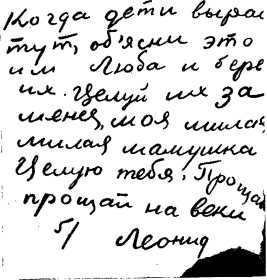
p It’s all over, either today or tomorrow I’ll be shot like the hundreds of others shot since September 1. Please believe me I go to my death for your sake because I love you and the children more than anyone ever loved. I’ve had a good deal of chances to taste freedom but I didn’t take them out of love for you and the children. When the children grow up, please explain that to them. Kiss them for me, my darling, darling Shura.
Love and kisses to you. Bye-bye forever,
Leonid
LEONID VINER’S NOTE
p September 14, 1943
p We die like heroes.
p Address: 26 Baranov St., Block 4, Voznesenka.
p Whoever finds this, get it to my children.
p All those in Gonchar’s group were shot on 14.IX.43.
Viner
The last page of L. Viner’s letter from prison to his wife
167
In April 1942, in the town of Zaporozhye in Orjonikidze District, an underground group was formed mostly made up of workers from Zaporozhstal, the local steel plant. Its ringleaders included Leonid Viner, A. Girya, Boris Zhivenko, Y. Ovsyuk (Kryukova), N. Stribkov (N. Khristenko) and A. Fokin. Leader of the group was Nikolai Gonchar. By June 1943 there were several dozen fighters in the group busy organising acts of sabotage, gathering arms and ammunition, distributing leaflets with news, arranging prison escapes and providing the escapees with clothing, food and false documents. Wireless sets hidden in the flats of Girya and Zhivenko supplied the group with Soviet news bulletins. In the summer of 1942, the conspirators built a secret tunnel in a well in Gonchar’s yard. There they concealed their arms, literature and typed out leaflets.
Leonid Viner
p The group did all they could to prevent their plant from being destroyed. To this end they got Gonchar appointed to the post of superintendent of the factory police. With his influence, Girya and other underground men were accepted into the factory police.
p On June 28, 1943, forty of the group were given away due to poor conspiration technique and taken in custody. This terrible blow took off Gonchar, Viner, Girya and Zhivenko among others. When their flats were searched the wireless sets and secret passage came to light.
p On September 14. 1943, the group’s leader, Nikolai Gonchar, chief of operations Leonid Viner, Girya, Zhivenko and a number of other active members were shot after several sessions of excruciating torture. Before their death, the fearless patriots wrote letters home from the Gestapo prison. The two letters above safely reached their destination. Viner’s note to the Soviet people was later found on him by other underground fighters after the shooting.
168
p
LETTER
FROM FLYER GRIGORY BEZOBRAZOV TO HIS SISTER
p September 19, 1943
p Greetings Vera,
p This evening I got a telegram from the High Command in Moscow congratulating me on the high award of Hero of the Soviet Union!
p You can well imagine I’m as pleased as punch!
p The higher the decoration the harder it is to earn it, that’s why I’m doubly gratified. I know I’ve done some decent scrapping and I’m still putting up a good show to set our Soviet land free. And I shall continue to fight, burn and set fire to the nazis, as befits a hero!
p Greetings to all my pals and acquaintances.
p Very best wishes to you. Looking forward to a warm welcome home.
Yours,
Grisha
p Grigory Bezobrazov was born on January 11, 1919, into a poor peasant family living not far from Kaluga. After secondary school he was accepted into the Krasnodar Air Force Cadet School. In 1940, the young graduate, with the rank of lieutenant, was posted to one of the air units in Byelorussia.
War broke out___ In the arduous years of war, his character matured and will-power steeled battle after battle. His pin-point bombing sent enemy ammunition dumps in the Volga battles into the air, set nazi tanks near the Vistula on fire and smashed fortifications near Berlin. By early 1943, Grigory Bezobrazov had 250-odd sorties to his credit and had dropped thousands of tons of destructive metal onto the heads of the nazis.
169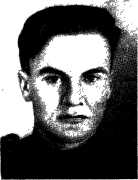
Grigory Bezobrazov, Hero of the Soviet Union
p By decree of the Presidium of the Supreme Soviet of the U.S.S.R., September 18, 1943, Senior Lieutenant Grigory Bezobrazov was made Hero of the Soviet Union.
p His daring sorties continued to pester the retreating enemy. On April 18, 1944, the courageous flyer set his bomber on a course for Berlin. But his plane did not return from its mission. II happened like this.
p On that day Soviet bombers, with their flight commander Bezobrazov at their head, took off for a bombing raid over one of Berlin’s outlying railway stations, where a large number of soldiers and equipment were concentrated. The bombers reached its destination without mishap. Grigory Bezobrazov saw through his bomb sight armoured gun platforms, hastily covered with a camouflage net, and the tiny, dark figures of the panicking soldiers. Almost immediately fires flared up down below, rubble of iron was blown skywards, bombs and ammunition began to explode. It looked as if the tornado of fire started by the bombs had scorched the very earth under the Germans’ feet.
p Mission accomplished, the bombers turned for home. But an antiaircraft shell had pierced Bezobrazov’s plane and it caught fire. Smoke poured into the cabin and clouded over the instrument panel and windscreen. It became difficult to observe the ground and the sky. The crew could hardly breathe. .. .
Grigory Bezobrazov could have bailed out of his burning plane. But the enemy was waiting below. The Hero of the Soviet Union took another decision. The bomber, engulfed in flames, dived down into a cluster of nazi machines.
Notes
| < | > | ||
| << | >> | ||
| <<< |
INSCRIPTION AND LETTER HOME
FROM INTELLIGENCE GIRL ZOYA KRUGLOVA |
ALEX. KUZNETSOV'S NOTE
FROM GRANKI DEATH CAMP |
>>> |