Emacs-File-stamp: "/home/ysverdlov/leninist.biz/en/1965/LFD232/20070221/099.tx"
Emacs-Time-stamp: "2010-01-19 11:19:47"
__EMAIL__ webmaster@leninist.biz
__OCR__ ABBYY 6 Professional (2007.02.21)
__WHERE_PAGE_NUMBERS__ bottom
__FOOTNOTE_MARKER_STYLE__ [*]+
__ENDNOTE_MARKER_STYLE__ nil
[BEGIN]
__TITLE__
Letters
from the Dead
__TEXTFILE_BORN__ 2007-02-21T23:59:22-0800
__TRANSMARKUP__ "Y. Sverdlov"
__SUBTITLE__
LAST LETTERS
FROM SOVIET MEN
AND WOMEN WHO DIED
FIGHTING THE NAZIS
( 1941 -- 1945 )
 PROGRESS PUBLISHERS
•
MOSCOW
PROGRESS PUBLISHERS
•
MOSCOW
'B&Hii 8 •»'•• *•
[1]
LETTERS FROM THE DEAD
From these pages speak out the dead, those who died
fighting the nazi invaders between 1941 and 1945. This is a
collection of their letters and documents written in the last
minutes of their lives-in a Gestapo cell, a concentration camp
or in the heat of battle. Here is a passionate call for triumph
over fascism and world reaction, an appeal to those who
survived to carry on the fight for mankind's future
happiness, for eternal peace among all men.
These words of farewell written by Soviet partisans,
underground fighters, soldiers, girls and boys driven into
captivity, give an exceptionally penetrating insight into the Soviet
character---the moral integrity, faith in victory, hatred for the
foe and fervent patriotism.
__COPYRIGHT__
First printing 1965
__TRANSL__
TRANSLATED FROM THE RUSSIAN BY JIM RIORDAN
[2]
CONTENTS
TO THOSE WHO SURVIVED (Introduction)........ 9
INSCRIPTIONS ON THE WALLS OF THE BREST FORTRESS
June 22-July 20, 1941...............17
NOTE FROM JUNIOR LIEUTENANT NIKOLAI SINOKOP
June 22, 1941..................20
TESTAMENT BY BINA LURJE, A PRIVATE OF THE 1ST
LATVIAN VOLUNTEER REGIMENT. August 26--28, 1941 ... 22
EXTRACTS FROM PROF. LEONID KULIK'S LETTERS TO
HIS WIFE. October 21--28, 1941............24
LETTER FROM GUNNER-SCOUT ARKADY POLUEKTOV
October 1941...................27
LETTER FROM SOVIET SAILORS DEFENDING THE MOONZUND
ISLANDS. Late October 1941.............28
LETTER FROM POLITICAL INSTRUCTOR NIKOLAI GATALSKY
TO HIS FAMILY. Not later than November 13, 1941 .... 30
NOTE AND LETTER FROM PARTISAN VERA PORSIINEVA TO
HER MOTHER. November 29, 1941..........32
NOTE FROM NAVAL MACHINE-GUNNER ALEXEI KALUZHNY.
December 20, 1941................34
VOW BY IVAN ANDROSOV. December 1941........35
LETTERS FROM LAZAR PAPERNIK, ASSISTANT POLITICAL
INSTRUCTOR OF A SKI DETACHMENT.........36
APPEAL FROM IVAN BALABANOV, JUNIOR POLITICAL
INSTRUCTOR OF A MOTORISED BATTALION. January 28, 1942 40
LETTER FROM SERGEANT YAKOV BONDAR TO HIS UNIT
PARTY ORGANISATION...............42
TESTAMENT BY PRIVATE STEFAN VOLKOV. Not later than
February 12, 1942.................43
3
NOTE FROM SOLDIER ALEXANDER VINOGRADOV .... 44
TESTAMENT LETTER AND NOTE HOME FROM LEONID SILIN.
August 30, 1941-March 7, 1942............46
LAST ISSUE OF A HANDWRITTEN NEWSSHEET OKOPNAYA
PRAVDA PUBLISHED BY YOUNG PIONEER VALERI VOLKOV.
Beginning of 1942.................52
NOTE FROM YEVGENIA BAGRECHEVA, SECRETARY OF
UNDERGROUND PARTY ORGANISATION, TO HER MOTHER. Not later
4
VASILY KRIVOPUSTENKO'S INSCRIPTION IN A
NOVOCHERKASSK GESTAPO CELL. September 26, 1942.......86
FROM A NOTE WRITTEN BY THREE DEFENDERS OF
LISICHANSK. September 28, 1942...........87
LETTERS FROM NIKOLAI STASHKOV, SECRETARY OF
DNEPROPETROVSK UNDERGROUND REGIONAL PARTY COMMITTEE 88
NOTE FROM THREE SOVIET GIRL-SCOUTS FROM A GESTAPO
GAOL IN PSKOV. October 17, 1942..........92
LETTERS FROM KONSTANTIN ZASLONOV, COMMANDER OF
ORSHA PARTISAN BRIGADE.............94
NOTE FROM SEVENTEEN BYELORUSSIAN PARTISANS.
December 3, 1942.................98
LETTER AND NOTES FROM GEORGI SAVCHENKO, LEADER OF
DNIEPROPETROVSK UNDERGROUND.........99
LETTERS FROM MINSK RESISTANCE FIGHTERS IVAN KOZLOV
AND GEORGI FALEVICH..............103
INSCRIPTIONS ON THE WALLS OF PRISON BARRACKS IN
CHISTYAKOVO, DONBAS. Late 1942..........107
NOTE FROM NIKOLAI BUKIN, ONE OF THE KHERSON
UNDERGROUND LEADERS. Early 1943............109
NINA POPTSOVA'S LETTER FROM PYATIGORSK GESTAPO
DUNGEON. January 6, 1943.............Ill
LIDIA BELOVA'S LETTER FROM NIKOPOL PRISON. Not later
than January 7, 1943................113
NOTES AND INSCRIPTIONS MADE ON THE WALLS OF PRISON
CELLS BY MEMBERS OF THE YOUNG GUARD. Not later than
February 9, 1943.................115
INSCRIPTION ON A Y.C.L. CARD BELONGING TO SERGEANT
GRIGORY KAGAMLYK. February 9, 1943........120
NOTE OF FOUR DEFENDERS OF VOLCHANSK. Late February
1943......................122
LETTER FROM MEDICAL ORDERLY VALENTINA KOLESNIKOVA.
Not later than March 3, 1943............124
LETTER FROM 15-YEAR-OLD KATYA SUSANINA. March 12, 1943 125
VICTOR CHALENKO'S TESTAMENT. Not later than March 14, 1943 128
LETTERS HOME FROM PARTISAN-SCOUT VALENTIN MALTSEV 129
APPEAL FROM MIKHAIL GUZOVSKY TO THE INHABITANTS OF
OSIPENKO. March 1943...............131
5
than March 19, 1942................
LETTER AND INSCRIPTION WRITTEN BY RZHEV
UNDERGROUND WORKERS ALEXEI ZHILTSOV AND ALEXANDER
BELYAKOV. Not later than March 28, 1942........56
LETTER FROM PYOTR TSURANOV, SECRETARY OF
DUKHOVSHCHINA UNDERGROUND DISTRICT PARTY COMMITTEE, TO
HIS WIFE. April 3, 1942..............58
LETTERS FROM YELENA UBIIVOVK, UNDERGROUND Y.C.L.
WORKER IN POLTAVA, FROM A GESTAPO CELL.....62
FROM THE DIARY OF IVAN MEDVEDOVSKY, MEMBER OF
UNDERGROUND ORGANISATION IN THE VILLAGE OF
CHAPAYEVKA. End of May 1942...........66
VOW BY JUNIOR SERGEANT VASILY AZAROV.......67
LETTERS FROM TWO GOMEL UNDERGROUND MEN-IVAN
SHILOV AND TIMOFEI BORODIN..........68
NOTE AND VOW FROM Y.C.L. SIGNALMAN VLADIMIR
PANKEVICH. Not later than July 23, 1942........71
LETTER FROM YAKOV GORDIENKO OF THE ODESSA
UNDERGROUND.................72
LETTER FROM SENIOR LIEUTENANT Y. CHERVONNY, July 1942 75
NOTE FROM LIEUTENANT LAZAR DZOTOV. August 15, 1942 . 79
LETTER FROM TANK-DRIVER GEORGI LANDAU. Not later than
80~
August 20, 1942
NOTE FROM CADET IVAN SHESTOVSKIKH. August 23, 1942 . 81
NOTE FROM BATTALION COMMISSAR IVAN SHCHERBINA TO
THE INFANTRY DIVISION COMMAND. September 17--18, 1942 82
LETTER FROM GUARDS MAJOR DMITRI PETRAKOV TO HIS
DAUGHTER LUDMILA. September 18, 1942.......84
LETTER HOME FROM PARTISAN-SCOUT OLGA RZHEVSKAYA.
February 22-April 6, 1943..............132
LETTERS FROM MEMBERS OF THE UNDERGROUND Y.C.L.
ORGANISATION IN DONETSK............136
NOTE FROM SERGEANT TIKHON BURLAK. Not later than
June 1, 1943...................141
LETTER FROM PARTISAN COMMANDER VASILY SHIMANSKY
TO HIS WIFE. Not later than June 1, 1943........143
NOTE FROM FIVE DEFENDERS OF GLAZUNOVKA.....146
NOTE FROM Y.C.L. GIRL MARIA KISLYAK FROM KHARKOV
GESTAPO GAOL. Not later than June 18, 1943.......147
FROM A LETTER WRITTEN BY INTELLIGENCE MAN NIKOLAI
KUZNETSOV. July 24, 1943.............149
INSCRIPTION BY MARINA GRYZUN ON THE WALL OF HER
CELL. July 28, 1943................152
LETTER HOME AND NOTE FROM ALEXANDRA POSTOLSKAYA 153
LETTER FROM JUNIOR LIEUTENANT LEONID KURIN TO HIS
SISTER. Not later than August 15, 1943.........155
NOTE FROM THE GUARDS LIEUTENANT MIKHAIL PANCHENKO.
Not later than August 18, 1943............158
LETTER FROM MEDICAL ORDERLY VALERIA GNAROVSKAYA 159
LETTER FROM SOVIET P.O.W.S IN THE CHISTYAKOV WAR CAMP 161
INSCRIPTION AND LETTER HOME FROM INTELLIGENCE GIRL
ZOYA KRUGLOVA. Not later than September 9, 1943 .... 162
LETTERS FROM MEMBERS OF THE ZAPOROZHYE
UNDERGROUND ....................165
LETTER FROM FLYER GRIGORY BEZOBRAZOV TO HIS SISTER.
September 19, 1943................168
ALEX. KUZNETSOV'S NOTE FROM GRANKI DEATH CAMP. Not
later than September 22, 1943............170
LETTER FROM IRINA MALOZHON. Not later than October 1943 171
LETTER FROM LIEUTENANT GLUKHOV TO HIS GIRL-FRIEND.
Not later than December 5, 1943............172
SERGEANT NAZAROV'S LETTER TO HIS GIRL-FRIEND.
December 5, 1943.................174
LIEUTENANT TARASENKO'S LAST LETTER. December 1943 . . 176
TESTAMENT OF TANK COMMANDER JUNIOR LIEUTENANT
GEORGI MOROZ. Not later than January 5, 1944.....178
6
CAPTAIN MASLOVSKY'S TESTAMENT TO HIS SON. January
4, 1944.....................180
PASHA SAVELYEVA'S INSCRIPTION ON THE WALL OF A DEATH
CELL IN LUTSK. January 1944............183
GUNNER VADIM USOV'S BATTLE PLEDGE. February 20, 1944 . 184
LETTERS FROM TANK COMMANDER VADIM SIVKOV AND
WIRELESS-OPERATOR PYOTR KRESTYANINOV......186
NOTE AND INSCRIPTION BY TANK COMMANDER ALEXANDER
DEGTYAREV...................189
WALL INSCRIPTIONS IN TIRASPOL GESTAPO CELLS .... 190
WALL INSCRIPTIONS IN TALLINN GESTAPO GAOL. May 1942
to April 1944 ,
192
LETTERS FROM RIGA UNDERGROUND LEADER IMANT
SUDMALIS TO HIS WIFE AND CHILDREN........
194
VOLODYA USTRITSOV'S NOTE FROM A NAZI GAOL IN PESHIN.
May 26, 1944..................
198
EXCERPTS FROM NOTEBOOK OF ARTILLERY OFFICER IVAN
ALEXEYEV....................
200
LETTERS FROM SIGNALMAN OLEG NECHITOVSKY. May 1944
201
ALEXANDER MOKSHIN'S NOTE. June 1944........
203
INSCRIPTIONS IN THE LAMSDORF PRISON CAMP.....
204
LETTER FROM RIGA UNDERGROUND FIGHTER HADO LAPSA
WITH POSTSCRIPT BY EDUARDS INDULEN FROM THE
CENTRAL RIGA GAOL. August 26, 1944.........
205
NIKOLAI SUCHKOV'S NOTE. Not later than September 9, 1944
209
POEMS AND NOTES LEFT BY TATAR POET MUSA JALIL. 1943--44
210
NOTE LEFT BY RESISTANCE GIRL FROM SLUTSK. 1944 ...
215
PAVEL NESMELOV'S LETTER.............
216
VERSES FROM A NOTEPAD FOUND IN SACHSENHAUSEN. 1943
to January 27, 1945................
218
INSCRIPTION IN JUN. LT. IVAN LANDYSHEV'S Y.C.L. CARD.
March 15, 1945..................
224
FROM DIARY OF P.O.W. BORIS NOZDRIN........
226
VLADIMIR CHURSIN'S TESTAMENT. April 16, 1945.....
228
PAVEL YABLOCHKIN'S LETTER. Not later than April 25, 1945.
229
LETTER HOME SENT BY SEN. LT. DOLGOV, COMMANDING
OFFICER OF A TANK COMPANY. Not later than May 2, 1945
231
[7]
~
[8]
__ALPHA_LVL1__
TO THOSE WHO SURVIVED
Those heroic and tragic war years 1941--45 are gradually
fading into the past. But the further they get from us and the
more the war wounds heal, the better perspective we have on
the titanic efforts of their victims.
Mankind will never forget them, those who gave their lives
to save others from slavery, to shield human civilisation and
bring long-awaited peace.
Dear reader, you have before you a collection of documents
left by Soviet patriots who died for the liberation and
happiness of their country. Most of these letters, testaments, diaries
and notes were written just a few days, hours or even minutes
before death in a nazi prison cell, on the battlefield or in the
rear.
These deeply-moving and awe-inspiring last lines cannot
but induce a feeling of pride and admiration for these brave
men and women. They spared no effort, not even their lives
to safeguard their country's independence, to smash fascism
and the "New Order" in Europe.
During the four years of their struggle against a formidable
and ruthless enemy, the Soviet people battled with the
Germans on a front stretching from the Arctic Ocean to the
Black Sea.
The war demanded countless sacrifices. The nazis were
sweeping aside all life and freedom that lay in their path,
were despoiling and trampling underfoot the dearest and most
precious human values. Hitler's men overran Europe to bleed
white Soviet people and make them subservient to the German
bankers and industrial magnates.
Once in the hands of their executioners, many men and
women courageously withstood all trials and torments,
9
preferring to die by enemy bullet rather than betray a
comrade. Through the innumerable acts of heroism we can
feel the unbroken spirit, the intrepid faith in victory over
fascism, the supremacy of communist over fascist ideas.
At first losses were many and defeats common. In defence
Soviet troops stood firm, then switched to the offensive driving
the nazis from the country and bringing freedom to Europe
and liberation from the nazi terror. No matter where the
combat, Soviet patriots fought to the bitter end. And they won.
On the field of battle, in a prison cell or in a partisan
dugout, many of them jotted down their innermost thoughts and
noble feelings. Some used their old letters, some a scrap of
paper, others their Party or Y.C.L. card, their handkerchiefs
or head-scarfs to write to their near and dear ones, to their
comrades-in-arms of their faith in victory and readiness to lay
down their lives for a happy future.
From these pages speak the fearless warriors who were the
first to bar the way to the nazi forces. On the Western frontier,
close to the Ukrainian village of Paripsa, some 136
borderguards bore the brunt of a first assault. For an hour and a
half they held at bay 16 tanks advancing along the
ZhitomirKiev highway. Junior Lieutenant Sinokop took a scrap of
paper and wrote what was to become a solemn pledge to all
who fell in battle: "I'm going to die for my country. The
enemy won't take me alive.''
We do not know the names of the other border-guards.
What we do know is that they were all staunch heroes.
Then come the brief notes from the Brest Fortress defenders:
``There were five of us: Sedov, I. Grutov, Bogolyub,
Mikhailov, V. Selivanov. We beat back the first attack on
22.VI.41 at 3.15. We shall die but not retreat!''
``We'll die but won't desert the fortress.''
``I am dying but won't surrender! Farewell, my country.
20/VII-41.''
Many hundred miles separate Brest from Moscow, but this
is where the main nazi drive on Moscow started. And it was
here that a few hundred valiant men made a last ditch stand
in their fortress and brought a German division to a halt for
a whole month. As they shot their last rounds, the defenders,
shedding their blood but never their courage, wrote their final
words on the fortress walls, words of tenderness to their
families, their country and their Party. So it was everywhere.
10
Everywhere sons and daughters gave their last breath to save
their homeland from the nazi marauders.
As they faced their executioners the authors of these notes
met their death with heads raised high.
``... Today, tomorrow-I don't know when-they are going
to shoot me because I cannot go against my conscience,
because I am a Komsomol girl. I'm not afraid to die and I shall
die calmly,'' wrote Yelena Ubiivovk, one of the members of
a big underground organisation in Poltava. All she regretted
was that she had been able to do so little in her 20 years.
Another letter is by young Communist Ivan Kozlov, a key
member of the Minsk underground caught by the Germans.
He spent two months in prison under constant torture and
interrogation. But nothing could break his will. Just before
his execution he wrote to his comrades: "No tears. No despair.
Our blood won't be shed in vain.
``Have courage, be brave, don't be afraid and never despair.
``I would give anything to live and get revenge on these
savages! That you must do. If only I were able.. .. You can
bet your life I would have slaughtered these dirty swine.. . .
Yet only a couple of years ago I was too scared even to carve
a little chicken....''
Many people volunteered to remain behind the lines and
eagerly carried out the responsible work they were given.
With heavy heart, Leonid Silin bade farewell to his home.
Like many other patriots he volunteered for the front. War
is cruel. In his last note to his wife and children he wrote:
"I want to hug and kiss you for the last time. Today I am
to be shot by order of the German Command.... I die for my
country, for our Party, for all Russians, Ukrainians,
Byelorussians and all other people in the land, and for you. Love
our country like I loved her, fight for her like I have and, if
need be, die for her like me!''
Among the heroes who fought until their last breath on the
approaches to Moscow were soldiers under the command of
Alexander Vinogradov. They barred the way to the
swastika'd tanks. "Three of us left: Kolya, Volodya and I,
Alexander. ... There goes another-Volodya from Moscow.
The tanks keep coming at us. Only two of us now. But we
shall hold out as long as we can... . Now there's only me,
wounded in the head and arm. But we've knocked out more
tanks. That makes 23 of them.''
11
Here is a strength of character that will never die: three,
two, one, mortally wounded, and 23 tanks are put out of
action. There must have been many heroes like Alexander
Vinogradov and his comrades or the famous 28 Panfilov men
who fought to the last man.
The poet-martyr and hero Musa Jalil, executed in a Berlin
prison, wrote this spirited call to battle:
Today the last of my songs I sing:
The axe hangs over my head.
It was songs that taught me freedom to prize.
Now they bid me to die like a fighter.
My life was a love-song that soared to the skies;
Let my death be the battle-song of a fighter.
Some of Jalil's poems were preserved and returned to the
Soviet Union by a member of the Belgian Resistance
Movement who had shared a cell with the poet. In this and many
other ways anti-fascists from all over Europe joined hands
and forged an unshakable friendship. Languages of many
nations are inscribed on the walls of the "Death Fortress" set
up by the Germans just outside Kaunas. "Keep up your spirits
even in this cess-pit. Victory is ours! Workers of the world,
unite !"-words in Russian, Rumanian, French and English,
scrawled on the solitary-cell wall in the Tiraspol Gestapo
prison.
By their bravery and sheer guts. Soviet heroes became an
inspiration to anti-fascist fighters the world over.
__b_b_b__
As you read these letters you cannot help appreciating the
lofty ideals and communist principles which have always
motivated the actions of the best people of the Soviet land.
They have faith in the coming of a society without wars or
plunder, a love for communism and their homeland, a desire
for comradeship and friendship among all nations.
The thoughts of the Soviet people in prison cells often
turned to the past, weighing up the good and the bad and
passing judgement on themselves. These are quite ordinary
men and women and when the time came for heroism they
did not flinch. They gave all they could for victory and did it
as a matter of course. And the knowledge that they were
laying down their lives for the people lightened their cruel
12
fate. Almost everyone of the letters mentions this. These
anti-fascist warriors used the slightest opportunity to inform
the folks at home, their comrades and countrymen that Hitler's
hangmen had not broken their will. They called out to those
alive to mercilessly crush their murderers.
Riga underground hero Imant Sudmalis and Donetsk
Komsomol and underground leader Savva Matekin both bear
witness to this undying faith and iron will.
``When I look back over the days gone by, I have nothing
to reproach myself for,'' wrote Imant Sudmalis in a Gestapo
dungeon before he was hanged. "I acted like a man and a
fighter in those fateful days.''
While waiting to be shot, Savva Matekin shared his last
thoughts with his wife: "What can a man do when he is in the
death cell? All the same they're scared of me. Tell that to
our people....''
At the time of the country's most harrowing tribulations,
thousands of people became giants among men and appeared
to the world as titans moulded from head to foot of pure steel.
``The horrors of war must never return! Peace will triumph
and life will prosper again!" That was the wish of these
legendary heroes. We shall never forget them. And we must
ensure their last wish is observed.
Every letter has its own story. Before they arrived in this
collection most of them travelled a hard and often perilous
journey, through many hands, along the rutted roads of war.
Keeping them often entailed mortal danger for those behind
the lines. They preserved them as their most precious
possession. Many similar letters were consumed in the flames of war
and, no doubt, more than a few still lie undiscovered.
These letters, notes, inscriptions on walls, diary excerpts,
etc., are presented in chronological order and divided into
sections where they happen to be connected by one particular
place or author, in which case they are arranged according to
the date of the last letter.
Each letter has a short note on its author and the conditions
under which it was written.
[13]
~
[14]
You may die, but in the song
of the brave and the strong in
heart, you will forever be a
living example, a proud appeal
for liberty and reason.
Maxim Gorky
[15]
~
[16]
__ALPHA_LVL1__
INSCRIPTIONS
ON THE WALLS OF THE BREST FORTRESS
June 22--July 20, 1941
There were five of us: Sedov, I. Grutov, Bogolyub,
Mikhailov, V. Selivanov. We fought the first attack on
22.VI.1941 at 3.15. We shall die but not retreat!
We'll die but won't desert the fortress.
I am dying but won't surrender! Farewell, my country.
20/VII-41.
__b_b_b__
The defence of the Brest Fortress^^*^^ between June and July 1941 has
gone down in history as an immortal act of valour by Soviet soldiers
who, though fighting against countless odds, held off many enemy
assaults and never surrendered.
Against the fortress manned by only a small garrison, the nazi
High Command used its 45th Infantry Division which included nine
light and three heavy artillery batteries and was reinforced by the
27th Artillery Regiment, plus nine howitzers and heavy mortars.
Despite the advantage gained by their surprise attack the Germans
failed to take the fortress by storm. Appreciating the gravity of the
situation, the fortress officers rapidly rearranged command over the
defence operations. On the third day of battle, June 24, 1941, Order
No. 1 was issued to the garrison. It stated that the situation demanded
a unified command and co-ordinated action against the enemy, that
all the remaining forces were to be combined into a single group
under the command of Captain Ivan Zubachov, with Regimental
Commissar Yefim Fomin as his political assistant.
_-_-_
^^*^^ For the whole amazing story of the Fortress defenders, see
Heroes of Brest Fortress, S. Smirnov, Progress Publishers, Moscow.
__PRINTERS_P_17_COMMENT__
2---3928
17
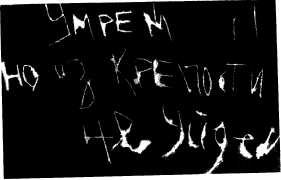
~
An inscription on the wall of the Brest Fortress
~
The fortress defenders were still beating off enemy attacks when
on June 27 German tanks entered Minsk, the Byelorussian capital.
When, on June 16, practically a whole month after the outbreak of
war, the ancient Russian town of Smolensk fell, the Brest Fortress
still stood as a redoubtable bastion deep in the rear of Hitler's armies
and, cut off from the rest of the world (their wireless was put out
of action in the first few days), they still held out using grenades,
rifles and machine-guns to beat back the frantic enemy. There was
no water, food supplies were running out, but the fortress defenders
gave no thought to surrendering.
When the plan to take the fortress by infantry attacks failed, the
12th German Corps commanders concentrated artillery fire from the
neighbouring 31st and 34th divisions on the fortress. Mass bombing
raids continued. But the men still thwarted the Germans. And in
answer to the enemy's offer to them to surrender, a strip of cloth was
hung from one of the fortress walls. On it were the words in blood:
"We shall all die for our country, but we won't surrender!''
Even the nazis, who had conquered almost all Europe, were struck
by the firmness and courage of the Soviet men and women in the
fortress. Among the captured staff papers of the 45th German Infantry
Division a battle report was discovered which contained the following
acknowledgement:
``Overwhelming attacks on a fortress defended by a courageous
garrison cost a lot of blood. This simple truth has been proved yet
again in the capture of the Brest Fortress. The Russians in
BrestLitovsk fought with exceptional stubbornness and determination, they
displayed superb infantry training and a splendid will to resist.''
18
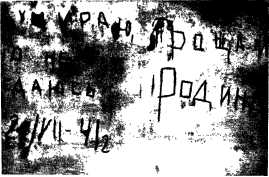
~
An inscription on the barrack wall of the Brest Fortress
~
Most of the valiant defenders of the Brest Fortress met their death,
including the commanding officers. Yefim Fomin, seriously wounded,
was captured by the Germans and shot. Captain Zubachov died in a
German concentration camp.
In the liny group of defenders who did come out alive was Brest
hero Major Pyotr Gavrilov, former CO of the 44th Infantry Regiment.
It was Gavrilov, more dead than alive, who led the last battle.
Wounded and shell-shocked, he fell into nazi hands. German officers
respectfully regarded him as a man of uncommon persistence and
faith in victory.
Excavations among the ruins of the fortress unearthed the remains
of soldiers, banners, guns and personal papers. Many inscriptions
made by the heroic defenders have been found on the stone arches,
walls and stairs.
[19]
__ALPHA_LVL1__
NOTE
FROM JUNIOR LIEUTENANT
NIKOLAI SINOKOP
22 June 1941
Ass. Com. Border-Post, Junior Lieutenant Nikolai Sinokop.
Bobrik village, Romensk District, Sumy Region.
I'll die for my country. The enemy won't take me alive.
22.6.41.
__b_b_b__
Nikolai Sinokop was born into a peasant's family on June 5, 1918,
in the village of Bobrik in Sumy Region. In 1938, he was called up
to serve in the Red Army. Two years later he was commissioned to
Junior Lieutenant and appointed assistant commander of a
borderpost on the western frontier of the Soviet Union.
At the outbreak of war, the border-guards were the first to bear
the brunt of the nazi attack. Many fierce battles took place between
the men guarding the frontier and the leading German units. The
enemy had immense advantage and was supported by tanks and
artillery. The dauntless border-guards had nothing to repulse the assault
with but machine- and submachine-guns and rifles. Despite the heavy
odds the guards put up staunch resistance to the tanks.
Like thousands of his frontier comrades, Komsomol member
Nikolai Sinokop found himself in the heat of the battle in the very first
hours of the war. It was then that he vowed to fight to the last breath
and not let the enemy through. He took off his medallion^^*^^ and wrote
the words of his pledge on the same paper as his name and place
of birth.
_-_-_
^^*^^ Identity cylinder, a plastic cylinder used in the Soviet Army as
an identification disc.
20
After stubborn, bloody and grossly unequal pitched battles with
the enemy, the surviving border-guards had to retreat eastwards.
Combining in a foot-column of about two hundred men they made their
way along the Zhitomir-Kiev highway.
On July 13, 1941, somewhere between 10 and 11 a.m., the column,
which had left the town of Skvir and was heading for the village of
Popelnya, was overtaken by 16 nazi tanks. On the outskirts of Paripsa
(some 3 miles from Popelnya) the guards decided to engage the
enemy. At a signal from their commanding officer the soldiers quickly
fanned out over the village vegetable plots and dug in. One group
under Jun. Lt. Sinokop lay in wait on a small hill to the north-west
of the village. Without any anti-tank weapons, the border-guards
fearlessly battled it out on the open ground with the black-swastika'd
tanks for an hour and a half. But the odds were too great.
After the battle, peasants from neighbouring villages picked up
among the deserted and burning tanks and buried 136 dead
borderguards. Among the papers discovered on the dead men was this note
folded inside Jun. Lt. Sinokop's identification cylinder.
[21]
__ALPHA_LVL1__
TESTAMENT
BY BINA LURJE, A PRIVATE OF THE 1ST LATVIAN
VOLUNTEER REGIMENT
August 26--28, 1941
TESTAMENT
Please convey this to my mother Mrs. Lurje, an evacuee
from Latvia, now living in Kirov.
I die for my country, for communism. It's two months now
since this fierce battle with the enemy began. For me the last
stage of the fight has now come-the battle for Tallinn. There
can be no retreat.
It's hard to die at 24, but for such a worthy cause, when
millions of lives are held in the balance of history, I, too, give
my life, knowing that future generations and you who remain
among the living, will honour and remember us as the world's
liberators from a horrible plague. What more is there to write?
Mum,
Don't take it too badly.
I'm not the first nor the last to give my life for communism,
for my country.
Long live the U.S.S.R. and victory over the enemy!
Y.C.L. member of the Latvian
~ ~ ~ ~ Regiment
~ ~ ~ ~ ~ ~ ~ ~ ~ ~ ~ Bina Lurje
22
__NOTE__ This blank space exists between two pages (due to font size change).
__b_b_b__
The 1st Latvian Volunteer Infantry Regiment, formed in the very
first days of the war and attached to the 8th Army took part in those
furious defensive battles against the German assault on Latvia and
Estonia in the summer of 1941.
In August 1941, together with other Army and Navy units, the
regiment defended Tallinn, the capital of Soviet Estonia.
Bina Lurje served in this regiment.' Back in bourgeois Latvia he had
been a fighter for his people's liberation. The Ulmanis court had
sentenced him to penal servitude for his communist activities. But
that did not crush the young patriot's will. When the Soviets set him
free in 1940 he gave himself fully to his work, even though he was
a sick man.
As soon as war broke out, Bina Lurje joined the volunteers. He
defended Tallinn to his last round, to his last drop of blood, and was
killed in the street fighting. The memory of this brave and dedicated
man left a deep trace on the minds of his comrades.
After his death, his comrades-in-arms discovered in his pocket
this testament placed in his Y.C.L. card.
[23]
__ALPHA_LVL1__
EXTRACTS FROM PROF. LEONID KULIK'S
LETTERS TO HIS WIFE
October 21--28, 1941
October 21, 1941. District village of Vskhody,^^*^^
Smolensk Region
Autumn is waning; the rooks have departed;
The forest stands naked, the fields lie deserted.
Bleak, windy and rainy. The snow has melted, the last leaves
on the trees rustle and float through the air one by one. There
isn't a soul about in the village, people are hiding in the few
decent houses left. All that lives is the highway teeming with
German vehicles of all shapes and sizes. And sometimes there
are long columns of prisoners.
Grief has cast her shadow over our country.
What am I? Who am I?
First of all I am wounded. My leg wound is improving,
but slowly, since I'm on the go from morning to night as I
am, in the second place, a medical instructor. To put it plainly,
I'm medical orderly in an infirmary for the Soviet wounded in
the village of Vskhody.
First I was on the dressings and operations and also a
kind of general help. Now they have put me in charge of the
general anaesthetic during operations and attached me to the
children's ward. It has six patients: Manya, Nina, Panya (all
3-5 years old), Vanya (12), Dusya and Polya (17).
_-_-_
^^*^^ In this village the Germans set up a ``hospital'' and left Soviet
wounded soldiers to die there.
24
October 28, 1941
. .. Dead of night. A thick, putrid stench of festering
wounds... . The close, oppressive, sticky air is filled with
groans, animal-like wailing, wild shrieks... . It's unbearably
stuffy. In the dim light from the splinter painfully glistens
the blue eye (the other is smashed) of a boy, a good boy, his
stomach ripped open by a shell splinter.
__b_b_b__
Leonid Kulik was born in 1883. After leaving school he studied at
Kazan University. But he was not to finish his studies. He was in
charge of an organisation of the Russian Social-Democratic Labour
Party. On instructions from the Bolshevik centre he carried out a
raid on a tsarist prison to liberate a condemned revolutionary. The
bold plan paid off but Kulik himself was arrested and exiled to
Orenburg Gubernia.
There he worked as a forester's assistant, which suited him well
since he was a great nature lover. He collected minerals, studied
plant life and geology and became an expert on mineralogy,
ornithology and botany.
After the 1917 Revolution his work and knowledge were widely
recognised and he became Scientific Secretary to the Meteorite
Commission of the U.S.S.R. Academy of Sciences. He journeyed all over
the country in search of meteorites.
He was particularly fascinated by the riddle of the Tunguska
meteorite. He gave twenty years of his life to this problem, during
which time he made countless expeditions to the place where the
giant Tunguska meteorite had fallen. These were difficult journeys
which entailed much danger and sacrifice, all willingly endured for
the purpose of unravelling the secret.
When war broke out. Prof. Kulik was 60. But he joined the ranks
of the people's volunteer detachments. Neither the Academy of
Sciences nor the entreaties of his colleagues and wife could persuade
him to remain in Moscow. He had made up his mind that his place
was alongside the anti-fascist fighters.
And so, a hard life at the front began for the elderly scientist.
Soviet troops were on the retreat. In the autumn of 1941, during a
battle near Spass-Demensk on the Smolensk plain, a group of men
including Leonid Kulik found themselves behind the lines. They
decided to fight their way back. Soon they ran into an enemy patrol.
In the ensuing skirmish the professor was hit in the leg and lost
consciousness. When he came to, he gritted his teeth and began
crawling eastwards. His leg wound was agonising and he was
craving for water. Once again he fainted. This time he regained
consciousness in a nazi prison camp. Interrogations began. The Germans soon
realised they had a noted Soviet scientist in their hands.
They tried everything to break him down. But they failed.
Kulik got in touch with the villagers and through them with
the partisans. He organised an infirmary in the camp and sat many
25
long nights at the bedside of the wounded doing his best to relieve
their suffering.
The partisans devised a plan for rescuing the professor. But it did
not come off. One hour before the appointed time, the Germans sent
him off to Spass-Demensk where he was pitched into a typhus
barracks.
Here, too, he did what he could to ease the suffering of the
delirious patients. But, faint with hunger, the old scientist's organism was
not equal to it, and on the third day he, too, went down with typhoid
fever. For a long time he raved in a delirium, fighting battles, escaping
from the camp, calling to his wife and daughter, shouting something
to the partisans, cursing the enemy and persuading someone to go
with him in search of the Tunguska meteorite. Death cut short the
scientist's sufferings. On April 14, 1942, Prof. Leonid Kulik passed
away.
[26]
__ALPHA_LVL1__
LETTER
FROM GUNNER-SCOUT ARKADY POLUEKTOV
October 1941
Dear Sasha,
If I die, write to my old people that I died painlessly and
calmly. I hate fascism, I hate the bloody, plundering and
murdering fascist scum. And if I had a second life, I'd give
it too. Tell them I'm happy to have fought in this great battle.
Farewell, don't forget me,
~ ~ ~ ~ ~ ~ ~ ~ ~ ~ Arkady Poluektov
__b_b_b__
In October of 1941, Moscow was in mortal danger. Hitler's armies
had pushed on into Mozhaisk, Maloyaroslavets and Naro-Fominsk,
not far from the capital.
The Naro-Fominsk sector of the front was being defended by the
33rd Army commanded by Lieutenant-General Yefremov. The battle
did not let up day or night. Side by side with the Red Army regular
detachments fought the soldiers of the people's volunteer corps of
the Kuibyshev and Frunze districts of Moscow. The soldiers daily
performed miracles of valour and daring. Every soldier knew that
Moscow lay behind him and that the enemy had to be stopped at all
costs.
In order to spot the enemy's firing points, gunner-scout Arkady
Poluektov was always trying to crawl as close as he could to enemy
lines so that his comrades on the gun batteries could pinpoint their
target. One bleak October day the brave scout was fire-spotting from
his vantage point. Enemy tanks and guns blew up into the air together
with their crews on his directions. But Arkady was to scout no more.
He lay dead, struck by an enemy bullet.
His last letter was written to his friend Alexander Gorbulin.
[27]
__ALPHA_LVL1__
LETTER
FROM SOVIET SAILORS DEFENDING
THE MOONZUND ISLANDS
Late October 1941
Comrade Sailors of the Red Navy,
We, Baltic Fleet sailors on Dago Island, in this critical hour,
vow to our government and Party that we shall fight to the
last man rather than surrender our island.
We shall show the whole world that Soviet sailors know
how to die having done their duty to their country with
honour.
Farewell, comrades.
Avenge our death. Destroy the fascist scum.
Centre. Dago Island, Takhkun Peninsula.
Signed on behalf of us all
Kurochkin, Orlov, Konkin
__b_b_b__
For two months a small garrison on the Moonzund archipelago in
the enemy's rear defended the island of Soviet Estonia. The enemy
had to divert considerable forces to deal with this handful of brave
men who were killing so many enemy soldiers, sinking ships and
shooting down planes.
The last battles took place on the Takhkun horn, the most northernly
tip of Khiuma (Dago) Island. It had fortified positions manned by a
small garrison of sailors. On October 12, 1941, the Germans began
large-scale landings on the island. Some 30 launches headed for the
western beaches, near Nurst. Southwards near Terkma, 15 landing
craft with an infantry regiment on board were hovering off-shore. The
landings were covered by artillery from Sarem Island, from an enemy
28
cruiser and four destroyers, and by terrific bombardment from the
air. The Khiuma defenders opened up on the enemy landing boats.
The shore batteries sank about two dozen craft and launches. But
the nazis brought up more and more reinforcements. Under cover
of darkness they managed to get a landing party ashore and began
to advance.
Soldiers of the 33rd Engineers' Battalion manned the defences of
the southern bank. The battalion's machine-gunners succeeded in
pegging the enemy back. For several days fierce fighting went on all
over the island. On October 17, the island garrison retreated to the
last outpost of defence. It stretched from Tarest to the west, covering
the Takhkun Peninsula.
The Baltic Fleet Command decided to evacuate the island garrison
to Hanko Peninsula. But stormy weather stopped the ships from
putting in at the island. Only on October 19 did the launches succeed
in taking the Khiuma Island defenders off.
Under constant fire and bombardment, a group of sailors covered
the evacuation. Before the last decisive battle the Takhkun defenders
wrote their letter of farewell, pledging to defend their native soil
until their last cartridge, until their last drop of blood. Having sealed
the letter in a bottle, they hurled it into the sea. At the beginning
of the winter of 1941 the bottle was picked up in the open sea by
sailors aboard a Soviet patrol vessel.
[29]
__ALPHA_LVL1__
LETTER
FROM POLITICAL INSTRUCTOR NIKOLAI GATALSKY
TO HIS FAMILY
Not later than November 13, 1941^^*^^
Volkhov~
My dear wife Stanislava, little Valya and mum,
Please excuse my bad writing. I'm having to write on a
scrap of paper perched on my knees. Hurrying to let you
know I'm alive and about to go into battle.
Maybe this letter will be the last, my dear ones. Dear
Stanislava, look after our daughter and care for my mother.
If you don't get any more news from me, you'll know I gave
my life honourably for you and our beloved country.
Best of luck---your husband and father.
Stassya, once again, look after our little girl.
Love to you all,
~ ~ ~ ~ ~ Kolya
__b_b_b__
Nikolai Gatalsky was a regular officer in the Soviet Aimy On
finishing a three-year course :n a military-political school he was
appointed to the 144th Division When war broke out he was
transferred to another unit fighting on the Leningrad Front "The fascists
will never set foot in the city of Lemn,'' he used to tell the men
and always himself headed the counter-attacks
The fighting was at its hottest around Leningrad Gatalsky's
detachment took up the defence of a hamlet called Morozovo On the
_-_-_
^^*^^ Nikolai Gatalsky was killed in battle on November 13, 1941
30
morning of Novcmbei 13, 1941, the nazis began a fierce assault It
seemed that just one moie push and the remaining heroes would be
wiped out But at that moment, the political instructor raised himself
to his full height Behind him rose the others With their last
handgrenades they tore into the enemy shouting ``hurrah''.
When the battle died down, there on the snow, surrounded by nazi
coipses, lay the political instructor. His men buried him on the
outskuts of the village Ini^c volleys rang out Then, Nikolai Gatalsky's
comrades again rushed into the fray
[31]
__ALPHA_LVL1__
NOTE AND LETTER
FROM PARTISAN VERA PORSHNEVA
TO HER MOTHER
November 29, 1941
Tomorrow I die, Mum.
You've lived fifty years, and I only twenty-four, I so much
want to live. How little I've done. I want to live to kill these
hateful fascists. They've tortured me, but I haven't told them
a thing. I know my partisan comrades will avenge my death.
They'll wipe out the invaders.
Don't cry, Mum. I'll die knowing that I've done all I can
for victory. It's no sin to die for the people. Tell all the girls
to join the partisans, be brave and kick these uninvited dogs
out of the country.
Victory is not far off!
__b_b_b__
LETTER TO HER MOTHER
November 30, 1941
My dear Mummy,
I'm writing this letter just before I die. When you get it
I shall no longer be alive. Dear Mum, you mustn't cry over
me, and you mustn't grieve too much. I'm not afraid of
death.. .. Mummy, you are all alone and I don't know how
you will get on without me. I think Zoya will look after you
alright. Anyway, my dear one, you must get along somehow.
Mum, I envy you a little all the same; you've already lived fifty
years, but I have to die at 24, and how much I want to live
and see the future. Never mind, enough of dreaming....
I'll end now, I can't write any more. My hands are
trembling and my head won't work. I've been without food now
32
for two days and nights, but it's easier to die on an empty
stomach. You know. Mum, it's such a pity to die.
Well, never mind. Farewell, my dearest mother. I'd love
to see you all, you, Zoya, dear little Zhenya. If he grows up
to be a man, tell him what his auntie was like. Well that's all.
All my love to you all, and to you. Mummy.
Your daughter Vera.
__b_b_b__
When the enemy had taken the western districts of Kalinin Region,
a wide-scale partisan movement started up.
Vera Porshneva was trained as a machine-gunner and posted to a
partisan unit where she was praised as a fearless and daring fighter.
A little later, she was given instructions to take up work in
German Commandatura, and get all the information she could. She
became the best scout in the partisan unit. Vera was given away by a
traitor and fell into nazi hands. This happened in the hamlet of
Borisovka. For twelve days, the Gestapo interrogated the girl using
all their usual methods.
All without success. Her torturers tried a new trick: they let her
go. Vera made up her mind to hide and later get back to her unit,
but she was closely followed and two days later she was again
seized and thrown into a stone cellar in a barn.
Inhuman tortures began. They forced white-hot needles under her
nails, burnt her breast, drove her half naked into the snow, gave her
neither water nor food. And only
greater and greater hatred welled
up in her eyes, eyes which before
the war everyone had said were
always so kind.
Vera knew death was not
far off, but she didn't
complain. She was confident in
victory over the nazis. All she
grieved for was her mpther. On
a tiny piece of grey paper Vera
wrote a few lines to her, which
bear the pain in her heart,
sober words of comfort and
confidence in a quick victory.
But she didn't manage to get
this note through. Just before
her death she wrote another
little letter which she sewed in
the fold of her coat.
Before they shot her the
brutal Gestapo branded a five--
cornered star on the young
heroine's breast. Vera Porshneva
died on December 21, 1941.
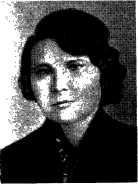
~
Vera Porshneva
~
[33]
__ALPHA_LVL1__
NOTE
FROM NAVAL MACHINE-GUNNER
ALEXEI KALUZHNY
December 20, 1941
My dear country! Dear Russian land! I, a son and pupil of
Leninist Y.C.L., have fought as my heart directed me, I killed
those bastards as long as my heart beat in my chest. I am
dying, but I know we shall win. The enemy won't get into
Sevastopol.
Black Sea sailors! Destroy the fascist mad dogs. I have kept
my sailor's vow.
Kaluzhny
__b_b_b__
By mid-November 1941, the nazi forces had taken all Crimea with
the exception of Sevastopol. The defence of this famous naval town
lasted more than eight months. The enemy bore tremendous losses
in men and weapons. Many brave sailors and naval officers of the
redoubtable Black Sea Fleet met their death during those heroic and
tragic days.
Naval machine-gunner Alexei Kaluzhny fought together with his
comrades-in-arms in pill-box No. 11 located at a crucial point near
the village of Dalny. For three days and nights the bold sailors fought
off fierce enemy attacks. Nazi planes constantly, bombed the pill-box
and it was heavily shelled. Petty Officer S. S. Rayenko, A. V. Kaluzhny,
D. I. Pogorelov, T. Dolya, I. Chetvertakov and others swore not to
budge an inch. Their supplies were running out, smoke was blinding
and choking them. Many sailors lay wounded. On the third night,
November 19, they received some reinforcements-M. N. Potapenko,
K. I. Korol and P. Korzh, bringing with them ammunition, food and
some water. Thanks to this help the brave sailors held out for another
24 hours. But the odds were too great. On December 20, when all
that was left were three gravely wounded sailors, the nazis stormed
the height and overran the pill-box.
A few days later Soviet troops again beat back the enemy. In what
was left of the dug-out they found nine of the fallen heroes. In the
gas-mask bag of the dead gunner Alexei Kaluzhny, they found a
scrap of paper-the sailor's last letter addressed to his fellow
countrymen.
34
__ALPHA_LVL1__
VOW BY IVAN ANDROSOV
December 1941
I go into battle a Communist, and I pledge that I shall fight
bravely, skilfully and worthily, not begrudging my blood and
even my life to wipe out this nazi plague. All I ask is, after
fascism is destroyed, if I am killed, to let my parents know
that I died for Lenin's cause. The address is Tatiana
Androsova, Noviki Village, Malevichesky Village Soviet, Zhlobinsky
District, Gomel Region, Byelorussian S.S.R.
I pledge I shall not leave the battlefield even if I am
wounded as long as I have strength.
Comradely greetings,~
Communist soldier Ivan Androsov
__b_b_b__
In the dark days of October 1941, Hitler's hordes tried to overrun
the old Russian gunsmith town of Tula.
For many days, the soldiers fought a persistent battle against
overwhelming odds.
On December 4 and 5, the town was almost completely surrounded.
All highways linking it up with Moscow and the nearest district
centres were cut off. Only to the north-west of Tula there remained
a narrow strip of land which the enemy forces had not managed to
overrun.
In one of the fierce encounters with Guderian panzer, a brave
young Communist of the 150th Regiment, Ivan Androsov, met his end.
The steel monsters were bearing down on a tiny handful of gallant
soldiers who met them with hand grenades and incendiary bottles.
The first, then the second and third stopped dead and burst into
flames. But more came on. And as they came, Ivan Androsov
hurriedly jotted down the last words he was ever to write. Three sheets
from his notebook were put in his Party card. At the next enemy
rush he hurriedly grabbed at his gun, but an enemy bullet got there
first.
35
__ALPHA_LVL1__
LETTERS FROM LAZAR PAPERNIK,
ASSISTANT POLITICAL INSTRUCTOR
OF A SKI DETACHMENT
LETTER TO HIS SISTER
Late December 1941
Dear little Zina and Leonard,~
Happy New Year. Good luck and good health. I hope 1942
will be a year of happy homecomings after the fascist dogs
have been kicked out of our land, so that we can all meet
again in our dear Moscow.
As you can see from the papers, we are driving the nazi
swine farther and farther from our Moscow, freeing more and
more towns and villages. I've seen tens of people, young and
old, children and old folk, greeting us with tears of happiness
in their eyes.
I know the places we have been through in the past few days.
I recalled the days I worked on building sites in the towns of
Istra and New-Jerusalem; I well remember their buildings
and museums. So it hurts me all the more, it really makes me
boil, to see the way these monsters have smashed it all down,
to see the way these plunderers have carried off everything
of any value.
My dear ones, it's very difficult to get an idea from the
papers of these nazi pigs and of their "New Order".
As assistant political instructor I have had enough
opportunity to witness the consequences of the foul actions of the
36
fascist scum. They're going to have to pay dearly for all
they've done on our land. They'll have to answer for all the
people they've enslaved.
1942 will be a year of complete destruction of these dregs
of humanity, a year of destruction of everything born of the
black plague of fascism.
I'm glad that in these difficult days I am among the
country's defenders. I'm glad I've had a decent training for
my service in the Red Army. All my peace-time hobbies--
skiing, riding, shooting-have come in very handy and I proudly
recall the days when, even though I was overloaded with
work, I trudged off to the gliding school or to the Budyonny
Cavalry School, and my days-off when I went skiing on the
Vorobyovy Hills, even though mum was against it.
A couple of days ago I had a very interesting and touching
meeting in the woods. After a nazi air raid, I was giving a
hand to some comrades from the neighbouring unit, who had
been raked by machine-gun fire, when I heard one of the
wounded calling my name. Just imagine my surprise to see
my old factory and riding school mate, Yasha.
Well, that's all, enjoy yourselves at the New Year. Best of
luck, see you soon in Moscow.
Let me know the birthday of our little sisters, I
remember it's somewhere between January 21 and 25. Let me know
more exactly.
Yours,
~ ~ ~ ~ ~ Lazar
__b_b_b__
__b_b_b__
LETTER HOME
January 6, 1942
Dear Mum and Dad,
Alive, well, everything as before.
I'm doing as you wanted-killing the nazis and liberating
the land for us and you, for thousands of people who have
had to leave their homes.
Love and kisses,
~ ~ ~ ~ ~ Your Lazar
37
__NOTE__ See previous note regarding b_b_b
__b_b_b__
In January 1942, a group of skiers performed an act of bravery
which was soon on the lips of every defender of Moscow.
Twentythree heroes fought and died but did not let the enemy through.
This is how it happened.
Under the blows of the Soviet forces the foe reeled back to the
west, hanging on grimly to every village and hamlet. Bitter fighting
occurred over the town of Sukhmichi which the nazis had turned into
a stronghold.
The detachment of skiers in which Assistant Political Instructor
Papernik was serving, received instructions to drive the nazis out of
the village of Khludnevo and to hang on to it until the arrival
of an infantry unit. It was absolutely vital to deprive the enemy
of a footing here, this being a supply point for the main town
defence.
During the night of January 23, twenty-five skiers made for the
enemy posts. Under cover of darkness the detachment reached the
village without any trouble. Here they found out from local
inhabitants that nazi reinforcements of two light tanks, mortars and
artillery had arrived in the village that evening. The two sides were
rather unevenly matched: 25 Soviet soldiers to more than 400
Germans. Nevertheless the valiant few decided to do their duty at all
cost':.
Carefully spying out the enemy gun emplacements, the Soviet
soldiers picked out their objects for attack.
It was already past midnight when the skiers came within striking
distance and, at their commander's signal, simultaneously let fly their
grenades and opened fire. The resultant panic gave the heroes a
chance to pick off many enemy soldiers and to reach the centre of the
village. But it was not long before the nazis came to their senses
and began to fire back in earnest. Under cover of two tanks the
Germans managed to press back the courageous men to the edge of the
village. The detachment commander, Captain Laznyuk, was badly
wounded. Political Instructor Yegortsev took command. He ordered
one of the soldiers to carry the commander out of range of fire
and then decided to make a dash with the remaining soldiers to
a big timbered barn standing on a hill just beyond the village.
Having taken up their places all round the barn, the skiers got ready
to beat off the tanks. The enemies were closing in. The soldiers
had to retreat into the barn. The fighting went on until morning.
Pravda of February 14, 1942, described this heroic epizode as
follows:
``In the morning the mortars began to shell the barn. . . . One by
one the skiers fell. The Germans wanted to take the rest prisoner,
they stopped firing and closed in shouting: 'Surrender, Russ!' 'Soviet
patriots never give themselves up!' someone shouted from the barn,
and hand grenades exploded among the Germans followed by
submachine-gun bursts. Enraged, the Germans threw all they had against
the barn. Papernik was the only one left alive. The Germans made a
rush intending to take at least one skier alive. 'Better death than
nazi prison!' cried Papernik and blew himself up with a grenade.''
When the village of Khludnevo was liberated, the villagers told
the story of the heroic death of the skiers. Twenty-two heroes were
posthumously awarded the Order of Lenin. For bravery and devotion
38
to his country, Assistant Political Instructor Papernik was
posthumously awarded the title of Hero of the Soviet Union.
Lazar Papernik was born in 1918 in a railwayman's family. From
school he began work at the First Moscow Watch Factory, named
after Kirov, first as turner then as milling-machine operator,
adjuster, tool technician, controller and, finally, chief of the shop.
On July 17, 1941, Lazar Papernik volunteered for the front.
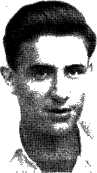
~
Lazar Papernik, Hero of the
Soviet Union
~
[39]
__ALPHA_LVL1__
APPEAL FROM IVAN BALABANOV
JUNIOR POLITICAL INSTRUCTOR
OF A MOTORISED BATTALION
January 28, 1942
Dear comrades,
I've done all I could. I took over command of the battalion
after our commander had been wounded, and I continued the
attack according to orders. I proudly looked death in the face
because I have a Bolshevik heart. I am not afraid to die. I have
fought hard because I love my people, my country and my
Party.
As I die on the field of battle, I want to tell my
comradesin-arms that I have never known cowardice or panic.
My dying wish is that you destroy fascism once and for all.
Be heroes of war so that history will remember you as valiant
defenders of Russian land.
I hope that you, courageous Russian soldiers, will avenge
my death.
Let my folks know how I lived and died.
Farewell, dear comrades-in-arms,
~ ~ ~ ~ ~ Ivan Balabanov
__b_b_b__
On January 28, 1942, Junior Political Instructor Balabanov led a group
of soldiers in an attack on an enemy post in the village of Gusevo.
The enemy had firmly dug in. Every house, every barn had been
turned into a stubborn nest of resistance. With the cry "Death to
the nazi swine!" Balabanov, under heavy fire, rushed ahead of his
soldiers to the nearest barn.
Though seriously wounded and losing blood, Balabanov forced
his way into the barn. Stunned by the audacity of the attack, the enemy
machine-gunners fled in panic.
The battle died down. As his strength began to ebb, Balabanov
sensed that his hour was near. With shaking hands he took a sheet
40
of paper from his map-case and wrote a few words to his comrades.
Again the fighting flared up. The Soviet soldiers rushed forward
again and again. The enemy was pushed back. His friends found Ivan
Balabanov dead. In the cold hand of their beloved leader, the soldiers
found a small sheet of paper-his last note.
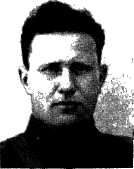
~
Ivan Balabanov
~
[41]
__ALPHA_LVL1__
LETTER
FROM SERGEANT YAKOV BONDAR
TO HIS UNIT PARTY ORGANISATION
I am glad to do my duty to liberate our country as quickly
as possible from the German scourge. If I die, then I die a
devoted patriot of my country, if I live I shall do all I can
to defeat the enemy.
I love my country and am ready to shed my last drop of
blood for her. One thing I know: the fascist beasts will soon
be destroyed, and Soviet people will live even more happily
than before.
Please consider me a Communist.
__b_b_b__
Sergeant Yakov Bondar, a Y.C.L. member, fought on the Leningrad
Front. He was fatally wounded. In his pocket was this letter written
on the eve of a battle.
[42]
__ALPHA_LVL1__
TESTAMENT BY PRIVATE STEPAN VOLKOV
Not later than February 12, 1942
MY TESTAMENT
Comrade soldiers, commanders and political instructors,~
As I go into attack, I pledge to fight to my last breath for
the honour and independence of my country. I am not a Party
member. But if I shed my blood in battle, consider it the blood
of a Communist. Death and destruction to the nazi butchers
who have sullied our sacred land!
Dear comrades-in-arms, if I die in this encounter, consider
me a Communist.
Long live the great Soviet people.
Convey my greetings to my wife Marusya and daughter
Tanya.
S. Volkov
__b_b_b__
Stepan Volkov served in a rifle company which had orders to
attack enemy stronghold in the village of Ustinovo. Just before the
attack, he wrole a pledge to his comrades. On a tiny piece of
notepaper he huriiedly jotted down the words of his testament: to fight
to the last breath against the nazi butchers. He rolled the note into
a ball and put it inside his identity cylinder.
Volkov was one of the first in the attack. From a nazi trench
ahead came a burst of fire. The attackers threw themselves flat.
Stepan, grenades in his hands, crawled towards the German trench
and threw in his grenades killing several Germans.
The enemy firing stopped. The way into the village of Ustinovo
was free. But at that moment the fearless fighter was hit by an
enemy bullet.
After the battle the soldiers buried Stepan Volkov on a hillock
close to the village for whose liberation he had given his life. Over
his grave they read out the note found on the hero.
43
__ALPHA_LVL1__
NOTE FROM SOLDIER
ALEXANDER VINOGRADOV
There was a dozen of us sent down the Minsk Highway to
bar the enemy's way, to stop the tanks. And we held out
for all we could. Now only three of us are left: Kolya, Volodya
and I, Alexander. But the enemy keeps coming on. There goes
another-Volodya from Moscow. The tanks are coming at us
But 19 are already in flames along the road. Only two of us
now. But we shall hold out as long as we can, we shan't let
them by until our lads arrive.
Now there's only me, wounded in the head and arm But
we've knocked out more tanks. That makes 23 of them.
Perhaps I'll die But, maybe someone will someday find my note
and remember us. I'm from Frunze, a Russian. No relatives
Farewell, friends.
Yours,
~ ~ ~ ~ ~ Alexander Vinogradov
22/2--1942
__b_b_b__
This note only came to light sixteen yeais later, in 1958 discovered
by a carpenter from the Nekrasov State Farm in Uvarovsky District,
Moscow Region The carpentei, I Smirnov, found it as he was squar
ing a birch log The note had been scrawled m pencil on both sides
of a narrow, thin strip of tracing paper
In January and February 1942, the nazi High Command brought
up another 40 divisions up from Germany and the occupied coun
tries to the Soviet front to help stem the advance of the Soviet troops
near Moscow These reinforcements put Soviet troops fighting in the
enemy rear in the region of Vya7ma in a tight spot
In the latter part of February, dogged battles flared up along the
front of the 5th Army advancing on Gzhatsk In mid-February, an
order came thiough foi the 612th Infantry Regiment of the 144th
44
Infantiy Division of this aimy to push on into the enemy real and
cut off the nazi communications The legiment advanced towards
Gzhatsk and cut off the Minsk Highway almost 16 miles to the east
of the town
On February 20, 1942, the 612th Infantry Regiment was ordered to
stiaddle the Minsk Highway 95 miles west of Moscow and block the
v,ay to the enemy tanks The soldiers dug in along the highway.
Alexander Vinogradov s group took up position on the right flank
The column of enemy tanks appeared all of a sudden speeding
towards Moscow The battalion put up a desperate resistance against
the naa tanks trying to blast their way through For three days the
infantrymen held out Their ranks were thinning visibly, but no one
gave way Twice wounded Alexander Vinogradov wrote a last lettei
to his countrymen, squeezed it into a rifle cartndge and drove it into
a tree trunk When, on the fourth day of the encounter, the 612th
Regiment men were relieved by units from the 108th Infantry
Division only a handful of survivors remained.
[45]
__ALPHA_LVL1__
TESTAMENT LETTER AND NOTE HOME
FROM LEONID SILIN
August 30, 1941--March 7, 1942
TESTAMENT LETTER
My dear ones at home,
Greetings, though when you read my letter I shall no longer
be alive.
But through death, too, through my absence, I embrace you
all, my dear ones, I kiss you. Not as a ghost but as your own
live and dear daddie.
My boys and Anya, don't think I went away to this awful
war out of some desire to cover myself in glory.
I knew I was probably going to my death.
I love life more than anything, but more than life I love
you, Anya and my boys.
And knowing what terror, what humiliating torments
awaited you if Hitler had his way, knowing how they would
torture you, how they would treat your mother, knowing how
your mother would shrivel up and you be turned into little
skeletons, I, out of love for you, had to leave you, though
wanting to be with you, had to go away to war.
I went to war, that means to my death, so that you may
live.
These are no fancy words. For me these words are now
clothed in flesh and blood, in my own blood.
My dear Annushka, I know you will have it hardest of all.
I know. But for you to be safe I am going into the fire....
46
I have nothing else to add. Only to say there was no one
else in the world I loved so much and found it so heartbreaking
to leave behind for good, to leave behind alone, as you, my
love.
Lenya, my elder son and helper,
We called you Lenya, like me.
So you will be me when I'm gone.
Our good, kind mummie has gone through a lot and
dreamed so much of an easy peaceful life, but she never had
much of a chance with me. I want you to make her happy.
I want her to find in you her best friend and helper. I
realise it's not easy for children to grow up without a father,
specially for boys. But, remember, I have died for you so
that you lads can grow up-whether it be hard or not-so that
you can grow up and not die from German bombs.
I have died as befits us men, defending our children, our
wives, our homes, our land.
I want you too to live just as your dad lived and died.
Remember, your mum is my best friend, she's dearer to
me than anyone else has ever been. So mum knows what's
good and what's bad, what I've done and what I haven't,
what I'd have approved of and what I wouldn't.
Always and in everything consult your mummie, don't
hide anything from her, confide in all and share everything
with her.
Never mind if she is a woman, she's a special woman, she's
our mum, our beloved, clever mummie. She will understand
everything.
Lenya, there's so much I must tell you, and I can't say it all,
and a lot you won't understand anyway.
I have many things I'd like to tell you. But your mother
will do this for me.
These are my parting words to you: don't forget your mum,
Lenya Silin, look after her, see she is alright all her life. Love
and obey your mum always.
Lenya Silin, my helper and elder son, farewell my little boy,
and don't forget me.
Genya, my younger son and helper,
I leave you behind quite a toddler. You won't even
remember your father's face or voice. But your elder brother, my
elder son and helper, Lenya Silin, will tell you what your
daddie was like, how much he loved you and what sort of
47
man he was. Mum will let you know how your father lived,
worked and struggled for a better life.
All I've written to your elder brother goes for you, too.
If you listen to Lenya Silin and your mum I'm sure you will
be a good, brave and decent man.
My boys Lenya and Genya,
Work well at school, study German very carefully, German
culture and German sciences. And you must use it all to defeat
and destroy German fascism.
Try to learn from the Germans their most dangerous and
terrible weapon-their organisation and precision.
And, when you feel you are strong enough, use all you
have against the nazis. Don't forget, my sons, as long as nazi
Germany remains, as long as one armed nazi remains, as long
as even one nazi laboratory or factory carries on unchecked,
then Europe, the world, mankind and you personally, and
your mummie, your wives and children will live in mortal,
terrible danger.
Never forget: fascism in general, and German fascism in
particular, is a deadly, ravaging leprosy, the black plague,
which threatens all mankind.
May your father's blood, may your father's ashes be a
reminder to your little hearts, my lads, and may the last
armed nazi feel your terrible revenge.
My boys and Anya, the main thing without me is to keep
calm and organise your life in an orderly way, no matter what
you do.
We, and myself in particular, came to grief because of the
stupid and cocksure system of leaving everything to chance,
disgusting organisation and the cackle-handedness of certain
commanders who haven't got the faintest idea about modern
war and underestimate the enemy.
I believe the enemy will be smashed and we shall win. If
not, destroy the enemy wherever and whenever you have the
chance.
Boys, listen to our dear, beloved mummie. She means
everything to me, my nearest and dearest.
Annushka, my dear one, farewell!
__b_b_b__
My darling, my honey,
Bring up our sons so that I would be proud of them even
though I'm not there, so that I would be pleased with my
48
strong, brave and optimistic lads, terrors of the foe and tender
and kind to people.
Be happy and healthy, look after yourselves.
Farewell, love and kisses for the last time. To you, Gena,
you, Lenya, you, Anya. Farewell!
Yours,
~ ~ ~ ~ ~ Dad
Forever Yours,
~ ~ ~ ~ ~ Lenya Silin-Senior
~ ~ ~ ~ ~ August 30, 1941
__b_b_b__
NOTE
My dear wife Anna and boys Lenya and Gennady,
I want to hug and kiss you for the last time. Today I am to
be shot by order of the German Command.
Boys, grow up and get your own back on all fascists for
me. As I part from you I am entrusting you with all my
blessed hatred for these vile swine. Cut them down to the
last fascist. I've lived honourably, fought honourably and
die honourably.
I die for our country, for our Party, for all Russians,
Ukrainians, Byelorussians and all other people in the country, and
for you. Love our country like I love her, fight for her like
I have and, if need be, die for her like me.
Boys, love and respect and obey your mother, she's going
to have a hard time bringing you up, but our country and
comrades whom I've saved, won't leave you in the lurch.
Remember every soldier must have one motto: I die but don't
surrender. I didn't surrender. I had a concussion, couldn't
walk and it wasn't right to desert my badly wounded
companions. When we were prisoners I set up a Soviet colony
and saved many lives. I stood by them to the last minute,
I've done all I could for my country. Time's running out.
My dear ones, be decent Soviet people, grow up to be
Bolsheviks! Anna, farewell! Lenya and Gennady, good-bye!
Long live our country!
All my love,
~ ~ ~ ~ ~ Your husband and father
49
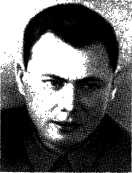
~
Leonid Silin
~
Leonid Silin joined up in the
early days of the war. He
came from a Riga family, his
father being a minor official.
He grew up in the same district
as several German families and
so came to have a good
knowledge of German. Before the
war he served in the Navy at
Sevastopol, then worked at the
Moscow Bearing Works and
took a correspondence course in
the Moscow College of Law.
Because of a weak heart he was
exempted from army service but
he was one of the first to sign
up when war broke out, hiding
his health record. But the doctors
found this out and he was
discharged. It would have taken
more than that to keep Leonid
Silin out of action. He succeeded
in his second attempt to get to
the front, this time as a lawyer.
These were trying years for the Soviet Union. Three months of
war had brought the enemy half-way through the Ukraine. Silin's
unit could not hold onto the right bank of the Dnieper and in
September 1941 had to beat a retreat to Poltava. A large group of
badly wounded soldiers was cut off and had to hole out in the
village of Krestitelevo. The wounded lay in long barns and listened
to the roar of the fighting. Finally they heard German speech.
What were they to do? The enemy was likely to burn down the barns
thus murdering dozens of wounded. A decision was taken in a flash.
Leonid Silin rose from the straw, opened the barn door and, limping
badly and leaning on a crutch, went out of the barn.
In faultless German he called out to the Germans that there
were only badly wounded soldiers in the barns and asked them to hold
their fire. The sudden appearance of a Soviet officer speaking fluent
German took the sergeant-major by surprise and the firing stopped.
Silin was taken to headquarters.
Back at H.Q., Silin endeavoured to prove himself before the
senior German officers a German sympathiser. He praised the
German successes and requested only that he be permitted to organise
a hospital for wounded Soviet prisoners-of-war (he put himself
forward as a wounded Soviet doctor). He knew full well what to expect
if the Germans got wind of his complete medical ignorance. But he
had to save people and it was well worth the risk. The Germans
seemed pleased with the ``doctor'', so smart and excellently versed
in German. They gave him permission to set up what passed as a
hospital.
From among his fellow prisoners, Silin selected a group of
surgeons, nurses and orderlies for his staff. Thus came into being Silin's
50
``Ukrainian'' hospital. The nazis refused to allow any wounded
Soviet officers, Communists, Jews or Russians here. And so the staff
had to disguise every new entry under a Ukrainian name.
In November the occupational forces gave permission for the
hospital to be moved to the village of Yeremeyevka where it was
housed in a big, two-storey school. Now the wounded had a roof
over their heads and there was more food to go round as the village
was some distance off the beaten track, which meant less frequent
raids from German requisitioning officials.
Leonid Silin was playing for time to allow the wounded to get
back their strength, hoping some time later to escape from the
hospital in a body and join up with the partisans in the woods. The
medical staff began to engage in underground activities. They
managed to get hold of a receiver and listened in to Sovinformbureau
news, which they passed on to the rest of the hospital and the
villagers as well. From the German stores sacks of corn began to
disappear and policemen would misplace their rifles and
submachineguns.
So as not to bring down the wrath of the nazis on the hospital,
Silin and his confederates had to be extremely careful. Nevertheless,
the German-appointed senior police officer of Yeremeyevka, the
traitor Atamas, nicknamed the ``Dragon'', sensed that Silin was
playing a double game. Wanting to curry favour with the Germans,
Atamas began to watch Silin and gather evidence. One of the hospital
staff also turned traitor.
On the night of March 2, 1942, the hospital was surrounded by
German soldiers and Ukrainian police. The nazis subjected all the
patients to a thorough examination and found that some were quite
fit and also that there was quite a number of Russians and Jews.
This discovery meant death for the hospital staff. On the next day,
March 3, about 40 wounded and doctors picked out by the Germans,
were taken from the hospital to the Kremenchug p.o.w. camp.
Leonid Silin remained courageous to the end. As he was being led
out to the sleighs on which the wounded lay, he asked leave to bid
farewell to those remaining. Addressing the villagers gathered on the
village square and his wounded comrades, he called on them to
continue the struggle against the invaders and keep faith in the victory
of the Red Army. Seeing the enormous effect his speech was having
on the people, the German officer cut him short and refused him
further time. As the sleigh started to move Leonid Silin bit through
a vein in his wrist, soaked his handkerchief in blood and, throwing
it into the crowd, cried: "See it gets to my sons.''
The brave Riga man was shot on March 7, 1942, together with
doctors Portnov and Gekker, a wounded Lieutenant-Colonel K.
Bogoroditsky and others.
A day later, an escapee from the Kremenchug camp brought Silin's
note to Oksana Romanchenko, a nurse at the hospital. He had
managed to write it before he was shot and pass it on to some
comrades with the request to get it through to nurse Romanchenko. The
note was written in pencil on sheets of paper and addressed to his
wife and children. When Soviet forces liberated Yeremeyevka, nurse
Romanchenko dispatched the note to the Moscow address indicated.
[51]
__ALPHA_LVL1__
LAST ISSUE
OF A HANDWRITTEN NEWSSHEET ``OKOPNAYA
PRAVDA'' PUBLISHED BY YOUNG PIONEER
VALERI VOLKOV
Beginning of 1942
Our handful of men are a mighty force which the enemy
reckons a division... .
... No power in the world can defeat us. Soviet people,
because we are our own masters, led by our Communist Party.
This is who we are....
Here, in School No. 52:
1. Commander . .. Zhidilov, Russian;
2. Cavalry Captain Gobaladze, Georgian;
3. Tank man, Vasili Paukshtite, Lett;
4. ... Captain-Surgeon Mamedov, Uzbek;
5. Pilot, Junior Lieutenant Ilita Daurova, an Ossetian girl;
6. Sailor Ibrahim Ibrahimov, Kazan Tatar;
7. Gunner Petrunenko from Kiev, Ukrainian;
8. Infantry Sergeant Bogomolov from Leningrad, Russian;
9. Diver-scout Arkady Zhuravlev from Vladivostok;
10. I, son of a cobbler, 4th form pupil, Valeri Volkov,
Russian. ...
__b_b_b__
Dear comrades,
Whoever gets out of this alive must tell all who will study
at this school. No matter where you end up come and tell
them what happened here in Sevastopol. I want to be a bird
and fly round all Sevastopol, to every home, every school,
52
every street.. .. Hitler and the other scum will never beat
us.... We are the millions, watch out! From the Far East to
Riga, from the Caucasus to Kiev, from Sevastopol to
Tashkent. . . . We, like steel, are invincible!
Valeri "the Poet" (Volk)
~ ~ ~ ~ ~ 1942
__b_b_b__
This small newssheet was written to the accompaniment of the
thunder of battle by a 13-year-old Sevastopol schoolboy, Valeri
Volkov, one of the heroic defenders of the besieged city.
Valeri fought among the grown-ups acting as lookout, scouting and
bringing in ammunition, assisting the wounded and using his rifle
when the Germans attacked. Those were fierce battles with no quarter
given day or night. Only eight men, a woman and a boy were left,
four Russians, a Ukrainian, a Georgian, a Lett, an Uzbek, a Tatar and
an Ossetian girl. That is when issue No. 11, the last, of their own
newspaper came out-a vivid testament to the courage of the
heroic ten.
Tanks were bearing down on the heroes. They tossed their
grenades. Valeri blew up one of the tanks. But the young hero was
the victim of an enemy bullet.
Twenty years went by and the ten Sevastopol heroes remained
unknown. It was only recently that two of the survivors, Ivan
Petrunenko and woman pilot Ilita Daurova, brought the last
newssheet to people's notice.
[53]
__ALPHA_LVL1__
NOTE FROM YEVGENIA BAGRECHEVA,
SECRETARY OF UNDERGROUND PARTY
ORGANISATION, TO HER MOTHER
Not later than March 19, 1942
Good-bye, my dear Mummie and Eleonora. As I wait to be
hanged I am writing to send my last greetings.
Don't cry. Mum, and don't say it's my own fault. There
was no other way. Look after yourself for Ellie's sake, you
should now be both grannie and mother to her. Bring her up
a good girl and a kind person, see that she loves her country
and people.
All my love to you all, remember me to all our relations,
friends and my pupils, all those who manage to get through
this awful time.
Zhenya
__b_b_b__
They all respected her in
Kardymovo, the district centre
of the Smolensk Region, where
she was history teacher in the
local secondary school. They
respected her for her love for
children, her pleasant air,
modesty and because she was
exacting to herself and her
comrades.
In Kardymovo, as
everywhere else in the country, the
Germans came up against
wellorganised resistance. Yevgenia
was secretary of the village
Communists; her fellow
resistance fighters were I. Kovalev,
Chairman of the Kardymovo
Village Soviet, M. Selyaninova,
schoolmistress, P. Shesterikova,
doctor, I. Kutsenko, from a
district hospital, and others.
~
Yevgenia Bagrecheva
~
[54]
A strong partisan movement swept the whole Smolensk Region. No
small thorn in the nazis' side was provided by the Kardymovo people.
After the first winter of the war, Soviet power was, in fact, restored
in several villages. To put down partisan resistance, the German
Command sent in its crack units from the 10th Tank Division. The
nazis burned down 25 villages, shot and hanged over 500 people and
carted off hundreds to their prisoner-of-war camp in Smolensk.
On March 19, 1942, Yevgenia Bagrecheva was hanged in the
village centre. Before her death, she had been tortured for a long
time. But nothing had broken her spirit. A few hours before her
death she wrote her last letter on a tiny scrap of paper. It is now
preserved in the Smolensk State Museum.
[55]
__ALPHA_LVL1__
LETTER AND INSCRIPTION
WRITTEN BY RZHEV UNDERGROUND WORKERS
ALEXEI ZHILTSOV AND ALEXANDER BELYAKOV
Not later than March 28, 1942
LETTER FROM ALEXEI ZHILTSOV TO HIS FATHER
My dear Dad,
Don't cry. Don't worry. Your son will never let anyone
down. If you keep alive let others know about us. I don't
want to die---so little we've done.
__b_b_b__
__b_b_b__
INSCRIPTION MADE BY ALEXANDER BELYAKOV
ON THE WALL OF HIS CELL
I shall endure all their inhuman torture. I give you my
word as a Komsomol member, dear comrades, they will never
make me talk. And don't you talk either. The great things we
have begun will be carried through by our comrades.
56
__b_b_b__
An underground Y.C.L. was formed in the city o£ Rzhev in the
first months of nazi occupation. It was led by Alexei Teleshov.
There were ten in the group in October 1941.
The youngsters were not long in establishing contact with the
partisans in the Panin woods. Numbers quickly multiplied. In
order to get their hands on weapons, the young fighters would
dispose of the German sentries. They also made a raid on the
ammunition dump. Their exploits began to get around among the
soldiers fighting on the Kalinin Front. In November 1941, Vladimir
Novozhenov, a scout from one of the army units, established
contact with them. They now began to indicate targets for Soviet
bombers, made raids on enemy transports and blew up railway
tracks.
Their activities were cut short by a betrayal. Fifteen underground
members were rounded up.
After excruciating torture, there was a public hanging of Teleshov,
Novozhenov and Belyakov on March 28, 1942. The rest were shot.
Before he died Alexei Zhiltsov managed to get a letter through to
his father. On the wall of the town dungeon was later found the
inscription made by Alexander Belyakov.
~
Alexei Zhiltsov
~
[57]
__ALPHA_LVL1__
LETTER
FROM PYOTR TSURANOV, SECRETARY
OF DUKHOVSHCHINA UNDERGROUND DISTRICT
PARTY COMMITTEE, TO HIS WIFE
April 3, 1942
Dear Vera, my darling, my own little dove,
My heart leaps with joy just to think you may get my letter,
you and our boy and girl will see my writing and know I am
alive and well.
We haven't seen or heard anything of each other for over
nine months. Now, when I have a chance to send you a letter
there's so much I want to tell you, so much....
What can I say to you? I remember, all my life I'll
remember Kulagino where I saw you (July 15) when you were sick,
with our newborn girl, where we parted so suddenly, without
saying good-bye properly. But I knew you couldn't be angry
at me, both as my wife and friend, since duty compelled me
to stay in the district come what may. I can well imagine the
whole horror of the situation in which I left you. Yet, as you
know, there was nothing I could do to help. I consoled myself
with the one thought that your suffering is all our people's
suffering, that there are thousands of martyrs like you, that
war is war.
But what is wonderful, my sweet, is that I haven't for one
moment lost my confidence that you are alive, that you think
about me, that you love me, as you did ten years ago, as you
always loved me. Not for one minute have I lost faith in us
seeing each other again, in being together again. And I still
believe it now, as much as I believe in our victory over
Hitler's bandits.
My darling, my little dove, we'll be together again. Just
wait and see. Keep your spirits up. I shall live yet to hug and
58
kiss you all! I'm longing for that wonderful moment as much
as I do for our country's complete liberation from the fascist
scum. That moment is coming nearer. We are all sure of it,
we Bolsheviks, partisans and all the people in our district.
Nine months in the nazi rear-how have I lived, where have
I lived in this time? How have we fought against the German
invaders? It cannot be described all in one letter.
No matter what I write to you it would still seem a trifle.
The first weeks and months of underground work were very
grim. We have now about ten detachments in the district. I'm
not exactly sure how many men we have in each detachment;
in my lot there are over a hundred. They're a wonderful, select
bunch.
I've been living in Fyodorovo, Ponizovye, Grishkovo,
Petrishchevo and Bosino. I've had to spend my nights in the
fields and woods. All autumn I was with a group of comrades
in the woods. February I lived in a dug-out. Can't grumble
about my health. I've probably never felt better. My stomach
ulcer seems to have healed, cicatrised. However much I hid,
the Dukhovshchina gang-those fascist creeps-soon nosed me
out. They've been hunting me like a bear, but it hasn't got
them anywhere. Only one...^^*^^ and several times we've led
them a merry dance. The Germans' fate in Demidovo,
Prechistoye and Dukhovshchina will be decided in a few days.
For the moment though we are still behind the lines,
surrounded by the foe, but they cannot do a thing about us. The
partisans are like quicksilver. Right from the beginning things
have been fine, marvellous. What's wonderful is that all the
people round here are right behind us, assisting us and hating
the nazis.
What more is there to tell you? When I was left in the
district I combed the whole area far and wide. I roped in
almost all Communists. I organised them in underground
Party partisan groups. Now they have grown into partisan
detachments. In one of these I am commissar....
A few of our good comrades fell into German hands and
lost their lives. I, as you see, with some fifty local Communists
have survived. Some of them have been with the partisans
since autumn, others since winter.
_-_-_
^^*^^ Text is rubbed out here in the paper's fold.
59
Now Dukhovshchina is surrounded by partisan
detachments. We've made short work of all nazi appointees. No one
nazi-appointed administration body is now operating. For the
time being the Germans are holing out like wolves in
Dukhovshchina and a few other villages. In a number of
villages we have already restored Soviet power. In the rest
power [also] belongs to the partisans. My oh my, how the
nazis are scared of the partisans...^^*^^ and I've easily escaped
their clutches. Well, now I think they haven't got a chance.
My dear little dove, I must hurry. I haven't written even a
fraction of what I wanted. Farewell.
Take care, bring up our son and little girl. I hope they are
clever and good, I hope they grow up Bolsheviks. I hope they,
and you as well, love our country.... And never lose faith
in our deliverance from the enemy.
Many, many kisses to you all.
No matter what happens to me I'm sure you'll be brave and
come through all the hardships and, at least, bring up our son
Volodya and daughter Nelya. If only I could see them now.
I can just imagine them. Remember how we used to go on a
ramble with our little girl? I haven't got anything more to
write on. Farewell... . Kisses. ...
Yours and yours alone,
~ ~ ~ ~ ~ Pyotr
__b_b_b__
Pyotr Tsuranov, second secretary of the Dukhovshchina District
Party Committee, was in charge of underground work in the district.
Under his leadership several underground groups were formed,
followed by small partisan units. With one of the units he took to the
woods neighbouring on Kasplyansky District. Here the partisan ranks
were reinforced by soldiers left behind in the rear and also by the
villagers.
Back in early September 1941, this unit had taken part in
skirmishes with regular units of the 9th German Army, thereby
rendering active assistance to the Soviet Army.
At the commencement to 1942, the unit had its base in the village
of Grishkovo, and a couple of months later in Gorodnya. It was
joined there by other partisan groups and detachments.
On March 25, 1942, a band of partisans headed by Pyotr Tsuranov
waited in ambush near the village of Zakup to which a column of 300
_-_-_
^^*^^ Another omission due to erasure in the letter's fold.
60
German soldiers was heading.
The partisans scattered the
Germans who fled in panic leaving
behind more than a hundred
dead.
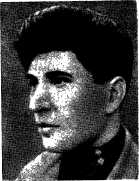
~
Pyotr Tsuranov
~
Pyotr wanted to tell his wife
of the hazards of fighting behind
the lines and the first thrills
of their modest victories. This
letter of April 3rd is their first
contact since parting. Will it
get through to her? Will his
family know he is alive and
well? Hardly having time to send
the letter he rushed off again
into the fray, this time in the
village of Falisa held by police
collecting taxes from the
population. Tsuranov and his
companions blasted the nazis from the
village with hand grenades and
eventually drove them out of
Trofimenka and Voskresenskoye
too. The clashes lasted two
days.
In April and May, a number of districts around Smolensk were
freed by the partisans and Soviet authority was restored. On
May Day there was a meeting of the Dukhovshchina underground
District Party Committee Bureau which discussed ways and means
of getting the whole district back into Soviet hands. District
Party Secretary Pyotr Tsuranov was responsible for this work
throughout the district. The Bureau, jointly with the District Party
Executive Committee and the Y.C.L. Committee, addressed the
following appeal to the people:
``Soviet power has been restored and Soviet authority is now coming
into its own on the territory of our district liberated from the nazis, i.e.,
in 10 village Soviets. But the battle against the foe certainly does not
end here. Our victories have to be consolidated and taken further. We
must do all we can to assist the Red Army and red partisans to smash
the enemy and drive Hitler's hordes out of the Soviet Union.
``We shall win!''
On June 22, an anti-fascist meeting of people from all over the
district took place. The resolution adopted by 500 delegates and signed
by Pyotr Tsuranov ended with slogans: "Long live our Soviet
homeland!" "Down with the fascist scum!''
In the summer of 1942, after a round of bitter fighting, the district
was occupied for the second time. Pyotr was put in charge of the
Burevestnik partisan unit and once more never gave himself any
let-up in fearless raids on the nazis, organising underground
operations, sabotage and raids.
In February 1943, the bold Communists' leader of Dukhovshchina
made his last sortie.
[61]
__ALPHA_LVL1__
LETTERS FROM YELENA UBIIVOVK,
UNDERGROUND Y.C.L. WORKER IN POLTAVA,
FROM A GESTAPO CELL
LETTER TO HER FATHER
12--13 May, 1942
Dear Dad,
You are a man and must take everything that comes as a
man. I have one chance in a hundred of getting out alive.
Sergei isn't to blame-he's done all he could to save me.
I'm not writing in a scatter-brained mood. I've given it a lot
of thought. As long as my breath holds out I shan't give up
hope. But if I die, this is my last wish: mum, I know, won't
get over my death, but you must live and get revenge
whenever you can.
From here, from the very heart of fascism, I clearly see
what this craven bestiality actually is.
I'm not afraid of death, but I want, if there is no other
way out, to die by my own hand. That is why I appeal to all
that you hold sacred, to your love for me-to bring me some
opium today-we have some at home in a bottle, exactly the
amount I need, no more no less, so as not to miss.
I know you'll do it for the love of me. Don't forget I'm not
scatter-brained and won't do anything rash. Pour it into a
phial and put it in a loaf. Better in a pot of soup, I can tip the
soup out.
I'll do my duty-I shan't implicate any innocent people and,
if need be, I'll die bravely.
But, to release me from my torturers, get it to me today,
while you can still visit me, a fatal dose of opium or morphia
-I realise you know best so be a good dad so that I don't
have to surfer any more. By 5 o'clock I'll be taken down to
the prison where you can see me.
62
Let my friends know I'm confident my death will be
avenged. Valya is a traitress, she split on me and Sergei.
Sergei's a good lad. Don't forget to let them know all this.
My every word is my last wish and my mind will be at
peace if I find you've done everything.
I still have hope, but my decision stands firm if all hope
fades. Don't tell mum anything for the time being.
Love to you all from the bottom of my heart.
Greetings to friends~
__b_b_b__
LETTER HOME
May 20, 1942
Greetings to you all at home,~
I cannot write much but want to send you all my best
regards. I'm quite all right here. I get all the things you send
in, except scent. If you want to send me something-scent
or cigarettes-bring it to the prison where there's less control.
My chances of getting out of here are very, very slim. I
shan't give up all hope of course, if I manage it I'll get out.
But I shan't buy my life at the price of treachery. After all
we only die once and life isn't all that is worthwhile these
days, I see it very clearly here.
I'm very, very sorry I have to cause you so much worry.
Believe you me, I've never forgotten you and never shall.
I get enough to eat with the food you send, but bread is
short.... Why, dad, didn't you send what I asked? You know
I've never done anything rash and never lose my head.
Now I feel alright and keep worrying only about you. Don't
forget, Sergei is not in any way, not in the slightest, to blame
-he did all he could and more even to save me. It's the
circumstances that are to blame, they don't meet our wishes.
I suppose I made a stupid mistake in telling about the
Y.C.L. Well, it can't be helped. Now, naturally, I'm looking
for a way of getting out (except treachery). They treat me
well, decently, better than the others. But that's nothing to
goby.
Lots of love to you all. Love to Mum, Dad, Verochka,
Glafira, Anyuta, Lelya and Igor.
63
__b_b_b__
LETTER HOME
May 23, 1942
My dear ones,
I'm very sorry I have to grieve you so. And I'm very sorry
you don't understand me at all. My life just couldn't be any
different in these circumstances. So it's necessary for death to
bring some kind of good. Remember the cost of ``repentance''?
Futile humility blotting out the past, and it won't save lives
anyway.
Dad, we were really together the whole day September 17.
They're very crafty here. How could you, a grown man, be so
trusting. You can give me away completely by being too
trusting. They use the most subtle means of getting what they
want. It wasn't out of humanism they let you see me. It's
impossible to describe it. You have to be here and see it all
to be convinced with your own eyes.
I have, and believe this, from what they say, a very small
chance of getting out of here, and I'll do all I can to make
use of it. And as far as treachery goes-that's another method
they use. I've read Sergei's testimony-he didn't give me away,
not by a single word.
By trying to cause trouble between us they aim at doing
more damage. I signed the testimony. It's just as well I know
a bit of German. What about those who don't? And you
believe these people.... You shouldn't. I shall naturally try
to keep alive. But if I don't succeed, you must get revenge for
me. I'm not afraid to die-everyone has to die some time. But
if I have to die, it's going to be the way the maximum good
conies out of it. Just believe me and not them. I'm fighting
for my life and know what I'm doing; it's easier for me here
to see what to do than for you on the outside. I am no child
and could have proved it to you.
Lots of love to all of you from the bottom of my heart.
Lyalya
__b_b_b__
LETTER HOME
May 24--25, 1942
Dear Mum, Dad, Verochka and Glafira,
Today, tomorrow-I don't know when-they are going to
shoot me because I cannot go against my conscience, because
I am a Komsomol girl. I'm not afraid to die. I shall die calmly.
64
I know full well that I cannot get out of here. Believe me
I'm not writing in a hot-headed way. I'm quite cool and
collected. Love and many kisses to you all for the last time.
I'm not lonely and I feel a lot of love and concern around me.
It's not so terrible to die.
Love to you all from the bottom of my heart.
Lyalya
__b_b_b__
Yelena Ubiivovk was a Y.C.L. member and student at Kharkov
University. The war found her in Poltava.
During the occupation of Poltava several young people's
underground organisations were formed.
Yelena set up an underground group which started up with nine
Y.C.L. members. Together with her companions she collected weapons
and conducted anti-fascist propaganda among the townsmen. The
underground workers managed to get in contact with a partisan unit
under the command of Zharov who was operating in the woods. The
Y.C.L.-ers began to regularly take down news from Moscow over the
radio and put out leaflets on behalf of the partisans. In six months
they had circulated over two thousand leaflets. The group grew to
twenty.
The young patriots used to lend a hand to the p.o.w.s in a
Poltava prison camp,
supplying them with civilian clothing
and food. They helped eighteen
prisoners escape and get through
to the partisans. The Y.C.L.
group was preparing for a
suitable moment to instigate an
armed uprising in Poltava.
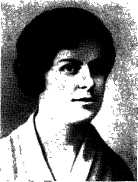
~
Yelena Ubiivovk
~
Due to too much trust in the
townspeople, the group was
uncovered. On May 6, 1942, the
leading members were arrested
and tortured.
Yelena Ubiivovk was
interrogated twenty-six times. On
May 26, before sunset, after
bravely withstanding all kinds
of torture Yelena Ubiivovk,
Sergei Sapega, Boris Serga,
Sergei Ilyevsky, Valentin Soroka
and Leonid Puzanov were shot
beyond the Poltava town
cemetery. Before she died Yelena
managed to get four letters
smuggled out of the Gestapo
dungeon to her parents.
__PRINTERS_P_65_COMMENT__
5---3928
[65]
__ALPHA_LVL1__
FROM THE DIARY OF IVAN MEDVEDOVSKY,
MEMBER OF UNDERGROUND ORGANISATION
IN THE VILLAGE OF CHAPAYEVKA
End of May 1942
They crucified me like Jesus Christ. They beat me with
sticks and ramrods, stuck needles into me.
May 3, 1942. Yesterday had a session with the S.D. Let go
for now. Live in stinking conditions. No bread, potatoes,
nothing. Beginning to swell. Bruises pain me, all the same
want to live. Live for the future.
__b_b_b__
When the Soviet Army
retreated eastwards, underground
groups were formed in the
Zaporozhye Region. One such
group was formed in the village
of Chapayevka under the
leadership of the local headmaster
Ivan Medvedovsky, a Y.C.L.
member. He conducted a
campaign among the villagers and
taught the young people how
to combat the nazi invaders.
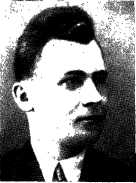
~
Ivan Medvedovsky
~
In May 1942, he was
arrested for the fourth time by the
Gestapo and shot.
Just before he met his end
he got his last note through to
his wife in which he expressed
his profound faith in Soviet
victory. "For all the vile deeds,
the people of our country will
pay the fascist swine back in
full. The time is not far off
when bloodthirsty Hilter and
his gang will be wiped off the
face of the earth.''
[66]
__ALPHA_LVL1__
VOW BY JUNIOR SERGEANT
VASILY AZAROV
I, son of my Homeland, brought up among the working
people, vow to defend my Naval fortress on the Black
SeaSevastopol-bravely and use my rifle to the best of ability.
I shall kill as many enemies as I can and part with my
life as dearly as possible. After fighting off two enemy attacks
we shall fight off the third too and completely rout them.
5.06.42. V. Azarov
__b_b_b__
Vasily Azarov was born in 1919. He fell in action while fending
off the third and most desperate nazi drive on Sevastopol in June
1942.
About this time the combat around Sevastopol had reached its
climax. Endeavouring to quickly overrun the key Soviet naval base
on the Black Sea, Hitler's High Command hurled 11 divisions-over
300,000 fighting men-against the port's defenders. Enemy forces were
backed up by 400 tanks, 2,000 guns and more than 500 planes.
Taking advantage of their overwhelming superiority, the nazis tore into
the town from land and air.
Cut off from their land communications and having great difficulty
in obtaining military supplies and provisions, the Soviet soldiers,
sailors and townsmen accomplished wonders of gallantry and heroism.
The defence of Sevastopol was of immense military and political
significance. By diverting a vast number of German and Rumanian troops,
the defenders foiled the German High Command's plans. Through
their astonishing grit and fortitude, the Sevastopol men gave the
enemy far more than he expected and dealt shattering blows to his
manpower and armaments.
Defence of the port lasted for 250 heroic days, of which every one
bore its own tale of valour. Few came out alive. But their names are
forever inscribed on the roll of the war's bravest defenders.
The courageous words written by Vasily Azarov show the
indomitable spirit of the Soviet fighters for the fortress of the Black Sea.
__PRINTERS_P_67_COMMENT__
5*
67
__ALPHA_LVL1__
LETTERS
FROM TWO GOMEL UNDERGROUND
MENIVAN SHILOV AND TIMOFEI BORODIN
LETTER FROM IVAN SHILOV
My dear Mum, Dad and brothers,
I am now in prison. The charges appear to be very
seriousit looks like the end of the road. There we are. Can't do
anything about it. I'm not the first and probably shan't be the
last.... So I beg you not to take it too badly. I love you all,
dearest mum and dad, my wife, little girl, and I love my
country. If this letter ever gets through to my family, I hope
it will remind you of the last days of my life. Survived at
the front but not at home. Fair enough, but I don't want any
of my family to grieve over it....
Today was the first interrogation. The next is on Monday,
11/5, when they'll give me the works. I only fear that my
arrest will make things hard for you. That's all for today. If
I get the chance I'll write some more. Good-bye for now,
love to all.
Yours,
~ ~ ~ ~ ~ Vanya
~
May 9, 1942
LETTER FROM TIMOFEI BORODIN
My dear ones,
Writing you in my last hour. Looks like I'll have my lot
from a bullet.
Mum, Dad, Valya, Tonya, Lida, Nina, Zhenya, Volodya,
Arkady, Sasha-if I've ever been unfair to any of you please
68
forgive me. My dear ones, look after yourselves and don't
ever quarrel.
Dad, look after Tonya and Sasha. Greetings in my last hour
to all at home and all the folks I know.
Borodin Timofei
20-VI-42.
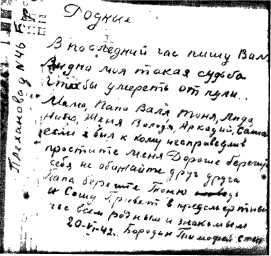
~
Borodin's letter on a handkerchief
~
In the second half of August 1941, the Gomel Region of Byelorussia
was occupied by the Cjrmans. By autumn an underground Party and
Y.C.L. organisation was in full swing. It was headed by Communist
Roman Timofeyenko and Y.C.L. members Timofei Borodin and Ivan
Shilov.
Timofei Borodin had been working in a printer's. After the
Germans had entered the town he went underground.
Ivan Shilov served in the Soviet Army. Soon after the outbreak of
war he had been caught in a German ring, but managed to get back
69
to his native Gomel where he, too, joined the underground Being an
expert at German he disguised himself as a German officer and
operated within the nazi ranks
One had to have an ineradicable faith in victory to be able to scorn
death and boldly take on such a dangerous task right under the
enemy s nose
The underground fighters riddled the occupational machine and
together with the partisans disrupted the invaders' economic, political
and administrative measures, thereby bowing uncertainty and fear in
the enemy ranks.
At the commencement to 1942, members of the underground turned
their attention on the town's industrial works They blew up
workshops m the engineering plant where the Germans repaired their
tanks, wrecked the locomotive works and knocked out several train
loads of arms and ammunition
On the territory of Gomel Region the best sons and daughters of
the Byelorussian people took up arms in dogged partisan combat
against the occupational forces The partisans worked in close con
tact with the town's underground Fighters inside the town got their
hands on medical supplies and passed them on to the partisans They
also kept them supplied with arms, ammunition and explosives
In May 1942, the two Y C L members Timofei Borodin and Ivan
Shilov were given away and arrested
Horrible tortures began To no avail The Gestapo piomised them
their lives if they were to name their fellow underground fighters
and tell where to locate the partisan detachments Again to no avail
The patriots would not split on their comrades On June 20, Timofei
Borodin and Ivan Shilov were shot One hour before he died Timofei
Borodin wrote his last note in big letters on his blood-stained hand
kerchief
[70]
__ALPHA_LVL1__
NOTE AND VOW
FROM Y.C.L. SIGNALMAN
VLADIMIR PANKEVICH
Not later than July 23, 1942
I swear to you, Vera, that I, a son of the people, will pound
the enemy to my last gasp, to my last drop of blood. My love
for you has remained and multiplied many times.
__b_b_b__
Vladimir Pankevich spared no effort to keep communications going
for the forward sections of his unit, even though he constantly had
to run a gauntlet of withering fire. When it came to furious battle
for the villages of Solnechnogorsk, Volokolamsk and others, he was
a brave example to others. He was struck down in the fighting for
the village of Bykovo In his pocket they found a photo and this
unsent note to his girl friend Vera.
[71]
__ALPHA_LVL1__
LETTER
FROM YAKOV GORDIENKO
OF THE ODESSA UNDERGROUND
Dear Mum and Dad,
I'm writing you my last note. 27-VII-42. That makes
exactly a month from the day they passed sentence. My time
is running out, and perhaps I won't live till next letter. I don't
expect any mercy. These rats know full well who I am
(thanks to the swine who gave me away). At the inquest I
kept pretty cool. I refused to answer. They took me away for
beatings. Three times they took me and beat me up for about
four to five hours. At half past three they stopped beating me.
In that time I lost consciousness three times and once I made
as if I had fainted. They beat me with a rubber hose, braided
with a thin wire. Then with a wooden stick, about five feet
long. Iron rods on my arms-----After that battering I still
have the scars on my legs and higher up. Now I can't hear
very well.
The rest of the boys in my group needn't worry. No torture
could tear their names from me. I led the boys on the job. I
gathered information. I was going to blow up a house where
the Gerries were (a new building next to the Red Army
House). But the old geezer putting me up got the wind up.
He knew if I'd got hold of the bloke that gave me away I
would have throttled him. I'd already done one bloke in.
Shame I didn't have enough time. ...
I reckoned on escaping. But a couple of days ago some
criminals here were going to make a break and they were
72
found out. Now there's no chance of getting out and there's
not much time left. Keep your end up. Sasha Khoroshenko
swore he wouldn't leave you in the lurch if anything happened
to me. You can bet your boots he'll be out. He has time and
he'll pick his moment to make a break. Our cause will win all
the same. The Soviets will mop up the Gerries and
cornchewing ``liberators'' this winter. They'll get it back a
thousand times worse for the blood of the partisans shot by
these bastards. I'm just sorry I won't be able to help my
companions when the time comes.
See if you can get hold of my documents. They're buried in
the shed. About a foot down under the first board from the
whetstone. There you'll find photos of my pals and
companions and my Y.C.L. card. The sigurantsa couldn't get it
out of me that I'm in the Y.C.L.
There's a photo of Vova F., please take it to 7 Lutheransky
Lane, to Nina Georgievna. Take it to her and tell her to make
a copy, and take the photo back. Maybe you'll meet him one
day. My letters are also there. And a box too. You can open
it. There is a vow inside, a vow of eternal friendship and
solidarity to each other. But we found ourselves all over the
place. I'm condemned to be shot. Vova, Misha and Abrasha
have been evacuated. They were wonderful chaps though.
Maybe you'll come across some of them.
Good-bye Mum and Dad. Get well soon, Dad. That's what
I want. Just ask you not to forget us and to get your
own back on the rats who gave us away. Give my regards
to Lena.
Lots of love to you all. Don't lose heart. Keep your ends
up. Best wishes to all the family. Victory will be ours!
27.VII.42.
Yasha
__b_b_b__
During the heroic days of the Odessa defence in August 1941, a
stocky figure turned up in Captain Molodtsov's "flying detachment''.
He was given a signaller's job. It was sixteen-year-old Yasha
Gordienko. The young lad dreamed of great feats and burned to get
hold of a gun to defend his home town from the nazi invaders. But
the soldiers kept him in check. Son of a Black Sea sailor, he had only
just finished school before war broke out. Who would have thought
then that a few months later he was to be a victim of the nazi
murderers?
73
On October 16, 1941, after 73 days of defence, the Soviet troops
had to withdraw from Odessa As the last Soviet ship put out of the
port, the Rumanian and German troops marched into the town
Captain Vladimir Molodtsov, known then as Badayev, and a group
of underground fighters took to the Odessa catacombs. Yasha
Gordienko joined Captain Molodtsov's band and acted as a scout He
collected information on the nazis' movements, distributed leaflets
and carried on political work among the townspeople. The brave
boy often had a hand in the operations-blowing up railway lines,
i aiding enemy lorries, cutting telephone wires, etc
Once, due to his initiative and courage, Yasha Gordienko succeeded
in rescuing some 50 prisoners
Yasha was caught in June 1942 at a secret address in Odessa After
taking a traitor in for questioning, agents of the Rumanian political
police (sigurantsa) learned the secret addresses of the underground
members. It had taken the nazis a long time to catch up with the
legendary Badayev. But one evening, when Yasha Gordienko and
his commander Badayev were unsuspectingly leaving their
hidmgplace, the police pounced Nothing could break their will. The young
boy stood up to the torture just as bravely as the experienced
Communist Vladimir Molodtsov. They were condemned to death and shot
in late July 1942 Yakov Gordienko was posthumously awarded the
Order of Lenin and the Partisan of the Patriotic War medal, First
Class
Realising that he was to die in a couple of days, Yasha wrote his
last letter home on half a dozen cigarette papers which his cell
companions managed to smuggle out to the address indicated
[74]
__ALPHA_LVL1__
LETTER
FROM SENIOR LIEUTENANT Y. CHERVONNY
July 1942
Darling Talyushka,
It's hard to begin with common words. When you receive
this letter I shall no longer be alive But there we are, we
have to take what comes in life.
Life! The word has such a proud ring. It contains grief
and good cheer, suffering and bliss. I'm not going to say
life's all the same to me. Not at all, it means a lot. And it's
darn hard to lose it.
Youth! What can be dearer than that? I'm not one of the
"Dismal Desmonds bearing death with a tirade of curses''.
No one should play with life Not to say we shouldn't be
afraid of danger. The boys on shore don't have to run so
many risks. But I, like so many of my companions, plumped
for the sea where there's a greater element of danger and
risk. Here a person can really extend himself to the full and
do most good. More simply, it was an urge to throw in all
I have.
Life can be just a round of daily vegetation like a dumb
animal, and life can be free and easy, with wonderful things
to look forward to. All of us strive to sling our hammock onto
the latter. Our generation has been entrusted with a great
and responsible task: to shed our blood and lay down our
lives to earn the right to happiness.
I remember when I was a lad at school. My first timid
steps when I took my school certificate. The first test-1938--39---
75
in a prison camp in Spain. That's where I was jolted out of
part of the benevolence and habit of seeing everything in a
rosy hue, which every young lad and lass does. It was a
good lesson in the attempt to understand life. There in Spain
I got a fair idea of what we were up against. As a result I
decided to devote my whole life to the armed forces, to
become an officer. Now you are getting a taste of hatred. It
came to me in those days.
Calm and peaceful 1940. A year of stupendous plans for
the future. Then came the war. Everyone was faced with the
problem of finding his feet and being a worthy son of his
country. The old feeling of hatred, the invasion of my beloved
Ukraine, losing my father, mother and brother, the realisation
that the fight was universal and there was no relying on
anyone, aided me right from those early days to decide where
I stood and what I was going to do. War came as a test, it
put the finishing touches to my character. I gave it all I had.
And I can honestly say that nobody can reproach me for any
action unworthy of an officer and a Communist.
We were forced to see life in the raw, cruelly and in a
much shorter time than age usually allows, but life will be
all the dearer to us. Once you know how dear life really is,
you don't treat it so lightly as the days go by. I know and am
confident that if I'd have got out of this mess in one piece
we'd have been so happy together.... We live at a time when,
before we can lay claim to that happiness, we have to win it
in stubborn combat and do our own little bit for the common
cause. It makes no difference whether it will be the skill,
blood or life. There is no other way.
Remember me now and again as the man who loved you
and would lay down his life for his Talyushka without a
thought. And that's how it really is. In every common cause
there's a part of every man. And for what I gave my part is
your cause too. I believed in your love knowing it was crystal
clear. It's so wonderful to think of all the times we've had
together....
I know it won't be easy for you to get over the idea of
losing your Zhenya. But please dear, don't make any foolish
pledges. Try to bury all the grief quickly. Try and make
your life happy. I'd like to think that in a little while you
will forget it all or at least get over it and be happy again.
To every man his own fate. There's no getting away from it.
76
I'd like to say a word of gratitude to your mother, father and
little Zoya. They really have looked on me as a son. I wish
them a long and happy carefree life. I hope your parents and
Zoya will one day have some grandchildren, sons and nieces
to nurse and make a fuss of.
One request to you. Once war is over and life gets back
to normal try and find my young brother if you can. If he's
alive, the country will look after him. He should be a big lad
now. Tell him about his Zhenya. Put him on the right lines.
His name is Alexander, born in 1930 and left behind in
Kherson. I comfort myself that you'll find him. Don't think
this is some kind of last wish or an order to look after him.
I don't want to burden you with a load of trouble. In our
country they look after children and make men out of them.
I'm sending you the certificate of my award. Let it be a little
souvenir. I don't have anything else.
That's about all. There's so much I want to say, I want to
find some tender words to express my feelings. But you know
your Zhenya well enough and you understand, don't you,
without me writing it down.
Keep your pecker up, look after yourself and put your
best foot forward. Be a clever little girl. Don't take it too
much to heart. It doesn't help much, you know. Try to make
a happy life for yourself and live it for both of us.
Remember your Zhenya now and again, but without any
tears and with the thought that he didn't die in vain.
Keep your spirits up,
I love you,
~ ~ ~ ~ ~ Yevgeny
__b_b_b__
At the outbreak of war, Senior Lieutenant Yevgeny Chervonny was
in Tallinn. In the grim August days of 1941, the torpedo boat on
which he served joined up with Soviet ships of the Baltic Fleet
leaving Tallinn harbour for Kronstadt. This was a gallant feat of
seamanship by the Baltic sailors. Under incessant bombardment, the ships
made their way through mine-infested waters to their main base.
For his personal bravery and the courageous actions of his crew
Yevgeny Chervonny was awarded the Order of the Red Banner.
Yevgeny hated fascism. He had already seen the hate-twisted faces
of the bearers of the "New Order''. Of a dark August night when
there was a lull in the fighting, Yevgeny would look back a few years
to 1938 when, a sea cadet at the Kherson Naval School, he had done
77
his navigator's training on the Skvortsov-Stcpanov, a motor-ship which
had been forcibly taken in tow by Franco's men. By starvation and
threats. Franco's henchmen had tried to make the Soviet seamen
betray their country. They were thrown into slinking holes and left
without a drop of water. But most of them came through all these
trials. Yevgeny Chervonny returned from prison a sick man He had
contracted T.B. Once home he was cured and became a hardened
fighter against fascism. Then came the war. The young officer swore to
tight the nazis to his last drop of blood, and to win. These are the
selfless and stern lines written by the captain of a section of the 2nd
L.roup of the patrol boats: "He shot down two planes personally. Took
part in six mine-laying runs. Had no losses. For 20 days his vessel and
a gun-boat supported a section of the coastal army with all its fire
Took part in three ice runs to Khanko. Saved 400 men. "
One July day in 1942, Senior Lieutenant Chervonny put to sea It
was an operation with practically no chance of coming back alive
Yevgeny knew what he was about. Before putting to sea he wrote his
last letter. . . .
His comrades later picked up his body among the debris of the
boat that had hit a mine. Yevgeny Chervonny made his final run to
Kronstadt wrapped in a naval flag.
In a small yellow case containing his personal effects his
comrades found this letter addressed to his wife.
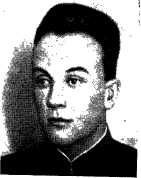
~
Yevgeny Chervonny
~
[78]
__ALPHA_LVL1__
NOTE FROM
LIEUTENANT LAZAR DZOTOV
August 15, 1942
To my people.
In my service to the Soviet people I'll fight to the last drop
of blood for the honour, freedom and independence of Soviet
land. I remain true to my war-pledge which I made to my
people. To the last minute of my life I count myself a true son
of my country.
Forward,
~ ~ ~ ~ ~ For our country.
~ ~ ~ ~ ~ ~ ~ ~ ~ ~ Lieutenant Dzotov
__b_b_b__
Lazar Dzotov, from the North Ossetian village of Dur-Dur, led two
platoons of submachine-gunners across a river on the outskirts of
Voronezh and silenced enemy gun posts which had prevented Soviet
units from making a crossing. This was on August 15, 1942. After
being mortally wounded in the battle, he scribbled his last wish
down on a piece of paper and passed it on to his comrades.
[79]
__ALPHA_LVL1__
LETTER
FROM TANK-DRIVER GEORGI LANDAU
Not later than August 20, 1942
Darling, my love,
Yesterday we finally contacted the enemy. Today we'll
soon move into the attack.
This is the set-up: artillery and mortars are thundering
away, our bombers have just gone over and given Fritz hell.
We are very close to the Germans. All the time nazi mortar
shells rend the air and bullets whistle overhead. We're all
in good spirits. I'm not the least bit scared, nervous or unsure
of myself. Instead, I have a burning love for our country, an
urge to do all I can to defend her, my dear ones, from these
20th-century Huns. Get revenge on them for all the misery
and suffering they've caused our people, get revenge on them
for our beloved Leningrad.
There's a lot more I could write but not much time left.
All my love and kisses to you,
~ ~ ~ ~ ~ Goga
__b_b_b__
A war correspondent came upon a tank unit in early August 1942
and got into conversation with the men. Soldiers wanted to recount
the battle deeds of their comrades, how life was at the front. There
and then the correspondent heard about Lieutenant Landau's letter.
``We used to call him Goga,'' the tank-men recalled. "He was a
fantastically courageous and daring officer. His tank crew were
always in front.
``This is his last letter. It was written just before the battle. Goga
didn't come back, he died a hero's death. . . .''
80
__ALPHA_LVL1__
NOTE
FROM CADET IVAN SHESTOVSKIKH
August 23, 1942
Today, August 23, we're pounding into the nazi rats. If they
kill me, let my country know I died heroically for Stalingrad.
I am a candidate to the Party, but please consider me a
Party member. Let my country know I died for the cause
of the Party.
__b_b_b__
In July 1942, the nazi forces pushed through to the Volga. Then
commenced a battle unprecedented in the history of war, lasting
200 days and nights and culminating in a glorious triumph for the
Soviet people.
First into battle and last out were the Communists and Y.C.L.
members. The best officers and men joined the Party in those grim days
and took the pledge: "Communists won't budge from Stalingrad!"
That was the pledge taken by young cadet Ivan Shestovskikh.
__PRINTERS_P_81_COMMENT__
6---3928
[81]
__ALPHA_LVL1__
NOTE
FROM BATTALION COMMISSAR IVAN SHCHERBINA
TO THE INFANTRY DIVISION COMMAND
September 17--18, 1942
Comrades Kuznetsov and Povarov,
Greetings friends. We're mowing down the Germans
surrounding us. Not a step backward-that is my duty and that
is my nature....
My regiment hasn't disgraced itself and won't disgrace the
Soviet Army.
I sent a letter to a skunk of a German officer. We are hitting
you hard and we'll carry on hitting you all the harder.
Comrade Kuznetsov, if I die-my only request is about my
family. Another regret is that I can't smash any more of
these bastards in the teeth, that is, I'm sorry I have to die so
soon with only 85 Gerries to my tally.
For our Soviet Homeland, lads, smash the enemy!
__b_b_b__
Ivan Shcherbina was born in Dnepropetrovsk in October 12, 1908.
On graduating from the Dniepropetrovsk Metallurgical Institute he
continued his studies at a Communist Party Institute before serving
in the N.K.V.D. (People's Commissariat of Internal Affairs) from 1935.
In 1939 he took part in the liberation of Western Ukraine. Just
before the war he passed out from the Lenin Military and Political
Academy. When war broke out he was appointed Commissar of the
272nd Infantry Regiment. Together with his regiment he made a hard
road of retreat to the banks of the Volga.
82
During the defence of Stalingrad between the 17 and 18
September, 1942, a group of 15--20 soldiers led by a couple of officers
defended the Gorky Drama Theatre. Enemy submachine-gunners under
the covering fire of tanks broke into the theatre. In order to drive
them out again, Ivan Shcherbina and three of his men decided to
break through to the main entrance and shoot down the nazis from
there. He was the first to dash from cover but was mowed down by
a machine-gun burst. The bullets hit him in the neck and shoulder,
smashing his carotid artery and his wind-pipe. His strength ebbing
away, he managed to jot down a few words to divisional commander.
Colonel Kuznetsov, and Colonel Povarov, head of the divisional
political department. To his last breath he had faith in the victory of
the Soviet people, and with these words fell back in his comrades'
arms.
[83]
__ALPHA_LVL1__
LETTER
FROM GUARDS MAJOR DMITRI PETRAKOV
TO HIS DAUGHTER LUDMILA
September 18, 1942
My little black-eyed Mila,
I'm sending you a cornflower.. .. Just imagine-the battle's
on, enemy shells bursting all around, craters around us and
a flower growing here.... And suddenly an explosion .. . the
cornflower is torn off. I picked it up and put it in my
pocket. . . . The flower had grown, reached for the sun but
had been torn off by an explosion, and if I hadn't picked it
up it would have been trampled upon. That's how the nazis
treat children in the villages they occupy. They murder and
trample little children into the ground.. .. Mila, papa Dima
will fight the nazis to his last drop of blood, to his last gasp,
so that the nazis won't treat you like this flower. What you
don't understand your mama will explain.
__b_b_b__
Before the war Dmitri Petrakov taught at a college in Ulyanovsk.
He was an extremely kind-hearted man. When war broke out he
was made educational officer and later regimental commissar.
On September 18, 1942, his battalion attempted to take a hill.
Every inch of land had to be gained by furious fighting. For
twentyfour hours the battalion soldiers three times warded off
counterattacks. Defying the fire of six-barrelled trench mortars and bombs,
the small group edged their way forward. When hand-to-hand
fighting ensued, the commissar deliberately ran the risk of calling
artillery fire upon his group. He telephoned the artillery and told them
to shell the area where he was fighting with his men. Only
exceptional gunnery on the part of the Soviet artillery, who wiped out the
attacking nazi groups, saved the lives of the heroes. And the hill
was taken.
84
In this encounter Dmitri Petrakov received concussion. When he
came to in the medical tent he wrote these few words to his daughter
Ludmila, referring to his last battle.
In October 1942, General Gurtyev's Siberian Division in which
Dmitri Petrakov was serving clashed with the nazi troops in the
factory district of the town. High explosive bombs were crashing all
around, walls of buildings came tumbling down and nazi tanks crawled
on over the rubble.
Communications were broken. It was then that Major Petrakov
led his men into a do-or-die assault on the enemy's rear. The
buildingthe key point of resistance-was captured.
In the summer of the following year. Major Petrakov's regiment
began to push towards Orel. The nazis threw all they had into defence,
employing more and more Tigers and Panthers. It had to be broken
down.
Major Petrakov crawled from trench to trench urging on his officers
and men:
``It's only about five miles to Orel. Two or three hours of hard-fought
offensive will save us many losses and won't give the Germans a chance
to destroy our ancient Russian town. Forward to liberate it!''
These ardent and moving words from their commissar brought a
superhuman effort from the soldiers who smashed the enemy's
resistance and broke through to the outskirts of the city. Then they
pressed on into the streets and squares. But Major Petrakov was
dead, killed as he reached the centre of the city.
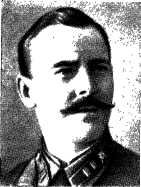
~
Dmitri Petrakov
~
[85]
__ALPHA_LVL1__
VASILY KRIVOPUSTENKO'S INSCRIPTION
IN A NOVOCHERKASSK GESTAPO CELL
September 26, 1942
I slept on this bunk from 24/IX to 26/IX-42, in for
interrogation.
They haven't passed sentence but to back up their
accusations they confronted me with a stranger, Alexei Yuokhanov.
He gave false testimony and began to lay into me as well,
even though he doesn't know me from Adam. Anyway he's a
swine and a traitor.
Judging by their attitude at the interrogation and their
prejudice I shall be shot.
Farewell. I shall die honourably.
26/IX
V. Krivopustenko
__b_b_b__
Vasily Krivopustenko was born in Taganrog in 1903 into a poor
Don Cossack family. He started work at the age of seven. He became
an apprentice to a cobbler, a cowherd and farm labourer.
During the Great October Revolution he joined the Red Guard and
then fought for the Red Army against the whiteguards on the Don.
After Civil War he took up work at a shoe factory where he was
much admired and respected. For many years he was in charge of
deliveries, chairman of his local trade union council, chairman of a
district Soviet, instructor at the Party regional committee and, lastly,
vice-chairman of the Executive Committee of the Novocherkassk
Soviet of Working People's Deputies.
When he went underground with other Communists he organised
resistance forces, helped form partisan groups and led raids in the
town and on the railway.
While preparing one operation-on September 24, 1942-he was
caught by the Gestapo and thrown into a cell.
The Germans knew whom they were dealing with and hardly
expected to get anything out of him. So they cruelly beat him up.
But he held his tongue. Realising he was doomed he wrote his last
lines of farewell to the Soviet people on the plank serving as a cell bed.
[86]
__ALPHA_LVL1__
FROM A NOTE
WRITTEN BY THREE DEFENDERS OF LISICHANSK
September 28, 1942
... 158th Division ... 259th Regiment. Whoever finds this
letter will know that we died for our country. September 28,
1942, in the town of Lisichansk. Seryozha Blinov from
Leningrad, 24, wounded Vanya Kharitonov and I, Styopa Mukhin,
26. We swear we shall fight for our country to the end. Please
send this to Leningrad, 24 Chapayev Street, District Military
Committee. Death to the fascists! Good-bye. We shall die.
Avenge us....
__b_b_b__
In the summer of 1960, some boys found an old cartridge case in
a ravine near Lisichansk, where the town slopes down to the
Northern Donets. There was a small sheet of paper from a school
notebook in the cartridge case, on which the vow of the three soldiers had
been written in indelible pencil.
The note was in bad shape and it was impossible to make out
several words. The surname Blinov was difficult to decipher. It might
have been Blitov. But the date September 28, 1942, was fairly clear.
At that time Lisichansk had been a long way behind enemy lines.
In July 1942, Hitler's forces had passed farther on to Lugansk and
Rostov. In September the fighting had raged up to the Volga. But
here is evidence that two and a half months after the fall of Lisichansk
fighting was still going on, apparently underground. This trio, like
many others, fell defending their native soil, but never surrendered.
[87]
__ALPHA_LVL1__
LETTERS
FROM NIKOLAI STASHKOV,
SECRETARY OF DNIEPROPETROVSK UNDERGROUND
REGIONAL PARTY COMMITTEE
LETTER TO HIS WIFE, SON AND DAUGHTER
September 26, 1941
Hello there, my little Katenka and Valerik,
Am writing a second letter, today 26-9-41. Staying behind
to work. Not afraid and no one made me. If alive we'll meet,
and I'll tell you all about it. If not tell the kiddies their dad
was no coward and gave his life for Lenin's Party, for his
country. Tell them, Katenka, their dad was a real Leninist
Bolshevik, remaining to work underground, on a big,
responsible job.
If I die be kind to the kids, give them your love. Tell them
I expect them to be real patriots of their Soviet land. See they
work well at school....
Maybe this is my last letter. Please keep it for memory's
sake, for the children.
I want you to know that I loved you all like my dear
country. If I die for my country I die for your happiness.
Don't blame me, it has to be like that, the circumstances
demand it, history demands it and it is people who make
history. It fell to me to carry on the fight against these
fascist pigs, these beasts, in the underground. We
underground fighters will get revenge on the fascist jackals for the
blood of fathers, for the destruction and suffering brought on
millions of people, for the destruction of my town.
88
My little darlings, I'm going on a very dangerous mission
but I go without any snivelling, for I know that we are in
the right, that we shall win sooner or later. Better die a hero
than become a slave.
Farewell.
No tears, no grieving. Once more I'm telling you: under the
Soviet authorities you won't be left in the lurch, just keep
your chin up....
Many, many kisses. Don't write to me,
~ ~ ~ ~ ~ Dad
__b_b_b__
LETTER TO HIS COMRADES
September 24, 1942
Comrades,
The prison is riddled with provocateurs. They operate like
this: their agent sits with you, tries to pump you. The weaker
ones are drawn into conversation. Secrets are given away in
gossip. The agent memorises them and passes them on to the
interrogator. The next time you come up for interrogation,
the same questions are asked. If you don't answer, they give
you injections. It's a painful thing to go through. When you
come to they tell you that you said this and that under the
influence of the pricks. In actual fact it's just the provocateur's
notes.
I've had some provocateurs in with me: S. Kulish
and Osipenko from Vasilkovsky District and his wife Zina.
These three are ex-parachutists but now work for the other
side. They've given away over a hundred people. They've
had a go at L. Berestov, the Masloprom factory manager,
P. Novichuk, my father, V. Bykovsky, Y. Shokhov, N.
Tokmakov, Alexander Kravchenko, M. Kalinkin and Yura
Savchenko. Osipenko's wife has worked on Vera Khitko,
Kharitina Zhuravlyova, Valya Alexeyeva and others.
Farewell comrades!
If you get hold of this note or have a chance to get it out,
pass it on or keep it until the Soviet authorities arrive.
Yours,
~ ~ ~ ~ ~ N. Stashkov
24.IX.42
89
__b_b_b__
He returned from the army
to his home town of
Dniepropetrovsk just two days before the
outbreak of war. He had hardly
had time to greet his friends and
visit his old factory Spartak
where he worked many years as
a fitter, when the first swastika'd
planes appeared over the
Dnieper.
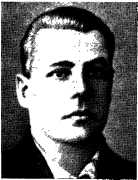
~
Nikolai Stashkov, Hero of the
Soviet Union
~
Then began frantic days
without sleep or rest when he
took up work in the Party
regional committee. When the
enemy came within striking
distance of Dniepropetrovsk,
Nikolai Stashkov was made
secretary of the town
underground regional committee of
the Party.
The German occupational
forces marched into
Dniepropetrovsk at the close of August
1941 and began to set up their
``New Order'' by fire and
carnage. Mass arrests of
Communists and all Soviet patriots
commenced. Between October 13 and 15, the Gestapo and quisling police
shot some 12,000 citizens, burying them in an anti-tank trench on the
edge of this town. By such fiendish actions the nazis wanted to coerce
the Soviet people, to bring them to their knees.
From day to day the partisan and underground movement steadily
grew under the guidance of the Party's underground regional
committee. Between October and November 1941, Nikolai Stashkov went
on foot round many districts and established personal contacts with
the leaders of Pavlograd, Sinelnikovo and other underground town
and district Party committees. He also made contact with leaders of
Y.C.L. organisations. In November he held a ``forest'' Party conference
attended by Communists from partisan detachments in the region.
Tn January and April of the following year, he was responsible
for meetings in Pavlograd of secretaries of underground town and
district Party committees-.
The workers of Dniepropetrovsk and Dnieprodzerzhinsk, the miners
of Krivorozhye and Marganets, the working men of other industrial
centres frustrated a good many enemy plans. The nazis were given
no peace anywhere and the ground everywhere burned under their
feet. They were never able to get any sizable factory going. Their
ruined tanks, guns, train engines and lorries had to be sent to
Germany for repairs. Railway blasts grew, smashing carriages with
troops and equipment.
The Gestapo had their work cut out searching high and low for
the people behind the resistance. In the end, one of their spies
managed to attend the ``wedding'' of a young underground pair,
90
Vera Khitko and Nikolai Tokmakov, which was in fact a cover for
Stashkov to brief his men. This was in June 1942.
After the ``wedding'' came the first round of arrests. This was
followed on July 8-9 by the second and more damaging arrests. Yet the
Gestapo could not pin down the leader. At the beginning of July,
Nikolai Stashkov made his way to Pavlograd where the underground
Party regional committee had its base. He now directed operations
from there.
Trouble came unexpected. On July 28, he was wandering through the
town market on his way to a rendezvous with some contacts. He
was trailed by a spy who suddenly shot him in the thigh and arm.
Wounded, he had little chance of escape and was caught by the
Gestapo quickly hurrying onto the scene.
Head of the local S.D. Sturmbanfuhrer Muhlde rushed to
Pavlograd and took the prisoner away under heavy guard to
Dniepropetrovsk. He was put into cell No. 20 of the Gestapo prison in
Korolenko Street.
Even before his wounds had healed he was constantly badgered by
high-ranking officers of the Gestapo and nazi administration. The
nazis did their level best to make him change sides. When they saw
it was useless they devised hideous torture for the brave Communist
and then planted a provocateur in his cell. During this time Nikolai
Stashkov discovered they had not even spared his 75-year-old father
and had shot him in front of the townspeople.
Yet even in prison, the underground leader felt himself responsible
for the fate of his comrades and did all he could to cheer them up.
This is evident from the letter to his comrades printed above.
On December 10, 1942, the prisoners saw some of their comrades
being taken out before the firing squad.
``Farewell, comrades!" called out Nikolai Stashkov.
A few weeks later, Nikolai Stashkov and his faithful companion
Georgi Savchenko were led out to face the firing squad. Stashkov
shouted out to the butchers: "Shoot me in the chest. I know you
haven't got the guts. You'll shoot me in the back of the head. You're
even afraid of the dead!''
For his bravery in war Nikolai Stashkov was posthumously awarded
the title of the Hero of the Soviet Union and had one of the streets
of Dniepropetrovsk named after him.
[91]
__ALPHA_LVL1__
NOTE
FROM THREE SOVIET GIRL-SCOUTS
FROM A GESTAPO GAOL IN PSKOV
October 17, 1942
Today is October 17, 1942. More than a month we've been
in this cell. Three of us. We have done our duty to our
country honourably. For that the nazis are torturing us. No
matter what they do we'll die honourably as in battle.
Farewell, comrades! Revenge us.
__b_b_b__
This short note on a page of a school exercise-book was discovered
in 1957 by some builders behind a door-frame in one of the cells of
the former Gestapo gaol in Pskov. On one side of the paper was the
outline of the red banner traced in blood and on the other the above
words.
The story behind the note is as follows.
On the night of August 8, 1942, four young girls were dropped
by parachute behind enemy lines near Pskov. The quartette, under
the code name Vera, consisted of Valeria Patkovskaya, 20,
Valentina Golubeva, 19, Yelena Silanova, 18, and Anfisa Gorbunova, 23.
All the girls were from Moscow. Their instructions were to settle
down in Pskov and radio information on the location of enemy
troops, their movements and strength, the defence fortifications, etc.,
to the Soviet Army H.Q. After a safe landing, the girls had the
misfortune of running into a search party the next day somewhere near
Zarechye. Three escaped but Yelena Silanova lost her life in the
shooting.
From a house on the outskirts of Pskov the trio started their
regular transmission of ciphers back to headquarters, keeping watch
on the junctions of all the main highways leading out of Pskov. At
the end of August they were forced to leave their convenient room
92
because the old landlord had been arrested and tortured to death
by the Gestapo. After registering at the Labour Exchange they quickly
found jobs: Valentina (under the name of Izotova) and Anfisa (under
the name of Mazina) at a cord factory, and Valeria (under the name
of Shchedrova) as an interpreter in a German office.
In September, during a registration check on Soviet citizens, they
were all summoned to the commandatura and detained because of some
irregularity with their passports. Initially, as there was no evidence
against the girls, they were held in Abwehrkommand No. 304 on
Krestyanskaya Street where the police were checking all suspects
and their papers, besides recruiting people. The conditions were a
good deal more free and easy than in gaol and the girls got ready
to make a break. But suddenly everything fell through. A woman
was brought to the Abwehrkommand who knew Valeria well. During
questioning she blurted out Valeria's real surname and, unable to
withstand the torture, gave her away as the leader of the intelligence
group. The next day Valeria Patkovskaya and her two companions
were carted off to the Gestapo gaol.
There the girls were strung up, burnt with flaming torches and
clubbed mercilessly. Then the nazis took the brave trio beyond the
town to the village of Peski and shot them.
[93]
__ALPHA_LVL1__
LETTERS FROM KONSTANTIN ZASLONOV,
COMMANDER OF ORSHA PARTISAN BRIGADE
LETTER TO A FRIEND
Not later than November 14, 1942
My dear Vladimir Yakovlevich,
Best partisan greetings from the dense thickets, swamps,
woods and partisan hamlets of Byelorussia.
When old pals meet they usually ask each other, "Well,
how're things going?" That's probably the question you'd
like to put to me. The usual reply is "Fair enough''. Then we
can get on with our chat as friends and comrades do. It's a
year since we parted, a year knocking around different parts,
sometimes envying each other.... I know it, we'd get chatting
as if we had only seen each other yesterday, I can just
imagine it. First of all, I'll begin with what interests you
just as keenly as other affairs of state-your only son.... The
boy lives in Slavny with your brother-in-law. Your dear
mother-in-law has been there too ever since her home was
bombed last February.
Now to business. Big things-we blast, blast and blast again.
Every day something new, sometimes we hack away-no
mercy to the Germans, sometimes it suits us better to lie low
and sometimes we watch the nazis bite the dust from a
derailed train. Sometimes we eat like kings, sleep like logs,
sometimes we go hungry for five days, sometimes we're chilled
to the marrow and our teeth chatter. There are provocateurs
about, spies and traitors around, sometimes we let them slip
through our fingers but more often they taste the vengeance
of the partisan boys.
94
My partisans got the Gerries so worked up they had to
muster and throw in three divisions against me but we made
it so hot for them they cleared off. Now the price on my
head has gone up and gets even higher after every sortie,
and sorties come thick and fast. Now the price on my head
is 50,000 marks, an Iron Cross and, into the bargain,
whoever delivers me dead or alive to the German authorities, will
be granted a wonderful life in Germany with all his relatives.
If any of the peasants give me away to the authorities they'll
be given two large German estates for their own use for life.
There we are, Vladimir Yakovlevich, that's about the size
of it.
I must admit, along with my men's heroism and bravery
there are the cowards and quislings. We've learned how to
deal with such people and we're doing alright, erasing them
from our life like one of nature's errors. Details of our
skirmishes and forays when we meet. I've just about walked
my feet off covering the length and breadth of Byelorussia,
although sometimes we get a lift.
Well, Volodya, all the best. Greetings, Zaslonov.
Greetings to the boys on the railway, see if you can scrape
together a decent group of about 15--20 men and pay us a call
for a couple of months, we'll have a few scraps and you can
fly back again. Come and be my guest with the boys, you can
contact me through Comrade Ponomarenko, he knows where
I am.
Zaslonov
__b_b_b__
LETTER HOME
Not later than November 14, 1942
My dear little Ritusya, my darling pets Muza and Iza. How
much I'd love to see you all. If we pull through we'll be
together again. If I die, it's for our country. That's how to
put it to the kiddies... .
__b_b_b__
With a heavy heart Konstantin Zaslonov left Orsha on July 15,
1941. He caught the last train for the east literally right under the
noses of the German motorcyclists. It was a hard trip to Moscow.
Finally, he reached the blacked-out, austere capital at the Ilyich
95
railway shed on the Byelorussian
line. There were several
railwaymen from Orsha already at work
there and Konstantin Zaslonov
was put in charge of the repaired
engines. One day he gathered
his friends about him and read
out an appeal to the Party
Central Committee and the
Ministry of Transport:~
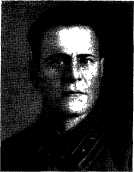
~
Konstantin Zaslonov, Hero of the
Soviet Union
~
``Our country is in flames.
Life demands that every citizen
with the heart of a patriot stand
up to defend our country. ... I
beg your permission to form a
partisan detachment and operate
between Yartsevo and
Baranovichi, including the strip of
railway line, stations and other
railway installations. I assure you
in the name of the bravest of
our lads who have asked me to
appeal to you, that we swear to
keep the partisan oath with
honour....''
This appeal expressed the
thoughts and hopes of all present, and soon afterwards some 30 Orsha
and Smolensk railwaymen were getting ready for their trip behind
the lines. Zaslonov was appointed commander with F. Yakushev as
his commissar. In early September the small partisan group set out for
Vyazma where they were joined by another group of workers.
At dawn on October 1, 1941, Zaslonov's men crossed the front near
Belsk, assisted by the covering fire of a squadron of the Major--
General Dovator's cavalry corps. The partisans slogged it out for one and
a half months surmounting all possible hazards, bearing all the
privations of early winter, giving many German search parties the slip
and suffering from cold and hunger.
Only a few reached Orsha----- In the town, Konstantin Zaslonov
soon made contact with the Communists left behind for underground
work in the enemy rear. With their assistance he managed to get
from the town authorities a temporary pass and then was allowed to
sign on for work at the Labour Exchange.
The jobless engineer, born in 1909, and having worked in the
local railway depot for a long time before the war, quickly attracted
the attention of the German administration who were badly in need
of specialists to set things right on the railway. After careful checks,
the ``loyal'' engineer was put in charge of Russian engine crews.
Making use of his position, Konstantin Zaslonov was able to fix
up work for his companions from Vyazma-Anatoly Andreyev, Sergei
Chebrikov and Pyotr Shurmin. This tiny group acted as the nucleus
of the resistance movement and carried on all manner of diversions
in Orsha and at neighbouring railway stations. Many railway
workers joined the resistance.
96
Despite the hard conditions under which they operated, the
incessant Gestapo checks and spying by German agents, Zaslonov and
his comrades trained the repair workers in subversive tactics and
skill. The group made their own mines disguised as lumps of coal
which they hid under coal heaps. They also made ``hedgehogs''--
special explosives which were scattered along the highways. The
resistance men blew up signal boxes, pump-houses, railway points
and bridges, burned down buildings and killed enemy soldiers and
officers.
From Zaslonov's dispatches to the Vitebsk Party underground
committee it is seen that in three months of the heroic campaign at Orsha
railway junction there were 98 train crashes, 200 locomotives were
knocked out and thousands of waggons and fuel cisterns and large
quantities of enemy equipment were blown up. This was a tremendous
help to the Soviet Army fighting the Germans near Moscow.
Besides, Zaslonov's men seized arms and built up a store to move
out to the forest. On several occasions the German administration
arrested Zaslonov, but every time he was able to establish his
nonimplication in sabotage. But in February 1942, when it had become
too dangerous to remain at the shed any longer Zaslonov and his
companions left for the south-west of Vitebsk Region leaving behind
a few trusted people on the railway. At the new base, the village of
Logi, a detachment named "Uncle Kostya" began to function. It
quickly grew. By June it had notched up 113 blown-up trains and
some 2,000 dead nazis and quislings. Soon after, the five detachments
were united in the 2,500-strong Zaslonov brigade.
Between October and November the partisans caused a great deal
of discomfort to the better-equipped and more numerous nazis based
on Vitebsk. On November 13, the Germans succeeded in surrounding
a group of commanders and commissars of the Orsha zone partisan
detachments who had gathered for a conflab in the village of Kupovat.
On the following morning the Germans closed in. After four hours
of furious fighting the enemy broke through to the edge of the village.
Hand-to-hand combat commenced. All the partisans and their officers
fought to their last cartridge, to their last gasp.
He perished. But other partisan brigades bore his name and
courageously fulfilled the deeds of one of the Soviet Union's bravest sons.
__PRINTERS_P_97_COMMENT__
7---3928
[97]
NOTE
FROM SEVENTEEN BYELORUSSIAN PARTISANS
December 3, 1942
We die for our country, but shall not let the enemy through.
Please consider us all Komsomol members.
__b_b_b__
It was the second rigorous winter of the war. The nazi invaders
had occupied Byelorussia and subjected her people to unprecedented
suffering. But the Byelorussian people refused to bow down to the
fascist butchers. A mighty partisan movement sprang up throughout
the occupied territory.
A group of 17 young Byelorussian partisans led by Communist
Vikenty Drozdovich was active in the Kopyl District.
On December 3, 1942, this small group of men received an order
from brigade headquarters to stop the nazis moving towards the
village of Lava, location of a partisan hospital and the brigade
headquarters. For four hours the brave seventeen youngsters beat off
eight enemy attacks backed by light tanks, armoured cars, artillery
and mortar fire.
The Soviet patriots made a pledge to their country they would fight
off the enemy until their last gasp. When their ammunition and hand
grenades ran out, they continued with rifle butts and bayonets. A
total of 85 Germans were killed and several light tanks and armoured
cars put out of action.
In the grossly unequal battle on December 3, 1942, all 17 patriots
fell. At the cost of their lives the heroes had given their people a
breathing space to evacuate the hospital and assemble their forces
for combat. The partisan brigade routed the Germans who had to
pay dearly with hundreds of lives for the death of the gallant
seventeen.
[98]
__ALPHA_LVL1__
LETTER AND NOTES
FROM GEORGI SAVCHENKO, LEADER
OF DNIEPROPETROVSK UNDERGROUND
LETTER HOME
Dear Mum and Dad and sister Tina,
If we ever meet again-and even though things are pretty
tough now I don't lose hope-I'll let you know a little more.
For the time being I'm just writing a few words about what
has happened to me in the past nine or ten months. This
period in my life is a darn sight richer in experience than
all the other years put together. In this time I've had to go
through just about the lot-starting from my baptism of fire
and ending with concentration camps. So I've seen quite a bit.
Up to August we retreated, fighting, eastwards. Then our
unit was surrounded and this is where things started. P.o.w.
camp. Escape. A few days of freedom. Inside again. Out
again. And inside again. This time I'm locked in the Bobruisk
Fortress. They started to beat the living daylights out of me,
after which I was about a fortnight on my back. I'd only just
got over it when I had another go at getting out. I thought
I'd make for Dnepropetrovsk to see you all and get back
into the fray.
Why am I doing all this?
1) I'm a Communist. Not just in words but after going
through an extensive communist school. My Party card is my
whole life to me, not a screen behind which one can hide
from life's tempests at the first moment of trial.
2) All the things I've been through force me to this decision.
I grew up, studied and matured in Soviet times. That has
99
Emacs-File-stamp: "/home/ysverdlov/leninist.biz/en/1965/LFD232/20070221/199.tx"
__EMAIL__ webmaster@leninist.biz
__OCR__ ABBYY 6 Professional (2007.02.22)
__WHERE_PAGE_NUMBERS__ bottom
__FOOTNOTE_MARKER_STYLE__ [*]+
__ENDNOTE_MARKER_STYLE__ nil
entered my blood and flesh. To live without or outside the
Soviet system is simply unthinkable for me. I'll fight might
and mane to see the red flag flying again over our country
and our Dniepropetrovsk and to get the country free of these
gorillas, these bandits, these bloodsuckers. . ..
Hatred makes my blood boil. No swine of a nazi I get
my hands on will escape with his life. Death to the bastards
who have besmirched our sacred land!
If I don't come back you will know I gave everything to
liberate my country, I died for you, my dear ones.
I hope it is only ``good-bye till we meet again''.
~ ~ ~ ~ ~ Lots of kisses,
~ ~ ~ ~ ~ ~ ~ ~ ~ ~ Your loving son and brother,
~ ~ ~ ~ ~ ~ ~ ~ ~ ~ ~ ~ ~ ~ ~ Yuri
March 19, 1942
Dniepropetrovsk
__b_b_b__
NOTE TO HIS AUNT K. A. SHEPITKO
Thanks for the bread and especially for the linen. Auntie
dear. I'm so sorry I've caused you and everyone at home
so much sorrow. It doesn't look as if I'll get out of here.
We are all due to be shot today or tomorrow. But I've no
regrets. We shall win all the same. Tell Klava to bring up
Galya a decent and honest girl. She'll have a hard time
without her husband, and so will the little girl without her dad.
Let's hope she marries again if she finds a suitable chap. I
lay down my life for my country.
Farewell.
__b_b_b__
NOTE TO HIS COMPANIONS
Greetings friends,
Thanks for all you've done for me. This note looks like
being my last "will and testament".
The case is already over and I'll be pushing up the daisies
today or tomorrow.
If you can get to see my folks, give them a kiss for me.
Yours,
~ ~ ~ ~ ~ Yuri
100
Once more please excuse the bother I've caused. I'd give
anything to live. But I'll go calmly in the knowledge that I'm
not the only one and there will be thousands of others who'll
take my place.
P.S. Wash out my linen and pass it on in a separate bundle.
Don't bring anything else.
December 21, 1942
__b_b_b__
Up to the war Georgi Savchenko was an electrical fitter at the
Petrovsky Works in Dniepropetrovsk. In 1939, he joined up, went
through a military-political college and became a political instructor.
In July 1941, his unit was encircled. In an attempt to break through
to his own men he was taken prisoner. Thrice he made a break
from captivity. Twice he was caught but the third time he managed
to get back to his native town where, together with a group of
youngsters, he formed a Party resistance group. At the beginning
of February 1941, the organisation numbered more than a hundred.
In a dark and dimly-lit cellar the resistance fighters rigged up a
transmitter and began to listen in to the voice of Moscow. They
jotted down the news, wrote out leaflets and distributed them around
the town. The leaflets were signed simply: Committee C.P.(B.)U.~
(Communist Party [Bolsheviks] of the Ukraine).
At the outset to 1942, the Germans decided to set the town's biggest
factories in motion-including the Petrovsky, the Artyom and several
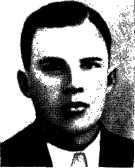
~
Georgi Savchenko
~
[101]
others. The resistance men and women intended to do all they could
to foil the Germans' plans. At the Petrovsky Plant an underground
group was set up to sabotage operations. Once they managed to
destroy the valuable cable which had arrived to the works. In the
end, the Germans had to give up their idea of trying to make the
factories work.
In the spring of 1942, Savchenko was elected secretary of the
underground town Party committee. Groups of young resistance fighters
sprang up and established contact with the neighbouring settlements.
The participants in the organisation worked out a plan for an uprising
in the town and collected arms and ammunition in preparation. They
blew up a gun-powder store, a fuel dump in Nizhnednieprovsk, and
a number of other targets. They destroyed trains, lorries and killed
German soldiers.
Despite the desperate efforts of the Gestapo the underground
remained a mystery to the Germans for some time. Finally, a spy
succeeded in worming his way into one of the groups.
The round-up commenced. In just one week more than 70 people
were brought in.
Georgi Savchenko managed to escape several times from under the
very noses of the Gestapo, until he was finally arrested in October
1942 when, scorning danger, he was putting the resistance back on
its feet. In early December the nazis shot a large group of resistance
fighters on the outskirts of the town. Savchenko faced the firing squad
at the end of January 1943 together with Nikolai Stashkov, secretary
of the underground Party regional committee.
Georgi Savchenko's letter was discovered in his old apartment on
Krasnoflotskaya Lane. It was hidden behind the frame of a picture
hanging next to a family portrait. He also managed to have two notes
smuggled out of gaol. The first was to his aunt who was let out of
prison shortly before his arrest. She persuaded the prison guard to
pass on to her nephew a loaf of bread and a change of linen. An
hour later the guard brought back the note hastily scribbled on a
scrap of paper. The second note was smuggled out on a piece of
cloth shortly before his execution.
[102]
__ALPHA_LVL1__
LETTERS
FROM MINSK RESISTANCE FIGHTERS
IVAN KOZLOV AND GEORGI FALEVICH
LETTER FROM IVAN KOZLOV TO HIS COMRADES
December 27, 1942
My dears,
Yesterday, Saturday, I received no correspondence from
you. Understood. I'll probably be the death of you with my
straightforwardness but there's no sense giving way to despair
when there's no way of mending what's done. Everything I've
got worked out, as you see, cannot be realised for reasons
which are beyond my control. I know it must be hard to lose
one of your mates. But how can you help? Tears are no use.
To hell with them. Millions are dying and in what way are
we better than them? A real patriot is one who looks death
bravely in the face. No tears. No despair. Our blood won't
be shed in vain.
Have courage, be brave, don't be afraid and never despair.
What wouldn't I give to live and get revenge on these
savages! If only I were able.... You can bet your life I would
have slaughtered these dirty swine. I wouldn't have cared, I
would have torn them apart-and enjoyed every minute of it.
Yet only a couple of years ago I was too scared even to
carve a little chicken.
Oh, how I want to live! The whole aim of life is not to
hide behind the backs of your comrades but to take a gun
in your hands and kill the dirty jackals. The whole ecstasy
103
of life, the eternal ideal of us all is to live for our country,
for our freedom-loving Russian nation, to battle for its
honour and freedom.
Ardent greetings to all those who go with gun in hands
to defend honour and independence.
Greetings to all friends and comrades....
From the very bottom of my heart I wish you the best of
luck. Please excuse the torments I'm causing you, they'll be
paid back in full.
Yours,
~ ~ ~ ~ ~ Vanya Kozlov~
See if you can get me a bit of baccy today round about
three.
__b_b_b__
GEORGI FALEVICH'S LETTER TO HIS FIANCEE
Not later than September 1942
My love, what a pity I can't write to you from here, I'd
swamp you with letters.
My darling, how I want to see you, kiss you and hold
you in my arms. But, unfortunately, all that is impossible both
now and in the future. Nina dear, please try and slip me a
few words somehow. My love, write me something every
day. It would make me so happy....
Give mum a kiss for me. Ask Vera Ignatyevna to forgive
me for everything-kiss her too.
I could do with a smoke!
All my love,
~ ~ ~ ~ ~ Georgi~
Tell them at home there is a note sewn in my underpants.
__b_b_b__
On June 28, 1941, the nazis marched into Minsk, but they were
unable to break its people's spirit. In the very first months of
occupation the Communists and Y.C.L. members began to get together small
resistance groups at the big factories, on the railway and in the
colleges. At the end of 1941 a town Party committee came into being
to lead the resistance struggle. Set up at the same time was a Military
Council of Partisan Detachments consisting mainly of soldiers and
officers who had stayed behind in the Byelorussian capital.
104
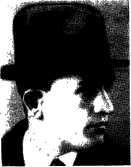
~
Ivan Kozlov
~
One of their first tasks was
to listen in to the news from
Moscow and to distribute leaflets.
After establishing contact with
the partisans, the underground
resistance began to engage in
intelligence work and supply the
partisans with arms and
ammunition, medicine and warm
clothing. In order to carry out intel
ligence work more efficiently the
Minsk patriots, on instructions
from the Party committee, made
their way into jobs at offices and
factories run by the Germans.
Ivan Kozlov was one of the
most active of the Minsk
underground workers. Right from the
very first days of occupation
Kozlov turned his house into a
meeting place for his fellow
resistance fighters, intelligence
people and partisans. He handled
all the messages which the partisans sent to the underground and
back again. On instructions from the Party committee, he became
engaged on the job of preparing documents for the underground. In
the squat house on Komarovskaya Street this talented artist forged
the stamps and signatures of the nazi administrators in Minsk.
He was supplied with blank documents by another member of the
underground, Y.C.L. lad Zakhar Gallo who got himself a job as clerk
in the German pass office. Risking his life daily Gallo brought
Kozlov blank passports, passes and other documents, specimens of
stamps and signatures. The pair of them supplied dozens of Minsk
fighters with life-saving documents. It took the Germans a long time
before they could lay their hands on the underground pass-issuing office.
Between September and October 1942, the Gestapo, with the
connivance of spies who had wormed their way into the Minsk
underground, dealt a serious blow to the Party organisation. On October
26, Kozlov was arrested. More than two months of endless questioning
and torture went by. Nothing could break the will of the intrepid
Soviet patriot. Not one name passed his lips.
His friends prepared an escape plan, but it fell through at the
last moment.
From time to time Ivan Kozlov succeeded in making contact with
his friends outside continuing the fight against the enemy. On
December 27, 1942, not long before his execution, he wrote them the letter
published above. His last words found their way through to his
comrades-in-arms and from them were sent to the partisans.
__*_*_*__
105
Georgi Falevich had been a chemistry student at the Byelorussia
State University. He could hardly have imagined that in a few months'
time he was to be in charge of a dispensary under the Germans. But
the underground needed a reliable cover and they needed medical
supplies, and the chemistry undergraduate took over a dispensary on
Sovietskaya St. right next door to the Gestapo H.Q. Another
undergraduate, Nina Yermolenko, joined her fiance at the dispensary.
All autumn and winter of 1941--42, the dispensary manager's office
served as a reliable cover for the partisans. Here they kept their
print and blank bread coupons with which they supplied the
underground fighters and partisan families. And a good deal of scarce
medical supplies were dispatched from here to the partisan units.
In the spring of 1942, a spy succeeded in penetrating the
organisation. Arrests commenced. On the morning of May 26, the Gestapo
pounced on two girls-partisan contacts-with whom Georgi Falevich
had sent an urgent order of medical supplies for the partisans. The
dispensary was cordoned off and all its assistants put under arrest.
Due to lack of evidence Nina Yermolenko was quickly released but
Georgi Falevich and his comrades were taken away to the town
Gestapo gaol.
The nazis tried every trick they knew to get information out of
the young chemist. But they got no names or addresses. The young
lad stood up to his torture bravely and took all blame on himself
in an effort to save the remaining underground fighters under arrest.
In September the Germans stopped taking any more parcels from
Nina for Georgi. It was later learned that he had been shot.
Through a policeman in league with the underground, Georgi
Falevich managed lo send out a few letters to his bride-to-be. They were
written on narrow strips of cloth torn from his clothing.
[106]
__ALPHA_LVL1__
INSCRIPTIONS
ON THE WALLS OF PRISON BARRACKS
IN CHISTYAKOVO, DONBAS
Late 1942
Brothers! Black Sea sailors,
Don't think I was taken prisoner for nothing. I was gravely
wounded but these dirty bastards patched me up to use me as
their workhorse. No go. Today they set on me, broke just
about every bone in my body, farewell.
Yours, Mikhail L.
__b_b_b__
I'll be gone today but you'll stay behind, Black Sea sailors.
Fire a few rounds for me, brothers, let'em know we won't
give in, that I'm gone but you remain.
Yours, Nikolai G.
__b_b_b__
Farewell to all my dear ones. How I'd like to get just one
more look at my sea, my Black Sea.
P. T.
__b_b_b__
Kid brother, Kolya, dear sailor boy,
Remember me, look after mum.
Your brother Oleg
107
__b_b_b__
After the fall of Odessa and Sevastopol, a group of Black Sea sailors
were taken prisoner and enclosed in the Chistyakovo prison barracks,
in the Donbas. According to eye-witness reports the seamen were
treated in an abominable way. In a note concealed in a stove in one
of the barracks, a tank man wrote: "They were tortured, branded with
white-hot irons, had their hands twisted off, and they said: 'Listen,
friends, if anyone succeeds in getting out of here alive, don't forget
to tell everyone that sailors are made of steel and no force on earth
can drive us down. Long live our country! Long live our Ukraine!'
``These are the words spoken by the sailors under torture, and
they were tortured before the eyes of all us prisoners so as to break
down our resistance. We later learned that the sailors had strangled
two German guards, but they didn't manage to escape.. . .''
Unfortunately, the names of the Black Sea heroes have not yet
been established.
[108]
__ALPHA_LVL1__
NOTE
FROM NIKOLAI BUKIN, ONE OF THE KHERSON
UNDERGROUND LEADERS
Early 1943
Even if they tear me to pieces, they won't get anything
from me!
__b_b_b__
Nikolai Bukin hailed from the Soviet Far North, the settlement of
Nivsk in Kandalaksha District. After crowning an excellent school
career in 1939, he volunteered for the army.
As soon as war began he was right in the thick of the fighting. In
a letter home sent on September 16, 1941, he wrote: "Now we have
to fight and fight to the death, for to die in battle is an honour, to
live in slavery is a sin. ... I go
to my death like all those who
defend every inch of Soviet soil
from the swine who strive to
enslave and destroy our fathers,
mothers, sisters and
brothers. ...''
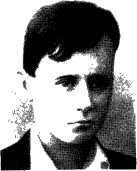
~
Nikolai Bukin
~
While defending the lower
reaches of the Dnieper, the
young soldier was seriously
wounded and taken prisoner.
But not for long. He escaped
and made contact with the
Y.C.L. members of Kherson and,
together with Ilya Kulik, headed
the young underground fighters.
The patriots derailed enemy
trains, stuck up leaflets in the
streets of the town and
assassinated nazis.
One day the Gestapo tracked
Nikolai Bukin down and tried
to take him alive. "To die in
battle is an honour,'' was the
young man's motto. And he
[109]
saved his last bullet for himself. He regained consciousness in a
condemned cell. The Gestapo nursed him back to health in order
to squeeze the names of other underground fighters from him. But
he didn't lose heart and was constantly trying to keep his
neighbours' spirits up. He managed to communicate to them his last,
courageous letter.
A survivor of the Kherson underground, Klava Shapovalova, wrote
to Nikolai Bukin's parents about the last days of their son's life: "I
remember seeing him one day.... And you know, no matter how
brutally they battered him, I never once saw a spark of fear of death
in his eyes. People like Nikolai don't cry. That's how he will always
remain in my memory....''
[110]
__ALPHA_LVL1__
NINA POPTSOVA'S LETTER
FROM PYATIGORSK GESTAPO DUNGEON
January 6, 1943
Farewell Mummy. I'll soon be gone. Don't cry over me.
Mum, when our Red Army comes, let them know I died for
my country. Let them avenge me and our suffering.
My dear Mum, farewell once more ... we shan't be seeing
each other any more. I'm going to die.
But how much I want to live! I'm only 20, and death is
knocking at the door. .. .
How much I want to work, to serve my country.
But these savages, murderers.... They snatch our young
lives away.
I'm now in the death cell, waiting for them to come along
at any moment. I can hear them shouting "Come out!'', they're
coming to the cell now. . . .
Oh, Mum, farewell! Kisses to you all for the last time. My
final greetings and kisses. . . .
Nina Poptsova
__b_b_b__
Nina Poptsova was a twenty-year-old Y.C.L. girl from a little
hamlet near Pyatigorsk. At the approach of Hitler's army she took to
the hills to fight the enemy from there. In late autumn 1942, she
was dropped by parachute behind the front line to glean what
information she could about the nazi troops. On instructions from her
command, Nina made three excursions behind the lines. On one
occasion she got through to Pyatigorsk, and on another to her native
village; she even fearlessly entered nazi offices. And everywhere
her sharp eyes took in exactly what was needed back at command
headquarters.
111
Nina twice safely crossed the front and dehveied her information
to headquarters Wnen she appeared for the third time in the streets
of Pyatigorsk she was spotted by a traitor and given away to the
Germans In the Pyatigorsk dungeons she was interrogated by officers
from the notorious Bergman Regiment with the participation of the
fascist butcher Oberlander But they were unable to force a word
fiom the young girl On the day of her death, January 6, 1943, five
days before Pyatigorsk's liberation, Nina wrote a letter to her mother
This letter, hurnedly scribbled in pencil, was discovered among the
documents left behind by the Germans in then hurried exit from the
town
[112]
__ALPHA_LVL1__
LIBIA BELOVA'S LETTER
FROM NIKOPOL PRISON
Not later than Januaiy 7, 1943^^*^^
My dearest Papa, Mama, dear sister Nyura and my darling son,
Thanks a lot for the two notes I m very pleased to have
heard your dear voice.
We haven't got any idea yet what they are going to do
with us-either camp or the shooting squad It's all the same
to us whether we live like that or die There are many of us
here who were arrested on political grounds And none of us
is in low spirits .. . talking and thinking about the future, and
not giving death a thought Papa, it's better to die on our own
soil than be taken to Geimany.
I'm not scared of dying I'm just a bit sorry for you and my
son. Still, let's not think of death, let's think of the future.
Best wishes to you all....
Lots of love,
~ ~ ~ ~ ~ Lidia
__b_b_b__
Lidia Bclova was a membei of Nikifor Taraskm s undei ground
gioup of young people in the village of Alexeyevka, in Zaporozhye
Region
Their chief mission was to cairy out agitation among the popula
tion Under Taiaskin s guidance, several biave girls, including Belova,
wrote out leaflets and appeals to the local population urging them to
combat the measures taken by the occupational forces, in particular
the dispatch of young people to Germany They urged the people
to destroy farm produce deliveries and disiupt enemy tiansport
These leaflets were posted all over the distuct.
_-_-_
^^*^^ Date she was shot
113
Due to the inexperience of certain members of the organisation,
the group was uncovered after it had been operating for over four
months. At the end of November 1942, Taraskin was taken in along
with other members. The arrested were detained in Nikopol prison
until January 1943, from where they succeeded in sending several
letters home.
Neither the brutal interrogations, nor the torture, nor imminent
death could break Lidia's will or that of her wonderful companions.
On the morning of January 7, 1943, the nazis led the Komsomol
girls out to be shot. They were taken by car to the edge of the town.
When the car was drawing near their place of execution, the girls,
at a sign from Taraskin, threw themselves on their guards, disarmed
them, threw them out of the car and jumped down themselves. But
the soldiers following in another car mowed them down with a
burst of machine-gun fire.
[114]
__ALPHA_LVL1__
NOTES AND INSCRIPTIONS
MADE ON THE WALLS OF PRISON CELLS
BY MEMBERS OF THE YOUNG GUARD
Not later than February 9, 1943
INSCRIPTIONS ON A CELL WALL IN KRASNODON
Captured Gukov V. S. 6.1.43.
Bondareva, Minayeva, Gromova and Samoshina.
Murdered by nazis 15/1/43, 9 p.m.
Death to the German invaders!
__b_b_b__
NOTE FROM MARIA DYMCHENKO
Dear sisters,
No hope of returning home. Due to be shot, pity on the
kiddies. Look after my children. It'll be tough for them
without a mother and father. I haven't lost hope and I know
the Soviet authorities will bring them up as they did me.
Our men will soon be back. We shall fight to the end....
Long to live. Look after yourselves,~
January 14, 1943
Maria
__b_b_b__
NOTE LEFT BY KLAVA KOVALYOVA
Dear Mummy,
If dad survives let him get...^^*^^ for me-as the saying goes:
"An eye for an eye, a tooth for a tooth.''
I won't be coming home, hide my diary.
Greetings~
January 14, 1943
Klava
_-_-_
^^*^^ Names of policemen arc omitted.
__PRINTERS_P_115_COMMENT__
8*
115
__b_b_b__
IVAN ZEMNUKHOV'S INSCRIPTION
Not later than January 15, 1943^^*^^
Dear Mum and Dad,
It all has to be endured somehow. Love from your loving
son,
Zemnukhov
__b_b_b__
LYUBOV SHEVTSOVA'S NOTES
January 1943
Greetings dear Mama and Mikhailovna,
Now you know where I am, Mum. . .. Please pardon me
for all I've done, perhaps I'll see you for the last time but
I don't suppose I'll ever see dad again.
Mama, please give my regards to Auntie Masha and all the
others. Don't take it too much to heart, for the time being
good-bye.
Yours,
~ ~ ~ ~ ~ Lyubasha
__b_b_b__
Not later than February 9, 1943^^**^^
Farewell, Mama, your daughter Lyuba is going into the
damp earth.
__b_b_b__
LYUBOV SHEVTSOVA'S INSCRIPTIONS
February 7, 1943
I'm thinking of you at this moment, Mama,~
Your Lyubasha~
Please forgive me. They've taken me forever.
Shevtsova
_-_-_
^^*^^ Ivan Zemnukhov was killed on the night of January 15, 1943.
^^**^^ Lyubov Shevtsova was shot on February 9, 1943.
116
__b_b_b__
Even before the occupation
of Krasnodon, the Lugansk
Regional Party Committee set about
organising a Bolshevik
underground. Philip Lyutikov, Party
member since 1924, was put
in charge of the Krasnodon
organisation. On July 20, 1942,
the nazis marched into
Karsnodon and mass arrests began.
Many of the resistance lighters
were rounded up and shot,
but the nazis failed to smash
the underground completely.
Lyutikov and other Communists
did what they could to patch
up contacts with the remaining
Y.C.L. members in the town.
Y.C.L. underground groups
began to spring up.
Organisation in the centre of the
town was run by Ivan
Zemnukhov and Oleg Koshevoi, one
of the outlying districts by
Sergei Tyulenin, the settlement
Pervomaika by Anatoly Popov,
Ulyana Gromova and Maya
Peglivanova, the Krasnodon settlement by Nikolai Sumskoi and
Antonina Yeliseyenko, the village of Novo-Alexandrovka by Klava
Kovalyova and the village of Sheverevka by Stepan Safonov.
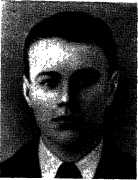
~
Ivan Zemnukhov, Hero of the
Soviet Union
~
At the end of September 1942, the first organised meeting of the
young underground fighters took place at which they set up an H.A.
under the name The Young Guard,^^*^^ at the suggestion of Sergei
Tyulenin. In early October, after the unification of all the underground
groups, Shevtsova and Gromova joined Turkenich, Tretyakevich,
Zemnukhov, Koshevoi, Tyulenin and Levashov at the H.Q. Oleg Koshevoi
was made secretary of the underground Y.C.L. organisation, Victor
Tretyakevich was put in charge of organisational work and Ivan
Turkenich was put in charge of operations. By the end of October the
Krasnodon underground organisation numbered over 100 members
broken down into groups of five.
The Young Guard brought the local people news from the front and
behind Soviet lines. During the occupation they produced more than
30 kinds of leaflets in a total of 5,000-odd copies. They sabotaged
farm supplies deliveries to the Germans, blew up stores and ruined
mine equipment. They organised the escape of 20 p.o.w.s from the
Pervomaisk hospital and more than 70 from the camp in Volchansk
village. On December 5, on Soviet Constitution Day, they burned down
_-_-_
^^*^^ The book The Young Guard by Fadcyev, translated into English
by Progress Publishers, gives a detailed account of the young people's
heroic activities.
117
the German Labour Exchange,
thus rescuing several thousand
Soviet people from being shipped
to work in Germany. The Young
Guard was preparing for an
armed uprising the moment
Soviet Army units drew near.
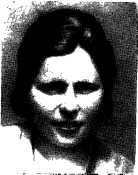
~
Lyubov Shevtsova, Hero of the
Soviet Union
~
Their downfall came
unexpectedly. On the morning of
January 1, 1943, the police
arrested Moshkov and
Tretyakevich. As soon as he put in an
appearance at the police station
to clear his companions,
Zemnukhov, too, was taken in
custody.
The daring Y.C.L. members
were given away by Gennady
Pocheptsov who was egged on
by his step-father. When he
learned of the arrest of the
three this cowardly traitor,
wanting to curry favour with the
Germans, supplied the names of
many of the other Young
Guards.
First to be rounded up were the entire 18 members of the
Pervomaika underground. Simultaneously, arrests began in the town. Four
cells of the town police station were filled to overflowing.
Terrible torture commenced. Worst to suffer was Victor
Tretyakevich who had been named in Pocheptsov's testimony as the ringleader
of the organisation. The brave young girls and boys were strung up
by their necks from window frames, their fingers were squeezed in
doors, they were flogged with cudgels and whipped with cord, needles
were driven under their finger and toe nails. The office of Solikovsky
who conducted the interrogation looked more like a slaughter-house
with all the blood covering the floor and walls. But nothing brought
the Young Guards to their knees.
On the night of January 15, 1943, the first thirteen were hurled
down the pit of No. 5 mine. They included Victor Tretyakevich, Ivan
Zemnukhov, Ulyana Gromova and Anatoly Popov. January 16 was
to have been Anatoly Popov's nineteenth birthday. On the 15th, when
he had recovered consciousness after a round of torture, he wrote a
letter in blood to his mother, which he succeeded in getting through
via a policeman. For the next few days the police carted groups of
underground fighters to the mine, shot them and bundled their
bodies down the 250 foot pit-shaft of No. 5 mine. After Krasnodon's
liberation, more than 70 unrecognisable corpses were retrieved from
the mine.
Some of the Young Guards were shot in the park of the town of
Rovenka. They included Oleg Koshevoi and Lyubov Shevtsova. The
118
latter was arrested on January 8 in Lugansk where she had gone to
contact the partisans. The nazis tortured her for more than a month
trying to get information about the whereabouts of the wireless set
and a code table which she was going to use to contact the partisan
H.Q. On February 9, 1943, two days before the flight from the town
of Rovenka, having forced nothing out of the young scout, the local
S.S. chief, Drevitz, shot Lyuba through the head.
By decree of the Presidium of the Supreme Soviet of the U.S.S.R.
of September 13, 1943, the leaders of the Young Guard-Ulyana Gromova,
Ivan Zemnukhov, Oleg Koshevoi, Sergei Tyulenin and Lyubov Shevtsova
were posthumously awarded the titles of Hero of the Soviet Union.
[119]
__ALPHA_LVL1__
INSCRIPTION ON A Y.C.L. CARD
BELONGING TO SERGEANT GRIGORY KAGAMLYK
February 9, 1943
Dying, but not a step back. Vow with my own blood.
Serg. Kagamlyk
__b_b_b__
Grigory Kagamlyk, born in the Ukraine in 1923, was commander
of an anti-tank gun section of the 3rd Company of the 47th Infrantry
Regiment, 15th Sivash Infrantry Division.
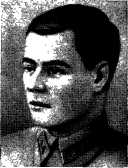
~
Y.C.L. card of Grigory Kagamlyk
~
It was the second year of the war on the Soviet territory. The Soviet
Army, having gained the initiative in the battle on the Volga,
[120]
continued its westward drive. At the end of January and the beginning
of February, 1943, Soviet troops on the Voronezh and Bryansk fronts
routed a 125,000-strong contingent of enemy troops consisting of eleven
German and two Hungarian infantry divisions and liberated Voronezh,
Kursk and Belgorod.
On February 9, the Soviet advance cleared the Germans out of the
village of Nikolsk in the neighbourhood of Kursk. The foe was
determined to regain this crucial point, and Sergeant Kagamlyk and
his anti-tank section were given the job of covering the right flank
which spelled most danger. Enemy tanks with submachine-gunners
trailing them bore down on the Soviet trenches. In the ferocious
encounter that ensued Sergeant Kagamlyk was wounded three times.
Despite an attempt to carry him back behind the lines, he stayed at
his post and continued fighting. In a breather between attacks
the sergeant, rapidly losing blood, jotted down a few words on his
Y.C.L. card.
He was finally struck down by a bullet, but his resolve and
fearlessness inspired his men, and they beat back the enemy. He was
posthumously awarded the title of Hero of the Soviet Union and his
name was put on his regiment's roll of honour.
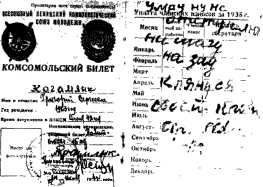
~
Grigory Kagamlyk, Hero of the
Soviet Union
~
[121]
__ALPHA_LVL1__
NOTE
OF FOUR DEFENDERS OF VOLCHANSK
Late February 1943^^*^^
We defenders of Volchansk died a brave death on this
spot. There were four of us: Kozodub V., Bondarenko V.,
Sinin, Kiparenko T. Serg.
1943. Get the note to the airfield.
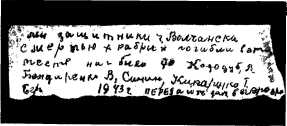
~
Note of the four defenders of Volchansk
~
In the summer of 1959, a local man from the town of Volchansk,
near Kharkov in the Ukraine, N. Akulichev, spotted the tip of a
metal canister peeping out of the sand on the site of what used to be an
airfield. After digging it out, he noticed a number of openings on its
_-_-_
^^*^^ Date of battle for Volchansk.
122
sides and in one of them a length of vinyl insulation with the word
``Note'' faintly scribbled on it. Inside lay a neatly folded slip of
cigarette paper bearing in ink the last words and surnames of four
men who fought and died defending Volchansk in 1943.
After the Soviet drive on Kharkov between February 2 and 16, 1943,
the nazi High Command desperately tried to retake the initiative and
avenge their recent defeats. They brought up over thirty divisions
from the Western front and in late February undertook a
counterdrive in the Donbas-Kharkov area. With these reinforcements the
Germans pushed the Soviet troops back across the North Donets
River. By the end of the month Soviet forces had to quit Kharkov,
too, after a round of heavy fighting.
The enemy was not given a chance to surround the Soviet troops
in the vicinity of Kharkov and take revenge for the defeat in the
Battle of the Volga. It was probably about this time that the Volchansk
defenders, beating off enemy tank attacks, wrote their note.
[123]
__ALPHA_LVL1__
LETTER
FROM MEDICAL ORDERLY
VALENTINA KOLESNIKOVA
Not later than March 3, 1943^^*^^
Dear comrades at the front, my dearest friend Nina,
If I die in this battle, please let my mother know that I,
her daughter, honourably carried out my duty to my country.
What a terrible pity my life has to end so early, but there
are others to avenge me.
Nina, I was a nurse. That really is wonderful-to save the
life of someone fighting for us, defending our homeland
from the treacherous foe, struggling for our future.
That's about all, please let my mother know.
Valya Kolesnikova~
Address: Lenin Collective Farm, Blagoveshchensky District,
Altai Territory.
__b_b_b__
Like many other Soviet girls, Valentina Kolesnikova wanted to get
to the front as quickly as possible. After finishing a nursing course,
Valya was posted to the front. She received her combat baptism in
the August skirmishes of 1942
Scorning death which lurked everywhere she selflessly did her duty
bringing aid to the wounded under the roar of guns, the whistling
of shells and the blast of enemy mortars. She was always in the
very thick of the danger.
On March 3, 1943, her young life was cut short by an enemy bullet
during the fighting for Smolensk.
_-_-_
^^*^^ Date of her death.
[124]
__ALPHA_LVL1__
LETTER
FROM 15-YEAR-OLD KATYA SUSANINA
March 12, 1943
March 12, Liozno, 1943
Dear, kind Daddie,
I am writing to you from German captivity. When you read
this letter, Daddie, I shan't be alive any more. I ask one
thing of you, Father-punish the German rats. This is the last
testament of your dying daughter.
A few words about mother. When you return, don't look for
mummie. The Germans shot her. When they were asking
questions about you, the officer lashed her across the face.
Mummie couldn't take it any longer and proudly said, these
are her last words: "You won't scare me with your beatings.
I know my husband will come back and kick you dirty swine
out of here.'' And the officer shot mummie right in the
mouth.. ..
Dear Daddie, I am fifteen today, and if you met me now,
you wouldn't recognise your little girl. I've got very skinny,
my eyes are sunken, my curls have been sheared off, my
hands have withered, I'm as skinny as a rake. Every time I
cough, blood conies up-they've burst my lungs.
Do you remember the time, Daddie, two years ago, when
I was thirteen? What a lovely birthday I had! I remember
you saying to me then: "Grow up, my little girl, to all the
joys in the world!" We played some records, our friends
wished me Happy Birthday and we sang our favourite Young
Pioneers' song.
125
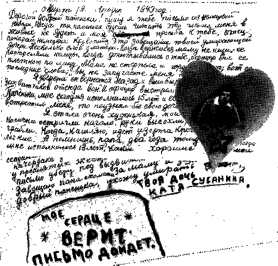
~
The first and the last pages of Katya Susanina's letter
~
But now, Daddie, when I look at myself in the mirror-my
dress is torn, in rags, a number on my neck like a convict,
I'm just a bag of bones-and salty tears are oozing from my
eyes. What's the use of being fifteen. I'm no good to anyone.
There are many people here no good to anyone. The starving
wander about and are hunted down by sheepdogs. Every day
they are taken out and murdered.
Yes Daddie, I am the slave of a German baron, I work for
a German, Scharlen, as a laundrymaid, I wash the linen,
scrub the floors. I work very hard and eat twice a day from
a trough with Rosa and Klara-they are the mistress's swine.
Those are the baron's orders. "Russians were and always will
be pigs,'' he said. I'm very scared of Klara. She is a big and
126
greedy pig. Once she nearly bit my finger off for grabbing a
potato out of the trough.
I live in a shed-I'm not allowed in the room. Once Josefa,
the Polish chambermaid, gave me a crust of bread and the
mistress caught her doing it and gave her a good lashing
about her head and back.
Twice I ran away from them but the watchman discovered
me both times. The baron himself ripped my dress off and
kicked me until I fainted. Then they threw a pail of water
over me and hurled me into the cellar.
Today I learned some news: Josefa said my owners are
leaving for Germany with a big group of men and women
slaves from the Vitebsk District. They are taking me with them
as well. No, I won't go with them to that infernal hell of a
Germany. I've made up my mind that it's better to die on my
native soil than be trampled into horrible German earth. Only
death can rescue me from a cruel beating.
I don't want to suffer any more in the hands of these
savage, ruthless Germans who won't let me live!
I beg you, Daddie, get revenge for mummie and me.
Goodbye, kind daddie, I am leaving you, to die.
Your daughter
~ ~ ~ ~ ~ Katya Susanina~
My heart tells me this letter will reach you.
__b_b_b__
Soon after the liberation of the Byelorussian town of Liozno in
1944, while clearing the brick work of a ruined oven in one of the
houses, a small yellow envelope sown up with thread was found. The
envelope contained a letter from a young Byelorussian girl, Katya
Susanina, who had been taken in bondage to a German landowner.
In the grip of despair Katya had committed suicide on her fifteenth
birthday. Before dying she had written her last letter to her father.
On the envelope was the following address: Active Army, Field Post
No. ... Pyotr Susanin. On the other side were the words in pencil:
"Whoever finds this letter hidden from the Germans, I beg of you,
please post it at once. My corpse will already be swinging from a
rope.''
The number of the field post had worn away with time and the
letter was unable to find its mark, but it went to the hearts of all
Soviet people. The letter was published in Komsomolskaya Ptavda
on May 27, 1944.
[127]
__ALPHA_LVL1__
VICTOR CHALENKO'S TESTAMENT
Not later than March 14, 1943
If I die in combat for the workers' cause, I ask officers
Vernishin and Kunitsyn to take the first opportunity they have
to go to my home in Yeisk and tell my mother that her son
died for the liberation of his country. Please let my dear
mother have my order, my Y.C.L. card and this pad. Ask her
to keep them as a memory of her son. Give her my sailor's
hat so that she will have something to remember her
sailorboy by.
Mother's address: Raissa Chalenko, Svanovskaya St.,
~ ~ ~ ~ ~ Yeisk
~ ~ ~ ~ ~ ~ ~ ~ ~ ~ Victor Chalenko
__b_b_b__
Y.C.L. member Victor Chalenko volunteered in 1942. When the
Soviet troops had to leave Yeisk he begged to be taken on in a marine
detachment. While he was in the marines he took part in the defence
of the Northern Caucasus. For his heroism and bravery in the battles
around Goryachi Klyuch and Tuapse, he was awarded the Red Banner
Order. In February 1943, he landed with the rest of his marine group
at Novorossiisk, on the Black Sea coast.
It was not an easy place for battle. The enemy had had time to
reinforce their positions and were causing the marines a lot of
trouble, particularly in one section of the beach where a machine-gun
in a log emplacement kept up rapid fire. Victor volunteered to silence
it. Under cover of darkness, he crawled towards the log emplacement
and hurled his hand grenades into it. The firing stopped at once but
splinters from the grenade also ripped into the hero. Taking
advantage of the silenced machine-gun, the marines took the German
positions by storm. They found their comrade dead. In his pocket was
discovered a writing pad with his testament on it.
128
__ALPHA_LVL1__
LETTERS HOME
FROM PARTISAN-SCOUT VALENTIN MALTSEV
LETTER TO HIS FATHER
March 14, 1943
14.3.43. I have to leave in a hurry. There was no time to
say good-bye, don't be cross. I won't be coming home any
more, though it isn't really settled yet, but I won't be in
Leningrad again. So, good-bye. I'll be battling away as long as my
eyes can see! And never mind the circumstances or the
rumours! Well, once more I shake your strong hand, and hug
and kiss you. Till better days and a happy reunion,
Yours,
~ ~ ~ ~ ~ V.
__b_b_b__
LETTER TO HIS MOTHER AND SISTER
March 16, 1943
Dearest Mum and Irinka,
I am writing from Khvoinaya where I arrived on March
16 at 9 p.m. I might disappear for about a year, but don't
worry, that's all part of the job. And don't hang out the
funeral notices, because I've reckoned on being back for
Irina's wedding and mother's silver wedding anniversary.
That's all for now, and for some time. All my love and kisses
to tide you over my absence. Ma, I wrote you a letter with all
sorts of stories which you must read, but don't take it too
much to heart. Eternal glory to the dead, let the living live
on. All my love to you. Bye-bye.
Your loving son,
~ ~ ~ ~ ~ Valya
__PRINTERS_P_129_COMMENT__
9---3928
129
__b_b_b__
Valentin Maltsev died when he was only eighteen The story of his
life and his heroic death pays homage to the wonderful qualities of
this remarkable young man
Valentin lived in Leningrad When war broke out, his father joined
the people s volunteer detachment and his mother and youngest sister
lima were evacuated The young lad refused to be evacuated He
wanted to stay behind and fight the nazis, but the army refused to
take him With some of his pals he used to keep a look-out on the
roofs at night and put out incendiaries, saw that the black-out was
observed, went to military training and then worked at the
Compulsory Universal Military Training Centre
He bravely bore up to the hai dships of the blockade of Leningrad,
the cold and the hunger, the constant air raids and the night raids
Not once did he lose heart In July 1943 he was offered a mission
as wireless operator behind enemy lines He trained hard in a special
intelligence school In March 1943, he was attached to a group led
by M Lyapushev and smuggled across the front to the vicinity of
Pskov
After successfully completing their mission the group was ordered
back to base In August 1943, not far from the front line, they ran
into another group carrying a wounded man To obtain food for the
wounded man, they turned off into the village of Petrovo In the
darkness they had not noticed there were police m the village To
cover the escape of his comrades, Valentin held off the police with a
pistol for as long as he could Finally, with only one bullet left, he
turned his pistol on himself rather than fall into enemy hands To
the end of his young life he remained true to his favourite motto
' Guards die but don't surrender
[130]
__ALPHA_LVL1__
APPEAL
FROM MIKHAIL GUZOVSKY TO THE INHABITANTS
OF OSIPENKO
March 1943
Comrades,
The fascist bastards are crawling away.
Comrades, don't let them carry off valuable property, oui
bread.
Burn, exterminate, strangle and kill these crawling bastards.
Hide yourselves from evacuation because whoever's with
them is our enemy
Death to Hitler's rats !
(Read and pass on)
__b_b_b__
Mikhail Guzovsky was one of the most active membeis of the
underground organisation in the town of Osipenko He distributed
leaflets which he had written by hand A few days before the German
forces left the town, he was captured by the na/is who found some
leaflets on him He was shot two days before the arnval of the Soviet
Army
[131]
__ALPHA_LVL1__
LETTER HOME
FROM PARTISAN-SCOUT OLGA RZHEVSKAYA
February 22--April 6, 1943
Olga Rzhevskaya. Age 20.
Obolonovets, Mutishchensky Village Soviet, Yelninsky
District.
Died 27/2-43. (For consorting with the partisans.)
Whoever finds this, please forward it to my parents.
__b_b_b__
My dearest Mother,
Greetings from your daughter Olga. Mama, today, March
6th, makes two months since I last saw freedom, but what
does it matter? My dear Mama, you probably heard that we
were sent to Spas-Demensk from Yelnya on January 11. The
investigation wound up on January 14 and the trial finished
on January 23. Up to February 27, I was detained in
SpasDemensk. On February 27, they transferred me to the Roslavl
prison where I am today. I don't know about you, but I
suppose it's no use me expecting to see you, my dearest Mother,
again. All you can do. Mama, is to treasure that sad day when
we had to part. That was January 10th, 1943 (a Sunday) when
I had to desert my home village and you, my darling Mother.
Dear Mama, I have one request of you: don't worry about
me, look after your health. You can't get me back but you
mustn't lose your health. After all you're all alone with no
one to rely on. Maybe Dusya will come back. Maybe she's
had better luck than I. Mama, I'll probably be condemned to
die in Roslavl, though I thought it would be in
SpasDemensk. . . .
Mama, I must ask you once again not to grieve over
meyou won't help yourself by doing so. And that's probably my
fate. Mama dear, I am now only with Nina, the other three
who have been taken with us were removed on February 14,
132
we don't know where they've been taken-home or
somewhere else.
Dearest Mama, just now I'd give anything to hear just one
little word from you, from all our family, then I would die
peacefully. I know my fate but I can't help feeling sorry for
you, my darling Mother.
Mama, please give my regards to Auntie Lena and her
children-Dusya, Valya, Kolya, to Auntie Natasha and Nadya,
and Katya, and to all our friends and relations. Mama, my
dearest, I'm coming to the end and beg you again not to
worry, I'm not the only one, there are many of us. My dear,
dear Mother, once more kind regards from your daughter
Olya.
__b_b_b__
Mama, if only the situation could suddenly change, I would
have been back with you. How happy we would have been.
But no, Mama, miracles don't happen in real life. One thing
I ask, don't worry, look after yourself and don't be sorry for
anything....
Mama, I made a calendar out for April and am crossing off
the days of my life.
__b_b_b__
Olga Rzhevskaya was a 20--
year-old partisan-scout. At dawn
on January 6, 1943, she fell into
the hands of the nazis, who came
across her when she was ill at
her mother's home in the tiny
Smolensk village of
Obolonovets. Despite the fact that she
was unconscious, the soldiers
dragged her in for questioning.
After torturing her for four
days and getting nowhere, the
nazis packed her off to the
town of Yelnya, and then on to
Spas-Demensk. The abominable
prison routine dragged on, daily
interrogation and torment.
While waiting to be shot, Olga
wrote on her neckerchief: "Died
February 22.'' Then she altered
it to "February 23''. Then she
had to revise that date every
day until February 27.
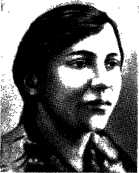
~
Olga Rzhevskaya
~
On that day, she was
transferred to Roslavl prison and her
[133]
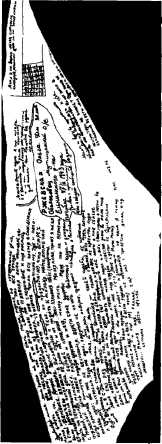
~
Olga Rzhevskaya's letter to her mother written on her neckerchief
~
[134]
daily count had to be started all over again. Every day the sick girl
was dragged out for interrogation. One morning they took her out
into the yard and stood her by the gallows.
``Now you can tell all!" said the officer. "In a minute you will be
dead.''
And she replied:
``I, Russian girl Olga Rzhevskaya, member of the Y.C.L. and a
partisan, hate your guts. I've done everything I can to fight you. There
are many like me. Your stores have been burnt down and are
burning, your soldiers and officers are being killed, your communications
cut-I've had a hand in it too. Pity I did so little. But I shall be
avenged. Soon the Red Army will be here and.. . .''
A kick from the officer's boot sent the stool under Olga's feet
spinning, and Olga dangled from the rope. But that wasn't the end.
The girl was pulled out of the noose, revived and shot a few days
later.
The letter above was written in a prison cell between interrogation
sessions. It was written in pencil in small writing on a white, silk
neckerchief. In one corner is a calendar with the 30 days of April
1943. Only the first six days are crossed off.
[135]
__ALPHA_LVL1__
LETTERS
FROM MEMBERS OF THE UNDERGROUND
Y.C.L. ORGANISATION IN DONETSK
SAVVA MATEKIN'S LETTERS TO HIS WIFE AND CHILDREN
August--October 5, 1942
Shura,
What can a man do when he's in the death cell? All the
same they're scared of me. Tell that to our people. I know
all's up with me and the moment will come quicker than
we may expect. Good-bye. Please tell everybody this isn't
the end. I die but you all live on.
Good-bye, my darling Shura~
__b_b_b__
My dear little Vova and Lusya,
I've always strived to bring you up properly, make people
out of you useful to the country, genuine, whole-hearted
people. My greatest wish was to see you, Vovochka, a scholar,
and you, Lusya, an engineer. But whatever you become I'm
firmly convinced my children will not let their father
downhe has not begrudged his life for the good of his country, for
the sake of saving his people and for the happiness of his
children. May you all be happy.
Your Father
__b_b_b__
I think my days are numbered. I hope you and the kiddies
forgive me for everything.... Remember that I've always been
ready to lay down my life for you. I die calm and confident.
When you find it necessary, explain everything to the children
-all the whys and the wherefores.
136
All my love to you for everything and from a pure heart.
Forgive and forget and be happy.
3.10.42. Been through interrogation. Feel things will turn
out for the worse, hurrying to relive all my short life again.
Bring up the kiddies, look after yourself and keep smiling.
Yours,
~ ~ ~ ~ ~ Savva
__b_b_b__
STEFAN SKOBLOV'S LETTER
23--29 May, 1943
Farewell, dear friends,
I have to die at the age of 24. In the prime of life and
creative thought the beating of my pulse has to come to a
stop, and the hot blood has to cool in my veins. In the gaols
of the German Gestapo I live out the last minutes of my life
proudly, with head held high.
In these brief, oh too brief minutes I invest whole years,
whole decades of unlived years, in these minutes I want to be
the happiest man in the world, for my life has come to an end
in the battle for human happiness....
Farewell, dear comrades, farewell forever!
__b_b_b__
TESTAMENT OF 18 MEMBERS
OF THE UNDERGROUND ORGANISATION
May 29, 1943
Friends,
We die for a just cause.... Don't let it damp your spirit,
stand up and flay the enemy at every turn. One request to
all of you-don't forget our parents....
Friends, listen to our call-flay the Germans! Farewell, you
Russian people! Don't bear a grudge against us!
__b_b_b__
In the autumn of 1941, the nazi drive eastwards swept them over
the Donets Basin. Together with other Soviet people who refused to
surrender, the Y.C.L. members of the town of Donetsk took up arms
against the foreign invaders. Their leader was Savva Matekin.
Savva Matekin was born in 1902. In the twenties, when life was
just getting back to normal in the Soviet Far North, he went off to
the remote Jamal Peninsula to help look after children there. Then
137
he worked for several years in
the remote corners of Siberia
before returning eventually to
his native Donbas. In September
1941, he left for the front and
was taken prisoner during the
retreat. He escaped and since
the front was already too far
off, he resolved to return to
his home in Budyonnovka-a
workers' estate just outside
Donetsk. There he managed to
take charge of studies in the
local school No. 68, where he
had worked before the war. But
he never gave up the struggle.
He decided to set up an
underground organisation from the
teachers and pupils on the
estate. Unafraid of the Gestapo,
he and his two colleagues,
Stepan Skoblov and Boris Orlov,
formed a Y.C.L. resistance group.
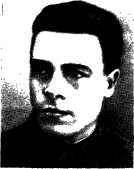
~
Savva Matekin
~
In the autumn of 1941, a member of the group, Vasily Goncharenko got hold of their first
six rifles and three boxes of ammunition. The group grew in number.
Two months later the group numbered 42 young people. Inspired by their example, other underground
groups in other estates began
to function around Donetsk. After
several raids on nazi soldiers
they had a good supply of arms
and ammunition. At the
beginning of 1942, the resistance men
and women blew up a railway
bridge, put out of action the
power station in Kurakhovka,
damaged enemy vehicles,
sabotaged food supplies, destroyed
fuel dumps, attacked nazi
soldiers and derailed several
trains. Once, Vanya Klimenko
and Volodya Kirilov were
responsible for sabotaging a
score of enemy vehicles waiting
to be transported to the front
from Mushketovo railway station.

~
Stepan Skoblov
~
The resistance fighters put
out a special appeal to the
Donetsk workers. They wrote:
"At every mine, on every estate
[138]
and in every village, form partisan units, aid the partisans, hide
them from the police, don't let the nazis carry off to Germany our
grain, industrial and other equipment. Whether you work in the mines,
at factories or in offices, hamper the German authorities from carrying
out their orders and plans, do all you can to harm the Germans,
spoil the equipment and output, get ready to welcome the Red Army
with honour!''
In August 1942, Savva Matekin, the organiser and inspirator of
the underground fighters, was arrested. Almost two months of torture
could not break his will. On October 7, 1942, the Germans shot him
at the Kalinovskaya mine.
On May 22, 1943, the Gestapo arrested 18 men. They were put
through the usual grilling in the building of the field gendarmerie in
Avdotino. Although they realised their fate was sealed, the young
Soviet patriots courageously bore all their sufferings without a murmur.
On the eve of their sentence they wrote a joint last testament to
their friends.
Between May 30 and June 3, the entire 18 were shot. They included
Stepan Skoblov and Boris Orlov. But the battle was not over. The
underground organisation continued to take revenge on the Germans
for the death of their comrades. Friends and comrades stepped into
the shoes of the dead.
Savva Matekin's letter was written on scraps of paper in which
his wife had wrapped a bottle of kvass. She had brought the bottle
to the gaol and then had taken it back. The condemned man had
thrown another part of his last notes into a ditch while on his way
to work. His wife had followed at a short distance and picked them
up. The last testament of the 18 was written in black pencil on a
handkerchief.
[139]
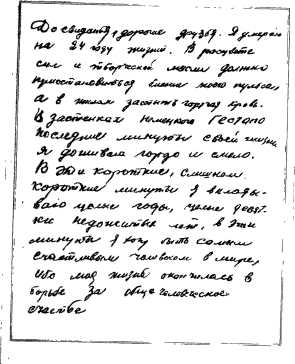
~
A page from Stepan SkobloVs last letter to his friends from the
prison
~
[140]
__ALPHA_LVL1__
NOTE
FROM SERGEANT TIKHON BURLAK
Not later than June 1, 1943
I die for my country. Consider me a Communist. Please tell
Lena I kept my promise and her love has gone with me.
__b_b_b__
Heavy fighting was in progress on the Eastern Front. The Germans
were holding fast to their lines but the Soviet forces doggedly pushed
ahead. During the liberation of the village of Medveditsa, one soldier
wiped out eight nazis. Weak, wounded, and losing a lot of blood.
Sergeant Burlak seized an enemy submachine-gun and a stock of
hand grenades and again rushed into the fighting.
After the battle, Tikhon Burlak was taken to hospital, but was
soon back in the trenches with his unit. He used to tell his comrades,
both old and new, about his girl-friend and once mentioned that none
of his family had remained alive in his Ukrainian home town of
Nikolayev.
One fine spring day. Sergeant Burlak was machine-gunning the
Germans from a gun emplacement.
Several times that day the Germans threw everything they had into
the attack, but each time the brave sergeant and his machine-gun
blocked their way. Towards nightfall, the fighting abated. But early
on the following day the Germans tried to overrun the sergeant's
post once again. Certain there was a large group of Soviet
machinegunners in the bunker, the Germans called up a bomber to snuff out
the fire. Bombs and shells gradually reduced the bunker to a
churnedup morass. Somehow the sergeant survived, although towards
evening he was wounded in the arm and head. But he stayed at his post.
He continued to fight as long as his ammunition held out. At long
last, after three days of fighting he was left with only two hand
141
grenades and a flare. Tikhon Burlak fired a flare which lit up the Germans
and hurled one grenade into the very thick of the Germans. The
other he dropped under himself, blowing him and his machine-gun
to smithereens.
By dawn the nazis were repelled and the battle was won. Around
the bunker lay 48 nazi corpses.
The Soviet soldiers rushed into what was once the bunker and
found their comrade's remains.
Near the tangled mass of the machine-gun lay the familiar
photograph of Lena, spattered with spots of fresh blood and punctured by
a grenade splinter.
On the ground also lay a note written in large blood-stained
letters on a sheet of paper by the dead hero-Sergeant Tikhon Burlak.
[142]
__ALPHA_LVL1__
LETTER
FROM PARTISAN COMMANDER
VASILY SHIMANSKY TO HIS WIFE
Not later than June 1, 1943
To my life's companion and work colleague, my darling,
my eternally unforgettable, dear Esfir Kharitonovna.
__b__
From Starik (V. A. Shimansky), commander of a partisan
detachment.
__b__
Dear Esfir Kharitonovna,
It will soon be two years since the barbarians first attacked
our sacred land and broke up the peaceful, happy life of many
millions of Soviet people. Broke up, too, our family life. I am
certain it will take less time than has already passed for the
Soviet people, and us included, to restore our former happy
life. What's more, everyone, including you and I, will rebuild
our lives on an even higher level than before. For over the
last couple of years, everyone has learned a lot about the
necessity of valuing time in life and life in time, about the
necessity of valuing your life's companion and yourself as a
companion.
Darling Firochka, I learned a terrific amount when I was
training and under the wing of our country, but I learned a
lot more when I took up my rifle and went to defend the
country. I'm a different man now. Not at all the one you knew
before. Now I've spilled a lot of fascist blood and aged
awfully.
143
I'm helping the country from without, and I so much want
to help you, too, even if it isn't very much. Don't know how,
my darling, everything's been given up to the country.
Perhaps the time will soon come when we shall meet and tell
each other everything, help each other and begin to live as
people do in paradise. That day will be happy for us all
because it will be simply wonderful, like nothing on earth.
Darling Firochka, I've been working behind the lines and
I'm glad to say I've been able to obtain extremely valuable
documents on the exact location of the major nazi airfield on
the South-Eastern Front, the chief base of the Luftwaffe H.Q.
on the South-Eastern Front and the chief headquarters of
Goring who is often visited there by Hitler. With these
documents in my hands, I handed over my partisan command
and will soon be crossing the front myself. It's a very
dangerous mission, but, with a bit of luck, it can be accomplished.
I put myself at my country's disposal, knowing that if I
can get these documents through to the Soviet Government,
it will go some way to driving the nazis out of the Ukraine
and be a particularly severe blow at their Air Force. Besides,
I have to get orders as to the further activities of my
detachment. Things are going from bad to worse with the
detachment. I have to know our future plan of action.
Good-bye, darling Firochka, I've left Marusya documents
on the detachment's activities. If I die please see that these
documents get through to the Soviet Government and consider
me a partisan of the war.
Good-bye, my dearest darling, my true love Esfir
Kharitonovna. Let all my friends and acquaintances know I have
given everything for the country's defence.
On June 1, 1943, I shall part with Nastya and in a month's
time should be with you, if not-the grave will have swallowed
me up.
Good-bye, darling,
Good-bye, all my friends,
Good-bye, to you, too, my dear Motherland,~
Starik
__b_b_b__
Vasily Shimansky was born in 1902 in the town of Balta not far
from Odessa. Once a farm labourer, he graduated in the thirties from
the Plekhanov Economic Institute in Moscow. In 1938, he took up a
post-graduate course. After a successful defence of his thesis, he was
144
appointed lecturer of political
economy in the Plekhanov
Institute.
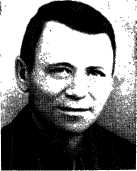
~
Vasily Shimansky
~
In August 1941, Vasily
Shimansky left for the front.
In December of the same
year he turned up under the
name of Pyotr Lishchenko in
Kordelevka, not far from
Vinnitsa. After getting a job as
blacksmith at a sugar refinery,
he became friends with ex--
prisoners-of-war who had escaped
from camps and were living
in Kordelevka. Three of the
ex-p.o.w.s-Andrei Yevtukhov,
Eduard Lyakhovetsky and Victor
Trishin-joined the Old Man
(Starik), as Shimansky was
known because of his beard, in
forming an underground group.
Starik's group went into
action. In order to study the
approaches to the main rail
lines, Shimansky became a
shepherd. Soon after, the underground fighters derailed a fuel-carrying
train. Their numbers grew. Besides the group in Kordelevka other
groups sprang up, including one at the local state farm of Katerinovka,
all uniting in Starik's partisan detachment.
In a single year they several times tore up the track on the
VinnitsaKiev line, derailed enemy trains, blew up vehicles, fuel dumps,
burned grain and killed callle about to be dispatched to Germany,
set fire to nazi-occupied buildings, etc.
The detachment discovered the location of Goring's headquarters
and a large German air base situated nearby. They also came upon
Hitler's lair known under the code name of Wehrwolf.
At the beginning of May 1943, the underground fighters took to
the Chorni (Black) Forest where they joined up with another partisan
unit. Meanwhile Vasily Shimansky and three companions moved on
to the east, towards the front. In mid-May, after several days and
nights of hard and torturous travel, the four men, wracked by wounds
and fatigue, came to the village of Kozatskoye, a few miles from
Balta. Here they were hidden by the local villagers, relations of
Shimansky. After a rest and medical treatment, they struggled on to
cover the last few miles at the end of May. What happened after that
is unknown.
Vasily Shimansky left behind with Maria Oleinik a number of
documents addressed to Soviet Army Command, and his
last letter to his wife, published above. The documents had been put
in a bottle and buried in the ground. After liberation, Maria Oleinik
handed over the documents to the Soviet authorities.
__PRINTERS_P_145_COMMENT__
10---3928
[145]
__ALPHA_LVL1__
NOTE
FROM FIVE DEFENDERS OF GLAZUNOVKA
Whoever finds this note, please report our deaths. There
are five of us left, our ammunition has run out, all we have
are three dozen grenades. Enemy tanks have appeared in the
distance. Farewell, dear comrades, we have died for our Soviet
motherland.... 12.VI.1943. V. Boiko, A. Kravchenko, G.
Vetrov, V. Yablochkin, A. Siyanovsky.
__b_b_b__
On August 30, 1961, a young schoolboy, Zhenya Kistanov, while
playing near his home near the Glazunovka drying works found a
cartridge case, mildewed with age. Inside the case he discovered a
tightly rolled piece of paper from a note-book on which the gallant
five's last words had been inscribed. They had apparently taken part
in the battle on the Kursk-Orlov Bulge.
After the publication of the note in the central newspapers the
pupils of Glazunovka secondary school received many letters from those
who had taken part in this great battle and from relations of the
dead five. Ex-soldiers wrote of the bloody encounters that had taken
place in the summer of 1943 in the neighbourhood of Glazunovka
Units of the Central front had beaten off attacks of enemy tanks and
self-propelled guns.
[146]
__ALPHA_LVL1__
NOTE
FROM Y.C.L. GIRL MARIA KISLYAK
FROM KHARKOV GESTAPO GAOL
Not later than June 18, 1943
Comrades,
I die for my country, without grudging my life. Good-bye,
dear sister Natasha and Mum and Dad.
Maria
__b_b_b__
On June 18, 1943, in the village of Lyodnoye, just outside Kharkov
the nazis hanged three young patriots: Maria Kislyak, 18 years old,
Fyodor Rudenko, 19, and Vasily Bugrimenko, 19.
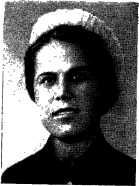
~
Maria Kislyak
~
The daring youngsters had not bowed to the "New Order" and had thrown all they had into resistance to the S.S. The eldest of the trio, Fyodor Rudenko was not yet twenty years of age and Maria Kislyak had only just graduated from Kharkov medical school.
During the first occupation
of Kharkov, Maria Kislyak
concealed and nursed in her flat
two wounded soldiers who later
rejoined the Soviet forces after
Kharkov's liberation in February
1943.
In the spring of 1943,
Lyodnoye was captured for the
second time. The two boys and
a girl formed an underground
group. Fyodor Rudenko already
knew a few things about war
as he had volunteered for the
army in February 1943, had been
__PRINTERS_P_149_COMMENT__
10*
[147]
taken pusoner near Chuguyev, escaped and came home to Lyodnoye
where he had at once joined the underground group.
__NOTE__ Most every IMG is shifted up or down to be between P's.
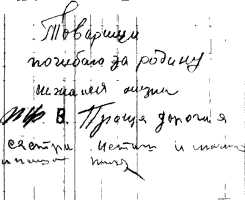
~
Maria Kislyak's note from the Kharkov Gestapo gaol
~
In late May 1943, the three were arrested and packed off to the
Gestapo in Kharkov. For over a fortnight the Gestapo tortured the
youngsters and on June 18 brought them, battered but undefeated,
to Lyodnoye for a public hanging. Before the hanging, Fyodor
Rudenko was unable to say a word since the nazis had gagged him.
But Maria Kislyak shouted: "Good-bye, Mum and Dad and all my
friends, I die for my country. Comrades, kill the Germans, purge
our soil of these evil creatures.''
A note from Maria scribbled on a piece of paper was smuggled
from the Kharkov Gestapo gaol.
[148]
__ALPHA_LVL1__
FROM A LETTER
WRITTEN BY INTELLIGENCE MAN
NIKOLAI KUZNETSOV
July 24, 1943
Tomorrow marks eleven months behind enemy lines.
On August 25, 1942, at 24.05, I was dropped by parachute
to spare the Germans no mercy in revenge for the blood and
tears shed by our mothers and brothers who groan under the
yoke of German occupation.
Eleven months I've been scrutinising the enemy with the
aid of a German officer's uniform. I've been preparing a fatal
blow, having got into the very lair of the satrap-Erich Koch,
the German tyrant in the Ukraine.
My mission is vital and to carry it through I have to
sacrifice my life, since getting away from the city centre after
making my attempt at the enemy during the parade is
completely out of the question. I love life, I'm still very young.
But because my motherland, whom I love like my own mother,
requires that I lay down my life in the name of freedom from
German occupation, I shall do so. Let the whole world know
the spirit and fire of a Russian patriot and Bolshevik. Let the
nazi gangleaders remember that trying to conquer our people
is like trying to put out the sun.
German bastards like Hitler, Koch and company thought
they could destroy our great Soviet nation. They had some
dim-witted idea about drowning the Russian and other
fraternal peoples of the U.S.S.R. in a sea of blood.
They forgot or didn't know history, these savages of the
20th century. They will understand all right on July 29, 1943,
when after a whistle an anti-tank grenade will explode spilling
their pagan German blood all over the asphalt. . . . Even if I
die, my people will keep my memory eternal.
149
``You may die, but in the song of the brave and the strong
in heart, you will forever be a living example, a proud appeal
for liberty and reason.''
That comes from my favourite piece of Gorky, I wish our
young people would read it more often. That's where I got
my strength for great deeds.
Yours,
~ ~ ~ ~ ~ Kuznetsov~
To be read only after my death.
24/VII. 1943 Kuznetsov
__b_b_b__
Nikolai Kuznetsov was born in 1911 in the village of Zyryanka
near Chelyabinsk in the Urals. Not far from his native village was
a German colony. The young Nikolai often used to come and chat
with the German colonists in German. Before he finished school he
spoke German quite fluently.
Up to 1938, he lived in Komi-Perm territory, and later went to
work at the Uralmash plant in Sverdlovsk.
When war came he was working in Moscow as an engineer at a
motor works. In the first few days of war he made a request to be
sent behind the lines on intelligence work. In May 1942, he began
to get ready for action in the enemy's rear under the guise of a
German officer. He first went through a tough training course, learning
about German arms and army
procedure, sharpening up his
shooting and studying explosives,
and talking with captured
German officers.
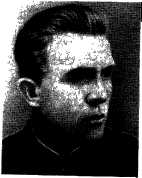
~
Nikolai Kuznetsov, Hero of the
Soviet Union
~
On the night of August 25,
1942, Nikolai Kuznetsov and a
tiny band of paratroopers
landed behind enemy lines. Three
days later, Kuznetsov met up
with D. Medvedev, commander
of a partisan detachment and
a Hero of the Soviet Union.
That marked the commencement
of the activities of the famous
scout.
Kuznetsov several times
successfully carried out daring
missions and from October 1942
he spent most of his time in
the town of Rovno, the
residence of Erich Koch,
Reichskommissar for the Ukraine.
In the very heart of the nazi
administration of the Ukraine,
Kuznetsov carried out
150
exceptionally brave and daring missions. He was often instrumental in getting
through to the Soviet Command extremely valuable political and
military information. With his help, for example, the Soviet
authorities managed to uncover a plot by the nazi intelligence to assassinate
the heads of government of the anti-Hitler coalition during the
Teheran Conference in 1943.
Nikolai Kuznetsov was an exceedingly courageous and clever man.
His exploits were truly legendary. Once, dressed as a nazi officer,
he got into the building of a German court and shot dead the chief
nazi judge in the Ukraine Alfred Funk. At the end of September 1943,
he carried out a death sentence order passed by the partisans on
Paul Dargel, Koch's assistant for political affairs, and General
Hermann Knut, another of Koch's right-hand men.
In November 1943, he and three comrades smuggled out of his
private residence General Ilgen, commander of Germany's special
forces in the Ukraine.
On January 18, 1944, Nikolai Kuznetsov received new instructions
and left for Lvov to assassinate the butcher of the Ukrainian
peopleDeputy Governor of Galicia, Bauer. Mission completed,
Kuznetsov and two partisans-Jan Kaminsky and Ivan Belov-made their
way to the front. During the night of March 8, 1944, in the village
of Boratin near Lvov, they were recognised by one of the Bendera
gang. In the ensuing skirmish Nikolai Kuznetsov blew up himself
and the onrushing foe with a hand grenade.
On November 5, 1944, he was posthumously awarded the title of
Hero of the Soviet Union.
The published letter was written on July 24, 1943, in the event
of his death.
[151]
__ALPHA_LVL1__
INSCRIPTION
BY MARINA GRYZUN ON THE WALL
OF HER CELL
July 28, 1943
I, Y.C.L. girl Marina Gryzun, was shot by the Germans on
July 28, 1943. Friends and comrades, avenge me and all those
who have died in German hands!
__b_b_b__
Marina Gryzun had lived all her life on the Lenin Collective Farm
in the village of Misailovka near Kiev. During the nazi occupation
she hid and nursed three Red Army men who had remained behind
the lines. Together with other Y.C.L. members she wrote leaflets
calling on everyone to fight the invaders, and stuck them on house
walls. She carried on agitation among the local inhabitants. In June
1943, Marina was arrested and shut up in a Gestapo cell in Boguslav.
The Germans cruelly tortured her. The reprisal against her was
carried into effect on July 28. The words above were inscribed in
blood on the cell wall.
[152]
__ALPHA_LVL1__
LETTER HOME AND NOTE
FROM ALEXANDRA POSTOLSKAYA
LETTER HOME
November 1942
I'm getting on all right. Life in the army is grand. You feel
you are a real human being and you change an awful lot.
After the war I'll carry on my peacetime job, but for the
moment I'm a real soldier girl. You wouldn't recognise me
now. Soon I'll send you a photo of me!
Well, that's all for now.
I wish I could get just a couple of lines from you. Please
write, dear Tanya, you know yourself what it's like to get no
news for nearly six months.
Mummy, don't you go worrying about all of us. You should
be proud that the son and daughter you brought up are serving
in the Red Army. You certainly know how much our country
needs us!
Keep calm, darling Mummy, when the time comes your
children will never let you down, just as you taught us, just
as the Y.C.L. taught us.
And if we have to die, then we shall die like the hundreds
and thousands of our glorious men at the front.
After all, how many young girls and boys give their lives
to save their country, how many wonderful, decent people
fearlessly fight and bravely fall in battle, but never surrender!
Isn't that an inspiration to us all!
And our duty, duty to all our people, is to learn to be good
soldiers and become fully-fledged fighters for the Red Army.
153
Don't be sad, Mummy! Not one of the beasts will remain
on our soil!!!
All for now.
Please write, Tanyusha. Look after mum and little Vera.
Lots of love to you all,
Yours loving,
~ ~ ~ ~ ~ Shura
__b_b_b__
NOTE
If I die, please let my father know that I fulfilled his order
as befits a Communist.
9.8.1943
Alexandra
__b_b_b__
When she entered her first year in the Tomsk Polytechnical
College, Alexandra Postolskaya was full of happy dreams of the future
But war came and sharply revised all her plans.
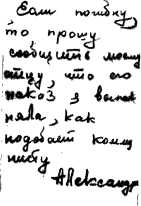
~
The last words of A.
Postolskaya's letter
~
[154]
Following in the footsteps of
her father, Sergei Postolsky,
and her brother Vladimir, the
teenager volunteered for the
army in the spring of 1942.
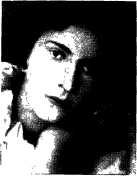
~
Alexandra Postolskaya
~
News about her acceptance
into the army came as a great
thrill: "They trust me, I'm going
to the front,'' she wrote at the
time. "I love my country, love
life. . . . And I'll help the army
and the front. How
marvellous!!!"
It was not long before Shura
was in the thick of the fighting
with the 758th Rifle
Regiment.
In July 1943, things began
. to hot up at the front as the
nazis brought up fresh
reinforcements. Her battalion had to
fight desperately and without
any let-up in order to shield
some of the neighbouring units.
In the vicinity of the village of
Rybka, near Smolensk, the battalion made a counter-attack, several
times engaging large enemy forces. On the night of August 9, 1943,
the battalion soldiers found themselves ringed off. It was then that
Shura wrote her last note in which she affirms she has done her duty
as befits a Communist.
After receiving instructions to pierce the enemy ring, Shura and a
group of scouts searched for weak links in the enemy encirclement,
and when a suitable place was found, she was the first to rush at the
Germans with the battle cry: "Kill the beasts!" Behind her came the
scouts and a platoon of submachine-gunners. The Germans wavered,
then gave way. The soldiers tore through the breach and quickly
rejoined their unit.
On August 16, 1943, the German Command started a new offensive.
New waves of enemy soldiers threw themselves against the
battalion's position. Again it was faced with the danger of being
cut off. Alexandra Postolskaya, seeing that the enemy had almost
broken through on the left flank, rushed across to lend a hand. Her
submachine-gun fire flailed the frantic Germans. For a brief second
she laid down her gun, picked up hand grenades, and hurled them
into their midst. "Forward, comrades!" shouted the young girl as she
led her companions into a fresh counter-attack.
The Rybka fighting lasted several hours and ended in victory. But
the soldiers' rejoicing was marred by Alexandra's death.
[155]
__ALPHA_LVL1__
LETTER
FROM JUNIOR LIEUTENANT LEONID KURIN
TO HIS SISTER
Not later than August 15, 1943
Hello there, Sonya. I'm sending you my battle greetings and
wish you and your children a happy and carefree life.
Sonya, my dear sister, there's so much I would like to tell
you about in these lines, so many thoughts I'd like to share
with you.
The war's already been on for many months. Throughout
these terrible days of fighting for our country, I have borne
my name of Communist and Soviet patriot with honour. I've
experienced the dangers and hardships of war but I've also
tasted the sweet smell of victory. It's just a pity that I haven't
killed enough Germans. But I've chalked up a few successes:
four enemy planes shot down and 150 or so enemy soldiers
have bit the dust from my bullets. If I live longer I'll try to
notch up a few more, really give the enemy something to
think about. But if I die, my comrades-in-arms will make them
pay for my death, they'll give Fritz something to remember
us by for the torments to my country, for the suffering of the
Russian people, and for me.
Sonya, I've been thinking about death-is it so awful or
not? No, it isn't so awful when you die for the future happy
days, for the happiness of our children. But a life has to be
given at the price of ten from the enemy. I am following in
father's footsteps. He was killed in 1919 and I have kept his
tradition. He fought for my life. I am fighting for the lives
of your children.
156
Sonya, I'd give anything to be home, if only for one short
day, just to see you. I know things are not so easy with you,
but you have to get over them somehow, take them all in
your stride come what may. And you will be over the hump.
Give all the family my love, say hello to Kostya and Sasha
for me. I hope they get on all right together. Kiss grannie and
mother.
Please don't cry, I ask you one thing-remember I fought
and died honourably, as befits a Russian and a Bolshevik. And
to you, my childhood companion, Sophie my dear, I wish
a long life and much happiness.
Farewell to you all. We shall win! Death to the German
invaders!
Leonid
__b_b_b__
Wireless-operator and air-gunner Junior Lieutenant Leonid Kurin
was fatally wounded in an air battle over Leningrad. A letter was
found in his field-case addressed to his sister in Teikovo not far from
Ivanovo. The note attached read: "Please post it in the event of my
death.'' His fellow flyers sent a copy of the letter to the Leningrad
newspaper Smena which published it on August 15, 1943.
[157]
__ALPHA_LVL1__
NOTE
FROM THE GUARDS LIEUTENANT
MIKHAIL PANCHENKO
Not later than August 18, 1943
Dear comrades,
In a few minutes the Germans will come at us again. But
they won't get through! If I happen to fall in this battle,
please inform my girl-friend at the following address:
Valya Fufayeva, Povorino, Voronezh Region.
__b_b_b__
On a section of the Bryansk Front, an unequal battle was in
progress with nazi infantrymen. Thirty enemy bombers pounded the
trenches, heavy Tiger tanks approached and behind them came
greygreen lines of German soldiers. A platoon of guards under Lieutenant
Panchenko which had just had time to dig itself in took the full
force of the onslaught. The Soviet soldiers met the onrushing
infantry with a tornado of automatic and machine-gun fire. All the
same, six tanks managed to get to the trenches. Lieutenant Panchenko
halted one Tiger tank with an anti-tank grenade, the rest were
destroyed by the artillery. Again the enemy attacked. The company
commander was killed. Lieutenant Panchenko took over. Under the
command of the courageous lieutenant the soldiers fought off 14
onslaughts and wiped out more than 200 men. In the last attack, Mikhail
Panchenko was killed. His note, written during the fighting, was
discovered in his tunic pocket.
[158]
__ALPHA_LVL1__
LETTER
FROM MEDICAL ORDERLY
VALERIA GNAROVSKAYA
LETTER TO HER MOTHER
August 22, 1943
My dear little Vitya, Mummie and Grannie,
Haven't dropped you a line for a whole week-haven't had
the time. Yesterday we came out of the righting and there was
a letter from Vitya waiting for me. So I am replying at once.
First a couple of words about myself-I'm alive and well.
To tell you the truth, I don't hear very well at the moment, but
it will blow over. I've already been twice in fighting. From
15.8.43 to 21.8.43 we've been giving the Gerries hell in these
parts. They tried to knock us off of the hill we were holding
but all their attempts to break through were foiled. Our lads
fought hammer and tongs-all my dear and brave comrades
true to their orders: not a step back.
Many of them died a hero's death, but I came through alive
and, my dear ones, even if I say it myself, I think I didn't
let anyone down. I carried about thirty badly wounded from
the battlefield. The regimental commander mentioned me in
the dispatches and I think he has put me forward for an
award.
Dear Vitya, you write that things are pretty bad at home.
I know, my love, but you must set your teeth, overcome all
the difficulties and realise that all this is the doing of the dirty
fascist beast. We have to show him what we are made of and
get revenge on him for smashing our happy life, for hundreds
and thousands of dead and wounded, and for the blood and
tears of our fathers, mothers and sisters. You have never had
occasion to feel uncomfortable for my sake. And I assure you
that will never be necessary.
Look after yourselves, write more often.
Lots of kisses to all of you,
~ ~ ~ ~ ~ Valya
159
__b_b_b__
Valeria Gnarovskaya, a sweet and kind 19-year-old girl, was known
at the front as Little Swallow. Valya saved the lives of many wounded
soldiers.
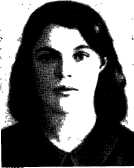
~
Valeria Gnarovskaya, Hero of the
Soviet Union
~
Once, in September 1943, the nazis suddenly launched a desperate
assault on a section held by her regiment. Two Tiger tanks broke
through the defences and were bearing down on the regiment's
position. It was a very critical moment. And then something happened
which even eyewitnesses find difficult to put into words. With a bundle
of grenades Valya ran forward and threw herself right under the
tracks of the leading Tiger. There was a big explosion and the tank
ground to a halt. The second tank tried to turn back but it was too
late. Valya's comrades dashed up and put it out of action. Thanks to
her self-sacrifice, the breach was quickly patched up, the assault beaten
off and the regiment put on the offensive. Valeria Gnarovskaya was
posthumously awarded the title of Hero of the Soviet Union.
[160]
__ALPHA_LVL1__
LETTER
FROM SOVIET P.O.W.S
IN THE CHISTYAKOV WAR CAMP
Dear brothers, we believe you will soon arrive and probably
find our letter. You will know that there was a concentration
camp here. Not far from the camp, there stands a cross
marking the remains of 7,000 Soviet people, shot or bayoneted
or starved to death.... Something like 600 wounded prisoners
have been murdered. We write to you just before our death.
In five or ten minutes we shall also be killed.. ..
Tell everyone about our fate. Get your revenge. Sensing
the end is near, the fascists have gone mad torturing our
people....
Farewell! They're coming for us.
With communist greetings,
~ ~ ~ ~ ~ Senior Lieutenant in the Medical Corps
~ ~ ~ ~ ~ ~ ~ ~ ~ ~ K. Kh. Khamedov
~ ~ ~ ~ ~ Medical Instructor
~ ~ ~ ~ ~ ~ ~ ~ ~ ~ Kurchenko
~ ~ ~ ~ ~ Red Army Man
~ ~ ~ ~ ~ ~ ~ ~ ~ ~ Andreyev
August 30, 1943
__b_b_b__
When the Donbas was liberated in September 1943, Soviet soldiers
discovered many cases of the awful trail of bestiality left by the
Germans. Many mines in the Donets Basin had been turned into mass
graves. This letter was written by three p.o.w.s in the Chistyakov
concentration camp shot by the nazis before the retreat.
__PRINTERS_P_161_COMMENT__
11---3928
[161]
__ALPHA_LVL1__
INSCRIPTION AND LETTER HOME
FROM INTELLIGENCE GIRL ZOYA KRUGLOVA
Not later than September 9, 1943
INSCRIPTION IN A CELL
I used to love freedom and the wide open spaces, that's
why it's very hard to get used to being locked up. In Greek,
my name, Zoya, means life. Oh, how I want to live, live,
live___Zoya Baiger (Kruglova).
__b_b_b__
LETTER HOME
My dear Mum and Dad, dear little sisters Valya, Panya and
Shura and dear little brother Borya. I'm writing to you,
darlings, from prison for the last time. You will receive this
letter when I am dead.
My darlings, it's already a year since you received news
from me,- I've been wandering about all the time but I never
forgot about you. They arrested me in February and that
makes two and a half months since I've been here alone in a
solitary cell. Every day I expected to be taken out and shot.
Mummie, things have been pretty grim but I endured it all.
They sent me to a camp in Pskov where I stayed two months
and escaped back to our side. I was again sent on a mission
and again I ended up in this prison-this is the second month.
I have been beaten about the head with sticks. Now waiting
to be shot. I don't think any more about living though, my
dear ones, I very much want to live a bit if only to see you,
give you a big hug and cry all my grief away on your breast,
Mummie dear. In fact, if I hadn't landed here a second
time I would have been home in September. But, there it is,
it's no use crying over spilt milk. At least, I've done my duty.
162
My dear ones, you can be proud that I haven't besmirched
your good name and honour. I am going to die, but I know
what for.
Mummie, don't take it too badly, don't cry. I would have
liked to have consoled you but I'm very far away and behind
iron bars and thick walls. I frequently sing songs in gaol, and
the whole prison listens. This is a song about my life and my
sad end:~
Don't you weep, don't weep,
~ ~ ~ ~ ~ my darling,
Don't you grieve my Mother dear.
We shall beat the nazi bandits
And be home again, don't tear.
But she died without returning
From her Ostrov prison cell.
By night they came and took her.
Shot her by the prison rail....
My dear ones, other girls will tell you about me, if they
survive. . . . Once more I beg you, please don't cry, don't
despair. My last farewell to Auntie Liza, Uncle Vanya, Lena
Almazova and every one of my friends, comrades and
relatives.
All my love to you all.
Farewell forever.
My body will be in Ostrov behind the gaol by the side of
the road. I shall be clothed in my black woollen dress, which
is a bit faded now, and the red knitted jumper you bought
for me, my dear Mummie, and Russian boots.
Your daughter,
~ ~ ~ ~ ~ Zoya~
Good-bye, good-bye. . ..
__b_b_b__
Zoya Kruglova was born on April 23, 1923, in the village of
Moshenskoye near Novgorod. She threw everything into the battle as soon
as war broke out. Zoya took part in putting up defences and
evacuating children from Leningrad, taught the local population what to do
during air raids and, at the same time, took a course in nursing. In
the autumn of 1941, she was appointed medical orderly to the 145th
Anti-tank Battalion. Shortly after, she began work for the intelligence
on the North-Western Front.
In the winter of the same year, she joined up with Anna Dmitriyeva
and wireless-operator Panya Morozova in crossing the front. The
Soviet High Command sent the girls to Soshikhin District, not far
__PRINTERS_P_163_COMMENT__
11*
163
from Pskov, to gather
information about nazi troop movements
on the Leningrad front. Having
a good command of German,
Zoya passed herself off as a
German girl, Baiger, whose
father was supposed to have
been shot by the Bolsheviks in
1938. She succeeded in finding
out valuable information about
landing strips, the number of
garrisons and the movements of
enemy troops. This information
was radioed back to H.Q.
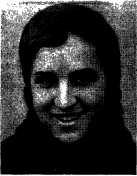
~
Zoya Kruglova
~
After spending a brief leave
at home, Zoya once more went
behind the lines. In the company
of a new wireless-operator,
Zinaida Baikova (``The
Wondergirl''), Zoya was flown to the
town of Ostrov in the Pskov
Region. Once in the town the
girls managed to get hold of
passports and find work: Zoya
in a labour office and her friend
as a cleaner in a military unit. The two girls made contact with the
town underground and went into action. In November they transmitted
four messages back to H.Q. After the arrest of underground leader
Klava Nazarova, the nazis began to keep a closer watch on all suspects.
At the commencement to 1943, Kruglova and Baikova were seized
by the Gestapo. Without getting anything out of the two girls, the
Gestapo sent Kruglova to a camp for condemned prisoners in Pskov
and Baikova off to the Diisseldorf prison in Germany.
Zoya escaped from the death prison and made her way back to
the partisans, but as she was attempting to cross the front she fell
into the hands of some provocateurs who passed as partisans and
again found herself in the Ostrov gaol.
In the nazi cell, Zoya conducted herself bravely. For more than a
month the nazis put the girl through various tortures. As a fellow
prisoner, A. Poyarkova, later testified, the girl was often brought
back from questionings with her head and face covered in blood and
bruises, but her spirit never sagged. She would often lament: "Oh,
how I want to live!" She never gave death a thought. Many a time
when she would sing, silence would descend on the gaol while
everyone listened to her songs.
Realising that this time there was no escape, Zoya did all she could
to see that her parents received her last letter. With the aid of Dusya
Demidova, she succeeded m sending a note to her sister whom she
knew before her arrest. With the knowledge that her note had got
through, Zoya sent her letter home in the same way.
At dawn on September 9, 1943, Zoya Kruglova was taken out with
four members of the Ostrov underground and shot, four miles from
the town, at a spot just off the main Ostrov-Palkino highway.
164
__ALPHA_LVL1__
LETTERS
FROM MEMBERS
OF THE ZAPOROZHYE UNDERGROUND
BORIS ZHIVENKO'S LETTER TO HIS MOTHER
September 2, 1943
Dear Mum,
I've received all you sent but it looks like being all to no
avail as we are to be shot before Sunday. Oh, my dear Mum,
I so want to live. Let's have some apples today....
Kisses to all.
September 2, 1943
Boris
__b_b_b__
LEONID VINER'S LETTER TO HIS WIFE
September 5, 1943
Dear Shura,
It's all over, either today or tomorrow I'll be shot like the
hundreds of others shot since September 1. Please believe me
I go to my death for your sake because I love you and the
children more than anyone ever loved. I've had a good deal
of chances to taste freedom but I didn't take them out of love
for you and the children. When the children grow up, please
explain that to them. Kiss them for me, my darling, darling
Shura.
Love and kisses to you. Bye-bye forever,
~ ~ ~ ~ ~ Leonid
165
__b_b_b__
LEONID VINER'S NOTE
September 14, 1943
We die like heroes.
Address: 26 Baranov St., Block 4, Voznesenka.
Whoever finds this, get it to my children.
All those in Gonchar's group were shot on 14.IX.43.
Viner
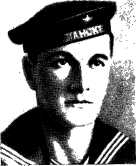
~
The last page of L. Viner's letter from prison to his wife
~
[166]
In April 1942, in the town of Zaporozhye in Orjonikidze District,
an underground group was formed mostly made up of workers from
Zaporozhstal, the local steel plant. Its ringleaders included Leonid
Viner, A. Girya, Boris Zhivenko, Y. Ovsyuk (Kryukova), N. Stribkov
(N. Khristenko) and A. Fokin. Leader of the group was Nikolai Gonchar.
By June 1943 there were several dozen fighters in the group busy
organising acts of sabotage, gathering arms and ammunition,
distributing leaflets with news, arranging prison escapes and providing the
escapees with clothing, food and false documents. Wireless sets hidden
in the flats of Girya and Zhivenko supplied the group with Soviet news
bulletins. In the summer of 1942, the conspirators built a secret tunnel
in a well in Gonchar's yard. There they concealed their arms,
literature and typed out leaflets.
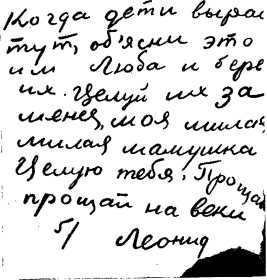
~
Leonid Viner
~
The group did all they could to prevent their plant from being
destroyed. To this end they got Gonchar appointed to the post of
superintendent of the factory police. With his influence, Girya and
other underground men were accepted into the factory police.
On June 28, 1943, forty of the group were given away due to poor
conspiration technique and taken in custody. This terrible blow took
off Gonchar, Viner, Girya and Zhivenko among others. When their
flats were searched the wireless sets and secret passage came to light.
On September 14. 1943, the group's leader, Nikolai Gonchar, chief
of operations Leonid Viner, Girya, Zhivenko and a number of other
active members were shot after several sessions of excruciating
torture. Before their death, the fearless patriots wrote letters home from
the Gestapo prison. The two letters above safely reached their
destination. Viner's note to the Soviet people was later found on him
by other underground fighters after the shooting.
[167]
LETTER
FROM FLYER GRIGORY BEZOBRAZOV
TO HIS SISTER
September 19, 1943
Greetings Vera,
This evening I got a telegram from the High Command in
Moscow congratulating me on the high award of Hero of the
Soviet Union!
You can well imagine I'm as pleased as punch!
The higher the decoration the harder it is to earn it, that's
why I'm doubly gratified. I know I've done some decent
scrapping and I'm still putting up a good show to set our
Soviet land free. And I shall continue to fight, burn and set
fire to the nazis, as befits a hero!
Greetings to all my pals and acquaintances.
Very best wishes to you. Looking forward to a warm
welcome home.
Yours,
~ ~ ~ ~ ~ Grisha
__b_b_b__
Grigory Bezobrazov was born on January 11, 1919, into a poor
peasant family living not far from Kaluga. After secondary school
he was accepted into the Krasnodar Air Force Cadet School. In 1940,
the young graduate, with the rank of lieutenant, was posted to one
of the air units in Byelorussia.
War broke out___ In the arduous years of war, his character
matured and will-power steeled battle after battle. His pin-point
bombing sent enemy ammunition dumps in the Volga battles into the
air, set nazi tanks near the Vistula on fire and smashed fortifications
near Berlin. By early 1943, Grigory Bezobrazov had 250-odd sorties
to his credit and had dropped thousands of tons of destructive metal
onto the heads of the nazis.
168
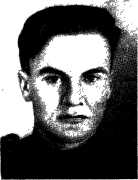
~
Grigory Bezobrazov, Hero of the
Soviet Union
~
By decree of the Presidium of the Supreme Soviet of the U.S.S.R.,
September 18, 1943, Senior Lieutenant Grigory Bezobrazov was made
Hero of the Soviet Union.
His daring sorties continued to pester the retreating enemy. On
April 18, 1944, the courageous flyer set his bomber on a course for
Berlin. But his plane did not return from its mission. II happened
like this.
On that day Soviet bombers, with their flight commander Bezobrazov
at their head, took off for a bombing raid over one of Berlin's outlying
railway stations, where a large number of soldiers and equipment
were concentrated. The bombers reached its destination without mishap.
Grigory Bezobrazov saw through his bomb sight armoured gun
platforms, hastily covered with a camouflage net, and the tiny, dark
figures of the panicking soldiers. Almost immediately fires flared up
down below, rubble of iron was blown skywards, bombs and
ammunition began to explode. It looked as if the tornado of fire started
by the bombs had scorched the very earth under the Germans' feet.
Mission accomplished, the bombers turned for home. But an
antiaircraft shell had pierced Bezobrazov's plane and it caught fire. Smoke
poured into the cabin and clouded over the instrument panel and
windscreen. It became difficult to observe the ground and the sky.
The crew could hardly breathe. .. .
Grigory Bezobrazov could have bailed out of his burning plane.
But the enemy was waiting below. The Hero of the Soviet Union
took another decision. The bomber, engulfed in flames, dived down
into a cluster of nazi machines.
169
__ALPHA_LVL1__
ALEX. KUZNETSOV'S NOTE
FROM GRANKI DEATH CAMP
Not later than September 22, 1943
Farewell, dear Soviet people. We are to be killed today, but
we want to live. We are young, have suffered terrible torture,
remained true to our country... .
I, Alex. Kuznetsov, Russian, lived in....^^*^^ My
comrade---Valdur Saarestik, from the Estonian S.S.R., Dago Island,
hom....*
__b_b_b__
After the liberation of Smolensk Region, a murder camp was
discovered in the village of Granki, in which during two years of
bloody slaughter, the occupational forces had shot and tortured many
Soviet people. In one of the discovered graves the body of a young
lad in a sweater was uncovered. There were no documents on him
but in the sleeve of his sweater was concealed a note written on a
piece of a German envelope, apparently picked up by the lad
somewhere on the road.
_-_-_
^^*^^ Several words are struck out.
[170]
__ALPHA_LVL1__
LETTER
FROM IRINA MALOZHON
Not later than October 1943
Dear Uncle,
I'm not afraid of dying. It's just a pity I've lived so little
and done so little for my country. Uncle, I'm already
accustomed to the gaol, I'm not the only one, there are many of
us. ... I'm not afraid of dying. Tell mum not to cry. I wouldn't
have lived much longer with her anyway. I would have gone
my own way. Tell mum to hide the grain, otherwise the
Germans will take it. Good-bye.
Yours,
~ ~ ~ ~ ~ Irina
__b_b_b__
Up to the war Ukrainian girl Irina Malozhon lived in the village
of Zhukli in Chernigov Region.
Like her friends, Irina dreamed of finishing school and going to
college. But the war broke out and the girl went to war in defence
of her country.
One September day in 1941, a cloud of dust announced the
unwelcome arrival of Hitler's tanks and lorryloads of soldiers in the
village. A foreign tongue rang out amidst the weeping of women
and children thrown out of their cottages by the Germans. The
Germans carried off grain, raped, plundered and murdered the peaceful
Soviet villagers.
Irina Malozhon joined up with the underground and started to
carry out the organisation's instructions. Together with other patriots
she printed and distributed leaflets appealing for resistance to the
occupational authorities, to their demands for food; they called on
the villagers to hide their grain, warm clothing and avoid forced
labour. The texts to the leaflets were composed by Irina's uncle Savva
Malozhon, to whom Irina's above letter was addressed.
One day, when Irina was passing out leaflets in a neighbouring
village, the nazis swooped and the girl was hurled into a dark cellar
where she was cruelly tortured. But she stood up to everything. After
more suffering in German hands, she was taken out and shot.
171
__ALPHA_LVL1__
LETTER
FROM LIEUTENANT GLUKHOV TO
HIS GIRL-FRIEND
Not later than December 5, 1943
Darling Naya, it's not often I write to you. Not because
I don't want to but because I can't write often. You know
my life is always in danger. I don't want to give you any
vain hopes. I always write to you after a battle. But if you
get this letter it means I'm gone, it means I fell in battle
with thoughts of you, my faraway yet very near sweetheart.
I took the trouble to write this letter beforehand so that
you might know how I loved you, how infinitely dear you
were to me.
Just one thing, my dear, sweet Naya, I am not writing this
letter to make you wear your heart out in despair and
sorrow over me, so that you forever go about in gloom and
mourning. No! I'm writing so that you know and remember
to the end of your days how much I loved you, how much
the very thought of you urged me on, gave me strength in
battle, made me scared of nothing when things got really
hot.
And there is something else-I want you to know you are
a good, decent girl and your love is a haven and oasis for
an exhausted soldier.
I have your photo here now before me. Your eyes are
looking at me as if they were alive. I see sadness in them.
If your picture had been taken with a deliberately affected
sorrow, it wouldn't have been so deep and complete as it
is in your eyes. I know you've been pining away.
Your letters breathe impatience, you ask me to show no
mercy to the nazis so that I come home sooner to you.
Believe me-your command, your call-I fulfil with honour.
Like you, I live with the dream of returning to you, of being
172
together with you once more. And I know that the farther
I go westwards, the quicker my homecoming will be. And
for the sake of this dream I rush into battle so ferociously,
and manage to do so much that it would amaze even myself
if I could read it in a newspaper.
I could get a reprimand if they read this letter, a
reprimand for fighting for you. Yet I don't know, I cannot make
out, where you end and my country begins. You and she
seem to have merged into one for me. And I see your eyes
as the eyes of my country. I have the feeling your gaze
follows me everywhere, that you, invisible to me, judge my
every step.
Your eyes.... When I gaze into them, I get an
inexplicable thrill and a quiet contentment. I remember your quick,
sly glances. It's only now I appreciate that in those fleeting
glances your love came out best and most of all.
You are my future. Why do I talk of the future, though?
After all, when you get this letter I shall be no more. I
wouldn't like you to receive it, and I won't even write the
address on the envelope. But if you do get it, don't take it
too much to heart. It just couldn't have been otherwise.
Bye-bye. Be happy without me. You should be able to
find yourself a friend and he will be no less happy with you
than I was. Cheer up. When V-day comes rejoice and
make merry with all the others. Only, when that happy and
lucky day comes, I'd like you not to lose that secret, tender
grief for me, I'd like your eyes to be suddenly, just for a
minute, as they are gazing at me from the picture now.
Please excuse this wish.
All my love and lots of kisses,
Love,
~ ~ ~ ~ ~ Pyotr
__b_b_b__
Fighting swirled around an enemy stronghold. In the path of the
Soviet soldiers was an enemy bunker from which a hail of
machinegun bullets poured that made it suicide for anyone to even raise their
heads. Lieutenant Pyotr Glukhov was hit by a bullet as he was
crawling to the gun slit of the bunker a grenade in hand. Some time
after, during a lull in the fighting, his battle comrades buried their
officer with military honours. Among his personal belongings were
found this unsent letter to his girl-friend and her photo. On the
back of the photo were the words: "My dear. You are far away but
always with me. I am sending you this photo so that you remember
• me more often. Love to you, my darling. Your Naya. May 1943, Ufa.''
173
__ALPHA_LVL1__
SERGEANT NAZAROV'S LETTER
TO HIS GIRL-FRIEND
December 5, 1943
Dear Sasha,
Please let my beloved Marusya know I kept my word. I
shall fight till my last drop of blood, as she requested.
To me my country is everything-life and love and
everything. ... Now I see why a Russian cannot be conquered. He
loves his country, and there lies his invincibility.
Marusya, we'll soon wipe out the Hitler scum and I'll
come home to you.
Dearest Marusya,
We've just crossed the Dnieper, the Germans are
attacking. But our lads are holding on!
That's all for now. I'll write again after the battle.
Marusya, love our country like I love her, she will
support and save you always and everywhere.
Our country means everything to us.
V. Nazarov
__b_b_b__
The fighting was hot and furious on the right bank of the Dnieper
River. The enemy was putting up dogged resistance and was making
counter-attacks time and again. But the Soviet troops held their ground
and began to press forward.
On December 5, 1943, Vladimir Nazarov fell during one of these
battles. He was always a selfless and fun-loving soldier and had been
mentioned for his resolve and efficiency. He was much liked by his
fellow soldiers. He began th<? war as a rifleman and soon
174
distinguished himself as an expert marksman. Once, while fighting off an
enemy assault, he put two tanks out of action.
Shortly after, he was made a sniper. When he died he had a total
of 168 nazis to his credit.
The story of the above letter is rather interesting. It was written
in the heat of the battle on a scrap of paper and handed to a friend,
A. Lipatov, with a request to send it to his girl-friend Marusya.
Lipatov had no time to ask the girl's surname or her address. Vladimir
was killed the same day. In the pocket of his tunic was discovered
a photograph of Marusya. On the back of the photo were the words:
"To my dear Volodya from Marusya Y. 10 V-1943.''
Vladimir Nazarov's last wish and letter were published in
Komsoniolskaya Pravda on December 24, 1943.
[175]
__ALPHA_LVL1__
LIEUTENANT TARASENKO'S
LAST LETTER
December 1943
My dear son Garik,
When you read this letter, many years will have passed,
the thunder of war will have died down and a happy and
joyful life will once again have blossomed over our
liberated land, just as it did before the war. When you were a
little boy, you used to lie in your cot and smile through
your sleep; mama and I used to think how lucky you were,
not having to go through what we had been through in our
childhood years. I used to think of bringing you up a real
man and was proud ot your first words, your first thoughts.
Then came the terrible war and you and mama were
evacuated beyond the Volga to save you from death, from
the murderers of little children, and I went to defend our
country. Probably to you our last meeting in March 1942 in
a stranger's hut in Kaisatskaya village was like a dream.
You have waited for me a long time and I never came. Like
hundreds of thousands of other fathers I died in combat with
the cursed foe-the German fascists who invaded our country,
broke up our peaceful life, bringing mountains of grief with
them.
But, though I die, I am deeply convinced that you, my
beloved boy, will live in a free, flourishing country-a
country of socialism; you will study in a Soviet school, make
your way in life and, like me once upon a time, will learn
about the war days from history, read stories about the
daring exploits of war heroes. And you, my dear little boy,
need not blush for me, for your father, you can proudly say:
"My dad died in the fight for future happiness, true to the
oath and his country.'' In a bitter fight with the Germans I
shed my blood to gain you the right to a happy life.
176
Just know this, my beloved son, that my blood too has
soaked the soil over which you can walk and build a happy
life, about which I dreamed so much.
Years will pass, lots of years, the graves of our enemies
will grow over with weeds and thistles while for us
defenders our free homeland will build a Victory monument.
Remember me when you look at it. Read my letter through
and what you don't understand ask your mama, she'll
explain.
Put your best foot forward, fight for a better life, and if
an enemy ever begins to threaten your beloved homeland,
get up and fight and don't let me, your father, down. Don't
spare yourself for your homeland.
All my love to you, my dear little son, for all your life,
always and ever.
Your loving father,
~ ~ ~ ~ ~ Grigory Alexeyevich Tarasenko
__b_b_b__
Grigory Tarasenko was born in 1910 into a worker's family in a
GLUEPATCH Jiijs in the Dniepropetrovsk Region. He lost his mother early on
(shot by the whiteguards) and
from the age of ten had to
look after himself.
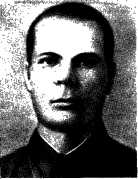
~
Grigory Tarasenko
~
Thanks to the help of
comrades and his own strong will
and persistence, he managed to
finish a secondary school.
In 1934, he became a
schoolmaster in the village of
Lyubimovka, Zaporozhye
Region.
He gained a commission in
the army when war broke out
and was seriously wounded in
one of the battles on the distant
approaches to Rostov-on-Don.
After regaining consciousness in
the sick bay. Lieutenant
Tarasenko asked for a pencil and,
with feeble hand, wrote his last
letter to his son. The letter,
tucked inside his Party card,
was kept by nurse A.
Khudyakova and passed on to the dead
man's son.
__PRINTERS_P_178_COMMENT__
12---3928
[177]
__ALPHA_LVL1__
TESTAMENT OF TANK COMMANDER
JUNIOR LIEUTENANT GEORGI MOROZ
Not later than January 5, 1944
TESTAMENT
I want to leave a brief testament in case I die in battle
with the German invaders.
I am a Communist. This small candidate card No. 5902866
and my devotion will carry me on until the invaders are
completely routed.
The Bolshevik Party is my leader and inspires me to fresh
exploits in battle.
I have been brought up to be a devoted son of my
country and the Red Army, a Soviet officer, and everything I
gained as'a result of hard work in the Syzran Tank School
I have put to full use on the field of battle.
I shall fight the enemy until my last drop of blood and
my last gasp.
My request to you, my comrades, is to write to my
parents after my death and tell them how I fought for my
country, how I shot up the nazis and their machines and guns
from my tank and how I died.
Please send on my Party card and other documents you
find on me to my dear mother and father. Let them have
this testament too. May these simple sheets of paper remind
them of their son Georgi and how he died during the war.
Their address: Ivan Moroz, Bezymyannaya station,
Saratov Region.
Bolshevik greetings to my dear sister Feodosiya-all the
best in your studies.
178
Greetings to my dear comrades Nadezhda Riesman and
Valentin Savichev.
Greetings to my college instructors-Captain Zuyev and
Sen. Lt. Golyashov and all the others.
Written before the battle,
~ ~ ~ ~ ~ Jun. Lieutenant G. Moroz
__b_b_b__
Junior Lieutenant Moroz's tank unit received instructions to disrupt
an important enemy transport artery. The tank under his command was
the first through enemy lines, but then it was hit and came to a halt.
The tank crew continued to shoot down the enemy. When ammunition
gave out, Georgi Moroz ordered his crew out of the tank and himself
covered their retreat.
Enemy soldiers were creeping up on the tank from all sides.
Jun. Lt. Moroz hurled his last grenades. Many nazi soldiers fell but
more and more surged on relentlessly towards the lone Soviet tank.
Now Moroz had only his pistol. His one thought was to kill as many
nazis as he could but to leave one bullet for himself so as not to
be taken prisoner.
When his men eventually got through to him they found him dead.
In the pocket of his tunic they came across the testament written
in ink on a sheet of paper.
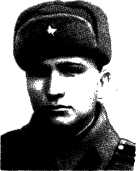
~
Georgi Moroz
~
[179]
__ALPHA_LVL1__
CAPTAIN MASLOVSKY'S TESTAMENT
TO HIS SON
January 4, 1944
Well, my dear son, we shan't be seeing each other any
more. An hour ago I received orders which mean I shan't
be coming back alive. That must be no cause for you to
lose heart or be afraid, my lad. Be proud, just as proud as
your dad going to his death. I'll do all I can to see you get
my letter, and I want you to be careful and not go
frightening your grannie.
Glorious Leningrad, the cradle of the revolution, is in
danger. Its future may well depend on the successful
accomplishment of my mission. For the sake of its safety, I
would carry out my mission to my last breath, to my last
drop of blood. I could not turn down this mission. Just the
opposite, I'm eager to be off, to get down to it as quickly
as possible. I'm waiting for the car to take me. A thousand
and one thoughts crowd my brain, questions keep flashing
through my head like lightning and I answer at once. One
of the first questions is: What is the strength that gives me
the courage to be a hero? Military discipline and my duty.
It's certainly true that there's only one step from discipline
to heroism. Remember that, my son, now and forever. And
while there's still time, I must take off my decorations and
kiss them in the old Guard's tradition. I'm telling you about
everything in detail so that you know what sort of man your
father was, how and for what he gave his life.
When you grow up, you'll think it over and you will come
to love your country. It's a marvellous thing to love your
country.
I have a son. My life continues-that's why it's not so hard
for me to die. I know that there, deep in the rear, lives and
grows the successor to my mind, my heart, my feelings. I
go to my death and I see my continuation. My son, in all
180
your letters you begged and expected me to return home
from the front. I don't want to deceive you: don't wait any
longer and don't grieve, you aren't alone. In the past, my
little boy, we haven't had much chance to see each other
but I've always loved you and been near to you even though
I've often been far away. That's my thought now, even though
I'll be dead, my heart will continue to live with you, even
death won't take you out of my heart.
In my letter of farewell, I am making a request to my
commanding officers to accept my son into the Suvorov
Military School, preferably in the Leningrad Region, so that
he can visit Poddorsk District, the Sokolsky Village Soviet,
because near the village of Khleboyedovo his father met his
death.
Good-bye, my son, good-bye, my dearest wife.
Polya, Yura! My wife, my son! You are my dearest love,
my own blood, my life! I love you, I love you till my last
drop of blood.
Please carry out my last wish.
~ ~ ~ ~ ~ All my love,
~ ~ ~ ~ ~ ~ ~ ~ ~ ~ Your ever-loving Gavriil
__b_b_b__
On a frosty January day in
1944, Captain Gavriil Maslovsky,
Chief of Staff of a special skiing
battalion, sat in a trench writing
his last letter to his son.
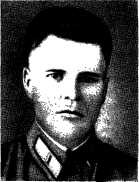
~
Gavriil Maslovsky
~
The infantry division of the
Guards in which he served was
holding onto a position not far
from the village of
Khleboyedovo, Novgorod Region. A scout
reported that to the south-east
of the neighbouring village of
Pryamiki, in the Kruglaya grove,
the enemy had a large store of
bombs and shells which were
about to be dispatched for use
against Leningrad. The store had
to be destroyed. The divisional
commander passed on his
instructions to blow up the dump
to Captain Maslovsky.
It was already getting dark
when Captain Maslovsky
finished writing his letter-his last
181
words to his son Yuri and his wife Polina, who was a surgeon in a
field hospital. The brave Communist, a man of iron will, called his
letters: "My last written words and wish for my son.''
It was almost time to be off.... Captain Maslovsky read the letter
through once more. He could imagine his little son Yuri snuggling
up in his warm bed and probably wondering: "Where is my dad
now?" He so much wanted to see his son, caress his curly head, press
him to his breast. But the rules of war are inexorable, it was time
to go. ... A few hours later a column of flame shot into the dark
sky and the earth trembled from a big explosion. The job had been
done, but Captain Maslovsky never returned.
His comrades sent the letter to his son Yuri, who, true to his
father's last wish, graduated in 1952 from the Sverdlovsk Suvorov
School and then a military motor and tractor college, and became
a Soviet Army officer.
[182]
__ALPHA_LVL1__
PASHA SAVELYEVA'S INSCRIPTION
ON THE WALL OF A DEATH CELL IN LUTSK
January 1944
The awful, horrible minute is approaching! My whole
body is mutilated-I've practically no hands, no legs.. .. But
I die without uttering a sound. It's terrible to die at 22.
How I want to live! We depart for the sake of those coming
after us, for your sake, my country. ... Blossom, be
beautiful, my native land, and farewell. Your Pasha.
__b_b_b__
Pasha Savelyeva was born into a peasant family and went to school
in the town of Rzhev. In the summer of 1940, after graduating from
the Moscow College of Finance and Economics, she went to work in
Lutsk. She was there when war broke out. Failing to evacuate to the
east, she decided to fight the occupational forces in the town. After
a while, she formed an underground group with other young people.
The courageous underground fighters gathered information about the
location of Hitler's troops, engaged in sabotage, assisted in the
escape of Soviet prisoners and supplied them with documents and
clothing. In early summer 1943, the group managed to establish
contact with the partisans operating somewhere near under the
command of D. Medvedev, Hero of the Soviet Union.
They got their hands on the nazi plan of Lutsk with all the military
objectives clearly marked. On instructions from the partisan centre,
they caused the Germans a lot of trouble on the railway. The nazis
were run off their feet trying to discover the people behind the
underground resistance.
On December 22, 1943, the Gestapo made a late call on Pasha
Savelyeva. After horrible torture and suffering, the nazis burned the
young patriot in January 1944 in the courtyard of an old, medieval
Catholic church, which the Germans had turned into a large torture
chamber.
An hour before execution she managed to pass the following note
to the cell next to her: "If they bring us out together let's try and
make a break for it. Perk up!" But they had no chance.
She scratched the above inscription with a nail on her cell wall just
a few minutes before she was executed.
183
__ALPHA_LVL1__
GUNNER VADIM USOV'S
BATTLE PLEDGE
February 20, 1944
As I go into battle, I swear to do my sacred duty for my
homeland and put all my hatred into my fighting skill-it
will treble my strength!
Even when I'm gone, my feat of arms will not be
forgotten. I would have liked to have lived but I have to sacrifice
myself so that my happy country may live and prosper, so
that others may live.
My dear country, accept my modest gift for your good,
and remember that I, brought up, fed and reared by you]
have repaid you with everything I had.
I, your son, was devoted to you right up to my dying
days and I have carried out my duty as a Communist and
soldier with a pure heart.
I have died so that you may live. I loved you fervently,
my homeland, and I hated your enemies.
... The final salvoes will die away and the dark war
clouds will disperse to reveal a free homeland, a free nation.
And whoever of you will live to see that great victory day,
that clear and joyful day, remember and pass on the story
of those who did not spare themselves to bring that day,
who gave their lives for it, to bring our triumph near.
You know, I, too, wanted to be with you on that day.
On that day I want you, Natasha dear, to remember the man
who used to live for you and, dying, used to think of you,
my unforgettable sweetheart.
184
Dearest mother, Lyalechka, Pavlik and Lyonechka, don't
grieve and weep for me, lighten your grief with the thought
that I was true to my duty to the very end, to my soldier's
job and shed my blood to hasten victory day.
Dear friends, I ask you for the last time to let my
comrades-in-arms know about this pledge. Then send it to my
family and write about me to Natalya Sergeyevna Ivanova,
born 1927, living at 1/4 Sovietsky Lane, Anzhero-Sudzhensk,
Kemerovo Region.
My mother's address: Valentina Nikolayevna Usova,
Lednevo State Farm, Nebylovsky District, Ivanovo Region.
__b_b_b__
Vadim Usov was born on November 24, 1923. In 1941, he finished
secondary school in Leningrad and gained admission to the
Dzerzhinsky Higher Naval-Engineering College. His dream was to study and
join the Navy.
At the end of 1941, he was sent with other cadets to the front.
Right from the start the young cadet scorned death and fought where
the fighting was at its hottest. He became a battle-hardened N.C.O.
in no time. His comrades liked him for his modesty and his
fearlessness, for his sensitive, kind heart.
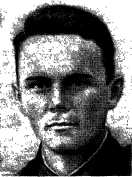
~
Vadim Usov
~
He fought his last battle on February 20, 1944, in
Karelia. From a bunker on a hill, the nazis had raked with fire just
about every foot of ground and
it would have been risking mass
suicide for the Soviet men to
have attempted an assault of the
hill. Then the unit commander
ordered Vadim Usov, a gun crew
commander, to push his gun as
close as possible to the bunker
and blast it wide open. It took
Vadim's crew eight shells to set
the bunker on fire. But by this
time enemy shells from two gun
batteries fell so thick and fast
around Usov's field piece that it
was a miracle they did not make
a direct hit. Vadim Usov gave
the order for his men to take
cover in the trenches while he
made a dash for his gun. But a
shell got there first and he was
killed by shrapnel.
When the battle was over,
Vadim's comrades found his
``Battle Pledge" among his
documents.
[185]
__ALPHA_LVL1__
LETTERS
FROM TANK COMMANDER VADIM SIVKOV
AND WIRELESS-OPERATOR PYOTR KRESTYANINOV
SIVKOV'S AND KRESTYANINOVS LETTER TO
THEIR COMRADES
We two remain alone in tank No. 17-tank commander
Jun. Lt. Vadim Sivkov and wireless-operator Pyotr
Krestyaninov. We prefer death in our own tank than to desert it.
We will not be taken prisoner, so we are leaving 2 or 3
bullets each for ourselves. Blame for the accident must be
put on our 'driver who did not carry out my orders and turn
to the left. When he jumped out I didn't shoot him for fear
of blocking the escape hatch.
Twice the Germans have approached the tank but haven't
been able to open the hatches. In our last minute of life we
shall blow up the tank with grenades so that the enemy
doesn't get hold of it. Please tell our people at home that
we did our duty to our country by capturing Yavkino with
only one tank, and then dying there.
Address: Lieutenant-Colonel Sivkov, District Military
Committee, Karakulino, Udmurt A.S.S.R.
Konstantin Krestyaninov, Ralniki, Shurminsky District,
Kirov Region.
Sivkov
P. Krestyaninov
March 15, 1944, 6.10 a.m.
186
__b_b_b__
VADIM SIVKOVS LETTER TO HIS PARENTS
My Dear Dad, Mum and Tasenka,
Just to let you know I've only been at the front a little
over a month. We've covered more than sixty miles in our
advance. On March 13, with a single tank I captured the
large village of Yavkino (1,167 homesteads according to
the 1930 map). On the night of March 15, the Germans
counter-attacked and recaptured the village. In the dark my
tank ran into an anti-tank trench. Just the two of us, my
wireless-operator and myself, are left. We decided to die if
necessary, but we shan't surrender. Two or three times the
Germans have come up to the tank but they haven't got it
open yet. It looks like these are the last minutes of my life.
That, in brief, is about all. Don't worry about me. That's
war for you. All the best for your future happiness. My last
request: let the boys in Izhevsk know about my death. Well,
that's about all.
Good-bye forever,~
Your son,
~ ~ ~ ~ ~ Vadim
March 15, 1944, 7 a.m.
Sivkov
__b_b_b__
It was the morning of March 13, 1944. The Soviet Army was
beating back the nazis from Russian soil. Among the leading units was
the 212th Separate Tank Regiment. Tank No. 17 of this regiment
pushed on ahead, mercilessly pursuing and mowing down the fleeing
enemy. Skilfully manoeuvring over the rugged terrain, the tank came
out to the village of Yavkino and ran into a strong barrage of fire
from the Germans entrenched in the village. The tank crew, led by
Junior Lieutenant Sivkov, decided to surge forward and drive the
nazis out of the village. Moving right up to the edge of the village
the tank opened up with all guns blazing, and at top speed tore into
the village. Diving and ditching among the houses, the tank made
it appear that at least a dozen tanks had burst into the village. The
nazis dashed out from houses, along the streets into the gardens, but
could not escape the Soviet tank's relentless fire. By mid-day no
enemy soldiers remained. And it was not long before the village was
completely taken over by the forward infantry detachments of the
Soviet Army.
According to an incomplete count, it was estimated that as a
result of the tank crew's daring action, some 250 Germans had been
killed and more than 100 different carts destroyed. Among the
187
trophies were 3 tanks in good shape, 12 armoured carriers, 3 guns,
5 mortars, 75 lorries and 250 carts.
Two days passed. The foe, having summoned up his reserves,
rushed into the counter-attack. Wave after wave of Germans
converged on Yavkino. And once again the tank, swerving through the
village, stopped the enemy's advance. But it ran into bad luck. As it
sharply rounded a house the tank pitched into an anti-tank trench.
The cannon, rammed into the trench wall, was silenced.
The nazis filtered back into the village and surrounded the stranded
tank. But there were Soviet men inside the tank-tank commander
Junior Lieutenant Vadim Sivkov and wireless operator Pyotr
Krestyaninov. And when Hitler's men hammered on the armoured sides
shouting "Russ, surrender!'', the only answer they got was a firm:
"Russians do not surrender.''
The tank men were Y.C.L. members, both born in 1925. They had
met up in the 212th Separate Tank Regiment. And for near on two
months they had been fighting shoulder to shoulder on the 3rd
Ukrainian Front.
When their tank had blundered into the pit they both understood
there was no way out. They checked their pistols and piled up their
remaining hand grenades. Even before the two friends had finished
writing their farewell letters home, they heard the nazis clamouring
on the tank's side. Seeing they would not be able to take the tank
men alive, the Germans dragged up the artillery piece to blast the
tank open. But the Soviet pair beat them to it. There was a
tremendous explosion and on the spot where the tank had stood a sheet
of flame shot up engulfing the enemy soldiers around.
Two days later Soviet units once more recaptured the village. The
remnants of the two tank men were buried with full military honours.
A short while after, a soldier on his way through the village spotted
the tank and on investigation, pulled a charred iron box from the
wreckage. Inside the box were two sheets of paper-the farewell letters
of the two heroes.
On May 24, 1944, a decree of the Presidium of the Supreme Soviet
of the U.S.S.R. was published awarding the two brave men the titles of
Hero of the Soviet Union.
[188]
__ALPHA_LVL1__
NOTE AND INSCRIPTION
BY TANK COMMANDER ALEXANDER DEGTYAREV
INSCRIPTION ON Y.C.L. CARD
I die a courageous death for my country's liberation.
March 22, 1944.
__b_b_b__
NOTE ON WRITING PAD
Please write about my death at the front to my parents at
the following address: Nikolai Degtyarev, Flat 9, Block 3,
151 Bolshaya Sadovaya, Saratov; and to my bride, Adelaida
Pulina, 4 Aptechnaya St., Saratov.
__b_b_b__
Tank commander Lieutenant Alexander Degtyarev was among the
advancing troops that were beating back the Germans to the west.
In the streets of Chertkov he engaged enemy tanks. Lieutenant
Degtyarev's tank knocked out a Tiger and an armoured carrier, but
at that moment an enemy 105-millimetre gun fired from an ambush
and knocked off the tank's turret. The driver carried his wounded
commander to the nearest house and himself ran for aid. Sensing
his end was near, Alexander Degtyarev pulled out his Y.C.L. card
and pad and wrote his last words to his comrades with a wounded
hand.
[189]
__ALPHA_LVL1__
WALL INSCRIPTIONS IN TIRASPOL GESTAPO CELLS
Partisan Popik Demyan from cell 46 was shot on October
14, 1943, at 9 p.m.
11.XII.43, 18 partisans shot from cell 32.
__b_b_b__
Alexander Kozlov-Soviet paratrooper-landed in the
vicinity of Breulov, arrested 20.XII.43. Petropavlovsky miners'
settlement, Karpinsky District, Sverdlovsk Region. Alexander
Kozlov died 7.11.44.
Glory to him, eternal glory!
In the hearts of patriots and all honest people
He will not die, but live forever.
The country will not forget him.
__b_b_b__
Brothers, avenge our blood, the blood of paratrooper
Alexander Kozlov. Get revenge on the nazis. Show no mercy.
We know our men will come and read these words.
__b_b_b__
Vasya Buzhenko died here, 10 Proletarskaya St., Ananyev,
Odessa Region. Good-bye Mum, Dad and brother Kolechka.
Your son Vasya Buzhenko. Love to you all, 3rd April, 44.
__b_b_b__
Don't despair, we shall win because we stand firm. May
hope for victory be your guiding star in minutes of despair.
Don't lose hope.
190
The whole world is fighting for justice, for our life. We'll
win because we have the Communist Party behind us.
__b_b_b__
__b_b_b__
Keep up your spirits even in this cess-pit. Victory is ours.
29.111.1944, at 10.30 p.m. wonderful news-we've won.
Workers of the world, unite!
__b_b_b__
__b_b_b__
The Moldavian Republic was liberated after ringing off and
wiping out a very large concentration of enemy forces around Kishinev
and Jassy. At the end of August 1944, troops of the 3rd Ukrainian
Front brought freedom to the Moldavian people. On August 27, the
last shots resounded on the eastern bank of the Prut River.
At every step Soviet soldiers came upon evidence of the
abominable crimes of Hitler's men. The monsters had tortured and murdered
tens of thousands of Soviet people here. In April of 1944 alone, the
nazis in Tiraspol shot over 2,000 men and women.
These inscriptions were made on walls, plank beds and doors of
cell 46-the death cell-in the First Gestapo Gaol and in the cells of
Tiraspol's Second Gaol. These cells once held Soviet patriots
condemned to be shot. Most of the inscriptions were made in Russian,
some in Rumanian, and a few reproduced in English and French.
[191]
__ALPHA_LVL1__
WALL INSCRIPTIONS
IN TALLINN GESTAPO GAOL
May 1942 to April 1944
CELL NO. 5
Good-bye, all ray comrades. I'll see you no more.
Pyotr Kornyev~
Long live the U.S.S.R.! Ivan Timofeyevich Kuleshov.
22.IV.-44.
__b_b_b__
CELL NO. 7
Long live the Estonian S.S.R. Death for death.
Boichenko Y. 2/5-42.
Workers of the world, unite! Our cause is just, the foe
will be smashed, victory will be ours! .
__b_b_b__
CELL NO. 19
Vladimir Lositsky was here, 1910, Golibisov village,
Starodubsky District, Orel Region. Sentenced to be shot
in 1943, X. 27. Please let my parents know at the above
address-Alexander Lositsky. Farewell, dear friends and my
country. Farewell, my children, they are taking me out to
be shot.
Good-bye forever.^^*^^
_-_-_
^^*^^ This inscription was made on the back of the bedside stand.
192
Farewell, friends!
Sentenced to be shot l/XII-43 imprisoned officer from 92
Infantry Division, 317 Infantry Regiment, Volkhov Front,
23 Strike Force. Taken prisoner wounded 25/VI-42. Was in
Pskov camp. Arrested 26/111--43. 24/VII-Pskov, gaol, cell 12.
From 25/VII-43 Revel Gaol, cell 40 and from 1/XII-43--
solitary 1/17.
__b_b_b__
These inscriptions were made in Tallinn Gestapo gaols. On
investigation of the gaol buildings shortly after the town s liberation by
the Soviet Army, a number of inscriptions on cell walls, beds and
tables were discovered. They had been made by former inmates
doomed by the German occupational forces. Some of the inscriptions
are reproduced above.
__PRINTERS_P_193_COMMENT__
13---3928
[193]
__ALPHA_LVL1__
LETTERS
FROM RIGA UNDERGROUND LEADER
IMANT SUDMALIS TO HIS WIFE AND CHILDREN
6 Upmalas St., Liepaya. To be sent after the war.
IV. 1944
Marusenka,
Hardly likely that you will receive this, my last letter,
but you might all the same!
On April 13, I was sentenced to death, I don't know the
date today, the days are all mixed up. But a lot of time has
passed since the trial, it must be about April 28 and I'm
thinking that it may well be our little Aijuk's birthday
today-six years old now---and maybe I shall be taken out to
be shot tonight.
They don't give me any books, I'm alone in the empty,
solitary central prison, I've got plenty of time to think over
the past. I look back to the past and see what a terrific
amount we've been through in these short years, I recollect
many wonderful minutes. And these memories of the tight
spots I've been in, of the peaceful, sunny hours with
youthese memories help me now. I don't regret the path I have
come... .
There could be so much to say and write about but I have
no pencil-I found a tiny piece of chipped lead in my pocket
and I'm writing with that.
You'll probably never know what fence I'll be buried
under, it doesn't really matter much-the same old earth
will cover us all. I have an idea, my love, that after the war
you'll go back to our dear Latvia. And there, sometime in
the evening after your day's work, remember that once upon
194
a time there was a man named Imis who loved you-tell
Aijuk and Sarmuk something about him.
Bring our laddies up the right way, Marusenka, teach
them to love the future in which they will live and for which
so much blood has been shed.
Give Aijuk and Sarmuk a caress for me, good-bye
Marusenka, we'll see each other no more. Don't want to die yet,
but believe me-I know how to die in the proper way. The
Gadfly, too, was shot in the spring when the young grass
was pushing through. Look after yourself and try to be
happy, Marusenka. Don't take it too badly.
Your Imis
May 25, 1944
__b_b_b__
Dear Marusenka, Aijuk, Sarmuk,
Can't tell whether you'll ever read my final words, but
I'm writing anyway. In a couple of hours I'll be executed.
The trial was on 13th May,^^*^^ so I've had a fair amount of
time to ponder over my life. When I look back over the
days gone by, I have nothing to reproach myself for. I
acted like a man and a real fighter in those fateful days.
If only the future is lovely and happy, it certainly should
be! All that blood surely cannot have been shed in vain.
Don't drown yourself in sorrow, my Marusenka, no one
has yet ever lived eternally. Bring up Aijuk and Sarmuk so
that they remember me sometimes, so that their lives are
happier and better.
Look after yourself, Marusenka, thanks for all the good
you gave me. And please give Aijuk and Sarmuk a hug for
me.
Imis
__b_b_b__
Imant Sudmalis was a Latvian partisan, the brains behind the Riga
resistance movement.
As secretary of the Liepaya District Y.C.L. Committee and member
of the Central Committee of the Latvian Communist Party, he
immediately took his stand in the front ranks of the fight against the
nazi invaders. On the second day of war, the Liepaya young people
formed a rifle company headed by Imant Sudmalis and Boris Pelnen,
secretary of the Liepaya Y.C.L. Committee. Liepaya workers'
detachments and Soviet soldiers and sailors who made up the small
__NOTE__ The period at end of footnote text not in OCR output probably
due to despeckling turned on about a week ago. 2007.02.22
_-_-_
^^*^^ The trial was, in fact, on 13th of April.
195
garrison in the town put up a
staunch resistance for five days.
Imant Sudmalis turned out to
be an excellent machine-gunner
and daring commander. After
the fall of Liepaya he headed a
group of young fighters who
broke through the besieged port
area and went underground in
Kurzeme.
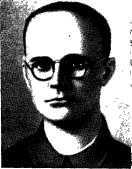
~
Imant Sudmalis
~
After a few months in
Kurzeme, Imant Sudmalis made his
way back to Riga where he set
about establishing an
underground organisation. In the
spring of 1942, a decision was
taken to send him across the
front to report on the results of
resistance work and receive
fresh instructions. He set off in
May of the same year. He met
up with Alexander Grom's
partisan group then operating in
the Byelorussian forests. They
helped him to cross the front line and by autumn he was in
Moscow.
In November, a Latvian partisan detachment was formed in the
Soviet rear. Imant Sudmalis was appointed Party organiser. At the
beginning of December, when the Russian winter was at its worse,
the detachment crossed the front at a point called Velikiye Luki and
made a 200-mile incursion into the Kalinin Region eventually setting
up a base in a forest in Byelorussia on the border with Latvia. From
December 1942 to January 1943, the detachment succeeded in uniting
the Ludzen and Daugavpils partisan groups operating along the
border. By its actions, the detachment created a base for future
activity of the Operative Group of the Central Committee of the
Latvian Communist Party-the organisational headquarters for the
underground movement in Latvia. On March 22, 1943, a Latvian
partisan brigade was formed on the basis of this detachment.
On July 20, 1943, Imant Sudmalis, on the authorisation of the
Latvian Y.C.L. Central Committee, returned to Riga where he became
head of the underground groups, directing and extending their
activities. He established contacts between the Riga underground and
the partisan units in North Latvia, and took part in many dangerous
operations. The most outstanding of them was the foiling of the
"Latvian People's Protest Meeting" which the Germans had intended
to stage in connection with the work of the Moscow Conference of
the Allies, which had discussed questions concerning the Baltic area.
The meeting was due to be held on November 13, 1943, on Riga's
Domskaya Square. Reichskommissar Loze, one of Hitler's top-ranking
officers, was billed to address the meeting. At 10 in the morning a
bomb exploded on Domskaya Square which the resistance men had
196
planted under the platform. The meeting's organisers took to their
heels. Utilising the ensuing hubbub, the crowd evaded the police
cordon and scattered. The nazis put up a sum of 30,000 imperial
marks for the head of the man responsible for the explosion. But
Imant was elusive. In December he was responsible for the starting
up of an underground print-shop in Riga.
The Gestapo did all they could to wipe out the Riga underground
organisation. In February 1944, mass arrests began. Sensing that a
provocateur had penetrated the resistance, Imant Sudmalis ordered
the abandonment of all the old secret apartment hide-outs, disbanded
the underground groups and dispatched all possible underground
suspects to the partisans. The complete destruction of the
underground was staved off but Imant himself was seized by the. nazis
and on May 25, 1944, at 6 o'clock in the evening, was hanged in the
cell of the fifth block of the Riga prison.
Imant Sudmalis was posthumously awarded the title of Hero of
the Soviet Union.
His letters, written in Latvian to his wife Maria, were discovered
after the war in a crack in the wall of his death cell.
[197]
__ALPHA_LVL1__
VOLODYA USTRITSOV'S NOTE
FROM A NAZI GAOL IN PESHIN
May 26, 1944
Long live the U.S.S.R.-Russia!
Here from 6 to 26-5-44.
Please inform: 19 Syezdovskaya, Vasilyevsky Island,
Leningrad 53-Volodya Ustritsov, Y.C.L. member, sailor, sentenced
to death 20-1 V-l 944. Shot 26-V-44.
For the Party!
__b_b_b__
Volodya Ustritsov, wounded and taken prisoner, bravely endured
all the nazi torture. On May 6, 1944, the retreating nazis transferred
him to Peshin gaol in Poland and killed him on May 26. Before
dying he scratched a few parting words with a nail on a piece of
black cardboard. After the town's liberation, Polish security officials
came across the cardboard in the Gestapo archives and sent it to the
Soviet Union.
[198]
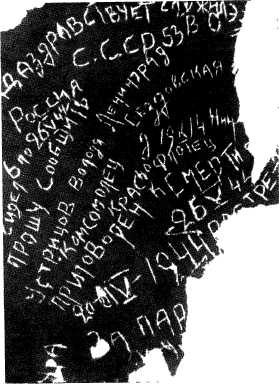 [199]
Emacs-File-stamp: "/home/ysverdlov/leninist.biz/en/1965/LFD232/20070221/232.tx"
__EMAIL__ webmaster@leninist.biz
__OCR__ ABBYY 6 Professional (2007.02.22)
__WHERE_PAGE_NUMBERS__ bottom
__FOOTNOTE_MARKER_STYLE__ [*]+
__ENDNOTE_MARKER_STYLE__ nil
__ALPHA_LVL1__
EXCERPTS FROM NOTEBOOK
[199]
Emacs-File-stamp: "/home/ysverdlov/leninist.biz/en/1965/LFD232/20070221/232.tx"
__EMAIL__ webmaster@leninist.biz
__OCR__ ABBYY 6 Professional (2007.02.22)
__WHERE_PAGE_NUMBERS__ bottom
__FOOTNOTE_MARKER_STYLE__ [*]+
__ENDNOTE_MARKER_STYLE__ nil
__ALPHA_LVL1__
EXCERPTS FROM NOTEBOOK
OF ARTILLERY OFFICER IVAN ALEXEYEV
I am defending a very valuable, important and crucial
district. It really is something to defend. Vital highways.
Though the place is dangerous, we cannot abandon it. If I
die, it will be worth it.
Glory to the late Junior Lieutenant V. M. Shchekin. His
name will live forever in my heart as my best man. He
fought for his country to his final breath.
30--05-44
After my death, please send my decorations to my
greyhaired father. Let him know my words.
``Your son Vanya carried out his father's advice and
behest without begrudging any strength or even his life.
``Accomplished well. With my unit, I brought down 23
enemy planes. July 6, 1941, in the region of Troni (
Bessarabia) we wiped out over a battalion of infantrymen and on
July 8, 1941, beat off 12 tanks, burned one tank, others sent
packing.''
Vanya Alexeyev
__b_b_b__
Ivan Alexeyev went to the front straight from college. Put in
command of a gun battery, he bravely fought the enemy. The young
Chuvash was much respected and liked in the army. He was killed
on June 13, 1944.
[200]
__ALPHA_LVL1__
LETTERS FROM SIGNALMAN
OLEG NECHITOVSKY
May 1944
LETTER TO HIS MOTHER
Good-bye, my dear Mother,
This is my dying letter and if you ever get it you will know
that your son is gone. I died as your son and as the son of
my country. I didn't spare my life for people's good and
happiness, for your peaceful old age, for a happy life for
the children.
No tears! Be proud and don't forget me. Please tell the
young ones that you once had a son and that he didn't spare
himself and gave his life for their future and their
happiness.
I find it terribly hard to write you this letter but I am
firmly convinced my comrades will carry on where I left
off. The nazis will be wiped off the tace of the earth, and
they won't get any peace in the other world either. I am
Ukrainian, but Byelorussian soil will take me as her son
just as well.
All my love and kisses to you for the last time!
Your son Oleg~
Whoever finds this letter, please send it to: Yevgeniya
Nechitovskaya, Flat 6, 144 Prozorovskaya St., Kiev.
__b_b_b__
LETTER TO HIS GIRL-FRIEND
Farewell, my darling Lidushka,
This is my last letter. And if you ever get it, I shall no
longer be alive. Please understand that I gave my life dearly,
honourably, on the battlefield, and the Byelorussian soil has
accepted me, son of the Ukraine, as her own son.
201
It's no use crying, better spare a thought for me now
and again, be proud that the man who loved you, who wanted
to build a life together with you, died honourably for his
country, for people's happiness. Of course I didn't want to
die, but the call of our country is law, my duty called and
life had to take second place.
We dreamed of so much, but.... The years will pass, you
will have a son and I would like you to tell him just a tiny
bit about the man who wanted to be his father.
That's all, good-bye.
Love and lots of kisses for the last time!
Your loving Oleg
__b_b_b__
Whoever finds this letter, please send it to: Lapidus (for
Lida Abalyshnikova), Flat 6, 25 Engels St., Kharkov.
__b_b_b__
At the beginning of 1944, the Soviet Army were beating back the
nazis westwards on all fronts. By May the troops of the 1st
Byelorussian Front were fighting on the right bank of the River Dnieper and
clearing the Polessye Region from the nazis.
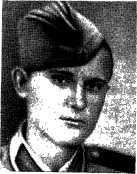
~
Oleg Nechitovsky
~
During the battles for Big and Small Kalinkovichi, the commander
of the forward battalion lost contact with the company operating
ahead in the region of the main thrust. Things began to look
desperate for the stranded men. It was vital to re-establish contact at all
cost. Signalman Oleg
Nechitovsky was called upon to
perform the extremely
dangerous mission.
He realised that he was going
to an almost certain death,
since the area where the cable
had been damaged was
constantly under fire. He searched
for and found the break in
the line with shells bursting all
around him. Wounded and fast
losing blood, he never stopped
work splicing the broken line.
His last words sent along the
repaired line were: "Order
accomplished. Line's back to
normal.'' Sensing that he could not
muster enough strength to crawl
back, he wrote his last letters
to his mother and girl-friend.
When the enemy retreated,
his comrades found him already
cold. The two letters were
discovered in his pocket.
[202]
__ALPHA_LVL1__
ALEXANDER MOKSHIN'S NOTE
June 1944
I swear to spare neither blood nor my life fighting for the
complete liberation of our beautiful country!
__b_b_b__
In the summer of 1944, sailors of the Ladoga Fleet took part in the
offensive on the Karelian Front, backing up the soldiers on shore
from the left flank. Particularly vital were the Tuloksin landings
whereby the sailors forced a bridgehead in the enemy rear between
the Olontsa and Vidlitsa rivers and straddled the railway and road
routes.
Alexander Mokshin from a landing party scouting out the district
around the village of Vidlitsa found himself up against a strong
covering detachment. There was no escape. Alone against a whole
platoon of nazis he fired his submachine-gun and hurled hand
grenades. Eleven nazis were killed, but the enemy was closing in.
So as not to fall into their hands, Alexander Mokshin reserved his last
hand grenade for himself.
After the village's capture, his comrades found the small note and
vow written on his Party card.
[203]
__ALPHA_LVL1__
INSCRIPTIONS
IN THE LAMSDORF PRISON CAMP
ON CELL DOOR NO. 8
Better death than nazi prison!
Master escaper Lisitsa Ivan G. was here imprisoned
3.9.43.
__b_b_b__
ON CELL DOOR NO. 14
Kazakh Kolya Zhakulbekov (Dotsent^^*^^), sentenced to be
shot for political work, was here. Formerly Sen. Lt. tank
man, recently arrived from Lublin, awaiting death.
Farewell, light of day!
Farewell, my native land!
Kolya, 15/VII-44
__b_b_b__
During the occupation of Poland, a large number of concentration
camps were formed on her territory holding many civilians and
Soviet p.o.w.s.
When the Soviet Army liberated the Lamsdorf camp in Poland they
found dozens of inscriptions on barrack walls, prison beds and cell
doors, made by Soviet patriots awaiting death. These inscriptions are
documentary proof of the invincible will of Soviet people who
preserved their human dignity in the face of nazi abominations
_-_-_
^^*^^ Probably a nickname.
[204]
__ALPHA_LVL1__
LETTER
FROM RIGA UNDERGROUND FIGHTER
HADO LAPSA
WITH POSTSCRIPT BY EDUARDS INDULEN
FROM THE CENTRAL RIGA GAOL
August 26, 1944
Approx. 10 p.m.
Dear Sis,
You will probably be surprised at my wanting
to write when you get this long letter from Pyotr. But there
we are-before they pump 8 grams of lead into me today,
I want to get off my chest everything that has heaped up
there over the past couple of months. In this letter I shan't
write about myself but about the unfortunate comrades who
have been with me. So as well as avenging me, I want you
all to avenge the inhuman suffering of these poor devils a
hundredfold and give them some measure of satisfaction. I
don't know whether I shall be able to put it over to you but
I am going to try. I have seen mutilated corpses dug up
after they have lain in the ground for several months.
Before that I never imagined I would ever have to see live
people in such a condition here, in Riga, in the cellars on
Reimers Street^^*^^ Damn that blasted house with all its
inhabitants-the German murderers and their obedient, sadistic
henchmen and the other dirty swine.
I was arrested on June 2, 1944. On that day I was put
into a cellar of this frightful house. I was in the first cell
which contained 7 or 8 inmates including the blacksmith
_-_-_
^^*^^ In Riga's Reimers St. (now Communard St.) the Gestapo had
their H.Q.
205
Klyava, or Klyavin, as far as I can remember, from Ogra
Volost. At the beginning, I paid no attention to anyone being
so taken up with my own worries. In a couple of hours I
calmed down and began to chat with my companions--
inmisfortune. Each of them spoke of his own troubles and
showed signs of torture on his body. It was a terrible sight
but I could hardly believe my eyes when, after some
hesitation, Klyava, a pale-faced fellow, somewhere between 40
and 45 who sat all the while to one side, pulled off his shirt
with an almost expressionless face. What we then saw was
no longer a human body. His entire body, from head to toe,
was unlike all the others-blue or all colours of the
rainbowit looked like the poor man had been roasted alive-his
whole body was swollen and a dark brown colour.
Blacksmith Klyava told us about himself-he was married,
father of two children and from 1940--41 had been an active
trade union worker. When the Germans came, he was
arrested for his union activities but after some neighbours had
vouched for him was set free. He was taken in for the second
time at the end of June and delivered to the Ogra S.D. police.
It was there that he had been worked over. A coward of
an informer had accused him of sympathy with the
Bolsheviks and of keeping a revolver. For this non-existent weapon
the Latvian police had beaten him up for six days on end.
The first day had been awful, the second even worse, but
after that he felt no more pain.
Most of the time the German murderers had always been
drunk. They ``worked'' in turns of three until the victim lost
consciousness. When he passed out they waited until he
came to and the ``work'' continued. As I said before, this
continued for six days. Then Klyava was taken to Riga.
They also arrested his wife. What happened to her and the
children he, of course, hadn't the faintest idea. I saw this
unfortunate man three or four times when he was taken in
for questioning. They lashed into him here too; the nazis'
``law'' is based on one thing only-inhuman use of power.
The last time I saw Klyava after interrogation I didn't
know what to do. I was horrified and speechless with
impotent rage. A few hours later he was brought down to our
cell. He was no longer a human being, but a martyr taken
down from the wrack. If his cell-mates hadn't supported
206
him and sat him on a bench next to the radiator which he
used for cooling his battered face, he would have fallen. The
martyr was only semi-conscious-his face was beaten to pulp,
his left ear partly ripped off, his bloody face was swollen
and as pale as a dead man's, except for the marks left by
the beating. I had never cried before, but when I saw him I
felt the tears welling in my eyes.
From then on, I had only one desire-that he and the
others, like Ludvig and Malvina Kukurevic, murdered on
August 8, should be avenged. I could still tell you plenty
more, my sweet sister, but my time is running out-at any
moment they will be taking me to Bikerniek Forest.^^*^^
Sis, you always were a real Soviet woman, and your duty
is to do all you can so that as soon as this rotten system
collapses, the names of these unfortunate martyrs, which
can be read on the walls of the Central Gaol's second cell,
shall be the accusers of these blasted nazis and even more
hateful Latvian quislings.
All these curs must get their deserts. Nobody must
forget the words of P. Ozol at his trial-that he was beaten
with a riding crop, with a stool, that they stamped on him,
and three days after the interrogation he was still giving
out blood instead of urine.
These savages can never be pardoned for feeding people
only on boiled water with a bit of flour until they dropped
from hunger and exhaustion, as happened with me.
Don't forget, you who remain alive, that we were clubbed
across the face for the slightest thing and threatened to be
shot. We suffered this horror every night, holding our breath
and waiting to be taken to the scaffold or to Bikerniek
Forest. We heard the groans and screams of our comrades as
they were being carted away. We saw a battered man brought
back from interrogation who died within half an hour
without regaining consciousness. (It happened in cell 26 in
the first block. My comrades Andrejs Grauds and M. Klanis
are witnesses.) Death to the bloody S.D. curs and the
lackeys of the German fascists.
I hope you won't doubt the integrity of this short letter.
Everything written here pales terribly in comparison with
reality, but, as I've already said, time is very short.
_-_-_
^^*^^ Place where mass shooting took place outside Riga.
207
I don't know if I'll be able to write to the end of this
page. Therefore please fulfil my only wish. Going to my
death I'm deeply convinced that I and my last cell-mate
Indulen and the many murdered and tortured fighters will
be worthily avenged and our relatives contented. But I
wish that when Latvia is again free and you receive this
letter, it will be published and those who survive will learn
how thousands of us died.
Once more I beg you-don't grieve over me and don't shed
any tears, for I die for my convictions, in the knowledge
that I did a lot to destroy the country of slaves--
Germanyand will ever remain in the memory of all my comrades as
a man who was not afraid of either truth or death.
Your brother Hado~
Greetings to everyone from Inda who is always in good
spirits and will go to his death with a smile.
E. Indulen
__b_b_b__
Hado Lapsa and Eduards Indulen were leading members of the
Latvian underground. Under their leadership, documents and passports
were prepared for members of the anti-fascist organisations in Riga.
On June 2, 1944, Hado Lapsa was arrested. Shortly after Eduards
Indulen also fell into the hands of the Gestapo. In the morning of
August 27, 1944, the two Soviet patriots were shot by the Riga
Gestapo.
[208]
__ALPHA_LVL1__
NIKOLAI SUCHKOV'S NOTE
Not later than September 9, 1944
I gave my life for our Communist Party, for our glorious
Komsomol, which brought me up.
Please, comrades, get this slip of paper to the Y.C.L.
organiser in our battalion. Let him know a Y.C.L. man
doesn't let his side down in battle.
__b_b_b__
This note was discovered on a dead Red Army man, Nikolai
Suchkov, after a furious skirmish with nazi submachine-gunners.
Eighteen-year-old Nikolai Suchkov surged forward in the heat of
battle and found himself surrounded by Germans. He had no hand
grenades and his ammunition had almost run out. Realising he would
not escape the nazis alive, he quickly scribbled a few words on a
scrap of paper.
[209]
__ALPHA_LVL1__
POEMS AND NOTES
LEFT BY TATAR POET MUSA JALIL
1943--44
True to its pledge is my heart to the last,
When doom overcasts my brow.
It was songs I gave to my land in the past;
'Tis my life I must give her now.
Singing, I welcomed the fragrance of spring,
Singing, I fought and bled.
Today the last of my songs I sing:
The axe hangs over my head.
It was songs that taught me freedom to prize,
Now they bid me to die as a Fighter.
My life was a love-song that soared to the skies,
Let my death be the battle-song of a fighter.
__b_b_b__
TO A FRIEND
Friend, do not grieve that we depart so soon.
Death lies in store for everyone on earth.
Man lay the limits of his years himself.
But years are not the yardstick of life's worth,
Nor is the time between one's birth and death
A credit worthy measure of its length.
Blood spilled in the defence of a just cause
Brings heroes deathlessness, their cause-immortal
~ ~ ~ ~ ~ ~ ~ ~ ~ ~ strength.
October 1943
210
__b_b_b__
HEROISM
Your song breathes fire, your song breathes love
For your native land-what more?
Nay, soldiers are not famed for songs,
But for their deeds at war.
~ ~ ~ ~ ~ Say, poet, did you rise and fight
~ ~ ~ ~ ~ When the hour of battle came?
~ ~ ~ ~ ~ In crucial times that try men's souls
~ ~ ~ ~ ~ The bold alone win fame.
To fight and win, to crush the foe,
One must be firm and brave.
Courage alone brings liberty.
The coward stays a slave.
~ ~ ~ ~ ~ Entreaties are of no avail
~ ~ ~ ~ ~ When men succumb to chains.
~ ~ ~ ~ ~ But he who fights with sword in hand
~ ~ ~ ~ ~ Forever free remains.
What worth is there in life enthralled,
What happiness in gaol?
Life's beauty lies in liberty.
All joys before it pale.
~ ~ ~ ~ ~ Your name lives on when you give your
~ ~ ~ ~ ~ ~ ~ ~ ~ ~ life
~ ~ ~ ~ ~ To free familiar parts.
~ ~ ~ ~ ~ The traitor's blood is mixed with mud.
~ ~ ~ ~ ~ The hero's fires men's hearts.
The hero, dying, does not die.
His fame survives his death.
Then fight and glorify your name,
Fight, whilst you draw your breath!
December 1943
__b_b_b__
LAST WORDS
Bluish-grey and snow-bound streets.
Blizzards blow their last.
Three guards with automatic guns
Lead their victim past,
~ ~ ~ ~ ~ Past houses veiled with falling snow,
~ ~ ~ ~ ~ Through the silent night.
~ ~ ~ ~ ~ And there, behind their snow-cloaked
~ ~ ~ ~ ~ ~ ~ ~ ~ ~ backs
~ ~ ~ ~ ~ Spring burgeons, fair and bright.
__PRINTERS_P_211_COMMENT__
14*
211
Bluish-grey and snow-bound streets.
Blizzards blow their last.
Three guards are levelling their guns.
Their victim's days are past.
__b_b_b__
JALIL'S TESTAMENT WRITTEN ON BACK COVER
OF HIS FIRST NOTEBOOK
December 1943
To the friend who can understand Tatar and will read
this notebook.
It was written by the Tatar people's poet Musa Jalil. After
suffering all the horrors of a nazi prison camp without
yielding to the fear of the forty deaths, he was taken to Berlin.
Here he was accused of being involved in an underground
organisation and the distribution of Soviet propaganda ...
and put in prison. He will be sentenced to death and die.
But he leaves behind 115 poems composed while behind
bars. He is concerned for them. Out of the 115 he has
therefore attempted to copy at least 60.
If this little book comes into your hands, write out a fair
copy carefully and accurately, keep it in a safe place and
after the war get it to Kazan, have it published as the poems
of the Tatar people's dead poet. That is my dying wish.
Musa Jalil. 1943. December
__b_b_b__
INSCRIPTION ON FRONT COVER OF FIRST NOTEBOOK
December 1943
In prison September 1942-November 1943-wrote 125
verses and one big poem. But will they ever see the light?
They'll die with me.
212
__b_b_b__
NOTE ON THE MARGIN OF A GERMAN BOOK
DISCOVERED BY SOVIET SOLDIERS IN MOABIT
PRISON LIBRARY
Not later than March 1944
I, well-known Tatar poet Musa Jalil, am locked in the
Moabit gaol for my politics and am sentenced to be shot....
Please give my best regards to A. Fadeyev, P. Tychina and
my family.
__b_b_b__
Musa Jalil (Musa Zalilov), the celebrated Tatar poet, was born in
1906 into a poor peasant family in the village of Mustafino, near
Orenburg. After joining the Y.C.L. m 1919 he began to write poetry,
sounding the call for battle for Soviet power. After finishing his studies
he took up full-time Y.C.L. work and wrote poetry at the same time.
One of his early works was the libretto to the famous Tatar opera
Altynchech. In 1939, he was elected President of the Tatar Union of
Writers.
At the very outset of the war Musa Jalil joined the army and after
taking a political workers' training course he was posted to the Volkhov
Front, to the 2nd Strike Force. In July of 1942, he ran into an ambush
near Myasnoi Bor and, badly wounded, was taken prisoner and put
in a prison camp near Helm in Poland. At the end of the year he
was still a sick man when he was transferred to the Demblinski p.o.w.
camp where he commenced his illegal work against the nazis. The next
spring Jalil was dispatched to Germany, to the Wustrau camp not
far from Berlin. On instructions from the underground he began
operating in the "Ideal Urals" committee, which recruited legionnaires
for Hitler's army among the Tatars, Bashkirs and other Soviet
eastern nationalities. Utilising his opportunity of visiting many war
camps, Jalil did what he could to see that an underground group
was operating well in every camp. Together with Jalil in the
resistance organisation was Abdulla Alishev, Tatar children's writer, whom
Musa Jalil knew from Kazan, Ahmed Simayev, a Moscow journalist,
an old friend of Jalil's from his Zamoskvorechye days when he
worked at a Tatar young workers' home, Garif Shabayev, insurance
agent from Tashkent, engineer Fuad Bulatov, etc.
__PRINTERS_P_213_COMMENT__
15---3928
213

~
Musa Jalil (Musa Zalilov), Hero
of the Soviet Union
~
In early summer 1943, Jalil left for the Tatar legion's Central Edlin
camp, situated near Radom, some 70 miles south of Warsaw. The
propaganda company in which Jalil worked was made the
underground centre in the Edlin camp. The underground fighters were
preparing for an uprising. But on the night of August 12, all the
underground members were arrested after being given away by a
traitor. First they were sent to a Warsaw gaol, then to Berlin, to the
Moabit prison. The investigation dragged on for six months until
eventually, in March 1944, a Dresden court sentenced them all to the
firing squad. After the sentence, Jalil and his companions languished
in Berlin's Tegel and Spandau gaols. They were executed at the end
of the year.
Musa Zalilov (Jalil) was posthumously awarded the title of Hero
of the Soviet Union and his literary works gained the supreme
Soviet award-the Lenin Prize.
His friends kept the three notebooks in which he had written his
beautiful poems. The first book contains sixty poems in closely-written
Arabic ligature. It was presented to the Tatar Union of Writers in
1946. The second book, containing fifty poems written in Tatar with
Latin letters, was handed in at the Soviet Consulate in Brussels in
1947. It had been preserved by Andre Timmermans, a Belgian
antifascist who had shared the same cell as Jalil in Moabit. Later on
another book came to light.
[214]
__ALPHA_LVL1__
NOTE
LEFT BY RESISTANCE GIRL FROM SLUTSK
1944
Borya, we are to be killed during the night. The rats can
sense their end is coming. I told them to their face that we
will win. Borya, please excuse me for causing you so much
grief. You know we don't always say and do what we like,
and I love you so, so much I don't know how to tell you.
Borya, right now I'm in your arms and I'm not afraid, let
them take me away. Yesterday, when they walloped me very
hard, I whispered to myself "Borya, dear" and told them
nothing-I don't want them to hear your name. Borya,
byebye, thanks for everything.
__b_b_b__
This note was written on a piece of notepaper by a 19-year-old
resistance girl from Slutsk. Her name remains unknown.
[215]
__ALPHA_LVL1__
PAVEL NESMELOV'S LETTER
Dear comrade,
If you find this letter when I'm dead you must know the
truth.... I fired off all my bullets and we held our ground
till our last bullet. Shot many Germans. Couldn't keep the
positions any longer. Now I lay here wounded in the leg.
Next to me lies Timofei Stefanishin, wounded and
shellshocked. Yesterday the two of us laid from dawn to sunset
in a vegetable patch, near a woodpile, trying not to be
noticed. When darkness fell we found a trench. We spent
the night there. January 21 is also drawing to a close.
Nothing to eat yesterday or today. To rise and enter the house
is dangerous. Germans are all around. We don't fancy
falling on the mercies of the Germans and being tortured.
It will soon be night. We don't know what's in store.
Maybe death.
Please, comrade, write a letter to my father and my family.
I have been two and a half years a prisoner in Rumania and,
despite my awful mutilation after the camp, I didn't go
home when they set me free.... I wrote home and got no
reply. My father, mother, wife and two sons are waiting
and hoping for my return. Their address is: Mikhail
Nesmelov, Galkin Village Soviet, Vetluga District, Gorky
Region.
That's about all. I wish you all the best in finishing the
war and hope you never have as much bad luck as me.
Good-bye friend!
Pavel M. Nesmelov
21.~1--45
216
__b_b_b__
Before the war Pavel Nesmelov was a secondary school history
teacher. In the war he was a fearless fighter.
In January 1942, he was badly wounded and taken to the Feodosia
hospital. When the nazis took over the town he became a prisoner.
Later he was set free by the Soviet Army. Despite his war wounds,
he went out to take his revenge on the enemy. In December 1944, he
was hit by a mortar shell splinter. But in January 1945, he was once
more fighting at the front.
Pavel Nesmelov's life came to a tragic end. He was once more
taken prisoner. His captors dealt with him extremely brutally before
shooting him.
Pavel Nesmelov's mutilated body was found on January 24, 1945,
at a spot west of the village of Nadivenim (on the west bank of the
Danube). This was where his last letter was discovered. It was sent
with an accompanying letter by Major Goryunov to Soviet Warrior,
a frontline newspaper. Major Goryunov's letter read:
``Soldiers of the Red Army, Pavel Nesmelov and Timofei Stefanishin
were found near a trench. They had been tortured by the Germans.
Nesmelov had had his ears, nose, lower lip and fingers of his right
hand cut off. Stefanishin had had his right eye poked out and his
nose cut off.''
[217]
__ALPHA_LVL1__
VERSES FROM A NOTEPAD
FOUND IN SACHSENHAUSEN
1943 to January 27, 1945
LAST WISH
__NOTE__ Verse below has no indentation and no gaps.
If ever it comes that I part with life
In this hated foreign land,
In a prison camp ridden with tears and strife.
If I die here young, and with ruthless hands,
The Germans take up my remains
Relieved at last of unheard-of pains.
To burn me and scatter my dust,---
And you, my beloved brothers and friends,
You whom I treasure and trust,
Will not be there to attend my end---
Rise like a man with your militant songs
And fight to revenge our wrongs.
Rise undaunted for your rightful cause.
Smash those walls and fling open those doors,
Lift the red banner of victory
High in the sky for the world to see.
The suffering millions will join your ranks
Like a mighty river that floods its banks.
The struggle will bring its fruits, I know.
Our forces will deal a shattering blow
At the vicious eagle who tears our land.
Revived and mighty again it will stand.
When you draw the account, dear comrades.
Of our sufferings, triumphs, defeats,
Do not be too hard, dear comrades,
On those whom the German so cruelly treats.
Remember the fallen heroes,
Carry their names in your hearts,
Mention them in your victory songs
When the great celebration starts.
__*_*_*__
218
I will be with you again, dear Russia.
To admire your rivers' mighty spread,
To listen to the murmur of your forests,
To tread the paths my fathers used to tread.
~ ~ ~ ~ ~ Long, long since I sang among your flowers,
~ ~ ~ ~ ~ Revelled in the fragrance of your streams,
~ ~ ~ ~ ~ And sat beneath the over-hanging oak-boughs
~ ~ ~ ~ ~ With the blue-eyed darling of my dreams.
Yet I am with you, with you forever,
For the moment sleep invades my eyes
I dream myself together with my darling
On the path that by the lakeside lies.
~ ~ ~ ~ ~ I will be with you again, dear Russia,
~ ~ ~ ~ ~ To admire your rivers' mighty spread.
~ ~ ~ ~ ~ To listen to the murmur of your forests,
~ ~ ~ ~ ~ To tread the paths my fathers used to tread.
__*_*_*__
How I wish I could see you today,
And walk in the shadowy park.
For the murmuring Dnieper to listen and smile
At our whispers exchanged in the dark.
~ ~ ~ ~ ~ I wish I could press you close to my heart,
~ ~ ~ ~ ~ Hold you tenderly in my arms,
~ ~ ~ ~ ~ And kiss, and kiss, and kiss without end
~ ~ ~ ~ ~ Your face, your shoulders, your palms.
But my dreams are in vain-for you I am dead,
And the love in your heart will die,
And I must follow my thorny path
And remember you with a sigh.
__*_*_*__
I cannot forget the land of my birth
Where my childhood and youth I spent.
Full of love is my soul for its sacred soil,
Which these verses of mine give vent.
A love which I bear through all tortures and grief,
In Gestapo's most fearful vaults,
A love that helps me to stand without tears
The murderers' taunts and assaults.
219
I open my soul unashamed in these lines---
He is blameless who meets his lot
Never bowing before the detested foe,
Whether destined to live or not.
__*_*_*__
My stubborn heart drives away my fears
And revives the dear old scenes,
Rejecting the thought that I may be shot
Ere the first light of morning gleams.
~ ~ ~ ~ ~ Reassured, I attend to the voice of my dreams
~ ~ ~ ~ ~ And I don't know how, but it somehow seems
~ ~ ~ ~ ~ That until I die I shall see once more
~ ~ ~ ~ ~ All that I cherished and loved before,
~ ~ ~ ~ ~ Everything that is now so far;
~ ~ ~ ~ ~ Hope shines in the joyless gloom like a star.
~ ~ ~ ~ ~ If only I could live to the day
~ ~ ~ ~ ~ When victory comes in its wreath of May.
How I want to live-I am still so young!
How I want to be my dear friends among!
But again and again the dark shadow of doubt
Puts the feeble light of my faint hopes out.
~ ~ ~ ~ ~ And yet, though seized by the anguish of
~ ~ ~ ~ ~ ~ ~ ~ ~ ~ death,
~ ~ ~ ~ ~ I am loyal to you to my very last breath,
~ ~ ~ ~ ~ To you, my Motherland! May you thrive
~ ~ ~ ~ ~ When I am no longer alive.
__b_b_b__
A notepad and verses were unearthed in 1958 when the former
Sachsenhausen concentration camp was being cleared out. The camp
site is quite near Oranienburg, about thirteen miles north of Berlin.
The leader of a building team Wilhelm Hermann came across the
tattered writing pad amidst the ruins of the camp barracks. It is still
possible to make out the words "Unforgettable. Verses in Captivity'',
written on the yellowed cover. Wilhelm Hermann gave the verses to
Senior Lieutenant Molotkov, a Soviet officer serving in one of the
Soviet Army units in Germany.
On December 31, 1958, the newspaper Soviet Army (for Soviet
troops serving in Germany) got news of the find and published five
verses. A few days later a report and some poems of the unknown
Soviet patriot appeared in Red Star and Komsomolskaya Pravda.
Despite all efforts, it has not yet been possible to establish the identity
220
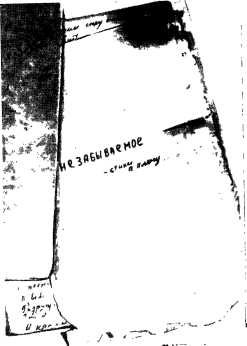
~
The first page of the notepad found in Sachsenhausen
~
of the poet. It has been suggested, however, that there was more
than one author. This appears likely from the fact that the verses
are entered into the notebook in even, firm handwriting with few
mistakes and no corrections. Many of the verses were known farther
abroad than Sachsenhausen; inmates of Ravensbriick, Buchenwald and
others claim knowledge of some of the verses. In their letters to
editorial office former prisoners suggest such names as Pyotr from
Kharkov, Victor from Donetsk, a certain Nikolai, Ivan Kolyuzhny,
__PRINTERS_P_222_COMMENT__
16---3928
221
and some others, as the authors. French Communist Salvador Charlie,
to whom one of the poems is dedicated, remembers being friendly
with a Russian inmate named Yuri Stolyarov who used to read him his
own poetry. Two acrostics in the notebook contain the names of Anton
Parkhomenko and Ivan Kolyuzhny. It may be these are the authors
of the poems or just the poet's friends.
Former Ravensbruck inmate Zinaida Golubeva, whose poem "A
Maiden's Song from Ravensbruck Concentration Camp" appears in the
notebook, recounted that during her time in Ravensbruck she
corresponded with one of the male prisoners (they tied a note to a stone
and threw it over two walls from the men's section of the camp to
the women's and back) who signed himself as ``Ivan'', ``Ivan-Star''
or ``Ivan-Star-Thorn''. In reply to her "A Maiden's Song.. .'' he sent
her "To the Dead Friend" and other verses. In his last note he
mentioned being taken away. That was the last she heard of him; he was
probably moved to Sachsenhausen.
The story how the notebook happened to be at the barracks
gradually unfolded from the letters that came to newspaper editorial
offices. The notebook was found in that part of the barrack ruins which
once served as a kitchen in the ``Sonderlager''. This special camp was
constructed between 1943 and 1944 for especially important prisoners,
including high-ranking officers of Hitler's Wehrmacht suspected of
being implicated in a plot to assassinate the Fuhrer. In 1945, the
barracks were repaired by a special gang from the ``Sonderlager''
which included Germans, Norwegians, Russians and other nationalities.
The chief electrician responsible for repairs of the camp electric wires
was Martin Gauslo, a Norwegian prisoner. After the war, he wrote
to a friend that while wiring an electric circuit in the special camp
he was asked by Russian friends to hide a notebook containing some
verses in a wall. He wrote:
"Dear friend,
``As I mentioned to you before, I drew up a plan of the^ kitchen
barracks in the special camp and marked the spot where I "hid the
manuscript containing a collection of poems of a Russian poet in
Sachsenhausen. It should be under the floor of the kitchen just in
front of the wall I have marked. If you intend to write there you
can tear off the plan and attach it to the letter. Very best wishes,~
``Martin Gauslo.''
__b_b_b__
As far as he can remember, the notebook was handed to him at
the beginning of 1945 by a Russian inmate named Mark Tilevich,
who had asked him to hide it-which he had done, wrapping the
notebook in a piece of rubberised material.
Mark Tilevich recalls that two members of the electricians' gang
used to read the verses jotted down in the notebook-Victor from
Donetsk and a doctor, Stepan Gun, who died on V-Day. But Mark
Tilevich cannot remember the author of the verses. Quite possible
it was Victor, for the name of Victor is mentioned by other former
inmates as a poet.
Whoever it was who wrote the verses in the notebook, he was
certainly a real Soviet patriot, whose spirit was not broken by any of
222
the humiliation or the whole regime of indignity which the Germans
had developed to a fine art. In the nazi concentration camps
everything was done to break a person down both physically and morally,
to trample on his feelings and destroy everything human in him.
Sachsenhausen was the graveyard of inmates from 27 European
nations. The camp officers and kapos put to death more than 100,000
prisoners. In 1941 alone, 18,000 Soviet officers and men were brutally
exterminated here. On April 21, 1945, about 30,000 survivors of the
camp were driven northwards, to the Baltic, where they were to be
loaded on barges and sunk. This really was a march of death:
thousands of emaciated, exhausted people remained forever by the
roadside-a guard would shoot anyone who could not move any farther.
Perhaps the owner of the notebook was among these unfortunates
from Sachsenhausen.
The author, or authors, whichever the case may be, will long
remain an example of heroism, extraordinary bravery and noble
feelings.
The notepad of checkered paper contains fifty poems. The verses are
written in a. small, clear hand, boldly lettered in indelible pencil.
The last poem is dated January 27, 1945.
[223]
__ALPHA_LVL1__
INSCRIPTION
IN JUN. LT. IVAN LANDYSHEV'S Y.C.L. CARD
March 15, 1945
I am not afraid, I feel no weariness in my arms, and I shall
fight the foe and be devoted to my country until my last drop
of blood!
__b_b_b__
After completely liberating Soviet territory towards the end of
1944 the Soviet Army battered the enemy on his own land. In March
1945, units of the 2nd Byelorussian Front, together with troops of
the 3rd Byelorussian Front who had overrun and pressed back to the

~
Ivan Landyshev's Y.C.L. card
~
[224]
sea enemy forces in Eastern Prussia, began to advance into Pomerania.
Towards mid-March, the enemy made a last ditch stand at the
approaches to Stettin.

~
Ivan Landyshev
~
Jun. Lt. Landyshev's unit broke through the Germans' first line of
defence and a pitched battle commenced in front of the second line
of trenches. In the heat of the combat, the company commander fell.
Twenty-year-old Ivan Landyshev took over command of the company.
The young officer did not lose his head. After issuing orders, he led
a charge. His group of men gained a hold in the enemy dug-outs and
hand-to-hand fighting started. During the skirmishing, Ivan Landyshev
was seriously wounded. But he continued to direct the fighting. Feeling
his strength ebbing away, he took out his Y.C.L. card and scrawled his
dying vow on the last page with the blood oozing from his open wounds.
Ivan Landyshev died on March 15, 1945. After the battle his comrades
buried the hero on Polish soil.
[225]
__ALPHA_LVL1__
FROM DIARY
OF P.O.W. BORIS NOZDRIN
Vesprem, on Lake Balaton, Hungary
~ ~ ~ ~ ~ 16th March, 1945
... I feel my release from captivity is near at hand. At a
time like this I feel like describing the whole of my life,
recalling everything. I feel like describing all the terrible
things the Germans did to the people they conquered. I feel
like describing all my hatred towards the enemy. I feel like
describing all my love for Russia, which I feel so keenly at
this moment. I can just imagine how lovely life will be after
the war, how people will respect one another after these
terrible trials of war. People will really value one another... .
I have Russia. I belong to her with all my very being, and
my life is for her. And over there in Russia lies my homeland
-Siberia and the beautiful village of Ushur, and there lives
my beloved with the simple Russian name of Masha. There
aren't any apples or grapes there, but they do have nuts, all
sorts of berries, and we will plant orchards there. Wherever
I've been, I have never forgotten Siberia. Her riches, the
taiga-golden forests and furry animals, and her fields-a
second Ukraine. What a marvellous future ahead of her!
__b_b_b__
April 1945, Austria~
Only half of us left-the rest have all been slaughtered. For
two days now we haven't had anything to eat and we work
more than all the others. We're working day and night. My
strength is running out.
Oh, my native land! If only I could see you as I see you in
my dreams. Oh, my native Russia, my invincible homeland.
A word of greeting I send you from my dingy prison. In
thought I walk about the Siberian expanses, but my strength
is running out. . . .
226
__b_b_b__
Minsk
~ ~ ~ ~ ~ Baranovichi
~ ~ ~ ~ ~ ~ ~ ~ ~ ~ Lublin
~ ~ ~ ~ ~ ~ ~ ~ ~ ~ ~ ~ ~ ~ ~ Uzhgorod
~ ~ ~ ~ ~ ~ ~ ~ ~ ~ ~ ~ ~ ~ ~ ~ ~ ~ ~ ~ Budapest
~ ~ ~ ~ ~ ~ ~ ~ ~ ~ ~ ~ ~ ~ ~ ~ ~ ~ ~ ~ ~ ~ ~ ~ ~ Vesprem
~ ~ ~ ~ ~ ~ ~ ~ ~ ~ ~ ~ ~ ~ ~ ~ ~ ~ ~ ~ ~ ~ ~ ~ ~ ~ ~ ~ ~ ~ Sharvar~
That is my hard trail. I'll try to remember everything, all
the places, all the indignities, the whole back-breaking trail.
And I'll describe it all, everything, if I live I'll write a book
In Captivity. Right at this moment some thing or other comes
back to me. I recall one date. That was January 17 or 18,
1942. I received a bad head wound near the village of Oskui,
Leningrad Region, Chudov District. I came to my senses and
well remember Minsk, a prisoner-of-war camp. I remember
sitting next to a student in horn-rimmed spectacles, Kostya,
and an interned soldier-either a Kazakh or a
BashkirBisinchakeyev. Then the gates flew open and an old man was
pushed in. He staggered forward, his arms flapping, lips
trembling, wanting to say something, but apparently unable
to do so. Blood trickled down his long, grey beard and on
his bald head there was a raw and bloody wound-a
fivepointed star had been carved out. He took a few more steps
and fell, stretching himself as after waking up, and then died
with his eyes open. We ran up. "Professor!" cried Kostya and
began to sob. He told me he had been one of his professors.
In Uzhgorod I met a nicely dressed Russian girl---Nina
Morozova from Gomel. She begged me to kill her because she
was being forced at gun-point to live with a German officer.
Instead of killing her I got her to change into soldier's
uniform, and she lived with us as a captured soldier. She lived
like that for a long time, then one day the guards noticed she
was a girl, and a German soldier raped her and slit her throat
before our very eyes.
__b_b_b__
Boris Nozdrin, born 1921, war taken prisoner, as his notes indicate,
in January 1942 after being wounded in the head during fighting
near the village of Oskui. He saw many war camps. When Soviet
troops advanced into Hungary and Austria, the nazis decided to wipe
out all Russian prisoners. Nozdrin was shot together with thousands
of other Soviet people in early April 1945. His diary was noticed in
the pocket of his service jacket as Soviet soldiers were burying the
mutilated corpses of their fellow countrymen.
__PRINTERS_P_226_COMMENT__
15*
[227]
__ALPHA_LVL1__
VLADIMIR CHURSIN'S TESTAMENT
April 16, 1945
LAST WISH
I go into battle with complete awareness of the task
entrusted me by the Communist Party.
And if I die, please know that I gave my life for my country.
I ask my comrades-in-arms not to stop until they see the walls
of Berlin.
16/IV--45
Best wishes,
~ ~ ~ ~ ~ V. I. Chursin
__b_b_b__
The war was coming to an end. The fighting had switched to the
lair of the nazi beast. The day of atonement was drawing near for
all the atrocities the nazis had committed in Europe. Hitler's men
were putting up a desperate resistance. The Soviet troops were
bearing down on the German capital and Hitler's army command
had decided to put up a last ditch fight for Berlin. At the approaches
to the city and in the city itself, the nazis had set up a strong system
of fortifications and concentrated about a million soldiers around the
town supported by a large number of artillery and tanks.
The decisive push into Germany took place between April 16 and
May 2 by troops of the 1st Ukrainian, 1st and 2nd Byelorussian
fronts.
Nineteen-year-old Vladimir Chursin wrote his last wish just before
the battle for Berlin. He was killed a little later in the last battle.
His comrades buried the courageous youngster and wrote on his
Y.C.L. card: "Your comrades have fulfilled your last wish-Berlin is
ours.''
[228]
__ALPHA_LVL1__
PAVEL YABLOCHKIN'S LETTER
Not later than April 25, 1945
Mum,
I'm taking a breather. So I have a bit of time to talk to you.
What a pity it has to be our last conversation. It would be
wonderful if you never get the letter, but saw me instead.
I'll be writing it and carrying it next to my heart, so that
if I'm killed some time or other we'll still be together, you
and I, like we were before.
I left you for a time. Don't you cry, Mum! I only want to
ask you one thing-to look after my son Alyosha. He'll be
without a father. Give him a kind pat on the head, tell him
a story and give him a kiss for me.
A year has already gone by since I escaped from the p.o.w.
camp. I saw a lot during my six months' inside! They forced
us to look. Mum, you just can't imagine, you've no idea.
Whenever I think of it ... if only I could find the words to
curse them, but words don't suffice. May they be cursed a
thousand times by all the people of the world and burn in
hell, may they be sent to feed the worms-and even the worms
would turn their noses up at them.
Elderly and middle-aged people were carefully spaced out
facing each other and buried in the earth up to their waists.
A line of tow was spread from one tc the other. Paraffin was
then poured on and a horrible chorus of heart-rending screams
came from amidst the blaze. But those swine were like blocks
of wood, like stone idols, grinning and cackling.
Mum,
I've seen them take little children like Alec, tear them
from their mothers' hands, grab hold of them by the legs,
give them a swing and hurl them down a well.
229
I've never been a believer in God, you know that, Mum.
Yet at times like that I've prayed to the Almighty, begged
with all my soul, that my nerves would stand the strain. Many
of us couldn't hold out, fainted or rushed to intervene-they
were shot in the legs and had their clothes lashed off of them
on the spot. Then salted like meat, and watered methodically
until they came to, sprinkled with salt again ... then the
Germans, going mad like wild beasts, chopped them into bits.
After all their fiendish tricks, the bastards are now taking
to their heels. Now they're scared of us like the plague. But
the truth will catch up with them and ferret them out wherever
they are. We'll give them a fair trial. After the war the stern
people of the whole world will see that they get their deserts
for the endless suffering and torments they caused.
Don't you cry, now. I didn't die, just went away from you,
Mum, like many went away, the same sort of people as me.
We went away fighting for our people, wiping barbarity and
slavery off the face of the earth. Went away for a happy
future for all people of the world as well as our own.
Mum, the war will be over, the country will heal its deep
wounds and once again people will begin to live in freedom.
Before you know it my Alec will be finishing school and
learning a trade of a locomotive driver.
No one would dare to be so inhuman or shameless as to
help again let loose any monsters like there are today. The
whole world would never let the Huns set the earth alight a
second time.
Build, live, work, study, and if you want to do us an honour
then band together and mop up the enemy quickly and get
over your war wounds, create a happy life for everyone. . . .
Good-bye, Alec and Mum. Lots of kisses to you both.
I've been sitting up too late. Off for a kip. My
comradesa great bunch of fighters-are asleep.
Your Pavel Yablochkin
__b_b_b__
Pavel Yablochkin was formerly a farmer from Yakshino on the
Volga. In the early part of the war he was captured, escaped and
was soon back with a rifle in his hands fighting the enemy. In fact,
he was several times cited for bravery. He was killed in Eastern
Prussia in the spring of 1945. This letter, soaked with the blood of
her son, was delivered to his mother.
[230]
__ALPHA_LVL1__
LETTER HOME
SENT BY SEN. LT. DOLGOV,
COMMANDING OFFICER OF A TANK COMPANY
Not later than May 2, 1945
Mum,
You are probably completely worn out. You must have a
load of worries, my dear. It's hard to imagine how you get
by with all that crowd to look after.
Mum, please don't worry yourself over me. Everything is
just grand. A soldier's duty is quite simple-we get on with the
battle. We're trying to finish off the nazis as quickly as we
can. When the war is over and we're all together again, I'll
tell you a lot about myself-how I lived, how we fought.
You keep writing to tell me to watch out for myself a bit
more. Please excuse me, Mum, but that's impossible. I'm a
commanding officer. Who's going to show the men an example
if their commanding officer starts thinking of trying to save
his skin rather than winning the battle. Please understand,
Mother, that I cannot do this although, of course, I'd very
much like to get through this war and stay alive so as I can
come back again to my home town and meet all of you.
All my love,
~ ~ ~ ~ ~ Sasha
__b_b_b__
Alexander Dolgov was born in 1917 in the village of Bolshoye
Tomilovo, near Kuibyshev.
Thirteen years later he began work on the local collective farm
and a little later left for one of the big factories in Chapayevsk,
where his brothers worked. Together with other factory hands, he
was called up in 1938.
231
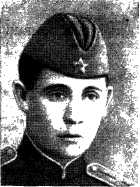
~
Alexander Dolgov, Hero of the
Soviet Union
~
Ten months later, when the Japanese troops invaded the Mongolian
People's Republic near the river Khalkhin-Gol, Private Dolgov was
in one of the units sent to beat off the Japanese attacks.
In August 1939, the Japanese invaders were finally repelled. On
the recommendation of his superiors, Private Dolgov was sent to a
regimental school which he finished with honours. Soon afterwards
the Germans attacked and he left for four years at the front.
The tank unit of the 1st Byelorussian Front in which Sen.
Lt. Dolgov's tank company served, had the enemy on the run back
to Berlin. Towards the war's end, Dolgov was given the responsible
task of piercing the enemy's defence at one particularly stubborn
point of the fighting. He gathered his tank men around him, explained
the situation and called on them to keep up the good name of the
Guards in combat. As always, the commanding officer's tank was
first into the attack. By his skill and fearlessness he was a great
inspiration to his men and the Soviet tanks soon ripped through the
enemy's defence and pushed on into Berlin. The way ahead through
the central defence sector was open.
In the morning of April 30, fighting flared up again for the
centre of the German capital. By the afternoon, at precisely 2.25 p.m.
Soviet troops had captured the Reichstag and run up the Victory
flag. The Berlin garrison laid down their arms and were taken
prisoner.
232
Berlin had fallen. For the third time in history Russian soldiers
victoriously passed through the Brandenburg Gates.
Together with other front units. Sen. Lt. Dolgov's tank company
moved on farther, to the city of Brandenburg, some 40 miles west
of Berlin. The tank company commander's actions were referred back
tJ H.Q. for commendation.
Alexander Dolgov led his tanks with just as much daring and
battlecraft onto Brandenburg. But he was not to see the V-Day-a
German shell blew up his tank in the very last battle.
By decree of the Supreme Soviet of the U.S.S.R. Alexander Dolgov
was posthumously awarded the title of Hero of the Soviet Union.
[233]
__ALPHA_LVL0__
The End.
[END]
~
[234]
To the Reader
Progress Publishers would be glad to have
your opinion of this book, its translation and
design, and any suggestions you may have for
future publications.
Please send your comments to 21, Zubovsky
Boulevard, Moscow, U.S.S.R.
[235]
Printed in the Union ot Soviet Socialist Republics
[236]