COMMANDER OF ORSHA PARTISAN BRIGADE
LETTER TO A FRIEND
p Not later than November 14, 1942
p My dear Vladimir Yakovlevich,
p Best partisan greetings from the dense thickets, swamps, woods and partisan hamlets of Byelorussia.
p When old pals meet they usually ask each other, "Well, how’re things going?" That’s probably the question you’d like to put to me. The usual reply is "Fair enough”. Then we can get on with our chat as friends and comrades do. It’s a year since we parted, a year knocking around different parts, sometimes envying each other.... I know it, we’d get chatting as if we had only seen each other yesterday, I can just imagine it. First of all, I’ll begin with what interests you just as keenly as other affairs of state-your only son.... The boy lives in Slavny with your brother-in-law. Your dear mother-in-law has been there too ever since her home was bombed last February.
p Now to business. Big things-we blast, blast and blast again. Every day something new, sometimes we hack away-no mercy to the Germans, sometimes it suits us better to lie low and sometimes we watch the nazis bite the dust from a derailed train. Sometimes we eat like kings, sleep like logs, sometimes we go hungry for five days, sometimes we’re chilled to the marrow and our teeth chatter. There are provocateurs about, spies and traitors around, sometimes we let them slip through our fingers but more often they taste the vengeance of the partisan boys.
95p My partisans got the Gerries so worked up they had to muster and throw in three divisions against me but we made it so hot for them they cleared off. Now the price on my head has gone up and gets even higher after every sortie, and sorties come thick and fast. Now the price on my head is 50,000 marks, an Iron Cross and, into the bargain, whoever delivers me dead or alive to the German authorities, will be granted a wonderful life in Germany with all his relatives. If any of the peasants give me away to the authorities they’ll be given two large German estates for their own use for life.
p There we are, Vladimir Yakovlevich, that’s about the size of it.
p I must admit, along with my men’s heroism and bravery there are the cowards and quislings. We’ve learned how to deal with such people and we’re doing alright, erasing them from our life like one of nature’s errors. Details of our skirmishes and forays when we meet. I’ve just about walked my feet off covering the length and breadth of Byelorussia, although sometimes we get a lift.
p Well, Volodya, all the best. Greetings, Zaslonov.
p Greetings to the boys on the railway, see if you can scrape together a decent group of about 15-20 men and pay us a call for a couple of months, we’ll have a few scraps and you can fly back again. Come and be my guest with the boys, you can contact me through Comrade Ponomarenko, he knows where I am.
Zaslonov
LETTER HOME
p Not later than November 14, 1942
My dear little Ritusya, my darling pets Muza and Iza. How much I’d love to see you all. If we pull through we’ll be together again. If I die, it’s for our country. That’s how to put it to the kiddies... .
With a heavy heart Konstantin Zaslonov left Orsha on July 15, 1941. He caught the last train for the east literally right under the noses of the German motorcyclists. It was a hard trip to Moscow. Finally, he reached the blacked-out, austere capital at the Ilyich 96 railway shed on the Byelorussian line. There were several railwaymen from Orsha already at work there and Konstantin Zaslonov was put in charge of the repaired engines. One day he gathered his friends about him and read out an appeal to the Party Central Committee and the Ministry of Transport:
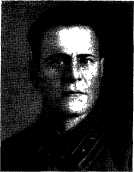
Konstantin Zaslonov, Hero of the Soviet Union
p “Our country is in flames. Life demands that every citizen with the heart of a patriot stand up to defend our country. ... I beg your permission to form a partisan detachment and operate between Yartsevo and Baranovichi, including the strip of railway line, stations and other railway installations. I assure you in the name of the bravest of our lads who have asked me to appeal to you, that we swear to keep the partisan oath with honour....”
p This appeal expressed the thoughts and hopes of all present, and soon afterwards some 30 Orsha and Smolensk railwaymen were getting ready for their trip behind the lines. Zaslonov was appointed commander with F. Yakushev as his commissar. In early September the small partisan group set out for Vyazma where they were joined by another group of workers.
p At dawn on October 1, 1941, Zaslonov’s men crossed the front near Belsk, assisted by the covering fire of a squadron of the Major-General Dovator’s cavalry corps. The partisans slogged it out for one and a half months surmounting all possible hazards, bearing all the privations of early winter, giving many German search parties the slip and suffering from cold and hunger.
p Only a few reached Orsha—- In the town, Konstantin Zaslonov soon made contact with the Communists left behind for underground work in the enemy rear. With their assistance he managed to get from the town authorities a temporary pass and then was allowed to sign on for work at the Labour Exchange.
p The jobless engineer, born in 1909, and having worked in the local railway depot for a long time before the war, quickly attracted the attention of the German administration who were badly in need of specialists to set things right on the railway. After careful checks, the “loyal” engineer was put in charge of Russian engine crews.
p Making use of his position, Konstantin Zaslonov was able to fix up work for his companions from Vyazma-Anatoly Andreyev, Sergei Chebrikov and Pyotr Shurmin. This tiny group acted as the nucleus of the resistance movement and carried on all manner of diversions in Orsha and at neighbouring railway stations. Many railway workers joined the resistance.
97p Despite the hard conditions under which they operated, the incessant Gestapo checks and spying by German agents, Zaslonov and his comrades trained the repair workers in subversive tactics and skill. The group made their own mines disguised as lumps of coal which they hid under coal heaps. They also made “hedgehogs”-special explosives which were scattered along the highways. The resistance men blew up signal boxes, pump-houses, railway points and bridges, burned down buildings and killed enemy soldiers and officers.
p From Zaslonov’s dispatches to the Vitebsk Party underground committee it is seen that in three months of the heroic campaign at Orsha railway junction there were 98 train crashes, 200 locomotives were knocked out and thousands of waggons and fuel cisterns and large quantities of enemy equipment were blown up. This was a tremendous help to the Soviet Army fighting the Germans near Moscow.
p Besides, Zaslonov’s men seized arms and built up a store to move out to the forest. On several occasions the German administration arrested Zaslonov, but every time he was able to establish his nonimplication in sabotage. But in February 1942, when it had become too dangerous to remain at the shed any longer Zaslonov and his companions left for the south-west of Vitebsk Region leaving behind a few trusted people on the railway. At the new base, the village of Logi, a detachment named "Uncle Kostya" began to function. It quickly grew. By June it had notched up 113 blown-up trains and some 2,000 dead nazis and quislings. Soon after, the five detachments were united in the 2,500-strong Zaslonov brigade.
p Between October and November the partisans caused a great deal of discomfort to the better-equipped and more numerous nazis based on Vitebsk. On November 13, the Germans succeeded in surrounding a group of commanders and commissars of the Orsha zone partisan detachments who had gathered for a conflab in the village of Kupovat. On the following morning the Germans closed in. After four hours of furious fighting the enemy broke through to the edge of the village. Hand-to-hand combat commenced. All the partisans and their officers fought to their last cartridge, to their last gasp.
p He perished. But other partisan brigades bore his name and courageously fulfilled the deeds of one of the Soviet Union’s bravest sons.
98p NOTE FROM SEVENTEEN BYELORUSSIAN PARTISANS
p December 3, 1942
We die for our country, but shall not let the enemy through. Please consider us all Komsomol members.
p It was the second rigorous winter of the war. The nazi invaders had occupied Byelorussia and subjected her people to unprecedented suffering. But the Byelorussian people refused to bow down to the fascist butchers. A mighty partisan movement sprang up throughout the occupied territory.
p A group of 17 young Byelorussian partisans led by Communist Vikenty Drozdovich was active in the Kopyl District.
p On December 3, 1942, this small group of men received an order from brigade headquarters to stop the nazis moving towards the village of Lava, location of a partisan hospital and the brigade headquarters. For four hours the brave seventeen youngsters beat off eight enemy attacks backed by light tanks, armoured cars, artillery and mortar fire.
p The Soviet patriots made a pledge to their country they would fight off the enemy until their last gasp. When their ammunition and hand grenades ran out, they continued with rifle butts and bayonets. A total of 85 Germans were killed and several light tanks and armoured cars put out of action.
In the grossly unequal battle on December 3, 1942, all 17 patriots fell. At the cost of their lives the heroes had given their people a breathing space to evacuate the hospital and assemble their forces for combat. The partisan brigade routed the Germans who had to pay dearly with hundreds of lives for the death of the gallant seventeen.
Notes
| < | > | ||
| << | >> | ||
| <<< |
NOTE
FROM THREE SOVIET GIRL-SCOUTS FROM A GESTAPO GAOL IN PSKOV |
LETTER AND NOTES
FROM GEORGI SAVCHENKO, LEADER OF DNIEPROPETROVSK UNDERGROUND |
>>> |