Thus reasoned Chernyshevsky. True, in his definition of the beautiful he had in mind not only organic life. In saying "the beautiful is life”, he added: "For man the beautiful creature is the one in whom he sees life as he understands it." It was on these grounds that Pisarev thought Chernyshevsky’s aim was to destroy all aesthetics. "The doctrine of The Aesthetic Relation is remarkable precisely for the fact that, in breaking the fetters of the old aesthetic theories, it in no way replaces them by new ones. This doctrine says openly and firmly that the right to pronounce final judgment on artistic works belongs not to the aesthetician who can judge only form, but to the thinking person, who judges content, i.e., the phenomena of life.” But this again is an incorrect conclusion. True, Belinsky thought, as we know, that the content of poetry was the same as the content of philosophy, and that the critic, in analysing an artistic work, was bound first and foremost to explain its idea and only then, in the "second act" of his analysis, to trace the idea in images, i.e., assess the form. Does this mean that, in Belinsky’s opinion, the right to pronounce final judgment on artistic works belongs not to the aesthetician, but to the thinker? Certainly not! Belinsky would have said that this distinction between the thinker and the aesthetician was a quite arbitrary one and lacking in foundation. To analyse an artistic work is to understand its idea and assess its form. The critic should judge both content and form; he should be both an aesthetician and a thinker; in short, the ideal criticism is philosophical criticism which alone has the right of pronouncing final judgment on artistic works. One might say almost the same, basing oneself on Chernyshevsky’s aesthetic theory. People by no means share the same understanding of life, and therefore they differ greatly in their judgments about beauty. But can it be said that they are all right? No, one has correct ideas about life, and another is mistaken; therefore the one judges correctly about beauty, and the other wrongly. The critic must surely be a thinking person. But not every thinking person can be a critic. Chernyshevsky says: "From the definition that the beautiful is life it be-
15—0766
226 comes clear why in the sphere of the beautiful there are no abstract thoughts, but only individual beings; we see life only in real, living beings, but abstract, general ideas do not make up the sphere of life.” Therefore it is not enough to determine the merit of an artistic work from the viewpoint of ”abstract thought”, one must also be able to assess its form, i.e., trace how successfully the artist has embodied his thought in images. When we see the beautiful, we are gripped by a feeling of serene joy. But this feeling is not always equally strong even in people who have completely identical views on life. In some it is stronger, in others weaker. People in whom it is stronger are more capable of assessing the form of a given artistic work than those in whom it is comparatively weak. Therefore only the person in whom a strongly developed capacity for thinking is combined with an equally strongly developed aesthetic sense can be a good critic of artistic works.p Moreover Pisarev did not notice that for him the word aesthetics had a different meaning than it did for Chernyshevsky. For him aesthetics was uthe science of the beautiful”, whereas for Chernyshevsky it was "the theory of art. a system of the general principles of art in general and poetry in particular". Chernyshevsky argues in his dissertation that "the sphere of art is not and cannot be confined to the sphere of the beautiful. Even if one agrees that the sublime and the comic are elements of the beautiful,” he says, "many works of art do not belong in content to these three headings: the beautiful, the sublime and the comic.... The beautiful, the tragic, the comic are only the three most definite elements out of a thousand elements on which the interest of life depends and to list which would mean listing all the feelings, all the aspirations that can move the human heart". [226•*
He also says that if the beautiful is usually regarded as the only content of art, the reason for this lies in confusing the beautiful as the object of art with beauty of form which is indeed an essential quality of any work of art. But from the fact that the form of any given work of art should be beautiful it does not follow that art should and can confine itself to the reproduction of the beautiful. "Art reproduces everything that is of interest to man in life.” If this is so, it goes without saying that art will not cease to exist as long as life does not cease to be of interest to man. and that to “annihilate” aesthetics, i.e., the theory of art, to “destroy” it, is simply impossible.
227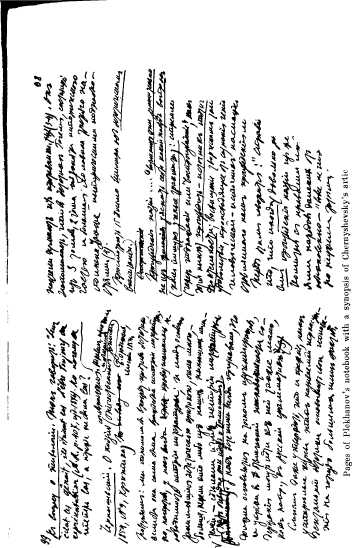
Pages of Plekhanov’s notebook with a synopsis of Chernyshevsky’s article “On Poetry”
228 229p Pisarev misunderstood Chernyshevsky. We do not blame him for this, but simply note the important fact here.
p Thus, Chernyshevsky had no intention whatsoever of destroying aesthetics. In embarking on his dissertation, he was pursuing other aims. We are now familiar with one of them: he wanted to prove that the sphere of art is incomparably broader than the sphere of the beautiful. In order to understand how this aim arose, one must recall Belinsky’s disputes with the supporters of the theory of art for art’s sake. In his last annual review of Russian literature the dying Belinsky challenged this theory, trying to prove that art had never been confined to the element of the beautiful only. The young and vigorous Chernyshevsky made this idea the basis of his first major theoretical study. This best characterises his attitude to the "criticism of the Gogol period". Chernyshesky’s dissertation was the further development of the views on art at which Belinsky arrived in the final years of his literary activity.
p In our article on Belinsky’s literary views we said that in his disputes with the supporters of pure art he sometimes abandoned the dialectical viewpoint for the viewpoint of the enlightener.^^74^^ But Belinsky was nevertheless more willing to examine the question historically; Chernyshevsky fully transferred it to the sphere of abstract reasoning on the “essence” of art, i.e., rather, on what art should be. "Science does not claim to stand higher than reality; and it need not be ashamed of that,” he says at the end of his dissertation. "Art, too, must not claim to stand higher than reality.... Let art be content with its lofty, splendid mission of being a partial substitvite for reality where it is absent and of being a textbook of life for man.” This is the view of an enlightener of the first water.
p It did not prevent Chernyshevsky from studying the history of literature in Russia and in the West. Shortly after the appearance of The Aesthetic Relation of Art to Reality the Sovremennik began to publish the Essays on the Gogol Period of Russian Literature and a fairly long work on Lessing. But the "exact study of facts" was of interest to Chernyshevsky, as to all enlighteners, mainly because it provided him with new data in support of his view of what art should be and what it would become when artists understood its true “essence”.
p “Being a textbook of life" means promoting the intellectual development of society. The enlightener sees this as the main purpose of art. This has been the case wherever a society has had a so-called period of enlightenment: in Greece, in France and in Germany. It was also the case in Russia when, after the defeat of Sevastopol,^^75^^ the progressive strata in our society set about reviewing our obsolete social relations and our traditional concepts.
p “Art for art’s sake is as strange an idea in our day as wealth for 230 wealth’s sake, science for science’s sake, etc.,” says Chernyshevsky in his article on Ordynsky’s book. "All the affairs of man should he of benefit to man, if they do not want to be an empty and idle activity: wealth exists in order to be used by man, science in order to be man’s guide; art, too, should serve some useful purpose and not fruitless pleasure.” But since the acquisition of useful information and intellectual development in general is the prime requirement of people who seek to organise their life properly, art should serve this development. Art, far more than science, attracts the attention of the public.
“It must be admitted that it attracts an enormous number of people very successfully, and thereby, quite unintentionally, helps to spread education, clear ideas of things, everything which is of intellectual and of subsequent material benefit to people.” Chernyshevsky says in the same article. "Art or, rather, poetry (poetry alone, for the other arts do very little in this respect), spreads among the mass of the reading public an enormous amount of knowledge and, what is still more important, acquaints it with the concepts worked out by science—such is poetry’s great purpose in life."
Notes
[226•*] In his book on art Count L. Tolstoy argues that the sphere ol art is incomparably inferior to the sphere of the beautiful. But he does not say a single word about Chernyshevsky. This is all the more a pity since our famous novelist’s rationalistic modes of discussing art are most reminiscent of the modes of discussion that we find in the dissertation The Aesthetic Relation of Art to Reality.
| < | > | ||
| << | I | III | >> |
| <<< | V. G. BELINSKY'S LITERARY VIEWS^^55^^ | UNADDRESSED LETTERS^^80^^ | >>> |