SENT BY SEN. LT. DOLGOV,
COMMANDING OFFICER OF A TANK COMPANY
p Not later than May 2, 1945
p Mum,
p You are probably completely worn out. You must have a load of worries, my dear. It’s hard to imagine how you get by with all that crowd to look after.
p Mum, please don’t worry yourself over me. Everything is just grand. A soldier’s duty is quite simple-we get on with the battle. We’re trying to finish off the nazis as quickly as we can. When the war is over and we’re all together again, I’ll tell you a lot about myself-how I lived, how we fought.
p You keep writing to tell me to watch out for myself a bit more. Please excuse me, Mum, but that’s impossible. I’m a commanding officer. Who’s going to show the men an example if their commanding officer starts thinking of trying to save his skin rather than winning the battle. Please understand, Mother, that I cannot do this although, of course, I’d very much like to get through this war and stay alive so as I can come back again to my home town and meet all of you.
All my love,
Sasha
p Alexander Dolgov was born in 1917 in the village of Bolshoye Tomilovo, near Kuibyshev.
Thirteen years later he began work on the local collective farm and a little later left for one of the big factories in Chapayevsk, where his brothers worked. Together with other factory hands, he was called up in 1938.
232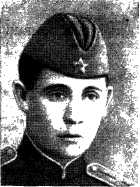
Alexander Dolgov, Hero of the Soviet Union
p Ten months later, when the Japanese troops invaded the Mongolian People’s Republic near the river Khalkhin-Gol, Private Dolgov was in one of the units sent to beat off the Japanese attacks.
p In August 1939, the Japanese invaders were finally repelled. On the recommendation of his superiors, Private Dolgov was sent to a regimental school which he finished with honours. Soon afterwards the Germans attacked and he left for four years at the front.
p The tank unit of the 1st Byelorussian Front in which Sen. Lt. Dolgov’s tank company served, had the enemy on the run back to Berlin. Towards the war’s end, Dolgov was given the responsible task of piercing the enemy’s defence at one particularly stubborn point of the fighting. He gathered his tank men around him, explained the situation and called on them to keep up the good name of the Guards in combat. As always, the commanding officer’s tank was first into the attack. By his skill and fearlessness he was a great inspiration to his men and the Soviet tanks soon ripped through the enemy’s defence and pushed on into Berlin. The way ahead through the central defence sector was open.
p In the morning of April 30, fighting flared up again for the centre of the German capital. By the afternoon, at precisely 2.25 p.m. Soviet troops had captured the Reichstag and run up the Victory flag. The Berlin garrison laid down their arms and were taken prisoner.
233p Berlin had fallen. For the third time in history Russian soldiers victoriously passed through the Brandenburg Gates.
p Together with other front units. Sen. Lt. Dolgov’s tank company moved on farther, to the city of Brandenburg, some 40 miles west of Berlin. The tank company commander’s actions were referred back tJ H.Q. for commendation.
p Alexander Dolgov led his tanks with just as much daring and battlecraft onto Brandenburg. But he was not to see the V-Day-a German shell blew up his tank in the very last battle.
By decree of the Supreme Soviet of the U.S.S.R. Alexander Dolgov was posthumously awarded the title of Hero of the Soviet Union.
Notes
| < | > | ||
| << | >> | ||
| <<< | PAVEL YABLOCHKIN'S LETTER | >>> |