FOUND IN SACHSENHAUSEN
1943 to January 27, 1945
LAST WISH
If ever it comes that I part with life
In this hated foreign land,
In a prison camp ridden with tears and strife.
If I die here young, and with ruthless hands,
The Germans take up my remains
Relieved at last of unheard-of pains.
To burn me and scatter my dust,—
And you, my beloved brothers and friends,
You whom I treasure and trust,
Will not be there to attend my end—
Rise like a man with your militant songs
And fight to revenge our wrongs.
Rise undaunted for your rightful cause.
Smash those walls and fling open those doors,
Lift the red banner of victory
High in the sky for the world to see.
The suffering millions will join your ranks
Like a mighty river that floods its banks.
The struggle will bring its fruits, I know.
Our forces will deal a shattering blow
At the vicious eagle who tears our land.
Revived and mighty again it will stand.
When you draw the account, dear comrades.
Of our sufferings, triumphs, defeats,
Do not be too hard, dear comrades,
On those whom the German so cruelly treats.
Remember the fallen heroes,
Carry their names in your hearts,
Mention them in your victory songs
When the great celebration starts.
p
I will be with you again, dear Russia.
To admire your rivers’ mighty spread,
To listen to the murmur of your forests,
To tread the paths my fathers used to tread.
p
Long, long since I sang among your flowers,
Revelled in the fragrance of your streams,
And sat beneath the over-hanging oak-boughs
With the blue-eyed darling of my dreams.
p
Yet I am with you, with you forever,
For the moment sleep invades my eyes
I dream myself together with my darling
On the path that by the lakeside lies.
I will be with you again, dear Russia,
To admire your rivers’ mighty spread.
To listen to the murmur of your forests,
To tread the paths my fathers used to tread.
p
How I wish I could see you today,
And walk in the shadowy park.
For the murmuring Dnieper to listen and smile
At our whispers exchanged in the dark.
p
I wish I could press you close to my heart,
Hold you tenderly in my arms,
And kiss, and kiss, and kiss without end
Your face, your shoulders, your palms.
But my dreams are in vain-for you I am dead,
And the love in your heart will die,
And I must follow my thorny path
And remember you with a sigh.
p
I cannot forget the land of my birth
Where my childhood and youth I spent.
Full of love is my soul for its sacred soil,
Which these verses of mine give vent.
p
A love which I bear through all tortures and grief,
In Gestapo’s most fearful vaults,
A love that helps me to stand without tears
The murderers’ taunts and assaults.
I open my soul unashamed in these lines—
He is blameless who meets his lot
Never bowing before the detested foe,
Whether destined to live or not.
p
My stubborn heart drives away my fears
And revives the dear old scenes,
Rejecting the thought that I may be shot
Ere the first light of morning gleams.
p
Reassured, I attend to the voice of my dreams
And I don’t know how, but it somehow seems
That until I die I shall see once more
All that I cherished and loved before,
Everything that is now so far;
Hope shines in the joyless gloom like a star.
If only I could live to the day
When victory comes in its wreath of May.
p
How I want to live-I am still so young!
How I want to be my dear friends among!
But again and again the dark shadow of doubt
Puts the feeble light of my faint hopes out.
And yet, though seized by the anguish of
death,
I am loyal to you to my very last breath,
To you, my Motherland! May you thrive
When I am no longer alive.
p A notepad and verses were unearthed in 1958 when the former Sachsenhausen concentration camp was being cleared out. The camp site is quite near Oranienburg, about thirteen miles north of Berlin. The leader of a building team Wilhelm Hermann came across the tattered writing pad amidst the ruins of the camp barracks. It is still possible to make out the words "Unforgettable. Verses in Captivity”, written on the yellowed cover. Wilhelm Hermann gave the verses to Senior Lieutenant Molotkov, a Soviet officer serving in one of the Soviet Army units in Germany.
p
On December 31, 1958, the newspaper Soviet Army (for Soviet troops serving in Germany) got news of the find and published five verses. A few days later a report and some poems of the unknown Soviet patriot appeared in Red Star and Komsomolskaya Pravda. Despite all efforts, it has not yet been possible to establish the identity
221
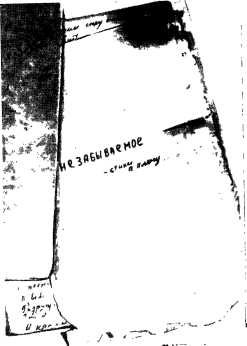
The first page of the notepad found in Sachsenhausen
of the poet. It has been suggested, however, that there was more
than one author. This appears likely from the fact that the verses
are entered into the notebook in even, firm handwriting with few
mistakes and no corrections. Many of the verses were known farther
abroad than Sachsenhausen; inmates of Ravensbriick, Buchenwald and
others claim knowledge of some of the verses. In their letters to
editorial office former prisoners suggest such names as Pyotr from
Kharkov, Victor from Donetsk, a certain Nikolai, Ivan Kolyuzhny,
222
and some others, as the authors. French Communist Salvador Charlie, to whom one of the poems is dedicated, remembers being friendly with a Russian inmate named Yuri Stolyarov who used to read him his own poetry. Two acrostics in the notebook contain the names of Anton Parkhomenko and Ivan Kolyuzhny. It may be these are the authors of the poems or just the poet’s friends.
p Former Ravensbruck inmate Zinaida Golubeva, whose poem "A Maiden’s Song from Ravensbruck Concentration Camp" appears in the notebook, recounted that during her time in Ravensbruck she corresponded with one of the male prisoners (they tied a note to a stone and threw it over two walls from the men’s section of the camp to the women’s and back) who signed himself as “Ivan”, “Ivan-Star” or “Ivan-Star-Thorn”. In reply to her "A Maiden’s Song.. .” he sent her "To the Dead Friend" and other verses. In his last note he mentioned being taken away. That was the last she heard of him; he was probably moved to Sachsenhausen.
p The story how the notebook happened to be at the barracks gradually unfolded from the letters that came to newspaper editorial offices. The notebook was found in that part of the barrack ruins which once served as a kitchen in the “Sonderlager”. This special camp was constructed between 1943 and 1944 for especially important prisoners, including high-ranking officers of Hitler’s Wehrmacht suspected of being implicated in a plot to assassinate the Fuhrer. In 1945, the barracks were repaired by a special gang from the “Sonderlager” which included Germans, Norwegians, Russians and other nationalities. The chief electrician responsible for repairs of the camp electric wires was Martin Gauslo, a Norwegian prisoner. After the war, he wrote to a friend that while wiring an electric circuit in the special camp he was asked by Russian friends to hide a notebook containing some verses in a wall. He wrote: "Dear friend,
p “As I mentioned to you before, I drew up a plan of the^ kitchen barracks in the special camp and marked the spot where I "hid the manuscript containing a collection of poems of a Russian poet in Sachsenhausen. It should be under the floor of the kitchen just in front of the wall I have marked. If you intend to write there you can tear off the plan and attach it to the letter. Very best wishes,
“Martin Gauslo.”
p As far as he can remember, the notebook was handed to him at the beginning of 1945 by a Russian inmate named Mark Tilevich, who had asked him to hide it-which he had done, wrapping the notebook in a piece of rubberised material.
p Mark Tilevich recalls that two members of the electricians’ gang used to read the verses jotted down in the notebook-Victor from Donetsk and a doctor, Stepan Gun, who died on V-Day. But Mark Tilevich cannot remember the author of the verses. Quite possible it was Victor, for the name of Victor is mentioned by other former inmates as a poet.
p Whoever it was who wrote the verses in the notebook, he was certainly a real Soviet patriot, whose spirit was not broken by any of 223 the humiliation or the whole regime of indignity which the Germans had developed to a fine art. In the nazi concentration camps everything was done to break a person down both physically and morally, to trample on his feelings and destroy everything human in him. Sachsenhausen was the graveyard of inmates from 27 European nations. The camp officers and kapos put to death more than 100,000 prisoners. In 1941 alone, 18,000 Soviet officers and men were brutally exterminated here. On April 21, 1945, about 30,000 survivors of the camp were driven northwards, to the Baltic, where they were to be loaded on barges and sunk. This really was a march of death: thousands of emaciated, exhausted people remained forever by the roadside-a guard would shoot anyone who could not move any farther. Perhaps the owner of the notebook was among these unfortunates from Sachsenhausen.
p The author, or authors, whichever the case may be, will long remain an example of heroism, extraordinary bravery and noble feelings.
The notepad of checkered paper contains fifty poems. The verses are written in a. small, clear hand, boldly lettered in indelible pencil. The last poem is dated January 27, 1945.
Notes
| < | > | ||
| << | >> | ||
| <<< | PAVEL NESMELOV'S LETTER |
INSCRIPTION
IN JUN. LT. IVAN LANDYSHEV'S Y.C.L. CARD |
>>> |