TO HIS SON
p January 4, 1944
p Well, my dear son, we shan’t be seeing each other any more. An hour ago I received orders which mean I shan’t be coming back alive. That must be no cause for you to lose heart or be afraid, my lad. Be proud, just as proud as your dad going to his death. I’ll do all I can to see you get my letter, and I want you to be careful and not go frightening your grannie.
p Glorious Leningrad, the cradle of the revolution, is in danger. Its future may well depend on the successful accomplishment of my mission. For the sake of its safety, I would carry out my mission to my last breath, to my last drop of blood. I could not turn down this mission. Just the opposite, I’m eager to be off, to get down to it as quickly as possible. I’m waiting for the car to take me. A thousand and one thoughts crowd my brain, questions keep flashing through my head like lightning and I answer at once. One of the first questions is: What is the strength that gives me the courage to be a hero? Military discipline and my duty. It’s certainly true that there’s only one step from discipline to heroism. Remember that, my son, now and forever. And while there’s still time, I must take off my decorations and kiss them in the old Guard’s tradition. I’m telling you about everything in detail so that you know what sort of man your father was, how and for what he gave his life.
p When you grow up, you’ll think it over and you will come to love your country. It’s a marvellous thing to love your country.
p I have a son. My life continues-that’s why it’s not so hard for me to die. I know that there, deep in the rear, lives and grows the successor to my mind, my heart, my feelings. I go to my death and I see my continuation. My son, in all 181 your letters you begged and expected me to return home from the front. I don’t want to deceive you: don’t wait any longer and don’t grieve, you aren’t alone. In the past, my little boy, we haven’t had much chance to see each other but I’ve always loved you and been near to you even though I’ve often been far away. That’s my thought now, even though I’ll be dead, my heart will continue to live with you, even death won’t take you out of my heart.
p In my letter of farewell, I am making a request to my commanding officers to accept my son into the Suvorov Military School, preferably in the Leningrad Region, so that he can visit Poddorsk District, the Sokolsky Village Soviet, because near the village of Khleboyedovo his father met his death.
p Good-bye, my son, good-bye, my dearest wife.
p Polya, Yura! My wife, my son! You are my dearest love, my own blood, my life! I love you, I love you till my last drop of blood.
Please carry out my last wish.
All my love,
Your ever-loving Gavriil
On a frosty January day in 1944, Captain Gavriil Maslovsky, Chief of Staff of a special skiing battalion, sat in a trench writing his last letter to his son.
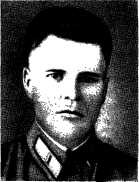
Gavriil Maslovsky
p The infantry division of the Guards in which he served was holding onto a position not far from the village of Khleboyedovo, Novgorod Region. A scout reported that to the south-east of the neighbouring village of Pryamiki, in the Kruglaya grove, the enemy had a large store of bombs and shells which were about to be dispatched for use against Leningrad. The store had to be destroyed. The divisional commander passed on his instructions to blow up the dump to Captain Maslovsky.
p It was already getting dark when Captain Maslovsky finished writing his letter-his last 182 words to his son Yuri and his wife Polina, who was a surgeon in a field hospital. The brave Communist, a man of iron will, called his letters: "My last written words and wish for my son.”
p It was almost time to be off.... Captain Maslovsky read the letter through once more. He could imagine his little son Yuri snuggling up in his warm bed and probably wondering: "Where is my dad now?" He so much wanted to see his son, caress his curly head, press him to his breast. But the rules of war are inexorable, it was time to go. ... A few hours later a column of flame shot into the dark sky and the earth trembled from a big explosion. The job had been done, but Captain Maslovsky never returned.
His comrades sent the letter to his son Yuri, who, true to his father’s last wish, graduated in 1952 from the Sverdlovsk Suvorov School and then a military motor and tractor college, and became a Soviet Army officer.
Notes
| < | > | ||
| << | >> | ||
| <<< |
TESTAMENT OF TANK COMMANDER
JUNIOR LIEUTENANT GEORGI MOROZ |
PASHA SAVELYEVA'S INSCRIPTION
ON THE WALL OF A DEATH CELL IN LUTSK |
>>> |