FROM PARTISAN COMMANDER
VASILY SHIMANSKY TO HIS WIFE
p Not later than June 1, 1943
To my life’s companion and work colleague, my darling, my eternally unforgettable, dear Esfir Kharitonovna.
From Starik (V. A. Shimansky), commander of a partisan detachment.
p Dear Esfir Kharitonovna,
p It will soon be two years since the barbarians first attacked our sacred land and broke up the peaceful, happy life of many millions of Soviet people. Broke up, too, our family life. I am certain it will take less time than has already passed for the Soviet people, and us included, to restore our former happy life. What’s more, everyone, including you and I, will rebuild our lives on an even higher level than before. For over the last couple of years, everyone has learned a lot about the necessity of valuing time in life and life in time, about the necessity of valuing your life’s companion and yourself as a companion.
p Darling Firochka, I learned a terrific amount when I was training and under the wing of our country, but I learned a lot more when I took up my rifle and went to defend the country. I’m a different man now. Not at all the one you knew before. Now I’ve spilled a lot of fascist blood and aged awfully.
144p I’m helping the country from without, and I so much want to help you, too, even if it isn’t very much. Don’t know how, my darling, everything’s been given up to the country. Perhaps the time will soon come when we shall meet and tell each other everything, help each other and begin to live as people do in paradise. That day will be happy for us all because it will be simply wonderful, like nothing on earth.
p Darling Firochka, I’ve been working behind the lines and I’m glad to say I’ve been able to obtain extremely valuable documents on the exact location of the major nazi airfield on the South-Eastern Front, the chief base of the Luftwaffe H.Q. on the South-Eastern Front and the chief headquarters of Goring who is often visited there by Hitler. With these documents in my hands, I handed over my partisan command and will soon be crossing the front myself. It’s a very dangerous mission, but, with a bit of luck, it can be accomplished.
p I put myself at my country’s disposal, knowing that if I can get these documents through to the Soviet Government, it will go some way to driving the nazis out of the Ukraine and be a particularly severe blow at their Air Force. Besides, I have to get orders as to the further activities of my detachment. Things are going from bad to worse with the detachment. I have to know our future plan of action.
p Good-bye, darling Firochka, I’ve left Marusya documents on the detachment’s activities. If I die please see that these documents get through to the Soviet Government and consider me a partisan of the war.
p Good-bye, my dearest darling, my true love Esfir Kharitonovna. Let all my friends and acquaintances know I have given everything for the country’s defence.
p On June 1, 1943, I shall part with Nastya and in a month’s time should be with you, if not-the grave will have swallowed me up.
p Good-bye, darling,
p Good-bye, all my friends,
p Good-bye, to you, too, my dear Motherland,
Starik
Vasily Shimansky was born in 1902 in the town of Balta not far from Odessa. Once a farm labourer, he graduated in the thirties from the Plekhanov Economic Institute in Moscow. In 1938, he took up a post-graduate course. After a successful defence of his thesis, he was
145 appointed lecturer of political economy in the Plekhanov Institute.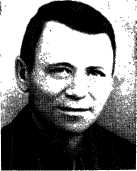
Vasily Shimansky
p In August 1941, Vasily Shimansky left for the front.
p In December of the same year he turned up under the name of Pyotr Lishchenko in Kordelevka, not far from Vinnitsa. After getting a job as blacksmith at a sugar refinery, he became friends with ex- prisoners-of-war who had escaped from camps and were living in Kordelevka. Three of the ex-p.o.w.s-Andrei Yevtukhov, Eduard Lyakhovetsky and Victor Trishin-joined the Old Man (Starik), as Shimansky was known because of his beard, in forming an underground group.
p Starik’s group went into action. In order to study the approaches to the main rail lines, Shimansky became a shepherd. Soon after, the underground fighters derailed a fuel-carrying train. Their numbers grew. Besides the group in Kordelevka other groups sprang up, including one at the local state farm of Katerinovka, all uniting in Starik’s partisan detachment.
p In a single year they several times tore up the track on the VinnitsaKiev line, derailed enemy trains, blew up vehicles, fuel dumps, burned grain and killed callle about to be dispatched to Germany, set fire to nazi-occupied buildings, etc.
p The detachment discovered the location of Goring’s headquarters and a large German air base situated nearby. They also came upon Hitler’s lair known under the code name of Wehrwolf.
p At the beginning of May 1943, the underground fighters took to the Chorni (Black) Forest where they joined up with another partisan unit. Meanwhile Vasily Shimansky and three companions moved on to the east, towards the front. In mid-May, after several days and nights of hard and torturous travel, the four men, wracked by wounds and fatigue, came to the village of Kozatskoye, a few miles from Balta. Here they were hidden by the local villagers, relations of Shimansky. After a rest and medical treatment, they struggled on to cover the last few miles at the end of May. What happened after that is unknown.
Vasily Shimansky left behind with Maria Oleinik a number of documents addressed to Soviet Army Command, and his last letter to his wife, published above. The documents had been put in a bottle and buried in the ground. After liberation, Maria Oleinik handed over the documents to the Soviet authorities.
Notes
| < | > | ||
| << | >> | ||
| <<< |
NOTE
FROM SERGEANT TIKHON BURLAK |
NOTE
FROM FIVE DEFENDERS OF GLAZUNOVKA |
>>> |