FROM MEMBERS OF THE UNDERGROUND
Y.C.L. ORGANISATION IN DONETSK
SAVVA MATEKIN’S LETTERS TO HIS WIFE AND CHILDREN
p August-October 5, 1942
p Shura,
p What can a man do when he’s in the death cell? All the same they’re scared of me. Tell that to our people. I know all’s up with me and the moment will come quicker than we may expect. Good-bye. Please tell everybody this isn’t the end. I die but you all live on.
Good-bye, my darling Shura
p My dear little Vova and Lusya,
p I’ve always strived to bring you up properly, make people out of you useful to the country, genuine, whole-hearted people. My greatest wish was to see you, Vovochka, a scholar, and you, Lusya, an engineer. But whatever you become I’m firmly convinced my children will not let their father downhe has not begrudged his life for the good of his country, for the sake of saving his people and for the happiness of his children. May you all be happy.
Your Father
p I think my days are numbered. I hope you and the kiddies forgive me for everything.... Remember that I’ve always been ready to lay down my life for you. I die calm and confident. When you find it necessary, explain everything to the children -all the whys and the wherefores.
137p All my love to you for everything and from a pure heart. Forgive and forget and be happy.
p 3.10.42. Been through interrogation. Feel things will turn out for the worse, hurrying to relive all my short life again. Bring up the kiddies, look after yourself and keep smiling.
Yours,
Savva
STEFAN SKOBLOV’S LETTER
p 23-29 May, 1943
p Farewell, dear friends,
p I have to die at the age of 24. In the prime of life and creative thought the beating of my pulse has to come to a stop, and the hot blood has to cool in my veins. In the gaols of the German Gestapo I live out the last minutes of my life proudly, with head held high.
p In these brief, oh too brief minutes I invest whole years, whole decades of unlived years, in these minutes I want to be the happiest man in the world, for my life has come to an end in the battle for human happiness....
Farewell, dear comrades, farewell forever!
TESTAMENT OF 18 MEMBERS
OF THE UNDERGROUND ORGANISATION
p May 29, 1943
p Friends,
p We die for a just cause.... Don’t let it damp your spirit, stand up and flay the enemy at every turn. One request to all of you-don’t forget our parents....
Friends, listen to our call-flay the Germans! Farewell, you Russian people! Don’t bear a grudge against us!
p In the autumn of 1941, the nazi drive eastwards swept them over the Donets Basin. Together with other Soviet people who refused to surrender, the Y.C.L. members of the town of Donetsk took up arms against the foreign invaders. Their leader was Savva Matekin.
Savva Matekin was born in 1902. In the twenties, when life was just getting back to normal in the Soviet Far North, he went off to the remote Jamal Peninsula to help look after children there. Then 138 he worked for several years in the remote corners of Siberia before returning eventually to his native Donbas. In September 1941, he left for the front and was taken prisoner during the retreat. He escaped and since the front was already too far off, he resolved to return to his home in Budyonnovka-a workers’ estate just outside Donetsk. There he managed to take charge of studies in the local school No. 68, where he had worked before the war. But he never gave up the struggle. He decided to set up an underground organisation from the teachers and pupils on the estate. Unafraid of the Gestapo, he and his two colleagues, Stepan Skoblov and Boris Orlov, formed a Y.C.L. resistance group.
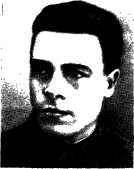
Savva Matekin
In the autumn of 1941, a member of the group, Vasily Goncharenko got hold of their first six rifles and three boxes of ammunition. The group grew in number. Two months later the group numbered 42 young people. Inspired by their example, other underground groups in other estates began to function around Donetsk. After several raids on nazi soldiers they had a good supply of arms and ammunition. At the beginning of 1942, the resistance men and women blew up a railway bridge, put out of action the power station in Kurakhovka, damaged enemy vehicles, sabotaged food supplies, destroyed fuel dumps, attacked nazi soldiers and derailed several trains. Once, Vanya Klimenko and Volodya Kirilov were responsible for sabotaging a score of enemy vehicles waiting to be transported to the front from Mushketovo railway station.
Stepan Skoblov
p The resistance fighters put out a special appeal to the Donetsk workers. They wrote: "At every mine, on every estate 139 and in every village, form partisan units, aid the partisans, hide them from the police, don’t let the nazis carry off to Germany our grain, industrial and other equipment. Whether you work in the mines, at factories or in offices, hamper the German authorities from carrying out their orders and plans, do all you can to harm the Germans, spoil the equipment and output, get ready to welcome the Red Army with honour!”
p In August 1942, Savva Matekin, the organiser and inspirator of the underground fighters, was arrested. Almost two months of torture could not break his will. On October 7, 1942, the Germans shot him at the Kalinovskaya mine.
p On May 22, 1943, the Gestapo arrested 18 men. They were put through the usual grilling in the building of the field gendarmerie in Avdotino. Although they realised their fate was sealed, the young Soviet patriots courageously bore all their sufferings without a murmur. On the eve of their sentence they wrote a joint last testament to their friends.
p Between May 30 and June 3, the entire 18 were shot. They included Stepan Skoblov and Boris Orlov. But the battle was not over. The underground organisation continued to take revenge on the Germans for the death of their comrades. Friends and comrades stepped into the shoes of the dead.
Savva Matekin’s letter was written on scraps of paper in which his wife had wrapped a bottle of kvass. She had brought the bottle to the gaol and then had taken it back. The condemned man had thrown another part of his last notes into a ditch while on his way to work. His wife had followed at a short distance and picked them up. The last testament of the 18 was written in black pencil on a handkerchief.
140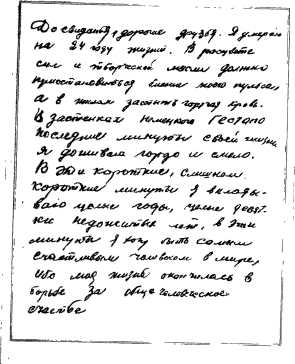
A page from Stepan SkobloVs last letter to his friends from the
prison
Notes
| < | > | ||
| << | >> | ||
| <<< |
LETTER HOME
FROM PARTISAN-SCOUT OLGA RZHEVSKAYA |
NOTE
FROM SERGEANT TIKHON BURLAK |
>>> |