FROM 15-YEAR-OLD KATYA SUSANINA
p March 12, 1943
p March 12, Liozno, 1943
p Dear, kind Daddie,
p I am writing to you from German captivity. When you read this letter, Daddie, I shan’t be alive any more. I ask one thing of you, Father-punish the German rats. This is the last testament of your dying daughter.
p A few words about mother. When you return, don’t look for mummie. The Germans shot her. When they were asking questions about you, the officer lashed her across the face. Mummie couldn’t take it any longer and proudly said, these are her last words: "You won’t scare me with your beatings. I know my husband will come back and kick you dirty swine out of here.” And the officer shot mummie right in the mouth.. ..
p Dear Daddie, I am fifteen today, and if you met me now, you wouldn’t recognise your little girl. I’ve got very skinny, my eyes are sunken, my curls have been sheared off, my hands have withered, I’m as skinny as a rake. Every time I cough, blood conies up-they’ve burst my lungs.
Do you remember the time, Daddie, two years ago, when I was thirteen? What a lovely birthday I had! I remember you saying to me then: "Grow up, my little girl, to all the joys in the world!" We played some records, our friends wished me Happy Birthday and we sang our favourite Young Pioneers’ song.
126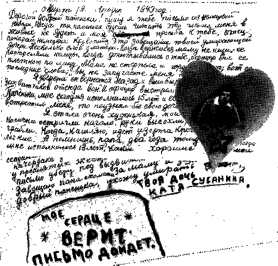
The first and the last pages of Katya Susanina’s letter
p But now, Daddie, when I look at myself in the mirror-my dress is torn, in rags, a number on my neck like a convict, I’m just a bag of bones-and salty tears are oozing from my eyes. What’s the use of being fifteen. I’m no good to anyone. There are many people here no good to anyone. The starving wander about and are hunted down by sheepdogs. Every day they are taken out and murdered.
p Yes Daddie, I am the slave of a German baron, I work for a German, Scharlen, as a laundrymaid, I wash the linen, scrub the floors. I work very hard and eat twice a day from a trough with Rosa and Klara-they are the mistress’s swine. Those are the baron’s orders. "Russians were and always will be pigs,” he said. I’m very scared of Klara. She is a big and 127 greedy pig. Once she nearly bit my finger off for grabbing a potato out of the trough.
p I live in a shed-I’m not allowed in the room. Once Josefa, the Polish chambermaid, gave me a crust of bread and the mistress caught her doing it and gave her a good lashing about her head and back.
p Twice I ran away from them but the watchman discovered me both times. The baron himself ripped my dress off and kicked me until I fainted. Then they threw a pail of water over me and hurled me into the cellar.
p Today I learned some news: Josefa said my owners are leaving for Germany with a big group of men and women slaves from the Vitebsk District. They are taking me with them as well. No, I won’t go with them to that infernal hell of a Germany. I’ve made up my mind that it’s better to die on my native soil than be trampled into horrible German earth. Only death can rescue me from a cruel beating.
p I don’t want to suffer any more in the hands of these savage, ruthless Germans who won’t let me live!
p I beg you, Daddie, get revenge for mummie and me. Goodbye, kind daddie, I am leaving you, to die.
p
Your daughter
Katya Susanina
My heart tells me this letter will reach you.
p Soon after the liberation of the Byelorussian town of Liozno in 1944, while clearing the brick work of a ruined oven in one of the houses, a small yellow envelope sown up with thread was found. The envelope contained a letter from a young Byelorussian girl, Katya Susanina, who had been taken in bondage to a German landowner. In the grip of despair Katya had committed suicide on her fifteenth birthday. Before dying she had written her last letter to her father. On the envelope was the following address: Active Army, Field Post No. ... Pyotr Susanin. On the other side were the words in pencil: "Whoever finds this letter hidden from the Germans, I beg of you, please post it at once. My corpse will already be swinging from a rope.”
The number of the field post had worn away with time and the letter was unable to find its mark, but it went to the hearts of all Soviet people. The letter was published in Komsomolskaya Ptavda on May 27, 1944.
Notes
| < | > | ||
| << | >> | ||
| <<< |
LETTER
FROM MEDICAL ORDERLY VALENTINA KOLESNIKOVA |
VICTOR CHALENKO'S TESTAMENT | >>> |