FROM NIKOLAI STASHKOV,
SECRETARY OF DNIEPROPETROVSK UNDERGROUND
REGIONAL PARTY COMMITTEE
LETTER TO HIS WIFE, SON AND DAUGHTER
p September 26, 1941
p Hello there, my little Katenka and Valerik,
p Am writing a second letter, today 26-9-41. Staying behind to work. Not afraid and no one made me. If alive we’ll meet, and I’ll tell you all about it. If not tell the kiddies their dad was no coward and gave his life for Lenin’s Party, for his country. Tell them, Katenka, their dad was a real Leninist Bolshevik, remaining to work underground, on a big, responsible job.
p If I die be kind to the kids, give them your love. Tell them I expect them to be real patriots of their Soviet land. See they work well at school....
p Maybe this is my last letter. Please keep it for memory’s sake, for the children.
p I want you to know that I loved you all like my dear country. If I die for my country I die for your happiness. Don’t blame me, it has to be like that, the circumstances demand it, history demands it and it is people who make history. It fell to me to carry on the fight against these fascist pigs, these beasts, in the underground. We underground fighters will get revenge on the fascist jackals for the blood of fathers, for the destruction and suffering brought on millions of people, for the destruction of my town.
89p My little darlings, I’m going on a very dangerous mission but I go without any snivelling, for I know that we are in the right, that we shall win sooner or later. Better die a hero than become a slave.
p Farewell.
p No tears, no grieving. Once more I’m telling you: under the Soviet authorities you won’t be left in the lurch, just keep your chin up....
Many, many kisses. Don’t write to me,
Dad
LETTER TO HIS COMRADES
p September 24, 1942
p Comrades,
p The prison is riddled with provocateurs. They operate like this: their agent sits with you, tries to pump you. The weaker ones are drawn into conversation. Secrets are given away in gossip. The agent memorises them and passes them on to the interrogator. The next time you come up for interrogation, the same questions are asked. If you don’t answer, they give you injections. It’s a painful thing to go through. When you come to they tell you that you said this and that under the influence of the pricks. In actual fact it’s just the provocateur’s notes.
p I’ve had some provocateurs in with me: S. Kulish and Osipenko from Vasilkovsky District and his wife Zina. These three are ex-parachutists but now work for the other side. They’ve given away over a hundred people. They’ve had a go at L. Berestov, the Masloprom factory manager, P. Novichuk, my father, V. Bykovsky, Y. Shokhov, N. Tokmakov, Alexander Kravchenko, M. Kalinkin and Yura Savchenko. Osipenko’s wife has worked on Vera Khitko, Kharitina Zhuravlyova, Valya Alexeyeva and others.
p Farewell comrades!
p If you get hold of this note or have a chance to get it out, pass it on or keep it until the Soviet authorities arrive.
p
Yours,
N. Stashkov
24.IX.42
90He returned from the army to his home town of Dniepropetrovsk just two days before the outbreak of war. He had hardly had time to greet his friends and visit his old factory Spartak where he worked many years as a fitter, when the first swastika’d planes appeared over the Dnieper.
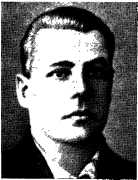
Nikolai Stashkov, Hero of the Soviet Union
p Then began frantic days without sleep or rest when he took up work in the Party regional committee. When the enemy came within striking distance of Dniepropetrovsk, Nikolai Stashkov was made secretary of the town underground regional committee of the Party.
p The German occupational forces marched into Dniepropetrovsk at the close of August 1941 and began to set up their “New Order” by fire and carnage. Mass arrests of Communists and all Soviet patriots commenced. Between October 13 and 15, the Gestapo and quisling police shot some 12,000 citizens, burying them in an anti-tank trench on the edge of this town. By such fiendish actions the nazis wanted to coerce the Soviet people, to bring them to their knees.
p From day to day the partisan and underground movement steadily grew under the guidance of the Party’s underground regional committee. Between October and November 1941, Nikolai Stashkov went on foot round many districts and established personal contacts with the leaders of Pavlograd, Sinelnikovo and other underground town and district Party committees. He also made contact with leaders of Y.C.L. organisations. In November he held a “forest” Party conference attended by Communists from partisan detachments in the region. Tn January and April of the following year, he was responsible for meetings in Pavlograd of secretaries of underground town and district Party committees-.
p The workers of Dniepropetrovsk and Dnieprodzerzhinsk, the miners of Krivorozhye and Marganets, the working men of other industrial centres frustrated a good many enemy plans. The nazis were given no peace anywhere and the ground everywhere burned under their feet. They were never able to get any sizable factory going. Their ruined tanks, guns, train engines and lorries had to be sent to Germany for repairs. Railway blasts grew, smashing carriages with troops and equipment.
p The Gestapo had their work cut out searching high and low for the people behind the resistance. In the end, one of their spies managed to attend the “wedding” of a young underground pair, 91 Vera Khitko and Nikolai Tokmakov, which was in fact a cover for Stashkov to brief his men. This was in June 1942.
p After the “wedding” came the first round of arrests. This was followed on July 8-9 by the second and more damaging arrests. Yet the Gestapo could not pin down the leader. At the beginning of July, Nikolai Stashkov made his way to Pavlograd where the underground Party regional committee had its base. He now directed operations from there.
p Trouble came unexpected. On July 28, he was wandering through the town market on his way to a rendezvous with some contacts. He was trailed by a spy who suddenly shot him in the thigh and arm. Wounded, he had little chance of escape and was caught by the Gestapo quickly hurrying onto the scene.
p Head of the local S.D. Sturmbanfuhrer Muhlde rushed to Pavlograd and took the prisoner away under heavy guard to Dniepropetrovsk. He was put into cell No. 20 of the Gestapo prison in Korolenko Street.
p Even before his wounds had healed he was constantly badgered by high-ranking officers of the Gestapo and nazi administration. The nazis did their level best to make him change sides. When they saw it was useless they devised hideous torture for the brave Communist and then planted a provocateur in his cell. During this time Nikolai Stashkov discovered they had not even spared his 75-year-old father and had shot him in front of the townspeople.
p Yet even in prison, the underground leader felt himself responsible for the fate of his comrades and did all he could to cheer them up. This is evident from the letter to his comrades printed above.
p On December 10, 1942, the prisoners saw some of their comrades being taken out before the firing squad.
p “Farewell, comrades!" called out Nikolai Stashkov.
p A few weeks later, Nikolai Stashkov and his faithful companion Georgi Savchenko were led out to face the firing squad. Stashkov shouted out to the butchers: "Shoot me in the chest. I know you haven’t got the guts. You’ll shoot me in the back of the head. You’re even afraid of the dead!”
For his bravery in war Nikolai Stashkov was posthumously awarded the title of the Hero of the Soviet Union and had one of the streets of Dniepropetrovsk named after him.
Notes
| < | > | ||
| << | >> | ||
| <<< |
FROM A NOTE
WRITTEN BY THREE DEFENDERS OF LISICHANSK |
NOTE
FROM THREE SOVIET GIRL-SCOUTS FROM A GESTAPO GAOL IN PSKOV |
>>> |