ASSISTANT POLITICAL INSTRUCTOR
OF A SKI DETACHMENT
LETTER TO HIS SISTER
p Late December 1941
p Dear little Zina and Leonard,
p Happy New Year. Good luck and good health. I hope 1942 will be a year of happy homecomings after the fascist dogs have been kicked out of our land, so that we can all meet again in our dear Moscow.
p As you can see from the papers, we are driving the nazi swine farther and farther from our Moscow, freeing more and more towns and villages. I’ve seen tens of people, young and old, children and old folk, greeting us with tears of happiness in their eyes.
p I know the places we have been through in the past few days. I recalled the days I worked on building sites in the towns of Istra and New-Jerusalem; I well remember their buildings and museums. So it hurts me all the more, it really makes me boil, to see the way these monsters have smashed it all down, to see the way these plunderers have carried off everything of any value.
p My dear ones, it’s very difficult to get an idea from the papers of these nazi pigs and of their "New Order".
p As assistant political instructor I have had enough opportunity to witness the consequences of the foul actions of the 37 fascist scum. They’re going to have to pay dearly for all they’ve done on our land. They’ll have to answer for all the people they’ve enslaved.
p 1942 will be a year of complete destruction of these dregs of humanity, a year of destruction of everything born of the black plague of fascism.
p I’m glad that in these difficult days I am among the country’s defenders. I’m glad I’ve had a decent training for my service in the Red Army. All my peace-time hobbies-skiing, riding, shooting-have come in very handy and I proudly recall the days when, even though I was overloaded with work, I trudged off to the gliding school or to the Budyonny Cavalry School, and my days-off when I went skiing on the Vorobyovy Hills, even though mum was against it.
p A couple of days ago I had a very interesting and touching meeting in the woods. After a nazi air raid, I was giving a hand to some comrades from the neighbouring unit, who had been raked by machine-gun fire, when I heard one of the wounded calling my name. Just imagine my surprise to see my old factory and riding school mate, Yasha.
p Well, that’s all, enjoy yourselves at the New Year. Best of luck, see you soon in Moscow.
p Let me know the birthday of our little sisters, I remember it’s somewhere between January 21 and 25. Let me know more exactly.
Yours,
Lazar
LETTER HOME
p January 6, 1942
p Dear Mum and Dad,
p Alive, well, everything as before.
p I’m doing as you wanted-killing the nazis and liberating the land for us and you, for thousands of people who have had to leave their homes.
Love and kisses,
Your Lazar
p In January 1942, a group of skiers performed an act of bravery which was soon on the lips of every defender of Moscow. Twentythree heroes fought and died but did not let the enemy through.
p This is how it happened.
p Under the blows of the Soviet forces the foe reeled back to the west, hanging on grimly to every village and hamlet. Bitter fighting occurred over the town of Sukhmichi which the nazis had turned into a stronghold.
p The detachment of skiers in which Assistant Political Instructor Papernik was serving, received instructions to drive the nazis out of the village of Khludnevo and to hang on to it until the arrival of an infantry unit. It was absolutely vital to deprive the enemy of a footing here, this being a supply point for the main town defence.
p During the night of January 23, twenty-five skiers made for the enemy posts. Under cover of darkness the detachment reached the village without any trouble. Here they found out from local inhabitants that nazi reinforcements of two light tanks, mortars and artillery had arrived in the village that evening. The two sides were rather unevenly matched: 25 Soviet soldiers to more than 400 Germans. Nevertheless the valiant few decided to do their duty at all cost’:.
p Carefully spying out the enemy gun emplacements, the Soviet soldiers picked out their objects for attack.
p It was already past midnight when the skiers came within striking distance and, at their commander’s signal, simultaneously let fly their grenades and opened fire. The resultant panic gave the heroes a chance to pick off many enemy soldiers and to reach the centre of the village. But it was not long before the nazis came to their senses and began to fire back in earnest. Under cover of two tanks the Germans managed to press back the courageous men to the edge of the village. The detachment commander, Captain Laznyuk, was badly wounded. Political Instructor Yegortsev took command. He ordered one of the soldiers to carry the commander out of range of fire and then decided to make a dash with the remaining soldiers to a big timbered barn standing on a hill just beyond the village. Having taken up their places all round the barn, the skiers got ready to beat off the tanks. The enemies were closing in. The soldiers had to retreat into the barn. The fighting went on until morning.
p Pravda of February 14, 1942, described this heroic epizode as follows:
p “In the morning the mortars began to shell the barn. . . . One by one the skiers fell. The Germans wanted to take the rest prisoner, they stopped firing and closed in shouting: ’Surrender, Russ!’ ’Soviet patriots never give themselves up!’ someone shouted from the barn, and hand grenades exploded among the Germans followed by submachine-gun bursts. Enraged, the Germans threw all they had against the barn. Papernik was the only one left alive. The Germans made a rush intending to take at least one skier alive. ’Better death than nazi prison!’ cried Papernik and blew himself up with a grenade.”
p When the village of Khludnevo was liberated, the villagers told the story of the heroic death of the skiers. Twenty-two heroes were posthumously awarded the Order of Lenin. For bravery and devotion 39 to his country, Assistant Political Instructor Papernik was posthumously awarded the title of Hero of the Soviet Union.
p Lazar Papernik was born in 1918 in a railwayman’s family. From school he began work at the First Moscow Watch Factory, named after Kirov, first as turner then as milling-machine operator, adjuster, tool technician, controller and, finally, chief of the shop.
On July 17, 1941, Lazar Papernik volunteered for the front.
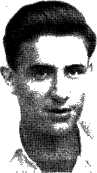
Lazar Papernik, Hero of the Soviet Union
Notes
| < | > | ||
| << | >> | ||
| <<< | VOW BY IVAN ANDROSOV |
APPEAL FROM IVAN BALABANOV
JUNIOR POLITICAL INSTRUCTOR OF A MOTORISED BATTALION |
>>> |