ON THE WALLS OF THE BREST FORTRESS
p June 22-July 20, 1941
p There were five of us: Sedov, I. Grutov, Bogolyub, Mikhailov, V. Selivanov. We fought the first attack on 22.VI.1941 at 3.15. We shall die but not retreat!
p We’ll die but won’t desert the fortress.
I am dying but won’t surrender! Farewell, my country. 20/VII-41.
p The defence of the Brest Fortress [17•* between June and July 1941 has gone down in history as an immortal act of valour by Soviet soldiers who, though fighting against countless odds, held off many enemy assaults and never surrendered.
p Against the fortress manned by only a small garrison, the nazi High Command used its 45th Infantry Division which included nine light and three heavy artillery batteries and was reinforced by the 27th Artillery Regiment, plus nine howitzers and heavy mortars.
Despite the advantage gained by their surprise attack the Germans failed to take the fortress by storm. Appreciating the gravity of the situation, the fortress officers rapidly rearranged command over the defence operations. On the third day of battle, June 24, 1941, Order No. 1 was issued to the garrison. It stated that the situation demanded a unified command and co-ordinated action against the enemy, that all the remaining forces were to be combined into a single group under the command of Captain Ivan Zubachov, with Regimental Commissar Yefim Fomin as his political assistant.
18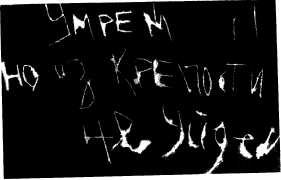
An inscription on the wall of the Brest Fortress
p The fortress defenders were still beating off enemy attacks when on June 27 German tanks entered Minsk, the Byelorussian capital. When, on June 16, practically a whole month after the outbreak of war, the ancient Russian town of Smolensk fell, the Brest Fortress still stood as a redoubtable bastion deep in the rear of Hitler’s armies and, cut off from the rest of the world (their wireless was put out of action in the first few days), they still held out using grenades, rifles and machine-guns to beat back the frantic enemy. There was no water, food supplies were running out, but the fortress defenders gave no thought to surrendering.
p When the plan to take the fortress by infantry attacks failed, the 12th German Corps commanders concentrated artillery fire from the neighbouring 31st and 34th divisions on the fortress. Mass bombing raids continued. But the men still thwarted the Germans. And in answer to the enemy’s offer to them to surrender, a strip of cloth was hung from one of the fortress walls. On it were the words in blood: "We shall all die for our country, but we won’t surrender!”
p Even the nazis, who had conquered almost all Europe, were struck by the firmness and courage of the Soviet men and women in the fortress. Among the captured staff papers of the 45th German Infantry Division a battle report was discovered which contained the following acknowledgement:
“Overwhelming attacks on a fortress defended by a courageous garrison cost a lot of blood. This simple truth has been proved yet again in the capture of the Brest Fortress. The Russians in BrestLitovsk fought with exceptional stubbornness and determination, they displayed superb infantry training and a splendid will to resist.”
19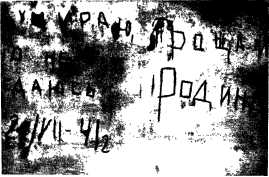
An inscription on the barrack wall of the Brest Fortress
p Most of the valiant defenders of the Brest Fortress met their death, including the commanding officers. Yefim Fomin, seriously wounded, was captured by the Germans and shot. Captain Zubachov died in a German concentration camp.
p In the liny group of defenders who did come out alive was Brest hero Major Pyotr Gavrilov, former CO of the 44th Infantry Regiment. It was Gavrilov, more dead than alive, who led the last battle. Wounded and shell-shocked, he fell into nazi hands. German officers respectfully regarded him as a man of uncommon persistence and faith in victory.
Excavations among the ruins of the fortress unearthed the remains of soldiers, banners, guns and personal papers. Many inscriptions made by the heroic defenders have been found on the stone arches, walls and stairs.
Notes
[17•*] For the whole amazing story of the Fortress defenders, see Heroes of Brest Fortress, S. Smirnov, Progress Publishers, Moscow.
| < | > | ||
| << | >> | ||
| <<< | TO THOSE WHO SURVIVED |
NOTE
FROM JUNIOR LIEUTENANT NIKOLAI SINOKOP |
>>> |