HAD NEVER SEEN BEFORE”
p For a long time Kampuchea was almost completely cut off from the outside world. It is only in the past few months that the doors to the country have been opened a crack to let in some foreign diplomats and a group of Yugoslav journalists. The once busy Kampuchean capital greets the visitors with the silence of its deserted streets.
16p Pnom Penh once had a population of over two million. But now, as Ieng Sary, one of the Kampuchean leaders, said at a press conference in Tokyo, no more than 200,000 people live in the capital. They are primarily civil servants and workers employed at the few remaining factories. That is why, according to foreign visitors, only very few pedestrians or cyclists can be seen in the city. The bus, postal and telegraph services are not operating. Even the few embassies (about ten) do not have regular telephone communications with the Foreign Ministry and their staff are permitted to leave the embassy compounds only on the Foreign Ministry’s authorisation and always under armed escort. Significantly, food is delivered by the military directly to the embassy buildings.
p The four-page Revolution, the only newspaper in the country, comes out once every ten days.
p The National Bank is in ruins. In fact there is no need for it because money has been abolished. There is one shop in Pnom Penh, open twice a week, and even then for foreigners only. The National Library has been turned into a warehouse. A “ghost city" is what Pnom Penh looks like today, as can be seen in the documentary shot by the Yugoslav journalists.
According to eyewitness reports, Takeo, Kampot and Battambang, all of which had sizeable populations in the past, look similarly deserted. Intent on building a “state such as the world has never seen before”, a state without cities, money, communications or mass media, the authorities have established a regime of brutal terror. There is no freedom of any kind in Kampuchea and national traditions and customs have been destroyed, writes the Vietnamese newspaper Nhan Dan, summing up interviews with Kampuchean soldiers taken prisoner. It is believed that between 2.5 and 3 million townspeople were moved from their homes in the second half of April 1975 and resettled in the countryside. All of them, the Yugoslav news agency TANJUG writes, “have been forcibly turned into peasants" and brought together into agricultural “communes”, working paddy fields and building irrigation canals and dikes from morning till night. An “egalitarian rural co-operative without trade and financial links, has been proclaimed the
17
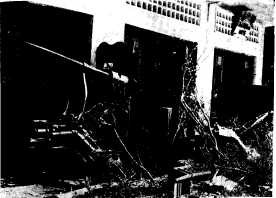 Pol Pot troops and their Chinese “advisors” turned the hospital on
Mao Zedong Street into a barracks. On January 7, 1979 they were
forced to flee, leaving their weapons behind. (SPK photo)
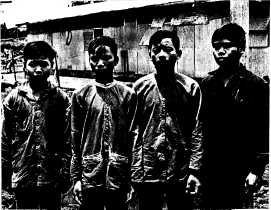 Twelve to fourteen-year-olds were conscripted into the army of the Pol Pot-Ieng Sary regime
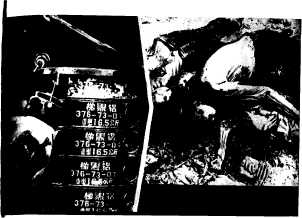 Murder weapons; some of the Pol Pot butchers’ victims
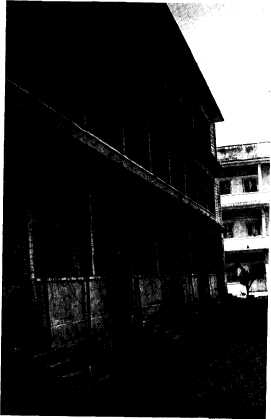
 A school turned into a prison by Pol Pot’s butchers. (TASS photo)
While the Pol Pot-Ieng Sary clique was in power, all Buddhist
A school turned into a prison by Pol Pot’s butchers. (TASS photo)
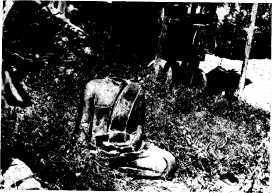
While the Pol Pot-Ieng Sary clique was in power, all Buddhist
pagodas were destroyed. The photo shows the broken statue of Buddha
at the Basset pagoda. (SPK photo)
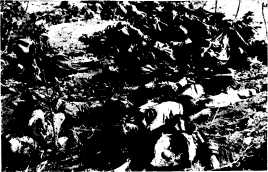
 These bodies of murdered people were found in one of the Pol Pot regime’s prisons after the liberation of Kampuchea. (SPK-VNA photo)
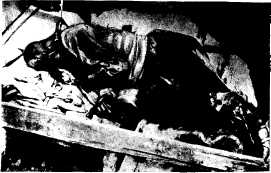
Body of a horribly murdered Kampuchean patriot. The bloody murder weapon has been thrown on to the floor. (SPK photo)
These bodies of murdered people were found in one of the Pol Pot regime’s prisons after the liberation of Kampuchea. (SPK-VNA photo)
Body of a horribly murdered Kampuchean patriot. The bloody murder weapon has been thrown on to the floor. (SPK photo)
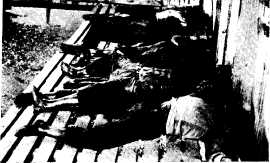
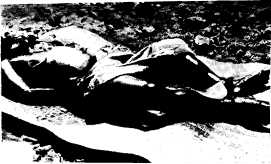 Bodies of murdered prisoners in the Basset region. (SPK photo)
A Kampuchean patriot, chained by the legs and murdered by Pol Pot’s agents in Basset. (SPK photo)
Bodies of murdered prisoners in the Basset region. (SPK photo)
A Kampuchean patriot, chained by the legs and murdered by Pol Pot’s agents in Basset. (SPK photo)
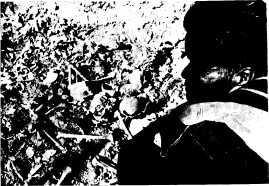
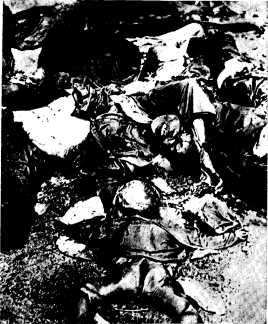 Remains of victims of the Pol Pot regime in the Kampong Cham Province. (TASS photo)
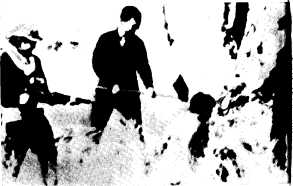 Victims of the criminal Pol Pot regime
Pol Pot’s butchers kill their victim with hoes
Victims of the criminal Pol Pot regime
Pol Pot’s butchers kill their victim with hoes
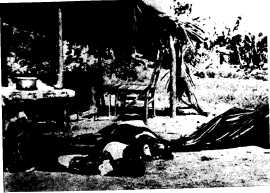 How China’s henchmen dealt with the Kampucheans
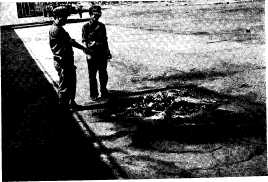 Remains of victims, burnt alive in Pnom Penh’s main square during the Pol Pot clique’s reign of terror. (TASS photo)
basic social and economic cell in present-day Kampuchea,” writes Dragoslav Rancic, correspondent for the Belgrade newspaper Politika.
Remains of victims, burnt alive in Pnom Penh’s main square during the Pol Pot clique’s reign of terror. (TASS photo)
basic social and economic cell in present-day Kampuchea,” writes Dragoslav Rancic, correspondent for the Belgrade newspaper Politika.
Notes
| < | HATRED AND PROVOCATION CAMPAIGN | NO RIGHTS, NO FREEDOMS | > |
| << | THE PRISON LAND | >> | |
| <<< |
THE PEOPLE'S REPUBLIC
OF KAMPUCHEA |
Part II -- THE REBIRTH OF KAMPUCHEA | >>> |