FROM SENIOR LIEUTENANT Y. CHERVONNY
p July 1942
p Darling Talyushka,
p It’s hard to begin with common words. When you receive this letter I shall no longer be alive But there we are, we have to take what comes in life.
p Life! The word has such a proud ring. It contains grief and good cheer, suffering and bliss. I’m not going to say life’s all the same to me. Not at all, it means a lot. And it’s darn hard to lose it.
p Youth! What can be dearer than that? I’m not one of the "Dismal Desmonds bearing death with a tirade of curses”. No one should play with life Not to say we shouldn’t be afraid of danger. The boys on shore don’t have to run so many risks. But I, like so many of my companions, plumped for the sea where there’s a greater element of danger and risk. Here a person can really extend himself to the full and do most good. More simply, it was an urge to throw in all I have.
p Life can be just a round of daily vegetation like a dumb animal, and life can be free and easy, with wonderful things to look forward to. All of us strive to sling our hammock onto the latter. Our generation has been entrusted with a great and responsible task: to shed our blood and lay down our lives to earn the right to happiness.
p I remember when I was a lad at school. My first timid steps when I took my school certificate. The first test-1938-39— 76 in a prison camp in Spain. That’s where I was jolted out of part of the benevolence and habit of seeing everything in a rosy hue, which every young lad and lass does. It was a good lesson in the attempt to understand life. There in Spain I got a fair idea of what we were up against. As a result I decided to devote my whole life to the armed forces, to become an officer. Now you are getting a taste of hatred. It came to me in those days.
p Calm and peaceful 1940. A year of stupendous plans for the future. Then came the war. Everyone was faced with the problem of finding his feet and being a worthy son of his country. The old feeling of hatred, the invasion of my beloved Ukraine, losing my father, mother and brother, the realisation that the fight was universal and there was no relying on anyone, aided me right from those early days to decide where I stood and what I was going to do. War came as a test, it put the finishing touches to my character. I gave it all I had. And I can honestly say that nobody can reproach me for any action unworthy of an officer and a Communist.
p We were forced to see life in the raw, cruelly and in a much shorter time than age usually allows, but life will be all the dearer to us. Once you know how dear life really is, you don’t treat it so lightly as the days go by. I know and am confident that if I’d have got out of this mess in one piece we’d have been so happy together.... We live at a time when, before we can lay claim to that happiness, we have to win it in stubborn combat and do our own little bit for the common cause. It makes no difference whether it will be the skill, blood or life. There is no other way.
p Remember me now and again as the man who loved you and would lay down his life for his Talyushka without a thought. And that’s how it really is. In every common cause there’s a part of every man. And for what I gave my part is your cause too. I believed in your love knowing it was crystal clear. It’s so wonderful to think of all the times we’ve had together....
p I know it won’t be easy for you to get over the idea of losing your Zhenya. But please dear, don’t make any foolish pledges. Try to bury all the grief quickly. Try and make your life happy. I’d like to think that in a little while you will forget it all or at least get over it and be happy again. To every man his own fate. There’s no getting away from it. 77 I’d like to say a word of gratitude to your mother, father and little Zoya. They really have looked on me as a son. I wish them a long and happy carefree life. I hope your parents and Zoya will one day have some grandchildren, sons and nieces to nurse and make a fuss of.
p One request to you. Once war is over and life gets back to normal try and find my young brother if you can. If he’s alive, the country will look after him. He should be a big lad now. Tell him about his Zhenya. Put him on the right lines. His name is Alexander, born in 1930 and left behind in Kherson. I comfort myself that you’ll find him. Don’t think this is some kind of last wish or an order to look after him. I don’t want to burden you with a load of trouble. In our country they look after children and make men out of them. I’m sending you the certificate of my award. Let it be a little souvenir. I don’t have anything else.
p That’s about all. There’s so much I want to say, I want to find some tender words to express my feelings. But you know your Zhenya well enough and you understand, don’t you, without me writing it down.
p Keep your pecker up, look after yourself and put your best foot forward. Be a clever little girl. Don’t take it too much to heart. It doesn’t help much, you know. Try to make a happy life for yourself and live it for both of us.
p Remember your Zhenya now and again, but without any tears and with the thought that he didn’t die in vain.
p Keep your spirits up,
p
I love you,
Yevgeny
p At the outbreak of war, Senior Lieutenant Yevgeny Chervonny was in Tallinn. In the grim August days of 1941, the torpedo boat on which he served joined up with Soviet ships of the Baltic Fleet leaving Tallinn harbour for Kronstadt. This was a gallant feat of seamanship by the Baltic sailors. Under incessant bombardment, the ships made their way through mine-infested waters to their main base. For his personal bravery and the courageous actions of his crew Yevgeny Chervonny was awarded the Order of the Red Banner.
p Yevgeny hated fascism. He had already seen the hate-twisted faces of the bearers of the "New Order”. Of a dark August night when there was a lull in the fighting, Yevgeny would look back a few years to 1938 when, a sea cadet at the Kherson Naval School, he had done 78 his navigator’s training on the Skvortsov-Stcpanov, a motor-ship which had been forcibly taken in tow by Franco’s men. By starvation and threats. Franco’s henchmen had tried to make the Soviet seamen betray their country. They were thrown into slinking holes and left without a drop of water. But most of them came through all these trials. Yevgeny Chervonny returned from prison a sick man He had contracted T.B. Once home he was cured and became a hardened fighter against fascism. Then came the war. The young officer swore to tight the nazis to his last drop of blood, and to win. These are the selfless and stern lines written by the captain of a section of the 2nd L.roup of the patrol boats: "He shot down two planes personally. Took part in six mine-laying runs. Had no losses. For 20 days his vessel and a gun-boat supported a section of the coastal army with all its fire Took part in three ice runs to Khanko. Saved 400 men. "
p One July day in 1942, Senior Lieutenant Chervonny put to sea It was an operation with practically no chance of coming back alive Yevgeny knew what he was about. Before putting to sea he wrote his last letter. . . .
p His comrades later picked up his body among the debris of the boat that had hit a mine. Yevgeny Chervonny made his final run to Kronstadt wrapped in a naval flag.
In a small yellow case containing his personal effects his comrades found this letter addressed to his wife.
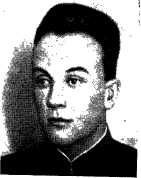
Yevgeny Chervonny
Notes
| < | > | ||
| << | >> | ||
| <<< | LETTER FROM YAKOV GORDIENKO OF THE ODESSA UNDERGROUND | NOTE FROM LIEUTENANT LAZAR DZOTOV | >>> |